Higher environmental temperature assists or accelerates crop drying in crib storage. However, higher environmental temperature poses a lot of problems to enclosed (bin) storage structures. This is the major disadvantage to silo storage in
"Higher environmental temperature assists or" is the property of its rightful owner. Permission is granted to
download and print the materials on this website for personal, non-commercial use only, and to display it
on your personal computer provided you do not modify the materials and that you retain all copyright
notices contained in the materials. By downloading content from our website, you accept the terms of this
agreement.
Presentation Transcript
01
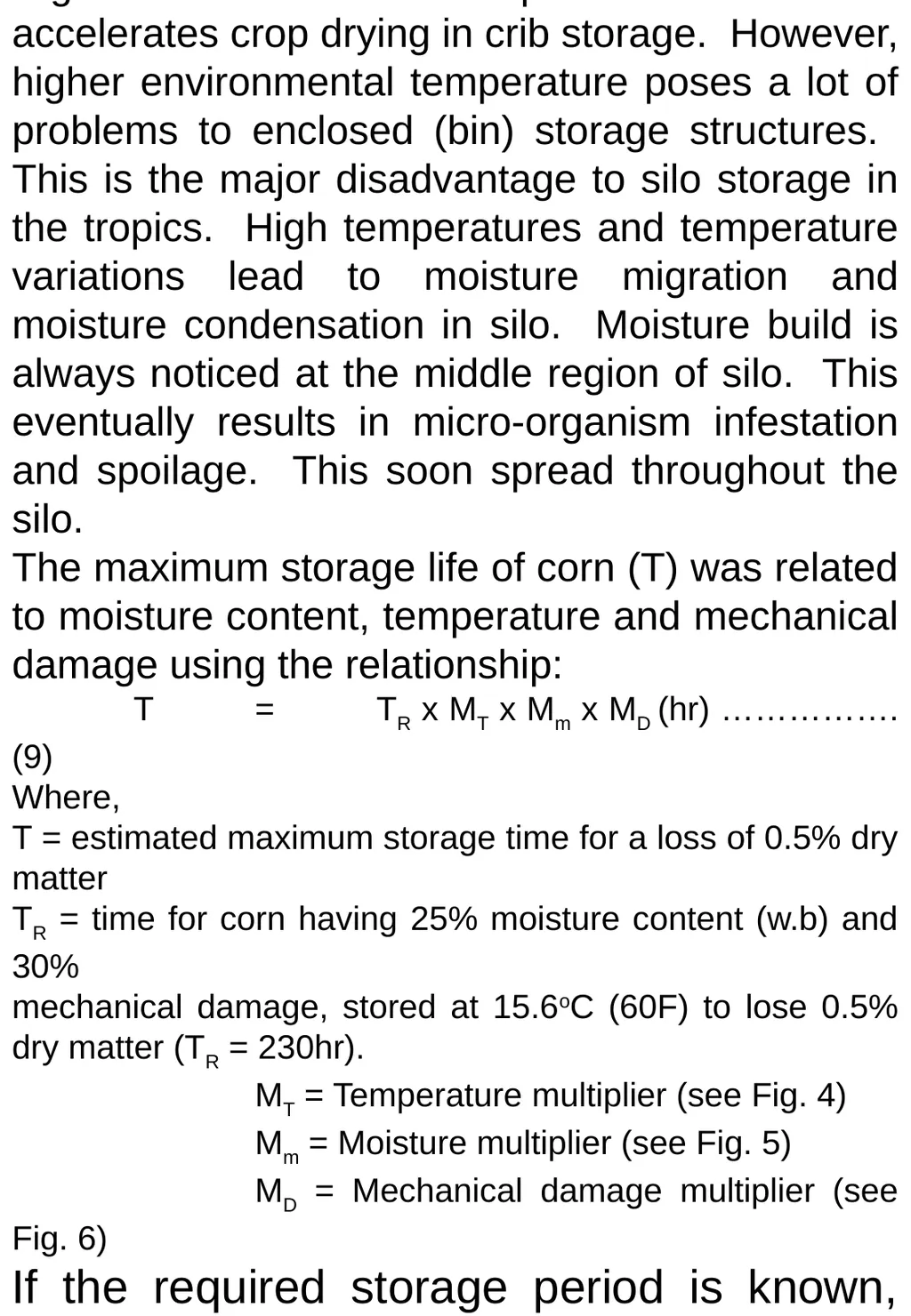
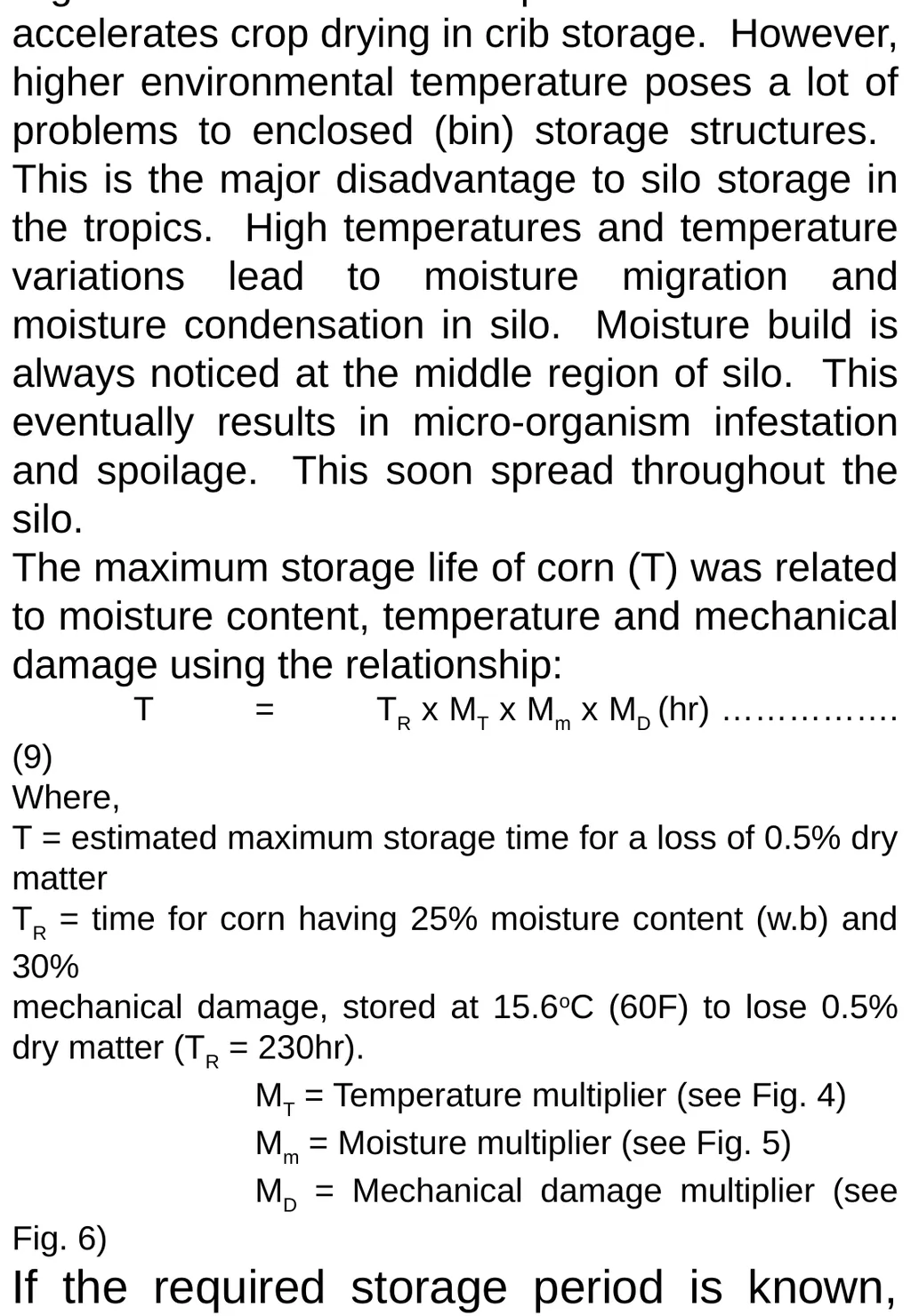
Higher environmental temperature assists or accelerates crop drying in crib storage. However, higher environmental temperature poses a lot of problems to enclosed (bin) storage structures. This is the major disadvantage to silo storage in the tropics. High temperatures and temperature variations lead to moisture migration and moisture condensation in silo. Moisture build is always noticed at the middle region of silo. This eventually results in micro-organism infestation and spoilage. This soon spread throughout the silo.
The maximum storage life of corn (T) was related to moisture content, temperature and mechanical damage using the relationship:
T = TR x MT x Mm x MD (hr) …………….(9)
Where,
T = estimated maximum storage time for a loss of 0.5% dry matter
TR = time for corn having 25% moisture content (w.b) and 30%
mechanical damage, stored at 15.6oC (60F) to lose 0.5% dry matter (TR = 230hr).
MT = Temperature multiplier (see Fig. 4)
Mm = Moisture multiplier (see Fig. 5)
MD = Mechanical damage multiplier (see Fig. 6)
If the required storage period is known, the equation could be used to estimate the storage conditions needed; or, if the storage conditions are known, the maximum storage period can be estimated.<br>
02
5.0 STORAGE STRUCTURES
The facilities that house stored materials for the purpose of preserving their qualities are called storage structures. The selection of storage structures depend on the production level, cultural practices, and the climatic conditions. Broadly, storage structures are classified as:
Traditional Structures: Small sized and short term with high level of infestation. They are mostly made of unrefined local materials
Modern Structures: Mostly large capacity and long term with better regulation of the storage environment. They are made of improved and refined materials
5.1 Traditional Storage Structures
These are devices used mostly for short term and small scale storage. Occasionally they include some medium term and medium scale storage devices. They require low level of scientific knowledge to construct, operate and maintain. They are mostly made of unrefined local materials. Traditional storage structures include:
Domestic structures
Rhombus
Traditional Crib
Barn
Shelf
Pit/ Underground Storage, etc.<br>
03
5.1.1 Domestic structures
This is the family level storage practiced in household. Some of the facilities used for domestic storage include guards, tin, box, basket, jute bag, polythene bag, and earthen pot, plastic or metal containers. It is advisable to cover the tin used for domestic storage of grains. The open end of polythene bag should also be tied. This is to ensure air-tight. Oxygen circulation is minimized and this retards the activities of insects. Products stored in domestic structures are preserved with powdered pepper. It is not advisable to store domestic food stuff with chemicals.
They are used at household and peasant levels for the storage of grain. Earthen pots are equally used for storage of fruits such as orange. Though small scale and short term in nature, they are very effective if used under air tight conditions. Items stored in these systems are locally preserved with wood or bone ash or powdered pepper<br>
04
5.1.2 Rhombus & Traditional Crib
These are used for grain storage, mostly materials in cob. Rhombus is mostly used in Northern Nigeria while the traditional crib is used in South Western and Eastern Nigeria. Rhombus is cylindrical in shape while crib has rectangular shape. They are made of palm font leaf, clay, tree stem and bamboo. Major disadvantages are moisture build as a result of rain, and micro organism infestation. Sometimes coal or wood heat is introduced at the lower base to ensure drying. They are mostly made of local materials such as palm frond, raffia leaf, bamboo, clay, straw and grass. Grains stored in traditional storage structures are not properly protected from rain. Micro-organism infestation is common in the traditional storage. Drying rate is also retarded in the traditional storage.<br>