Higher PE Course overview - revision Swimming Method of collecting data (MOCD) 200m frontcrawl swim test and 7 metre reaction test be able to describe, explain, analyse; Strength after taking data Reaction time Development need Lack
"Higher PE Course overview - revision Swimming" is the property of its rightful owner. Permission is granted to
download and print the materials on this website for personal, non-commercial use only, and to display it
on your personal computer provided you do not modify the materials and that you retain all copyright
notices contained in the materials. By downloading content from our website, you accept the terms of this
agreement.
Presentation Transcript
01
Higher PE Course overview - revision<br>
02
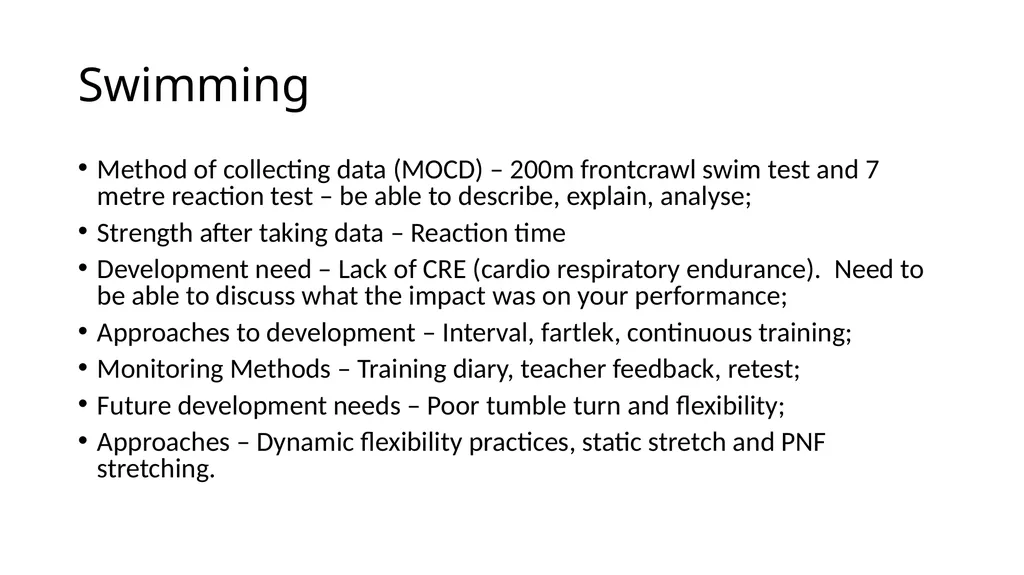
Swimming Method of collecting data (MOCD) – 200m frontcrawl swim test and 7 metre reaction test – be able to describe, explain, analyse;
Strength after taking data – Reaction time
Development need – Lack of CRE (cardio respiratory endurance). Need to be able to discuss what the impact was on your performance;
Approaches to development – Interval, fartlek, continuous training;
Monitoring Methods – Training diary, teacher feedback, retest;
Future development needs – Poor tumble turn and flexibility;
Approaches – Dynamic flexibility practices, static stretch and PNF stretching.<br>
03
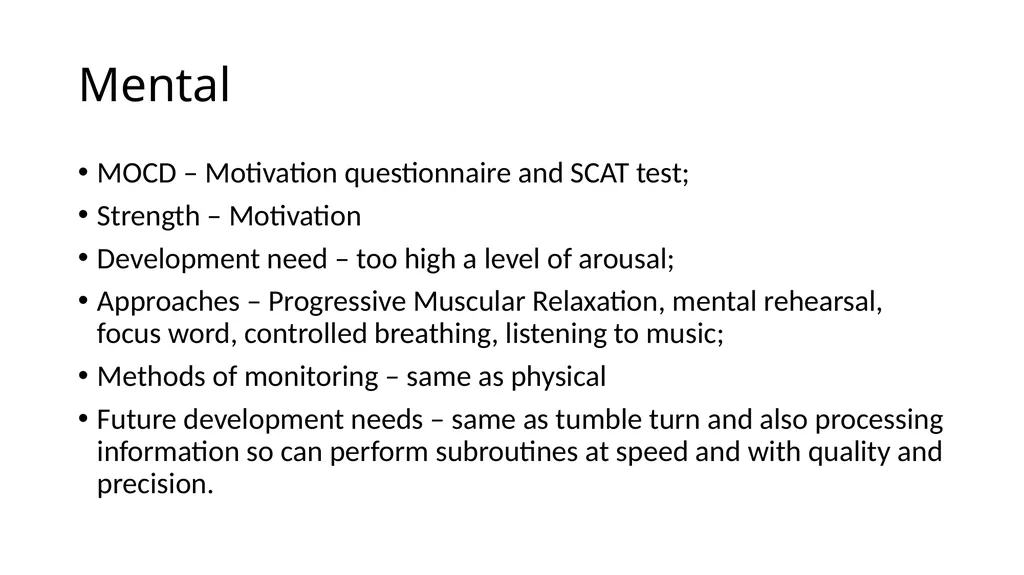
Mental MOCD – Motivation questionnaire and SCAT test;
Strength – Motivation
Development need – too high a level of arousal;
Approaches – Progressive Muscular Relaxation, mental rehearsal, focus word, controlled breathing, listening to music;
Methods of monitoring – same as physical
Future development needs – same as tumble turn and also processing information so can perform subroutines at speed and with quality and precision.<br>
04
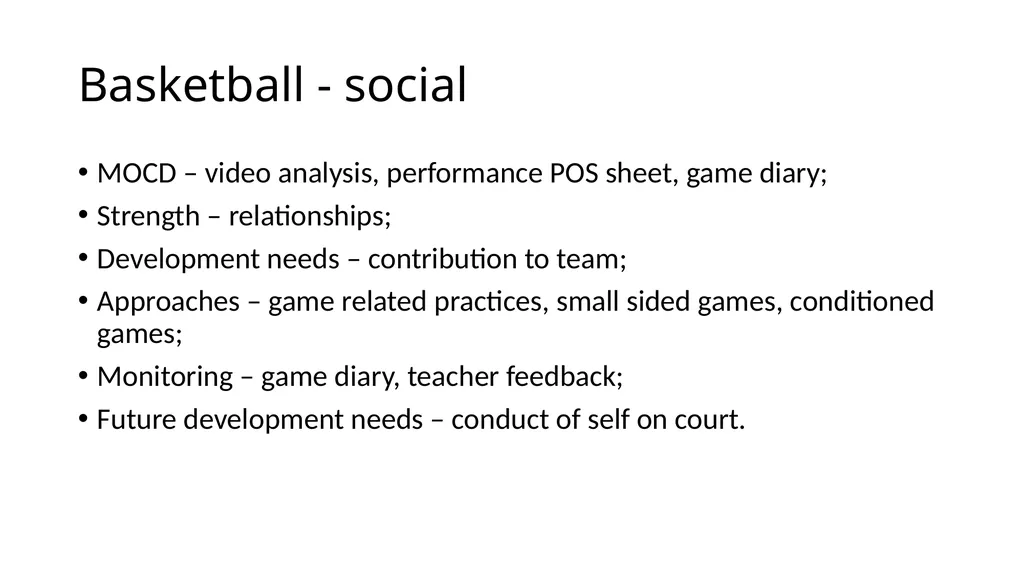
Basketball - social MOCD – video analysis, performance POS sheet, game diary;
Strength – relationships;
Development needs – contribution to team;
Approaches – game related practices, small sided games, conditioned games;
Monitoring – game diary, teacher feedback;
Future development needs – conduct of self on court.<br>
05
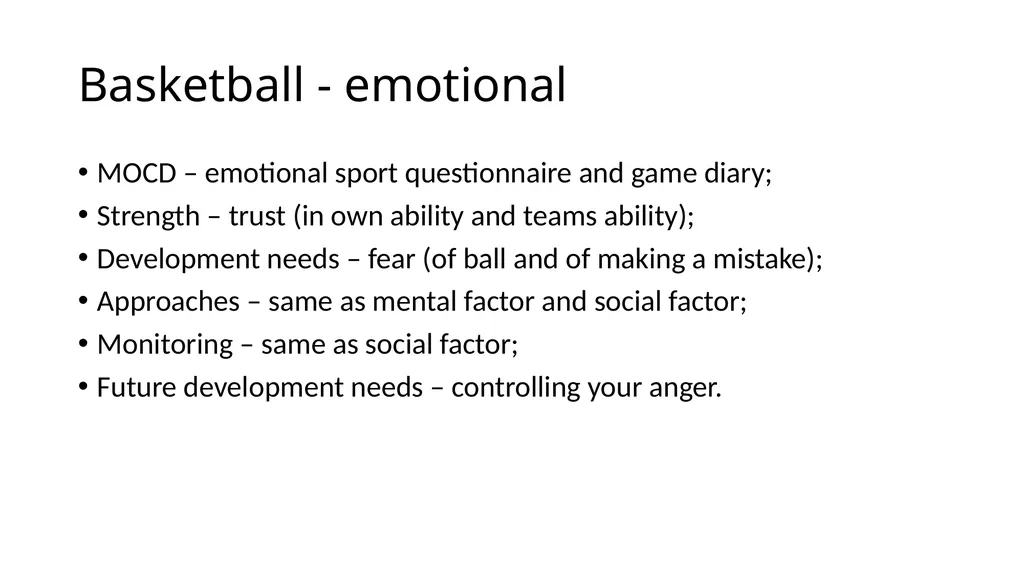
Basketball - emotional MOCD – emotional sport questionnaire and game diary;
Strength – trust (in own ability and teams ability);
Development needs – fear (of ball and of making a mistake);
Approaches – same as mental factor and social factor;
Monitoring – same as social factor;
Future development needs – controlling your anger.<br>
06
Volleyball - social MOCD - video analysis and game diary;
Strength – role models;
Development needs – roles and responsibilities (position 3 in attack and defence)
Approaches – see basketball
Monitoring – see basketball
Future development needs – conduct of self<br>
07
Volleyball - emotional MOCD – Emotional and sport questionnaire and game diary;
Strength – trust
Development need – fear;
Approaches – see social and mental
Monitoring – see basketball;
Future development needs – anger.<br>
08
Badminton Strength – overhead clear;
Weakness – Smash
MOCD - general/performance observation schedule, scatter diagram and video analysis
Approaches to development and stages of learning –
Stages of learning – Cognitive (understanding stage), Associative stage (practice stage) and then Autonomous stage (model performer stage)
Cognitive stage approaches to development – Shadow practice, non opposed feeder drills. These allow you to understand the subroutines and are under no pressure from external factors such as competitors, hard drills etc.<br>
09
Association stage Approaches to development – Combination drill which was underarm serve, overhead clear and then smash; Pressure drill - where feeder feeds either in front on behind head, performer moves to then get in correct position to play smash.
This is more game like and develops your skill. It can add to motivation and improve concentration;<br>
10
Autonomous stage This is the model performer stage where you can easily do the subroutines and can now concentrate on other factors such as tactics – where to play the shuttle based on your opponents weakness.
Approaches to development – 10 shot rally with variety of shots. Tenth shot must be a Smash;
Conditioned game – add in a rule which is not in the rule book e.g if you win the rally with a smash, you get double points.<br>
11
Badminton Mental
SCAT test
Weakness – too high a level of arousal
Strength – processing information
Future development needs – net shot and decision making.<br>