
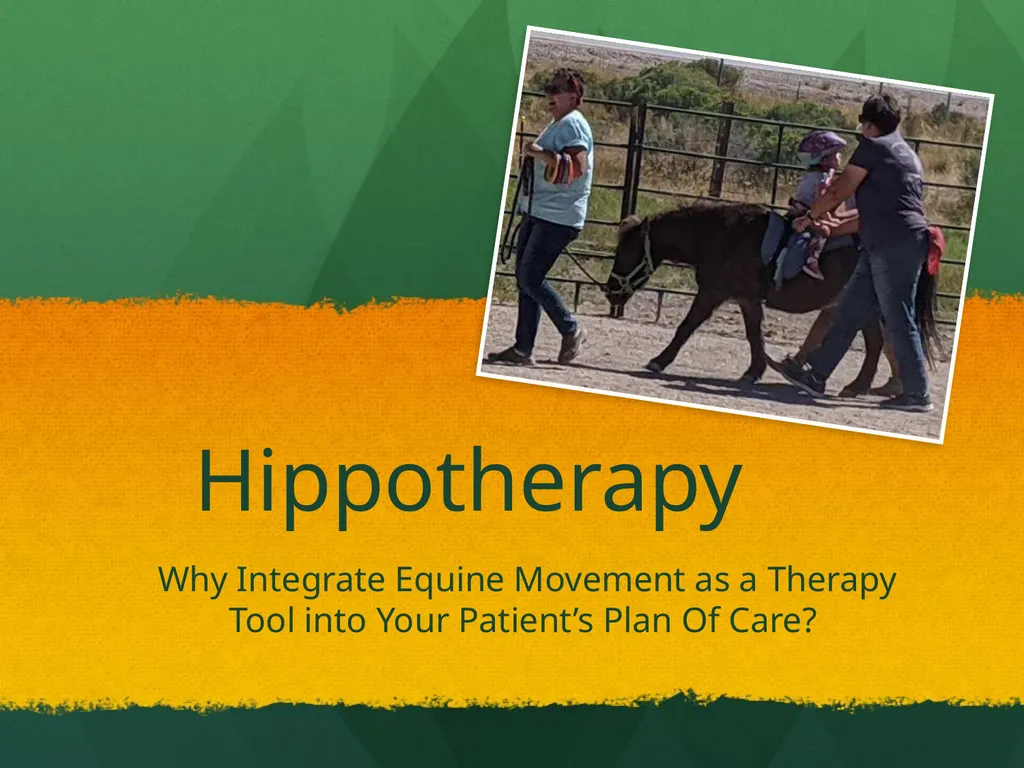
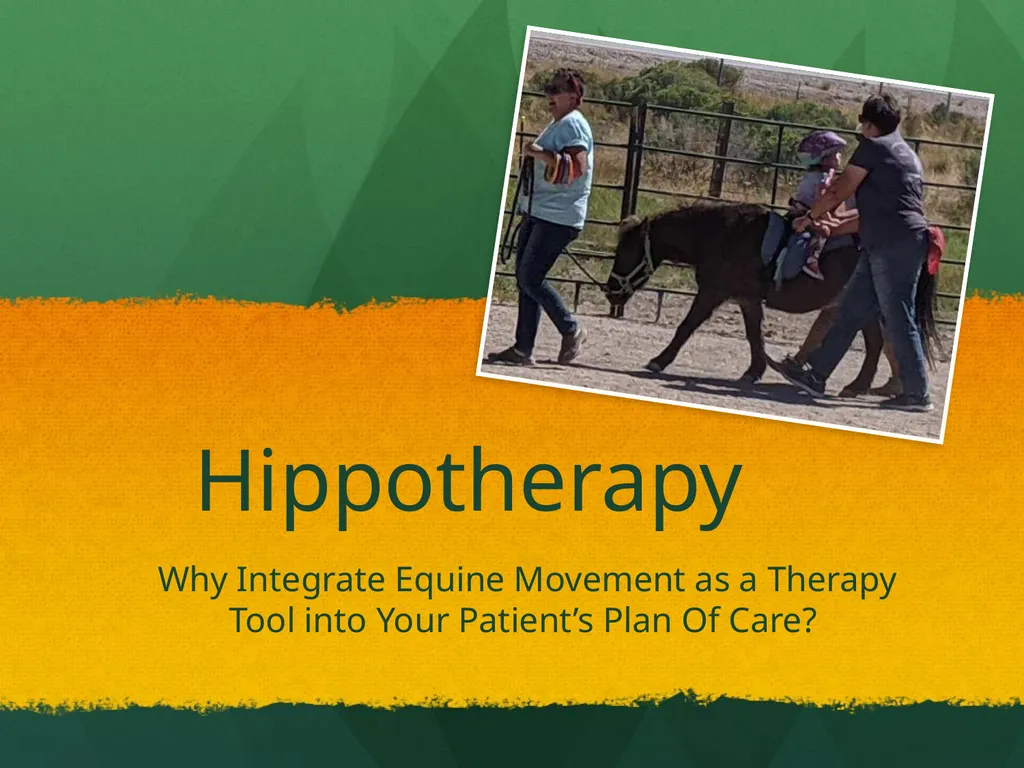
Hippotherapy Why Integrate Equine Movement as a
TG
Published · 29 slides · 0 views
1 / 1



Description
Hippotherapy Why Integrate Equine Movement as a Therapy Tool into Your Patients Plan Of Care? What is Hippotherapy? The word hippo comes from the Greek derivative of horse. Hippotherapy literally is treatment incorporating the horse
Related Topics
Share
Embed code
Download this presentation From Below
"Hippotherapy Why Integrate Equine Movement as a" is the property of its rightful owner. Permission is granted to download and print the materials on this website for personal, non-commercial use only, and to display it on your personal computer provided you do not modify the materials and that you retain all copyright notices contained in the materials. By downloading content from our website, you accept the terms of this agreement.
Presentation Transcript
01
Hippotherapy Why Integrate Equine Movement as a Therapy Tool into Your Patient’s Plan Of Care?<br>
02
What is Hippotherapy? The word “hippo” comes from the Greek derivative of horse. Hippotherapy literally is “treatment incorporating the horse”
Equine movement IS used in treatment as a therapy tool. Hippotherapy is NOT a separate or unique therapy session<br>
Equine movement IS used in treatment as a therapy tool. Hippotherapy is NOT a separate or unique therapy session<br>
03
Hippotherapy refers to how occupational therapy, physical therapy and speech-language pathology professionals use evidence – based practice and clinical reasoning in the purposeful manipulation of equine movement to engage sensory, neuromotor, and cognitive systems to achieve functional outcomes. In conjunction with the affordances of the equine environment and other treatment strategies, hippotherapy is part of a patient’s integrated plan of care
AHA, Inc 2015<br>
AHA, Inc 2015<br>
04
The History of Hippotherapy 1960’s The horse began to be used as an adjunct to physical therapy in Germany, Switzerland and Austria
1987 A group of 18 American and Canadian therapists traveled to Germany to study classic hippotherapy and began development of a standardized hippotherapy curriculum
2004 Establishment of AHA, Inc., an independent 501c3 organization for the education and networking of therapists using hippotherapy in their practice<br>
1987 A group of 18 American and Canadian therapists traveled to Germany to study classic hippotherapy and began development of a standardized hippotherapy curriculum
2004 Establishment of AHA, Inc., an independent 501c3 organization for the education and networking of therapists using hippotherapy in their practice<br>
05
Hippotherapy and Conceptual Framework Optimal treatment using equine movement is guided by theory. In 1997 the conceptual frame work was developed to guide the use of hippotherapy in practice and is based on Component theories from:
Dynamic Systems Theory
Sensory Integration® Theory
Ecological Theory
Motor Learning<br>
Dynamic Systems Theory
Sensory Integration® Theory
Ecological Theory
Motor Learning<br>
06
Basic Concepts of the Conceptual Framework Neural Plasticity and Self Organization
Control Parameters
Arousal
Motivation
Variability of Practice and Problem Solving
Generalization<br>
Control Parameters
Arousal
Motivation
Variability of Practice and Problem Solving
Generalization<br>
07
The Hippotherapy Treatment Team Therapist
Horse Handler
Side Walker
Consultants
Volunteers<br>
Horse Handler
Side Walker
Consultants
Volunteers<br>
08
The Human and the Horse<br>
09
Equine Movement and Patient Response With equine movement, the horse influences the patient, as does the patient influence the horse
The horses movement promotes active responses in the patient
Variations in the horses movement, as directed by the therapist promotes variations in the patient’s responses and are intended to affect function
The effects of movement imparted to the patient are both biomechanical and sensory<br>
The horses movement promotes active responses in the patient
Variations in the horses movement, as directed by the therapist promotes variations in the patient’s responses and are intended to affect function
The effects of movement imparted to the patient are both biomechanical and sensory<br>
10
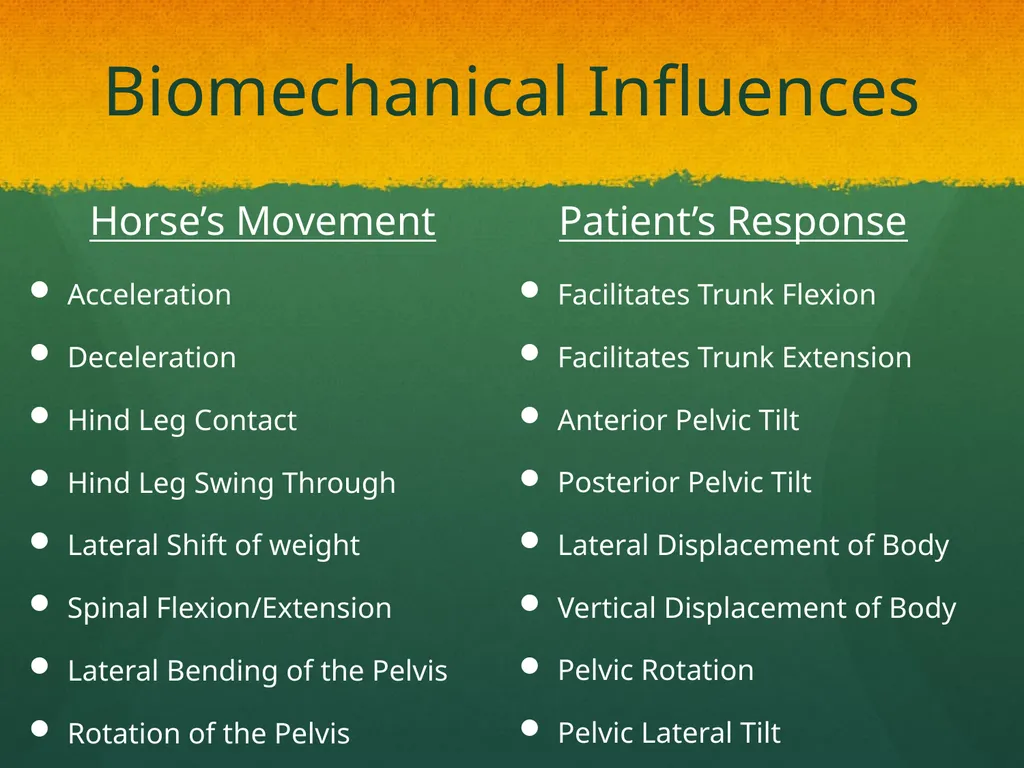
Biomechanical Influences Horse’s Movement Acceleration
Deceleration
Hind Leg Contact
Hind Leg Swing Through
Lateral Shift of weight
Spinal Flexion/Extension
Lateral Bending of the Pelvis
Rotation of the Pelvis Patient’s Response Facilitates Trunk Flexion
Facilitates Trunk Extension
Anterior Pelvic Tilt
Posterior Pelvic Tilt
Lateral Displacement of Body
Vertical Displacement of Body
Pelvic Rotation
Pelvic Lateral Tilt<br>
Deceleration
Hind Leg Contact
Hind Leg Swing Through
Lateral Shift of weight
Spinal Flexion/Extension
Lateral Bending of the Pelvis
Rotation of the Pelvis Patient’s Response Facilitates Trunk Flexion
Facilitates Trunk Extension
Anterior Pelvic Tilt
Posterior Pelvic Tilt
Lateral Displacement of Body
Vertical Displacement of Body
Pelvic Rotation
Pelvic Lateral Tilt<br>
11
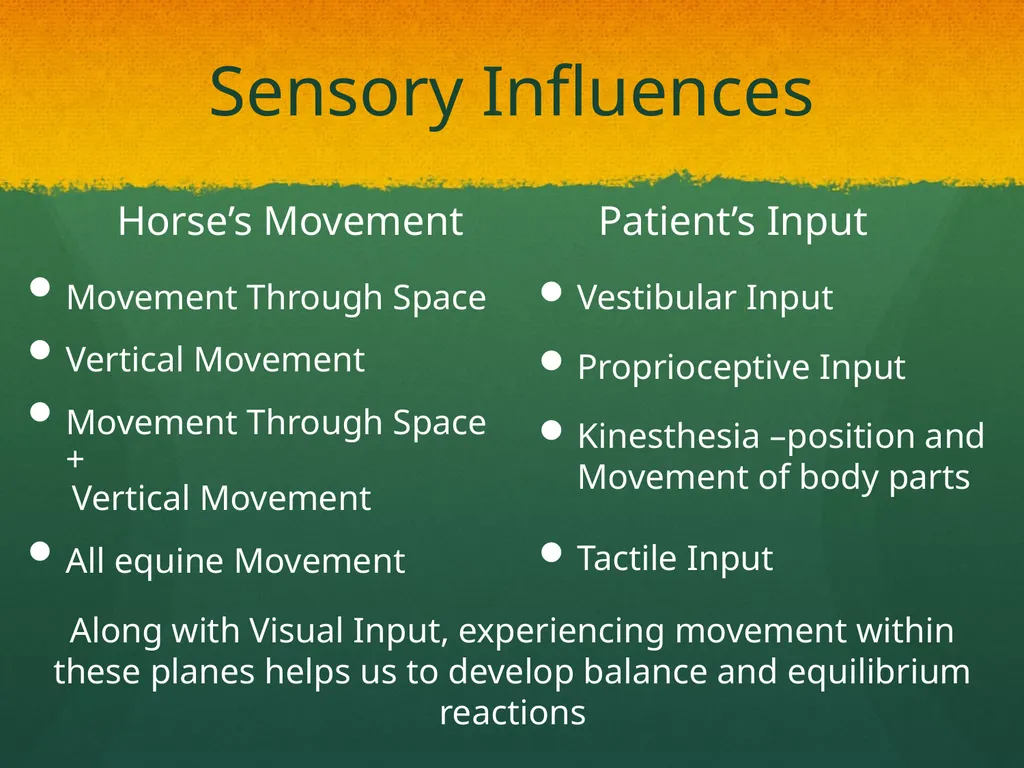
Sensory Influences Horse’s Movement Movement Through Space
Vertical Movement
Movement Through Space +
Vertical Movement
All equine Movement Patient’s Input Vestibular Input
Proprioceptive Input
Kinesthesia –position and Movement of body parts
Tactile Input Along with Visual Input, experiencing movement within these planes helps us to develop balance and equilibrium reactions<br>
Vertical Movement
Movement Through Space +
Vertical Movement
All equine Movement Patient’s Input Vestibular Input
Proprioceptive Input
Kinesthesia –position and Movement of body parts
Tactile Input Along with Visual Input, experiencing movement within these planes helps us to develop balance and equilibrium reactions<br>
12
Effects of the Horse’s Gait Walking
The average horse walks 100 step/min which can be up to 3000 steps in a 30 minute session
Visual perceptual system is affected as rider moves through space
Proprioceptive system is affected with each foot fall
The predictable rhythm at a slow to moderate rate can produce a calming effect or decrease the level of arousal, it helps to influence core stability and muscle tone whether sitting, supine, or prone
3000 attempts of practice and motor input =Motor learning<br>
The average horse walks 100 step/min which can be up to 3000 steps in a 30 minute session
Visual perceptual system is affected as rider moves through space
Proprioceptive system is affected with each foot fall
The predictable rhythm at a slow to moderate rate can produce a calming effect or decrease the level of arousal, it helps to influence core stability and muscle tone whether sitting, supine, or prone
3000 attempts of practice and motor input =Motor learning<br>
13
Effects of the Horse’s Gait Trot/Jog
Average speed is 8 mph
Facilitates alternating co-contraction throughout the trunk of the patient
The concussive impact increases arousal for most patients, but can also satiate the sensory system resulting in greater focus or attention to task<br>
Average speed is 8 mph
Facilitates alternating co-contraction throughout the trunk of the patient
The concussive impact increases arousal for most patients, but can also satiate the sensory system resulting in greater focus or attention to task<br>
14
Effects of the Horse’s Gait Transitions
Moving between variations of gait
Changing from one gait to another
Requires the sensory registration of change and the motor planning and behavioral response to the input
Timing of the transition should be established by the therapist to meet the treatment objectives for the patient<br>
Moving between variations of gait
Changing from one gait to another
Requires the sensory registration of change and the motor planning and behavioral response to the input
Timing of the transition should be established by the therapist to meet the treatment objectives for the patient<br>
15
Movement Analysis of the Horse Manipulated During Hippotherapy Impulsion
Tempo/Speed
Changes in Direction
Transition<br>
Tempo/Speed
Changes in Direction
Transition<br>
16
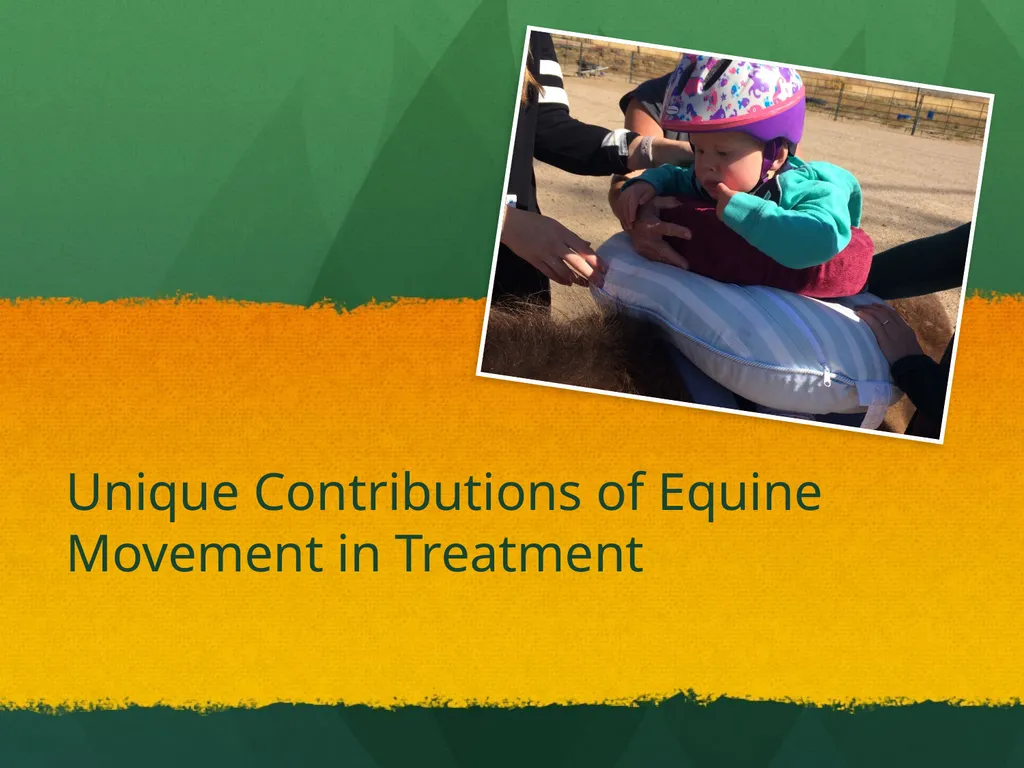
Unique Contributions of Equine Movement in Treatment<br>
17
How Equine Movement Affects Balance and Postural Control Development of stability: The broad base of support provides stability to the patient while the horse’s movement challenges the patient to maintain stability during rhythmic, reciprocal movement
Orientation: Optical righting, organization of body parts for a task. As the horse changes direction, the relationship between body segments of the patient must change accordingly
Anticipatory control: Practice can occur by having the horse move when transitions are expected or transitions without patient awareness<br>
Orientation: Optical righting, organization of body parts for a task. As the horse changes direction, the relationship between body segments of the patient must change accordingly
Anticipatory control: Practice can occur by having the horse move when transitions are expected or transitions without patient awareness<br>
18
How Equine Movement Affects Balance and Postural Control, Cont.. Somatosensory, vestibular and visual input: The therapist can modify the sensory input
Coordination and timing of postural strategies: The opportunity to practice solutions to postural challenges for specific tasks
Practice on a static and a dynamic surface: Can be modified by the horse’s movement, by changing the environment (different surfaces or grades) or by changing the tack
Facilitation of postural tone: May be attributed to strong somatosensory and proprioceptive input through the pelvis, hips and spine, in addition to vestibular and visual sensory input to the CNS
Integration and interpretation of movement: Many patients have not had varied movement opportunities to learn postural control, particularly movement through space<br>
Coordination and timing of postural strategies: The opportunity to practice solutions to postural challenges for specific tasks
Practice on a static and a dynamic surface: Can be modified by the horse’s movement, by changing the environment (different surfaces or grades) or by changing the tack
Facilitation of postural tone: May be attributed to strong somatosensory and proprioceptive input through the pelvis, hips and spine, in addition to vestibular and visual sensory input to the CNS
Integration and interpretation of movement: Many patients have not had varied movement opportunities to learn postural control, particularly movement through space<br>
19
Influence Of Hippotherapy on Musculoskeletal Function Movement on the horse influences movement of the spine/pelvis in a multi-dimensional pattern
Approximation of the joints from force transmission from the ground and through the horse influence joint stability
Oscillation/vibration from ground forces influence skeletal and disc stimulation
Positioning for ROM, particularly pelvis and hips
Positioning for postural control provides skeletal alignment including head and neck<br>
Approximation of the joints from force transmission from the ground and through the horse influence joint stability
Oscillation/vibration from ground forces influence skeletal and disc stimulation
Positioning for ROM, particularly pelvis and hips
Positioning for postural control provides skeletal alignment including head and neck<br>
20
Influence of Hippotherapy on Arousal Function Sensory input from equine movement stimulates the limbic system (involved with emotions), vision, proprioception, vestibular and olfactory
Upright posture/positioning with activation of postural control mechanisms influence arousal, as arousal influences postural control<br>
Upright posture/positioning with activation of postural control mechanisms influence arousal, as arousal influences postural control<br>
21
Influence of Hippotherapy on Respiratory Function Positioning and facilitation of an elongated trunk, whether in sitting or in other positions
Facilitation of trunk rotation, lateral flexion, and flexion/extension, mobilizing pelvis, spine, and ribs in small range, rhythmic activation
Facilitation of core stabilizers for improved spinal stability
Rhythmic input to encourage timing of breath
Approximation through concussive forces assisting in normalization of muscle tone in the diaphragm
Concussive forces from the ground, with appropriate positioning, help to loosen secretions in the lungs<br>
Facilitation of trunk rotation, lateral flexion, and flexion/extension, mobilizing pelvis, spine, and ribs in small range, rhythmic activation
Facilitation of core stabilizers for improved spinal stability
Rhythmic input to encourage timing of breath
Approximation through concussive forces assisting in normalization of muscle tone in the diaphragm
Concussive forces from the ground, with appropriate positioning, help to loosen secretions in the lungs<br>
22
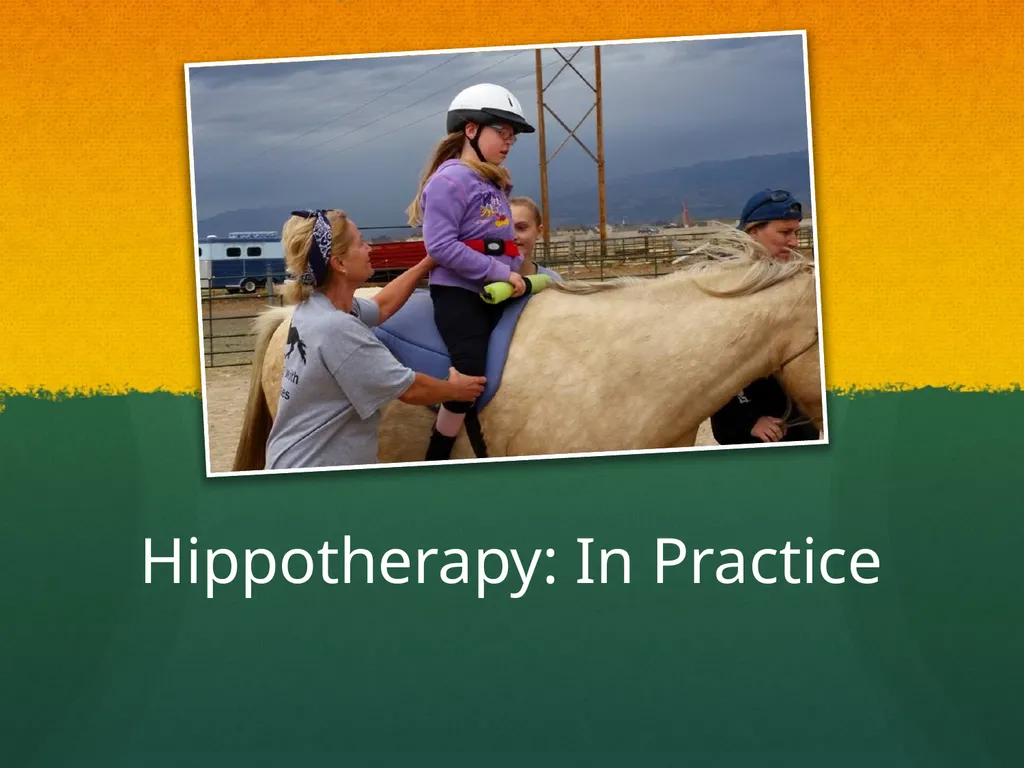
Hippotherapy: In Practice<br>
23
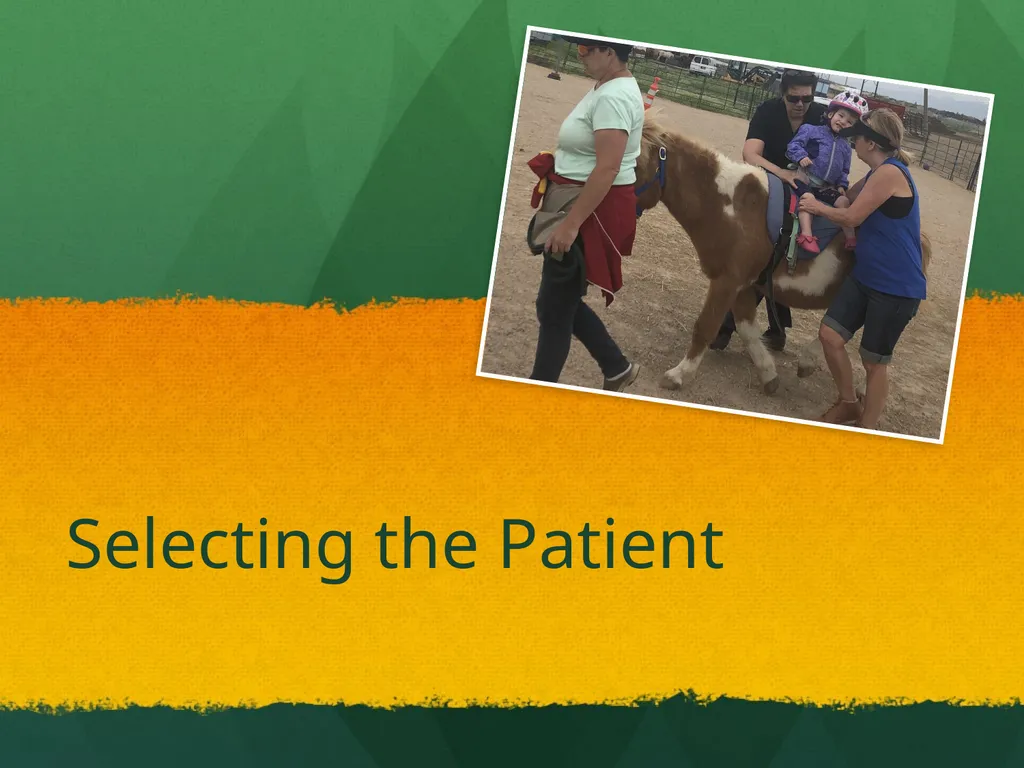
Selecting the Patient<br>
24
Contraindications Acute mental disorders
Acute herniated disc
Chiari 11 malformation with neurologic symptoms
Atlantoaxial instability (displacement of C1 on C2)
Coxa arthrosis (degeneration of the hip)
Uncontrolled grand mal seizures
Hemophilia with recent history of bleeding
Open wounds over weight bearing surface
Pathologic Fractures without successful treatment
Tethered cord with symptoms
Unstable spine or joints including unstable hardware<br>
Acute herniated disc
Chiari 11 malformation with neurologic symptoms
Atlantoaxial instability (displacement of C1 on C2)
Coxa arthrosis (degeneration of the hip)
Uncontrolled grand mal seizures
Hemophilia with recent history of bleeding
Open wounds over weight bearing surface
Pathologic Fractures without successful treatment
Tethered cord with symptoms
Unstable spine or joints including unstable hardware<br>
25
Considerations for Patient Selection Age
Cognitive ability
Sitting Balance
Height and Weight
Mobility and Alignment
Joint Stiffness
Muscle Stiffness
Limited Mobility/Malalignment<br>
Cognitive ability
Sitting Balance
Height and Weight
Mobility and Alignment
Joint Stiffness
Muscle Stiffness
Limited Mobility/Malalignment<br>
26
Position Options Forward Sitting
Backward Sitting
Side Sitting
Prone Over Barrel
Prone On Rump
Supine on Rump
Quadruped
Modified Stand<br>
Backward Sitting
Side Sitting
Prone Over Barrel
Prone On Rump
Supine on Rump
Quadruped
Modified Stand<br>
27
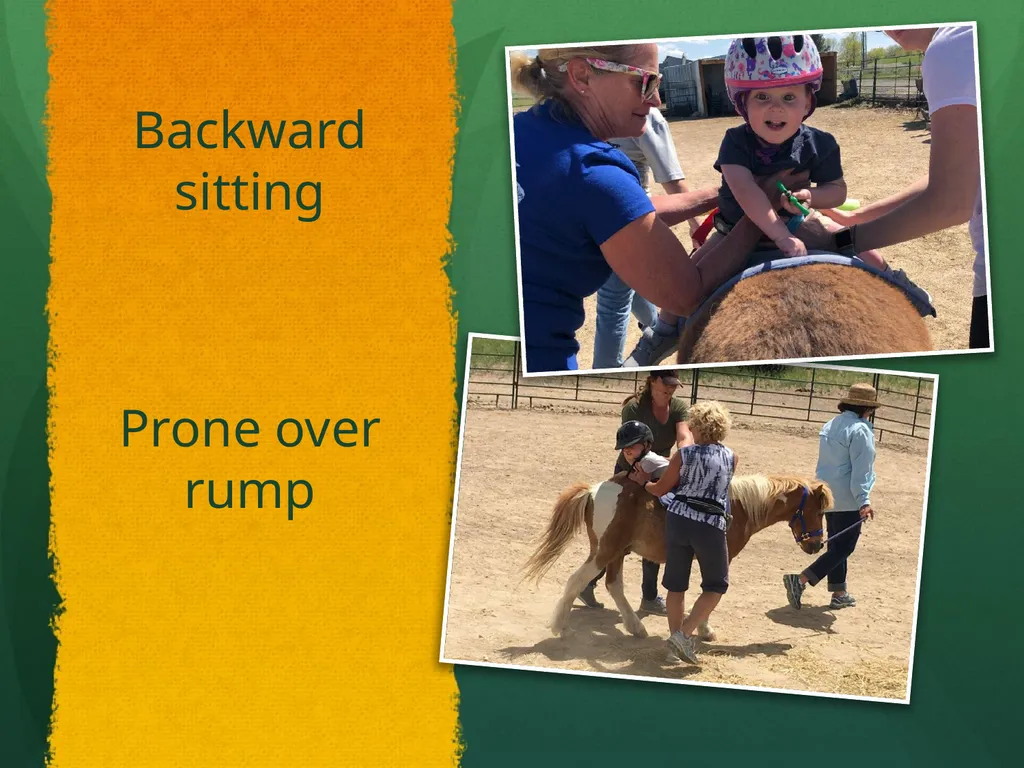
Backward sitting Prone over rump<br>
28
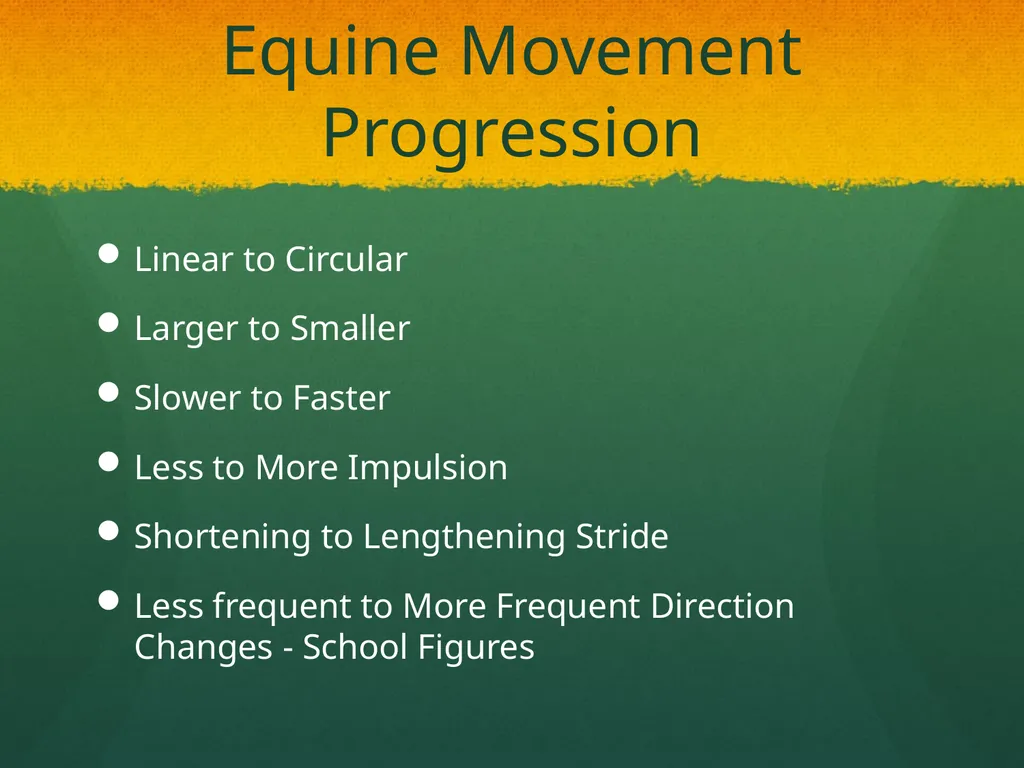
Equine Movement Progression Linear to Circular
Larger to Smaller
Slower to Faster
Less to More Impulsion
Shortening to Lengthening Stride
Less frequent to More Frequent Direction Changes - School Figures<br>
Larger to Smaller
Slower to Faster
Less to More Impulsion
Shortening to Lengthening Stride
Less frequent to More Frequent Direction Changes - School Figures<br>
29
Thank You!!!!<br>