
Historical Context of She Stoops to Conquer
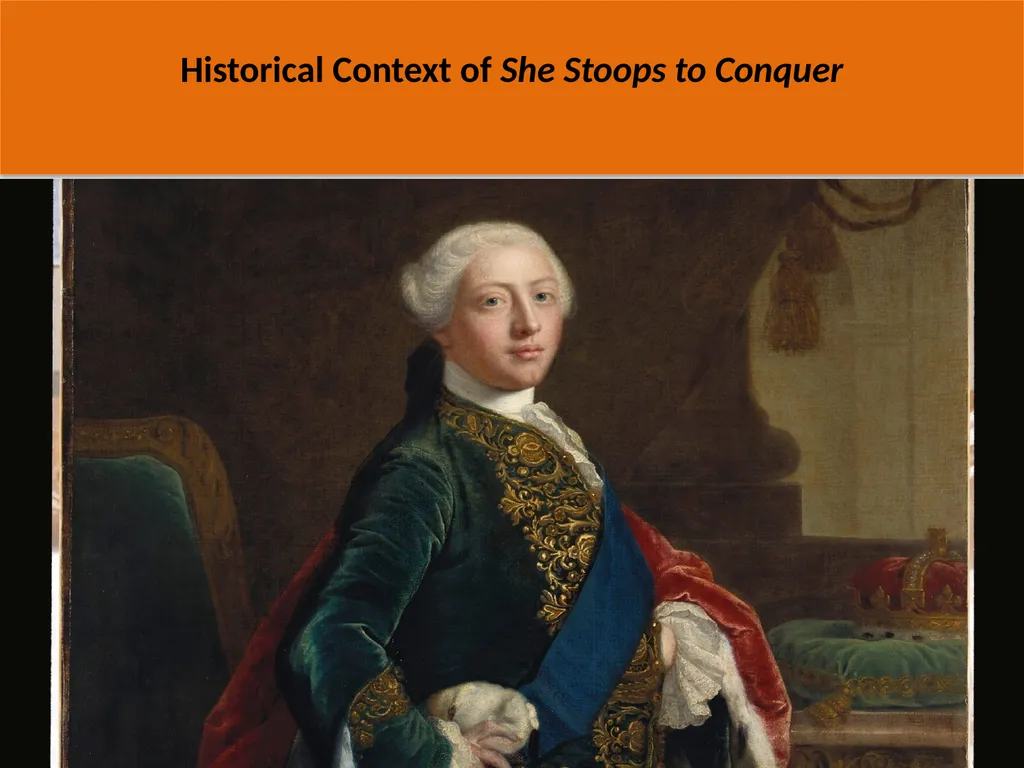
Description: Historical Context of She Stoops to Conquer Historical Context of She Stoops to Conquer The play takes place during the long and relatively peaceful reign of King George III (1738-1820), a time of enormous social transformation for Britain.
Related Topics
Download Presentation
"Historical Context of She Stoops to Conquer" is the property of its rightful owner. Permission is granted to download and print the materials on this website for personal, non-commercial use only, and to display it on your personal computer provided you do not modify the materials and that you retain all copyright notices contained in the materials. By downloading content from our website, you accept the terms of this agreement.
Presentation Transcript
slide1. Historical Context of She Stoops to Conquer<br>
slide2. Historical Context of She Stoops to Conquer The play takes place during the long and relatively peaceful reign of King George III (1738-1820), a time of enormous social transformation for Britain.<br>
slide3. Historical Context of She Stoops to Conquer The Agricultural Revolution had led to an unprecedented increase in agricultural production and a massive consolidation of farmland, which in turn sent many of Britain’s rural-dwellers into the city looking for work.<br>
slide4. Historical Context of She Stoops to Conquer Class divisions were slowly but surely becoming more pronounced as the Industrial Revolution, in its very early years, was creating a new class of working poor in the increasingly populous cities.<br>
slide5. Historical Context of She Stoops to Conquer A new sense of cosmopolitanism began to develop among the cities’ wealthy urban elite, they began to see themselves as superior—more cultured and worldly—than people of the same class who lived in the countryside (the landed gentry).<br>
slide6. Historical Context of She Stoops to Conquer This social dynamic sets the stage for many of the interactions in She Stoops to Conquer, as Marlow and Hastings (two young “city slickers”) have journeyed to the countryside to visit the Hardcastles. Marlow’s loftiness toward Hardcastle, for example—even though it is the result of his mistaken belief that Hardcastle is an innkeeper—draws laughs because it plays on Hardcastle’s sensitivity to this newly emergent hierarchy between the cultured city-dweller and the country unsophisticated person.<br>
slide7. THE END SEE YOU NEXT TIME!<br>
slide2. Historical Context of She Stoops to Conquer The play takes place during the long and relatively peaceful reign of King George III (1738-1820), a time of enormous social transformation for Britain.<br>

slide3. Historical Context of She Stoops to Conquer The Agricultural Revolution had led to an unprecedented increase in agricultural production and a massive consolidation of farmland, which in turn sent many of Britain’s rural-dwellers into the city looking for work.<br>
slide4. Historical Context of She Stoops to Conquer Class divisions were slowly but surely becoming more pronounced as the Industrial Revolution, in its very early years, was creating a new class of working poor in the increasingly populous cities.<br>
slide5. Historical Context of She Stoops to Conquer A new sense of cosmopolitanism began to develop among the cities’ wealthy urban elite, they began to see themselves as superior—more cultured and worldly—than people of the same class who lived in the countryside (the landed gentry).<br>
slide6. Historical Context of She Stoops to Conquer This social dynamic sets the stage for many of the interactions in She Stoops to Conquer, as Marlow and Hastings (two young “city slickers”) have journeyed to the countryside to visit the Hardcastles. Marlow’s loftiness toward Hardcastle, for example—even though it is the result of his mistaken belief that Hardcastle is an innkeeper—draws laughs because it plays on Hardcastle’s sensitivity to this newly emergent hierarchy between the cultured city-dweller and the country unsophisticated person.<br>
slide7. THE END SEE YOU NEXT TIME!<br>