Historical Contexts for Lagaan and Cricket Political History and Geography Film set 1893, high noon of British Empire Sun never sets etc. Empire in India, start late 1700s, with efforts of what was initially a trading company, The East
"Historical Contexts for Lagaan and Cricket" is the property of its rightful owner. Permission is granted to
download and print the materials on this website for personal, non-commercial use only, and to display it
on your personal computer provided you do not modify the materials and that you retain all copyright
notices contained in the materials. By downloading content from our website, you accept the terms of this
agreement.
Presentation Transcript
01
Historical Contexts for Lagaan and Cricket<br>
02
Political History and Geography Film set 1893, high noon of British Empire… Sun never sets etc.
Empire in India, start late 1700s, with efforts of what was initially a trading company, The East India Company (EIC), slowly expanded, large parts of subcontinent by 1830s
Important to note, this was not, could not be SETTLER colonialism like Namerica or Australia. Existing population large and political systems strong. Took control of the TOP of the political, economic system
1857 saw a HUGE armed uprising, almost removed British. But won, and two pronged strategy after. ONE, viciously put down, led to increase in racist behavior, and TWO secure allies among the ruling class. Left many small and large Indian princes in nominal control of their territories, as long as they recognize BRITISH PARAMOUNTCY<br>
03
Princely India and Lagaan We can see both racism and alliances in operation in the film, Capt. Russell on the one hand, and the Raja or King, Puran Singh
Princes, nominally independent, but as you can see from film, dependent. In return for “protection” (which they did not have the option to refuse!) They had to pay a tax. The tax obviously came from peasants, agricultural pop. Tax called Lagaan<br>
04
Historical Context Class Caste Region Religion India primarily agrarian. Villages. Hierarchies of class (economics) caste (culture and politics) and gender. See many in the film
Not bore you with a long lecture on history of caste. For the moment, think of it as analogous to race in the US. Inequality based on birth. Cannot change. Justified by ideology of inherent inequality
Analogous is not IDENTICAL. So important differences. Different strata or levels, hierarchical. NOMINALLY based on ideas of purity and pollution. Those at the top, Brahmins or priests, not necessarily the richest or powerful, but the PUREST. Those at the very bottom considered so IMPURE that their very touch is considered polluting. Those are the people considered UNTOUCHABLES
Kachra (word MEANS “garbage”) is an untouchable, and you can see how that operates. Most of the team members consider it unthinkable that they play on the same team with an untouchable, and it took Bhuwan a lot of effort to get him to play with the team
RELIGION many in India, Hindu (caste) Muslims (sects) Sikhs, Jain etc etc. ISMAIL = Muslim DEVA = Sikh
REGION: Though most from the same village DEVA is not
So a coming together of CASTE REGION and RELIGION to defeat the Brits. That’s the nationalist message of the film. Pretty much what Indian nationalists at the time were saying too!<br>
05
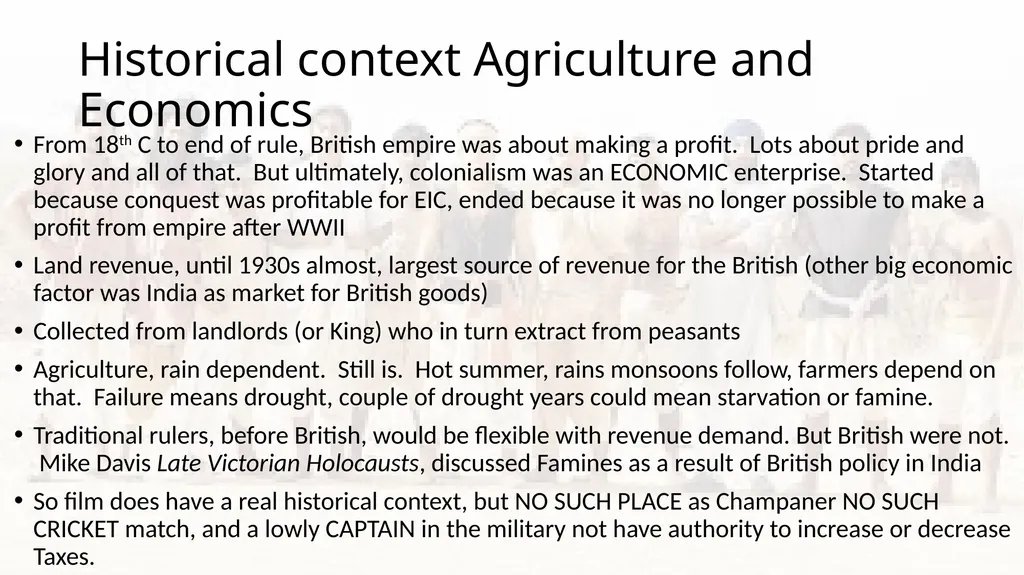
Historical context Agriculture and Economics From 18th C to end of rule, British empire was about making a profit. Lots about pride and glory and all of that. But ultimately, colonialism was an ECONOMIC enterprise. Started because conquest was profitable for EIC, ended because it was no longer possible to make a profit from empire after WWII
Land revenue, until 1930s almost, largest source of revenue for the British (other big economic factor was India as market for British goods)
Collected from landlords (or King) who in turn extract from peasants
Agriculture, rain dependent. Still is. Hot summer, rains monsoons follow, farmers depend on that. Failure means drought, couple of drought years could mean starvation or famine.
Traditional rulers, before British, would be flexible with revenue demand. But British were not. Mike Davis Late Victorian Holocausts, discussed Famines as a result of British policy in India
So film does have a real historical context, but NO SUCH PLACE as Champaner NO SUCH CRICKET match, and a lowly CAPTAIN in the military not have authority to increase or decrease Taxes.<br>
06
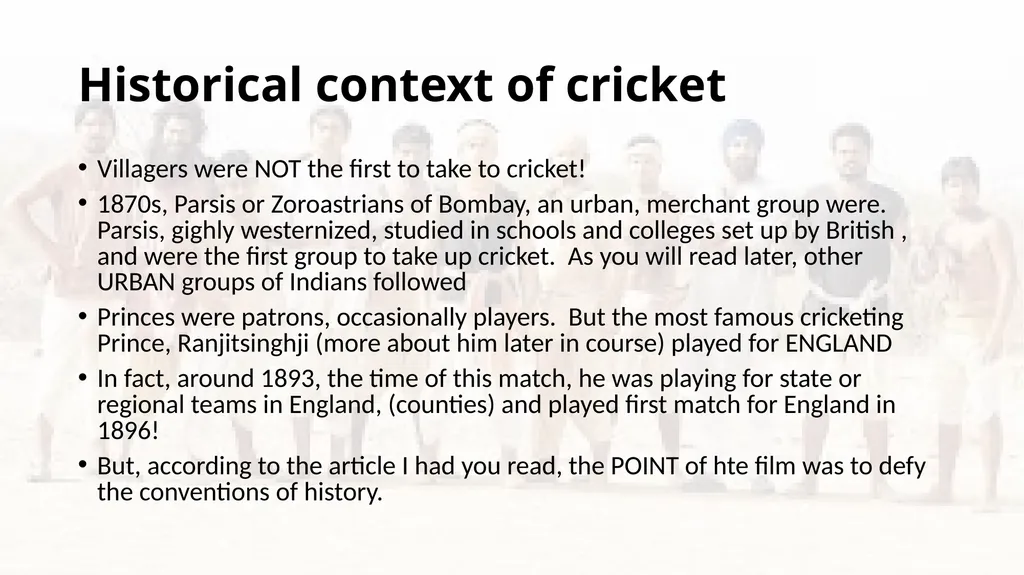
Historical context of cricket Villagers were NOT the first to take to cricket!
1870s, Parsis or Zoroastrians of Bombay, an urban, merchant group were. Parsis, gighly westernized, studied in schools and colleges set up by British , and were the first group to take up cricket. As you will read later, other URBAN groups of Indians followed
Princes were patrons, occasionally players. But the most famous cricketing Prince, Ranjitsinghji (more about him later in course) played for ENGLAND
In fact, around 1893, the time of this match, he was playing for state or regional teams in England, (counties) and played first match for England in 1896!
But, according to the article I had you read, the POINT of hte film was to defy the conventions of history.<br>