Historical Introduction to the Elementary Particles 1.1-1.3 1.1 THE CLASSICAL ERA J.J.Thomson discovered the electron from cathode rays. The charge-to-mass ratio was enormously great and it turned out that the mass of the particle was
"Historical Introduction to the Elementary" is the property of its rightful owner. Permission is granted to
download and print the materials on this website for personal, non-commercial use only, and to display it
on your personal computer provided you do not modify the materials and that you retain all copyright
notices contained in the materials. By downloading content from our website, you accept the terms of this
agreement.
Presentation Transcript
01
Historical Introduction to the Elementary Particles (1.1-1.3)<br>
02
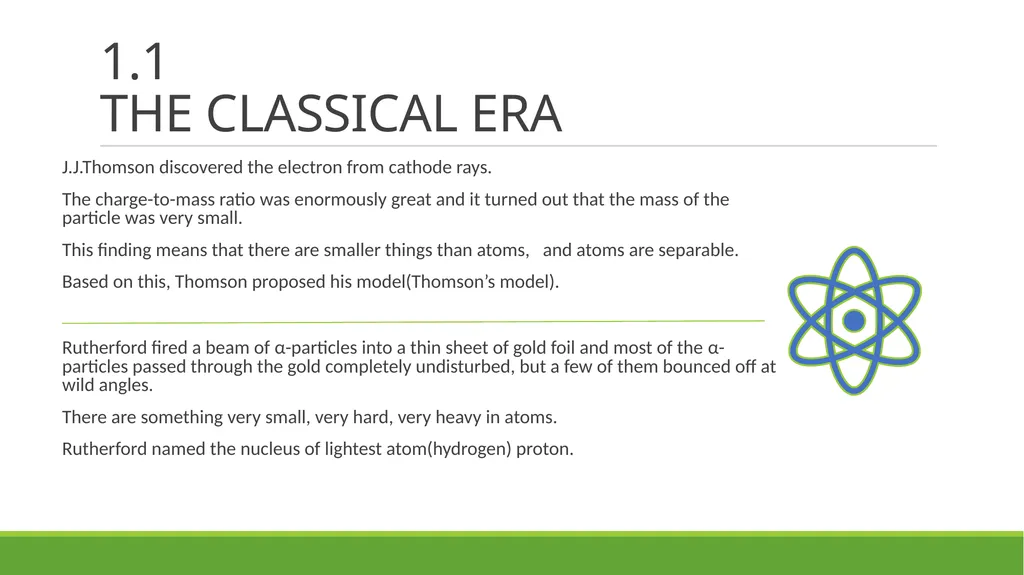
1.1 THE CLASSICAL ERA J.J.Thomson discovered the electron from cathode rays.
The charge-to-mass ratio was enormously great and it turned out that the mass of the particle was very small.
This finding means that there are smaller things than atoms, and atoms are separable.
Based on this, Thomson proposed his model(Thomson’s model).
Rutherford fired a beam of α-particles into a thin sheet of gold foil and most of the α-particles passed through the gold completely undisturbed, but a few of them bounced off at wild angles.
There are something very small, very hard, very heavy in atoms.
Rutherford named the nucleus of lightest atom(hydrogen) proton.<br>
03
1.1 THE CLASSICAL ERA In 1914, Niel.Bohr proposed a model — the Bohr’s model to explain the structure of atom.
The result of the model on the hydrogen agree with experiment perfectly, while it didn’t agree with the experiments of other kinds of atoms except hydrogen.
Chadwick discovered the neutron in 1932, putting the final touch on what we might call the classical period in elementary particle physics.<br>
04
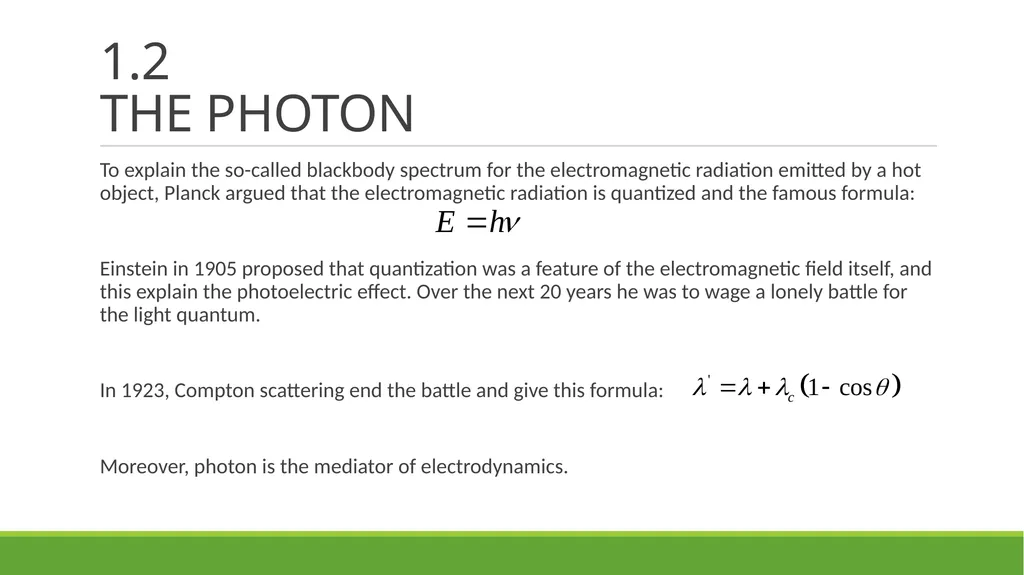
1.2 THE PHOTON To explain the so-called blackbody spectrum for the electromagnetic radiation emitted by a hot object, Planck argued that the electromagnetic radiation is quantized and the famous formula:
Εinstein in 1905 proposed that quantization was a feature of the electromagnetic field itself, and this explain the photoelectric effect. Over the next 20 years he was to wage a lonely battle for the light quantum.
In 1923, Compton scattering end the battle and give this formula:
Moreover, photon is the mediator of electrodynamics.<br>
05
1.3 MESONS One problem to which the “classical” model does not address itself at all: What holds the nucleus together?
The strong force
In 1934, Yukawa assumed that the proton and neutron are attracted to one another by some sort of field and the mediator exchanged are particles whose mass is about 300 times of the electron, or about the sixth the mass of a proton.
Yukawa called this kind of particles mesons.<br>
06
In 1934, two separate groups (Anderson and Neddermeyer on the West Coast, and Street and Stevenson on the East) had identified particles matching Yukawa’s description.
Something disturbing—They had the wrong lifetime and they seemed to be significantly lighter than Yukawa had predicted; worse still, different mass measurements were not consistent with one another.
In 1947, Powell and his co-workers at Bristol discovered that there are actually two middle-weight particles in cosmic rays, which they called π (or “pion”) and μ (or “muon”).
π is the true Yukawa meson and μ belongs in the lepton family. THANK YOU<br>