HIWALAH Adopted from open source lecture of UNIVERSITI TEKNOLOGI MARA. Center of Islamic Finance COMSATS Institute of Information Technology Lahore Campus 1 2 Literally To move, shifting from one place to another. Technically To make a
"HIWALAH Adopted from open source lecture of" is the property of its rightful owner. Permission is granted to
download and print the materials on this website for personal, non-commercial use only, and to display it
on your personal computer provided you do not modify the materials and that you retain all copyright
notices contained in the materials. By downloading content from our website, you accept the terms of this
agreement.
Presentation Transcript
01
HIWALAH Adopted from open source lecture of UNIVERSITI TEKNOLOGI MARA. Center of Islamic Finance
COMSATS Institute of Information Technology
Lahore Campus 1<br>
02
2<br>
03
Literally
To move, shifting from one place to another.
Technically
To make a transfer of a debt from one debtor to the debtor account of another.
To transfer a debt from one person (debtor) to another with the same price, it comes to the consequence than the liability of the debtor is abolished. In other words, the first obligator is freed from any financial obligations.
Hiwalah is a contract which caused the transfer of debt from one party to another.
According to Mughni Muhtaj, the term Hiwalah is refer to the debt transfer from a party/person to another. HIWALAH 3<br>
04
Through the transfer of a claim of a debt, the responsibility for its settlement is shifted from one person to another.
Hiwalah is similar to the sale of debt but is not sale, it also resemble kafalah and wakalah.
However, it is a unique contract which has its own distinct features and condition.
The three important participants in a Hiwalah contract are: the principal debtor, the creditor and the transferee.
When a valid Hiwalah is concluded, the debt is no longer demanded from the principal debtor.
This is because in Hiwalah, the debt is transferred from the principal debtor to the transferee.
Furthermore, Hiwalah establishes a right for the creditor to demand the settlement of debt from the transferee. NATURE OF AL-HIWALAH 4<br>
05
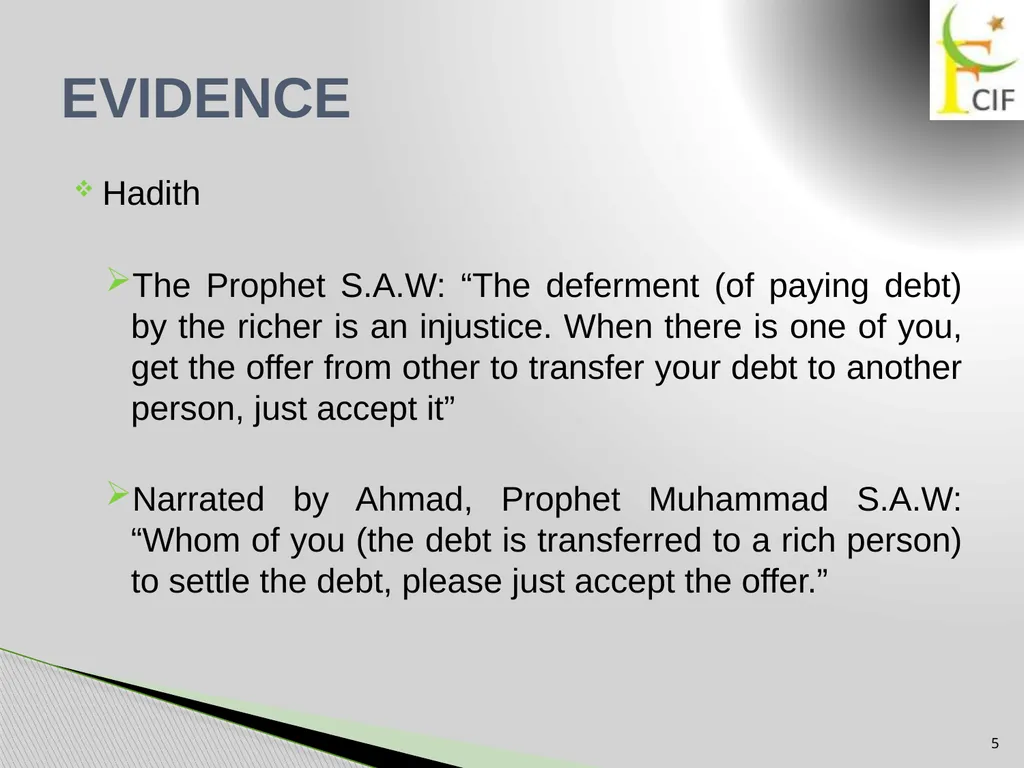
Hadith
The Prophet S.A.W: “The deferment (of paying debt) by the richer is an injustice. When there is one of you, get the offer from other to transfer your debt to another person, just accept it”
Narrated by Ahmad, Prophet Muhammad S.A.W: “Whom of you (the debt is transferred to a rich person) to settle the debt, please just accept the offer.” EVIDENCE 5<br>
06
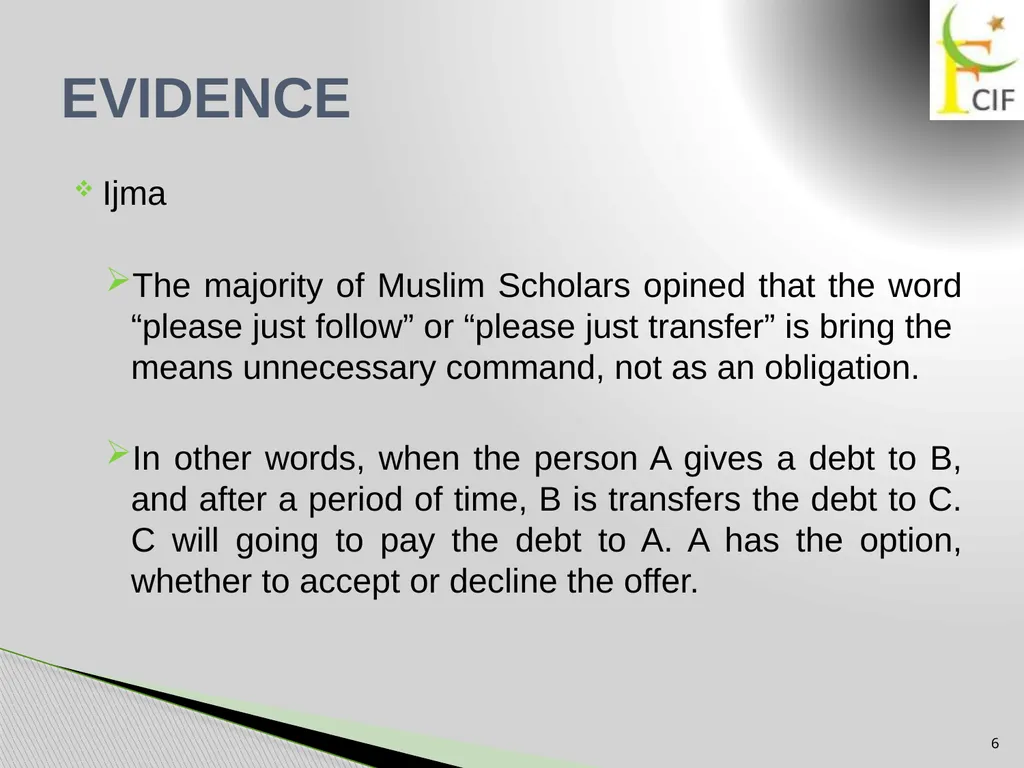
Ijma
The majority of Muslim Scholars opined that the word “please just follow” or “please just transfer” is bring the means unnecessary command, not as an obligation.
In other words, when the person A gives a debt to B, and after a period of time, B is transfers the debt to C. C will going to pay the debt to A. A has the option, whether to accept or decline the offer. EVIDENCE 6<br>
07
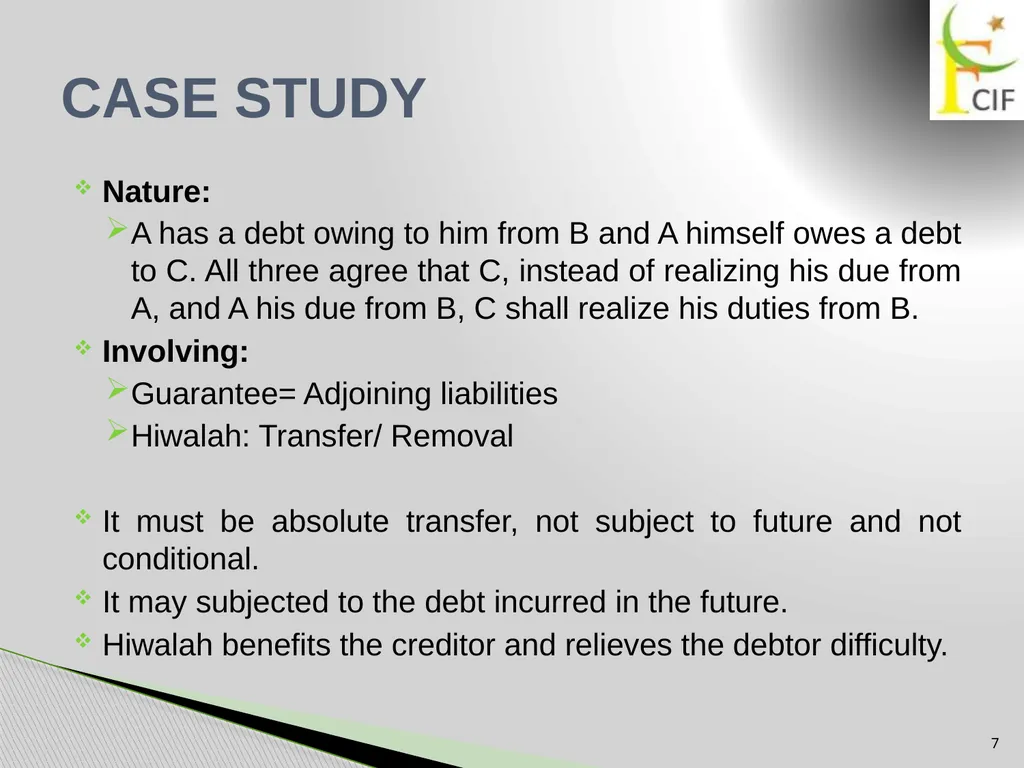
Nature:
A has a debt owing to him from B and A himself owes a debt to C. All three agree that C, instead of realizing his due from A, and A his due from B, C shall realize his duties from B.
Involving:
Guarantee= Adjoining liabilities
Hiwalah: Transfer/ Removal
It must be absolute transfer, not subject to future and not conditional.
It may subjected to the debt incurred in the future.
Hiwalah benefits the creditor and relieves the debtor difficulty. CASE STUDY 7<br>
08
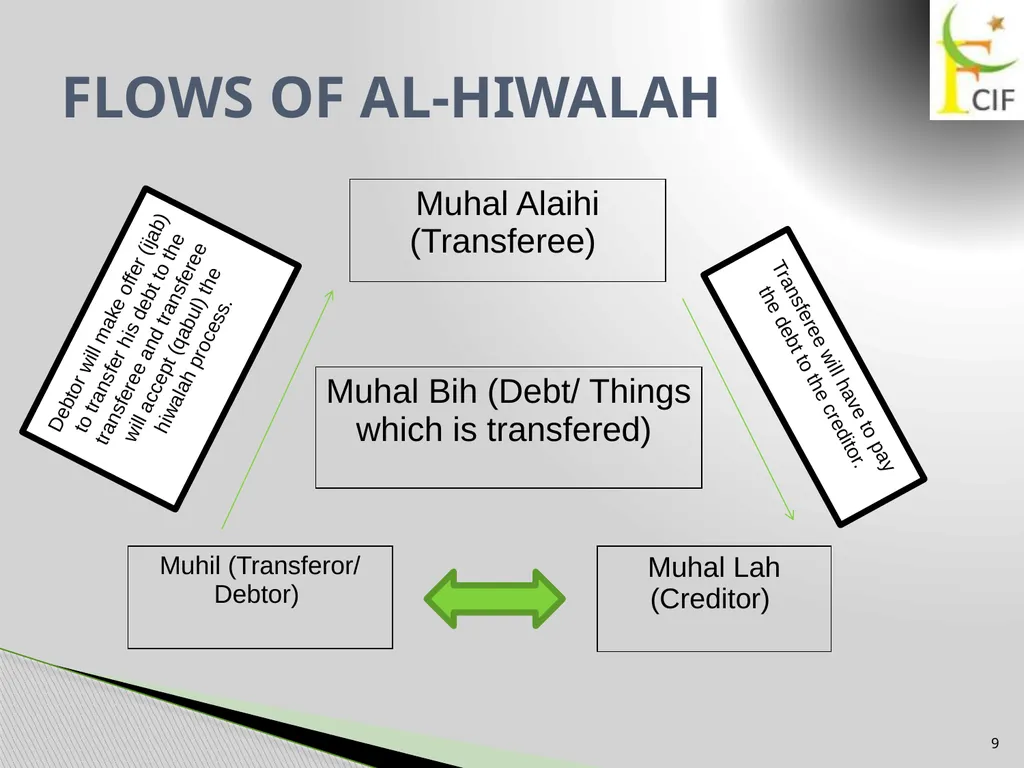
Al-Muhil
A person who is transfers his debt to another person/ the transferor
Al-Muhal
A creditor, whom his property/ debt is transferred to be paid by another person instead of his debtor/ the tranferee
Al-Muhal Alaihi
A person who accept a hiwalah to himself/ the payer
Al-Muhal Bih
The things which is transferred by Hiwalah/ the debt
Sighah
Ijab (Offer)
Qabul (Acceptance) PILLARS OF AL-HIWALAH 8<br>
09
FLOWS OF AL-HIWALAH Debtor will make offer (ijab) to transfer his debt to the transferee and transferee will accept (qabul) the hiwalah process. Transferee will have to pay the debt to the creditor. 9<br>
10
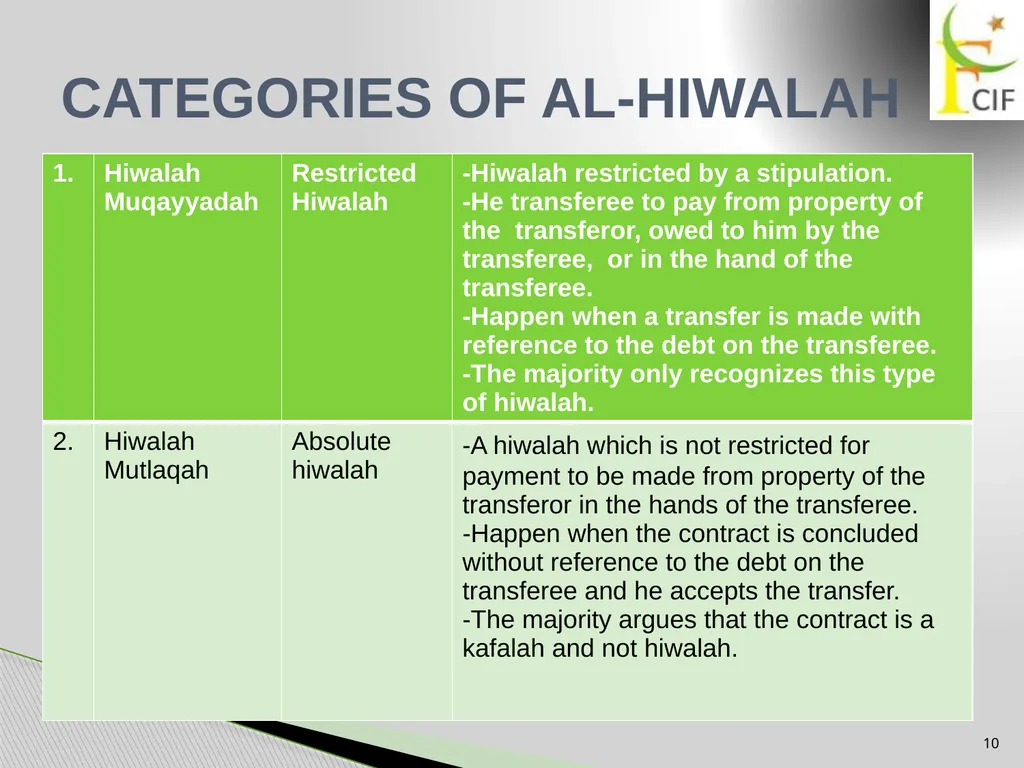
CATEGORIES OF AL-HIWALAH 10<br>
11
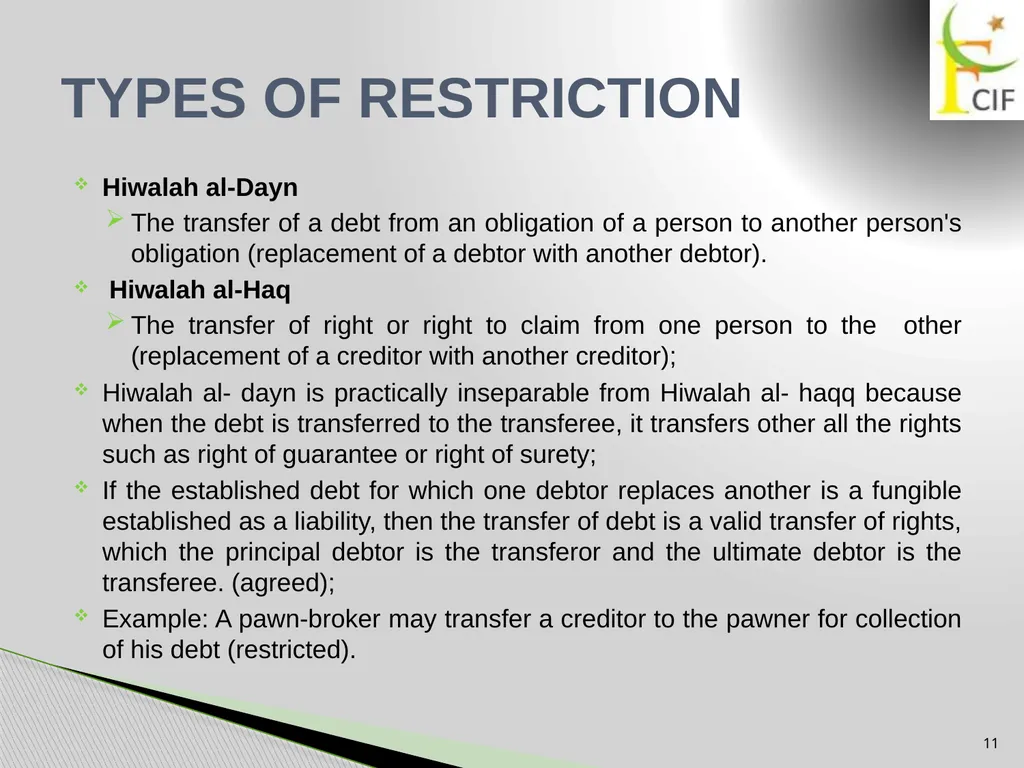
Hiwalah al-Dayn
The transfer of a debt from an obligation of a person to another person's obligation (replacement of a debtor with another debtor).
Hiwalah al-Haq
The transfer of right or right to claim from one person to the other (replacement of a creditor with another creditor);
Hiwalah al- dayn is practically inseparable from Hiwalah al- haqq because when the debt is transferred to the transferee, it transfers other all the rights such as right of guarantee or right of surety;
If the established debt for which one debtor replaces another is a fungible established as a liability, then the transfer of debt is a valid transfer of rights, which the principal debtor is the transferor and the ultimate debtor is the transferee. (agreed);
Example: A pawn-broker may transfer a creditor to the pawner for collection of his debt (restricted). TYPES OF RESTRICTION 11<br>
12
The parties must be legally competent to act independently.
The relevant parties shall give their consent on the Hiwalah agreement.
The acceptance of the creditor and the transferee should be given during the session of the contract.
The subject matter of Hiwalah should be debt (dain) and not a specific thing (’’ain).
Both the transferred debt and debt to be used for settlement should be known and transferable.
The transferee should owe a debt to the principal debtor. If the transferee is not indebted to the principal debtor and agrees to pay to the creditor the contract is changed to kafalah. As in this case the transferee is paying for the principal debtor.
The principal debtor (al-muhil) should owe a debt to the creditor (al-muhal). In the absence of such a debt if the creditor (muhal) is refereed to the transferee, the contract is not a Hiwalah but is considered wakalah. CONDITIONS OF AL-HIWALAH 12<br>
13
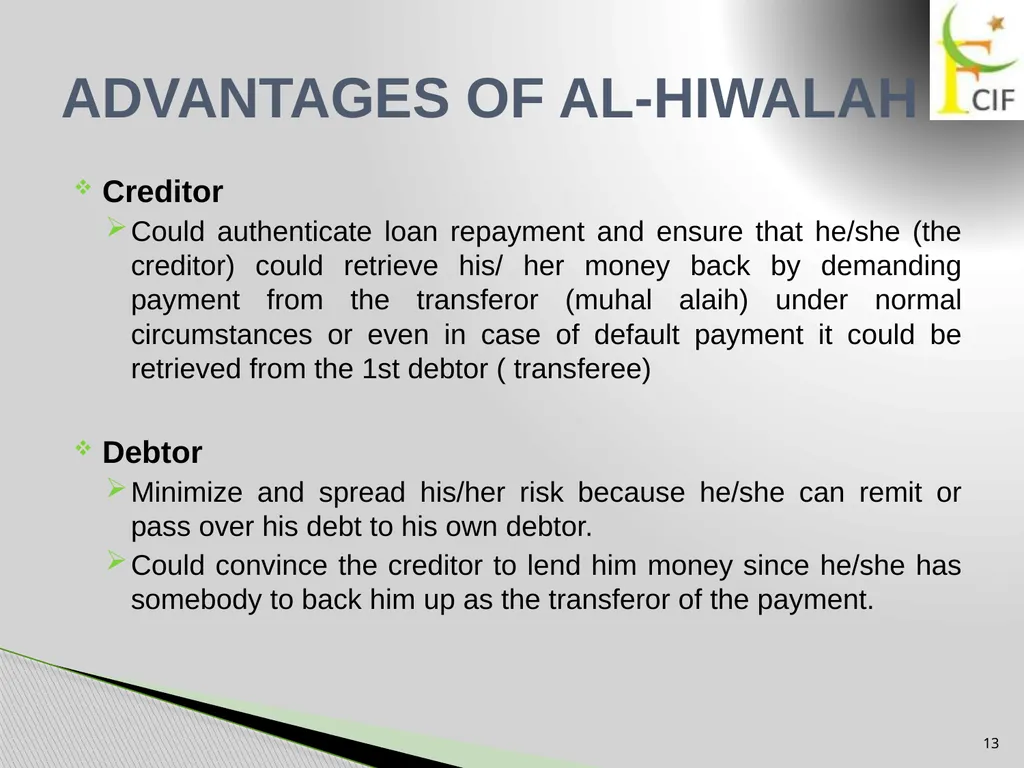
Creditor
Could authenticate loan repayment and ensure that he/she (the creditor) could retrieve his/ her money back by demanding payment from the transferor (muhal alaih) under normal circumstances or even in case of default payment it could be retrieved from the 1st debtor ( transferee)
Debtor
Minimize and spread his/her risk because he/she can remit or pass over his debt to his own debtor.
Could convince the creditor to lend him money since he/she has somebody to back him up as the transferor of the payment. ADVANTAGES OF AL-HIWALAH 13<br>
14
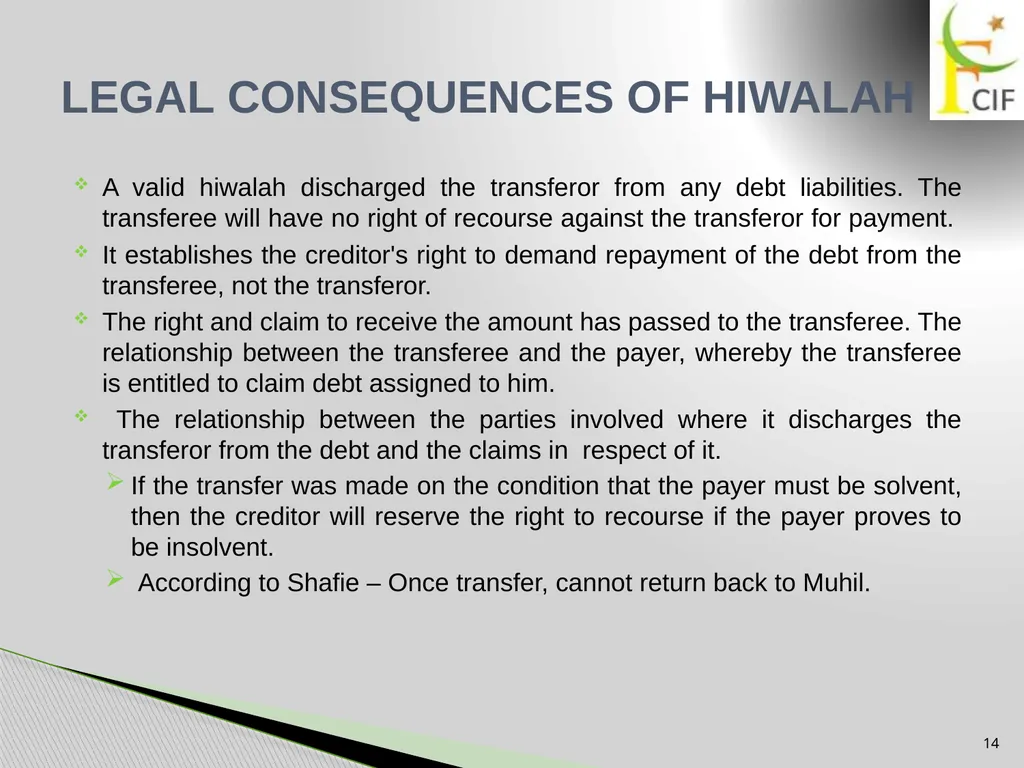
A valid hiwalah discharged the transferor from any debt liabilities. The transferee will have no right of recourse against the transferor for payment.
It establishes the creditor's right to demand repayment of the debt from the transferee, not the transferor.
The right and claim to receive the amount has passed to the transferee. The relationship between the transferee and the payer, whereby the transferee is entitled to claim debt assigned to him.
The relationship between the parties involved where it discharges the transferor from the debt and the claims in respect of it.
If the transfer was made on the condition that the payer must be solvent, then the creditor will reserve the right to recourse if the payer proves to be insolvent.
According to Shafie – Once transfer, cannot return back to Muhil. LEGAL CONSEQUENCES OF HIWALAH 14<br>
15
Mutual agreement among contracting parties to terminate the hiwalah.
The settlement of debt by the payer to the transferee.
The death of the payer and the transferee inherit the payer's property.
The debt has been written off by the transferee. TERMINATION OF HIWALAH 15<br>
16
Suftajah (Bills Of Exchange)
By this application it enables a debtor to make payments in another place through his agent or a second person.
Example: A person gives a portion of his property to a merchant to pay to another person in a different country. The sender benefits by insuring himself against the risks of transferring that property himself.
Other banking products and facilities
Banker's cheques
Demand drafts
Telegraphic transfers
Mail transfers
Standing instruction MODERN APPLICATION 16<br>