
HL Essay Everything you need to know to get
FD
Published · 36 slides · 0 views

1 / 1



Description
HL Essay Everything you need to know to get started From formulating a line of inquiry, to planning, to writing an analytical draft Brief The HL Essay is a 1200-1500 word essay about a text studied during the IB English course. For Language
Related Topics
Share
Embed code
Download this presentation From Below
"HL Essay Everything you need to know to get" is the property of its rightful owner. Permission is granted to download and print the materials on this website for personal, non-commercial use only, and to display it on your personal computer provided you do not modify the materials and that you retain all copyright notices contained in the materials. By downloading content from our website, you accept the terms of this agreement.
Presentation Transcript
01
HL Essay Everything you need to know to get started
From formulating a line of inquiry, to planning, to writing an analytical draft<br>
From formulating a line of inquiry, to planning, to writing an analytical draft<br>
02
Brief The HL Essay is a 1200-1500 word essay about a text studied during the IB English course. For Language and Literature students, the work you choose to analyse can be literary or non-literary (also known as body of work), but for IB English Literature the text must be literary.
The HL Essay will make up 20% of your final IB English HL grade, and it is graded externally.
You must choose your own line of inquiry.
The essay is analytical in nature.<br>
The HL Essay will make up 20% of your final IB English HL grade, and it is graded externally.
You must choose your own line of inquiry.
The essay is analytical in nature.<br>
03
Requirements for Choosing a Text You are free to choose any text you have studied on your course except texts that you have already chosen for IB assessments (your Individual Oral or Extended Essay). Additionally, the text you choose to use for this activity will no longer be available for future assessments (i.e. the IO, if you haven’t completed this yet, or Paper 2).
If you are a Lang-Lit student you can choose either a literary work (such as Broken April by Ismail Kadare or Top Girls by Caryl Churchill) or a non-literary body of such as a collection of adverts, cartoons, photographs, speeches, recruitment posters, and so on.
You must choose a text you have studied in sufficient depth on the IB English course, not a text that you have read by yourself outside class.<br>
If you are a Lang-Lit student you can choose either a literary work (such as Broken April by Ismail Kadare or Top Girls by Caryl Churchill) or a non-literary body of such as a collection of adverts, cartoons, photographs, speeches, recruitment posters, and so on.
You must choose a text you have studied in sufficient depth on the IB English course, not a text that you have read by yourself outside class.<br>
04
Things to think about when choosing your text Some texts are more straightforward than others. For example, a novel, a play, or a work of literary non-fiction (such as a memoir) count as a single work and you can choose one of these with no further concerns.
Short stories and poetry are collections of ‘texts’ that form a ‘literary work’. If you choose to write about a short story or poetry collection, you should not focus on only one story or poem. Be prepared to write about two or more ‘texts’ from the collection.
A body of work must also be a collection of ‘texts’ and should be formed of the same text type. So, for example, if you choose an advert campaign that features short films, posters, and web articles, you could not mix and match. You should make a body of work out of one of these ‘text types’. Like poems, one advert, poster or other single ‘text’ is not enough for the intended scope of this essay. You should aim to include details from at least 2 – 3 of these smaller ‘texts’.<br>
Short stories and poetry are collections of ‘texts’ that form a ‘literary work’. If you choose to write about a short story or poetry collection, you should not focus on only one story or poem. Be prepared to write about two or more ‘texts’ from the collection.
A body of work must also be a collection of ‘texts’ and should be formed of the same text type. So, for example, if you choose an advert campaign that features short films, posters, and web articles, you could not mix and match. You should make a body of work out of one of these ‘text types’. Like poems, one advert, poster or other single ‘text’ is not enough for the intended scope of this essay. You should aim to include details from at least 2 – 3 of these smaller ‘texts’.<br>
05
What your examiners say Extract from May 2024 Subject Report Reference should be made to a work or body of work as a whole: however, it is not necessary to write about all the texts studied within a work or body of work. An essay referencing many shorter texts is unlikely to contain enough detail to support a developed line of inquiry. The candidate should use their judgment to select an appropriate number of texts, which may vary depending on the text type, the complexity and length. The minimum number of texts within a body of work that an essay should refer to is two: a Higher Level Essay should not be on only one text as it would then be unlikely to have as broad a focus as the component aims to have.<br>
06
Creating a line of inquiry Once you have chosen which text you would like to write about, you should develop a line of inquiry. This will establish the direction and focus of your HL Essay writing.
The line of inquiry is the core question that your HL essay will try to answer.
The line of inquiry must be generated by the student, not assigned by the teacher to a class. You should avoid choosing a line of inquiry that is the same as another student in your class, although of course you may be writing about the same work.<br>
The line of inquiry is the core question that your HL essay will try to answer.
The line of inquiry must be generated by the student, not assigned by the teacher to a class. You should avoid choosing a line of inquiry that is the same as another student in your class, although of course you may be writing about the same work.<br>
07
Creating a line of inquiry You should begin by considering an idea or effect that interests you from the work you have chosen. This is the ‘big idea’ that you will investigate throughout the writing of your essay.
While not a compulsory starting point, the idea you choose to explore could be linked to one of the seven core concepts of the IB English curriculum:
Creativity
Identity
Culture
Community
Perspective
Transformation
Representation
Alternatively, the idea you want to discuss could be drawn from the themes and concerns of the literary work or body of work.<br>
While not a compulsory starting point, the idea you choose to explore could be linked to one of the seven core concepts of the IB English curriculum:
Creativity
Identity
Culture
Community
Perspective
Transformation
Representation
Alternatively, the idea you want to discuss could be drawn from the themes and concerns of the literary work or body of work.<br>
08
Creating a line of inquiry Next, you should consider a broad methodology by which the author has shaped your understanding of the ‘big idea’.
The methodology you choose to investigate will probably be derived from the formal or stylistic features of the work you’ve studied.
As such, there are too many styles, traditions, language and literature devices, author’s creative choices, character types, settings, or generic conventions to list here.
Return to your notebook, learner portfolio, classwork, homework, discussions, annotations, and so on to discover possibilities that are relevant to you and the works you’ve studied.<br>
The methodology you choose to investigate will probably be derived from the formal or stylistic features of the work you’ve studied.
As such, there are too many styles, traditions, language and literature devices, author’s creative choices, character types, settings, or generic conventions to list here.
Return to your notebook, learner portfolio, classwork, homework, discussions, annotations, and so on to discover possibilities that are relevant to you and the works you’ve studied.<br>
09
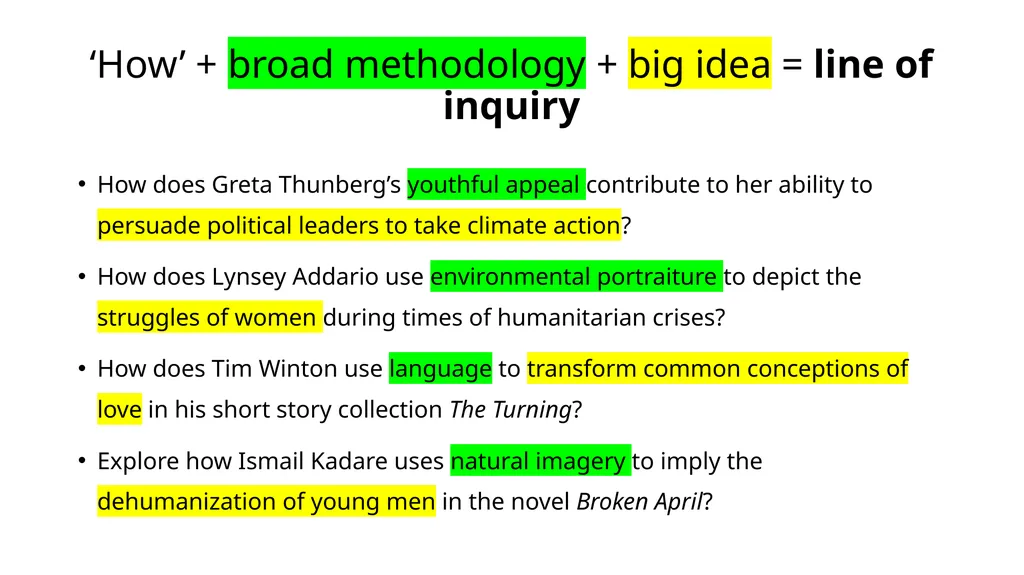
‘How’ + broad methodology + big idea = line of inquiry How does Greta Thunberg’s youthful appeal contribute to her ability to persuade political leaders to take climate action?
How does Lynsey Addario use environmental portraiture to depict the struggles of women during times of humanitarian crises?
How does Tim Winton use language to transform common conceptions of love in his short story collection The Turning?
Explore how Ismail Kadare uses natural imagery to imply the dehumanization of young men in the novel Broken April?<br>
How does Lynsey Addario use environmental portraiture to depict the struggles of women during times of humanitarian crises?
How does Tim Winton use language to transform common conceptions of love in his short story collection The Turning?
Explore how Ismail Kadare uses natural imagery to imply the dehumanization of young men in the novel Broken April?<br>
10
Arriving at a suitable line of inquiry can be tricky. Some questions are too broad, while others are too narrow. This activity will help you get a feel for questions that are ‘just right’. Over the following slides, you will see some proposed lines of inquiry for different texts. Simply say whether they are ‘too broad’, ‘too narrow’, or ‘just right’. Here are three examples:<br>
11
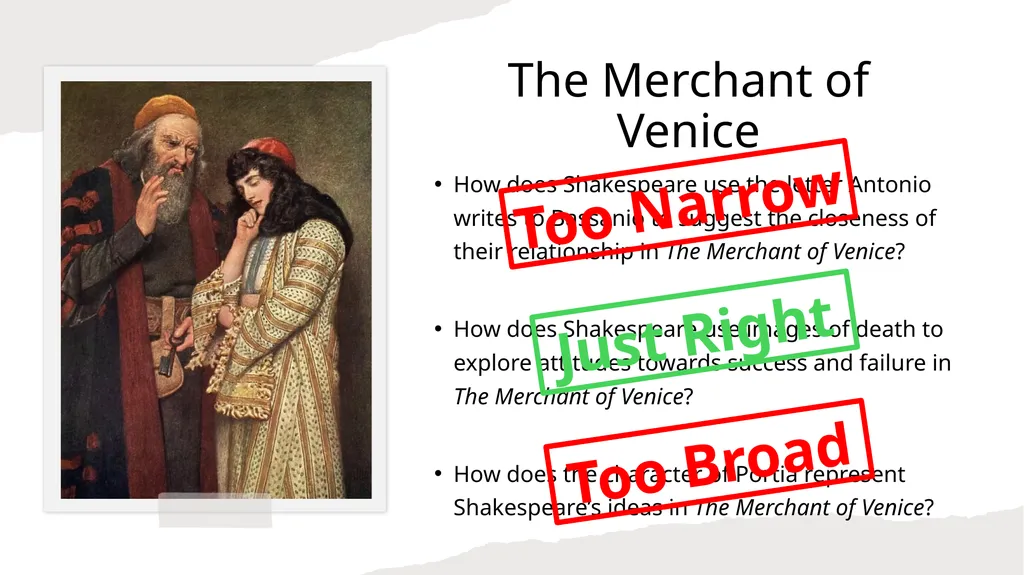
The Merchant of Venice How does Shakespeare use the letter Antonio writes to Bassanio to suggest the closeness of their relationship in The Merchant of Venice?
How does Shakespeare use images of death to explore attitudes towards success and failure in The Merchant of Venice?
How does the character of Portia represent Shakespeare’s ideas in The Merchant of Venice? Just Right Too Narrow Too Broad<br>
How does Shakespeare use images of death to explore attitudes towards success and failure in The Merchant of Venice?
How does the character of Portia represent Shakespeare’s ideas in The Merchant of Venice? Just Right Too Narrow Too Broad<br>
12
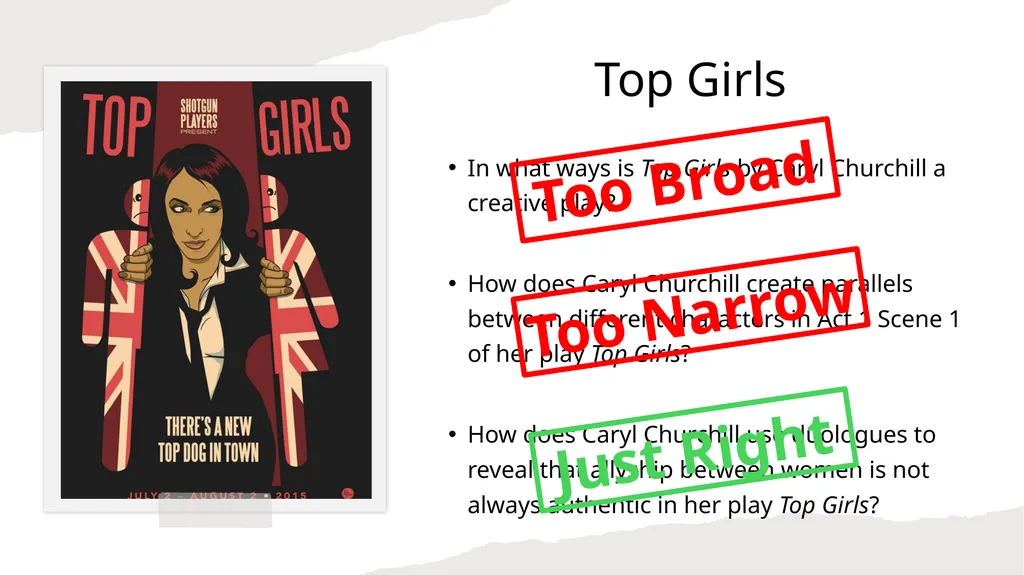
Top Girls In what ways is Top Girls by Caryl Churchill a creative play?
How does Caryl Churchill create parallels between different characters in Act 1 Scene 1 of her play Top Girls?
How does Caryl Churchill use duologues to reveal that allyship between women is not always authentic in her play Top Girls? Too Narrow Too Broad Just Right<br>
How does Caryl Churchill create parallels between different characters in Act 1 Scene 1 of her play Top Girls?
How does Caryl Churchill use duologues to reveal that allyship between women is not always authentic in her play Top Girls? Too Narrow Too Broad Just Right<br>
13
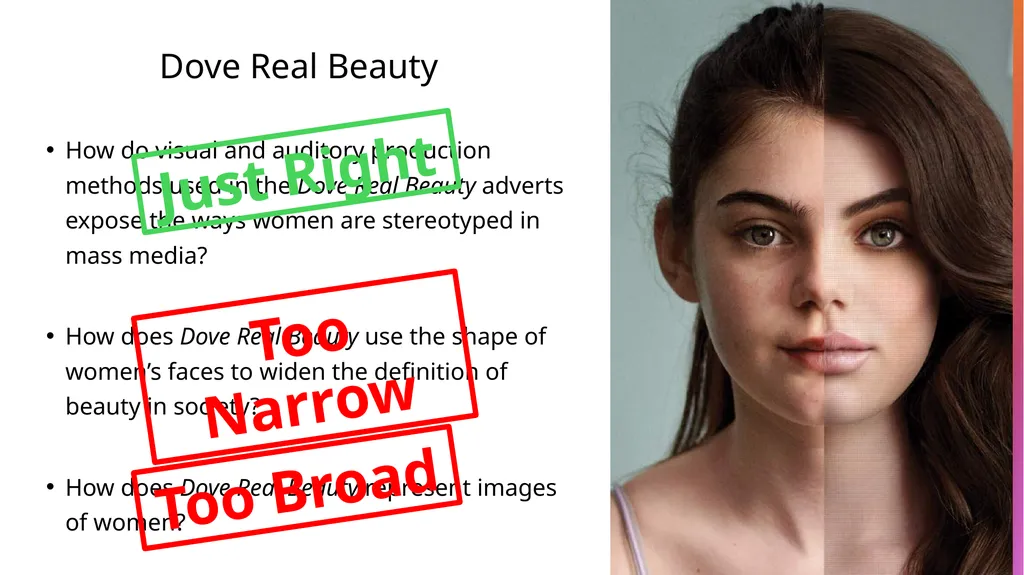
Dove Real Beauty How do visual and auditory production methods used in the Dove Real Beauty adverts expose the ways women are stereotyped in mass media?
How does Dove Real Beauty use the shape of women’s faces to widen the definition of beauty in society?
How does Dove Real Beauty represent images of women? Just Right Too Broad Too Narrow<br>
How does Dove Real Beauty use the shape of women’s faces to widen the definition of beauty in society?
How does Dove Real Beauty represent images of women? Just Right Too Broad Too Narrow<br>
14
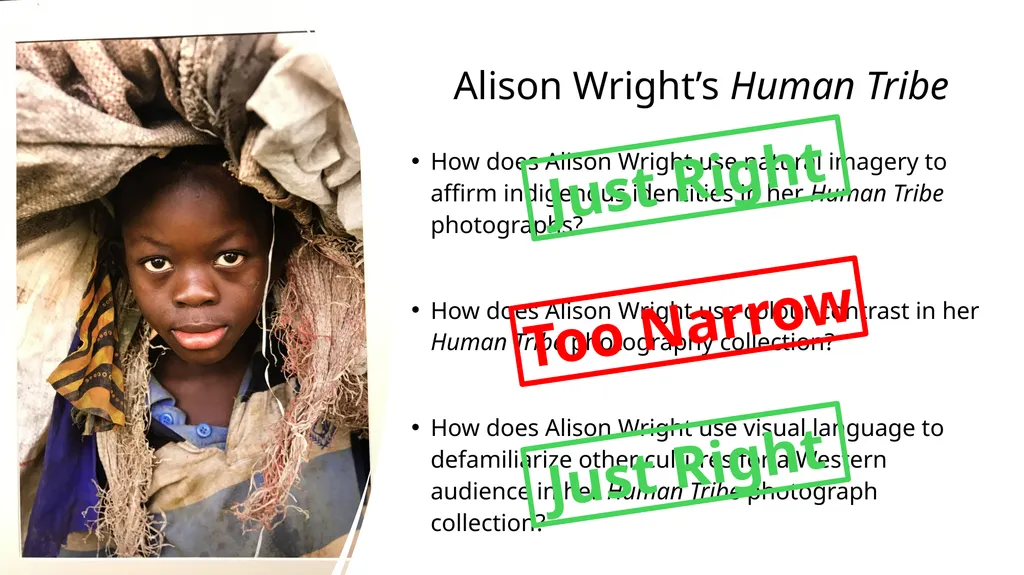
Alison Wright’s Human Tribe How does Alison Wright use natural imagery to affirm indigenous identities in her Human Tribe photographs?
How does Alison Wright use colour contrast in her Human Tribe photography collection?
How does Alison Wright use visual language to defamiliarize other cultures for a Western audience in her Human Tribe photograph collection? Just Right Just Right Too Narrow<br>
How does Alison Wright use colour contrast in her Human Tribe photography collection?
How does Alison Wright use visual language to defamiliarize other cultures for a Western audience in her Human Tribe photograph collection? Just Right Just Right Too Narrow<br>
15
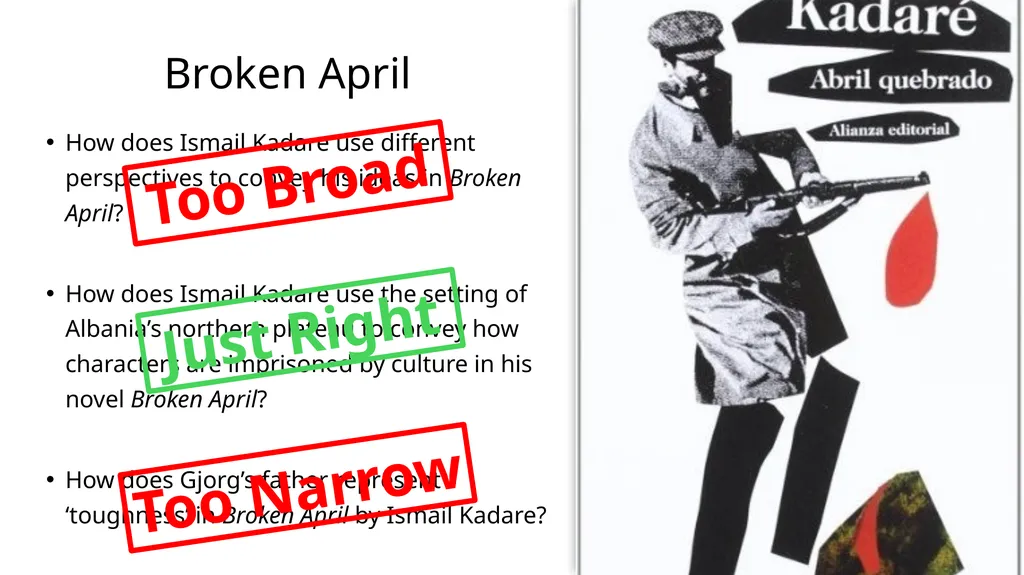
Broken April How does Ismail Kadare use different perspectives to convey his ideas in Broken April?
How does Ismail Kadare use the setting of Albania’s northern plateau to convey how characters are imprisoned by culture in his novel Broken April?
How does Gjorg’s father represent ‘toughness’ in Broken April by Ismail Kadare? Just Right Too Broad Too Narrow<br>
How does Ismail Kadare use the setting of Albania’s northern plateau to convey how characters are imprisoned by culture in his novel Broken April?
How does Gjorg’s father represent ‘toughness’ in Broken April by Ismail Kadare? Just Right Too Broad Too Narrow<br>
16
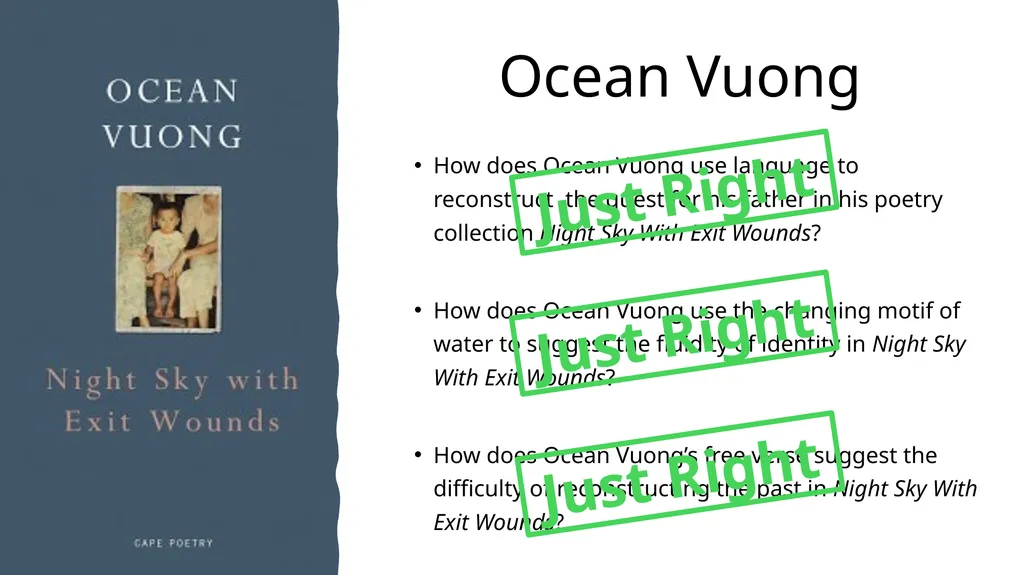
Ocean Vuong How does Ocean Vuong use language to reconstruct the quest for his father in his poetry collection Night Sky With Exit Wounds?
How does Ocean Vuong use the changing motif of water to suggest the fluidity of identity in Night Sky With Exit Wounds?
How does Ocean Vuong’s free verse suggest the difficulty of reconstructing the past in Night Sky With Exit Wounds? Just Right Just Right Just Right<br>
How does Ocean Vuong use the changing motif of water to suggest the fluidity of identity in Night Sky With Exit Wounds?
How does Ocean Vuong’s free verse suggest the difficulty of reconstructing the past in Night Sky With Exit Wounds? Just Right Just Right Just Right<br>
17
What your examiners say Extract from May 2024 Subject Report The essay should be clearly linked to, and closely focused on, the development of one well-defined line of inquiry which is relevant appropriate to the chosen body of work. Where this is not the case, the essay is unlikely to achieve the upper mark bands. Selecting a line of inquiry, ideally one that focuses on a writer’s choice, is the single most important factor in determining success in this assessment; it should be broad enough to consider an aspect of the work as a whole, yet not too broad that the subsequent analysis will be superficial.<br>
18
Creating an outline: step 1 Once you have formulated a line of inquiry, you should look at how your essay might develop by considering both your methodology and ideas in more detail.
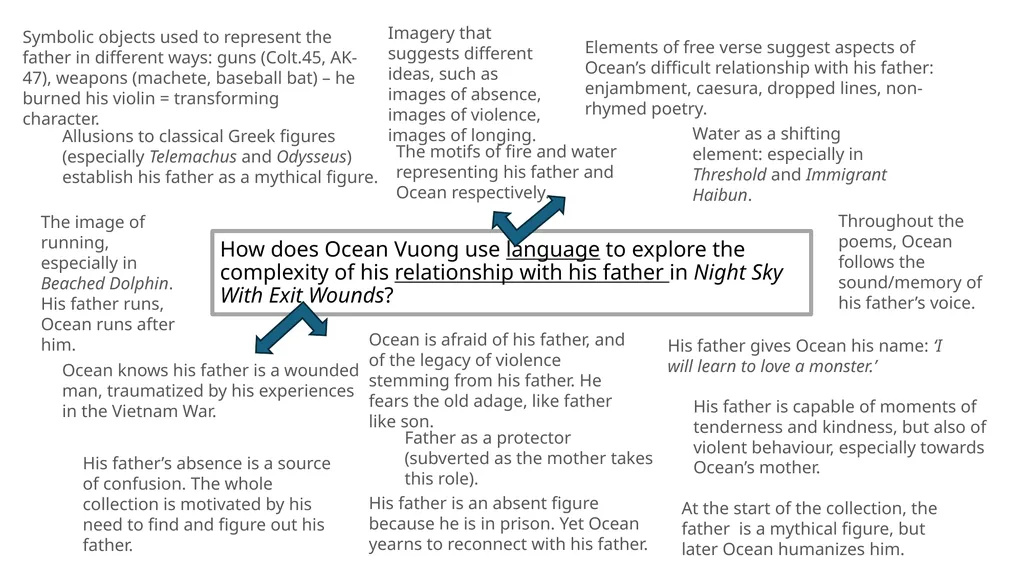
As a first step, you should brainstorm your question. This process is best achieved using pen and paper. Write your question out in the middle of a piece of paper, and set yourself a time (eg 20 minutes) where you allow yourself to freely consider different aspects of your question.
Your question should have two parts, so make sure you give some time and attention to both parts of the question when you are in the initial stages of planning.
On the next slide is an example of an effective way to brainstorm a text. Notice how the student’s ideas connect to both parts of the question:<br>
As a first step, you should brainstorm your question. This process is best achieved using pen and paper. Write your question out in the middle of a piece of paper, and set yourself a time (eg 20 minutes) where you allow yourself to freely consider different aspects of your question.
Your question should have two parts, so make sure you give some time and attention to both parts of the question when you are in the initial stages of planning.
On the next slide is an example of an effective way to brainstorm a text. Notice how the student’s ideas connect to both parts of the question:<br>
19
How does Ocean Vuong use language to explore the complexity of his relationship with his father in Night Sky With Exit Wounds? Symbolic objects used to represent the father in different ways: guns (Colt.45, AK-47), weapons (machete, baseball bat) – he burned his violin = transforming character. Elements of free verse suggest aspects of Ocean’s difficult relationship with his father: enjambment, caesura, dropped lines, non-rhymed poetry. His father is capable of moments of tenderness and kindness, but also of violent behaviour, especially towards Ocean’s mother. Ocean knows his father is a wounded man, traumatized by his experiences in the Vietnam War. Allusions to classical Greek figures (especially Telemachus and Odysseus) establish his father as a mythical figure. Imagery that suggests different ideas, such as images of absence, images of violence, images of longing. Ocean is afraid of his father, and of the legacy of violence stemming from his father. He fears the old adage, like father like son. His father’s absence is a source of confusion. The whole collection is motivated by his need to find and figure out his father. The motifs of fire and water representing his father and Ocean respectively. His father is an absent figure because he is in prison. Yet Ocean yearns to reconnect with his father. At the start of the collection, the father is a mythical figure, but later Ocean humanizes him. Water as a shifting element: especially in Threshold and Immigrant Haibun. The image of running, especially in Beached Dolphin. His father runs, Ocean runs after him. Throughout the poems, Ocean follows the sound/memory of his father’s voice. His father gives Ocean his name: ‘I will learn to love a monster.’ Father as a protector (subverted as the mother takes this role).<br>
20
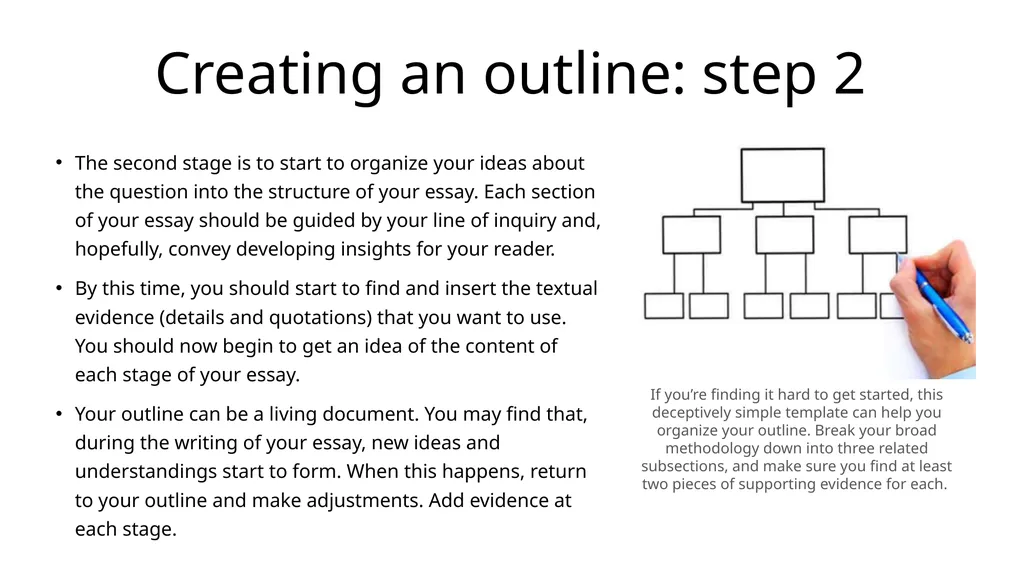
Creating an outline: step 2 The second stage is to start to organize your ideas about the question into the structure of your essay. Each section of your essay should be guided by your line of inquiry and, hopefully, convey developing insights for your reader.
By this time, you should start to find and insert the textual evidence (details and quotations) that you want to use. You should now begin to get an idea of the content of each stage of your essay.
Your outline can be a living document. You may find that, during the writing of your essay, new ideas and understandings start to form. When this happens, return to your outline and make adjustments. Add evidence at each stage. If you’re finding it hard to get started, this deceptively simple template can help you organize your outline. Break your broad methodology down into three related subsections, and make sure you find at least two pieces of supporting evidence for each.<br>
By this time, you should start to find and insert the textual evidence (details and quotations) that you want to use. You should now begin to get an idea of the content of each stage of your essay.
Your outline can be a living document. You may find that, during the writing of your essay, new ideas and understandings start to form. When this happens, return to your outline and make adjustments. Add evidence at each stage. If you’re finding it hard to get started, this deceptively simple template can help you organize your outline. Break your broad methodology down into three related subsections, and make sure you find at least two pieces of supporting evidence for each.<br>
21
What your examiners say Extract from May 2024 Subject Report The best essays identify a range of authorial choices in relation to the work or body of work as a whole, analyse the effects created, and develop a coherent argument which connects these to the chosen focus. The best responses use pertinent textual evidence precisely and concisely. These students use evidence to support their emerging interpretation to suggest they have considered their work in an independent manner. The claims they make are substantiated by convincing use of textual details.<br>
22
Writing your Introduction Once you have settled on your outline, you are ready to begin writing. Sometimes getting started is the hardest part. If you can encapsulate your HL Essay in one paragraph, though, you know you have planned a project that is likely to be successful. A good introduction should achieve the following things:
Introduce the author, with pertinent detail (e.g. time period, geographical location, etc);
Broadly introduce the body of work or literary work;
Establish what the focus of the essay is going to be;
Introduce your analytical methodology;
State your thesis.<br>
Introduce the author, with pertinent detail (e.g. time period, geographical location, etc);
Broadly introduce the body of work or literary work;
Establish what the focus of the essay is going to be;
Introduce your analytical methodology;
State your thesis.<br>
23
On the next four slides you will read different introductions to successful HL essays. Can you identify the five elements that make a complete introduction?
Is there any information missing?
Can you suggest any improvement?
After you discuss each example, click on the essay question to find ‘notes from an examiner’ that might help you understand the strengths and weaknesses of the writing.<br>
Is there any information missing?
Can you suggest any improvement?
After you discuss each example, click on the essay question to find ‘notes from an examiner’ that might help you understand the strengths and weaknesses of the writing.<br>
24
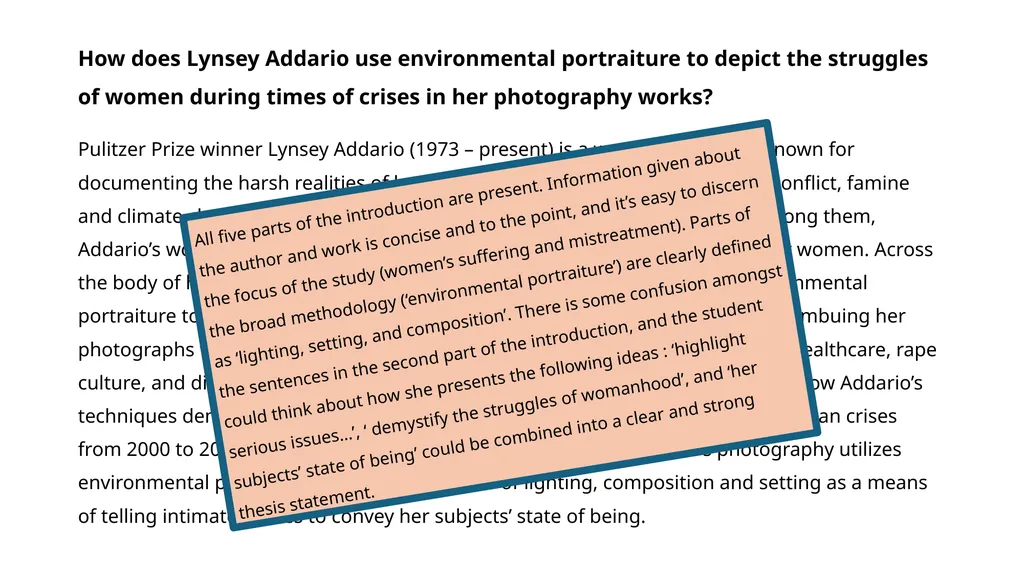
How does Lynsey Addario use environmental portraiture to depict the struggles of women during times of crises in her photography works? Pulitzer Prize winner Lynsey Addario (1973 – present) is a war photographer known for documenting the harsh realities of humanitarian crises arising from wartime conflict, famine and climate change. These crises affect a sweeping number of victims, and among them, Addario’s work focuses on the sufferings and mistreatment faced specifically by women. Across the body of her work, she extensively employs the powerful technique of environmental portraiture to produce candid portrayals of her subjects in their natural setting, imbuing her photographs with the requisite depth needed to highlight the serious issues of healthcare, rape culture, and displacement these women grapple with. Ultimately, it can be seen how Addario’s techniques demystify the struggles of womanhood during the times of humanitarian crises from 2000 to 2020. Hence, this essay will explore how Lynsey Addario’s photography utilizes environmental portraiture through techniques of lighting, composition and setting as a means of telling intimate stories to convey her subjects’ state of being. All five parts of the introduction are present. Information given about the author and work is concise and to the point, and it’s easy to discern the focus of the study (women’s suffering and mistreatment). Parts of the broad methodology (‘environmental portraiture’) are clearly defined as ‘lighting, setting, and composition’. There is some confusion amongst the sentences in the second part of the introduction, and the student could think about how she presents the following ideas : ‘highlight serious issues…’, ‘ demystify the struggles of womanhood’, and ‘her subjects’ state of being’ could be combined into a clear and strong thesis statement.<br>
25
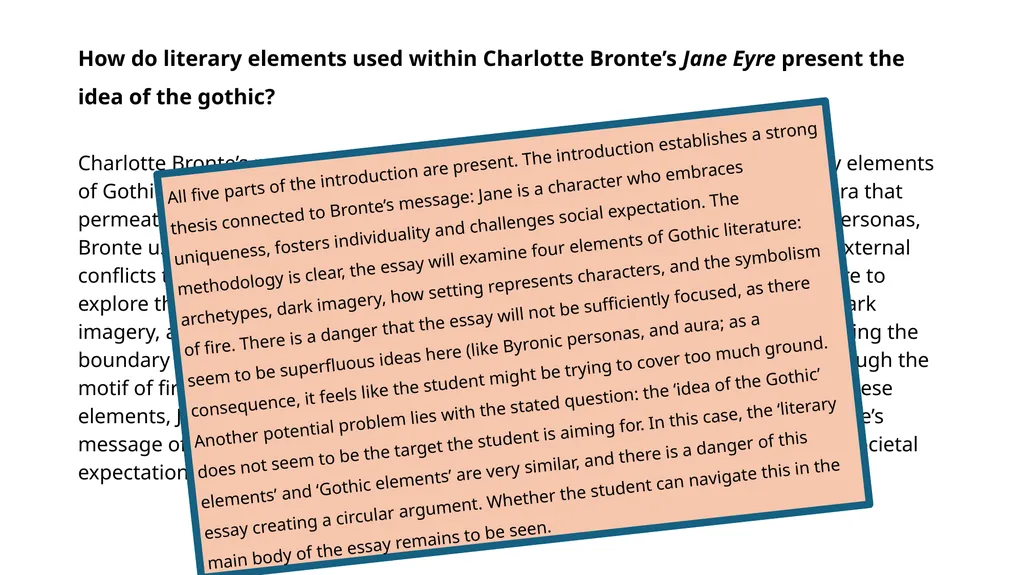
How do literary elements used within Charlotte Bronte’s Jane Eyre present the idea of the gothic? Charlotte Bronte’s novel Jane Eyre (1847) integrates traditional and contemporary elements of Gothic literature to convey timeless lessons about human nature. From the aura that permeates the novel’s pages to the supernatural characterization of its Byronic personas, Bronte uses a plethora of literary elements to offer insight into the internal and external conflicts that govern each individual. In Jane Eyre, Bronte employs the Gothic genre to explore the frailty of the human soul and search for identity. Gothic archetypes, dark imagery, and depictions of nature reflect the inner turmoil of the characters, blurring the boundary between ‘self’ and setting. Use of symbolism is also evident as seen through the motif of fire, which represents both destruction and change. Through the mix of these elements, Jane is seen to be a peculiar yet independent woman, highlighting Bronte’s message of embracing one’s uniqueness, fostering individuality, and challenging societal expectations. All five parts of the introduction are present. The introduction establishes a strong thesis connected to Bronte’s message: Jane is a character who embraces uniqueness, fosters individuality and challenges social expectation. The methodology is clear, the essay will examine four elements of Gothic literature: archetypes, dark imagery, how setting represents characters, and the symbolism of fire. There is a danger that the essay will not be sufficiently focused, as there seem to be superfluous ideas here (like Byronic personas, and aura; as a consequence, it feels like the student might be trying to cover too much ground. Another potential problem lies with the stated question: the ‘idea of the Gothic’ does not seem to be the target the student is aiming for. In this case, the ‘literary elements’ and ‘Gothic elements’ are very similar, and there is a danger of this essay creating a circular argument. Whether the student can navigate this in the main body of the essay remains to be seen.<br>
26
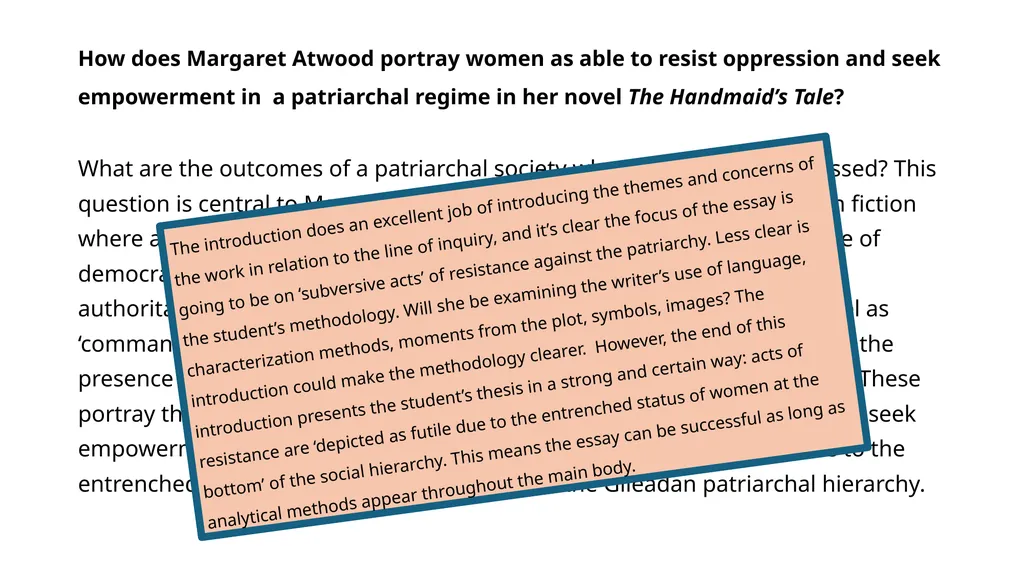
How does Margaret Atwood portray women as able to resist oppression and seek empowerment in a patriarchal regime in her novel The Handmaid’s Tale? What are the outcomes of a patriarchal society where women are oppressed? This question is central to Margaret Atwood’s The Handmaid’s Tale, a dystopian fiction where a totalitarian theocracy has been established following the collapse of democracy. Under this patriarchal regime, known as ‘Republic of Gilead’, authoritarian roles are commandeered by white males (known in the novel as ‘commanders’) Although they subjugate female agency, Atwood alludes to the presence of female resistance, implicitly pursued through subversive acts. These portray the power of female identity in its attempt to resist oppression and seek empowerment. However, these attempts are often depicted as futile due to the entrenched status of women at the bottom of the Gileadan patriarchal hierarchy. The introduction does an excellent job of introducing the themes and concerns of the work in relation to the line of inquiry, and it’s clear the focus of the essay is going to be on ‘subversive acts’ of resistance against the patriarchy. Less clear is the student’s methodology. Will she be examining the writer’s use of language, characterization methods, moments from the plot, symbols, images? The introduction could make the methodology clearer. However, the end of this introduction presents the student’s thesis in a strong and certain way: acts of resistance are ‘depicted as futile due to the entrenched status of women at the bottom’ of the social hierarchy. This means the essay can be successful as long as analytical methods appear throughout the main body.<br>
27
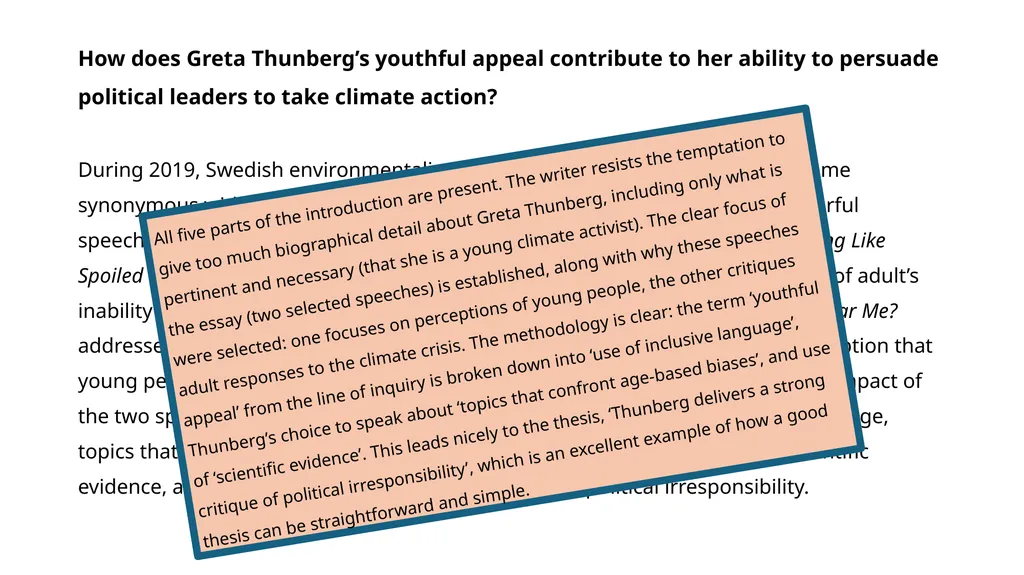
How does Greta Thunberg’s youthful appeal contribute to her ability to persuade political leaders to take climate action? During 2019, Swedish environmentalist Greta Thunberg, a name that has become synonymous with the worldwide pleas for climate activism, delivered two powerful speeches on behalf of youth activists to political leaders. The first, You’re All Acting Like Spoiled Children (February 21st) challenged age-based hierarchies with a critique of adult’s inability to respond to the climate crisis. The second (April 23rd), titled Can You Hear Me? addressed the challenges that come with being a young activist due to the perception that young people are ignorant of current global issues. This essay will highlight the impact of the two speeches by focusing on her effective and strategic use of inclusive language, topics that confront age-based biases, and how she links youth activism to scientific evidence, all combining to deliver a strong critique of political irresponsibility. All five parts of the introduction are present. The writer resists the temptation to give too much biographical detail about Greta Thunberg, including only what is pertinent and necessary (that she is a young climate activist). The clear focus of the essay (two selected speeches) is established, along with why these speeches were selected: one focuses on perceptions of young people, the other critiques adult responses to the climate crisis. The methodology is clear: the term ‘youthful appeal’ from the line of inquiry is broken down into ‘use of inclusive language’, Thunberg’s choice to speak about ‘topics that confront age-based biases’, and use of ‘scientific evidence’. This leads nicely to the thesis, ‘Thunberg delivers a strong critique of political irresponsibility’, which is an excellent example of how a good thesis can be straightforward and simple.<br>
28
What your examiners say Extract from May 2024 Subject Report The essay requires an introduction, in which the body of work or work focused upon, the line of inquiry and the thesis are established. Clarity at this point contributes significantly to an effective structure throughout the essay. In some cases, the candidate demonstrated clearly that they had studied the author and a full body of work, and was able to make reference to themes or techniques across that body of work. Such a breadth of approach in the introduction generally led to a successful essay.<br>
29
Understanding the Mark Scheme: Criteria B As is common in IB English assessments, your writing will be assessed according to four criteria. By understanding the criteria, you can develop a series of top-quality paragraphs that successfully elucidates upon your line of inquiry:
Criteria A: Knowledge, understanding and interpretation
Criteria B: Analysis and evaluation
Criteria C: Focus, organization and development
Criteria D: Use of language<br>
Criteria A: Knowledge, understanding and interpretation
Criteria B: Analysis and evaluation
Criteria C: Focus, organization and development
Criteria D: Use of language<br>
30
Criteria B: Analysis and Evaluation There are many aspects that can make your HL Essay great, but if you have to pick one thing to get good at, it should be analysis.
Each paragraph should contain at least one point of analysis.
Some paragraphs can develop analysis of multiple techniques, explaining how they work together to create certain effects.
Over the next few slides, you’ll see some top-quality paragraphs of analysis. Simply identify the main point of analysis, any supporting points, and what effects are discussed.
If you need help, click the image on the right of each slide to get an outline:<br>
Each paragraph should contain at least one point of analysis.
Some paragraphs can develop analysis of multiple techniques, explaining how they work together to create certain effects.
Over the next few slides, you’ll see some top-quality paragraphs of analysis. Simply identify the main point of analysis, any supporting points, and what effects are discussed.
If you need help, click the image on the right of each slide to get an outline:<br>
31
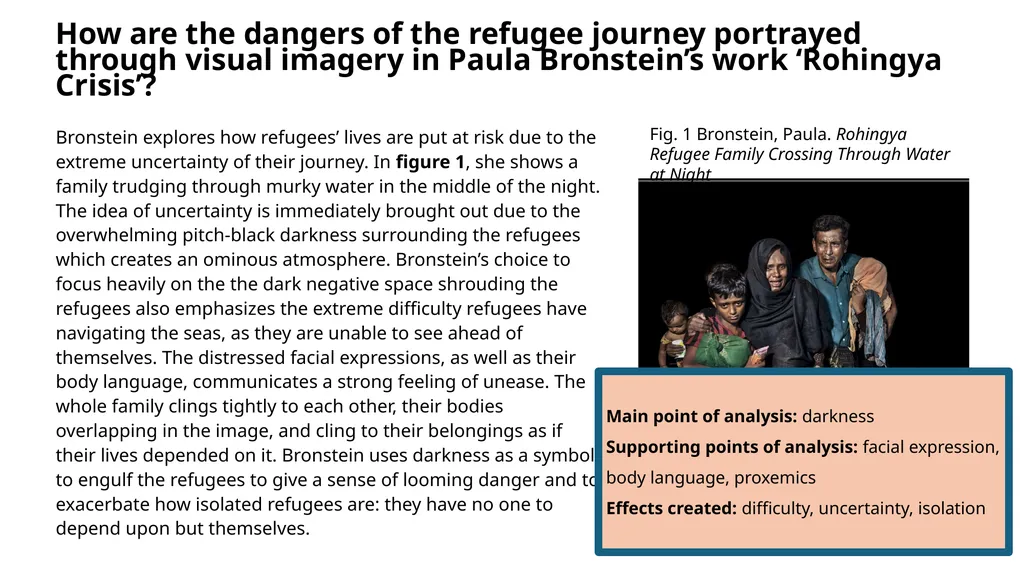
How are the dangers of the refugee journey portrayed through visual imagery in Paula Bronstein’s work ‘Rohingya Crisis’? Bronstein explores how refugees’ lives are put at risk due to the extreme uncertainty of their journey. In figure 1, she shows a family trudging through murky water in the middle of the night. The idea of uncertainty is immediately brought out due to the overwhelming pitch-black darkness surrounding the refugees which creates an ominous atmosphere. Bronstein’s choice to focus heavily on the the dark negative space shrouding the refugees also emphasizes the extreme difficulty refugees have navigating the seas, as they are unable to see ahead of themselves. The distressed facial expressions, as well as their body language, communicates a strong feeling of unease. The whole family clings tightly to each other, their bodies overlapping in the image, and cling to their belongings as if their lives depended on it. Bronstein uses darkness as a symbol to engulf the refugees to give a sense of looming danger and to exacerbate how isolated refugees are: they have no one to depend upon but themselves. Main point of analysis: darkness
Supporting points of analysis: facial expression, body language, proxemics
Effects created: difficulty, uncertainty, isolation Fig. 1 Bronstein, Paula. Rohingya Refugee Family Crossing Through Water at Night<br>
Supporting points of analysis: facial expression, body language, proxemics
Effects created: difficulty, uncertainty, isolation Fig. 1 Bronstein, Paula. Rohingya Refugee Family Crossing Through Water at Night<br>
32
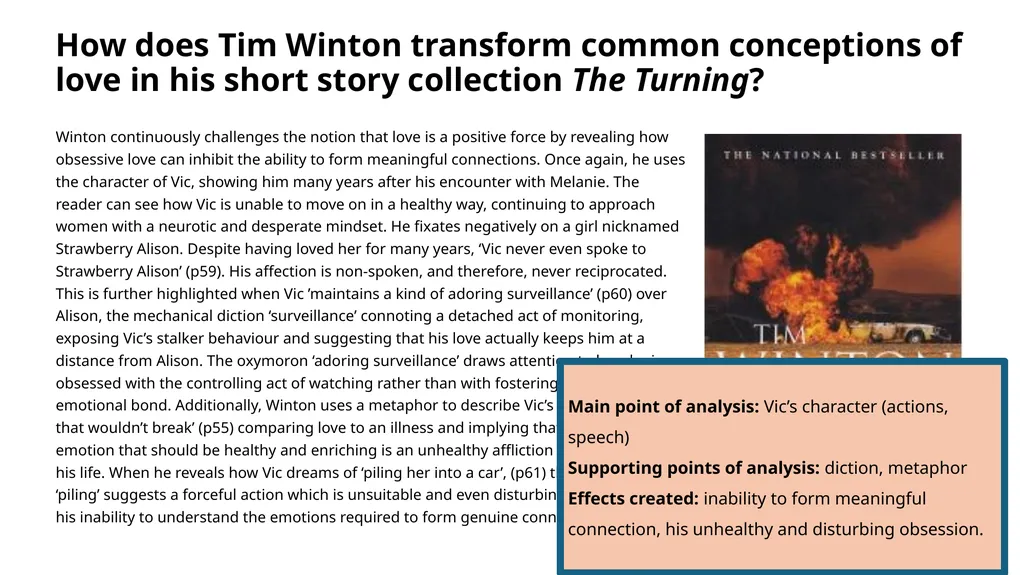
How does Tim Winton transform common conceptions of love in his short story collection The Turning? Winton continuously challenges the notion that love is a positive force by revealing how obsessive love can inhibit the ability to form meaningful connections. Once again, he uses the character of Vic, showing him many years after his encounter with Melanie. The reader can see how Vic is unable to move on in a healthy way, continuing to approach women with a neurotic and desperate mindset. He fixates negatively on a girl nicknamed Strawberry Alison. Despite having loved her for many years, ‘Vic never even spoke to Strawberry Alison’ (p59). His affection is non-spoken, and therefore, never reciprocated. This is further highlighted when Vic ’maintains a kind of adoring surveillance’ (p60) over Alison, the mechanical diction ‘surveillance’ connoting a detached act of monitoring, exposing Vic’s stalker behaviour and suggesting that his love actually keeps him at a distance from Alison. The oxymoron ‘adoring surveillance’ draws attention to how he is obsessed with the controlling act of watching rather than with fostering a genuine emotional bond. Additionally, Winton uses a metaphor to describe Vic’s love ‘like a fever that wouldn’t break’ (p55) comparing love to an illness and implying that, for Vic, an emotion that should be healthy and enriching is an unhealthy affliction that dominates his life. When he reveals how Vic dreams of ‘piling her into a car’, (p61) the active verb ‘piling’ suggests a forceful action which is unsuitable and even disturbing, demonstrating his inability to understand the emotions required to form genuine connections. Main point of analysis: Vic’s character (actions, speech)
Supporting points of analysis: diction, metaphor
Effects created: inability to form meaningful connection, his unhealthy and disturbing obsession.<br>
Supporting points of analysis: diction, metaphor
Effects created: inability to form meaningful connection, his unhealthy and disturbing obsession.<br>
33
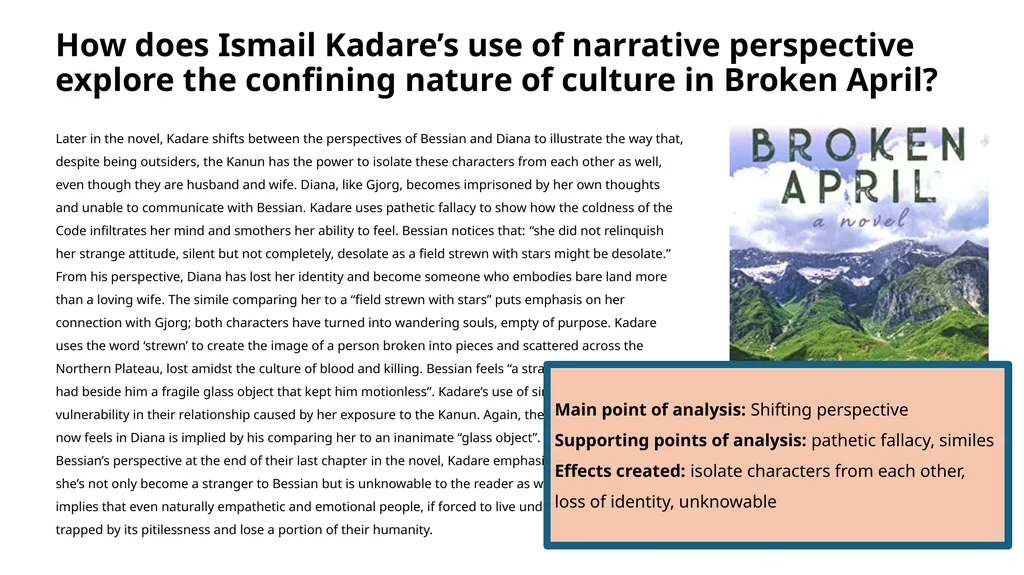
How does Ismail Kadare’s use of narrative perspective explore the confining nature of culture in Broken April? Later in the novel, Kadare shifts between the perspectives of Bessian and Diana to illustrate the way that, despite being outsiders, the Kanun has the power to isolate these characters from each other as well, even though they are husband and wife. Diana, like Gjorg, becomes imprisoned by her own thoughts and unable to communicate with Bessian. Kadare uses pathetic fallacy to show how the coldness of the Code infiltrates her mind and smothers her ability to feel. Bessian notices that: “she did not relinquish her strange attitude, silent but not completely, desolate as a field strewn with stars might be desolate.” From his perspective, Diana has lost her identity and become someone who embodies bare land more than a loving wife. The simile comparing her to a “field strewn with stars” puts emphasis on her connection with Gjorg; both characters have turned into wandering souls, empty of purpose. Kadare uses the word ‘strewn’ to create the image of a person broken into pieces and scattered across the Northern Plateau, lost amidst the culture of blood and killing. Bessian feels “a strange misgiving, as if he had beside him a fragile glass object that kept him motionless”. Kadare’s use of simile suggests a new vulnerability in their relationship caused by her exposure to the Kanun. Again, the lack of humanity he now feels in Diana is implied by his comparing her to an inanimate “glass object”. By switching to Bessian’s perspective at the end of their last chapter in the novel, Kadare emphasizes Diana’s lifelessness; she’s not only become a stranger to Bessian but is unknowable to the reader as well. In this way, Kadare implies that even naturally empathetic and emotional people, if forced to live under the Code, would be trapped by its pitilessness and lose a portion of their humanity. Main point of analysis: Shifting perspective
Supporting points of analysis: pathetic fallacy, similes
Effects created: isolate characters from each other, loss of identity, unknowable<br>
Supporting points of analysis: pathetic fallacy, similes
Effects created: isolate characters from each other, loss of identity, unknowable<br>
34
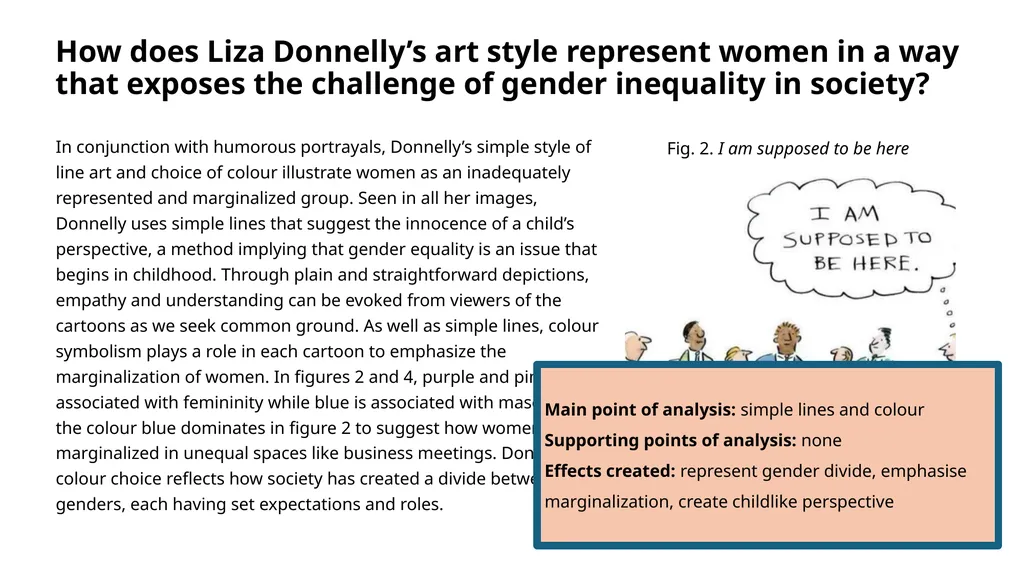
How does Liza Donnelly’s art style represent women in a way that exposes the challenge of gender inequality in society? In conjunction with humorous portrayals, Donnelly’s simple style of line art and choice of colour illustrate women as an inadequately represented and marginalized group. Seen in all her images, Donnelly uses simple lines that suggest the innocence of a child’s perspective, a method implying that gender equality is an issue that begins in childhood. Through plain and straightforward depictions, empathy and understanding can be evoked from viewers of the cartoons as we seek common ground. As well as simple lines, colour symbolism plays a role in each cartoon to emphasize the marginalization of women. In figures 2 and 4, purple and pink are associated with femininity while blue is associated with masculinity; the colour blue dominates in figure 2 to suggest how women are marginalized in unequal spaces like business meetings. Donnelly’s colour choice reflects how society has created a divide between genders, each having set expectations and roles. Main point of analysis: simple lines and colour
Supporting points of analysis: none
Effects created: represent gender divide, emphasise marginalization, create childlike perspective Fig. 2. I am supposed to be here<br>
Supporting points of analysis: none
Effects created: represent gender divide, emphasise marginalization, create childlike perspective Fig. 2. I am supposed to be here<br>
35
What your examiners say Extract from May 2024 Subject Report Students must demonstrate understanding of the conventions and nature of the text type chosen. For example, in fiction, first person point of view... If a student is writing about a graphic text then the visual images as well as the written text must be addressed. A narrow focus on one mode will not do the texts justice. When writing about audio-visual texts… due consideration must be given to mise-en-scene, lighting, sound, camera angles, characterisation, and dialogue as appropriate to the line of inquiry. Simply listing a number of features found in the work.. is not enough for the higher marks. The best essays correctly identify a range of authorial choices in relation to the work as a whole, analyse the effects created, and develop a coherent argument.<br>
36
Time to Write! By this point, you should have enough information to write the first draft of your HL Essay.
Return to your line of inquiry and outline. Check your notes, quotations, and references to the text. Do you have any gaps? Are you starting to see how the parts of your essay will fit together into a cogent whole?
Use your outline to help you produce a first draft. You will have one round of feedback from your teacher to help you improve before the final submission of your HL Essay.<br>
Return to your line of inquiry and outline. Check your notes, quotations, and references to the text. Do you have any gaps? Are you starting to see how the parts of your essay will fit together into a cogent whole?
Use your outline to help you produce a first draft. You will have one round of feedback from your teacher to help you improve before the final submission of your HL Essay.<br>