01
© Hodder & Stoughton Limited 2024 Wildfire hazards:causes, impacts and management Simon Oakes<br>
02
Wildfire hazard themes © Hodder & Stoughton Limited 2024<br>
03
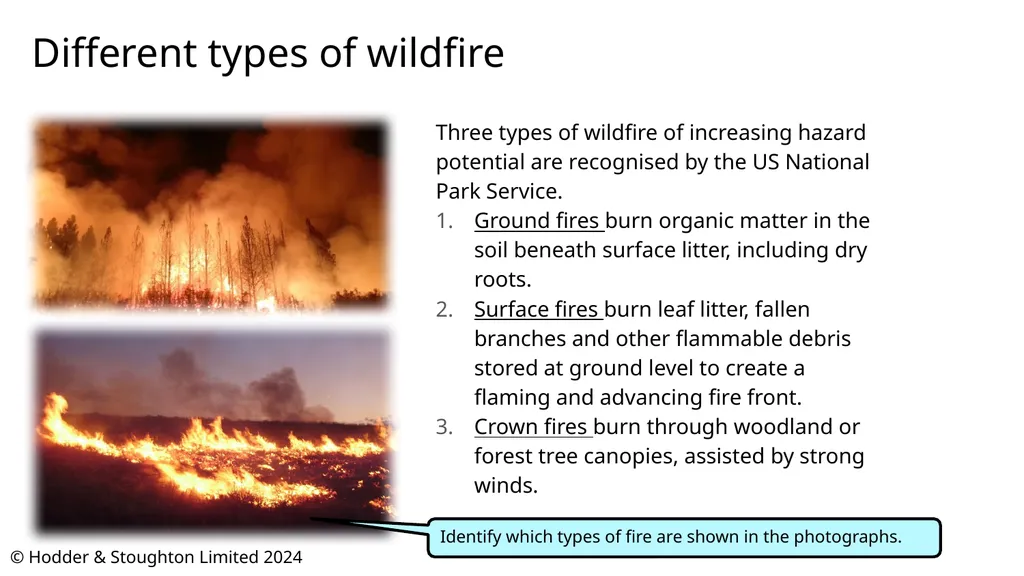
© Hodder & Stoughton Limited 2024 Different types of wildfire Three types of wildfire of increasing hazard potential are recognised by the US National Park Service.
Ground fires burn organic matter in the soil beneath surface litter, including dry roots.
Surface fires burn leaf litter, fallen branches and other flammable debris stored at ground level to create a flaming and advancing fire front.
Crown fires burn through woodland or forest tree canopies, assisted by strong winds. Identify which types of fire are shown in the photographs.<br>
04
Natural and human causes of wildfires © Hodder & Stoughton Limited 2024 Wildfire ignition is caused naturally by lightning which strikes the Earth millions of times every day.
It may also be human induced, either accidently or deliberately.
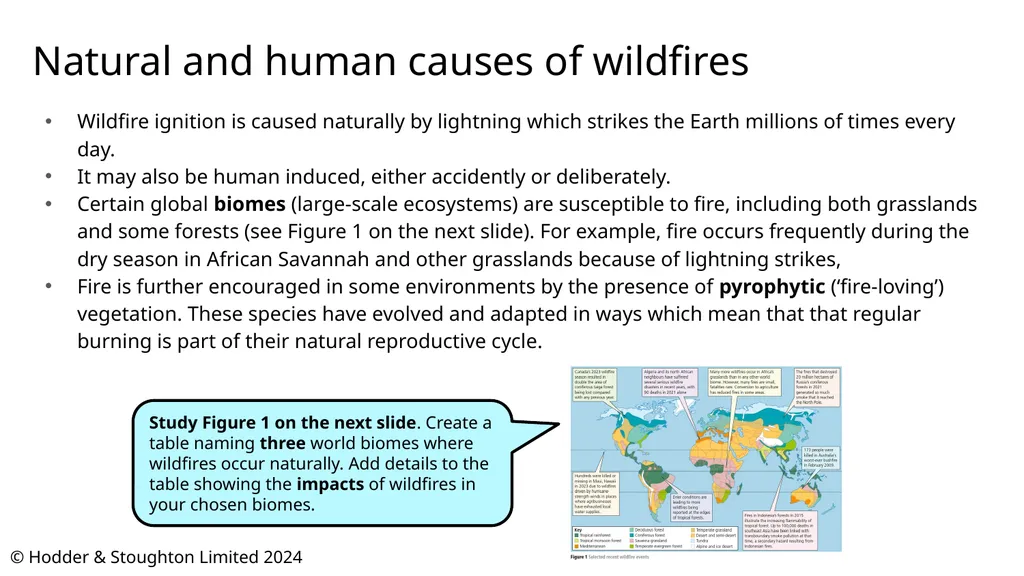
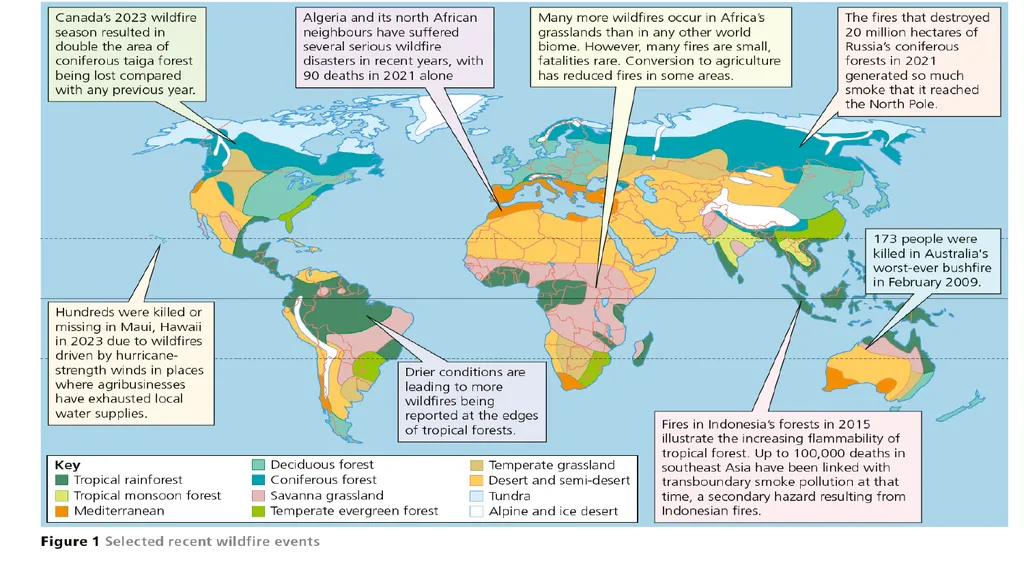
Certain global biomes (large-scale ecosystems) are susceptible to fire, including both grasslands and some forests (see Figure 1 on the next slide). For example, fire occurs frequently during the dry season in African Savannah and other grasslands because of lightning strikes,
Fire is further encouraged in some environments by the presence of pyrophytic (‘fire-loving’) vegetation. These species have evolved and adapted in ways which mean that that regular burning is part of their natural reproductive cycle. Study Figure 1 on the next slide. Create a table naming three world biomes where wildfires occur naturally. Add details to the table showing the impacts of wildfires in your chosen biomes.<br>
05
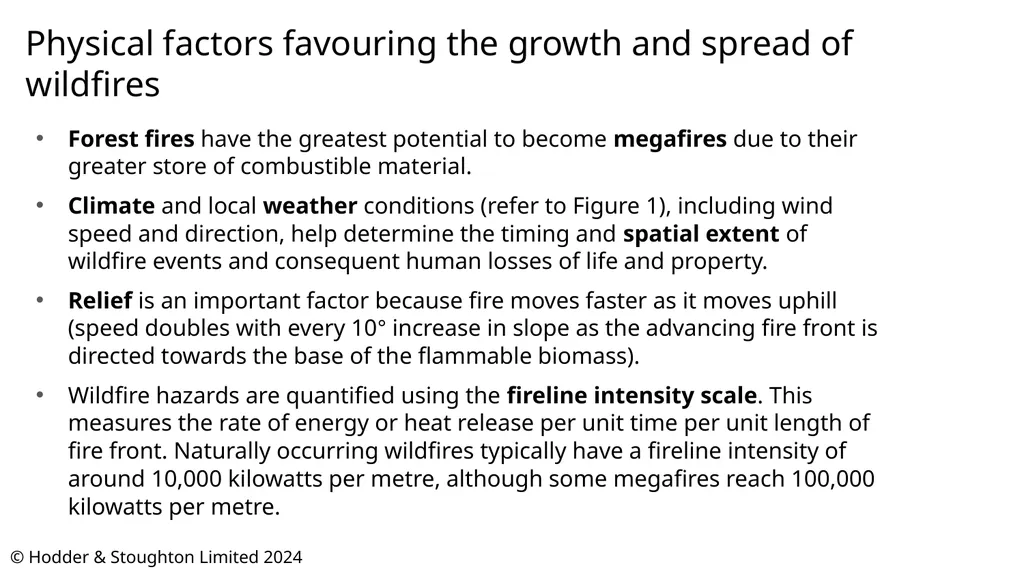
Physical factors favouring the growth and spread of wildfires Forest fires have the greatest potential to become megafires due to their greater store of combustible material.
Climate and local weather conditions (refer to Figure 1), including wind speed and direction, help determine the timing and spatial extent of wildfire events and consequent human losses of life and property.
Relief is an important factor because fire moves faster as it moves uphill (speed doubles with every 10° increase in slope as the advancing fire front is directed towards the base of the flammable biomass).
Wildfire hazards are quantified using the fireline intensity scale. This measures the rate of energy or heat release per unit time per unit length of fire front. Naturally occurring wildfires typically have a fireline intensity of around 10,000 kilowatts per metre, although some megafires reach 100,000 kilowatts per metre. © Hodder & Stoughton Limited 2024<br>
06
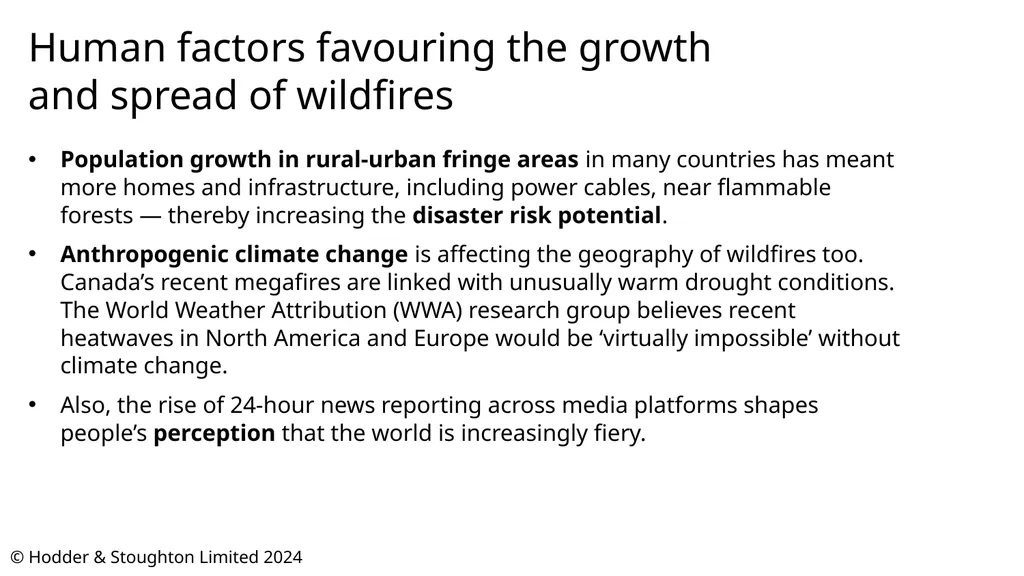
Human factors favouring the growth and spread of wildfires © Hodder & Stoughton Limited 2024 Population growth in rural-urban fringe areas in many countries has meant more homes and infrastructure, including power cables, near flammable forests — thereby increasing the disaster risk potential.
Anthropogenic climate change is affecting the geography of wildfires too. Canada’s recent megafires are linked with unusually warm drought conditions. The World Weather Attribution (WWA) research group believes recent heatwaves in North America and Europe would be ‘virtually impossible’ without climate change.
Also, the rise of 24-hour news reporting across media platforms shapes people’s perception that the world is increasingly fiery.<br>
07
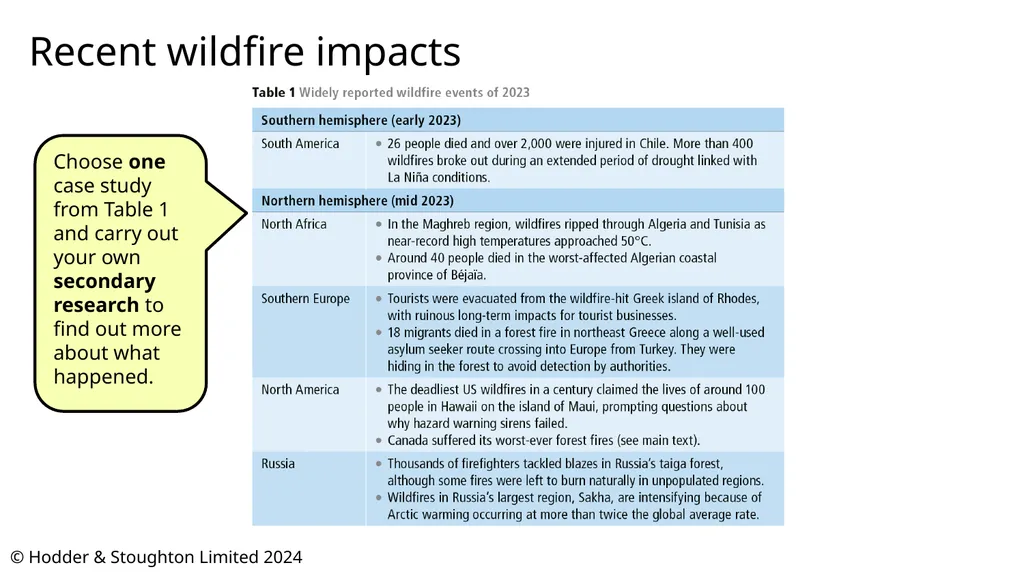
Recent wildfire impacts © Hodder & Stoughton Limited 2024 Choose one case study from Table 1 and carry out your own secondary research to find out more about what happened.<br>
08
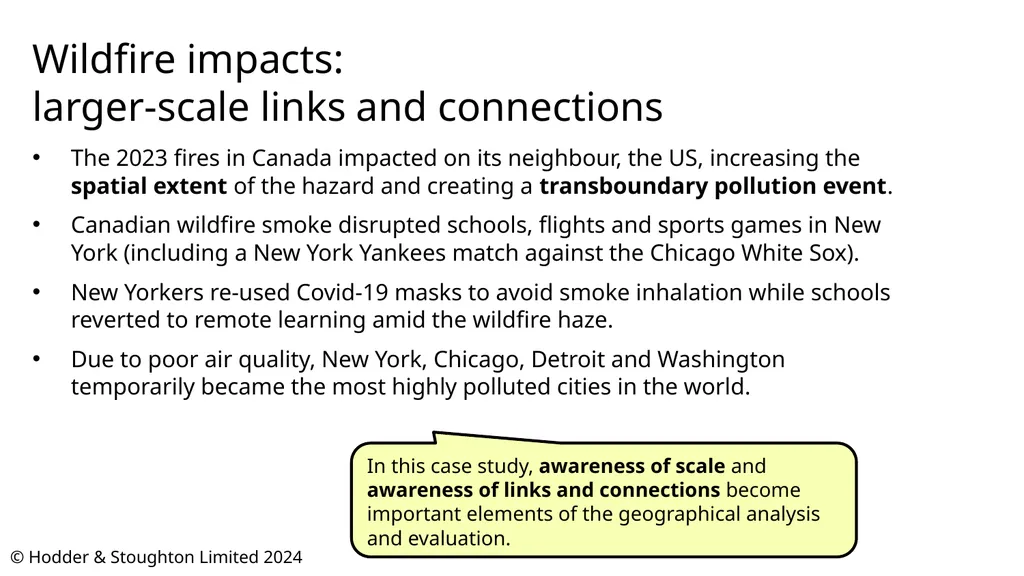
Wildfire impacts:larger-scale links and connections © Hodder & Stoughton Limited 2024 The 2023 fires in Canada impacted on its neighbour, the US, increasing the spatial extent of the hazard and creating a transboundary pollution event.
Canadian wildfire smoke disrupted schools, flights and sports games in New York (including a New York Yankees match against the Chicago White Sox).
New Yorkers re-used Covid-19 masks to avoid smoke inhalation while schools reverted to remote learning amid the wildfire haze.
Due to poor air quality, New York, Chicago, Detroit and Washington temporarily became the most highly polluted cities in the world. In this case study, awareness of scale and awareness of links and connections become important elements of the geographical analysis and evaluation.<br>
09
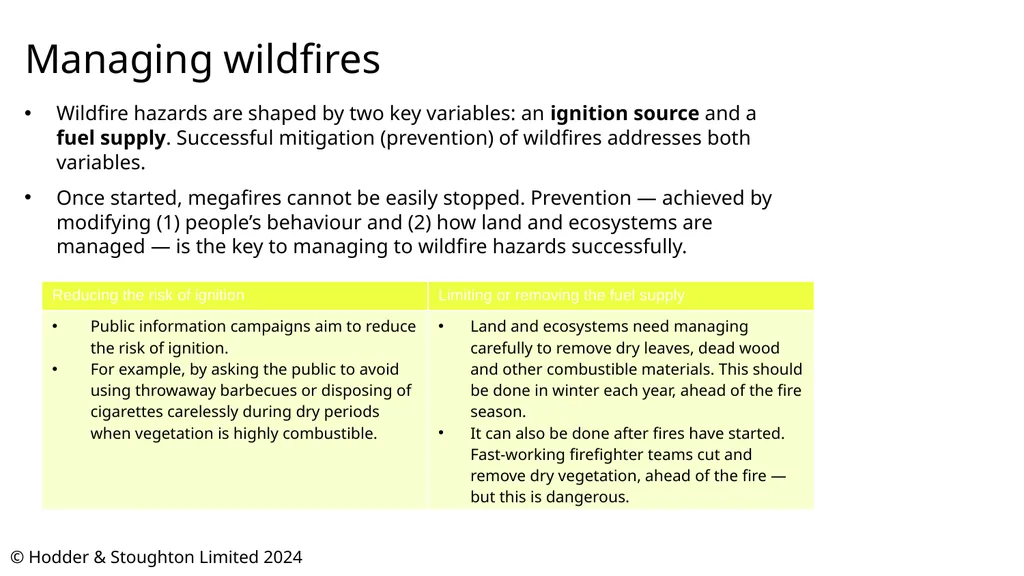
Managing wildfires © Hodder & Stoughton Limited 2024 Wildfire hazards are shaped by two key variables: an ignition source and a fuel supply. Successful mitigation (prevention) of wildfires addresses both variables.
Once started, megafires cannot be easily stopped. Prevention — achieved by modifying (1) people’s behaviour and (2) how land and ecosystems are managed — is the key to managing to wildfire hazards successfully.<br>
10
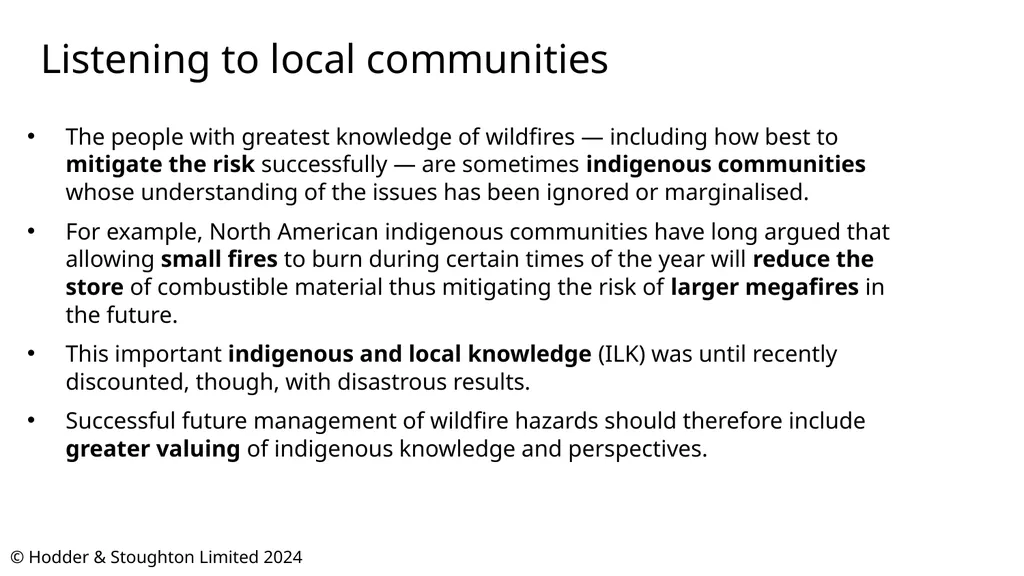
© Hodder & Stoughton Limited 2024 Listening to local communities The people with greatest knowledge of wildfires — including how best to mitigate the risk successfully — are sometimes indigenous communities whose understanding of the issues has been ignored or marginalised.
For example, North American indigenous communities have long argued that allowing small fires to burn during certain times of the year will reduce the store of combustible material thus mitigating the risk of larger megafires in the future.
This important indigenous and local knowledge (ILK) was until recently discounted, though, with disastrous results.
Successful future management of wildfire hazards should therefore include greater valuing of indigenous knowledge and perspectives.<br>
11
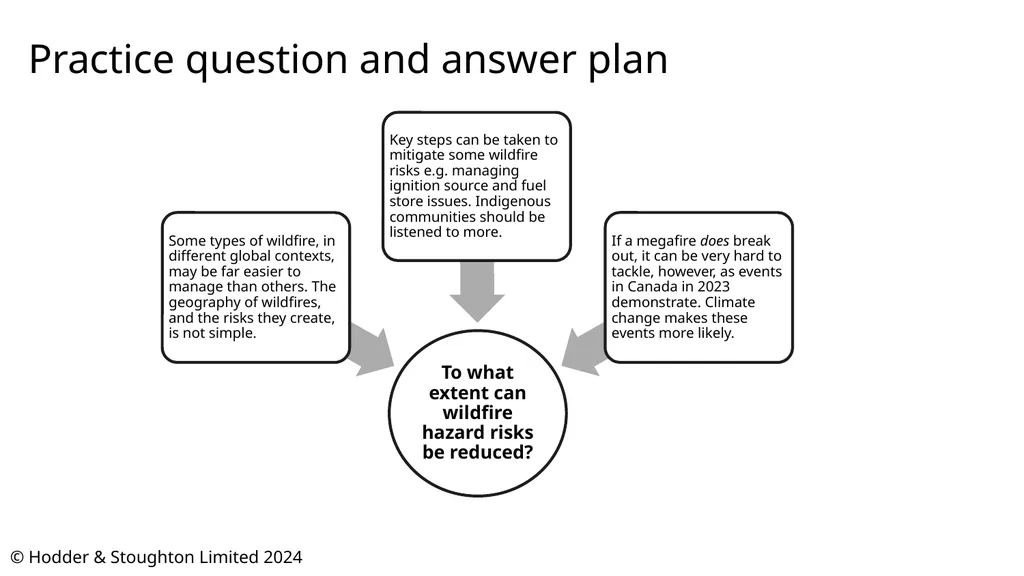
Practice question and answer plan © Hodder & Stoughton Limited 2024<br>
12
Further research BBC 20-minute wildfires podcast: www.tinyurl.com/2zcxfj63
Open Geography wildfires information: www.tinyurl.com/3fruzfp7
Interview with Professor Stefan Doerr: www.tinyurl.com/37jr2n6b
Financial Times wildfires report: www.tinyurl.com/yc6383zb
Canadian Geographic report: www.tinyurl.com/65subs62 © Hodder & Stoughton Limited 2024<br>
13
This resource is part of Geography Review, a magazine written for A-level students by subject experts. To subscribe to the full magazine go to: http://www.hoddereducation.co.uk/geographyreview Slide 1 and 3 images:
https://en.wikipedia.org/wiki/Wildfire#/media/File:The_Rim_Fire_in_the_Stanislaus_National_Forest_near_in_California_began_on_Aug._17,_2013-0004.jpg
https://en.wikipedia.org/wiki/Wildfire#/media/File:2011-08-04_20_00_00_Susie_Fire_in_the_Adobe_Range_west_of_Elko_Nevada.jpg © Hodder & Stoughton Limited 2024<br>
Show all 13 slides