
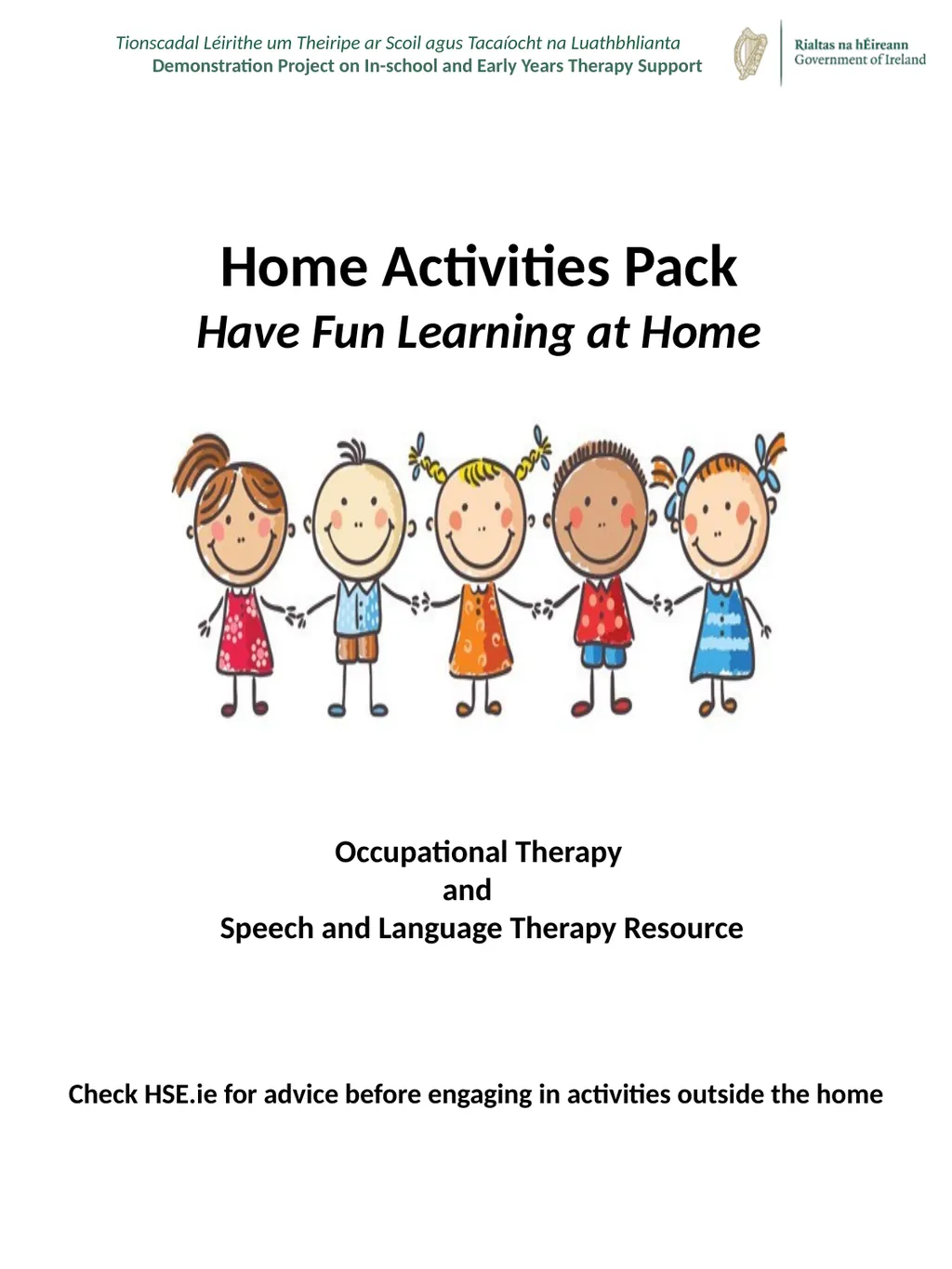
Home Activities Pack Have Fun Learning at Home
T
Published · 14 slides · 0 views

1 / 1




Description
Home Activities Pack Have Fun Learning at Home Tionscadal Léirithe um Theiripe ar Scoil agus Tacaíocht na Luathbhlianta Demonstration Project on In-school and Early Years Therapy Support Occupational Therapy and Speech and Language Therapy
Related Topics
Share
Embed code
Download this presentation From Below
"Home Activities Pack Have Fun Learning at Home" is the property of its rightful owner. Permission is granted to download and print the materials on this website for personal, non-commercial use only, and to display it on your personal computer provided you do not modify the materials and that you retain all copyright notices contained in the materials. By downloading content from our website, you accept the terms of this agreement.
Presentation Transcript
01
Home Activities Pack
Have Fun Learning at Home Tionscadal Léirithe um Theiripe ar Scoil agus Tacaíocht na Luathbhlianta
Demonstration Project on In-school and Early Years Therapy Support Occupational Therapy
and
Speech and Language Therapy Resource Check HSE.ie for advice before engaging in activities outside the home<br>
Demonstration Project on In-school and Early Years Therapy Support Occupational Therapy
and
Speech and Language Therapy Resource Check HSE.ie for advice before engaging in activities outside the home<br>
02
This booklet contains some ideas and games that you can try at home. These fun and easy games will give you and your child a chance to play together, while supporting your child’s skills as they move towards school age.
These activities are designed to develop key skills your child will need when they start school. These skills are:
Attention and Listening: looking; sitting; waiting and listening are all important skills for the classroom. Playing games that develop these skills will help your child to understand and learn.
Pre-reading: book-sharing and phonological awareness (listening and learning how sounds go together to make words) activities get your child ready for when they start learning to read sounds and words.
Gross Motor Skills: involve the large muscles of the body and enable such functions as maintaining balance, walking, climbing, jumping, pushing and ball skills. They are the building blocks of fine motor development. About this Booklet<br>
These activities are designed to develop key skills your child will need when they start school. These skills are:
Attention and Listening: looking; sitting; waiting and listening are all important skills for the classroom. Playing games that develop these skills will help your child to understand and learn.
Pre-reading: book-sharing and phonological awareness (listening and learning how sounds go together to make words) activities get your child ready for when they start learning to read sounds and words.
Gross Motor Skills: involve the large muscles of the body and enable such functions as maintaining balance, walking, climbing, jumping, pushing and ball skills. They are the building blocks of fine motor development. About this Booklet<br>
03
Fine Motor/Pre-writing Skills
The ability to coordinate the action of the eyes and hands together in performing precise manipulative movements. Fine motor skill efficiency will impact on development of lots of everyday skills including dressing, playing with toys, using cutlery and mark-making etc.
Independence Skills
The tasks of everyday life which have a specific value and meaning to individuals. For your child these include everything from putting on his/her coat, using cutlery, getting dressed, opening a lunchbox and zipping/buttoning coats.
Social Skills
Activities that promote communicating with others and help your child to get on well with peers and manage social situations like problem-solving and negotiating.
Language Development
Activities that can be carried out throughout the day by talking about what your child is interested in; naming items; commenting; saying things the right way and repeating new words and phrases. About this Booklet<br>
The ability to coordinate the action of the eyes and hands together in performing precise manipulative movements. Fine motor skill efficiency will impact on development of lots of everyday skills including dressing, playing with toys, using cutlery and mark-making etc.
Independence Skills
The tasks of everyday life which have a specific value and meaning to individuals. For your child these include everything from putting on his/her coat, using cutlery, getting dressed, opening a lunchbox and zipping/buttoning coats.
Social Skills
Activities that promote communicating with others and help your child to get on well with peers and manage social situations like problem-solving and negotiating.
Language Development
Activities that can be carried out throughout the day by talking about what your child is interested in; naming items; commenting; saying things the right way and repeating new words and phrases. About this Booklet<br>
04
General Tips for your Child’s Development! Tionscadal Léirithe um Theiripe ar Scoil agus Tacaíocht na Luathbhlianta
Demonstration Project on In-school and Early Years Therapy Support There are many opportunities to develop your child’s language, communication, movement and independence skills during everyday activities at home. Some general tips to consider include:
Encourage your child to participate in a variety of physical activities and support them to learn and make sense of the world around them through these activities. The more experiences your child is exposed to will influence brain development. Young children are active learners who enjoy learning through play and physical activities. Don’t be too quick to help your child with these tasks. Let them try it out first, and wait to see if they need help. You can even ask “Would you like me to help you?” and wait for them to decide.
Some children lack confidence with their physical skills and may need encouragement. Children need to learn through their own efforts and only then will they be able to interact with and enjoy the environment around them. Consider modifying the environment or activity to enable your child to participate successfully.
Learning new vocabulary. Remember to use a range of words like action words and describing words. This includes concepts such as dry; empty; rough; high; above; beside.<br>
Demonstration Project on In-school and Early Years Therapy Support There are many opportunities to develop your child’s language, communication, movement and independence skills during everyday activities at home. Some general tips to consider include:
Encourage your child to participate in a variety of physical activities and support them to learn and make sense of the world around them through these activities. The more experiences your child is exposed to will influence brain development. Young children are active learners who enjoy learning through play and physical activities. Don’t be too quick to help your child with these tasks. Let them try it out first, and wait to see if they need help. You can even ask “Would you like me to help you?” and wait for them to decide.
Some children lack confidence with their physical skills and may need encouragement. Children need to learn through their own efforts and only then will they be able to interact with and enjoy the environment around them. Consider modifying the environment or activity to enable your child to participate successfully.
Learning new vocabulary. Remember to use a range of words like action words and describing words. This includes concepts such as dry; empty; rough; high; above; beside.<br>
05
General Tips for your Child’s Development! Tionscadal Léirithe um Theiripe ar Scoil agus Tacaíocht na Luathbhlianta
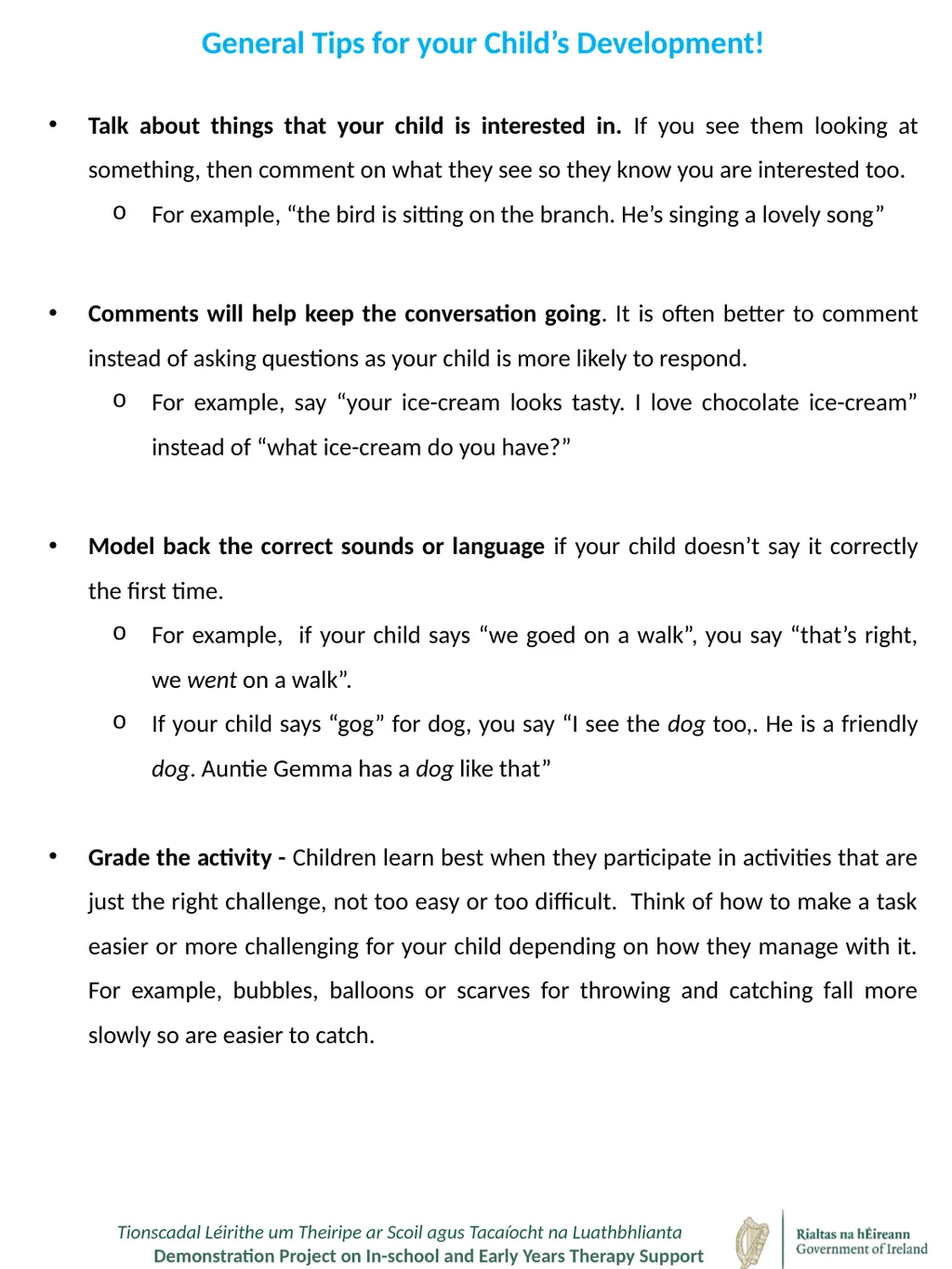
Demonstration Project on In-school and Early Years Therapy Support Talk about things that your child is interested in. If you see them looking at something, then comment on what they see so they know you are interested too.
For example, “the bird is sitting on the branch. He’s singing a lovely song”
Comments will help keep the conversation going. It is often better to comment instead of asking questions as your child is more likely to respond.
For example, say “your ice-cream looks tasty. I love chocolate ice-cream” instead of “what ice-cream do you have?”
Model back the correct sounds or language if your child doesn’t say it correctly the first time.
For example, if your child says “we goed on a walk”, you say “that’s right, we went on a walk”.
If your child says “gog” for dog, you say “I see the dog too,. He is a friendly dog. Auntie Gemma has a dog like that”
Grade the activity - Children learn best when they participate in activities that are just the right challenge, not too easy or too difficult. Think of how to make a task easier or more challenging for your child depending on how they manage with it. For example, bubbles, balloons or scarves for throwing and catching fall more slowly so are easier to catch.<br>
Demonstration Project on In-school and Early Years Therapy Support Talk about things that your child is interested in. If you see them looking at something, then comment on what they see so they know you are interested too.
For example, “the bird is sitting on the branch. He’s singing a lovely song”
Comments will help keep the conversation going. It is often better to comment instead of asking questions as your child is more likely to respond.
For example, say “your ice-cream looks tasty. I love chocolate ice-cream” instead of “what ice-cream do you have?”
Model back the correct sounds or language if your child doesn’t say it correctly the first time.
For example, if your child says “we goed on a walk”, you say “that’s right, we went on a walk”.
If your child says “gog” for dog, you say “I see the dog too,. He is a friendly dog. Auntie Gemma has a dog like that”
Grade the activity - Children learn best when they participate in activities that are just the right challenge, not too easy or too difficult. Think of how to make a task easier or more challenging for your child depending on how they manage with it. For example, bubbles, balloons or scarves for throwing and catching fall more slowly so are easier to catch.<br>
06
Tionscadal Léirithe um Theiripe ar Scoil agus Tacaíocht na Luathbhlianta
Demonstration Project on In-school and Early Years Therapy Support Woodland Wonder Play ‘I Spy’ as you walk around the woods. Comment on what the animals or woodland items are doing when you see them, e.g. “The birds are chirping” or “The wind is whistling” Find animals that fly; that swim; that run, that hop etc.
Model the sentence for your child and repeat the key word a few times,
e.g. “that’s right – the rabbit hops. You show me your rabbit hop. Wow, that’s a big rabbit hop!” Label the new animals that your child might not know, e.g. “oh look, that’s a hedgehog. He is spikey and small and has a pointy nose”. See if your child can identify where the animal lives for example, for younger children, if they can identify water for a fish, a tree or nest for birds etc.
For older children you can ask them to describe the body parts of the animals for example, beak, snout, fin etc. Before you go, encourage your child to think about what animals they might see in the woods. Clap out the syllables/beats in the animal names:
Hedgehog (2 syllables)
Butterflies (3 syllables)
Rabbit (2 syllables)
Fish (1 syllable)
Bird (1 syllable) Sing an action rhyme before, during or after your zoo trip. For example sing the rhyme to the tune of Old McDonald …. For example
Old McDonald walked in the woods,
ee, ii, ee, ii, oo.
And in those woods he saw a dog,
ee, ii, ee, ii, oo<br>
Demonstration Project on In-school and Early Years Therapy Support Woodland Wonder Play ‘I Spy’ as you walk around the woods. Comment on what the animals or woodland items are doing when you see them, e.g. “The birds are chirping” or “The wind is whistling” Find animals that fly; that swim; that run, that hop etc.
Model the sentence for your child and repeat the key word a few times,
e.g. “that’s right – the rabbit hops. You show me your rabbit hop. Wow, that’s a big rabbit hop!” Label the new animals that your child might not know, e.g. “oh look, that’s a hedgehog. He is spikey and small and has a pointy nose”. See if your child can identify where the animal lives for example, for younger children, if they can identify water for a fish, a tree or nest for birds etc.
For older children you can ask them to describe the body parts of the animals for example, beak, snout, fin etc. Before you go, encourage your child to think about what animals they might see in the woods. Clap out the syllables/beats in the animal names:
Hedgehog (2 syllables)
Butterflies (3 syllables)
Rabbit (2 syllables)
Fish (1 syllable)
Bird (1 syllable) Sing an action rhyme before, during or after your zoo trip. For example sing the rhyme to the tune of Old McDonald …. For example
Old McDonald walked in the woods,
ee, ii, ee, ii, oo.
And in those woods he saw a dog,
ee, ii, ee, ii, oo<br>
07
Tionscadal Léirithe um Theiripe ar Scoil agus Tacaíocht na Luathbhlianta
Demonstration Project on In-school and Early Years Therapy Support Bear hunt !
(play at home before or after trip)
Make an obstacle course pretending the children are going on a bear hunt.
Try to use lots of movement opportunities such as balancing on tip toes along tape on the ground, crawling over and under items, crossing the ‘lake’ on stepping stones, for balance and body control. Arts and crafts are a really nice way to encourage development of fine motor skills. Lots of woodland themed arts and crafts can be found online for example; Prickly Tickly Hedgehog;
You will need a paper plate, crayons and a child’s safety scissors.
Cut a small paper plate in half and colour it.
Make snips around the outside edge of the plate beginning just above the head for the spikes.
Fold the first spike backwards, the second forwards etc.
Draw on face
You can add to your hedgehog by using other materials such as snipped pieces of straws or shredded paper. What Time is it Mr Wolf?
One child is the ‘wolf’ and the rest are the ‘sheep’. The wolf stands at one end of the garden /room with his/her back to the sheep.
The sheep call out ‘What time is it Mr. Wolf?’
Mr. Wolf turns to face them and shouts a time (e.g. 2 o’clock).
The sheep then take the same number of steps as the time (e.g. 2 steps).
Mr. Wolf turns his back again for the sheep to call out ‘What time is it Mr. Wolf?’
When the sheep get close to the wolf he shouts out ‘dinner time’ and chases them back to the start line (their den!).
If a sheep gets caught, they become Mr. Wolf. Sammy snail
Ask your child to lie on his/her tummy on a mat and place a bean-bag on their back.
Pretend they are a snail and using a ‘commando crawl’, move slowly and carefully along the mat so that they don’t lose their ‘house’.
When the leader shouts ‘danger’ your child should attempt to curl up into a ball (going into their ‘shell’), whilst trying to keep the bean-bag (house) on their backs.<br>
Demonstration Project on In-school and Early Years Therapy Support Bear hunt !
(play at home before or after trip)
Make an obstacle course pretending the children are going on a bear hunt.
Try to use lots of movement opportunities such as balancing on tip toes along tape on the ground, crawling over and under items, crossing the ‘lake’ on stepping stones, for balance and body control. Arts and crafts are a really nice way to encourage development of fine motor skills. Lots of woodland themed arts and crafts can be found online for example; Prickly Tickly Hedgehog;
You will need a paper plate, crayons and a child’s safety scissors.
Cut a small paper plate in half and colour it.
Make snips around the outside edge of the plate beginning just above the head for the spikes.
Fold the first spike backwards, the second forwards etc.
Draw on face
You can add to your hedgehog by using other materials such as snipped pieces of straws or shredded paper. What Time is it Mr Wolf?
One child is the ‘wolf’ and the rest are the ‘sheep’. The wolf stands at one end of the garden /room with his/her back to the sheep.
The sheep call out ‘What time is it Mr. Wolf?’
Mr. Wolf turns to face them and shouts a time (e.g. 2 o’clock).
The sheep then take the same number of steps as the time (e.g. 2 steps).
Mr. Wolf turns his back again for the sheep to call out ‘What time is it Mr. Wolf?’
When the sheep get close to the wolf he shouts out ‘dinner time’ and chases them back to the start line (their den!).
If a sheep gets caught, they become Mr. Wolf. Sammy snail
Ask your child to lie on his/her tummy on a mat and place a bean-bag on their back.
Pretend they are a snail and using a ‘commando crawl’, move slowly and carefully along the mat so that they don’t lose their ‘house’.
When the leader shouts ‘danger’ your child should attempt to curl up into a ball (going into their ‘shell’), whilst trying to keep the bean-bag (house) on their backs.<br>
08
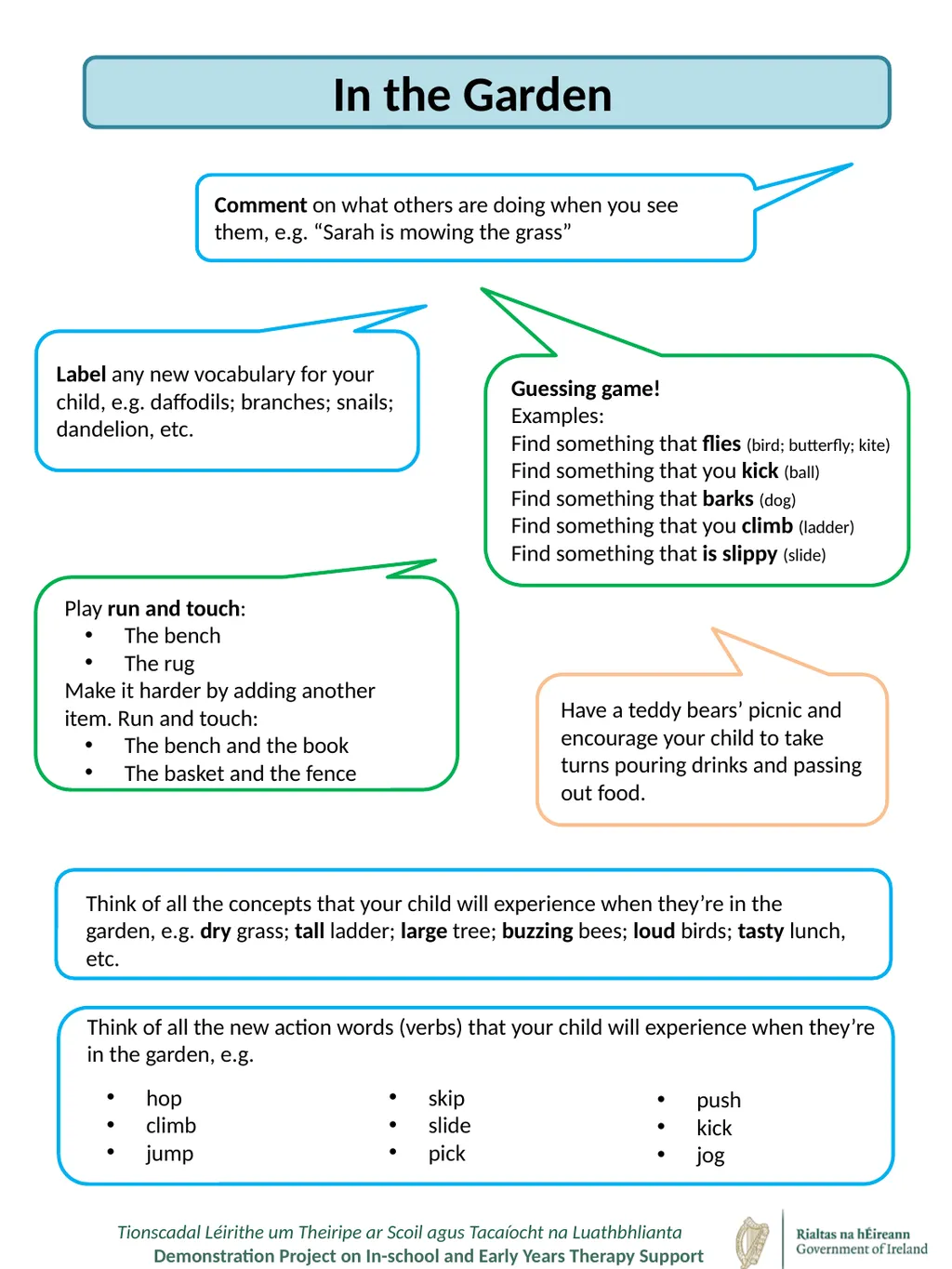
In the Garden \\\\\ Comment on what others are doing when you see them, e.g. “Sarah is mowing the grass” Guessing game!
Examples:
Find something that flies (bird; butterfly; kite)
Find something that you kick (ball)
Find something that barks (dog)
Find something that you climb (ladder)
Find something that is slippy (slide) Label any new vocabulary for your child, e.g. daffodils; branches; snails; dandelion, etc. Think of all the concepts that your child will experience when they’re in the garden, e.g. dry grass; tall ladder; large tree; buzzing bees; loud birds; tasty lunch, etc. Think of all the new action words (verbs) that your child will experience when they’re in the garden, e.g. hop
climb
jump skip
slide
pick push
kick
jog Tionscadal Léirithe um Theiripe ar Scoil agus Tacaíocht na Luathbhlianta
Demonstration Project on In-school and Early Years Therapy Support Have a teddy bears’ picnic and encourage your child to take turns pouring drinks and passing out food. Play run and touch:
The bench
The rug
Make it harder by adding another item. Run and touch:
The bench and the book
The basket and the fence<br>
Examples:
Find something that flies (bird; butterfly; kite)
Find something that you kick (ball)
Find something that barks (dog)
Find something that you climb (ladder)
Find something that is slippy (slide) Label any new vocabulary for your child, e.g. daffodils; branches; snails; dandelion, etc. Think of all the concepts that your child will experience when they’re in the garden, e.g. dry grass; tall ladder; large tree; buzzing bees; loud birds; tasty lunch, etc. Think of all the new action words (verbs) that your child will experience when they’re in the garden, e.g. hop
climb
jump skip
slide
pick push
kick
jog Tionscadal Léirithe um Theiripe ar Scoil agus Tacaíocht na Luathbhlianta
Demonstration Project on In-school and Early Years Therapy Support Have a teddy bears’ picnic and encourage your child to take turns pouring drinks and passing out food. Play run and touch:
The bench
The rug
Make it harder by adding another item. Run and touch:
The bench and the book
The basket and the fence<br>
09
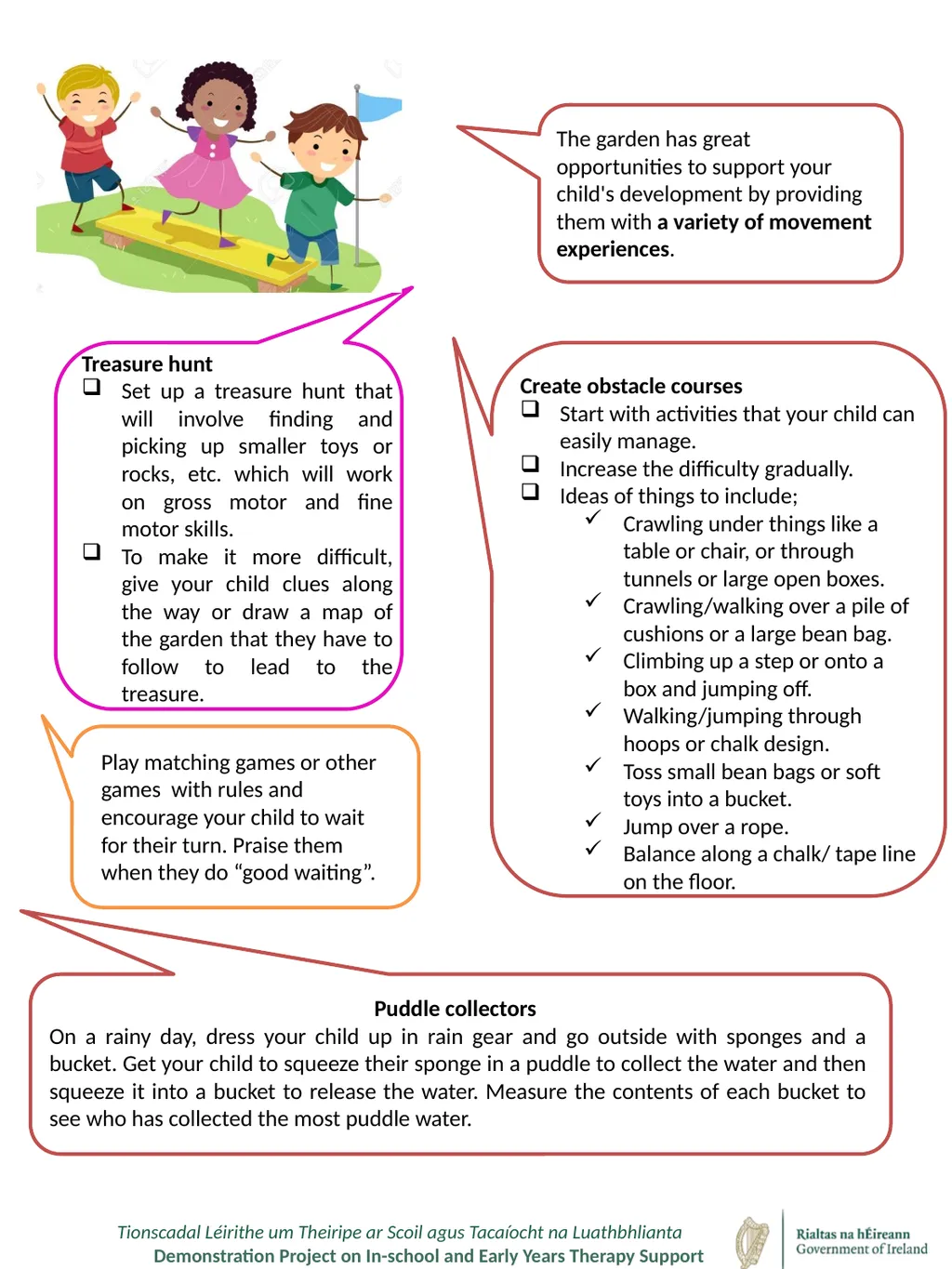
\\\\\ Play matching games or other games with rules and encourage your child to wait for their turn. Praise them when they do “good waiting”. Treasure hunt
Set up a treasure hunt that will involve finding and picking up smaller toys or rocks, etc. which will work on gross motor and fine motor skills.
To make it more difficult, give your child clues along the way or draw a map of the garden that they have to follow to lead to the treasure. The garden has great opportunities to support your child's development by providing them with a variety of movement experiences. Tionscadal Léirithe um Theiripe ar Scoil agus Tacaíocht na Luathbhlianta
Demonstration Project on In-school and Early Years Therapy Support Create obstacle courses
Start with activities that your child can easily manage.
Increase the difficulty gradually.
Ideas of things to include;
Crawling under things like a table or chair, or through tunnels or large open boxes.
Crawling/walking over a pile of cushions or a large bean bag.
Climbing up a step or onto a box and jumping off.
Walking/jumping through hoops or chalk design.
Toss small bean bags or soft toys into a bucket.
Jump over a rope.
Balance along a chalk/ tape line on the floor. \\\\\ Puddle collectors
On a rainy day, dress your child up in rain gear and go outside with sponges and a bucket. Get your child to squeeze their sponge in a puddle to collect the water and then squeeze it into a bucket to release the water. Measure the contents of each bucket to see who has collected the most puddle water.<br>
Set up a treasure hunt that will involve finding and picking up smaller toys or rocks, etc. which will work on gross motor and fine motor skills.
To make it more difficult, give your child clues along the way or draw a map of the garden that they have to follow to lead to the treasure. The garden has great opportunities to support your child's development by providing them with a variety of movement experiences. Tionscadal Léirithe um Theiripe ar Scoil agus Tacaíocht na Luathbhlianta
Demonstration Project on In-school and Early Years Therapy Support Create obstacle courses
Start with activities that your child can easily manage.
Increase the difficulty gradually.
Ideas of things to include;
Crawling under things like a table or chair, or through tunnels or large open boxes.
Crawling/walking over a pile of cushions or a large bean bag.
Climbing up a step or onto a box and jumping off.
Walking/jumping through hoops or chalk design.
Toss small bean bags or soft toys into a bucket.
Jump over a rope.
Balance along a chalk/ tape line on the floor. \\\\\ Puddle collectors
On a rainy day, dress your child up in rain gear and go outside with sponges and a bucket. Get your child to squeeze their sponge in a puddle to collect the water and then squeeze it into a bucket to release the water. Measure the contents of each bucket to see who has collected the most puddle water.<br>
10
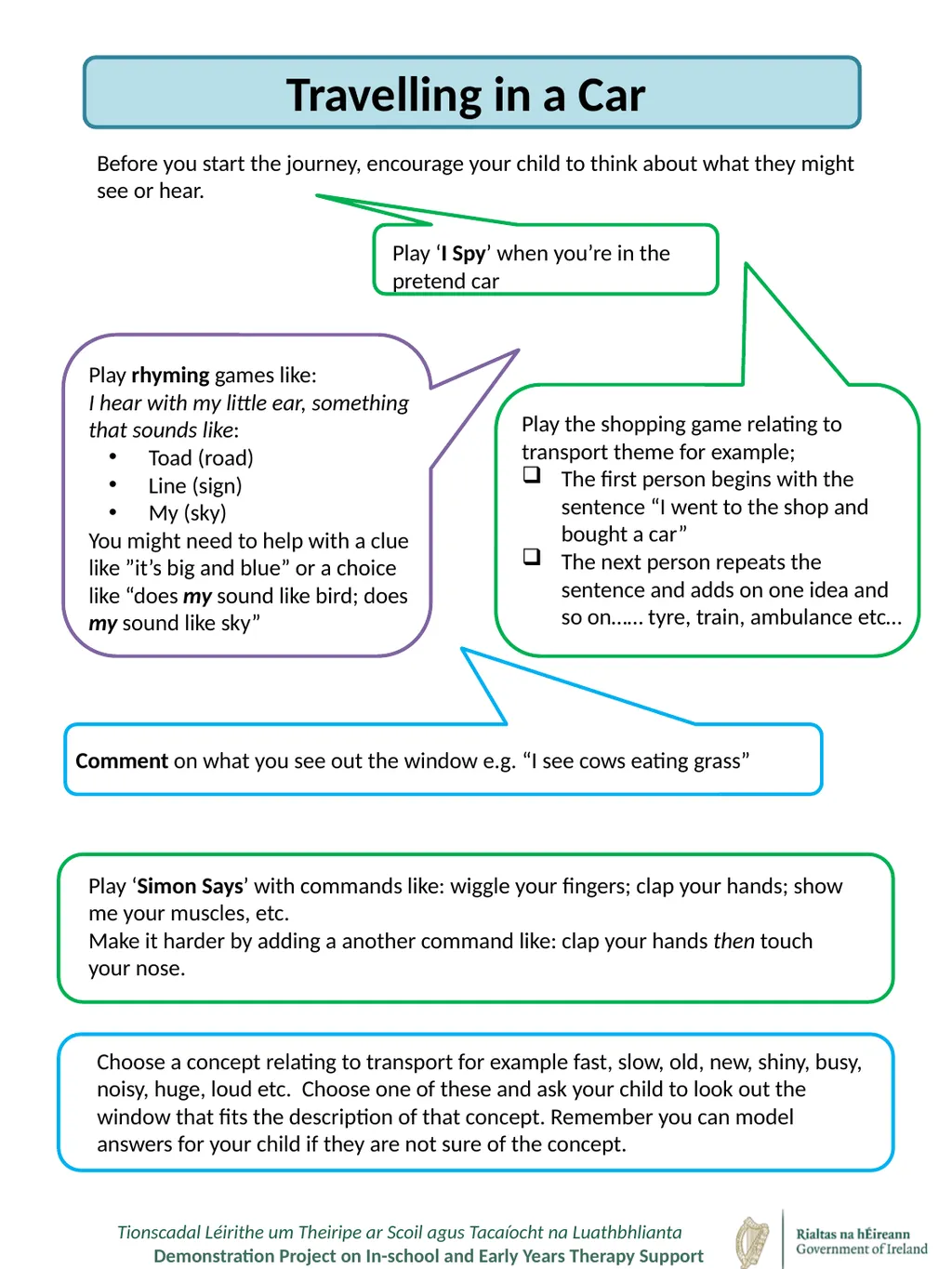
Travelling in a Car \\\\\ Play the shopping game relating to transport theme for example;
The first person begins with the sentence “I went to the shop and bought a car”
The next person repeats the sentence and adds on one idea and so on…… tyre, train, ambulance etc… Play rhyming games like:
I hear with my little ear, something that sounds like:
Toad (road)
Line (sign)
My (sky)
You might need to help with a clue like ”it’s big and blue” or a choice like “does my sound like bird; does my sound like sky” Choose a concept relating to transport for example fast, slow, old, new, shiny, busy, noisy, huge, loud etc. Choose one of these and ask your child to look out the window that fits the description of that concept. Remember you can model answers for your child if they are not sure of the concept. Before you start the journey, encourage your child to think about what they might see or hear. Play ‘I Spy’ when you’re in the pretend car Tionscadal Léirithe um Theiripe ar Scoil agus Tacaíocht na Luathbhlianta
Demonstration Project on In-school and Early Years Therapy Support Comment on what you see out the window e.g. “I see cows eating grass” Play ‘Simon Says’ with commands like: wiggle your fingers; clap your hands; show me your muscles, etc.
Make it harder by adding a another command like: clap your hands then touch your nose.<br>
The first person begins with the sentence “I went to the shop and bought a car”
The next person repeats the sentence and adds on one idea and so on…… tyre, train, ambulance etc… Play rhyming games like:
I hear with my little ear, something that sounds like:
Toad (road)
Line (sign)
My (sky)
You might need to help with a clue like ”it’s big and blue” or a choice like “does my sound like bird; does my sound like sky” Choose a concept relating to transport for example fast, slow, old, new, shiny, busy, noisy, huge, loud etc. Choose one of these and ask your child to look out the window that fits the description of that concept. Remember you can model answers for your child if they are not sure of the concept. Before you start the journey, encourage your child to think about what they might see or hear. Play ‘I Spy’ when you’re in the pretend car Tionscadal Léirithe um Theiripe ar Scoil agus Tacaíocht na Luathbhlianta
Demonstration Project on In-school and Early Years Therapy Support Comment on what you see out the window e.g. “I see cows eating grass” Play ‘Simon Says’ with commands like: wiggle your fingers; clap your hands; show me your muscles, etc.
Make it harder by adding a another command like: clap your hands then touch your nose.<br>
11
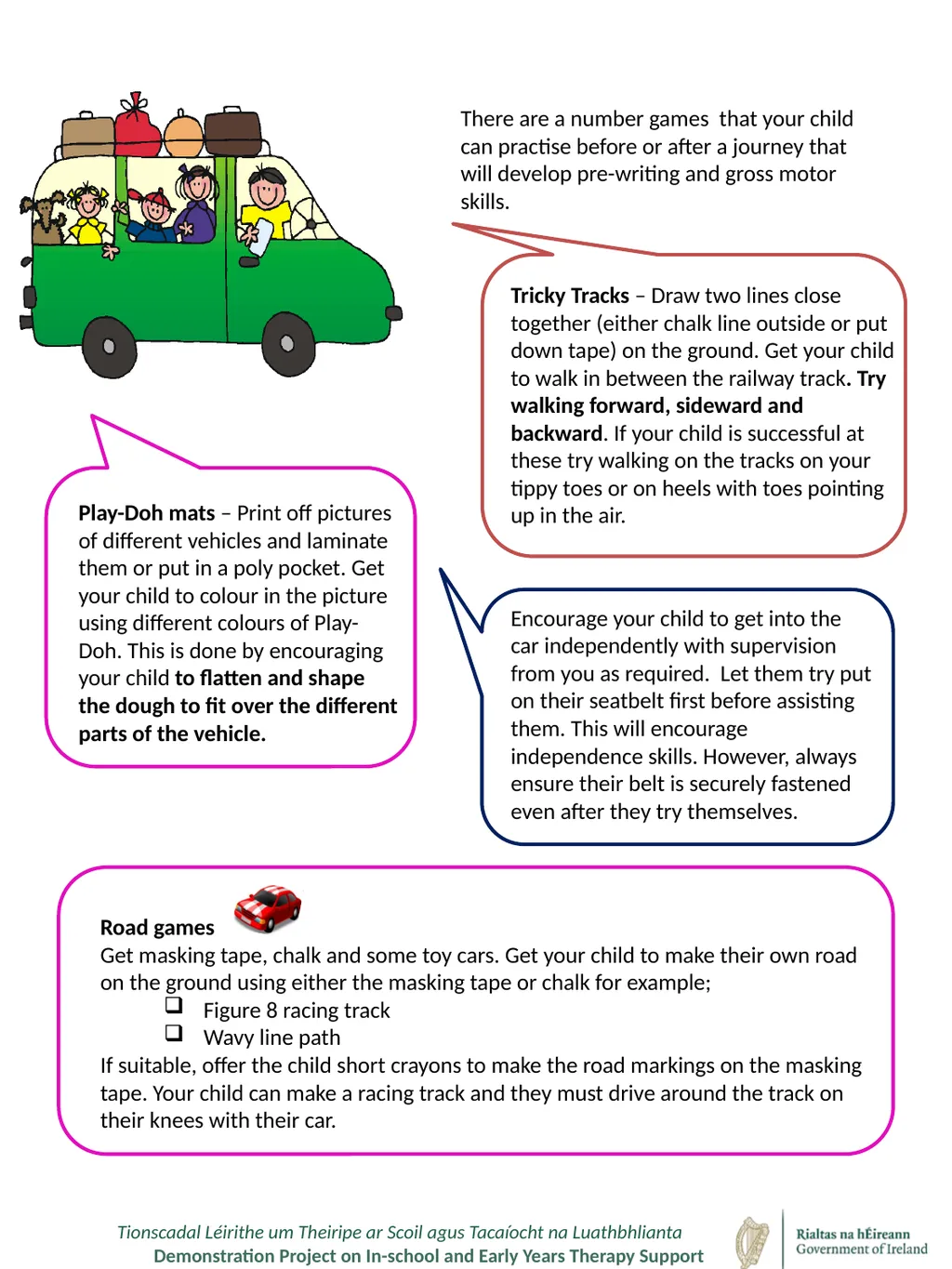
\\\\\ Tricky Tracks – Draw two lines close together (either chalk line outside or put down tape) on the ground. Get your child to walk in between the railway track. Try walking forward, sideward and backward. If your child is successful at these try walking on the tracks on your tippy toes or on heels with toes pointing up in the air. Road games
Get masking tape, chalk and some toy cars. Get your child to make their own road on the ground using either the masking tape or chalk for example;
Figure 8 racing track
Wavy line path
If suitable, offer the child short crayons to make the road markings on the masking tape. Your child can make a racing track and they must drive around the track on their knees with their car. Play-Doh mats – Print off pictures of different vehicles and laminate them or put in a poly pocket. Get your child to colour in the picture using different colours of Play-Doh. This is done by encouraging your child to flatten and shape the dough to fit over the different parts of the vehicle. There are a number games that your child can practise before or after a journey that will develop pre-writing and gross motor skills. Tionscadal Léirithe um Theiripe ar Scoil agus Tacaíocht na Luathbhlianta
Demonstration Project on In-school and Early Years Therapy Support Encourage your child to get into the car independently with supervision from you as required. Let them try put on their seatbelt first before assisting them. This will encourage independence skills. However, always ensure their belt is securely fastened even after they try themselves.<br>
Get masking tape, chalk and some toy cars. Get your child to make their own road on the ground using either the masking tape or chalk for example;
Figure 8 racing track
Wavy line path
If suitable, offer the child short crayons to make the road markings on the masking tape. Your child can make a racing track and they must drive around the track on their knees with their car. Play-Doh mats – Print off pictures of different vehicles and laminate them or put in a poly pocket. Get your child to colour in the picture using different colours of Play-Doh. This is done by encouraging your child to flatten and shape the dough to fit over the different parts of the vehicle. There are a number games that your child can practise before or after a journey that will develop pre-writing and gross motor skills. Tionscadal Léirithe um Theiripe ar Scoil agus Tacaíocht na Luathbhlianta
Demonstration Project on In-school and Early Years Therapy Support Encourage your child to get into the car independently with supervision from you as required. Let them try put on their seatbelt first before assisting them. This will encourage independence skills. However, always ensure their belt is securely fastened even after they try themselves.<br>
12
Tionscadal Léirithe um Theiripe ar Scoil agus Tacaíocht na Luathbhlianta
Demonstration Project on In-school and Early Years Therapy Support In the House \\\\\ Comment on what you are doing when you are doing it, e.g. “It’s time to get dinner ready. I’m going to peel and chop the carrots. Will I chop them into circles or sticks?” Guessing game!
Examples:
Find something that ticks (clock)
Find something that you fold (clothes)
Find something that blows (fan)
Find something that is shiny (mirror) Share books with your child.
Use your voice and facial expressions to make the story more exciting.
Pause to see what your child is interested in and then make comments.
Highlight and explain any new words.
Ask your child what they think might happen next in the story. Think of all the concepts that your child will experience when they’re playing at home, e.g. wet clothes; tall tower; tasty lunch; cosy blanket; exciting book; loud song, etc. Think of all the new action words (verbs) that your child will experience when they’re at home, e.g. sit
tidy
set (table) stack
brush
race push
kick
jog Sing nursery rhymes together. Draw attention to how the words sound the same at the end. Try making a silly rhyme like “Miss Polly had a…monkey” and ask your child to fix it. Use actions when you sing nursery rhymes to make it more fun. Encourage your child to use imagination in play e.g. play shop. Encourage them to try out different roles and to take turns. Show them how to greet the customers and say thank-you.<br>
Demonstration Project on In-school and Early Years Therapy Support In the House \\\\\ Comment on what you are doing when you are doing it, e.g. “It’s time to get dinner ready. I’m going to peel and chop the carrots. Will I chop them into circles or sticks?” Guessing game!
Examples:
Find something that ticks (clock)
Find something that you fold (clothes)
Find something that blows (fan)
Find something that is shiny (mirror) Share books with your child.
Use your voice and facial expressions to make the story more exciting.
Pause to see what your child is interested in and then make comments.
Highlight and explain any new words.
Ask your child what they think might happen next in the story. Think of all the concepts that your child will experience when they’re playing at home, e.g. wet clothes; tall tower; tasty lunch; cosy blanket; exciting book; loud song, etc. Think of all the new action words (verbs) that your child will experience when they’re at home, e.g. sit
tidy
set (table) stack
brush
race push
kick
jog Sing nursery rhymes together. Draw attention to how the words sound the same at the end. Try making a silly rhyme like “Miss Polly had a…monkey” and ask your child to fix it. Use actions when you sing nursery rhymes to make it more fun. Encourage your child to use imagination in play e.g. play shop. Encourage them to try out different roles and to take turns. Show them how to greet the customers and say thank-you.<br>
13
Tionscadal Léirithe um Theiripe ar Scoil agus Tacaíocht na Luathbhlianta
Demonstration Project on In-school and Early Years Therapy Support \\\\\ Body Outlines
Either yourself or your child lies on a large piece of paper, or on the path. Take a pencil or piece of chalk and draw around your child’s body. Name each body part as you trace around it. This is a lovely activity to develop body awareness. When cooking meals or baking at home you should include your child in the age appropriate activities in the process. Get your child to stir the bowl of ingredients, put toppings on a pizza or even turn the pages of the cookbook. Involving your child in the process will help with confidence and fine motor skill development. Fine motor skills and pre-writing skills can be developed at home. Some examples of activities you can do with your child at home include: making more Play-Doh mats, completing jigsaws, picking up small items with pegs, building Lego, painting or drawing lines and shapes, hanging up washing on the line using clothes pegs and cutting out lines on thick paper using child-sized scissors. Mirror Mirror: Facing a mirror, take turns copying movements by looking in the mirror. Try things like;
Waving
Shaking a foot
Putting hands on knees Human mirrors: One person does the movements and the other person copies these by pretending to be the mirror Mirror Games! House of Shapes
Encourage children to cut out an assortment of shapes for a house on a light card (use used cereal boxes). Provide each child with a large piece of paper and encourage them to glue the variety of shapes onto their paper to create different shaped houses and buildings where people might live.<br>
Demonstration Project on In-school and Early Years Therapy Support \\\\\ Body Outlines
Either yourself or your child lies on a large piece of paper, or on the path. Take a pencil or piece of chalk and draw around your child’s body. Name each body part as you trace around it. This is a lovely activity to develop body awareness. When cooking meals or baking at home you should include your child in the age appropriate activities in the process. Get your child to stir the bowl of ingredients, put toppings on a pizza or even turn the pages of the cookbook. Involving your child in the process will help with confidence and fine motor skill development. Fine motor skills and pre-writing skills can be developed at home. Some examples of activities you can do with your child at home include: making more Play-Doh mats, completing jigsaws, picking up small items with pegs, building Lego, painting or drawing lines and shapes, hanging up washing on the line using clothes pegs and cutting out lines on thick paper using child-sized scissors. Mirror Mirror: Facing a mirror, take turns copying movements by looking in the mirror. Try things like;
Waving
Shaking a foot
Putting hands on knees Human mirrors: One person does the movements and the other person copies these by pretending to be the mirror Mirror Games! House of Shapes
Encourage children to cut out an assortment of shapes for a house on a light card (use used cereal boxes). Provide each child with a large piece of paper and encourage them to glue the variety of shapes onto their paper to create different shaped houses and buildings where people might live.<br>
14
References Drew, S. (2006). Smart Moves: Motor Skills Development Programme. Smart CC Publishing. Usk, United Kingdom.
Drew, S. (2011). Movers and Creators. Creative Activities to Develop Physical Skills in the Early Years. Smart CC Publishing. Usk, United Kingdom.
The Communication Trust “Summer Talk” booklet: https://www.thecommunicationtrust.org.uk/resources/resources/resources-for-parents/summer-talk.aspx<br>
Drew, S. (2011). Movers and Creators. Creative Activities to Develop Physical Skills in the Early Years. Smart CC Publishing. Usk, United Kingdom.
The Communication Trust “Summer Talk” booklet: https://www.thecommunicationtrust.org.uk/resources/resources/resources-for-parents/summer-talk.aspx<br>