Homogeneous and Heterogeneous Mixtures Homogeneous and Heterogeneous Mixtures A mixture is a combination of two or more substances that are physically combined and can be separated. When we say substance, it is either an element or a
"Homogeneous and Heterogeneous Mixtures Homogeneous" is the property of its rightful owner. Permission is granted to
download and print the materials on this website for personal, non-commercial use only, and to display it
on your personal computer provided you do not modify the materials and that you retain all copyright
notices contained in the materials. By downloading content from our website, you accept the terms of this
agreement.
Presentation Transcript
01
Homogeneous and Heterogeneous Mixtures<br>
02
Homogeneous and Heterogeneous Mixtures A mixture is a combination of two or more substances that are physically combined and can be separated. When we say substance, it is either an element or a compound.<br>
03
Homogeneous and Heterogeneous Mixtures An element is a substance that cannot be broken down into simpler substances by a chemical reaction. There are 118 elements discovered and synthesized by scientists and are included in the periodic table of elements. Examples of elements:
carbon, oxygen, hydrogen, nitrogen gas, aluminum, copper, sodium, and chlorine.<br>
04
Homogeneous and Heterogeneous Mixtures A compound is a substance formed when elements combine chemically. Example: Table Salt
It is made up of two elements: sodium and chlorine.
Its chemical name is sodium chloride, represented by the formula NaCl. Water
It is made up to two elements: Hydrogen and oxygen.
The formula of water is H2O.<br>
05
Homogeneous and Heterogeneous Mixtures In a mixture, the substances are put together without chemical change, and no
new substance is formed. The substances retain their individual composition even when
combined, and these substances can be separated from one another. Example: Fruit salad<br>
06
Homogeneous and Heterogeneous Mixtures Homogeneous or uniform mixtures
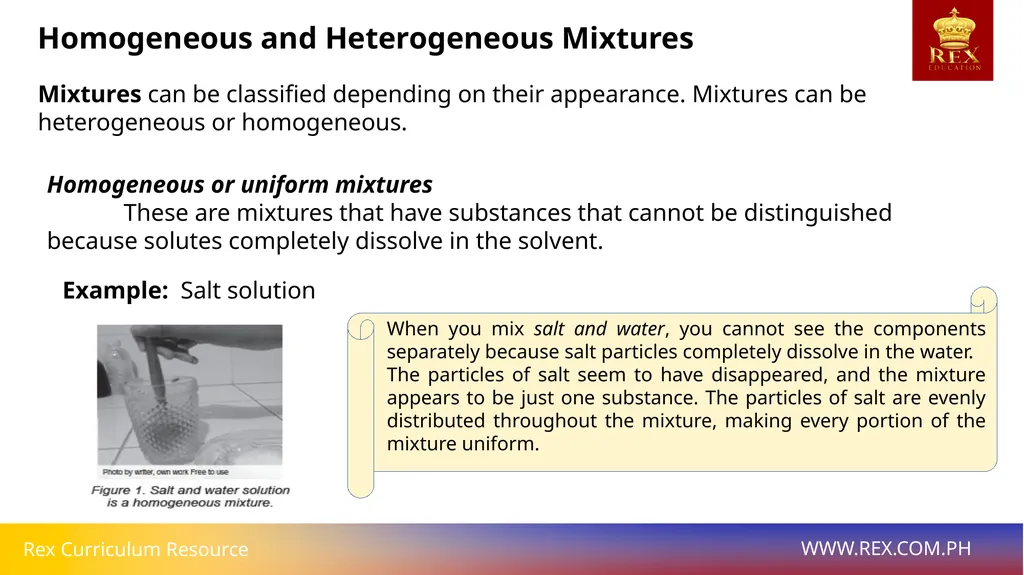
These are mixtures that have substances that cannot be distinguished because solutes completely dissolve in the solvent. Mixtures can be classified depending on their appearance. Mixtures can be
heterogeneous or homogeneous. Example: Salt solution When you mix salt and water, you cannot see the components separately because salt particles completely dissolve in the water.
The particles of salt seem to have disappeared, and the mixture appears to be just one substance. The particles of salt are evenly distributed throughout the mixture, making every portion of the mixture uniform.<br>
07
Homogeneous and Heterogeneous Mixtures Examples of homogeneous or uniform mixtures
air
hot coffee
rubbing alcohol
vinegar
bronze
steel<br>
08
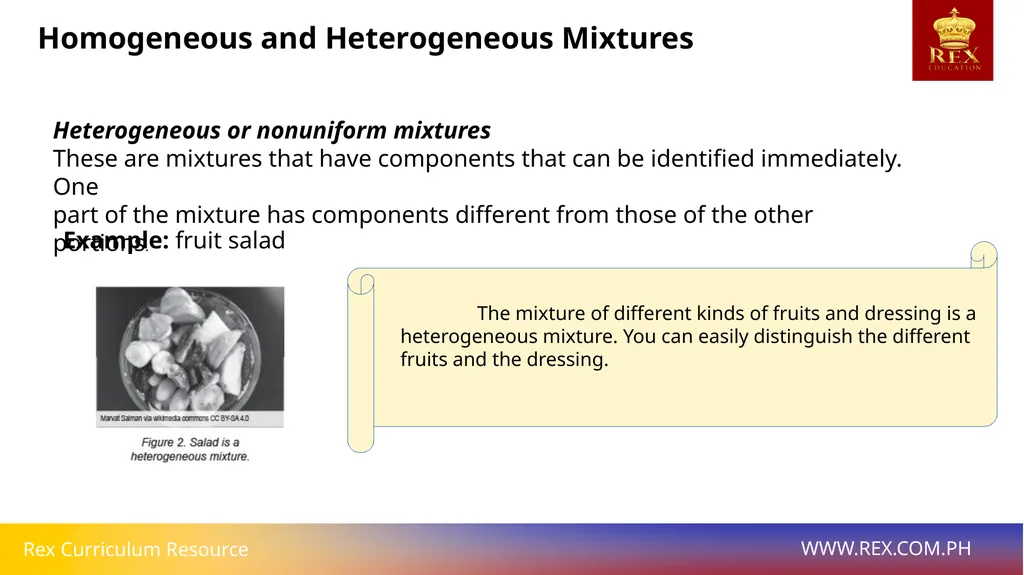
Homogeneous and Heterogeneous Mixtures Heterogeneous or nonuniform mixtures
These are mixtures that have components that can be identified immediately. One
part of the mixture has components different from those of the other portions. Example: fruit salad The mixture of different kinds of fruits and dressing is a heterogeneous mixture. You can easily distinguish the different
fruits and the dressing.<br>
09
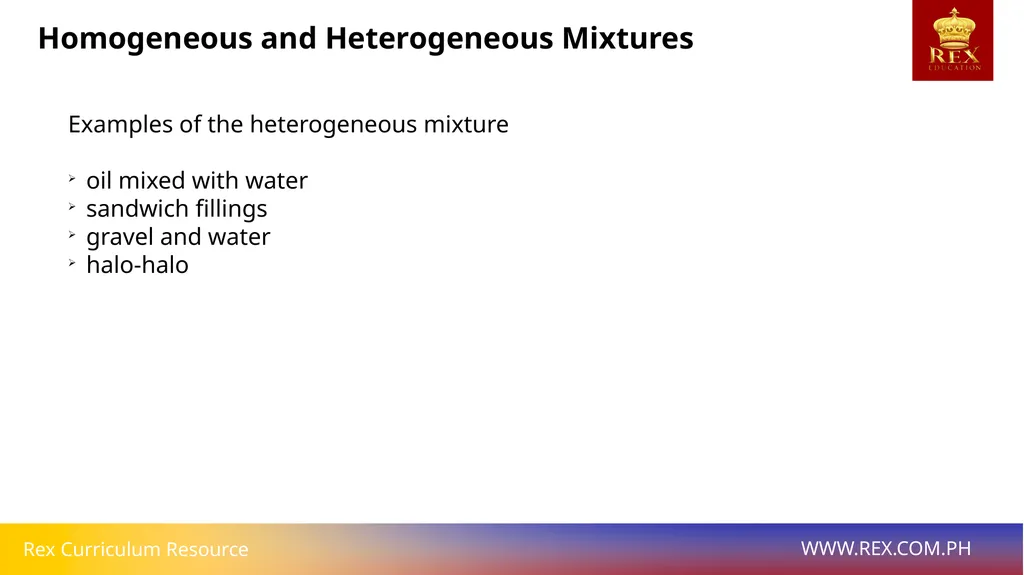
Homogeneous and Heterogeneous Mixtures Examples of the heterogeneous mixture
oil mixed with water
sandwich fillings
gravel and water
halo-halo<br>
10
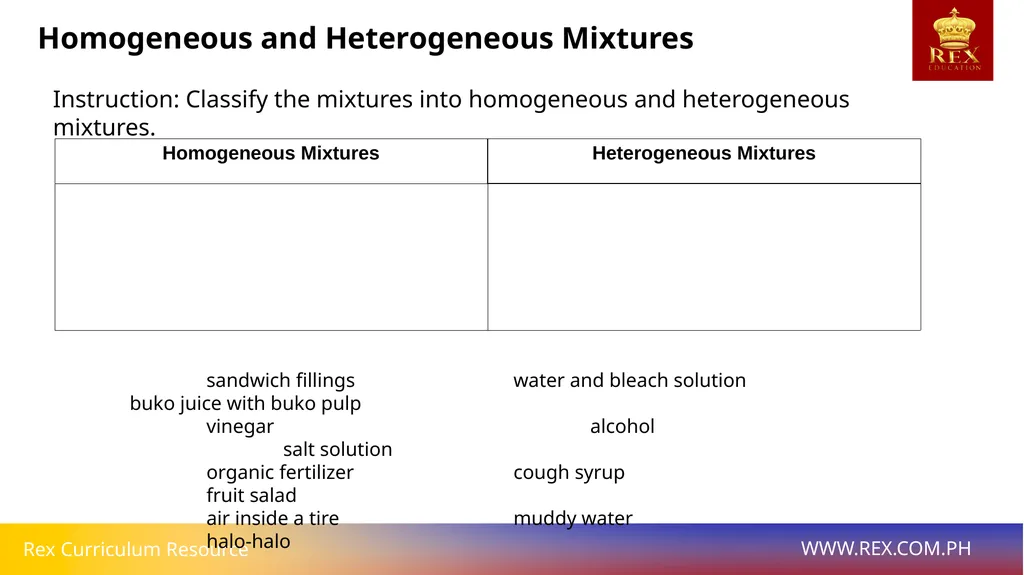
Homogeneous and Heterogeneous Mixtures Instruction: Classify the mixtures into homogeneous and heterogeneous mixtures. sandwich fillings water and bleach solution buko juice with buko pulp
vinegar alcohol salt solution
organic fertilizer cough syrup fruit salad
air inside a tire muddy water halo-halo<br>
11
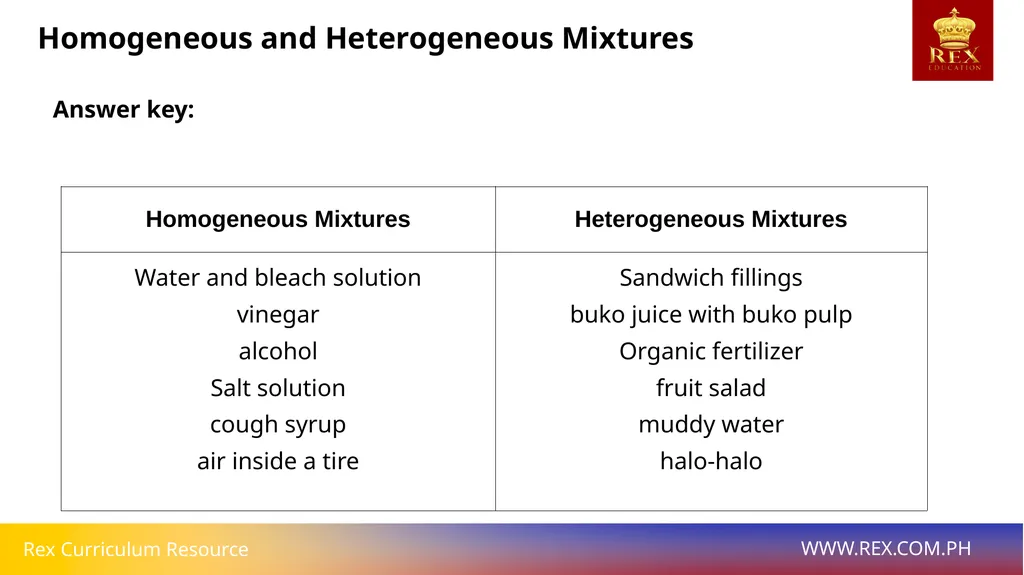
Homogeneous and Heterogeneous Mixtures Answer key:<br>