
Housing Choice Voucher (HCV) Homeownership Program
LO
Published · 71 slides · 0 views

1 / 1








Description
Housing Choice Voucher (HCV) Homeownership Program 2022 1 Introduction The Housing Choice Voucher (HCV) Homeownership Program allows a Public Housing Authority (PHA) to make monthly housing assistance payments on behalf of low-income,
Related Topics
Share
Embed code
Download this presentation From Below
"Housing Choice Voucher (HCV) Homeownership Program" is the property of its rightful owner. Permission is granted to download and print the materials on this website for personal, non-commercial use only, and to display it on your personal computer provided you do not modify the materials and that you retain all copyright notices contained in the materials. By downloading content from our website, you accept the terms of this agreement.
Presentation Transcript
01
Housing Choice Voucher (HCV)
Homeownership Program 2022 1<br>
02
Introduction The Housing Choice Voucher (HCV) Homeownership Program allows a Public Housing Authority (PHA) to make monthly housing assistance payments on behalf of low-income, first-time homebuyers to assist in meeting their monthly homeownership expenses.
The HCV Homeownership Program is considered a special voucher type under the Housing Choice Voucher Program. 2<br>
The HCV Homeownership Program is considered a special voucher type under the Housing Choice Voucher Program. 2<br>
03
Purpose This presentation is designed to assist PHAs who are thinking about starting a homeownership program, or have already taken the first steps, and are wondering what to do next. Additional information including the Housing Choice Voucher Homeownership Guidebook, flyers and a webinar panel highlighting existing programs is available on the HCV Homeownership page on the HUD Exchange.
Note: this presentation covers key points of program regulations but is not intended to be comprehensive. When planning a homeownership program, due diligence is recommended in reviewing regulations at 24 CFR 982.625 – 24 CFR 982.643 3<br>
Note: this presentation covers key points of program regulations but is not intended to be comprehensive. When planning a homeownership program, due diligence is recommended in reviewing regulations at 24 CFR 982.625 – 24 CFR 982.643 3<br>
04
Topics Overview of the HCV Homeownership Program
Steps to develop an HCV Homeownership Program
Program operations
Homeownership counseling
Eligible housing
Inspections
Financing
Post-purchase activities
Policy development and program reporting requirements 4<br>
Steps to develop an HCV Homeownership Program
Program operations
Homeownership counseling
Eligible housing
Inspections
Financing
Post-purchase activities
Policy development and program reporting requirements 4<br>
05
Overview of the HCV Homeownership Program 5<br>
06
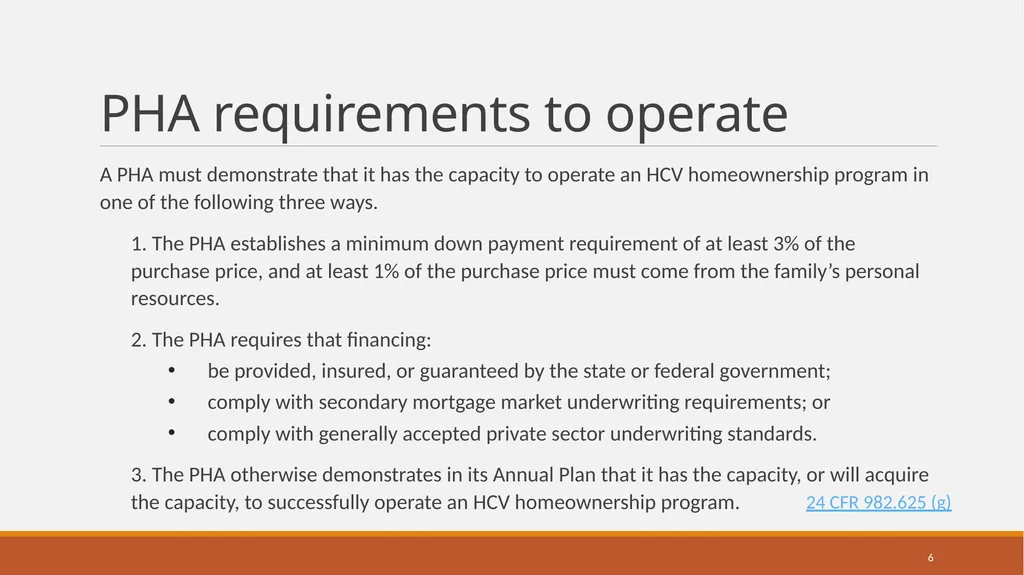
PHA requirements to operate A PHA must demonstrate that it has the capacity to operate an HCV homeownership program in one of the following three ways.
1. The PHA establishes a minimum down payment requirement of at least 3% of the purchase price, and at least 1% of the purchase price must come from the family’s personal resources.
2. The PHA requires that financing:
be provided, insured, or guaranteed by the state or federal government;
comply with secondary mortgage market underwriting requirements; or
comply with generally accepted private sector underwriting standards.
3. The PHA otherwise demonstrates in its Annual Plan that it has the capacity, or will acquire the capacity, to successfully operate an HCV homeownership program. 24 CFR 982.625 (g) 6<br>
1. The PHA establishes a minimum down payment requirement of at least 3% of the purchase price, and at least 1% of the purchase price must come from the family’s personal resources.
2. The PHA requires that financing:
be provided, insured, or guaranteed by the state or federal government;
comply with secondary mortgage market underwriting requirements; or
comply with generally accepted private sector underwriting standards.
3. The PHA otherwise demonstrates in its Annual Plan that it has the capacity, or will acquire the capacity, to successfully operate an HCV homeownership program. 24 CFR 982.625 (g) 6<br>
07
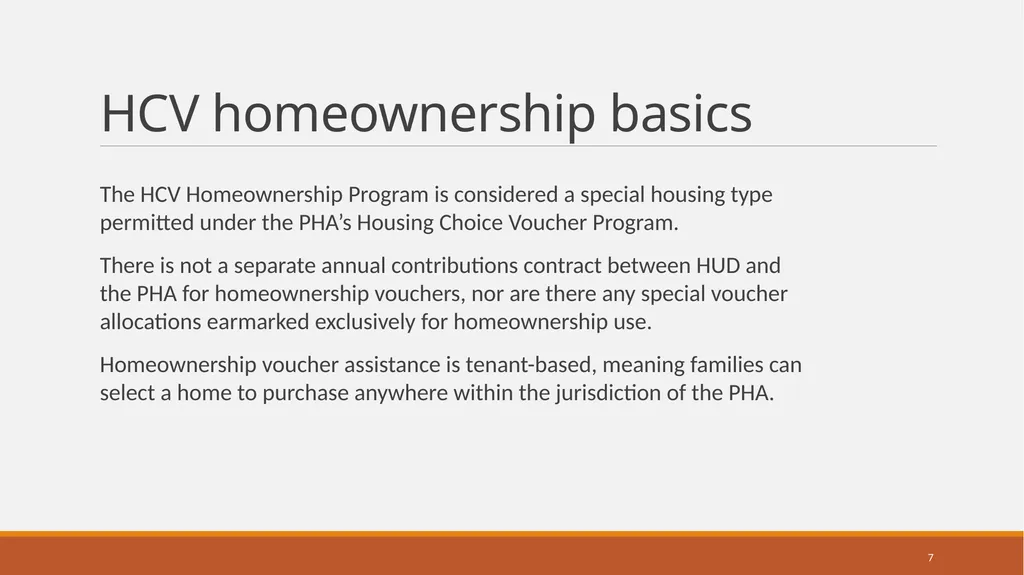
HCV homeownership basics The HCV Homeownership Program is considered a special housing type permitted under the PHA’s Housing Choice Voucher Program.
There is not a separate annual contributions contract between HUD and the PHA for homeownership vouchers, nor are there any special voucher allocations earmarked exclusively for homeownership use.
Homeownership voucher assistance is tenant-based, meaning families can select a home to purchase anywhere within the jurisdiction of the PHA. 7<br>
There is not a separate annual contributions contract between HUD and the PHA for homeownership vouchers, nor are there any special voucher allocations earmarked exclusively for homeownership use.
Homeownership voucher assistance is tenant-based, meaning families can select a home to purchase anywhere within the jurisdiction of the PHA. 7<br>
08
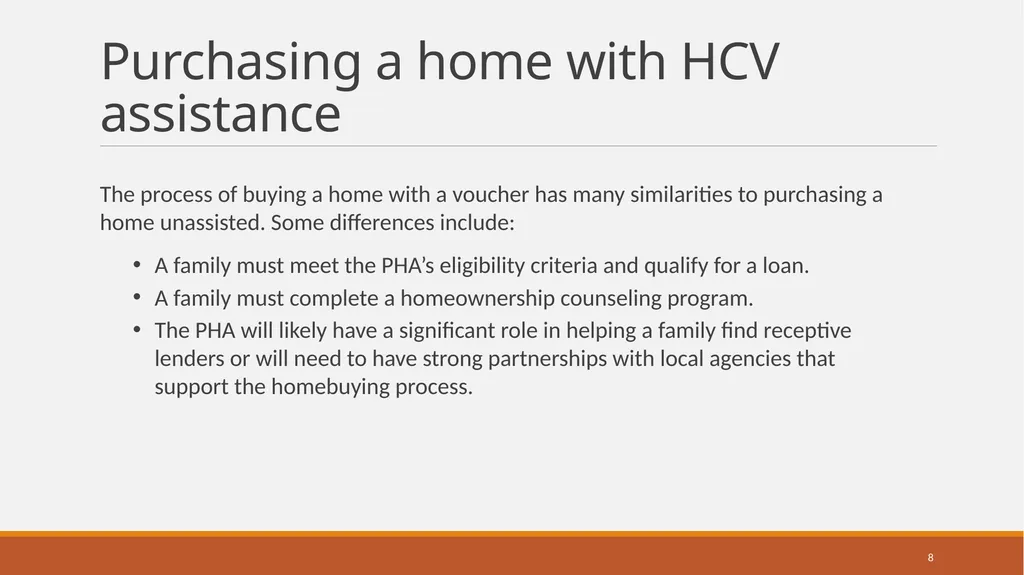
Purchasing a home with HCV assistance The process of buying a home with a voucher has many similarities to purchasing a home unassisted. Some differences include:
A family must meet the PHA’s eligibility criteria and qualify for a loan.
A family must complete a homeownership counseling program.
The PHA will likely have a significant role in helping a family find receptive lenders or will need to have strong partnerships with local agencies that support the homebuying process. 8<br>
A family must meet the PHA’s eligibility criteria and qualify for a loan.
A family must complete a homeownership counseling program.
The PHA will likely have a significant role in helping a family find receptive lenders or will need to have strong partnerships with local agencies that support the homebuying process. 8<br>
09
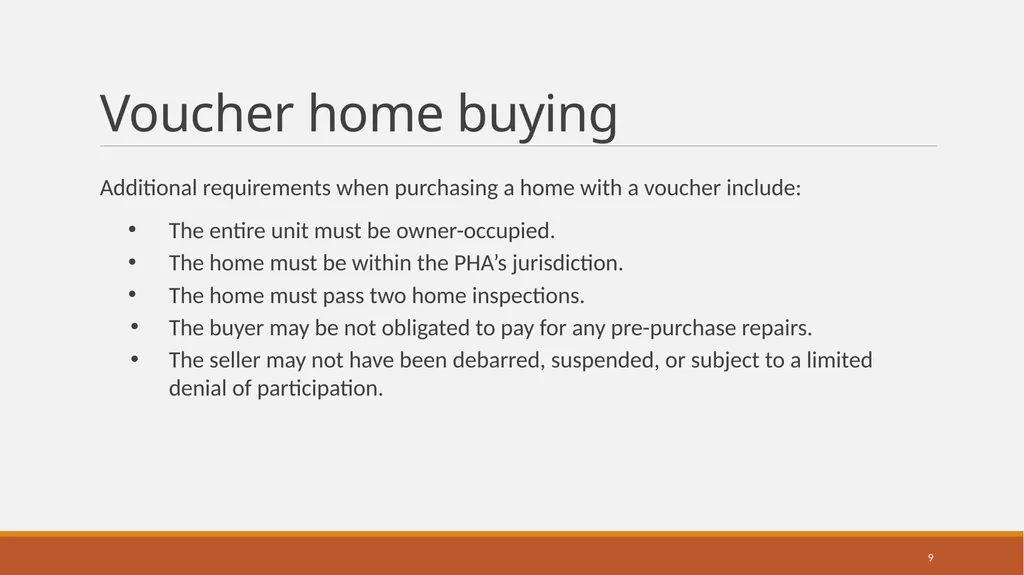
Voucher home buying Additional requirements when purchasing a home with a voucher include:
The entire unit must be owner-occupied.
The home must be within the PHA’s jurisdiction.
The home must pass two home inspections.
The buyer may be not obligated to pay for any pre-purchase repairs.
The seller may not have been debarred, suspended, or subject to a limited denial of participation. 9<br>
The entire unit must be owner-occupied.
The home must be within the PHA’s jurisdiction.
The home must pass two home inspections.
The buyer may be not obligated to pay for any pre-purchase repairs.
The seller may not have been debarred, suspended, or subject to a limited denial of participation. 9<br>
10
Steps to develop an HCV Homeownership Program 10<br>
11
Planning for a homeownership program An assessment of the conditions necessary for a successful HCV Homeownership Program in your community and in your PHA will consider the factors below.
For a homeownership program to succeed, four basic elements are needed:
bankable program participants;
affordable units;
willing lenders; and
agency and partner capacity to pull it all together. 11<br>
For a homeownership program to succeed, four basic elements are needed:
bankable program participants;
affordable units;
willing lenders; and
agency and partner capacity to pull it all together. 11<br>
12
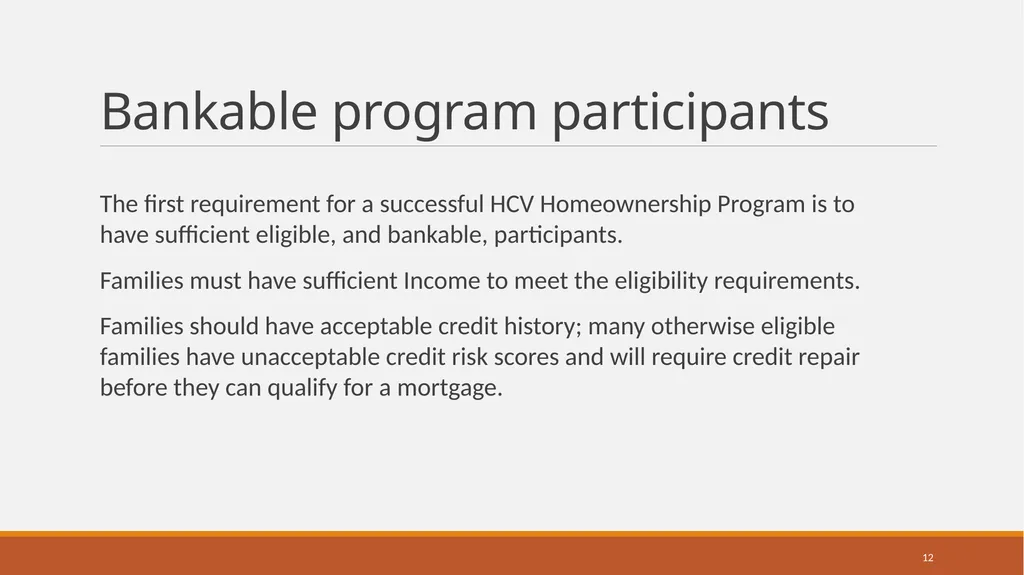
Bankable program participants The first requirement for a successful HCV Homeownership Program is to have sufficient eligible, and bankable, participants.
Families must have sufficient Income to meet the eligibility requirements.
Families should have acceptable credit history; many otherwise eligible families have unacceptable credit risk scores and will require credit repair before they can qualify for a mortgage. 12<br>
Families must have sufficient Income to meet the eligibility requirements.
Families should have acceptable credit history; many otherwise eligible families have unacceptable credit risk scores and will require credit repair before they can qualify for a mortgage. 12<br>
13
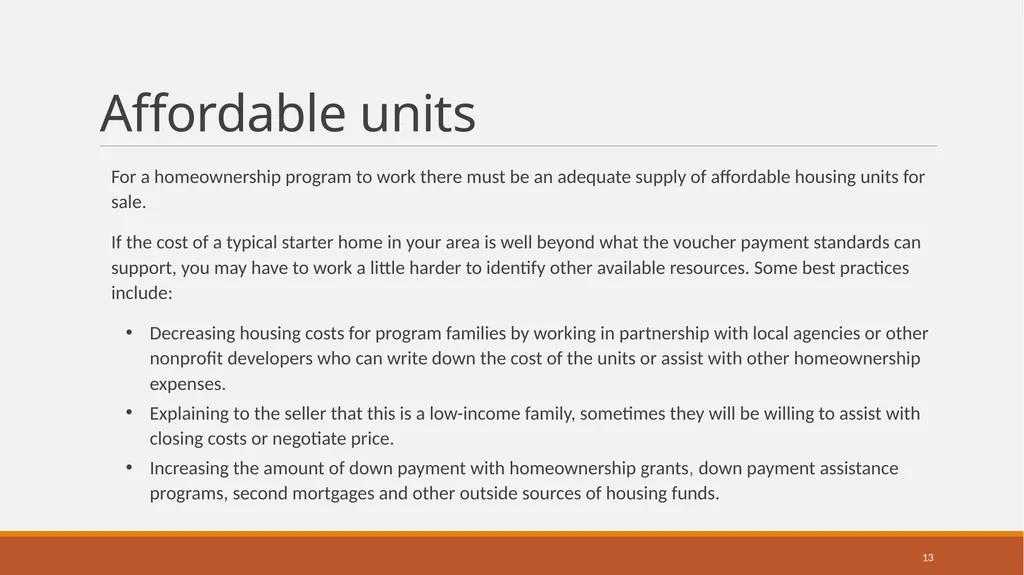
Affordable units For a homeownership program to work there must be an adequate supply of affordable housing units for sale.
If the cost of a typical starter home in your area is well beyond what the voucher payment standards can support, you may have to work a little harder to identify other available resources. Some best practices include:
Decreasing housing costs for program families by working in partnership with local agencies or other nonprofit developers who can write down the cost of the units or assist with other homeownership expenses.
Explaining to the seller that this is a low-income family, sometimes they will be willing to assist with closing costs or negotiate price.
Increasing the amount of down payment with homeownership grants, down payment assistance programs, second mortgages and other outside sources of housing funds. 13<br>
If the cost of a typical starter home in your area is well beyond what the voucher payment standards can support, you may have to work a little harder to identify other available resources. Some best practices include:
Decreasing housing costs for program families by working in partnership with local agencies or other nonprofit developers who can write down the cost of the units or assist with other homeownership expenses.
Explaining to the seller that this is a low-income family, sometimes they will be willing to assist with closing costs or negotiate price.
Increasing the amount of down payment with homeownership grants, down payment assistance programs, second mortgages and other outside sources of housing funds. 13<br>
14
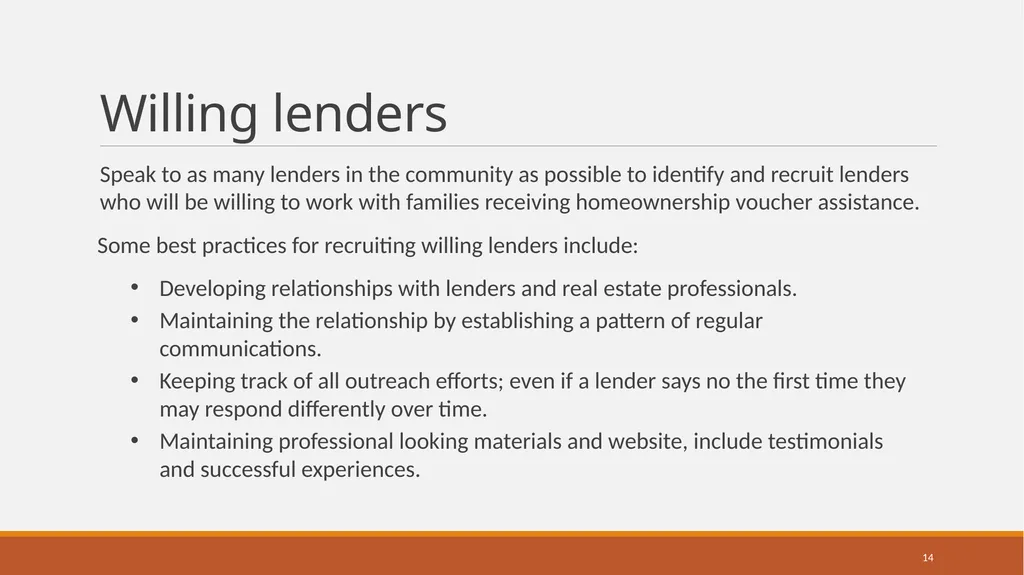
Willing lenders Speak to as many lenders in the community as possible to identify and recruit lenders who will be willing to work with families receiving homeownership voucher assistance.
Some best practices for recruiting willing lenders include:
Developing relationships with lenders and real estate professionals.
Maintaining the relationship by establishing a pattern of regular communications.
Keeping track of all outreach efforts; even if a lender says no the first time they may respond differently over time.
Maintaining professional looking materials and website, include testimonials and successful experiences. 14<br>
Some best practices for recruiting willing lenders include:
Developing relationships with lenders and real estate professionals.
Maintaining the relationship by establishing a pattern of regular communications.
Keeping track of all outreach efforts; even if a lender says no the first time they may respond differently over time.
Maintaining professional looking materials and website, include testimonials and successful experiences. 14<br>
15
Agency capacity Developing a successful homeownership program requires planning, partnership development, capacity building, and the ability to continuously interact with a new array of local agencies and financial institutions.
Implementing a homeownership counseling program requires the ability to counsel and educate low-income families in all aspects of locating, financing, purchasing and maintaining a home. 15<br>
Implementing a homeownership counseling program requires the ability to counsel and educate low-income families in all aspects of locating, financing, purchasing and maintaining a home. 15<br>
16
Program operations 16<br>
17
Outreach and briefing PHAs implementing an HCV Homeownership Program may wish to discuss the homeownership voucher option at voucher holders’ briefings for admission to the Housing Choice Voucher (HCV) Program, or at subsequent encounters, such as recertifications. 17<br>
18
Initial requirements Before commencing homeownership assistance, the PHA must determine that the following initial requirements have been met:
the family is qualified to receive homeownership assistance;
the unit is eligible; and
the family has completed the required homeownership counseling. 24 CFR 982.626 (a) 18<br>
the family is qualified to receive homeownership assistance;
the unit is eligible; and
the family has completed the required homeownership counseling. 24 CFR 982.626 (a) 18<br>
19
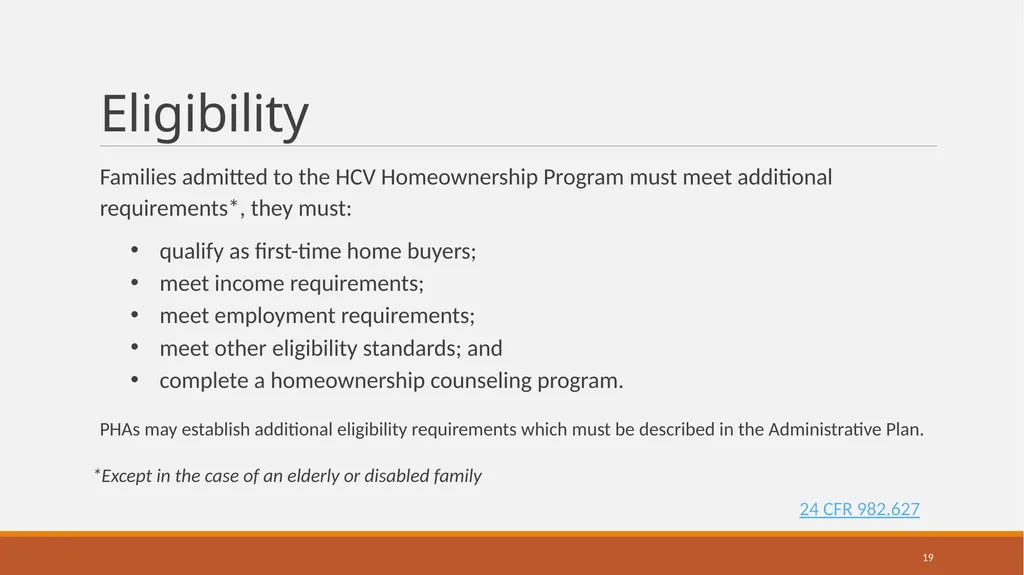
Eligibility Families admitted to the HCV Homeownership Program must meet additional requirements*, they must:
qualify as first-time home buyers;
meet income requirements;
meet employment requirements;
meet other eligibility standards; and
complete a homeownership counseling program.
PHAs may establish additional eligibility requirements which must be described in the Administrative Plan.
*Except in the case of an elderly or disabled family 24 CFR 982.627 19<br>
qualify as first-time home buyers;
meet income requirements;
meet employment requirements;
meet other eligibility standards; and
complete a homeownership counseling program.
PHAs may establish additional eligibility requirements which must be described in the Administrative Plan.
*Except in the case of an elderly or disabled family 24 CFR 982.627 19<br>
20
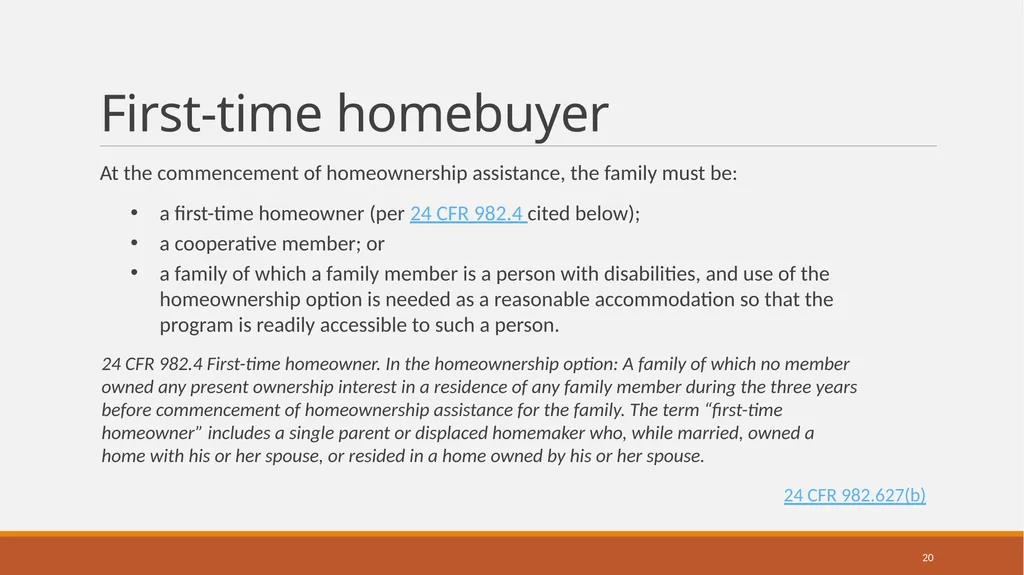
First-time homebuyer At the commencement of homeownership assistance, the family must be:
a first-time homeowner (per 24 CFR 982.4 cited below);
a cooperative member; or
a family of which a family member is a person with disabilities, and use of the homeownership option is needed as a reasonable accommodation so that the program is readily accessible to such a person.
24 CFR 982.4 First-time homeowner. In the homeownership option: A family of which no member owned any present ownership interest in a residence of any family member during the three years before commencement of homeownership assistance for the family. The term “first-time homeowner” includes a single parent or displaced homemaker who, while married, owned a home with his or her spouse, or resided in a home owned by his or her spouse. 24 CFR 982.627(b) 20<br>
a first-time homeowner (per 24 CFR 982.4 cited below);
a cooperative member; or
a family of which a family member is a person with disabilities, and use of the homeownership option is needed as a reasonable accommodation so that the program is readily accessible to such a person.
24 CFR 982.4 First-time homeowner. In the homeownership option: A family of which no member owned any present ownership interest in a residence of any family member during the three years before commencement of homeownership assistance for the family. The term “first-time homeowner” includes a single parent or displaced homemaker who, while married, owned a home with his or her spouse, or resided in a home owned by his or her spouse. 24 CFR 982.627(b) 20<br>
21
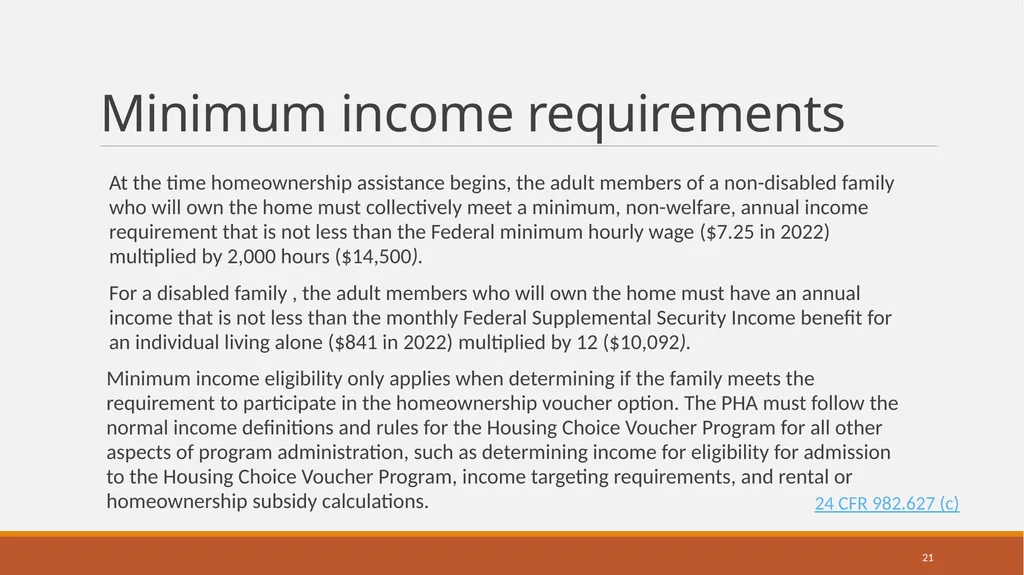
Minimum income requirements At the time homeownership assistance begins, the adult members of a non-disabled family who will own the home must collectively meet a minimum, non-welfare, annual income requirement that is not less than the Federal minimum hourly wage ($7.25 in 2022) multiplied by 2,000 hours ($14,500).
For a disabled family , the adult members who will own the home must have an annual income that is not less than the monthly Federal Supplemental Security Income benefit for an individual living alone ($841 in 2022) multiplied by 12 ($10,092).
Minimum income eligibility only applies when determining if the family meets the requirement to participate in the homeownership voucher option. The PHA must follow the normal income definitions and rules for the Housing Choice Voucher Program for all other aspects of program administration, such as determining income for eligibility for admission to the Housing Choice Voucher Program, income targeting requirements, and rental or homeownership subsidy calculations. 24 CFR 982.627 (c) 21<br>
For a disabled family , the adult members who will own the home must have an annual income that is not less than the monthly Federal Supplemental Security Income benefit for an individual living alone ($841 in 2022) multiplied by 12 ($10,092).
Minimum income eligibility only applies when determining if the family meets the requirement to participate in the homeownership voucher option. The PHA must follow the normal income definitions and rules for the Housing Choice Voucher Program for all other aspects of program administration, such as determining income for eligibility for admission to the Housing Choice Voucher Program, income targeting requirements, and rental or homeownership subsidy calculations. 24 CFR 982.627 (c) 21<br>
22
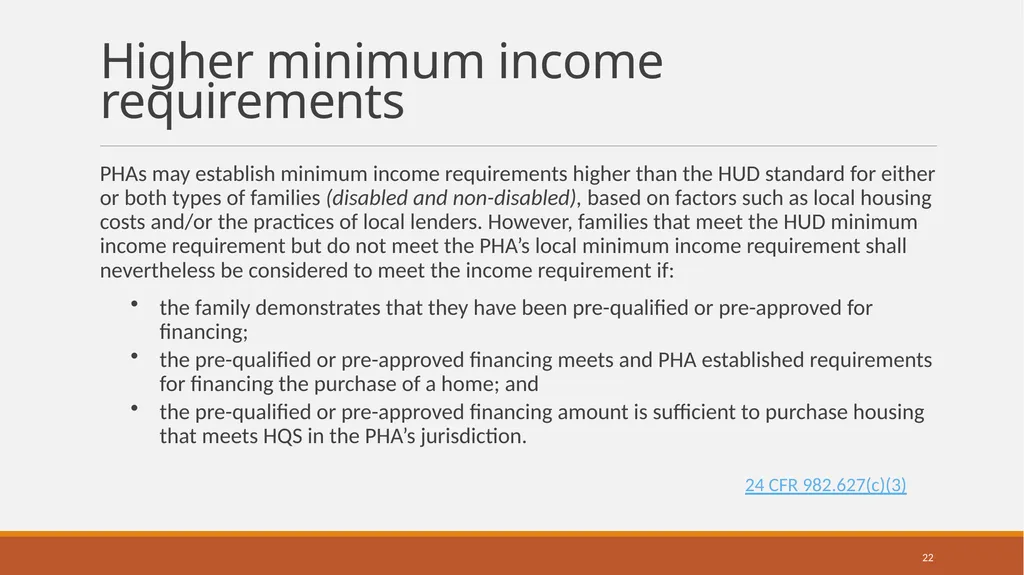
Higher minimum income requirements PHAs may establish minimum income requirements higher than the HUD standard for either or both types of families (disabled and non-disabled), based on factors such as local housing costs and/or the practices of local lenders. However, families that meet the HUD minimum income requirement but do not meet the PHA’s local minimum income requirement shall nevertheless be considered to meet the income requirement if:
the family demonstrates that they have been pre-qualified or pre-approved for financing;
the pre-qualified or pre-approved financing meets and PHA established requirements for financing the purchase of a home; and
the pre-qualified or pre-approved financing amount is sufficient to purchase housing that meets HQS in the PHA’s jurisdiction. 24 CFR 982.627(c)(3) 22<br>
the family demonstrates that they have been pre-qualified or pre-approved for financing;
the pre-qualified or pre-approved financing meets and PHA established requirements for financing the purchase of a home; and
the pre-qualified or pre-approved financing amount is sufficient to purchase housing that meets HQS in the PHA’s jurisdiction. 24 CFR 982.627(c)(3) 22<br>
23
Minimum employment requirements One or more adult members who will own the home must:
be currently employed on a full-time basis (not less than 30 hours per week on average); and
have been continuously employed during the year before commencement of homeownership assistance.
The PHA can set its own policies regarding what it considers continuous employment and may consider self-employment.
The employment requirement does not apply to an elderly or disabled family (head, spouse or sole member is elderly or disabled), or a family that includes a person with disabilities, if other family members are unable to work on a full-time basis because they are required to care for the person with disabilities, and a reasonable accommodation is necessary.
The PHA may not establish an employment requirement in addition to the HUD established employment requirement. 24 CFR 982.627(d) 23<br>
be currently employed on a full-time basis (not less than 30 hours per week on average); and
have been continuously employed during the year before commencement of homeownership assistance.
The PHA can set its own policies regarding what it considers continuous employment and may consider self-employment.
The employment requirement does not apply to an elderly or disabled family (head, spouse or sole member is elderly or disabled), or a family that includes a person with disabilities, if other family members are unable to work on a full-time basis because they are required to care for the person with disabilities, and a reasonable accommodation is necessary.
The PHA may not establish an employment requirement in addition to the HUD established employment requirement. 24 CFR 982.627(d) 23<br>
24
Local program requirements Except where HUD has established mandatory eligibility criteria, PHAs have the option to adopt their own policies limiting homeownership assistance to families or purposes defined by the PHA. For example:
A PHA may choose to limit participation to families who are current participants in the PHA’s HCV program, or to families who are participants in, or have graduated from, a Family Self-Sufficiency program.
A PHA may limit the number of families who will be permitted to exercise the homeownership option and may establish policies for selecting among eligible families who wish to participate. 24 CFR 982.626(b) 24<br>
A PHA may choose to limit participation to families who are current participants in the PHA’s HCV program, or to families who are participants in, or have graduated from, a Family Self-Sufficiency program.
A PHA may limit the number of families who will be permitted to exercise the homeownership option and may establish policies for selecting among eligible families who wish to participate. 24 CFR 982.626(b) 24<br>
25
Reasonable Accommodation In the case where homeownership assistance is requested, the family demonstrates that the housing available to lease under the Housing Choice Voucher Program is not readily accessible to or usable by the family, and the nature of the disability of the disabled family member makes such an accommodation necessary, the PHA will determine if a reasonable accommodation is necessary on a case-by-case basis, based on the specific circumstances and individual needs of the person with the disability. 24 CFR 982.625(d)(2) 25<br>
26
Homeownership counseling 26<br>
27
Homeownership counseling Once a family has been selected for participation in the homeownership program and verified that they meet the requirements for participation, they must then complete a PHA-prescribed course of housing counseling provided by a HUD Certified Housing Counseling Program.
In general, the goal of homeownership counseling is to ensure that homebuyers are prepared for homeownership and are mortgage-ready when they seek available lenders.
The PHA may work with the housing counseling agency to adapt the subject covered in pre-assistance counseling to local circumstances and the needs of individual families.
The PHA may offer additional counseling after commencement of homeownership assistance. The PHA has the discretion to determine whether they are required to participate in ongoing counseling.
Homeownership counseling is an integral component of the HCV Homeownership Program. 24 CFR 982.630 27<br>
In general, the goal of homeownership counseling is to ensure that homebuyers are prepared for homeownership and are mortgage-ready when they seek available lenders.
The PHA may work with the housing counseling agency to adapt the subject covered in pre-assistance counseling to local circumstances and the needs of individual families.
The PHA may offer additional counseling after commencement of homeownership assistance. The PHA has the discretion to determine whether they are required to participate in ongoing counseling.
Homeownership counseling is an integral component of the HCV Homeownership Program. 24 CFR 982.630 27<br>
28
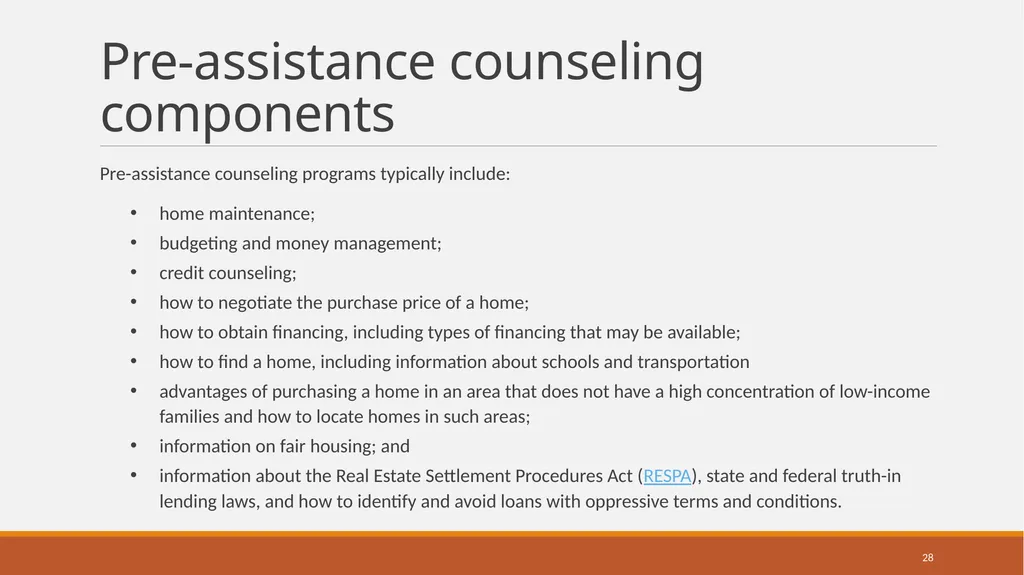
Pre-assistance counseling components Pre-assistance counseling programs typically include:
home maintenance;
budgeting and money management;
credit counseling;
how to negotiate the purchase price of a home;
how to obtain financing, including types of financing that may be available;
how to find a home, including information about schools and transportation
advantages of purchasing a home in an area that does not have a high concentration of low-income families and how to locate homes in such areas;
information on fair housing; and
information about the Real Estate Settlement Procedures Act (RESPA), state and federal truth-in lending laws, and how to identify and avoid loans with oppressive terms and conditions. 28<br>
home maintenance;
budgeting and money management;
credit counseling;
how to negotiate the purchase price of a home;
how to obtain financing, including types of financing that may be available;
how to find a home, including information about schools and transportation
advantages of purchasing a home in an area that does not have a high concentration of low-income families and how to locate homes in such areas;
information on fair housing; and
information about the Real Estate Settlement Procedures Act (RESPA), state and federal truth-in lending laws, and how to identify and avoid loans with oppressive terms and conditions. 28<br>
29
Eligible housing 29<br>
30
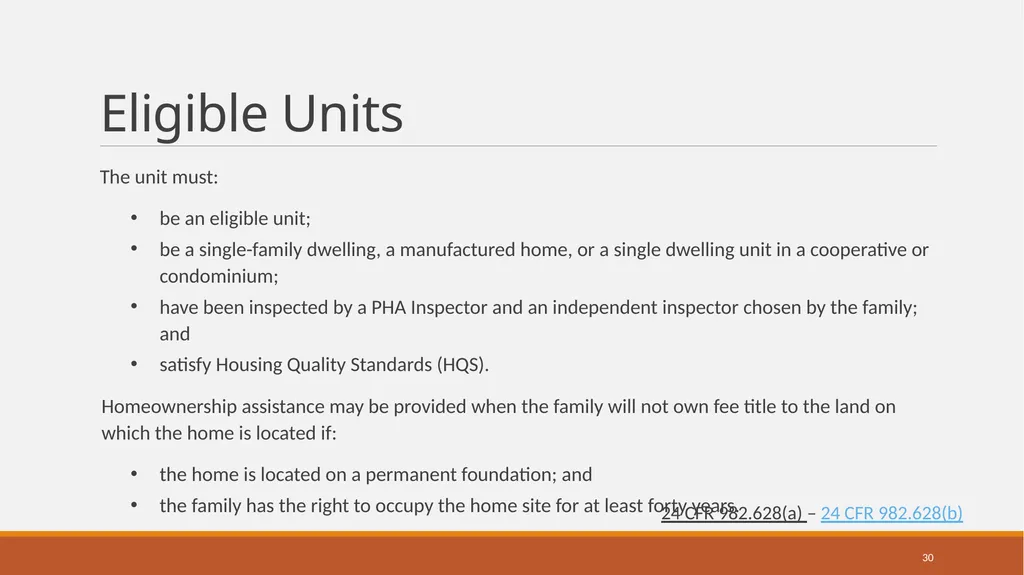
Eligible Units The unit must:
be an eligible unit;
be a single-family dwelling, a manufactured home, or a single dwelling unit in a cooperative or condominium;
have been inspected by a PHA Inspector and an independent inspector chosen by the family; and
satisfy Housing Quality Standards (HQS).
Homeownership assistance may be provided when the family will not own fee title to the land on which the home is located if:
the home is located on a permanent foundation; and
the family has the right to occupy the home site for at least forty years. 24 CFR 982.628(a) – 24 CFR 982.628(b) 30<br>
be an eligible unit;
be a single-family dwelling, a manufactured home, or a single dwelling unit in a cooperative or condominium;
have been inspected by a PHA Inspector and an independent inspector chosen by the family; and
satisfy Housing Quality Standards (HQS).
Homeownership assistance may be provided when the family will not own fee title to the land on which the home is located if:
the home is located on a permanent foundation; and
the family has the right to occupy the home site for at least forty years. 24 CFR 982.628(a) – 24 CFR 982.628(b) 30<br>
31
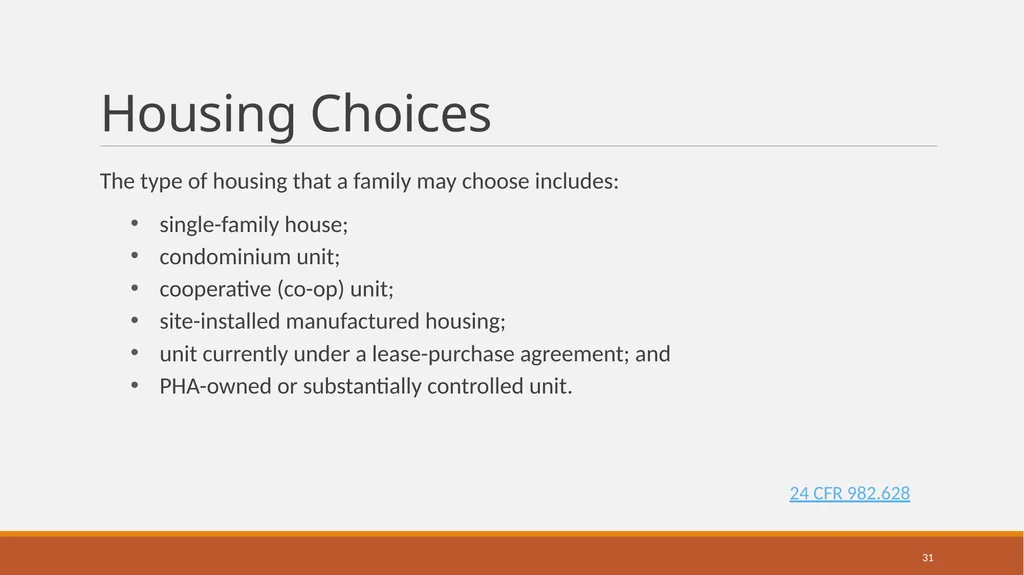
Housing Choices The type of housing that a family may choose includes:
single-family house;
condominium unit;
cooperative (co-op) unit;
site-installed manufactured housing;
unit currently under a lease-purchase agreement; and
PHA-owned or substantially controlled unit. 24 CFR 982.628 31<br>
single-family house;
condominium unit;
cooperative (co-op) unit;
site-installed manufactured housing;
unit currently under a lease-purchase agreement; and
PHA-owned or substantially controlled unit. 24 CFR 982.628 31<br>
32
Single-family houses A one-unit property within the context of the program regulations, provides living space for one family, and is built on land owned by the family (or the family has the right to occupy the land for at least 40 years). The unit may be a detached unit, a semi-detached unit, a townhouse, or a row home. The characteristic that distinguishes this unit from a co-op or a condominium is that the family is purchasing the unit and the land on which the unit is built. These units are commonly owned in fee simple, a legal term for the form of homeownership in which the house and property (land) are owned by a single person or family. 32<br>
33
Condominium units Condominiums are single-family units held under a form of homeownership in which the purchaser buys a one-family unit in a multi-family building or development. The “unit” that the buyer purchases consists of the living space enclosed by the exterior walls of the units, including interior partitions, cabinets, appliances and fixtures. The exterior walls of the unit — including the roof, plumbing, and wiring — and the common areas and grounds, are owned and maintained collectively by the condominium owners through a condominium association. The owner of a condominium unit pays a monthly fee to an association to cover the cost of exterior and common area maintenance and repairs. 33<br>
34
Cooperative (co-op) units Cooperative units are single-family units in multifamily buildings or developments owned by a co-op association. Families who reside in the units have an equity interest in the property in the form of shares in the co-op association.
Residents pay a monthly fee to the association that is used to pay expenses for the building or development including:
monthly mortgage payments;
utility, maintenance, and repair costs;
taxes and insurance; and
management expenses. 34<br>
Residents pay a monthly fee to the association that is used to pay expenses for the building or development including:
monthly mortgage payments;
utility, maintenance, and repair costs;
taxes and insurance; and
management expenses. 34<br>
35
Site-installed Manufactured Housing Site-installed manufactured housing refers to manufactured housing installed on a permanent foundation.
The land on which the manufactured unit is permanently installed may be owned, purchased by the family, or may be land that the family has the right to occupy for a period of at least 40 years.
The Rural Housing Service also provides mortgage loans at extremely favorable terms for site-installed manufactured housing in rural areas. 35<br>
The land on which the manufactured unit is permanently installed may be owned, purchased by the family, or may be land that the family has the right to occupy for a period of at least 40 years.
The Rural Housing Service also provides mortgage loans at extremely favorable terms for site-installed manufactured housing in rural areas. 35<br>
36
Lease-Purchase Agreements A lease-purchase agreement is a purchase option under which the family leases a unit from an owner prior to purchase.
The family initially pays rent for the unit and extra monthly payments to accumulate a down-payment or reduce the purchase price of the unit.
The lease-purchase agreement itself is not considered a “present homeownership interest” in the property and does not preclude the family’s future participation in the voucher homeownership program.
An assisted family living in a rental unit under a lease-purchase agreement is eligible to receive rental assistance for the unit under the voucher program. In order to convert rental voucher assistance into homeownership assistance, the family must meet the eligibility criteria for homeownership assistance at the time they are ready to assume title to the property, not when they enter into the lease-purchase agreement. 36<br>
The family initially pays rent for the unit and extra monthly payments to accumulate a down-payment or reduce the purchase price of the unit.
The lease-purchase agreement itself is not considered a “present homeownership interest” in the property and does not preclude the family’s future participation in the voucher homeownership program.
An assisted family living in a rental unit under a lease-purchase agreement is eligible to receive rental assistance for the unit under the voucher program. In order to convert rental voucher assistance into homeownership assistance, the family must meet the eligibility criteria for homeownership assistance at the time they are ready to assume title to the property, not when they enter into the lease-purchase agreement. 36<br>
37
PHA-Owned Units Homeownership assistance may be provided for the purchase of a unit that is owned by the PHA only if the following conditions are satisfied:
The PHA must inform the family, both orally and in writing, that the family has the right to purchase any eligible unit and a PHA-owned unit is freely selected by the family.
The unit is not ineligible housing.
The PHA must obtain the services of an independent agency to:
inspect the unit for HQS compliance;
review the independent inspection report;
review the contract of sale; and
determine the reasonableness of the sales price and any PHA provided financing. 24 CFR 982.628(d) 37<br>
The PHA must inform the family, both orally and in writing, that the family has the right to purchase any eligible unit and a PHA-owned unit is freely selected by the family.
The unit is not ineligible housing.
The PHA must obtain the services of an independent agency to:
inspect the unit for HQS compliance;
review the independent inspection report;
review the contract of sale; and
determine the reasonableness of the sales price and any PHA provided financing. 24 CFR 982.628(d) 37<br>
38
Housing Search & Purchase Time Limits A PHA may establish time limits for families that have been approved for homeownership voucher assistance to find a home, and to complete the purchase of the property.
These time limits may differ in length from the time limit provided to search under the rental program.
If the family is unable to purchase a home within the time limit, the PHA may continue to assist a currently subsidized family, issue the family a voucher to lease a unit, or place the family’s name on the waiting list for a voucher. 24 CFR 982.629 38<br>
These time limits may differ in length from the time limit provided to search under the rental program.
If the family is unable to purchase a home within the time limit, the PHA may continue to assist a currently subsidized family, issue the family a voucher to lease a unit, or place the family’s name on the waiting list for a voucher. 24 CFR 982.629 38<br>
39
Portability A family in the HCV Homeownership Program may use portability to purchase a home in another PHA locality only if the new or receiving PHA locality has an HCV Homeownership Program and is accepting new families.
In general, portability procedures are similar to portability procedures for HCV rental assistance.
The family must attend briefing and counseling sessions required by the receiving PHA. 24 CFR 982.636 39<br>
In general, portability procedures are similar to portability procedures for HCV rental assistance.
The family must attend briefing and counseling sessions required by the receiving PHA. 24 CFR 982.636 39<br>
40
Inspections 40<br>
41
Inspecting Homeownership Units The HCV Homeownership Program requires two inspections of properties:
an initial Housing Quality Standards inspection conducted by the PHA; and
a professional home inspection conducted by an independent inspector selected by the homebuyer.
The unit must meet Housing Quality Standards before homeownership assistance may begin. 24 CFR 982.631(a) 41<br>
an initial Housing Quality Standards inspection conducted by the PHA; and
a professional home inspection conducted by an independent inspector selected by the homebuyer.
The unit must meet Housing Quality Standards before homeownership assistance may begin. 24 CFR 982.631(a) 41<br>
42
The HQS Inspection The HQS inspection will include both the federal housing quality standards, and any additional local standards that are used in the administration of the rental assistance program.
These additional provisions must be incorporated into the agency’s voucher Administrative Plan.
The seller must then be contacted to see if the seller will correct the HQS deficiencies prior to settlement. 42<br>
These additional provisions must be incorporated into the agency’s voucher Administrative Plan.
The seller must then be contacted to see if the seller will correct the HQS deficiencies prior to settlement. 42<br>
43
Independent Inspection The unit must be inspected by an independent inspector selected and paid for by the family.
The independent inspection must cover:
major building systems and components;
foundation and structure;
housing interior and exterior;
roofing;
plumbing;
electrical; and
heating systems.
The independent inspector must provide a copy of the inspection report both to the family and to the PHA. 24 CFR 982.631(b) 43<br>
The independent inspection must cover:
major building systems and components;
foundation and structure;
housing interior and exterior;
roofing;
plumbing;
electrical; and
heating systems.
The independent inspector must provide a copy of the inspection report both to the family and to the PHA. 24 CFR 982.631(b) 43<br>
44
Contract of Sale The family must submit a copy of the contract of sale to the PHA. The agreement must include:
the price and other terms of purchase;
a provision for a pre-purchase inspection by an independent home inspector chosen by the purchaser;
a provision that the purchaser is not obligated to purchase the unit unless the inspection is satisfactory to the purchaser;
a provision that the purchaser is not obligated to pay for any necessary repairs; and
the seller’s certification that they have not been debarred, suspended, or subject to a limited denial of participation under 2 CFR part 2424. 24 CFR 982.631(c) 44<br>
the price and other terms of purchase;
a provision for a pre-purchase inspection by an independent home inspector chosen by the purchaser;
a provision that the purchaser is not obligated to purchase the unit unless the inspection is satisfactory to the purchaser;
a provision that the purchaser is not obligated to pay for any necessary repairs; and
the seller’s certification that they have not been debarred, suspended, or subject to a limited denial of participation under 2 CFR part 2424. 24 CFR 982.631(c) 44<br>
45
Housing Assistance Payment The housing assistance payment is equal to the lower of the payment standard or the actual monthly homeownership expense for the unit minus the total tenant payment.
Monthly HAP payments can be paid either to the lender or directly to the family. 24 CFR 982.635(a) 45<br>
Monthly HAP payments can be paid either to the lender or directly to the family. 24 CFR 982.635(a) 45<br>
46
Homeownership Expenses Homeownership expenses for a family (other than a cooperative member) may only include amounts to cover:
principal and interest on initial mortgage debt, any refinancing of such debt, and any mortgage insurance premium incurred to finance purchase of the home;
real estate taxes and public assessments on the home;
home insurance;
the PHA allowance for maintenance expenses;
the PHA allowance for costs of major repairs and replacements;
the PHA utility allowance for the home;
principal and interest on mortgage debt incurred to finance costs for major repairs, replacements, or improvements for the home; and
land lease payments, if applicable. 24 CFR 982.635(c)(2) 46<br>
principal and interest on initial mortgage debt, any refinancing of such debt, and any mortgage insurance premium incurred to finance purchase of the home;
real estate taxes and public assessments on the home;
home insurance;
the PHA allowance for maintenance expenses;
the PHA allowance for costs of major repairs and replacements;
the PHA utility allowance for the home;
principal and interest on mortgage debt incurred to finance costs for major repairs, replacements, or improvements for the home; and
land lease payments, if applicable. 24 CFR 982.635(c)(2) 46<br>
47
Homeownership Expenses for a Cooperative Owner Homeownership expenses for a cooperative member may only include amounts to cover:
the cooperative charge under the cooperative occupancy agreement including payment for real estate taxes and public assessments on the home;
principal and interest on initial debt incurred to finance purchase of cooperative membership shares and any refinancing of such debt;
home insurance;
the PHA allowance for maintenance expenses;
the PHA allowance for costs of major repairs and replacements;
the PHA utility allowance for the home; and
principal and interest on debt incurred to finance major repairs, replacements, or improvements for the home. 24 CFR 982.635(c)(3) 47<br>
the cooperative charge under the cooperative occupancy agreement including payment for real estate taxes and public assessments on the home;
principal and interest on initial debt incurred to finance purchase of cooperative membership shares and any refinancing of such debt;
home insurance;
the PHA allowance for maintenance expenses;
the PHA allowance for costs of major repairs and replacements;
the PHA utility allowance for the home; and
principal and interest on debt incurred to finance major repairs, replacements, or improvements for the home. 24 CFR 982.635(c)(3) 47<br>
48
Financing 48<br>
49
Securing financing In the HCV Homeownership Program, the primary responsibility for securing the necessary financing rests with the family. The PHA is permitted and encouraged to partner and educate lenders in the community in order to assist in obtaining financing. However, a PHA may not require use of a particular lender or lenders. The family makes the selection, so long as the lender meets the qualifying criteria and conditions as set forth by the PHA. 24 CFR 982.632 49<br>
50
PHA financing requirements The PHA may review lender qualifications and the loan terms before authorizing homeownership assistance. The PHA may disapprove proposed financing, refinancing or other debt if the PHA determines that the debt is unaffordable, or if the PHA determines that the lender or the loan terms do not meet PHA qualifications.
In making this determination, the PHA may consider other family expenses, such as childcare, unreimbursed medical expenses, homeownership expenses, and other family expenses as determined by the PHA.
All PHA financing or affordability requirements must be described in the PHA Administrative Plan. 24 CFR 982.632 50<br>
In making this determination, the PHA may consider other family expenses, such as childcare, unreimbursed medical expenses, homeownership expenses, and other family expenses as determined by the PHA.
All PHA financing or affordability requirements must be described in the PHA Administrative Plan. 24 CFR 982.632 50<br>
51
Additional Resources Many HCV Homeownership Programs work because the PHAs and/or their partners are able to obtain additional funding to fill the gaps between the purchase price and loans after the family’s income and HAP payments were exhausted.
If home sales in your area exceed the amounts that assisted families can afford, networking with other local government agencies, nonprofit housing service organizations, and lenders is critical in the development of a workable and successful program. 51<br>
If home sales in your area exceed the amounts that assisted families can afford, networking with other local government agencies, nonprofit housing service organizations, and lenders is critical in the development of a workable and successful program. 51<br>
52
Lender Recruitment Although families are ultimately responsible for securing their own financing, the complexity of the HCV Homeownership program typically requires that PHAs engage in lender outreach, education, and cultivating relationships with lenders who are willing to work with the program
PHAs may choose to collaborate with lenders to develop financing models that reflect the family’s increased borrowing capacity and partner with organizations that provide loans or grant funds to qualified families. 52<br>
PHAs may choose to collaborate with lenders to develop financing models that reflect the family’s increased borrowing capacity and partner with organizations that provide loans or grant funds to qualified families. 52<br>
53
Financing Models Family choice financing model
Single mortgage model - HAP as income
Single mortgage model - HAP as offset
Two mortgage model
Home Choice for the disabled
For an individual loan, it is the lender, not the PHA that will ultimately decide what standards to use in evaluating the family’s loan application. It is not necessary for all lenders in a community to use the same underwriting standards, or for any lender to use the same standard for all families. Rigidly restricting the agency or lender to only one of these models can effectively disqualify program families from taking advantage of opportunities afforded to them by the multiplicity of lenders and lending products in any market. 53<br>
Single mortgage model - HAP as income
Single mortgage model - HAP as offset
Two mortgage model
Home Choice for the disabled
For an individual loan, it is the lender, not the PHA that will ultimately decide what standards to use in evaluating the family’s loan application. It is not necessary for all lenders in a community to use the same underwriting standards, or for any lender to use the same standard for all families. Rigidly restricting the agency or lender to only one of these models can effectively disqualify program families from taking advantage of opportunities afforded to them by the multiplicity of lenders and lending products in any market. 53<br>
54
Family choice financing model Under the simplest scenario of voucher homeownership, a family completes required homeownership counseling and are pre-approved/pre-qualified for financing, find a unit, secure financing, and return to the PHA with a contract of sale and an approved mortgage loan
The lender, the agency insuring the loan, and/or the secondary investor who will purchase the loan once settlement has been made, determines how the HAP is figured into the loan. 54<br>
The lender, the agency insuring the loan, and/or the secondary investor who will purchase the loan once settlement has been made, determines how the HAP is figured into the loan. 54<br>
55
Single mortgage model – HAP as income In this model, underwriters consider the Housing Assistance Payment (HAP) as an additional source of income when determining how much a family can borrow.
HAP is not taxable, therefore underwriters inflate (or “gross up”) the HAP by 25 percent and add it to other income sources to derive total gross income.
The HAP as income model can be used in single - or multiple - mortgage transactions.
The benefit of this model is that it results in lower family contribution towards principal, interest, taxes and insurance (PITI), however it also results in a lower loan amount. 55<br>
HAP is not taxable, therefore underwriters inflate (or “gross up”) the HAP by 25 percent and add it to other income sources to derive total gross income.
The HAP as income model can be used in single - or multiple - mortgage transactions.
The benefit of this model is that it results in lower family contribution towards principal, interest, taxes and insurance (PITI), however it also results in a lower loan amount. 55<br>
56
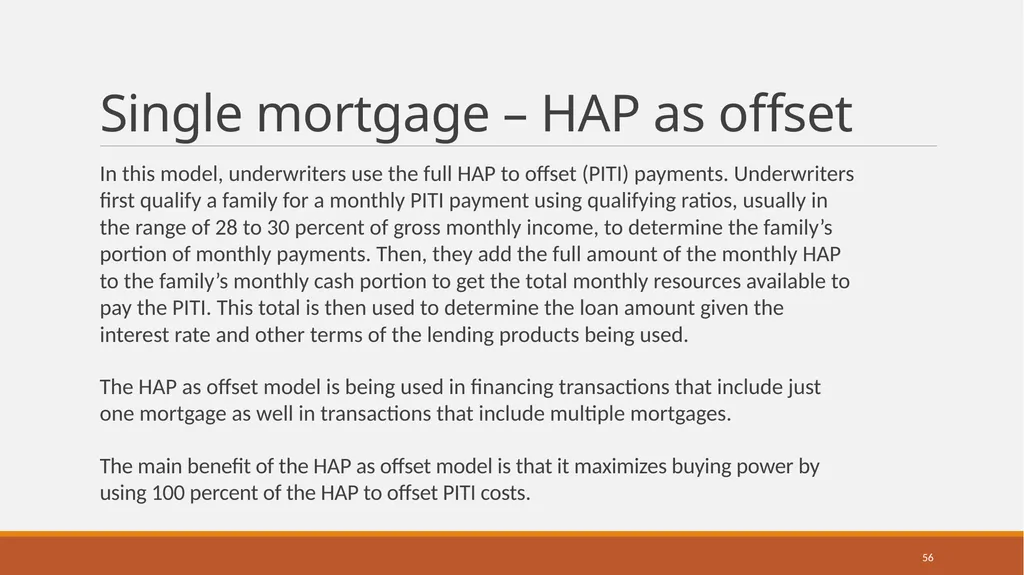
Single mortgage – HAP as offset In this model, underwriters use the full HAP to offset (PITI) payments. Underwriters first qualify a family for a monthly PITI payment using qualifying ratios, usually in the range of 28 to 30 percent of gross monthly income, to determine the family’s portion of monthly payments. Then, they add the full amount of the monthly HAP to the family’s monthly cash portion to get the total monthly resources available to pay the PITI. This total is then used to determine the loan amount given the interest rate and other terms of the lending products being used.
The HAP as offset model is being used in financing transactions that include just one mortgage as well in transactions that include multiple mortgages.
The main benefit of the HAP as offset model is that it maximizes buying power by using 100 percent of the HAP to offset PITI costs. 56<br>
The HAP as offset model is being used in financing transactions that include just one mortgage as well in transactions that include multiple mortgages.
The main benefit of the HAP as offset model is that it maximizes buying power by using 100 percent of the HAP to offset PITI costs. 56<br>
57
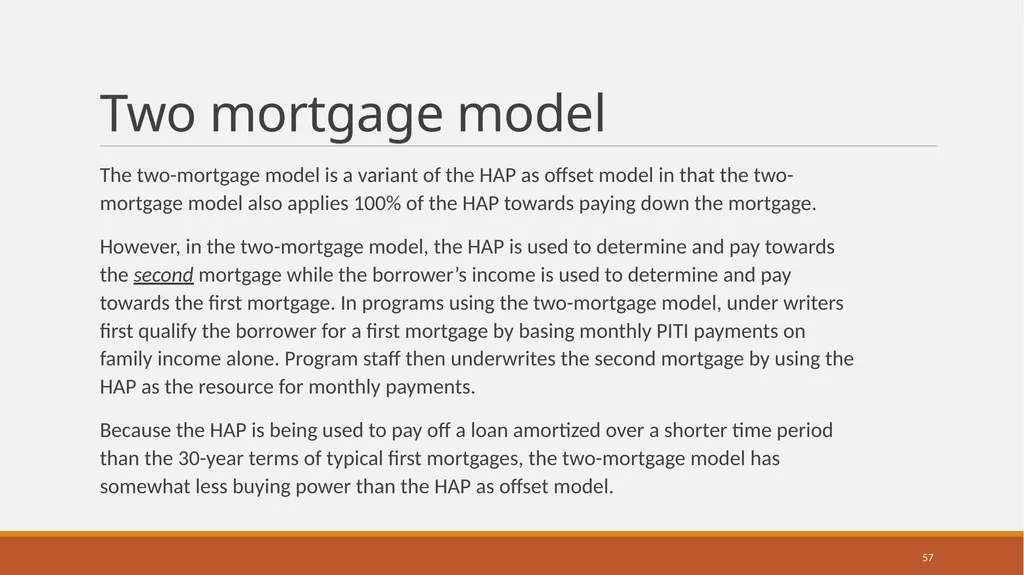
Two mortgage model The two-mortgage model is a variant of the HAP as offset model in that the two-mortgage model also applies 100% of the HAP towards paying down the mortgage.
However, in the two-mortgage model, the HAP is used to determine and pay towards the second mortgage while the borrower’s income is used to determine and pay towards the first mortgage. In programs using the two-mortgage model, under writers first qualify the borrower for a first mortgage by basing monthly PITI payments on family income alone. Program staff then underwrites the second mortgage by using the HAP as the resource for monthly payments.
Because the HAP is being used to pay off a loan amortized over a shorter time period than the 30-year terms of typical first mortgages, the two-mortgage model has somewhat less buying power than the HAP as offset model. 57<br>
However, in the two-mortgage model, the HAP is used to determine and pay towards the second mortgage while the borrower’s income is used to determine and pay towards the first mortgage. In programs using the two-mortgage model, under writers first qualify the borrower for a first mortgage by basing monthly PITI payments on family income alone. Program staff then underwrites the second mortgage by using the HAP as the resource for monthly payments.
Because the HAP is being used to pay off a loan amortized over a shorter time period than the 30-year terms of typical first mortgages, the two-mortgage model has somewhat less buying power than the HAP as offset model. 57<br>
58
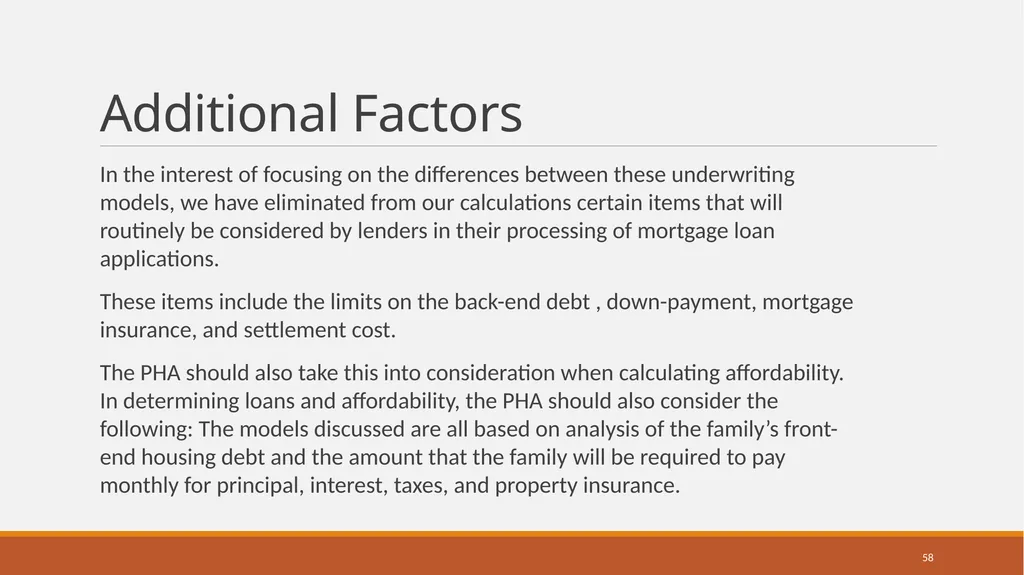
Additional Factors In the interest of focusing on the differences between these underwriting models, we have eliminated from our calculations certain items that will routinely be considered by lenders in their processing of mortgage loan applications.
These items include the limits on the back-end debt , down-payment, mortgage insurance, and settlement cost.
The PHA should also take this into consideration when calculating affordability. In determining loans and affordability, the PHA should also consider the following: The models discussed are all based on analysis of the family’s front-end housing debt and the amount that the family will be required to pay monthly for principal, interest, taxes, and property insurance. 58<br>
These items include the limits on the back-end debt , down-payment, mortgage insurance, and settlement cost.
The PHA should also take this into consideration when calculating affordability. In determining loans and affordability, the PHA should also consider the following: The models discussed are all based on analysis of the family’s front-end housing debt and the amount that the family will be required to pay monthly for principal, interest, taxes, and property insurance. 58<br>
59
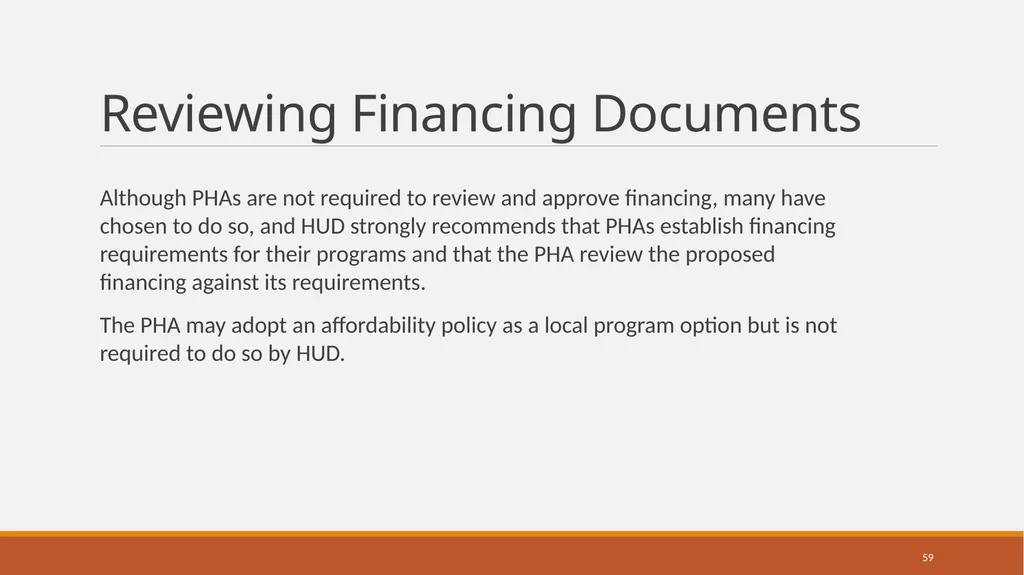
Reviewing Financing Documents Although PHAs are not required to review and approve financing, many have chosen to do so, and HUD strongly recommends that PHAs establish financing requirements for their programs and that the PHA review the proposed financing against its requirements.
The PHA may adopt an affordability policy as a local program option but is not required to do so by HUD. 59<br>
The PHA may adopt an affordability policy as a local program option but is not required to do so by HUD. 59<br>
60
Post-purchase
activities 60<br>
61
Ongoing Eligibility Families receiving voucher homeownership assistance are required to comply with the PHA’s policies on reexaminations.
All families are required to complete regularly scheduled reexaminations in accordance with PHA policy which may be annually, biennially, or triennially.
The payment standard that is used to calculate the family’s TTP at any reexamination is the higher of the current payment standard that would otherwise apply, or the payment standard used for the family at the commencement of its homeownership assistance. This provision is necessary so lenders can be assured that the level of subsidy will not be reduced, unless there is a corresponding increase in the family’s ability to pay. 24 CFR 982.633 61<br>
All families are required to complete regularly scheduled reexaminations in accordance with PHA policy which may be annually, biennially, or triennially.
The payment standard that is used to calculate the family’s TTP at any reexamination is the higher of the current payment standard that would otherwise apply, or the payment standard used for the family at the commencement of its homeownership assistance. This provision is necessary so lenders can be assured that the level of subsidy will not be reduced, unless there is a corresponding increase in the family’s ability to pay. 24 CFR 982.633 61<br>
62
Family Moves The family may purchase another home and receive homeownership assistance or may move to a rental unit and receive rental assistance, provided that no member of the family still has any homeownership interest in the old unit.
For both the HCV rental and homeownership programs, the PHA may place a limitation on the number of moves a family can make during any 12-month period.
For the family to be approved to purchase a new unit with homeownership voucher assistance, the PHA must determine that the family still meets the initial eligibility requirements at the time the family will purchase the new unit.
The family may move either with voucher rental assistance (in accordance with rental assistance program requirements) or with voucher homeownership assistance (in accordance with homeownership option program requirements).
Homeownership assistance is a covered program under the Violence Against Women’s Act (VAWA). 24 CFR 982.637 62<br>
For both the HCV rental and homeownership programs, the PHA may place a limitation on the number of moves a family can make during any 12-month period.
For the family to be approved to purchase a new unit with homeownership voucher assistance, the PHA must determine that the family still meets the initial eligibility requirements at the time the family will purchase the new unit.
The family may move either with voucher rental assistance (in accordance with rental assistance program requirements) or with voucher homeownership assistance (in accordance with homeownership option program requirements).
Homeownership assistance is a covered program under the Violence Against Women’s Act (VAWA). 24 CFR 982.637 62<br>
63
Loans for Repairs and Improvements The PHA provides allowances to families in the homeownership program that consider the family’s responsibility for routine maintenance of the unit, and the need to save money for major repairs and replacements.
Whether the family establishes a reserve fund or not, the unit may, at some point, require repairs that exceed the amount that the family has available for that purpose.
If the family finds it necessary to take out a home-equity loan to cover the cost of repairs or for improvements to the home, the PHA must include the cost of debt service on the loan in the family’s monthly homeownership expenses. 24 CFR 982.635(c)(2)(vii) 63<br>
Whether the family establishes a reserve fund or not, the unit may, at some point, require repairs that exceed the amount that the family has available for that purpose.
If the family finds it necessary to take out a home-equity loan to cover the cost of repairs or for improvements to the home, the PHA must include the cost of debt service on the loan in the family’s monthly homeownership expenses. 24 CFR 982.635(c)(2)(vii) 63<br>
64
Refinancing The PHA may require that the family obtain the PHA’s approval for any loans that are secured by the assisted property, including any refinancing or home equity loans.
In reviewing the proposed loan, the PHA may use the same criteria that it uses to review the initial mortgage loan. 24 CFR 982.632(d) 64<br>
In reviewing the proposed loan, the PHA may use the same criteria that it uses to review the initial mortgage loan. 24 CFR 982.632(d) 64<br>
65
Denial or termination of assistance At any time, the PHA may deny or terminate homeownership assistance the same as HCV rental assistance in accordance with 24 CFR 982.552 or 24 CFR 982.553.
The PHA may deny or terminate assistance for violation of participant obligations, including completing regular recertifications. (Continued HQS inspections are based on PHA policy).
The PHA must terminate homeownership assistance if the family is removed from the home due to judgment or order of foreclosure on any mortgage securing debt incurred to purchase the home, or any refinancing of such debt. 24 CFR 982.638 65<br>
The PHA may deny or terminate assistance for violation of participant obligations, including completing regular recertifications. (Continued HQS inspections are based on PHA policy).
The PHA must terminate homeownership assistance if the family is removed from the home due to judgment or order of foreclosure on any mortgage securing debt incurred to purchase the home, or any refinancing of such debt. 24 CFR 982.638 65<br>
66
Death of the Homeowner In the event of the death of the family member who is the sole owner of the home, the PHA may continue making homeownership assistance payments on behalf of the remaining family members as long as the unit is solely occupied by remaining family members, and until the estate is settled as this will result in a change in ownership of the home. 24 CFR 982.633(b)(3)(iii) 66<br>
67
Term Limits on Assistance The homeownership voucher has term limits on the family’s receipt of homeownership assistance.
Except in the case of a family that qualifies as an elderly or disabled family, the family members may not receive homeownership assistance for more than:
fifteen years, if the initial mortgage incurred to finance the purchase of the home has a term of 20 years or longer; or
ten years in all other cases.
In the case of an elderly family, the exception on term limits only applies if the family qualifies as an elderly family at the start of homeownership assistance.
In the case of a disabled family, the exception applies if at any time during receipt of homeownership assistance the family qualifies as disabled.
If the family ceases to qualify as a disabled or elderly family, the maximum term becomes applicable from the date homeownership assistance commenced. However, a family must be provided at least 6 months of homeownership assistance after the maximum term becomes applicable. 24 CFR 982.634 67<br>
Except in the case of a family that qualifies as an elderly or disabled family, the family members may not receive homeownership assistance for more than:
fifteen years, if the initial mortgage incurred to finance the purchase of the home has a term of 20 years or longer; or
ten years in all other cases.
In the case of an elderly family, the exception on term limits only applies if the family qualifies as an elderly family at the start of homeownership assistance.
In the case of a disabled family, the exception applies if at any time during receipt of homeownership assistance the family qualifies as disabled.
If the family ceases to qualify as a disabled or elderly family, the maximum term becomes applicable from the date homeownership assistance commenced. However, a family must be provided at least 6 months of homeownership assistance after the maximum term becomes applicable. 24 CFR 982.634 67<br>
68
Policy Development and Program reporting requirements 68<br>
69
The PHA Plan The PHA Plan is a comprehensive guide to PHA policies, programs, operations and strategies for meeting local housing needs and goals. There are two parts to the PHA Plan:
a Five-year Plan that describes the mission and long-term goals of the agency; and
an Annual Plan that provides details about the agency’s needs, resources, programs and services for the year ahead.
Plans for the HCV Homeownership Program must be included in the broader PHA planning process.
PHAs under the Moving to Work Demonstration (MTW) Program who operate block grants are exempt from the requirement to submit a PHA Plan and are directed to submit an Annual MTW Plan and an Annual MTW Report. MTW PHAs that do not operate block grants are not exempt from the requirement to submit a PHA Plan. 24 CFR 982.625(g)(3) 69<br>
a Five-year Plan that describes the mission and long-term goals of the agency; and
an Annual Plan that provides details about the agency’s needs, resources, programs and services for the year ahead.
Plans for the HCV Homeownership Program must be included in the broader PHA planning process.
PHAs under the Moving to Work Demonstration (MTW) Program who operate block grants are exempt from the requirement to submit a PHA Plan and are directed to submit an Annual MTW Plan and an Annual MTW Report. MTW PHAs that do not operate block grants are not exempt from the requirement to submit a PHA Plan. 24 CFR 982.625(g)(3) 69<br>
70
The PHA Administrative Plan PHA policy decisions regarding the implementation of the HCV Homeownership Program must be incorporated into the PHA’s Administrative Plan. Typically, a PHA implementing a targeted housing program, or allowing the use of a new housing type, adds a chapter to its existing Administrative Plan. The new chapter describes any special policies or provisions applicable to the new program, and states that, unless otherwise noted, the PHA’s other voucher program policies will apply to the new program. If the PHA has established local or optional policies in any of the following areas, they must be addressed in the Administrative Plan:
limitations on the number of families;
PHA requirements for participation;
maximum time to locate and purchase a home;
issuing non-purchasing families a rental voucher;
counseling requirements;
minimum down payment or equity requirements;
requirements for financing the purchase;
requirement to comply with generally accepted underwriting standards;
affordability restrictions;
financing affordability;
requirements for continuation of homeownership assistance;
determining homeownership expenses; and
limitations on moves by families. 24 CFR 982.626(b) 70<br>
limitations on the number of families;
PHA requirements for participation;
maximum time to locate and purchase a home;
issuing non-purchasing families a rental voucher;
counseling requirements;
minimum down payment or equity requirements;
requirements for financing the purchase;
requirement to comply with generally accepted underwriting standards;
affordability restrictions;
financing affordability;
requirements for continuation of homeownership assistance;
determining homeownership expenses; and
limitations on moves by families. 24 CFR 982.626(b) 70<br>
71
PHA reporting requirements PHAs are reminded that information on families assisted under the HCV Homeownership Program is reported on Section 15 of form HUD-50058 or on Section 22 of form HUD-50058 MTW. It is extremely important that the PHA correctly identify homeownership families in reporting program data to HUD.
Statement of Homeownership Obligations 71<br>
Statement of Homeownership Obligations 71<br>