How are Planets Formed? Pre-solar nebula Protoplanetary disk: condensation and accretion Solar wind (beginning of fusion) Collisions continue Planetary migration (orbits shifting) Late Heavy Bombardment (Hadean Era) Planetary Evolution An
"How are Planets Formed? Pre-solar nebula" is the property of its rightful owner. Permission is granted to
download and print the materials on this website for personal, non-commercial use only, and to display it
on your personal computer provided you do not modify the materials and that you retain all copyright
notices contained in the materials. By downloading content from our website, you accept the terms of this
agreement.
Presentation Transcript
01
How are Planets Formed?<br>
02
Pre-solar nebula
Protoplanetary disk: condensation and accretion
Solar wind (beginning of fusion)
Collisions continue
Planetary migration (orbits shifting)
Late Heavy Bombardment (Hadean Era)
Planetary Evolution An Overview<br>
03
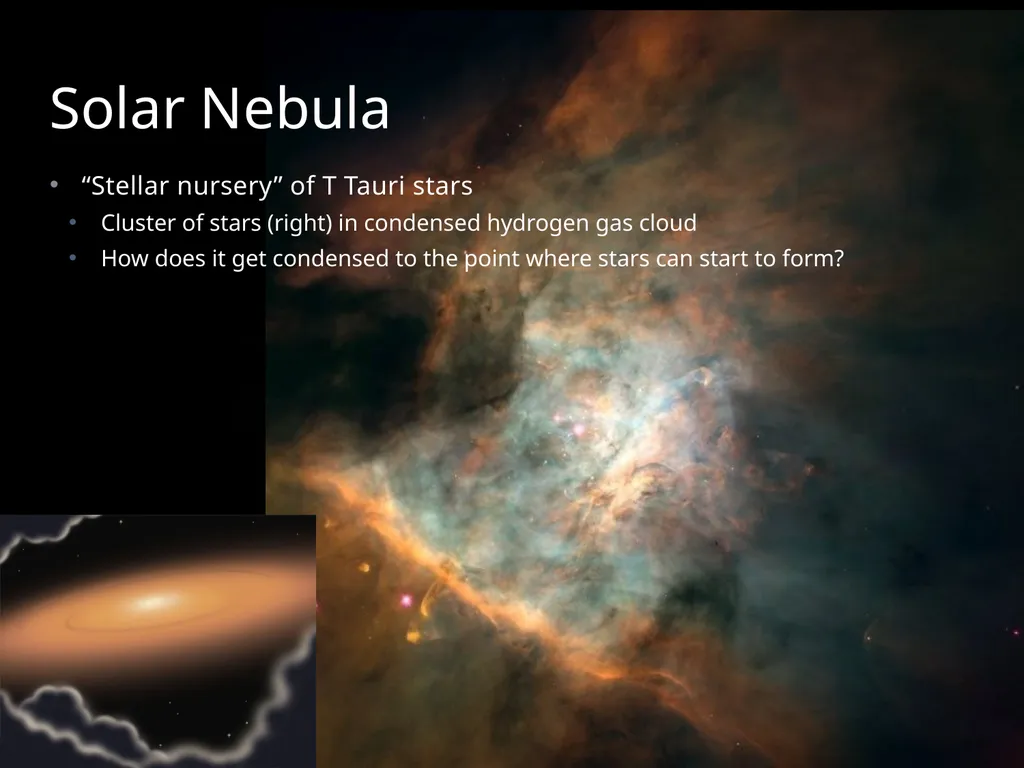
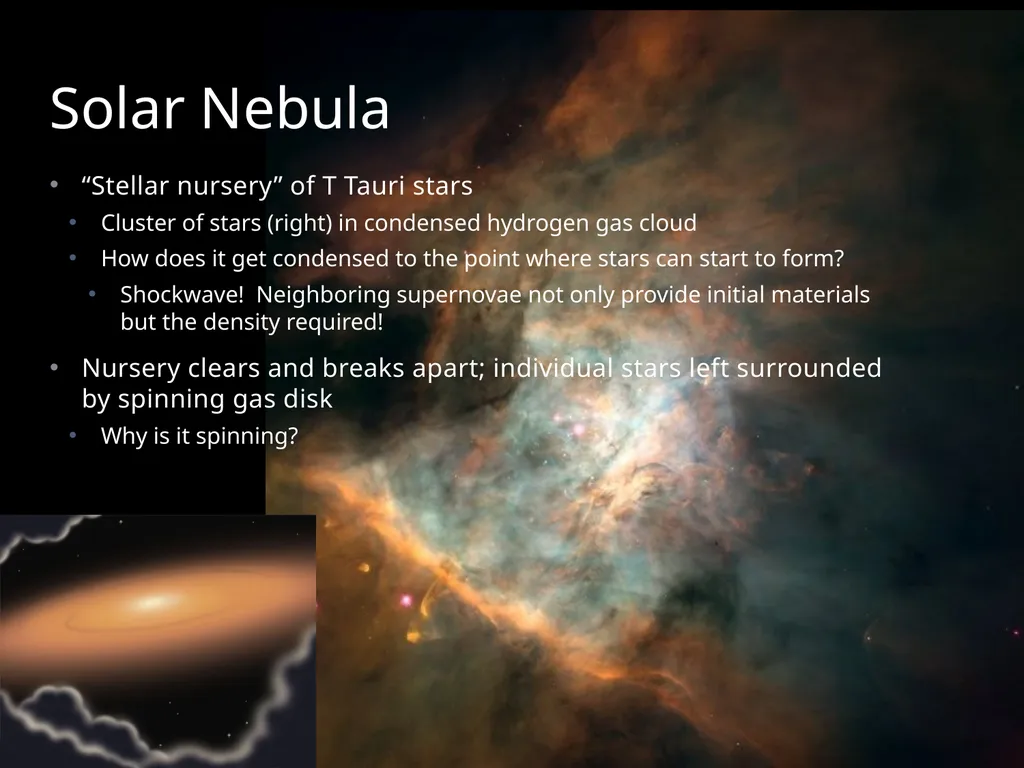
“Stellar nursery” of T Tauri stars
Cluster of stars (right) in condensed hydrogen gas cloud
How does it get condensed to the point where stars can start to form? Solar Nebula<br>
04
“Stellar nursery” of T Tauri stars
Cluster of stars (right) in condensed hydrogen gas cloud
How does it get condensed to the point where stars can start to form?
Shockwave! Neighboring supernovae not only provide initial materials but the density required!
Nursery clears and breaks apart; individual stars left surrounded by spinning gas disk
Why is it spinning? Solar Nebula<br>
05
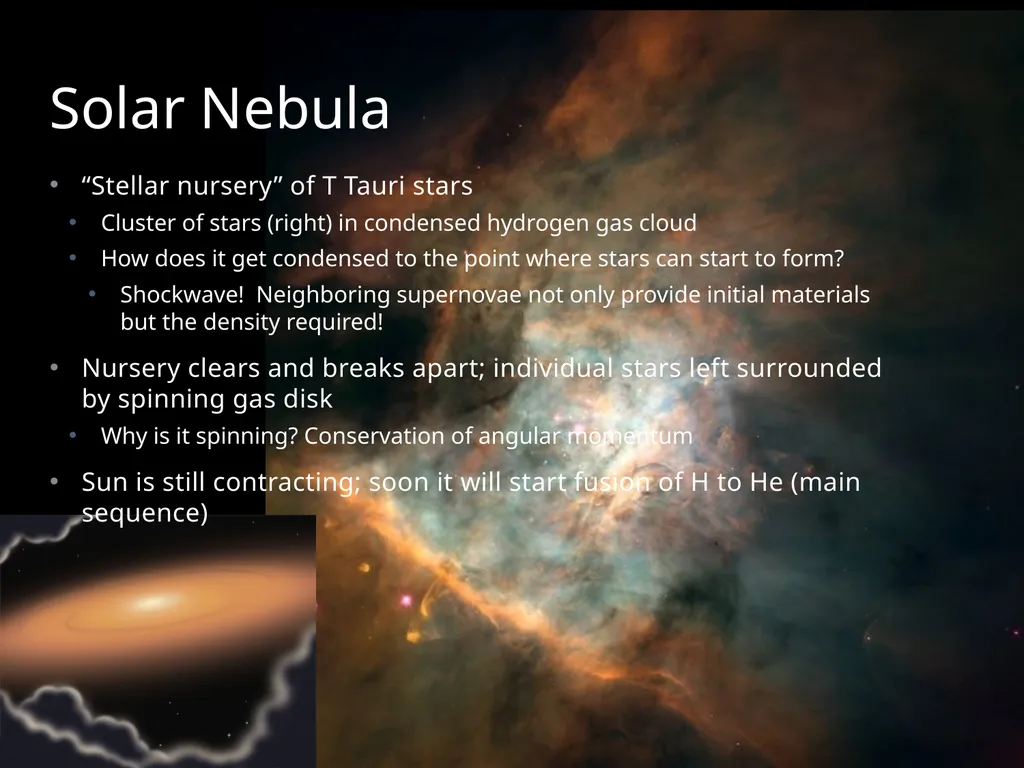
“Stellar nursery” of T Tauri stars
Cluster of stars (right) in condensed hydrogen gas cloud
How does it get condensed to the point where stars can start to form?
Shockwave! Neighboring supernovae not only provide initial materials but the density required!
Nursery clears and breaks apart; individual stars left surrounded by spinning gas disk
Why is it spinning? Conservation of angular momentum
Sun is still contracting; soon it will start fusion of H to He (main sequence) Solar Nebula<br>
06
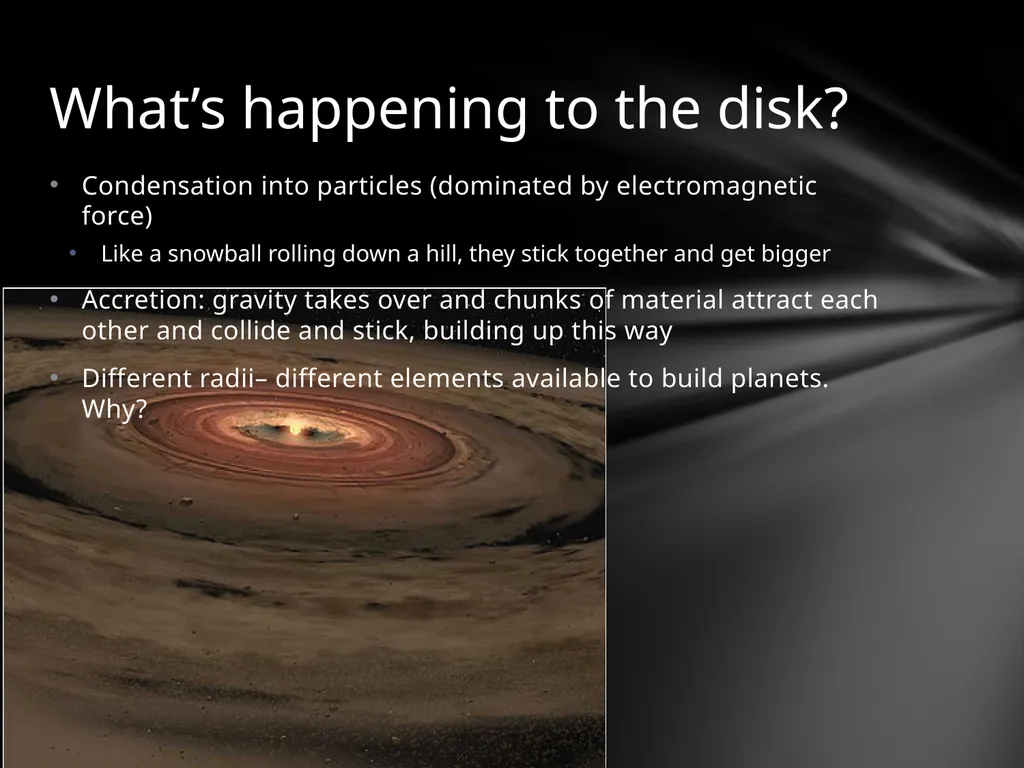
Condensation into particles (dominated by electromagnetic force)
Like a snowball rolling down a hill, they stick together and get bigger
Accretion: gravity takes over and chunks of material attract each other and collide and stick, building up this way
Different radii– different elements available to build planets. Why? What’s happening to the disk?<br>
07
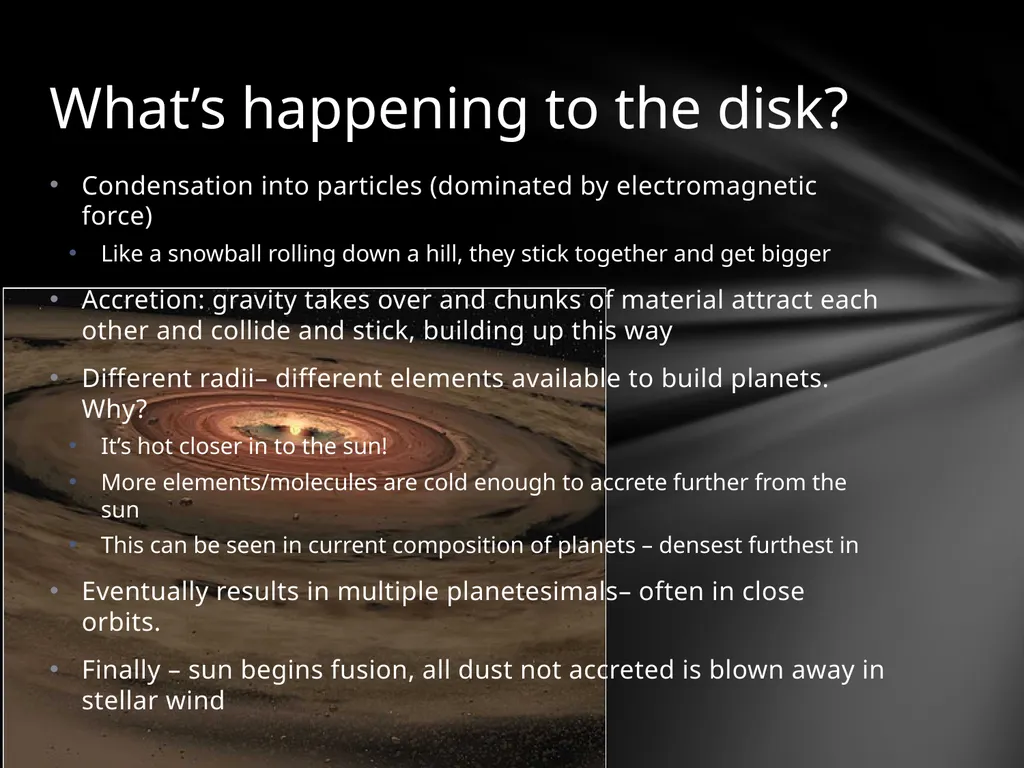
Condensation into particles (dominated by electromagnetic force)
Like a snowball rolling down a hill, they stick together and get bigger
Accretion: gravity takes over and chunks of material attract each other and collide and stick, building up this way
Different radii– different elements available to build planets. Why?
It’s hot closer in to the sun!
More elements/molecules are cold enough to accrete further from the sun
This can be seen in current composition of planets – densest furthest in
Eventually results in multiple planetesimals– often in close orbits.
Finally – sun begins fusion, all dust not accreted is blown away in stellar wind What’s happening to the disk?<br>
08
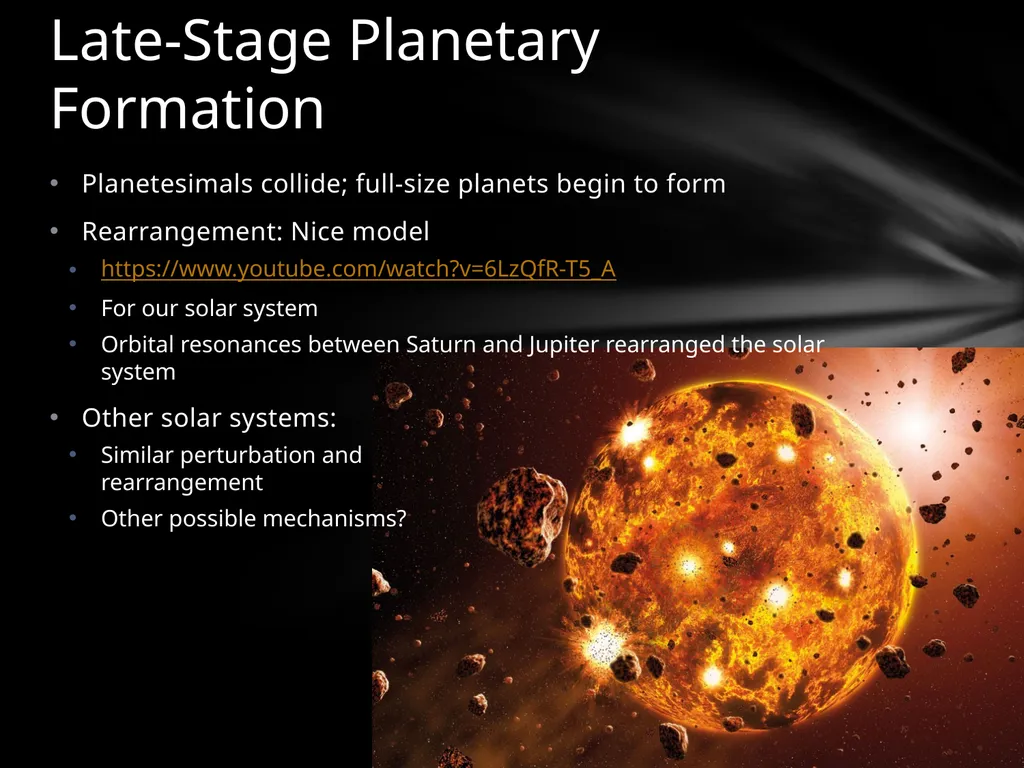
Planetesimals collide; full-size planets begin to form
Rearrangement: Nice model
https://www.youtube.com/watch?v=6LzQfR-T5_A
For our solar system
Orbital resonances between Saturn and Jupiter rearranged the solar system
Other solar systems:
Similar perturbation and rearrangement
Other possible mechanisms? Late-Stage Planetary Formation<br>
09
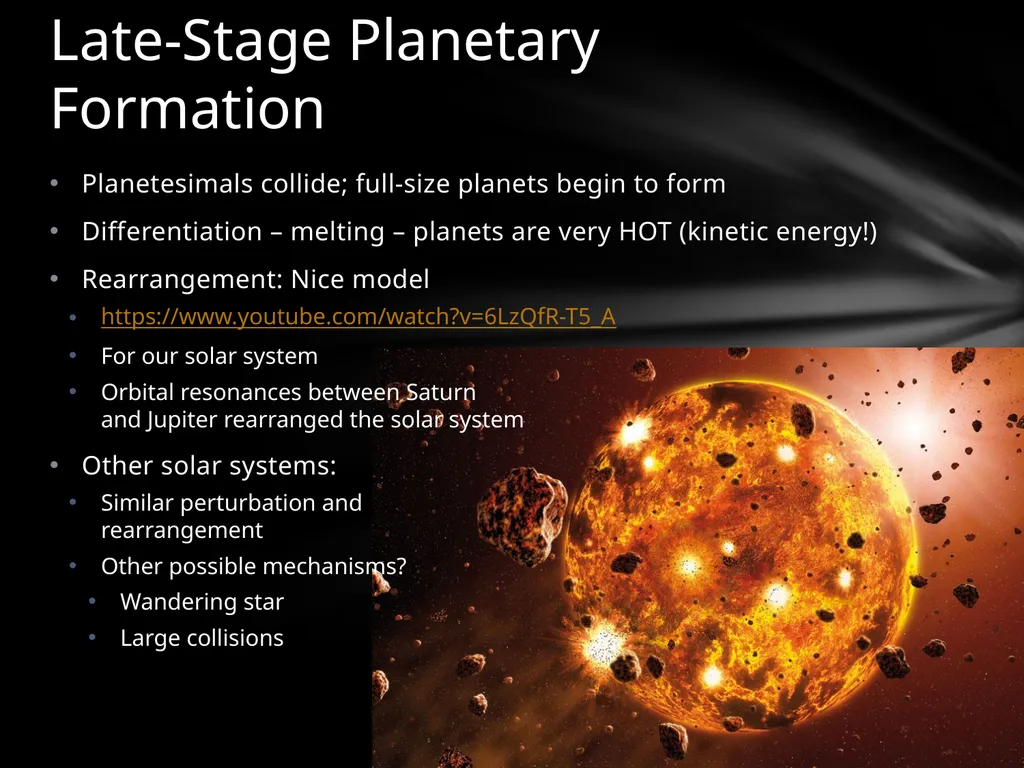
Planetesimals collide; full-size planets begin to form
Differentiation – melting – planets are very HOT (kinetic energy!)
Rearrangement: Nice model
https://www.youtube.com/watch?v=6LzQfR-T5_A
For our solar system
Orbital resonances between Saturn and Jupiter rearranged the solar system
Other solar systems:
Similar perturbation and rearrangement
Other possible mechanisms?
Wandering star
Large collisions Late-Stage Planetary Formation<br>
10
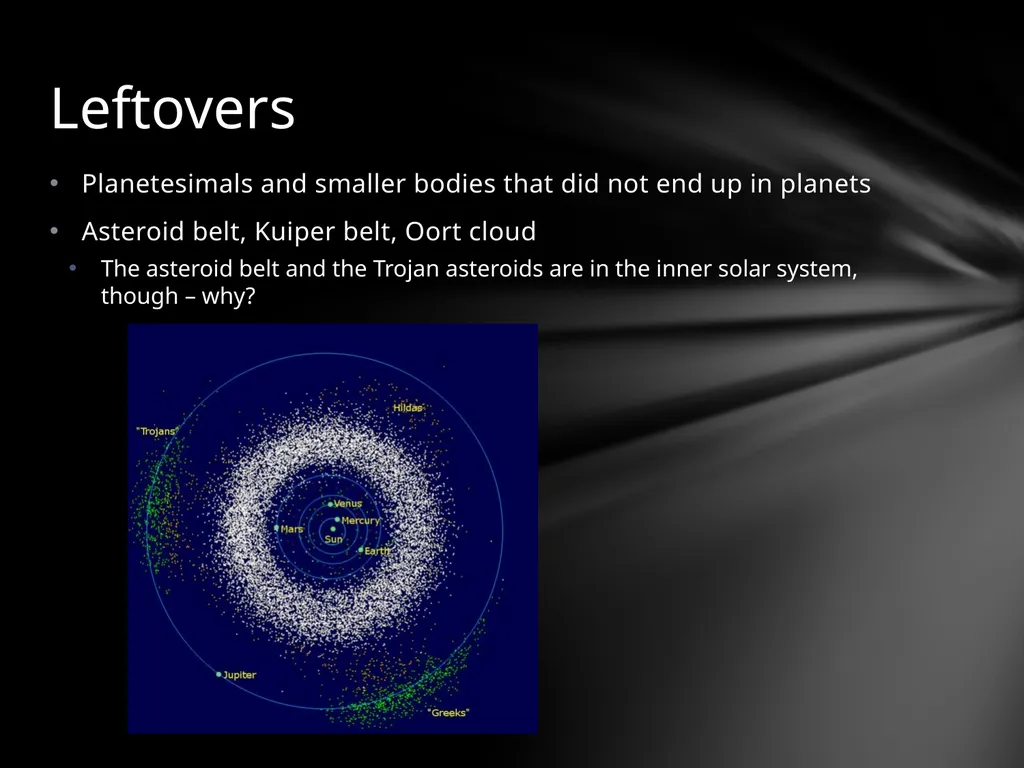
Planetesimals and smaller bodies that did not end up in planets
Asteroid belt, Kuiper belt, Oort cloud
The asteroid belt and the Trojan asteroids are in the inner solar system, though – why? Leftovers<br>
11
Leftovers: asteroid belt, Kuiper belt, Oort cloud
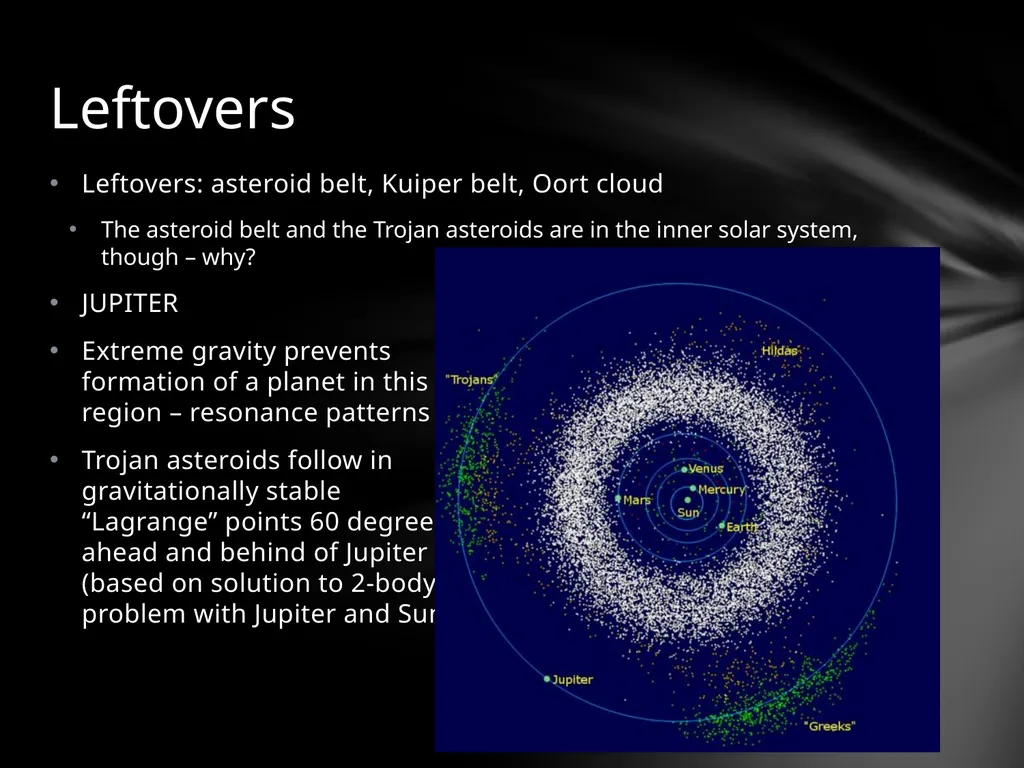
The asteroid belt and the Trojan asteroids are in the inner solar system, though – why?
JUPITER
Extreme gravity prevents formation of a planet in this region – resonance patterns
Trojan asteroids follow in gravitationally stable “Lagrange” points 60 degrees ahead and behind of Jupiter (based on solution to 2-body problem with Jupiter and Sun) Leftovers<br>
12
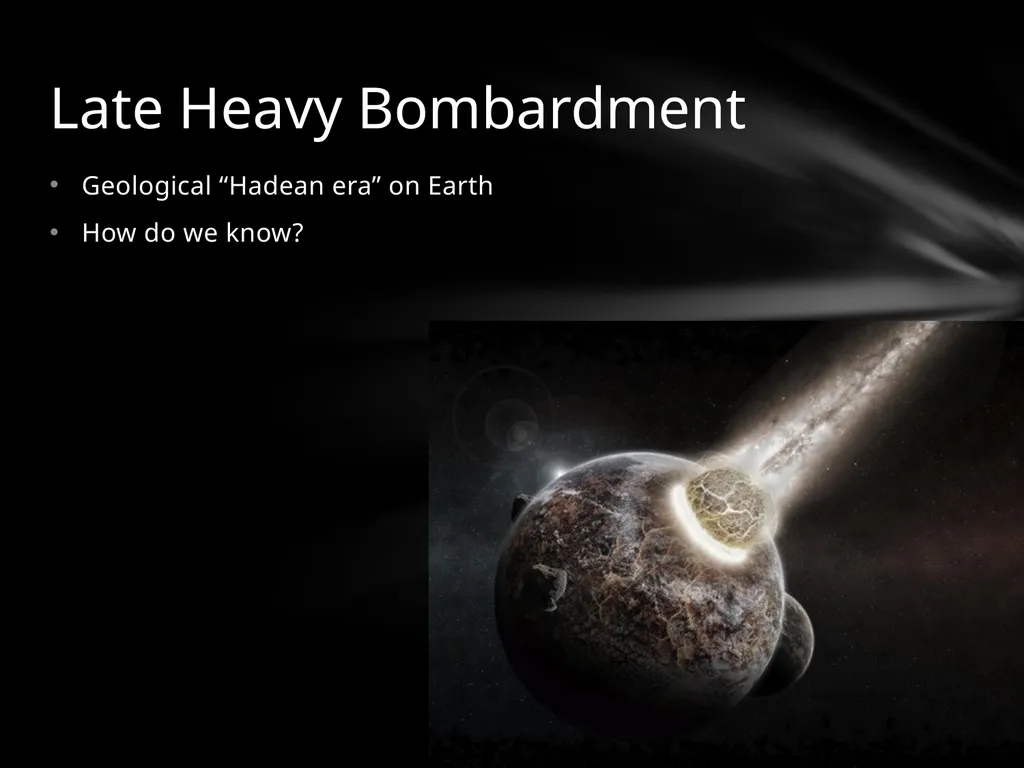
Geological “Hadean era” on Earth
How do we know? Late Heavy Bombardment<br>
13
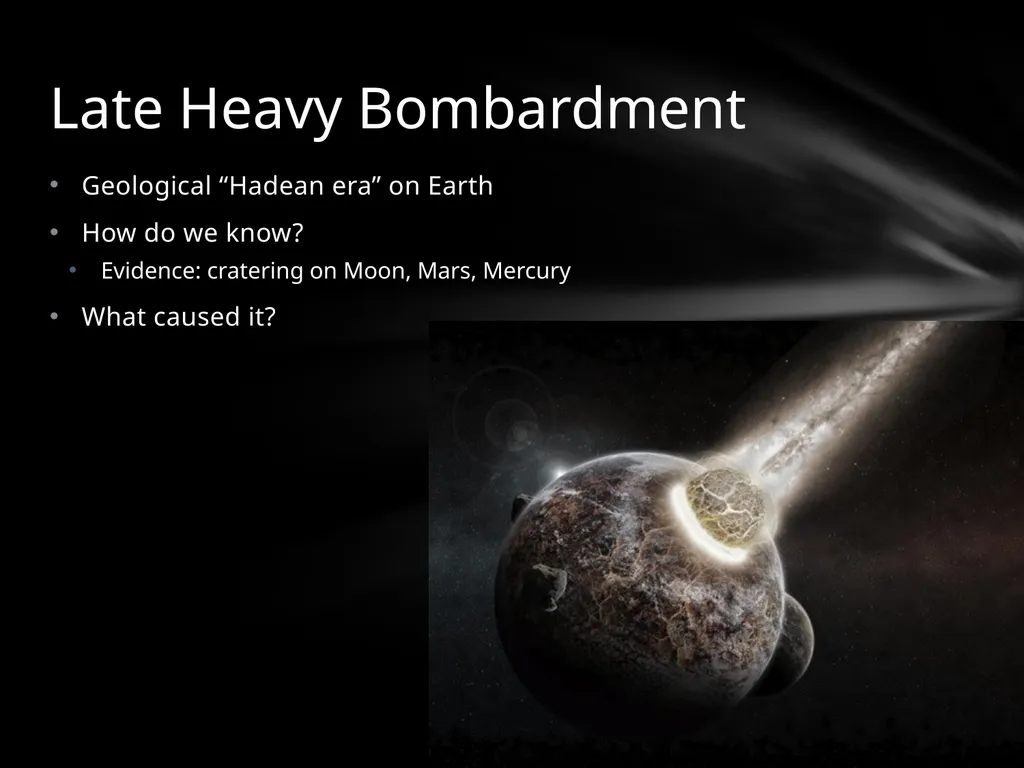
Geological “Hadean era” on Earth
How do we know?
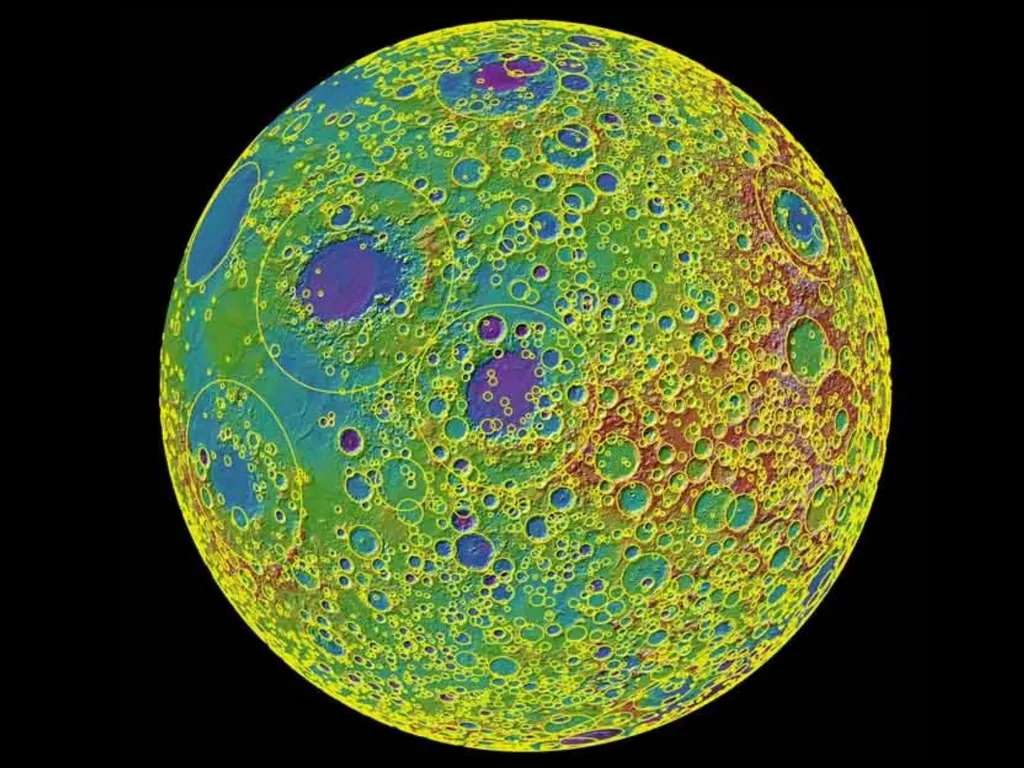
Evidence: cratering on Moon, Mars, Mercury
What caused it? Late Heavy Bombardment<br>
14
Geological “Hadean era” on Earth
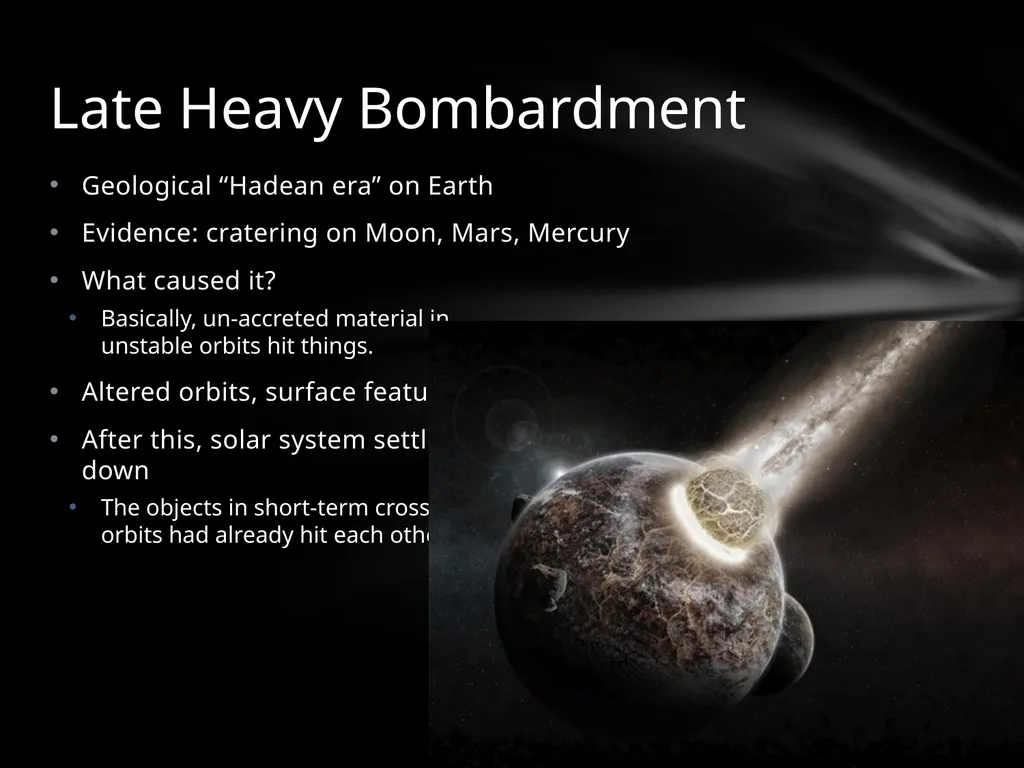
Evidence: cratering on Moon, Mars, Mercury
What caused it?
Basically, un-accreted material in unstable orbits hit things.
Altered orbits, surface features
After this, solar system settled down
The objects in short-term crossing orbits had already hit each other Late Heavy Bombardment<br>
15
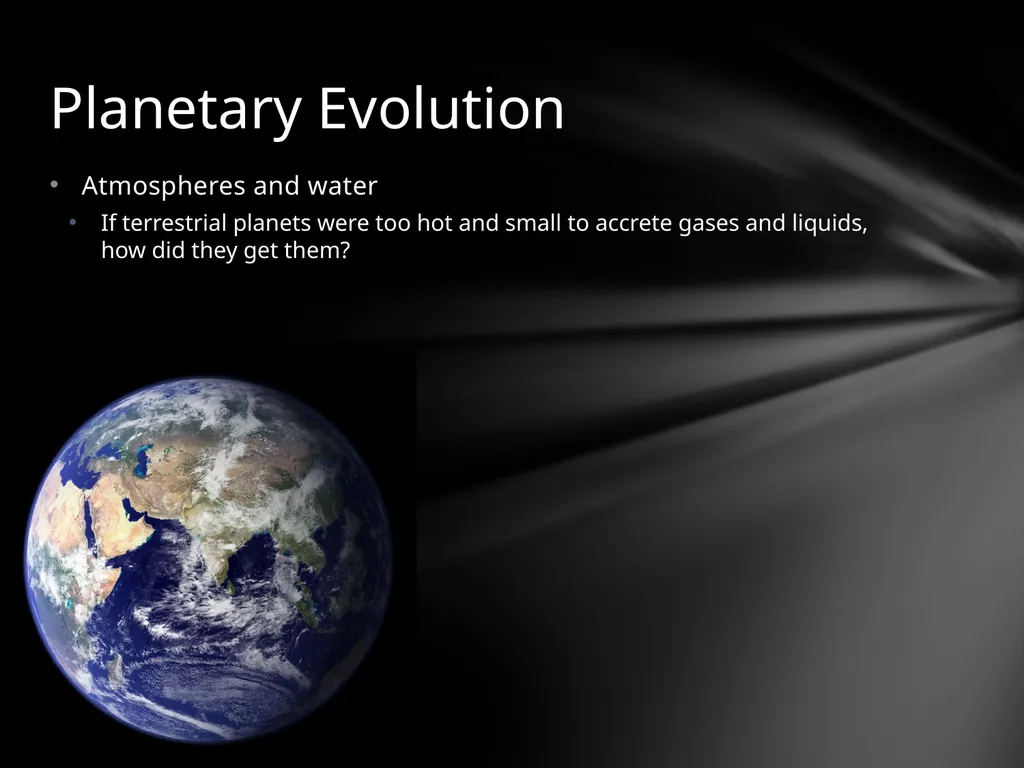
Atmospheres and water
If terrestrial planets were too hot and small to accrete gases and liquids, how did they get them? Planetary Evolution<br>
16
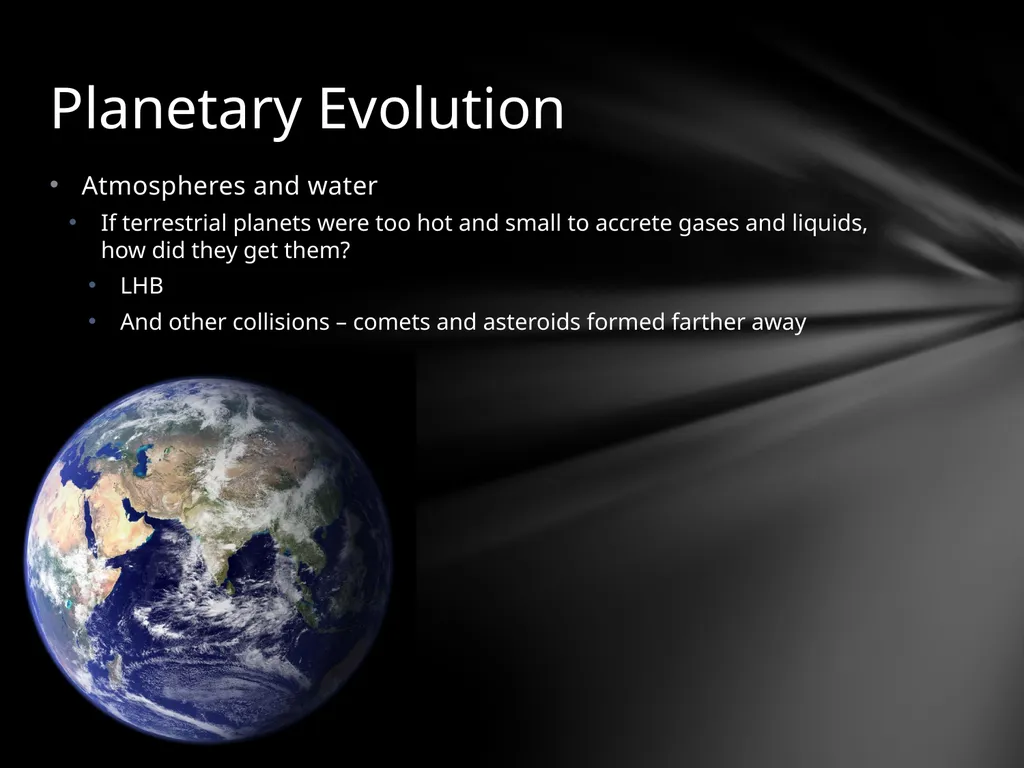
Atmospheres and water
If terrestrial planets were too hot and small to accrete gases and liquids, how did they get them?
LHB
And other collisions – comets and asteroids formed farther away
Structure Planetary Evolution<br>
17
Moons and other satellites
How could a planet get moons? Planetary Evolution<br>
18
Moons and other satellites
How could a planet get moons?
Co-formation (planets had disks like suns do and satellites accreted)
Capture
Other processes: collision and subsequent accretion (Earth’s Moon)
https://www.youtube.com/watch?v=HKkXVny7Yd8
Surface Processes
Some internal heating > volcanism and plate tectonics
Continued collisions
Actions of atmosphere
Cooling of the planet (Mercury’s scarps)
Entropy, chemical and thermal reactions run down to stable states from initial conditions
Next week: specific examples from the solar system we know the most about! Planetary Evolution<br>