
HOW MANY ANIMALS CAN YOUR LAND SUPPORT? First





Description: HOW MANY ANIMALS CAN YOUR LAND SUPPORT? First things first; Before knowing how many animals (cows, horses, sheep, goats, etc) your land can support, we must first determine how much feed (grass and forbs) is available for the animals to
Related Topics
Download Presentation
"HOW MANY ANIMALS CAN YOUR LAND SUPPORT? First" is the property of its rightful owner. Permission is granted to download and print the materials on this website for personal, non-commercial use only, and to display it on your personal computer provided you do not modify the materials and that you retain all copyright notices contained in the materials. By downloading content from our website, you accept the terms of this agreement.
Presentation Transcript
slide1. HOW MANY ANIMALS CAN YOUR LAND SUPPORT? First things first;
Before knowing how many animals (cows, horses, sheep, goats, etc) your land can support, we must first determine how much feed (grass and forbs) is available for the animals to graze.
If you place too many animals on a piece of land - it is likely to be overgrazed very quickly, which can lead to degradation of the land, as well as you having to buy supplemental feed (the most expensive thing on a ranch!)<br>
slide2. Carrying Capacity - the number of grazing animals a given area or pasture is able to support without depleting rangeland vegetation or soil resources.
Determining the carrying capacity (how many animals your land can support) is all about BASIC math.
Here are the basic equations you need:
Pounds/year = (pounds of forage/acre/yr – RDM) * # of acres * HE
Pounds/year/animal needed = Average weight * 0.03 * 365 days/year
Residual Dry Matter (RDM) - the amount of old plant material left on the ground at the beginning of a new growing season. The beginning of the new growing season is defined as the first rain event in the fall. Sometimes September 1st is used as an objective, consistent time to measure RDM. in California, RDM indicates the previous season's use and can be used to describe the health or condition of annual rangelands. DETERMINING CARRYING CAPACITY:<br>
slide3. Harvest Efficiency (HE) - intake by livestock. A standard measure based on slope of terrain. The steeper the ground, the more difficult it will be for the animal to graze it; thus providing a lower Harvest Efficiency. DETERMINING CARRYING CAPACITY: Harvest Efficiency and RDM<br>
slide4. DETERMINING CARRYING CAPACITY: FORAGE PRODUCTION When determining the average forage productivity of a given area there are typically 3 options:
Web Soil Survey
Local Cooperative Extension Office (dependent on office - not all of them have range managers on staff)
Forage clipping (field method)
Clipping should be conducted at the peak production period (right after the annual grasses have developed their seeds, before the landscape starts to turn brown). Roughly the middle of May for most of the Central Valley in California.
Once clippings have been collected, they must be dried to remove moisture and obtain an accurate weight.<br>
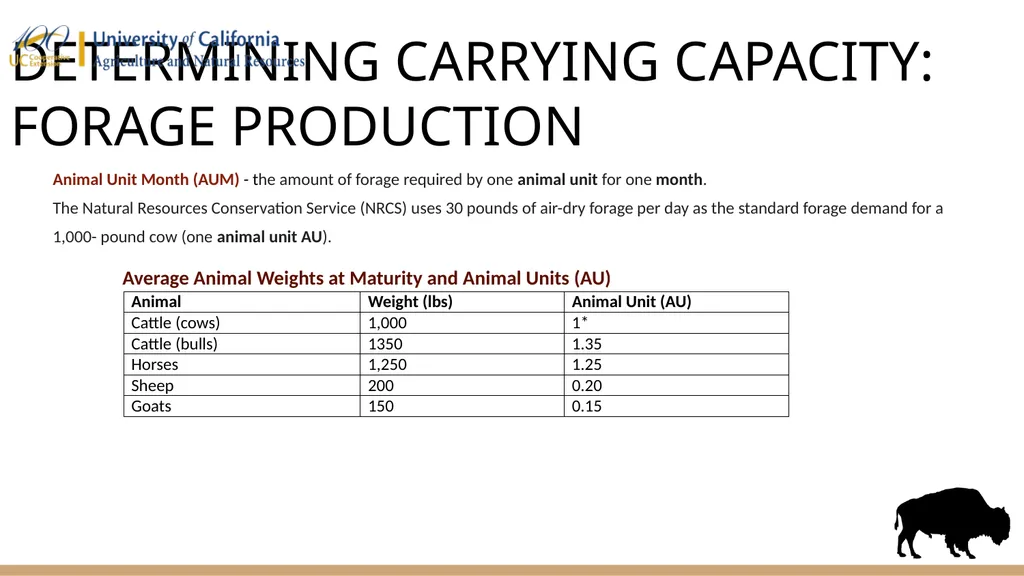
slide5. DETERMINING CARRYING CAPACITY: FORAGE PRODUCTION Animal Unit Month (AUM) - the amount of forage required by one animal unit for one month.
The Natural Resources Conservation Service (NRCS) uses 30 pounds of air-dry forage per day as the standard forage demand for a 1,000- pound cow (one animal unit AU). Average Animal Weights at Maturity and Animal Units (AU)<br>
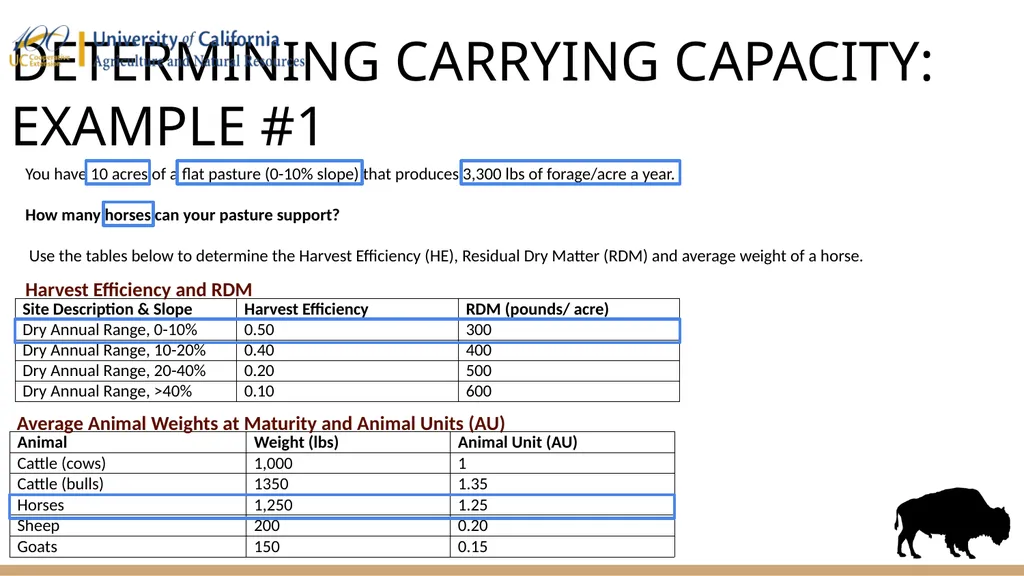
slide6. DETERMINING CARRYING CAPACITY: EXAMPLE #1 You have 10 acres of a flat pasture (0-10% slope) that produces 3,300 lbs of forage/acre a year.
How many horses can your pasture support?
Use the tables below to determine the Harvest Efficiency (HE), Residual Dry Matter (RDM) and average weight of a horse. Average Animal Weights at Maturity and Animal Units (AU) Harvest Efficiency and RDM<br>
slide7. Step 1 - How many pounds of forage per year is efficiently produced on your 10 acres? (remember, each acre produces 3,300 pounds/year)
Pounds/year = (pounds of forage/acre/yr – RDM) * # of acres * HE
Pounds/year = (3,300 lbs/acre/year – 300 lbs)* 10 acres * 0.50
= 15,000 pounds/year DETERMINING CARRYING CAPACITY: EXAMPLE #1 Average Animal Weights at Maturity and Animal Units (AU) Harvest Efficiency and RDM<br>
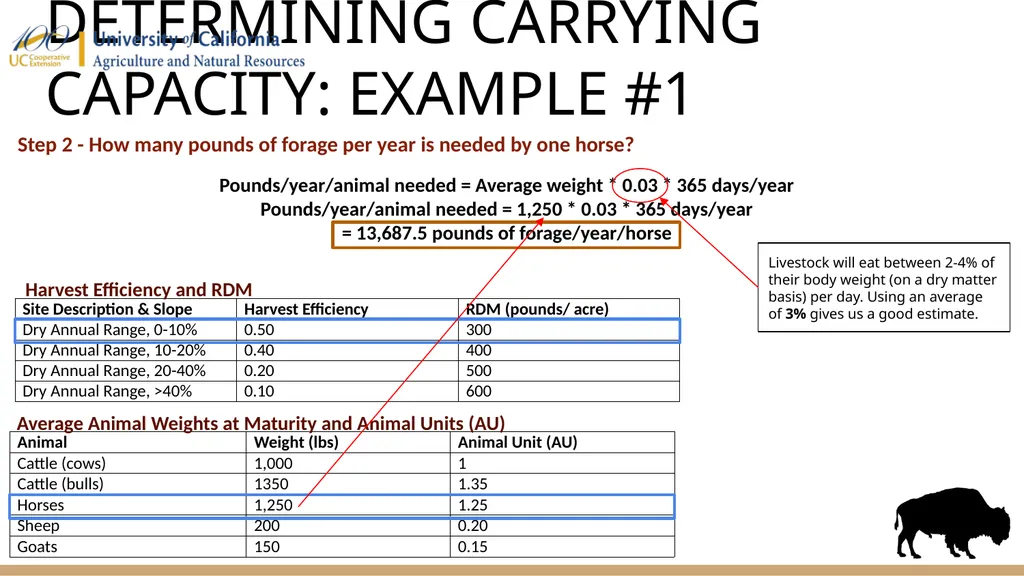
slide8. Pounds/year/animal needed = Average weight * 0.03 * 365 days/year
Pounds/year/animal needed = 1,250 * 0.03 * 365 days/year
= 13,687.5 pounds of forage/year/horse DETERMINING CARRYING CAPACITY: EXAMPLE #1 Average Animal Weights at Maturity and Animal Units (AU) Harvest Efficiency and RDM Step 2 - How many pounds of forage per year is needed by one horse? Livestock will eat between 2-4% of their body weight (on a dry matter basis) per day. Using an average of 3% gives us a good estimate.<br>
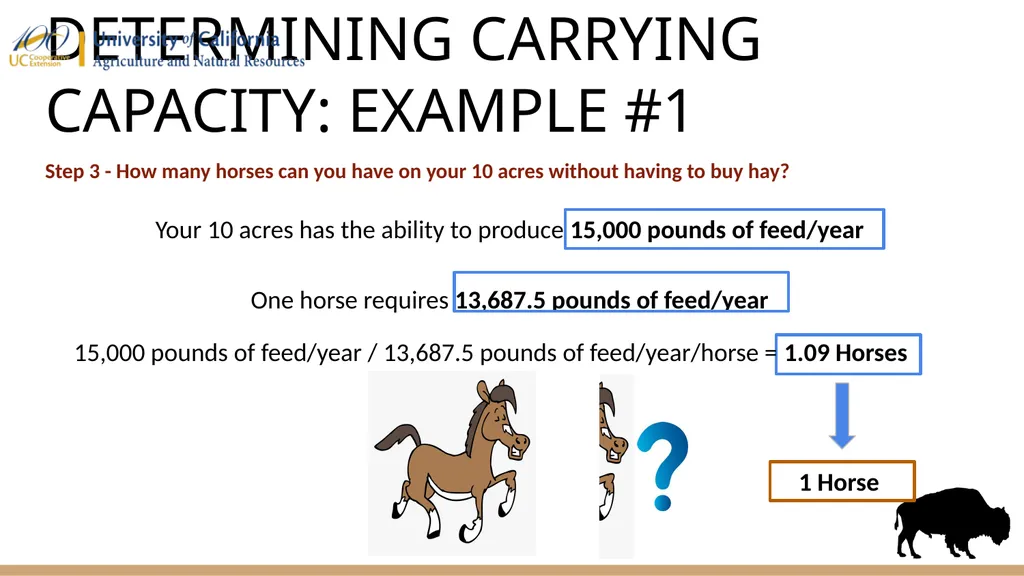
slide9. 1 Horse 15,000 pounds of feed/year / 13,687.5 pounds of feed/year/horse = 1.09 Horses Step 3 - How many horses can you have on your 10 acres without having to buy hay? DETERMINING CARRYING CAPACITY: EXAMPLE #1 Your 10 acres has the ability to produce 15,000 pounds of feed/year One horse requires 13,687.5 pounds of feed/year<br>
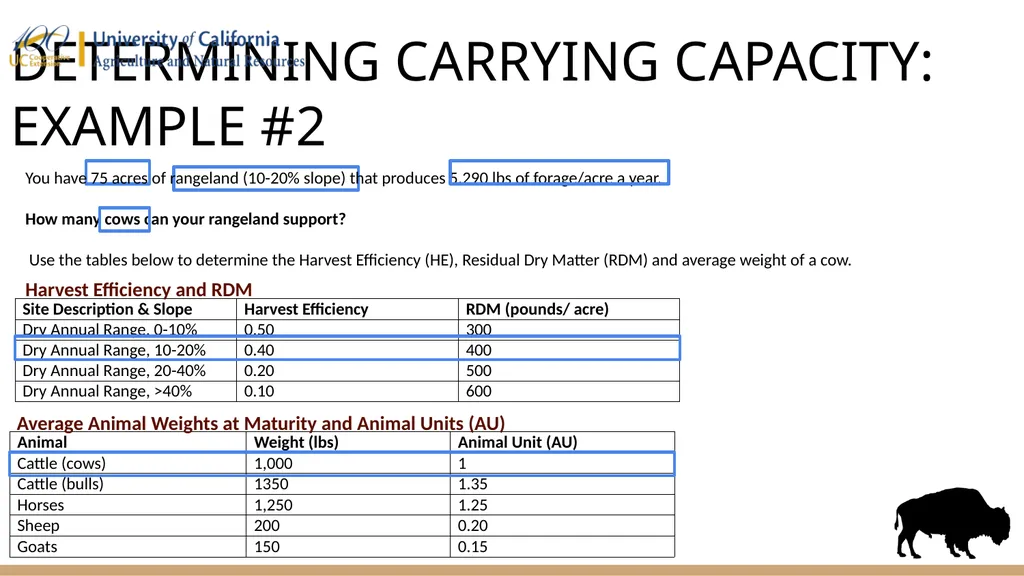
slide10. DETERMINING CARRYING CAPACITY: EXAMPLE #2 You have 75 acres of rangeland (10-20% slope) that produces 5,290 lbs of forage/acre a year.
How many cows can your rangeland support?
Use the tables below to determine the Harvest Efficiency (HE), Residual Dry Matter (RDM) and average weight of a cow. Average Animal Weights at Maturity and Animal Units (AU) Harvest Efficiency and RDM<br>
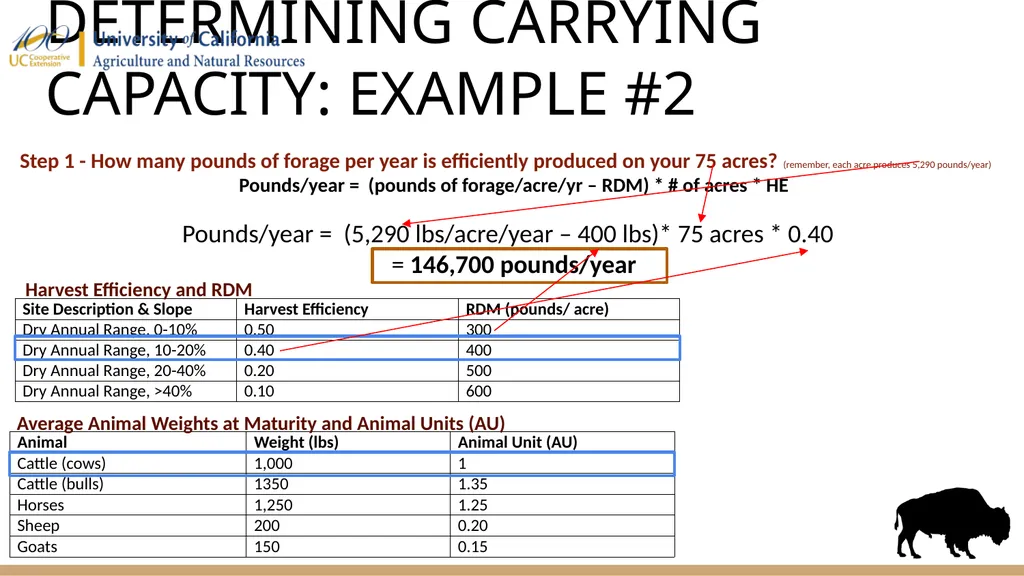
slide11. Step 1 - How many pounds of forage per year is efficiently produced on your 75 acres? (remember, each acre produces 5,290 pounds/year)
Pounds/year = (pounds of forage/acre/yr – RDM) * # of acres * HE
Pounds/year = (5,290 lbs/acre/year – 400 lbs)* 75 acres * 0.40
= 146,700 pounds/year DETERMINING CARRYING CAPACITY: EXAMPLE #2 Average Animal Weights at Maturity and Animal Units (AU) Harvest Efficiency and RDM<br>
slide12. Pounds/year/animal needed = Average weight * 0.03 * 365 days/year
Pounds/year/animal needed = 1,000 * 0.03 * 365 days/year
= 10,950 pounds of forage/year/cow Step 2 - How many pounds of forage per year is needed by one cow? DETERMINING CARRYING CAPACITY: EXAMPLE #2 Average Animal Weights at Maturity and Animal Units (AU) Harvest Efficiency and RDM Remember to use 3% for body weight consumption<br>
slide13. One cow requires 10,950 pounds of feed/year 146,700 pounds of feed/year /10,950 pounds of feed/year/cow = 13.39 Cows 13 Cows Step 3 - How many cows can you have on your 10 acres without having to buy hay? DETERMINING CARRYING CAPACITY: EXAMPLE #2 Your 10 acres has the ability to produce 146,700 pounds of feed/year<br>
Before knowing how many animals (cows, horses, sheep, goats, etc) your land can support, we must first determine how much feed (grass and forbs) is available for the animals to graze.
If you place too many animals on a piece of land - it is likely to be overgrazed very quickly, which can lead to degradation of the land, as well as you having to buy supplemental feed (the most expensive thing on a ranch!)<br>
slide2. Carrying Capacity - the number of grazing animals a given area or pasture is able to support without depleting rangeland vegetation or soil resources.
Determining the carrying capacity (how many animals your land can support) is all about BASIC math.
Here are the basic equations you need:
Pounds/year = (pounds of forage/acre/yr – RDM) * # of acres * HE
Pounds/year/animal needed = Average weight * 0.03 * 365 days/year
Residual Dry Matter (RDM) - the amount of old plant material left on the ground at the beginning of a new growing season. The beginning of the new growing season is defined as the first rain event in the fall. Sometimes September 1st is used as an objective, consistent time to measure RDM. in California, RDM indicates the previous season's use and can be used to describe the health or condition of annual rangelands. DETERMINING CARRYING CAPACITY:<br>
slide3. Harvest Efficiency (HE) - intake by livestock. A standard measure based on slope of terrain. The steeper the ground, the more difficult it will be for the animal to graze it; thus providing a lower Harvest Efficiency. DETERMINING CARRYING CAPACITY: Harvest Efficiency and RDM<br>
slide4. DETERMINING CARRYING CAPACITY: FORAGE PRODUCTION When determining the average forage productivity of a given area there are typically 3 options:
Web Soil Survey
Local Cooperative Extension Office (dependent on office - not all of them have range managers on staff)
Forage clipping (field method)
Clipping should be conducted at the peak production period (right after the annual grasses have developed their seeds, before the landscape starts to turn brown). Roughly the middle of May for most of the Central Valley in California.
Once clippings have been collected, they must be dried to remove moisture and obtain an accurate weight.<br>
slide5. DETERMINING CARRYING CAPACITY: FORAGE PRODUCTION Animal Unit Month (AUM) - the amount of forage required by one animal unit for one month.
The Natural Resources Conservation Service (NRCS) uses 30 pounds of air-dry forage per day as the standard forage demand for a 1,000- pound cow (one animal unit AU). Average Animal Weights at Maturity and Animal Units (AU)<br>
slide6. DETERMINING CARRYING CAPACITY: EXAMPLE #1 You have 10 acres of a flat pasture (0-10% slope) that produces 3,300 lbs of forage/acre a year.
How many horses can your pasture support?
Use the tables below to determine the Harvest Efficiency (HE), Residual Dry Matter (RDM) and average weight of a horse. Average Animal Weights at Maturity and Animal Units (AU) Harvest Efficiency and RDM<br>
slide7. Step 1 - How many pounds of forage per year is efficiently produced on your 10 acres? (remember, each acre produces 3,300 pounds/year)
Pounds/year = (pounds of forage/acre/yr – RDM) * # of acres * HE
Pounds/year = (3,300 lbs/acre/year – 300 lbs)* 10 acres * 0.50
= 15,000 pounds/year DETERMINING CARRYING CAPACITY: EXAMPLE #1 Average Animal Weights at Maturity and Animal Units (AU) Harvest Efficiency and RDM<br>
slide8. Pounds/year/animal needed = Average weight * 0.03 * 365 days/year
Pounds/year/animal needed = 1,250 * 0.03 * 365 days/year
= 13,687.5 pounds of forage/year/horse DETERMINING CARRYING CAPACITY: EXAMPLE #1 Average Animal Weights at Maturity and Animal Units (AU) Harvest Efficiency and RDM Step 2 - How many pounds of forage per year is needed by one horse? Livestock will eat between 2-4% of their body weight (on a dry matter basis) per day. Using an average of 3% gives us a good estimate.<br>
slide9. 1 Horse 15,000 pounds of feed/year / 13,687.5 pounds of feed/year/horse = 1.09 Horses Step 3 - How many horses can you have on your 10 acres without having to buy hay? DETERMINING CARRYING CAPACITY: EXAMPLE #1 Your 10 acres has the ability to produce 15,000 pounds of feed/year One horse requires 13,687.5 pounds of feed/year<br>
slide10. DETERMINING CARRYING CAPACITY: EXAMPLE #2 You have 75 acres of rangeland (10-20% slope) that produces 5,290 lbs of forage/acre a year.
How many cows can your rangeland support?
Use the tables below to determine the Harvest Efficiency (HE), Residual Dry Matter (RDM) and average weight of a cow. Average Animal Weights at Maturity and Animal Units (AU) Harvest Efficiency and RDM<br>
slide11. Step 1 - How many pounds of forage per year is efficiently produced on your 75 acres? (remember, each acre produces 5,290 pounds/year)
Pounds/year = (pounds of forage/acre/yr – RDM) * # of acres * HE
Pounds/year = (5,290 lbs/acre/year – 400 lbs)* 75 acres * 0.40
= 146,700 pounds/year DETERMINING CARRYING CAPACITY: EXAMPLE #2 Average Animal Weights at Maturity and Animal Units (AU) Harvest Efficiency and RDM<br>
slide12. Pounds/year/animal needed = Average weight * 0.03 * 365 days/year
Pounds/year/animal needed = 1,000 * 0.03 * 365 days/year
= 10,950 pounds of forage/year/cow Step 2 - How many pounds of forage per year is needed by one cow? DETERMINING CARRYING CAPACITY: EXAMPLE #2 Average Animal Weights at Maturity and Animal Units (AU) Harvest Efficiency and RDM Remember to use 3% for body weight consumption<br>
slide13. One cow requires 10,950 pounds of feed/year 146,700 pounds of feed/year /10,950 pounds of feed/year/cow = 13.39 Cows 13 Cows Step 3 - How many cows can you have on your 10 acres without having to buy hay? DETERMINING CARRYING CAPACITY: EXAMPLE #2 Your 10 acres has the ability to produce 146,700 pounds of feed/year<br>