
How Self-Compassion Can Help Resolve Guilt/Shame



Description: How Self-Compassion Can Help Resolve GuiltShame from Trauma Presented by Oren Gafni, Associate Marriage and Family Therapist, Associate Professional Clinical Counselor What are shame and guilt Will be used interchangeably in
Related Topics
Download Presentation
"How Self-Compassion Can Help Resolve Guilt/Shame" is the property of its rightful owner. Permission is granted to download and print the materials on this website for personal, non-commercial use only, and to display it on your personal computer provided you do not modify the materials and that you retain all copyright notices contained in the materials. By downloading content from our website, you accept the terms of this agreement.
Presentation Transcript
slide1. How Self-Compassion Can Help Resolve Guilt/Shame from Trauma Presented by Oren Gafni, Associate Marriage and Family Therapist, Associate Professional Clinical Counselor<br>
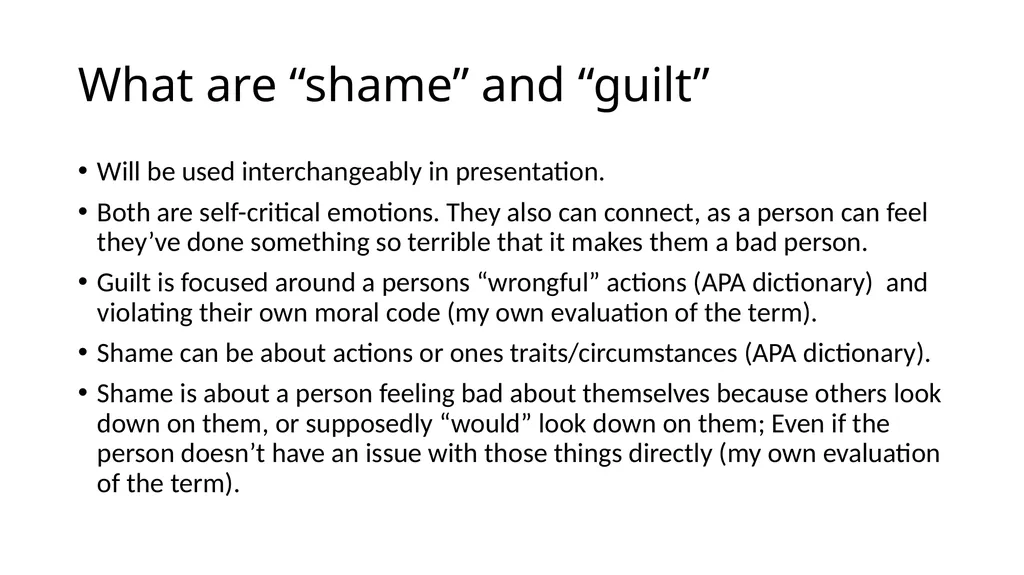
slide2. What are “shame” and “guilt” Will be used interchangeably in presentation.
Both are self-critical emotions. They also can connect, as a person can feel they’ve done something so terrible that it makes them a bad person.
Guilt is focused around a persons “wrongful” actions (APA dictionary) and violating their own moral code (my own evaluation of the term).
Shame can be about actions or ones traits/circumstances (APA dictionary).
Shame is about a person feeling bad about themselves because others look down on them, or supposedly “would” look down on them; Even if the person doesn’t have an issue with those things directly (my own evaluation of the term).<br>
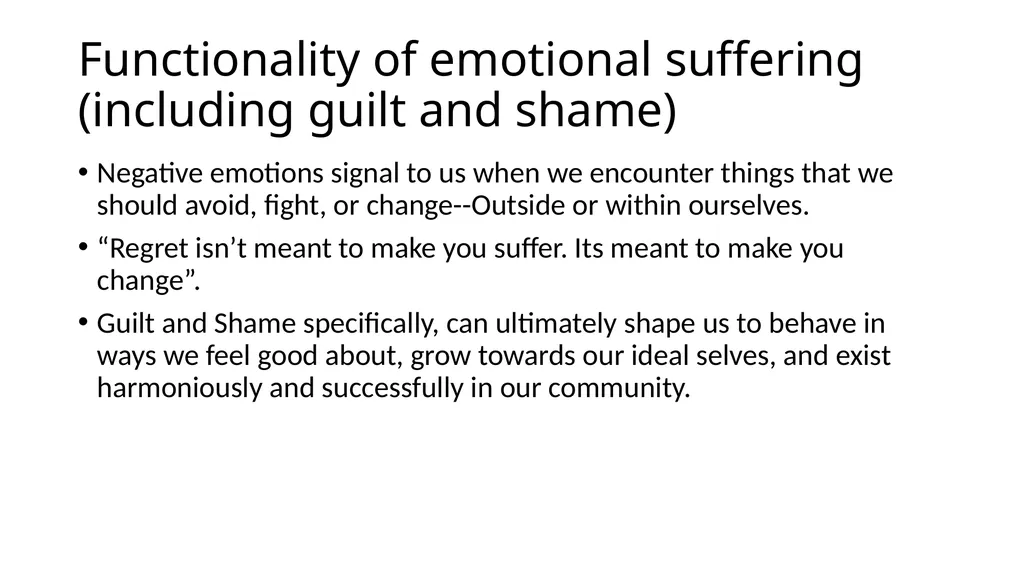
slide3. Functionality of emotional suffering (including guilt and shame) Negative emotions signal to us when we encounter things that we should avoid, fight, or change--Outside or within ourselves.
“Regret isn’t meant to make you suffer. Its meant to make you change”.
Guilt and Shame specifically, can ultimately shape us to behave in ways we feel good about, grow towards our ideal selves, and exist harmoniously and successfully in our community.<br>
slide4. When shame and guilt become unhealthy Shame and guilt become excessive when they are no longer alerting you to things you should do differently in the future, but instead are only discouraging you, making it difficult to focus on other things, and making you feel worse about yourself.<br>
slide5. Shame and guilt can follow a traumatic event Guilt that one couldn’t help others or themselves more in the situation (feelings of helplessness). “I should have done something about it. I felt so helpless, so useless”.
Shame about feeling “disgraced” or “tainted” from ones victimization, if one was victimized in some way. Perceiving ones self as “damaged goods”.
Self-blame for being in the situation where the traumatic event occurred. “I should have known better. What I did was basically asking for something terrible to happen to me. I deserve what I got.”
Shame around how one is affected by their trauma symptoms, or not “functioning normally”, struggling more to take care of obligations or others afterwards. “Whats wrong with me? Everyone else seems to be living their lives and doing the things they need to do. Why cant I?”<br>
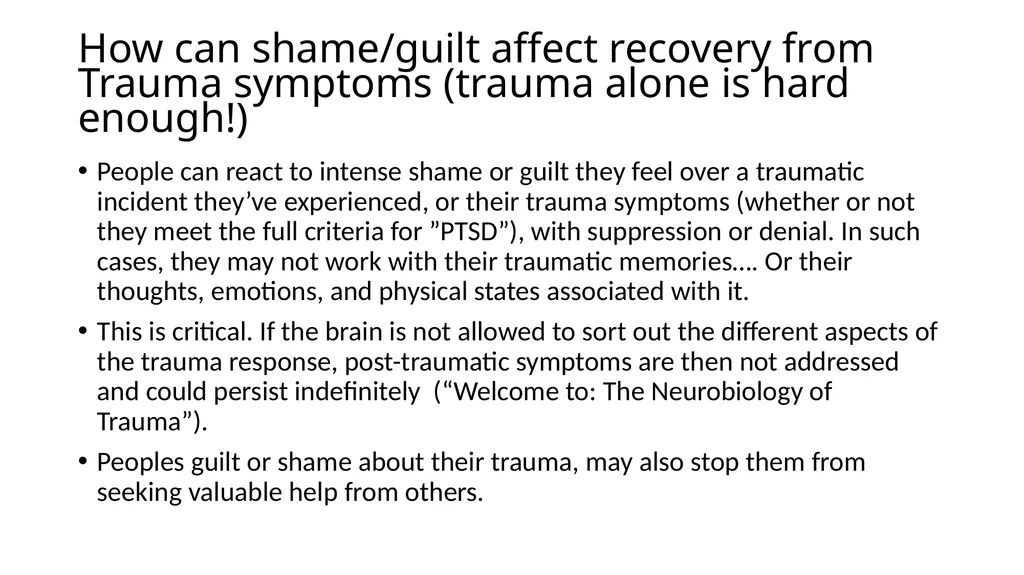
slide6. How can shame/guilt affect recovery from Trauma symptoms (trauma alone is hard enough!) People can react to intense shame or guilt they feel over a traumatic incident they’ve experienced, or their trauma symptoms (whether or not they meet the full criteria for ”PTSD”), with suppression or denial. In such cases, they may not work with their traumatic memories…. Or their thoughts, emotions, and physical states associated with it.
This is critical. If the brain is not allowed to sort out the different aspects of the trauma response, post-traumatic symptoms are then not addressed and could persist indefinitely (“Welcome to: The Neurobiology of Trauma”).
Peoples guilt or shame about their trauma, may also stop them from seeking valuable help from others.<br>
slide7. How can shame/guilt affect recovery from Trauma symptoms (cont’d) One more way which guilt and shame could interfere with trauma recovery, is by further straining a mind which is already overwhelmed with symptoms from trauma. Guilt/shame when left unchecked, can make a traumatic experience unnecessarily more traumatic, by adding harshness to it.<br>
slide8. Before discussing some effective ways to address shame and guilt …<br>
slide9. A better understanding of the following features of trauma, give us a good starting point: Trauma symptoms
The common “freeze/feigned death” responses during the traumatic event.<br>
slide10. Trauma Symptoms There are many significant symptoms which can result from trauma and are hallmarks of PTSD: loss of interests, blaming ones self and others, negative emotions, isolation, difficulty with memory and concentration, restricted emotional expression; Nightmares, intrusive memories, flashbacks, dissociation, “exposure distress”; Avoidance of certain thoughts, feelings, and external reminders of the trauma; Increased hypervigilance and physical reactivity, exaggerated startle response, sleep disturbances, irritability, aggressive behaviors, reckless self-destructive behaviors (source: DSM-5)
This laundry list of symptoms shows us how trauma affects many areas all over the brain.<br>
slide11. Trauma Symptoms (cont’d) Ultimately trauma symptoms can affect anyone, because trauma is simply “…an experience we have which overwhelms our ability to cope” (Dr Dan Siegel, PhD, “Welcome to: The Neurobiology of Trauma”)
At the time of of the Trauma, the brain could not sort out all of the information the senses were feeding it. Like a computer that was given too many directions at one time, the traumatized brain is stuck on the screen of the traumatic event like a frozen computer. Even machines experience trauma!
But people can help themselves resolve these symptoms by safely processing these thoughts, memories, and emotional states.<br>
slide12. The “Freeze/Feigned death” responses People know about the natural, instinctive ”fight or flight” responses to danger.
Less well known are the “freeze and feigned death” responses to dangerous situations. Because this response is less well understood, people may think that they’re not supposed to respond to danger this way, and something must be wrong with them if they have (Dr Ruth Lanius, MD, “Welcome to: The Neurobiology of Trauma”).
The freeze response involves involuntary physical paralysis, dissociation (not being in ones own body), and numbness. The feigned death response is similar but the body goes completely limp and collapses, and the person may lose consciousness.<br>
slide13. The “Freeze/Feigned Death” responses (cont’d) In reality the ”freeze/feigned death” responses are just as normal and natural as the “fight” and “flight” responses. They’re also just as functional and adaptive!
In situations when one doesn’t have the ability to run or fight to save themselves, or when provocation drastically increases the risk of harm, the freeze/feigned death responses are far more adaptive than the flight or fight responses.
Cue examples of predators, possums, and situations of being overrun in war.<br>
slide14. What can we do about these thoughts and feelings? Time for some coping strategies!
…..<br>
slide15. Self-compassion is what is needed following Trauma Care, understanding, and acceptance we can provide to the overwhelmed parts of ourselves helps us to heal and return towards baseline.<br>
slide16. Self-talk: The author of all our stories We have an almost continuous stream of thoughts about our experiences, like an ongoing mental commentary. They may or may not be in word form. The patterns of this inner monologue, influences our attitudes towards everything, including ourselves.
However, we’re normally not thinking about these thoughts in a sharp, alert way. Most of this commentary happens automatically, and we barely notice it as its happening, and we usually don’t remember it. But we do absorb it and it affects us.
Whenever that inner monologue comments about us, that’s called our “self-talk”.
Managing our self-talk is a powerful tool in reducing shame and guilt.<br>
slide17. How to respond to negative self-talk? When you notice shaming self-talk, calmly acknowledge and then compassionately shift energy away from that shaming self-talk.
Come up with things you will do or focus on instead, in those moments, after shutting down the self talk.
A mantra can be helpful to say in your mind each time you notice and put a stop to shaming self-talk.
Gain awareness over time of triggers that seem to activate thoughts of shame and guilt, so you can either avoid them when reasonable or prepare yourself adequately when you encounter them.<br>
slide18. How to respond to negative self-talk (cont’d) Engage in the practice of seeing/treating yourself as you would someone else.
When you catch shaming/guilting self-talk, try to imagine how you would speak to someone you cared for, about those very same things you feel ashamed or guilty over.
https://www.youtube.com/watch?v=BGeTgE8w7RI
Common bias of self-non-personhood.<br>
slide19. What about changing the self talk? Positive self talk? Positive self-talk can be helpful, but not in the way a lot of people think.
If you don’t have anything nice to say, don’t say anything.
You shouldn’t fake positive self-talk. You wont believe it, and if you continuously engage in that behavior, you may learn to stop trusting yourself.
Positive self-talk can be genuinely used by looking out for moments throughout your days were you appreciate or feel proud of things you did. When you catch those moments, linger on your actions/qualities that inspired them.<br>
slide20. All this depends on Mindfulness In order to stop or change the harsh things your thoughts are saying to you throughout the day, you must know its happening, when its happening.
Most of us are on autopilot and have learned to not pay special attention to our thoughts, leaving them unsupervised.
Being aware of what’s going on within your body, mind, and environment is necessary for catching negative self-talk, appreciating positive things you do, and recognizing over time the various factors that influence the way you think and feel about yourself.<br>
slide21. …But mindfulness is difficult! Being aware of different things going on within us WHILE we are doing our daily activities can be unnatural.
It involves leaving just a small part of your mind free, to scan around a bit and observe what’s happening right now.
Mindfulness should be seen as a journey, not a destination.
Calm, steady, consistent, efforts at self-awareness will yield progress over time.
Self-compassion can easily be practiced in the process of cultivating this skill as it will be a useful antidote to any frustration, or discouragement you may experience. Not judging what you’re observing is important.<br>
slide22. Cultivating mindfulness Mindfulness meditation (using the breath as an anchor point).
Informal mindfulness practice (the most abundant practice). Ask yourself to tune in to your inner experience throughout the day, as often as you comfortably can.
Using “bookmarks” in your daily routine as natural “check-ins” to pay attention to your experience and what you’re doing. These are noticeable events that a person regularly experiences, which they can use as wake-up calls to pay attention to their inner experience in that moment. These bookmark check-ins ideally become habits.<br>
slide23. Self-Compassion through Self-Care Managing self-talk deals with thoughts of guilt and shame. Self-care deals with the behavior side of guilt and shame.
Self-compassionate self-care is about being purposeful in doing things for yourself which make you feel loved, supported, empowered, and cared for-–by YOU!
It is helpful to pay attention to which activities inspire the most good-will toward yourself, so you can hone in on those activities in the future to strengthen your relationship with yourself.<br>
slide24. Tapping into dignity through disclosure and expression Shame tends to act as hiding and secrecy.
If you feel safe enough in certain supportive relationships to sharing what you are ashamed of, it can have a dignified effect of “ownership” and no longer hiding. Dignity and ownership are the opposites of shame and guilt.
Another form of expression is: saying out loud by yourself in a strong non-hesitating tone of voice, what you did or what happened to you, that you’re ashamed of or feel guilty about and add “and I’m owning it”. Now you are digesting the shame or guilt, rather than living in its shadow.
Journaling can be helpful in coming to terms with ones relationship to their trauma, and processing their thoughts/feelings.<br>
slide25. Good deeds Helping others, gives fresh positive material a person can think about in regards to one self, instead of the things one feels guilt or shame over. Engaging in helping others can make it more obvious to the helper, that they are valuable and worthy of fondness and goodwill.<br>
slide26. Sources DSM-5
NICABM online seminar “Welcome to: The Neurobiology of Trauma”
American Psychological Association Dictionary
Link (from “How to Respond to Negative Self-Talk” section): Peter Attia, MD
Mindfulness resource: https://greatergood.berkeley.edu/topic/mindfulness/definition#how-cultivate-mindfulness<br>
slide27. Bonus piece of potentially useful perspective on trauma: Difference between blame and mistakes Some people could have perhaps averted a traumatic event where they were victimized, if they made some different decision or behaved differently at some critical point…. They may have made a mistake in hindsight. Fair enough.
Beyond being unproductive to fixate on, internalizing shame/guilt from this aspect of the trauma is a distorted way of thinking.
People often believe that making foolish decisions that may have led to the traumatic event makes them deserving of harm or trauma.
The only person directly responsible for an aggressive action, is the person who’s intention it was to make it happen.<br>
slide28. Difference between blame and mistakes (cont’d) Blame and words like “deserve” are about morality. It suggests bad intentions or indifference to harm on the part of the person being blamed.
Mistakes do not necessarily justify blame. Most mistakes are innocent in their intention. They are not meant to cause harm…. Even most of the ones which are very foolish or turn out to be harmful.
Before leaping to judge your character, think about your values and your intentions in the past. Did you mean to cause harm?
Would you blame someone who didn’t know what the consequences of their actions (or inaction) would be? Or a person who couldn’t control a situation completely, but tried to make it better in some way?
Intention is the difference between committing a moral wrong (blame) and making an error (“oops”). Everyone makes errors <br>
slide2. What are “shame” and “guilt” Will be used interchangeably in presentation.
Both are self-critical emotions. They also can connect, as a person can feel they’ve done something so terrible that it makes them a bad person.
Guilt is focused around a persons “wrongful” actions (APA dictionary) and violating their own moral code (my own evaluation of the term).
Shame can be about actions or ones traits/circumstances (APA dictionary).
Shame is about a person feeling bad about themselves because others look down on them, or supposedly “would” look down on them; Even if the person doesn’t have an issue with those things directly (my own evaluation of the term).<br>
slide3. Functionality of emotional suffering (including guilt and shame) Negative emotions signal to us when we encounter things that we should avoid, fight, or change--Outside or within ourselves.
“Regret isn’t meant to make you suffer. Its meant to make you change”.
Guilt and Shame specifically, can ultimately shape us to behave in ways we feel good about, grow towards our ideal selves, and exist harmoniously and successfully in our community.<br>
slide4. When shame and guilt become unhealthy Shame and guilt become excessive when they are no longer alerting you to things you should do differently in the future, but instead are only discouraging you, making it difficult to focus on other things, and making you feel worse about yourself.<br>
slide5. Shame and guilt can follow a traumatic event Guilt that one couldn’t help others or themselves more in the situation (feelings of helplessness). “I should have done something about it. I felt so helpless, so useless”.
Shame about feeling “disgraced” or “tainted” from ones victimization, if one was victimized in some way. Perceiving ones self as “damaged goods”.
Self-blame for being in the situation where the traumatic event occurred. “I should have known better. What I did was basically asking for something terrible to happen to me. I deserve what I got.”
Shame around how one is affected by their trauma symptoms, or not “functioning normally”, struggling more to take care of obligations or others afterwards. “Whats wrong with me? Everyone else seems to be living their lives and doing the things they need to do. Why cant I?”<br>
slide6. How can shame/guilt affect recovery from Trauma symptoms (trauma alone is hard enough!) People can react to intense shame or guilt they feel over a traumatic incident they’ve experienced, or their trauma symptoms (whether or not they meet the full criteria for ”PTSD”), with suppression or denial. In such cases, they may not work with their traumatic memories…. Or their thoughts, emotions, and physical states associated with it.
This is critical. If the brain is not allowed to sort out the different aspects of the trauma response, post-traumatic symptoms are then not addressed and could persist indefinitely (“Welcome to: The Neurobiology of Trauma”).
Peoples guilt or shame about their trauma, may also stop them from seeking valuable help from others.<br>
slide7. How can shame/guilt affect recovery from Trauma symptoms (cont’d) One more way which guilt and shame could interfere with trauma recovery, is by further straining a mind which is already overwhelmed with symptoms from trauma. Guilt/shame when left unchecked, can make a traumatic experience unnecessarily more traumatic, by adding harshness to it.<br>
slide8. Before discussing some effective ways to address shame and guilt …<br>
slide9. A better understanding of the following features of trauma, give us a good starting point: Trauma symptoms
The common “freeze/feigned death” responses during the traumatic event.<br>
slide10. Trauma Symptoms There are many significant symptoms which can result from trauma and are hallmarks of PTSD: loss of interests, blaming ones self and others, negative emotions, isolation, difficulty with memory and concentration, restricted emotional expression; Nightmares, intrusive memories, flashbacks, dissociation, “exposure distress”; Avoidance of certain thoughts, feelings, and external reminders of the trauma; Increased hypervigilance and physical reactivity, exaggerated startle response, sleep disturbances, irritability, aggressive behaviors, reckless self-destructive behaviors (source: DSM-5)
This laundry list of symptoms shows us how trauma affects many areas all over the brain.<br>
slide11. Trauma Symptoms (cont’d) Ultimately trauma symptoms can affect anyone, because trauma is simply “…an experience we have which overwhelms our ability to cope” (Dr Dan Siegel, PhD, “Welcome to: The Neurobiology of Trauma”)
At the time of of the Trauma, the brain could not sort out all of the information the senses were feeding it. Like a computer that was given too many directions at one time, the traumatized brain is stuck on the screen of the traumatic event like a frozen computer. Even machines experience trauma!
But people can help themselves resolve these symptoms by safely processing these thoughts, memories, and emotional states.<br>
slide12. The “Freeze/Feigned death” responses People know about the natural, instinctive ”fight or flight” responses to danger.
Less well known are the “freeze and feigned death” responses to dangerous situations. Because this response is less well understood, people may think that they’re not supposed to respond to danger this way, and something must be wrong with them if they have (Dr Ruth Lanius, MD, “Welcome to: The Neurobiology of Trauma”).
The freeze response involves involuntary physical paralysis, dissociation (not being in ones own body), and numbness. The feigned death response is similar but the body goes completely limp and collapses, and the person may lose consciousness.<br>
slide13. The “Freeze/Feigned Death” responses (cont’d) In reality the ”freeze/feigned death” responses are just as normal and natural as the “fight” and “flight” responses. They’re also just as functional and adaptive!
In situations when one doesn’t have the ability to run or fight to save themselves, or when provocation drastically increases the risk of harm, the freeze/feigned death responses are far more adaptive than the flight or fight responses.
Cue examples of predators, possums, and situations of being overrun in war.<br>
slide14. What can we do about these thoughts and feelings? Time for some coping strategies!
…..<br>
slide15. Self-compassion is what is needed following Trauma Care, understanding, and acceptance we can provide to the overwhelmed parts of ourselves helps us to heal and return towards baseline.<br>
slide16. Self-talk: The author of all our stories We have an almost continuous stream of thoughts about our experiences, like an ongoing mental commentary. They may or may not be in word form. The patterns of this inner monologue, influences our attitudes towards everything, including ourselves.
However, we’re normally not thinking about these thoughts in a sharp, alert way. Most of this commentary happens automatically, and we barely notice it as its happening, and we usually don’t remember it. But we do absorb it and it affects us.
Whenever that inner monologue comments about us, that’s called our “self-talk”.
Managing our self-talk is a powerful tool in reducing shame and guilt.<br>
slide17. How to respond to negative self-talk? When you notice shaming self-talk, calmly acknowledge and then compassionately shift energy away from that shaming self-talk.
Come up with things you will do or focus on instead, in those moments, after shutting down the self talk.
A mantra can be helpful to say in your mind each time you notice and put a stop to shaming self-talk.
Gain awareness over time of triggers that seem to activate thoughts of shame and guilt, so you can either avoid them when reasonable or prepare yourself adequately when you encounter them.<br>
slide18. How to respond to negative self-talk (cont’d) Engage in the practice of seeing/treating yourself as you would someone else.
When you catch shaming/guilting self-talk, try to imagine how you would speak to someone you cared for, about those very same things you feel ashamed or guilty over.
https://www.youtube.com/watch?v=BGeTgE8w7RI
Common bias of self-non-personhood.<br>
slide19. What about changing the self talk? Positive self talk? Positive self-talk can be helpful, but not in the way a lot of people think.
If you don’t have anything nice to say, don’t say anything.
You shouldn’t fake positive self-talk. You wont believe it, and if you continuously engage in that behavior, you may learn to stop trusting yourself.
Positive self-talk can be genuinely used by looking out for moments throughout your days were you appreciate or feel proud of things you did. When you catch those moments, linger on your actions/qualities that inspired them.<br>
slide20. All this depends on Mindfulness In order to stop or change the harsh things your thoughts are saying to you throughout the day, you must know its happening, when its happening.
Most of us are on autopilot and have learned to not pay special attention to our thoughts, leaving them unsupervised.
Being aware of what’s going on within your body, mind, and environment is necessary for catching negative self-talk, appreciating positive things you do, and recognizing over time the various factors that influence the way you think and feel about yourself.<br>
slide21. …But mindfulness is difficult! Being aware of different things going on within us WHILE we are doing our daily activities can be unnatural.
It involves leaving just a small part of your mind free, to scan around a bit and observe what’s happening right now.
Mindfulness should be seen as a journey, not a destination.
Calm, steady, consistent, efforts at self-awareness will yield progress over time.
Self-compassion can easily be practiced in the process of cultivating this skill as it will be a useful antidote to any frustration, or discouragement you may experience. Not judging what you’re observing is important.<br>
slide22. Cultivating mindfulness Mindfulness meditation (using the breath as an anchor point).
Informal mindfulness practice (the most abundant practice). Ask yourself to tune in to your inner experience throughout the day, as often as you comfortably can.
Using “bookmarks” in your daily routine as natural “check-ins” to pay attention to your experience and what you’re doing. These are noticeable events that a person regularly experiences, which they can use as wake-up calls to pay attention to their inner experience in that moment. These bookmark check-ins ideally become habits.<br>
slide23. Self-Compassion through Self-Care Managing self-talk deals with thoughts of guilt and shame. Self-care deals with the behavior side of guilt and shame.
Self-compassionate self-care is about being purposeful in doing things for yourself which make you feel loved, supported, empowered, and cared for-–by YOU!
It is helpful to pay attention to which activities inspire the most good-will toward yourself, so you can hone in on those activities in the future to strengthen your relationship with yourself.<br>
slide24. Tapping into dignity through disclosure and expression Shame tends to act as hiding and secrecy.
If you feel safe enough in certain supportive relationships to sharing what you are ashamed of, it can have a dignified effect of “ownership” and no longer hiding. Dignity and ownership are the opposites of shame and guilt.
Another form of expression is: saying out loud by yourself in a strong non-hesitating tone of voice, what you did or what happened to you, that you’re ashamed of or feel guilty about and add “and I’m owning it”. Now you are digesting the shame or guilt, rather than living in its shadow.
Journaling can be helpful in coming to terms with ones relationship to their trauma, and processing their thoughts/feelings.<br>
slide25. Good deeds Helping others, gives fresh positive material a person can think about in regards to one self, instead of the things one feels guilt or shame over. Engaging in helping others can make it more obvious to the helper, that they are valuable and worthy of fondness and goodwill.<br>
slide26. Sources DSM-5
NICABM online seminar “Welcome to: The Neurobiology of Trauma”
American Psychological Association Dictionary
Link (from “How to Respond to Negative Self-Talk” section): Peter Attia, MD
Mindfulness resource: https://greatergood.berkeley.edu/topic/mindfulness/definition#how-cultivate-mindfulness<br>
slide27. Bonus piece of potentially useful perspective on trauma: Difference between blame and mistakes Some people could have perhaps averted a traumatic event where they were victimized, if they made some different decision or behaved differently at some critical point…. They may have made a mistake in hindsight. Fair enough.
Beyond being unproductive to fixate on, internalizing shame/guilt from this aspect of the trauma is a distorted way of thinking.
People often believe that making foolish decisions that may have led to the traumatic event makes them deserving of harm or trauma.
The only person directly responsible for an aggressive action, is the person who’s intention it was to make it happen.<br>
slide28. Difference between blame and mistakes (cont’d) Blame and words like “deserve” are about morality. It suggests bad intentions or indifference to harm on the part of the person being blamed.
Mistakes do not necessarily justify blame. Most mistakes are innocent in their intention. They are not meant to cause harm…. Even most of the ones which are very foolish or turn out to be harmful.
Before leaping to judge your character, think about your values and your intentions in the past. Did you mean to cause harm?
Would you blame someone who didn’t know what the consequences of their actions (or inaction) would be? Or a person who couldn’t control a situation completely, but tried to make it better in some way?
Intention is the difference between committing a moral wrong (blame) and making an error (“oops”). Everyone makes errors <br>