
How to Write Research Hypotheses A
A
Published · 36 slides · 0 views

1 / 1


Description
How to Write Research Hypotheses A student-friendly lecture on developing clear, testable, and research-aligned hypotheses Author: Muhammad Hassan Website: ResearchMethod.net ResearchMethod.net Muhammad Hassan LECTURE ROADMAP Lecture
Related Topics
Share
Embed code
Download this presentation From Below
"How to Write Research Hypotheses A" is the property of its rightful owner. Permission is granted to download and print the materials on this website for personal, non-commercial use only, and to display it on your personal computer provided you do not modify the materials and that you retain all copyright notices contained in the materials. By downloading content from our website, you accept the terms of this agreement.
Presentation Transcript
01
How to Write
Research Hypotheses A student-friendly lecture on developing clear, testable, and research-aligned hypotheses Author: Muhammad Hassan
Website: ResearchMethod.net ResearchMethod.net | Muhammad Hassan<br>
Research Hypotheses A student-friendly lecture on developing clear, testable, and research-aligned hypotheses Author: Muhammad Hassan
Website: ResearchMethod.net ResearchMethod.net | Muhammad Hassan<br>
02
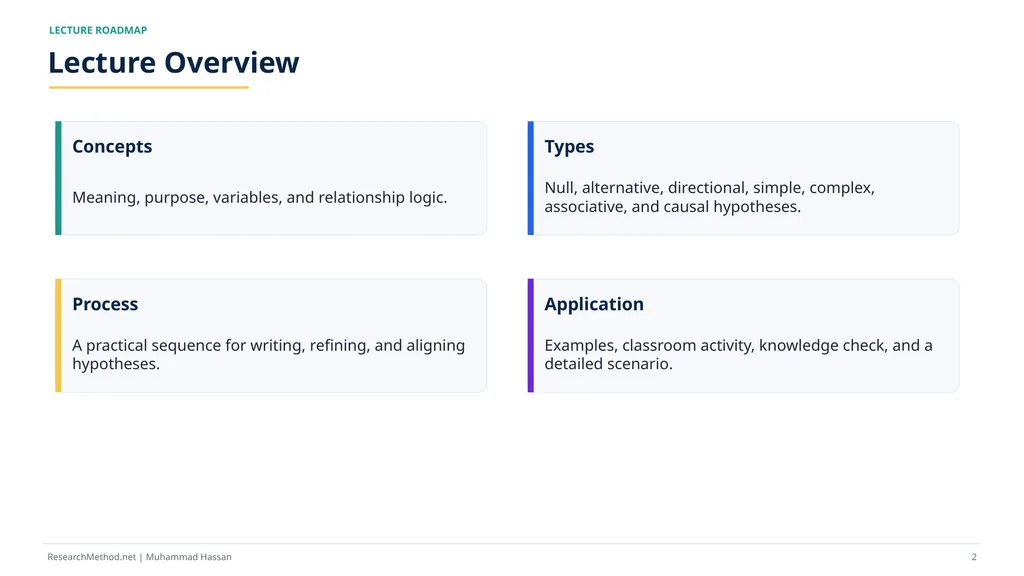
LECTURE ROADMAP Lecture Overview ResearchMethod.net | Muhammad Hassan 2 Concepts Meaning, purpose, variables, and relationship logic. Types Null, alternative, directional, simple, complex, associative, and causal hypotheses. Process A practical sequence for writing, refining, and aligning hypotheses. Application Examples, classroom activity, knowledge check, and a detailed scenario.<br>
03
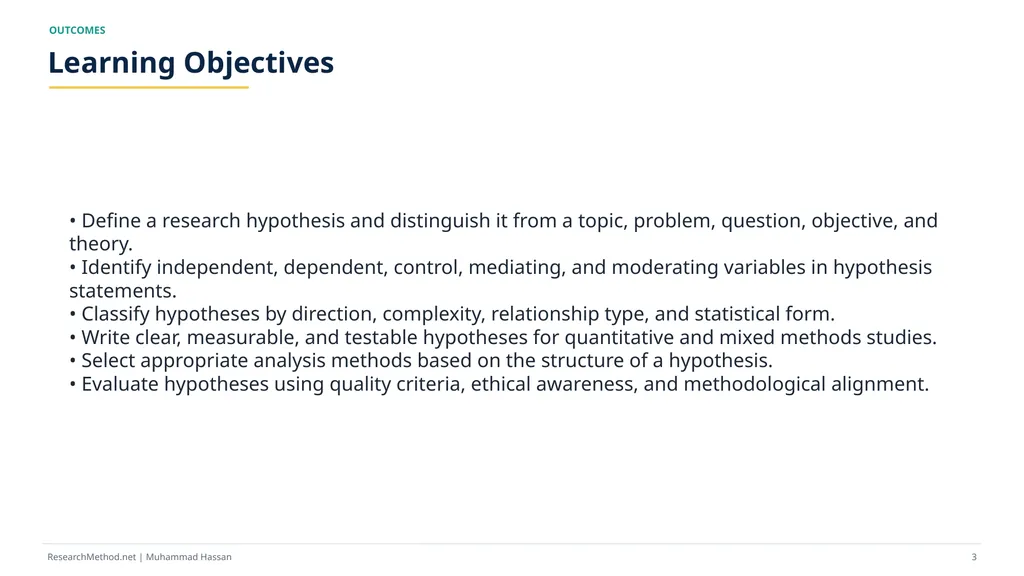
OUTCOMES Learning Objectives ResearchMethod.net | Muhammad Hassan 3 • Define a research hypothesis and distinguish it from a topic, problem, question, objective, and theory.
• Identify independent, dependent, control, mediating, and moderating variables in hypothesis statements.
• Classify hypotheses by direction, complexity, relationship type, and statistical form.
• Write clear, measurable, and testable hypotheses for quantitative and mixed methods studies.
• Select appropriate analysis methods based on the structure of a hypothesis.
• Evaluate hypotheses using quality criteria, ethical awareness, and methodological alignment.<br>
• Identify independent, dependent, control, mediating, and moderating variables in hypothesis statements.
• Classify hypotheses by direction, complexity, relationship type, and statistical form.
• Write clear, measurable, and testable hypotheses for quantitative and mixed methods studies.
• Select appropriate analysis methods based on the structure of a hypothesis.
• Evaluate hypotheses using quality criteria, ethical awareness, and methodological alignment.<br>
04
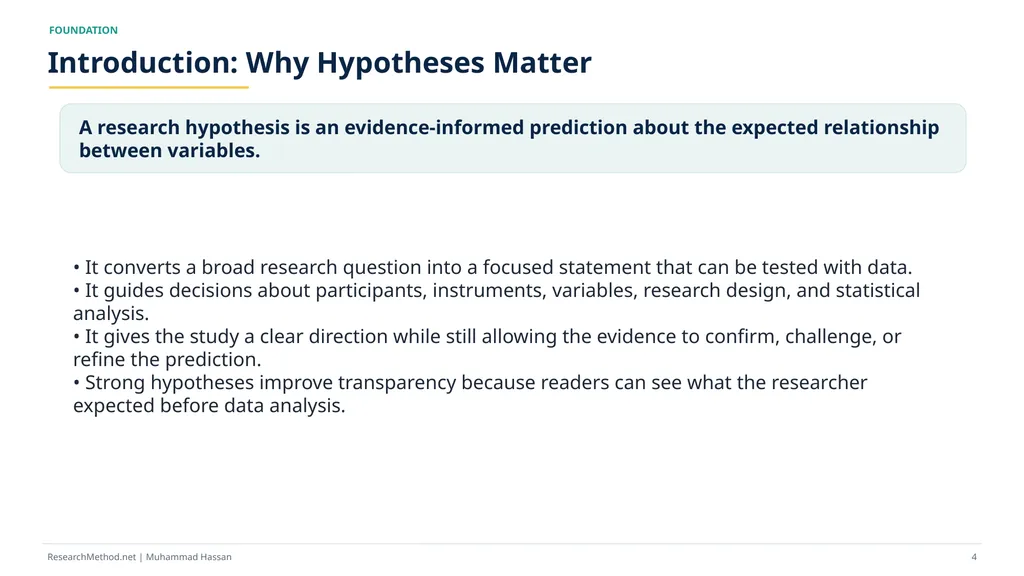
FOUNDATION Introduction: Why Hypotheses Matter ResearchMethod.net | Muhammad Hassan 4 A research hypothesis is an evidence-informed prediction about the expected relationship between variables. • It converts a broad research question into a focused statement that can be tested with data.
• It guides decisions about participants, instruments, variables, research design, and statistical analysis.
• It gives the study a clear direction while still allowing the evidence to confirm, challenge, or refine the prediction.
• Strong hypotheses improve transparency because readers can see what the researcher expected before data analysis.<br>
• It guides decisions about participants, instruments, variables, research design, and statistical analysis.
• It gives the study a clear direction while still allowing the evidence to confirm, challenge, or refine the prediction.
• Strong hypotheses improve transparency because readers can see what the researcher expected before data analysis.<br>
05
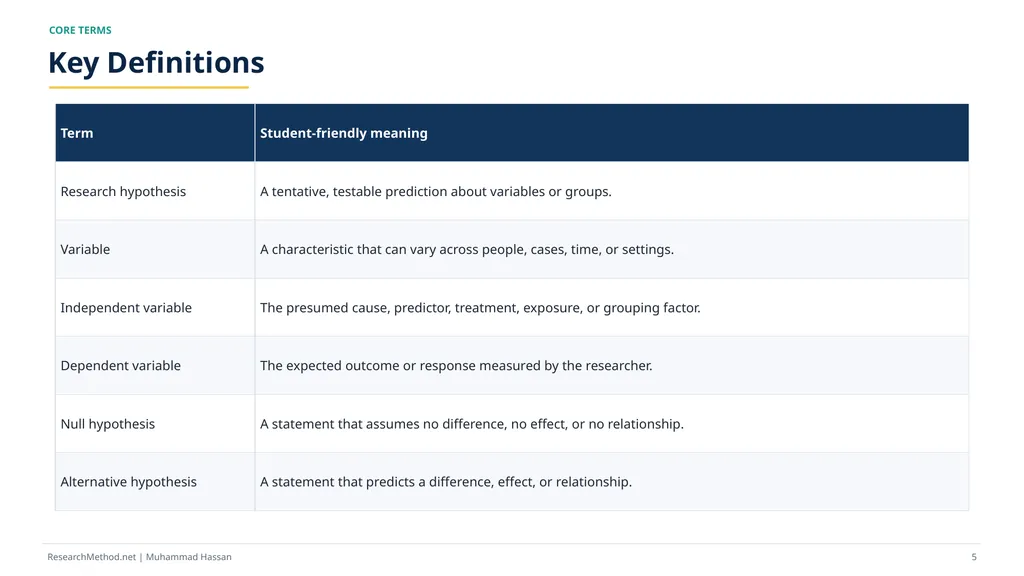
CORE TERMS Key Definitions ResearchMethod.net | Muhammad Hassan 5 Term Student-friendly meaning Research hypothesis A tentative, testable prediction about variables or groups. Variable A characteristic that can vary across people, cases, time, or settings. Independent variable The presumed cause, predictor, treatment, exposure, or grouping factor. Dependent variable The expected outcome or response measured by the researcher. Null hypothesis A statement that assumes no difference, no effect, or no relationship. Alternative hypothesis A statement that predicts a difference, effect, or relationship.<br>
06
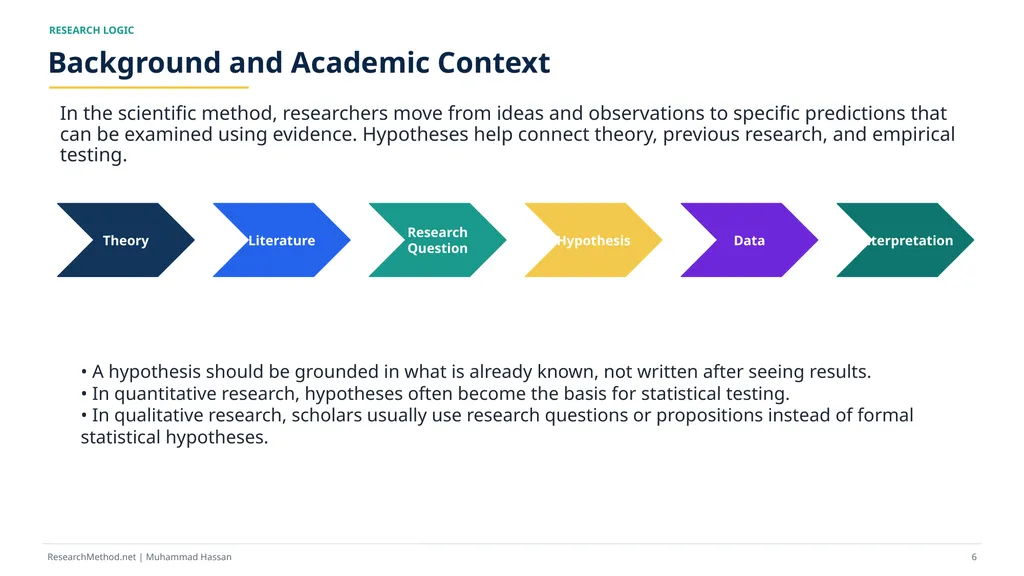
RESEARCH LOGIC Background and Academic Context ResearchMethod.net | Muhammad Hassan 6 In the scientific method, researchers move from ideas and observations to specific predictions that can be examined using evidence. Hypotheses help connect theory, previous research, and empirical testing. Theory Literature Research Question Hypothesis Data Interpretation • A hypothesis should be grounded in what is already known, not written after seeing results.
• In quantitative research, hypotheses often become the basis for statistical testing.
• In qualitative research, scholars usually use research questions or propositions instead of formal statistical hypotheses.<br>
• In quantitative research, hypotheses often become the basis for statistical testing.
• In qualitative research, scholars usually use research questions or propositions instead of formal statistical hypotheses.<br>
07
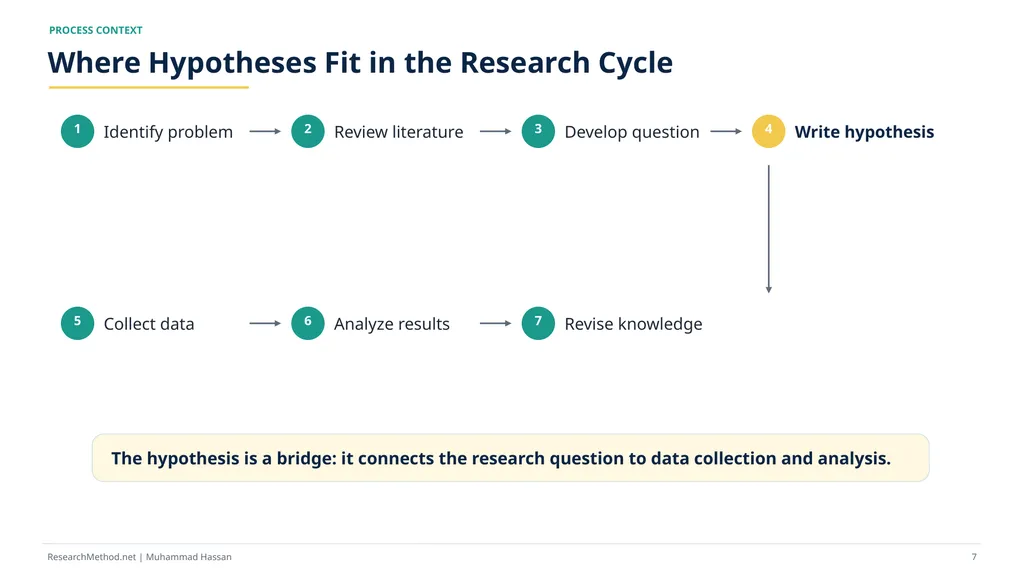
PROCESS CONTEXT Where Hypotheses Fit in the Research Cycle ResearchMethod.net | Muhammad Hassan 7 1 Identify problem 2 Review literature 3 Develop question 4 Write hypothesis 5 Collect data 6 Analyze results 7 Revise knowledge The hypothesis is a bridge: it connects the research question to data collection and analysis.<br>
08
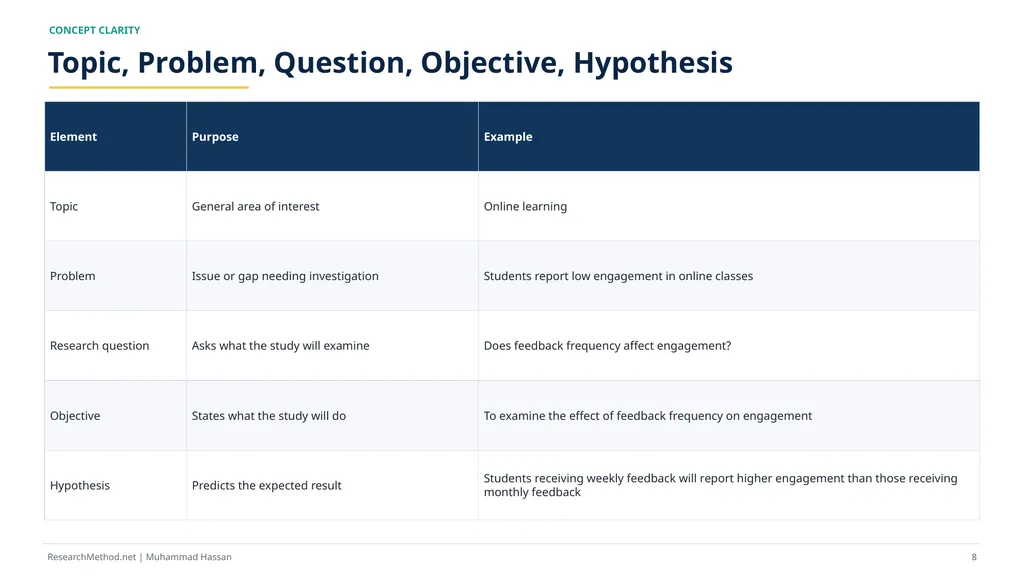
CONCEPT CLARITY Topic, Problem, Question, Objective, Hypothesis ResearchMethod.net | Muhammad Hassan 8 Element Purpose Example Topic General area of interest Online learning Problem Issue or gap needing investigation Students report low engagement in online classes Research question Asks what the study will examine Does feedback frequency affect engagement? Objective States what the study will do To examine the effect of feedback frequency on engagement Hypothesis Predicts the expected result Students receiving weekly feedback will report higher engagement than those receiving monthly feedback<br>
09
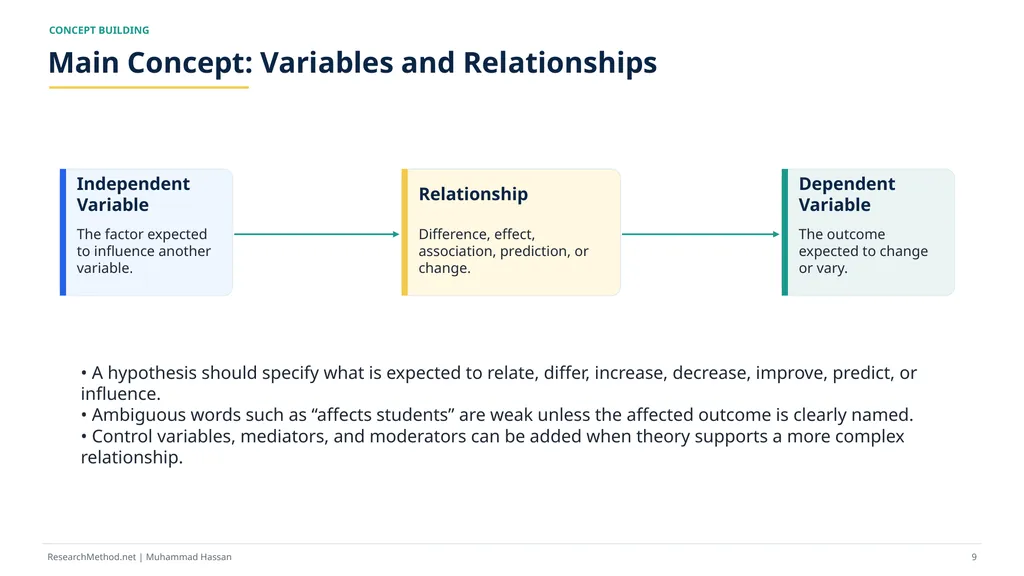
CONCEPT BUILDING Main Concept: Variables and Relationships ResearchMethod.net | Muhammad Hassan 9 Independent Variable The factor expected to influence another variable. Relationship Difference, effect, association, prediction, or change. Dependent Variable The outcome expected to change or vary. • A hypothesis should specify what is expected to relate, differ, increase, decrease, improve, predict, or influence.
• Ambiguous words such as “affects students” are weak unless the affected outcome is clearly named.
• Control variables, mediators, and moderators can be added when theory supports a more complex relationship.<br>
• Ambiguous words such as “affects students” are weak unless the affected outcome is clearly named.
• Control variables, mediators, and moderators can be added when theory supports a more complex relationship.<br>
10
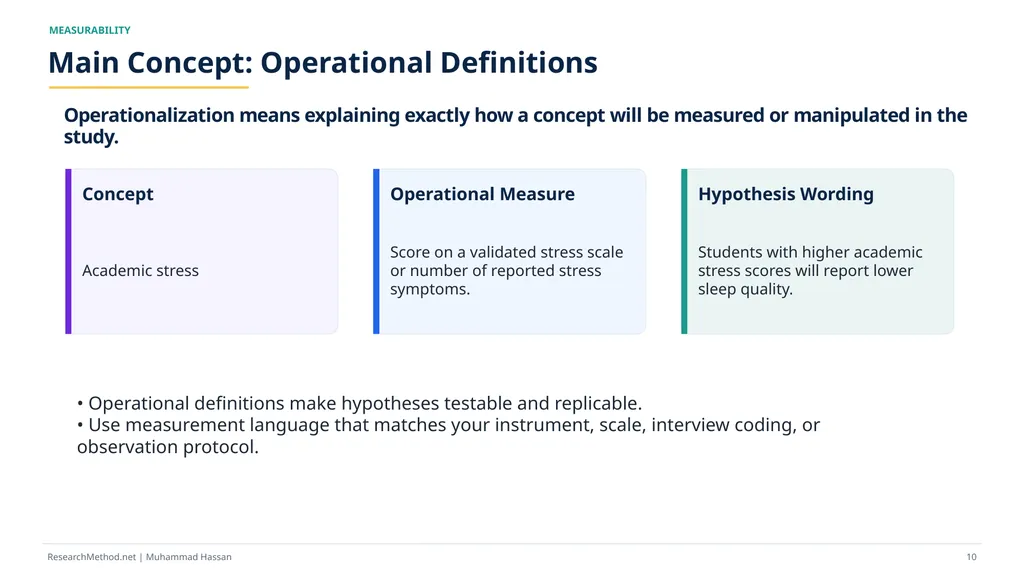
MEASURABILITY Main Concept: Operational Definitions ResearchMethod.net | Muhammad Hassan 10 Operationalization means explaining exactly how a concept will be measured or manipulated in the study. Concept Academic stress Operational Measure Score on a validated stress scale or number of reported stress symptoms. Hypothesis Wording Students with higher academic stress scores will report lower sleep quality. • Operational definitions make hypotheses testable and replicable.
• Use measurement language that matches your instrument, scale, interview coding, or observation protocol.<br>
• Use measurement language that matches your instrument, scale, interview coding, or observation protocol.<br>
11
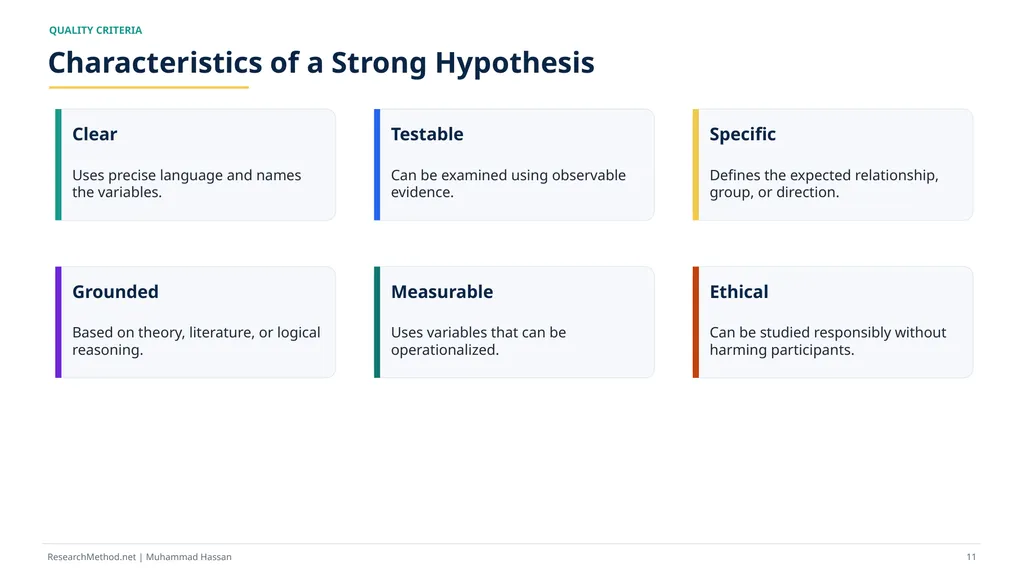
QUALITY CRITERIA Characteristics of a Strong Hypothesis ResearchMethod.net | Muhammad Hassan 11 Clear Uses precise language and names the variables. Testable Can be examined using observable evidence. Specific Defines the expected relationship, group, or direction. Grounded Based on theory, literature, or logical reasoning. Measurable Uses variables that can be operationalized. Ethical Can be studied responsibly without harming participants.<br>
12
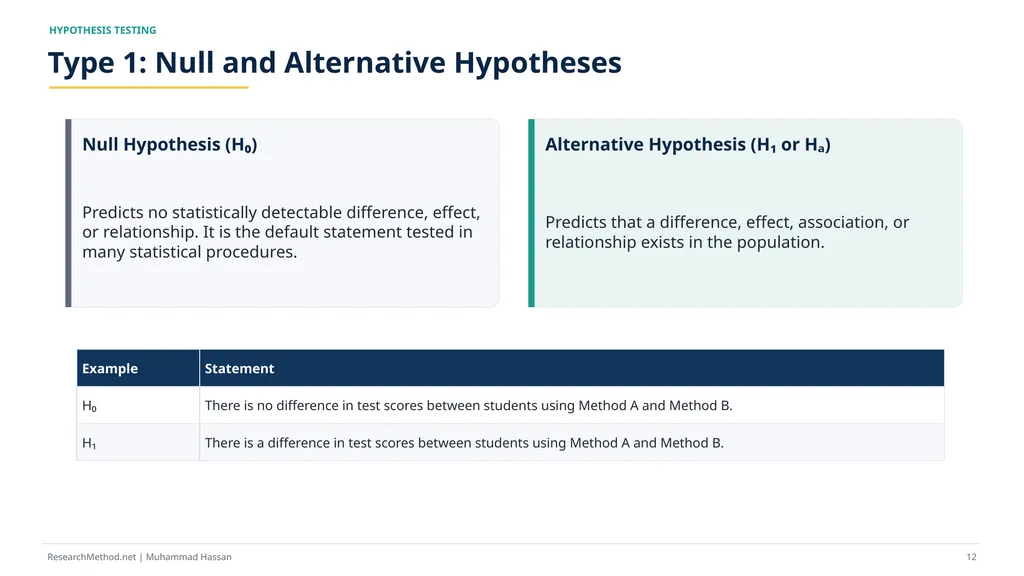
HYPOTHESIS TESTING Type 1: Null and Alternative Hypotheses ResearchMethod.net | Muhammad Hassan 12 Null Hypothesis (H₀) Predicts no statistically detectable difference, effect, or relationship. It is the default statement tested in many statistical procedures. Alternative Hypothesis (H₁ or Hₐ) Predicts that a difference, effect, association, or relationship exists in the population. Example Statement H₀ There is no difference in test scores between students using Method A and Method B. H₁ There is a difference in test scores between students using Method A and Method B.<br>
13
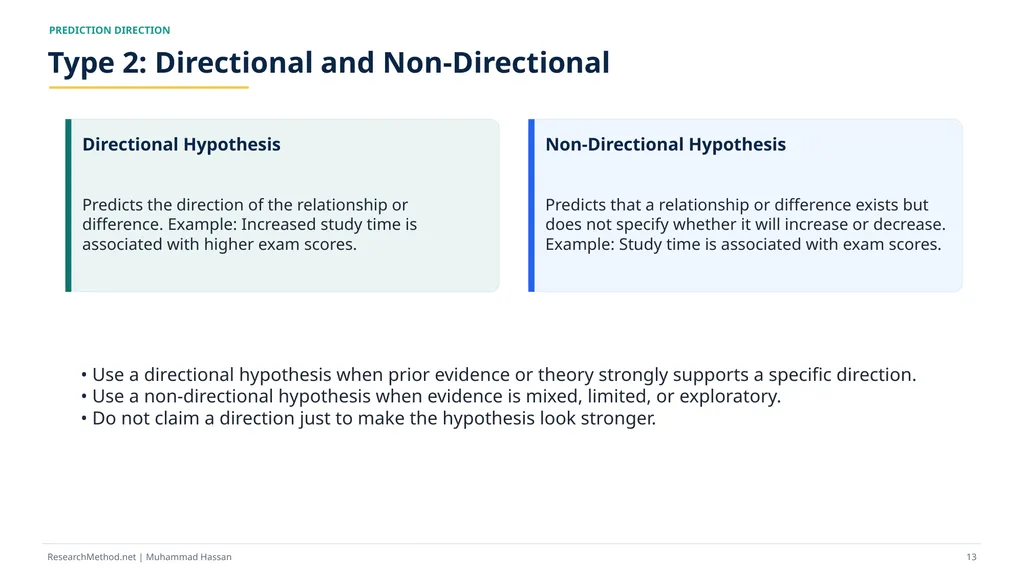
PREDICTION DIRECTION Type 2: Directional and Non-Directional ResearchMethod.net | Muhammad Hassan 13 Directional Hypothesis Predicts the direction of the relationship or difference. Example: Increased study time is associated with higher exam scores. Non-Directional Hypothesis Predicts that a relationship or difference exists but does not specify whether it will increase or decrease. Example: Study time is associated with exam scores. • Use a directional hypothesis when prior evidence or theory strongly supports a specific direction.
• Use a non-directional hypothesis when evidence is mixed, limited, or exploratory.
• Do not claim a direction just to make the hypothesis look stronger.<br>
• Use a non-directional hypothesis when evidence is mixed, limited, or exploratory.
• Do not claim a direction just to make the hypothesis look stronger.<br>
14
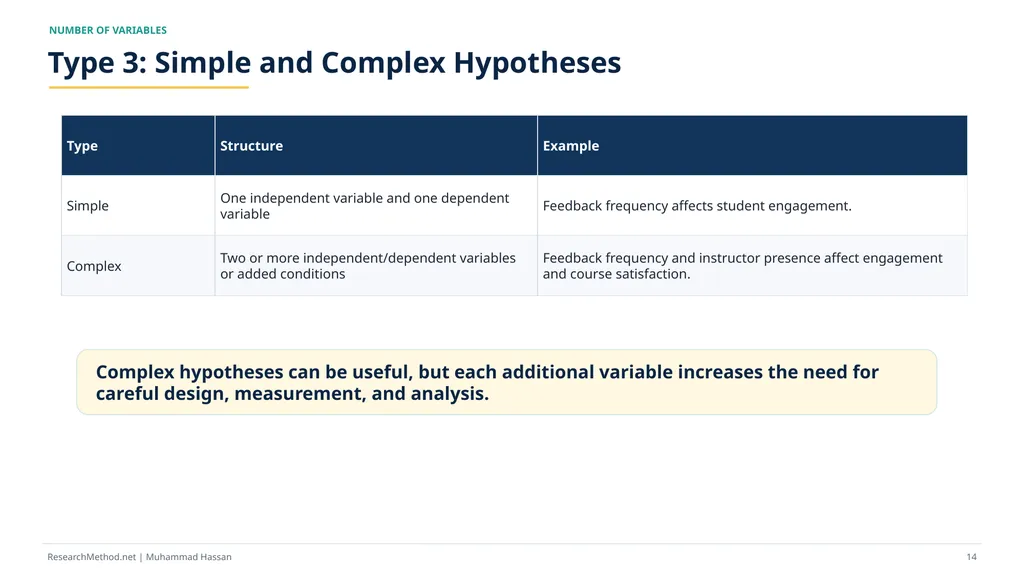
NUMBER OF VARIABLES Type 3: Simple and Complex Hypotheses ResearchMethod.net | Muhammad Hassan 14 Type Structure Example Simple One independent variable and one dependent variable Feedback frequency affects student engagement. Complex Two or more independent/dependent variables or added conditions Feedback frequency and instructor presence affect engagement and course satisfaction. Complex hypotheses can be useful, but each additional variable increases the need for careful design, measurement, and analysis.<br>
15
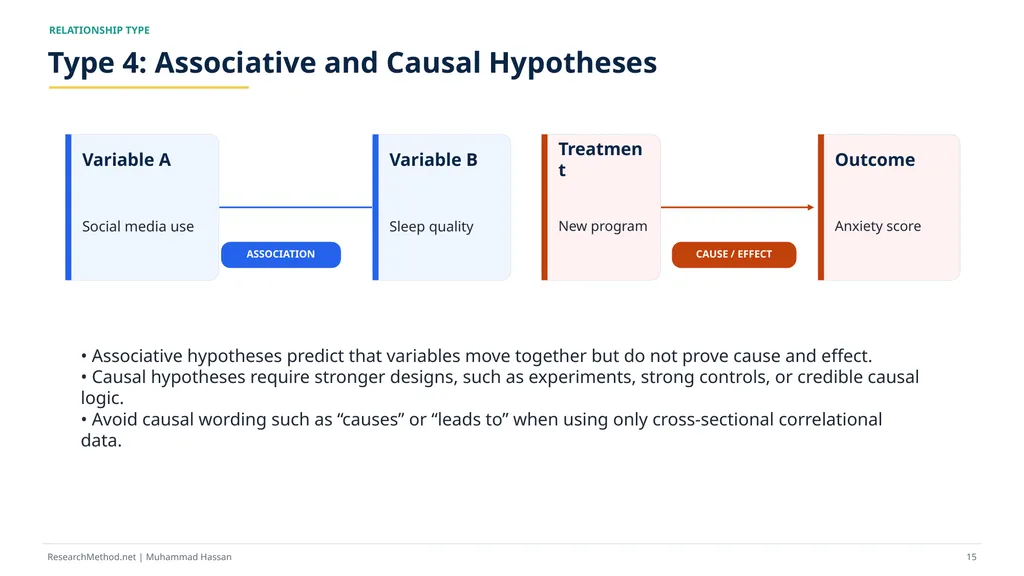
RELATIONSHIP TYPE Type 4: Associative and Causal Hypotheses ResearchMethod.net | Muhammad Hassan 15 Variable A Social media use Variable B Sleep quality Treatment New program Outcome Anxiety score ASSOCIATION CAUSE / EFFECT • Associative hypotheses predict that variables move together but do not prove cause and effect.
• Causal hypotheses require stronger designs, such as experiments, strong controls, or credible causal logic.
• Avoid causal wording such as “causes” or “leads to” when using only cross-sectional correlational data.<br>
• Causal hypotheses require stronger designs, such as experiments, strong controls, or credible causal logic.
• Avoid causal wording such as “causes” or “leads to” when using only cross-sectional correlational data.<br>
16
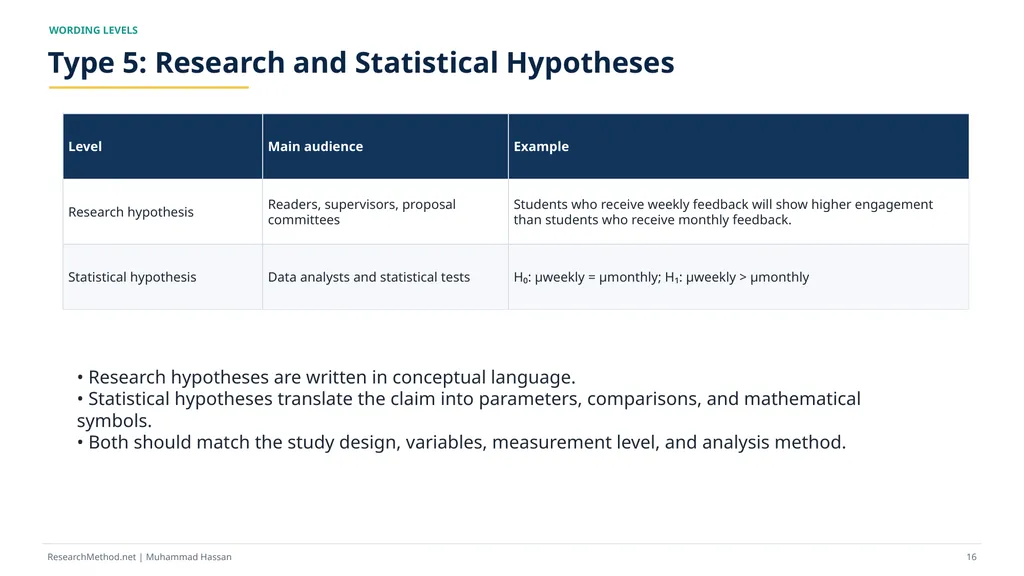
WORDING LEVELS Type 5: Research and Statistical Hypotheses ResearchMethod.net | Muhammad Hassan 16 Level Main audience Example Research hypothesis Readers, supervisors, proposal committees Students who receive weekly feedback will show higher engagement than students who receive monthly feedback. Statistical hypothesis Data analysts and statistical tests H₀: μweekly = μmonthly; H₁: μweekly > μmonthly • Research hypotheses are written in conceptual language.
• Statistical hypotheses translate the claim into parameters, comparisons, and mathematical symbols.
• Both should match the study design, variables, measurement level, and analysis method.<br>
• Statistical hypotheses translate the claim into parameters, comparisons, and mathematical symbols.
• Both should match the study design, variables, measurement level, and analysis method.<br>
17
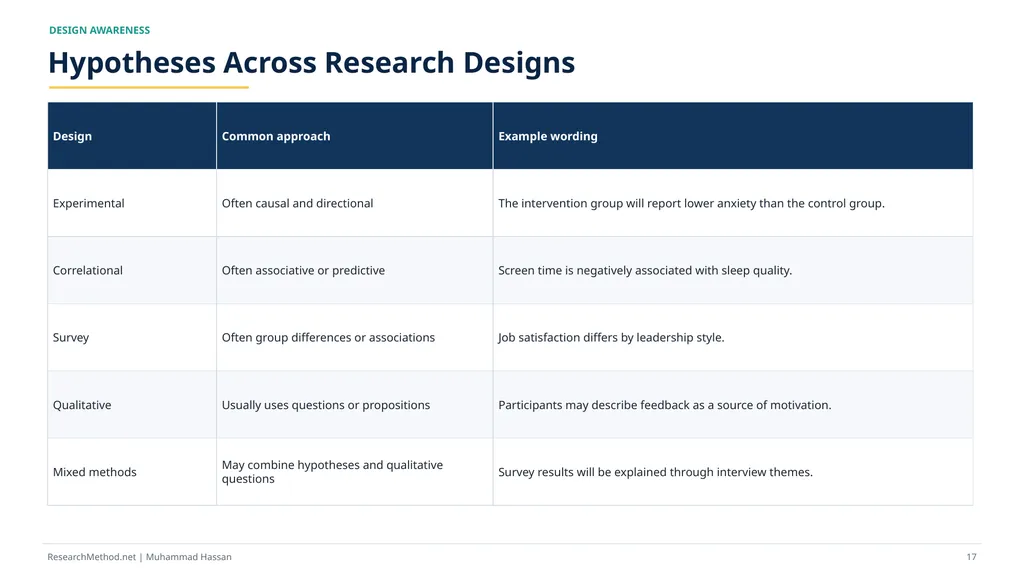
DESIGN AWARENESS Hypotheses Across Research Designs ResearchMethod.net | Muhammad Hassan 17 Design Common approach Example wording Experimental Often causal and directional The intervention group will report lower anxiety than the control group. Correlational Often associative or predictive Screen time is negatively associated with sleep quality. Survey Often group differences or associations Job satisfaction differs by leadership style. Qualitative Usually uses questions or propositions Participants may describe feedback as a source of motivation. Mixed methods May combine hypotheses and qualitative questions Survey results will be explained through interview themes.<br>
18
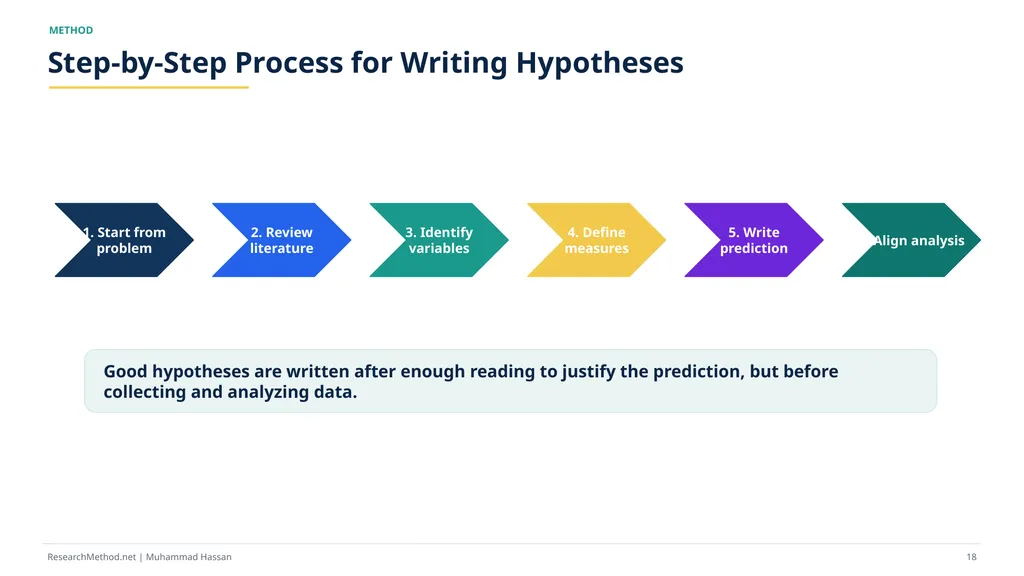
METHOD Step-by-Step Process for Writing Hypotheses ResearchMethod.net | Muhammad Hassan 18 1. Start from problem 2. Review literature 3. Identify variables 4. Define measures 5. Write prediction 6. Align analysis Good hypotheses are written after enough reading to justify the prediction, but before collecting and analyzing data.<br>
19
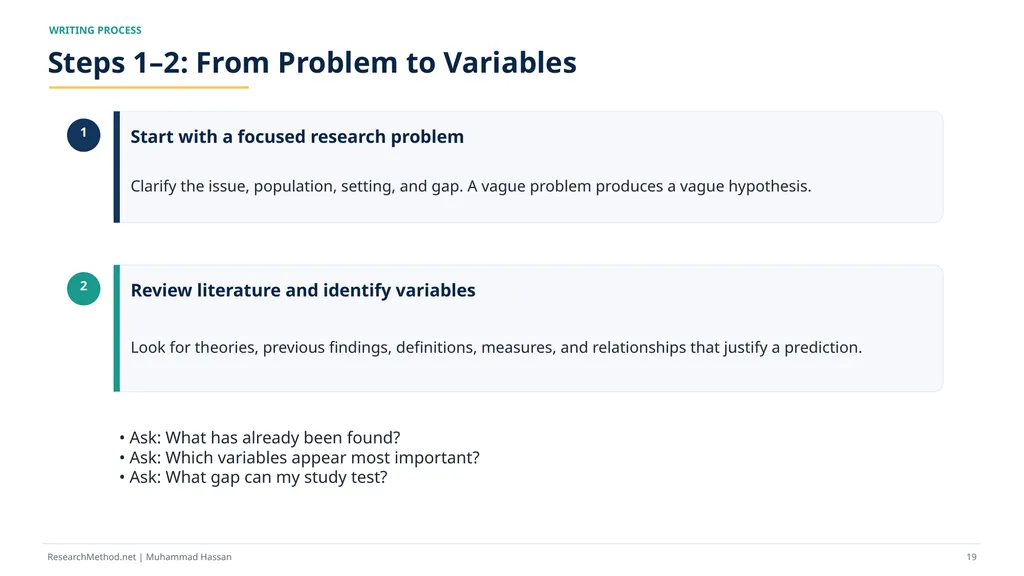
WRITING PROCESS Steps 1–2: From Problem to Variables ResearchMethod.net | Muhammad Hassan 19 1 Start with a focused research problem Clarify the issue, population, setting, and gap. A vague problem produces a vague hypothesis. 2 Review literature and identify variables Look for theories, previous findings, definitions, measures, and relationships that justify a prediction. • Ask: What has already been found?
• Ask: Which variables appear most important?
• Ask: What gap can my study test?<br>
• Ask: Which variables appear most important?
• Ask: What gap can my study test?<br>
20
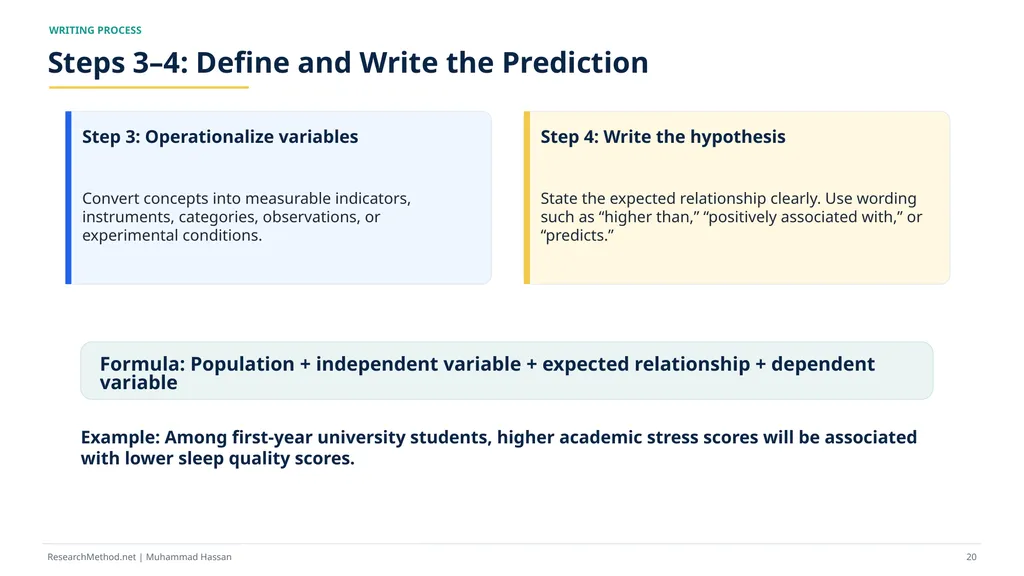
WRITING PROCESS Steps 3–4: Define and Write the Prediction ResearchMethod.net | Muhammad Hassan 20 Step 3: Operationalize variables Convert concepts into measurable indicators, instruments, categories, observations, or experimental conditions. Step 4: Write the hypothesis State the expected relationship clearly. Use wording such as “higher than,” “positively associated with,” or “predicts.” Formula: Population + independent variable + expected relationship + dependent variable Example: Among first-year university students, higher academic stress scores will be associated with lower sleep quality scores.<br>
21
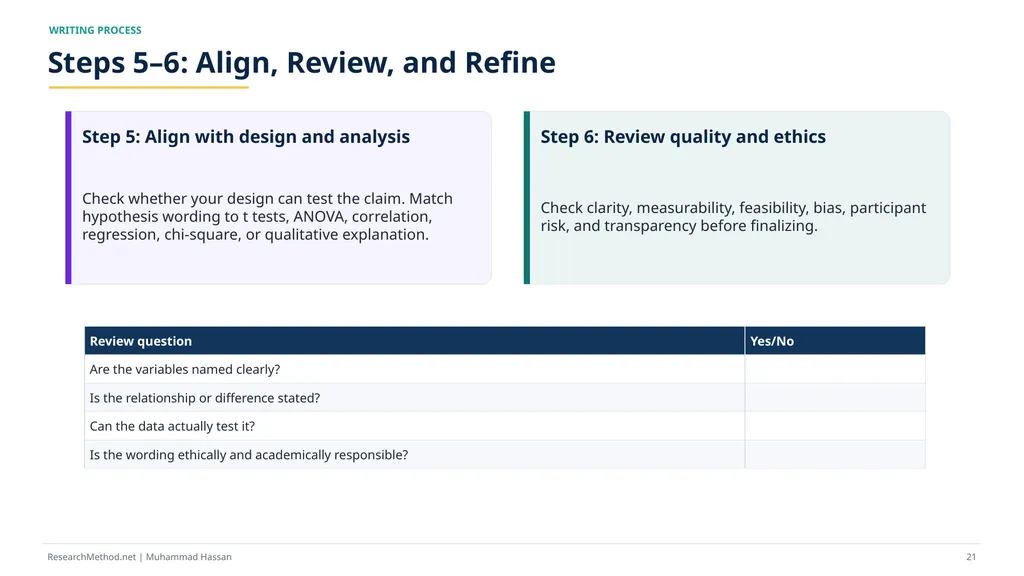
WRITING PROCESS Steps 5–6: Align, Review, and Refine ResearchMethod.net | Muhammad Hassan 21 Step 5: Align with design and analysis Check whether your design can test the claim. Match hypothesis wording to t tests, ANOVA, correlation, regression, chi-square, or qualitative explanation. Step 6: Review quality and ethics Check clarity, measurability, feasibility, bias, participant risk, and transparency before finalizing. Review question Yes/No Are the variables named clearly? Is the relationship or difference stated? Can the data actually test it? Is the wording ethically and academically responsible?<br>
22
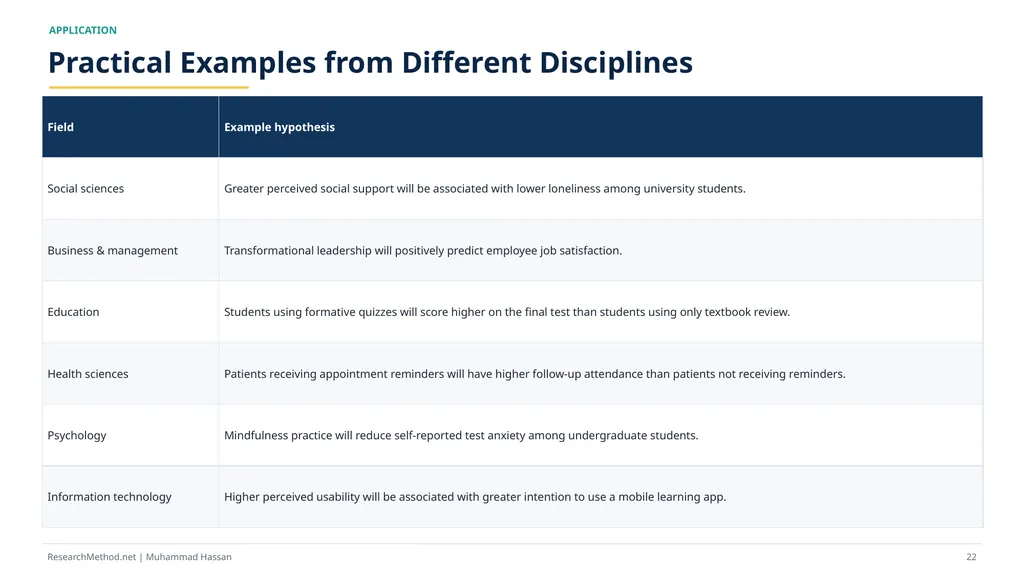
APPLICATION Practical Examples from Different Disciplines ResearchMethod.net | Muhammad Hassan 22 Field Example hypothesis Social sciences Greater perceived social support will be associated with lower loneliness among university students. Business & management Transformational leadership will positively predict employee job satisfaction. Education Students using formative quizzes will score higher on the final test than students using only textbook review. Health sciences Patients receiving appointment reminders will have higher follow-up attendance than patients not receiving reminders. Psychology Mindfulness practice will reduce self-reported test anxiety among undergraduate students. Information technology Higher perceived usability will be associated with greater intention to use a mobile learning app.<br>
23
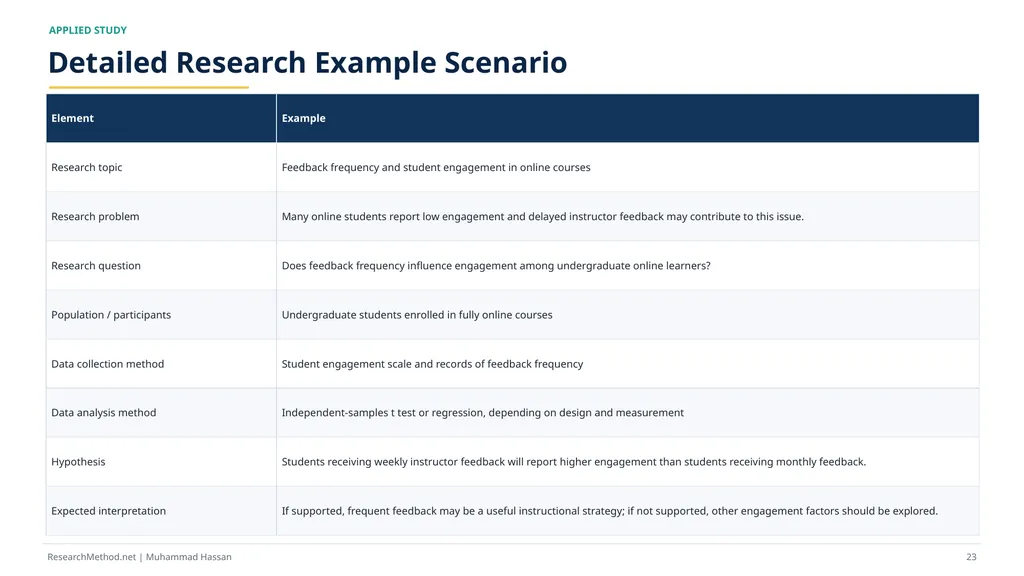
APPLIED STUDY Detailed Research Example Scenario ResearchMethod.net | Muhammad Hassan 23 Element Example Research topic Feedback frequency and student engagement in online courses Research problem Many online students report low engagement and delayed instructor feedback may contribute to this issue. Research question Does feedback frequency influence engagement among undergraduate online learners? Population / participants Undergraduate students enrolled in fully online courses Data collection method Student engagement scale and records of feedback frequency Data analysis method Independent-samples t test or regression, depending on design and measurement Hypothesis Students receiving weekly instructor feedback will report higher engagement than students receiving monthly feedback. Expected interpretation If supported, frequent feedback may be a useful instructional strategy; if not supported, other engagement factors should be explored.<br>
24
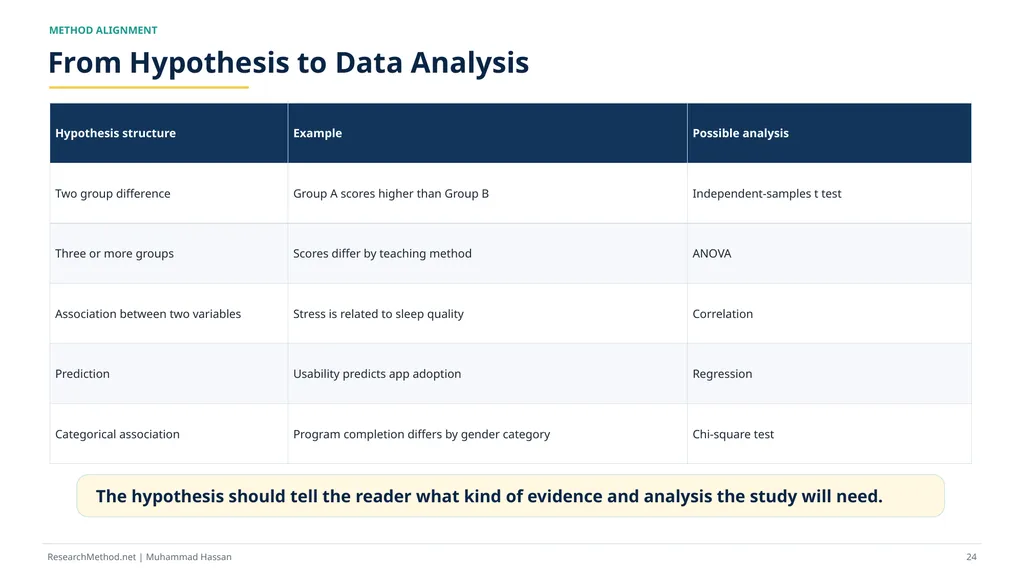
METHOD ALIGNMENT From Hypothesis to Data Analysis ResearchMethod.net | Muhammad Hassan 24 Hypothesis structure Example Possible analysis Two group difference Group A scores higher than Group B Independent-samples t test Three or more groups Scores differ by teaching method ANOVA Association between two variables Stress is related to sleep quality Correlation Prediction Usability predicts app adoption Regression Categorical association Program completion differs by gender category Chi-square test The hypothesis should tell the reader what kind of evidence and analysis the study will need.<br>
25
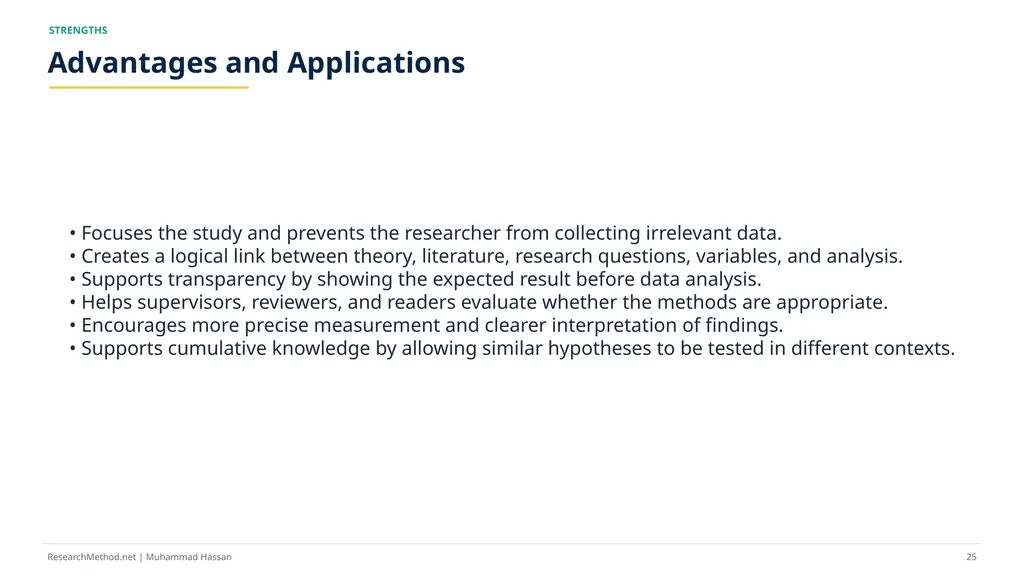
STRENGTHS Advantages and Applications ResearchMethod.net | Muhammad Hassan 25 • Focuses the study and prevents the researcher from collecting irrelevant data.
• Creates a logical link between theory, literature, research questions, variables, and analysis.
• Supports transparency by showing the expected result before data analysis.
• Helps supervisors, reviewers, and readers evaluate whether the methods are appropriate.
• Encourages more precise measurement and clearer interpretation of findings.
• Supports cumulative knowledge by allowing similar hypotheses to be tested in different contexts.<br>
• Creates a logical link between theory, literature, research questions, variables, and analysis.
• Supports transparency by showing the expected result before data analysis.
• Helps supervisors, reviewers, and readers evaluate whether the methods are appropriate.
• Encourages more precise measurement and clearer interpretation of findings.
• Supports cumulative knowledge by allowing similar hypotheses to be tested in different contexts.<br>
26
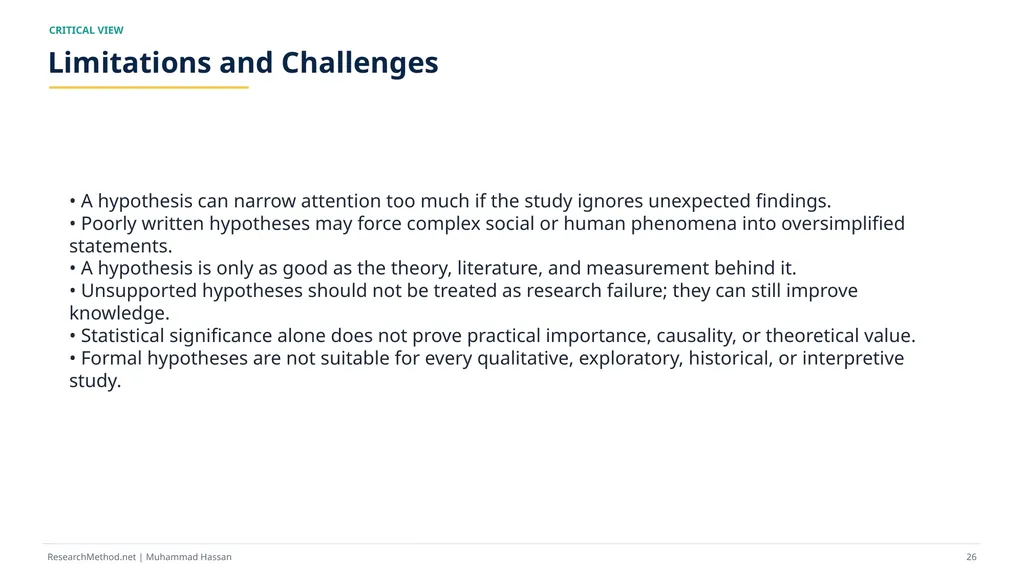
CRITICAL VIEW Limitations and Challenges ResearchMethod.net | Muhammad Hassan 26 • A hypothesis can narrow attention too much if the study ignores unexpected findings.
• Poorly written hypotheses may force complex social or human phenomena into oversimplified statements.
• A hypothesis is only as good as the theory, literature, and measurement behind it.
• Unsupported hypotheses should not be treated as research failure; they can still improve knowledge.
• Statistical significance alone does not prove practical importance, causality, or theoretical value.
• Formal hypotheses are not suitable for every qualitative, exploratory, historical, or interpretive study.<br>
• Poorly written hypotheses may force complex social or human phenomena into oversimplified statements.
• A hypothesis is only as good as the theory, literature, and measurement behind it.
• Unsupported hypotheses should not be treated as research failure; they can still improve knowledge.
• Statistical significance alone does not prove practical importance, causality, or theoretical value.
• Formal hypotheses are not suitable for every qualitative, exploratory, historical, or interpretive study.<br>
27
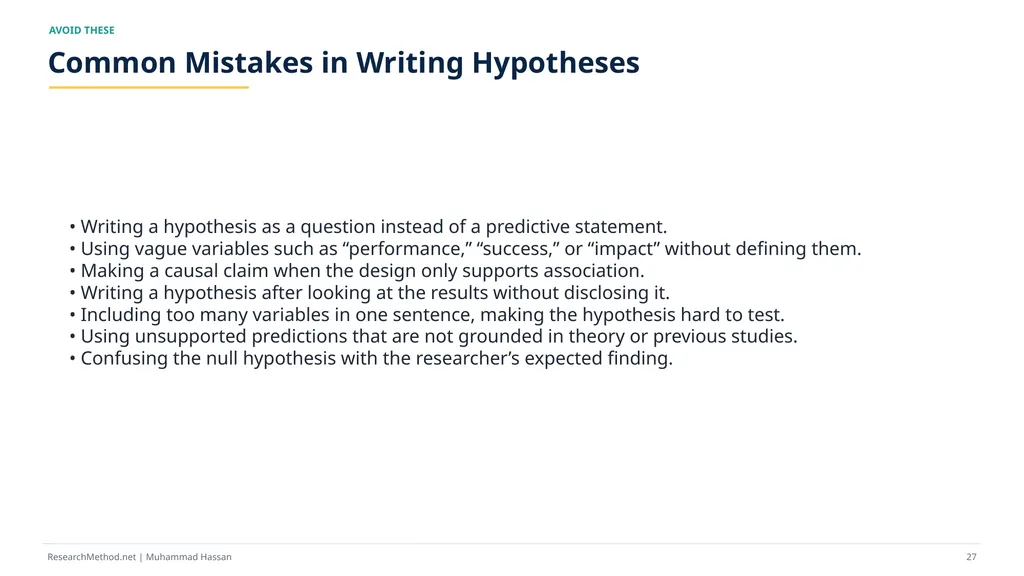
AVOID THESE Common Mistakes in Writing Hypotheses ResearchMethod.net | Muhammad Hassan 27 • Writing a hypothesis as a question instead of a predictive statement.
• Using vague variables such as “performance,” “success,” or “impact” without defining them.
• Making a causal claim when the design only supports association.
• Writing a hypothesis after looking at the results without disclosing it.
• Including too many variables in one sentence, making the hypothesis hard to test.
• Using unsupported predictions that are not grounded in theory or previous studies.
• Confusing the null hypothesis with the researcher’s expected finding.<br>
• Using vague variables such as “performance,” “success,” or “impact” without defining them.
• Making a causal claim when the design only supports association.
• Writing a hypothesis after looking at the results without disclosing it.
• Including too many variables in one sentence, making the hypothesis hard to test.
• Using unsupported predictions that are not grounded in theory or previous studies.
• Confusing the null hypothesis with the researcher’s expected finding.<br>
28
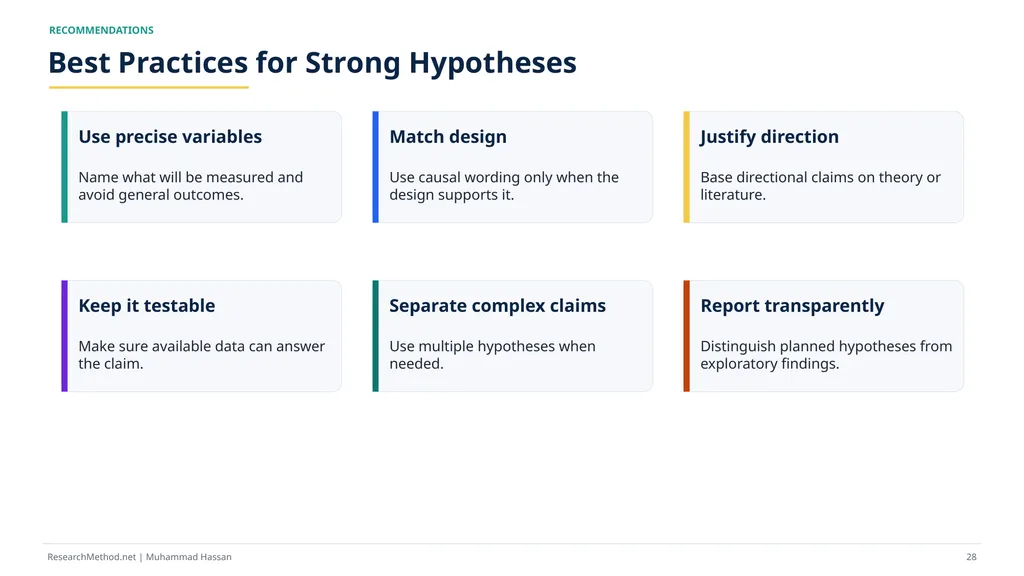
RECOMMENDATIONS Best Practices for Strong Hypotheses ResearchMethod.net | Muhammad Hassan 28 Use precise variables Name what will be measured and avoid general outcomes. Match design Use causal wording only when the design supports it. Justify direction Base directional claims on theory or literature. Keep it testable Make sure available data can answer the claim. Separate complex claims Use multiple hypotheses when needed. Report transparently Distinguish planned hypotheses from exploratory findings.<br>
29
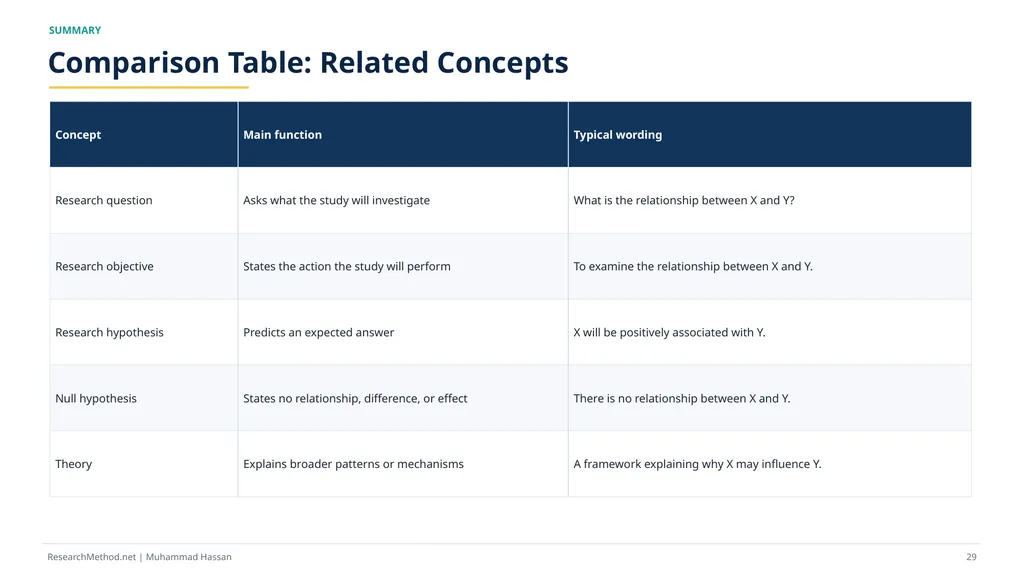
SUMMARY Comparison Table: Related Concepts ResearchMethod.net | Muhammad Hassan 29 Concept Main function Typical wording Research question Asks what the study will investigate What is the relationship between X and Y? Research objective States the action the study will perform To examine the relationship between X and Y. Research hypothesis Predicts an expected answer X will be positively associated with Y. Null hypothesis States no relationship, difference, or effect There is no relationship between X and Y. Theory Explains broader patterns or mechanisms A framework explaining why X may influence Y.<br>
30
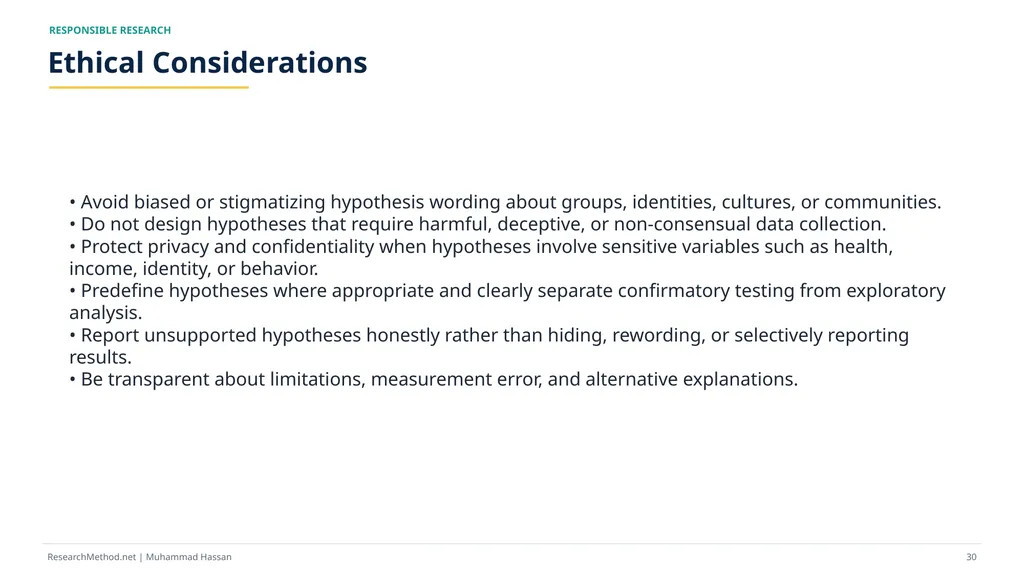
RESPONSIBLE RESEARCH Ethical Considerations ResearchMethod.net | Muhammad Hassan 30 • Avoid biased or stigmatizing hypothesis wording about groups, identities, cultures, or communities.
• Do not design hypotheses that require harmful, deceptive, or non-consensual data collection.
• Protect privacy and confidentiality when hypotheses involve sensitive variables such as health, income, identity, or behavior.
• Predefine hypotheses where appropriate and clearly separate confirmatory testing from exploratory analysis.
• Report unsupported hypotheses honestly rather than hiding, rewording, or selectively reporting results.
• Be transparent about limitations, measurement error, and alternative explanations.<br>
• Do not design hypotheses that require harmful, deceptive, or non-consensual data collection.
• Protect privacy and confidentiality when hypotheses involve sensitive variables such as health, income, identity, or behavior.
• Predefine hypotheses where appropriate and clearly separate confirmatory testing from exploratory analysis.
• Report unsupported hypotheses honestly rather than hiding, rewording, or selectively reporting results.
• Be transparent about limitations, measurement error, and alternative explanations.<br>
31
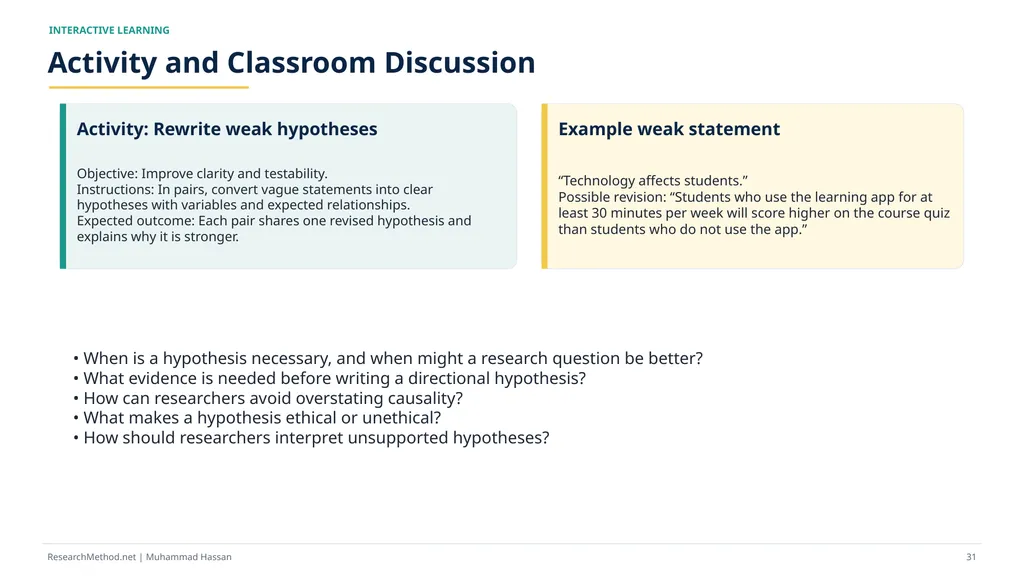
INTERACTIVE LEARNING Activity and Classroom Discussion ResearchMethod.net | Muhammad Hassan 31 Activity: Rewrite weak hypotheses Objective: Improve clarity and testability.
Instructions: In pairs, convert vague statements into clear hypotheses with variables and expected relationships.
Expected outcome: Each pair shares one revised hypothesis and explains why it is stronger. Example weak statement “Technology affects students.”
Possible revision: “Students who use the learning app for at least 30 minutes per week will score higher on the course quiz than students who do not use the app.” • When is a hypothesis necessary, and when might a research question be better?
• What evidence is needed before writing a directional hypothesis?
• How can researchers avoid overstating causality?
• What makes a hypothesis ethical or unethical?
• How should researchers interpret unsupported hypotheses?<br>
Instructions: In pairs, convert vague statements into clear hypotheses with variables and expected relationships.
Expected outcome: Each pair shares one revised hypothesis and explains why it is stronger. Example weak statement “Technology affects students.”
Possible revision: “Students who use the learning app for at least 30 minutes per week will score higher on the course quiz than students who do not use the app.” • When is a hypothesis necessary, and when might a research question be better?
• What evidence is needed before writing a directional hypothesis?
• How can researchers avoid overstating causality?
• What makes a hypothesis ethical or unethical?
• How should researchers interpret unsupported hypotheses?<br>
32
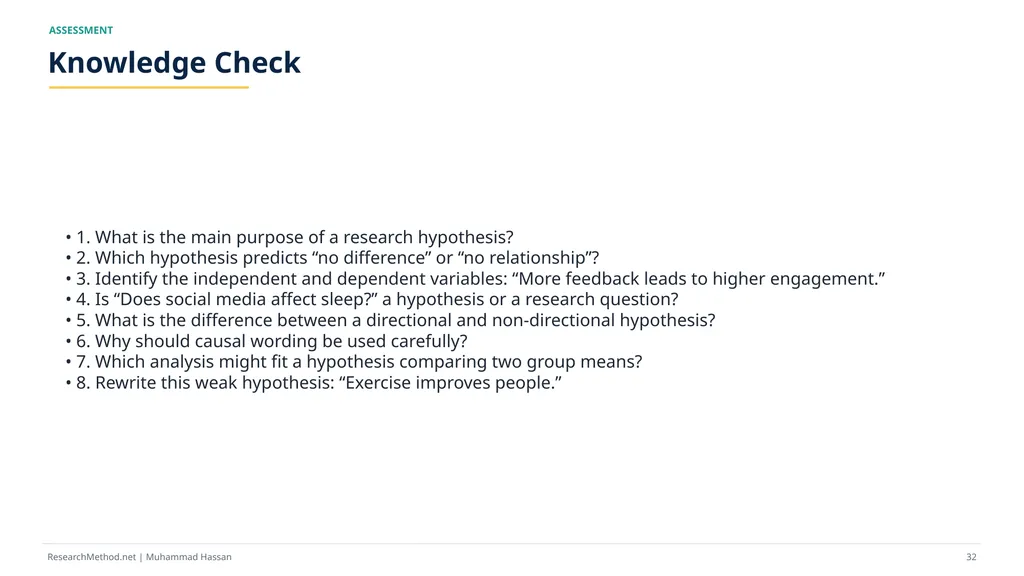
ASSESSMENT Knowledge Check ResearchMethod.net | Muhammad Hassan 32 • 1. What is the main purpose of a research hypothesis?
• 2. Which hypothesis predicts “no difference” or “no relationship”?
• 3. Identify the independent and dependent variables: “More feedback leads to higher engagement.”
• 4. Is “Does social media affect sleep?” a hypothesis or a research question?
• 5. What is the difference between a directional and non-directional hypothesis?
• 6. Why should causal wording be used carefully?
• 7. Which analysis might fit a hypothesis comparing two group means?
• 8. Rewrite this weak hypothesis: “Exercise improves people.”<br>
• 2. Which hypothesis predicts “no difference” or “no relationship”?
• 3. Identify the independent and dependent variables: “More feedback leads to higher engagement.”
• 4. Is “Does social media affect sleep?” a hypothesis or a research question?
• 5. What is the difference between a directional and non-directional hypothesis?
• 6. Why should causal wording be used carefully?
• 7. Which analysis might fit a hypothesis comparing two group means?
• 8. Rewrite this weak hypothesis: “Exercise improves people.”<br>
33
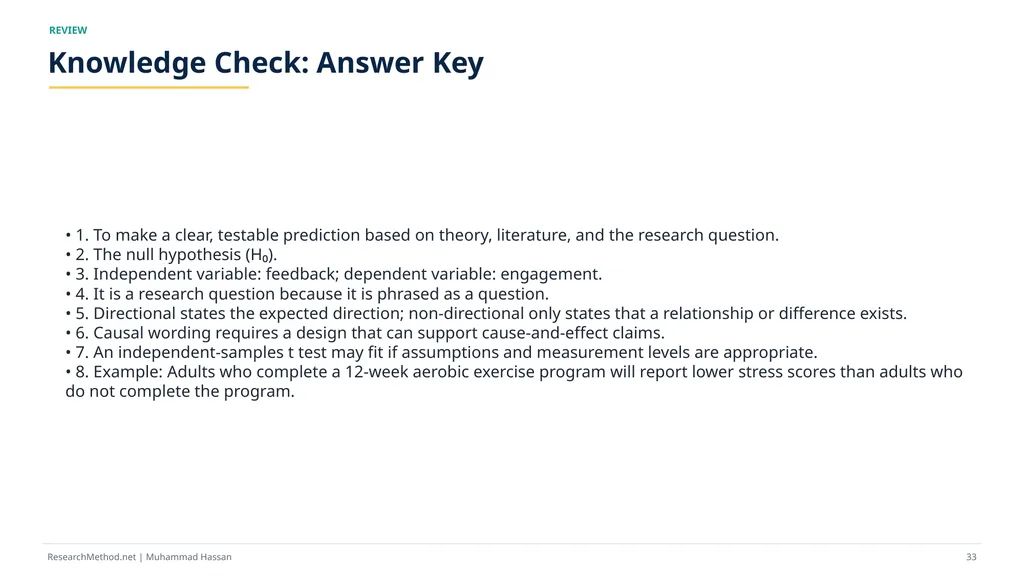
REVIEW Knowledge Check: Answer Key ResearchMethod.net | Muhammad Hassan 33 • 1. To make a clear, testable prediction based on theory, literature, and the research question.
• 2. The null hypothesis (H₀).
• 3. Independent variable: feedback; dependent variable: engagement.
• 4. It is a research question because it is phrased as a question.
• 5. Directional states the expected direction; non-directional only states that a relationship or difference exists.
• 6. Causal wording requires a design that can support cause-and-effect claims.
• 7. An independent-samples t test may fit if assumptions and measurement levels are appropriate.
• 8. Example: Adults who complete a 12-week aerobic exercise program will report lower stress scores than adults who do not complete the program.<br>
• 2. The null hypothesis (H₀).
• 3. Independent variable: feedback; dependent variable: engagement.
• 4. It is a research question because it is phrased as a question.
• 5. Directional states the expected direction; non-directional only states that a relationship or difference exists.
• 6. Causal wording requires a design that can support cause-and-effect claims.
• 7. An independent-samples t test may fit if assumptions and measurement levels are appropriate.
• 8. Example: Adults who complete a 12-week aerobic exercise program will report lower stress scores than adults who do not complete the program.<br>
34
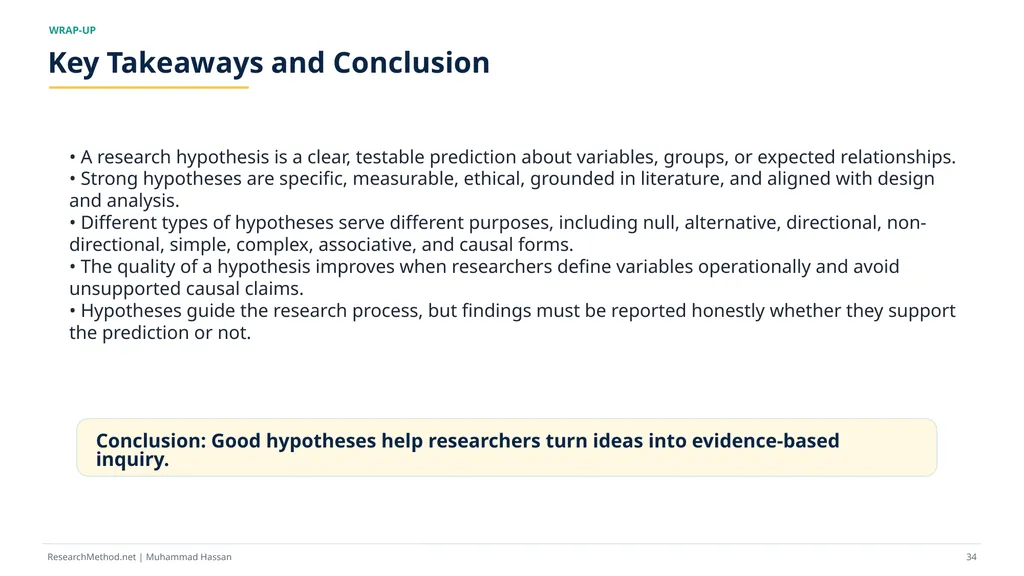
WRAP-UP Key Takeaways and Conclusion ResearchMethod.net | Muhammad Hassan 34 • A research hypothesis is a clear, testable prediction about variables, groups, or expected relationships.
• Strong hypotheses are specific, measurable, ethical, grounded in literature, and aligned with design and analysis.
• Different types of hypotheses serve different purposes, including null, alternative, directional, non-directional, simple, complex, associative, and causal forms.
• The quality of a hypothesis improves when researchers define variables operationally and avoid unsupported causal claims.
• Hypotheses guide the research process, but findings must be reported honestly whether they support the prediction or not. Conclusion: Good hypotheses help researchers turn ideas into evidence-based inquiry.<br>
• Strong hypotheses are specific, measurable, ethical, grounded in literature, and aligned with design and analysis.
• Different types of hypotheses serve different purposes, including null, alternative, directional, non-directional, simple, complex, associative, and causal forms.
• The quality of a hypothesis improves when researchers define variables operationally and avoid unsupported causal claims.
• Hypotheses guide the research process, but findings must be reported honestly whether they support the prediction or not. Conclusion: Good hypotheses help researchers turn ideas into evidence-based inquiry.<br>
35
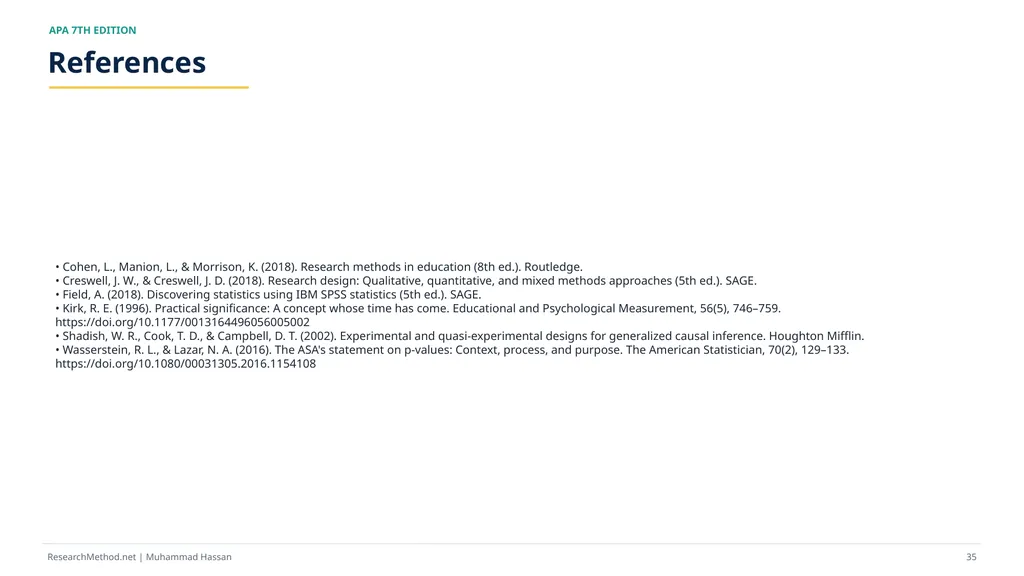
APA 7TH EDITION References ResearchMethod.net | Muhammad Hassan 35 • Cohen, L., Manion, L., & Morrison, K. (2018). Research methods in education (8th ed.). Routledge.
• Creswell, J. W., & Creswell, J. D. (2018). Research design: Qualitative, quantitative, and mixed methods approaches (5th ed.). SAGE.
• Field, A. (2018). Discovering statistics using IBM SPSS statistics (5th ed.). SAGE.
• Kirk, R. E. (1996). Practical significance: A concept whose time has come. Educational and Psychological Measurement, 56(5), 746–759. https://doi.org/10.1177/0013164496056005002
• Shadish, W. R., Cook, T. D., & Campbell, D. T. (2002). Experimental and quasi-experimental designs for generalized causal inference. Houghton Mifflin.
• Wasserstein, R. L., & Lazar, N. A. (2016). The ASA's statement on p-values: Context, process, and purpose. The American Statistician, 70(2), 129–133. https://doi.org/10.1080/00031305.2016.1154108<br>
• Creswell, J. W., & Creswell, J. D. (2018). Research design: Qualitative, quantitative, and mixed methods approaches (5th ed.). SAGE.
• Field, A. (2018). Discovering statistics using IBM SPSS statistics (5th ed.). SAGE.
• Kirk, R. E. (1996). Practical significance: A concept whose time has come. Educational and Psychological Measurement, 56(5), 746–759. https://doi.org/10.1177/0013164496056005002
• Shadish, W. R., Cook, T. D., & Campbell, D. T. (2002). Experimental and quasi-experimental designs for generalized causal inference. Houghton Mifflin.
• Wasserstein, R. L., & Lazar, N. A. (2016). The ASA's statement on p-values: Context, process, and purpose. The American Statistician, 70(2), 129–133. https://doi.org/10.1080/00031305.2016.1154108<br>
36
Thank You Author: Muhammad Hassan
Website: ResearchMethod.net Visit ResearchMethod.net for research guides, templates, lecture slides, examples, and academic resources. ResearchMethod.net | Muhammad Hassan<br>
Website: ResearchMethod.net Visit ResearchMethod.net for research guides, templates, lecture slides, examples, and academic resources. ResearchMethod.net | Muhammad Hassan<br>