
https://presentations. gilead.com/item/020cd91051
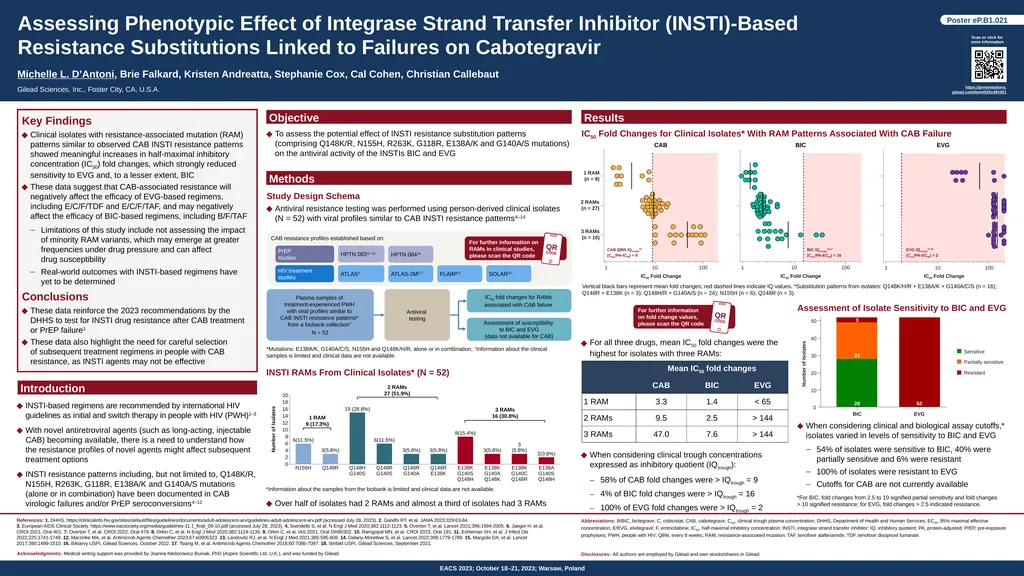
Description: https:presentations. gilead.comitem020cd91051 Assessing Phenotypic Effect of Integrase Strand Transfer Inhibitor (INSTI)-Based Resistance Substitutions Linked to Failures on Cabotegravir Michelle L. DAntoni, Brie Falkard, Kristen
Related Topics
Download Presentation
"https://presentations. gilead.com/item/020cd91051" is the property of its rightful owner. Permission is granted to download and print the materials on this website for personal, non-commercial use only, and to display it on your personal computer provided you do not modify the materials and that you retain all copyright notices contained in the materials. By downloading content from our website, you accept the terms of this agreement.
Presentation Transcript
slide1. https://presentations.
gilead.com/item/020cd91051 Assessing Phenotypic Effect of Integrase Strand Transfer Inhibitor (INSTI)-Based
Resistance Substitutions Linked to Failures on Cabotegravir Michelle L. D’Antoni, Brie Falkard, Kristen Andreatta, Stephanie Cox, Cal Cohen, Christian Callebaut
Gilead Sciences, Inc., Foster City, CA, U.S.A. Key Findings
Clinical isolates with resistance-associated mutation (RAM) patterns similar to observed CAB INSTI resistance patterns showed meaningful increases in half-maximal inhibitory concentration (IC50) fold changes, which strongly reduced sensitivity to EVG and, to a lesser extent, BIC
These data suggest that CAB-associated resistance will negatively affect the efficacy of EVG-based regimens, including E/C/F/TDF and E/C/F/TAF, and may negatively affect the efficacy of BIC-based regimens, including B/F/TAF
Limitations of this study include not assessing the impact of minority RAM variants, which may emerge at greater frequencies under drug pressure and can affect drug susceptibility
Real-world outcomes with INSTI-based regimens have yet to be determined References: 1. DHHS. https://clinicalinfo.hiv.gov/sites/default/files/guidelines/documents/adult-adolescent-arv/guidelines-adult-adolescent-arv.pdf (accessed July 28, 2023). 2. Gandhi RT, et al. JAMA 2023;329:63-84. 3. European AIDS Clinical Society. https://www.eacsociety.org/media/guidelines-11.1_final_09-10.pdf (accessed July 28, 2023). 4. Swindells S, et al. N Engl J Med 2020;382:1112-1123. 5. Overton T, et al. Lancet 2021;396:1994-2005. 6. Jaeger H, et al. CROI 2021, Oral 401. 7. Overton T, et al. CROI 2022, Oral 479. 8. Orkin C, et al. N Engl J Med 2020;382:1124-1135. 9. Orkin C, et al. IAS 2021, Oral OAB0302. 10. Ramgopal MN, et al. CROI 2023, Oral 191. 11. Eshleman SH, et al. J Infect Dis 2022;225:1741-1749. 12. Marzinke MA, et al. Antimicrob Agents Chemother 2023;67:e0005323. 13. Landovitz RJ, et al. N Engl J Med 2021;385:595-608. 14. Delany-Moretlwe S, et al. Lancet 2022;399:1779-1789. 15. Margolis DA, et al. Lancet 2017;390:1499-1510. 16. Biktarvy USPI, Gilead Sciences, October 2022. 17. Tsiang M, et al. Antimicrob Agents Chemother 2016;60:7086-7097. 18. Stribild USPI, Gilead Sciences, September 2021. Acknowledgments: Medical writing support was provided by Joanna Nikitorowicz-Buniak, PhD (Aspire Scientific Ltd, U.K.), and was funded by Gilead. Disclosures: All authors are employed by Gilead and own stocks/shares in Gilead. Abbreviations: B/BIC, bictegravir; C, cobicistat; CAB, cabotegravir; Ctau, clinical trough plasma concentration; DHHS, Department of Health and Human Services; EC95, 95% maximal effective concentration; E/EVG, elvitegravir; F, emtricitabine; IC50, half-maximal inhibitory concentration; INSTI, integrase strand transfer inhibitor; IQ, inhibitory quotient; PA, protein-adjusted; PrEP, pre-exposure prophylaxis; PWH, people with HIV; Q8W, every 8 weeks; RAM, resistance-associated mutation; TAF, tenofovir alafenamide; TDF, tenofovir disoproxil fumarate. Introduction Study Design Schema INSTI-based regimens are recommended by international HIV guidelines as initial and switch therapy in people with HIV (PWH)1–3
With novel antiretroviral agents (such as long-acting, injectable CAB) becoming available, there is a need to understand how the resistance profiles of novel agents might affect subsequent treatment options
INSTI resistance patterns including, but not limited to, Q148K/R, N155H, R263K, G118R, E138A/K and G140A/S mutations (alone or in combination) have been documented in CAB virologic failures and/or PrEP seroconversions4–12 INSTI RAMs From Clinical Isolates* (N = 52) Scan or click for more information Poster eP.B1.021 Conclusions
These data reinforce the 2023 recommendations by the DHHS to test for INSTI drug resistance after CAB treatment or PrEP failure1
These data also highlight the need for careful selection of subsequent treatment regimens in people with CAB resistance, as INSTI agents may not be effective Objective To assess the potential effect of INSTI resistance substitution patterns (comprising Q148K/R, N155H, R263K, G118R, E138A/K and G140A/S mutations) on the antiviral activity of the INSTIs BIC and EVG Methods Results Antiviral resistance testing was performed using person-derived clinical isolates (N = 52) with viral profiles similar to CAB INSTI resistance patterns4–14 *Mutations: E138A/K, G140A/C/S, N155H and Q148K/H/R, alone or in combination; †Information about the clinical samples is limited and clinical data are not available. *Information about the samples from the biobank is limited and clinical data are not available. Over half of isolates had 2 RAMs and almost a third of isolates had 3 RAMs IC50 Fold Changes for Clinical Isolates* With RAM Patterns Associated With CAB Failure Vertical black bars represent mean fold changes; red dashed lines indicate IQ values. *Substitution patterns from isolates: Q148K/H/R + E138A/K + G140A/C/S (n = 16); Q148R + E138K (n = 3); Q148H/R + G140A/S (n = 24); N155H (n = 6); Q148R (n = 3). For all three drugs, mean IC50 fold changes were the highest for isolates with three RAMs: When considering clinical trough concentrations expressed as inhibitory quotient (IQtrough):
58% of CAB fold changes were > IQtrough = 9
4% of BIC fold changes were > IQtrough = 16
100% of EVG fold changes were > IQtrough = 2 Assessment of Isolate Sensitivity to BIC and EVG When considering clinical and biological assay cutoffs,* isolates varied in levels of sensitivity to BIC and EVG
54% of isolates were sensitive to BIC, 40% were partially sensitive and 6% were resistant
100% of isolates were resistant to EVG
Cutoffs for CAB are not currently available *For BIC, fold changes from 2.5 to 10 signified partial sensitivity and fold changes > 10 signified resistance; for EVG, fold changes > 2.5 indicated resistance. CAB resistance profiles established based on: HIV treatment studies ATLAS4 FLAIR8,9 ATLAS-2M5–7 SOLAR10 PrEP studies HPTN 08311–13 HPTN 08414 IC50 fold changes for RAMs associated with CAB failure Assessment of susceptibility to BIC and EVG (data not available for CAB) Plasma samples of treatment-experienced PWH with viral profiles similar to CAB INSTI resistance patterns* from a biobank collection†
N = 52 Antiviral testing<br>
Gilead Sciences, Inc., Foster City, CA, U.S.A. Key Findings
Clinical isolates with resistance-associated mutation (RAM) patterns similar to observed CAB INSTI resistance patterns showed meaningful increases in half-maximal inhibitory concentration (IC50) fold changes, which strongly reduced sensitivity to EVG and, to a lesser extent, BIC
These data suggest that CAB-associated resistance will negatively affect the efficacy of EVG-based regimens, including E/C/F/TDF and E/C/F/TAF, and may negatively affect the efficacy of BIC-based regimens, including B/F/TAF
Limitations of this study include not assessing the impact of minority RAM variants, which may emerge at greater frequencies under drug pressure and can affect drug susceptibility
Real-world outcomes with INSTI-based regimens have yet to be determined References: 1. DHHS. https://clinicalinfo.hiv.gov/sites/default/files/guidelines/documents/adult-adolescent-arv/guidelines-adult-adolescent-arv.pdf (accessed July 28, 2023). 2. Gandhi RT, et al. JAMA 2023;329:63-84. 3. European AIDS Clinical Society. https://www.eacsociety.org/media/guidelines-11.1_final_09-10.pdf (accessed July 28, 2023). 4. Swindells S, et al. N Engl J Med 2020;382:1112-1123. 5. Overton T, et al. Lancet 2021;396:1994-2005. 6. Jaeger H, et al. CROI 2021, Oral 401. 7. Overton T, et al. CROI 2022, Oral 479. 8. Orkin C, et al. N Engl J Med 2020;382:1124-1135. 9. Orkin C, et al. IAS 2021, Oral OAB0302. 10. Ramgopal MN, et al. CROI 2023, Oral 191. 11. Eshleman SH, et al. J Infect Dis 2022;225:1741-1749. 12. Marzinke MA, et al. Antimicrob Agents Chemother 2023;67:e0005323. 13. Landovitz RJ, et al. N Engl J Med 2021;385:595-608. 14. Delany-Moretlwe S, et al. Lancet 2022;399:1779-1789. 15. Margolis DA, et al. Lancet 2017;390:1499-1510. 16. Biktarvy USPI, Gilead Sciences, October 2022. 17. Tsiang M, et al. Antimicrob Agents Chemother 2016;60:7086-7097. 18. Stribild USPI, Gilead Sciences, September 2021. Acknowledgments: Medical writing support was provided by Joanna Nikitorowicz-Buniak, PhD (Aspire Scientific Ltd, U.K.), and was funded by Gilead. Disclosures: All authors are employed by Gilead and own stocks/shares in Gilead. Abbreviations: B/BIC, bictegravir; C, cobicistat; CAB, cabotegravir; Ctau, clinical trough plasma concentration; DHHS, Department of Health and Human Services; EC95, 95% maximal effective concentration; E/EVG, elvitegravir; F, emtricitabine; IC50, half-maximal inhibitory concentration; INSTI, integrase strand transfer inhibitor; IQ, inhibitory quotient; PA, protein-adjusted; PrEP, pre-exposure prophylaxis; PWH, people with HIV; Q8W, every 8 weeks; RAM, resistance-associated mutation; TAF, tenofovir alafenamide; TDF, tenofovir disoproxil fumarate. Introduction Study Design Schema INSTI-based regimens are recommended by international HIV guidelines as initial and switch therapy in people with HIV (PWH)1–3
With novel antiretroviral agents (such as long-acting, injectable CAB) becoming available, there is a need to understand how the resistance profiles of novel agents might affect subsequent treatment options
INSTI resistance patterns including, but not limited to, Q148K/R, N155H, R263K, G118R, E138A/K and G140A/S mutations (alone or in combination) have been documented in CAB virologic failures and/or PrEP seroconversions4–12 INSTI RAMs From Clinical Isolates* (N = 52) Scan or click for more information Poster eP.B1.021 Conclusions
These data reinforce the 2023 recommendations by the DHHS to test for INSTI drug resistance after CAB treatment or PrEP failure1
These data also highlight the need for careful selection of subsequent treatment regimens in people with CAB resistance, as INSTI agents may not be effective Objective To assess the potential effect of INSTI resistance substitution patterns (comprising Q148K/R, N155H, R263K, G118R, E138A/K and G140A/S mutations) on the antiviral activity of the INSTIs BIC and EVG Methods Results Antiviral resistance testing was performed using person-derived clinical isolates (N = 52) with viral profiles similar to CAB INSTI resistance patterns4–14 *Mutations: E138A/K, G140A/C/S, N155H and Q148K/H/R, alone or in combination; †Information about the clinical samples is limited and clinical data are not available. *Information about the samples from the biobank is limited and clinical data are not available. Over half of isolates had 2 RAMs and almost a third of isolates had 3 RAMs IC50 Fold Changes for Clinical Isolates* With RAM Patterns Associated With CAB Failure Vertical black bars represent mean fold changes; red dashed lines indicate IQ values. *Substitution patterns from isolates: Q148K/H/R + E138A/K + G140A/C/S (n = 16); Q148R + E138K (n = 3); Q148H/R + G140A/S (n = 24); N155H (n = 6); Q148R (n = 3). For all three drugs, mean IC50 fold changes were the highest for isolates with three RAMs: When considering clinical trough concentrations expressed as inhibitory quotient (IQtrough):
58% of CAB fold changes were > IQtrough = 9
4% of BIC fold changes were > IQtrough = 16
100% of EVG fold changes were > IQtrough = 2 Assessment of Isolate Sensitivity to BIC and EVG When considering clinical and biological assay cutoffs,* isolates varied in levels of sensitivity to BIC and EVG
54% of isolates were sensitive to BIC, 40% were partially sensitive and 6% were resistant
100% of isolates were resistant to EVG
Cutoffs for CAB are not currently available *For BIC, fold changes from 2.5 to 10 signified partial sensitivity and fold changes > 10 signified resistance; for EVG, fold changes > 2.5 indicated resistance. CAB resistance profiles established based on: HIV treatment studies ATLAS4 FLAIR8,9 ATLAS-2M5–7 SOLAR10 PrEP studies HPTN 08311–13 HPTN 08414 IC50 fold changes for RAMs associated with CAB failure Assessment of susceptibility to BIC and EVG (data not available for CAB) Plasma samples of treatment-experienced PWH with viral profiles similar to CAB INSTI resistance patterns* from a biobank collection†
N = 52 Antiviral testing<br>