
https://rshp.scot A national teaching and learning
MT
Published · 20 slides · 0 views
1 / 1


Description
https:rshp.scot A national teaching and learning resource for Relationships, Sexual Health and Parenthood (RSHP) education From ages 3 to 18 Welcome This information is about what we do in a part of our Health and Wellbeing curriculum
Related Topics
Share
Embed code
Download this presentation From Below
"https://rshp.scot A national teaching and learning" is the property of its rightful owner. Permission is granted to download and print the materials on this website for personal, non-commercial use only, and to display it on your personal computer provided you do not modify the materials and that you retain all copyright notices contained in the materials. By downloading content from our website, you accept the terms of this agreement.
Presentation Transcript
01
https://rshp.scot A national teaching and learning resource for Relationships, Sexual Health and Parenthood (RSHP) education
From ages 3 to 18<br>
From ages 3 to 18<br>
02
Welcome This information is about what we do in a part of our Health and Wellbeing curriculum that we call Relationships, Sexual Health and Parenthood (RSHP) education.
Broughton is using the RSHP Programme in line with City of Edinburgh guidance. You can see at https://rshp.scot/
Our RSHP curriculum has been in place for some years, it is part of Curriculum for Excellence. This is resource, designed to help us to deliver the existing RSHP curriculum.<br>
Broughton is using the RSHP Programme in line with City of Edinburgh guidance. You can see at https://rshp.scot/
Our RSHP curriculum has been in place for some years, it is part of Curriculum for Excellence. This is resource, designed to help us to deliver the existing RSHP curriculum.<br>
03
What is the resource? A teacher or early years practitioner can use the resource to support teaching and learning.
All content is age and stage appropriate for learners 3-18 years, organised by Curriculum for Excellence Levels, from Early Level through to Senior Phase.
It can be used in formal and informal learning settings.
Content is up-to-date, engaging and meets the needs of learners, including those with additional support needs.<br>
All content is age and stage appropriate for learners 3-18 years, organised by Curriculum for Excellence Levels, from Early Level through to Senior Phase.
It can be used in formal and informal learning settings.
Content is up-to-date, engaging and meets the needs of learners, including those with additional support needs.<br>
04
What will I find in the resource? The resource was developed by a partnership of Local Authorities and Health Boards, with advice from Education Scotland and Scottish Government.
The resource is made up of a series of Activity Plans that describe how a teacher can approach an aspect of RSHP education.
The Activity Plans are supported by PowerPoints or other resources the lesson might need.
There is information for parents and carers, ideas about communicating between school and home, reading lists for school libraries and reading at home.
The resource is accessible and open to everyone; parents and carers can see what is being delivered in school.<br>
The resource is made up of a series of Activity Plans that describe how a teacher can approach an aspect of RSHP education.
The Activity Plans are supported by PowerPoints or other resources the lesson might need.
There is information for parents and carers, ideas about communicating between school and home, reading lists for school libraries and reading at home.
The resource is accessible and open to everyone; parents and carers can see what is being delivered in school.<br>
05
Why has it been developed? There is a need to ensure the quality, relevance, consistency and coverage of RSHP education.
We need to deliver RSHP education that helps protect children and young people from harm and supports them to understand that friendships and personal relationships should be healthy, happy and safe.
The resource helps teachers to source material that is age and stage appropriate, so that they can focus on building relationships with learners.
We need our RSHP education to reflect a modern and inclusive Scotland where we value and respect the human rights of everyone.<br>
We need to deliver RSHP education that helps protect children and young people from harm and supports them to understand that friendships and personal relationships should be healthy, happy and safe.
The resource helps teachers to source material that is age and stage appropriate, so that they can focus on building relationships with learners.
We need our RSHP education to reflect a modern and inclusive Scotland where we value and respect the human rights of everyone.<br>
06
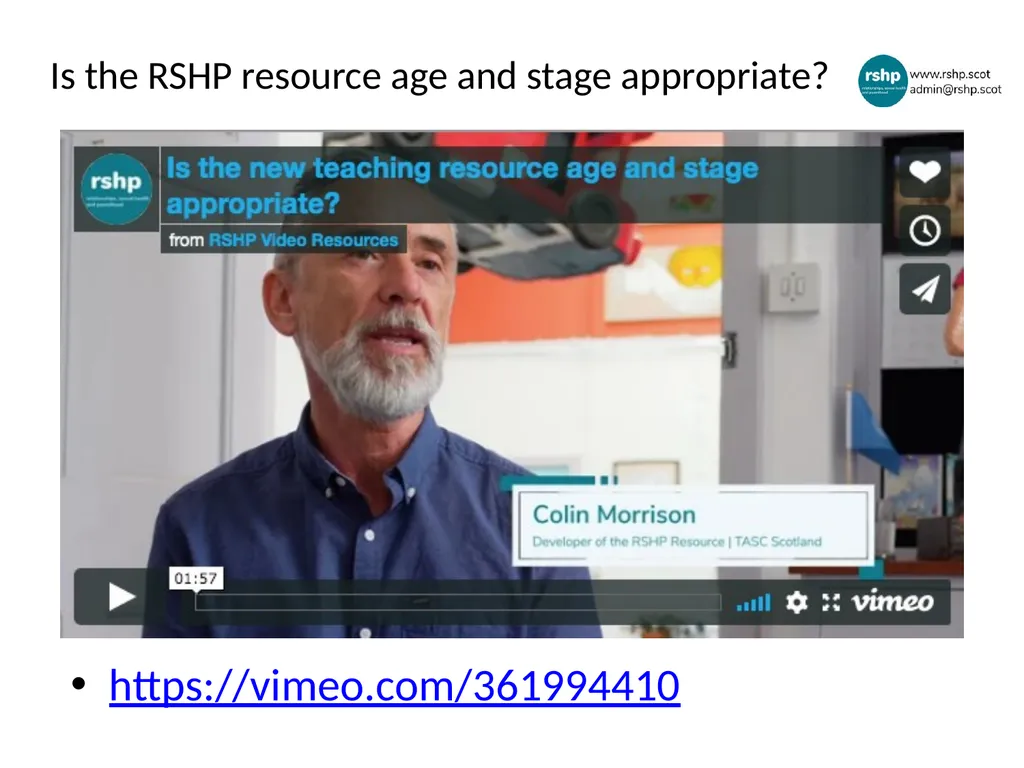
Is the RSHP resource age and stage appropriate? https://vimeo.com/361994410<br>
07
What do we do at Early Level? (normally Nursery and Primary 1) When it comes to families and friendships, children learn:
That all our families are different, and that people who are important to the children provide care and love.
How to make and keep friendships, thinking about how they get along with other children, play together, co-operate and share. This can include learning about personal space and to recognise and respect how another person is feeling.
About the importance of kindness and showing kindness to others.
When it comes to every child being unique and special children learn:
That people are individual and unique.
About the similarities and differences among children in their group.
To understand that treating someone badly based on a difference is not okay.<br>
That all our families are different, and that people who are important to the children provide care and love.
How to make and keep friendships, thinking about how they get along with other children, play together, co-operate and share. This can include learning about personal space and to recognise and respect how another person is feeling.
About the importance of kindness and showing kindness to others.
When it comes to every child being unique and special children learn:
That people are individual and unique.
About the similarities and differences among children in their group.
To understand that treating someone badly based on a difference is not okay.<br>
08
What do we do at Early Level?
(normally Nursery and Primary 1) When it comes to feelings and making choices children learn:
To recognise and express their feelings, including when they might feel safe or unsafe, happy or worried.
To identify adults that they can go to if they have a question or a worry, introducing the idea of trust.
When it comes to looking after them and other living things children learn about:
Where living things come from.
The needs of plants, animals and babies.
That there are professional people who help and care for them
When it comes to their bodies, children learn about:
Names for parts of their body – and that parts of their body are private.
Keeping clean and why this is important – learning about hand washing and brushing teeth.
Information for parents and carers about RSHP learning at Early Level at school and at home: https://rshp.scot/early-level/<br>
To recognise and express their feelings, including when they might feel safe or unsafe, happy or worried.
To identify adults that they can go to if they have a question or a worry, introducing the idea of trust.
When it comes to looking after them and other living things children learn about:
Where living things come from.
The needs of plants, animals and babies.
That there are professional people who help and care for them
When it comes to their bodies, children learn about:
Names for parts of their body – and that parts of their body are private.
Keeping clean and why this is important – learning about hand washing and brushing teeth.
Information for parents and carers about RSHP learning at Early Level at school and at home: https://rshp.scot/early-level/<br>
09
What do we do at First Level?
(normally Primary 2, 3 and 4) When it comes to relationships children learn about:
What makes then unique
Families, and how all our families are different
The different adults who might care for children – like teachers, support staff in school
Making and having friends
Being a boy and a girl and that they can be any kind of boy or girl they want to be
What makes people alike and what makes us different (diversity)
Respect for others and the importance of being kind.
When it comes to growing up and their body children learn about:
Making choices and decisions
Looking after their body and keeping clean
How their bodies change as they grow
Names of parts of their body and names for private body parts
Parts of their body are private
Other people should not touch the private parts of their body
What behaviour is okay in public and what is okay in private (for example pulling pants up before leaving the bathroom).<br>
What makes then unique
Families, and how all our families are different
The different adults who might care for children – like teachers, support staff in school
Making and having friends
Being a boy and a girl and that they can be any kind of boy or girl they want to be
What makes people alike and what makes us different (diversity)
Respect for others and the importance of being kind.
When it comes to growing up and their body children learn about:
Making choices and decisions
Looking after their body and keeping clean
How their bodies change as they grow
Names of parts of their body and names for private body parts
Parts of their body are private
Other people should not touch the private parts of their body
What behaviour is okay in public and what is okay in private (for example pulling pants up before leaving the bathroom).<br>
10
What do we do at First Level?
(normally Primary 2, 3 and 4) When it comes to how human life begins, pregnancy and birth children learn about:
The life cycles of plants and animals
What a baby needs and how to care for a baby.
How a baby is made
Pregnancy and how a baby is born
Information for parents and carers about RSHP learning at First Level at school and at home: https://rshp.scot/first-level/<br>
The life cycles of plants and animals
What a baby needs and how to care for a baby.
How a baby is made
Pregnancy and how a baby is born
Information for parents and carers about RSHP learning at First Level at school and at home: https://rshp.scot/first-level/<br>
11
What do we do at Second Level?
(normally Primary 5, 6 and 7) When it comes to relationships children learn about:
What makes them unique and what makes people alike and what makes us different (diversity)
Making and having friends
Being a boy and a girl, and that they can be any kind of boy or girl they want to be
Loving relationships and being attracted to others
Respect for others and the importance of being kind – in our face-to-face relationships and online.
When it comes to being safe children learn about:
Social media and being safe and smart online
Feeling safe and unsafe
Different kinds of abuse and neglect that can happen to a child
What we mean by consent
Who they can go to for help and support.<br>
What makes them unique and what makes people alike and what makes us different (diversity)
Making and having friends
Being a boy and a girl, and that they can be any kind of boy or girl they want to be
Loving relationships and being attracted to others
Respect for others and the importance of being kind – in our face-to-face relationships and online.
When it comes to being safe children learn about:
Social media and being safe and smart online
Feeling safe and unsafe
Different kinds of abuse and neglect that can happen to a child
What we mean by consent
Who they can go to for help and support.<br>
12
What do we do at Second Level?
(normally Primary 5, 6 and 7) When it comes to growing up and learning about their body children learn about:
Making choices and decisions
Looking after their body and keeping clean
Puberty and how the bodies and emotions of both girls and boys change as they grow
What ‘having sex’ is and about contraception and condoms.
When it comes to conception, pregnancy, birth and being a parent/carer children learn about:
How a baby is made (conception)
Pregnancy and how a baby is born
Being a parent and thinking about what kind of parent they would be.
Information for parents and carers about RSHP learning at Second Level at school and at home: https://rshp.scot/second-level/<br>
Making choices and decisions
Looking after their body and keeping clean
Puberty and how the bodies and emotions of both girls and boys change as they grow
What ‘having sex’ is and about contraception and condoms.
When it comes to conception, pregnancy, birth and being a parent/carer children learn about:
How a baby is made (conception)
Pregnancy and how a baby is born
Being a parent and thinking about what kind of parent they would be.
Information for parents and carers about RSHP learning at Second Level at school and at home: https://rshp.scot/second-level/<br>
13
Why is RSHP important? Relationships
– friendships, families, personal relationships
Body image
Internet safety
Equality and Diversity
Simple factual answers
Looking forward<br>
– friendships, families, personal relationships
Body image
Internet safety
Equality and Diversity
Simple factual answers
Looking forward<br>
14
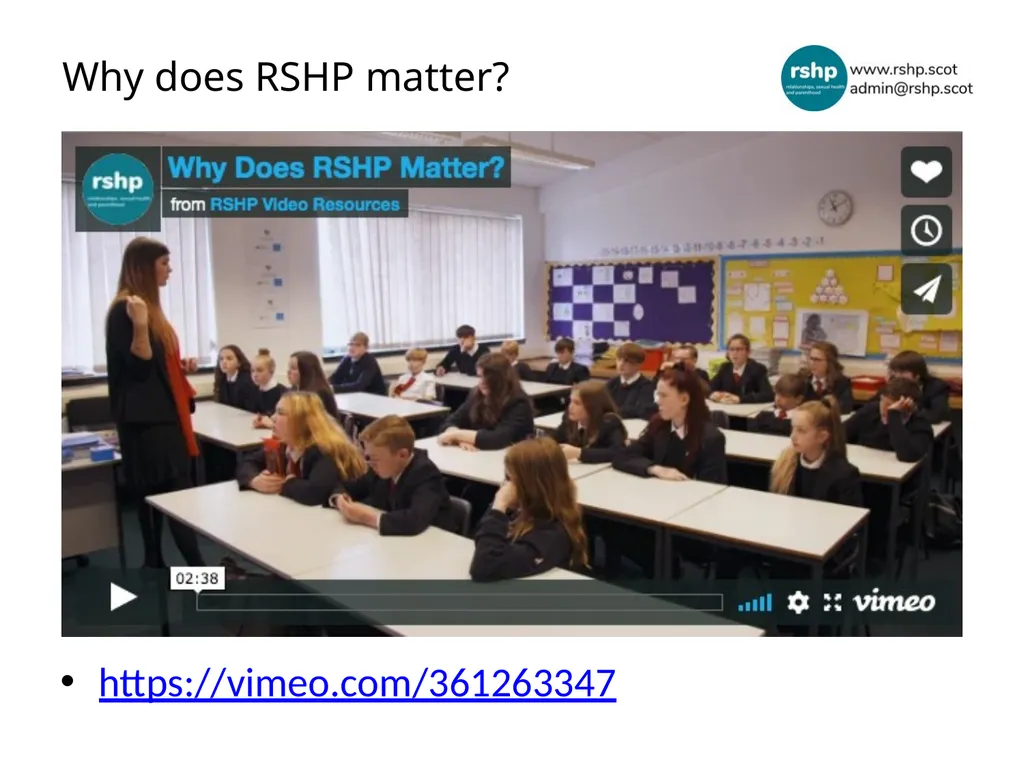
Why does RSHP matter? https://vimeo.com/361263347<br>
15
Some frequently asked questions Why is it important for children to learn the correct words for private parts of their body?
Why does the resource have learning about ‘having sex’ in primary school? How is this done?
Why does the resource have learning about abuse in the primary school? How is this done?
Why and how does the resource help children and young people to learn about sex and gender equality?
Why and how does the resource help children and young people to learn about consent?
Why and how does the resource help children and young people to learn about sexual orientation?<br>
Why does the resource have learning about ‘having sex’ in primary school? How is this done?
Why does the resource have learning about abuse in the primary school? How is this done?
Why and how does the resource help children and young people to learn about sex and gender equality?
Why and how does the resource help children and young people to learn about consent?
Why and how does the resource help children and young people to learn about sexual orientation?<br>
16
What if I wish to withdraw my child from this part of the curriculum? Right to an education that meets their needs
Not the school or local authorities preferred position
Carefully considered with the school’s management team
Reviewed each year
Points to consider:
Interdisciplinary learning
Hear content second hand from peers
Disempowers learners<br>
Not the school or local authorities preferred position
Carefully considered with the school’s management team
Reviewed each year
Points to consider:
Interdisciplinary learning
Hear content second hand from peers
Disempowers learners<br>
17
Parents and Carers Across this resource, and in our school approach to RSHP education, there is an acknowledgement that parents and carers are the primary educators of their children.
In delivering RSHP education parents/carers will be given advance knowledge of topics and lessons.
By learning together at home and school we can help consolidate learning – it’s a partnership approach.
The resource is open and accessible to anyone. It has lots of information for parents and carers as well as answers to some frequently asked questions.
https://rshp.scot<br>
In delivering RSHP education parents/carers will be given advance knowledge of topics and lessons.
By learning together at home and school we can help consolidate learning – it’s a partnership approach.
The resource is open and accessible to anyone. It has lots of information for parents and carers as well as answers to some frequently asked questions.
https://rshp.scot<br>
18
What is the role of parents and carers in
RSHP education? https://vimeo.com/361996285<br>
19
Any Questions?<br>
20
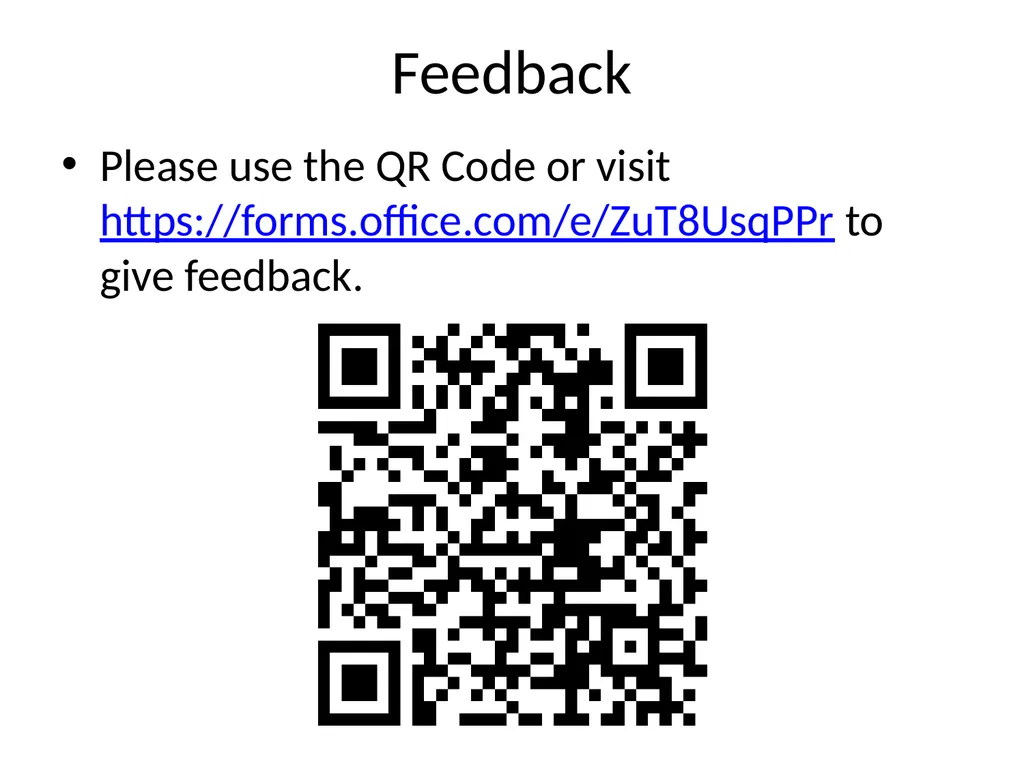
Feedback Please use the QR Code or visit https://forms.office.com/e/ZuT8UsqPPr to give feedback.<br>