
HUMAN RESOURCE MANAGEMENT Unit-1 Concepts,

Description: HUMAN RESOURCE MANAGEMENT Unit-1 Concepts, Objectives, Functions of HRM Evolution of HRM HRM in the Indian Scenario Dr Sunil Kant Mishra Associate Professor An organisation is consist of ----- Non-Human Resources Money Material Machines
Related Topics
Download Presentation
"HUMAN RESOURCE MANAGEMENT Unit-1 Concepts," is the property of its rightful owner. Permission is granted to download and print the materials on this website for personal, non-commercial use only, and to display it on your personal computer provided you do not modify the materials and that you retain all copyright notices contained in the materials. By downloading content from our website, you accept the terms of this agreement.
Presentation Transcript
slide1. HUMAN RESOURCE MANAGEMENT Unit-1
Concepts, Objectives, Functions of HRM
Evolution of HRM
HRM in the Indian Scenario Dr Sunil Kant Mishra
Associate Professor<br>
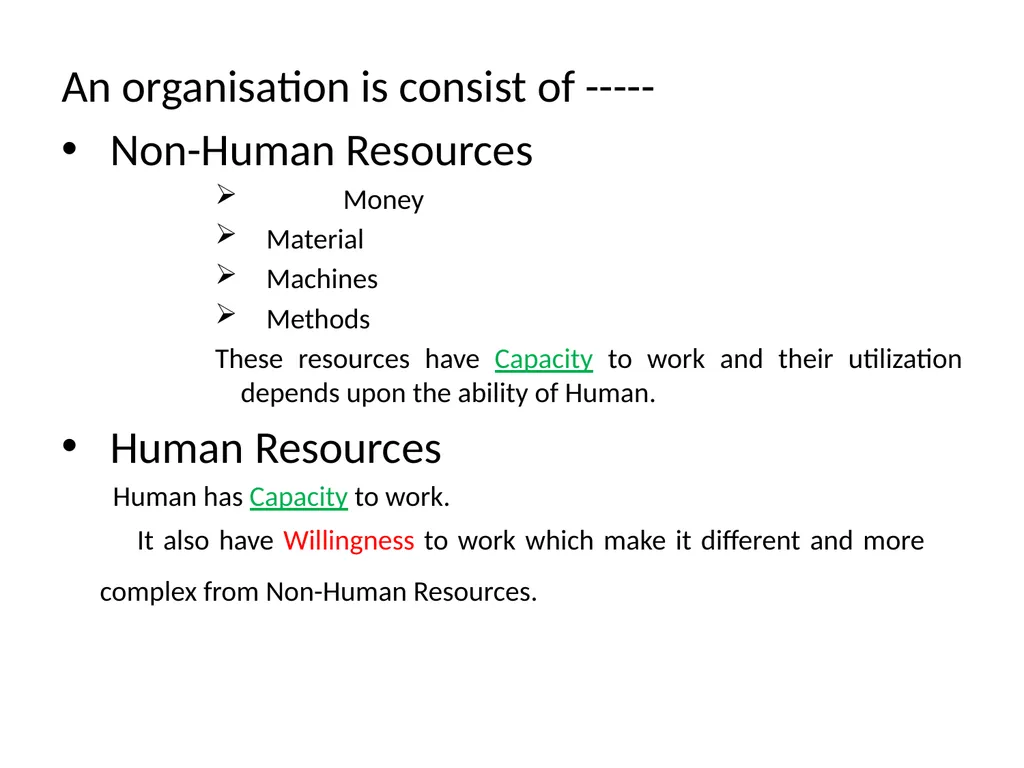
slide2. An organisation is consist of -----
Non-Human Resources
Money
Material
Machines
Methods
These resources have Capacity to work and their utilization depends upon the ability of Human.
Human Resources
Human has Capacity to work.
It also have Willingness to work which make it different and more complex from Non-Human Resources.<br>
slide3. An organisation’s success depends upon the skills and willpower of its HUMAN resources. Motivated Men will certainly brings happiness to all- Organisation, Individual and Society.<br>
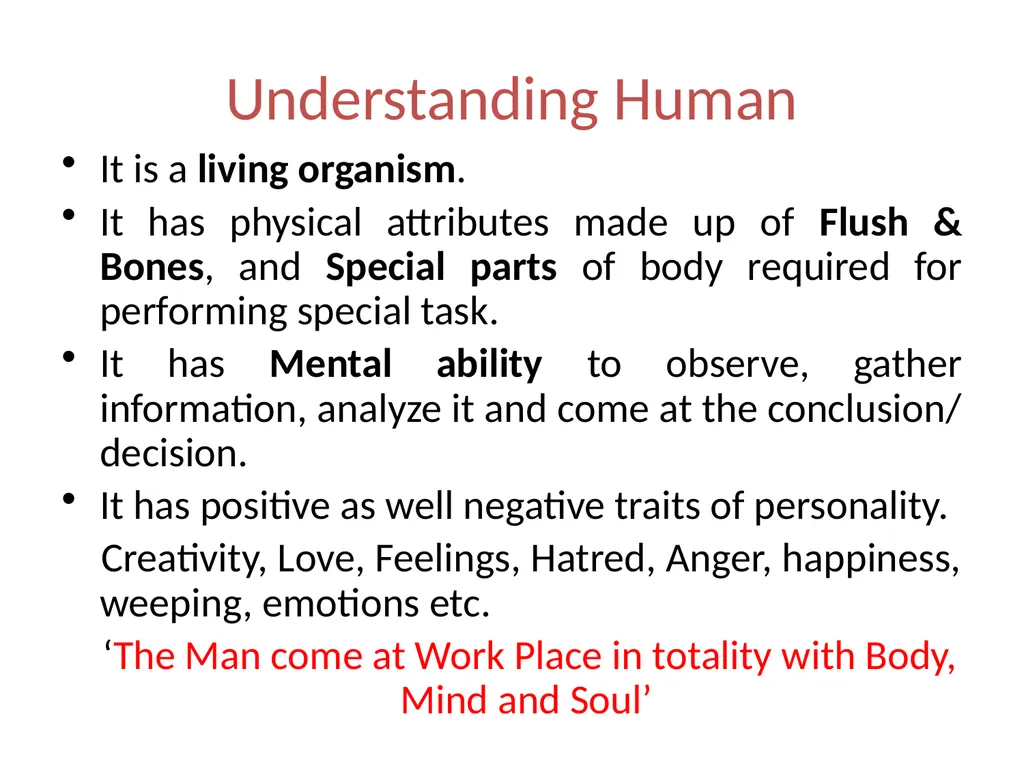
slide4. Understanding Human It is a living organism.
It has physical attributes made up of Flush & Bones, and Special parts of body required for performing special task.
It has Mental ability to observe, gather information, analyze it and come at the conclusion/ decision.
It has positive as well negative traits of personality.
Creativity, Love, Feelings, Hatred, Anger, happiness, weeping, emotions etc.
‘The Man come at Work Place in totality with Body, Mind and Soul’<br>
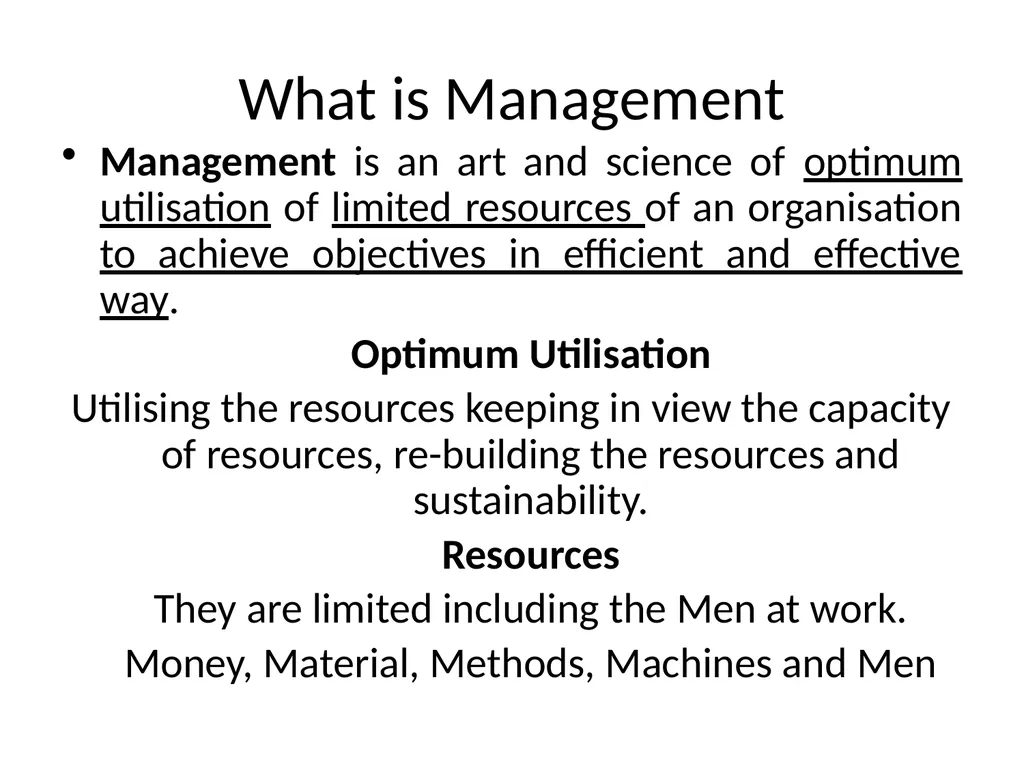
slide5. What is Management Management is an art and science of optimum utilisation of limited resources of an organisation to achieve objectives in efficient and effective way.
Optimum Utilisation
Utilising the resources keeping in view the capacity of resources, re-building the resources and sustainability.
Resources
They are limited including the Men at work.
Money, Material, Methods, Machines and Men<br>
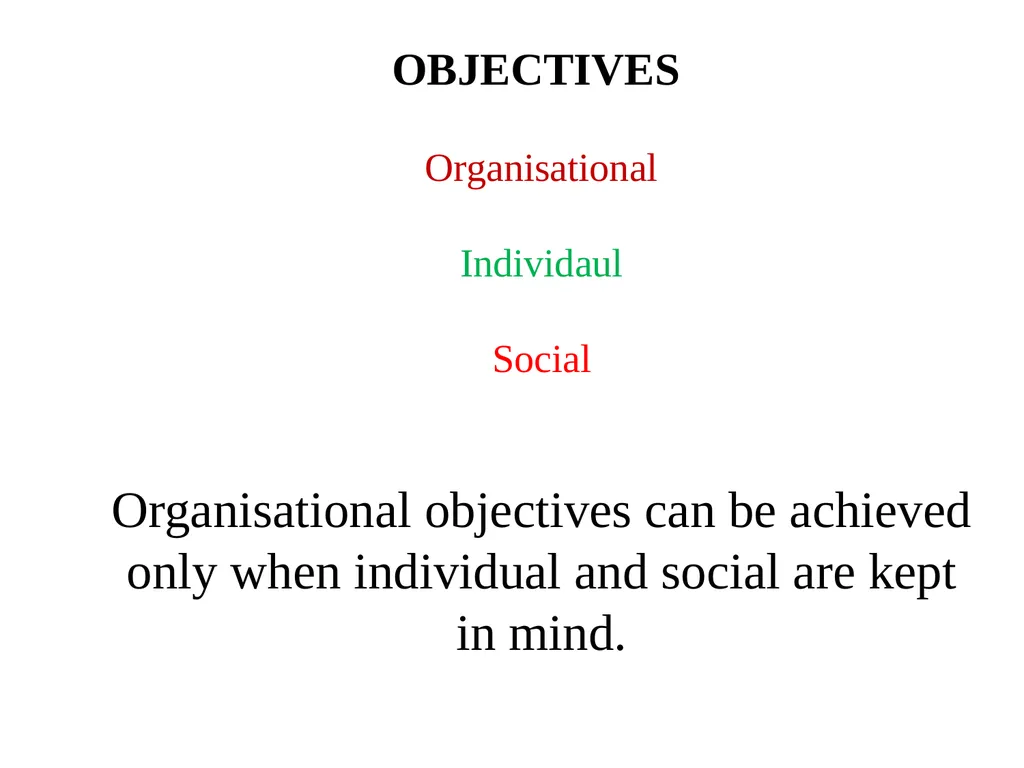
slide6. OBJECTIVES
Organisational
Individaul
Social
Organisational objectives can be achieved only when individual and social are kept in mind.<br>
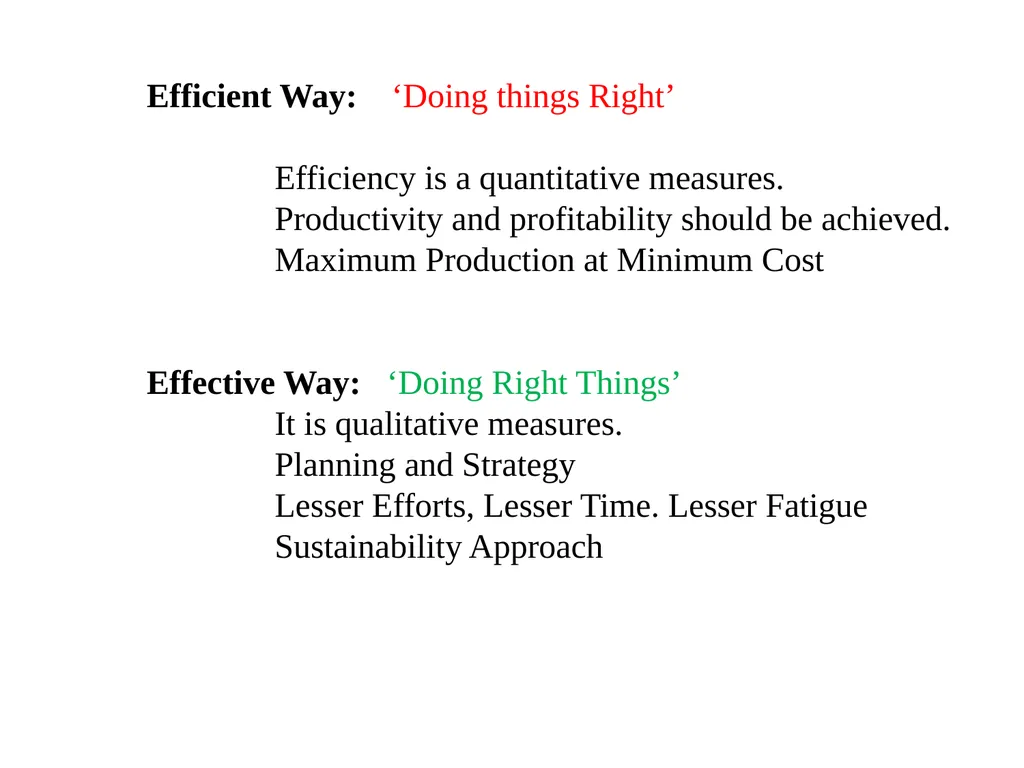
slide7. Efficient Way: ‘Doing things Right’
Efficiency is a quantitative measures.
Productivity and profitability should be achieved.
Maximum Production at Minimum Cost
Effective Way: ‘Doing Right Things’
It is qualitative measures.
Planning and Strategy
Lesser Efforts, Lesser Time. Lesser Fatigue
Sustainability Approach<br>
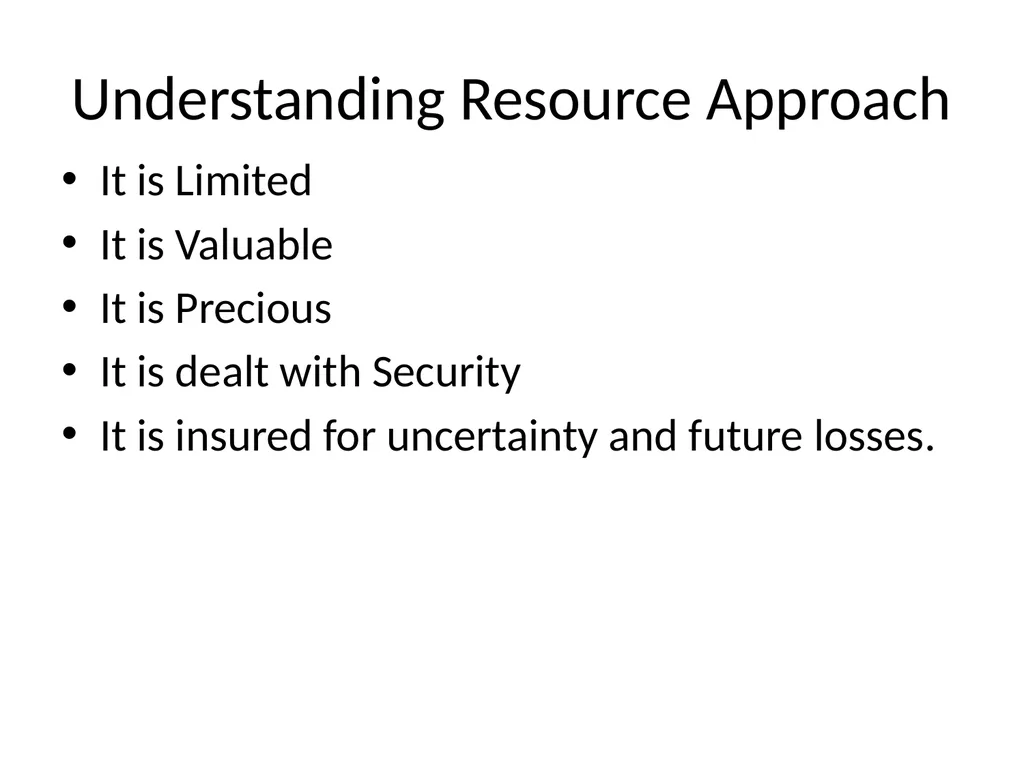
slide8. Understanding Resource Approach It is Limited
It is Valuable
It is Precious
It is dealt with Security
It is insured for uncertainty and future losses.<br>
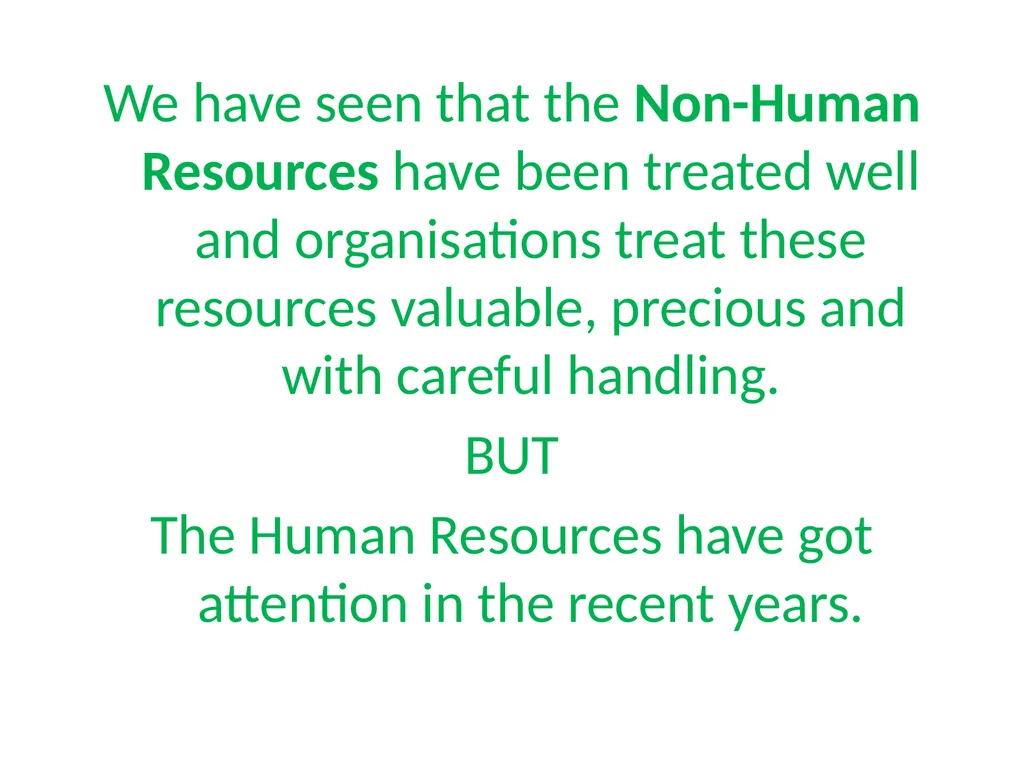
slide9. We have seen that the Non-Human Resources have been treated well and organisations treat these resources valuable, precious and with careful handling.
BUT
The Human Resources have got attention in the recent years.<br>
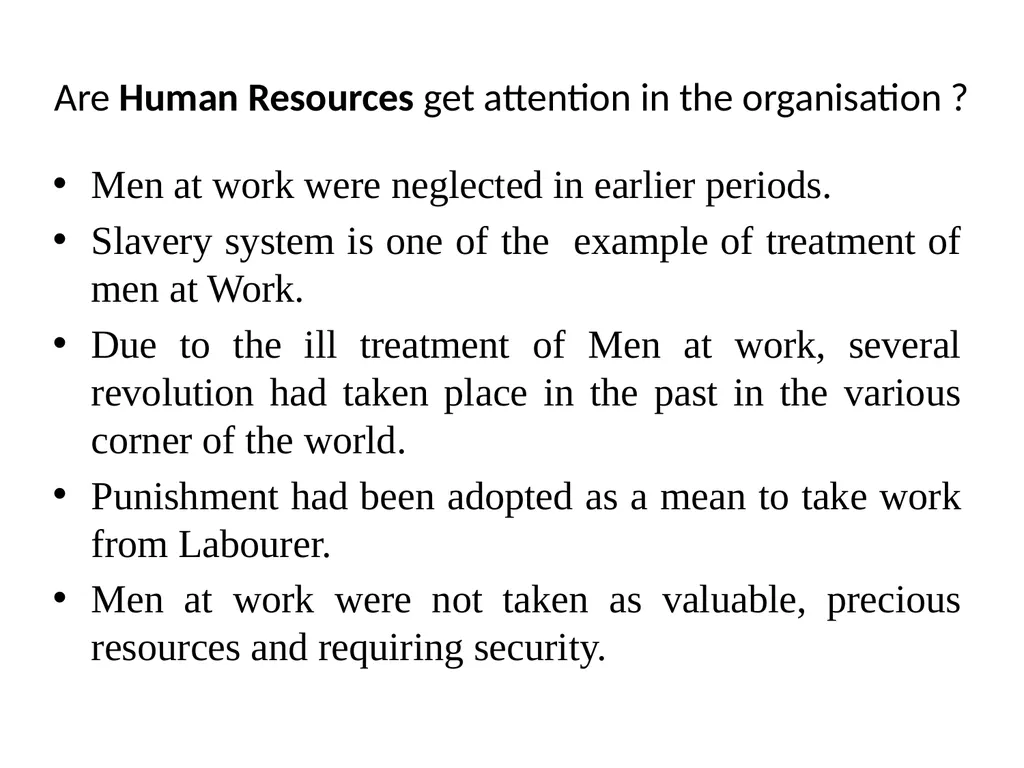
slide10. Are Human Resources get attention in the organisation ? Men at work were neglected in earlier periods.
Slavery system is one of the example of treatment of men at Work.
Due to the ill treatment of Men at work, several revolution had taken place in the past in the various corner of the world.
Punishment had been adopted as a mean to take work from Labourer.
Men at work were not taken as valuable, precious resources and requiring security.<br>
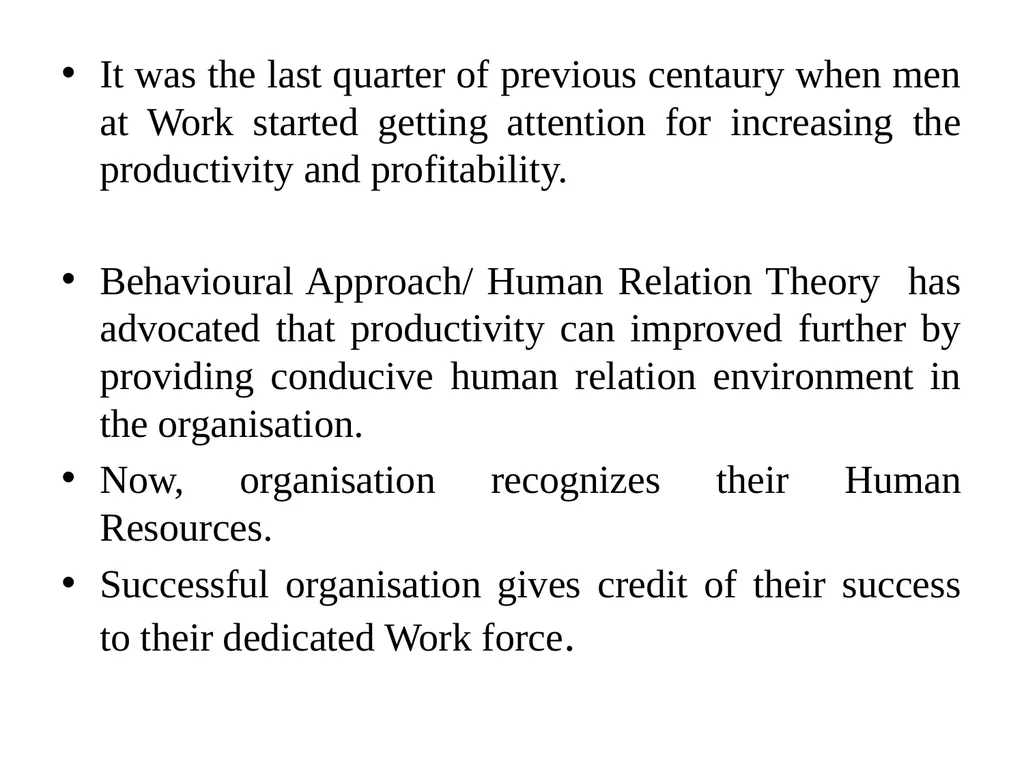
slide11. It was the last quarter of previous centaury when men at Work started getting attention for increasing the productivity and profitability.
Behavioural Approach/ Human Relation Theory has advocated that productivity can improved further by providing conducive human relation environment in the organisation.
Now, organisation recognizes their Human Resources.
Successful organisation gives credit of their success to their dedicated Work force.<br>
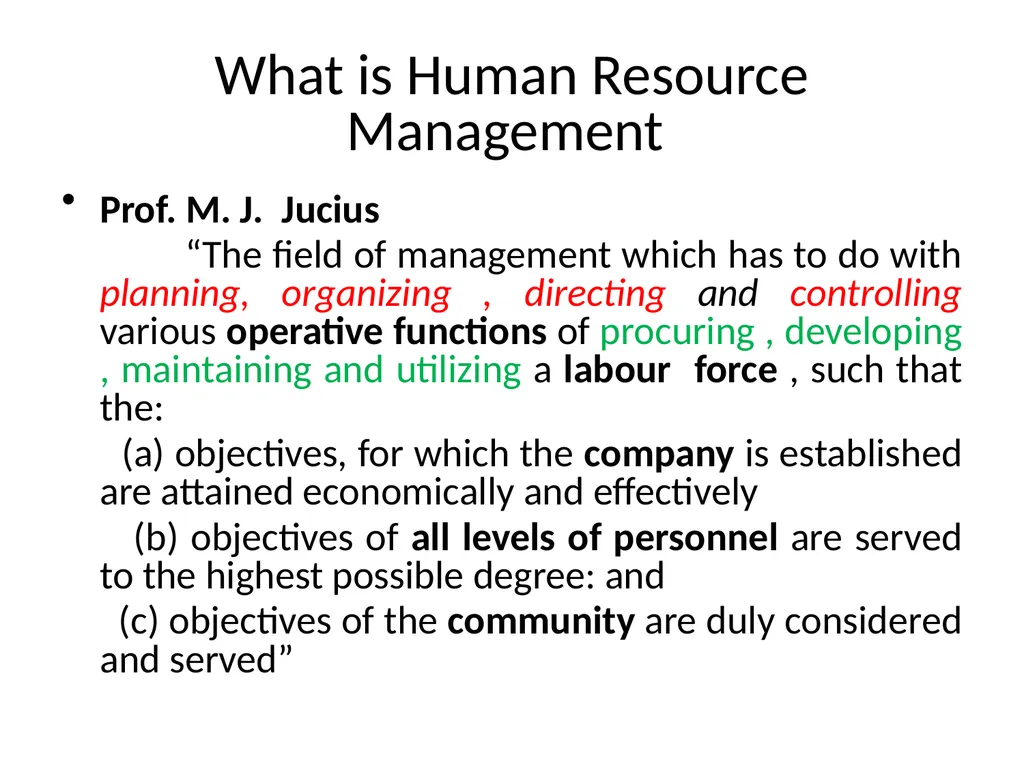
slide12. What is Human Resource Management Prof. M. J. Jucius
“The field of management which has to do with planning, organizing , directing and controlling various operative functions of procuring , developing , maintaining and utilizing a labour force , such that the:
(a) objectives, for which the company is established are attained economically and effectively
(b) objectives of all levels of personnel are served to the highest possible degree: and
(c) objectives of the community are duly considered and served”<br>
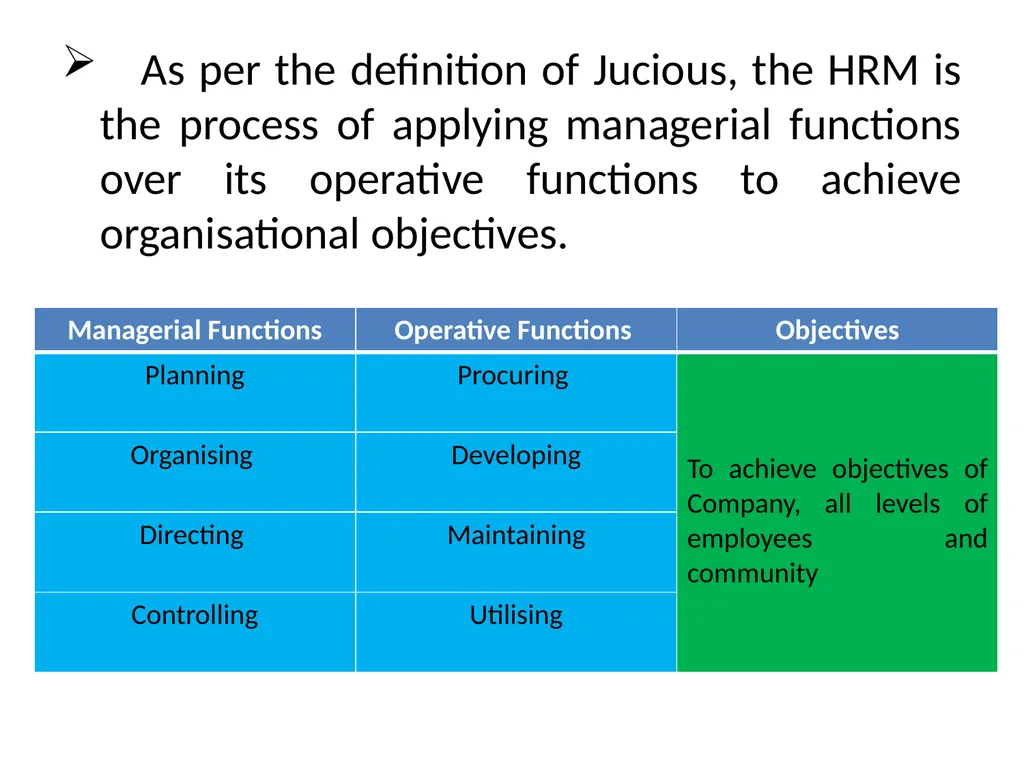
slide13. As per the definition of Jucious, the HRM is the process of applying managerial functions over its operative functions to achieve organisational objectives.<br>
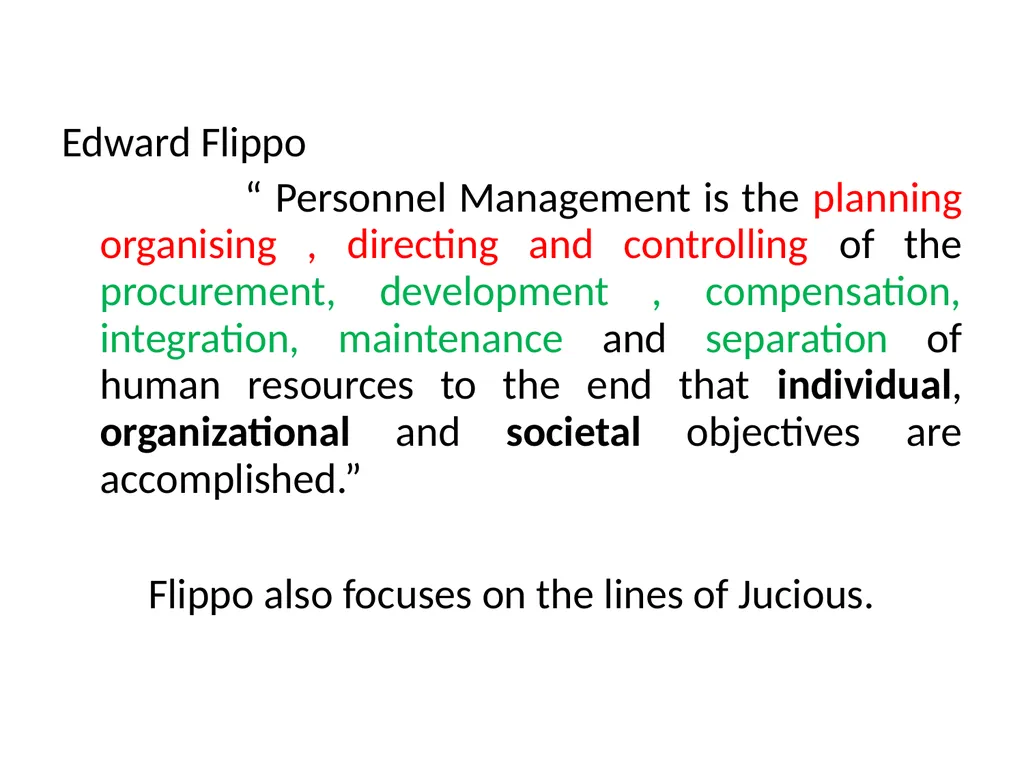
slide14. Edward Flippo
“ Personnel Management is the planning organising , directing and controlling of the procurement, development , compensation, integration, maintenance and separation of human resources to the end that individual, organizational and societal objectives are accomplished.”
Flippo also focuses on the lines of Jucious.<br>
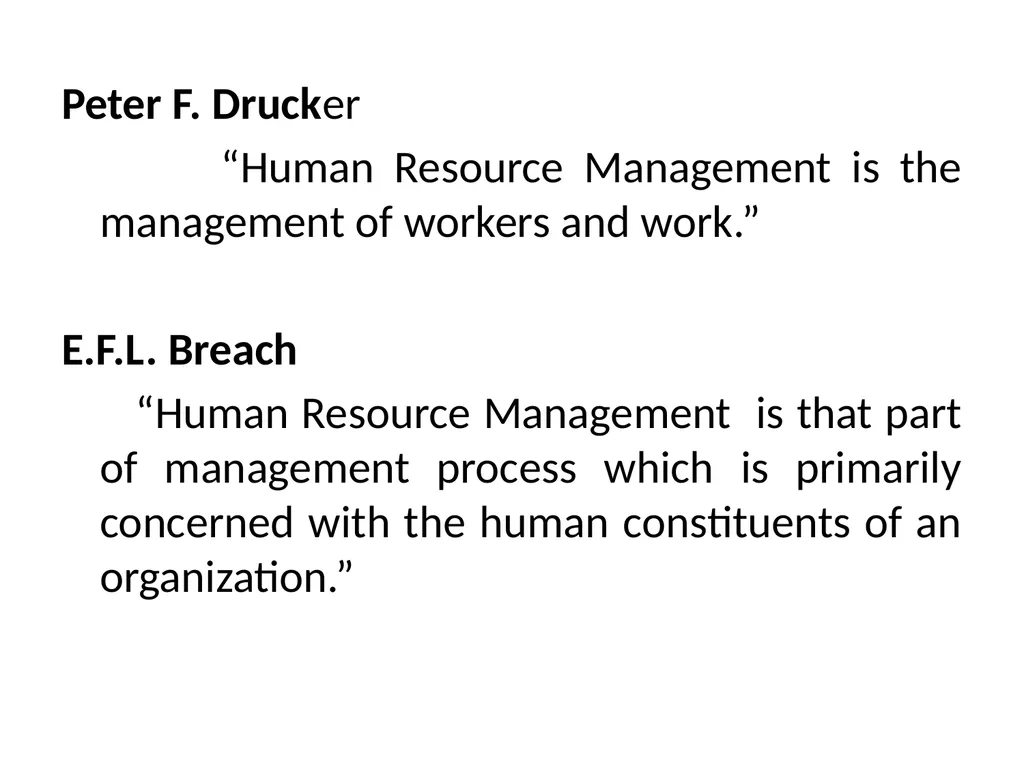
slide15. Peter F. Drucker
“Human Resource Management is the management of workers and work.”
E.F.L. Breach
“Human Resource Management is that part of management process which is primarily concerned with the human constituents of an organization.”<br>
slide16. Conclusion HRM is the process of applying managerial functions over operative functions to manage the men at work to help in achieving organisational objectives.<br>
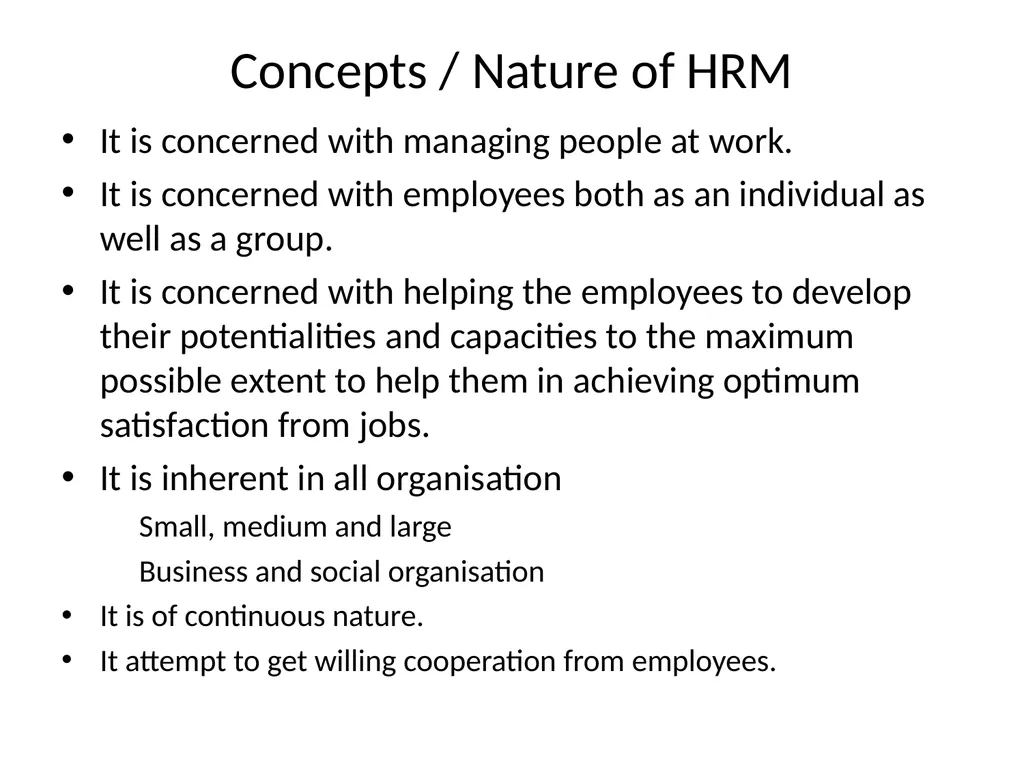
slide17. Concepts / Nature of HRM It is concerned with managing people at work.
It is concerned with employees both as an individual as well as a group.
It is concerned with helping the employees to develop their potentialities and capacities to the maximum possible extent to help them in achieving optimum satisfaction from jobs.
It is inherent in all organisation
Small, medium and large
Business and social organisation
It is of continuous nature.
It attempt to get willing cooperation from employees.<br>
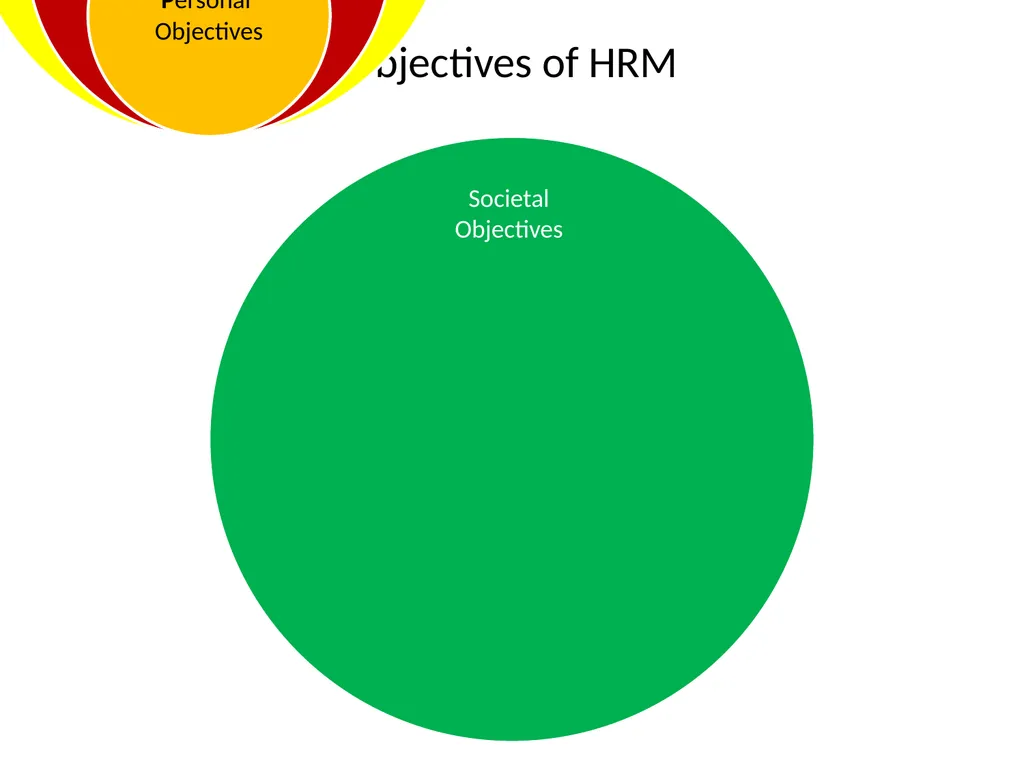
slide18. Objectives of HRM<br>
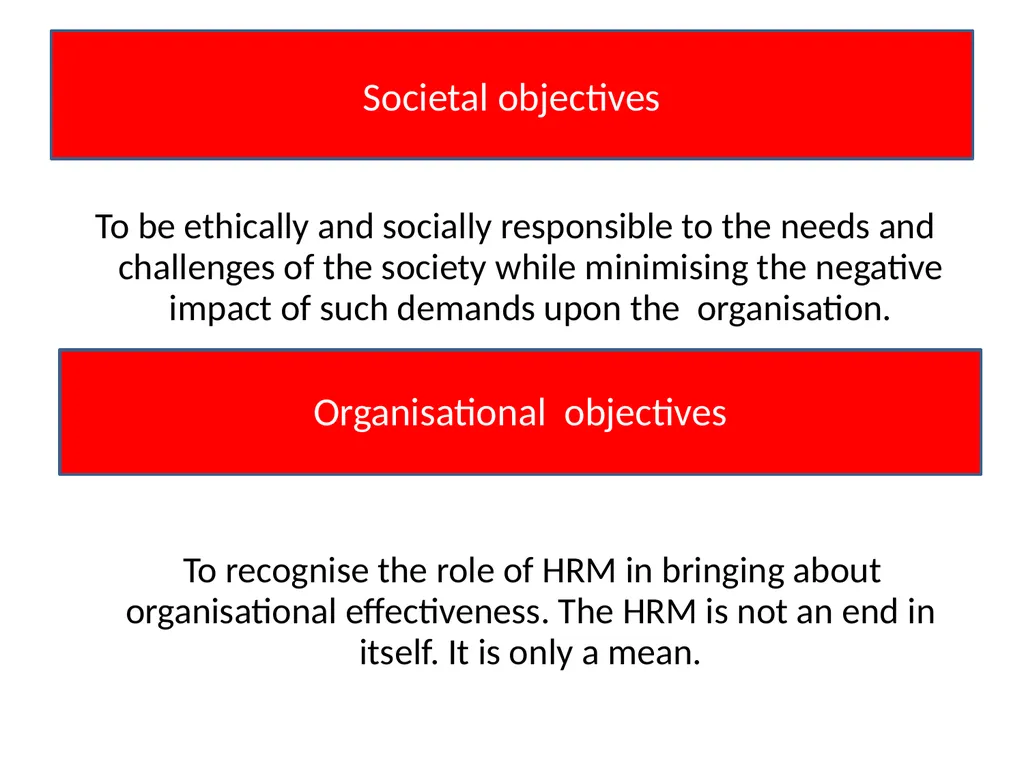
slide19. To be ethically and socially responsible to the needs and challenges of the society while minimising the negative impact of such demands upon the organisation.
To recognise the role of HRM in bringing about organisational effectiveness. The HRM is not an end in itself. It is only a mean. Societal objectives Organisational objectives<br>
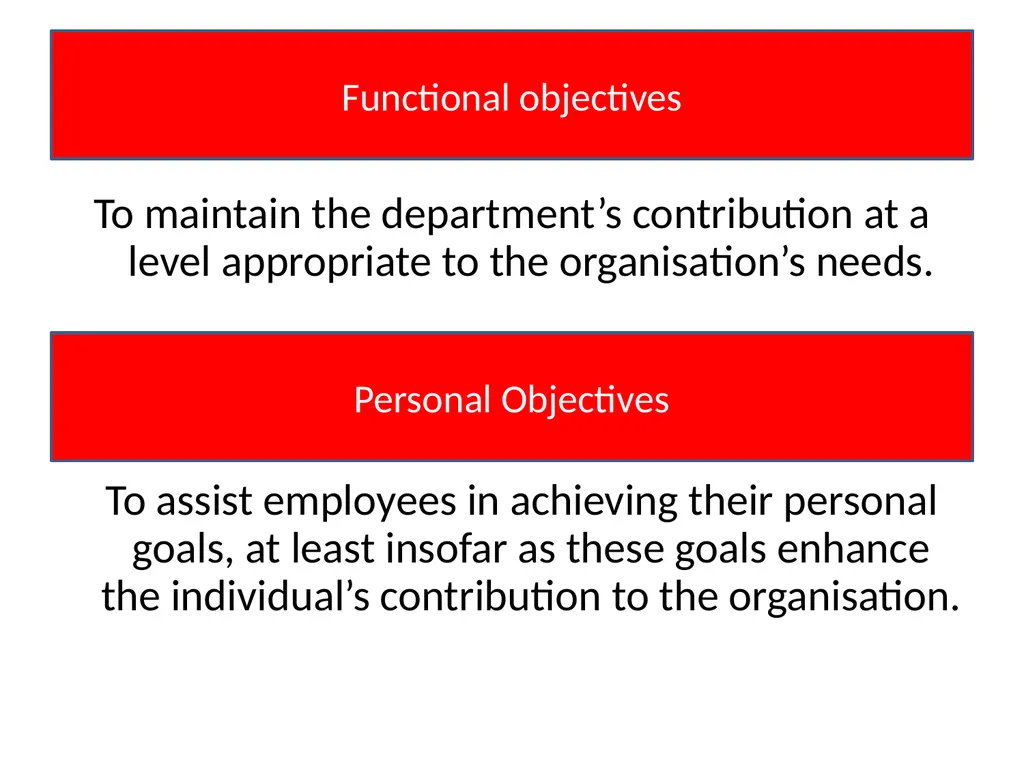
slide20. To maintain the department’s contribution at a level appropriate to the organisation’s needs.
To assist employees in achieving their personal goals, at least insofar as these goals enhance the individual’s contribution to the organisation. Functional objectives Personal Objectives<br>
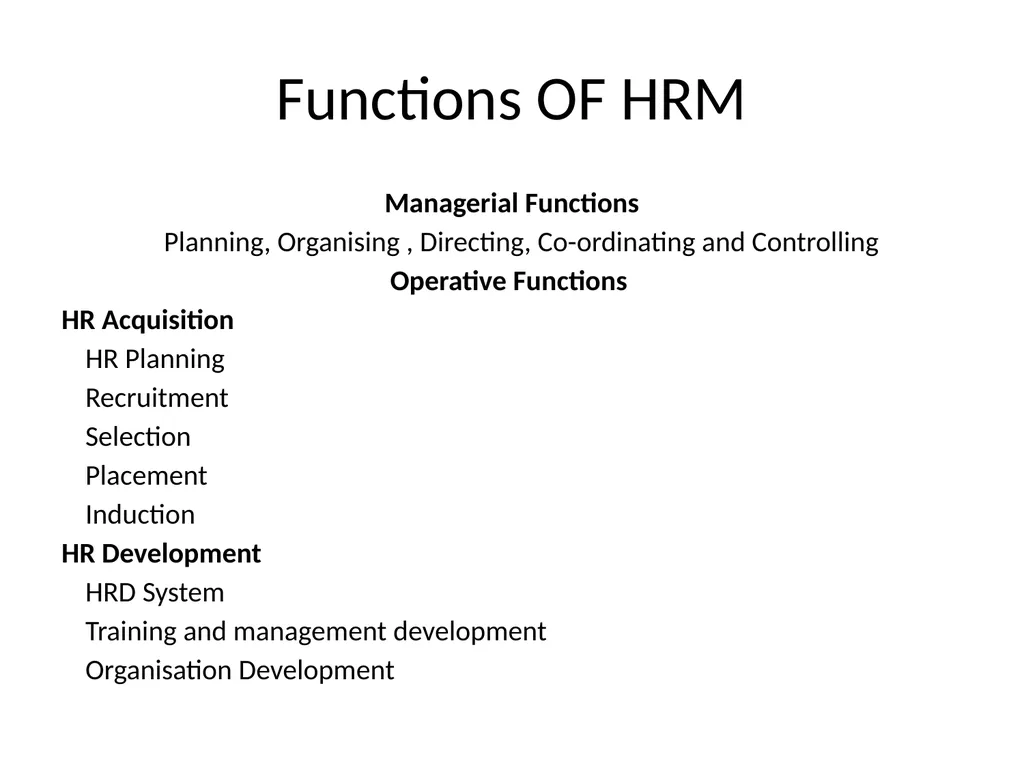
slide21. Functions OF HRM Managerial Functions
Planning, Organising , Directing, Co-ordinating and Controlling
Operative Functions
HR Acquisition
HR Planning
Recruitment
Selection
Placement
Induction
HR Development
HRD System
Training and management development
Organisation Development<br>
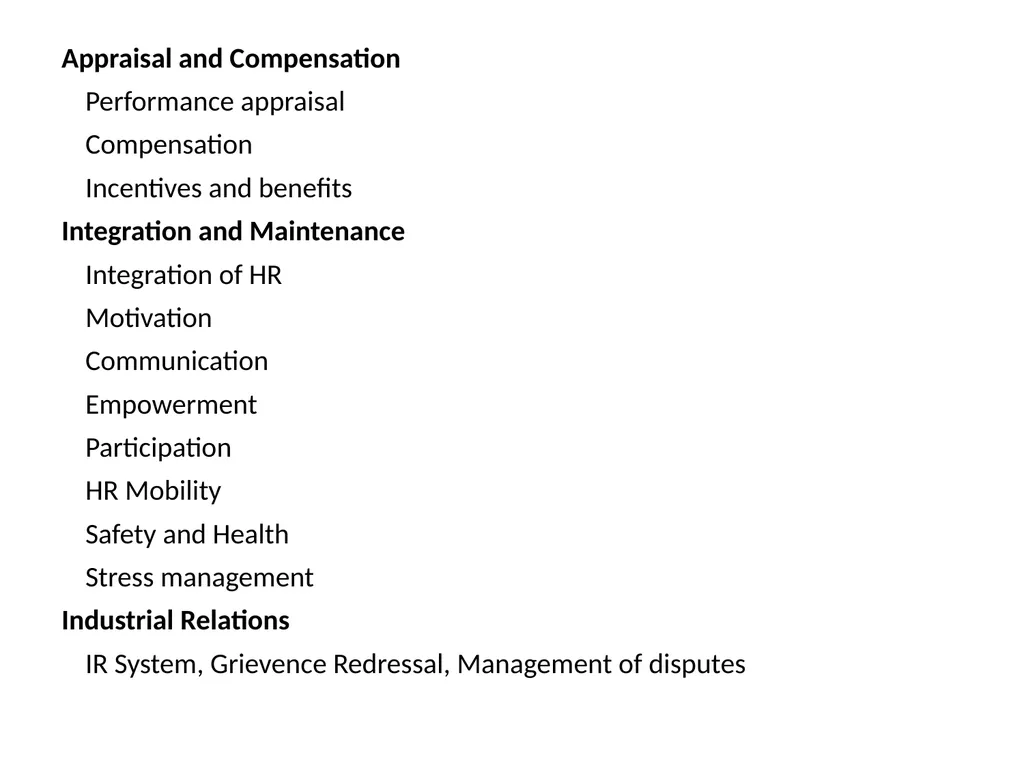
slide22. Appraisal and Compensation
Performance appraisal
Compensation
Incentives and benefits
Integration and Maintenance
Integration of HR
Motivation
Communication
Empowerment
Participation
HR Mobility
Safety and Health
Stress management
Industrial Relations
IR System, Grievence Redressal, Management of disputes<br>
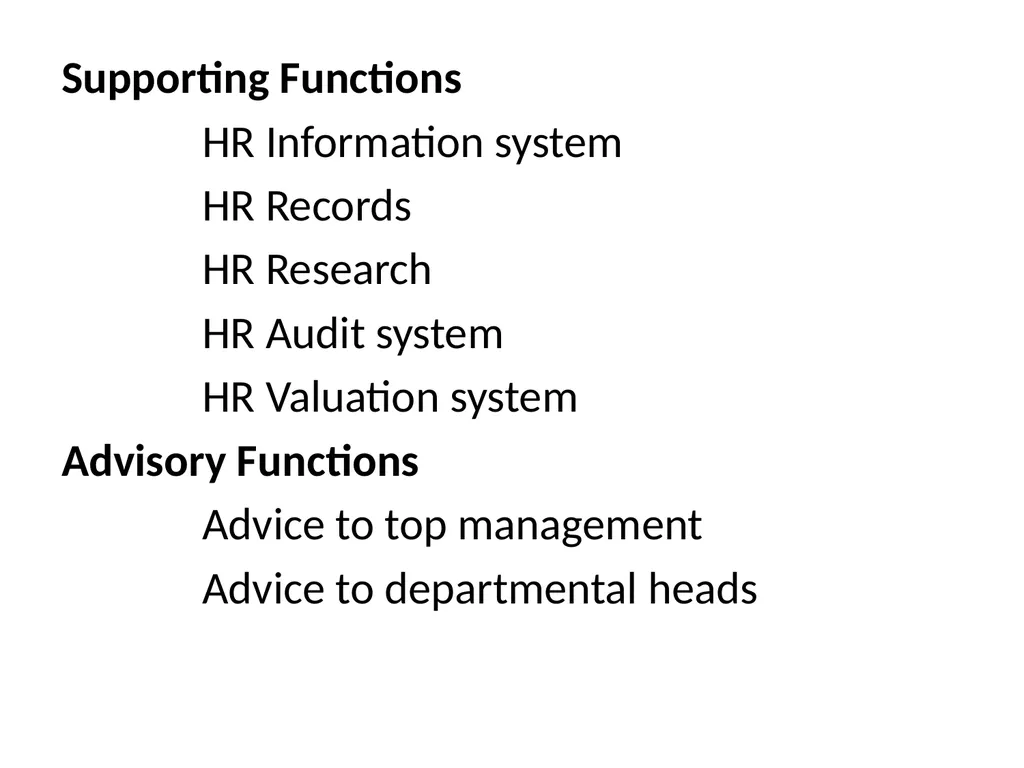
slide23. Supporting Functions
HR Information system
HR Records
HR Research
HR Audit system
HR Valuation system
Advisory Functions
Advice to top management
Advice to departmental heads<br>
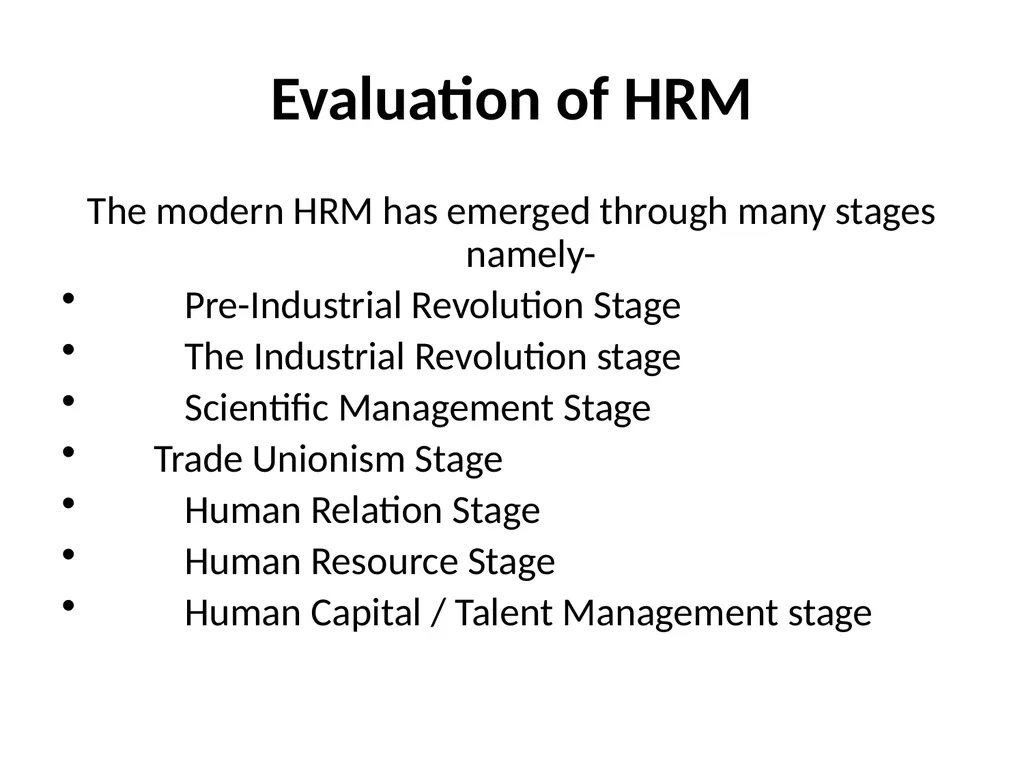
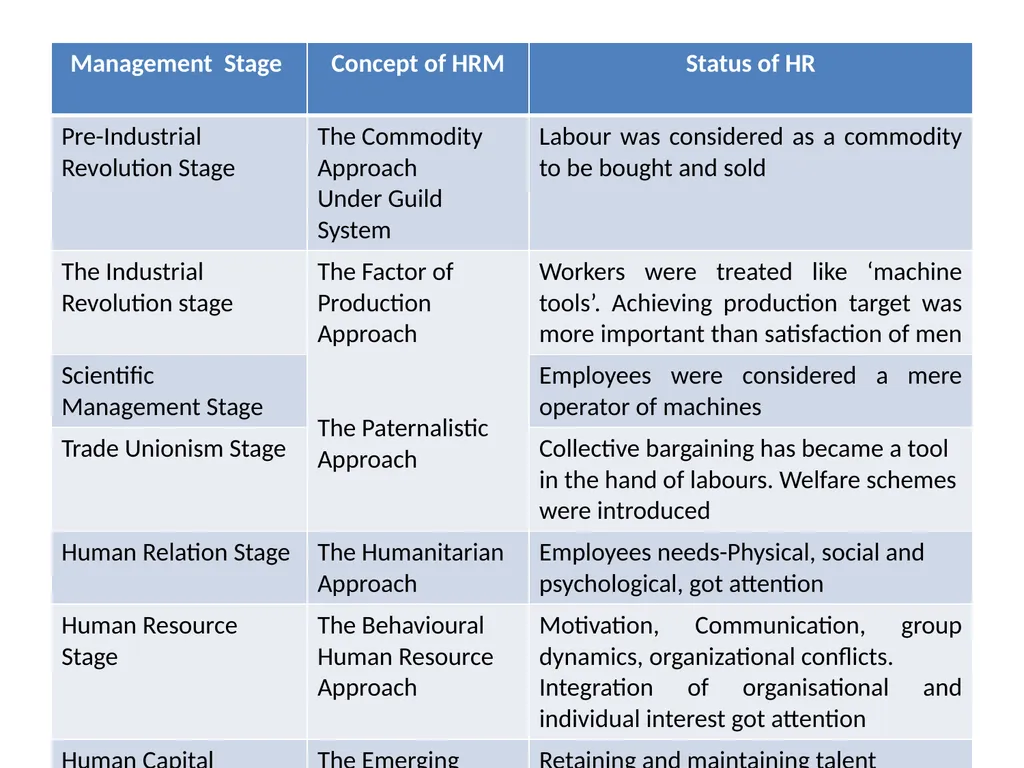
slide24. Evaluation of HRM The modern HRM has emerged through many stages namely-
Pre-Industrial Revolution Stage
The Industrial Revolution stage
Scientific Management Stage
Trade Unionism Stage
Human Relation Stage
Human Resource Stage
Human Capital / Talent Management stage<br>
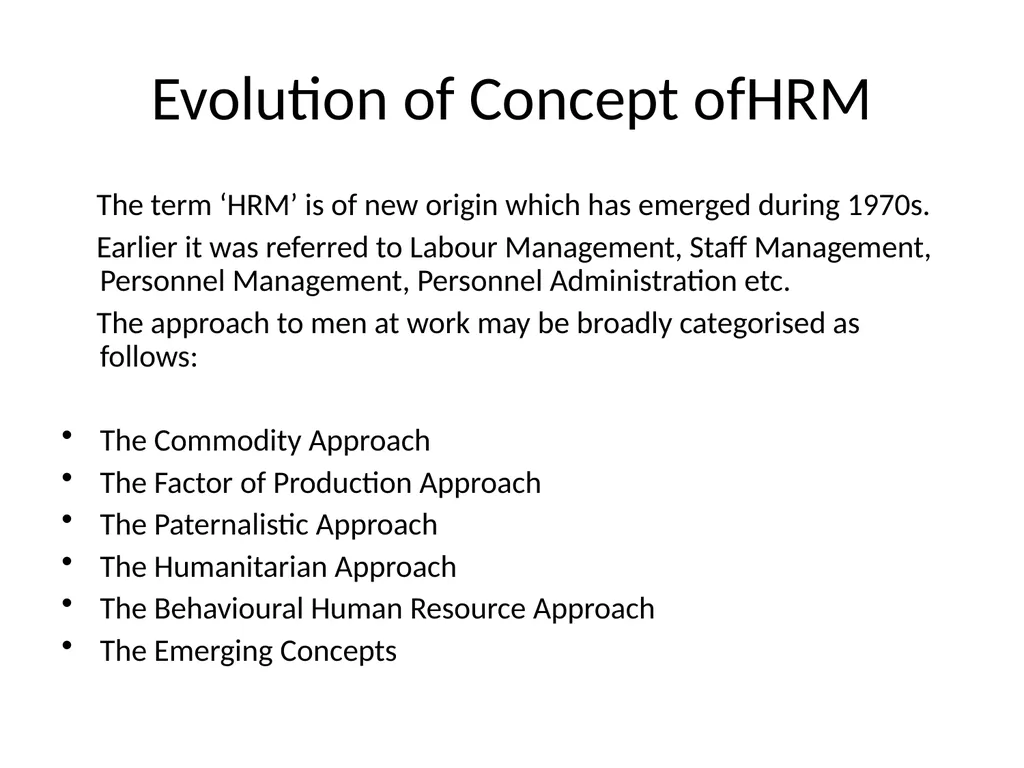
slide25. Evolution of Concept ofHRM The term ‘HRM’ is of new origin which has emerged during 1970s.
Earlier it was referred to Labour Management, Staff Management, Personnel Management, Personnel Administration etc.
The approach to men at work may be broadly categorised as follows:
The Commodity Approach
The Factor of Production Approach
The Paternalistic Approach
The Humanitarian Approach
The Behavioural Human Resource Approach
The Emerging Concepts<br>
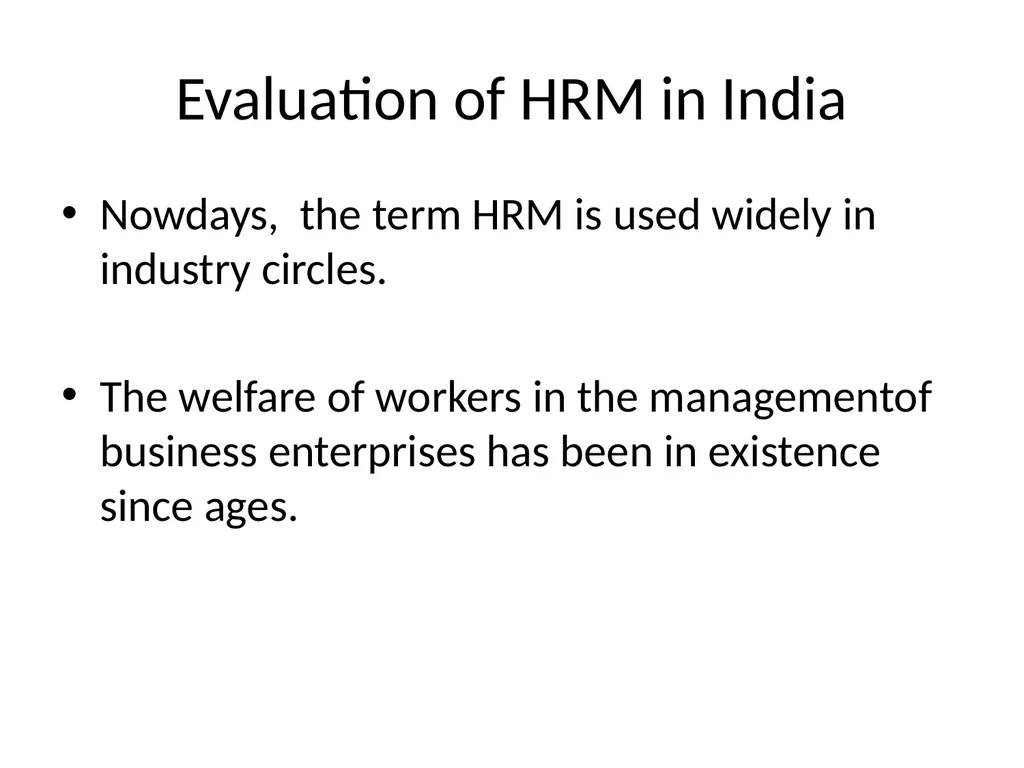
slide27. Evaluation of HRM in India Nowdays, the term HRM is used widely in industry circles.
The welfare of workers in the managementof business enterprises has been in existence since ages.<br>
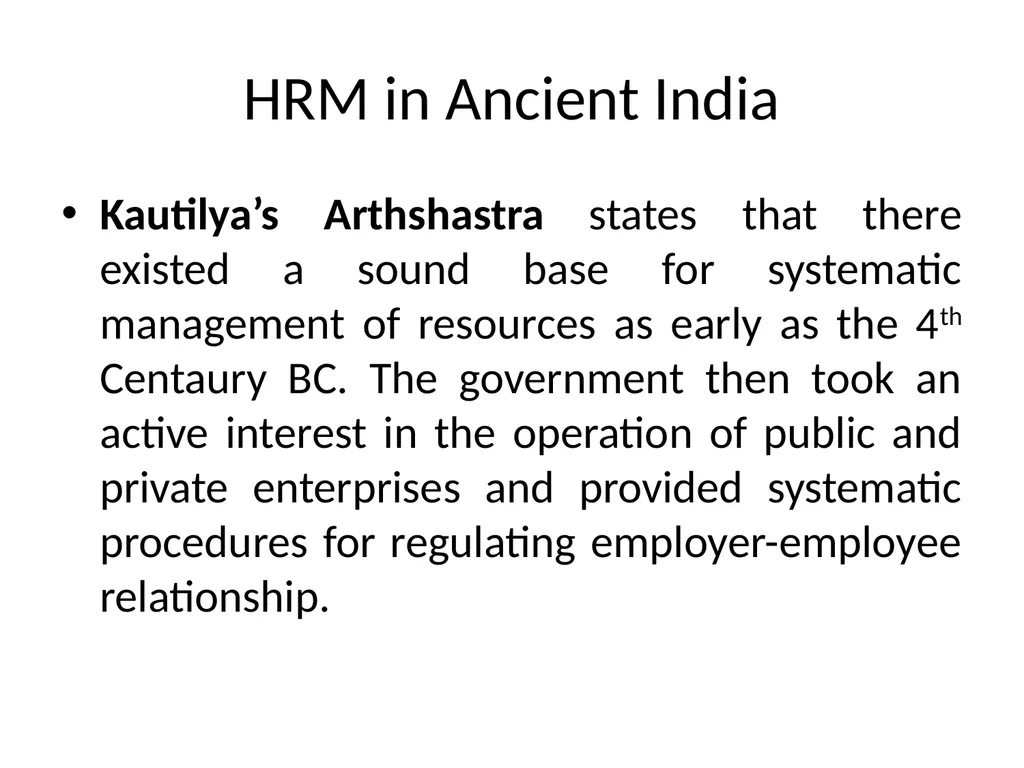
slide28. HRM in Ancient India Kautilya’s Arthshastra states that there existed a sound base for systematic management of resources as early as the 4th Centaury BC. The government then took an active interest in the operation of public and private enterprises and provided systematic procedures for regulating employer-employee relationship.<br>
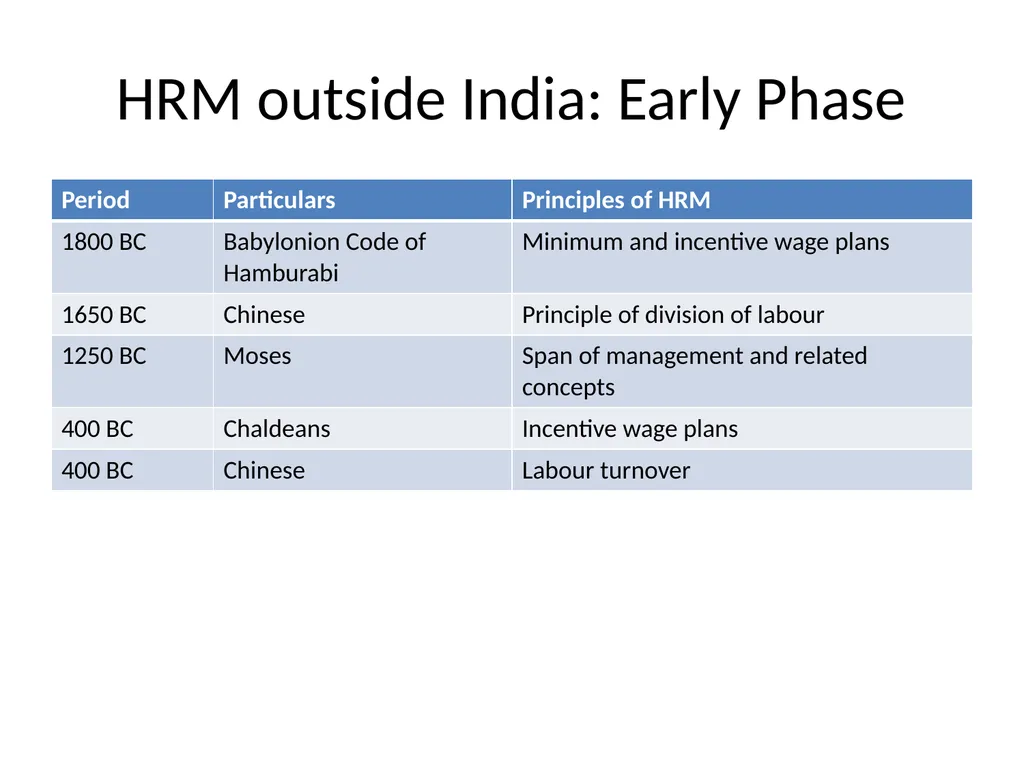
slide29. HRM outside India: Early Phase<br>
slide30. HRM in India in 20th Century<br>
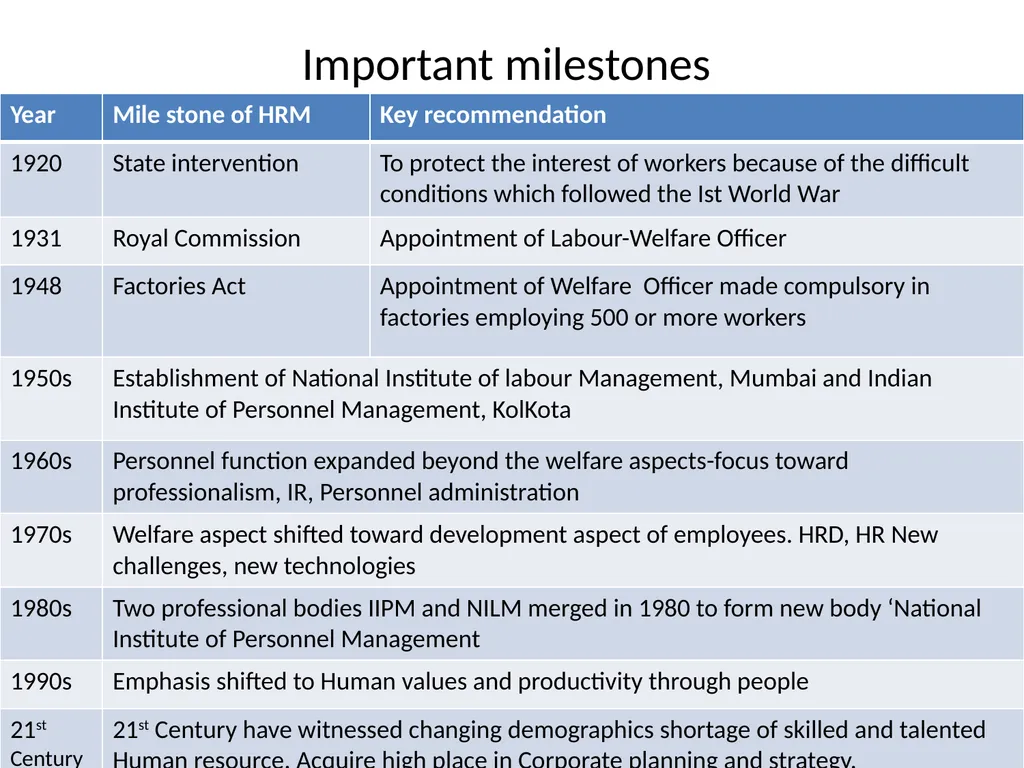
slide31. Important milestones<br>
slide32. Thank you
……continue learning<br>
Concepts, Objectives, Functions of HRM
Evolution of HRM
HRM in the Indian Scenario Dr Sunil Kant Mishra
Associate Professor<br>
slide2. An organisation is consist of -----
Non-Human Resources
Money
Material
Machines
Methods
These resources have Capacity to work and their utilization depends upon the ability of Human.
Human Resources
Human has Capacity to work.
It also have Willingness to work which make it different and more complex from Non-Human Resources.<br>
slide3. An organisation’s success depends upon the skills and willpower of its HUMAN resources. Motivated Men will certainly brings happiness to all- Organisation, Individual and Society.<br>
slide4. Understanding Human It is a living organism.
It has physical attributes made up of Flush & Bones, and Special parts of body required for performing special task.
It has Mental ability to observe, gather information, analyze it and come at the conclusion/ decision.
It has positive as well negative traits of personality.
Creativity, Love, Feelings, Hatred, Anger, happiness, weeping, emotions etc.
‘The Man come at Work Place in totality with Body, Mind and Soul’<br>
slide5. What is Management Management is an art and science of optimum utilisation of limited resources of an organisation to achieve objectives in efficient and effective way.
Optimum Utilisation
Utilising the resources keeping in view the capacity of resources, re-building the resources and sustainability.
Resources
They are limited including the Men at work.
Money, Material, Methods, Machines and Men<br>
slide6. OBJECTIVES
Organisational
Individaul
Social
Organisational objectives can be achieved only when individual and social are kept in mind.<br>
slide7. Efficient Way: ‘Doing things Right’
Efficiency is a quantitative measures.
Productivity and profitability should be achieved.
Maximum Production at Minimum Cost
Effective Way: ‘Doing Right Things’
It is qualitative measures.
Planning and Strategy
Lesser Efforts, Lesser Time. Lesser Fatigue
Sustainability Approach<br>
slide8. Understanding Resource Approach It is Limited
It is Valuable
It is Precious
It is dealt with Security
It is insured for uncertainty and future losses.<br>
slide9. We have seen that the Non-Human Resources have been treated well and organisations treat these resources valuable, precious and with careful handling.
BUT
The Human Resources have got attention in the recent years.<br>
slide10. Are Human Resources get attention in the organisation ? Men at work were neglected in earlier periods.
Slavery system is one of the example of treatment of men at Work.
Due to the ill treatment of Men at work, several revolution had taken place in the past in the various corner of the world.
Punishment had been adopted as a mean to take work from Labourer.
Men at work were not taken as valuable, precious resources and requiring security.<br>
slide11. It was the last quarter of previous centaury when men at Work started getting attention for increasing the productivity and profitability.
Behavioural Approach/ Human Relation Theory has advocated that productivity can improved further by providing conducive human relation environment in the organisation.
Now, organisation recognizes their Human Resources.
Successful organisation gives credit of their success to their dedicated Work force.<br>
slide12. What is Human Resource Management Prof. M. J. Jucius
“The field of management which has to do with planning, organizing , directing and controlling various operative functions of procuring , developing , maintaining and utilizing a labour force , such that the:
(a) objectives, for which the company is established are attained economically and effectively
(b) objectives of all levels of personnel are served to the highest possible degree: and
(c) objectives of the community are duly considered and served”<br>
slide13. As per the definition of Jucious, the HRM is the process of applying managerial functions over its operative functions to achieve organisational objectives.<br>
slide14. Edward Flippo
“ Personnel Management is the planning organising , directing and controlling of the procurement, development , compensation, integration, maintenance and separation of human resources to the end that individual, organizational and societal objectives are accomplished.”
Flippo also focuses on the lines of Jucious.<br>
slide15. Peter F. Drucker
“Human Resource Management is the management of workers and work.”
E.F.L. Breach
“Human Resource Management is that part of management process which is primarily concerned with the human constituents of an organization.”<br>
slide16. Conclusion HRM is the process of applying managerial functions over operative functions to manage the men at work to help in achieving organisational objectives.<br>
slide17. Concepts / Nature of HRM It is concerned with managing people at work.
It is concerned with employees both as an individual as well as a group.
It is concerned with helping the employees to develop their potentialities and capacities to the maximum possible extent to help them in achieving optimum satisfaction from jobs.
It is inherent in all organisation
Small, medium and large
Business and social organisation
It is of continuous nature.
It attempt to get willing cooperation from employees.<br>
slide18. Objectives of HRM<br>
slide19. To be ethically and socially responsible to the needs and challenges of the society while minimising the negative impact of such demands upon the organisation.
To recognise the role of HRM in bringing about organisational effectiveness. The HRM is not an end in itself. It is only a mean. Societal objectives Organisational objectives<br>
slide20. To maintain the department’s contribution at a level appropriate to the organisation’s needs.
To assist employees in achieving their personal goals, at least insofar as these goals enhance the individual’s contribution to the organisation. Functional objectives Personal Objectives<br>
slide21. Functions OF HRM Managerial Functions
Planning, Organising , Directing, Co-ordinating and Controlling
Operative Functions
HR Acquisition
HR Planning
Recruitment
Selection
Placement
Induction
HR Development
HRD System
Training and management development
Organisation Development<br>
slide22. Appraisal and Compensation
Performance appraisal
Compensation
Incentives and benefits
Integration and Maintenance
Integration of HR
Motivation
Communication
Empowerment
Participation
HR Mobility
Safety and Health
Stress management
Industrial Relations
IR System, Grievence Redressal, Management of disputes<br>
slide23. Supporting Functions
HR Information system
HR Records
HR Research
HR Audit system
HR Valuation system
Advisory Functions
Advice to top management
Advice to departmental heads<br>
slide24. Evaluation of HRM The modern HRM has emerged through many stages namely-
Pre-Industrial Revolution Stage
The Industrial Revolution stage
Scientific Management Stage
Trade Unionism Stage
Human Relation Stage
Human Resource Stage
Human Capital / Talent Management stage<br>
slide25. Evolution of Concept ofHRM The term ‘HRM’ is of new origin which has emerged during 1970s.
Earlier it was referred to Labour Management, Staff Management, Personnel Management, Personnel Administration etc.
The approach to men at work may be broadly categorised as follows:
The Commodity Approach
The Factor of Production Approach
The Paternalistic Approach
The Humanitarian Approach
The Behavioural Human Resource Approach
The Emerging Concepts<br>
slide27. Evaluation of HRM in India Nowdays, the term HRM is used widely in industry circles.
The welfare of workers in the managementof business enterprises has been in existence since ages.<br>
slide28. HRM in Ancient India Kautilya’s Arthshastra states that there existed a sound base for systematic management of resources as early as the 4th Centaury BC. The government then took an active interest in the operation of public and private enterprises and provided systematic procedures for regulating employer-employee relationship.<br>
slide29. HRM outside India: Early Phase<br>
slide30. HRM in India in 20th Century<br>
slide31. Important milestones<br>
slide32. Thank you
……continue learning<br>