Hurley chapter 5 Categorical Syllogisms Categorical Syllogisms We already know that a categorical syllogism is a deductive argument consisting of two premises and one conclusion. It consists of three different terms, which appear twice in
"Hurley chapter 5 Categorical Syllogisms" is the property of its rightful owner. Permission is granted to
download and print the materials on this website for personal, non-commercial use only, and to display it
on your personal computer provided you do not modify the materials and that you retain all copyright
notices contained in the materials. By downloading content from our website, you accept the terms of this
agreement.
Presentation Transcript
01
Hurley chapter 5 Categorical Syllogisms<br>
02
Categorical Syllogisms We already know that a categorical syllogism is a deductive argument consisting of two premises and one conclusion. It consists of three different terms, which appear twice in the distinct propositions.<br>
03
Rules: All three statements should be standard-form categorical propositions.
The two occurrences of each term (subject and predicate) should be identical
Each term should be used in the same sense throughout the argument (Do not equivocate).
The major premise (with predicate term) should be listed first, the minor premise second (with subject term) , and the conclusion last.<br>
04
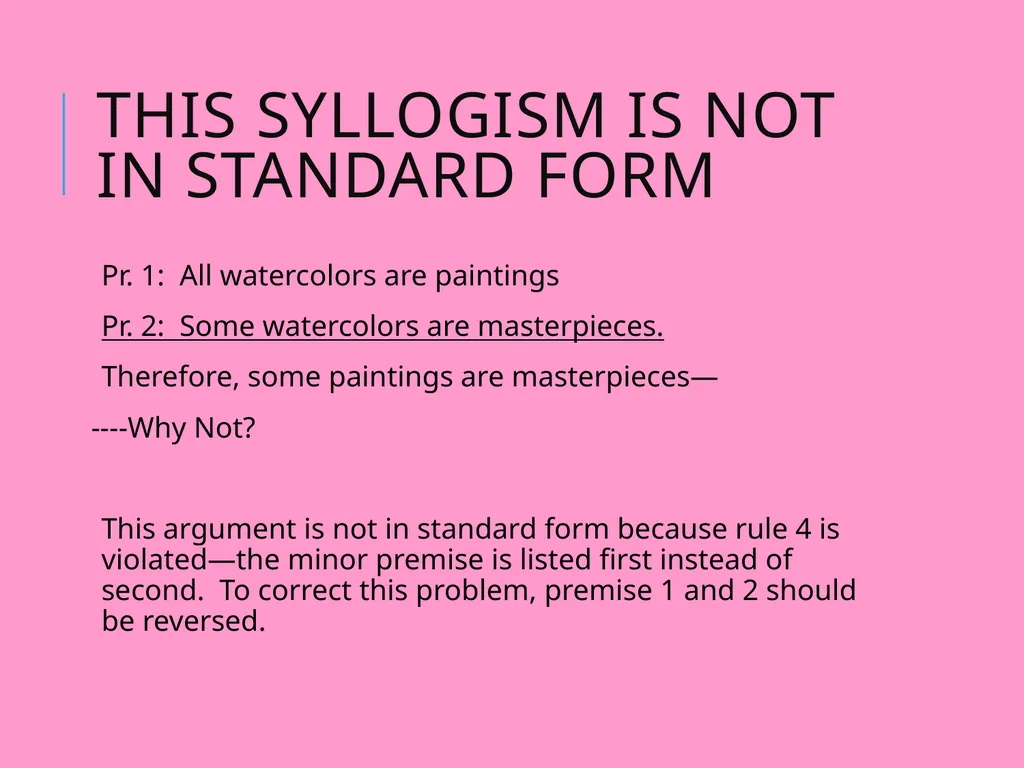
This syllogism is not in standard form Pr. 1: All watercolors are paintings
Pr. 2: Some watercolors are masterpieces.
Therefore, some paintings are masterpieces—
----Why Not?
This argument is not in standard form because rule 4 is violated—the minor premise is listed first instead of second. To correct this problem, premise 1 and 2 should be reversed.<br>
05
Translation into standard form Sometimes we must translate everyday language into categorical propositions and then put the syllogism into standard form, following the rules given earlier.
Example—Put this syllogism in standard form.
Snowy days are always cold days below 32 degrees because snowflakes only form copiously on cold days below 32 degrees and snowy days are comprised of copious snowflakes.
A sample translation into standard form:
All copious snowflakes (M) are things that occur on cold days below 32 degrees (P).
All snowy days (S) are copious snowflakes (M)
Thus, all snowy days (S) are things that occur on cold days below 32 degrees (P)<br>
06
Mood and Figure After a syllogism’s categorical proposition have been put into standard form, validity and invalidity of the syllogism can be determined simply by inspecting its form.
The mood of the syllogism is determined by the letter names of the propositions that make it up (A,E, I, or O). The letter of the major premise always goes first.
For example, an argument that is EAE would be:
No __ are ___
All __ are ___
Therefore, no__ are ____<br>
07
Figure The figure of a syllogism is determined by the location of the two middle terms in the premises.<br>
08
p. 261<br>
09
To remember how figure is defined—think of shirt collars<br>
10
p. 261<br>
11
Checking for validity Once the mood and figure of a syllogism is known, you can check it on the chart provided by Hurley to determine whether it is valid conditionally or unconditionally.
There are two systems of thought here—A Boolean standpoint holds that a syllogism of certain forms are unconditionally valid, meaning that the argument will be valid regardless of whether its terms denote actually existing things. An Aristotelian standpoint understands some syllogisms as conditionally valid, meaning that the argument is valid on the condition that its critical term denotes an actually existing thing. The required condition is identified in the last column.
To check for validity, first check to see if the argument is unconditionally valid. If not, check to see if it is conditionally valid.<br>
12
Unconditionally valid forms (Boolean standpoint)<br>
13
Conditionally Valid Forms<br>
14
p. 263<br>
15
Practice—Determine the major,minor, and middle terms. Identify the mood and figure. Determine whether valid from Boolean standpoint, Aristotelian, or invalid Pr. 1: All Neutron stars are things that produce intense gravity.
Pr. 2: All neutron stars are extremely dense objects.
Therefore, All extremely dense objects are things that produce
intense gravity.
Pr. 1: No kids who can stay out of trouble are youngsters prone to
boredom.
Pr. 2: Some youngsters prone to boredom are latchkey
children.
Therefore, some latchkey children are not kids who can
stay out of trouble.<br>
16
Practice 5.1 Pr. 1: All (M) Neutron stars are things that (P) produce intense gravity.
Pr. 2: All (M) neuron stars are extremely dense objects.
Therefore, All (S) extremely dense objects are (P)things that produce
intense gravity.
AAA-3 It is invalid.
Pr. 1: No (P) kids who can stay out of trouble are (M) youngsters prone to boredom.
Pr. 2: Some (M) youngsters prone to boredom are (S) latchkey
children.
Therefore, some (S) latchkey children are not (P)kids who can
stay out of trouble.
EIO-4 Unconditionally valid<br>
17
Practice 5.1--Reconstruct the following syllogistic forms from the following combinations of mood and figure, using S, P and M. Determine if they are valid. 1. AII-2
2. AAA-3
3. EIO—4
4. IEA—1
5. OOO-2
6. EAE--2<br>
18
Practice 5.1--Reconstruct the following syllogistic forms from the following combinations of mood and figure. Determine if they are valid. 1. AII-2: All P are M/Some S are M/Some S are P,
invalid
2. AAA-3: All M are P/All M are S/ All S are P, inv.
3. EIO—4: No P are M/Some Mare S/Some S are not P, valid
4. IEA—1: Some M are P/No S are M/All S are P, invalid
5. OOO-2: Some P are not M/Some S are not M/Some S are not P, invalid
6. EAE—2: No P are M/All S are M/No S are P, valid<br>