Hydraulic Systems Lecture 1 Introduction Introduction Meaning of Hydraulic The Greek word Hydra refers to water while Aulos means pipes. The word hydraulics originated from Greek by combining these words, which in simple English means,
"Hydraulic Systems Lecture 1 Introduction" is the property of its rightful owner. Permission is granted to
download and print the materials on this website for personal, non-commercial use only, and to display it
on your personal computer provided you do not modify the materials and that you retain all copyright
notices contained in the materials. By downloading content from our website, you accept the terms of this
agreement.
Presentation Transcript
01
Hydraulic Systems Lecture 1 Introduction
Introduction
Meaning of Hydraulic
The Greek word 'Hydra' refers to water while 'Aulos' means pipes. The word
hydraulics originated from Greek by combining these words, which in simple English means, water in pipes. The principles of hydraulics were put to use water energy in converting the energy of flowing water into useful mechanical energy by means of a
water wheel. Nowadays, the meaning has been expanded to include the physical behavior of all liquids, including hydraulic fluid.
Types of energy transformer
Electrical machines or diesel, petrol and steam engines are prime movers. These prime movers can provide various movements to the objects by using some mechanical attachments like screw jack, lever, rack and pinions etc. However, these are not the only prime movers. The enclosed fluids (liquids and gases) can also be used as prime movers to provide controlled motion and force to the objects or substances. The specially designed enclosed fluid systems can provide both linear as well as rotary motion.
Principle of hydraulic system work
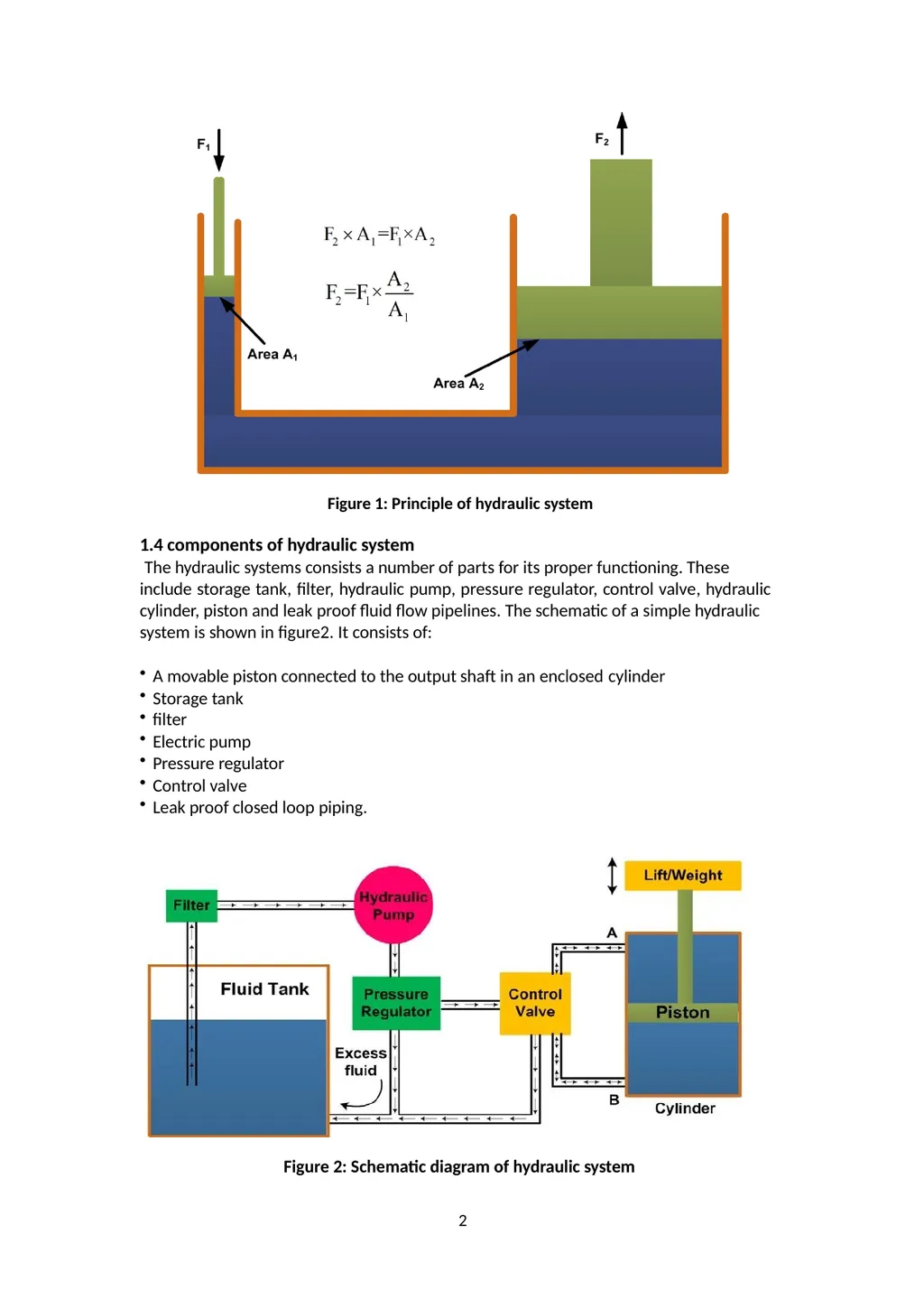
This kind of enclosed fluid based systems using pressurized incompressible liquids as transmission media are called as hydraulic systems. The hydraulic system works on
the principle of Pascal’s law which says that the pressure in an enclosed fluid is uniform in all the directions. The Pascal’s law is illustrated in figure 1. The force given by fluid is given by the multiplication of pressure and area of cross section. As the pressure is same in all the direction, the smaller piston feels a smaller force and a large piston feels a large force. Therefore, a large force can be generated with smaller force input by using hydraulic systems. 1<br>
02
Figure 1: Principle of hydraulic system
1.4 components of hydraulic system
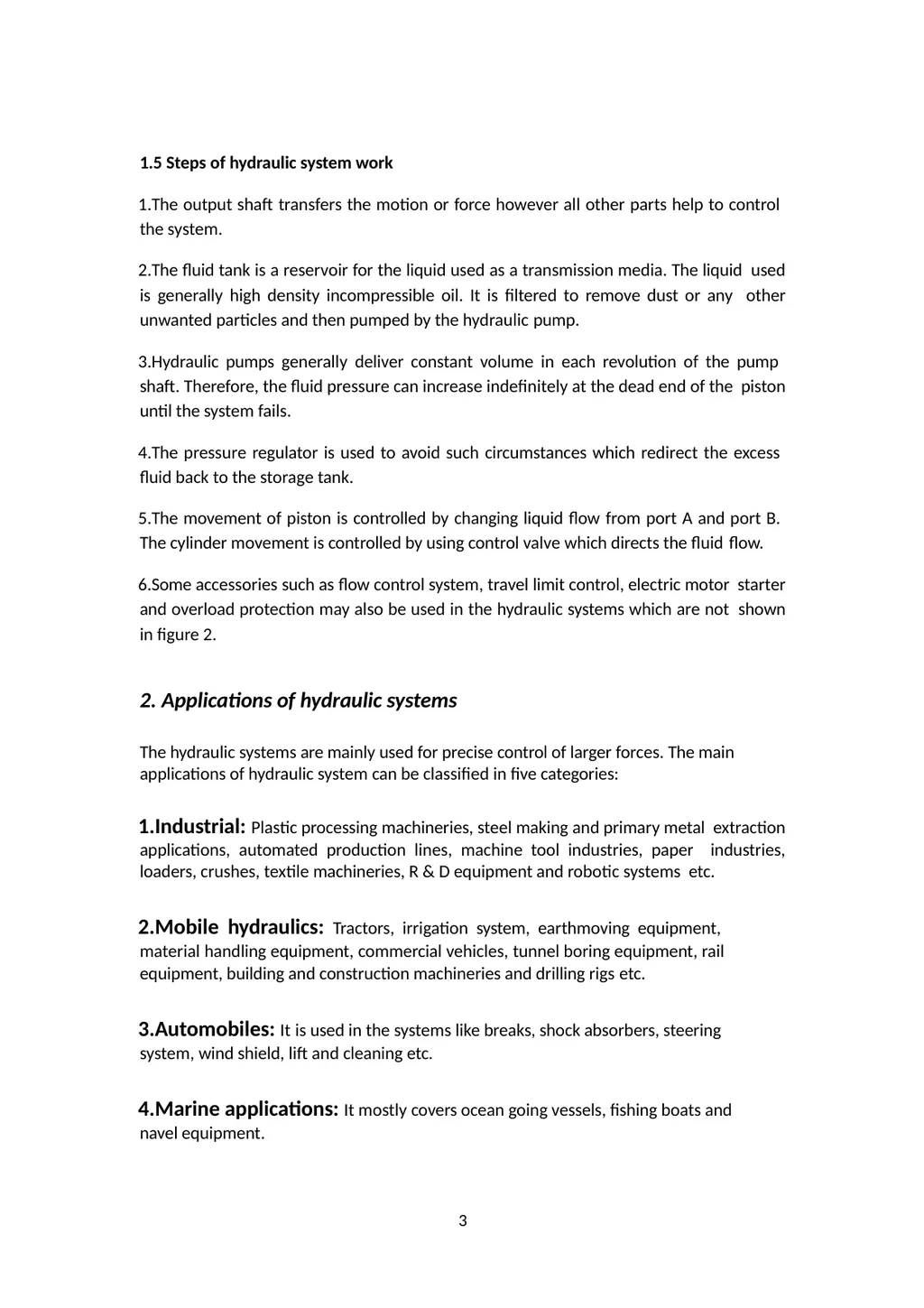
The hydraulic systems consists a number of parts for its proper functioning. These include storage tank, filter, hydraulic pump, pressure regulator, control valve, hydraulic
cylinder, piston and leak proof fluid flow pipelines. The schematic of a simple hydraulic system is shown in figure2. It consists of:
A movable piston connected to the output shaft in an enclosed cylinder
Storage tank
filter
Electric pump
Pressure regulator
Control valve
Leak proof closed loop piping. Figure 2: Schematic diagram of hydraulic system 2<br>
03
3 1.5 Steps of hydraulic system work
The output shaft transfers the motion or force however all other parts help to control the system.
The fluid tank is a reservoir for the liquid used as a transmission media. The liquid used is generally high density incompressible oil. It is filtered to remove dust or any other unwanted particles and then pumped by the hydraulic pump.
Hydraulic pumps generally deliver constant volume in each revolution of the pump shaft. Therefore, the fluid pressure can increase indefinitely at the dead end of the piston until the system fails.
The pressure regulator is used to avoid such circumstances which redirect the excess fluid back to the storage tank.
The movement of piston is controlled by changing liquid flow from port A and port B. The cylinder movement is controlled by using control valve which directs the fluid flow.
Some accessories such as flow control system, travel limit control, electric motor starter and overload protection may also be used in the hydraulic systems which are not shown in figure 2.
Applications of hydraulic systems
The hydraulic systems are mainly used for precise control of larger forces. The main applications of hydraulic system can be classified in five categories:
Industrial: Plastic processing machineries, steel making and primary metal extraction applications, automated production lines, machine tool industries, paper industries, loaders, crushes, textile machineries, R & D equipment and robotic systems etc.
Mobile hydraulics: Tractors, irrigation system, earthmoving equipment, material handling equipment, commercial vehicles, tunnel boring equipment, rail equipment, building and construction machineries and drilling rigs etc.
Automobiles: It is used in the systems like breaks, shock absorbers, steering system, wind shield, lift and cleaning etc.
Marine applications: It mostly covers ocean going vessels, fishing boats and navel equipment.<br>
04
4 2.5 Aerospace equipment: There are equipment and systems used for rudder control, landing gear, breaks, flight control and transmission etc. which are used in airplanes, rockets and spaceships.
Classification of hydraulic motion
Any device operated by a hydraulic fluid may be called a hydraulic device, but a distinction has to be made between the devices which utilize the impact or momentum of a moving fluid and those operated by a thrust on a confined fluid i.e. by pressure. This leads us to the subsequent categorization of the field of hydraulics into:
Hydrodynamics: Hydrodynamics deals with the characteristics of a liquid in motion, especially when the liquid impacts on an object and releases a part of its energy to do some useful work.
Hydrostatics: Hydrostatics deals with the potential energy available when a liquid is confined and pressurized. This potential energy also known as hydrostatic energy is applied in most of the hydraulic systems. This field of hydraulics is governed by Pascal's law. It can thus be concluded that pressure energy is converted into mechanical motion in a hydrostatic device whereas kinetic energy is converted into mechanical energy in a hydrodynamic device.
Advantages and Disadvantages of Hydraulic system
Advantages
The hydraulic system uses incompressible fluid which results in higher efficiency.
It delivers consistent power output which is difficult in pneumatic or mechanical drive systems.
Hydraulic systems employ high density incompressible fluid. Possibility of leakage is less in hydraulic system as compared to that in pneumatic system. The maintenance cost is less.
These systems perform well in hot environment conditions.
Disadvantages
The material of storage tank, piping, cylinder and piston can be corroded with the hydraulic fluid. Therefore one must be careful while selecting materials and hydraulic fluid.
The structural weight and size of the system is more which makes it unsuitable for the smaller instruments.
The small impurities in the hydraulic fluid can permanently damage the complete system, therefore one should be careful and suitable filter must be installed.
The leakage of hydraulic fluid is also a critical issue and suitable prevention method and seals must be adopted.
The hydraulic fluids, if not disposed properly, can be harmful to the environment.<br>