
HYPERNATREMIA DR. NITHYA RAMANUJAN JUNIOR RESIDENT
KB
Published · 20 slides · 0 views
1 / 1

Description
HYPERNATREMIA DR. NITHYA RAMANUJAN JUNIOR RESIDENT GENERAL MEDICINE HYPERNATREMIA Increase in the plasma Na concentration to 145 mM. Less common than hyponatemia. But associated with mortality rates high as 4060, because of severity of
Related Topics
Share
Embed code
Download this presentation From Below
"HYPERNATREMIA DR. NITHYA RAMANUJAN JUNIOR RESIDENT" is the property of its rightful owner. Permission is granted to download and print the materials on this website for personal, non-commercial use only, and to display it on your personal computer provided you do not modify the materials and that you retain all copyright notices contained in the materials. By downloading content from our website, you accept the terms of this agreement.
Presentation Transcript
01
HYPERNATREMIA DR. NITHYA RAMANUJAN
JUNIOR RESIDENT
GENERAL MEDICINE<br>
JUNIOR RESIDENT
GENERAL MEDICINE<br>
02
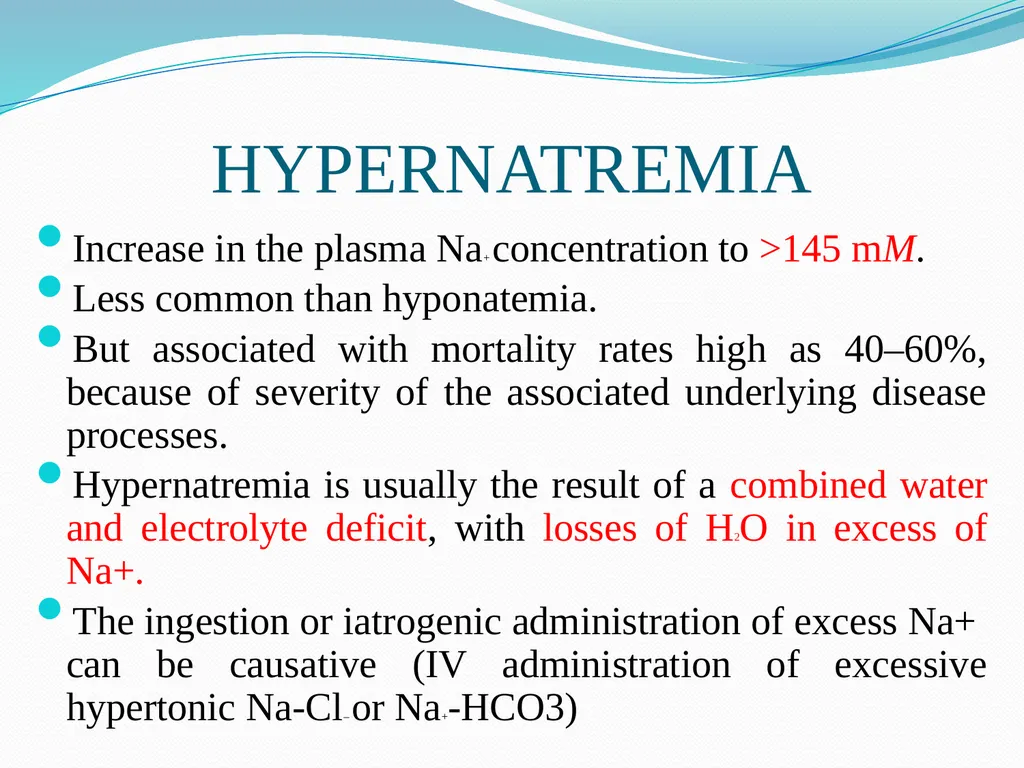
HYPERNATREMIA Increase in the plasma Na+ concentration to >145 mM.
Less common than hyponatemia.
But associated with mortality rates high as 40–60%, because of severity of the associated underlying disease processes.
Hypernatremia is usually the result of a combined water and electrolyte deficit, with losses of H2O in excess of Na+.
The ingestion or iatrogenic administration of excess Na+ can be causative (IV administration of excessive hypertonic Na-Cl– or Na+-HCO3)<br>
Less common than hyponatemia.
But associated with mortality rates high as 40–60%, because of severity of the associated underlying disease processes.
Hypernatremia is usually the result of a combined water and electrolyte deficit, with losses of H2O in excess of Na+.
The ingestion or iatrogenic administration of excess Na+ can be causative (IV administration of excessive hypertonic Na-Cl– or Na+-HCO3)<br>
03
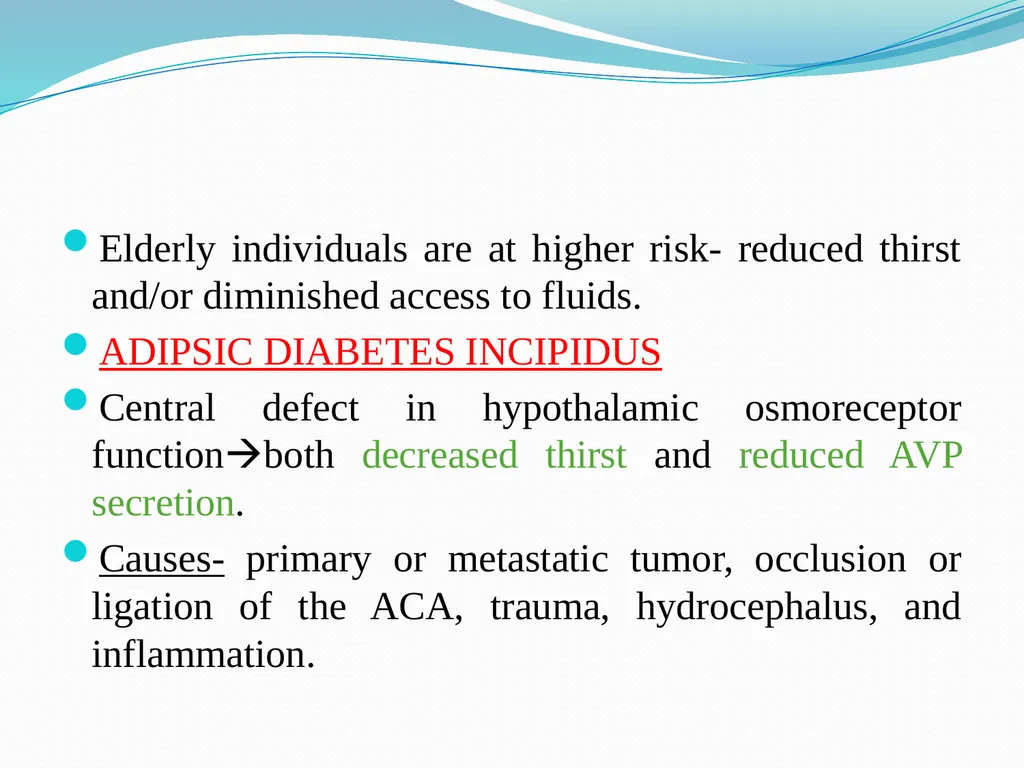
Elderly individuals are at higher risk- reduced thirst and/or diminished access to fluids.
ADIPSIC DIABETES INCIPIDUS
Central defect in hypothalamic osmoreceptor functionboth decreased thirst and reduced AVP secretion.
Causes- primary or metastatic tumor, occlusion or ligation of the ACA, trauma, hydrocephalus, and inflammation.<br>
ADIPSIC DIABETES INCIPIDUS
Central defect in hypothalamic osmoreceptor functionboth decreased thirst and reduced AVP secretion.
Causes- primary or metastatic tumor, occlusion or ligation of the ACA, trauma, hydrocephalus, and inflammation.<br>
04
ETIOLOGY Loss of water via both renal and nonrenal routes.
NON RENAL ROUTES
Insensible losses of water- fever, exercise, heat exposure, severe burns, or mechanical ventilation.
GI cause-Diarrhea (osmotic diarrhea and viral gastroenteritis typically generate stools with Na+ and K+ <100 mM water loss and hypernatremia.
Secretory diarrhea typically results in isotonic stool and thus hypovolemia with or without hypovolemic hyponatremia.<br>
NON RENAL ROUTES
Insensible losses of water- fever, exercise, heat exposure, severe burns, or mechanical ventilation.
GI cause-Diarrhea (osmotic diarrhea and viral gastroenteritis typically generate stools with Na+ and K+ <100 mM water loss and hypernatremia.
Secretory diarrhea typically results in isotonic stool and thus hypovolemia with or without hypovolemic hyponatremia.<br>
05
RENAL ROUTES
Osmotic diuresis secondary to hyperglycemia, excess urea, postobstructive diuresis, or mannitol.
(increase in urinary solute excretion and increased urinary osmolality)
Water diuresis -central DI, nephrogenic DI (NDI), gestational DI.
Gestational DI
Rare complication of late-term pregnancy
Increased activity of a circulating placental protease with “vasopressinase” activity reduced circulating AVP polyuria,often accompanied by hypernatremia.
DDAVP is an effective therapy(as it is resistant to vasopressinase enzyme).<br>
Osmotic diuresis secondary to hyperglycemia, excess urea, postobstructive diuresis, or mannitol.
(increase in urinary solute excretion and increased urinary osmolality)
Water diuresis -central DI, nephrogenic DI (NDI), gestational DI.
Gestational DI
Rare complication of late-term pregnancy
Increased activity of a circulating placental protease with “vasopressinase” activity reduced circulating AVP polyuria,often accompanied by hypernatremia.
DDAVP is an effective therapy(as it is resistant to vasopressinase enzyme).<br>
06
NEPHROGENIC DI Characterized by renal resistance to AVP( partial or complete).
Genetic causes
Loss-of-function mutations in the X-linked V2 receptor
Mutations in the AVP-responsive aquaporin-2 water channel AR NDI and AD NDI (recessive deficiency of the aquaporin-1 water channel causes a more modest concentrating defect )
Acquired causes
Hypercalcemia polyuria and NDI
calcium signals directly through the calcium-sensing receptor, downregulate Na+, K+, and Cl– transport by the TALH and water transport in principal cells, thus reducing renal concentrating ability.
Hypokalemia inhibits the renal response to AVP and downregulates aquaporin-2 expression.<br>
Genetic causes
Loss-of-function mutations in the X-linked V2 receptor
Mutations in the AVP-responsive aquaporin-2 water channel AR NDI and AD NDI (recessive deficiency of the aquaporin-1 water channel causes a more modest concentrating defect )
Acquired causes
Hypercalcemia polyuria and NDI
calcium signals directly through the calcium-sensing receptor, downregulate Na+, K+, and Cl– transport by the TALH and water transport in principal cells, thus reducing renal concentrating ability.
Hypokalemia inhibits the renal response to AVP and downregulates aquaporin-2 expression.<br>
07
Drugs -lithium, ifosfamide, and several antiviral agents.
NDI by lithium : multiple mechanisms
Direct inhibition of renal glycogen synthase kinase-3(GSK3), pharmacologic target of lithium in bipolar disease.
GSK3 is required for the response of principal cells to AVP.
The entry of lithium through the amiloride-sensitive Na+ channel ENaC is required for the effect of the drug on principal cells, hence combined therapy with lithium and amiloride can mitigate lithium-associated NDI.
Prolonged lithium therapy chronic tubulointerstitial scarring and chronic kidney disease.
Such that patients may have a persistent NDI long after stopping drug, with a reduced therapeutic benefit from amiloride.<br>
NDI by lithium : multiple mechanisms
Direct inhibition of renal glycogen synthase kinase-3(GSK3), pharmacologic target of lithium in bipolar disease.
GSK3 is required for the response of principal cells to AVP.
The entry of lithium through the amiloride-sensitive Na+ channel ENaC is required for the effect of the drug on principal cells, hence combined therapy with lithium and amiloride can mitigate lithium-associated NDI.
Prolonged lithium therapy chronic tubulointerstitial scarring and chronic kidney disease.
Such that patients may have a persistent NDI long after stopping drug, with a reduced therapeutic benefit from amiloride.<br>
08
CONSEQUENCES Hypernatremia increases osmolality of the ECF osmotic gradient between the ECF and ICF an efflux of intracellular water cellular shrinkage.
Acute hypernatremia sudden shrinkage of brain cells parenchymal or subarachnoid hemorrhages and/or subdural hematomas. (vascular complications are primarily encountered in pediatric and neonatal patients).
Osmotic damage to muscle membranes hypernatremic rhabdomyolysis.<br>
Acute hypernatremia sudden shrinkage of brain cells parenchymal or subarachnoid hemorrhages and/or subdural hematomas. (vascular complications are primarily encountered in pediatric and neonatal patients).
Osmotic damage to muscle membranes hypernatremic rhabdomyolysis.<br>
09
Chronic hypernatremia Brain cells accommodate to a chronic increase in ECF osmolality (>48 h).
Activation of membrane transporters mediate influx and intracellular accumulation of organic osmolytes (creatine, betaine, glutamate, myoinositol, and taurine) increase in ICF water normalization of brain parenchymal volume.
Predisposes these patients to the development of cerebral edema and seizures during overly rapid hydration (overcorrection of plasma Na+ concentration by >10 mM/d).<br>
Activation of membrane transporters mediate influx and intracellular accumulation of organic osmolytes (creatine, betaine, glutamate, myoinositol, and taurine) increase in ICF water normalization of brain parenchymal volume.
Predisposes these patients to the development of cerebral edema and seizures during overly rapid hydration (overcorrection of plasma Na+ concentration by >10 mM/d).<br>
10
CLINICAL FEATURES Mainly neurologic
Altered mental status(mild confusion to deep coma)
Weakness
Neuromuscular irritability
Focal neurologic deficits
Coma
Seizures
Due to accomodation in chronic hypernatremia, patients are less likely to develop severe neurologic compromise.
Signs of volume depletion
CDI and NDI- polyuria, thirst<br>
Altered mental status(mild confusion to deep coma)
Weakness
Neuromuscular irritability
Focal neurologic deficits
Coma
Seizures
Due to accomodation in chronic hypernatremia, patients are less likely to develop severe neurologic compromise.
Signs of volume depletion
CDI and NDI- polyuria, thirst<br>
11
DIAGNOSTIC APPROACH History- presence or absence of thirst, polyuria, and/or an extrarenal source for water loss(diarrhea).
Physical examination
Detailed neurologic examination
Assessment of the ECFV(patients with large water deficit and/or a combined deficit in electrolytes and water may be hypovolemic, with reduced JVP and orthostasis.
Accurate I/O charting(the diagnosis and management of hypernatremia).
Laboratory investigation – blood and urine routines, serum osmolality, urine osmolality, urine electrolytes<br>
Physical examination
Detailed neurologic examination
Assessment of the ECFV(patients with large water deficit and/or a combined deficit in electrolytes and water may be hypovolemic, with reduced JVP and orthostasis.
Accurate I/O charting(the diagnosis and management of hypernatremia).
Laboratory investigation – blood and urine routines, serum osmolality, urine osmolality, urine electrolytes<br>
12
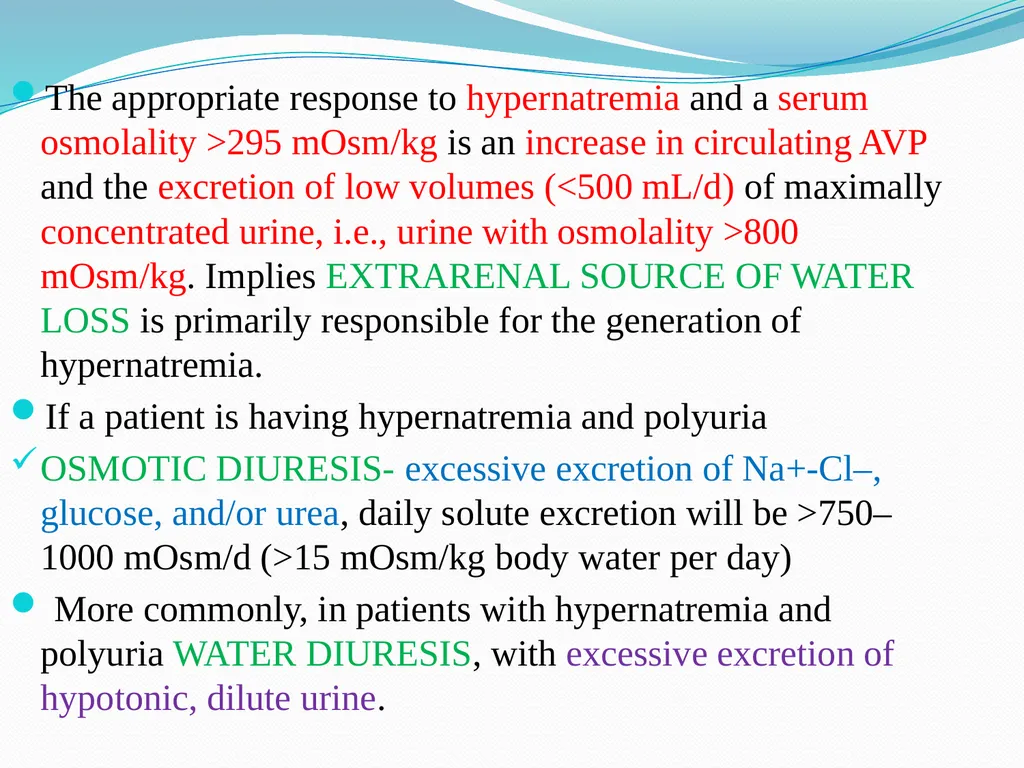
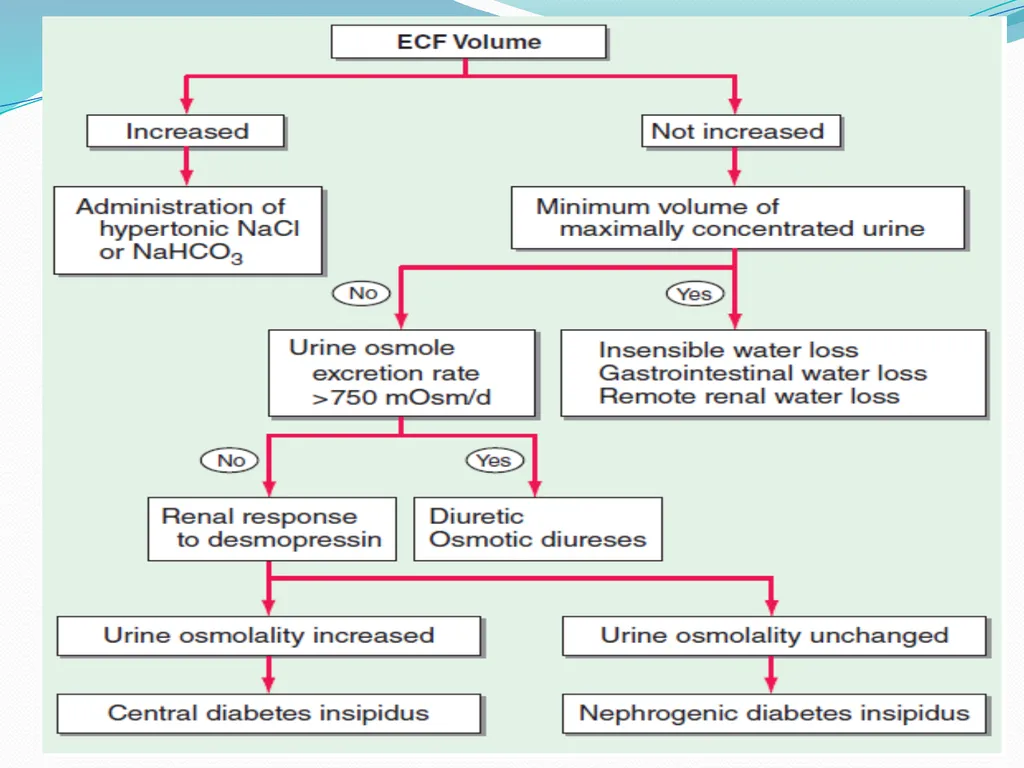
The appropriate response to hypernatremia and a serum osmolality >295 mOsm/kg is an increase in circulating AVP and the excretion of low volumes (<500 mL/d) of maximally concentrated urine, i.e., urine with osmolality >800 mOsm/kg. Implies EXTRARENAL SOURCE OF WATER LOSS is primarily responsible for the generation of hypernatremia.
If a patient is having hypernatremia and polyuria
OSMOTIC DIURESIS- excessive excretion of Na+-Cl–, glucose, and/or urea, daily solute excretion will be >750–1000 mOsm/d (>15 mOsm/kg body water per day)
More commonly, in patients with hypernatremia and polyuria WATER DIURESIS, with excessive excretion of hypotonic, dilute urine.<br>
If a patient is having hypernatremia and polyuria
OSMOTIC DIURESIS- excessive excretion of Na+-Cl–, glucose, and/or urea, daily solute excretion will be >750–1000 mOsm/d (>15 mOsm/kg body water per day)
More commonly, in patients with hypernatremia and polyuria WATER DIURESIS, with excessive excretion of hypotonic, dilute urine.<br>
13
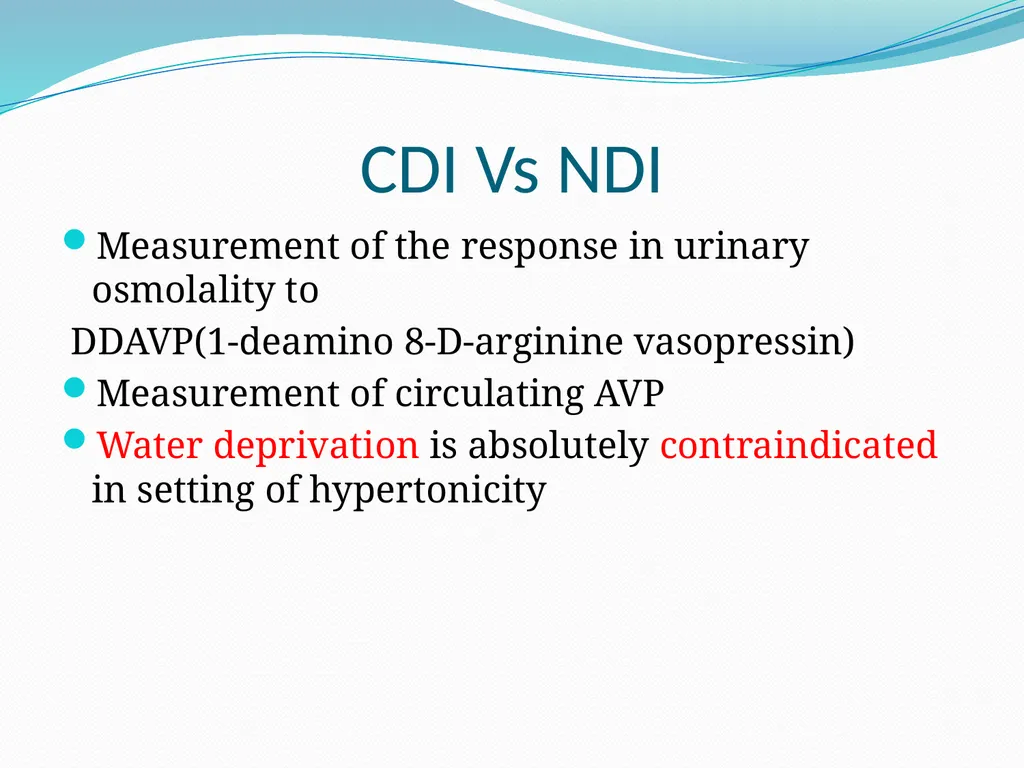
CDI Vs NDI Measurement of the response in urinary osmolality to
DDAVP(1-deamino 8-D-arginine vasopressin)
Measurement of circulating AVP
Water deprivation is absolutely contraindicated in setting of hypertonicity<br>
DDAVP(1-deamino 8-D-arginine vasopressin)
Measurement of circulating AVP
Water deprivation is absolutely contraindicated in setting of hypertonicity<br>
14
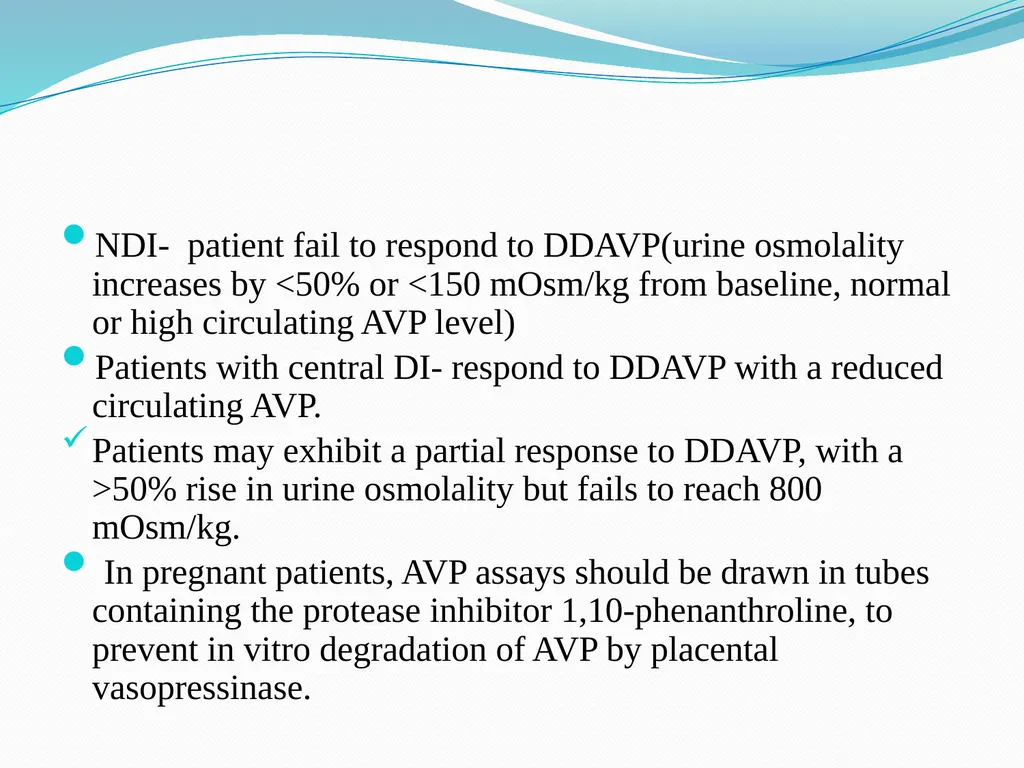
NDI- patient fail to respond to DDAVP(urine osmolality increases by <50% or <150 mOsm/kg from baseline, normal or high circulating AVP level)
Patients with central DI- respond to DDAVP with a reduced circulating AVP.
Patients may exhibit a partial response to DDAVP, with a >50% rise in urine osmolality but fails to reach 800 mOsm/kg.
In pregnant patients, AVP assays should be drawn in tubes containing the protease inhibitor 1,10-phenanthroline, to prevent in vitro degradation of AVP by placental vasopressinase.<br>
Patients with central DI- respond to DDAVP with a reduced circulating AVP.
Patients may exhibit a partial response to DDAVP, with a >50% rise in urine osmolality but fails to reach 800 mOsm/kg.
In pregnant patients, AVP assays should be drawn in tubes containing the protease inhibitor 1,10-phenanthroline, to prevent in vitro degradation of AVP by placental vasopressinase.<br>
15
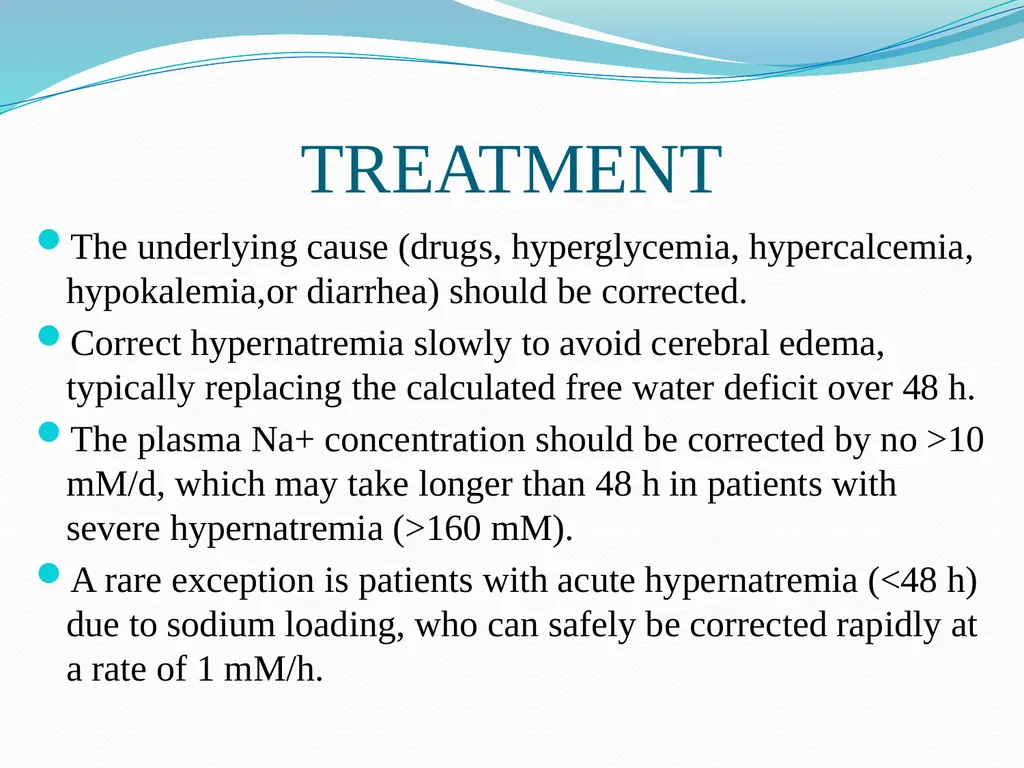
TREATMENT The underlying cause (drugs, hyperglycemia, hypercalcemia, hypokalemia,or diarrhea) should be corrected.
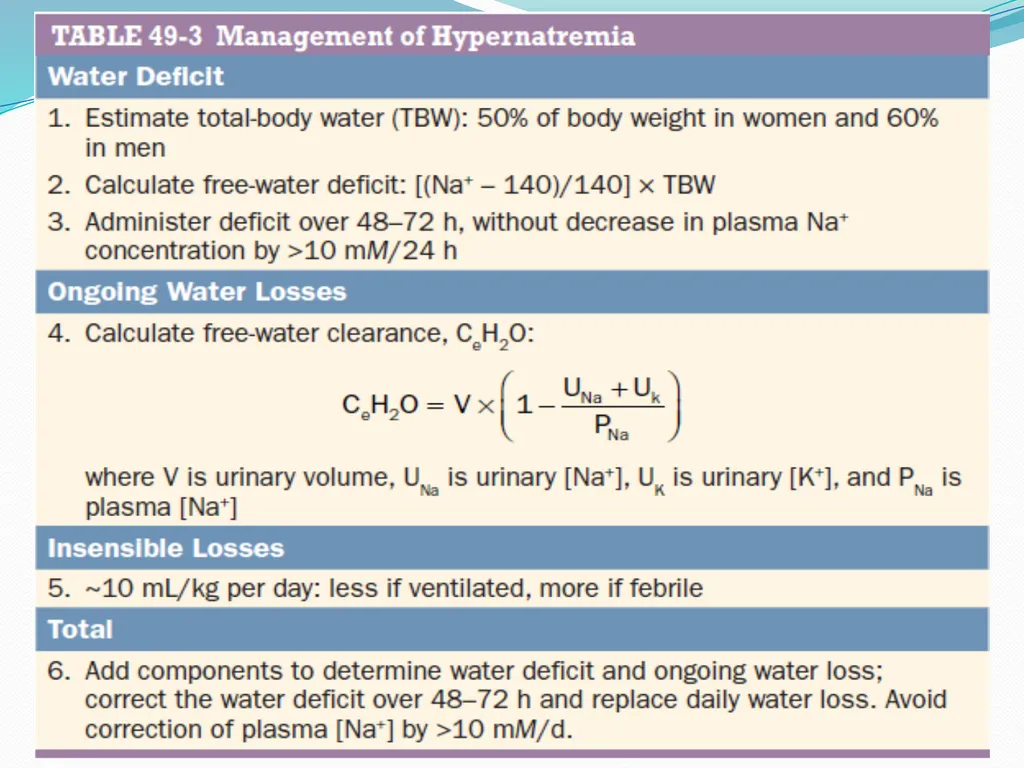
Correct hypernatremia slowly to avoid cerebral edema, typically replacing the calculated free water deficit over 48 h.
The plasma Na+ concentration should be corrected by no >10 mM/d, which may take longer than 48 h in patients with severe hypernatremia (>160 mM).
A rare exception is patients with acute hypernatremia (<48 h) due to sodium loading, who can safely be corrected rapidly at a rate of 1 mM/h.<br>
Correct hypernatremia slowly to avoid cerebral edema, typically replacing the calculated free water deficit over 48 h.
The plasma Na+ concentration should be corrected by no >10 mM/d, which may take longer than 48 h in patients with severe hypernatremia (>160 mM).
A rare exception is patients with acute hypernatremia (<48 h) due to sodium loading, who can safely be corrected rapidly at a rate of 1 mM/h.<br>
16
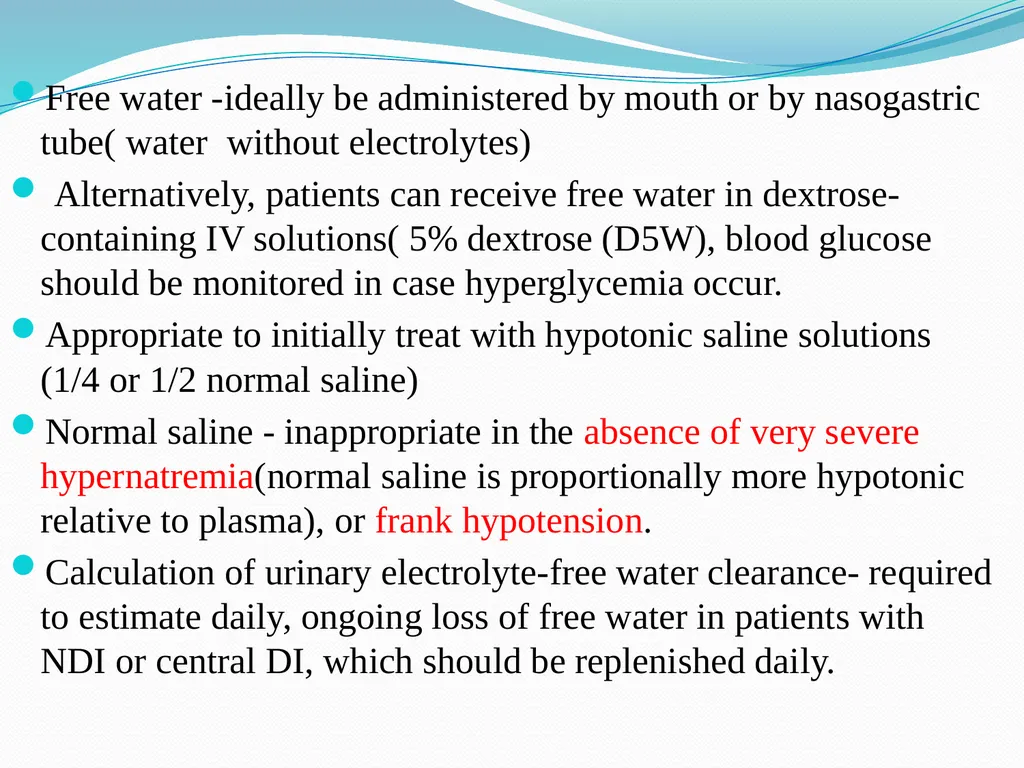
Free water -ideally be administered by mouth or by nasogastric tube( water without electrolytes)
Alternatively, patients can receive free water in dextrose-containing IV solutions( 5% dextrose (D5W), blood glucose should be monitored in case hyperglycemia occur.
Appropriate to initially treat with hypotonic saline solutions (1/4 or 1/2 normal saline)
Normal saline - inappropriate in the absence of very severe hypernatremia(normal saline is proportionally more hypotonic relative to plasma), or frank hypotension.
Calculation of urinary electrolyte-free water clearance- required to estimate daily, ongoing loss of free water in patients with NDI or central DI, which should be replenished daily.<br>
Alternatively, patients can receive free water in dextrose-containing IV solutions( 5% dextrose (D5W), blood glucose should be monitored in case hyperglycemia occur.
Appropriate to initially treat with hypotonic saline solutions (1/4 or 1/2 normal saline)
Normal saline - inappropriate in the absence of very severe hypernatremia(normal saline is proportionally more hypotonic relative to plasma), or frank hypotension.
Calculation of urinary electrolyte-free water clearance- required to estimate daily, ongoing loss of free water in patients with NDI or central DI, which should be replenished daily.<br>
17
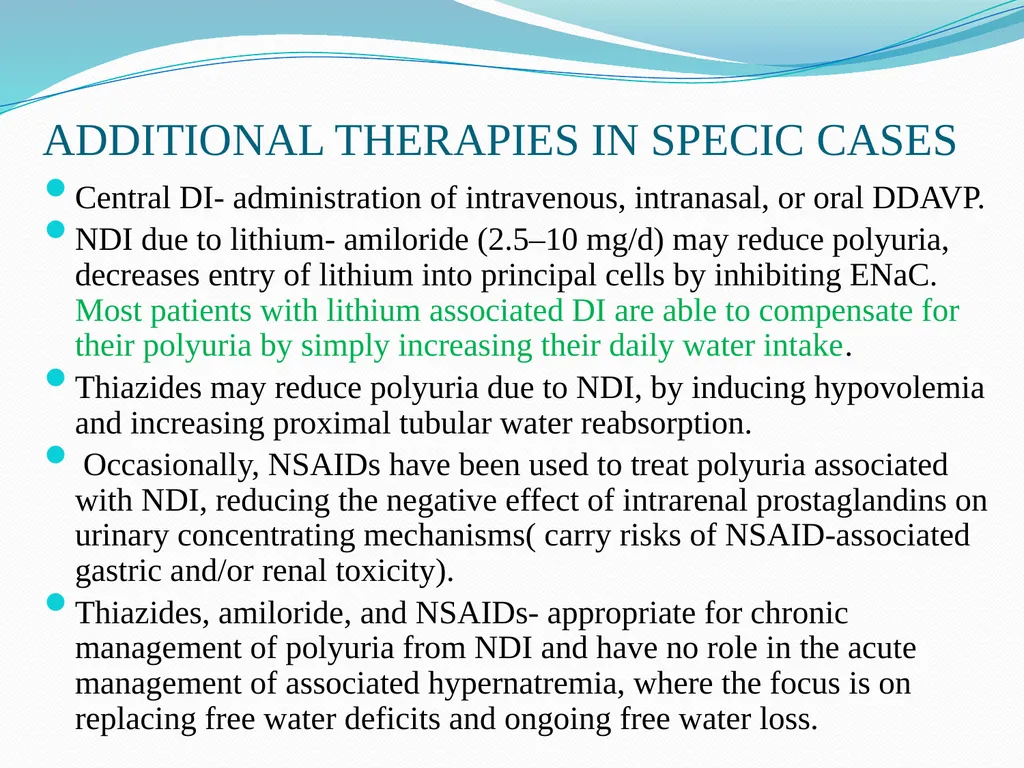
ADDITIONAL THERAPIES IN SPECIC CASES Central DI- administration of intravenous, intranasal, or oral DDAVP.
NDI due to lithium- amiloride (2.5–10 mg/d) may reduce polyuria, decreases entry of lithium into principal cells by inhibiting ENaC. Most patients with lithium associated DI are able to compensate for their polyuria by simply increasing their daily water intake.
Thiazides may reduce polyuria due to NDI, by inducing hypovolemia and increasing proximal tubular water reabsorption.
Occasionally, NSAIDs have been used to treat polyuria associated with NDI, reducing the negative effect of intrarenal prostaglandins on urinary concentrating mechanisms( carry risks of NSAID-associated gastric and/or renal toxicity).
Thiazides, amiloride, and NSAIDs- appropriate for chronic management of polyuria from NDI and have no role in the acute management of associated hypernatremia, where the focus is on replacing free water deficits and ongoing free water loss.<br>
NDI due to lithium- amiloride (2.5–10 mg/d) may reduce polyuria, decreases entry of lithium into principal cells by inhibiting ENaC. Most patients with lithium associated DI are able to compensate for their polyuria by simply increasing their daily water intake.
Thiazides may reduce polyuria due to NDI, by inducing hypovolemia and increasing proximal tubular water reabsorption.
Occasionally, NSAIDs have been used to treat polyuria associated with NDI, reducing the negative effect of intrarenal prostaglandins on urinary concentrating mechanisms( carry risks of NSAID-associated gastric and/or renal toxicity).
Thiazides, amiloride, and NSAIDs- appropriate for chronic management of polyuria from NDI and have no role in the acute management of associated hypernatremia, where the focus is on replacing free water deficits and ongoing free water loss.<br>
18
THANK YOU<br>