HYPERTHYROIDISM MR. DINESH SINGH P.G. NURSING TUTOR ROHILKHAND COLLEGE OF NURSING 10-04-2024 ROHILKHAND COLLEGE OF NURSING 1 OBJECTIVES Introduction of the Hyperthyroidism. Define the Hyperthyroidism. Explain the causes of Hyperthyroidism.
"HYPERTHYROIDISM MR. DINESH SINGH P.G. NURSING" is the property of its rightful owner. Permission is granted to
download and print the materials on this website for personal, non-commercial use only, and to display it
on your personal computer provided you do not modify the materials and that you retain all copyright
notices contained in the materials. By downloading content from our website, you accept the terms of this
agreement.
Presentation Transcript
01
HYPERTHYROIDISM MR. DINESH SINGH
P.G. NURSING TUTOR
ROHILKHAND COLLEGE OF NURSING 10-04-2024 ROHILKHAND COLLEGE OF NURSING 1<br>
02
OBJECTIVES Introduction of the Hyperthyroidism.
Define the Hyperthyroidism.
Explain the causes of Hyperthyroidism.
State the clinical manifestations of Hyperthyroidism.
Elaborate the diagnostic evaluation of Hyperthyroidism.
Discuss the management of Hyperthyroidism.
Describe the prevention of Hyperthyroidism. 10-04-2024 ROHILKHAND COLLEGE OF NURSING 2<br>
03
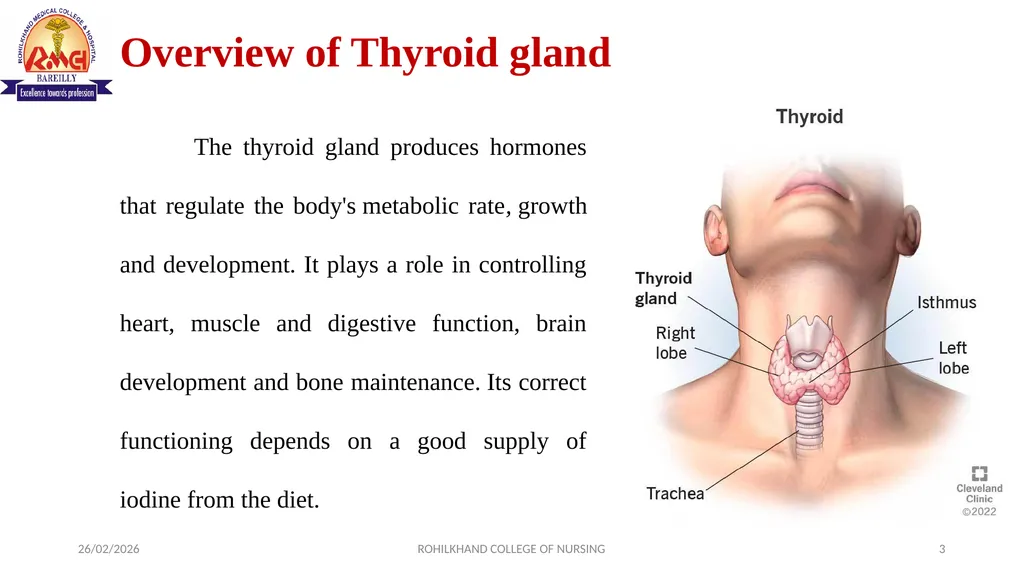
Overview of Thyroid gland The thyroid gland produces hormones that regulate the body's metabolic rate, growth and development. It plays a role in controlling heart, muscle and digestive function, brain development and bone maintenance. Its correct functioning depends on a good supply of iodine from the diet. 10-04-2024 ROHILKHAND COLLEGE OF NURSING 3<br>
04
INTRODUCTION Hyperthyroidism happens when the thyroid gland makes too much thyroid hormone. This condition also is called overactive thyroid. Hyperthyroidism speeds up the body's metabolism. That can cause many symptoms, such as weight loss, hand tremors, and rapid or irregular heartbeat. 10-04-2024 ROHILKHAND COLLEGE OF NURSING 4<br>
05
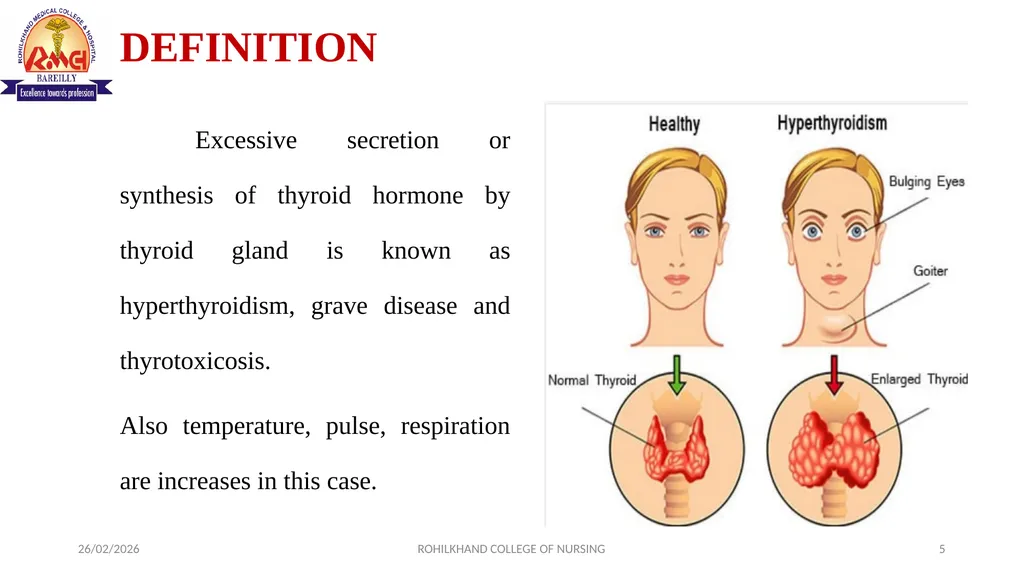
DEFINITION Excessive secretion or synthesis of thyroid hormone by thyroid gland is known as hyperthyroidism, grave disease and thyrotoxicosis.
Also temperature, pulse, respiration are increases in this case. 10-04-2024 ROHILKHAND COLLEGE OF NURSING 5<br>
06
ETIOLOGY Over function of entire thyroid gland
Over treatment of myxedema (Severe advanced hypothyroidism)
Plummer’s disease (multinodular Goiter)
Emotional upset
Over work
Worry
Anxiety
Acute infection
Stimulation of sympathetic system 10-04-2024 ROHILKHAND COLLEGE OF NURSING 6<br>
07
10-04-2024 ROHILKHAND COLLEGE OF NURSING 7<br>
08
CLINICAL MANIFESTATION Cardiovascular System
Hypertension
Tachycardia
Bound and rapid pulse
Palpitation
Respiratory System
Dyspnea
Increase respiratory rate 10-04-2024 ROHILKHAND COLLEGE OF NURSING 8 G.I.T
Appetite increase but weight loss due to improper metabolism.
Diarrhea
Splenomegaly
Hepatomegaly
Musculo-Skeletal System
Fatigue
Muscle weakness<br>
09
CONT… Nervous System
Difficulty in focusing of eye
Nervousness
Insomnia
Restlessness
Fatigue
Lack of concentration 10-04-2024 ROHILKHAND COLLEGE OF NURSING 9 Reproductive
Amenorrhea (absence of menstruation)
Menstrual irregularities<br>
10
DIAGNOSTIC EVALUATION Physical appearance
Enlarge neck
Protruding eyes
Agitating expression due to basal metabolic rate (BMR) 10-04-2024 ROHILKHAND COLLEGE OF NURSING 10<br>
11
MANAGEMENT Antithyroid drugs: Most often used to treat an overactive thyroid (hyperthyroidism)
Methimazole
Potassium iodine therapy
B-adrenergic blockers, e.g. Atenolol (to reduce Blood Pressure) 10-04-2024 ROHILKHAND COLLEGE OF NURSING 11<br>
12
SURGICAL MANAGEMENT Subtotal thyroidectomy (removal of one lobe)
Total thyroidectomy (Removal of gland) 10-04-2024 ROHILKHAND COLLEGE OF NURSING 12<br>
13
COMPLICATIONS Hypertension
Heart failure 10-04-2024 ROHILKHAND COLLEGE OF NURSING 13<br>
14
REFERENCES 10-04-2024 ROHILKHAND COLLEGE OF NURSING 14<br>