
Hypothesis Testing Objectives: Students should be
LO
Published · 30 slides · 0 views
1 / 1



Description
Hypothesis Testing Objectives: Students should be able to identify the null and alternative (research) hypotheses in a statistical test Students should know the difference between one-and two-directional hypothesis testing Students should
Related Topics
Share
Embed code
Download this presentation From Below
"Hypothesis Testing Objectives: Students should be" is the property of its rightful owner. Permission is granted to download and print the materials on this website for personal, non-commercial use only, and to display it on your personal computer provided you do not modify the materials and that you retain all copyright notices contained in the materials. By downloading content from our website, you accept the terms of this agreement.
Presentation Transcript
01
Hypothesis Testing Objectives:
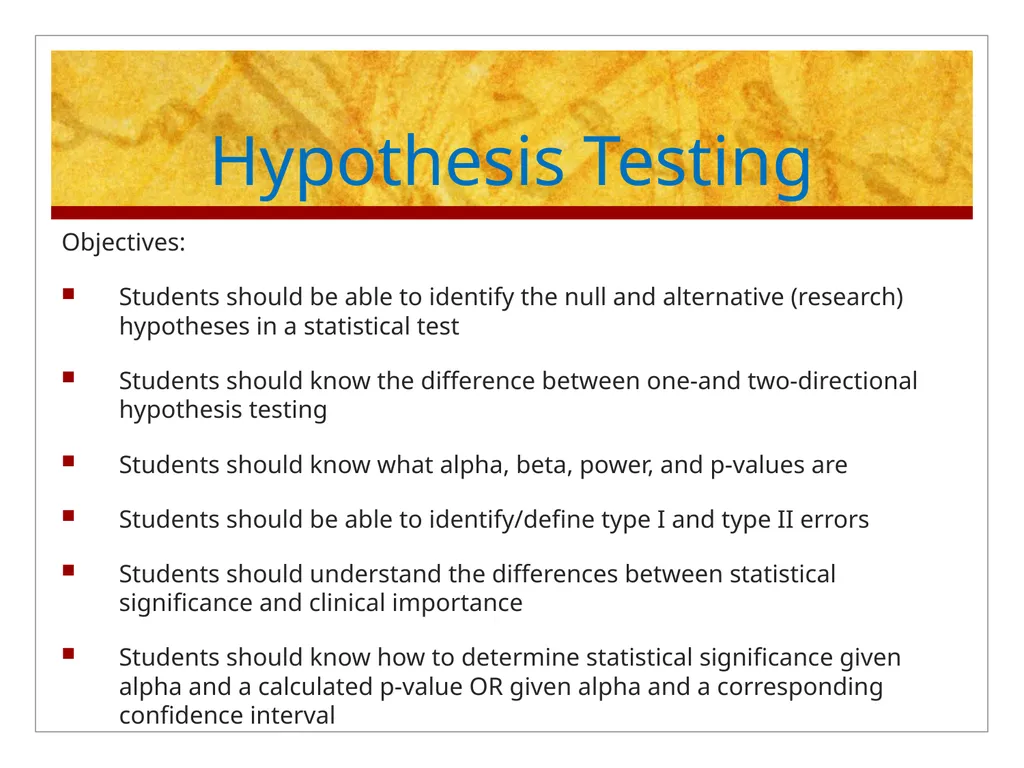
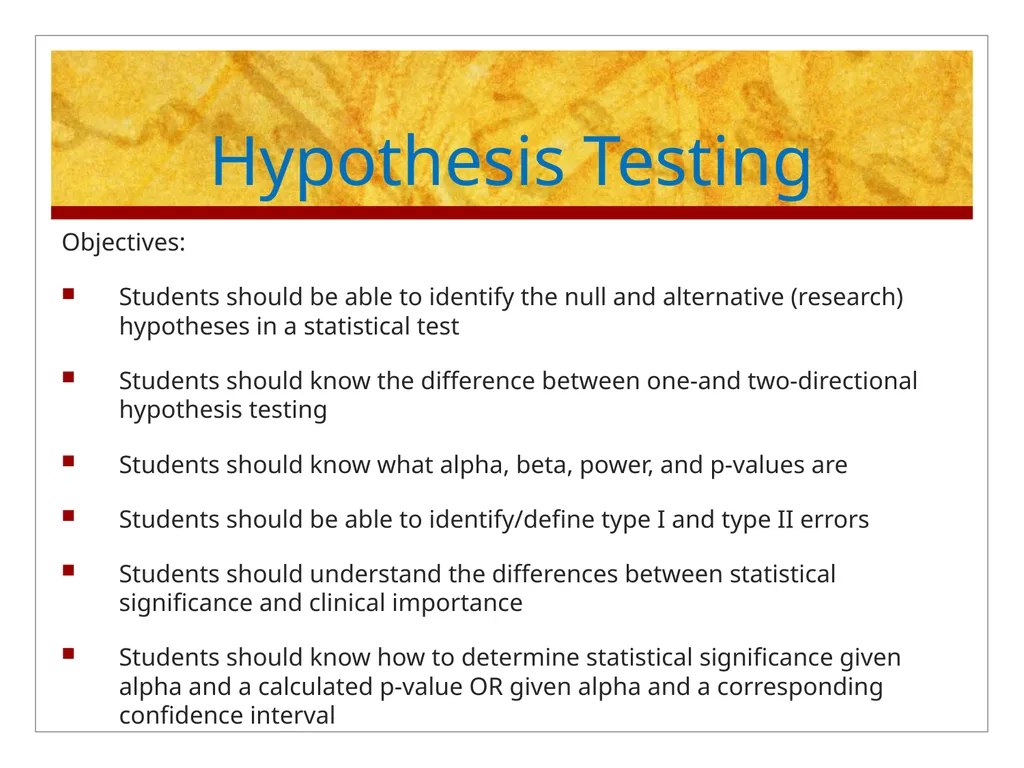
Students should be able to identify the null and alternative (research) hypotheses in a statistical test
Students should know the difference between one-and two-directional hypothesis testing
Students should know what alpha, beta, power, and p-values are
Students should be able to identify/define type I and type II errors
Students should understand the differences between statistical significance and clinical importance
Students should know how to determine statistical significance given alpha and a calculated p-value OR given alpha and a corresponding confidence interval<br>
02
Hypothesis Testing The second type of inferential statistics
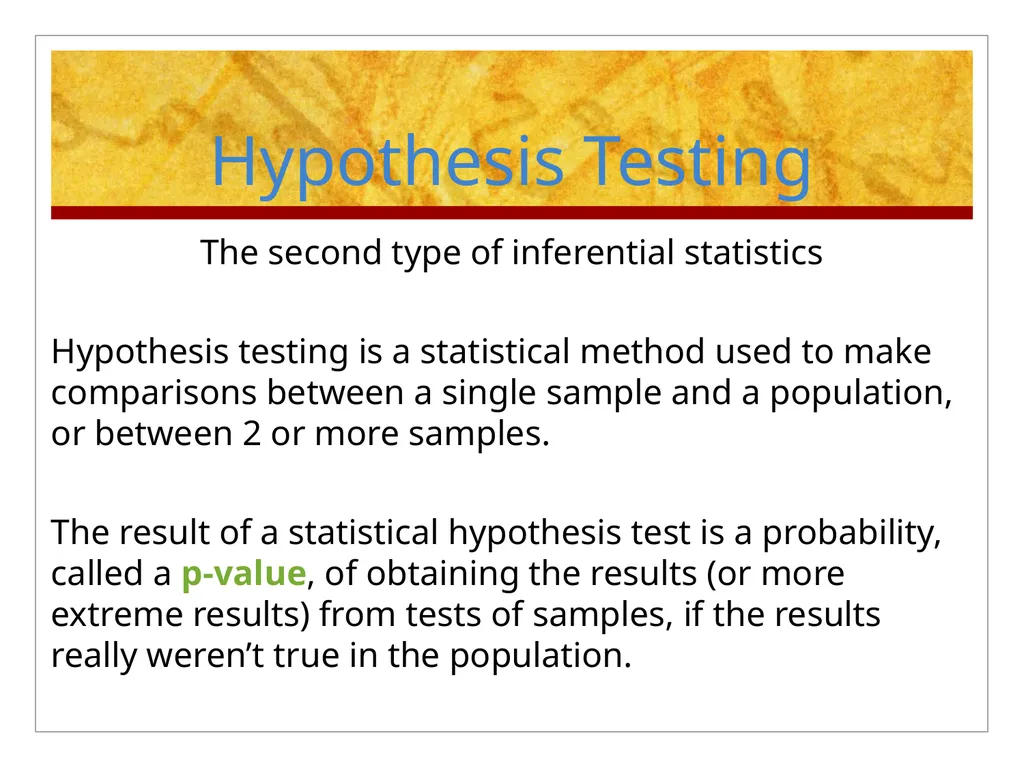
Hypothesis testing is a statistical method used to make comparisons between a single sample and a population, or between 2 or more samples.
The result of a statistical hypothesis test is a probability, called a p-value, of obtaining the results (or more extreme results) from tests of samples, if the results really weren’t true in the population.<br>
03
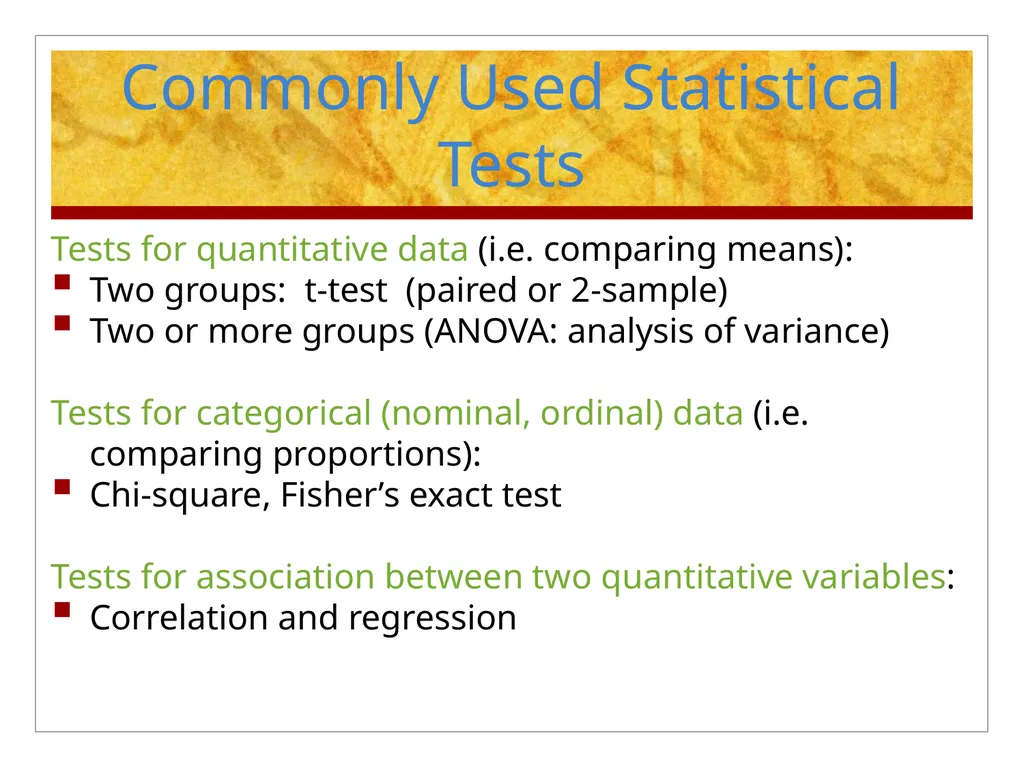
Commonly Used Statistical Tests Tests for quantitative data (i.e. comparing means):
Two groups: t-test (paired or 2-sample)
Two or more groups (ANOVA: analysis of variance)
Tests for categorical (nominal, ordinal) data (i.e. comparing proportions):
Chi-square, Fisher’s exact test
Tests for association between two quantitative variables:
Correlation and regression<br>
Two groups: t-test (paired or 2-sample)
Two or more groups (ANOVA: analysis of variance)
Tests for categorical (nominal, ordinal) data (i.e. comparing proportions):
Chi-square, Fisher’s exact test
Tests for association between two quantitative variables:
Correlation and regression<br>
04
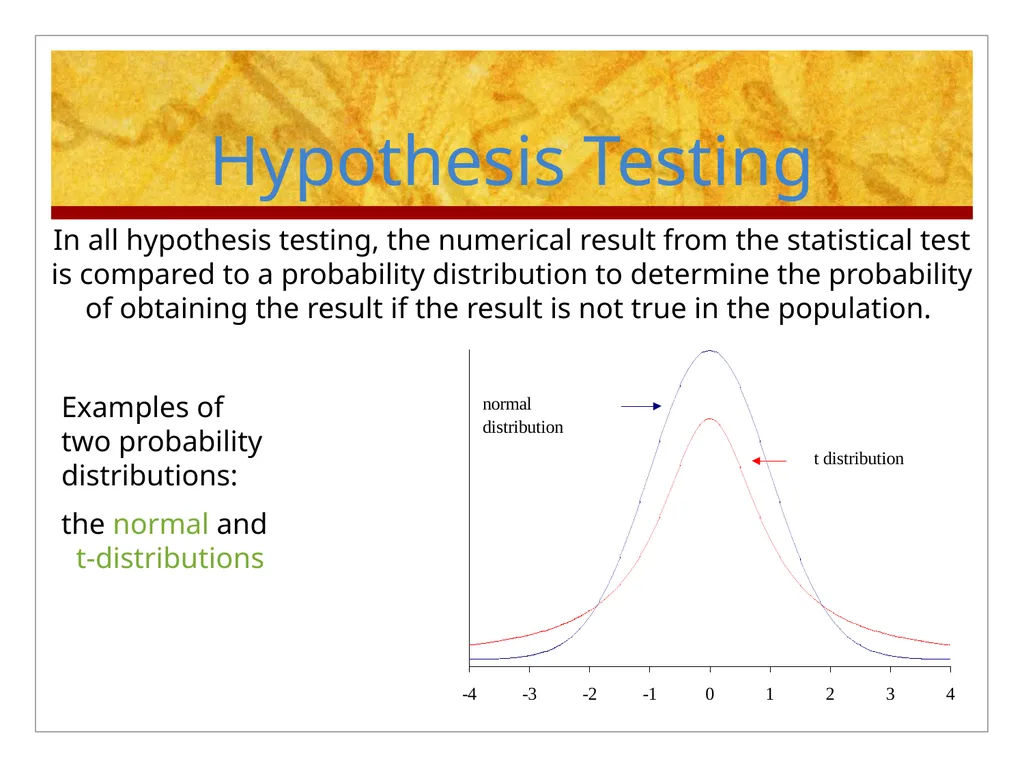
Hypothesis Testing In all hypothesis testing, the numerical result from the statistical test is compared to a probability distribution to determine the probability of obtaining the result if the result is not true in the population. Examples of two probability distributions:
the normal and t-distributions<br>
the normal and t-distributions<br>
05
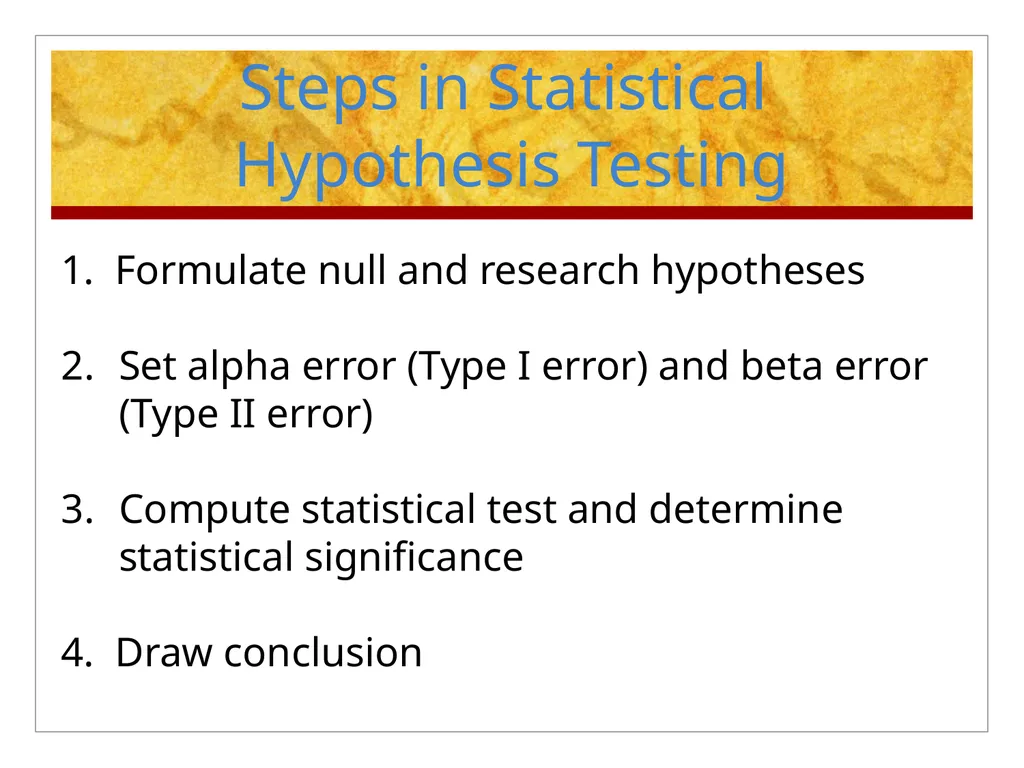
Steps in Statistical
Hypothesis Testing 1. Formulate null and research hypotheses
Set alpha error (Type I error) and beta error (Type II error)
Compute statistical test and determine statistical significance
4. Draw conclusion<br>
Set alpha error (Type I error) and beta error (Type II error)
Compute statistical test and determine statistical significance
4. Draw conclusion<br>
06
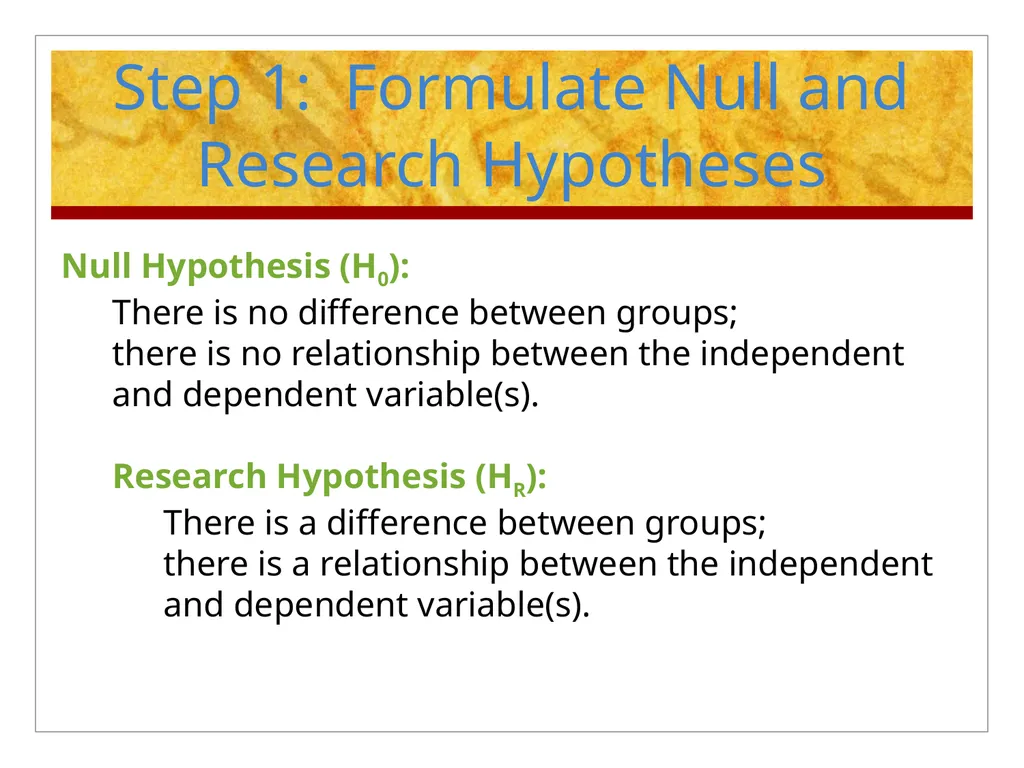
Null Hypothesis (H0):
There is no difference between groups;
there is no relationship between the independent and dependent variable(s).
Research Hypothesis (HR):
There is a difference between groups;
there is a relationship between the independent
and dependent variable(s). Step 1: Formulate Null and Research Hypotheses<br>
07
Directional vs
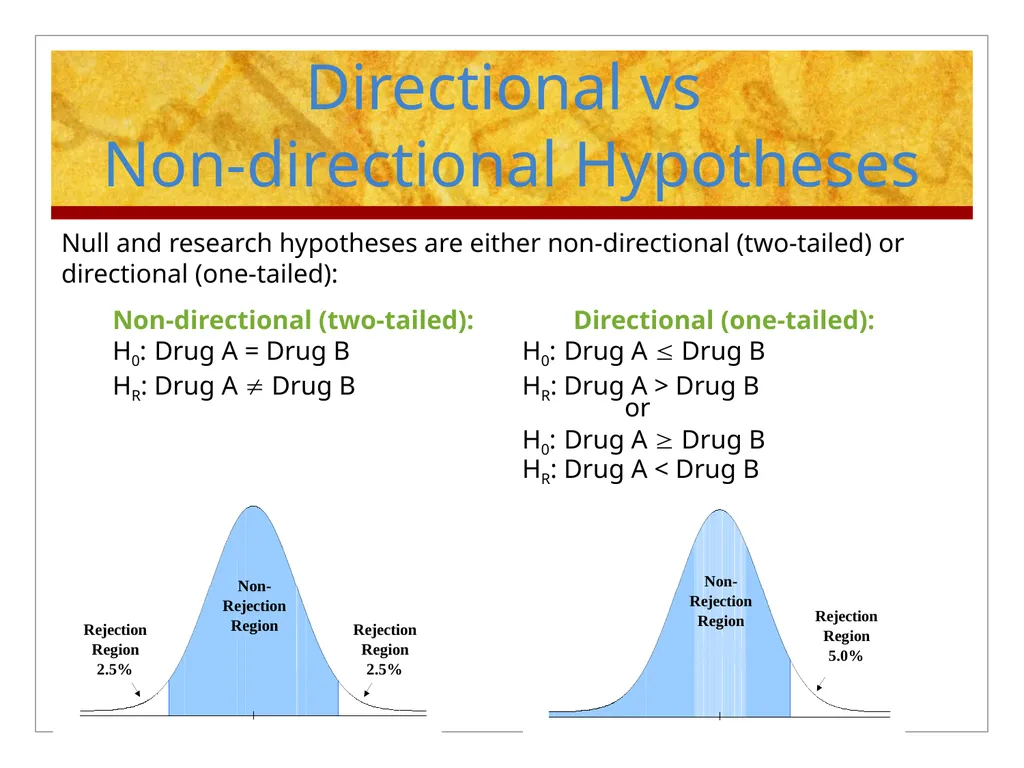
Non-directional Hypotheses Null and research hypotheses are either non-directional (two-tailed) or directional (one-tailed):
Non-directional (two-tailed): Directional (one-tailed):
H0: Drug A = Drug B H0: Drug A Drug B
HR: Drug A Drug B HR: Drug A > Drug B
or
H0: Drug A Drug B
HR: Drug A < Drug B<br>
Non-directional (two-tailed): Directional (one-tailed):
H0: Drug A = Drug B H0: Drug A Drug B
HR: Drug A Drug B HR: Drug A > Drug B
or
H0: Drug A Drug B
HR: Drug A < Drug B<br>
08
Example:
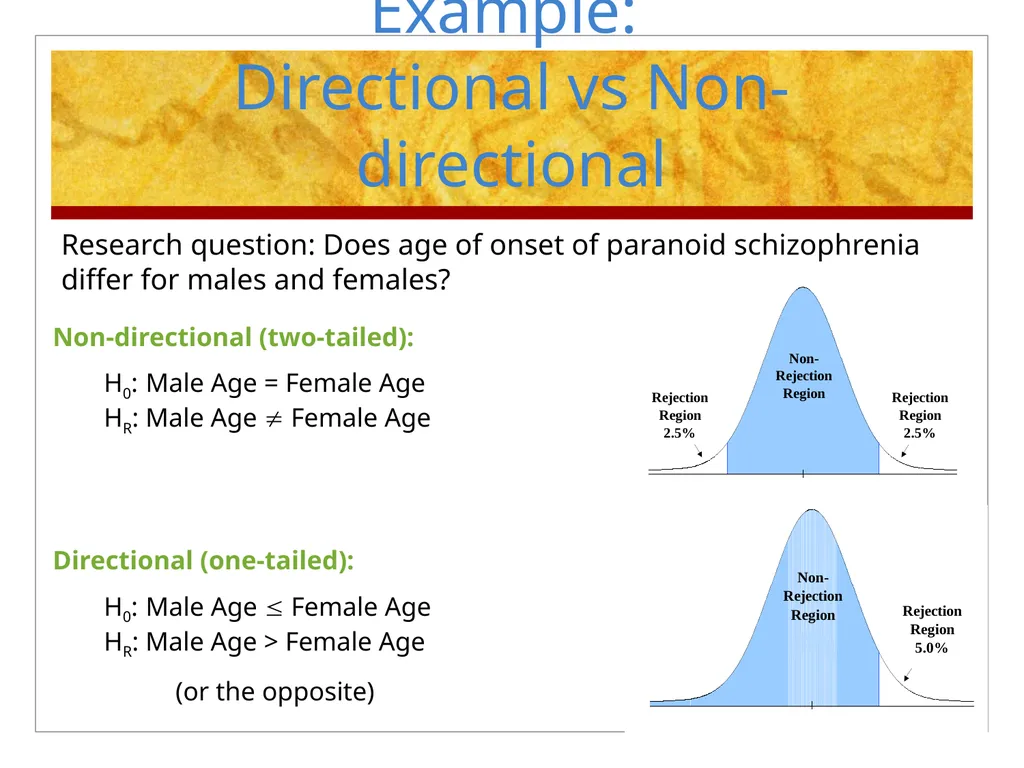
Directional vs Non-directional Research question: Does age of onset of paranoid schizophrenia differ for males and females? Non-directional (two-tailed):
H0: Male Age = Female Age
HR: Male Age Female Age
Directional (one-tailed):
H0: Male Age Female Age
HR: Male Age > Female Age
(or the opposite)<br>
H0: Male Age = Female Age
HR: Male Age Female Age
Directional (one-tailed):
H0: Male Age Female Age
HR: Male Age > Female Age
(or the opposite)<br>
09
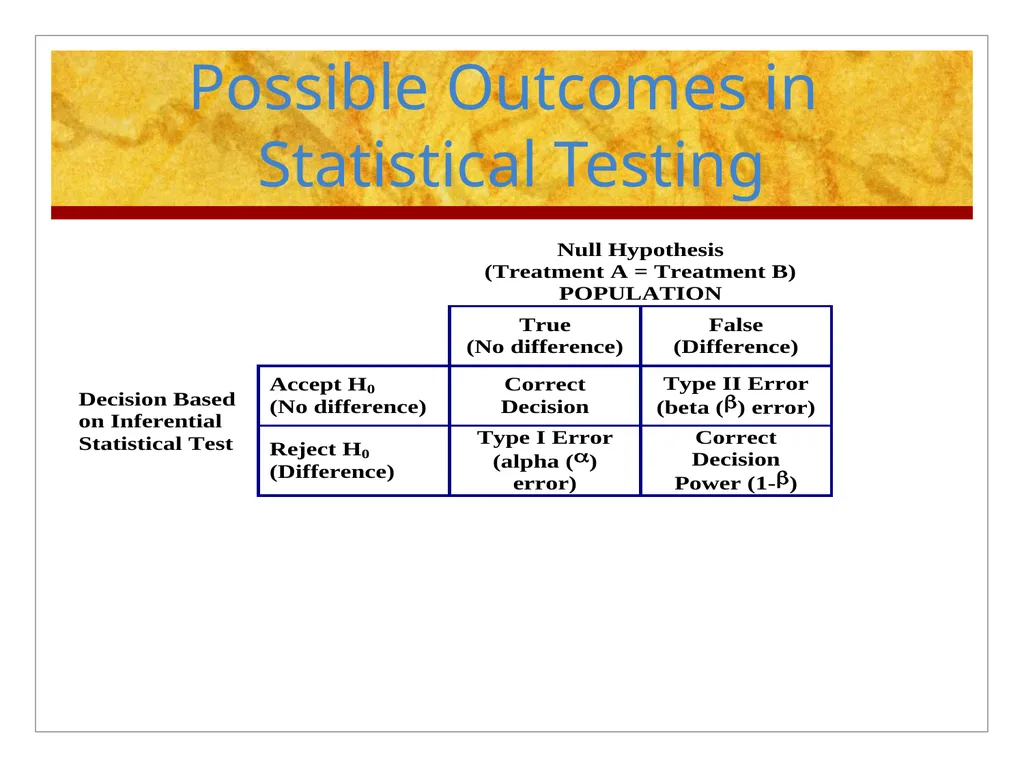
Step 2: Set Alpha (Type I) and Beta (Type II) Errors Alpha () is the level of significance in hypothesis testing:
Alpha is a probability specified before the test is performed.
Alpha is the probability of rejecting the null hypothesis when it is true.
By convention, typical values of alpha specified in medical research are 0.05 and 0.01.
Alphas have corresponding critical values, the same ones used to calculate confidence intervals – 0.05/1.96, 0.01/2.575<br>
10
Step 2: Set Alpha (Type I) and Beta (Type II) Errors Beta () is the probability of accepting the null hypothesis when it is false.
Typical values for beta are 0.10 to 0.20
Beta is directly related to the power of a statistical test:
Power is the probability of correctly rejecting the null hypothesis when it is false. Power = 1 - Beta
A type II error occurs when a false null hypothesis is accepted.<br>
Typical values for beta are 0.10 to 0.20
Beta is directly related to the power of a statistical test:
Power is the probability of correctly rejecting the null hypothesis when it is false. Power = 1 - Beta
A type II error occurs when a false null hypothesis is accepted.<br>
11
P-values P-values are the actual probabilities calculated from a statistical test, and are compared against alpha to determine whether to reject the null hypothesis or not.
Example:
alpha = 0.05; calculated p-value = 0.008; reject null hypothesis
alpha = 0.05; calculated p-value = 0.110; do not reject null hypothesis
A type I error occurs when a true null hypothesis is rejected.<br>
Example:
alpha = 0.05; calculated p-value = 0.008; reject null hypothesis
alpha = 0.05; calculated p-value = 0.110; do not reject null hypothesis
A type I error occurs when a true null hypothesis is rejected.<br>
12
Possible Outcomes in
Statistical Testing<br>
13
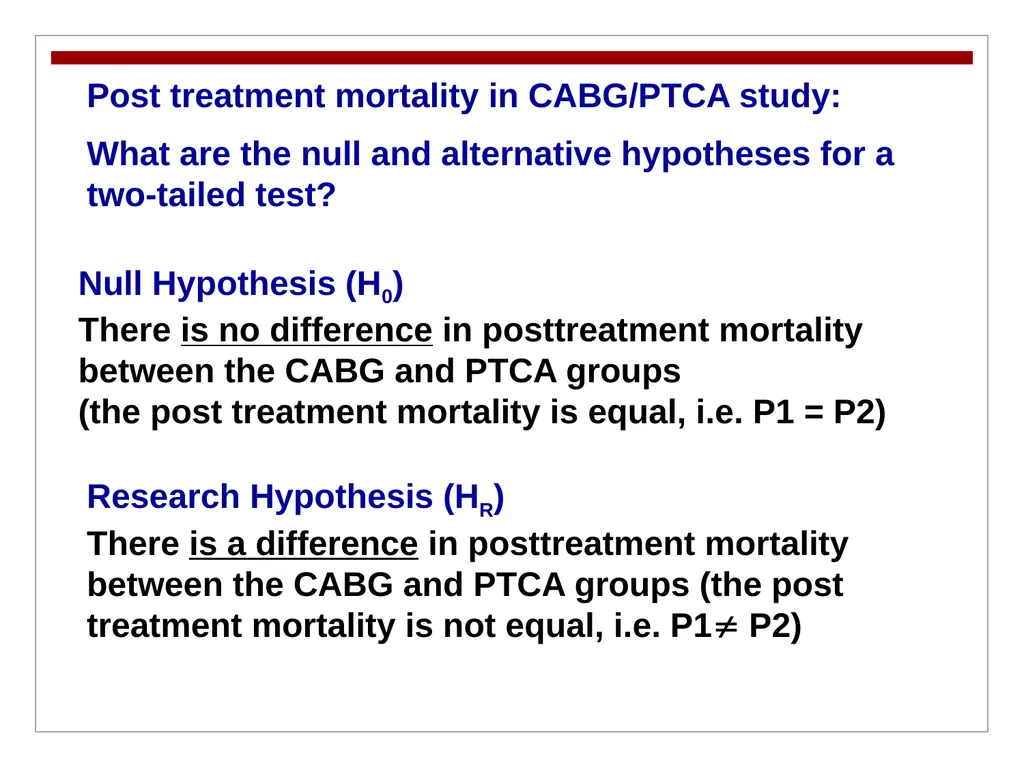
Null Hypothesis (H0)
There is no difference in posttreatment mortality between the CABG and PTCA groups
(the post treatment mortality is equal, i.e. P1 = P2) Post treatment mortality in CABG/PTCA study:
What are the null and alternative hypotheses for a two-tailed test? Research Hypothesis (HR)
There is a difference in posttreatment mortality between the CABG and PTCA groups (the post treatment mortality is not equal, i.e. P1 P2)<br>
14
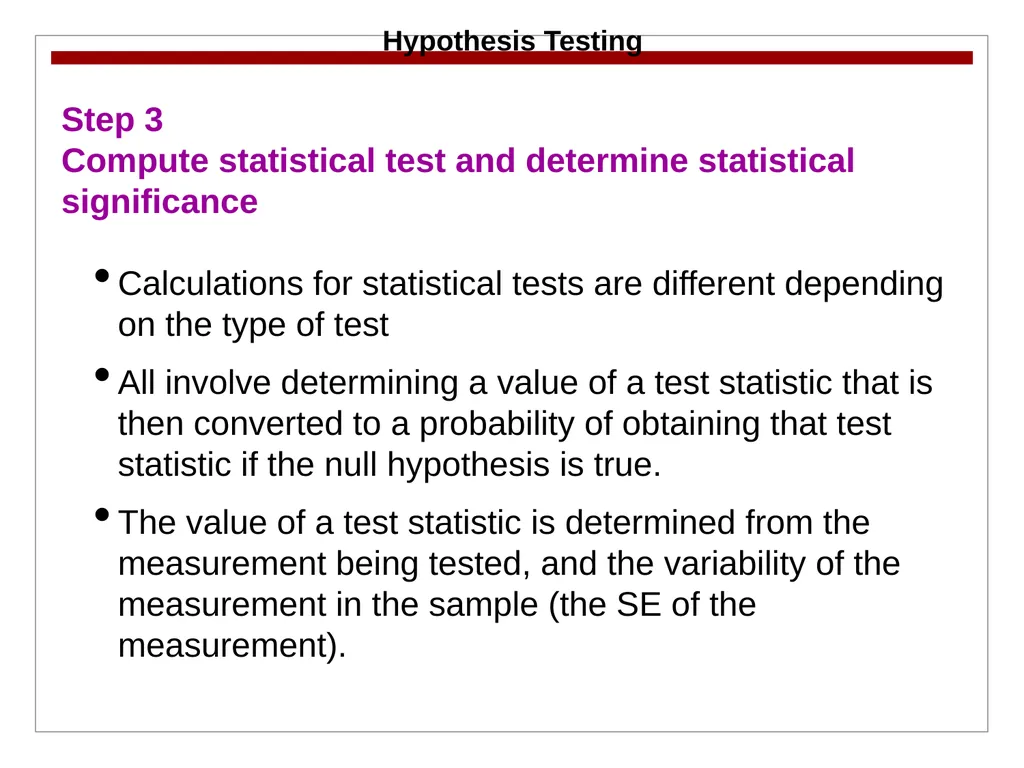
Step 3
Compute statistical test and determine statistical significance
Calculations for statistical tests are different depending on the type of test
All involve determining a value of a test statistic that is then converted to a probability of obtaining that test statistic if the null hypothesis is true.
The value of a test statistic is determined from the measurement being tested, and the variability of the measurement in the sample (the SE of the measurement). Hypothesis Testing<br>
15
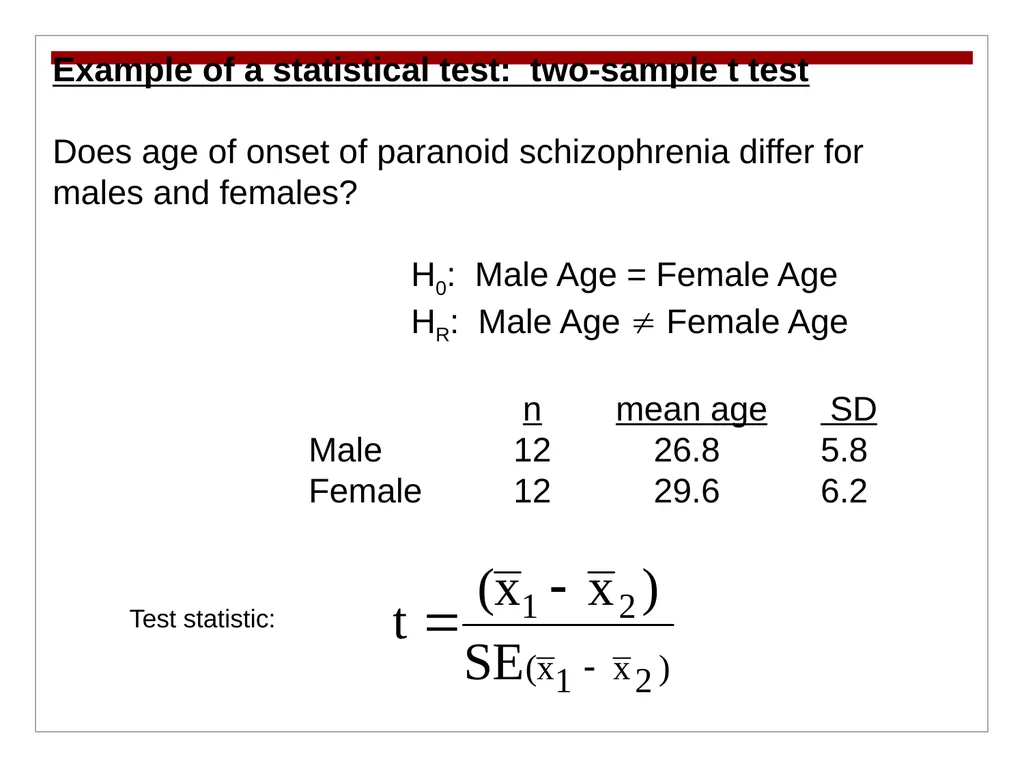
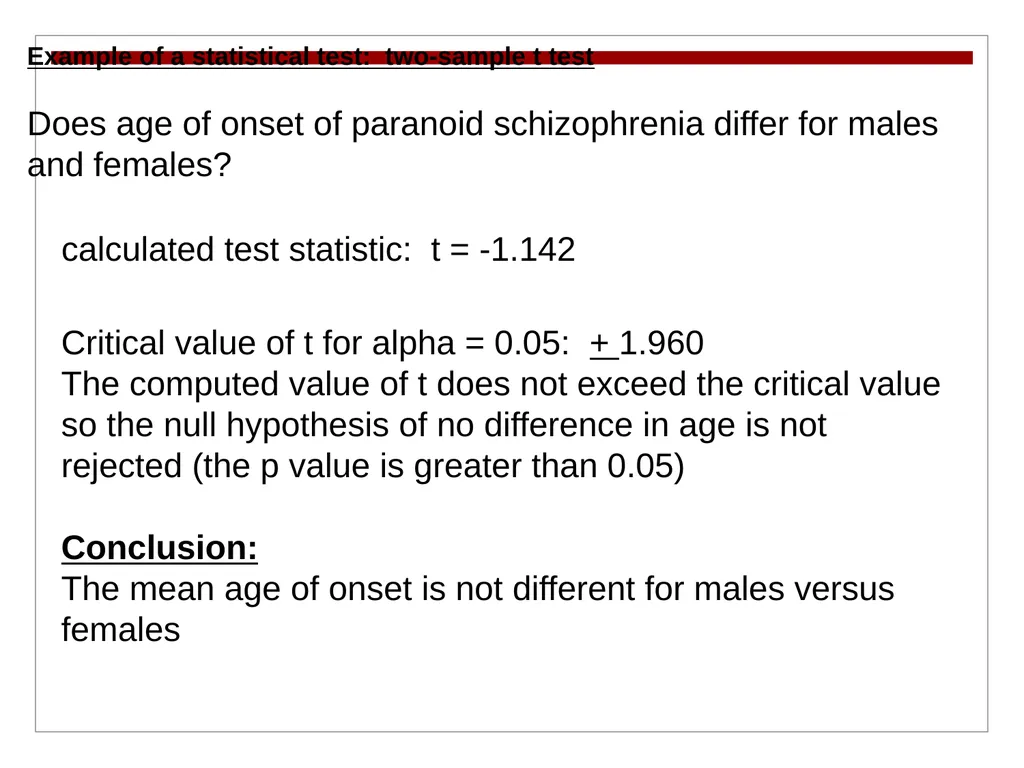
Example of a statistical test: two-sample t test
Does age of onset of paranoid schizophrenia differ for males and females?
H0: Male Age = Female Age
HR: Male Age Female Age
n mean age SD
Male 12 26.8 5.8
Female 12 29.6 6.2 Test statistic:<br>
Does age of onset of paranoid schizophrenia differ for males and females?
H0: Male Age = Female Age
HR: Male Age Female Age
n mean age SD
Male 12 26.8 5.8
Female 12 29.6 6.2 Test statistic:<br>
16
Example of a statistical test: two-sample t test
Does age of onset of paranoid schizophrenia differ for males and females? calculated test statistic: t = -1.142 Critical value of t for alpha = 0.05: + 1.960
The computed value of t does not exceed the critical value so the null hypothesis of no difference in age is not rejected (the p value is greater than 0.05)
Conclusion:
The mean age of onset is not different for males versus females<br>
17
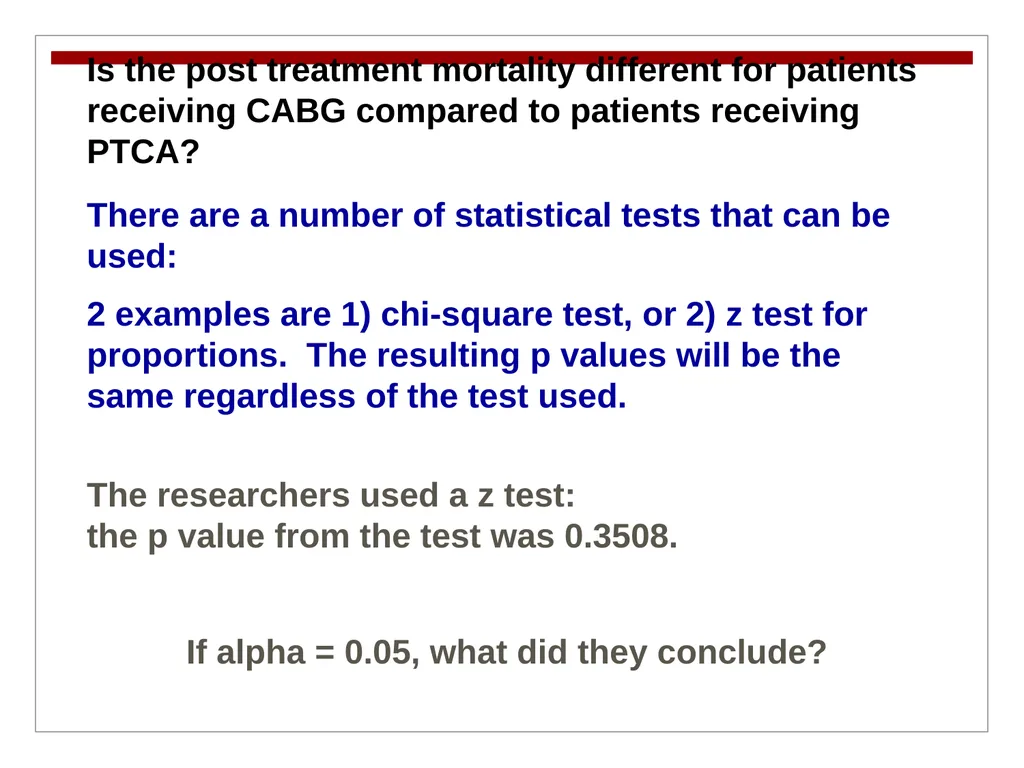
There are a number of statistical tests that can be used:
2 examples are 1) chi-square test, or 2) z test for proportions. The resulting p values will be the same regardless of the test used.
The researchers used a z test:
the p value from the test was 0.3508.
If alpha = 0.05, what did they conclude? Is the post treatment mortality different for patients receiving CABG compared to patients receiving PTCA?<br>
18
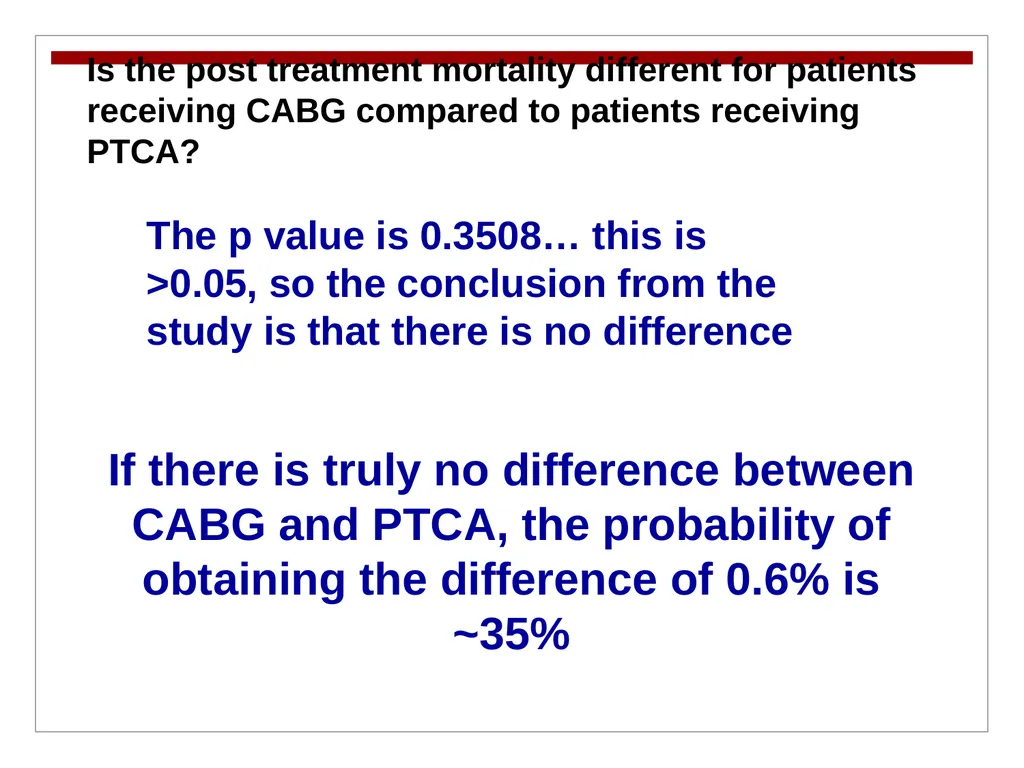
The p value is 0.3508… this is >0.05, so the conclusion from the study is that there is no difference Is the post treatment mortality different for patients receiving CABG compared to patients receiving PTCA? If there is truly no difference between CABG and PTCA, the probability of obtaining the difference of 0.6% is ~35%<br>
19
Step 4
Draw conclusion about the population based on the results of the statistical test on the sample
Statistical conclusion: the results either are or are not statistically significant………
BUT
You need to interpret the results in a meaningful (and not just statistical) way Hypothesis Testing<br>
Draw conclusion about the population based on the results of the statistical test on the sample
Statistical conclusion: the results either are or are not statistically significant………
BUT
You need to interpret the results in a meaningful (and not just statistical) way Hypothesis Testing<br>
20
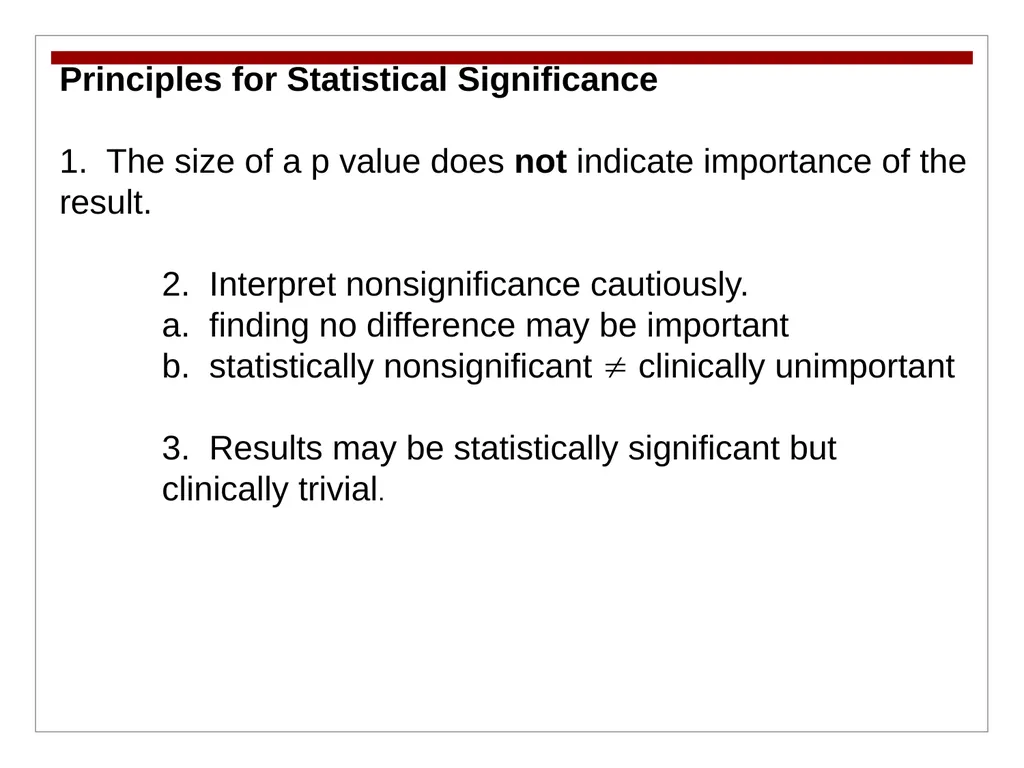
Principles for Statistical Significance
1. The size of a p value does not indicate importance of the result.
2. Interpret nonsignificance cautiously.
a. finding no difference may be important
b. statistically nonsignificant clinically unimportant
3. Results may be statistically significant but clinically trivial.<br>
1. The size of a p value does not indicate importance of the result.
2. Interpret nonsignificance cautiously.
a. finding no difference may be important
b. statistically nonsignificant clinically unimportant
3. Results may be statistically significant but clinically trivial.<br>
21
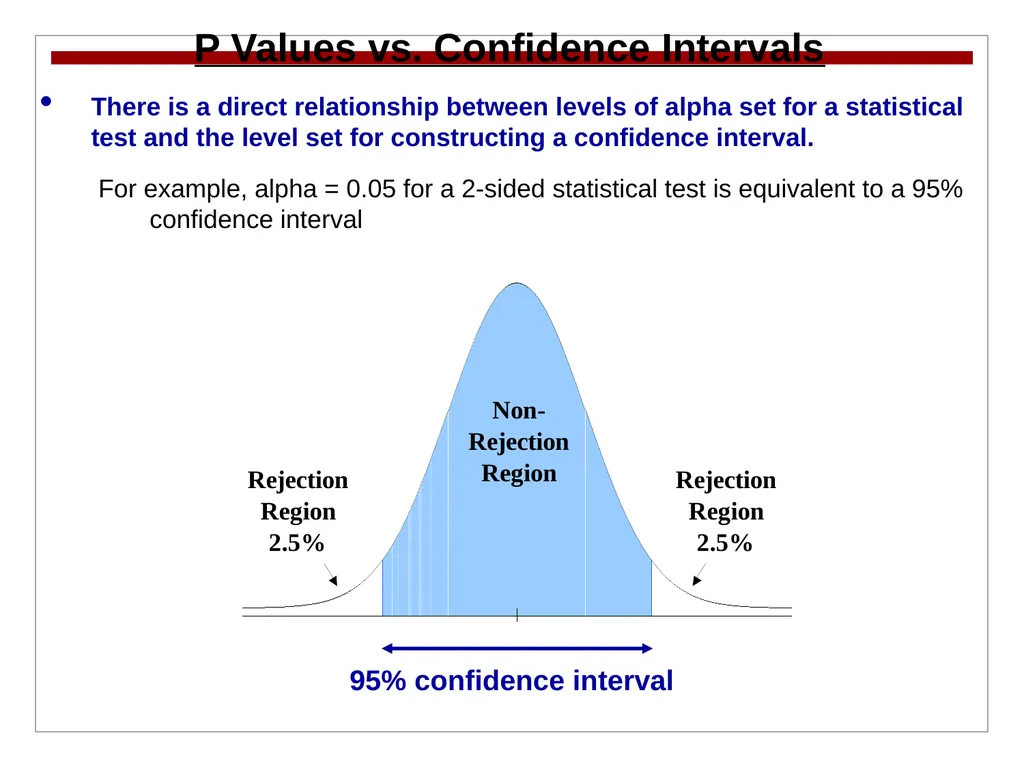
P Values vs. Confidence Intervals
There is a direct relationship between levels of alpha set for a statistical test and the level set for constructing a confidence interval.
For example, alpha = 0.05 for a 2-sided statistical test is equivalent to a 95% confidence interval<br>
There is a direct relationship between levels of alpha set for a statistical test and the level set for constructing a confidence interval.
For example, alpha = 0.05 for a 2-sided statistical test is equivalent to a 95% confidence interval<br>
22
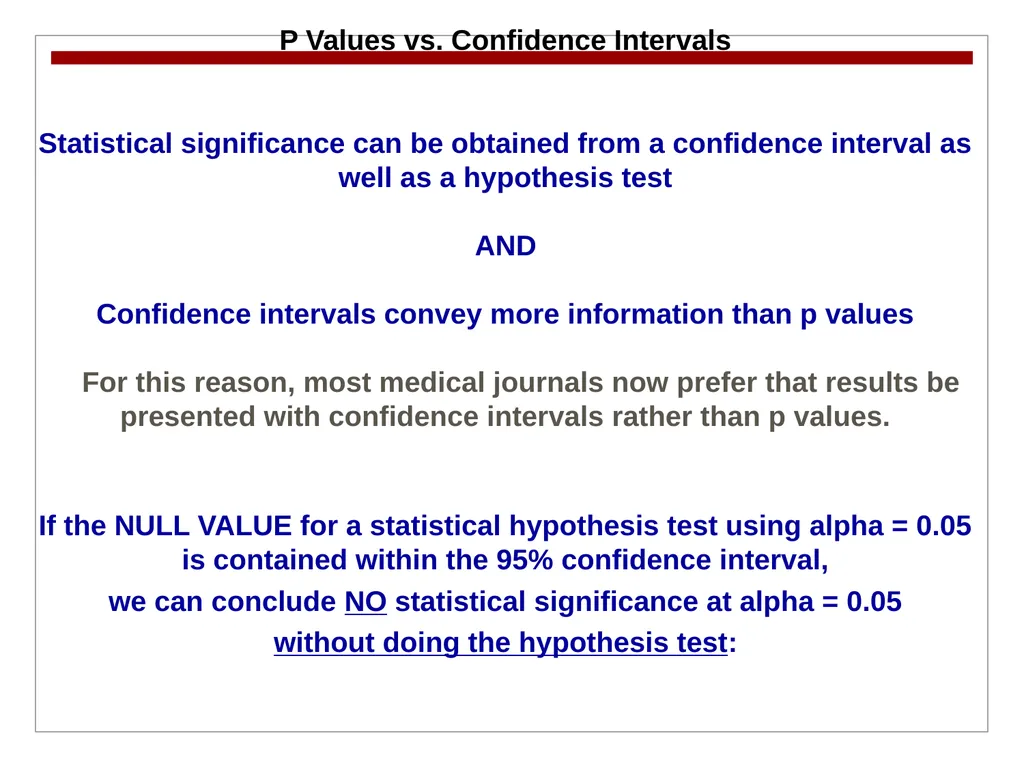
P Values vs. Confidence Intervals
Statistical significance can be obtained from a confidence interval as well as a hypothesis test
AND
Confidence intervals convey more information than p values
For this reason, most medical journals now prefer that results be presented with confidence intervals rather than p values.
If the NULL VALUE for a statistical hypothesis test using alpha = 0.05 is contained within the 95% confidence interval,
we can conclude NO statistical significance at alpha = 0.05
without doing the hypothesis test:<br>
23
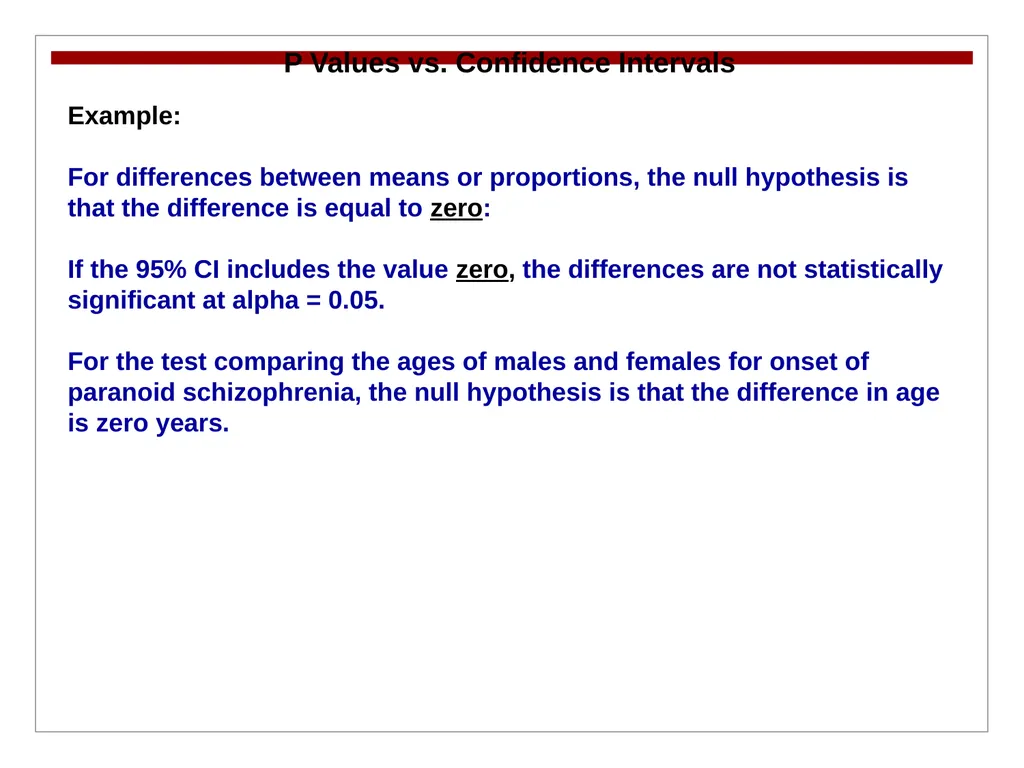
P Values vs. Confidence Intervals Example:
For differences between means or proportions, the null hypothesis is that the difference is equal to zero:
If the 95% CI includes the value zero, the differences are not statistically significant at alpha = 0.05.
For the test comparing the ages of males and females for onset of paranoid schizophrenia, the null hypothesis is that the difference in age is zero years.<br>
24
P Values vs. Confidence Intervals Example:
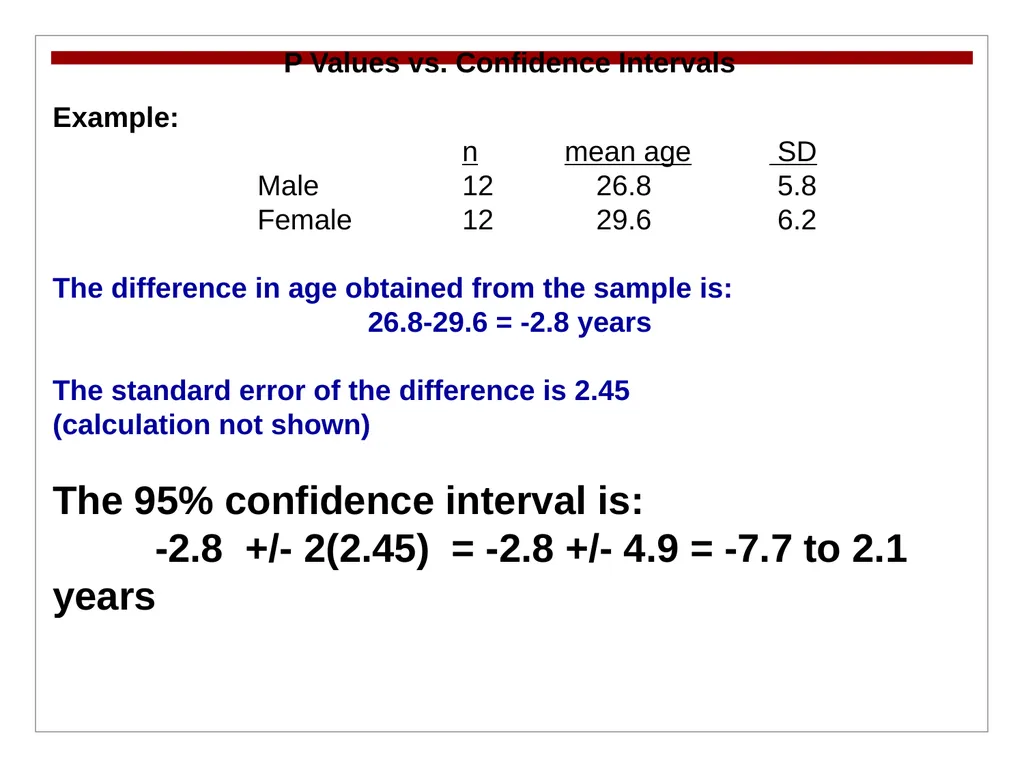
n mean age SD
Male 12 26.8 5.8
Female 12 29.6 6.2
The difference in age obtained from the sample is:
26.8-29.6 = -2.8 years
The standard error of the difference is 2.45
(calculation not shown)
The 95% confidence interval is:
-2.8 +/- 2(2.45) = -2.8 +/- 4.9 = -7.7 to 2.1 years<br>
n mean age SD
Male 12 26.8 5.8
Female 12 29.6 6.2
The difference in age obtained from the sample is:
26.8-29.6 = -2.8 years
The standard error of the difference is 2.45
(calculation not shown)
The 95% confidence interval is:
-2.8 +/- 2(2.45) = -2.8 +/- 4.9 = -7.7 to 2.1 years<br>
25
P Values vs. Confidence Intervals The 95% confidence interval is:
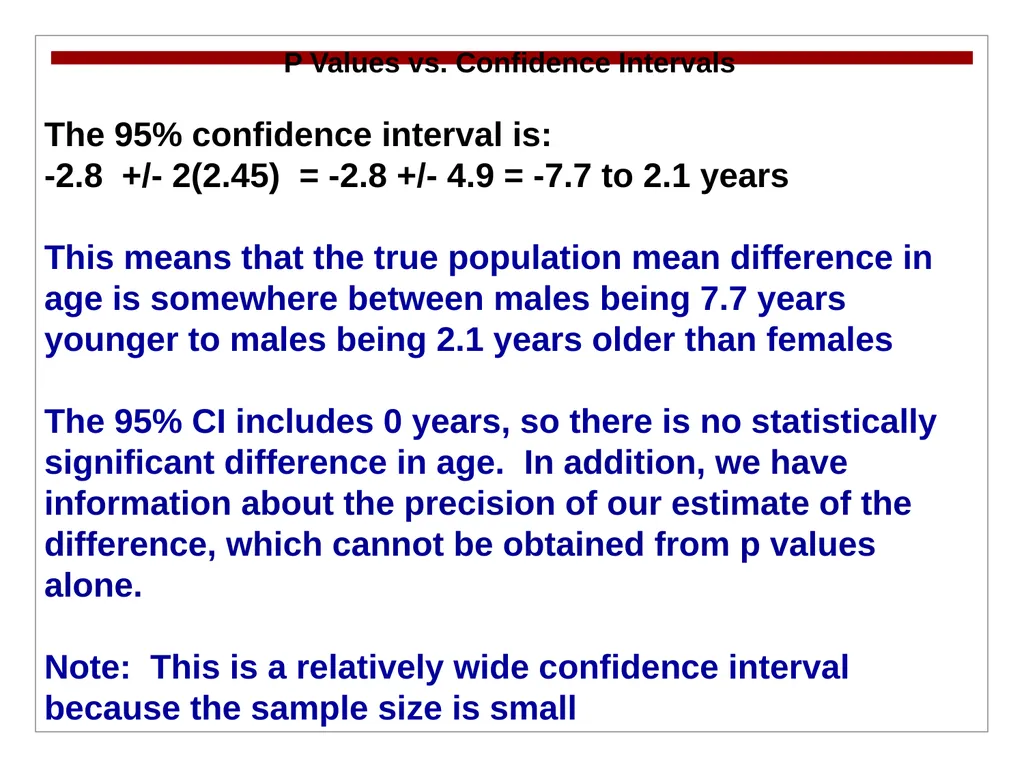
-2.8 +/- 2(2.45) = -2.8 +/- 4.9 = -7.7 to 2.1 years
This means that the true population mean difference in age is somewhere between males being 7.7 years younger to males being 2.1 years older than females
The 95% CI includes 0 years, so there is no statistically significant difference in age. In addition, we have information about the precision of our estimate of the difference, which cannot be obtained from p values alone.
Note: This is a relatively wide confidence interval because the sample size is small<br>
26
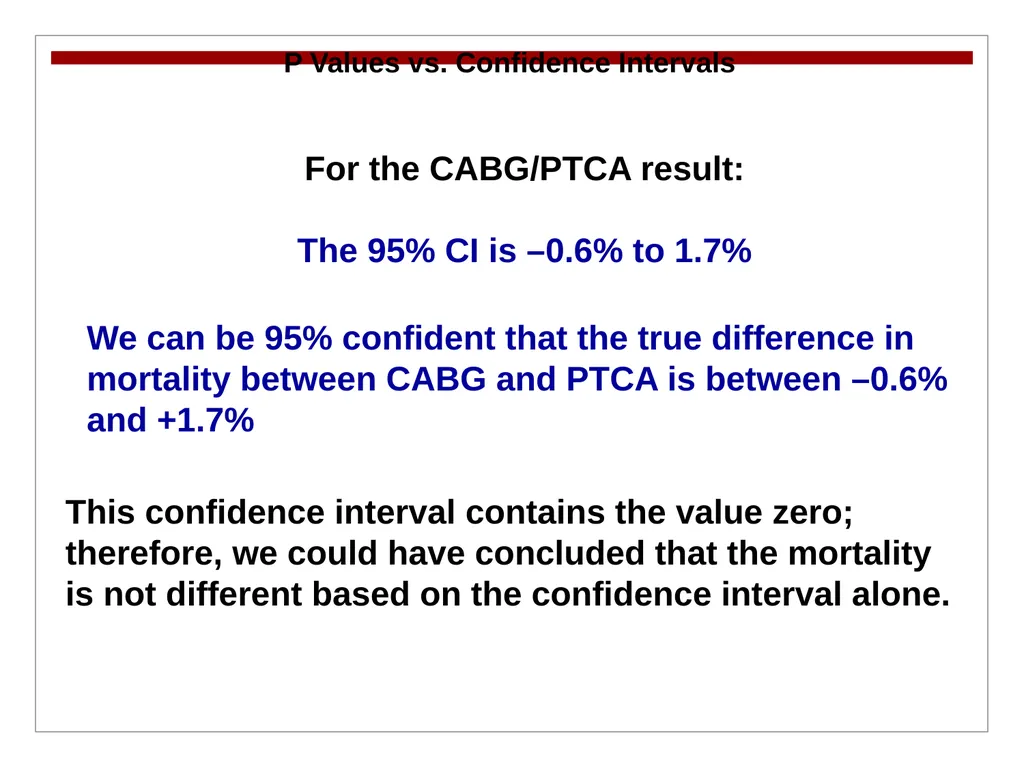
P Values vs. Confidence Intervals We can be 95% confident that the true difference in mortality between CABG and PTCA is between –0.6% and +1.7% For the CABG/PTCA result:
The 95% CI is –0.6% to 1.7% This confidence interval contains the value zero; therefore, we could have concluded that the mortality is not different based on the confidence interval alone.<br>
The 95% CI is –0.6% to 1.7% This confidence interval contains the value zero; therefore, we could have concluded that the mortality is not different based on the confidence interval alone.<br>
27
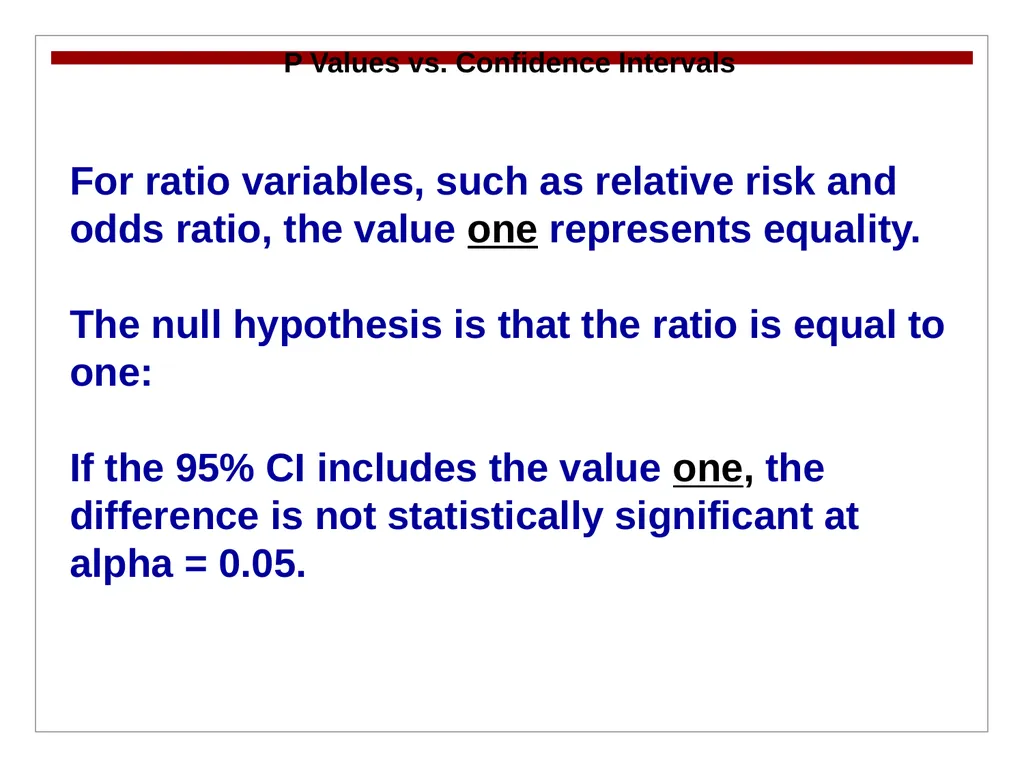
P Values vs. Confidence Intervals For ratio variables, such as relative risk and odds ratio, the value one represents equality.
The null hypothesis is that the ratio is equal to one:
If the 95% CI includes the value one, the difference is not statistically significant at alpha = 0.05.<br>
The null hypothesis is that the ratio is equal to one:
If the 95% CI includes the value one, the difference is not statistically significant at alpha = 0.05.<br>