I read papers related to pruning and reducing the size of neural networks. Most of the papers were about pruning during training and pruning after training a model. Initial notes: Unstructured and structured pruning, combine weight tensors
"I read papers related to pruning and reducing the" is the property of its rightful owner. Permission is granted to
download and print the materials on this website for personal, non-commercial use only, and to display it
on your personal computer provided you do not modify the materials and that you retain all copyright
notices contained in the materials. By downloading content from our website, you accept the terms of this
agreement.
Presentation Transcript
01
I read papers related to pruning and reducing the size of neural networks. Most of the papers were about pruning during training and pruning after training a model.
Initial notes:
Unstructured and structured pruning, combine weight tensors and channels
Pruning weights using the magnitude of weights, magnitude of gradients, or some other importance score
Keep pruned weights pruned or reactivate weights if needed
Pruning vs. quantization
In the following slides, DT = During Training, PT=Post Training<br>
02
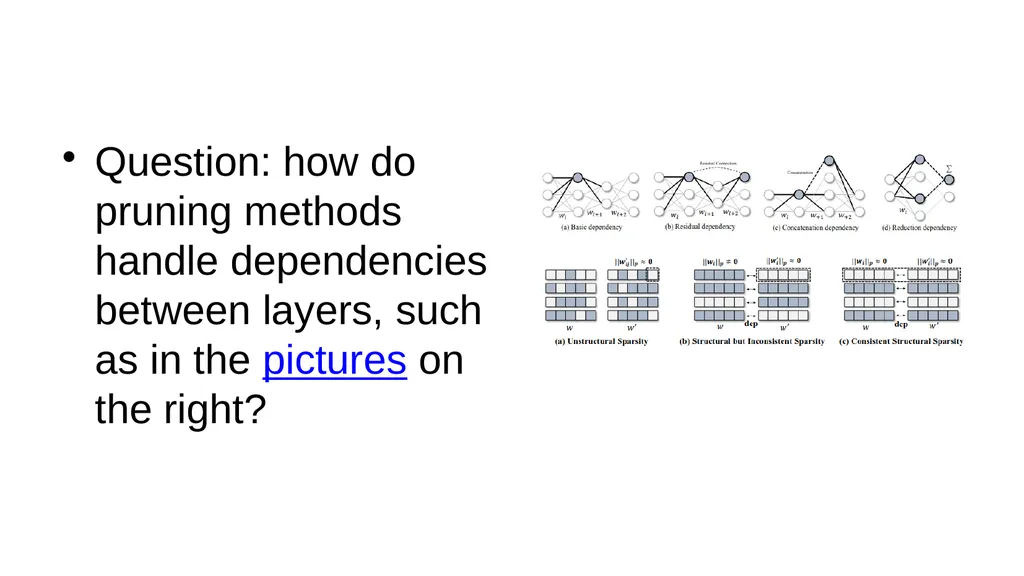
Question: how do pruning methods handle dependencies between layers, such as in the pictures on the right?<br>
03
Lottery ticket hypothesis Dense, randomly-initialized, feed-forward networks contain subnetworks (winning tickets) that — when trained in isolation — reach test accuracy comparable to the original network in a similar number of iterations
Leads to iterative pruning, where a dense network is trained for j iterations, after which a percentage of parameters is pruned, and a mask is created. Remaining parameters are reset to their initial values, and this is repeated, until the total % of pruned parameters is at a required level.
https://arxiv.org/abs/1803.03635
Lottery ticket hypothesis is investigated more here https://arxiv.org/abs/2210.03044
Learning rate rewinding: rewind only the learning rate, keep the weights as they are.<br>
04
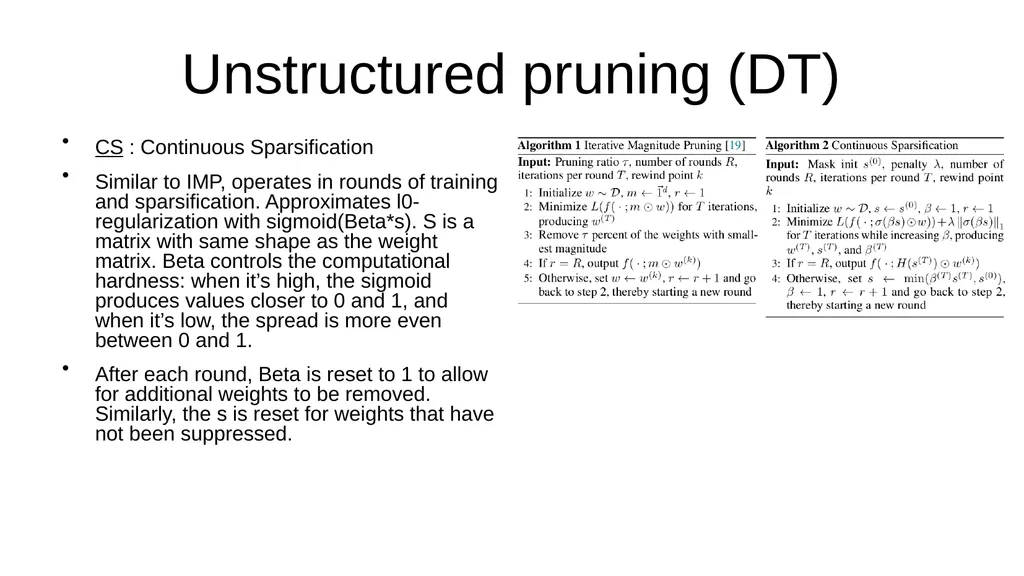
Unstructured pruning (DT) CS : Continuous Sparsification
Similar to IMP, operates in rounds of training and sparsification. Approximates l0-regularization with sigmoid(Beta*s). S is a matrix with same shape as the weight matrix. Beta controls the computational hardness: when it’s high, the sigmoid produces values closer to 0 and 1, and when it’s low, the spread is more even between 0 and 1.
After each round, Beta is reset to 1 to allow for additional weights to be removed. Similarly, the s is reset for weights that have not been suppressed.<br>
05
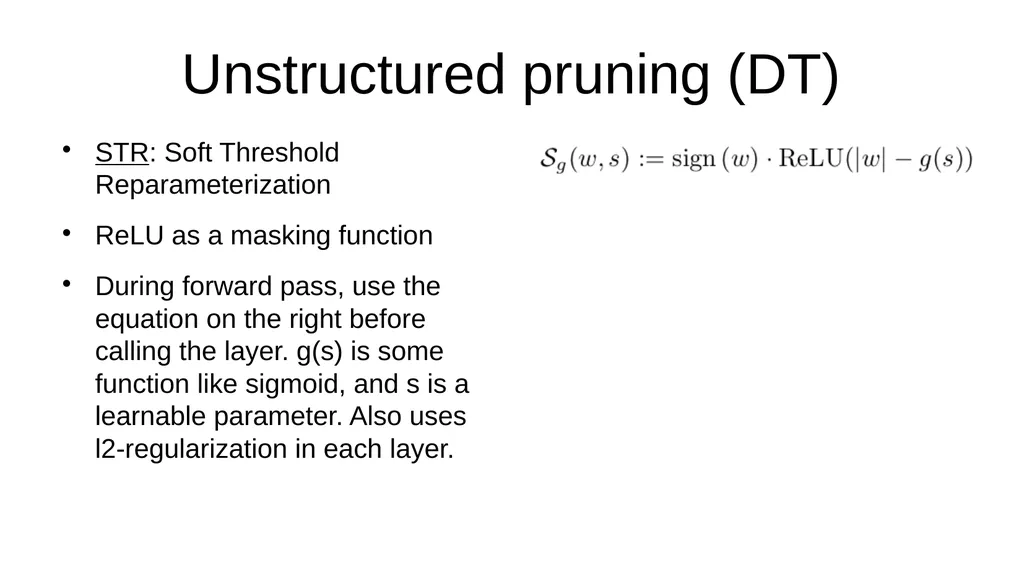
Unstructured pruning (DT) STR: Soft Threshold Reparameterization
ReLU as a masking function
During forward pass, use the equation on the right before calling the layer. g(s) is some function like sigmoid, and s is a learnable parameter. Also uses l2-regularization in each layer.<br>
06
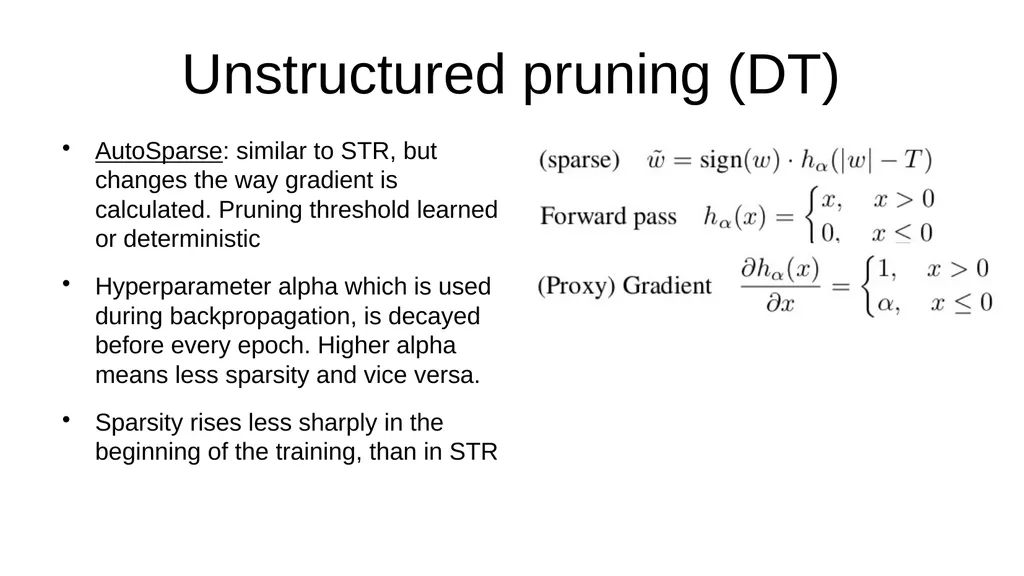
Unstructured pruning (DT) AutoSparse: similar to STR, but changes the way gradient is calculated. Pruning threshold learned or deterministic
Hyperparameter alpha which is used during backpropagation, is decayed before every epoch. Higher alpha means less sparsity and vice versa.
Sparsity rises less sharply in the beginning of the training, than in STR<br>
07
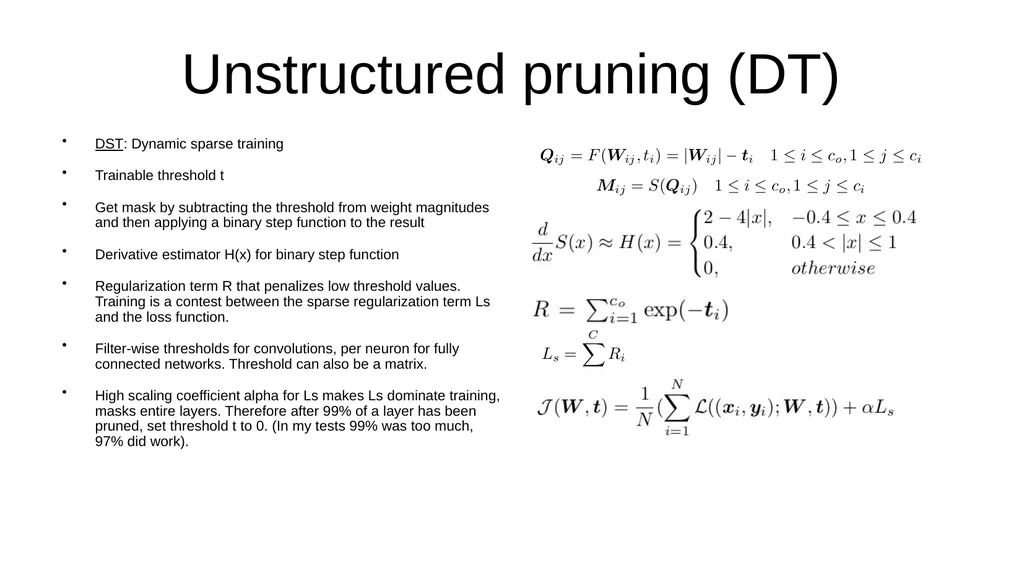
Unstructured pruning (DT) DST: Dynamic sparse training
Trainable threshold t
Get mask by subtracting the threshold from weight magnitudes and then applying a binary step function to the result
Derivative estimator H(x) for binary step function
Regularization term R that penalizes low threshold values. Training is a contest between the sparse regularization term Ls and the loss function.
Filter-wise thresholds for convolutions, per neuron for fully connected networks. Threshold can also be a matrix.
High scaling coefficient alpha for Ls makes Ls dominate training, masks entire layers. Therefore after 99% of a layer has been pruned, set threshold t to 0. (In my tests 99% was too much, 97% did work).<br>
08
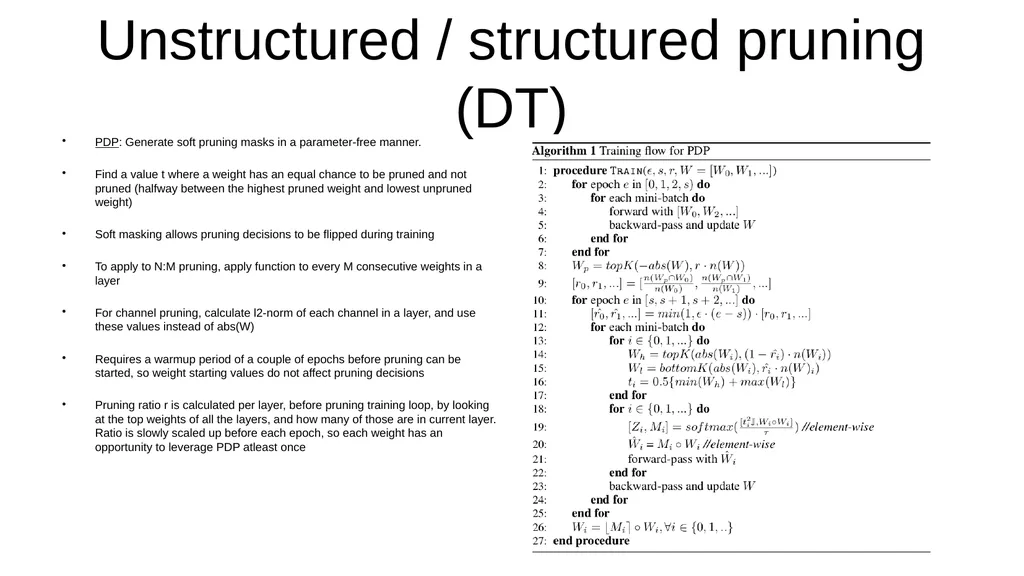
Unstructured / structured pruning (DT) PDP: Generate soft pruning masks in a parameter-free manner.
Find a value t where a weight has an equal chance to be pruned and not pruned (halfway between the highest pruned weight and lowest unpruned weight)
Soft masking allows pruning decisions to be flipped during training
To apply to N:M pruning, apply function to every M consecutive weights in a layer
For channel pruning, calculate l2-norm of each channel in a layer, and use these values instead of abs(W)
Requires a warmup period of a couple of epochs before pruning can be started, so weight starting values do not affect pruning decisions
Pruning ratio r is calculated per layer, before pruning training loop, by looking at the top weights of all the layers, and how many of those are in current layer. Ratio is slowly scaled up before each epoch, so each weight has an opportunity to leverage PDP atleast once<br>
09
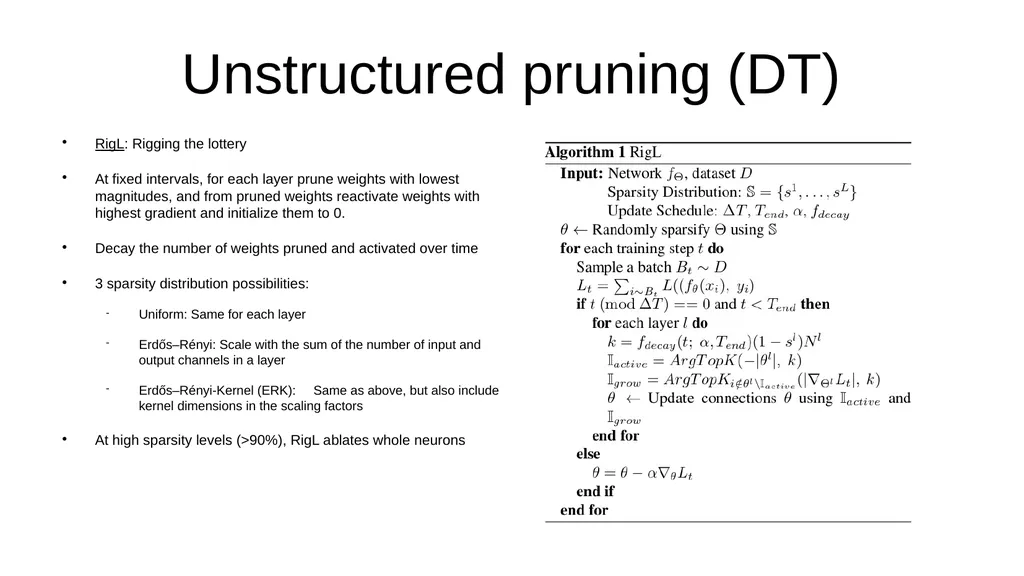
Unstructured pruning (DT) RigL: Rigging the lottery
At fixed intervals, for each layer prune weights with lowest magnitudes, and from pruned weights reactivate weights with highest gradient and initialize them to 0.
Decay the number of weights pruned and activated over time
3 sparsity distribution possibilities:
Uniform: Same for each layer
Erdős–Rényi: Scale with the sum of the number of input and output channels in a layer
Erdős–Rényi-Kernel (ERK): Same as above, but also include kernel dimensions in the scaling factors
At high sparsity levels (>90%), RigL ablates whole neurons<br>
10
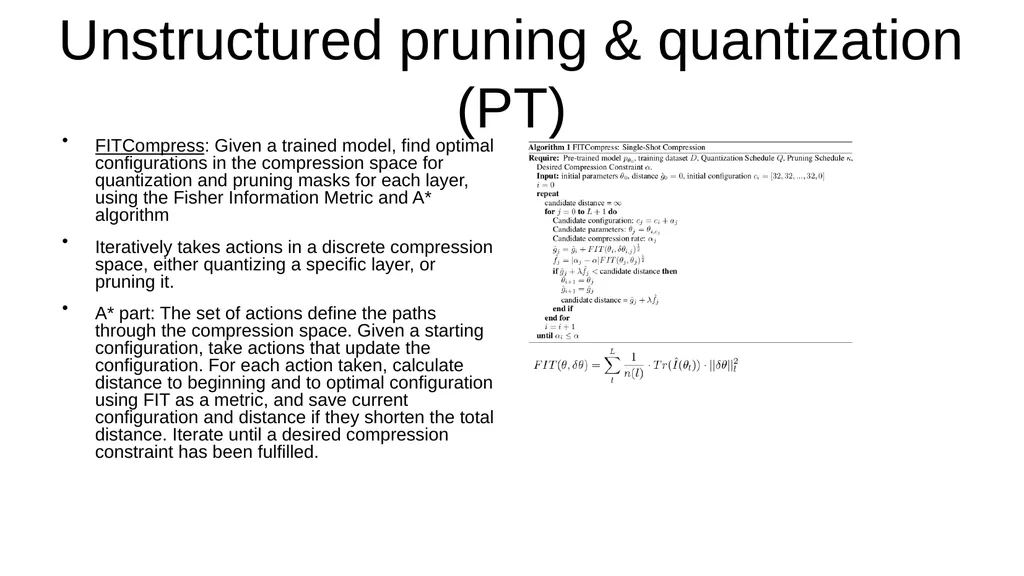
Unstructured pruning & quantization (PT) FITCompress: Given a trained model, find optimal configurations in the compression space for quantization and pruning masks for each layer, using the Fisher Information Metric and A* algorithm
Iteratively takes actions in a discrete compression space, either quantizing a specific layer, or pruning it.
A* part: The set of actions define the paths through the compression space. Given a starting configuration, take actions that update the configuration. For each action taken, calculate distance to beginning and to optimal configuration using FIT as a metric, and save current configuration and distance if they shorten the total distance. Iterate until a desired compression constraint has been fulfilled.<br>
11
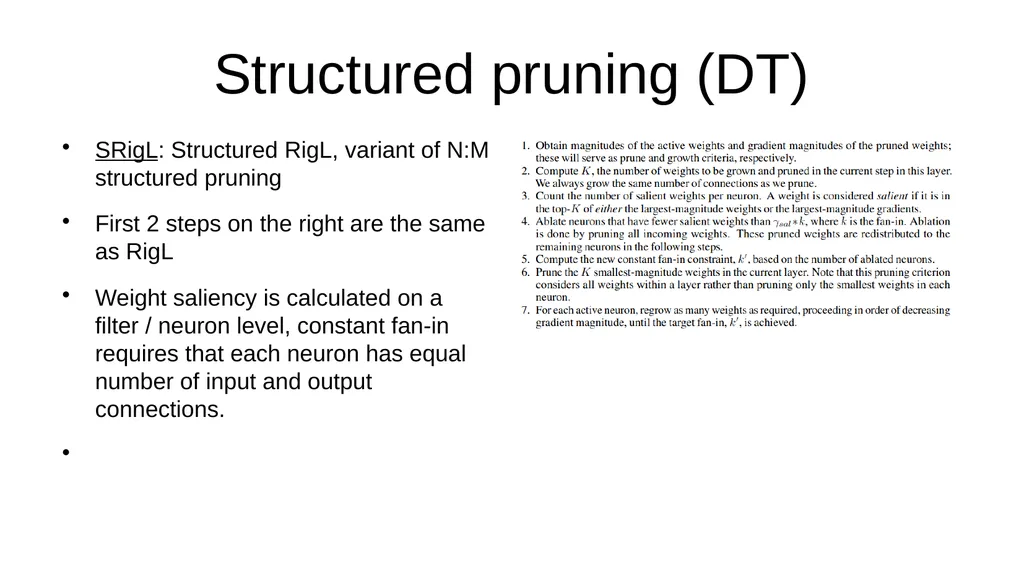
Structured pruning (DT) SRigL: Structured RigL, variant of N:M structured pruning
First 2 steps on the right are the same as RigL
Weight saliency is calculated on a filter / neuron level, constant fan-in requires that each neuron has equal number of input and output connections.<br>
12
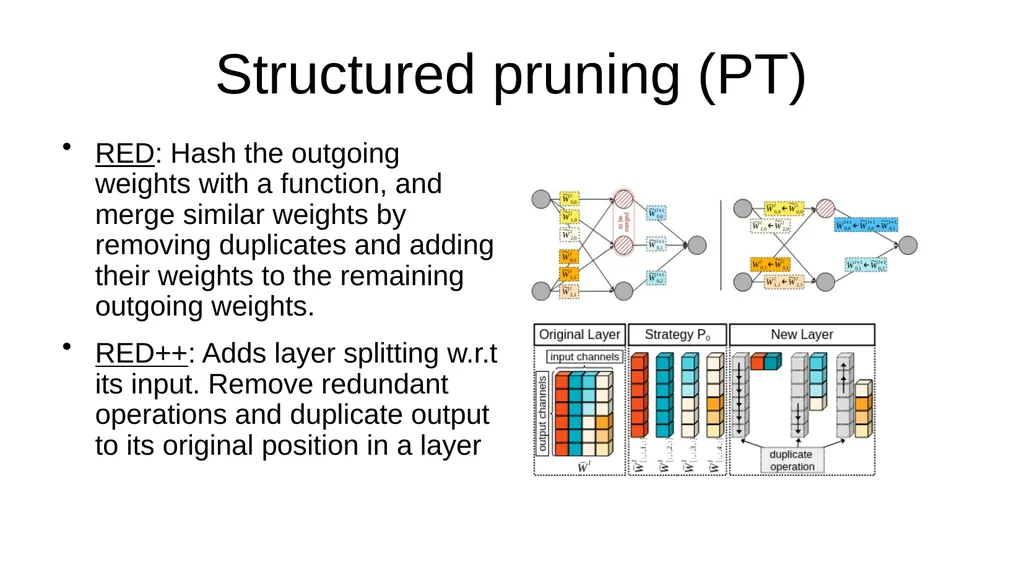
Structured pruning (PT) RED: Hash the outgoing weights with a function, and merge similar weights by removing duplicates and adding their weights to the remaining outgoing weights.
RED++: Adds layer splitting w.r.t its input. Remove redundant operations and duplicate output to its original position in a layer<br>
13
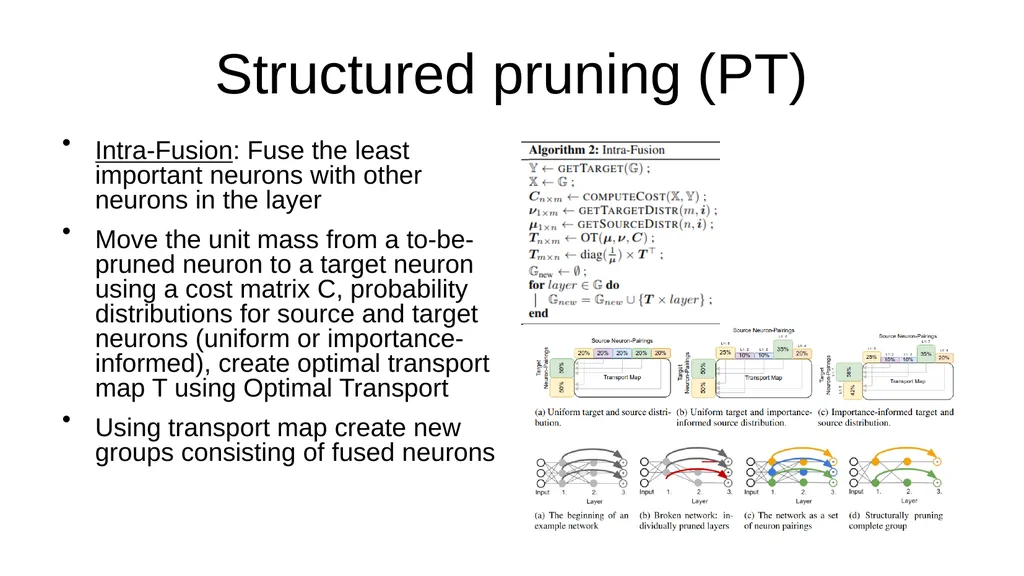
Structured pruning (PT) Intra-Fusion: Fuse the least important neurons with other neurons in the layer
Move the unit mass from a to-be-pruned neuron to a target neuron using a cost matrix C, probability distributions for source and target neurons (uniform or importance-informed), create optimal transport map T using Optimal Transport
Using transport map create new groups consisting of fused neurons<br>
14
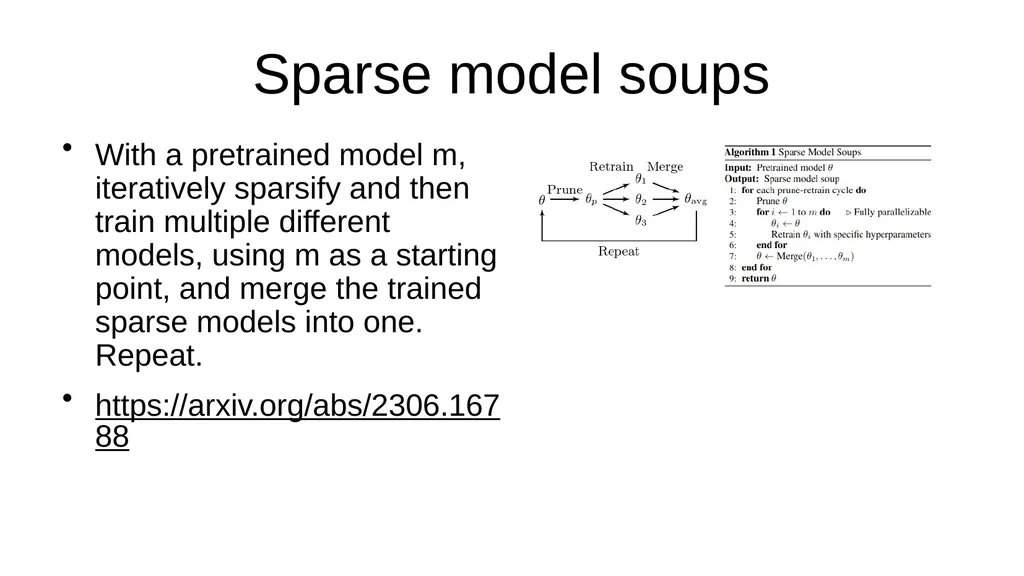
Sparse model soups With a pretrained model m, iteratively sparsify and then train multiple different models, using m as a starting point, and merge the trained sparse models into one. Repeat.
https://arxiv.org/abs/2306.16788<br>
15
Other pruning selection criterias Activation based pruning: using a trained model, iterate n-samples and save activation values of each weight. Prune weights that have an average activation value below some threshold t.
Weight magnitude + input activation based pruning:weight importance is decided based on element-wise multiplication between a weight magnitude and the norm of its input activations
Latency-driven structured pruning (PT): Create a lookup table for neuron latencies. When considering which neurons to prune, consider not only their importance score, but also their latency score. Can also look at groups of neurons, such as channels, or channels from other layers connected to current layer via skip connections.<br>
16
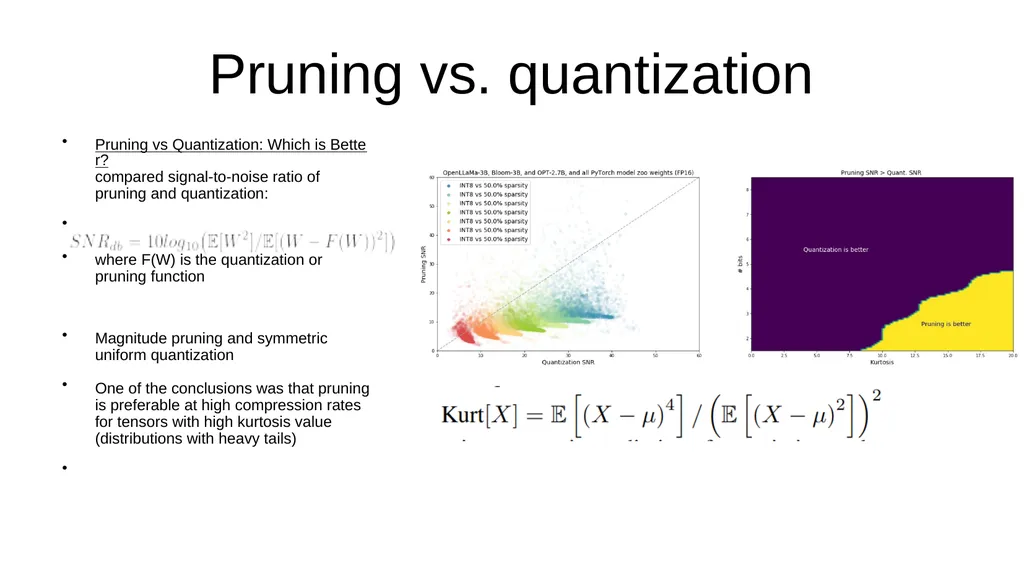
Pruning vs. quantization Pruning vs Quantization: Which is Better?compared signal-to-noise ratio of pruning and quantization:
where F(W) is the quantization or pruning function
Magnitude pruning and symmetric uniform quantization
One of the conclusions was that pruning is preferable at high compression rates for tensors with high kurtosis value (distributions with heavy tails)<br>