
IARC Benefit Plans World Vegetable Center 14 June
EM
Published · 89 slides · 0 views

1 / 1


































Description
IARC Benefit Plans World Vegetable Center 14 June 2018 Todays Topics About AIARC Retirement Plan Basics of Investing International Plan U.S. Plan Insurance Medical Evacuation Death Disability How your Insurance Works - Sample Scenarios
Related Topics
Share
Embed code
Download this presentation From Below
"IARC Benefit Plans World Vegetable Center 14 June" is the property of its rightful owner. Permission is granted to download and print the materials on this website for personal, non-commercial use only, and to display it on your personal computer provided you do not modify the materials and that you retain all copyright notices contained in the materials. By downloading content from our website, you accept the terms of this agreement.
Presentation Transcript
01
IARC Benefit Plans World Vegetable Center
14 June 2018<br>
14 June 2018<br>
02
Today’s Topics About AIARC
Retirement Plan
Basics of Investing
International Plan
U.S. Plan
Insurance
Medical & Evacuation
Death & Disability
How your Insurance Works - Sample Scenarios<br>
Retirement Plan
Basics of Investing
International Plan
U.S. Plan
Insurance
Medical & Evacuation
Death & Disability
How your Insurance Works - Sample Scenarios<br>
03
www.AIARC.org Brochures
Instructions
Forms
Contact information
Links to partner (vendor) information<br>
Instructions
Forms
Contact information
Links to partner (vendor) information<br>
04
About AIARC AIARC performs the following centralized management functions on behalf of its member Centers:
Disburses $150 million annually for payroll, retirement plan contributions, and insurance premiums;
Acts as the administrator and fiduciary for more than $480 million in retirement fund assets divided between a U.S. 403 (b) plan and an offshore plan located in Guernsey;
Acts as the administrator and contracting agent for insurance coverage for over 6,700 employees and dependents to include: medical, emergency evacuation, life, long-term disability, accidental death and dismemberment, and business travel accident; and
Serves as the paymaster and administrator for payroll services for over 1,500 employees in 83 countries worldwide.<br>
Disburses $150 million annually for payroll, retirement plan contributions, and insurance premiums;
Acts as the administrator and fiduciary for more than $480 million in retirement fund assets divided between a U.S. 403 (b) plan and an offshore plan located in Guernsey;
Acts as the administrator and contracting agent for insurance coverage for over 6,700 employees and dependents to include: medical, emergency evacuation, life, long-term disability, accidental death and dismemberment, and business travel accident; and
Serves as the paymaster and administrator for payroll services for over 1,500 employees in 83 countries worldwide.<br>
05
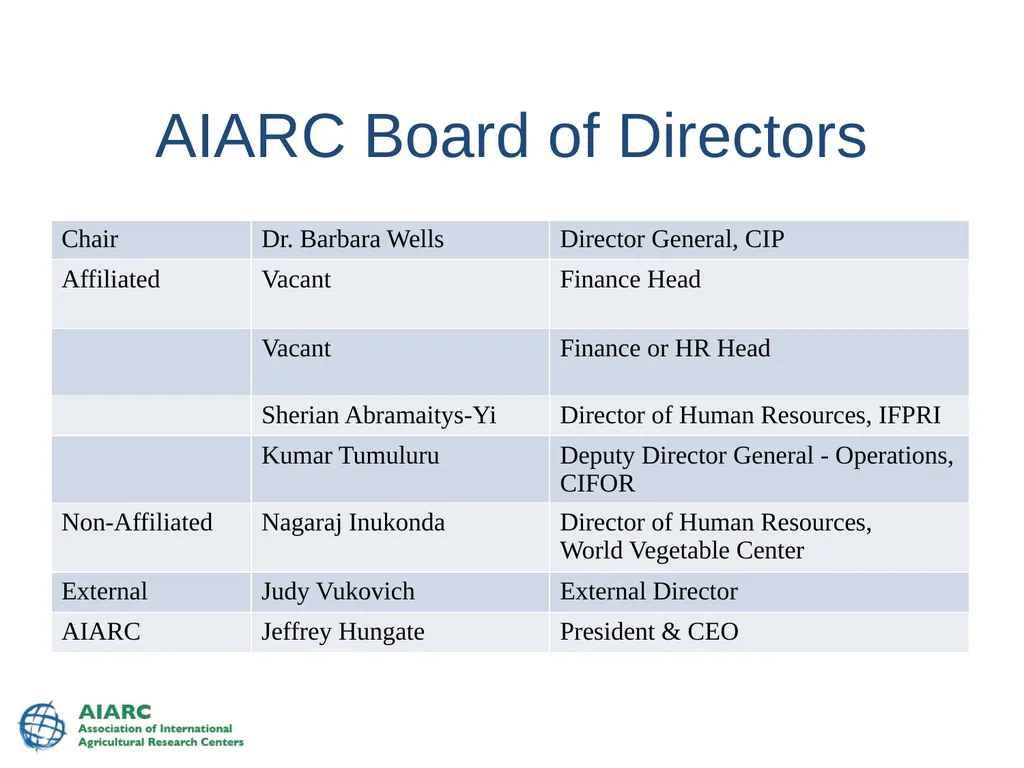
AIARC Board of Directors<br>
06
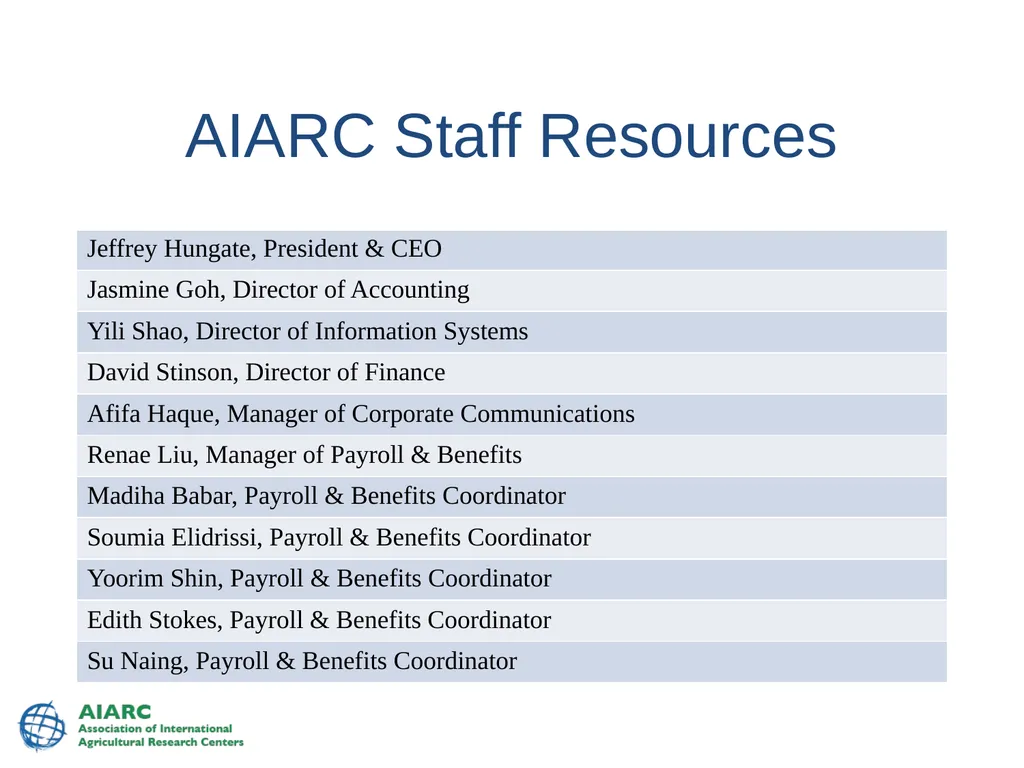
AIARC Staff Resources<br>
07
IARC Retirement Plan World Vegetable Center
14 June 2018<br>
14 June 2018<br>
08
Retirement Plan Topics Basic Concepts of Investing
Power of Compound Interest
Risk & Reward
International (Offshore) and U.S. Plans
Plan Structure
Eligibility / Contributions
Custodial Account / Oversight
Investment Fund Options
Platform Functions<br>
Power of Compound Interest
Risk & Reward
International (Offshore) and U.S. Plans
Plan Structure
Eligibility / Contributions
Custodial Account / Oversight
Investment Fund Options
Platform Functions<br>
09
Presentation Note Please note that:
AIARC is not an investment advisor, and
if you need personal advice about investments, you should consult with a financial professional.<br>
AIARC is not an investment advisor, and
if you need personal advice about investments, you should consult with a financial professional.<br>
10
Basic Concepts of Investing<br>
11
Key Questions Why should I invest?
How much do I need to invest?
Why buy a bond?
Why buy a stock?
What are the best investments for me?
What are the risks?
How do you reduce risk?
Why buy mutual funds?<br>
How much do I need to invest?
Why buy a bond?
Why buy a stock?
What are the best investments for me?
What are the risks?
How do you reduce risk?
Why buy mutual funds?<br>
12
Why Should I Invest? In general, an individual invests to create wealth for a home, a child’s education, or retirement.
The purpose of the IARC Retirement Plan is to provide a vehicle that allows you to accrue financial resources so you can leave your job at retirement and still live comfortably while not working.<br>
The purpose of the IARC Retirement Plan is to provide a vehicle that allows you to accrue financial resources so you can leave your job at retirement and still live comfortably while not working.<br>
13
How is wealth created? Wealth (the accumulation of financial resources) is created when:
Your money earns money
You buy something with your money that could increase in value<br>
Your money earns money
You buy something with your money that could increase in value<br>
14
Your Money Earns Money Someone pays you to use your money for a period of time. For example:
A bank will pay you interest on a savings account so it can loan your money to someone else at a higher rate
A corporation will pay you dividends on a share of stock so it can invest in its operations<br>
A bank will pay you interest on a savings account so it can loan your money to someone else at a higher rate
A corporation will pay you dividends on a share of stock so it can invest in its operations<br>
15
Buy Low, Sell High You buy something that you hope will increase in value over time. When you need your money back, you sell it hoping someone else will pay you more for it. For example:
Real estate
Gold
Stocks<br>
Real estate
Gold
Stocks<br>
16
How much do I need to invest? Very little because small investments can add up to a big sum of money over time.
The Power of Compounding
You earn interest on the money you invest, and then you earn interest on the prior interest earned<br>
The Power of Compounding
You earn interest on the money you invest, and then you earn interest on the prior interest earned<br>
17
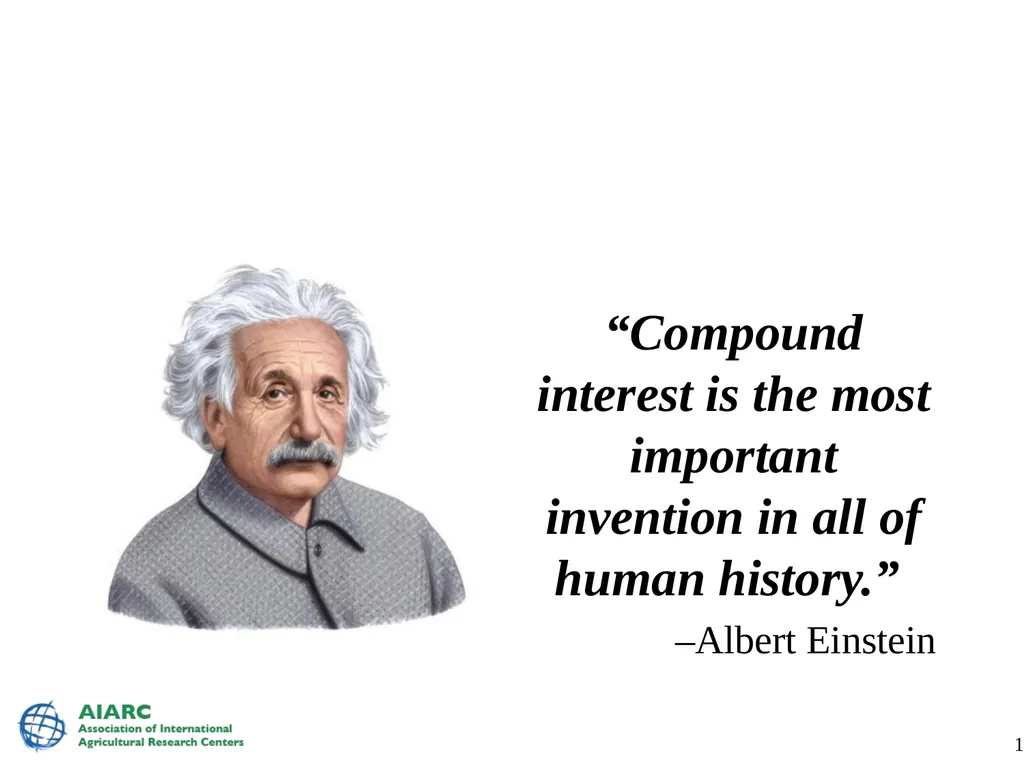
“Compound interest is the most important invention in all of human history.”
–Albert Einstein<br>
–Albert Einstein<br>
18
Power of Compounding<br>
19
Power of Compounding<br>
20
Investment Asset Classes In general, there are three primary asset classes:
Cash
Bonds
Stocks<br>
Cash
Bonds
Stocks<br>
21
Bonds A bond is a loan.
When you buy a bond, you become a lender to a corporation or government (borrowers).
Corporations and governments raise money from investors by issuing bonds for capital projects, financing debt, and cash flow.<br>
When you buy a bond, you become a lender to a corporation or government (borrowers).
Corporations and governments raise money from investors by issuing bonds for capital projects, financing debt, and cash flow.<br>
22
Why buy a bond? When you (the investor) buy a bond, you are lending to the issuer (the borrower) who promises to pay you a specified rate of interest during the life of the bond and to repay the principal when the bond matures.
In general, you buy a bond to:
Receive a predictable income stream
Preserve the principal investment<br>
In general, you buy a bond to:
Receive a predictable income stream
Preserve the principal investment<br>
23
Stocks A stock is a receipt of ownership.
Corporations issue stocks to investors so they can raise funds to:
Pay off debt
Launch new products
Expand into new markets
Enlarge facilities or build new ones<br>
Corporations issue stocks to investors so they can raise funds to:
Pay off debt
Launch new products
Expand into new markets
Enlarge facilities or build new ones<br>
24
Why buy a stock? When an investor purchases a stock, he or she becomes a proportional owner of the company.
In general, you buy a stock for:
Capital appreciation (buy low, sell high)
Dividend payments (your money earns money)<br>
In general, you buy a stock for:
Capital appreciation (buy low, sell high)
Dividend payments (your money earns money)<br>
25
What are the best investments for me? The answer depends on your personal Risk Tolerance and your investment Time Horizon
Risk Tolerance is your willingness to lose some or all of your original investment in exchange for potentially greater returns.
Time horizon is the number of months, years, or decades that you have to keep your savings invested.<br>
Risk Tolerance is your willingness to lose some or all of your original investment in exchange for potentially greater returns.
Time horizon is the number of months, years, or decades that you have to keep your savings invested.<br>
26
Risk and Reward In finance, risk refers to the degree of uncertainty about the rate of return on an asset and the potential harm that could arise when financial returns are not what the investor expected.
In general, an investor requires a higher return to compensate for taking a higher risk.<br>
In general, an investor requires a higher return to compensate for taking a higher risk.<br>
27
Risk & Reward<br>
28
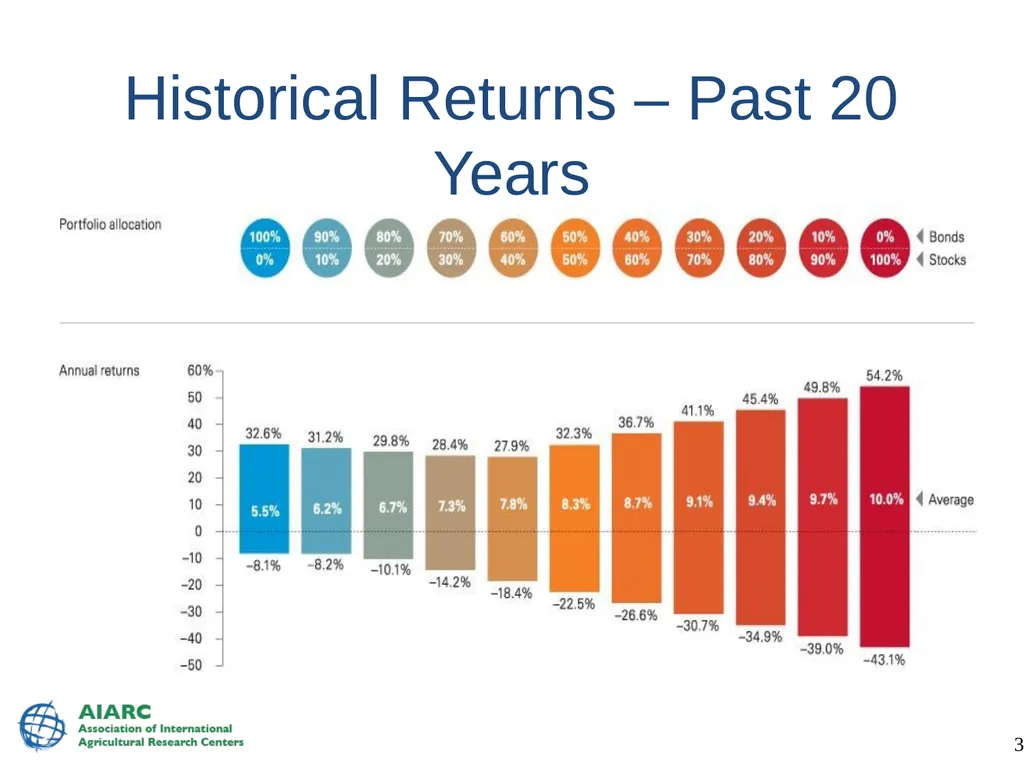
Risk & Reward Stocks have the potential for the highest returns but also have the greatest risk. The volatility of stocks makes them a very risky investment in the short-term.
Bonds are generally less volatile than stocks and offer more modest returns, but bonds offer higher returns than money market funds.<br>
Bonds are generally less volatile than stocks and offer more modest returns, but bonds offer higher returns than money market funds.<br>
29
Risk & Reward Money market funds are a type of mutual fund that invests in high quality short-term (less than 90 days) debt. They pay dividends that reflect short-term interest rates.
Money market funds are considered the safest investments of the three asset classes, but offer the lowest returns. The principal concern to investors is inflation risk.<br>
Money market funds are considered the safest investments of the three asset classes, but offer the lowest returns. The principal concern to investors is inflation risk.<br>
30
Historical Returns – Past 20 Years<br>
31
What are the risks? Business Risk
Market (Volatility) Risk
Interest Rate Risk
Inflation (purchasing power) Risk<br>
Market (Volatility) Risk
Interest Rate Risk
Inflation (purchasing power) Risk<br>
32
How do you reduce risk? Diversify – “Don’t put all your eggs in one basket.”
Allocate your investments among different asset classes such as cash, bonds, and stocks.
Further allocate your investments within each asset class, i.e., stocks invest in large, small, and global company stocks .<br>
Allocate your investments among different asset classes such as cash, bonds, and stocks.
Further allocate your investments within each asset class, i.e., stocks invest in large, small, and global company stocks .<br>
33
Mutual Fund A mutual fund is a company that pools money from many investors and invests the money in securities such as money markets, bonds, and stocks. Each share represents an investor’s part ownership in the fund
A share value will rise or fall as the values of the individual stocks and bonds within the fund rise and fall<br>
A share value will rise or fall as the values of the individual stocks and bonds within the fund rise and fall<br>
34
Why buy mutual funds? Affordability
Diversification
Liquidity
Dividend/Interest Payments
Appreciation in Share Price<br>
Diversification
Liquidity
Dividend/Interest Payments
Appreciation in Share Price<br>
35
Types of Mutual Funds Money Market Funds
Bond Funds
Stock Funds
Balanced Funds
Lifecycle / Target Date Funds<br>
Bond Funds
Stock Funds
Balanced Funds
Lifecycle / Target Date Funds<br>
36
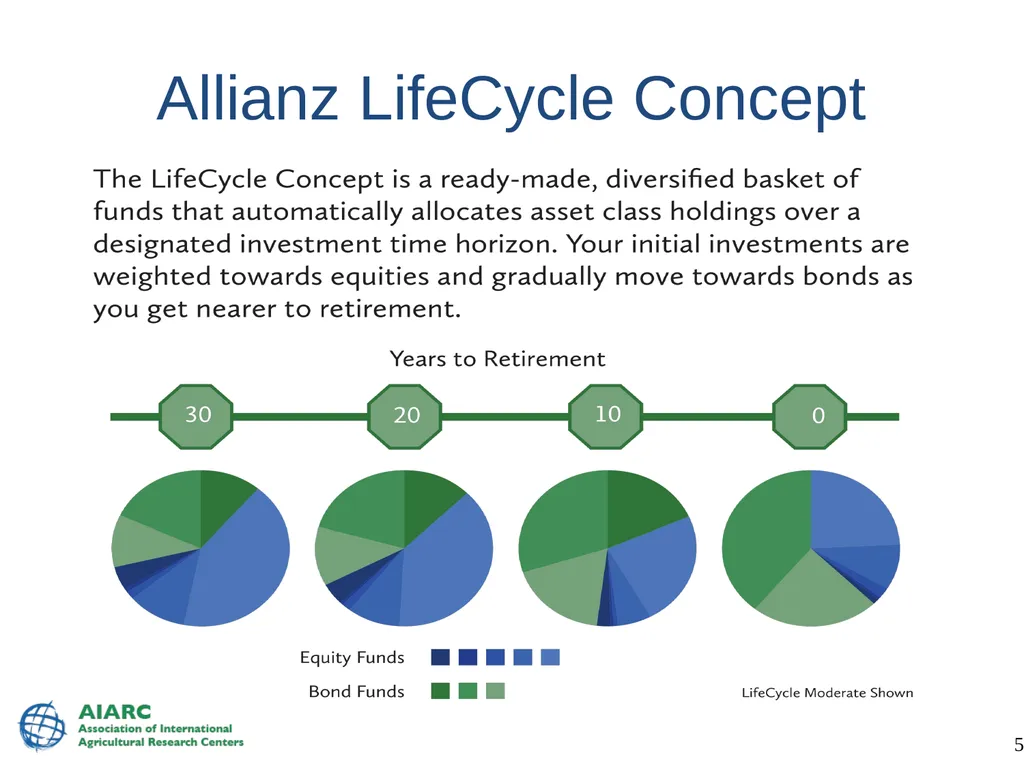
Lifecycle / Target Date Funds Hold a mix of cash, bonds, and stocks.
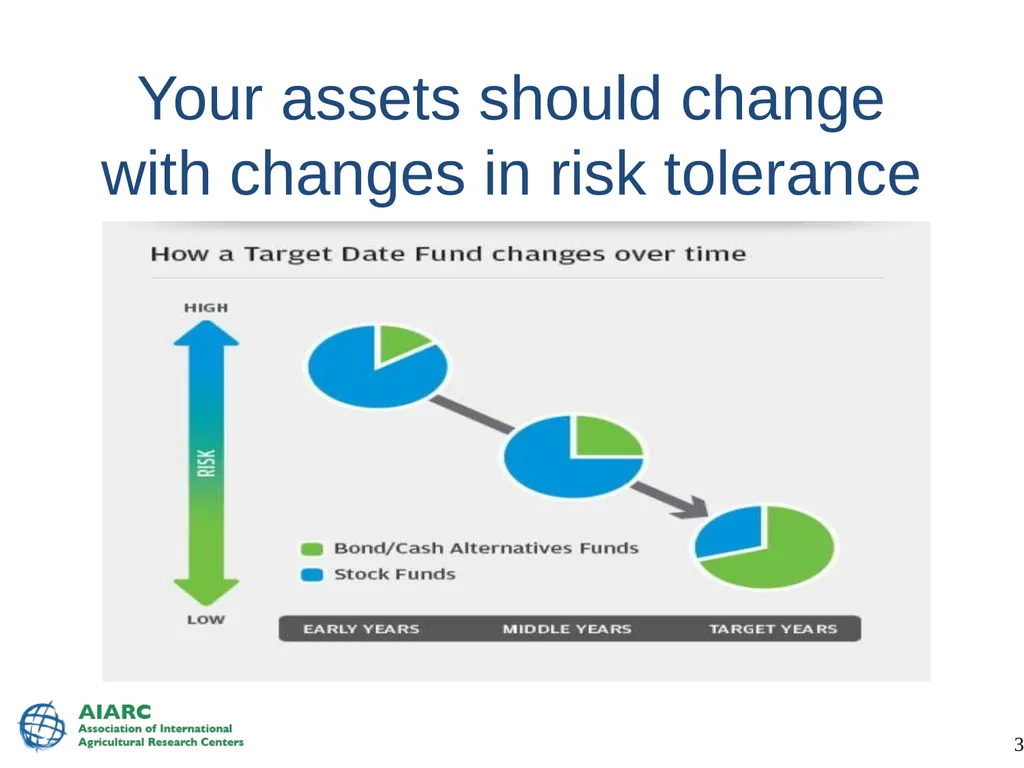
Designed to make investing for retirement more convenient by automatically changing your asset allocation over time.
The fund manager will make all decisions about the allocation of cash, bonds, and stocks for you based on your investment time horizon.<br>
Designed to make investing for retirement more convenient by automatically changing your asset allocation over time.
The fund manager will make all decisions about the allocation of cash, bonds, and stocks for you based on your investment time horizon.<br>
37
Your assets should change with changes in risk tolerance<br>
38
Questions?<br>
39
IARC International (Offshore) Retirement Plan<br>
40
International Retirement Plan Topics Plan Structure
Eligibility / Contributions
Custodial Account / Oversight
Investment Fund Options
LifeCycle Concept
Plan Platform - Allianz<br>
Eligibility / Contributions
Custodial Account / Oversight
Investment Fund Options
LifeCycle Concept
Plan Platform - Allianz<br>
41
International Retirement Plan Resources AIARC.org Website
IARC Retirement Plan Participant Brochure
IARC Retirement Plan Investment Brochure
IARCPlan.org (Allianz Plan Platform)
LifeCycle Brochure & Video
Fund Factsheets
Retirement Calculators<br>
IARC Retirement Plan Participant Brochure
IARC Retirement Plan Investment Brochure
IARCPlan.org (Allianz Plan Platform)
LifeCycle Brochure & Video
Fund Factsheets
Retirement Calculators<br>
42
Plan Structure International (Offshore)
Retirement Plan<br>
Retirement Plan<br>
43
Key Questions Who is eligible to participate?
What is a trust?
What is a custodial account?
Who oversees the trust?
How much does my employer contribute?
Can I make my own contributions?<br>
What is a trust?
What is a custodial account?
Who oversees the trust?
How much does my employer contribute?
Can I make my own contributions?<br>
44
International Retirement Plan Eligibility To be eligible for the International (Offshore) Retirement Plan, you must be actively employed by a Center and be a non-U.S. Taxpayer.
Note: The tax treatment of any contributions into and any benefits taken from the Plan will depend on your own personal circumstance and country of residence.<br>
Note: The tax treatment of any contributions into and any benefits taken from the Plan will depend on your own personal circumstance and country of residence.<br>
45
International Retirement Plan Structure The plan was established in 1996, under a trust in Guernsey, to help Centers’ employees save for retirement.
A trust is a separate legal arrangement that segregates the assets of the plan from those of the Centers and AIARC.
All assets of the trust are held in a custodial bank with Citibank.<br>
A trust is a separate legal arrangement that segregates the assets of the plan from those of the Centers and AIARC.
All assets of the trust are held in a custodial bank with Citibank.<br>
46
International Retirement Plan Structure The operations of the trust are governed by Guernsey laws and are overseen by the IARC Plan Board of Directors.
Under a management agreement with the trust, AIARC administers the day-to-day activities of the trust.
AIARC contracts with Allianz to administer the International Plan’s platform.<br>
Under a management agreement with the trust, AIARC administers the day-to-day activities of the trust.
AIARC contracts with Allianz to administer the International Plan’s platform.<br>
47
Contribution Schedule Center (Employer)
15% of gross month salary
Voluntary (Employee)
Up to 100% of your net salary on a monthly basis<br>
15% of gross month salary
Voluntary (Employee)
Up to 100% of your net salary on a monthly basis<br>
48
Voluntary Contribution To add or change a voluntary contribution, the employee must complete the Offshore Retirement Plan Voluntary Contribution Change Form –AllianzGI and submit to AIARC.
For investment choices, the new or changed contribution amount is allocated in the same percentage and to the same funds as the existing voluntary contribution.<br>
For investment choices, the new or changed contribution amount is allocated in the same percentage and to the same funds as the existing voluntary contribution.<br>
49
Investment Fund Options International (Offshore)
Retirement Plan<br>
Retirement Plan<br>
50
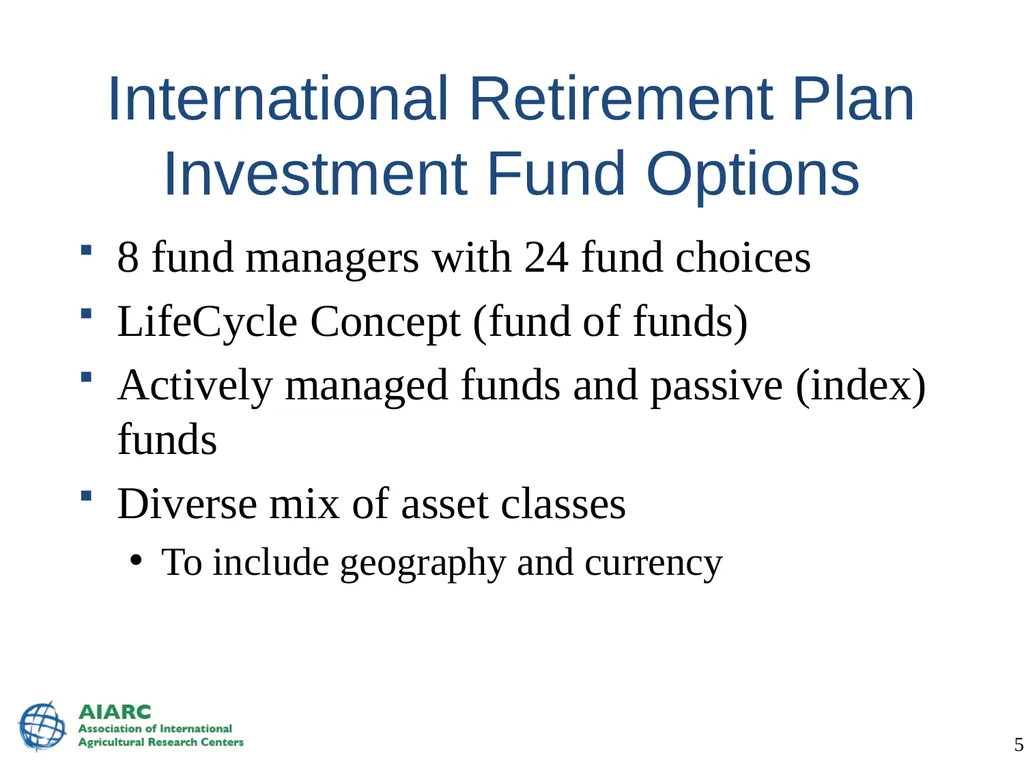
International Retirement Plan Investment Fund Options 8 fund managers with 24 fund choices
LifeCycle Concept (fund of funds)
Actively managed funds and passive (index) funds
Diverse mix of asset classes
To include geography and currency<br>
LifeCycle Concept (fund of funds)
Actively managed funds and passive (index) funds
Diverse mix of asset classes
To include geography and currency<br>
51
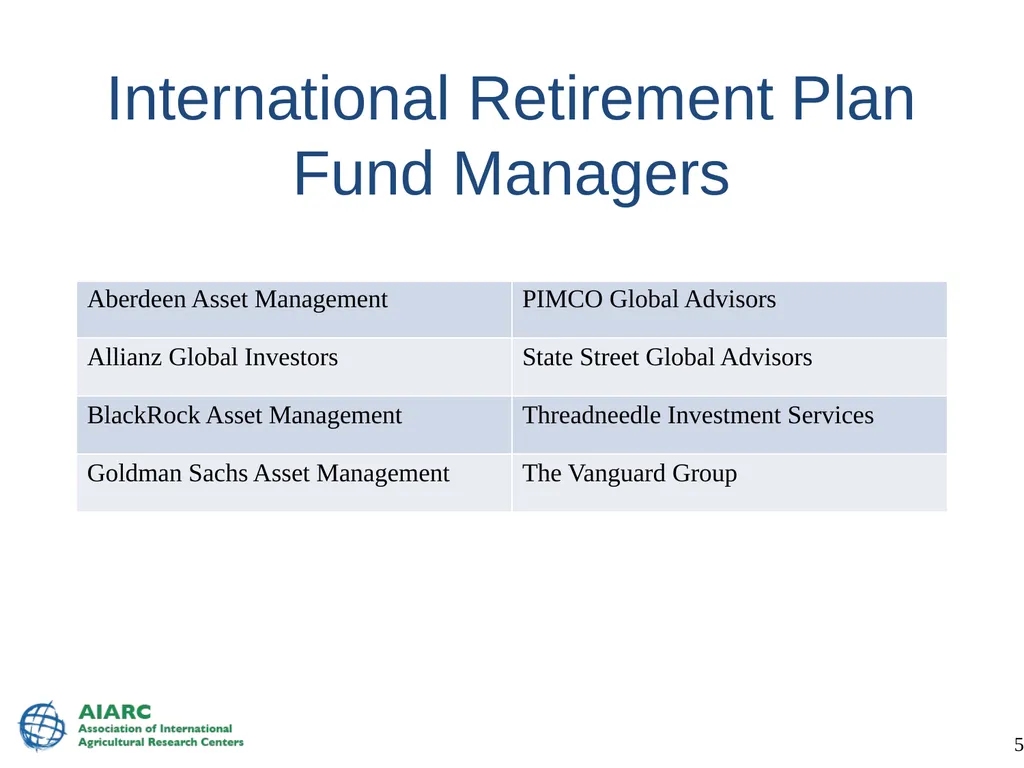
International Retirement Plan Fund Managers<br>
52
Index (Passive) Fund An index fund attempts to mimic the return of a specific market index, i.e., S&P 500, FTSE, TAIEX, etc. It contains all of the holdings of the index.
Fees are generally lower than active management because an index fund does not require researching investments or monitoring market movements.<br>
Fees are generally lower than active management because an index fund does not require researching investments or monitoring market movements.<br>
53
Actively Managed Fund Professional managers choose what they believe are the best investment opportunities, given a fund’s strategy, with the goal of outperforming a specific benchmark.<br>
54
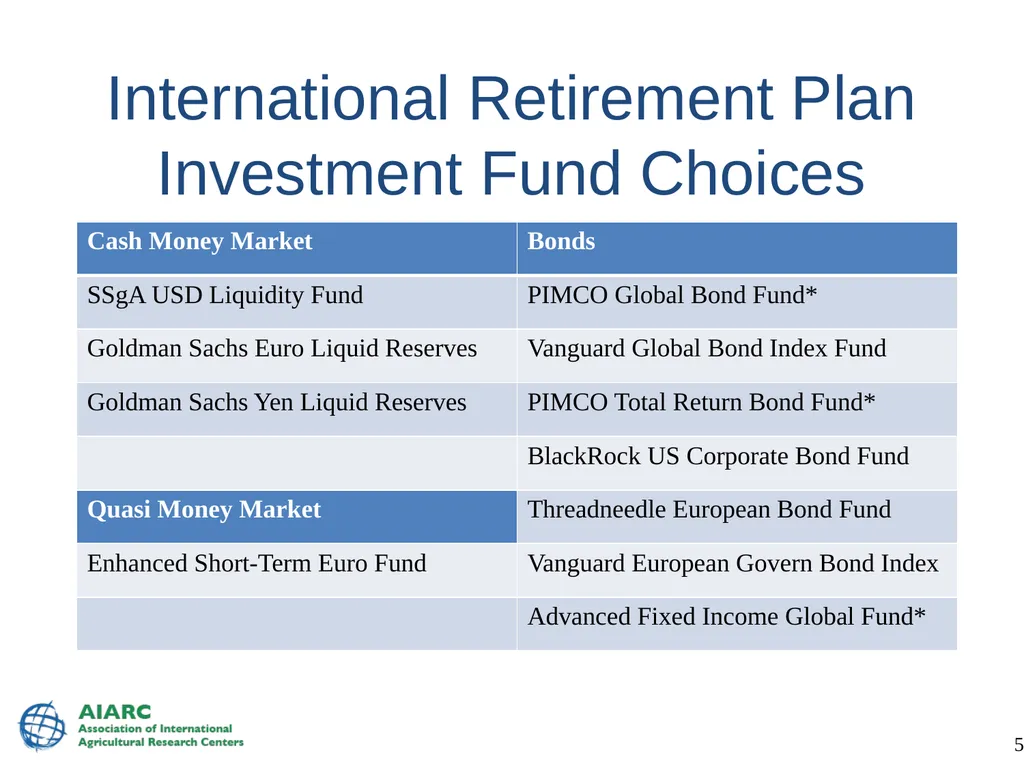
International Retirement Plan Investment Fund Choices<br>
55
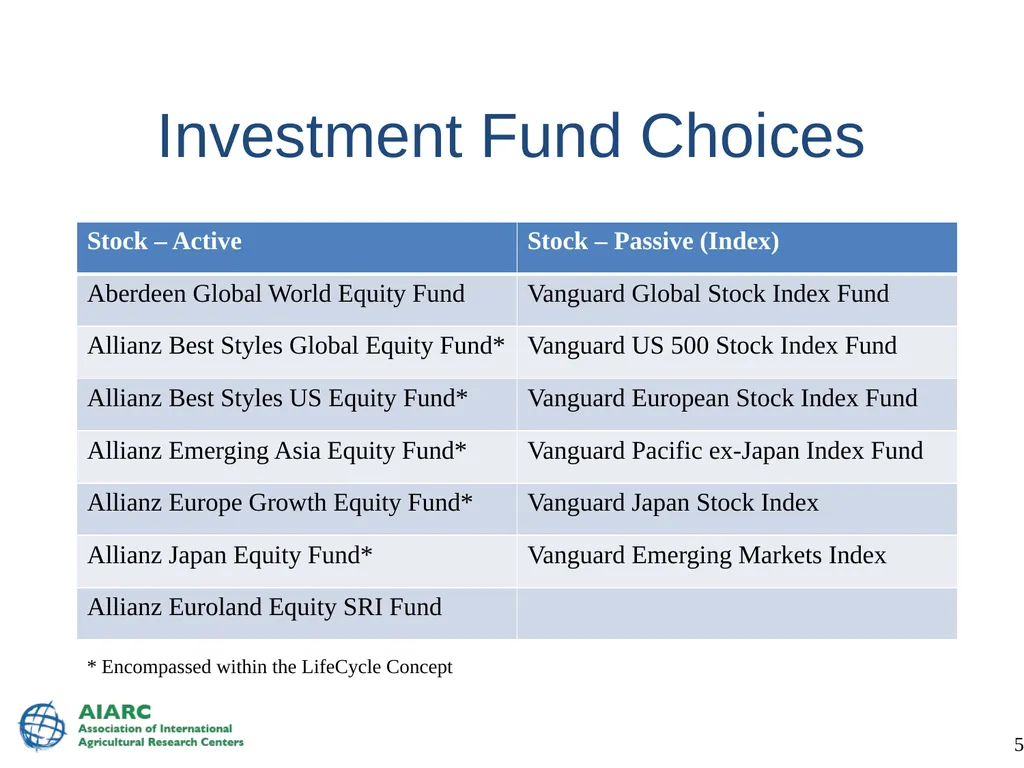
Investment Fund Choices * Encompassed within the LifeCycle Concept<br>
56
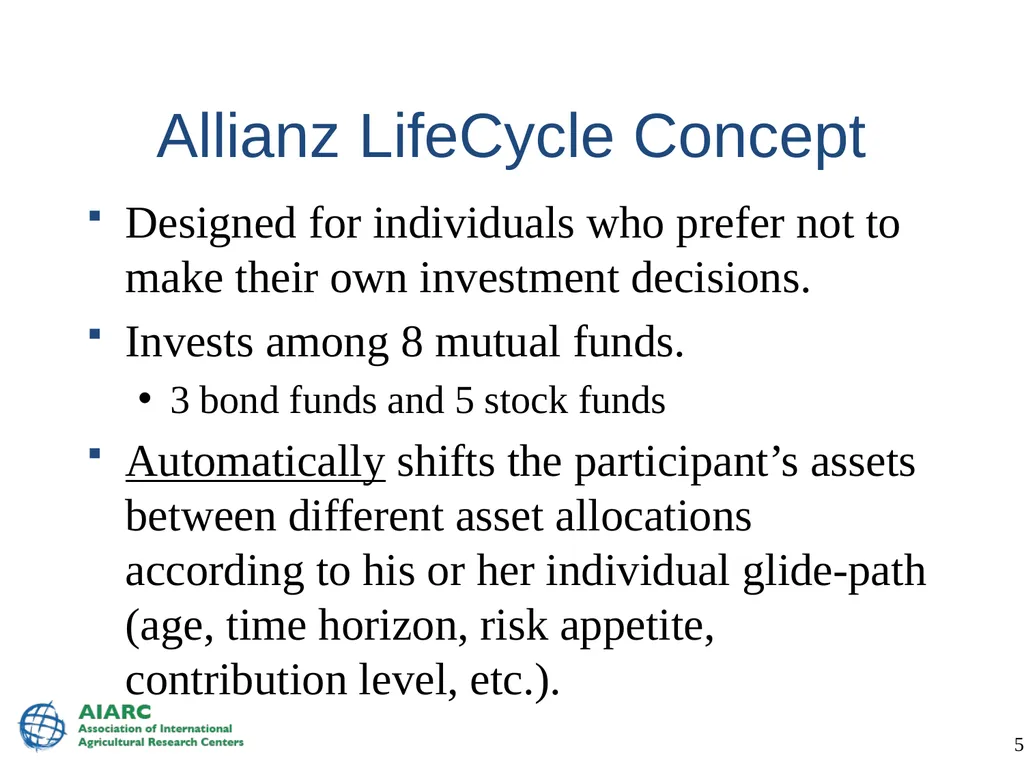
Allianz LifeCycle Concept Designed for individuals who prefer not to make their own investment decisions.
Invests among 8 mutual funds.
3 bond funds and 5 stock funds
Automatically shifts the participant’s assets between different asset allocations according to his or her individual glide-path (age, time horizon, risk appetite, contribution level, etc.).<br>
Invests among 8 mutual funds.
3 bond funds and 5 stock funds
Automatically shifts the participant’s assets between different asset allocations according to his or her individual glide-path (age, time horizon, risk appetite, contribution level, etc.).<br>
57
Allianz LifeCycle Concept<br>
58
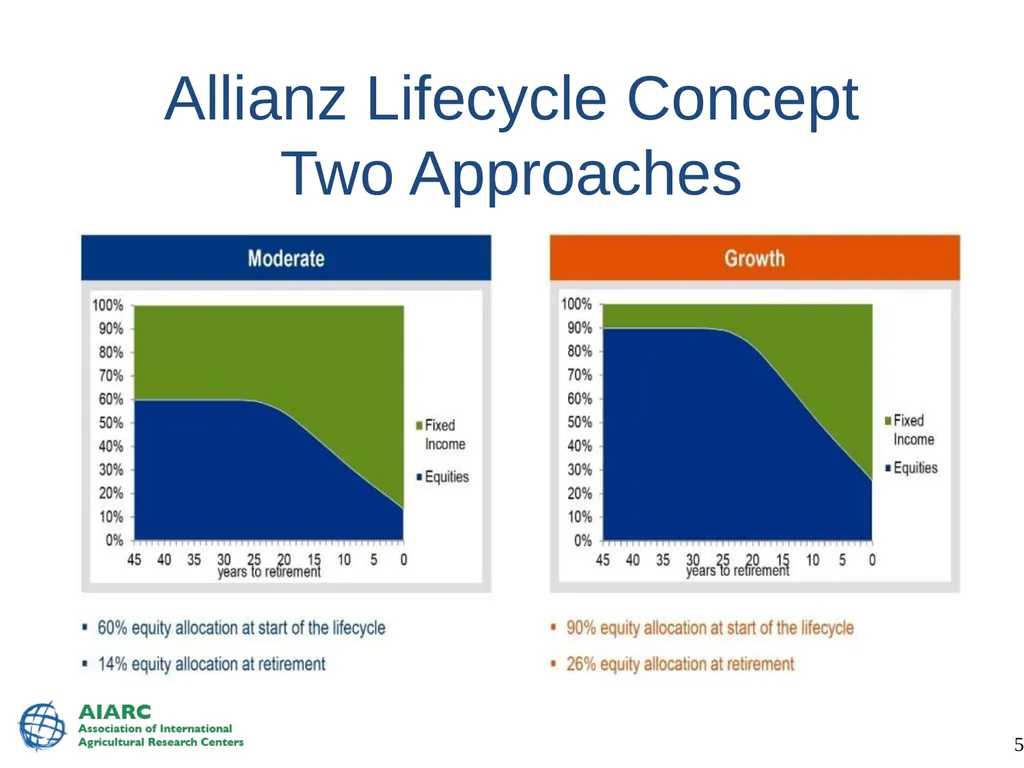
Allianz Lifecycle Concept
Two Approaches<br>
59
Benefits of LifeCycle Professionally managed
Diversification
Assets invested across asset classes and regions
Automatically moves investments from riskier to safer assets as retirement age approaches
Automatically rebalances investments
At least two times per year<br>
Diversification
Assets invested across asset classes and regions
Automatically moves investments from riskier to safer assets as retirement age approaches
Automatically rebalances investments
At least two times per year<br>
60
Plan Platform
provided by Allianz International (Offshore)
Retirement Plan<br>
Retirement Plan<br>
61
Key Questions How do I login?
How do I update my contact or beneficiary information?
How do I find my account value?
How do I move/change funds?
How do I request a withdrawal?<br>
How do I update my contact or beneficiary information?
How do I find my account value?
How do I move/change funds?
How do I request a withdrawal?<br>
62
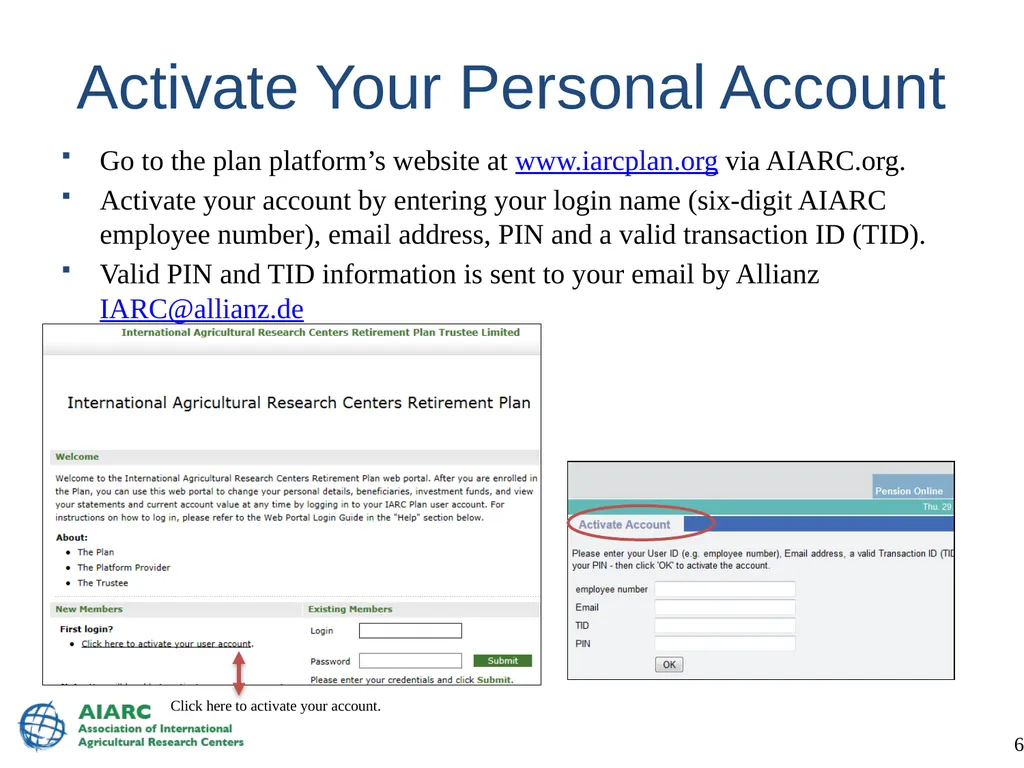
Activate Your Personal Account Go to the plan platform’s website at www.iarcplan.org via AIARC.org.
Activate your account by entering your login name (six-digit AIARC employee number), email address, PIN and a valid transaction ID (TID).
Valid PIN and TID information is sent to your email by Allianz IARC@allianz.de Click here to activate your account.<br>
Activate your account by entering your login name (six-digit AIARC employee number), email address, PIN and a valid transaction ID (TID).
Valid PIN and TID information is sent to your email by Allianz IARC@allianz.de Click here to activate your account.<br>
63
View Quarterly Investment Statements
Update Personal Details
contact information (address, phone, etc.)
beneficiary information
Change Email address or Account Password View current account balance
View transaction history and pending transactions
Change investment allocations of contributions (existing and future)
Make fund switches or rebalance funds My Data Section My Account Section<br>
Update Personal Details
contact information (address, phone, etc.)
beneficiary information
Change Email address or Account Password View current account balance
View transaction history and pending transactions
Change investment allocations of contributions (existing and future)
Make fund switches or rebalance funds My Data Section My Account Section<br>
64
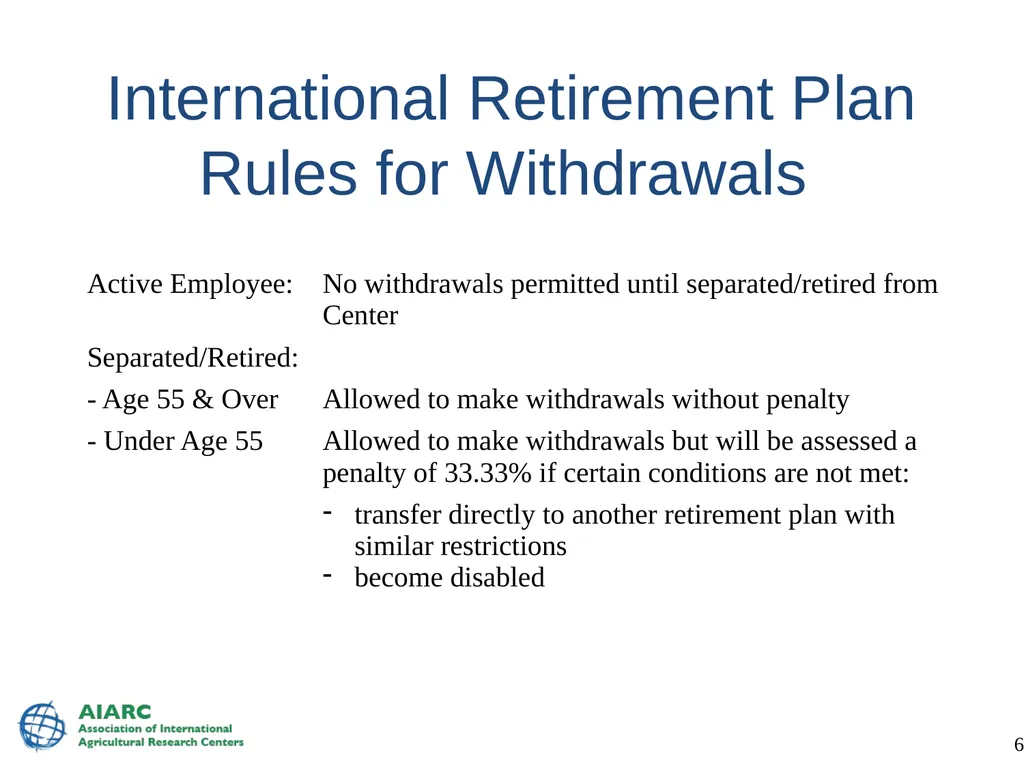
International Retirement Plan Rules for Withdrawals<br>
65
Questions?<br>
66
U.S. Retirement Plan<br>
67
U.S Retirement Plan
Topics Plan Structure
Eligibility / Contributions
Custodial Account / Oversight
Investment Fund Options
Target Date Funds
Plan Platform – Vanguard<br>
Eligibility / Contributions
Custodial Account / Oversight
Investment Fund Options
Target Date Funds
Plan Platform – Vanguard<br>
68
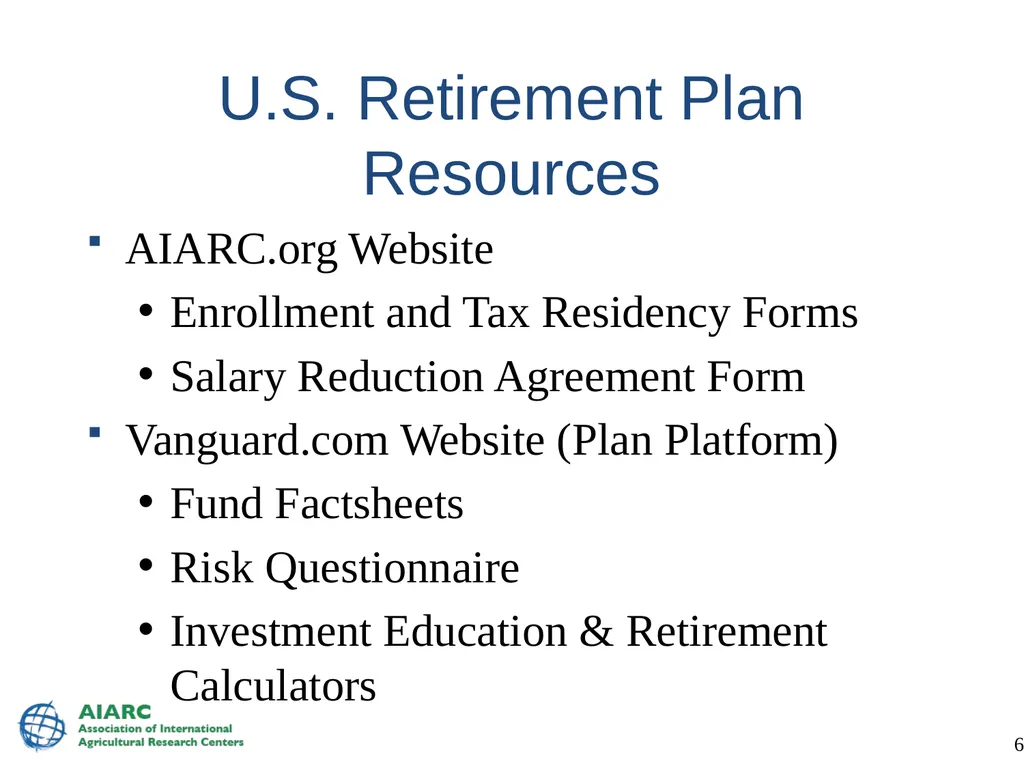
U.S. Retirement Plan Resources AIARC.org Website
Enrollment and Tax Residency Forms
Salary Reduction Agreement Form
Vanguard.com Website (Plan Platform)
Fund Factsheets
Risk Questionnaire
Investment Education & Retirement Calculators<br>
Enrollment and Tax Residency Forms
Salary Reduction Agreement Form
Vanguard.com Website (Plan Platform)
Fund Factsheets
Risk Questionnaire
Investment Education & Retirement Calculators<br>
69
Plan Structure U.S. Retirement Plan<br>
70
Key Questions Who is eligible to participate?
What is a custodial account?
Who oversees the Plan?
How much does my employer contribute?
How much can I voluntarily contribute?<br>
What is a custodial account?
Who oversees the Plan?
How much does my employer contribute?
How much can I voluntarily contribute?<br>
71
U.S. Retirement Plan
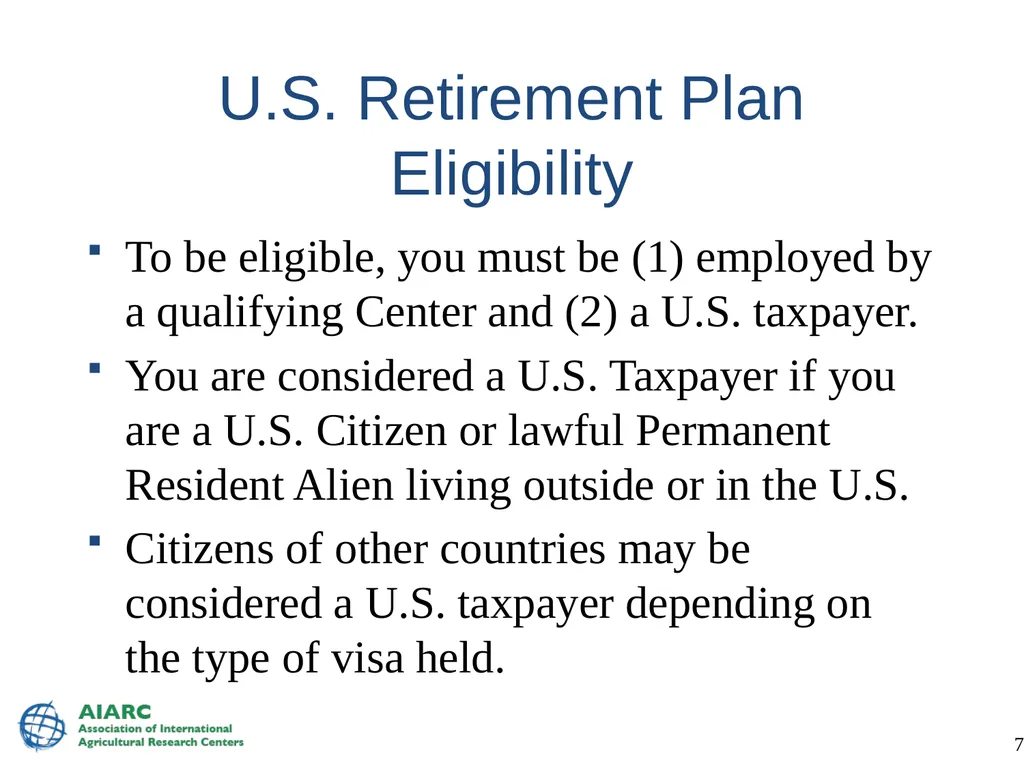
Eligibility To be eligible, you must be (1) employed by a qualifying Center and (2) a U.S. taxpayer.
You are considered a U.S. Taxpayer if you are a U.S. Citizen or lawful Permanent Resident Alien living outside or in the U.S.
Citizens of other countries may be considered a U.S. taxpayer depending on the type of visa held.<br>
You are considered a U.S. Taxpayer if you are a U.S. Citizen or lawful Permanent Resident Alien living outside or in the U.S.
Citizens of other countries may be considered a U.S. taxpayer depending on the type of visa held.<br>
72
U.S. Retirement Plan Structure The Plan was established in 1996 to help Center employees save for retirement.
The Plan provides for the creation and administration of custodial accounts to receive contributions from the Center on behalf of the Plan participants in accordance with Section 403(b)(7) of the Internal Revenue Service Code.<br>
The Plan provides for the creation and administration of custodial accounts to receive contributions from the Center on behalf of the Plan participants in accordance with Section 403(b)(7) of the Internal Revenue Service Code.<br>
73
U.S. Retirement Plan Structure AIARC is the Plan sponsor with each Center adopting the Plan prototype.
The Plan is overseen by the AIARC Board of Directors.
AIARC serves as Plan administrator and manages the day-to-day activities.
AIARC contracts with Vanguard to administer the U.S. Plan’s platform.<br>
The Plan is overseen by the AIARC Board of Directors.
AIARC serves as Plan administrator and manages the day-to-day activities.
AIARC contracts with Vanguard to administer the U.S. Plan’s platform.<br>
74
Contribution Schedule Center (Employer)
15% of salary
Voluntary (Employee)
Up to 100% of your net salary on a monthly basis
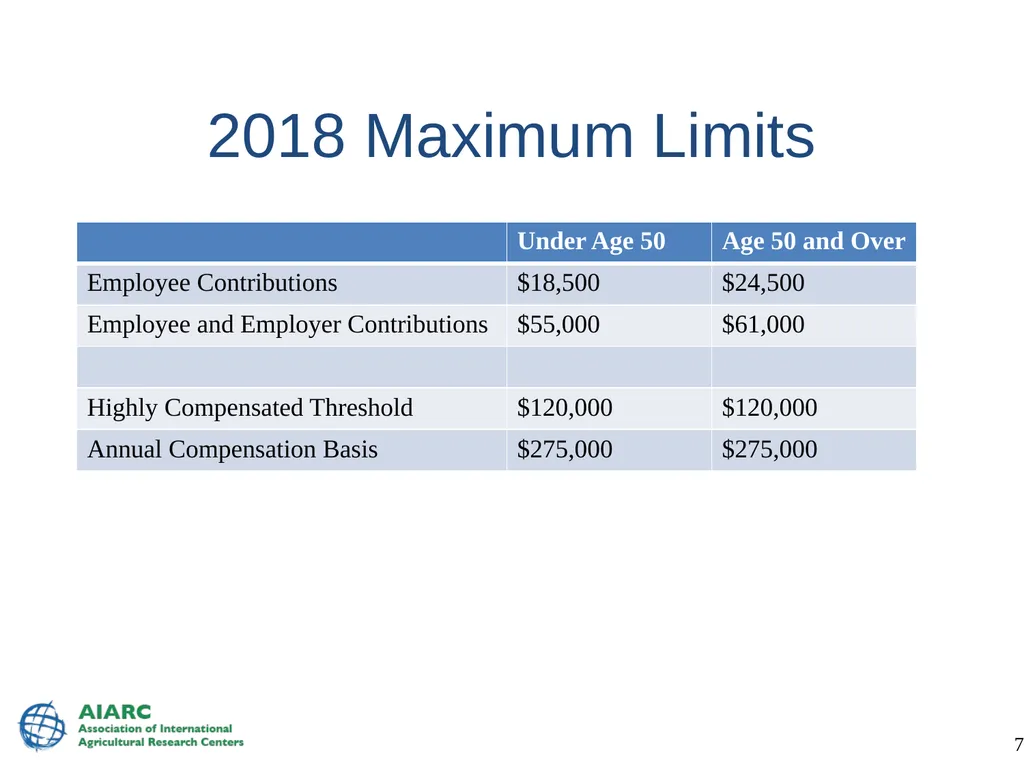
Note: The Internal Revenue Service imposes annual limits for both voluntary and total contributions.<br>
15% of salary
Voluntary (Employee)
Up to 100% of your net salary on a monthly basis
Note: The Internal Revenue Service imposes annual limits for both voluntary and total contributions.<br>
75
2018 Maximum Limits<br>
76
Contribution Tip Update your Salary Reduction Agreement (SRA) Form each January to maximize your voluntary contribution.
If you are interested in making voluntary contributions, please contact your Center’s AIARC Coordinator to assist you in calculating your maximum allowable amount.<br>
If you are interested in making voluntary contributions, please contact your Center’s AIARC Coordinator to assist you in calculating your maximum allowable amount.<br>
77
Investment Fund Options U.S. Retirement Plan<br>
78
U.S. Retirement Plan
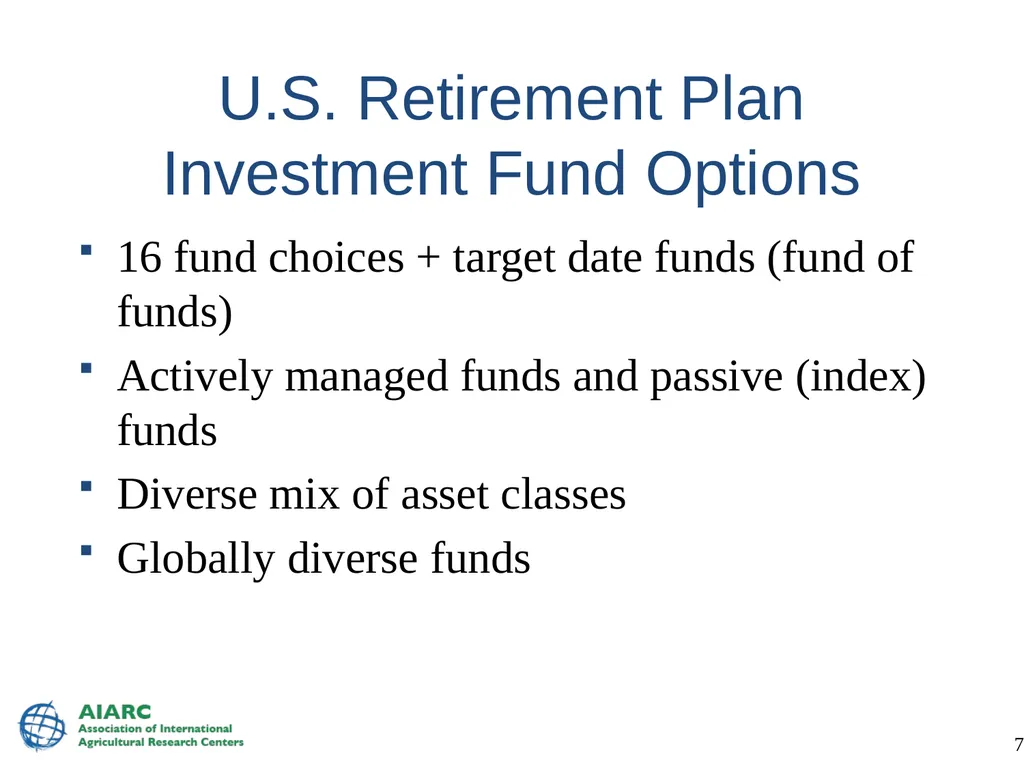
Investment Fund Options 16 fund choices + target date funds (fund of funds)
Actively managed funds and passive (index) funds
Diverse mix of asset classes
Globally diverse funds<br>
Actively managed funds and passive (index) funds
Diverse mix of asset classes
Globally diverse funds<br>
79
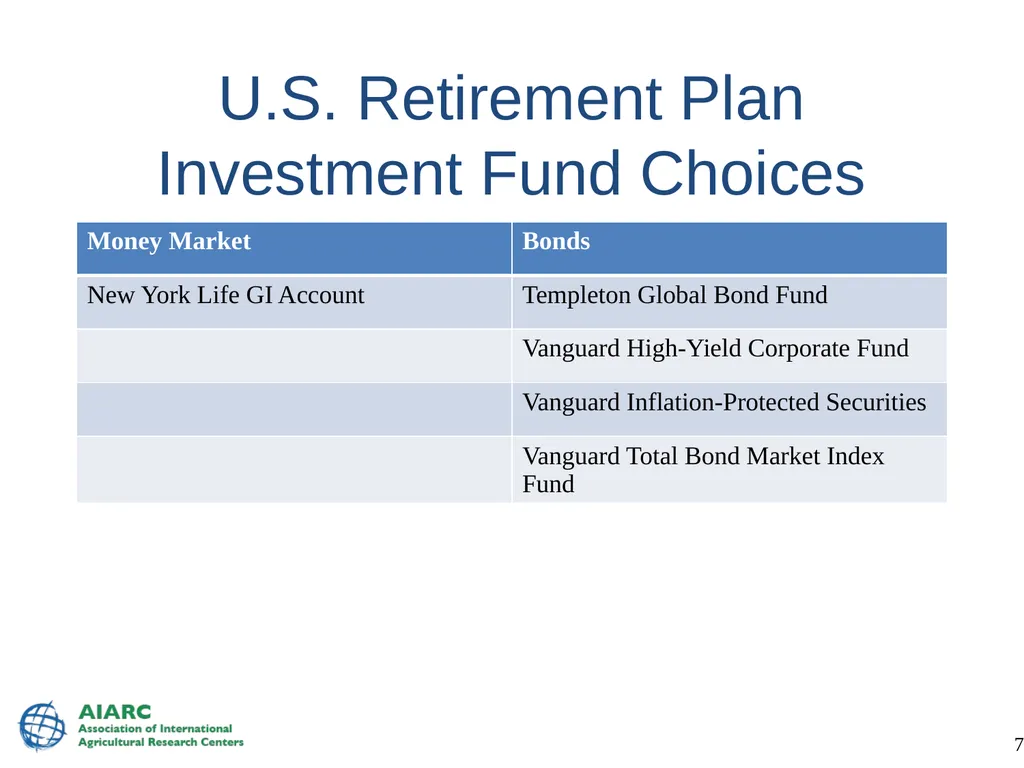
U.S. Retirement Plan Investment Fund Choices<br>
80
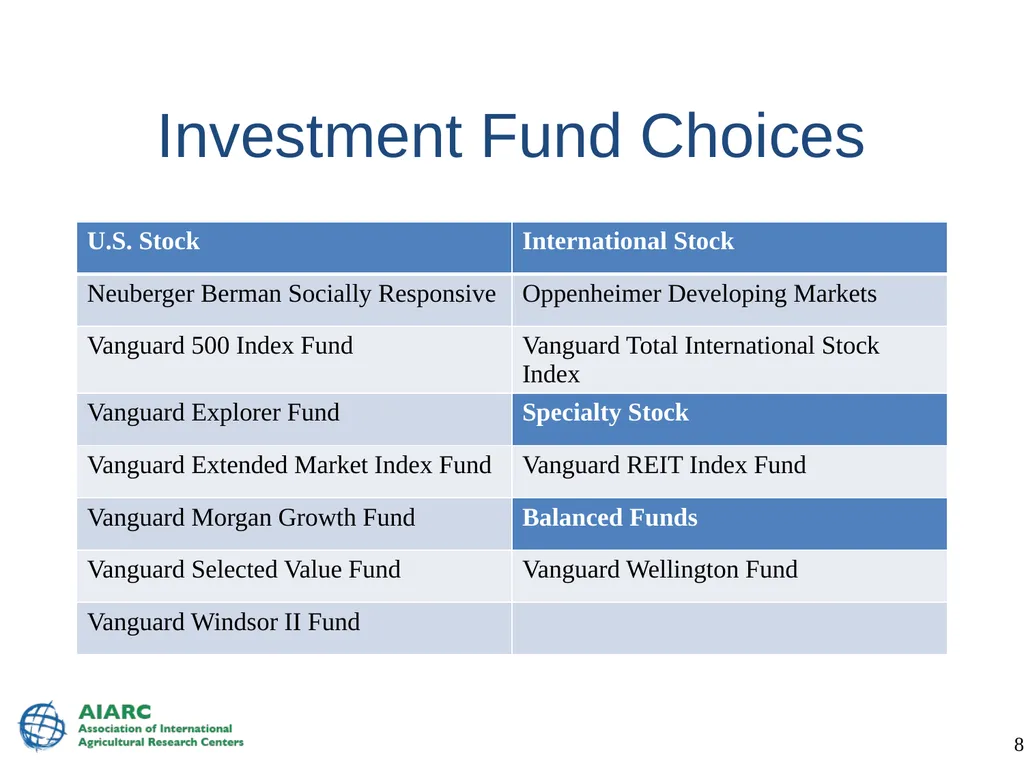
Investment Fund Choices<br>
81
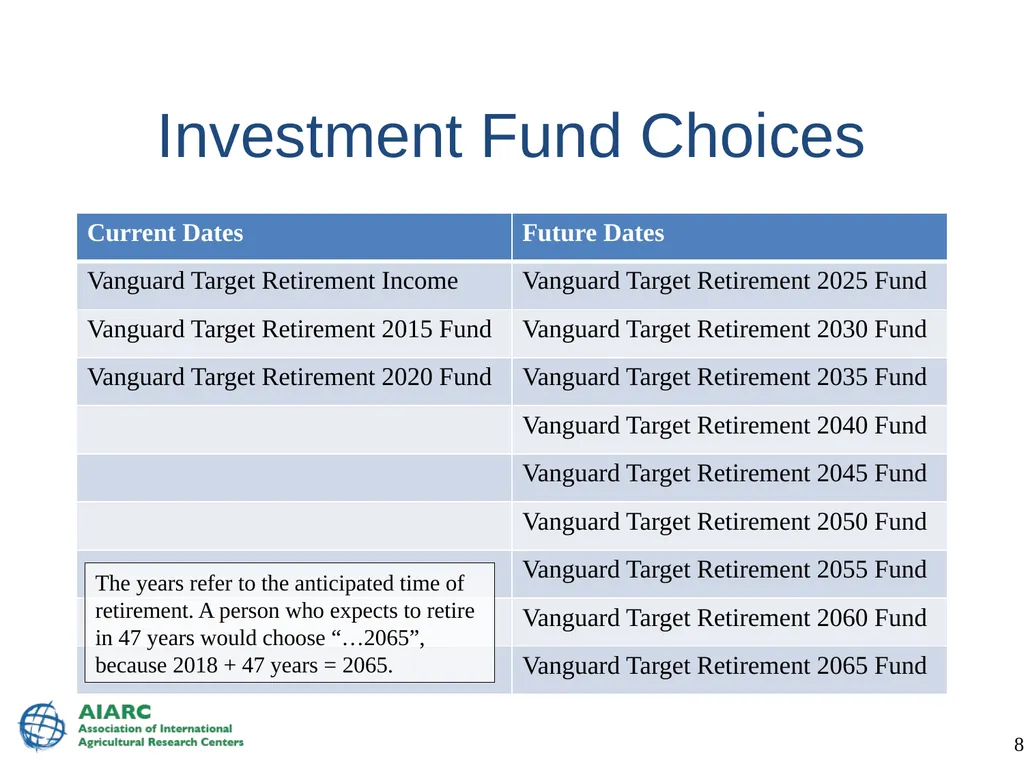
Investment Fund Choices The years refer to the anticipated time of retirement. A person who expects to retire in 47 years would choose “…2065”, because 2018 + 47 years = 2065.<br>
82
Target Date Allocations Years till retirement…<br>
83
Plan Platform
provided by Vanguard U.S. Retirement Plan<br>
84
Key Questions How do I login?
How do I update my contact and beneficiary information?
How do I find my account value?
How do I move/change funds?
What are the rules for withdrawing funds?<br>
How do I update my contact and beneficiary information?
How do I find my account value?
How do I move/change funds?
What are the rules for withdrawing funds?<br>
85
Activate Your Personal Account Go to the plan platform’s website at www.vanguard.com
Choose “Vanguard’s Website for Retirement Plan Participants”.
Click “Register” near the upper-right corner of the page.
Follow the prompts to enter your personal information. The Plan number is “093962”.
If you used AIARC’s address of record, enter “22314” when it asks for your ZIP code.
Instructions for accessing your account can be found at the www.AIARC.org website.<br>
Choose “Vanguard’s Website for Retirement Plan Participants”.
Click “Register” near the upper-right corner of the page.
Follow the prompts to enter your personal information. The Plan number is “093962”.
If you used AIARC’s address of record, enter “22314” when it asks for your ZIP code.
Instructions for accessing your account can be found at the www.AIARC.org website.<br>
86
View current investment account balance
View employer and employee contributions
View account performance
View transaction history and quarterly statements View all investment options
Change investments
Change investment allocations
View Fund Fact Sheets
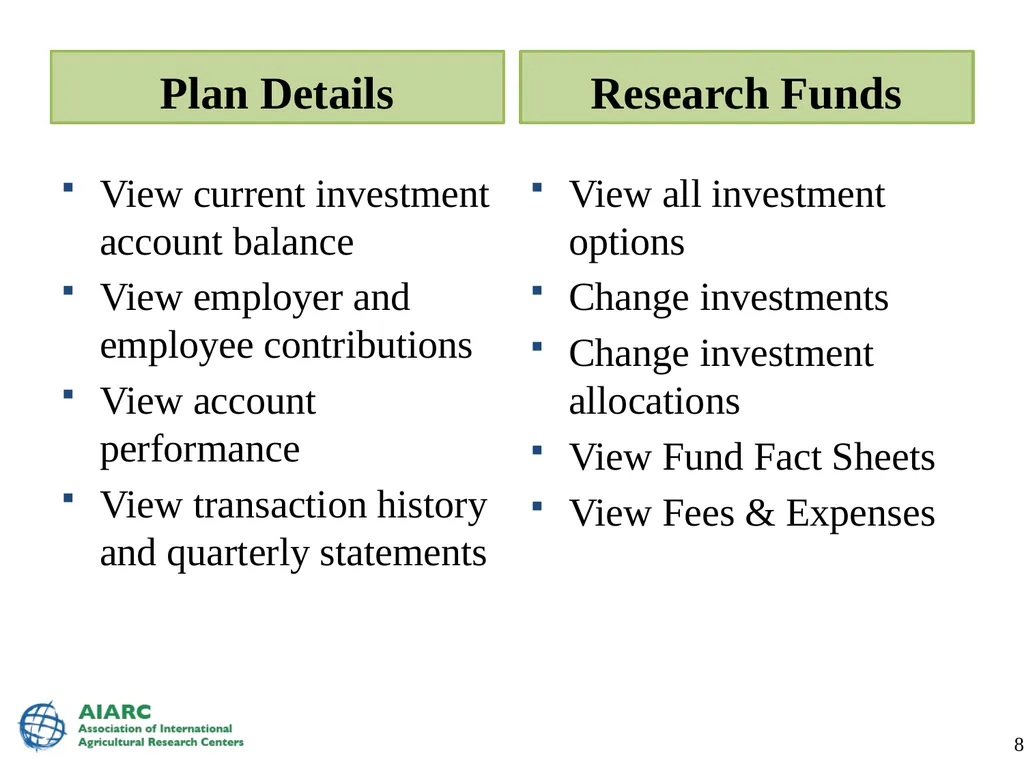
View Fees & Expenses Plan Details Research Funds<br>
View employer and employee contributions
View account performance
View transaction history and quarterly statements View all investment options
Change investments
Change investment allocations
View Fund Fact Sheets
View Fees & Expenses Plan Details Research Funds<br>
87
Plan News
Investment Basics
Retirement Planning
Market & Economy
Estate Planning Change contact information
Change password and security questions
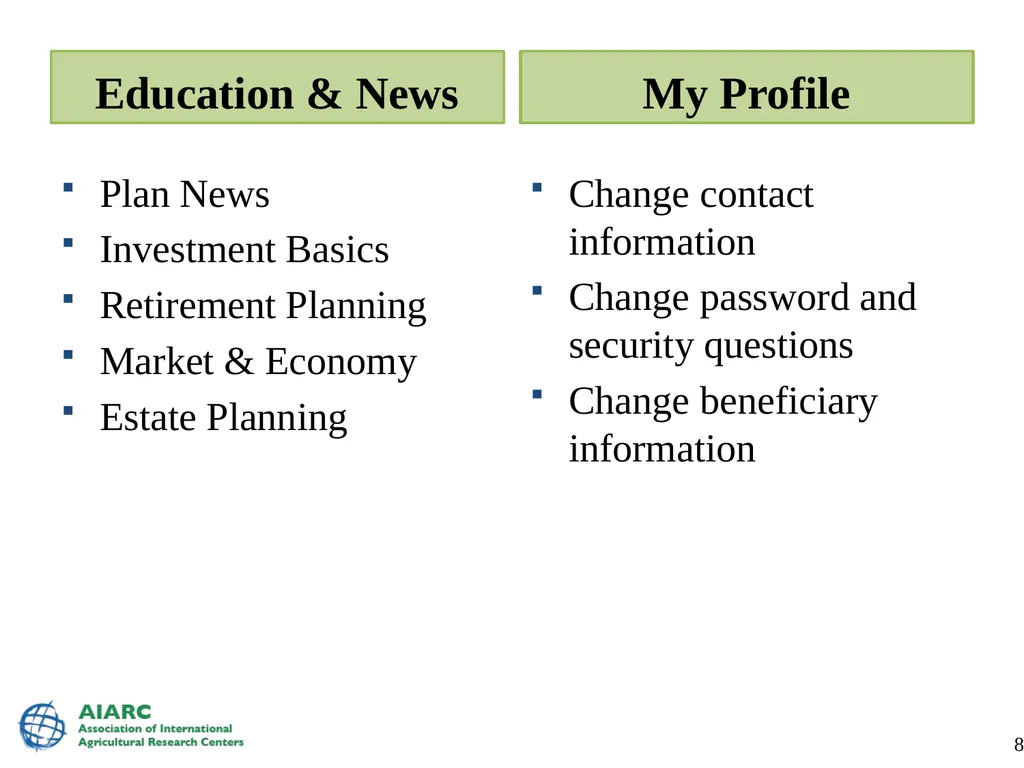
Change beneficiary information Education & News My Profile<br>
Investment Basics
Retirement Planning
Market & Economy
Estate Planning Change contact information
Change password and security questions
Change beneficiary information Education & News My Profile<br>
88
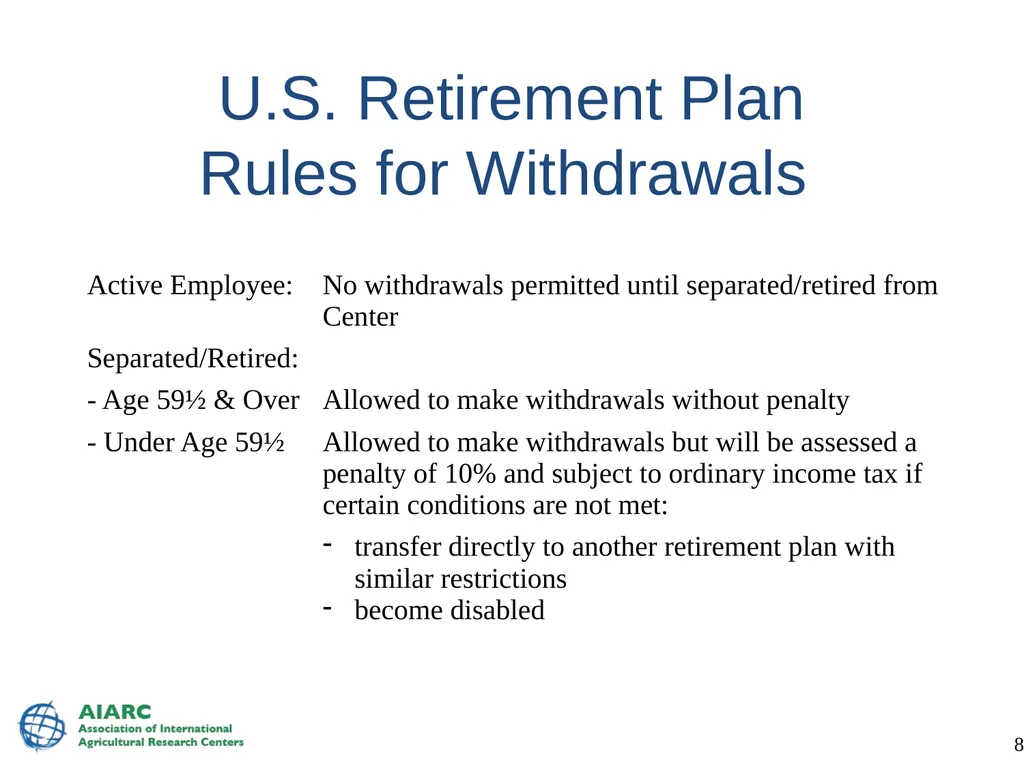
U.S. Retirement Plan
Rules for Withdrawals<br>
89
Questions? Thank You!<br>