
Icebreaker Please type into the chat: What are
TF
Published · 34 slides · 0 views

1 / 1





Description
Icebreaker Please type into the chat: What are your reflections after completing the Challenging Patient Encounters Digital Module? Facilitating Values Clarification for Abortion Access About Us 3 Objectives After this workshop,
Related Topics
Share
Embed code
Download this presentation From Below
"Icebreaker Please type into the chat: What are" is the property of its rightful owner. Permission is granted to download and print the materials on this website for personal, non-commercial use only, and to display it on your personal computer provided you do not modify the materials and that you retain all copyright notices contained in the materials. By downloading content from our website, you accept the terms of this agreement.
Presentation Transcript
01
Icebreaker Please type into the chat:
What are your reflections after completing the Challenging Patient Encounters Digital Module?<br>
What are your reflections after completing the Challenging Patient Encounters Digital Module?<br>
02
Facilitating Values Clarification for Abortion Access<br>
03
About Us 3<br>
04
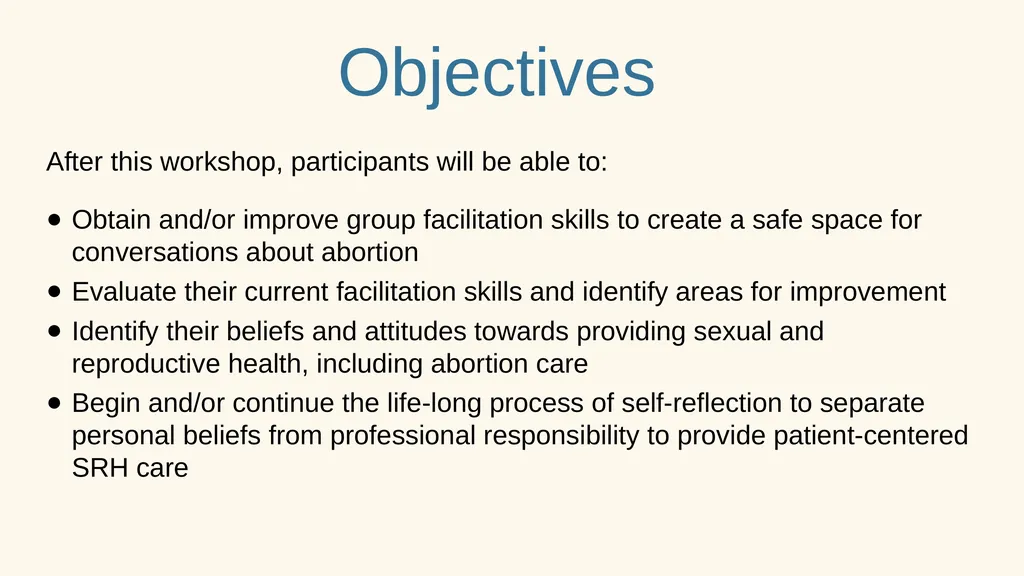
Objectives After this workshop, participants will be able to:
Obtain and/or improve group facilitation skills to create a safe space for conversations about abortion
Evaluate their current facilitation skills and identify areas for improvement
Identify their beliefs and attitudes towards providing sexual and reproductive health, including abortion care
Begin and/or continue the life-long process of self-reflection to separate personal beliefs from professional responsibility to provide patient-centered SRH care<br>
Obtain and/or improve group facilitation skills to create a safe space for conversations about abortion
Evaluate their current facilitation skills and identify areas for improvement
Identify their beliefs and attitudes towards providing sexual and reproductive health, including abortion care
Begin and/or continue the life-long process of self-reflection to separate personal beliefs from professional responsibility to provide patient-centered SRH care<br>
05
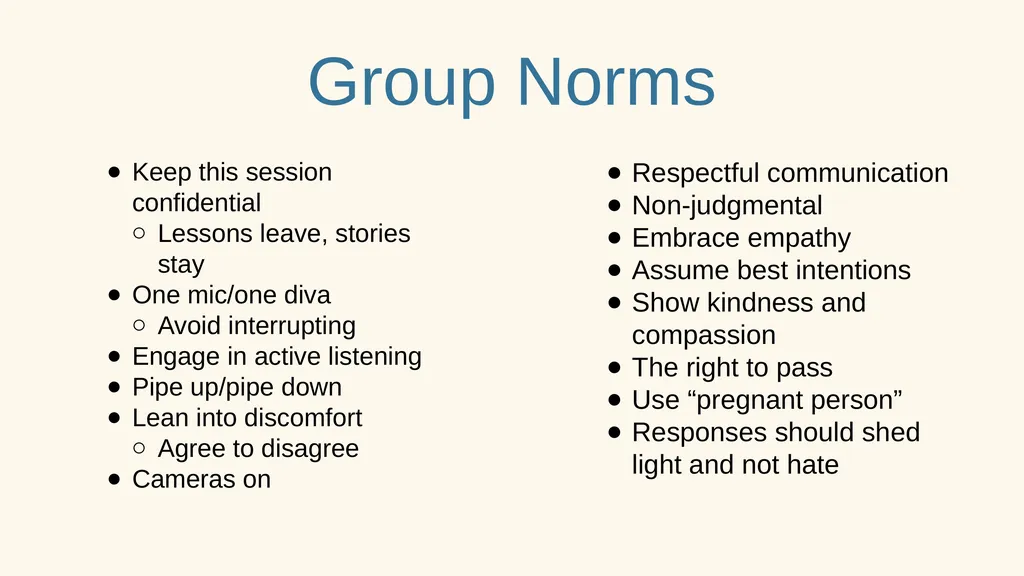
Group Norms Keep this session confidential
Lessons leave, stories stay
One mic/one diva
Avoid interrupting
Engage in active listening
Pipe up/pipe down
Lean into discomfort
Agree to disagree
Cameras on Respectful communication
Non-judgmental
Embrace empathy
Assume best intentions
Show kindness and compassion
The right to pass
Use “pregnant person”
Responses should shed light and not hate<br>
Lessons leave, stories stay
One mic/one diva
Avoid interrupting
Engage in active listening
Pipe up/pipe down
Lean into discomfort
Agree to disagree
Cameras on Respectful communication
Non-judgmental
Embrace empathy
Assume best intentions
Show kindness and compassion
The right to pass
Use “pregnant person”
Responses should shed light and not hate<br>
06
Values Clarification is not a Training… It is a Conversation<br>
07
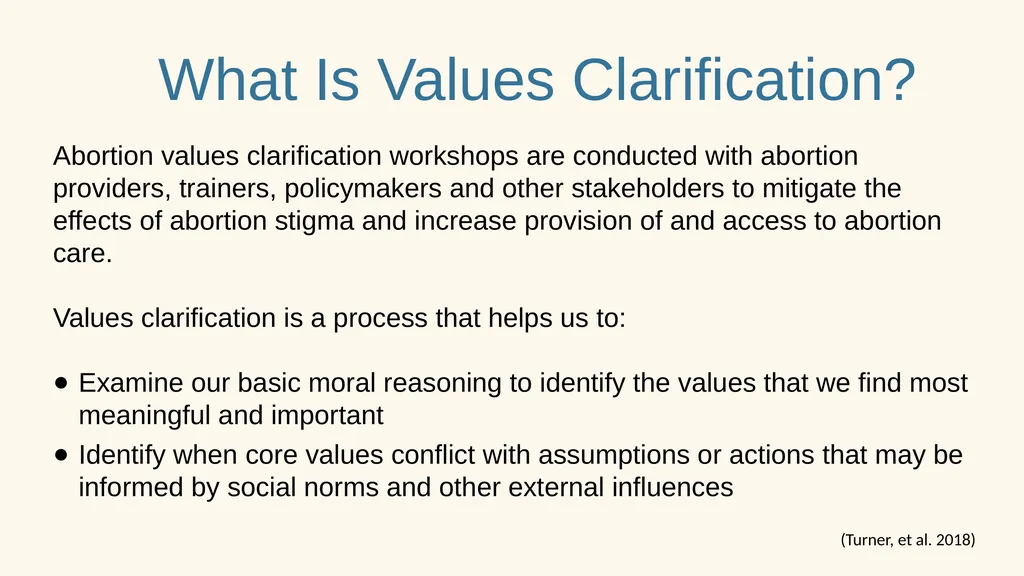
What Is Values Clarification? Abortion values clarification workshops are conducted with abortion providers, trainers, policymakers and other stakeholders to mitigate the effects of abortion stigma and increase provision of and access to abortion care.
Values clarification is a process that helps us to:
Examine our basic moral reasoning to identify the values that we find most meaningful and important
Identify when core values conflict with assumptions or actions that may be informed by social norms and other external influences (Turner, et al. 2018)<br>
Values clarification is a process that helps us to:
Examine our basic moral reasoning to identify the values that we find most meaningful and important
Identify when core values conflict with assumptions or actions that may be informed by social norms and other external influences (Turner, et al. 2018)<br>
08
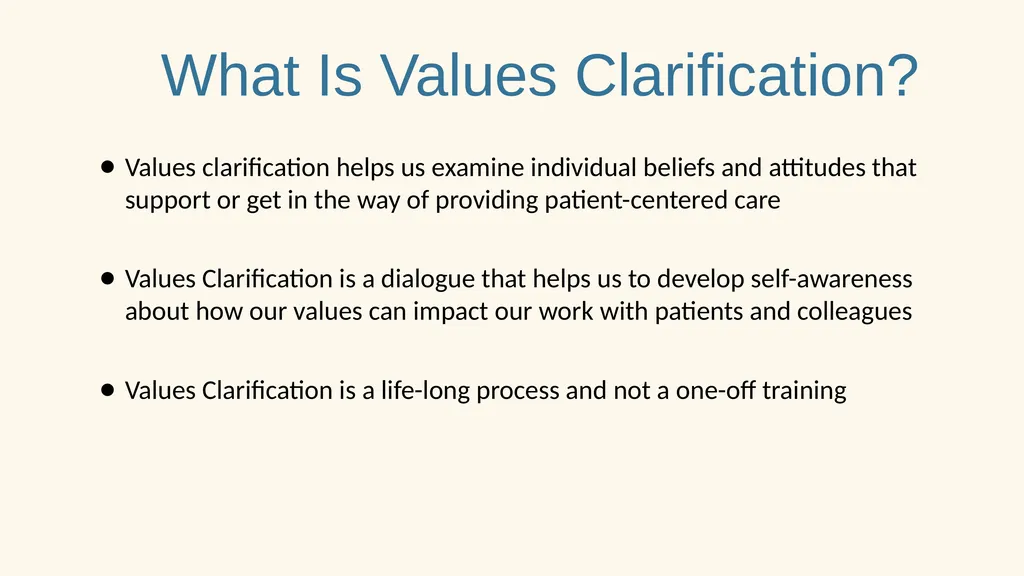
Values clarification helps us examine individual beliefs and attitudes that support or get in the way of providing patient-centered care
Values Clarification is a dialogue that helps us to develop self-awareness about how our values can impact our work with patients and colleagues
Values Clarification is a life-long process and not a one-off training What Is Values Clarification?<br>
Values Clarification is a dialogue that helps us to develop self-awareness about how our values can impact our work with patients and colleagues
Values Clarification is a life-long process and not a one-off training What Is Values Clarification?<br>
09
Values Clarification Workshops in
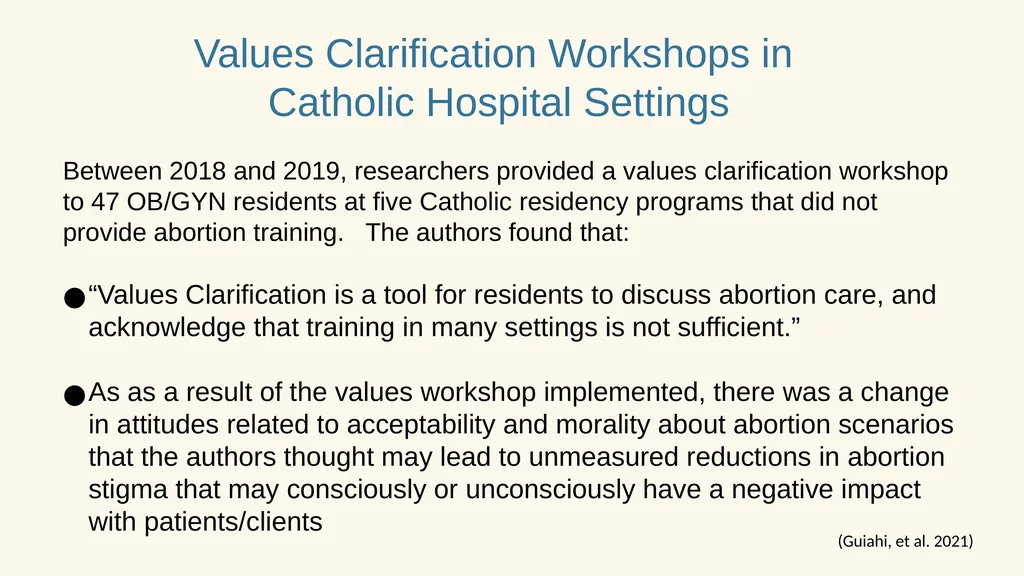
Catholic Hospital Settings Between 2018 and 2019, researchers provided a values clarification workshop to 47 OB/GYN residents at five Catholic residency programs that did not provide abortion training. The authors found that:
“Values Clarification is a tool for residents to discuss abortion care, and acknowledge that training in many settings is not sufficient.”
As as a result of the values workshop implemented, there was a change in attitudes related to acceptability and morality about abortion scenarios that the authors thought may lead to unmeasured reductions in abortion stigma that may consciously or unconsciously have a negative impact with patients/clients (Guiahi, et al. 2021)<br>
Catholic Hospital Settings Between 2018 and 2019, researchers provided a values clarification workshop to 47 OB/GYN residents at five Catholic residency programs that did not provide abortion training. The authors found that:
“Values Clarification is a tool for residents to discuss abortion care, and acknowledge that training in many settings is not sufficient.”
As as a result of the values workshop implemented, there was a change in attitudes related to acceptability and morality about abortion scenarios that the authors thought may lead to unmeasured reductions in abortion stigma that may consciously or unconsciously have a negative impact with patients/clients (Guiahi, et al. 2021)<br>
10
Model Activity: Agree/Disagree<br>
11
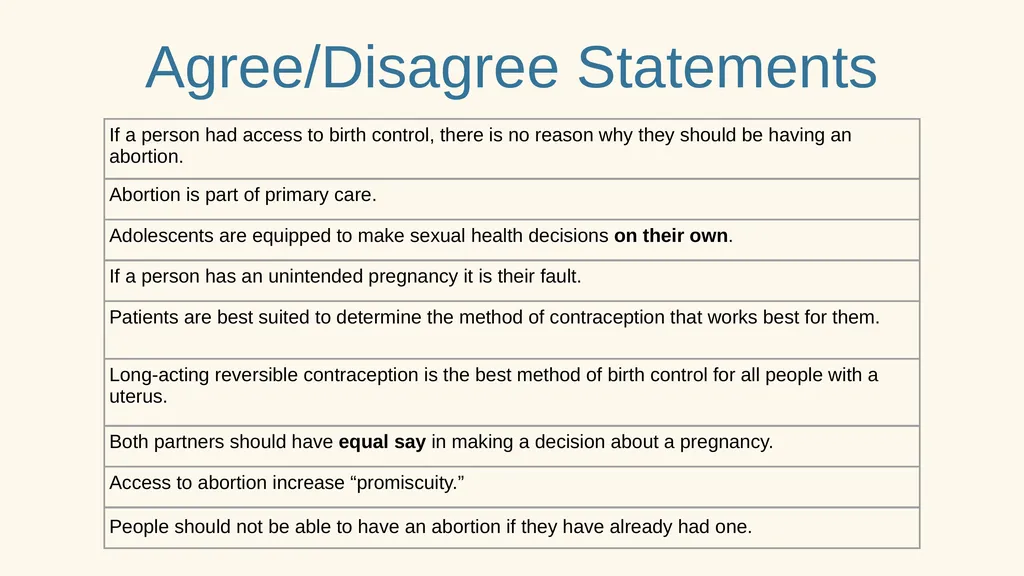
Agree/Disagree Statements<br>
12
Facilitation Skills & Strategies<br>
13
Facilitator Skills Create a safe space for fun, interesting, and challenging conversations
Listen with compassion
Model being non-judgmental
Accommodate different points of view/Meet people where they are at
Handle conflict
Redirect
Remain professional/not take things personally
Facilitate dialogue
Read the room
Time management<br>
Listen with compassion
Model being non-judgmental
Accommodate different points of view/Meet people where they are at
Handle conflict
Redirect
Remain professional/not take things personally
Facilitate dialogue
Read the room
Time management<br>
14
Facilitator Skills Effective facilitators are:
Empathic
Prepared/Familiar with the training/workshop
Aware of how their biases can impact their facilitation of the training/workshop/conversation
Able to acknowledge and apologize for missteps<br>
Empathic
Prepared/Familiar with the training/workshop
Aware of how their biases can impact their facilitation of the training/workshop/conversation
Able to acknowledge and apologize for missteps<br>
15
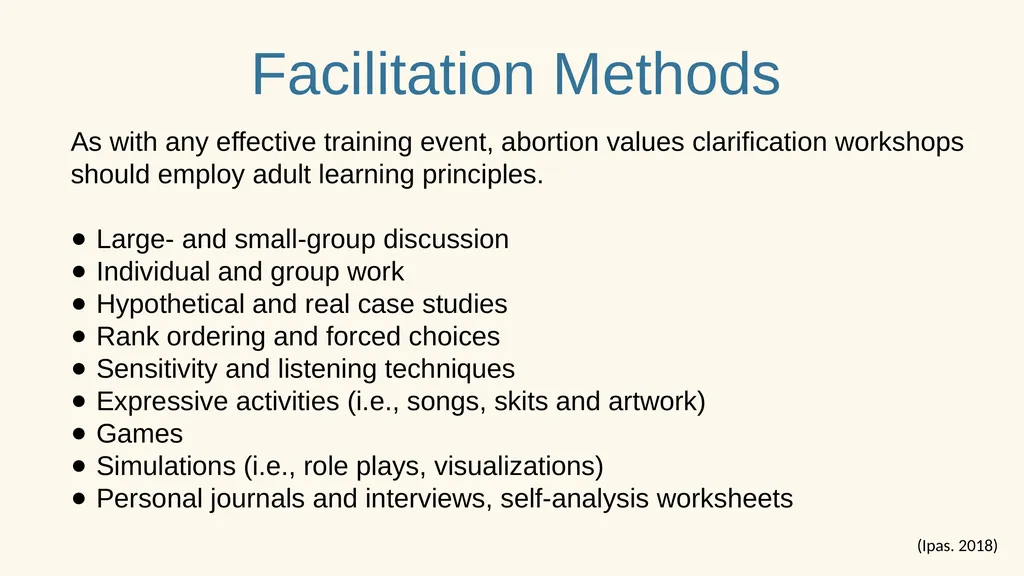
Facilitation Methods As with any effective training event, abortion values clarification workshops should employ adult learning principles.
Large- and small-group discussion
Individual and group work
Hypothetical and real case studies
Rank ordering and forced choices
Sensitivity and listening techniques
Expressive activities (i.e., songs, skits and artwork)
Games
Simulations (i.e., role plays, visualizations)
Personal journals and interviews, self-analysis worksheets (Ipas. 2018)<br>
Large- and small-group discussion
Individual and group work
Hypothetical and real case studies
Rank ordering and forced choices
Sensitivity and listening techniques
Expressive activities (i.e., songs, skits and artwork)
Games
Simulations (i.e., role plays, visualizations)
Personal journals and interviews, self-analysis worksheets (Ipas. 2018)<br>
16
REDIRECTION STRATEGIES Remind participants of the ground rules
Offer for someone who hasn’t spoken to speak
“I’d like to hear from someone who hasn’t shared a lot today”
Empower participants to call ELMO
Enough, Let’s Move On
Take a break
Acknowledge limited time
Parking Lot
Switch facilitators
Use humor (appropriately)
Throw it back to the group
Acknowledge how people are feeling and then move on<br>
Offer for someone who hasn’t spoken to speak
“I’d like to hear from someone who hasn’t shared a lot today”
Empower participants to call ELMO
Enough, Let’s Move On
Take a break
Acknowledge limited time
Parking Lot
Switch facilitators
Use humor (appropriately)
Throw it back to the group
Acknowledge how people are feeling and then move on<br>
17
BREAK:
LET’S BREATHE Calm Sage, 2020<br>
LET’S BREATHE Calm Sage, 2020<br>
18
Values Clarification is not a Training…
It is a Conversation<br>
It is a Conversation<br>
19
"The World Health Organization recommends values clarification trainings for abortion providers to address the role that abortion stigma plays in preventing people from getting the care they need” (WHO. 2012)<br>
20
Having the Conversation (MSI Reproductive Choices) “Abortion Stigma Thrives on Silence”<br>
21
Engaging in Effective Conversations Consider the needs of your audience including: emotions, lived experience, identity and beliefs.
People experience abortion as polarized, partisan politics – not health care…it is important to promote abortion as healthcare.
Conflicted and complex feelings about abortion do not need to be resolved, but managed. (Harris. 2021)<br>
People experience abortion as polarized, partisan politics – not health care…it is important to promote abortion as healthcare.
Conflicted and complex feelings about abortion do not need to be resolved, but managed. (Harris. 2021)<br>
22
Engaging in Effective Conversations Understand the ”tension of opposites” – the capacity to hold and engage with two incompatible feelings – rather than feeling the need to make it one or the other – we recognize that it can be both. For example:
Abortion can be two things at the same time for some of us
Empathy does not have to equal agreement
It is important to understand other’s beliefs and evoke shared values (i.e. we want what is best for our patients)
We don’t all have to agree (Harris. 2021)<br>
Abortion can be two things at the same time for some of us
Empathy does not have to equal agreement
It is important to understand other’s beliefs and evoke shared values (i.e. we want what is best for our patients)
We don’t all have to agree (Harris. 2021)<br>
23
When talking about abortion we should situate ourselves as human beings – and discuss our motivations for work.
Being intentional about language helps to decrease abortion stigma
Emphasize compassion, shared values and empathy even if you don’t share the same beliefs
Discuss being a doctor/provider who provides abortion care – not an abortion doctor
Avoid use of the word fetus
Decision carries more weight then choice. Emphasize that a person’s decision is made together with their physician and family or loved ones
Avoid being dogmatic when having these conversations Language Nuances (Harris. 2021)<br>
Being intentional about language helps to decrease abortion stigma
Emphasize compassion, shared values and empathy even if you don’t share the same beliefs
Discuss being a doctor/provider who provides abortion care – not an abortion doctor
Avoid use of the word fetus
Decision carries more weight then choice. Emphasize that a person’s decision is made together with their physician and family or loved ones
Avoid being dogmatic when having these conversations Language Nuances (Harris. 2021)<br>
24
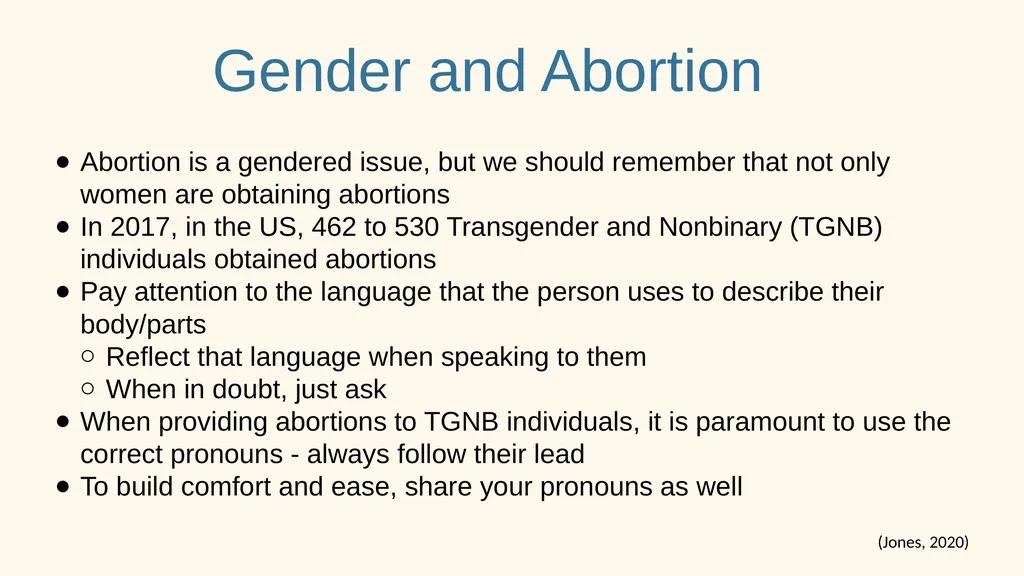
Gender and Abortion Abortion is a gendered issue, but we should remember that not only women are obtaining abortions
In 2017, in the US, 462 to 530 Transgender and Nonbinary (TGNB) individuals obtained abortions
Pay attention to the language that the person uses to describe their body/parts
Reflect that language when speaking to them
When in doubt, just ask
When providing abortions to TGNB individuals, it is paramount to use the correct pronouns - always follow their lead
To build comfort and ease, share your pronouns as well (Jones, 2020)<br>
In 2017, in the US, 462 to 530 Transgender and Nonbinary (TGNB) individuals obtained abortions
Pay attention to the language that the person uses to describe their body/parts
Reflect that language when speaking to them
When in doubt, just ask
When providing abortions to TGNB individuals, it is paramount to use the correct pronouns - always follow their lead
To build comfort and ease, share your pronouns as well (Jones, 2020)<br>
25
Model Activity: Case Reflection<br>
26
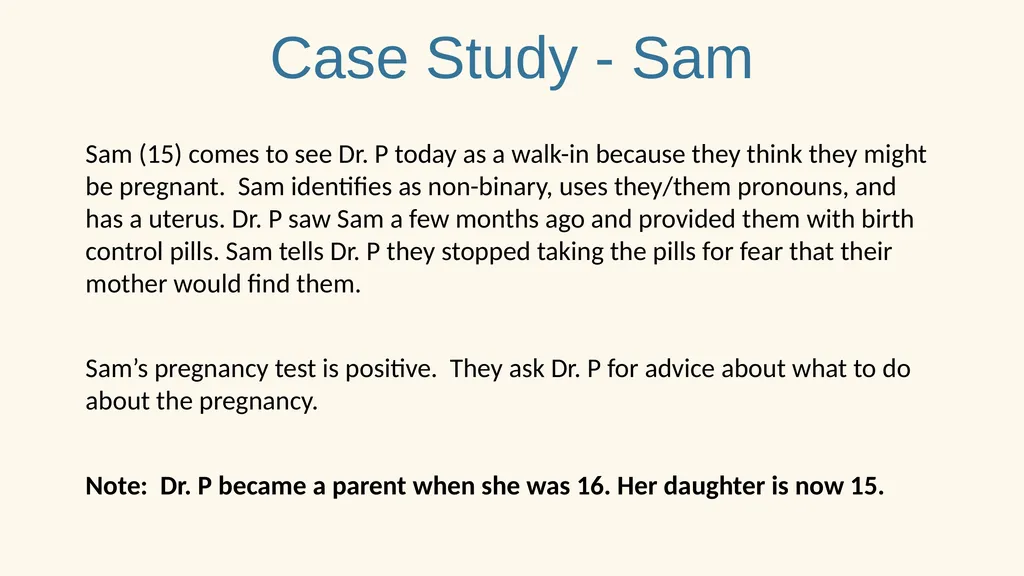
Case Study - Sam Sam (15) comes to see Dr. P today as a walk-in because they think they might be pregnant. Sam identifies as non-binary, uses they/them pronouns, and has a uterus. Dr. P saw Sam a few months ago and provided them with birth control pills. Sam tells Dr. P they stopped taking the pills for fear that their mother would find them.
Sam’s pregnancy test is positive. They ask Dr. P for advice about what to do about the pregnancy.
Note: Dr. P became a parent when she was 16. Her daughter is now 15.<br>
Sam’s pregnancy test is positive. They ask Dr. P for advice about what to do about the pregnancy.
Note: Dr. P became a parent when she was 16. Her daughter is now 15.<br>
27
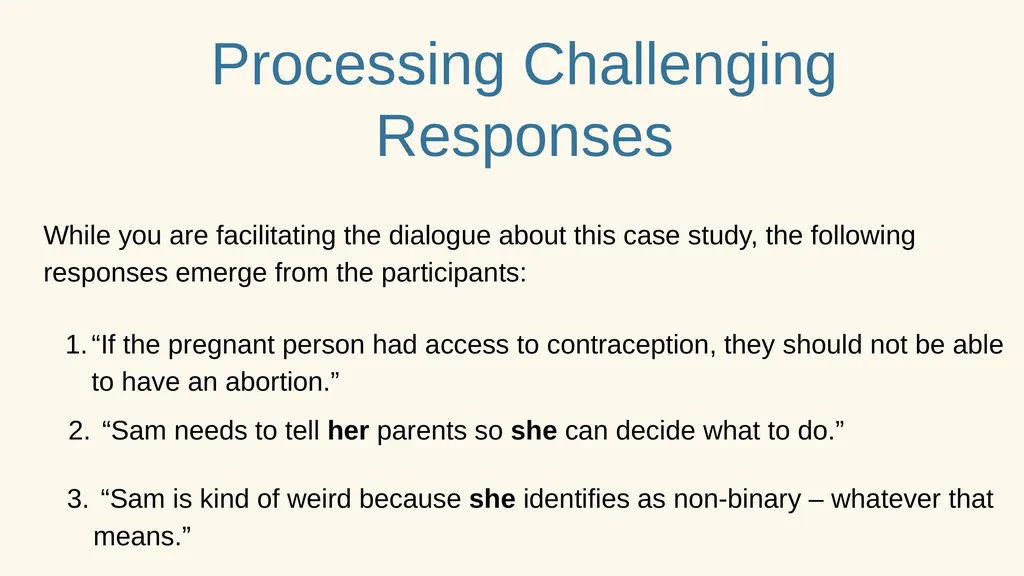
While you are facilitating the dialogue about this case study, the following responses emerge from the participants: Processing Challenging Responses “If the pregnant person had access to contraception, they should not be able to have an abortion.” “Sam needs to tell her parents so she can decide what to do.” “Sam is kind of weird because she identifies as non-binary – whatever that means.”<br>
28
Summary/Reflections and Next Steps One thing I have learned…
One thing I will do differently…
To prepare to facilitate Values Clarification conversations I will…<br>
One thing I will do differently…
To prepare to facilitate Values Clarification conversations I will…<br>
29
QUESTIONS?<br>
30
Resources Tips and Tricks for Redirection Strategies
Compendium of Values Statements
Icebreakers
RHAP Values Clarification Workshop
Facilitation Resources
References<br>
Compendium of Values Statements
Icebreakers
RHAP Values Clarification Workshop
Facilitation Resources
References<br>
31
References Turner KL, Pearson E, George A, Andersen KL. Values clarification workshops to improve abortion knowledge, attitudes and intentions: a pre-post assessment in 12 countries. Reprod Health. 2018; 15: 40. 2018. https://doi.org/10.1186/s12978-018-0480-0
Prine L, Lesnewski R, Bregman R. Integrating medical abortion into a residency practice. Fam Med. 2003; Jul-Aug;35(7):469-71. https://pubmed.ncbi.nlm.nih.gov/12861455/
Guiahi M, Wilson C, Claymore E, Simonson K, Steinauer J. Influence of a values clarification workshop on residents training at Catholic Hospital programs. Contraception: X. 2021; 3. https://doi.org/10.1016/j.conx.2021.100054
Abortion attitude transformation: A Values Clarification Toolkit For Humanitarian Audiences. Ipas. 2018. https://www.ipas.org/wp-content/uploads/2023/05/VCATHS2E18-AbortionAttitudeTransformation-humanitarian-audiences-c.pdf.
Calm Sage. 1 Minute Breathing Exercise| Mini Meditation | Simple Breathing Exercise | One Minute Breathe Bubble. YouTube. June 4, 2020. Accessed May 22, 2024. https://tinyurl.com/4a9s5hea
Safe Abortion: Technical And Policy Guidance For Health Systems. World Health Organization. 2012
Values Clarification/VCAT Facilitators Training. MSI Reproductive Choices. Accessed May 15, 2024. https://kayaconnect.org/course/info.php?id=5040.
Harris L.Shifting Culture: Evidence-Based Messaging Recommendations for Doctors who Provide Abortion Care, September 2021.
Jones R, Witwer E, et al. Transgender abortion patients and the provision of transgender-specific care at non-hospital facilities that provide abortions. Contraception: X. 2020; 2. https://doi.org/10.1016/j.conx.2020.100019<br>
Prine L, Lesnewski R, Bregman R. Integrating medical abortion into a residency practice. Fam Med. 2003; Jul-Aug;35(7):469-71. https://pubmed.ncbi.nlm.nih.gov/12861455/
Guiahi M, Wilson C, Claymore E, Simonson K, Steinauer J. Influence of a values clarification workshop on residents training at Catholic Hospital programs. Contraception: X. 2021; 3. https://doi.org/10.1016/j.conx.2021.100054
Abortion attitude transformation: A Values Clarification Toolkit For Humanitarian Audiences. Ipas. 2018. https://www.ipas.org/wp-content/uploads/2023/05/VCATHS2E18-AbortionAttitudeTransformation-humanitarian-audiences-c.pdf.
Calm Sage. 1 Minute Breathing Exercise| Mini Meditation | Simple Breathing Exercise | One Minute Breathe Bubble. YouTube. June 4, 2020. Accessed May 22, 2024. https://tinyurl.com/4a9s5hea
Safe Abortion: Technical And Policy Guidance For Health Systems. World Health Organization. 2012
Values Clarification/VCAT Facilitators Training. MSI Reproductive Choices. Accessed May 15, 2024. https://kayaconnect.org/course/info.php?id=5040.
Harris L.Shifting Culture: Evidence-Based Messaging Recommendations for Doctors who Provide Abortion Care, September 2021.
Jones R, Witwer E, et al. Transgender abortion patients and the provision of transgender-specific care at non-hospital facilities that provide abortions. Contraception: X. 2020; 2. https://doi.org/10.1016/j.conx.2020.100019<br>
32
References Understanding the Training of Trainers Model. Centers for Disease Control and Prevention. Updated March 13, 2019. Accessed May 5, 2024. https://www.cdc.gov/healthyschools/tths/train_trainers_model.htm
Steinauer J. Train the Trainer: How to Facilitate a Values Clarification Exercise. Bixby Center for Global Reproductive Health. Webinar. June 25, 2010. Accessed May 15, 2024.
Harris L, Having Difficult Conversations. RHAP Virtual Learning Collaborative. April 2024.
Challenging Patient Encounters Digital Module: Family Planning and Abortion. Innovating Education in Reproductive Health, Bixby Center for Reproductive Health, UCSF. Accessed April 28, 2024. https://www.innovating-education.org/learning-module/values-clarification/
The Abortion Option: A Values Clarification Guide for Health Care Professionals. National Abortion Federation. 2005. Accessed April 15, 2024. https://prochoice.org/wp-content/uploads/abortion_option.pdf?.
Turner KL, Chapman Page K. Abortion attitude transformation: A values clarification toolkit for global audiences. Ipas. 2008
Turner KL, Chapman Page K, Smith D, Börjesson E, Villa L. Abortion attitude transformation: Activities adapted for young women. Ipas. 2011<br>
Steinauer J. Train the Trainer: How to Facilitate a Values Clarification Exercise. Bixby Center for Global Reproductive Health. Webinar. June 25, 2010. Accessed May 15, 2024.
Harris L, Having Difficult Conversations. RHAP Virtual Learning Collaborative. April 2024.
Challenging Patient Encounters Digital Module: Family Planning and Abortion. Innovating Education in Reproductive Health, Bixby Center for Reproductive Health, UCSF. Accessed April 28, 2024. https://www.innovating-education.org/learning-module/values-clarification/
The Abortion Option: A Values Clarification Guide for Health Care Professionals. National Abortion Federation. 2005. Accessed April 15, 2024. https://prochoice.org/wp-content/uploads/abortion_option.pdf?.
Turner KL, Chapman Page K. Abortion attitude transformation: A values clarification toolkit for global audiences. Ipas. 2008
Turner KL, Chapman Page K, Smith D, Börjesson E, Villa L. Abortion attitude transformation: Activities adapted for young women. Ipas. 2011<br>
33
Our work is about building power among primary care clinicians to protect and expand access to care in their communities so patients can exercise their reproductive autonomy, get the services they need and want, when they want them and in a place/with a clinician they know and trust. Thank You!<br>