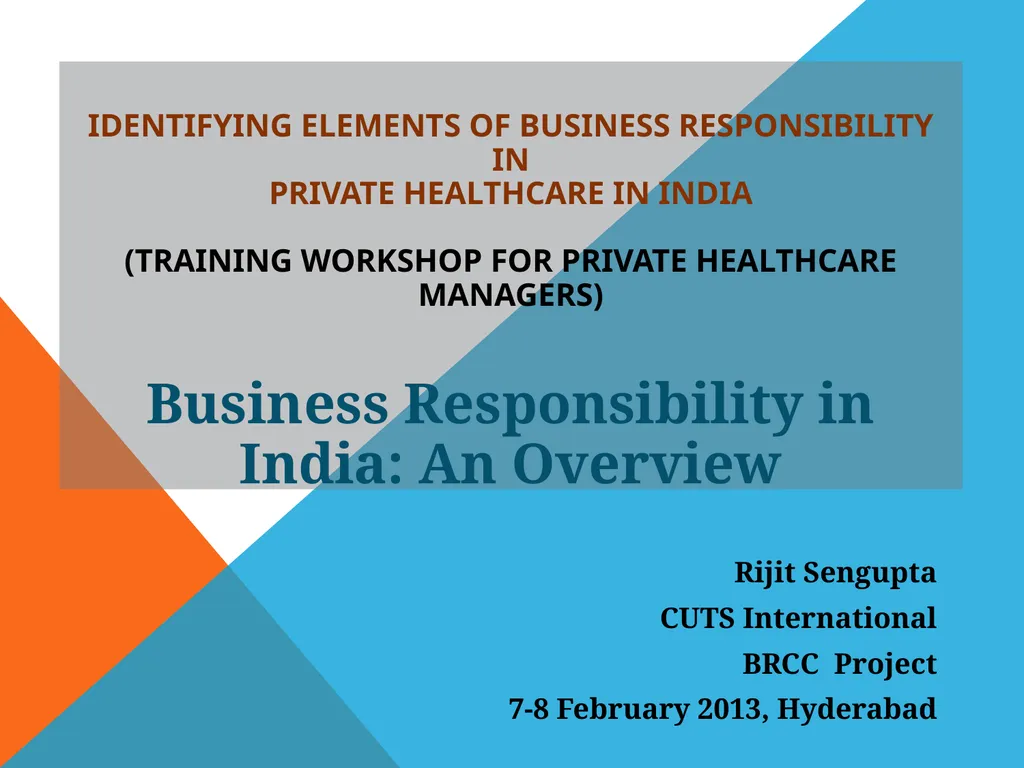
Identifying Elements of Business Responsibility in
Description: Identifying Elements of Business Responsibility in Private Healthcare in India (Training workshop for private healthcare managers) Business Responsibility in India: An Overview Rijit Sengupta CUTS International BRCC Project 7-8 February
Related Topics
Download Presentation
"Identifying Elements of Business Responsibility in" is the property of its rightful owner. Permission is granted to download and print the materials on this website for personal, non-commercial use only, and to display it on your personal computer provided you do not modify the materials and that you retain all copyright notices contained in the materials. By downloading content from our website, you accept the terms of this agreement.
Presentation Transcript
slide1. Identifying Elements of Business Responsibility inPrivate Healthcare in India(Training workshop for private healthcare managers)Business Responsibility in India: An Overview Rijit Sengupta
CUTS International
BRCC Project
7-8 February 2013, Hyderabad<br>
slide2. Setting the stage A short message from
Shri N R Narayan Murthy
Founder & Chief Mentor, Infosys Technologies BRCC Project 2<br>
slide3. Outline Introduction
Definition & Conceptual Clarity
History of CSR in India
Policies and Measures
Delivery Mechanisms
Role of Government
Current State of Play BRCC Project 3<br>
slide4. INTRODUCTION Promoting ‘responsible business’ is ingrained in the Indian tradition of doing business - Sukhasya Moolam Dharma
Stalwarts of responsible and ethical business practices:
- Kautilya (4th Century B.C.)
- Jamshetji N Tata (post-independent India)
- N R Narayan Murthy (new millennium)
Corporate Social Responsibility – definition incorporating all three elements of sustainable development: economy, equity & environment BRCC Project 4<br>
slide5. Definition & conceptual clarity CSR is the continuing commitment by business to behave ethically and contribute to economic development while improving the quality of life of the workforce and their families as well as of the local community and society at large (WBCSD, 1998)
CSR is the responsibility of enterprises for their impacts on society (EU, 2011)
CSR is about ensuring that companies can grow on a sustainable basis, while ensuring fairness to all stakeholders (N R Narayana Murthy) BRCC Project 5<br>
slide6. History of csr in india First Phase: Vedic philosophy and thoughts enshrined in Arthashashtra
Second Phase: Characterised by altruistic activities mainly by wealthy merchants
Third Phase: Stress on Indian industrialists to provide support for building a ‘new India’. Idea of Trusteeship
Fourth Phase: Characterised by enactment of legislations towards labour and environment protection
Fifth Phase: Businesses have started incorporating elements of CSR in their core business strategy/model BRCC Project 6<br>
slide7. Policies & measures PM’s Ten Point Social Charter (2007)
Voluntary Guidelines on CSR (MoCA, 2009)
National Voluntary Guidelines on Social, Economic & Environmental Responsibilities of Business (2011)
Expert Group for implementation of NVGs (2012)
Section 135 in Companies Bill (passed by Lok Sabha, 2012 and to travel to Rajya Sabha in Budget Session)
2% CSR expenditure mandatory for certain sized firms
CSR expenditure of CSR Investment? (Tax benefits?) BRCC Project 7<br>
slide8. Delivery mechanisms Individual Philanthropy: The idea of ‘giving’ is part of the Indian tradition and is practiced by firms donating to NGOs or Trusts to undertake community services BRCC Project 8<br>
slide9. Delivery mechanisms Corporate Social Responsibility/Corporate Philanthropy: allocates a certain amount of its funds either to a department within the business entity, or creates another organisation (e.g., a foundation) for undertaking such activities BRCC Project 9<br>
slide10. Delivery mechanisms Business Responsibility: According to this approach, the business entity refines/readjusts its model of doing business from within and in the process makes greater positive contribution to societal development. BRCC Project 10<br>
slide11. Role of government Mandating: formulating laws, regulations, norms to control/monitor business behaviour
Facilitating: developing policies and conditions to enable investment in CSR activities
Partnering: combining skills of the public sector with that of the private sector to undertake CSR activities
Endorsing: recognising CSR activities through award schemes and other incentive measures
Demonstrating: leading the way by ensuring that public sector firms are pioneers in undertaking CSR activities BRCC Project 11<br>
slide12. Current state of play NVGs provide a framework to guide ‘eligible’ firms for investing in CSR activities
‘Eligible’ firms need to make investments in CSR activities as per Section 135 of Companies Bill
Reports to be submitted in a specific format (ABRR; SEBI has made it mandatory for top 100 listed firms)
Can firms claim tax relief for their CSR investments?
Firms are unlikely to meet their 2% targets early on; it might be possible for them to carry over unspent amounts
Need to align the NVGs with the Companies Bill (amendment of Schedule VII and/or Regulations) BRCC Project 12<br>
slide13. Thank You
rsg@cuts.org
ccier@cuts.org
+91-9829285928 BRCC Project 13<br>
CUTS International
BRCC Project
7-8 February 2013, Hyderabad<br>
slide2. Setting the stage A short message from
Shri N R Narayan Murthy
Founder & Chief Mentor, Infosys Technologies BRCC Project 2<br>
slide3. Outline Introduction
Definition & Conceptual Clarity
History of CSR in India
Policies and Measures
Delivery Mechanisms
Role of Government
Current State of Play BRCC Project 3<br>
slide4. INTRODUCTION Promoting ‘responsible business’ is ingrained in the Indian tradition of doing business - Sukhasya Moolam Dharma
Stalwarts of responsible and ethical business practices:
- Kautilya (4th Century B.C.)
- Jamshetji N Tata (post-independent India)
- N R Narayan Murthy (new millennium)
Corporate Social Responsibility – definition incorporating all three elements of sustainable development: economy, equity & environment BRCC Project 4<br>
slide5. Definition & conceptual clarity CSR is the continuing commitment by business to behave ethically and contribute to economic development while improving the quality of life of the workforce and their families as well as of the local community and society at large (WBCSD, 1998)
CSR is the responsibility of enterprises for their impacts on society (EU, 2011)
CSR is about ensuring that companies can grow on a sustainable basis, while ensuring fairness to all stakeholders (N R Narayana Murthy) BRCC Project 5<br>
slide6. History of csr in india First Phase: Vedic philosophy and thoughts enshrined in Arthashashtra
Second Phase: Characterised by altruistic activities mainly by wealthy merchants
Third Phase: Stress on Indian industrialists to provide support for building a ‘new India’. Idea of Trusteeship
Fourth Phase: Characterised by enactment of legislations towards labour and environment protection
Fifth Phase: Businesses have started incorporating elements of CSR in their core business strategy/model BRCC Project 6<br>
slide7. Policies & measures PM’s Ten Point Social Charter (2007)
Voluntary Guidelines on CSR (MoCA, 2009)
National Voluntary Guidelines on Social, Economic & Environmental Responsibilities of Business (2011)
Expert Group for implementation of NVGs (2012)
Section 135 in Companies Bill (passed by Lok Sabha, 2012 and to travel to Rajya Sabha in Budget Session)
2% CSR expenditure mandatory for certain sized firms
CSR expenditure of CSR Investment? (Tax benefits?) BRCC Project 7<br>
slide8. Delivery mechanisms Individual Philanthropy: The idea of ‘giving’ is part of the Indian tradition and is practiced by firms donating to NGOs or Trusts to undertake community services BRCC Project 8<br>
slide9. Delivery mechanisms Corporate Social Responsibility/Corporate Philanthropy: allocates a certain amount of its funds either to a department within the business entity, or creates another organisation (e.g., a foundation) for undertaking such activities BRCC Project 9<br>
slide10. Delivery mechanisms Business Responsibility: According to this approach, the business entity refines/readjusts its model of doing business from within and in the process makes greater positive contribution to societal development. BRCC Project 10<br>
slide11. Role of government Mandating: formulating laws, regulations, norms to control/monitor business behaviour
Facilitating: developing policies and conditions to enable investment in CSR activities
Partnering: combining skills of the public sector with that of the private sector to undertake CSR activities
Endorsing: recognising CSR activities through award schemes and other incentive measures
Demonstrating: leading the way by ensuring that public sector firms are pioneers in undertaking CSR activities BRCC Project 11<br>
slide12. Current state of play NVGs provide a framework to guide ‘eligible’ firms for investing in CSR activities
‘Eligible’ firms need to make investments in CSR activities as per Section 135 of Companies Bill
Reports to be submitted in a specific format (ABRR; SEBI has made it mandatory for top 100 listed firms)
Can firms claim tax relief for their CSR investments?
Firms are unlikely to meet their 2% targets early on; it might be possible for them to carry over unspent amounts
Need to align the NVGs with the Companies Bill (amendment of Schedule VII and/or Regulations) BRCC Project 12<br>
slide13. Thank You
rsg@cuts.org
ccier@cuts.org
+91-9829285928 BRCC Project 13<br>