Identifying Life Threatening Emergencies
Description: Identifying Life Threatening Emergencies Danielles Law Training Responsibilities Quality of Care You have an important role in caring for individuals with intellectual and developmental disabilities Recognizing medical issues and
Related Topics
Download Presentation
"Identifying Life Threatening Emergencies" is the property of its rightful owner. Permission is granted to download and print the materials on this website for personal, non-commercial use only, and to display it on your personal computer provided you do not modify the materials and that you retain all copyright notices contained in the materials. By downloading content from our website, you accept the terms of this agreement.
Presentation Transcript
slide1. Identifying Life Threatening Emergencies Danielle’s Law Training<br>
slide2. Responsibilities & Quality of Care You have an important role in caring for individuals with intellectual and developmental disabilities
Recognizing medical issues and obtaining appropriate care is vital
Good communication and monitoring of individuals you are assisting provides quality of care
Your actions can save a life<br>
slide3. Identifying Life Threatening Emergencies Life Threatening Emergencies are potentially fatal
Not all medical situations are life threatening emergencies
Need to identify those situations that are life threatening emergencies<br>
slide4. Health Threatening Conditions Some medical situations may be health threatening, but not life threatening
Obtain appropriate medical care for health threatening conditions, such as calling a doctor
Always follow established medical protocols for any individual you support, such as checking blood sugar or providing PRN asthma medication
Report all health conditions to your supervisor and monitor the condition<br>
slide5. Health Threatening Conditions Examples of Health Threatening Conditions:
Sprained ankle
Bleeding controlled with pressure
Seizures typical to the person that last under 5 minutes
Minor burns/cuts
Flu symptoms
If the health threatening condition worsens or becomes life threatening, call 9-1-1 immediately<br>
slide6. Life threatening emergencies are those situations when immediate intervention is necessary to protect a person’s life or if serious impairment or dysfunction of a person’s body functions or organs/parts may occur Identifying Life Threatening Emergencies<br>
slide7. Identifying Life Threatening Emergencies Examples of life threatening emergencies include, but are not limited to:
Unconsciousness
Persistent chest pain or discomfort
Not breathing or trouble breathing
Severe bleeding
Severe, persistent abdominal pain
Stroke symptoms
Serious head injury
Shock
Some seizures<br>
slide8. Identifying Life Threatening Emergencies Seizures that may be life threatening:
First time seizure
Lasting longer than 5 minutes
Back-to-back (3 or more in a row)
Result in serious injury
Person is not breathing once seizure stops
Occur in someone who is pregnant
Occur in someone who has diabetes<br>
slide9. Identifying Life Threatening Emergencies Some questions to determine if 9-1-1 should be called:
Could this condition be potentially fatal?
Could the condition get worse and become life threatening if you drove the person to the hospital?
Could moving the person on your own cause further injury?
Does the person require the skills/equipment of emergency medical personnel?<br>
slide10. Identifying Life Threatening Emergencies If you identify a life threatening emergency, CALL 9-1-1 immediately
Don’t call a supervisor or co-worker first when a life threatening emergency exists
If you are not sure if the situation is life threatening, call 9-1-1<br>
slide11. Calling 9-1-1 Tell the 9-1-1 Operator:
Your name and number
Location of incident
What happened
Condition of person including any special conditions
Care being provided
Don’t hang up until the dispatcher instructs you to do so<br>
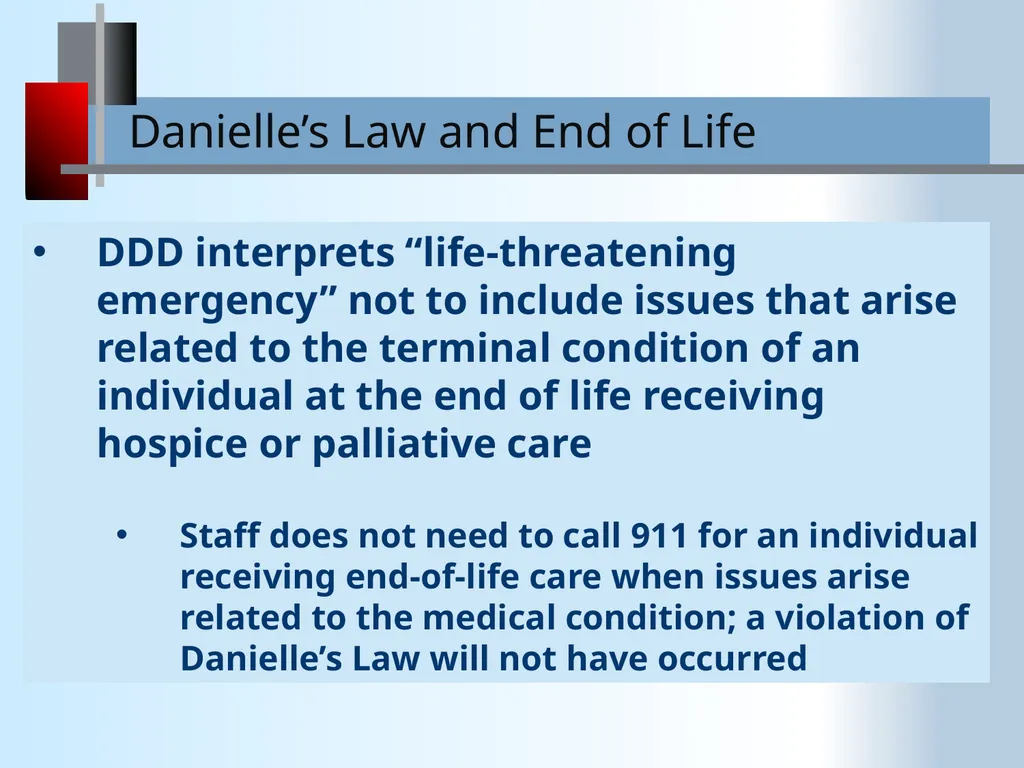
slide12. Danielle’s Law and End of Life DDD interprets “life-threatening emergency” not to include issues that arise related to the terminal condition of an individual at the end of life receiving hospice or palliative care
Staff does not need to call 911 for an individual receiving end-of-life care when issues arise related to the medical condition; a violation of Danielle’s Law will not have occurred<br>
slide13. Danielle’s Law and End of Life (cont.) Individuals at the end of life should be permitted to have their and their guardians’ decisions regarding medical treatment followed
Appropriate medical care must always be provided<br>
slide14. Danielle’s Law and End of Life (cont.) Staff must call 911 if a “life-threatening emergency” does occur
An event not related to the end-of-life condition – for example, an injury leading to excessive bleeding
If the individual has a Practitioner Order for Life-Sustaining Treatment (POLST) or Do Not Resuscitate (DNR) order, this should be provided to emergency personnel<br>
slide15. Scenarios Activity Get into small groups
Determine if each situation is a life-threatening emergency requiring a 9-1-1 call
Decide how you would handle the situation
Choose a group leader as a spokesperson to report your group’s decisions<br>
slide16. Responding to Life Threatening Emergencies CHECK the person to determine if he/she is experiencing a life threatening emergency
CALL 9-1-1 IF the condition is life threatening
CARE for the person until help arrives
You are not required to call 9-1-1 in non-life threatening situations, but appropriate medical care is always required<br>
slide17. Who is Danielle? 32 year old Danielle Gruskowski lived a full and active life as a member of her family and of the Carteret, NJ community
She founded the “Carteret Specials” group dedicated to enriching the lives of local children with developmental disabilities, which is still active today<br>
slide18. Danielle’s Law Danielle’s Law was named in her memory to increase necessary 9-1-1 calls for life threatening emergencies
The law emphasizes the importance of staff calling 9-1-1 in life threatening emergencies for people with intellectual and developmental disabilities or traumatic brain injuries<br>
slide19. It’s the Law: Staff Responsibilities Anyone who works with individuals with intellectual and developmental disabilities or traumatic brain injury must call 9-1-1 in the event of a life threatening emergency
Not calling 9-1-1 or delaying the call in a life threatening emergency is a violation of the law<br>
slide20. Employer/Provider Responsibilities Ensure staff are trained to identify life threatening emergencies and know when to call 9-1-1
File an incident report according to Division procedures
Maintain a record of all 9-1-1 calls<br>
slide21. Department of Human Services Responsibilities Ensure training is provided to service providers
Maintain records of provider calls to 9-1-1
Review potential violations of Danielle’s Law
Situations where a reasonably prudent person did not act in a life threatening emergency
Maintain records of violations<br>
slide22. Penalties for Non-Compliance with Law If you do not call 9-1-1 in a life threatening emergency, penalties may include:
Termination from employment
Fines up to $25,000
Loss of license (for healthcare professionals)<br>
slide23. How are Danielle’s Law Violations Reviewed? Reviewed by OPIA & DDD Risk Management Staff
Criteria:
Was the condition a life threatening emergency?
Would a reasonably prudent person have known at the time of the incident that the condition was life threatening?
Outcome of incident not considered
Recommendation made to Assistant Commissioner for final decision<br>
slide24. Review & Quiz Review of health threatening conditions
Review of life threatening emergencies
Frequently Asked Questions
Quiz For
Life Threatening
Emergencies<br>
slide25. Quiz Question: True or False? Direct care staff often know the person best, so their input into medical conditions is important.
TRUE OR FALSE?<br>
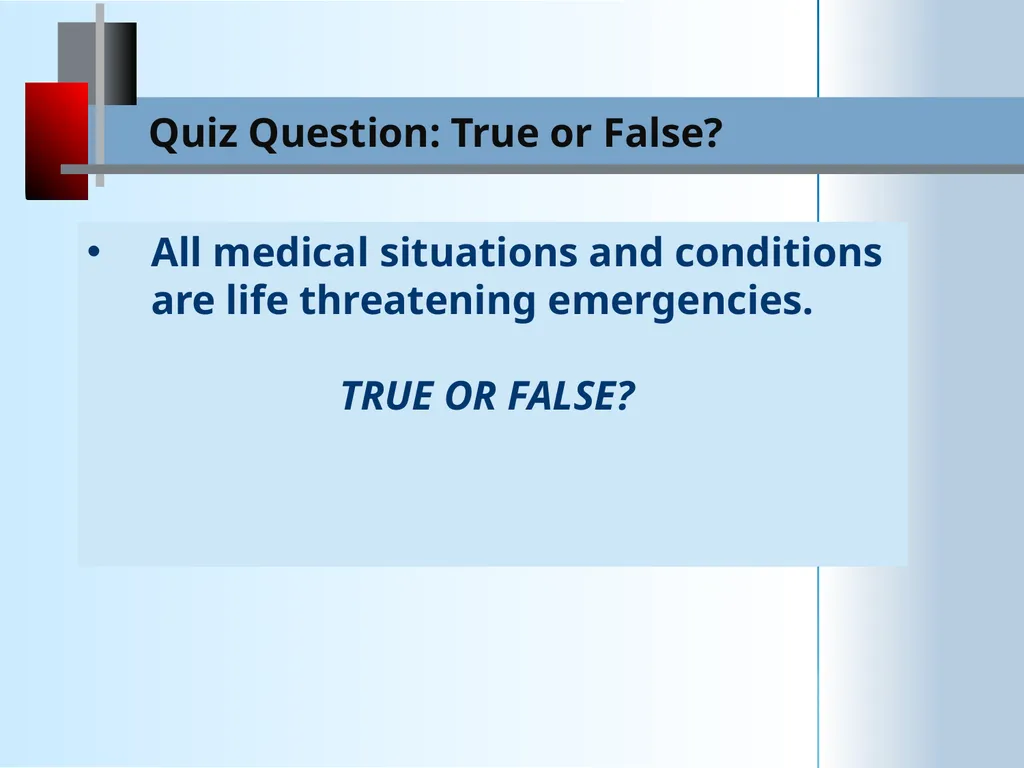
slide26. Quiz Question: True or False? All medical situations and conditions are life threatening emergencies.
TRUE OR FALSE?<br>
slide27. Quiz Question: True or False? All 9-1-1 calls must be for life threatening emergencies.
TRUE OR FALSE?<br>
slide28. Quiz Question: True or False? A health threatening condition may need immediate medical care such as driving someone to the doctor’s office or an emergency room.
TRUE OR FALSE?<br>
slide29. Quiz Question: True or False? Examples of life threatening emergencies would be a heart attack or stroke.
TRUE OR FALSE?<br>
slide30. Quiz Question: True or False? An example of a health threatening condition would be seizures typical for the person lasting less than 5 minutes.
TRUE OR FALSE?<br>
slide31. Quiz Question: True or False? If someone is having trouble breathing, but is conscious and able to talk to you, it would be safe to drive them to the hospital yourself.
TRUE OR FALSE?<br>
slide32. Quiz Question: True or False? When you identify a life threatening emergency, you should call 9-1-1, provide care and then call your supervisor to report the situation.
TRUE OR FALSE?<br>
slide33. Quiz Question: True or False? Health threatening conditions are not emergencies, however appropriate and prompt medical care is always required, such as calling a doctor.
TRUE OR FALSE?<br>
slide34. Wrap Up Questions?
Acknowledgement of Training Form
Thank You!<br>

slide2. Responsibilities & Quality of Care You have an important role in caring for individuals with intellectual and developmental disabilities
Recognizing medical issues and obtaining appropriate care is vital
Good communication and monitoring of individuals you are assisting provides quality of care
Your actions can save a life<br>
slide3. Identifying Life Threatening Emergencies Life Threatening Emergencies are potentially fatal
Not all medical situations are life threatening emergencies
Need to identify those situations that are life threatening emergencies<br>
slide4. Health Threatening Conditions Some medical situations may be health threatening, but not life threatening
Obtain appropriate medical care for health threatening conditions, such as calling a doctor
Always follow established medical protocols for any individual you support, such as checking blood sugar or providing PRN asthma medication
Report all health conditions to your supervisor and monitor the condition<br>
slide5. Health Threatening Conditions Examples of Health Threatening Conditions:
Sprained ankle
Bleeding controlled with pressure
Seizures typical to the person that last under 5 minutes
Minor burns/cuts
Flu symptoms
If the health threatening condition worsens or becomes life threatening, call 9-1-1 immediately<br>
slide6. Life threatening emergencies are those situations when immediate intervention is necessary to protect a person’s life or if serious impairment or dysfunction of a person’s body functions or organs/parts may occur Identifying Life Threatening Emergencies<br>
slide7. Identifying Life Threatening Emergencies Examples of life threatening emergencies include, but are not limited to:
Unconsciousness
Persistent chest pain or discomfort
Not breathing or trouble breathing
Severe bleeding
Severe, persistent abdominal pain
Stroke symptoms
Serious head injury
Shock
Some seizures<br>
slide8. Identifying Life Threatening Emergencies Seizures that may be life threatening:
First time seizure
Lasting longer than 5 minutes
Back-to-back (3 or more in a row)
Result in serious injury
Person is not breathing once seizure stops
Occur in someone who is pregnant
Occur in someone who has diabetes<br>
slide9. Identifying Life Threatening Emergencies Some questions to determine if 9-1-1 should be called:
Could this condition be potentially fatal?
Could the condition get worse and become life threatening if you drove the person to the hospital?
Could moving the person on your own cause further injury?
Does the person require the skills/equipment of emergency medical personnel?<br>
slide10. Identifying Life Threatening Emergencies If you identify a life threatening emergency, CALL 9-1-1 immediately
Don’t call a supervisor or co-worker first when a life threatening emergency exists
If you are not sure if the situation is life threatening, call 9-1-1<br>
slide11. Calling 9-1-1 Tell the 9-1-1 Operator:
Your name and number
Location of incident
What happened
Condition of person including any special conditions
Care being provided
Don’t hang up until the dispatcher instructs you to do so<br>
slide12. Danielle’s Law and End of Life DDD interprets “life-threatening emergency” not to include issues that arise related to the terminal condition of an individual at the end of life receiving hospice or palliative care
Staff does not need to call 911 for an individual receiving end-of-life care when issues arise related to the medical condition; a violation of Danielle’s Law will not have occurred<br>
slide13. Danielle’s Law and End of Life (cont.) Individuals at the end of life should be permitted to have their and their guardians’ decisions regarding medical treatment followed
Appropriate medical care must always be provided<br>
slide14. Danielle’s Law and End of Life (cont.) Staff must call 911 if a “life-threatening emergency” does occur
An event not related to the end-of-life condition – for example, an injury leading to excessive bleeding
If the individual has a Practitioner Order for Life-Sustaining Treatment (POLST) or Do Not Resuscitate (DNR) order, this should be provided to emergency personnel<br>
slide15. Scenarios Activity Get into small groups
Determine if each situation is a life-threatening emergency requiring a 9-1-1 call
Decide how you would handle the situation
Choose a group leader as a spokesperson to report your group’s decisions<br>
slide16. Responding to Life Threatening Emergencies CHECK the person to determine if he/she is experiencing a life threatening emergency
CALL 9-1-1 IF the condition is life threatening
CARE for the person until help arrives
You are not required to call 9-1-1 in non-life threatening situations, but appropriate medical care is always required<br>
slide17. Who is Danielle? 32 year old Danielle Gruskowski lived a full and active life as a member of her family and of the Carteret, NJ community
She founded the “Carteret Specials” group dedicated to enriching the lives of local children with developmental disabilities, which is still active today<br>
slide18. Danielle’s Law Danielle’s Law was named in her memory to increase necessary 9-1-1 calls for life threatening emergencies
The law emphasizes the importance of staff calling 9-1-1 in life threatening emergencies for people with intellectual and developmental disabilities or traumatic brain injuries<br>
slide19. It’s the Law: Staff Responsibilities Anyone who works with individuals with intellectual and developmental disabilities or traumatic brain injury must call 9-1-1 in the event of a life threatening emergency
Not calling 9-1-1 or delaying the call in a life threatening emergency is a violation of the law<br>
slide20. Employer/Provider Responsibilities Ensure staff are trained to identify life threatening emergencies and know when to call 9-1-1
File an incident report according to Division procedures
Maintain a record of all 9-1-1 calls<br>
slide21. Department of Human Services Responsibilities Ensure training is provided to service providers
Maintain records of provider calls to 9-1-1
Review potential violations of Danielle’s Law
Situations where a reasonably prudent person did not act in a life threatening emergency
Maintain records of violations<br>
slide22. Penalties for Non-Compliance with Law If you do not call 9-1-1 in a life threatening emergency, penalties may include:
Termination from employment
Fines up to $25,000
Loss of license (for healthcare professionals)<br>
slide23. How are Danielle’s Law Violations Reviewed? Reviewed by OPIA & DDD Risk Management Staff
Criteria:
Was the condition a life threatening emergency?
Would a reasonably prudent person have known at the time of the incident that the condition was life threatening?
Outcome of incident not considered
Recommendation made to Assistant Commissioner for final decision<br>
slide24. Review & Quiz Review of health threatening conditions
Review of life threatening emergencies
Frequently Asked Questions
Quiz For
Life Threatening
Emergencies<br>
slide25. Quiz Question: True or False? Direct care staff often know the person best, so their input into medical conditions is important.
TRUE OR FALSE?<br>
slide26. Quiz Question: True or False? All medical situations and conditions are life threatening emergencies.
TRUE OR FALSE?<br>
slide27. Quiz Question: True or False? All 9-1-1 calls must be for life threatening emergencies.
TRUE OR FALSE?<br>
slide28. Quiz Question: True or False? A health threatening condition may need immediate medical care such as driving someone to the doctor’s office or an emergency room.
TRUE OR FALSE?<br>
slide29. Quiz Question: True or False? Examples of life threatening emergencies would be a heart attack or stroke.
TRUE OR FALSE?<br>
slide30. Quiz Question: True or False? An example of a health threatening condition would be seizures typical for the person lasting less than 5 minutes.
TRUE OR FALSE?<br>
slide31. Quiz Question: True or False? If someone is having trouble breathing, but is conscious and able to talk to you, it would be safe to drive them to the hospital yourself.
TRUE OR FALSE?<br>
slide32. Quiz Question: True or False? When you identify a life threatening emergency, you should call 9-1-1, provide care and then call your supervisor to report the situation.
TRUE OR FALSE?<br>
slide33. Quiz Question: True or False? Health threatening conditions are not emergencies, however appropriate and prompt medical care is always required, such as calling a doctor.
TRUE OR FALSE?<br>
slide34. Wrap Up Questions?
Acknowledgement of Training Form
Thank You!<br>