
IEEE 802.11 Overview and Amendments under
SN
Published · 27 slides · 0 views

1 / 1
Description
IEEE 802.11 Overview and Amendments under development Overview of the 802.11 Working Group The IEEE 802.11 standard to date New Amendments: Markets, use cases and key technologies 2025 September Presenter: At lectures, symposia, seminars,
Related Topics
Share
Embed code
Download this presentation From Below
"IEEE 802.11 Overview and Amendments under" is the property of its rightful owner. Permission is granted to download and print the materials on this website for personal, non-commercial use only, and to display it on your personal computer provided you do not modify the materials and that you retain all copyright notices contained in the materials. By downloading content from our website, you accept the terms of this agreement.
Presentation Transcript
01
IEEE 802.11 Overview and Amendments under development
Overview of the 802.11 Working Group
The IEEE 802.11 standard to date
New Amendments: Markets, use cases and key technologies
2025 September
Presenter:
“At lectures, symposia, seminars, or educational courses, an individual presenting information on IEEE standards shall make it clear that his or her views should be considered the personal views of that individual rather than the formal position, explanation, or interpretation of the IEEE.” IEEE-SA Standards Board Operation Manual (subclause 5.9.3) 1<br>
02
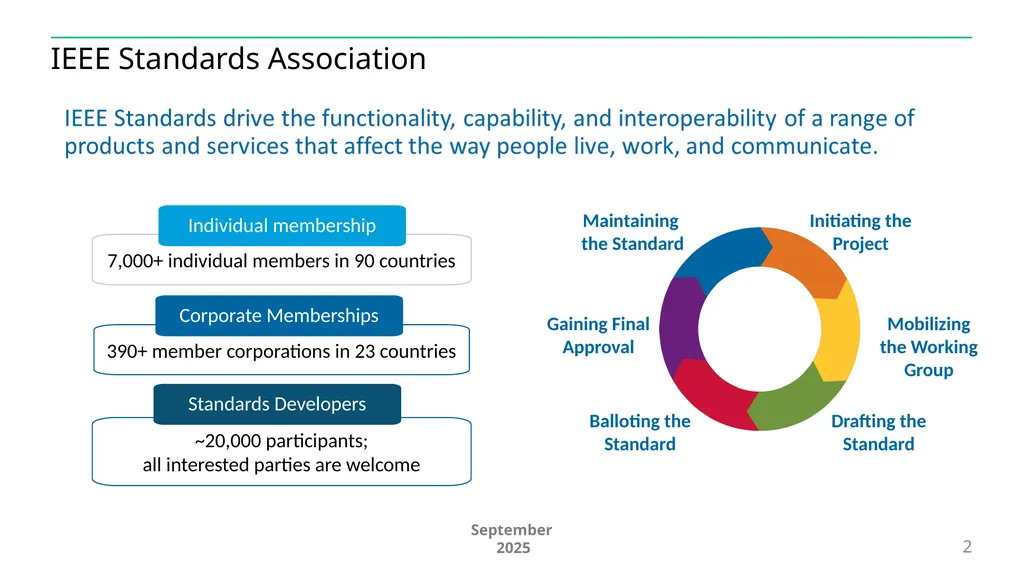
IEEE Standards Association 2 September 2025<br>
03
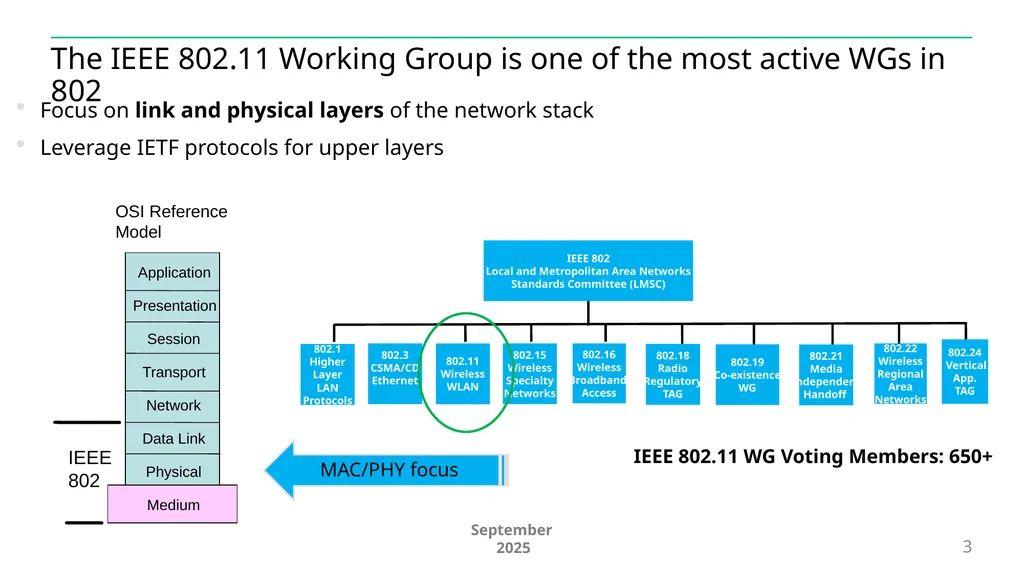
The IEEE 802.11 Working Group is one of the most active WGs in 802 3 Focus on link and physical layers of the network stack
Leverage IETF protocols for upper layers MAC/PHY focus September 2025<br>
Leverage IETF protocols for upper layers MAC/PHY focus September 2025<br>
04
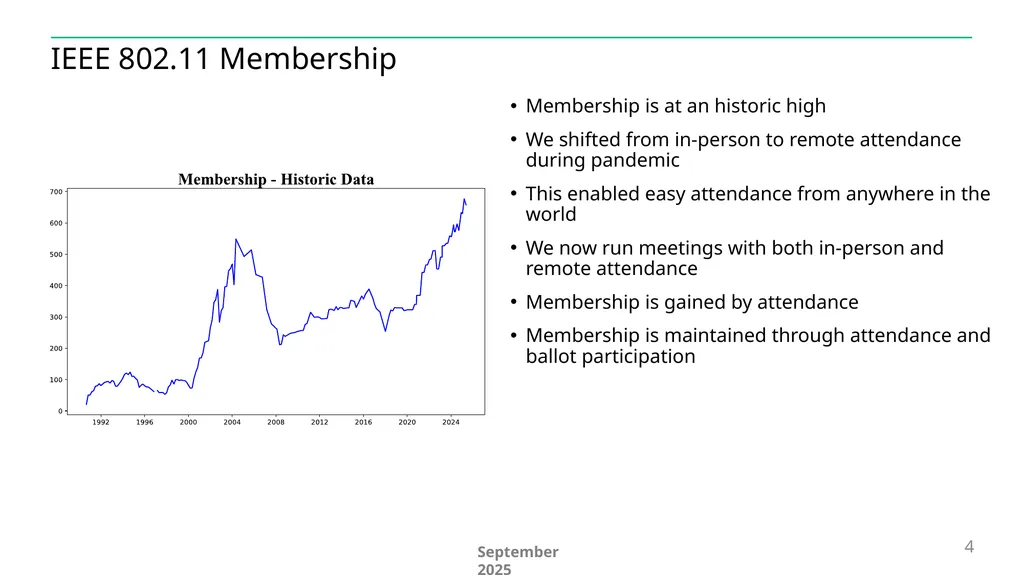
IEEE 802.11 Membership Membership is at an historic high
We shifted from in-person to remote attendance during pandemic
This enabled easy attendance from anywhere in the world
We now run meetings with both in-person and remote attendance
Membership is gained by attendance
Membership is maintained through attendance and ballot participation September 2025 4<br>
We shifted from in-person to remote attendance during pandemic
This enabled easy attendance from anywhere in the world
We now run meetings with both in-person and remote attendance
Membership is gained by attendance
Membership is maintained through attendance and ballot participation September 2025 4<br>
05
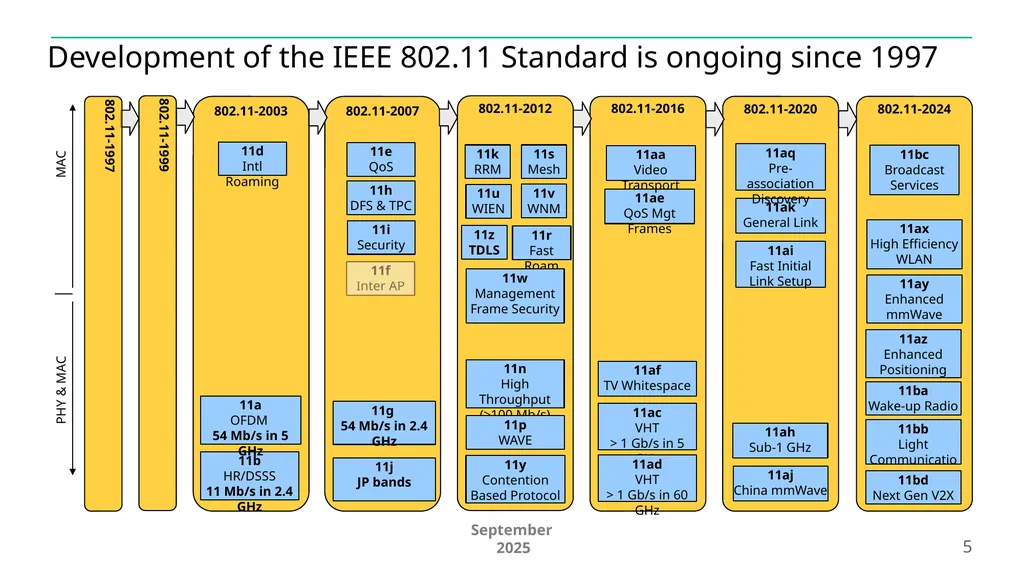
Development of the IEEE 802.11 Standard is ongoing since 1997 5 September 2025<br>
06
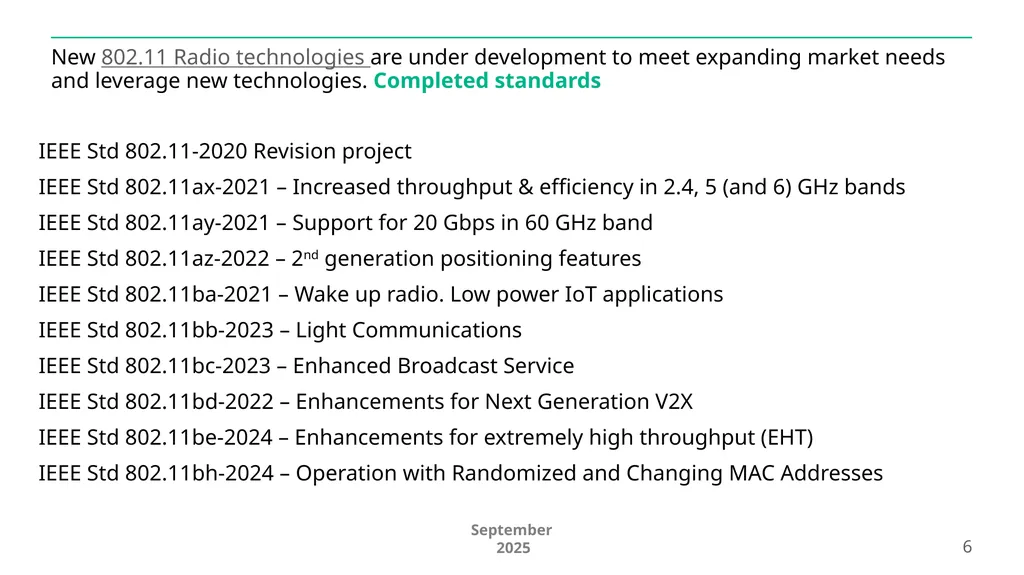
New 802.11 Radio technologies are under development to meet expanding market needs and leverage new technologies. Completed standards IEEE Std 802.11-2020 Revision project
IEEE Std 802.11ax-2021 – Increased throughput & efficiency in 2.4, 5 (and 6) GHz bands
IEEE Std 802.11ay-2021 – Support for 20 Gbps in 60 GHz band
IEEE Std 802.11az-2022 – 2nd generation positioning features
IEEE Std 802.11ba-2021 – Wake up radio. Low power IoT applications
IEEE Std 802.11bb-2023 – Light Communications
IEEE Std 802.11bc-2023 – Enhanced Broadcast Service
IEEE Std 802.11bd-2022 – Enhancements for Next Generation V2X
IEEE Std 802.11be-2024 – Enhancements for extremely high throughput (EHT)
IEEE Std 802.11bh-2024 – Operation with Randomized and Changing MAC Addresses 6 September 2025<br>
IEEE Std 802.11ax-2021 – Increased throughput & efficiency in 2.4, 5 (and 6) GHz bands
IEEE Std 802.11ay-2021 – Support for 20 Gbps in 60 GHz band
IEEE Std 802.11az-2022 – 2nd generation positioning features
IEEE Std 802.11ba-2021 – Wake up radio. Low power IoT applications
IEEE Std 802.11bb-2023 – Light Communications
IEEE Std 802.11bc-2023 – Enhanced Broadcast Service
IEEE Std 802.11bd-2022 – Enhancements for Next Generation V2X
IEEE Std 802.11be-2024 – Enhancements for extremely high throughput (EHT)
IEEE Std 802.11bh-2024 – Operation with Randomized and Changing MAC Addresses 6 September 2025<br>
07
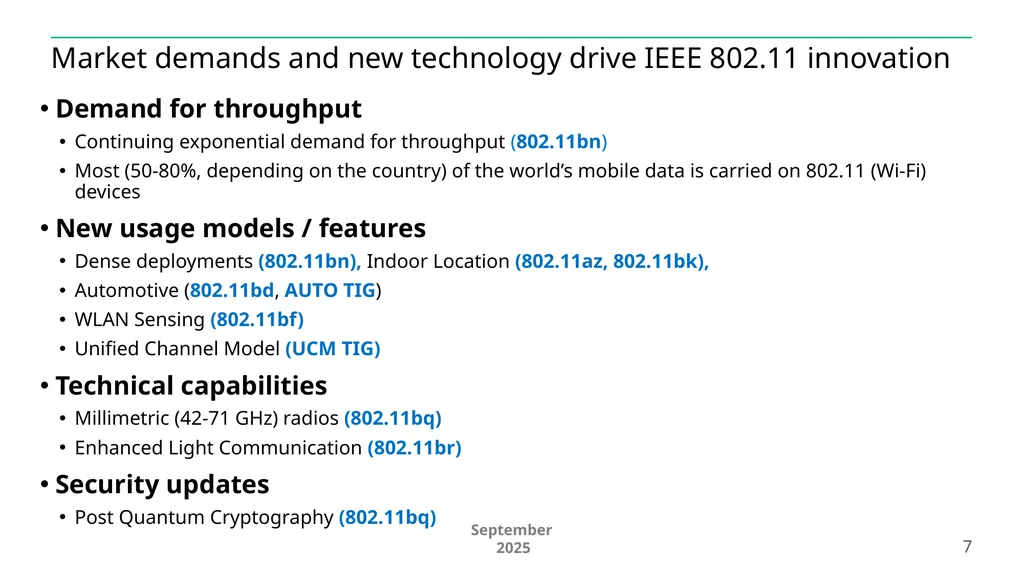
Market demands and new technology drive IEEE 802.11 innovation Demand for throughput
Continuing exponential demand for throughput (802.11bn)
Most (50-80%, depending on the country) of the world’s mobile data is carried on 802.11 (Wi-Fi) devices
New usage models / features
Dense deployments (802.11bn), Indoor Location (802.11az, 802.11bk),
Automotive (802.11bd, AUTO TIG)
WLAN Sensing (802.11bf)
Unified Channel Model (UCM TIG)
Technical capabilities
Millimetric (42-71 GHz) radios (802.11bq)
Enhanced Light Communication (802.11br)
Security updates
Post Quantum Cryptography (802.11bq) 7 September 2025<br>
Continuing exponential demand for throughput (802.11bn)
Most (50-80%, depending on the country) of the world’s mobile data is carried on 802.11 (Wi-Fi) devices
New usage models / features
Dense deployments (802.11bn), Indoor Location (802.11az, 802.11bk),
Automotive (802.11bd, AUTO TIG)
WLAN Sensing (802.11bf)
Unified Channel Model (UCM TIG)
Technical capabilities
Millimetric (42-71 GHz) radios (802.11bq)
Enhanced Light Communication (802.11br)
Security updates
Post Quantum Cryptography (802.11bq) 7 September 2025<br>
08
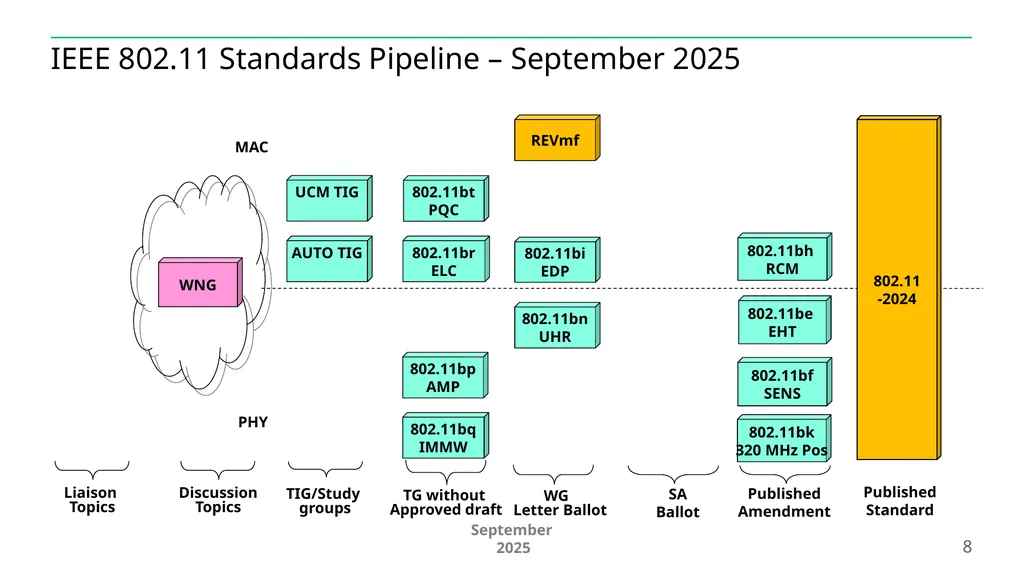
IEEE 802.11 Standards Pipeline – September 2025 8 September 2025 UCM TIG 802.11br
ELC<br>
ELC<br>
09
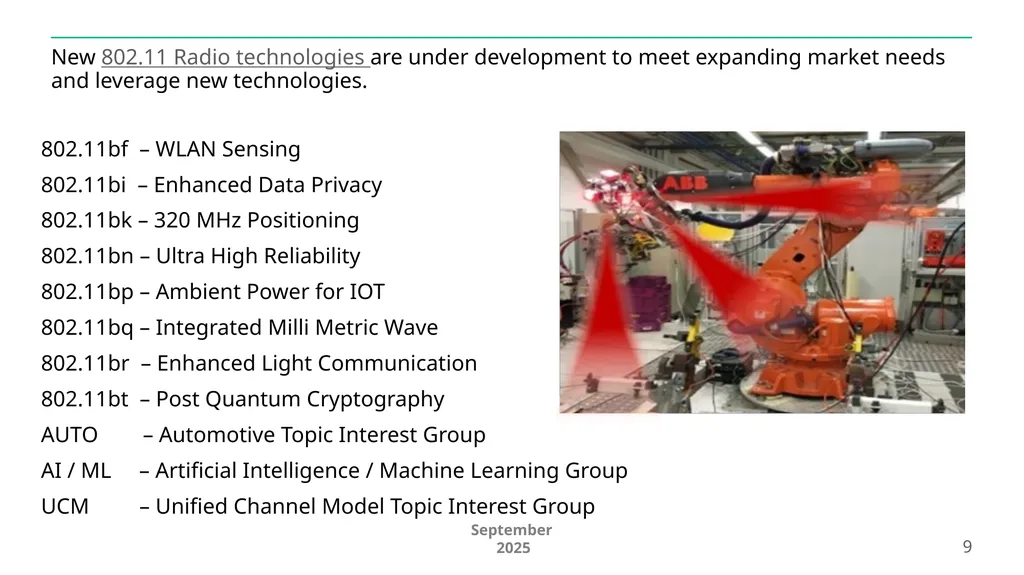
New 802.11 Radio technologies are under development to meet expanding market needs and leverage new technologies. 802.11bf – WLAN Sensing
802.11bi – Enhanced Data Privacy
802.11bk – 320 MHz Positioning
802.11bn – Ultra High Reliability
802.11bp – Ambient Power for IOT
802.11bq – Integrated Milli Metric Wave
802.11br – Enhanced Light Communication
802.11bt – Post Quantum Cryptography
AUTO – Automotive Topic Interest Group
AI / ML – Artificial Intelligence / Machine Learning Group
UCM – Unified Channel Model Topic Interest Group 9 September 2025<br>
802.11bi – Enhanced Data Privacy
802.11bk – 320 MHz Positioning
802.11bn – Ultra High Reliability
802.11bp – Ambient Power for IOT
802.11bq – Integrated Milli Metric Wave
802.11br – Enhanced Light Communication
802.11bt – Post Quantum Cryptography
AUTO – Automotive Topic Interest Group
AI / ML – Artificial Intelligence / Machine Learning Group
UCM – Unified Channel Model Topic Interest Group 9 September 2025<br>
10
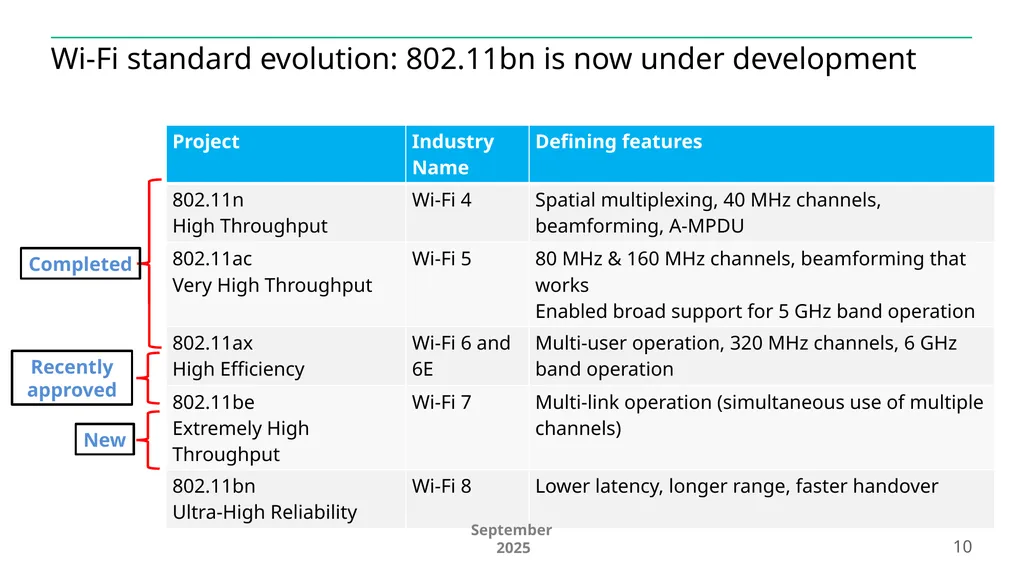
Wi-Fi standard evolution: 802.11bn is now under development 10 Completed Recently approved New September 2025<br>
11
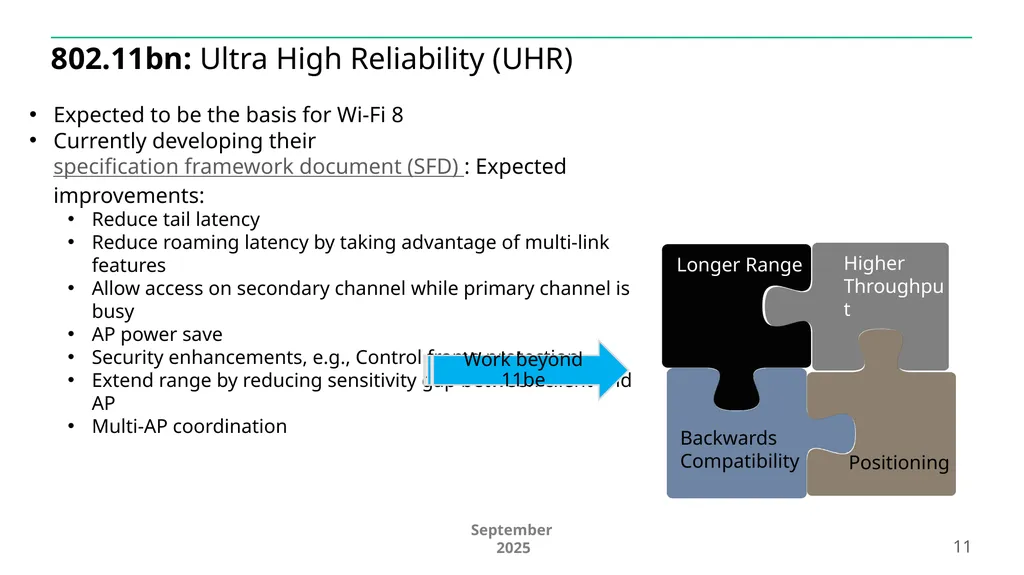
802.11bn: Ultra High Reliability (UHR) 11 Expected to be the basis for Wi-Fi 8
Currently developing their specification framework document (SFD) : Expected improvements:
Reduce tail latency
Reduce roaming latency by taking advantage of multi-link features
Allow access on secondary channel while primary channel is busy
AP power save
Security enhancements, e.g., Control frame protection
Extend range by reducing sensitivity gap between client and AP
Multi-AP coordination Work beyond 11be September 2025<br>
Currently developing their specification framework document (SFD) : Expected improvements:
Reduce tail latency
Reduce roaming latency by taking advantage of multi-link features
Allow access on secondary channel while primary channel is busy
AP power save
Security enhancements, e.g., Control frame protection
Extend range by reducing sensitivity gap between client and AP
Multi-AP coordination Work beyond 11be September 2025<br>
12
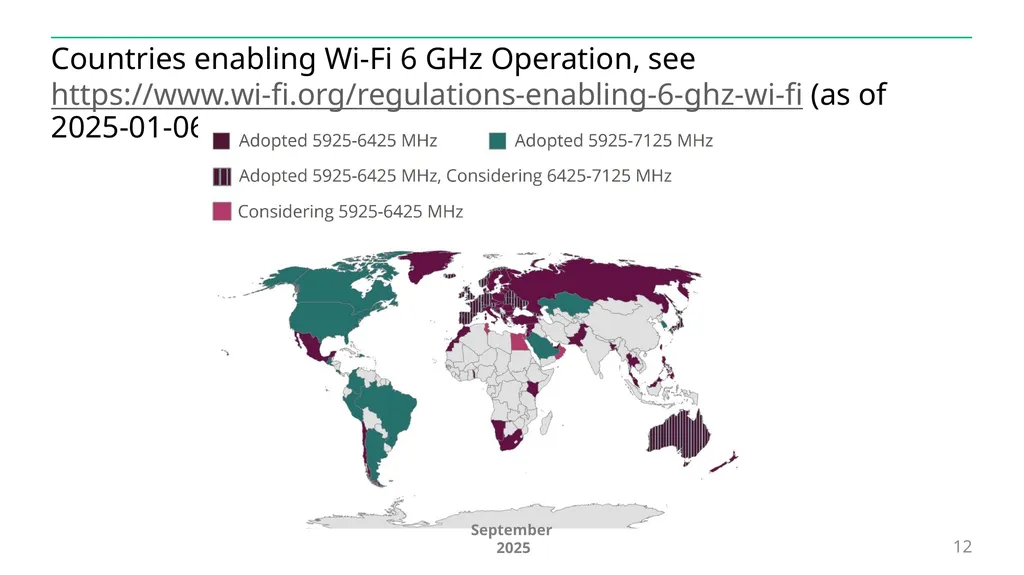
Countries enabling Wi-Fi 6 GHz Operation, see https://www.wi-fi.org/regulations-enabling-6-ghz-wi-fi (as of 2025-01-06) 12 September 2025<br>
13
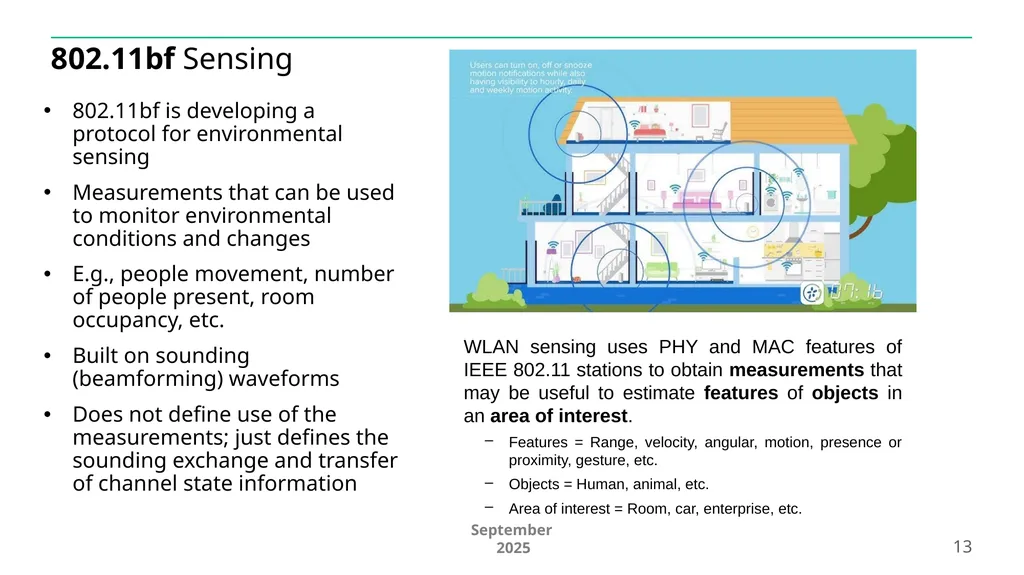
802.11bf Sensing WLAN sensing uses PHY and MAC features of IEEE 802.11 stations to obtain measurements that may be useful to estimate features of objects in an area of interest.
Features = Range, velocity, angular, motion, presence or proximity, gesture, etc.
Objects = Human, animal, etc.
Area of interest = Room, car, enterprise, etc. 802.11bf is developing a protocol for environmental sensing
Measurements that can be used to monitor environmental conditions and changes
E.g., people movement, number of people present, room occupancy, etc.
Built on sounding (beamforming) waveforms
Does not define use of the measurements; just defines the sounding exchange and transfer of channel state information September 2025 13<br>
Features = Range, velocity, angular, motion, presence or proximity, gesture, etc.
Objects = Human, animal, etc.
Area of interest = Room, car, enterprise, etc. 802.11bf is developing a protocol for environmental sensing
Measurements that can be used to monitor environmental conditions and changes
E.g., people movement, number of people present, room occupancy, etc.
Built on sounding (beamforming) waveforms
Does not define use of the measurements; just defines the sounding exchange and transfer of channel state information September 2025 13<br>
14
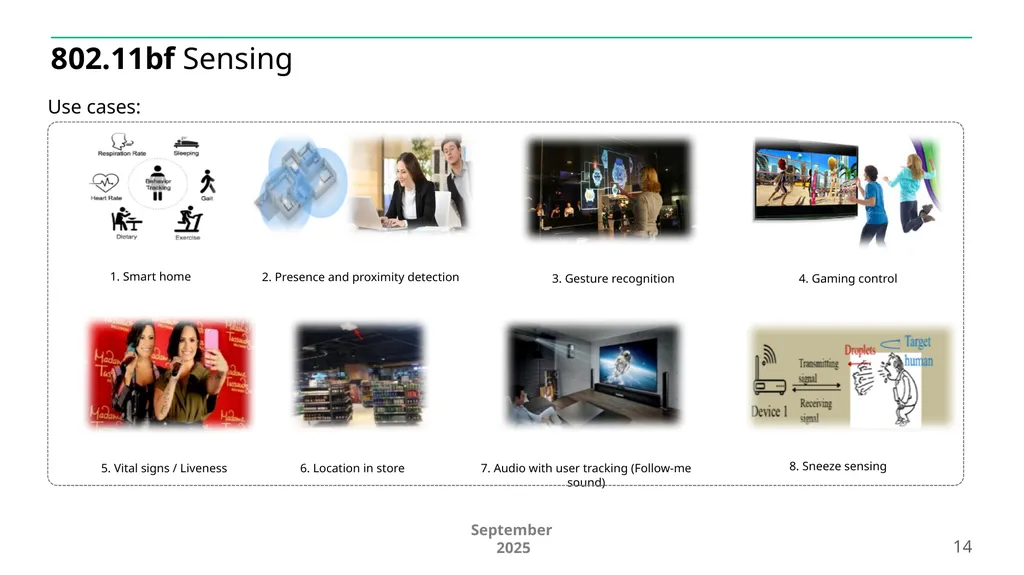
802.11bf Sensing Use cases: September 2025 14<br>
15
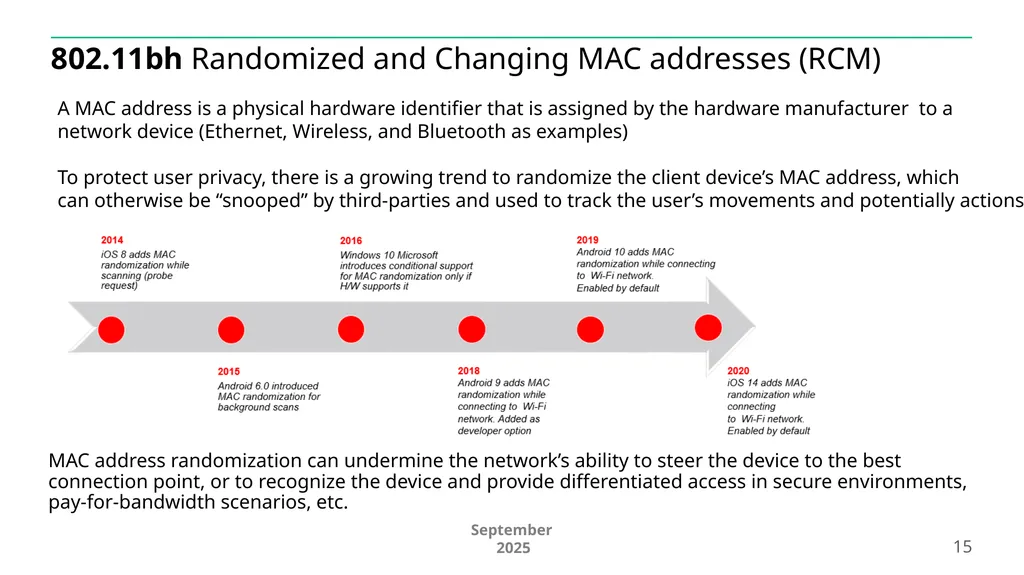
802.11bh Randomized and Changing MAC addresses (RCM) MAC address randomization can undermine the network’s ability to steer the device to the best connection point, or to recognize the device and provide differentiated access in secure environments, pay-for-bandwidth scenarios, etc. A MAC address is a physical hardware identifier that is assigned by the hardware manufacturer to a
network device (Ethernet, Wireless, and Bluetooth as examples)
To protect user privacy, there is a growing trend to randomize the client device’s MAC address, which
can otherwise be “snooped” by third-parties and used to track the user’s movements and potentially actions. September 2025 15<br>
network device (Ethernet, Wireless, and Bluetooth as examples)
To protect user privacy, there is a growing trend to randomize the client device’s MAC address, which
can otherwise be “snooped” by third-parties and used to track the user’s movements and potentially actions. September 2025 15<br>
16
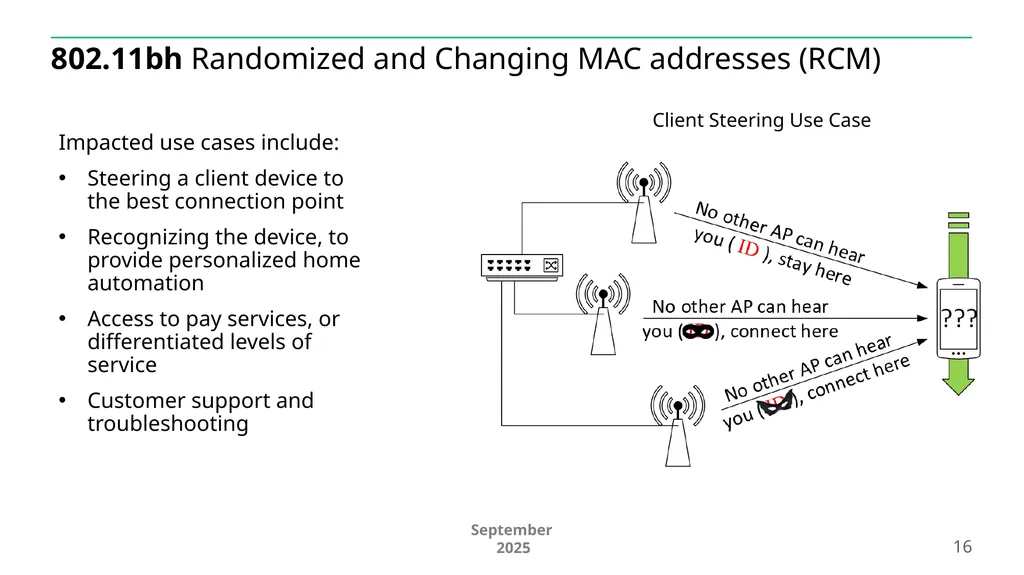
802.11bh Randomized and Changing MAC addresses (RCM) Impacted use cases include:
Steering a client device to the best connection point
Recognizing the device, to provide personalized home automation
Access to pay services, or differentiated levels of service
Customer support and troubleshooting Client Steering Use Case September 2025 16<br>
Steering a client device to the best connection point
Recognizing the device, to provide personalized home automation
Access to pay services, or differentiated levels of service
Customer support and troubleshooting Client Steering Use Case September 2025 16<br>
17
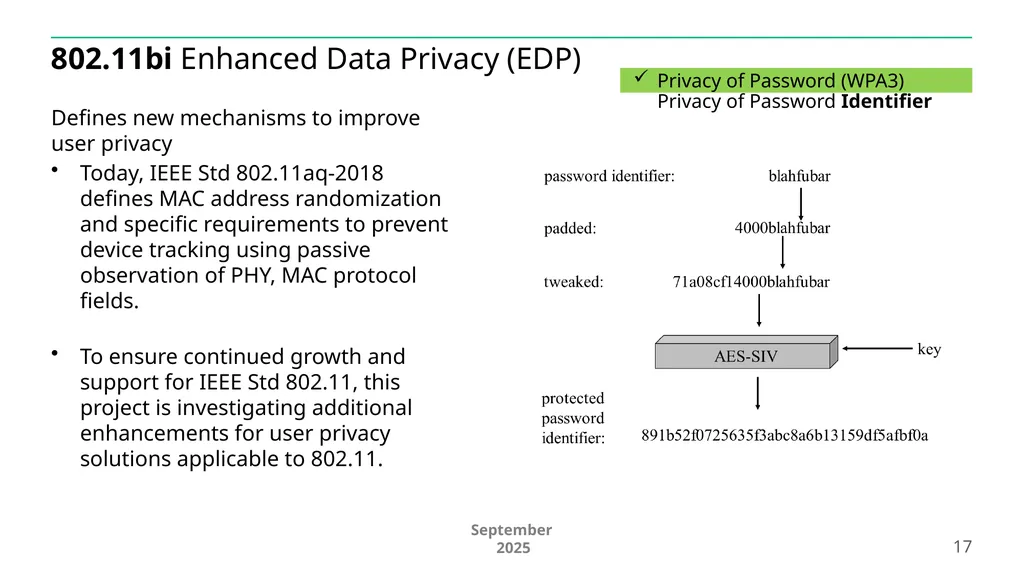
802.11bi Enhanced Data Privacy (EDP) Defines new mechanisms to improve user privacy
Today, IEEE Std 802.11aq-2018 defines MAC address randomization and specific requirements to prevent device tracking using passive observation of PHY, MAC protocol fields.
To ensure continued growth and support for IEEE Std 802.11, this project is investigating additional enhancements for user privacy solutions applicable to 802.11. Privacy of Password (WPA3) Privacy of Password Identifier September 2025 17<br>
Today, IEEE Std 802.11aq-2018 defines MAC address randomization and specific requirements to prevent device tracking using passive observation of PHY, MAC protocol fields.
To ensure continued growth and support for IEEE Std 802.11, this project is investigating additional enhancements for user privacy solutions applicable to 802.11. Privacy of Password (WPA3) Privacy of Password Identifier September 2025 17<br>
18
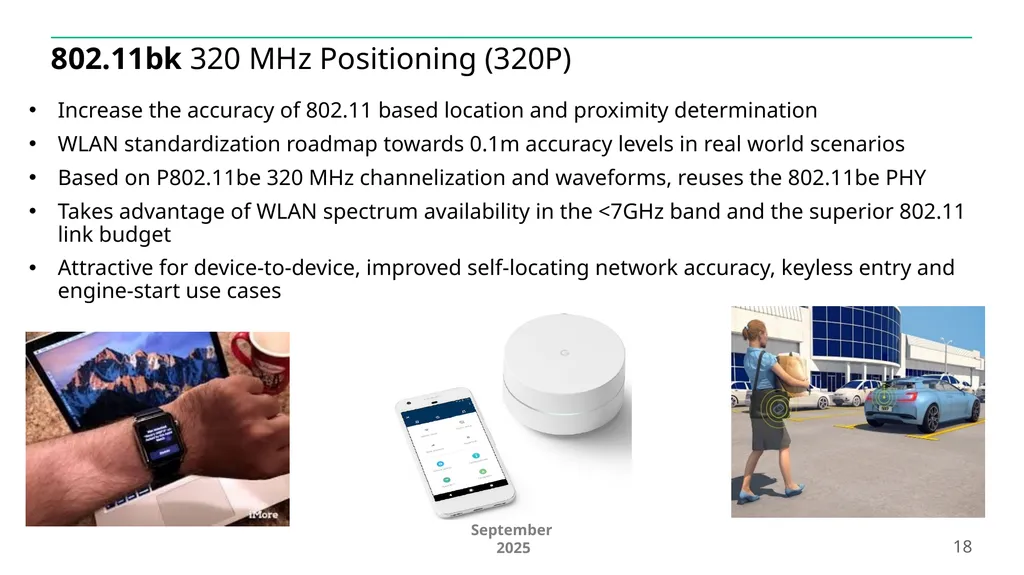
802.11bk 320 MHz Positioning (320P) Increase the accuracy of 802.11 based location and proximity determination
WLAN standardization roadmap towards 0.1m accuracy levels in real world scenarios
Based on P802.11be 320 MHz channelization and waveforms, reuses the 802.11be PHY
Takes advantage of WLAN spectrum availability in the <7GHz band and the superior 802.11 link budget
Attractive for device-to-device, improved self-locating network accuracy, keyless entry and engine-start use cases September 2025 18<br>
WLAN standardization roadmap towards 0.1m accuracy levels in real world scenarios
Based on P802.11be 320 MHz channelization and waveforms, reuses the 802.11be PHY
Takes advantage of WLAN spectrum availability in the <7GHz band and the superior 802.11 link budget
Attractive for device-to-device, improved self-locating network accuracy, keyless entry and engine-start use cases September 2025 18<br>
19
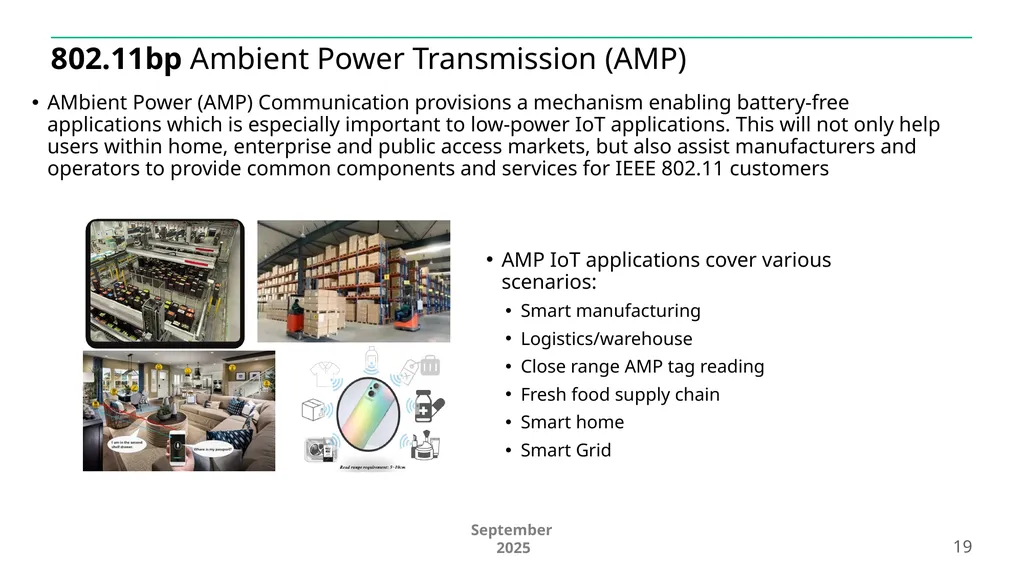
802.11bp Ambient Power Transmission (AMP) AMbient Power (AMP) Communication provisions a mechanism enabling battery-free applications which is especially important to low-power IoT applications. This will not only help users within home, enterprise and public access markets, but also assist manufacturers and operators to provide common components and services for IEEE 802.11 customers AMP IoT applications cover various scenarios:
Smart manufacturing
Logistics/warehouse
Close range AMP tag reading
Fresh food supply chain
Smart home
Smart Grid September 2025 19<br>
Smart manufacturing
Logistics/warehouse
Close range AMP tag reading
Fresh food supply chain
Smart home
Smart Grid September 2025 19<br>
20
802.11bp Ambient Power Transmission (AMP) 802.11bp defines MAC/PHY enhancements from mainstream 802.11 standards and amendments to provide an ambient power communication solution in WLAN by:
defining ambient power transmission in both S1G and 2.4 GHz bands.
defining wireless power transmission protocol in S1G
supporting both bistatic and monostatic transmission
defining mechanisms for coexistence between 802.11bp compliant devices and legacy 802.11 devices.
A technical report on AMP in WLAN was developed by an earlier AMP group. September 2025 20<br>
defining ambient power transmission in both S1G and 2.4 GHz bands.
defining wireless power transmission protocol in S1G
supporting both bistatic and monostatic transmission
defining mechanisms for coexistence between 802.11bp compliant devices and legacy 802.11 devices.
A technical report on AMP in WLAN was developed by an earlier AMP group. September 2025 20<br>
21
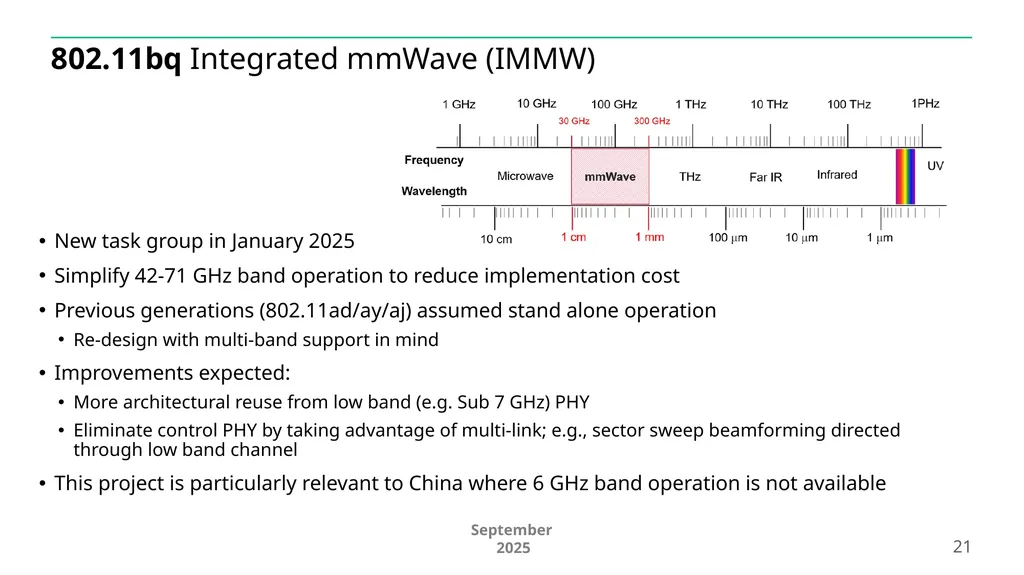
802.11bq Integrated mmWave (IMMW) New task group in January 2025
Simplify 42-71 GHz band operation to reduce implementation cost
Previous generations (802.11ad/ay/aj) assumed stand alone operation
Re-design with multi-band support in mind
Improvements expected:
More architectural reuse from low band (e.g. Sub 7 GHz) PHY
Eliminate control PHY by taking advantage of multi-link; e.g., sector sweep beamforming directed through low band channel
This project is particularly relevant to China where 6 GHz band operation is not available September 2025 21<br>
Simplify 42-71 GHz band operation to reduce implementation cost
Previous generations (802.11ad/ay/aj) assumed stand alone operation
Re-design with multi-band support in mind
Improvements expected:
More architectural reuse from low band (e.g. Sub 7 GHz) PHY
Eliminate control PHY by taking advantage of multi-link; e.g., sector sweep beamforming directed through low band channel
This project is particularly relevant to China where 6 GHz band operation is not available September 2025 21<br>
22
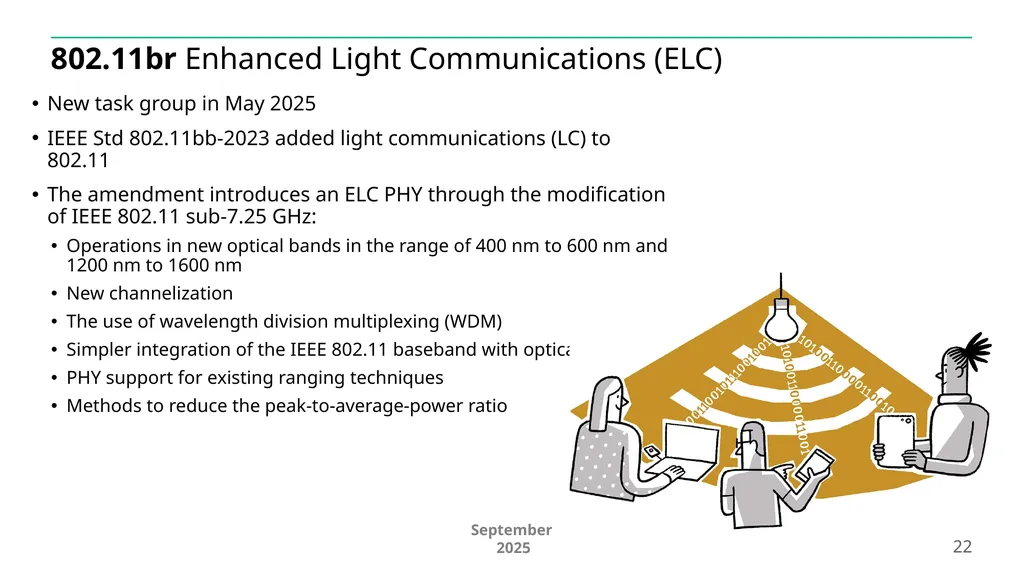
802.11br Enhanced Light Communications (ELC) New task group in May 2025
IEEE Std 802.11bb-2023 added light communications (LC) to 802.11
The amendment introduces an ELC PHY through the modification of IEEE 802.11 sub-7.25 GHz:
Operations in new optical bands in the range of 400 nm to 600 nm and 1200 nm to 1600 nm
New channelization
The use of wavelength division multiplexing (WDM)
Simpler integration of the IEEE 802.11 baseband with optical frontends
PHY support for existing ranging techniques
Methods to reduce the peak-to-average-power ratio September 2025 22<br>
IEEE Std 802.11bb-2023 added light communications (LC) to 802.11
The amendment introduces an ELC PHY through the modification of IEEE 802.11 sub-7.25 GHz:
Operations in new optical bands in the range of 400 nm to 600 nm and 1200 nm to 1600 nm
New channelization
The use of wavelength division multiplexing (WDM)
Simpler integration of the IEEE 802.11 baseband with optical frontends
PHY support for existing ranging techniques
Methods to reduce the peak-to-average-power ratio September 2025 22<br>
23
802.11bt Post Quantum Cryptography (PQC) New task group in September 2025
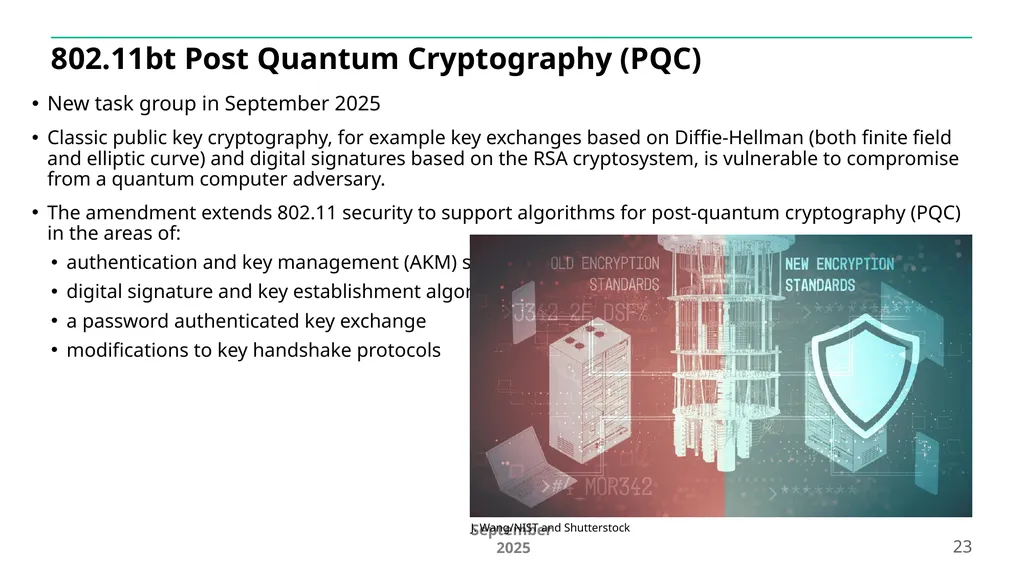
Classic public key cryptography, for example key exchanges based on Diffie-Hellman (both finite field and elliptic curve) and digital signatures based on the RSA cryptosystem, is vulnerable to compromise from a quantum computer adversary.
The amendment extends 802.11 security to support algorithms for post-quantum cryptography (PQC) in the areas of:
authentication and key management (AKM) suites
digital signature and key establishment algorithms
a password authenticated key exchange
modifications to key handshake protocols September 2025 23 J. Wang/NIST and Shutterstock<br>
Classic public key cryptography, for example key exchanges based on Diffie-Hellman (both finite field and elliptic curve) and digital signatures based on the RSA cryptosystem, is vulnerable to compromise from a quantum computer adversary.
The amendment extends 802.11 security to support algorithms for post-quantum cryptography (PQC) in the areas of:
authentication and key management (AKM) suites
digital signature and key establishment algorithms
a password authenticated key exchange
modifications to key handshake protocols September 2025 23 J. Wang/NIST and Shutterstock<br>
24
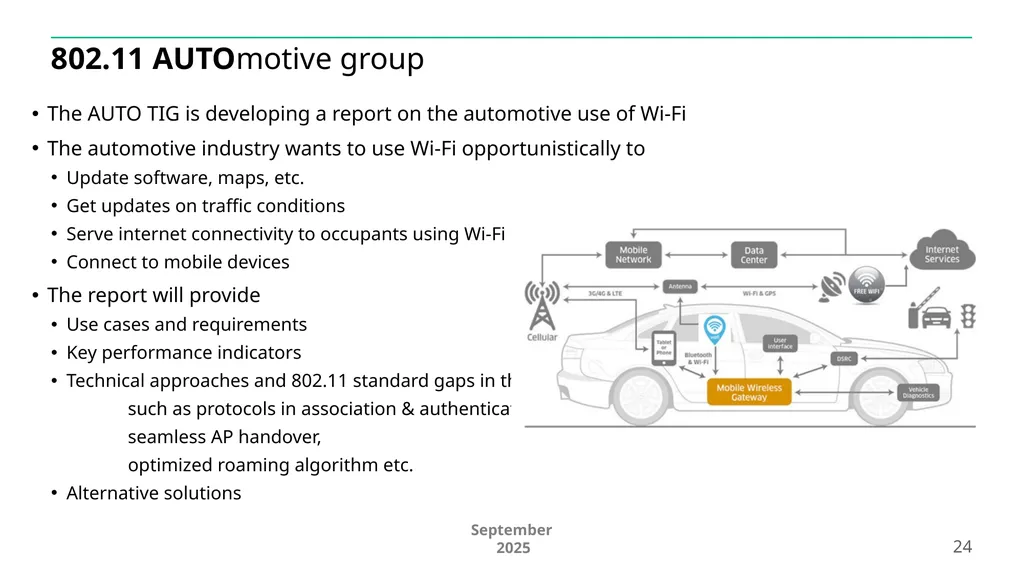
802.11 AUTOmotive group The AUTO TIG is developing a report on the automotive use of Wi-Fi
The automotive industry wants to use Wi-Fi opportunistically to
Update software, maps, etc.
Get updates on traffic conditions
Serve internet connectivity to occupants using Wi-Fi
Connect to mobile devices
The report will provide
Use cases and requirements
Key performance indicators
Technical approaches and 802.11 standard gaps in the areas
such as protocols in association & authentication,
seamless AP handover,
optimized roaming algorithm etc.
Alternative solutions September 2025 24<br>
The automotive industry wants to use Wi-Fi opportunistically to
Update software, maps, etc.
Get updates on traffic conditions
Serve internet connectivity to occupants using Wi-Fi
Connect to mobile devices
The report will provide
Use cases and requirements
Key performance indicators
Technical approaches and 802.11 standard gaps in the areas
such as protocols in association & authentication,
seamless AP handover,
optimized roaming algorithm etc.
Alternative solutions September 2025 24<br>
25
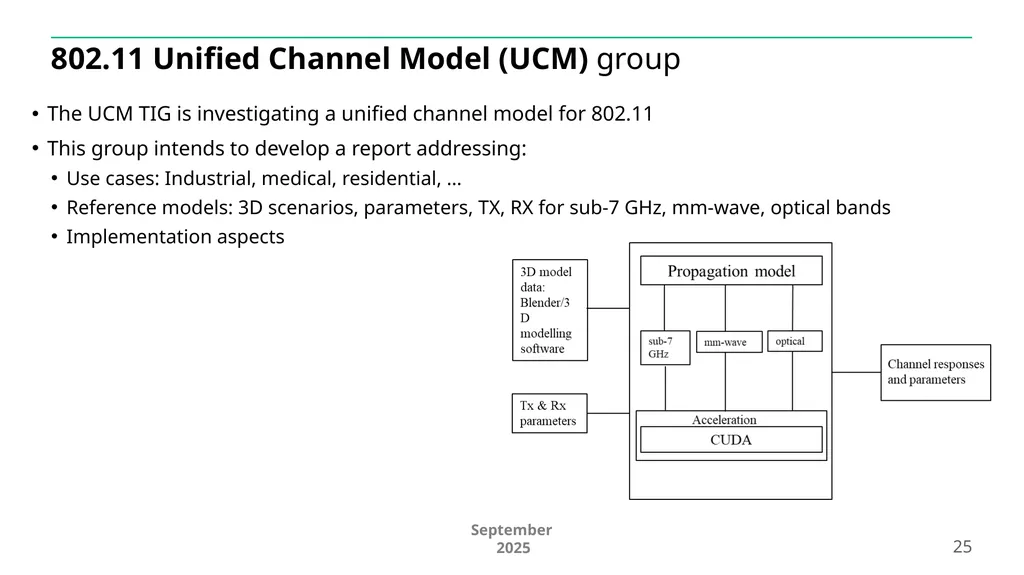
802.11 Unified Channel Model (UCM) group The UCM TIG is investigating a unified channel model for 802.11
This group intends to develop a report addressing:
Use cases: Industrial, medical, residential, …
Reference models: 3D scenarios, parameters, TX, RX for sub-7 GHz, mm-wave, optical bands
Implementation aspects September 2025 25<br>
This group intends to develop a report addressing:
Use cases: Industrial, medical, residential, …
Reference models: 3D scenarios, parameters, TX, RX for sub-7 GHz, mm-wave, optical bands
Implementation aspects September 2025 25<br>
26
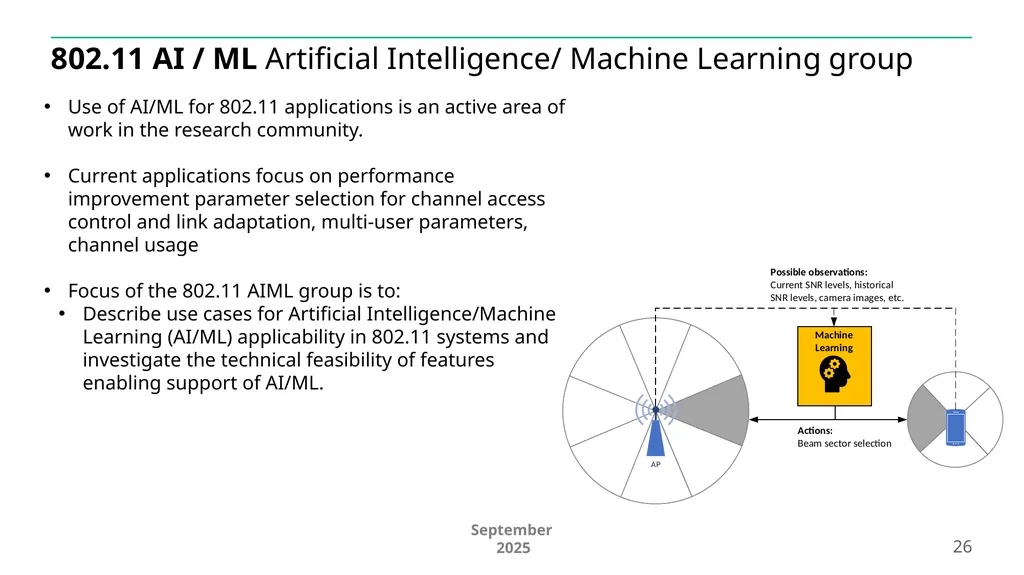
802.11 AI / ML Artificial Intelligence/ Machine Learning group Use of AI/ML for 802.11 applications is an active area of work in the research community.
Current applications focus on performance improvement parameter selection for channel access control and link adaptation, multi-user parameters, channel usage
Focus of the 802.11 AIML group is to:
Describe use cases for Artificial Intelligence/Machine Learning (AI/ML) applicability in 802.11 systems and investigate the technical feasibility of features enabling support of AI/ML. September 2025 26<br>
Current applications focus on performance improvement parameter selection for channel access control and link adaptation, multi-user parameters, channel usage
Focus of the 802.11 AIML group is to:
Describe use cases for Artificial Intelligence/Machine Learning (AI/ML) applicability in 802.11 systems and investigate the technical feasibility of features enabling support of AI/ML. September 2025 26<br>
27
Thank You
Questions ? September 2025 27<br>