If instead of moving your hand back and forth just once, you continue to produce pulses, you will send a series of longitudinal pulses down the Slinky. If equal time intervals separate the pulses, you produce a periodic wave. The time
"If instead of moving your hand back and forth just" is the property of its rightful owner. Permission is granted to
download and print the materials on this website for personal, non-commercial use only, and to display it
on your personal computer provided you do not modify the materials and that you retain all copyright
notices contained in the materials. By downloading content from our website, you accept the terms of this
agreement.
Presentation Transcript
01
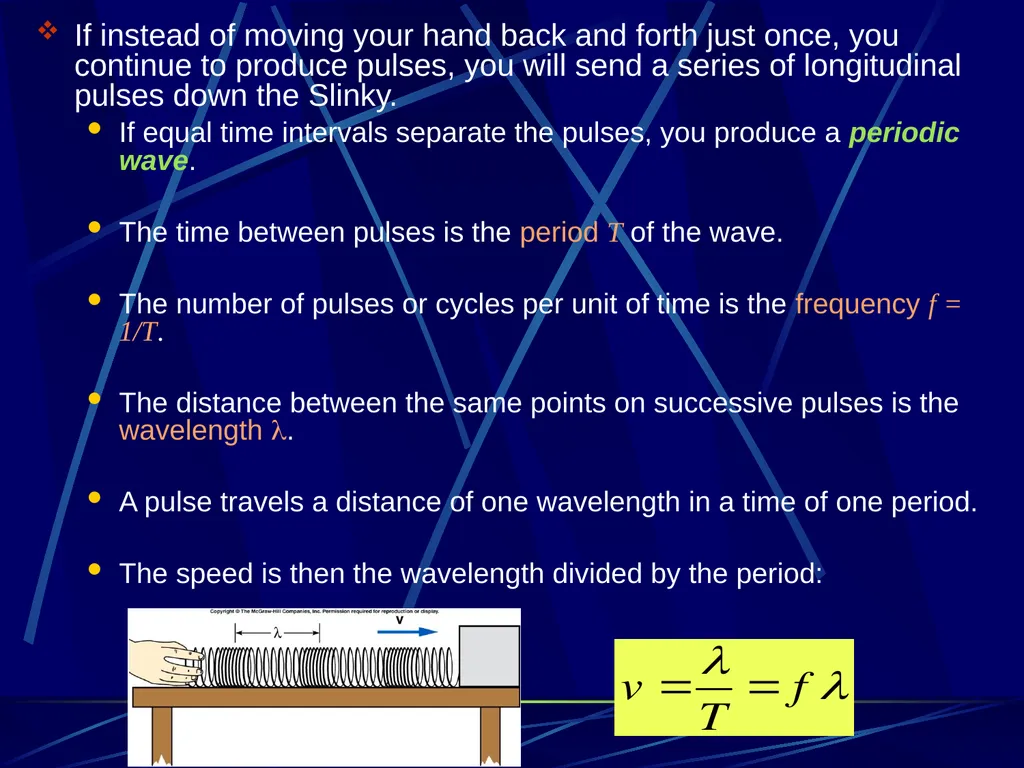
If instead of moving your hand back and forth just once, you continue to produce pulses, you will send a series of longitudinal pulses down the Slinky.
If equal time intervals separate the pulses, you produce a periodic wave.
The time between pulses is the period T of the wave.
The number of pulses or cycles per unit of time is the frequency f = 1/T.
The distance between the same points on successive pulses is the wavelength .
A pulse travels a distance of one wavelength in a time of one period.
The speed is then the wavelength divided by the period:<br>
02
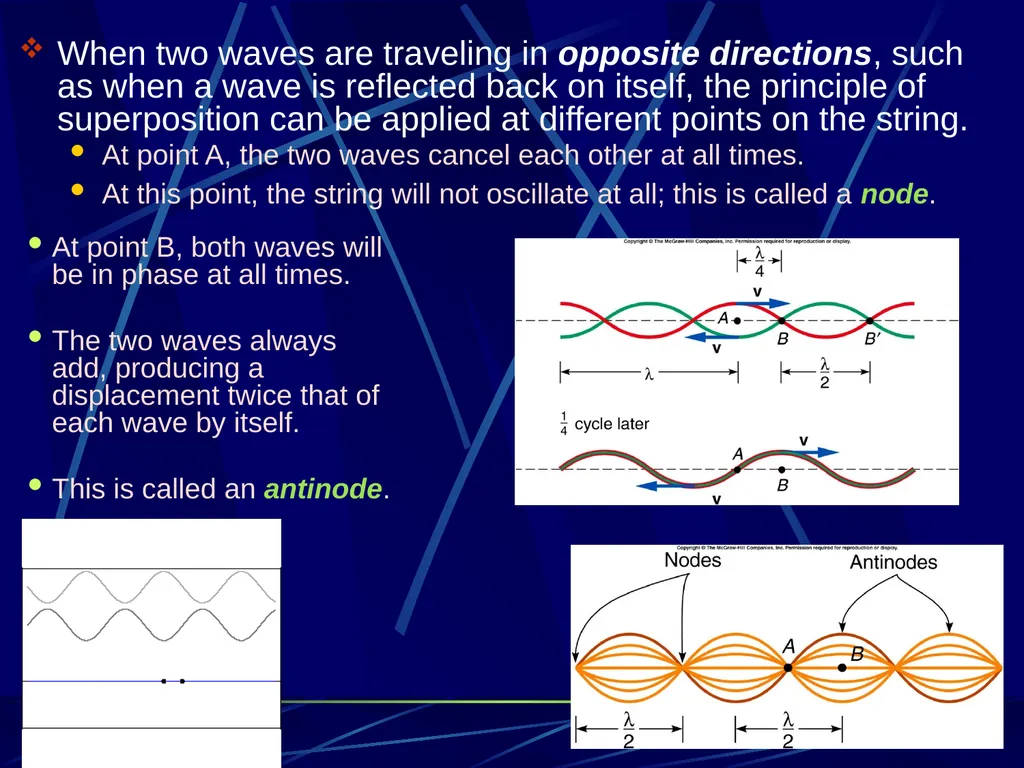
When two waves are traveling in opposite directions, such as when a wave is reflected back on itself, the principle of superposition can be applied at different points on the string.
At point A, the two waves cancel each other at all times.
At this point, the string will not oscillate at all; this is called a node. At point B, both waves will be in phase at all times.
The two waves always add, producing a displacement twice that of each wave by itself.
This is called an antinode.<br>
03
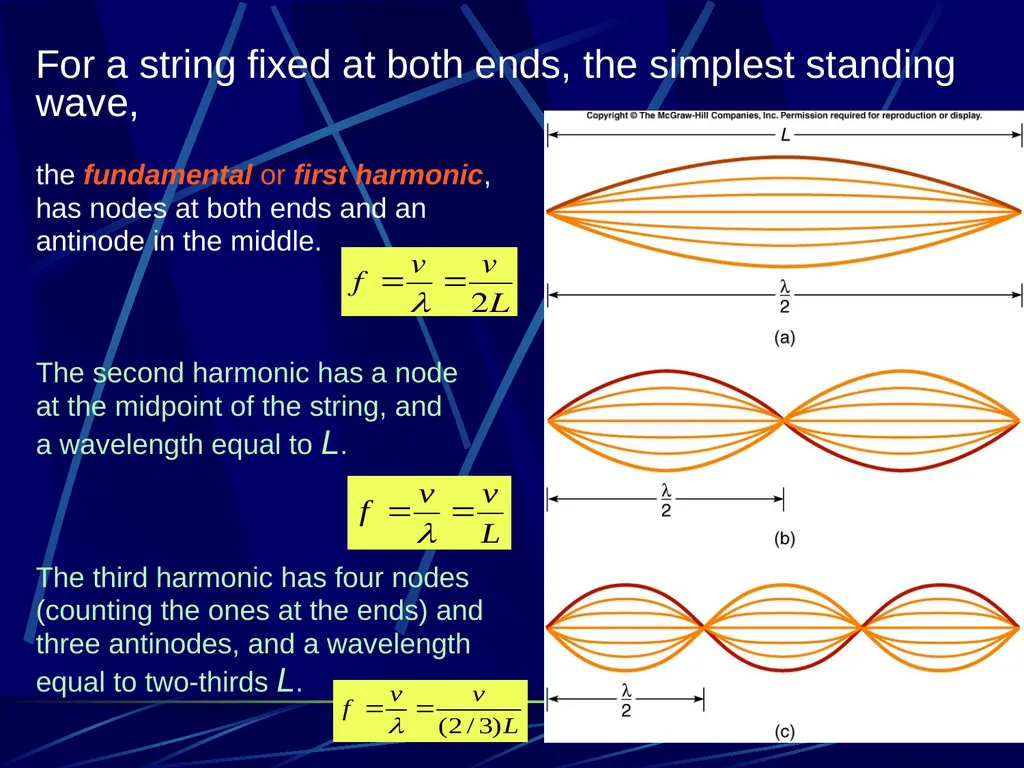
For a string fixed at both ends, the simplest standing wave,
the fundamental or first harmonic,
has nodes at both ends and an
antinode in the middle.
The second harmonic has a node
at the midpoint of the string, and
a wavelength equal to L.
The third harmonic has four nodes
(counting the ones at the ends) and
three antinodes, and a wavelength
equal to two-thirds L.<br>
04
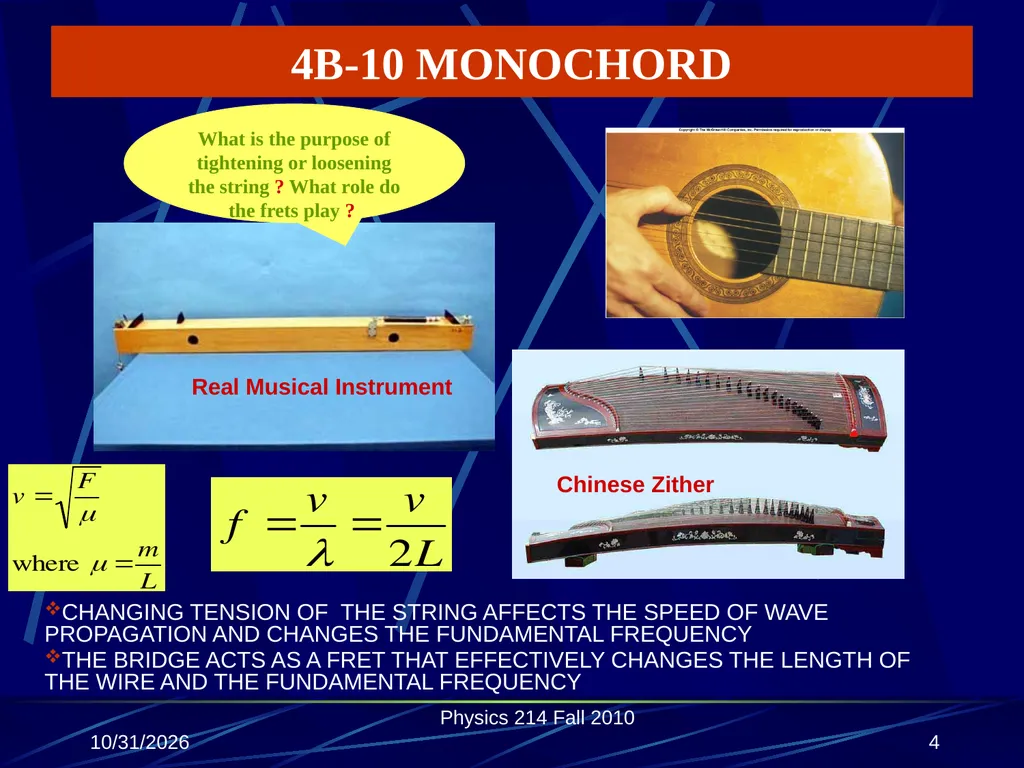
4/15/2021 Physics 214 Fall 2010 4 CHANGING TENSION OF THE STRING AFFECTS THE SPEED OF WAVE PROPAGATION AND CHANGES THE FUNDAMENTAL FREQUENCY
THE BRIDGE ACTS AS A FRET THAT EFFECTIVELY CHANGES THE LENGTH OF THE WIRE AND THE FUNDAMENTAL FREQUENCY What is the purpose of tightening or loosening the string ? What role do the frets play ? Chinese Zither Real Musical Instrument 4B-10 MONOCHORD<br>
05
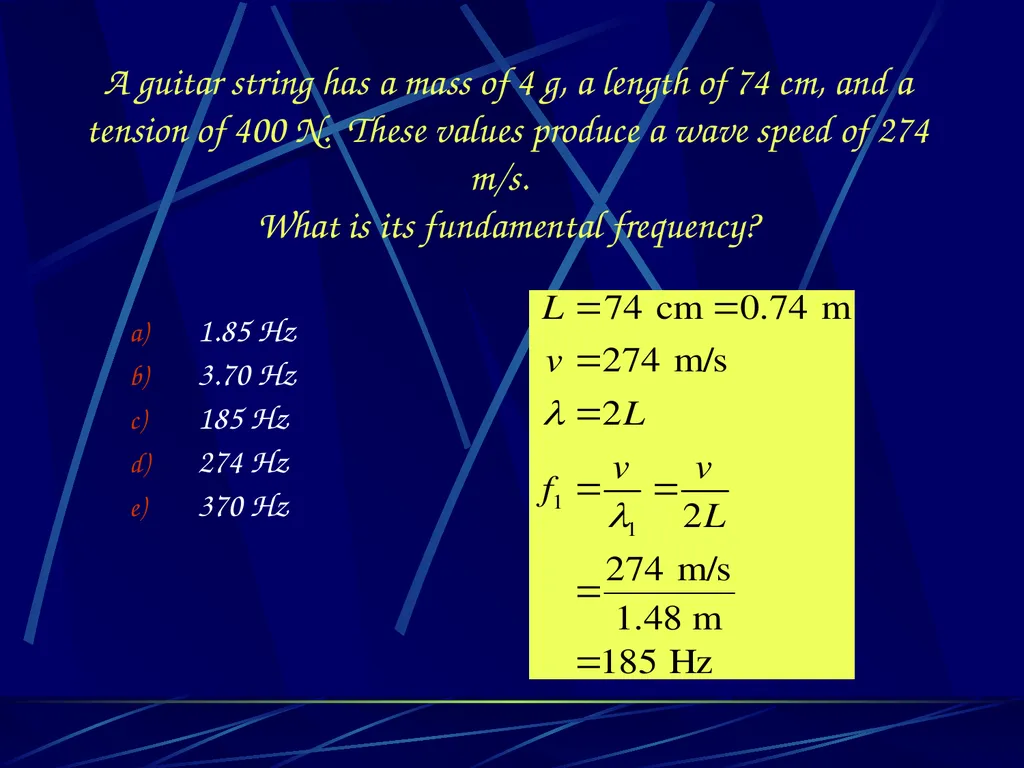
A guitar string has a mass of 4 g, a length of 74 cm, and a tension of 400 N. These values produce a wave speed of 274 m/s. What is its fundamental frequency? 1.85 Hz
3.70 Hz
185 Hz
274 Hz
370 Hz<br>
06
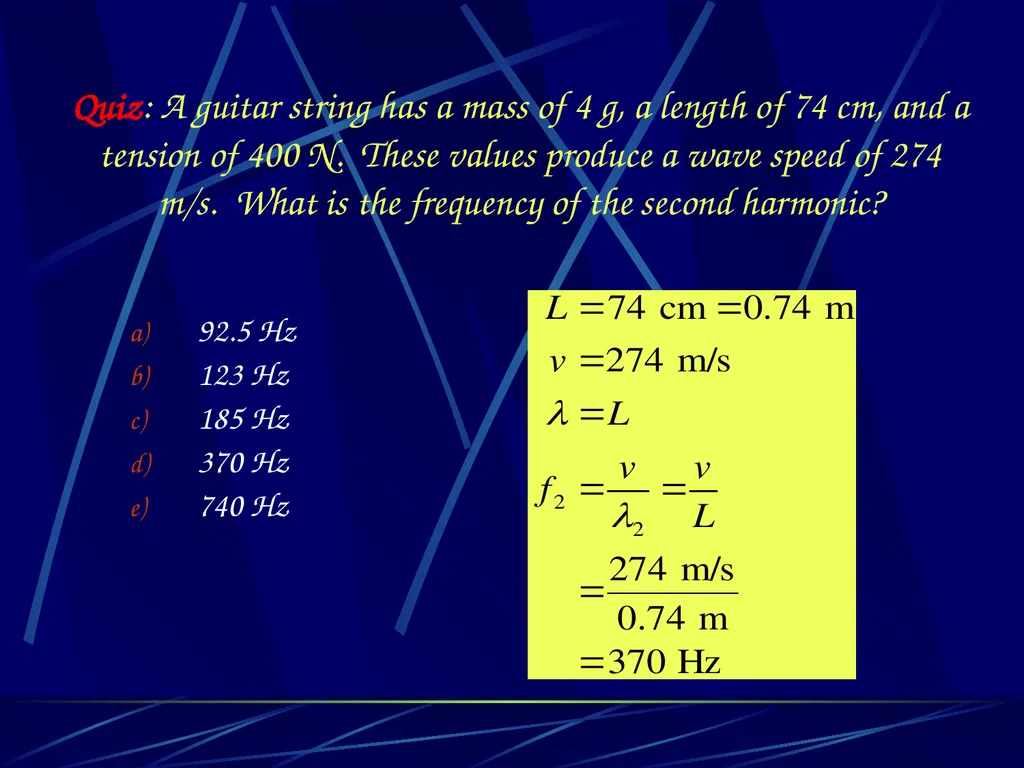
Quiz: A guitar string has a mass of 4 g, a length of 74 cm, and a tension of 400 N. These values produce a wave speed of 274 m/s. What is the frequency of the second harmonic? 92.5 Hz
123 Hz
185 Hz
370 Hz
740 Hz<br>
07
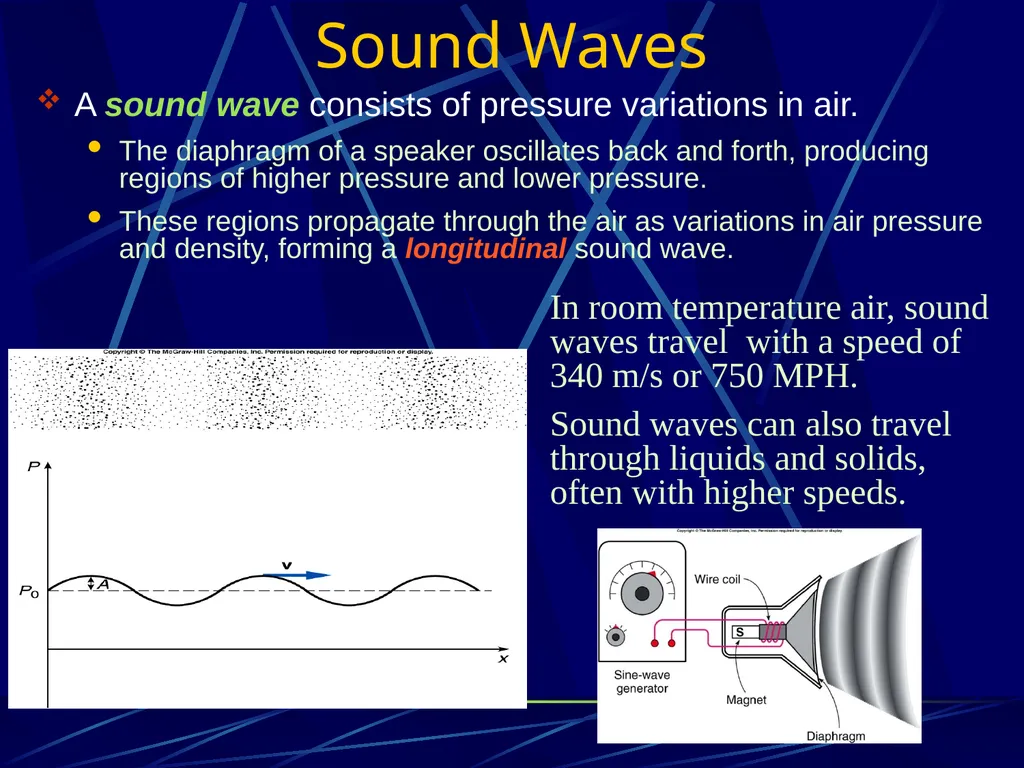
A sound wave consists of pressure variations in air.
The diaphragm of a speaker oscillates back and forth, producing regions of higher pressure and lower pressure.
These regions propagate through the air as variations in air pressure and density, forming a longitudinal sound wave. Sound Waves In room temperature air, sound waves travel with a speed of 340 m/s or 750 MPH.
Sound waves can also travel through liquids and solids, often with higher speeds.<br>
08
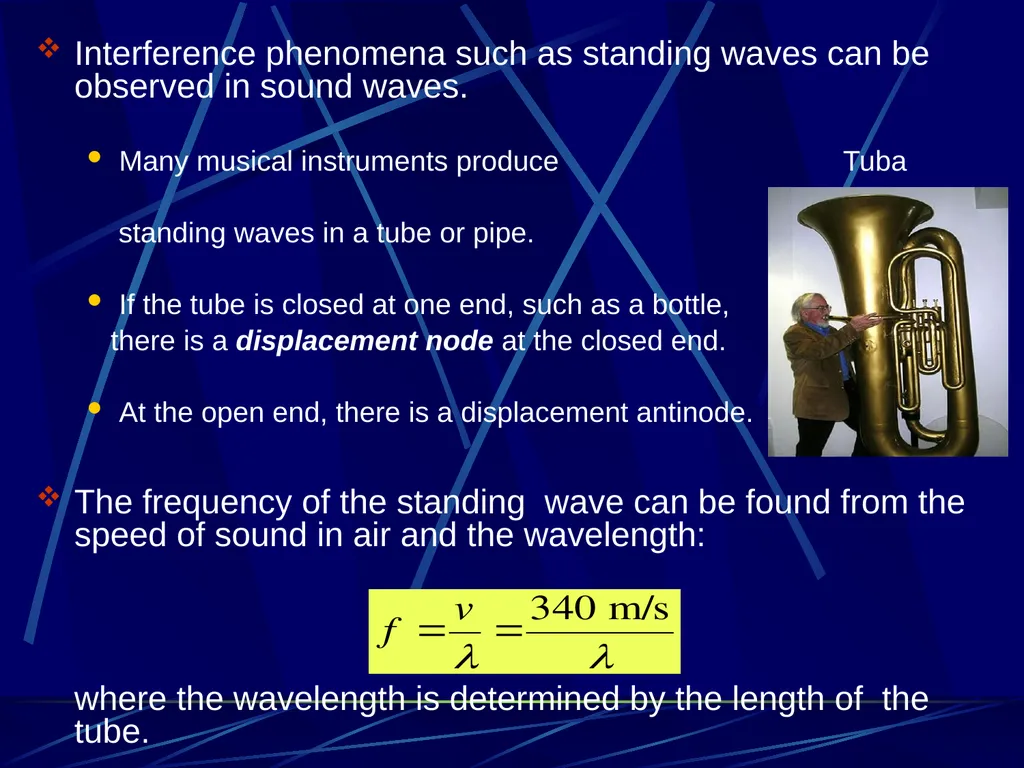
Interference phenomena such as standing waves can be observed in sound waves.
Many musical instruments produce Tuba
standing waves in a tube or pipe.
If the tube is closed at one end, such as a bottle,
there is a displacement node at the closed end.
At the open end, there is a displacement antinode.
The frequency of the standing wave can be found from the
speed of sound in air and the wavelength:
where the wavelength is determined by the length of the tube.<br>
09
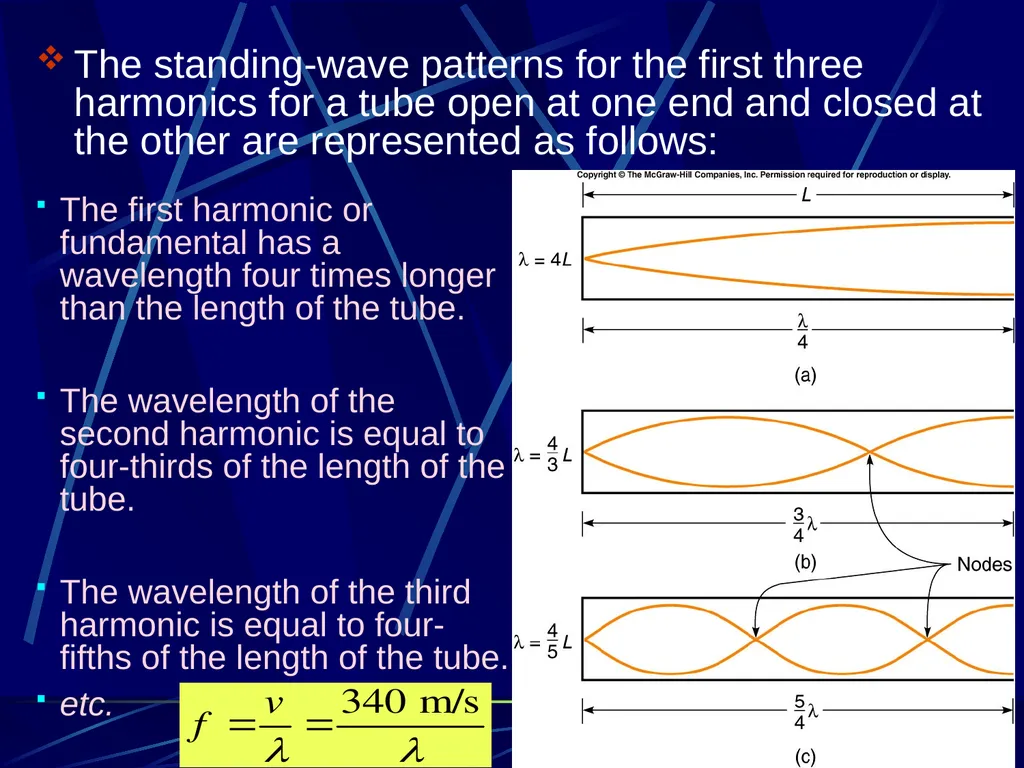
The standing-wave patterns for the first three harmonics for a tube open at one end and closed at the other are represented as follows: The first harmonic or fundamental has a wavelength four times longer than the length of the tube.
The wavelength of the second harmonic is equal to four-thirds of the length of the tube.
The wavelength of the third harmonic is equal to four-fifths of the length of the tube.
etc.<br>
10
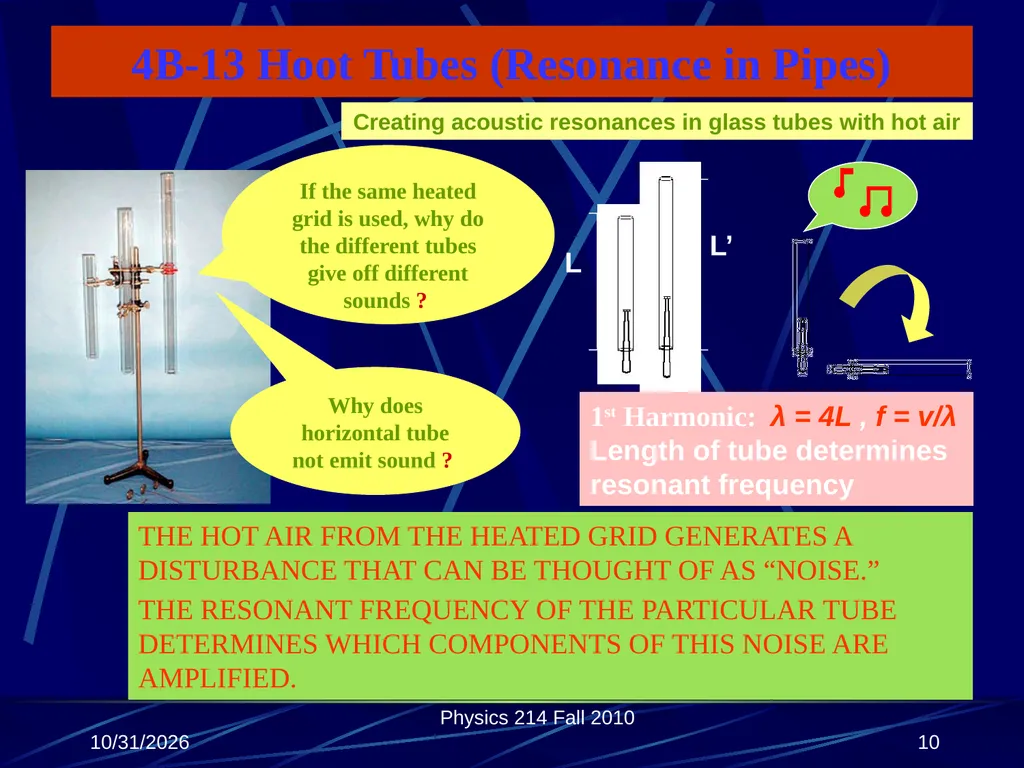
4/15/2021 Physics 214 Fall 2010 10 4B-13 Hoot Tubes (Resonance in Pipes) THE HOT AIR FROM THE HEATED GRID GENERATES A DISTURBANCE THAT CAN BE THOUGHT OF AS “NOISE.”
THE RESONANT FREQUENCY OF THE PARTICULAR TUBE DETERMINES WHICH COMPONENTS OF THIS NOISE ARE AMPLIFIED. Creating acoustic resonances in glass tubes with hot air If the same heated grid is used, why do the different tubes give off different sounds ? Why does horizontal tube not emit sound ? 1st Harmonic: λ = 4L , f = v/λ
Length of tube determines resonant frequency<br>
11
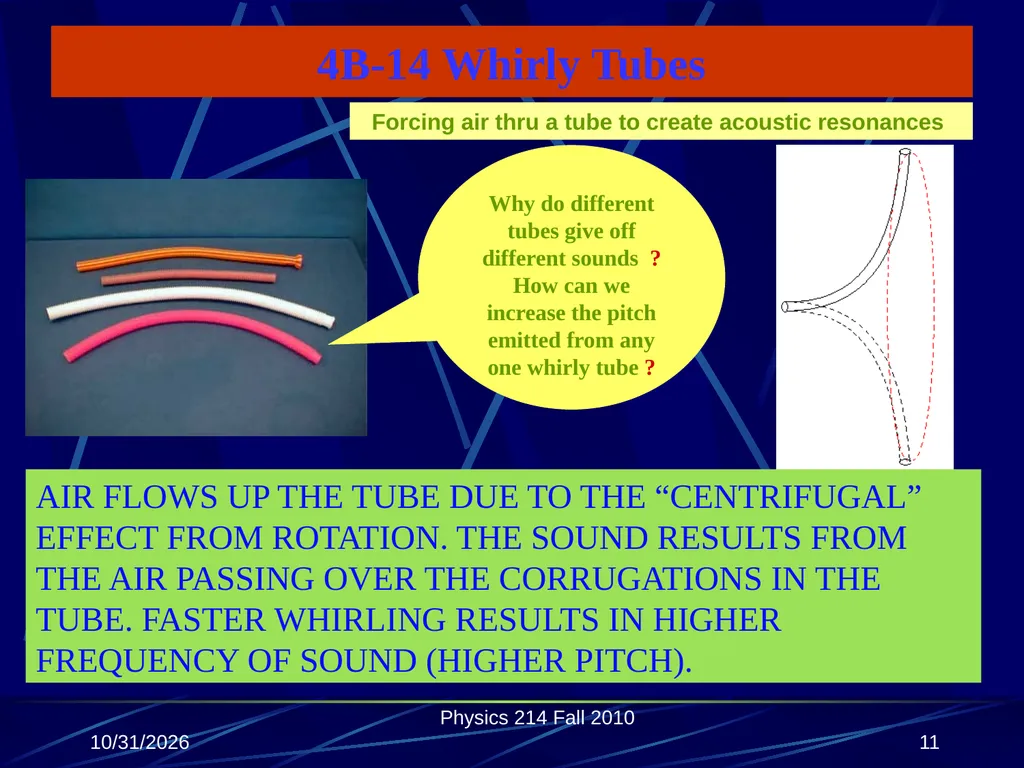
4/15/2021 Physics 214 Fall 2010 11 Why do different tubes give off different sounds ? How can we increase the pitch emitted from any one whirly tube ? 4B-14 Whirly Tubes AIR FLOWS UP THE TUBE DUE TO THE “CENTRIFUGAL” EFFECT FROM ROTATION. THE SOUND RESULTS FROM THE AIR PASSING OVER THE CORRUGATIONS IN THE TUBE. FASTER WHIRLING RESULTS IN HIGHER FREQUENCY OF SOUND (HIGHER PITCH). Forcing air thru a tube to create acoustic resonances<br>
12
Demos: 1S-42 Standing Waves (Metal Bar) A metal bar can produce interesting sound. https://www.youtube.com/watch?v=hVsQ_m6281g Ancient Chinese fountain bowel<br>
13
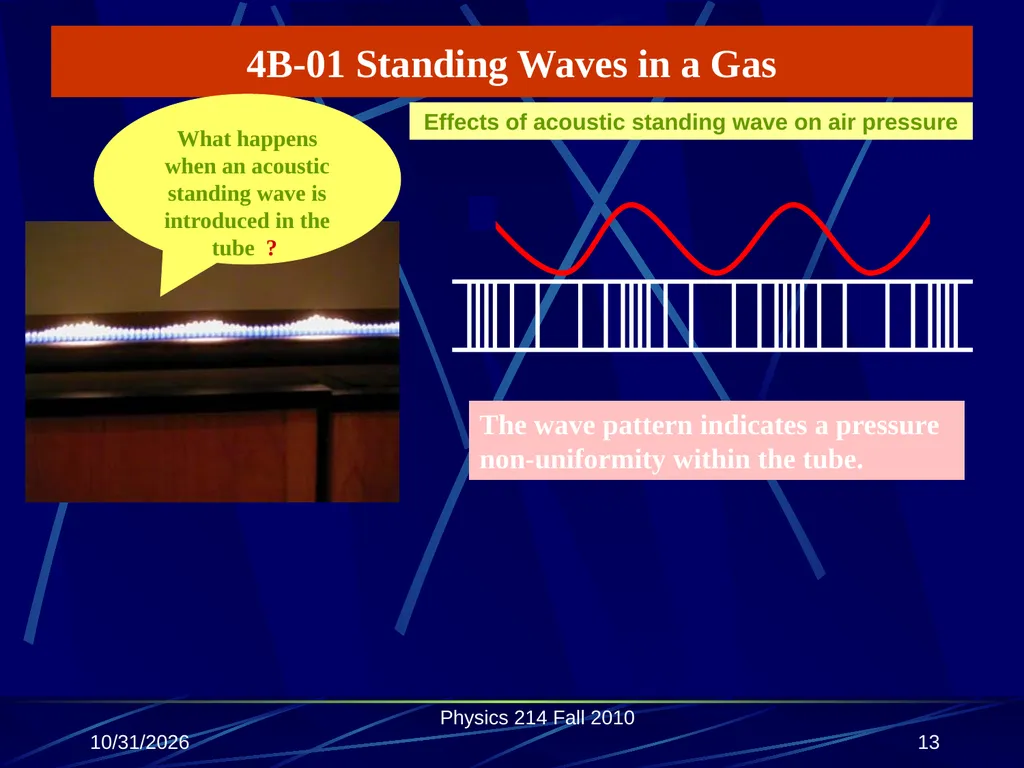
4/15/2021 Physics 214 Fall 2010 13 4B-01 Standing Waves in a Gas Effects of acoustic standing wave on air pressure The wave pattern indicates a pressure non-uniformity within the tube. What happens when an acoustic standing wave is introduced in the tube ?<br>
14
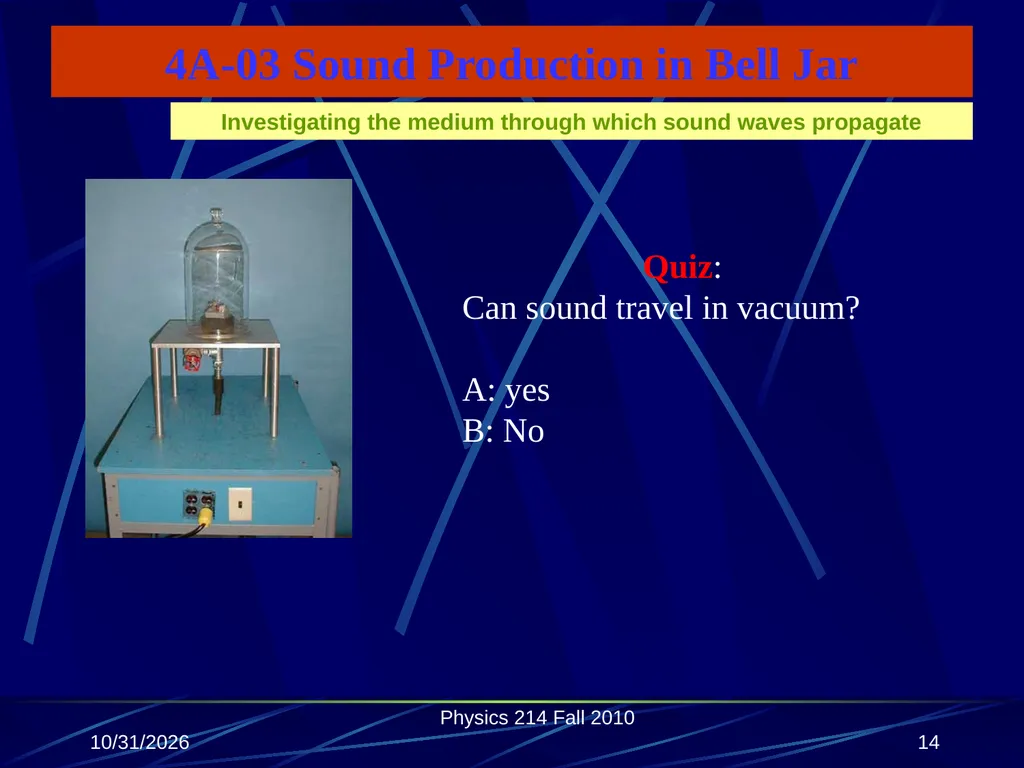
4/15/2021 Physics 214 Fall 2010 14 4A-03 Sound Production in Bell Jar Investigating the medium through which sound waves propagate Quiz:
Can sound travel in vacuum?
A: yes
B: No<br>
15
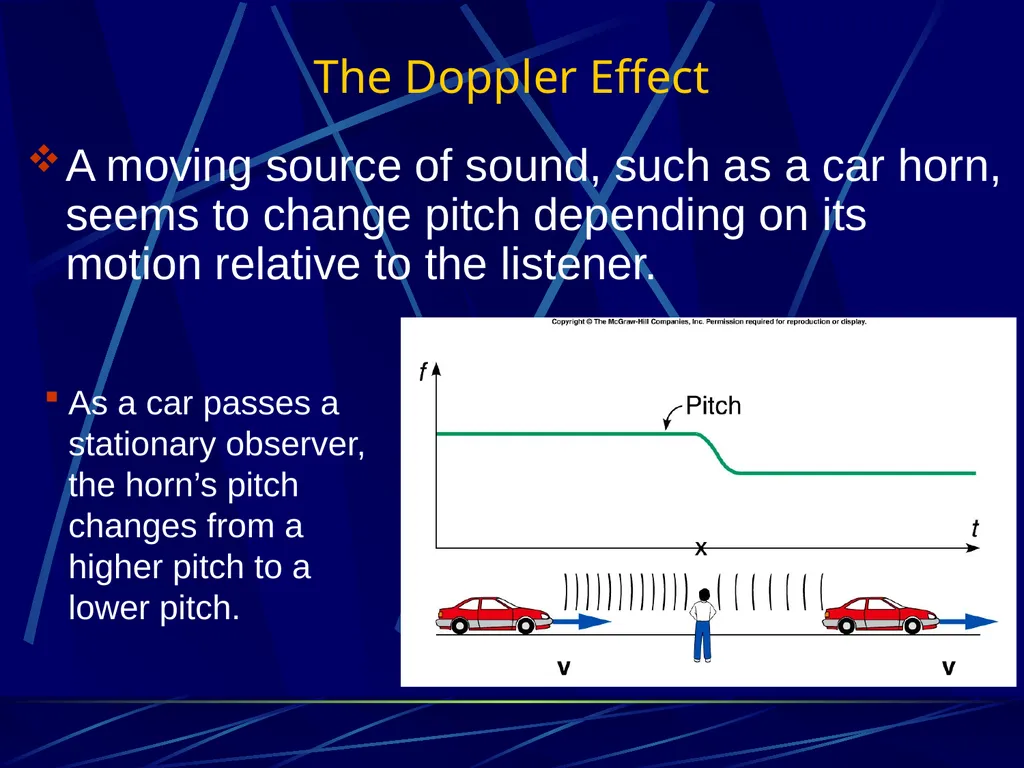
The Doppler Effect A moving source of sound, such as a car horn, seems to change pitch depending on its motion relative to the listener. As a car passes a stationary observer, the horn’s pitch changes from a higher pitch to a lower pitch.<br>
16
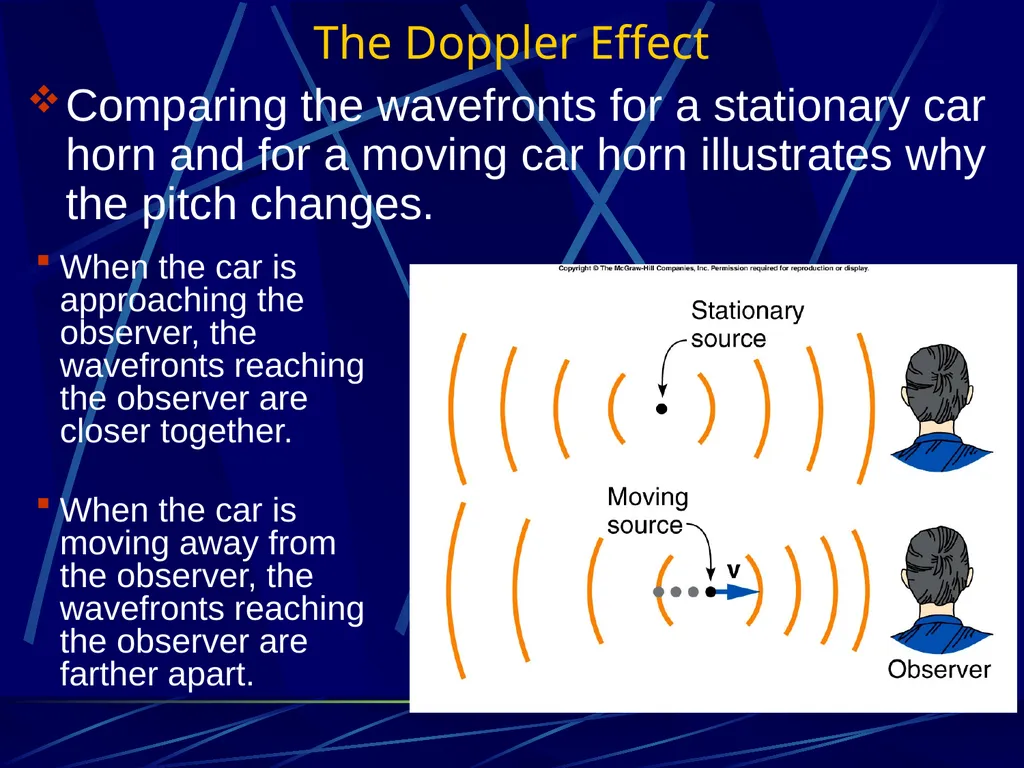
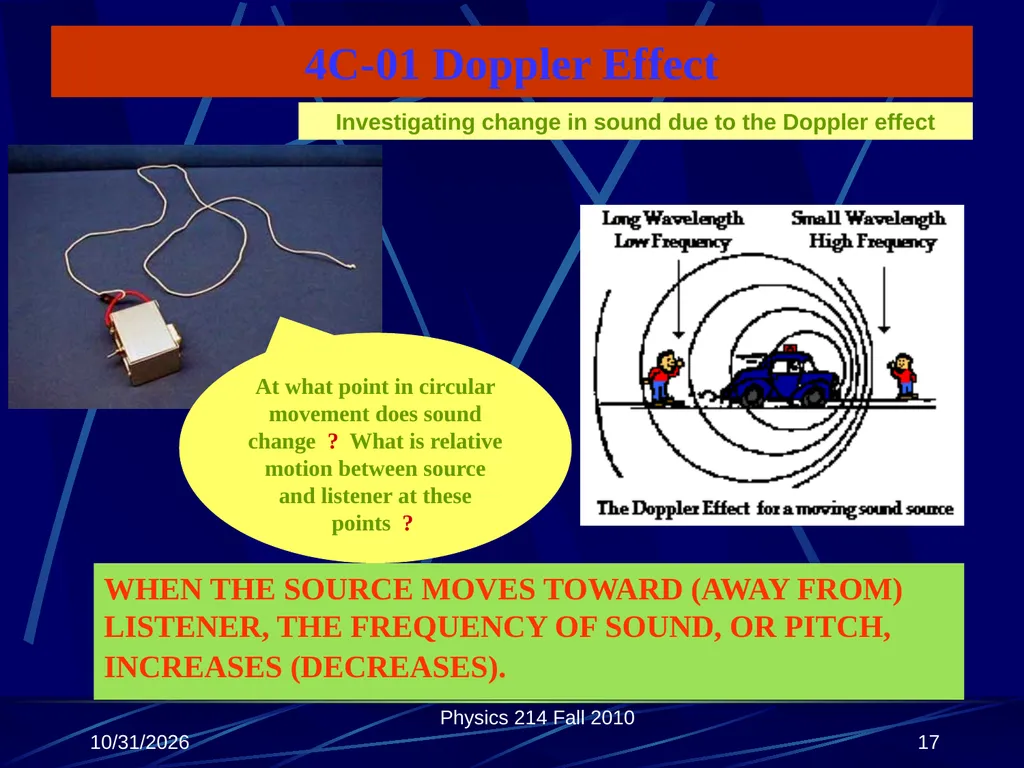
The Doppler Effect Comparing the wavefronts for a stationary car horn and for a moving car horn illustrates why the pitch changes. When the car is approaching the observer, the wavefronts reaching the observer are closer together.
When the car is moving away from the observer, the wavefronts reaching the observer are farther apart.<br>
17
4/15/2021 Physics 214 Fall 2010 17 At what point in circular movement does sound change ? What is relative motion between source and listener at these points ? 4C-01 Doppler Effect WHEN THE SOURCE MOVES TOWARD (AWAY FROM) LISTENER, THE FREQUENCY OF SOUND, OR PITCH, INCREASES (DECREASES). Investigating change in sound due to the Doppler effect<br>