If Rudyard Kipling The Poet: Joseph Rudyard Kipling was an English short-story writer, poet and novelist. He was one of the most popular writers in England in both prose and verse in the late 19th and early 20th centuries He is regarded
"‘If’ Rudyard Kipling The Poet: Joseph Rudyard" is the property of its rightful owner. Permission is granted to
download and print the materials on this website for personal, non-commercial use only, and to display it
on your personal computer provided you do not modify the materials and that you retain all copyright
notices contained in the materials. By downloading content from our website, you accept the terms of this
agreement.
Presentation Transcript
01
‘If’ Rudyard Kipling<br>
02
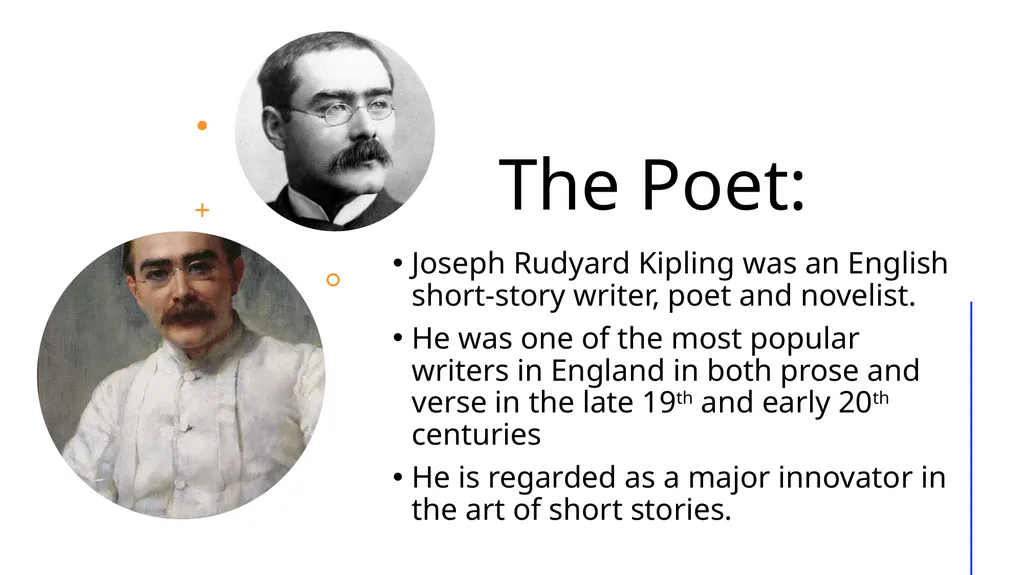
The Poet: Joseph Rudyard Kipling was an English short-story writer, poet and novelist.
He was one of the most popular writers in England in both prose and verse in the late 19th and early 20th centuries
He is regarded as a major innovator in the art of short stories. This Photo by Unknown Author is licensed under CC BY-SA This Photo by Unknown Author is licensed under CC BY-SA<br>
03
The poem ‘If’ by the India-born British Nobel laureate poet Rudyard Kipling is a poem of ultimate inspiration that tells us how to deal with different situations in life. The poet conveys his ideas about how to win this life, and after all, how to be a good human being. This Photo by Unknown Author is licensed under CC BY-SA<br>
04
Summary Throughout the poem, the speaker gives the reader multiple scenarios, both positive and negative, along with a glimpse into how one should conduct oneself. The poem has an almost mathematical proof about it with its if-then scenario.
Kipling leaves the “then” until the final two lines, revealing to the reader that if he or she is able to do all that was just mentioned, he or she will not only have the world at his or her fingertips, but he or she will also be a “Man.”<br>
05
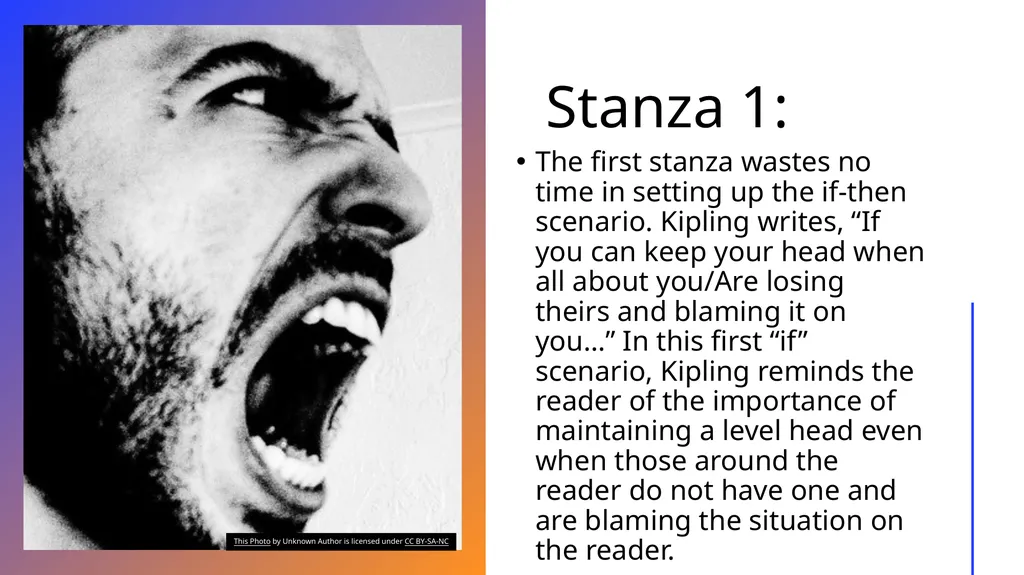
Stanza 1: The first stanza wastes no time in setting up the if-then scenario. Kipling writes, “If you can keep your head when all about you/Are losing theirs and blaming it on you…” In this first “if” scenario, Kipling reminds the reader of the importance of maintaining a level head even when those around the reader do not have one and are blaming the situation on the reader. This Photo by Unknown Author is licensed under CC BY-SA-NC<br>
06
The third and fourth lines present the next “if” situation. Kipling writes, “If you can trust yourself when all men doubt you,/But make allowance for their doubting too…”
Here, the speaker emphasizes two traits that all people must possess: self-trust and the ability to understand the thoughts and feelings of others, even if that means understanding that people will not always like or agree with you.<br>
07
Stanza 2: In this stanza Kipling urges his reader to dream and think, but to not get so caught up in dreams and thoughts that the reader loses his grasp on reality.
The speaker informs the reader that he or she must be able to endure hearing his or her words being twisted by dishonest and harmful people in order to serve their own agendas.<br>
08
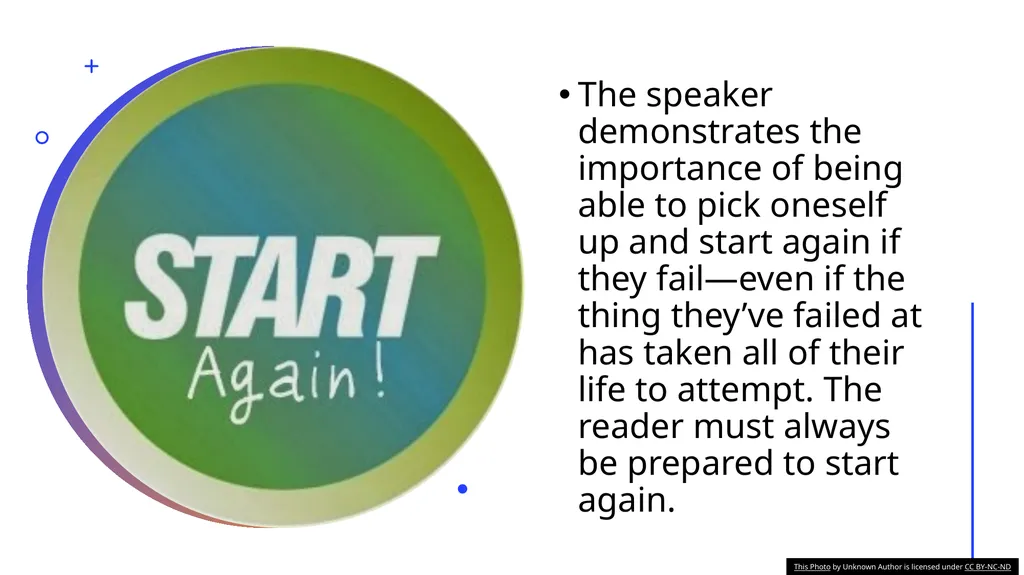
The speaker demonstrates the importance of being able to pick oneself up and start again if they fail—even if the thing they’ve failed at has taken all of their life to attempt. The reader must always be prepared to start again. This Photo by Unknown Author is licensed under CC BY-NC-ND<br>
09
Stanza 3: The theme in the beginning of stanza 3 is very similar to the one in the last two lines of the previous stanza: if you lose everything, you must be willing to begin again. Not only that, but you must also be willing to forget about the loss and not dwell on it.
The speaker is imploring the reader to endure, even if that feels both physically (sinew) and emotionally (heart and nerve) impossible. It is also worth noting the capitalization of “Will.” Perhaps Kipling wanted to emphasize the resilience of the human spirit here by making it a power that is separate from the person who possesses it.<br>
10
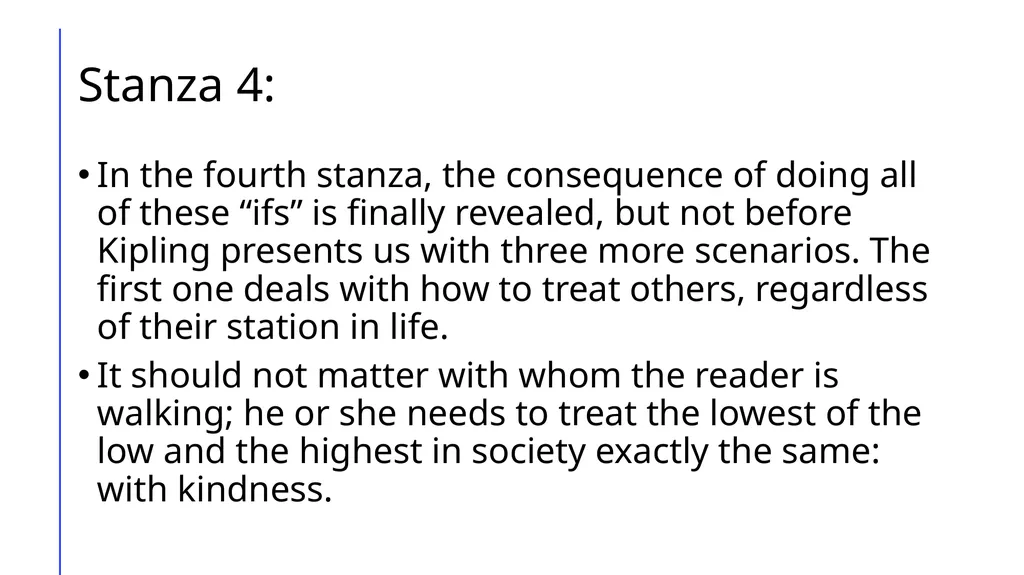
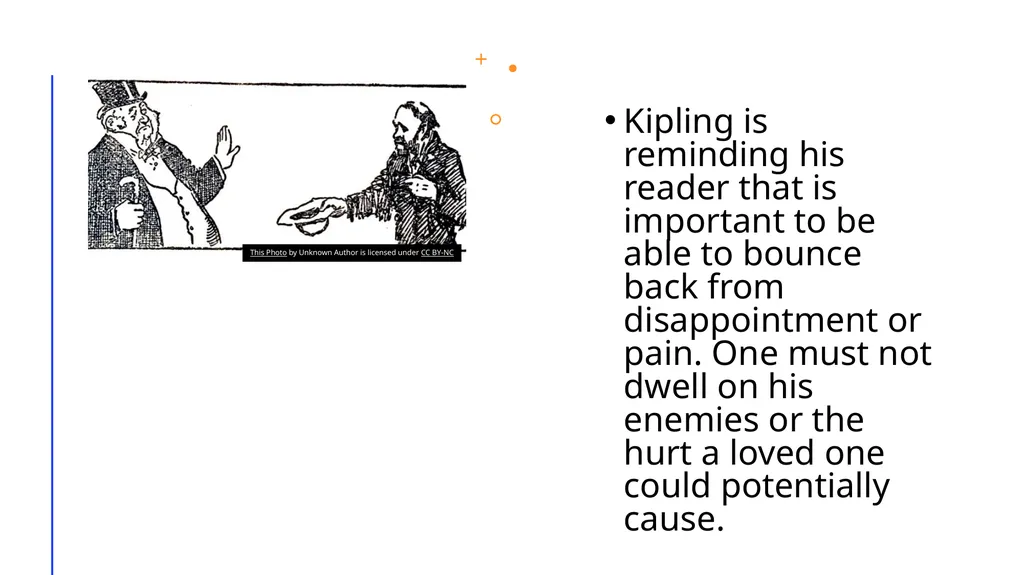
Stanza 4: In the fourth stanza, the consequence of doing all of these “ifs” is finally revealed, but not before Kipling presents us with three more scenarios. The first one deals with how to treat others, regardless of their station in life.
It should not matter with whom the reader is walking; he or she needs to treat the lowest of the low and the highest in society exactly the same: with kindness.<br>
11
Kipling is reminding his reader that is important to be able to bounce back from disappointment or pain. One must not dwell on his enemies or the hurt a loved one could potentially cause. This Photo by Unknown Author is licensed under CC BY-NC<br>
12
Finally, the poet gives the reader his final piece of advice:
“If you can fill the unforgiving minute
With sixty seconds’ worth of distance run,”
He is telling his reader to never give up or waste even a single second of time. If you are given a minute, make sure you use all sixty seconds of it. Finally, in the last two lines, the outcome of abiding by all of these tidbits is revealed:
“Yours is the Earth and everything that’s in it,
And—which is more—you’ll be a Man, my son!”<br>
13
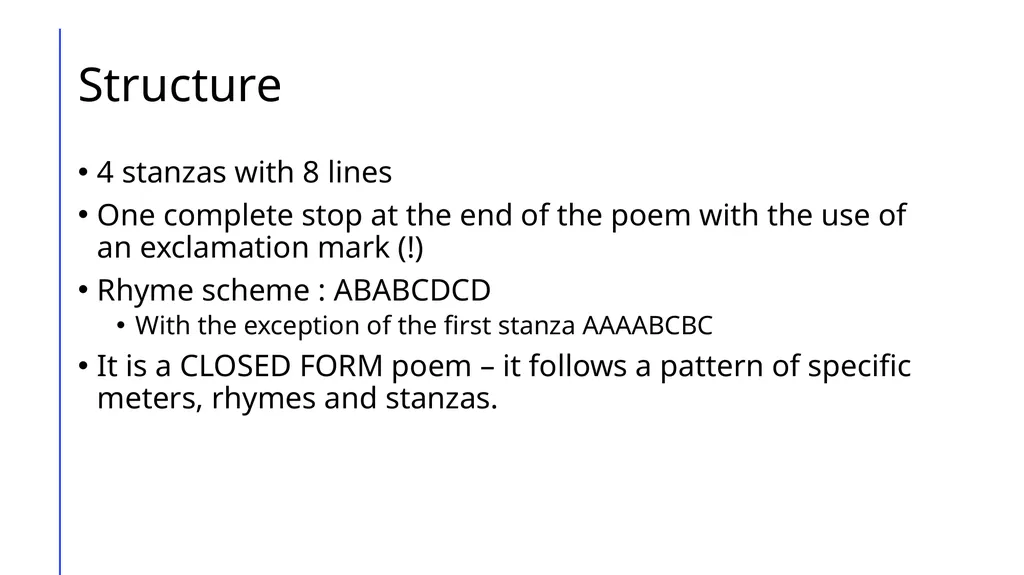
Structure 4 stanzas with 8 lines
One complete stop at the end of the poem with the use of an exclamation mark (!)
Rhyme scheme : ABABCDCD
With the exception of the first stanza AAAABCBC
It is a CLOSED FORM poem – it follows a pattern of specific meters, rhymes and stanzas.<br>
14
Style: Kipling wrote this as a DIDACTIC poem –
It is instructional poetry.
The poet expects the reader to learn skills, philosophy etc. from the verses This Photo by Unknown Author is licensed under CC BY-SA-NC<br>
15
Tone: The speaker of the poem, presumably Kipling, keeps a positive and upbeat tone throughout the work, informing the reader what he or she needs to do in order to be a successful person in life.
Kipling makes this a very personal poem by his use of the pronoun “you.” In fact, one could even interpret that the poem is Kipling talking to himself or giving himself a pep-talk. This Photo by Unknown Author is licensed under CC BY-SA<br>
16
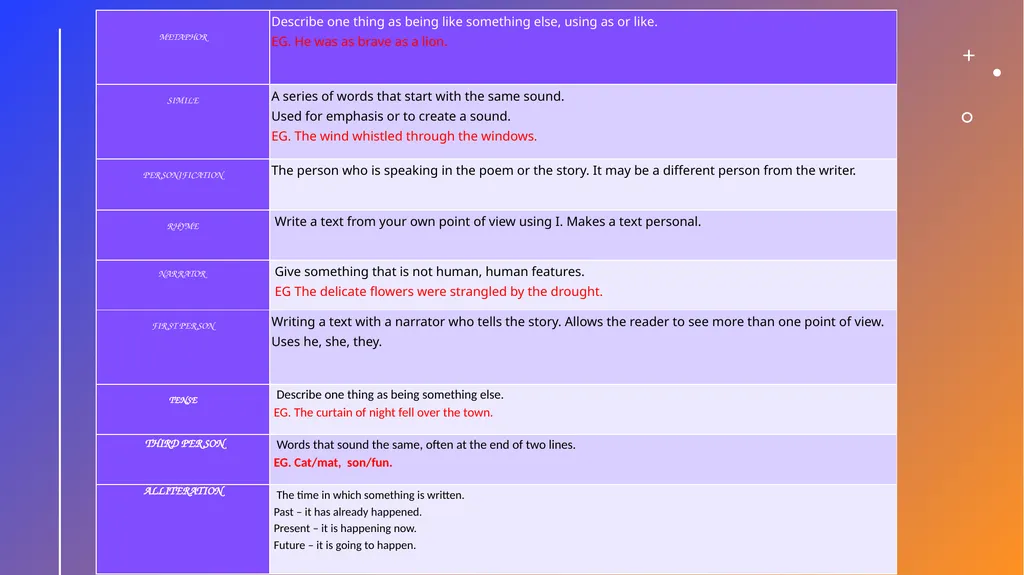
Poetic Techniques<br>
17
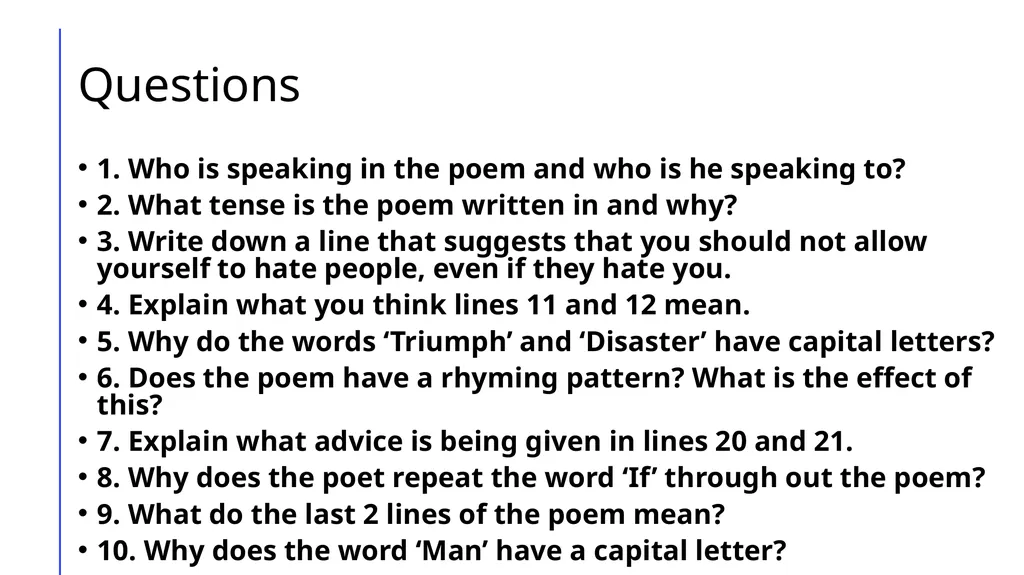
Questions 1. Who is speaking in the poem and who is he speaking to?
2. What tense is the poem written in and why?
3. Write down a line that suggests that you should not allow yourself to hate people, even if they hate you.
4. Explain what you think lines 11 and 12 mean.
5. Why do the words ‘Triumph’ and ‘Disaster’ have capital letters?
6. Does the poem have a rhyming pattern? What is the effect of this?
7. Explain what advice is being given in lines 20 and 21.
8. Why does the poet repeat the word ‘If’ through out the poem?
9. What do the last 2 lines of the poem mean?
10. Why does the word ‘Man’ have a capital letter?<br>