IFAD partnership strategy Presentation to informal seminar of Executive Board 12 December 2011 Background and process Consultation document of Eighth Replenishment committed IFAD to prepare partnership strategy Strategic Framework 2011-2015
"IFAD partnership strategy Presentation to informal" is the property of its rightful owner. Permission is granted to
download and print the materials on this website for personal, non-commercial use only, and to display it
on your personal computer provided you do not modify the materials and that you retain all copyright
notices contained in the materials. By downloading content from our website, you accept the terms of this
agreement.
Presentation Transcript
01
IFAD partnership strategy Presentation to informal seminar of Executive Board
12 December 2011<br>
02
Background and process Consultation document of Eighth Replenishment committed IFAD to prepare partnership strategy
Strategic Framework 2011-2015 reconfirmed the importance of partnerships for IFAD’s work – one of its ‘principles of engagement’
Initial work towards strategy – Information Note to Executive Board Sept. 2011, led from NALO
Policy Reference Group for strategy established Oct. 2011, met twice to date
Interviews with staff and managers; meetings with Resource Mobilisation and Partnerships Office (RMP), with CPM focus group; research and initial consultation with IFAD partners; mapping of IFAD’s existing partnerships; review of key documentation, including IOE work
The Partnering Initiative (TPI) – specialised NGO – supporting the in-house work
Presentation of preliminary ideas to Informal Seminar of Executive Board Dec. 2011 – for discussion and views
Sharing of draft strategy document for comments, and presentation of final version to Executive Board in 2012<br>
03
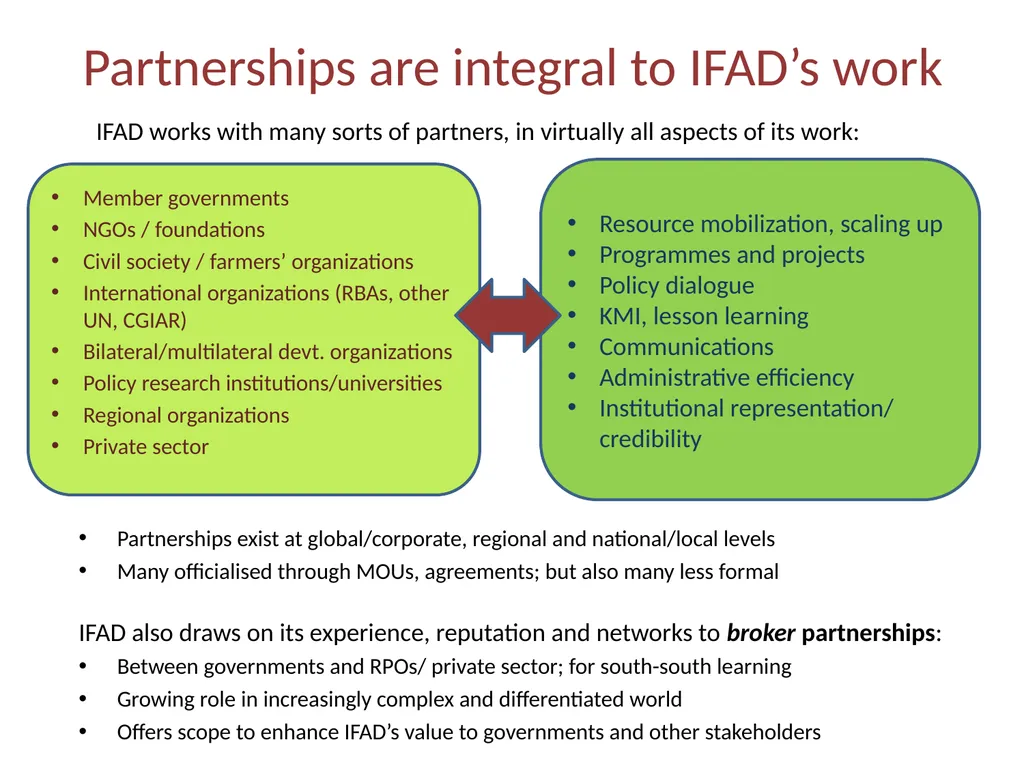
Partnerships are integral to IFAD’s work IFAD works with many sorts of partners, in virtually all aspects of its work: Partnerships exist at global/corporate, regional and national/local levels
Many officialised through MOUs, agreements; but also many less formal
IFAD also draws on its experience, reputation and networks to broker partnerships:
Between governments and RPOs/ private sector; for south-south learning
Growing role in increasingly complex and differentiated world
Offers scope to enhance IFAD’s value to governments and other stakeholders Resource mobilization, scaling up
Programmes and projects
Policy dialogue
KMI, lesson learning
Communications
Administrative efficiency
Institutional representation/ credibility Member governments
NGOs / foundations
Civil society / farmers’ organizations
International organizations (RBAs, other UN, CGIAR)
Bilateral/multilateral devt. organizations
Policy research institutions/universities
Regional organizations
Private sector<br>
04
So why an IFAD partnership strategy? A rapidly changing external environment:
Complex development issues require broad or multi-sectoral expertise, and new, knowledge-intensive ways of working
Need for scalable solutions for substantial impact on rural poverty
Evolving Aid Effectiveness agenda – Busan focus on partnerships
In this context, partnerships can enable IFAD to:
Focus on what it is mandated to do and does best
Leverage external resources to complement its own programme of work
Better achieve its strategic objectives
Building on what IFAD already does, a more strategic approach to partnerships can help the organization:
To be more selective, and give focus, direction and guidance to development and management of partnerships
To maximise efficiency and effectiveness of partnerships in achieving its strategic objectives<br>
05
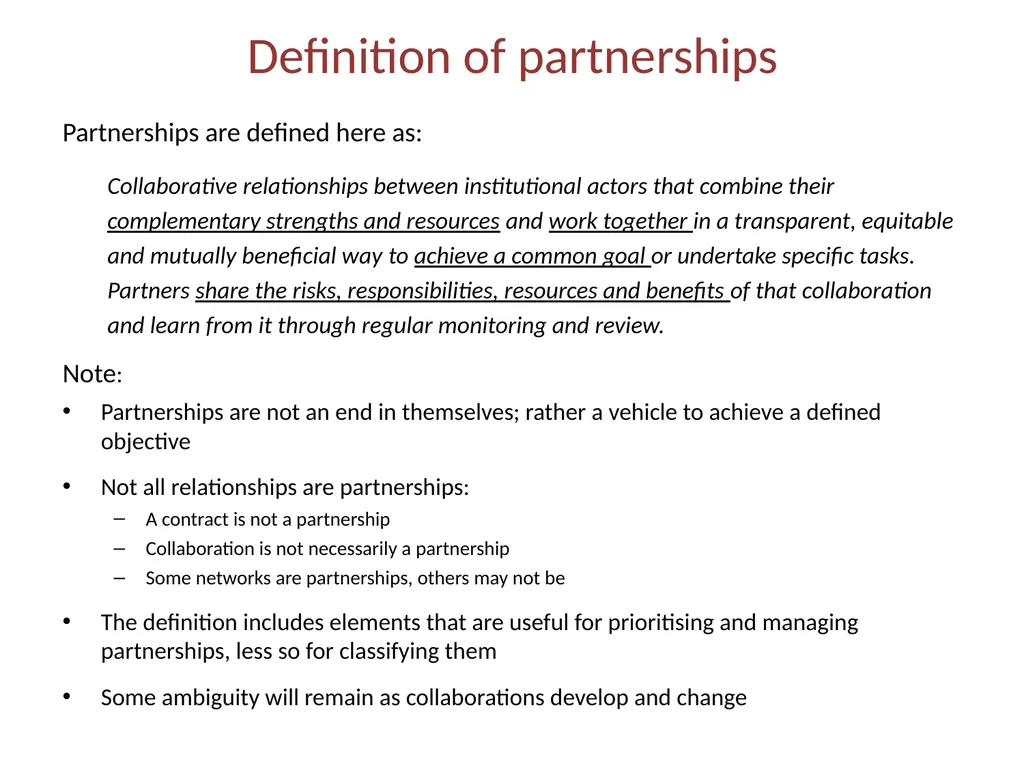
Definition of partnerships Partnerships are defined here as:
Collaborative relationships between institutional actors that combine their complementary strengths and resources and work together in a transparent, equitable and mutually beneficial way to achieve a common goal or undertake specific tasks. Partners share the risks, responsibilities, resources and benefits of that collaboration and learn from it through regular monitoring and review.
Note:
Partnerships are not an end in themselves; rather a vehicle to achieve a defined objective
Not all relationships are partnerships:
A contract is not a partnership
Collaboration is not necessarily a partnership
Some networks are partnerships, others may not be
The definition includes elements that are useful for prioritising and managing partnerships, less so for classifying them
Some ambiguity will remain as collaborations develop and change<br>
06
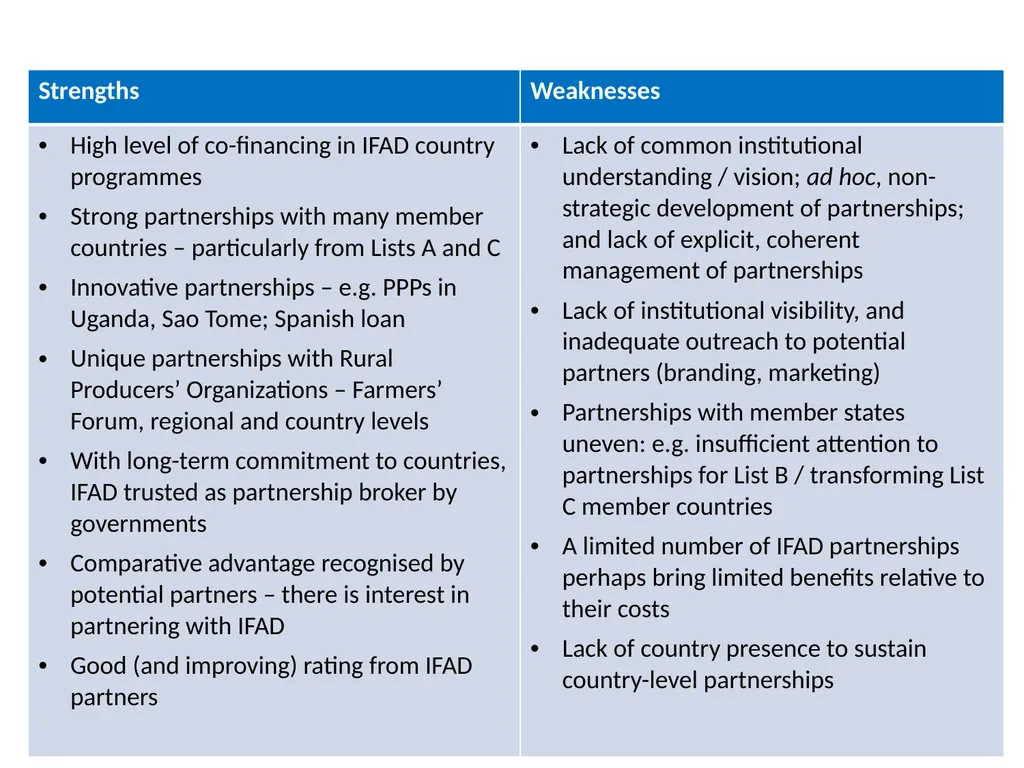
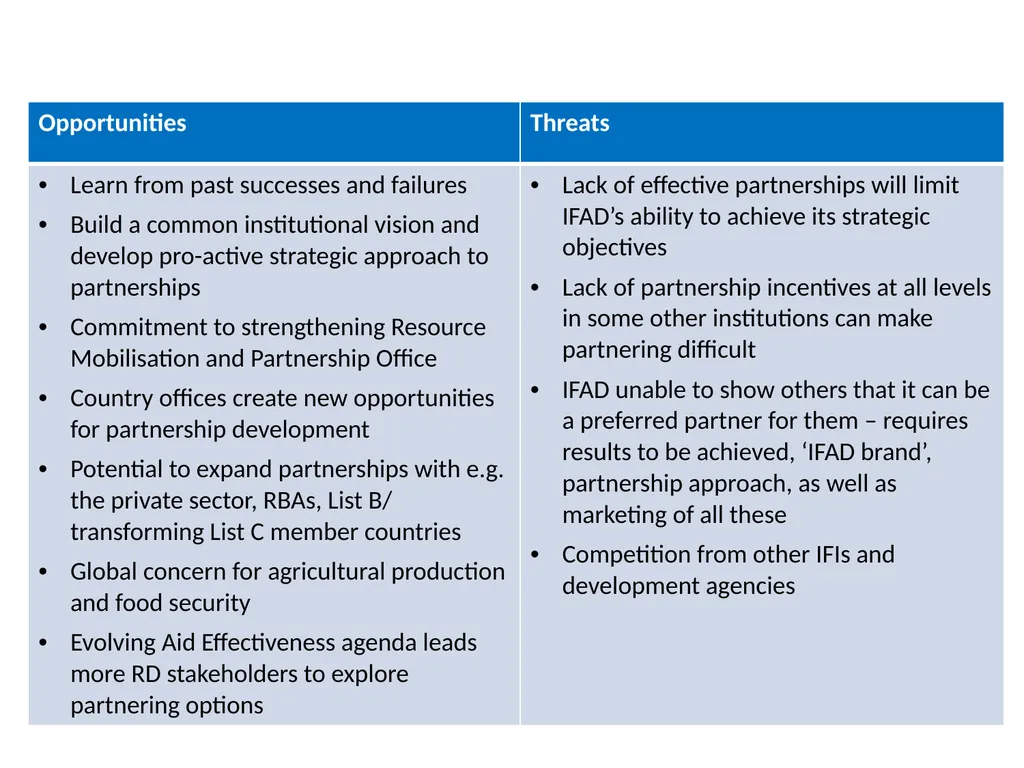
Partnership SWOT for IFAD Strengths, Weaknesses, Opportunities & Threats
from research interviews, focus groups meetings, views of external partners, and recent ARRI and CLE evaluation data<br>
07
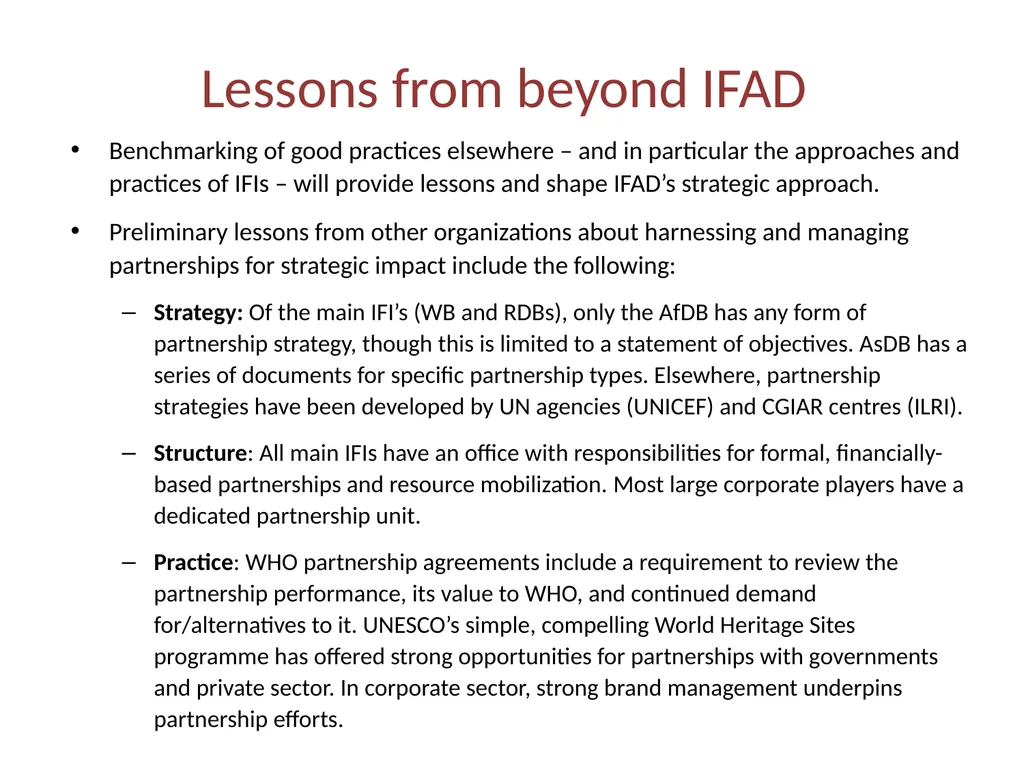
Lessons from beyond IFAD Benchmarking of good practices elsewhere – and in particular the approaches and practices of IFIs – will provide lessons and shape IFAD’s strategic approach.
Preliminary lessons from other organizations about harnessing and managing partnerships for strategic impact include the following:
Strategy: Of the main IFI’s (WB and RDBs), only the AfDB has any form of partnership strategy, though this is limited to a statement of objectives. AsDB has a series of documents for specific partnership types. Elsewhere, partnership strategies have been developed by UN agencies (UNICEF) and CGIAR centres (ILRI).
Structure: All main IFIs have an office with responsibilities for formal, financially-based partnerships and resource mobilization. Most large corporate players have a dedicated partnership unit.
Practice: WHO partnership agreements include a requirement to review the partnership performance, its value to WHO, and continued demand for/alternatives to it. UNESCO’s simple, compelling World Heritage Sites programme has offered strong opportunities for partnerships with governments and private sector. In corporate sector, strong brand management underpins partnership efforts.<br>
08
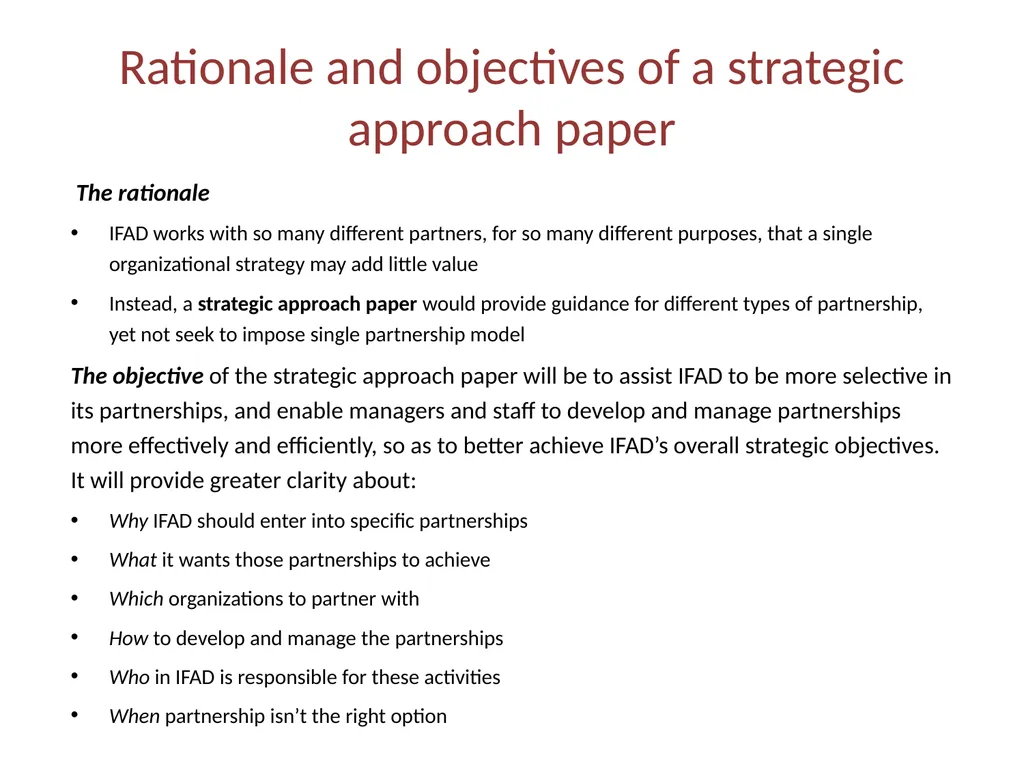
Rationale and objectives of a strategic approach paper The rationale
IFAD works with so many different partners, for so many different purposes, that a single organizational strategy may add little value
Instead, a strategic approach paper would provide guidance for different types of partnership, yet not seek to impose single partnership model
The objective of the strategic approach paper will be to assist IFAD to be more selective in its partnerships, and enable managers and staff to develop and manage partnerships more effectively and efficiently, so as to better achieve IFAD’s overall strategic objectives. It will provide greater clarity about:
Why IFAD should enter into specific partnerships
What it wants those partnerships to achieve
Which organizations to partner with
How to develop and manage the partnerships
Who in IFAD is responsible for these activities
When partnership isn’t the right option<br>
09
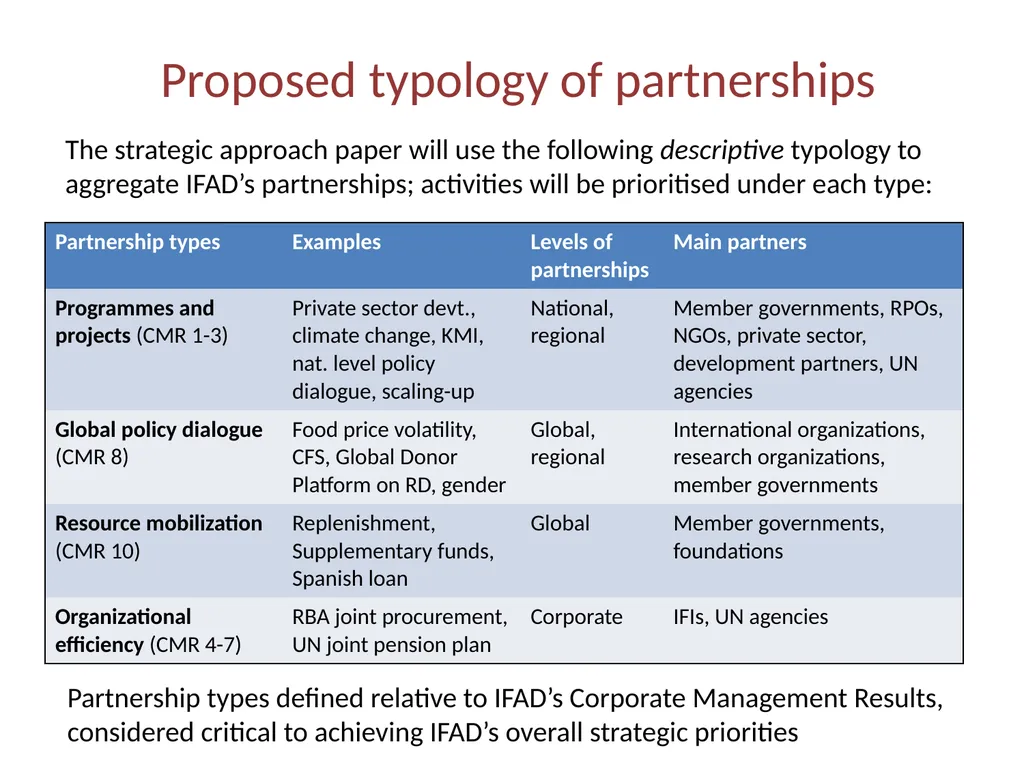
Proposed typology of partnerships Partnership types defined relative to IFAD’s Corporate Management Results, considered critical to achieving IFAD’s overall strategic priorities The strategic approach paper will use the following descriptive typology to aggregate IFAD’s partnerships; activities will be prioritised under each type:<br>
10
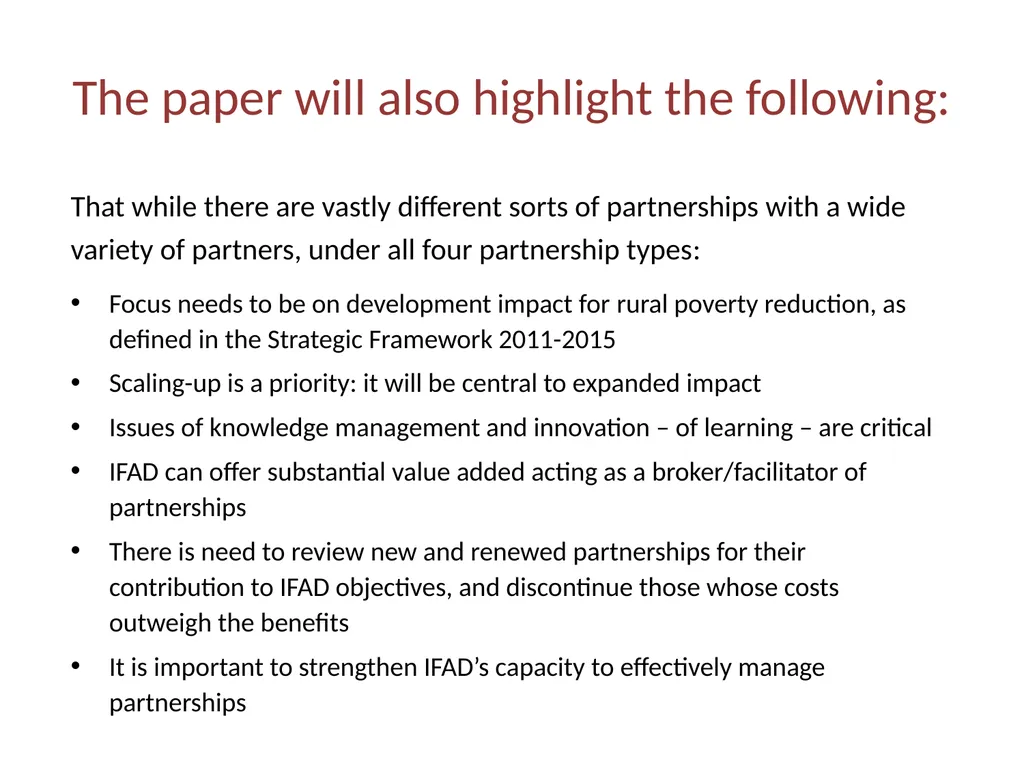
The paper will also highlight the following: That while there are vastly different sorts of partnerships with a wide variety of partners, under all four partnership types:
Focus needs to be on development impact for rural poverty reduction, as defined in the Strategic Framework 2011-2015
Scaling-up is a priority: it will be central to expanded impact
Issues of knowledge management and innovation – of learning – are critical
IFAD can offer substantial value added acting as a broker/facilitator of partnerships
There is need to review new and renewed partnerships for their contribution to IFAD objectives, and discontinue those whose costs outweigh the benefits
It is important to strengthen IFAD’s capacity to effectively manage partnerships<br>
11
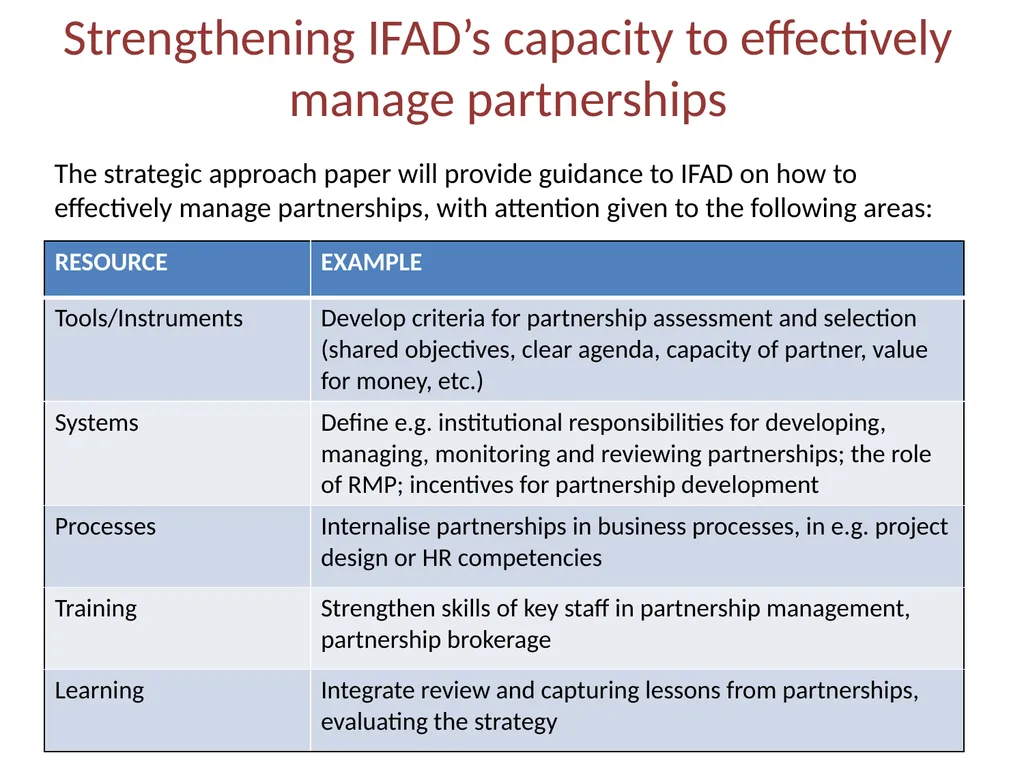
Strengthening IFAD’s capacity to effectively manage partnerships The strategic approach paper will provide guidance to IFAD on how to effectively manage partnerships, with attention given to the following areas:<br>
12
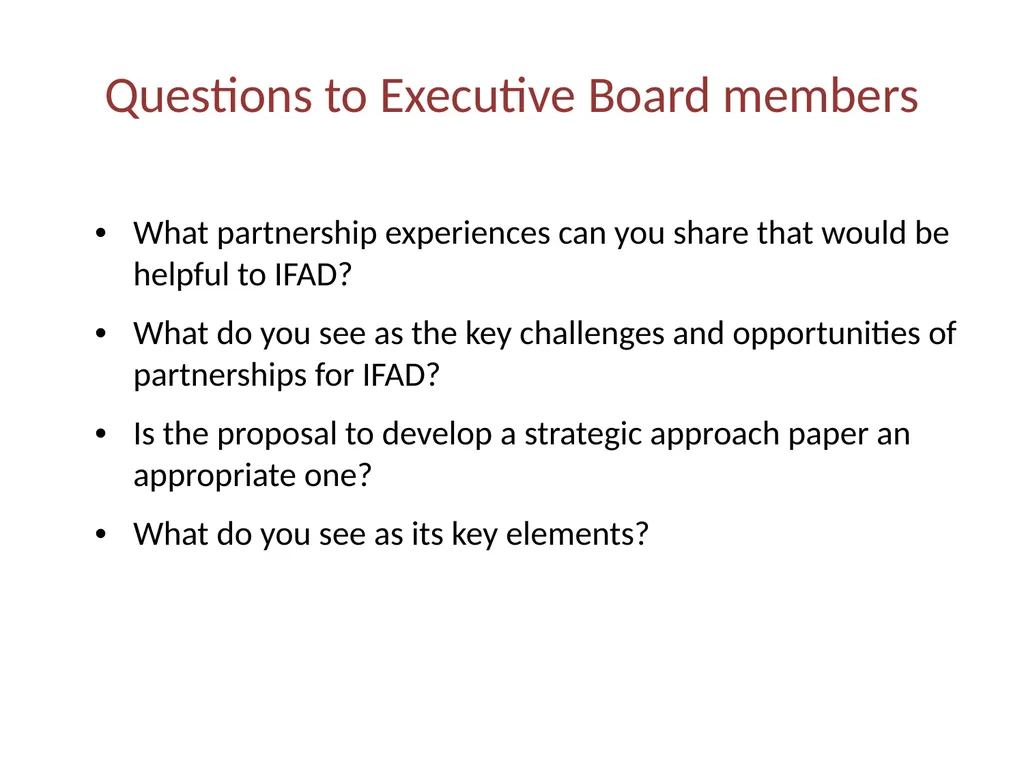
Questions to Executive Board members What partnership experiences can you share that would be helpful to IFAD?
What do you see as the key challenges and opportunities of partnerships for IFAD?
Is the proposal to develop a strategic approach paper an appropriate one?
What do you see as its key elements?<br>