
IG3IS - Integrated Global Greenhouse Gas
OM
Published · 12 slides · 0 views

1 / 1
Description
IG3IS - Integrated Global Greenhouse Gas Information System Global Greenhouse Gas Watch: Overview and way forward Phil DeCola Co-Chair of IG3IS IG3IS - Integrated Global Greenhouse Gas Information System (suite of systematic information
Related Topics
Share
Embed code
Download this presentation From Below
"IG3IS - Integrated Global Greenhouse Gas" is the property of its rightful owner. Permission is granted to download and print the materials on this website for personal, non-commercial use only, and to display it on your personal computer provided you do not modify the materials and that you retain all copyright notices contained in the materials. By downloading content from our website, you accept the terms of this agreement.
Presentation Transcript
01
IG3IS - Integrated Global Greenhouse Gas Information System
& Global Greenhouse Gas Watch:
Overview and way forward Phil DeCola Co-Chair of IG3IS<br>
& Global Greenhouse Gas Watch:
Overview and way forward Phil DeCola Co-Chair of IG3IS<br>
02
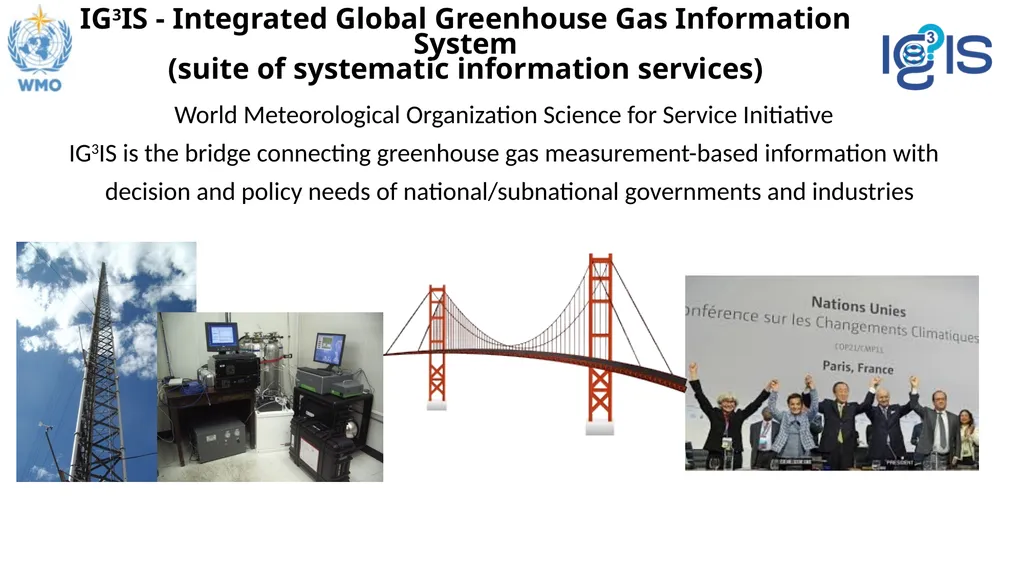
IG3IS - Integrated Global Greenhouse Gas Information System
(suite of systematic information services) World Meteorological Organization Science for Service Initiative
IG3IS is the bridge connecting greenhouse gas measurement-based information with
decision and policy needs of national/subnational governments and industries<br>
IG3IS is the bridge connecting greenhouse gas measurement-based information with
decision and policy needs of national/subnational governments and industries<br>
03
Idea for an IG3IS presented at the 3rd CAS Management Meeting in 2008
Original vision was for NWP-like Global Carbon/GHG Assimilation System
Achieved buy-in with a set of measurement-based “systematic information services”
Sustained effort began in 2015 with support from NOAA, NIST, and NASA and IG3IS resolution prepared, presented, and adopted at the 17th WMO Congress (2015)
Science team was assembled and concept paper with principles and objectives and approved by Executive Council-68 in 2016
IG3IS Science Implementation Plan was completed and approved by EC-70 in 2018 and adopted by 18th Congress in June 2019 IG3IS Brief History<br>
Original vision was for NWP-like Global Carbon/GHG Assimilation System
Achieved buy-in with a set of measurement-based “systematic information services”
Sustained effort began in 2015 with support from NOAA, NIST, and NASA and IG3IS resolution prepared, presented, and adopted at the 17th WMO Congress (2015)
Science team was assembled and concept paper with principles and objectives and approved by Executive Council-68 in 2016
IG3IS Science Implementation Plan was completed and approved by EC-70 in 2018 and adopted by 18th Congress in June 2019 IG3IS Brief History<br>
04
Promote a hybrid approach (NAS-like) combining emission knowledge based on both atmospheric measurements and activity data to better quantify, attribute, and track changes in greenhouse gas emissions.
Stakeholder driven (user co-design) so that information meets user priorities and deliver on the foreseen climate action value proposition.
IG3IS, like GAW, will serve as an international mechanism to establish and propagate consistent methods and skill towards standards.
Success-criteria are that the information guides and tracks additional and valuable emission-reduction actions.
IG3IS relies on a multi-tiered observing strategy involving satellite, aircraft, mobile, and tower-based surface measurements
IG3IS must mature in concert with evolution of policy and technology. WMO IG3IS set of guiding principles<br>
Stakeholder driven (user co-design) so that information meets user priorities and deliver on the foreseen climate action value proposition.
IG3IS, like GAW, will serve as an international mechanism to establish and propagate consistent methods and skill towards standards.
Success-criteria are that the information guides and tracks additional and valuable emission-reduction actions.
IG3IS relies on a multi-tiered observing strategy involving satellite, aircraft, mobile, and tower-based surface measurements
IG3IS must mature in concert with evolution of policy and technology. WMO IG3IS set of guiding principles<br>
05
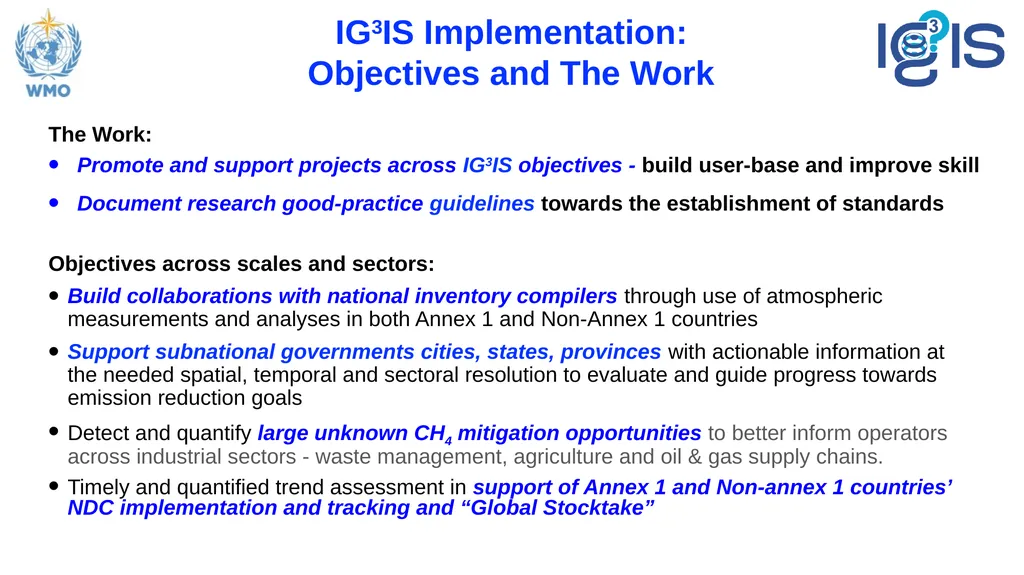
Objectives across scales and sectors:
Build collaborations with national inventory compilers through use of atmospheric measurements and analyses in both Annex 1 and Non-Annex 1 countries
Support subnational governments cities, states, provinces with actionable information at the needed spatial, temporal and sectoral resolution to evaluate and guide progress towards emission reduction goals
Detect and quantify large unknown CH4 mitigation opportunities to better inform operators across industrial sectors - waste management, agriculture and oil & gas supply chains.
Timely and quantified trend assessment in support of Annex 1 and Non-annex 1 countries’ NDC implementation and tracking and “Global Stocktake” The Work:
Promote and support projects across IG3IS objectives - build user-base and improve skill
Document research good-practice guidelines towards the establishment of standards IG3IS Implementation:
Objectives and The Work<br>
Build collaborations with national inventory compilers through use of atmospheric measurements and analyses in both Annex 1 and Non-Annex 1 countries
Support subnational governments cities, states, provinces with actionable information at the needed spatial, temporal and sectoral resolution to evaluate and guide progress towards emission reduction goals
Detect and quantify large unknown CH4 mitigation opportunities to better inform operators across industrial sectors - waste management, agriculture and oil & gas supply chains.
Timely and quantified trend assessment in support of Annex 1 and Non-annex 1 countries’ NDC implementation and tracking and “Global Stocktake” The Work:
Promote and support projects across IG3IS objectives - build user-base and improve skill
Document research good-practice guidelines towards the establishment of standards IG3IS Implementation:
Objectives and The Work<br>
06
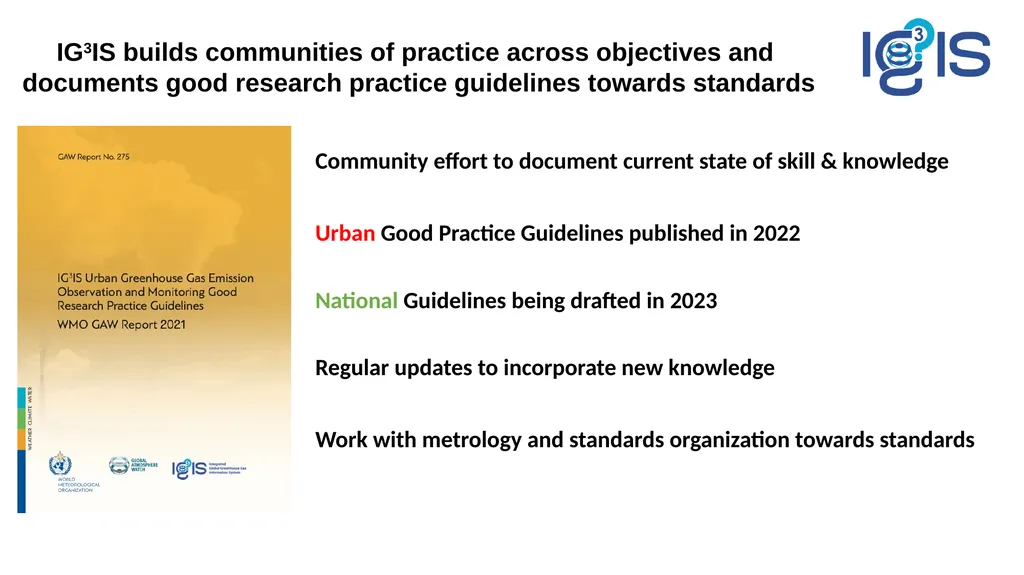
Community effort to document current state of skill & knowledge
Urban Good Practice Guidelines published in 2022
National Guidelines being drafted in 2023
Regular updates to incorporate new knowledge
Work with metrology and standards organization towards standards IG3IS builds communities of practice across objectives and
documents good research practice guidelines towards standards<br>
Urban Good Practice Guidelines published in 2022
National Guidelines being drafted in 2023
Regular updates to incorporate new knowledge
Work with metrology and standards organization towards standards IG3IS builds communities of practice across objectives and
documents good research practice guidelines towards standards<br>
07
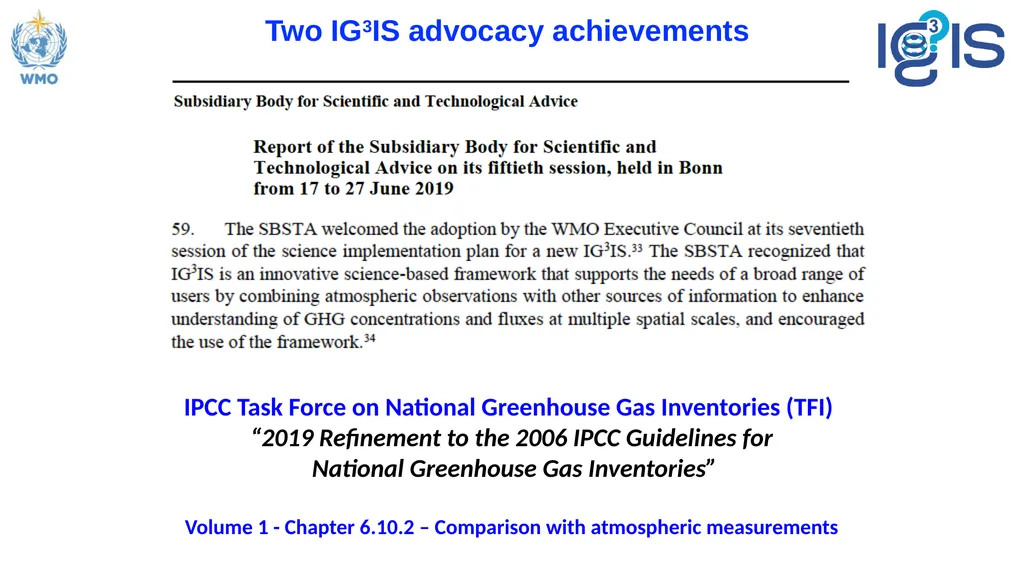
IPCC Task Force on National Greenhouse Gas Inventories (TFI)
“2019 Refinement to the 2006 IPCC Guidelines for
National Greenhouse Gas Inventories”
Volume 1 - Chapter 6.10.2 – Comparison with atmospheric measurements Two IG3IS advocacy achievements<br>
“2019 Refinement to the 2006 IPCC Guidelines for
National Greenhouse Gas Inventories”
Volume 1 - Chapter 6.10.2 – Comparison with atmospheric measurements Two IG3IS advocacy achievements<br>
08
Coordination of the global greenhouse gas measurement and modeling communities into a community of practice under GGGW,
Facilitation of international cooperation programs and capacity building,
Coordination of the network design of multi-tiered observing systems,
Development of common standards and practices
Partner with IG3IS to deliver applications and scientific information services Global Greenhouse Gas Watch:
WMO Role and Goals • Monthly CO2 net fluxes between the Earth surface and the atmosphere with 1x1 degree horizontal resolution delivered with a maximum delay of one month
• Monthly CH4 net fluxes between the Earth surface and the atmosphere with 1x1 degree horizontal resolution delivered with a maximum delay of one month
• 3D fields of atmospheric CO2 and CH4 abundance with hourly resolution and the latency to be defined through user requirements and further consultation (tentatively on the order of a few days).
• N2O abundances and net fluxes with resolution and latency still to be defined.<br>
Facilitation of international cooperation programs and capacity building,
Coordination of the network design of multi-tiered observing systems,
Development of common standards and practices
Partner with IG3IS to deliver applications and scientific information services Global Greenhouse Gas Watch:
WMO Role and Goals • Monthly CO2 net fluxes between the Earth surface and the atmosphere with 1x1 degree horizontal resolution delivered with a maximum delay of one month
• Monthly CH4 net fluxes between the Earth surface and the atmosphere with 1x1 degree horizontal resolution delivered with a maximum delay of one month
• 3D fields of atmospheric CO2 and CH4 abundance with hourly resolution and the latency to be defined through user requirements and further consultation (tentatively on the order of a few days).
• N2O abundances and net fluxes with resolution and latency still to be defined.<br>
09
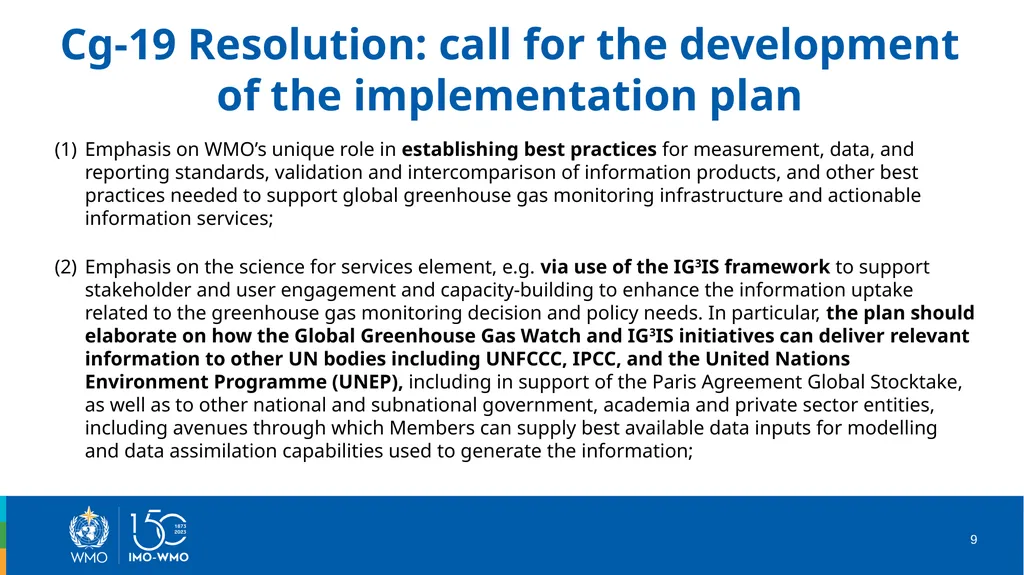
Cg-19 Resolution: call for the development of the implementation plan (1) Emphasis on WMO’s unique role in establishing best practices for measurement, data, and reporting standards, validation and intercomparison of information products, and other best practices needed to support global greenhouse gas monitoring infrastructure and actionable information services;
(2) Emphasis on the science for services element, e.g. via use of the IG3IS framework to support stakeholder and user engagement and capacity-building to enhance the information uptake related to the greenhouse gas monitoring decision and policy needs. In particular, the plan should elaborate on how the Global Greenhouse Gas Watch and IG3IS initiatives can deliver relevant information to other UN bodies including UNFCCC, IPCC, and the United Nations Environment Programme (UNEP), including in support of the Paris Agreement Global Stocktake, as well as to other national and subnational government, academia and private sector entities, including avenues through which Members can supply best available data inputs for modelling and data assimilation capabilities used to generate the information;<br>
(2) Emphasis on the science for services element, e.g. via use of the IG3IS framework to support stakeholder and user engagement and capacity-building to enhance the information uptake related to the greenhouse gas monitoring decision and policy needs. In particular, the plan should elaborate on how the Global Greenhouse Gas Watch and IG3IS initiatives can deliver relevant information to other UN bodies including UNFCCC, IPCC, and the United Nations Environment Programme (UNEP), including in support of the Paris Agreement Global Stocktake, as well as to other national and subnational government, academia and private sector entities, including avenues through which Members can supply best available data inputs for modelling and data assimilation capabilities used to generate the information;<br>
10
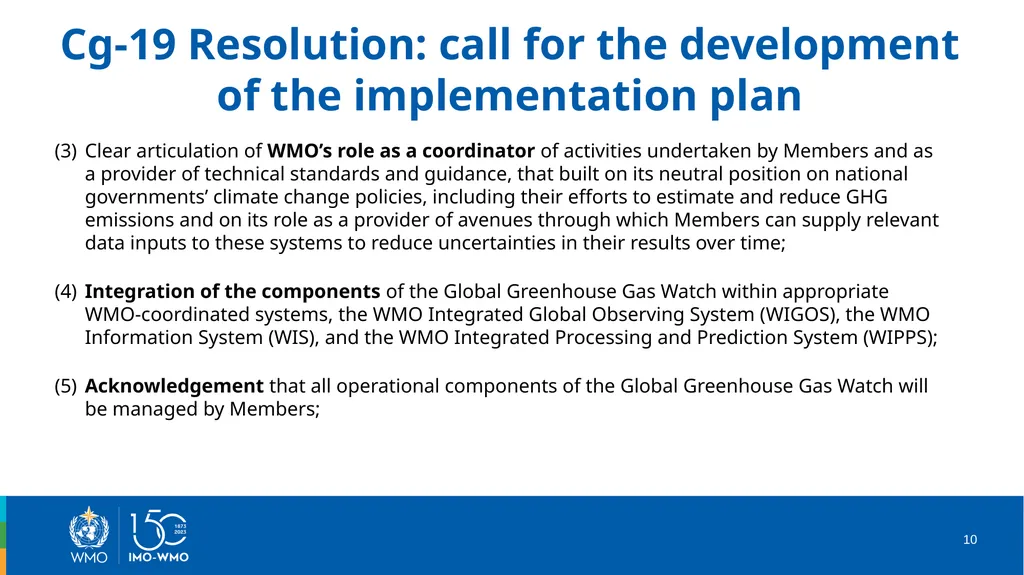
Cg-19 Resolution: call for the development of the implementation plan (3) Clear articulation of WMO’s role as a coordinator of activities undertaken by Members and as a provider of technical standards and guidance, that built on its neutral position on national governments’ climate change policies, including their efforts to estimate and reduce GHG emissions and on its role as a provider of avenues through which Members can supply relevant data inputs to these systems to reduce uncertainties in their results over time;
(4) Integration of the components of the Global Greenhouse Gas Watch within appropriate WMO-coordinated systems, the WMO Integrated Global Observing System (WIGOS), the WMO Information System (WIS), and the WMO Integrated Processing and Prediction System (WIPPS);
(5) Acknowledgement that all operational components of the Global Greenhouse Gas Watch will be managed by Members;<br>
(4) Integration of the components of the Global Greenhouse Gas Watch within appropriate WMO-coordinated systems, the WMO Integrated Global Observing System (WIGOS), the WMO Information System (WIS), and the WMO Integrated Processing and Prediction System (WIPPS);
(5) Acknowledgement that all operational components of the Global Greenhouse Gas Watch will be managed by Members;<br>
11
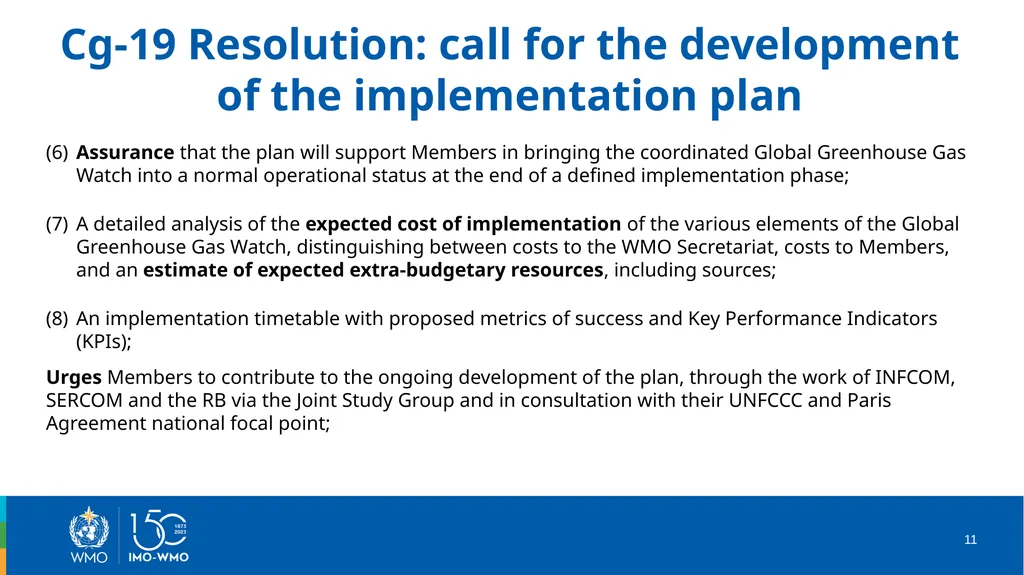
Cg-19 Resolution: call for the development of the implementation plan (6) Assurance that the plan will support Members in bringing the coordinated Global Greenhouse Gas Watch into a normal operational status at the end of a defined implementation phase;
(7) A detailed analysis of the expected cost of implementation of the various elements of the Global Greenhouse Gas Watch, distinguishing between costs to the WMO Secretariat, costs to Members, and an estimate of expected extra-budgetary resources, including sources;
(8) An implementation timetable with proposed metrics of success and Key Performance Indicators (KPIs);
Urges Members to contribute to the ongoing development of the plan, through the work of INFCOM, SERCOM and the RB via the Joint Study Group and in consultation with their UNFCCC and Paris Agreement national focal point;<br>
(7) A detailed analysis of the expected cost of implementation of the various elements of the Global Greenhouse Gas Watch, distinguishing between costs to the WMO Secretariat, costs to Members, and an estimate of expected extra-budgetary resources, including sources;
(8) An implementation timetable with proposed metrics of success and Key Performance Indicators (KPIs);
Urges Members to contribute to the ongoing development of the plan, through the work of INFCOM, SERCOM and the RB via the Joint Study Group and in consultation with their UNFCCC and Paris Agreement national focal point;<br>
12
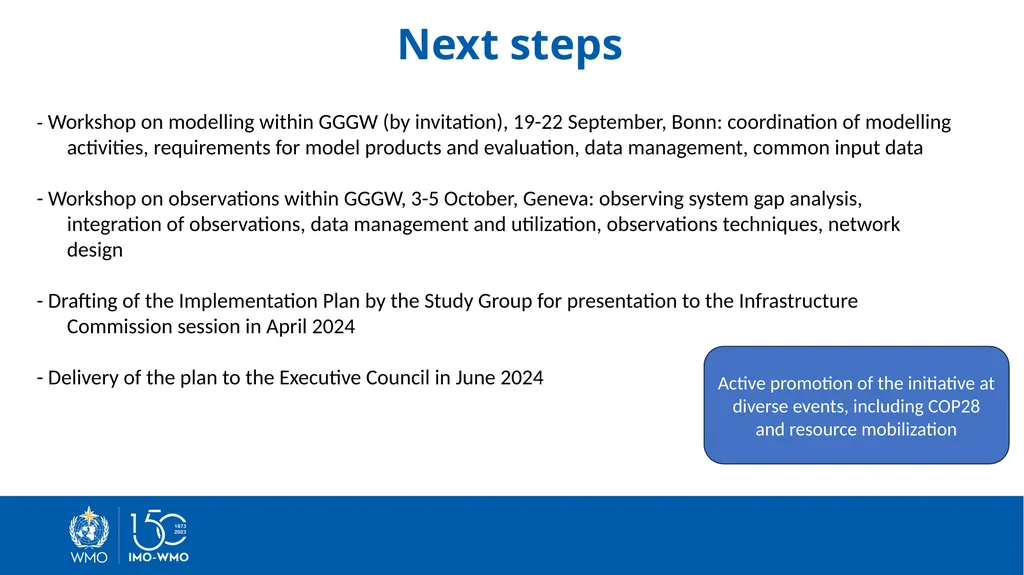
Next steps - Workshop on modelling within GGGW (by invitation), 19-22 September, Bonn: coordination of modelling activities, requirements for model products and evaluation, data management, common input data
- Workshop on observations within GGGW, 3-5 October, Geneva: observing system gap analysis, integration of observations, data management and utilization, observations techniques, network design
- Drafting of the Implementation Plan by the Study Group for presentation to the Infrastructure Commission session in April 2024
- Delivery of the plan to the Executive Council in June 2024 Active promotion of the initiative at diverse events, including COP28 and resource mobilization<br>
- Workshop on observations within GGGW, 3-5 October, Geneva: observing system gap analysis, integration of observations, data management and utilization, observations techniques, network design
- Drafting of the Implementation Plan by the Study Group for presentation to the Infrastructure Commission session in April 2024
- Delivery of the plan to the Executive Council in June 2024 Active promotion of the initiative at diverse events, including COP28 and resource mobilization<br>