
IGNEOUS ROCKS Classification and Nomenclature
Description: IGNEOUS ROCKS Classification and Nomenclature Rajnikant Patidar Department of Geology M.L. Sukhadia University, Udaipur Different types of igneous rocks are found in nature. Identification, correct naming (nomenclature) and their
Related Topics
Download Presentation
"IGNEOUS ROCKS Classification and Nomenclature" is the property of its rightful owner. Permission is granted to download and print the materials on this website for personal, non-commercial use only, and to display it on your personal computer provided you do not modify the materials and that you retain all copyright notices contained in the materials. By downloading content from our website, you accept the terms of this agreement.
Presentation Transcript
slide1. IGNEOUS ROCKS
Classification and Nomenclature Rajnikant Patidar
Department of Geology
M.L. Sukhadia University, Udaipur<br>
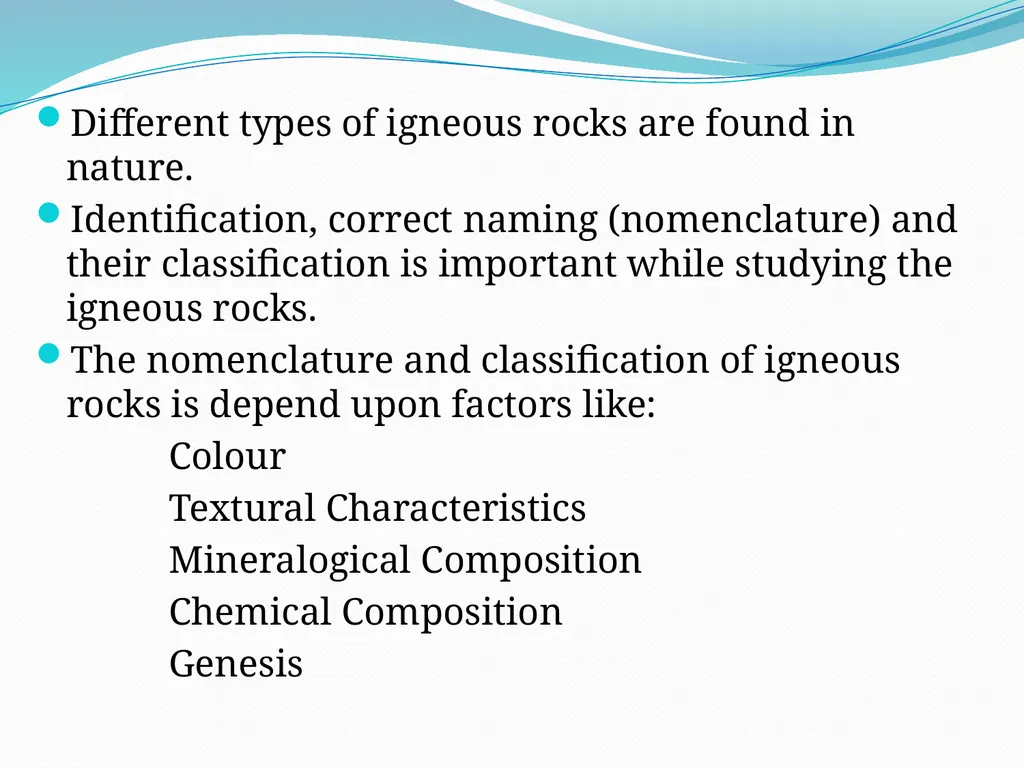
slide2. Different types of igneous rocks are found in nature.
Identification, correct naming (nomenclature) and their classification is important while studying the igneous rocks.
The nomenclature and classification of igneous rocks is depend upon factors like:
Colour
Textural Characteristics
Mineralogical Composition
Chemical Composition
Genesis<br>
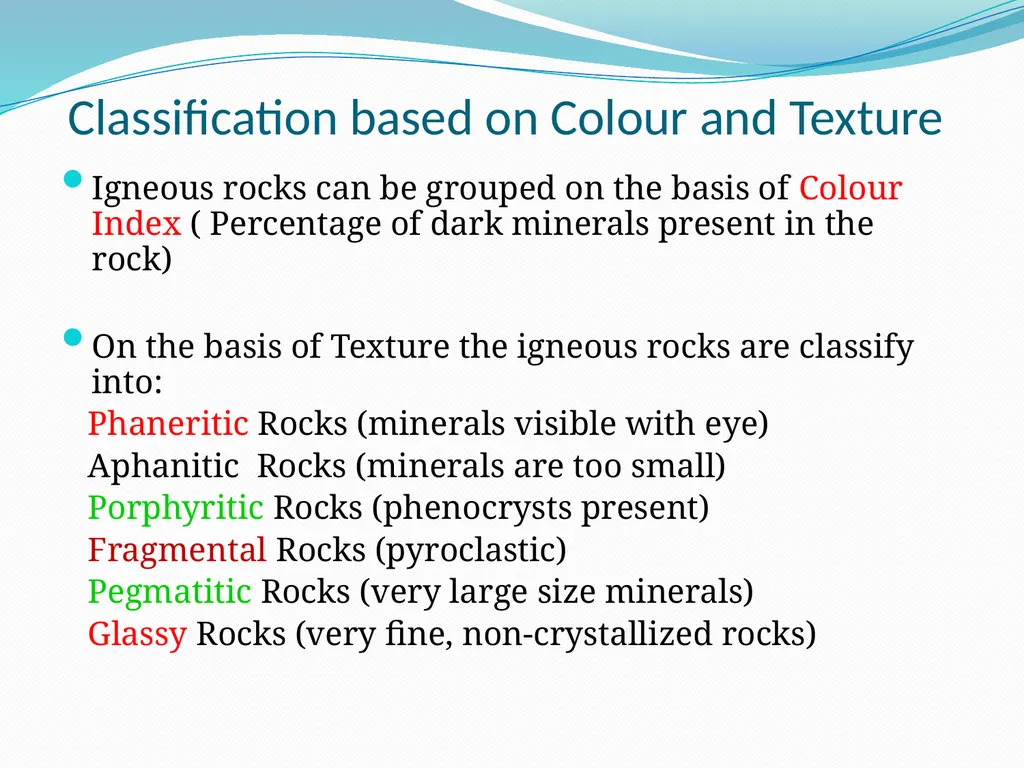
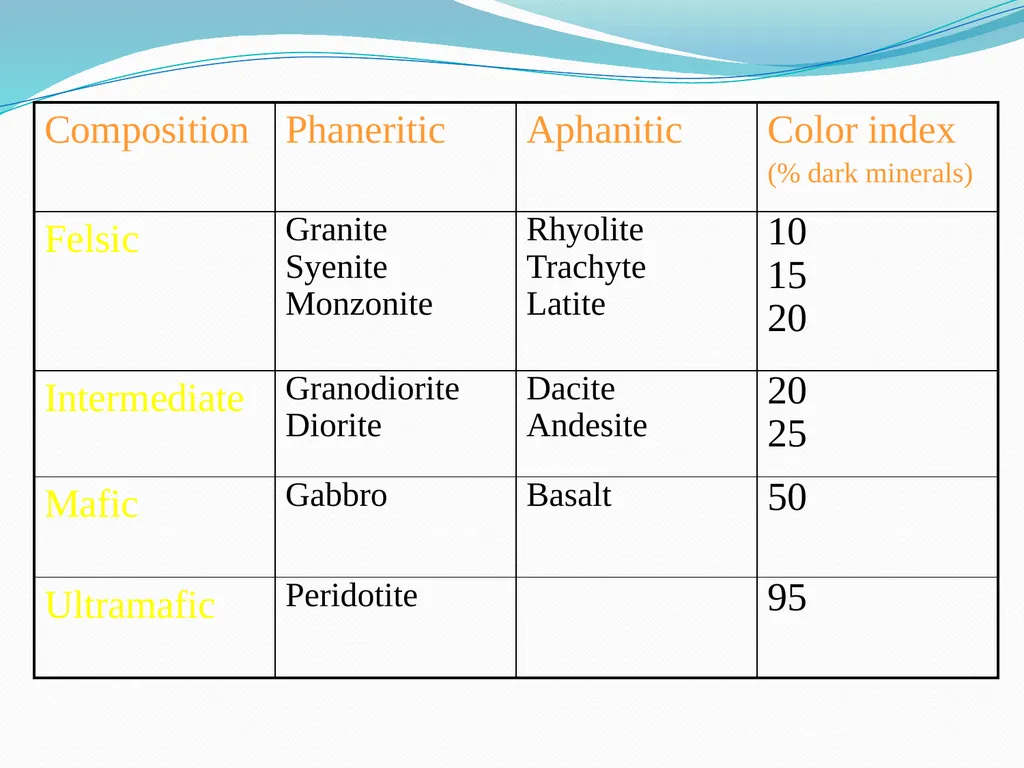
slide3. Classification based on Colour and Texture Igneous rocks can be grouped on the basis of Colour Index ( Percentage of dark minerals present in the rock)
On the basis of Texture the igneous rocks are classify into:
Phaneritic Rocks (minerals visible with eye)
Aphanitic Rocks (minerals are too small)
Porphyritic Rocks (phenocrysts present)
Fragmental Rocks (pyroclastic)
Pegmatitic Rocks (very large size minerals)
Glassy Rocks (very fine, non-crystallized rocks)<br>
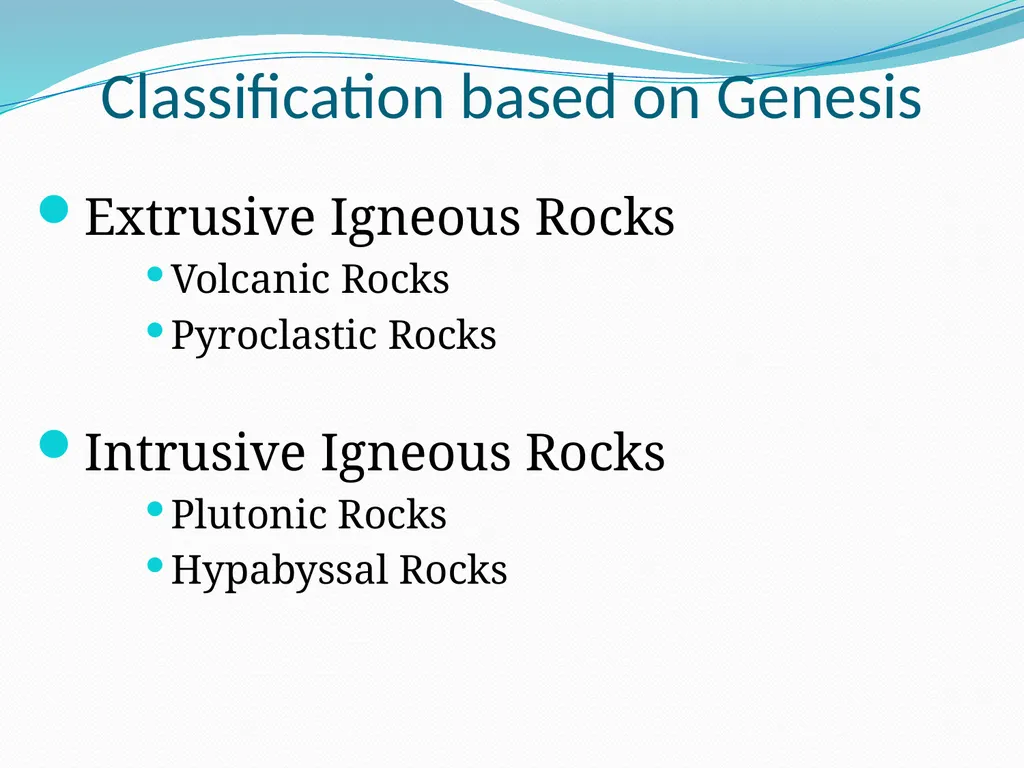
slide5. Classification based on Genesis Extrusive Igneous Rocks
Volcanic Rocks
Pyroclastic Rocks
Intrusive Igneous Rocks
Plutonic Rocks
Hypabyssal Rocks<br>
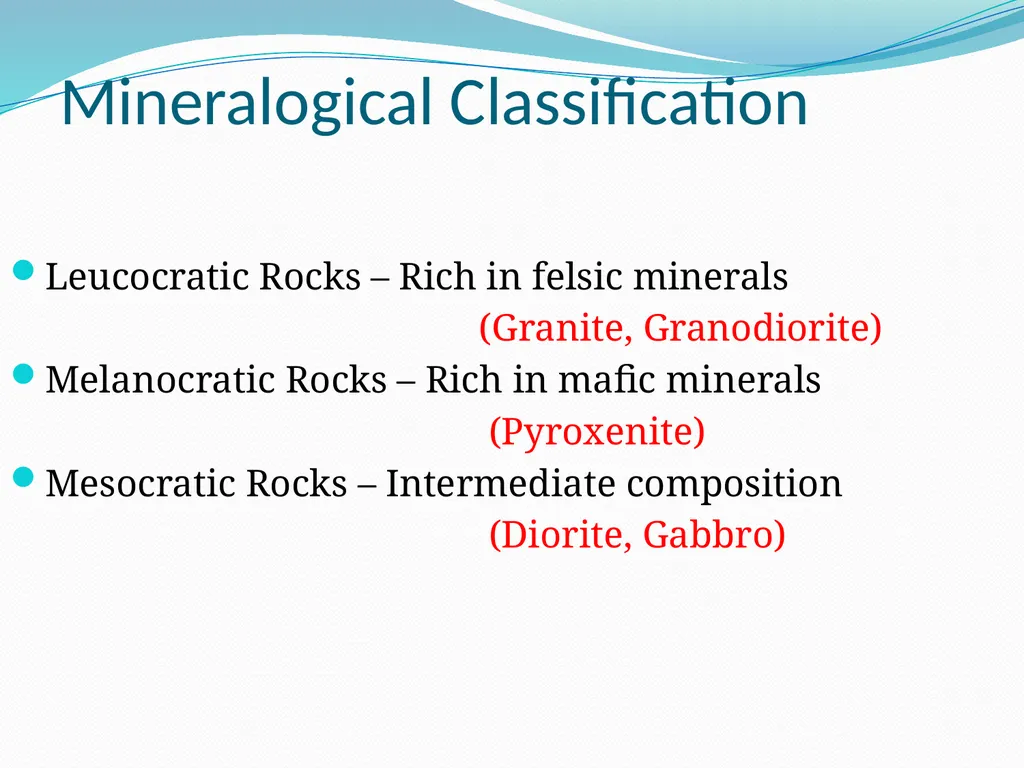
slide6. Mineralogical Classification Leucocratic Rocks – Rich in felsic minerals
(Granite, Granodiorite)
Melanocratic Rocks – Rich in mafic minerals
(Pyroxenite)
Mesocratic Rocks – Intermediate composition
(Diorite, Gabbro)<br>
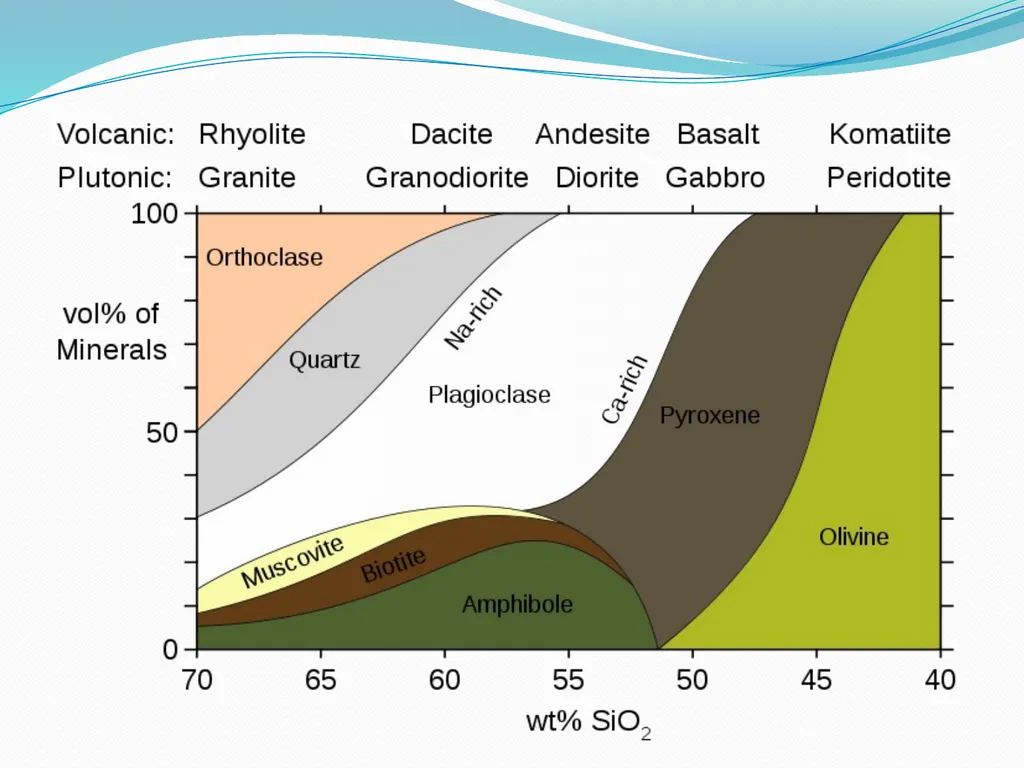
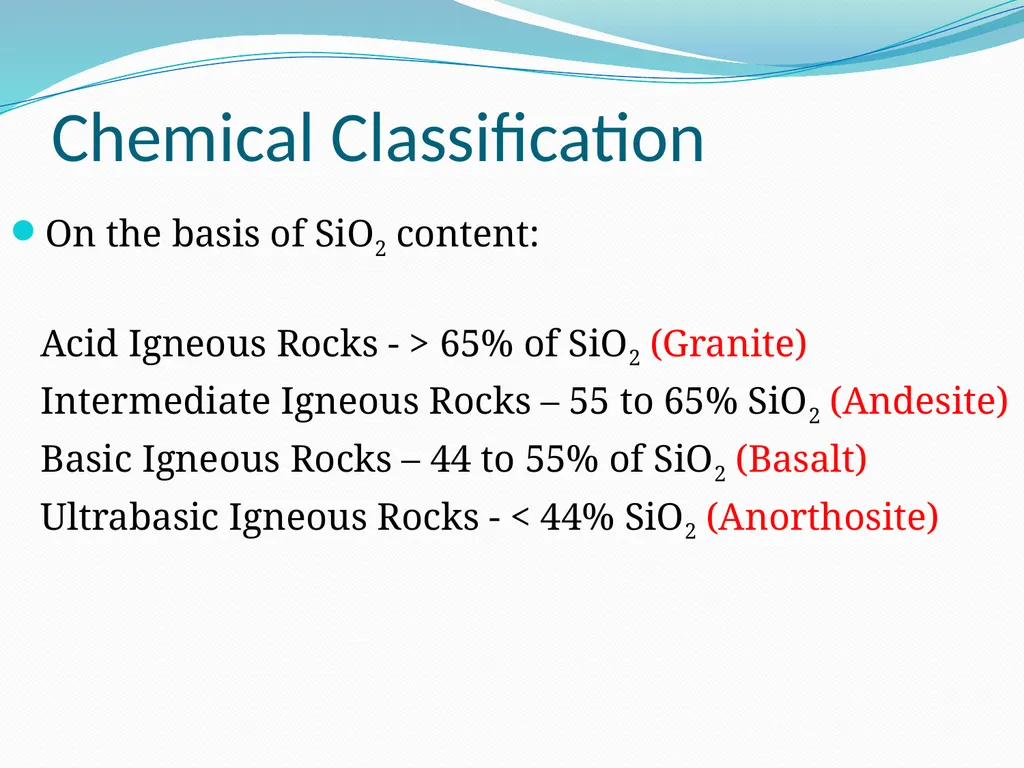
slide8. Chemical Classification On the basis of SiO2 content:
Acid Igneous Rocks - > 65% of SiO2 (Granite)
Intermediate Igneous Rocks – 55 to 65% SiO2 (Andesite)
Basic Igneous Rocks – 44 to 55% of SiO2 (Basalt)
Ultrabasic Igneous Rocks - < 44% SiO2 (Anorthosite)<br>
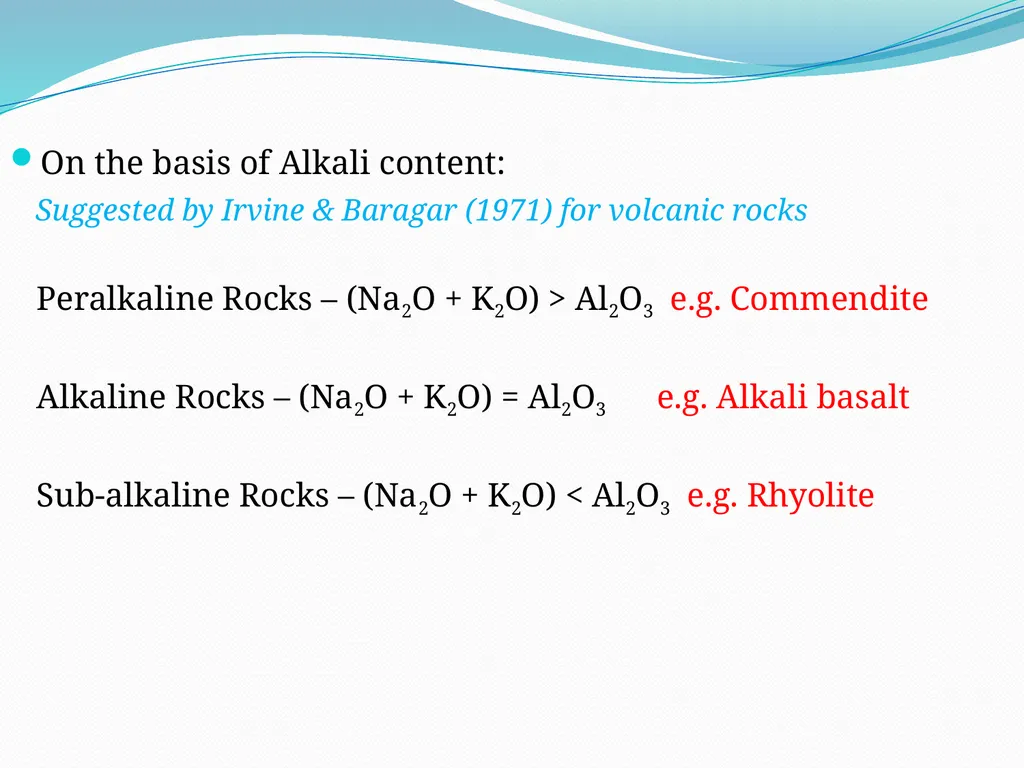
slide9. On the basis of Alkali content:
Suggested by Irvine & Baragar (1971) for volcanic rocks
Peralkaline Rocks – (Na2O + K2O) > Al2O3 e.g. Commendite
Alkaline Rocks – (Na2O + K2O) = Al2O3 e.g. Alkali basalt
Sub-alkaline Rocks – (Na2O + K2O) < Al2O3 e.g. Rhyolite<br>
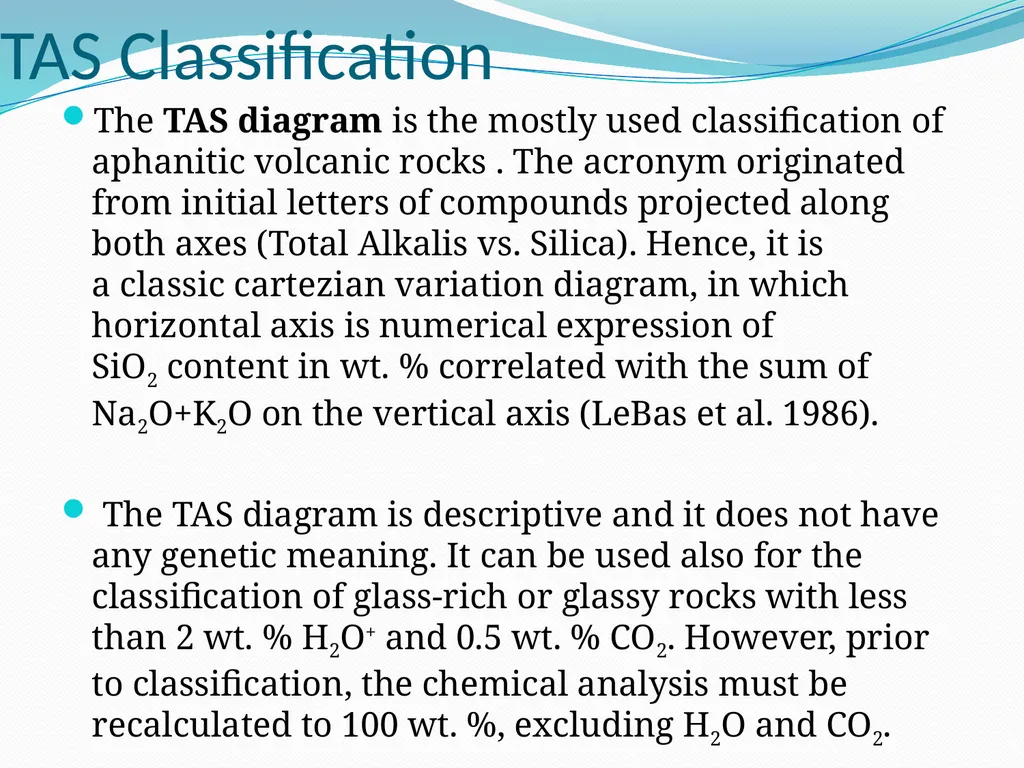
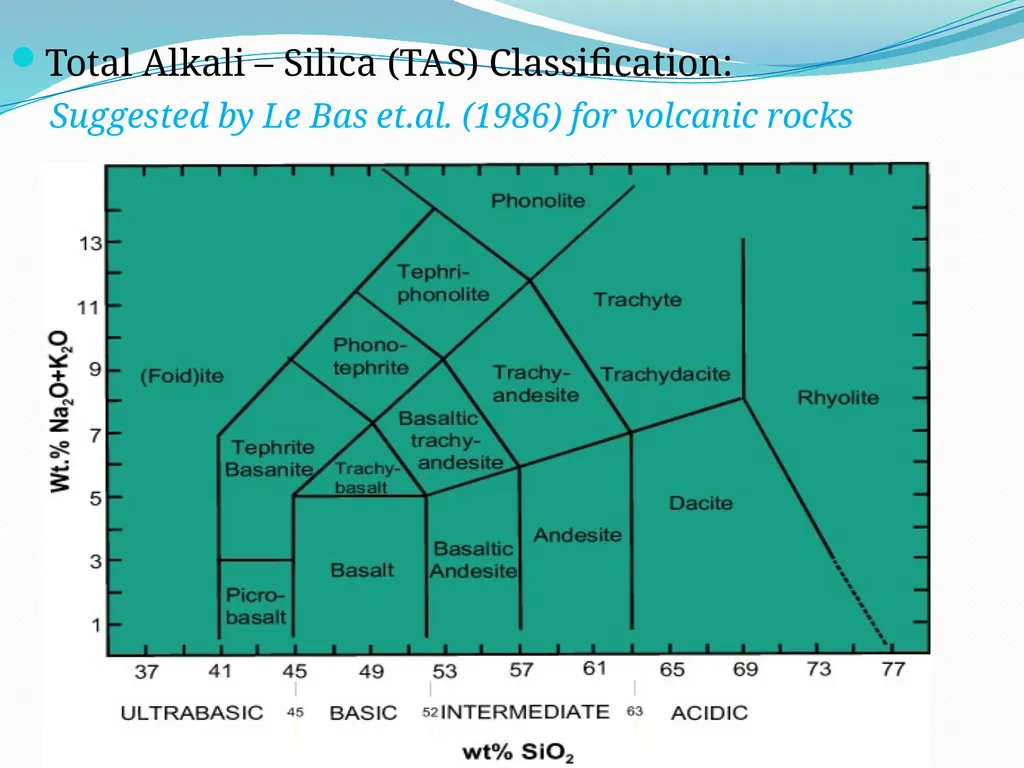
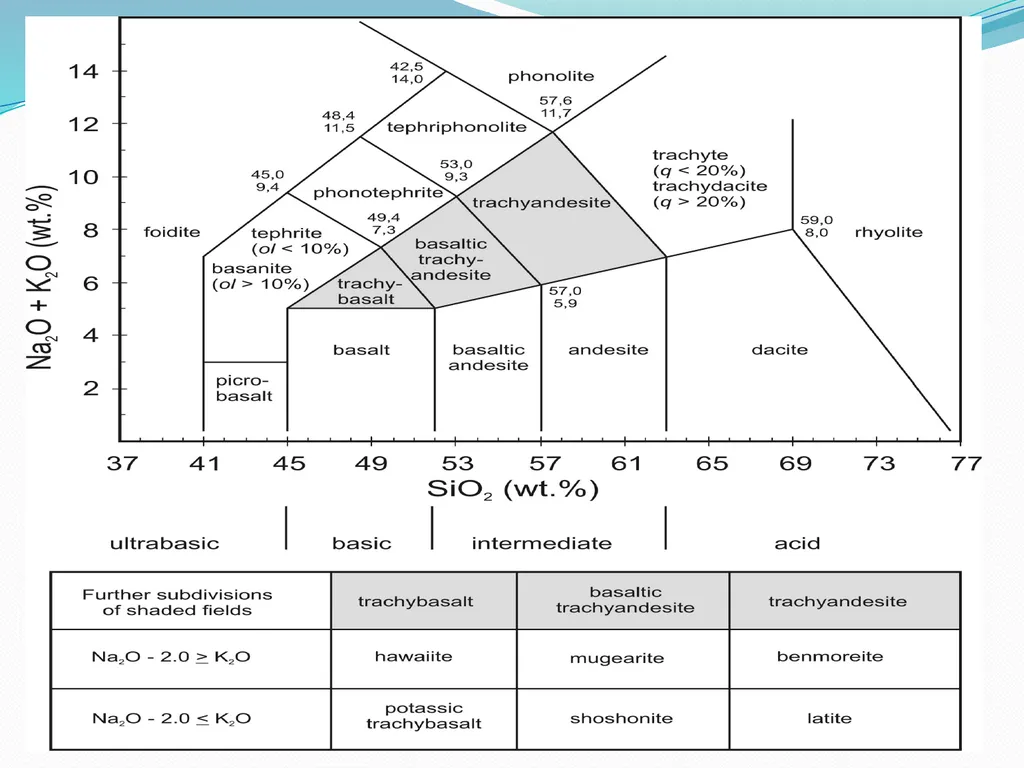
slide10. TAS Classification The TAS diagram is the mostly used classification of aphanitic volcanic rocks . The acronym originated from initial letters of compounds projected along both axes (Total Alkalis vs. Silica). Hence, it is a classic cartezian variation diagram, in which horizontal axis is numerical expression of SiO2 content in wt. % correlated with the sum of Na2O+K2O on the vertical axis (LeBas et al. 1986).
The TAS diagram is descriptive and it does not have any genetic meaning. It can be used also for the classification of glass-rich or glassy rocks with less than 2 wt. % H2O+ and 0.5 wt. % CO2. However, prior to classification, the chemical analysis must be recalculated to 100 wt. %, excluding H2O and CO2.<br>
slide11. Total Alkali – Silica (TAS) Classification:
Suggested by Le Bas et.al. (1986) for volcanic rocks<br>
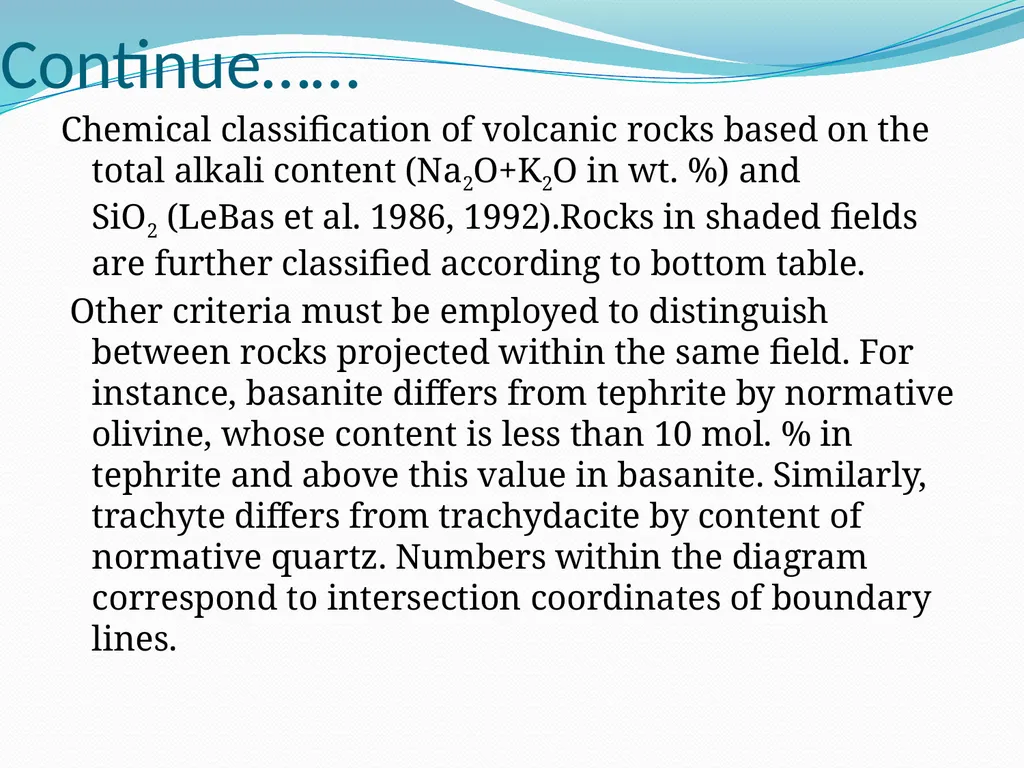
slide12. Continue…… Chemical classification of volcanic rocks based on the total alkali content (Na2O+K2O in wt. %) and SiO2 (LeBas et al. 1986, 1992).Rocks in shaded fields are further classified according to bottom table.
Other criteria must be employed to distinguish between rocks projected within the same field. For instance, basanite differs from tephrite by normative olivine, whose content is less than 10 mol. % in tephrite and above this value in basanite. Similarly, trachyte differs from trachydacite by content of normative quartz. Numbers within the diagram correspond to intersection coordinates of boundary lines.<br>
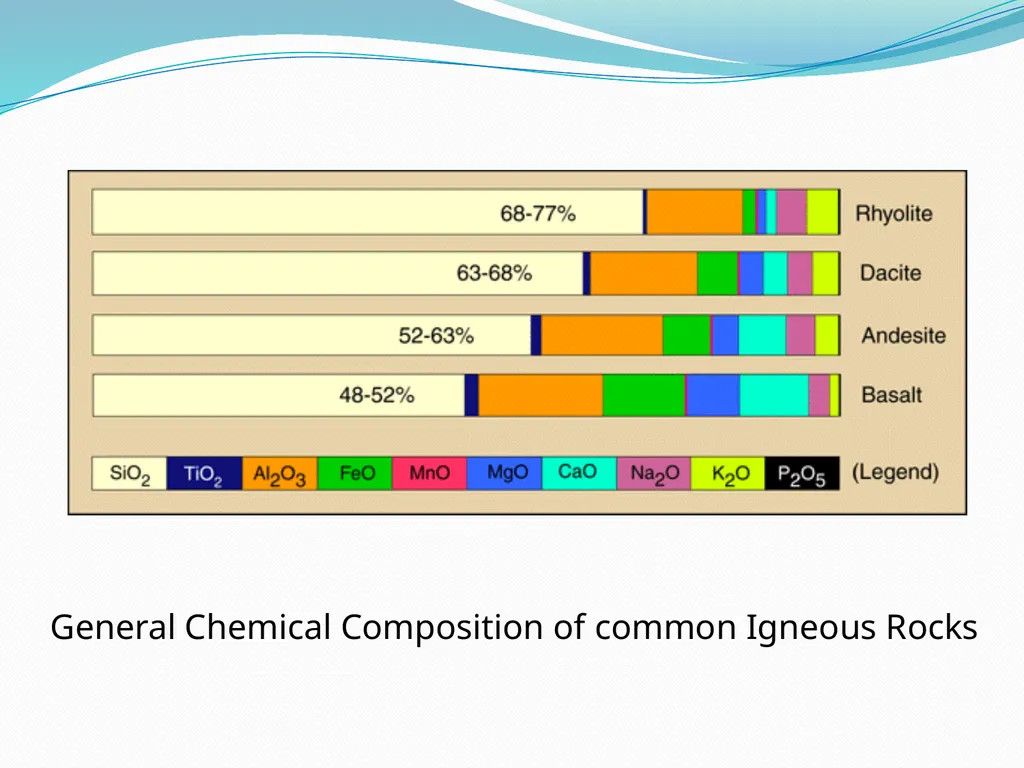
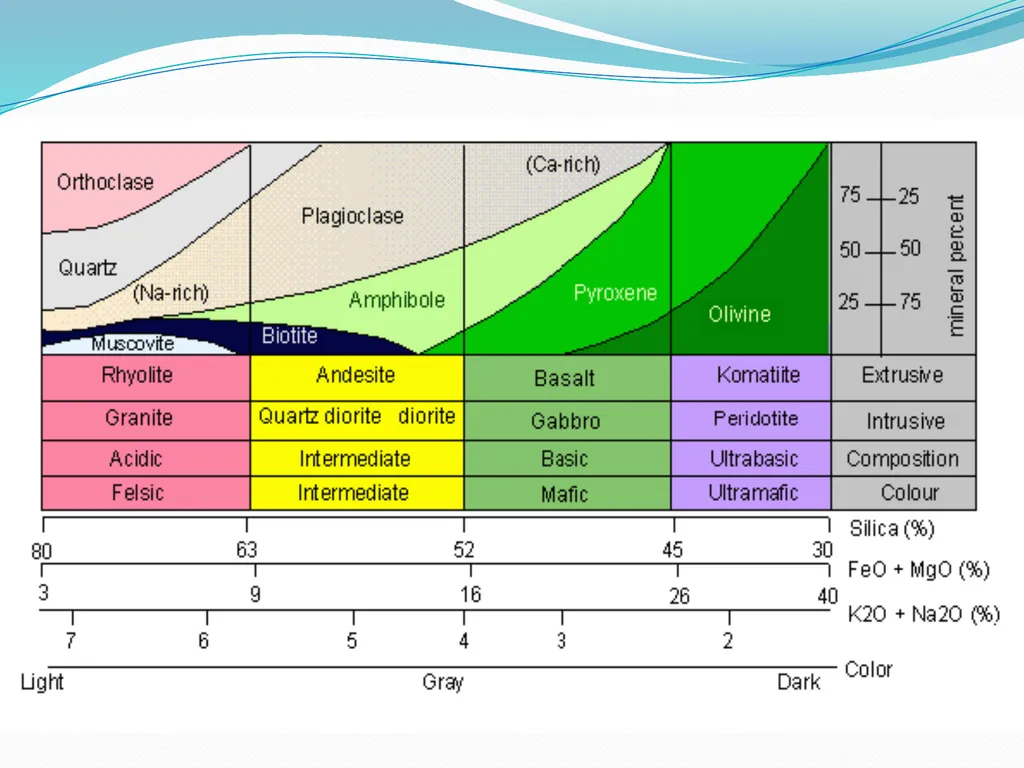
slide14. General Chemical Composition of common Igneous Rocks<br>
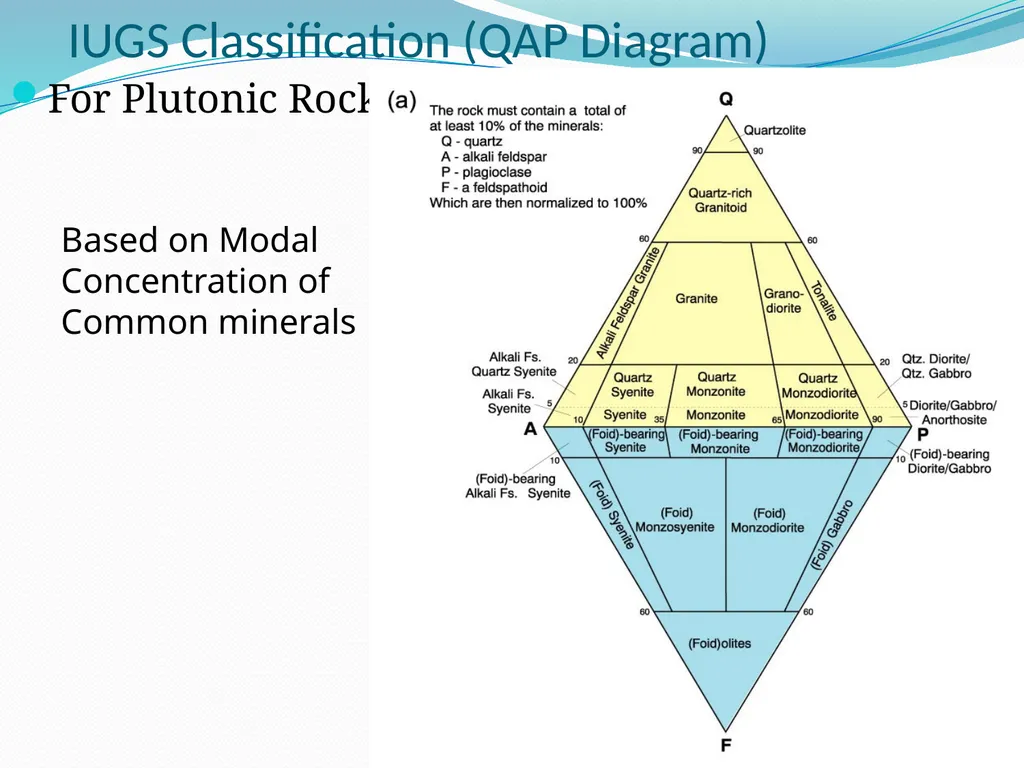
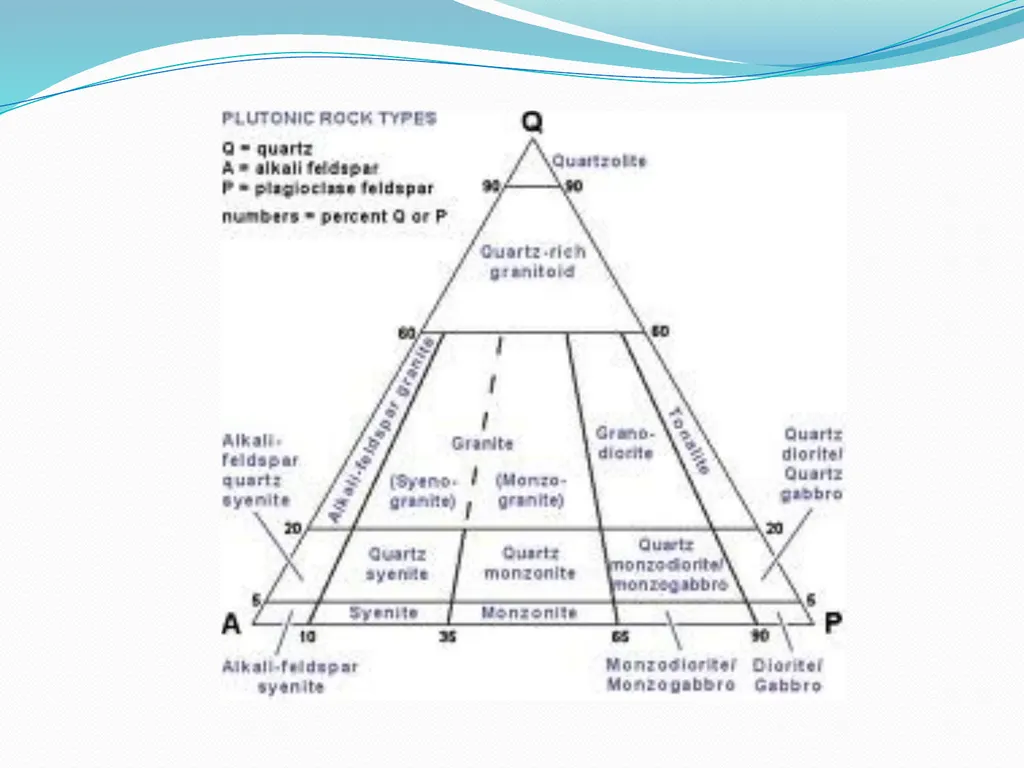
slide15. IUGS Classification (QAP Diagram) For Plutonic Rocks: Based on Modal
Concentration of
Common minerals<br>
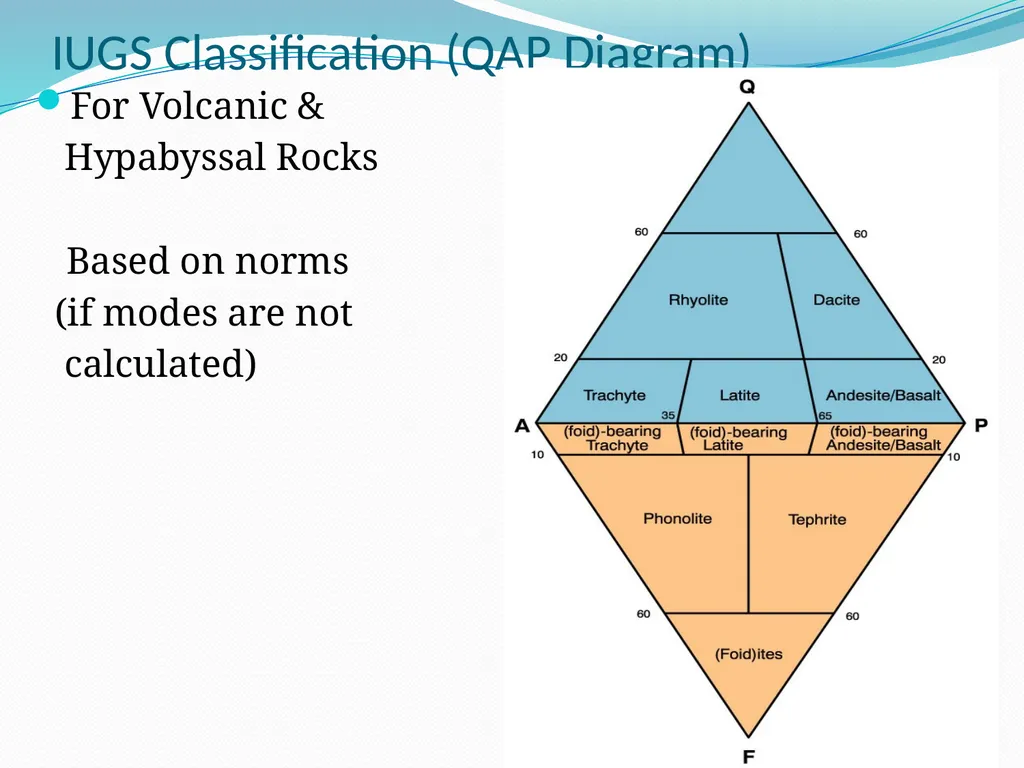
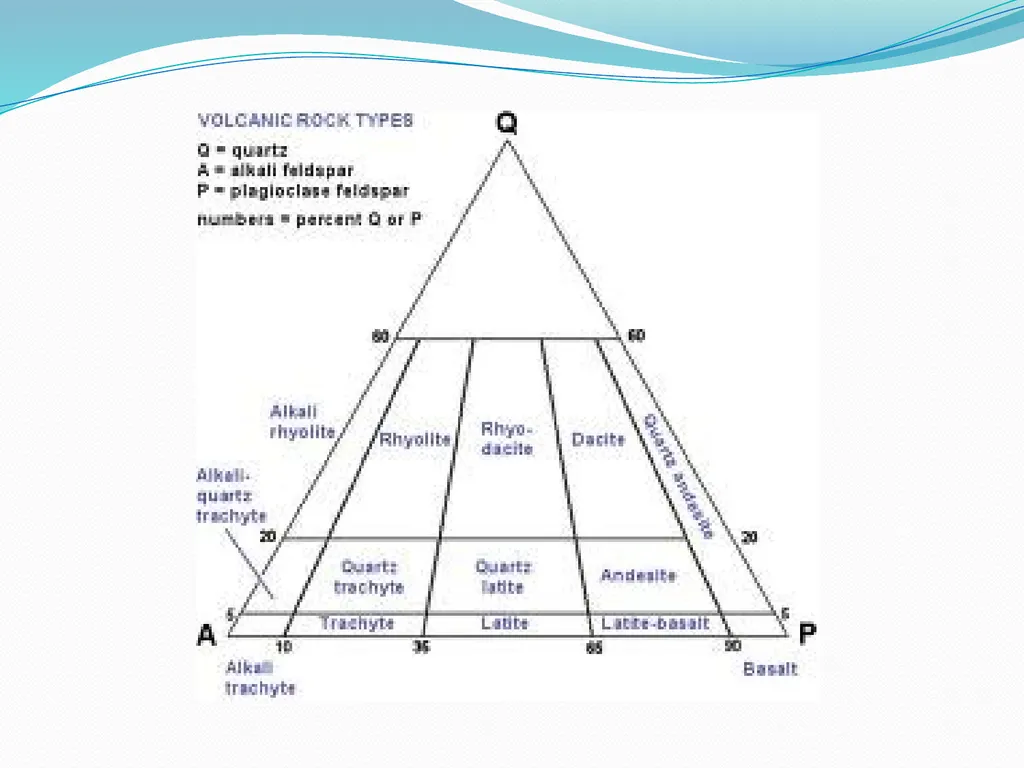
slide17. IUGS Classification (QAP Diagram) For Volcanic &
Hypabyssal Rocks
Based on norms
(if modes are not
calculated)<br>
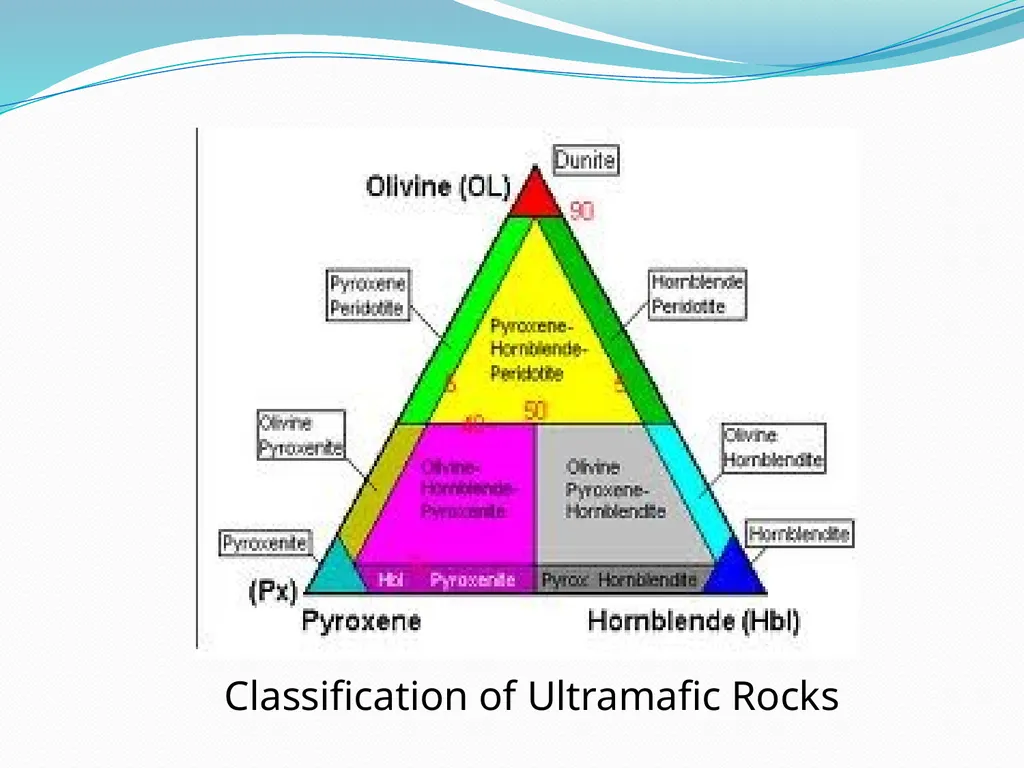
slide19. Classification of Ultramafic Rocks<br>
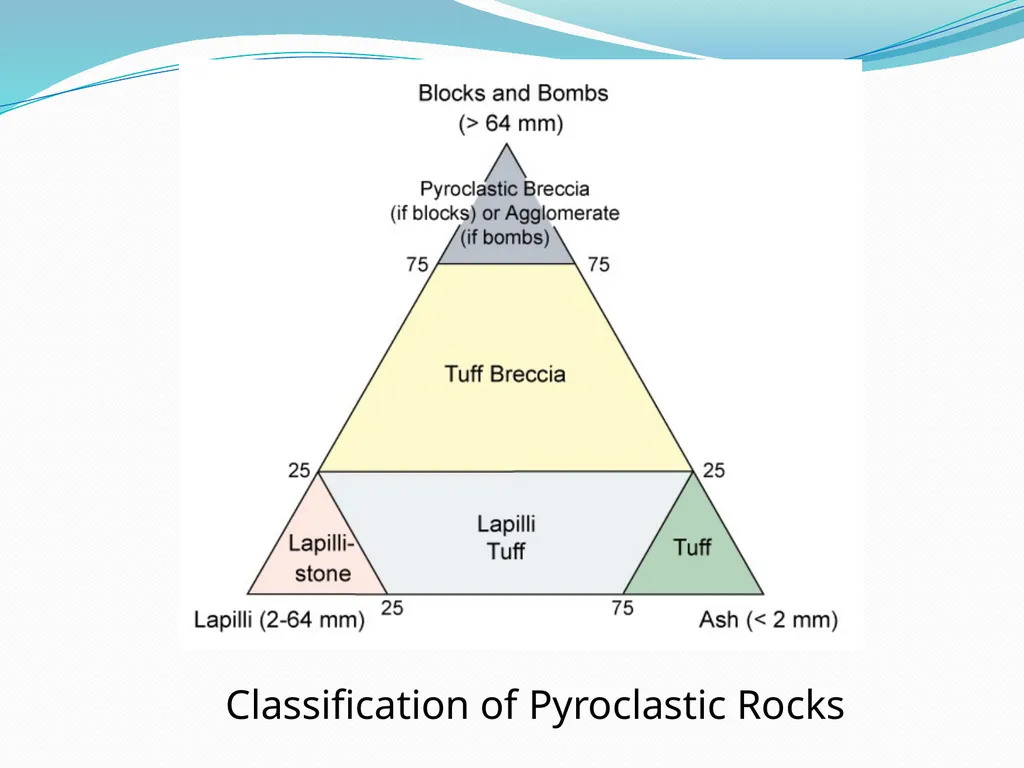
slide20. Classification of Pyroclastic Rocks<br>
Department of Geology
M.L. Sukhadia University, Udaipur<br>
slide2. Different types of igneous rocks are found in nature.
Identification, correct naming (nomenclature) and their classification is important while studying the igneous rocks.
The nomenclature and classification of igneous rocks is depend upon factors like:
Colour
Textural Characteristics
Mineralogical Composition
Chemical Composition
Genesis<br>
slide3. Classification based on Colour and Texture Igneous rocks can be grouped on the basis of Colour Index ( Percentage of dark minerals present in the rock)
On the basis of Texture the igneous rocks are classify into:
Phaneritic Rocks (minerals visible with eye)
Aphanitic Rocks (minerals are too small)
Porphyritic Rocks (phenocrysts present)
Fragmental Rocks (pyroclastic)
Pegmatitic Rocks (very large size minerals)
Glassy Rocks (very fine, non-crystallized rocks)<br>
slide5. Classification based on Genesis Extrusive Igneous Rocks
Volcanic Rocks
Pyroclastic Rocks
Intrusive Igneous Rocks
Plutonic Rocks
Hypabyssal Rocks<br>
slide6. Mineralogical Classification Leucocratic Rocks – Rich in felsic minerals
(Granite, Granodiorite)
Melanocratic Rocks – Rich in mafic minerals
(Pyroxenite)
Mesocratic Rocks – Intermediate composition
(Diorite, Gabbro)<br>
slide8. Chemical Classification On the basis of SiO2 content:
Acid Igneous Rocks - > 65% of SiO2 (Granite)
Intermediate Igneous Rocks – 55 to 65% SiO2 (Andesite)
Basic Igneous Rocks – 44 to 55% of SiO2 (Basalt)
Ultrabasic Igneous Rocks - < 44% SiO2 (Anorthosite)<br>
slide9. On the basis of Alkali content:
Suggested by Irvine & Baragar (1971) for volcanic rocks
Peralkaline Rocks – (Na2O + K2O) > Al2O3 e.g. Commendite
Alkaline Rocks – (Na2O + K2O) = Al2O3 e.g. Alkali basalt
Sub-alkaline Rocks – (Na2O + K2O) < Al2O3 e.g. Rhyolite<br>
slide10. TAS Classification The TAS diagram is the mostly used classification of aphanitic volcanic rocks . The acronym originated from initial letters of compounds projected along both axes (Total Alkalis vs. Silica). Hence, it is a classic cartezian variation diagram, in which horizontal axis is numerical expression of SiO2 content in wt. % correlated with the sum of Na2O+K2O on the vertical axis (LeBas et al. 1986).
The TAS diagram is descriptive and it does not have any genetic meaning. It can be used also for the classification of glass-rich or glassy rocks with less than 2 wt. % H2O+ and 0.5 wt. % CO2. However, prior to classification, the chemical analysis must be recalculated to 100 wt. %, excluding H2O and CO2.<br>
slide11. Total Alkali – Silica (TAS) Classification:
Suggested by Le Bas et.al. (1986) for volcanic rocks<br>
slide12. Continue…… Chemical classification of volcanic rocks based on the total alkali content (Na2O+K2O in wt. %) and SiO2 (LeBas et al. 1986, 1992).Rocks in shaded fields are further classified according to bottom table.
Other criteria must be employed to distinguish between rocks projected within the same field. For instance, basanite differs from tephrite by normative olivine, whose content is less than 10 mol. % in tephrite and above this value in basanite. Similarly, trachyte differs from trachydacite by content of normative quartz. Numbers within the diagram correspond to intersection coordinates of boundary lines.<br>
slide14. General Chemical Composition of common Igneous Rocks<br>
slide15. IUGS Classification (QAP Diagram) For Plutonic Rocks: Based on Modal
Concentration of
Common minerals<br>
slide17. IUGS Classification (QAP Diagram) For Volcanic &
Hypabyssal Rocks
Based on norms
(if modes are not
calculated)<br>
slide19. Classification of Ultramafic Rocks<br>
slide20. Classification of Pyroclastic Rocks<br>