
IHCDA HOME Homebuyer Program Applying 101 Samantha
SB
Published · 61 slides · 0 views

1 / 1

Description
IHCDA HOME Homebuyer Program Applying 101 Samantha Spergel Director of Real Estate Strategic Initiatives and Engagement Indiana Housing Community Development Authority IHCDAs Mission and Vision Our Mission To provide housing
Related Topics
Share
Embed code
Download this presentation From Below
"IHCDA HOME Homebuyer Program Applying 101 Samantha" is the property of its rightful owner. Permission is granted to download and print the materials on this website for personal, non-commercial use only, and to display it on your personal computer provided you do not modify the materials and that you retain all copyright notices contained in the materials. By downloading content from our website, you accept the terms of this agreement.
Presentation Transcript
01
IHCDA HOME Homebuyer Program
Applying 101 Samantha Spergel
Director of Real Estate Strategic Initiatives and Engagement
Indiana Housing & Community Development Authority<br>
Director of Real Estate Strategic Initiatives and Engagement
Indiana Housing & Community Development Authority<br>
02
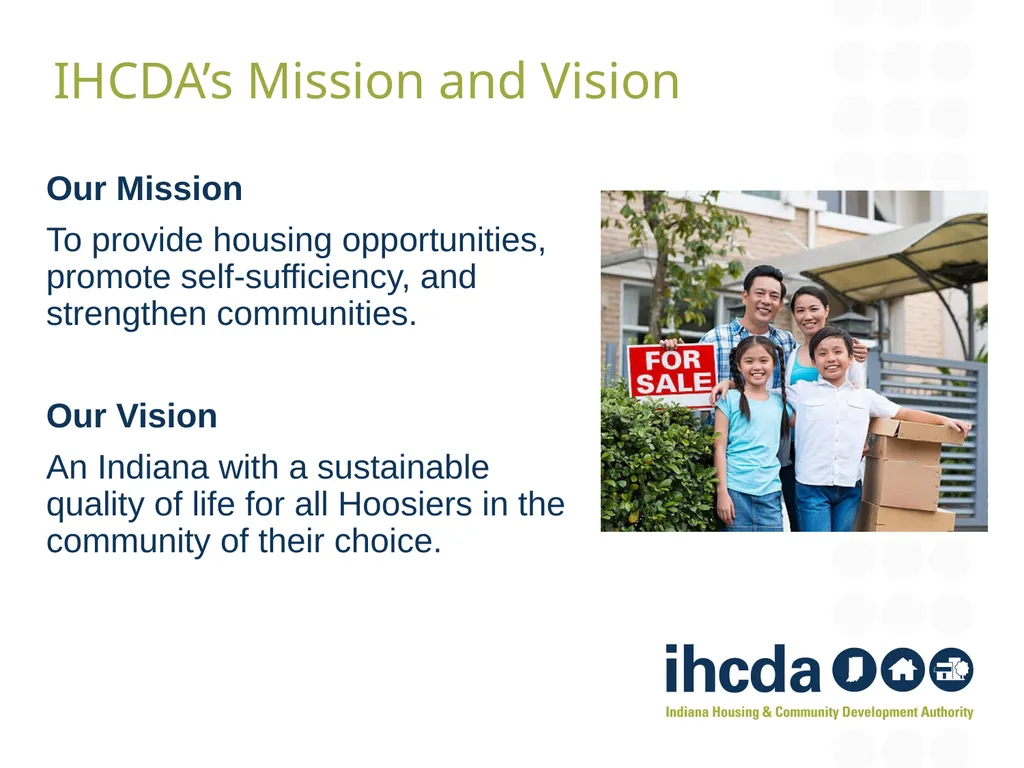
IHCDA’s Mission and Vision Our Mission
To provide housing opportunities, promote self-sufficiency, and strengthen communities.
Our Vision
An Indiana with a sustainable quality of life for all Hoosiers in the community of their choice.<br>
To provide housing opportunities, promote self-sufficiency, and strengthen communities.
Our Vision
An Indiana with a sustainable quality of life for all Hoosiers in the community of their choice.<br>
03
Agenda What is HOME Homebuyer (why did I sign up for this?)
Eligible unit types
Who can apply?
How to apply?
Threshold
Organization Structure and Capacity
Market need and pipeline
Site details
Development plan
Financing and Match
Special Threshold topics
Scoring<br>
Eligible unit types
Who can apply?
How to apply?
Threshold
Organization Structure and Capacity
Market need and pipeline
Site details
Development plan
Financing and Match
Special Threshold topics
Scoring<br>
04
What is HOME Homebuyer?<br>
05
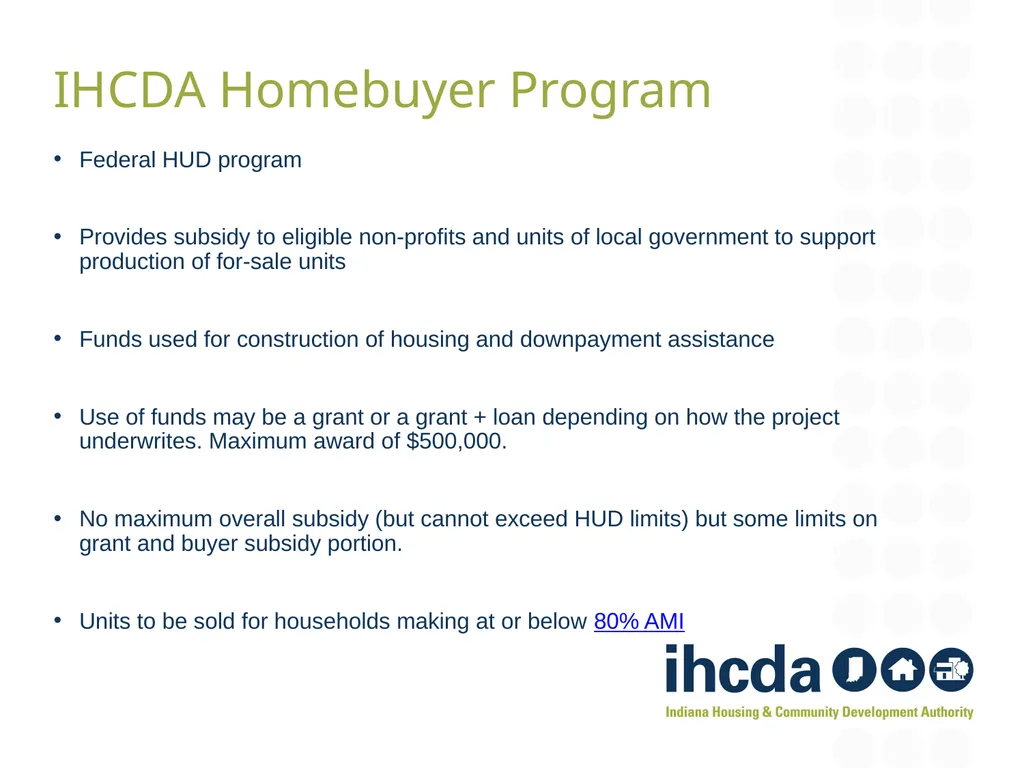
IHCDA Homebuyer Program Federal HUD program
Provides subsidy to eligible non-profits and units of local government to support production of for-sale units
Funds used for construction of housing and downpayment assistance
Use of funds may be a grant or a grant + loan depending on how the project underwrites. Maximum award of $500,000.
No maximum overall subsidy (but cannot exceed HUD limits) but some limits on grant and buyer subsidy portion.
Units to be sold for households making at or below 80% AMI<br>
Provides subsidy to eligible non-profits and units of local government to support production of for-sale units
Funds used for construction of housing and downpayment assistance
Use of funds may be a grant or a grant + loan depending on how the project underwrites. Maximum award of $500,000.
No maximum overall subsidy (but cannot exceed HUD limits) but some limits on grant and buyer subsidy portion.
Units to be sold for households making at or below 80% AMI<br>
06
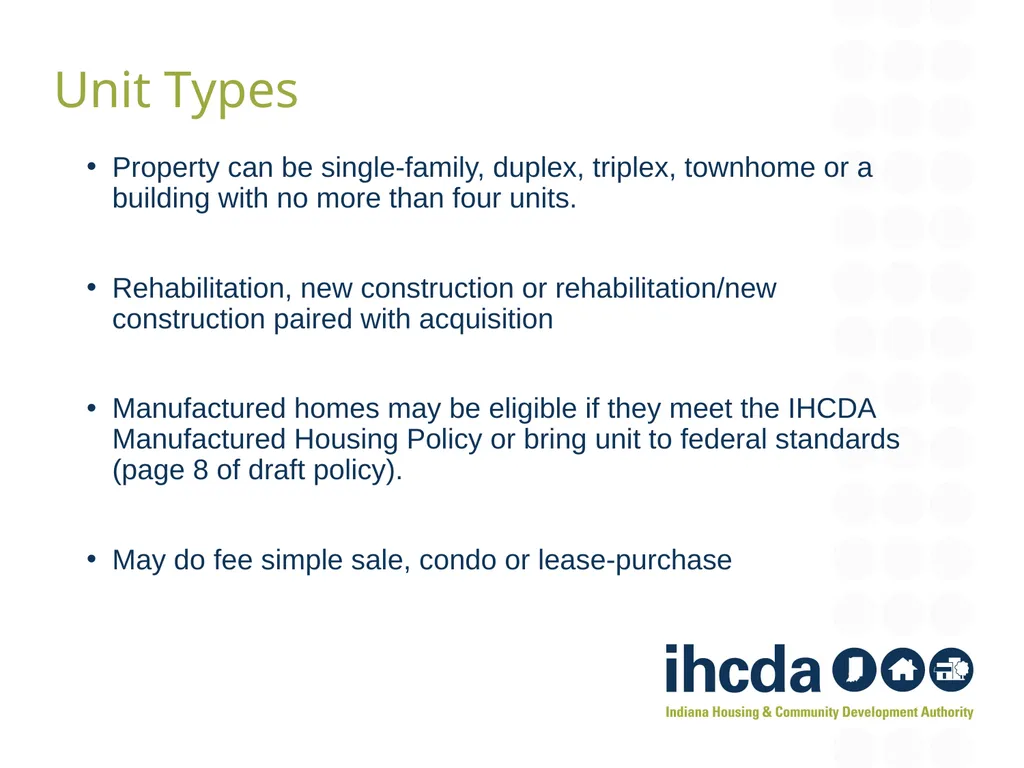
Unit Types Property can be single-family, duplex, triplex, townhome or a building with no more than four units.
Rehabilitation, new construction or rehabilitation/new construction paired with acquisition
Manufactured homes may be eligible if they meet the IHCDA Manufactured Housing Policy or bring unit to federal standards (page 8 of draft policy).
May do fee simple sale, condo or lease-purchase<br>
Rehabilitation, new construction or rehabilitation/new construction paired with acquisition
Manufactured homes may be eligible if they meet the IHCDA Manufactured Housing Policy or bring unit to federal standards (page 8 of draft policy).
May do fee simple sale, condo or lease-purchase<br>
07
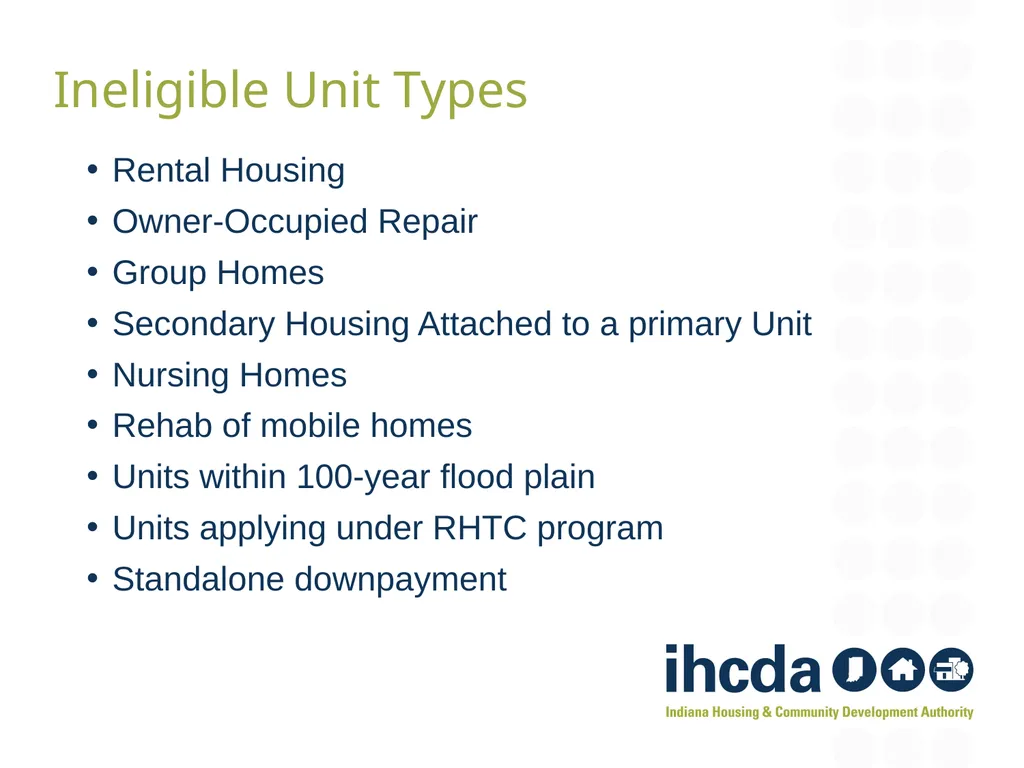
Ineligible Unit Types Rental Housing
Owner-Occupied Repair
Group Homes
Secondary Housing Attached to a primary Unit
Nursing Homes
Rehab of mobile homes
Units within 100-year flood plain
Units applying under RHTC program
Standalone downpayment<br>
Owner-Occupied Repair
Group Homes
Secondary Housing Attached to a primary Unit
Nursing Homes
Rehab of mobile homes
Units within 100-year flood plain
Units applying under RHTC program
Standalone downpayment<br>
08
Applicant Eligibility<br>
09
Eligible Applicants Can be Units of Local Government that do not already receive HOME
Community Housing Development Organizations (CHDOs)
501(c)3 and (c)4
PHAs
Joint Venture Partnerships<br>
Community Housing Development Organizations (CHDOs)
501(c)3 and (c)4
PHAs
Joint Venture Partnerships<br>
10
Ineligible Geographies Following localities are not eligible for HOME funding:
Bloomington
Evansville
Fort Wayne
Gary
Hammond
Indianapolis
Beech Grove, Lawrence, Speedway and Southport are eligible. Town of Cumberland is eligible outside Marion County
Lake County
Lafayette Consortium
Includes Cities of Lafayette and West Lafayette and unincorporated areas of Tippecanoe County.
Muncie
South Bend Consortium
Includes cities of South Bend and Mishawaka and
unincorporated areas of St. Joe County.<br>
Bloomington
Evansville
Fort Wayne
Gary
Hammond
Indianapolis
Beech Grove, Lawrence, Speedway and Southport are eligible. Town of Cumberland is eligible outside Marion County
Lake County
Lafayette Consortium
Includes Cities of Lafayette and West Lafayette and unincorporated areas of Tippecanoe County.
Muncie
South Bend Consortium
Includes cities of South Bend and Mishawaka and
unincorporated areas of St. Joe County.<br>
11
Eligible PJs Proposed projects of Anderson, East Chicago and Terre Haute are eligible during PY 2023.
PJ must also commit their HOME funds to the project.<br>
PJ must also commit their HOME funds to the project.<br>
12
Past HOME awards Any other HOME awards that the applicant has received from IHCDA must be drawn by a minimum of 25% of the award’s total funding amount.
HOME funds awarded within the last six months or those which have not received Release of Funds are exempt.<br>
HOME funds awarded within the last six months or those which have not received Release of Funds are exempt.<br>
13
How to Apply?<br>
14
Funding Round Timeline Applications can be submitted on a rolling basis
IHCDA staff will review the application – process may take 1-2 months. IHCDA staff will review for threshold and scoring. IHCDA will send both a Threshold Letter and Preliminary Score Sheet.
Environmental Review (more later) will be conducted simultaneously.
All awards are subject to IHCDA Board of Director approval.<br>
IHCDA staff will review the application – process may take 1-2 months. IHCDA staff will review for threshold and scoring. IHCDA will send both a Threshold Letter and Preliminary Score Sheet.
Environmental Review (more later) will be conducted simultaneously.
All awards are subject to IHCDA Board of Director approval.<br>
15
IHCDA Application Materials IHCDA application materials will be available on IHCDA’s HOME Investment Partnership Program site
Includes:
Policy
Application
Pro-Forma
Board Resolution
Homebuyer Tabs
ERR materials can be found on ERR site
CHDO Application Workbook, Block Group, and Predevelopment Policy/Application on CHDO site<br>
Includes:
Policy
Application
Pro-Forma
Board Resolution
Homebuyer Tabs
ERR materials can be found on ERR site
CHDO Application Workbook, Block Group, and Predevelopment Policy/Application on CHDO site<br>
16
Application Submission No fee to apply!
Please contact Chris Adkins at CAdkins@ihcda.IN.gov to set up a OneDrive folder for your application submission.
Completed copy in both Excel and PDF of the Application Form
Completed Pro-forma (one per unit)<br>
Please contact Chris Adkins at CAdkins@ihcda.IN.gov to set up a OneDrive folder for your application submission.
Completed copy in both Excel and PDF of the Application Form
Completed Pro-forma (one per unit)<br>
17
Application Submission All supporting documents required in the tabs.
PLEASE submit this information as separate, labeled PDF documents under the required labeled tabs.
Please don’t send one PDF of all supporting documentation. It will delay review significantly.
Signed ERR record in PDF format
Please notify Chris when all items have been uploaded.<br>
PLEASE submit this information as separate, labeled PDF documents under the required labeled tabs.
Please don’t send one PDF of all supporting documentation. It will delay review significantly.
Signed ERR record in PDF format
Please notify Chris when all items have been uploaded.<br>
18
Application Submission Application has three parts:
Application form and Supplemental Materials – Threshold Items
Pro-Forma
Scoring
Application form includes questions on various items for threshold, and scoring.
If you see anything not working correctly, please let IHCDA know!<br>
Application form and Supplemental Materials – Threshold Items
Pro-Forma
Scoring
Application form includes questions on various items for threshold, and scoring.
If you see anything not working correctly, please let IHCDA know!<br>
19
Threshold Items<br>
20
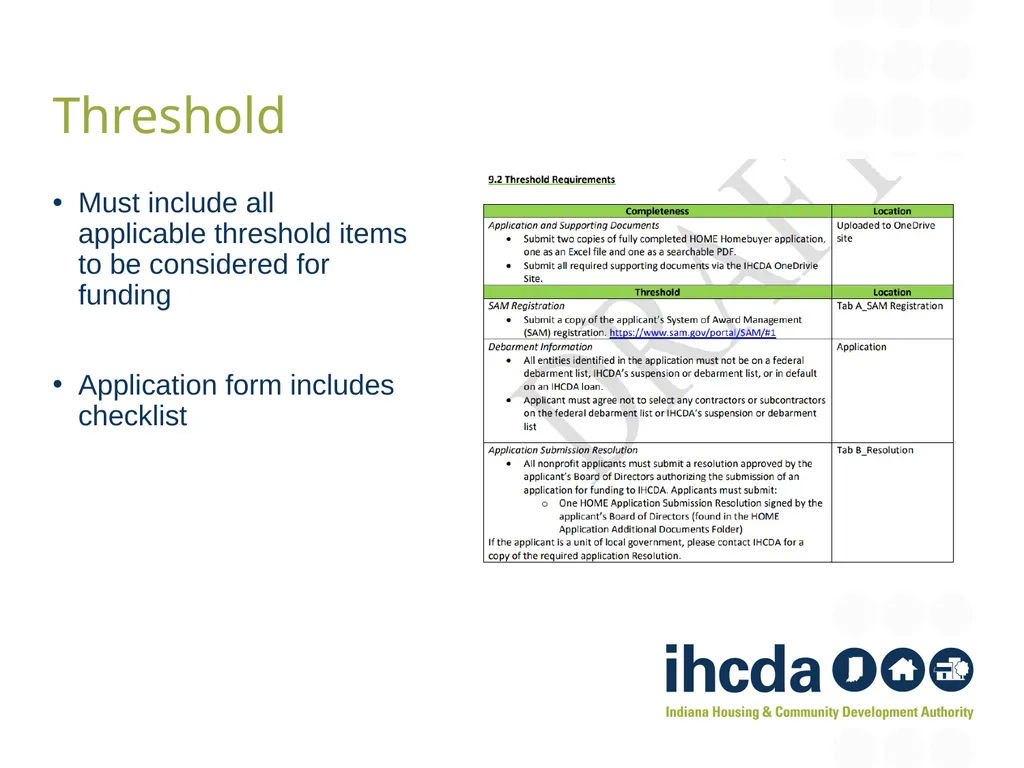
Threshold Must include all applicable threshold items to be considered for funding
Application form includes checklist<br>
Application form includes checklist<br>
21
Threshold Items – Organizational Structure and Capacity
Who is building?<br>
Who is building?<br>
22
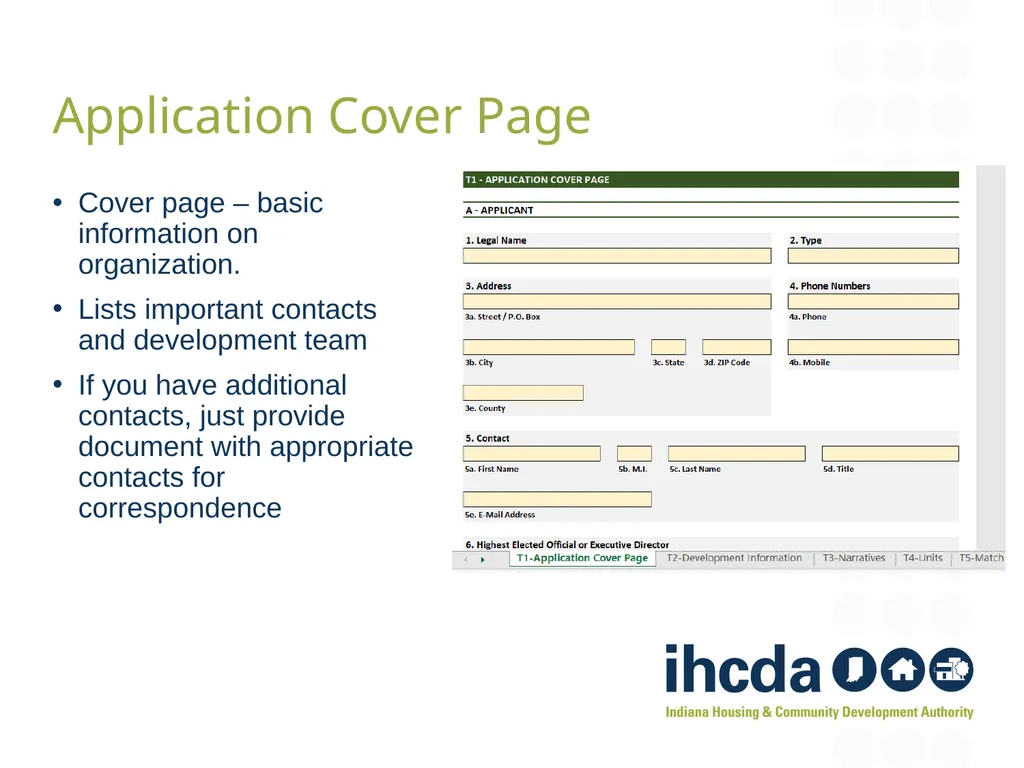
Application Cover Page Cover page – basic information on organization.
Lists important contacts and development team
If you have additional contacts, just provide document with appropriate contacts for correspondence<br>
Lists important contacts and development team
If you have additional contacts, just provide document with appropriate contacts for correspondence<br>
23
Organizational Requirements Sam.Gov registration
NEW! UEI number now required instead of DUNS
Debarment documentation not required – please make sure cover page includes all partners
Architect license requirement
Board Resolution – required under State Statute.
Can be found on IHCDA website
If signing electronically, please also provide Bylaws or Amendment authorizing electronic signature<br>
NEW! UEI number now required instead of DUNS
Debarment documentation not required – please make sure cover page includes all partners
Architect license requirement
Board Resolution – required under State Statute.
Can be found on IHCDA website
If signing electronically, please also provide Bylaws or Amendment authorizing electronic signature<br>
24
Organizational Capacity Non-Profit Applicant Documentation
IRS Determination Letter
Certificate of Assistance
Audited Financial Statements
Most recent copy of your audited financial statements. If you are not required to have audited financial statements, submit a compilation report put together by a third party OR your most current year-end financials.
Year-to-Date Financials
Most current YTD financials which includes both the balance sheet and income statement.<br>
IRS Determination Letter
Certificate of Assistance
Audited Financial Statements
Most recent copy of your audited financial statements. If you are not required to have audited financial statements, submit a compilation report put together by a third party OR your most current year-end financials.
Year-to-Date Financials
Most current YTD financials which includes both the balance sheet and income statement.<br>
25
Administrator Documentation needed to show administrator has been properly procured via the Competitive Negotiation Procedure
Signed copy of the RFP
Submit advertisement of the RFP
Signed agreement<br>
Signed copy of the RFP
Submit advertisement of the RFP
Signed agreement<br>
26
CHDO Requirements If your organization wants to be certified as a CHDO:
If you have not been certified with in 6 months of the application, please submit full CHDO application
If you have been certified within past 6 months through separate Homebuyer application or HOME Rental application, please provide either:
Letter from Executive Director stating nothing has changed since last certification, OR,
Letter and documentation of any CHDO changes
If you want to certify, and you have not received $50k of CHDO Operating in a given Program Year, you are eligible for CHDO Operating. See Tab D1 in Application form to apply.<br>
If you have not been certified with in 6 months of the application, please submit full CHDO application
If you have been certified within past 6 months through separate Homebuyer application or HOME Rental application, please provide either:
Letter from Executive Director stating nothing has changed since last certification, OR,
Letter and documentation of any CHDO changes
If you want to certify, and you have not received $50k of CHDO Operating in a given Program Year, you are eligible for CHDO Operating. See Tab D1 in Application form to apply.<br>
27
Threshold Requirements – Market Need and Pipeline
Who is buying?<br>
Who is buying?<br>
28
Market Need and Analysis A full market study is not required for HOME Homebuyer
Want to demonstrate either:
Have specific buyers lined up and tentatively selected (tend to see this with Habitat) OR
Strong pipeline of buyers and partnerships
Regulations pertaining to timing of selling the unit – more on this later, but good to be cognizant of now when applying
Think through scaling project to ensure units get sold<br>
Want to demonstrate either:
Have specific buyers lined up and tentatively selected (tend to see this with Habitat) OR
Strong pipeline of buyers and partnerships
Regulations pertaining to timing of selling the unit – more on this later, but good to be cognizant of now when applying
Think through scaling project to ensure units get sold<br>
29
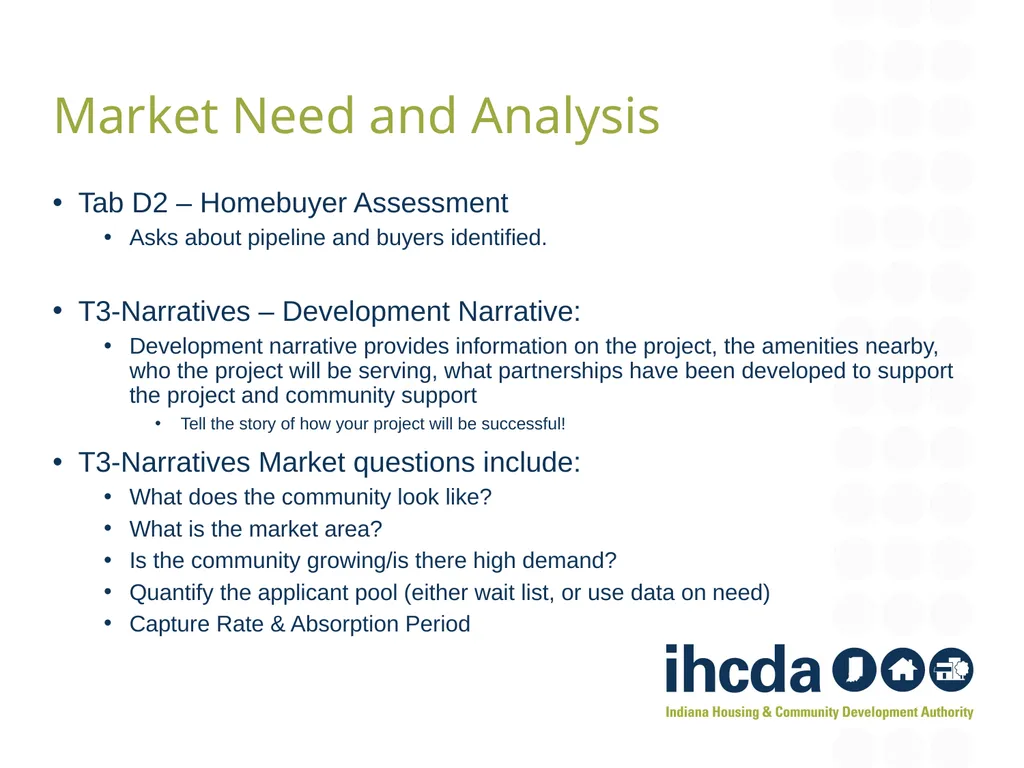
Market Need and Analysis Tab D2 – Homebuyer Assessment
Asks about pipeline and buyers identified.
T3-Narratives – Development Narrative:
Development narrative provides information on the project, the amenities nearby, who the project will be serving, what partnerships have been developed to support the project and community support
Tell the story of how your project will be successful!
T3-Narratives Market questions include:
What does the community look like?
What is the market area?
Is the community growing/is there high demand?
Quantify the applicant pool (either wait list, or use data on need)
Capture Rate & Absorption Period<br>
Asks about pipeline and buyers identified.
T3-Narratives – Development Narrative:
Development narrative provides information on the project, the amenities nearby, who the project will be serving, what partnerships have been developed to support the project and community support
Tell the story of how your project will be successful!
T3-Narratives Market questions include:
What does the community look like?
What is the market area?
Is the community growing/is there high demand?
Quantify the applicant pool (either wait list, or use data on need)
Capture Rate & Absorption Period<br>
30
How will you work with buyers? T3- Narrative – Program Guidelines
How will you accept application?
How to you target the population you are serving?
How do you evaluate applications?
Require Grievance Procedure Policy
How grievances are submitted
Who will review those
Timeframe for review
Appeals process<br>
How will you accept application?
How to you target the population you are serving?
How do you evaluate applications?
Require Grievance Procedure Policy
How grievances are submitted
Who will review those
Timeframe for review
Appeals process<br>
31
How will you work with buyers? Tab D6 – LEP (Meaningful Access for Limited English Proficient Persons)
Please describe meaningful actions to ensure access to the project
Housing Counseling – more in a future application
Will need narrative describing the services to be provided to a homebuyer
Regulations pertaining to who can provide housing counseling<br>
Please describe meaningful actions to ensure access to the project
Housing Counseling – more in a future application
Will need narrative describing the services to be provided to a homebuyer
Regulations pertaining to who can provide housing counseling<br>
32
Threshold Requirements – Site Details
Where are we building?<br>
Where are we building?<br>
33
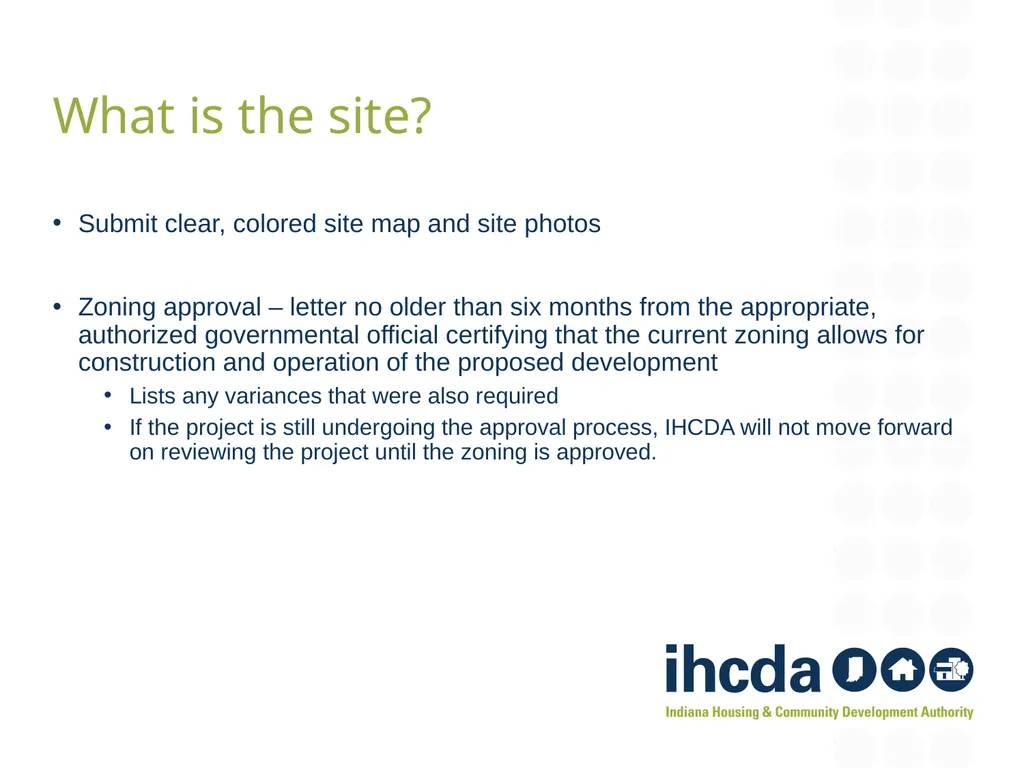
What is the site? Submit clear, colored site map and site photos
Zoning approval – letter no older than six months from the appropriate, authorized governmental official certifying that the current zoning allows for construction and operation of the proposed development
Lists any variances that were also required
If the project is still undergoing the approval process, IHCDA will not move forward on reviewing the project until the zoning is approved.<br>
Zoning approval – letter no older than six months from the appropriate, authorized governmental official certifying that the current zoning allows for construction and operation of the proposed development
Lists any variances that were also required
If the project is still undergoing the approval process, IHCDA will not move forward on reviewing the project until the zoning is approved.<br>
34
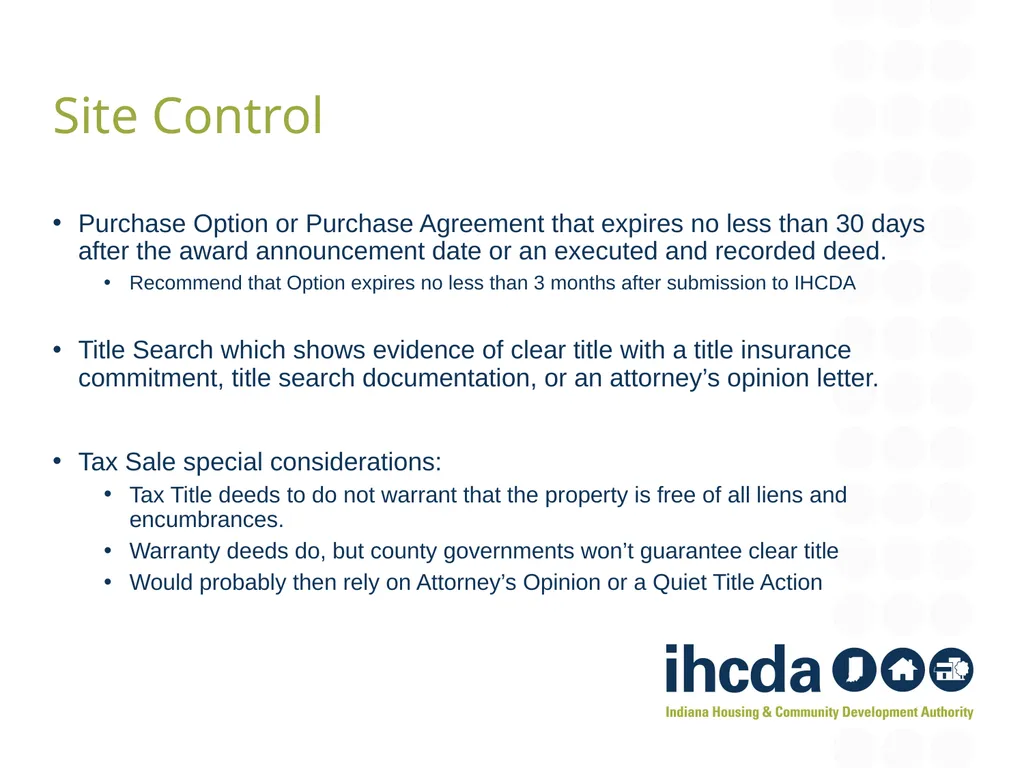
Site Control Purchase Option or Purchase Agreement that expires no less than 30 days after the award announcement date or an executed and recorded deed.
Recommend that Option expires no less than 3 months after submission to IHCDA
Title Search which shows evidence of clear title with a title insurance commitment, title search documentation, or an attorney’s opinion letter.
Tax Sale special considerations:
Tax Title deeds to do not warrant that the property is free of all liens and encumbrances.
Warranty deeds do, but county governments won’t guarantee clear title
Would probably then rely on Attorney’s Opinion or a Quiet Title Action<br>
Recommend that Option expires no less than 3 months after submission to IHCDA
Title Search which shows evidence of clear title with a title insurance commitment, title search documentation, or an attorney’s opinion letter.
Tax Sale special considerations:
Tax Title deeds to do not warrant that the property is free of all liens and encumbrances.
Warranty deeds do, but county governments won’t guarantee clear title
Would probably then rely on Attorney’s Opinion or a Quiet Title Action<br>
35
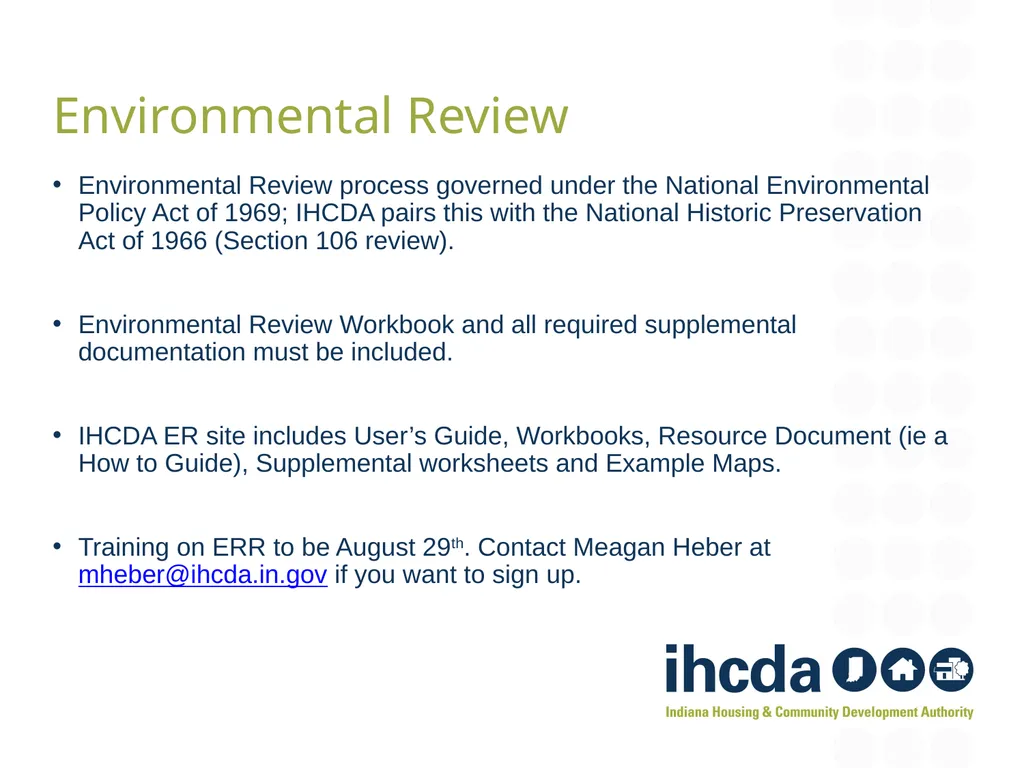
Environmental Review Environmental Review process governed under the National Environmental Policy Act of 1969; IHCDA pairs this with the National Historic Preservation Act of 1966 (Section 106 review).
Environmental Review Workbook and all required supplemental documentation must be included.
IHCDA ER site includes User’s Guide, Workbooks, Resource Document (ie a How to Guide), Supplemental worksheets and Example Maps.
Training on ERR to be August 29th. Contact Meagan Heber at mheber@ihcda.in.gov if you want to sign up.<br>
Environmental Review Workbook and all required supplemental documentation must be included.
IHCDA ER site includes User’s Guide, Workbooks, Resource Document (ie a How to Guide), Supplemental worksheets and Example Maps.
Training on ERR to be August 29th. Contact Meagan Heber at mheber@ihcda.in.gov if you want to sign up.<br>
36
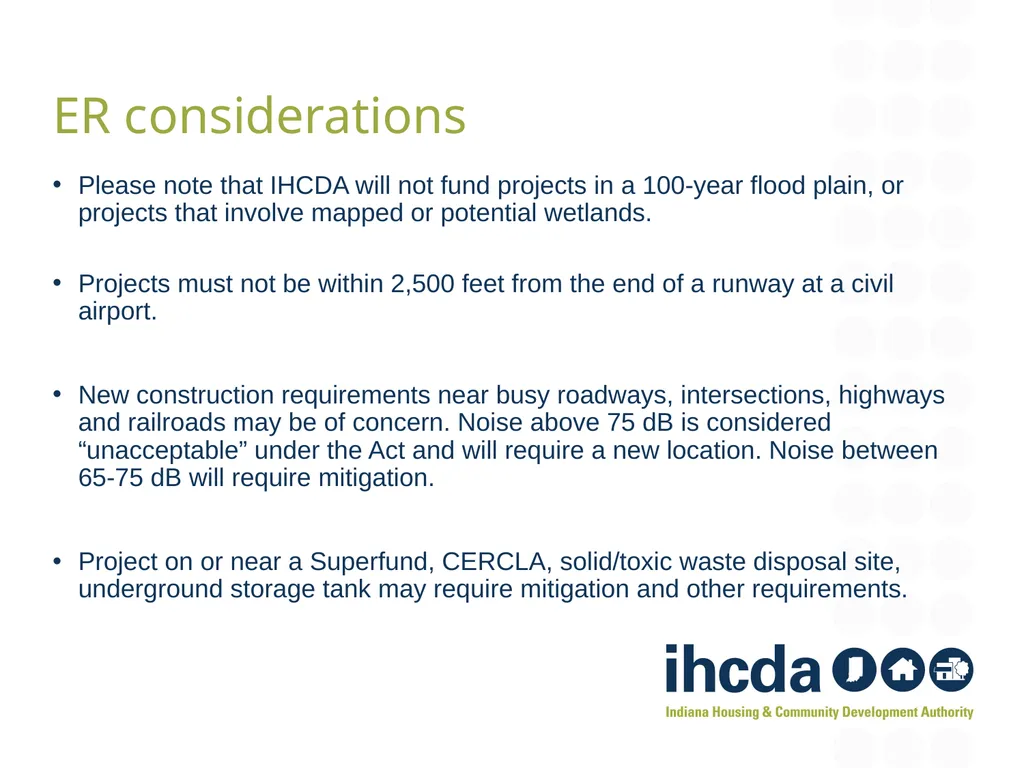
ER considerations Please note that IHCDA will not fund projects in a 100-year flood plain, or projects that involve mapped or potential wetlands.
Projects must not be within 2,500 feet from the end of a runway at a civil airport.
New construction requirements near busy roadways, intersections, highways and railroads may be of concern. Noise above 75 dB is considered “unacceptable” under the Act and will require a new location. Noise between 65-75 dB will require mitigation.
Project on or near a Superfund, CERCLA, solid/toxic waste disposal site, underground storage tank may require mitigation and other requirements.<br>
Projects must not be within 2,500 feet from the end of a runway at a civil airport.
New construction requirements near busy roadways, intersections, highways and railroads may be of concern. Noise above 75 dB is considered “unacceptable” under the Act and will require a new location. Noise between 65-75 dB will require mitigation.
Project on or near a Superfund, CERCLA, solid/toxic waste disposal site, underground storage tank may require mitigation and other requirements.<br>
37
Section 106 All new construction units must under a 30-day archeology review with the State Historic Preservation Office
Consulting Party letters – applicants must consult with outside parties and provide these letters with their application
If these are not done at time of application, this will delay funding
IHCDA will request a word document of the consulting party letter for tribal consultation which must come from IHCDA.<br>
Consulting Party letters – applicants must consult with outside parties and provide these letters with their application
If these are not done at time of application, this will delay funding
IHCDA will request a word document of the consulting party letter for tribal consultation which must come from IHCDA.<br>
38
ER Feasibility and Timing IHCDA encourages partners to use the workbook to determine if a site and site plan may or may not be feasible.
Timing on ERR is critical!
Cannot execute an option or purchase property once the application for HOME funding is submitted to IHCDA – if this occurs, IHCDA will not be able to put HOME funds into the unit. This is called a “choice limiting action”.<br>
Timing on ERR is critical!
Cannot execute an option or purchase property once the application for HOME funding is submitted to IHCDA – if this occurs, IHCDA will not be able to put HOME funds into the unit. This is called a “choice limiting action”.<br>
39
Conversion to Exempt Applicants are to fill out the workbook in full. IHCDA or their third party, SJCA will determine if the project will convert to exempt.
Two criteria must be met to convert:
The project is either 4 or less units on one site, or five or more units scattered sites, when the sites are more than 2,000 feet part and there are also not more than 4 units on any one site, AND,
The development must not require compliance or additional consultation with regulatory authorities
If the project does convert, IHCDA will send a ROF letter – no public comment period is needed.
If it does not convert, 45-day public comment period is needed.<br>
Two criteria must be met to convert:
The project is either 4 or less units on one site, or five or more units scattered sites, when the sites are more than 2,000 feet part and there are also not more than 4 units on any one site, AND,
The development must not require compliance or additional consultation with regulatory authorities
If the project does convert, IHCDA will send a ROF letter – no public comment period is needed.
If it does not convert, 45-day public comment period is needed.<br>
40
Threshold Requirements – Development Plans
What are we building?<br>
What are we building?<br>
41
Development Budget & Appraisals Submit detailed construction cost estimates for the development. IHCDA will need this for each unit as each unit has to be individually underwritten.
If not put together by an engineer or contractor, please provide information as to how the estimates were generated.
IHCDA will use either the purchase agreement, or an “As-Is” appraisal to determine market value of the property pre-new construction/rehab. IHCDA may allow for a Comparative Market Analysis. Contact IHCDA prior to application submission.
As-Is appraisals will be required if using HOME for acquisition.<br>
If not put together by an engineer or contractor, please provide information as to how the estimates were generated.
IHCDA will use either the purchase agreement, or an “As-Is” appraisal to determine market value of the property pre-new construction/rehab. IHCDA may allow for a Comparative Market Analysis. Contact IHCDA prior to application submission.
As-Is appraisals will be required if using HOME for acquisition.<br>
42
Development Budget & Appraisals While not required with application, an Appraisal to determine sales price (“After –Development Value”) can be submitted with application. This helps determine the amount of HOME needed for the project. Otherwise, provide comps to justify the proposed sales price.
If an appraisal is provided, no additional appraisal is needed to be submitted to IHCDA when selling the unit. If an appraisal is not provided, it will be required prior to closing.
If you are planning on using the HOME funds for acquisition, the cost of the eligible HOME costs will be based upon the lesser of the actual value paid for the property, or the appraised fair market value from the as-is appraisal.<br>
If an appraisal is provided, no additional appraisal is needed to be submitted to IHCDA when selling the unit. If an appraisal is not provided, it will be required prior to closing.
If you are planning on using the HOME funds for acquisition, the cost of the eligible HOME costs will be based upon the lesser of the actual value paid for the property, or the appraised fair market value from the as-is appraisal.<br>
43
Unit Plans & Design Provide site plans that show how the development is to be built, including:
Demolition
Existing Buildings
Placement and Orientation of new and existing buildings, parking, sidewalks, amenities
Location and size of any proposed commercial areas
Scaled drawing elevations for all building types
Rehab projects may submit renderings or photos if they are accompanied by an architect’s certification that elevations will not change.
Unit and Floor plans that include the square footage for each unit.
Cannot be handwritten.
Habitat Affiliates: if the specific unit and floor plan has not been determined, submit a variety of plans.
Tab T4 Units Tab will identify numbers of units, number of bedrooms per unit, and projected AMI target for each unit.<br>
Demolition
Existing Buildings
Placement and Orientation of new and existing buildings, parking, sidewalks, amenities
Location and size of any proposed commercial areas
Scaled drawing elevations for all building types
Rehab projects may submit renderings or photos if they are accompanied by an architect’s certification that elevations will not change.
Unit and Floor plans that include the square footage for each unit.
Cannot be handwritten.
Habitat Affiliates: if the specific unit and floor plan has not been determined, submit a variety of plans.
Tab T4 Units Tab will identify numbers of units, number of bedrooms per unit, and projected AMI target for each unit.<br>
44
New Construction Requirements All new construction homebuyer units must meet the visitability standard. All units must also be made accessible upon the request of the prospective buyer.
Visitability is a design concept that allows persons with mobility impairments to enter and stay in a residence. Requirements include:
At least one zero-step entrance on an accessible route. Can be any entrance to the unit.
All main floor interior doors (including bathroom and closets) must provide at least 31 ¾ inches of clear opening width.
At least one half or full bathroom on the main level that is accessible.
Each hallway on the first floor had a width of at least 36 inches and is level, with ramped or beveled changes at each door threshold.
Each bathroom on the first floor is reinforced for potential installation of grab bars.
Each electrical plug or receptacle is at least 15 inches above the floor.<br>
Visitability is a design concept that allows persons with mobility impairments to enter and stay in a residence. Requirements include:
At least one zero-step entrance on an accessible route. Can be any entrance to the unit.
All main floor interior doors (including bathroom and closets) must provide at least 31 ¾ inches of clear opening width.
At least one half or full bathroom on the main level that is accessible.
Each hallway on the first floor had a width of at least 36 inches and is level, with ramped or beveled changes at each door threshold.
Each bathroom on the first floor is reinforced for potential installation of grab bars.
Each electrical plug or receptacle is at least 15 inches above the floor.<br>
45
Rehabilitation Requirements Units to be rehabbed must be inspected by IHCDA or its third Party, Van Marter to confirm the construction cost estimates. IHCDA may require changes to cost-estimates and the pro-forma based on those results.
Units built prior to 1978 must include a risk assessment with their application and include removal of lead-based paint as part of their scope.
There are strict licensing requirements on who can remove lead paint. Please contact Dave Pugh at dpugh@ihcda.in.gov for further guidance.
IHCDA further recommends including other hazard removal (ie asbestos) as part of the construction cost estimates.<br>
Units built prior to 1978 must include a risk assessment with their application and include removal of lead-based paint as part of their scope.
There are strict licensing requirements on who can remove lead paint. Please contact Dave Pugh at dpugh@ihcda.in.gov for further guidance.
IHCDA further recommends including other hazard removal (ie asbestos) as part of the construction cost estimates.<br>
46
Construction Standards Units must, at a minimum meet the stricter of the local rehabilitation standards or the Indiana State Building Code.
Any units utilizing gas appliances must provide carbon monoxide detectors in addition to standard smoke detectors.
Units must meet additional energy efficiency standards for new construction as required under Chapter 11, and the appliable amendments to the 2020 Indiana Residential Code.<br>
Any units utilizing gas appliances must provide carbon monoxide detectors in addition to standard smoke detectors.
Units must meet additional energy efficiency standards for new construction as required under Chapter 11, and the appliable amendments to the 2020 Indiana Residential Code.<br>
47
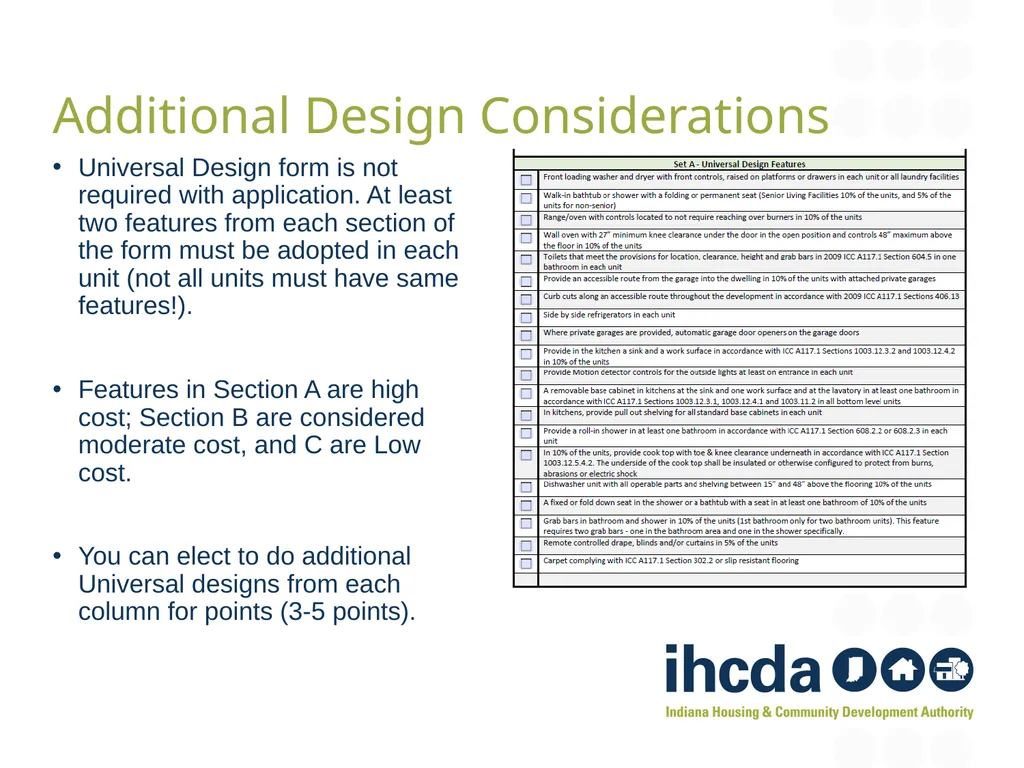
Additional Design Considerations Universal Design form is not required with application. At least two features from each section of the form must be adopted in each unit (not all units must have same features!).
Features in Section A are high cost; Section B are considered moderate cost, and C are Low cost.
You can elect to do additional Universal designs from each column for points (3-5 points).<br>
Features in Section A are high cost; Section B are considered moderate cost, and C are Low cost.
You can elect to do additional Universal designs from each column for points (3-5 points).<br>
48
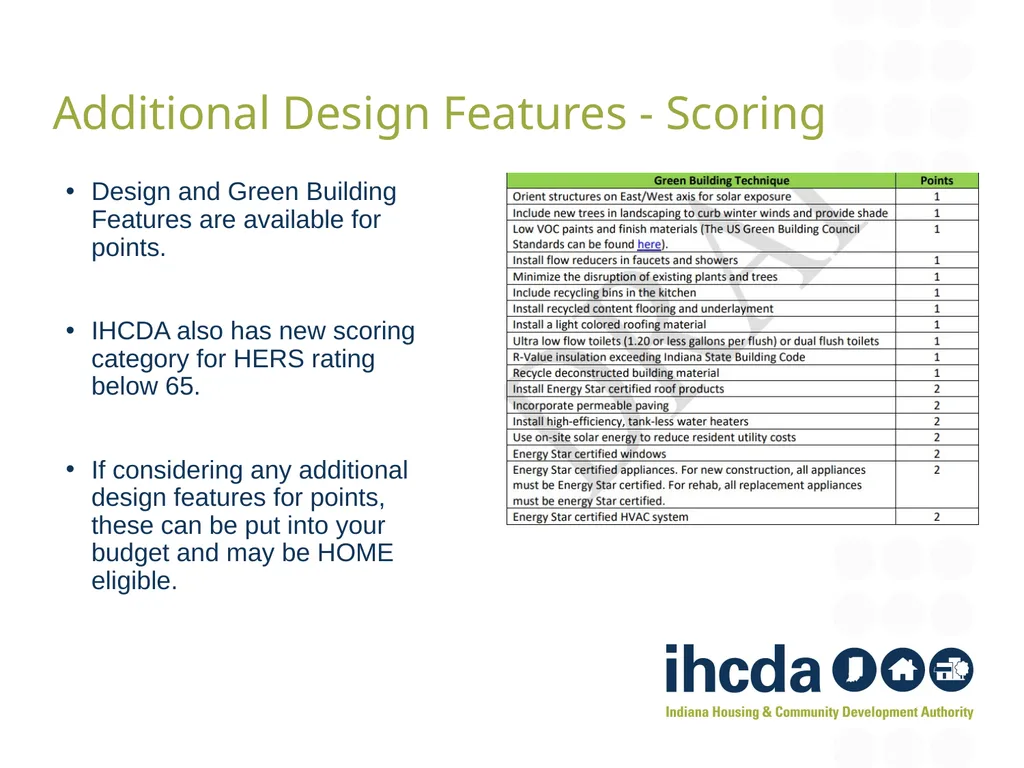
Additional Design Features - Scoring Design and Green Building Features are available for points.
IHCDA also has new scoring category for HERS rating below 65.
If considering any additional design features for points, these can be put into your budget and may be HOME eligible.<br>
IHCDA also has new scoring category for HERS rating below 65.
If considering any additional design features for points, these can be put into your budget and may be HOME eligible.<br>
49
Threshold Requirements – Other Funding
What are the other sources in the project?<br>
What are the other sources in the project?<br>
50
Funding Commitment HOME regulations require PJs (IHCDA) to ensure projects have all financing lined-up prior to entering into a contract.
Must have letter of commitment or agreement with funder included as part of application.
Letter must be signed by highest official, on letterhead and in PDF.
Can accept conditional agreements/letters
If funds were committed more than one year prior to submission, provide a letter confirming funds are available/accessible
SOURCES = USES<br>
Must have letter of commitment or agreement with funder included as part of application.
Letter must be signed by highest official, on letterhead and in PDF.
Can accept conditional agreements/letters
If funds were committed more than one year prior to submission, provide a letter confirming funds are available/accessible
SOURCES = USES<br>
51
IHCDA Funding Sources CHDO Pre-Development Loan – loan for up to $30,000 for eligible CHDOs
MUST be fully drawn prior to application
CHDO Proceeds (more detail later) but can be used as a source of equity or debt!
IHCDA Development Fund – Loan of up to $500,000.
At least 50% of the units must be designated for households at or below 50% of AMI; remainder of units must be below 80% AMI.
Can be sued for pre-development, acquisition, construction, permanent financing or bridge financing.
Loan term is 1.5%.<br>
MUST be fully drawn prior to application
CHDO Proceeds (more detail later) but can be used as a source of equity or debt!
IHCDA Development Fund – Loan of up to $500,000.
At least 50% of the units must be designated for households at or below 50% of AMI; remainder of units must be below 80% AMI.
Can be sued for pre-development, acquisition, construction, permanent financing or bridge financing.
Loan term is 1.5%.<br>
52
IHCDA Funding Sources CHDO Pre-Development Loan – loan for up to $30,000 for eligible CHDOs
MUST be fully drawn prior to application
CHDO Proceeds (more detail later) but can be used as a source of equity or debt!
IHCDA Development Fund – Loan of up to $500,000.
At least 50% of the units must be designated for households at or below 50% of AMI; remainder of units must be below 80% AMI.
Can be sued for pre-development, acquisition, construction, permanent financing or bridge financing.
Loan term is 1.5%.<br>
MUST be fully drawn prior to application
CHDO Proceeds (more detail later) but can be used as a source of equity or debt!
IHCDA Development Fund – Loan of up to $500,000.
At least 50% of the units must be designated for households at or below 50% of AMI; remainder of units must be below 80% AMI.
Can be sued for pre-development, acquisition, construction, permanent financing or bridge financing.
Loan term is 1.5%.<br>
53
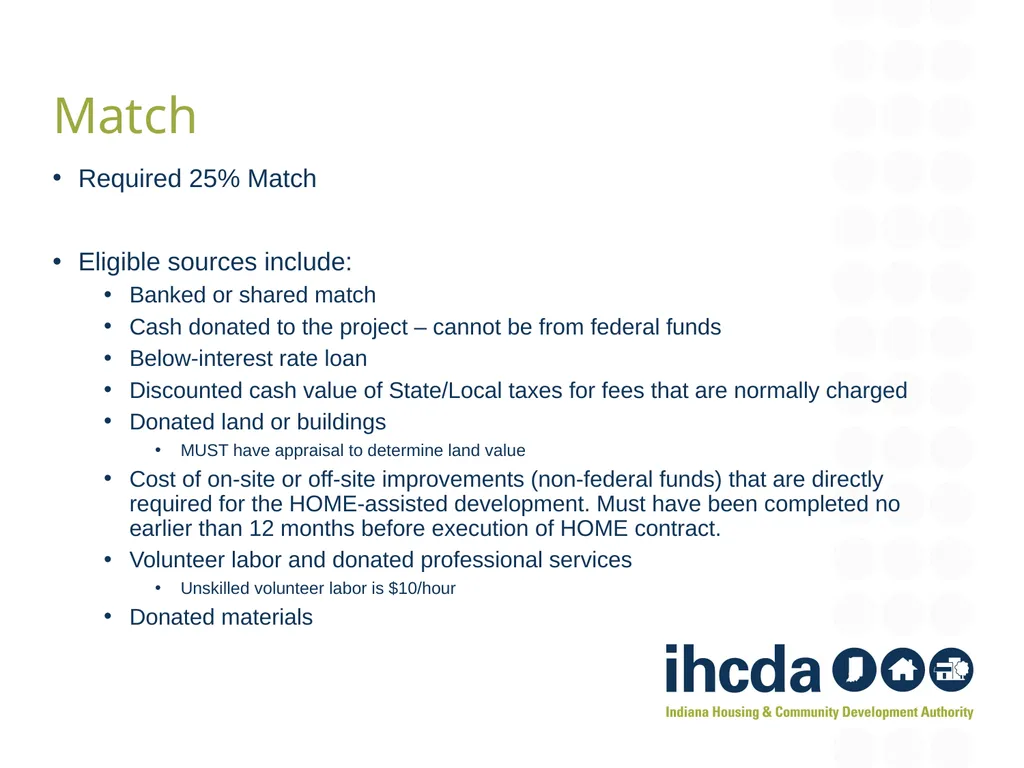
Match Required 25% Match
Eligible sources include:
Banked or shared match
Cash donated to the project – cannot be from federal funds
Below-interest rate loan
Discounted cash value of State/Local taxes for fees that are normally charged
Donated land or buildings
MUST have appraisal to determine land value
Cost of on-site or off-site improvements (non-federal funds) that are directly required for the HOME-assisted development. Must have been completed no earlier than 12 months before execution of HOME contract.
Volunteer labor and donated professional services
Unskilled volunteer labor is $10/hour
Donated materials<br>
Eligible sources include:
Banked or shared match
Cash donated to the project – cannot be from federal funds
Below-interest rate loan
Discounted cash value of State/Local taxes for fees that are normally charged
Donated land or buildings
MUST have appraisal to determine land value
Cost of on-site or off-site improvements (non-federal funds) that are directly required for the HOME-assisted development. Must have been completed no earlier than 12 months before execution of HOME contract.
Volunteer labor and donated professional services
Unskilled volunteer labor is $10/hour
Donated materials<br>
54
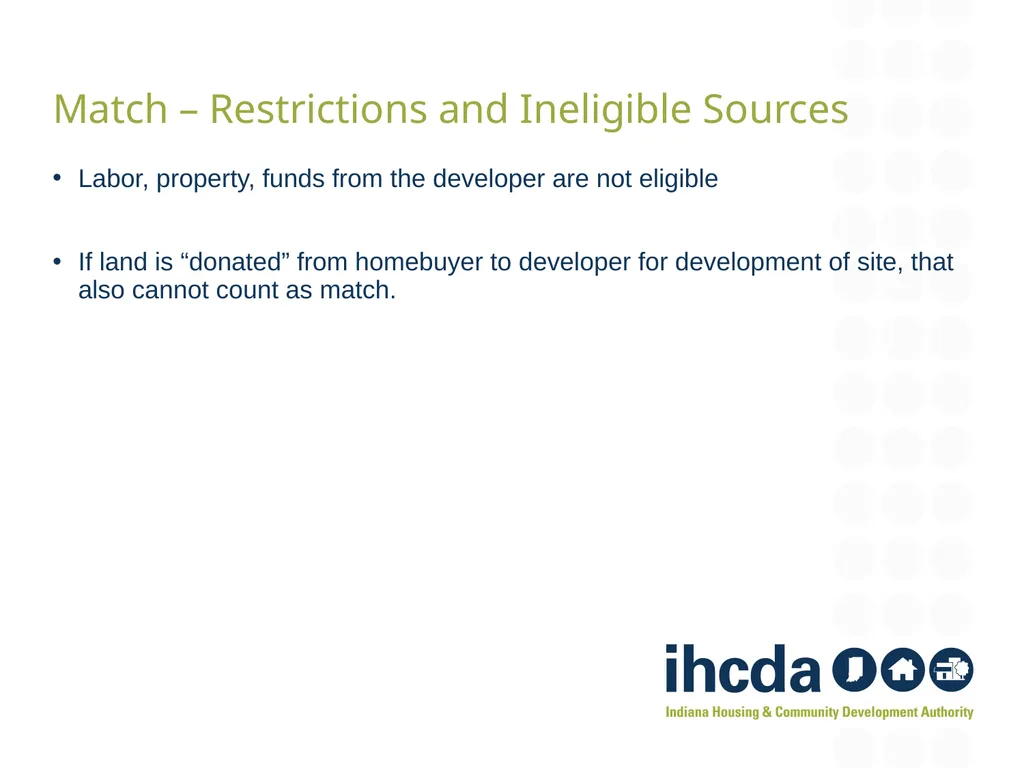
Match – Restrictions and Ineligible Sources Labor, property, funds from the developer are not eligible
If land is “donated” from homebuyer to developer for development of site, that also cannot count as match.<br>
If land is “donated” from homebuyer to developer for development of site, that also cannot count as match.<br>
55
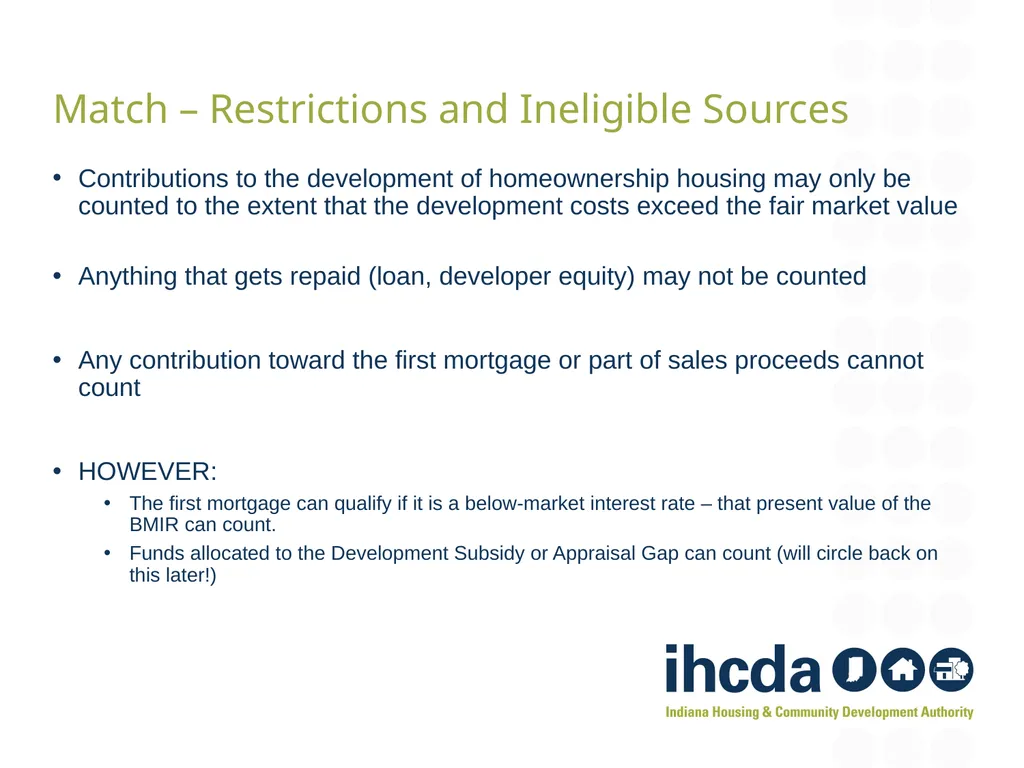
Match – Restrictions and Ineligible Sources Contributions to the development of homeownership housing may only be counted to the extent that the development costs exceed the fair market value
Anything that gets repaid (loan, developer equity) may not be counted
Any contribution toward the first mortgage or part of sales proceeds cannot count
HOWEVER:
The first mortgage can qualify if it is a below-market interest rate – that present value of the BMIR can count.
Funds allocated to the Development Subsidy or Appraisal Gap can count (will circle back on this later!)<br>
Anything that gets repaid (loan, developer equity) may not be counted
Any contribution toward the first mortgage or part of sales proceeds cannot count
HOWEVER:
The first mortgage can qualify if it is a below-market interest rate – that present value of the BMIR can count.
Funds allocated to the Development Subsidy or Appraisal Gap can count (will circle back on this later!)<br>
56
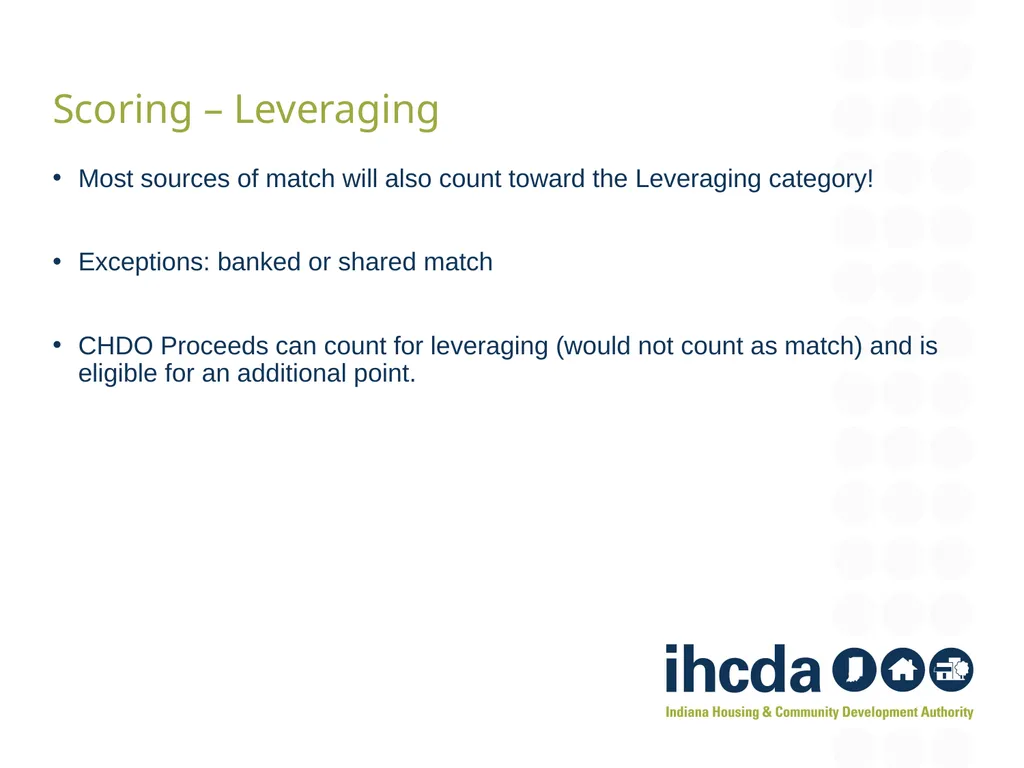
Scoring – Leveraging Most sources of match will also count toward the Leveraging category!
Exceptions: banked or shared match
CHDO Proceeds can count for leveraging (would not count as match) and is eligible for an additional point.<br>
Exceptions: banked or shared match
CHDO Proceeds can count for leveraging (would not count as match) and is eligible for an additional point.<br>
57
Scoring<br>
58
Scoring Criteria Minimum score of 50 (out of possible 95 points)
Scoring covers:
Development Characteristics
Development Features
Readiness
Capacity
Leveraging
Bonus<br>
Scoring covers:
Development Characteristics
Development Features
Readiness
Capacity
Leveraging
Bonus<br>
59
Upcoming Training –
Monday, August 21st
9:30am<br>
Monday, August 21st
9:30am<br>
60
Application Underwriting Criteria Understanding the subsidies and the HOME request
Affordability Requirements
Resale v. Recapture
Breaking down the application proforma
Development Budget
Eligible Costs
Documentation of Costs
Preliminary Homebuyer underwriting
Putting it all together
Other sources
Proceeds
Determining final HOME request<br>
Affordability Requirements
Resale v. Recapture
Breaking down the application proforma
Development Budget
Eligible Costs
Documentation of Costs
Preliminary Homebuyer underwriting
Putting it all together
Other sources
Proceeds
Determining final HOME request<br>
61
Samantha Spergel, Director of Real Estate Strategic Initiatives and Engagement
sspergel@ihcda.in.gov Any Questions?<br>
sspergel@ihcda.in.gov Any Questions?<br>