Immediate Use Compounding of Medications March 2024 Objectives By the end of this presentation the learner will be able to Define compounding of medications Identify situations where immediate use compounding outside of the pharmacy is
"Immediate Use Compounding of Medications March" is the property of its rightful owner. Permission is granted to
download and print the materials on this website for personal, non-commercial use only, and to display it
on your personal computer provided you do not modify the materials and that you retain all copyright
notices contained in the materials. By downloading content from our website, you accept the terms of this
agreement.
Presentation Transcript
01
Immediate Use Compounding of Medications March 2024<br>
02
Objectives By the end of this presentation the learner will be able to
Define compounding of medications
Identify situations where immediate use compounding outside of the pharmacy is appropriate
Identify the criteria that must be followed with preparing an immediate use CSP
Identify the appropriate environment & importance of maintaining aseptic technique
Identify the “not to touch” critical areas on the medication vials, needle, and syringe
Identify proper labeling of the CSP after preparation is complete
Defines beyond-use date for CSP’s<br>
03
3 Compounding of Medications Sterile compounding is defined as combining, admixing, diluting, pooling, reconstituting, repackaging, or otherwise altering a drug product or bulk drug substance to create a sterile preparation.
CSP = Compounded Sterile Preparation<br>
04
4 Immediate Use CSP Whenever possible, compounding of medications should be performed in the pharmacy by
a pharmacist.
In urgent or emergent situations in which waiting to obtain the compounded medication(s) from pharmacy could cause a delay in patient care and increased risk for patient harm, a trained RN or provider may compound medications aseptically, outside of the pharmacy.
Examples:
Adding a medication from a vial to an IV piggyback bag
Adding a vasoactive medication from a vial to an IV bag of fluid for continuous infusion
Preparing syringes in advance in anticipation of use during a procedure.
*This does NOT apply to hazardous drugs. Hazardous drugs are to only be compounded in the Pharmacy (ie. Chemotherapy drugs) !<br>
05
5 Immediate Use CSP What is NOT considered Immediate Use Compounding?
Immediate Use Compounding does not include mixing, reconstituting, or other such acts that are performed in accordance with directions contained in approved labeling or supplemental materials provided by the product’s manufacturer.
Examples:
Reconstitution of powder in a vial and drawing it up for administration in a syringe
Drawing up liquid from a vial for administration
Preparation of t-PA<br>
06
6 Immediate Use CSP When preparing a CSP the following criteria must be met:
Aseptic technique is followed
NO hazardous drugs are used
The preparation involves not more than 3 different sterile products
Any unused starting component from a single-dose container must be discarded after preparation is complete.
Administration begins within 4 hours following the start of preparation. If administration has not begun within 4 hours of compounding, it must be promptly, appropriately, and safely discarded.
The CSP must be labeled with the following:
Names and amounts (doses) of all active ingredients
Name or initials of the person who prepared the preparation
The 4-hour time period within which administration must begin (beyond-use date)<br>
07
7 Immediate Use CSP Environment for Preparation
Designated area is clean & uncluttered
Preparation activities take place on a hard, non-porous surface that can be disinfected
At least 3 feet away from a sink
if within 3 feet of a sink, a splash guard is installed to provide a physical barrier between the prep area and sink.
Free from sources of contamination, including:
Food and drink
Biohazardous materials (e.g., lab specimens)
Visible contaminants, both non-microbial (e.g., rust, dust, flaking paint) and microbial (e.g., mold/mildew)
Airflow from HVAC vents, windows, etc.
Foot traffic (e.g., near entrance/exit, in busy hallway)<br>
08
8 Immediate Use CSP Aseptic Technique Principles
Aseptic technique refers to the manner of handling, preparing, and storing medications and injection equipment/supplies (e.g., syringes, needles) to prevent microbial contamination and infection
To preserve sterility of materials used in sterile preparation of medications, knowledge of what not to touch is important. These “not to touch” points are known as critical sites and include:
Stopper of vial
Needle
Hub, Bevel, Tip, Lumen
Syringes
Tip
Plunger
Inner Shaft<br>
09
9 Immediate Use CSP Preparation
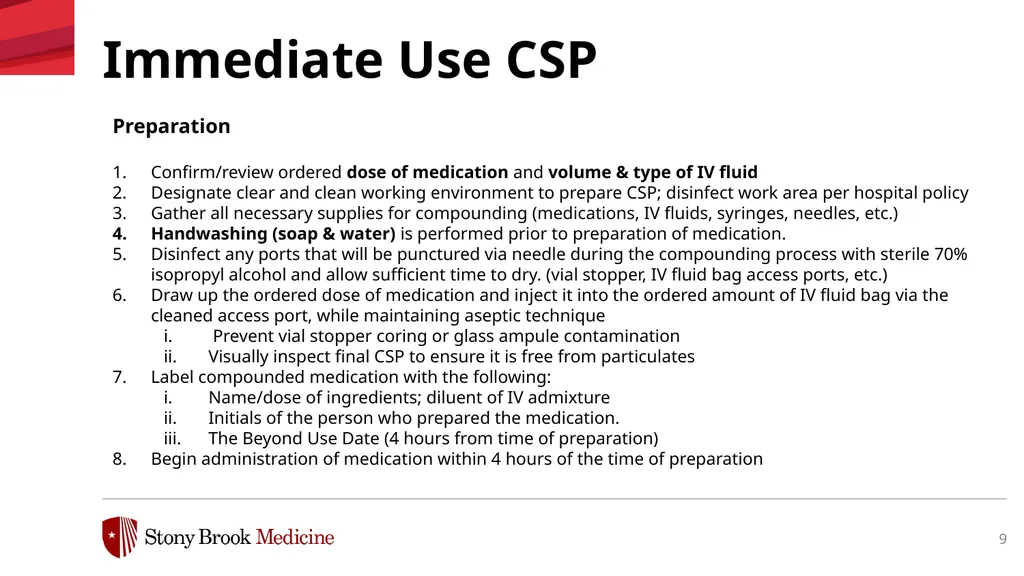
Confirm/review ordered dose of medication and volume & type of IV fluid
Designate clear and clean working environment to prepare CSP; disinfect work area per hospital policy
Gather all necessary supplies for compounding (medications, IV fluids, syringes, needles, etc.)
Handwashing (soap & water) is performed prior to preparation of medication.
Disinfect any ports that will be punctured via needle during the compounding process with sterile 70% isopropyl alcohol and allow sufficient time to dry. (vial stopper, IV fluid bag access ports, etc.)
Draw up the ordered dose of medication and inject it into the ordered amount of IV fluid bag via the cleaned access port, while maintaining aseptic technique
Prevent vial stopper coring or glass ampule contamination
Visually inspect final CSP to ensure it is free from particulates
Label compounded medication with the following:
Name/dose of ingredients; diluent of IV admixture
Initials of the person who prepared the medication.
The Beyond Use Date (4 hours from time of preparation)
Begin administration of medication within 4 hours of the time of preparation<br>
10
10 Immediate Use CSP Considerations
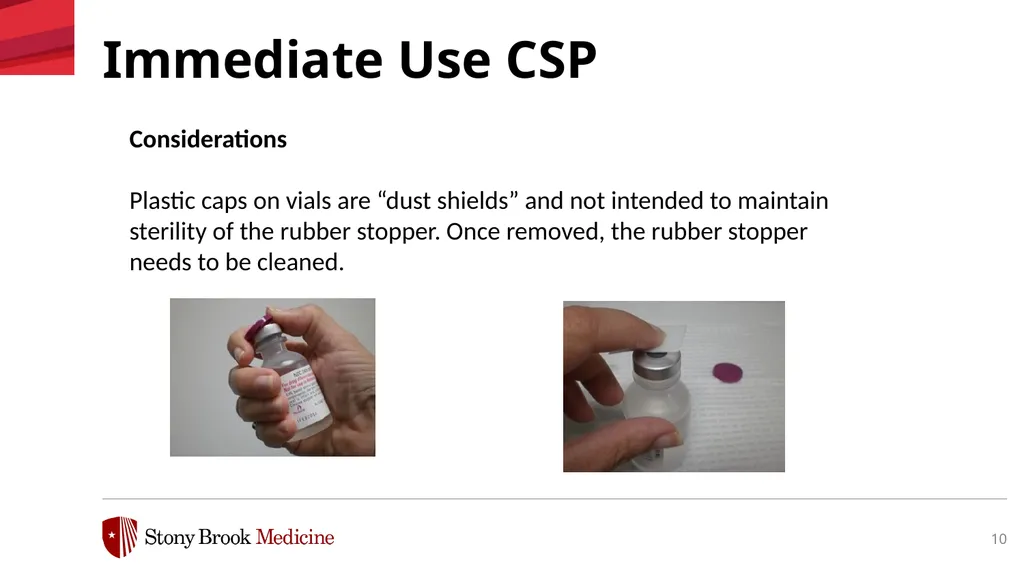
Plastic caps on vials are “dust shields” and not intended to maintain sterility of the rubber stopper. Once removed, the rubber stopper needs to be cleaned.<br>
11
11 Immediate Use CSP Considerations
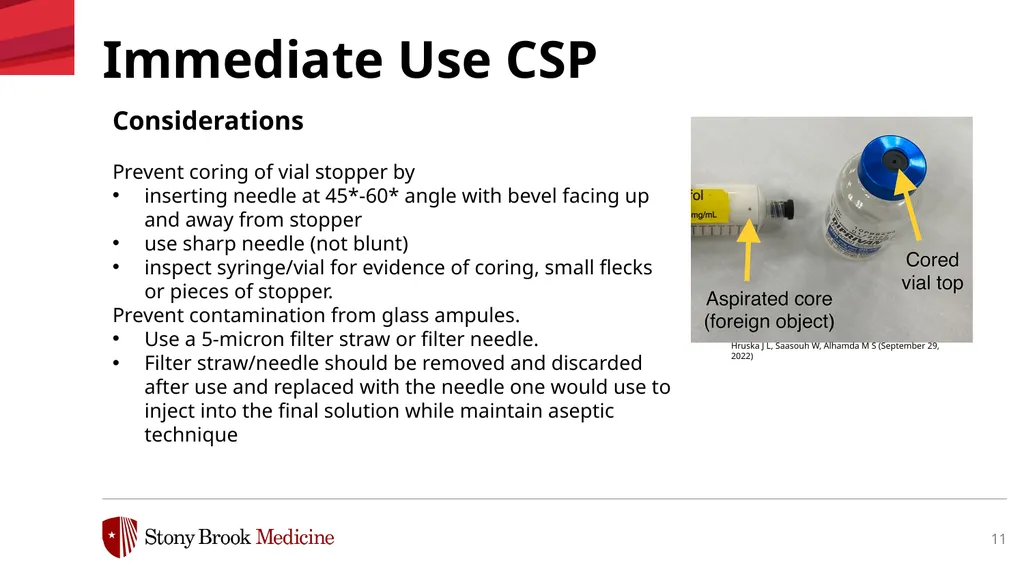
Prevent coring of vial stopper by
inserting needle at 45*-60* angle with bevel facing up and away from stopper
use sharp needle (not blunt)
inspect syringe/vial for evidence of coring, small flecks or pieces of stopper.
Prevent contamination from glass ampules.
Use a 5-micron filter straw or filter needle.
Filter straw/needle should be removed and discarded after use and replaced with the needle one would use to inject into the final solution while maintain aseptic technique Hruska J L, Saasouh W, Alhamda M S (September 29, 2022)<br>
12
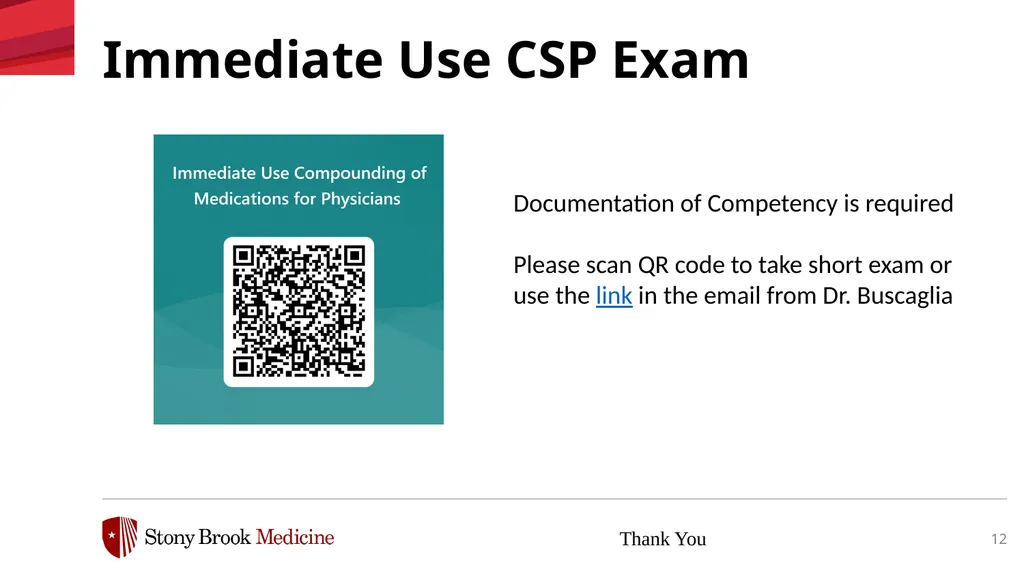
12 Thank You Immediate Use CSP Exam Documentation of Competency is required
Please scan QR code to take short exam or use the link in the email from Dr. Buscaglia<br>
National Infusion Center Association (NICA) (2021) National Infusion Center Association (NICA). Medication-Preparation-Area-Checklist. Retrieved from: https://infusioncenter.org/wp-content/uploads/2021/01/Medication-Preparation-Area-Checklist_0121.pdf
Centers for Disease Control and Prevention. Medication Preparation FAQs regarding Safe Practices for Medical Injections. https://www.cdc.gov/injectionsafety/providers/provider_faqs_med-prep.html. Accessed December 14, 2022<br>