Impact of Risk Management Online Courses in Puerto
Description: Impact of Risk Management Online Courses in Puerto Rico Introduction Abstract Farmers and ranchers in Puerto Rico have suffered many losses due to recent emergencies such as hurricanes, earthquakes, and now to the pandemic. It is because of
Related Topics
Download Presentation
"Impact of Risk Management Online Courses in Puerto" is the property of its rightful owner. Permission is granted to download and print the materials on this website for personal, non-commercial use only, and to display it on your personal computer provided you do not modify the materials and that you retain all copyright notices contained in the materials. By downloading content from our website, you accept the terms of this agreement.
Presentation Transcript
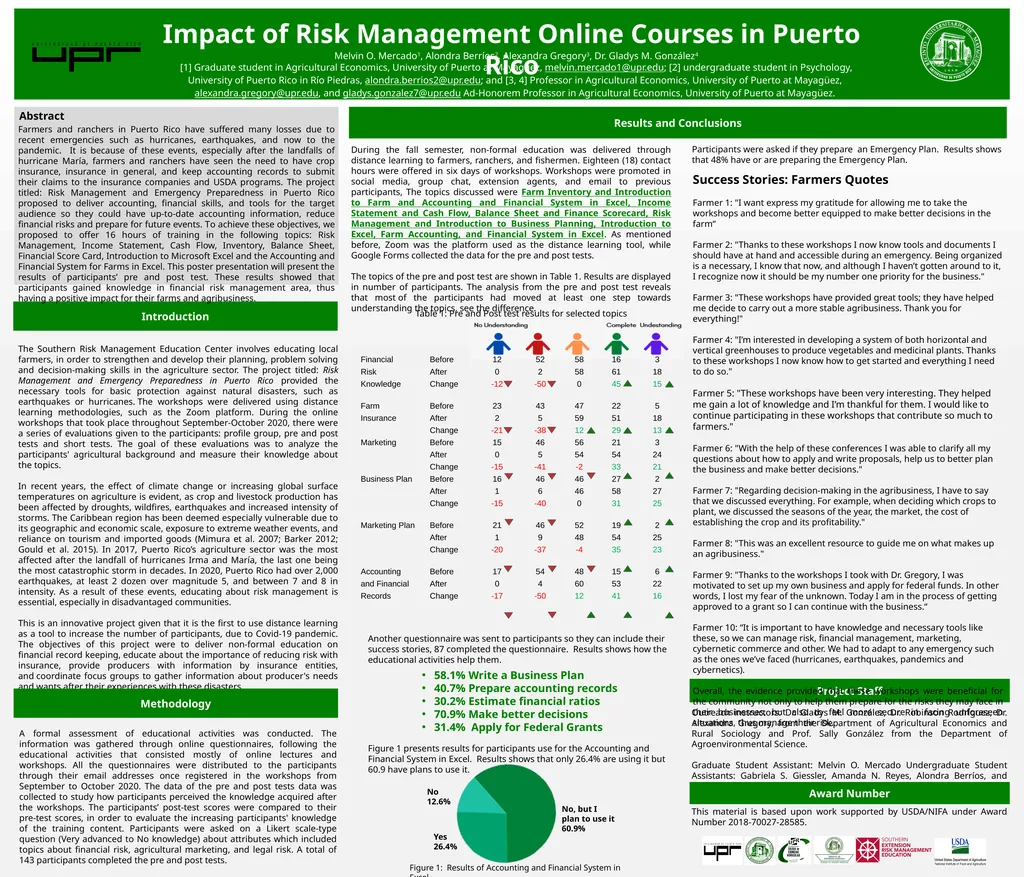
slide1. Impact of Risk Management Online Courses in Puerto Rico Introduction Abstract Farmers and ranchers in Puerto Rico have suffered many losses due to recent emergencies such as hurricanes, earthquakes, and now to the pandemic. It is because of these events, especially after the landfalls of hurricane MarÃa, farmers and ranchers have seen the need to have crop insurance, insurance in general, and keep accounting records to submit their claims to the insurance companies and USDA programs. The project titled: Risk Management and Emergency Preparedness in Puerto Rico proposed to deliver accounting, financial skills, and tools for the target audience so they could have up-to-date accounting information, reduce financial risks and prepare for future events. To achieve these objectives, we proposed to offer 16 hours of training in the following topics: Risk Management, Income Statement, Cash Flow, Inventory, Balance Sheet, Financial Score Card, Introduction to Microsoft Excel and the Accounting and Financial System for Farms in Excel. This poster presentation will present the results of participants’ pre and post test. These results showed that participants gained knowledge in financial risk management area, thus having a positive impact for their farms and agribusiness. The Southern Risk Management Education Center involves educating local farmers, in order to strengthen and develop their planning, problem solving and decision-making skills in the agriculture sector. The project titled: Risk Management and Emergency Preparedness in Puerto Rico provided the necessary tools for basic protection against natural disasters, such as earthquakes or hurricanes. The workshops were delivered using distance learning methodologies, such as the Zoom platform. During the online workshops that took place throughout September-October 2020, there were a series of evaluations given to the participants: profile group, pre and post tests and short tests. The goal of these evaluations was to analyze the participants' agricultural background and measure their knowledge about the topics.
In recent years, the effect of climate change or increasing global surface temperatures on agriculture is evident, as crop and livestock production has been affected by droughts, wildfires, earthquakes and increased intensity of storms. The Caribbean region has been deemed especially vulnerable due to its geographic and economic scale, exposure to extreme weather events, and reliance on tourism and imported goods (Mimura et al. 2007; Barker 2012; Gould et al. 2015). In 2017, Puerto Rico’s agriculture sector was the most affected after the landfall of hurricanes Irma and MarÃa, the last one being the most catastrophic storm in decades. In 2020, Puerto Rico had over 2,000 earthquakes, at least 2 dozen over magnitude 5, and between 7 and 8 in intensity. As a result of these events, educating about risk management is essential, especially in disadvantaged communities.
This is an innovative project given that it is the first to use distance learning as a tool to increase the number of participants, due to Covid-19 pandemic. The objectives of this project were to deliver non-formal education on financial record keeping, educate about the importance of reducing risk with insurance, provide producers with information by insurance entities, and coordinate focus groups to gather information about producer's needs and wants after their experiences with these disasters. A formal assessment of educational activities was conducted. The information was gathered through online questionnaires, following the educational activities that consisted mostly of online lectures and workshops. All the questionnaires were distributed to the participants through their email addresses once registered in the workshops from September to October 2020. The data of the pre and post tests data was collected to study how participants perceived the knowledge acquired after the workshops. The participants’ post-test scores were compared to their pre-test scores, in order to evaluate the increasing participants' knowledge of the training content. Participants were asked on a Likert scale-type question (Very advanced to No knowledge) about attributes which included topics about financial risk, agricultural marketing, and legal risk. A total of 143 participants completed the pre and post tests. During the fall semester, non-formal education was delivered through distance learning to farmers, ranchers, and fishermen. Eighteen (18) contact hours were offered in six days of workshops. Workshops were promoted in social media, group chat, extension agents, and email to previous participants, The topics discussed were Farm Inventory and Introduction to Farm and Accounting and Financial System in Excel, Income Statement and Cash Flow, Balance Sheet and Finance Scorecard, Risk Management and Introduction to Business Planning, Introduction to Excel, Farm Accounting, and Financial System in Excel. As mentioned before, Zoom was the platform used as the distance learning tool, while Google Forms collected the data for the pre and post tests.
The topics of the pre and post test are shown in Table 1. Results are displayed in number of participants. The analysis from the pre and post test reveals that most of the participants had moved at least one step towards understanding the topics, see the difference. Methodology Results and Conclusions Melvin O. Mercado1, Alondra BerrÃos2, Alexandra Gregory3, Dr. Gladys M. González4
[1] Graduate student in Agricultural Economics, University of Puerto at Mayagüez, melvin.mercado1@upr.edu; [2] undergraduate student in Psychology, University of Puerto Rico in RÃo Piedras, alondra.berrios2@upr.edu; and [3, 4] Professor in Agricultural Economics, University of Puerto at Mayagüez, alexandra.gregory@upr.edu, and gladys.gonzalez7@upr.edu Ad-Honorem Professor in Agricultural Economics, University of Puerto at Mayagüez. Project Staff Outreach instructors: Dr. Gladys M. González, Dr. Robinson RodrÃguez, Dr. Alexandra Gregory, from the Department of Agricultural Economics and Rural Sociology and Prof. Sally González from the Department of Agroenvironmental Science.
Graduate Student Assistant: Melvin O. Mercado Undergraduate Student Assistants: Gabriela S. Giessler, Amanda N. Reyes, Alondra BerrÃos, and Neishaly Soto Award Number This material is based upon work supported by USDA/NIFA under Award Number 2018-70027-28585. Figure 1 presents results for participants use for the Accounting and Financial System in Excel. Results shows that only 26.4% are using it but 60.9 have plans to use it. Another questionnaire was sent to participants so they can include their success stories, 87 completed the questionnaire. Results shows how the educational activities help them. Participants were asked if they prepare an Emergency Plan. Results shows that 48% have or are preparing the Emergency Plan. Success Stories: Farmers Quotes
Farmer 1: "I want express my gratitude for allowing me to take the workshops and become better equipped to make better decisions in the farm“
Farmer 2: "Thanks to these workshops I now know tools and documents I should have at hand and accessible during an emergency. Being organized is a necessary, I know that now, and although I haven’t gotten around to it, I recognize now it should be my number one priority for the business."
Farmer 3: "These workshops have provided great tools; they have helped me decide to carry out a more stable agribusiness. Thank you for everything!"
Farmer 4: "I’m interested in developing a system of both horizontal and vertical greenhouses to produce vegetables and medicinal plants. Thanks to these workshops I now know how to get started and everything I need to do so."
Farmer 5: "These workshops have been very interesting. They helped me gain a lot of knowledge and I’m thankful for them. I would like to continue participating in these workshops that contribute so much to farmers."
Farmer 6: "With the help of these conferences I was able to clarify all my questions about how to apply and write proposals, help us to better plan the business and make better decisions."
Farmer 7: "Regarding decision-making in the agribusiness, I have to say that we discussed everything. For example, when deciding which crops to plant, we discussed the seasons of the year, the market, the cost of establishing the crop and its profitability."
Farmer 8: "This was an excellent resource to guide me on what makes up an agribusiness."
Farmer 9: "Thanks to the workshops I took with Dr. Gregory, I was motivated to set up my own business and apply for federal funds. In other words, I lost my fear of the unknown. Today I am in the process of getting approved to a grant so I can continue with the business.“
Farmer 10: “It is important to have knowledge and necessary tools like these, so we can manage risk, financial management, marketing, cybernetic commerce and other. We had to adapt to any emergency such as the ones we’ve faced (hurricanes, earthquakes, pandemics and cybernetics).
Overall, the evidence provided that these workshops were beneficial for the community not only to help them prepare for the risks they may face in their businesses, but also to feel more secure in facing unforeseen situations, thus manage their risk. Table 1: Pre and Post test results for selected topics 58.1% Write a Business Plan
40.7% Prepare accounting records
30.2% Estimate financial ratios
70.9% Make better decisions
31.4% Apply for Federal Grants<br>
In recent years, the effect of climate change or increasing global surface temperatures on agriculture is evident, as crop and livestock production has been affected by droughts, wildfires, earthquakes and increased intensity of storms. The Caribbean region has been deemed especially vulnerable due to its geographic and economic scale, exposure to extreme weather events, and reliance on tourism and imported goods (Mimura et al. 2007; Barker 2012; Gould et al. 2015). In 2017, Puerto Rico’s agriculture sector was the most affected after the landfall of hurricanes Irma and MarÃa, the last one being the most catastrophic storm in decades. In 2020, Puerto Rico had over 2,000 earthquakes, at least 2 dozen over magnitude 5, and between 7 and 8 in intensity. As a result of these events, educating about risk management is essential, especially in disadvantaged communities.
This is an innovative project given that it is the first to use distance learning as a tool to increase the number of participants, due to Covid-19 pandemic. The objectives of this project were to deliver non-formal education on financial record keeping, educate about the importance of reducing risk with insurance, provide producers with information by insurance entities, and coordinate focus groups to gather information about producer's needs and wants after their experiences with these disasters. A formal assessment of educational activities was conducted. The information was gathered through online questionnaires, following the educational activities that consisted mostly of online lectures and workshops. All the questionnaires were distributed to the participants through their email addresses once registered in the workshops from September to October 2020. The data of the pre and post tests data was collected to study how participants perceived the knowledge acquired after the workshops. The participants’ post-test scores were compared to their pre-test scores, in order to evaluate the increasing participants' knowledge of the training content. Participants were asked on a Likert scale-type question (Very advanced to No knowledge) about attributes which included topics about financial risk, agricultural marketing, and legal risk. A total of 143 participants completed the pre and post tests. During the fall semester, non-formal education was delivered through distance learning to farmers, ranchers, and fishermen. Eighteen (18) contact hours were offered in six days of workshops. Workshops were promoted in social media, group chat, extension agents, and email to previous participants, The topics discussed were Farm Inventory and Introduction to Farm and Accounting and Financial System in Excel, Income Statement and Cash Flow, Balance Sheet and Finance Scorecard, Risk Management and Introduction to Business Planning, Introduction to Excel, Farm Accounting, and Financial System in Excel. As mentioned before, Zoom was the platform used as the distance learning tool, while Google Forms collected the data for the pre and post tests.
The topics of the pre and post test are shown in Table 1. Results are displayed in number of participants. The analysis from the pre and post test reveals that most of the participants had moved at least one step towards understanding the topics, see the difference. Methodology Results and Conclusions Melvin O. Mercado1, Alondra BerrÃos2, Alexandra Gregory3, Dr. Gladys M. González4
[1] Graduate student in Agricultural Economics, University of Puerto at Mayagüez, melvin.mercado1@upr.edu; [2] undergraduate student in Psychology, University of Puerto Rico in RÃo Piedras, alondra.berrios2@upr.edu; and [3, 4] Professor in Agricultural Economics, University of Puerto at Mayagüez, alexandra.gregory@upr.edu, and gladys.gonzalez7@upr.edu Ad-Honorem Professor in Agricultural Economics, University of Puerto at Mayagüez. Project Staff Outreach instructors: Dr. Gladys M. González, Dr. Robinson RodrÃguez, Dr. Alexandra Gregory, from the Department of Agricultural Economics and Rural Sociology and Prof. Sally González from the Department of Agroenvironmental Science.
Graduate Student Assistant: Melvin O. Mercado Undergraduate Student Assistants: Gabriela S. Giessler, Amanda N. Reyes, Alondra BerrÃos, and Neishaly Soto Award Number This material is based upon work supported by USDA/NIFA under Award Number 2018-70027-28585. Figure 1 presents results for participants use for the Accounting and Financial System in Excel. Results shows that only 26.4% are using it but 60.9 have plans to use it. Another questionnaire was sent to participants so they can include their success stories, 87 completed the questionnaire. Results shows how the educational activities help them. Participants were asked if they prepare an Emergency Plan. Results shows that 48% have or are preparing the Emergency Plan. Success Stories: Farmers Quotes
Farmer 1: "I want express my gratitude for allowing me to take the workshops and become better equipped to make better decisions in the farm“
Farmer 2: "Thanks to these workshops I now know tools and documents I should have at hand and accessible during an emergency. Being organized is a necessary, I know that now, and although I haven’t gotten around to it, I recognize now it should be my number one priority for the business."
Farmer 3: "These workshops have provided great tools; they have helped me decide to carry out a more stable agribusiness. Thank you for everything!"
Farmer 4: "I’m interested in developing a system of both horizontal and vertical greenhouses to produce vegetables and medicinal plants. Thanks to these workshops I now know how to get started and everything I need to do so."
Farmer 5: "These workshops have been very interesting. They helped me gain a lot of knowledge and I’m thankful for them. I would like to continue participating in these workshops that contribute so much to farmers."
Farmer 6: "With the help of these conferences I was able to clarify all my questions about how to apply and write proposals, help us to better plan the business and make better decisions."
Farmer 7: "Regarding decision-making in the agribusiness, I have to say that we discussed everything. For example, when deciding which crops to plant, we discussed the seasons of the year, the market, the cost of establishing the crop and its profitability."
Farmer 8: "This was an excellent resource to guide me on what makes up an agribusiness."
Farmer 9: "Thanks to the workshops I took with Dr. Gregory, I was motivated to set up my own business and apply for federal funds. In other words, I lost my fear of the unknown. Today I am in the process of getting approved to a grant so I can continue with the business.“
Farmer 10: “It is important to have knowledge and necessary tools like these, so we can manage risk, financial management, marketing, cybernetic commerce and other. We had to adapt to any emergency such as the ones we’ve faced (hurricanes, earthquakes, pandemics and cybernetics).
Overall, the evidence provided that these workshops were beneficial for the community not only to help them prepare for the risks they may face in their businesses, but also to feel more secure in facing unforeseen situations, thus manage their risk. Table 1: Pre and Post test results for selected topics 58.1% Write a Business Plan
40.7% Prepare accounting records
30.2% Estimate financial ratios
70.9% Make better decisions
31.4% Apply for Federal Grants<br>