
Implementation of Export Control Reform Note: This
Description: Implementation of Export Control Reform Note: This presentation is merely a summary of official statements and final rules published by the Departments of Commerce and State. Final rules, as well as the Export Administration Regulations and
Related Topics
Download Presentation
"Implementation of Export Control Reform Note: This" is the property of its rightful owner. Permission is granted to download and print the materials on this website for personal, non-commercial use only, and to display it on your personal computer provided you do not modify the materials and that you retain all copyright notices contained in the materials. By downloading content from our website, you accept the terms of this agreement.
Presentation Transcript
slide1. Implementation of
Export Control Reform Note: This presentation is merely a summary of official statements and final rules published by the Departments of Commerce and State. Final rules, as well as the Export Administration Regulations and International Traffic in Arms Regulations, must be reviewed to determine the full scope of any applicable requirements. Date of Last Revision: Nov. 25, 2015 Kevin Wolf
Assistant Secretary of Commerce
for Export Administration<br>
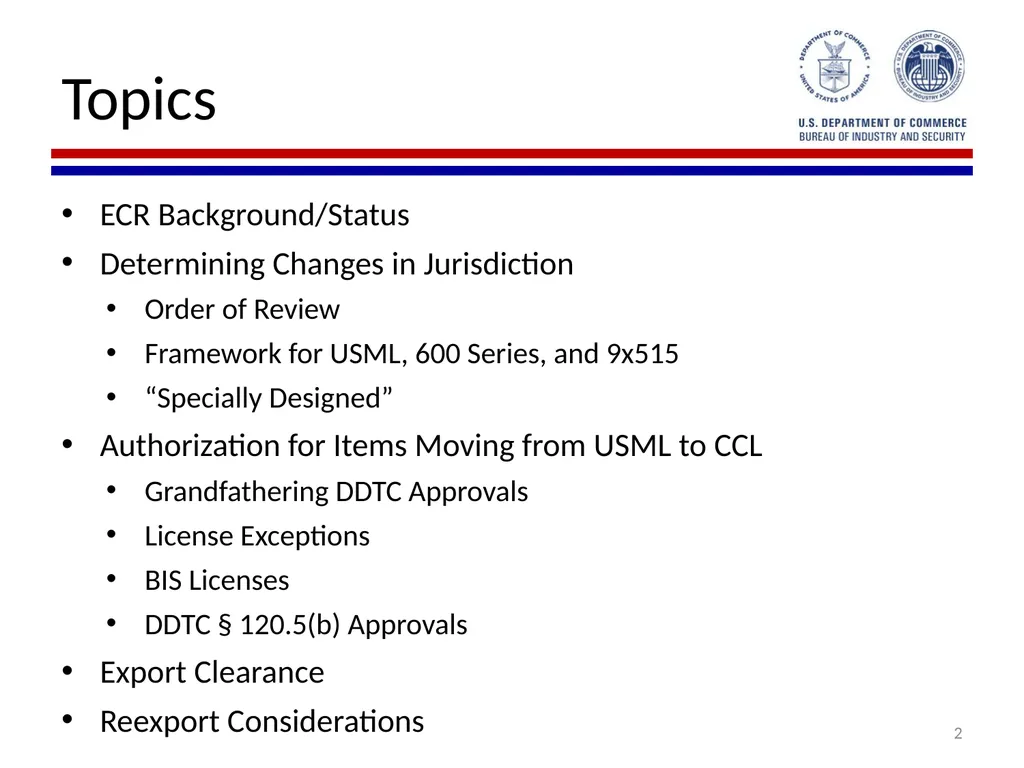
slide2. Topics ECR Background/Status
Determining Changes in Jurisdiction
Order of Review
Framework for USML, 600 Series, and 9x515
“Specially Designed”
Authorization for Items Moving from USML to CCL
Grandfathering DDTC Approvals
License Exceptions
BIS Licenses
DDTC § 120.5(b) Approvals
Export Clearance
Reexport Considerations 2<br>
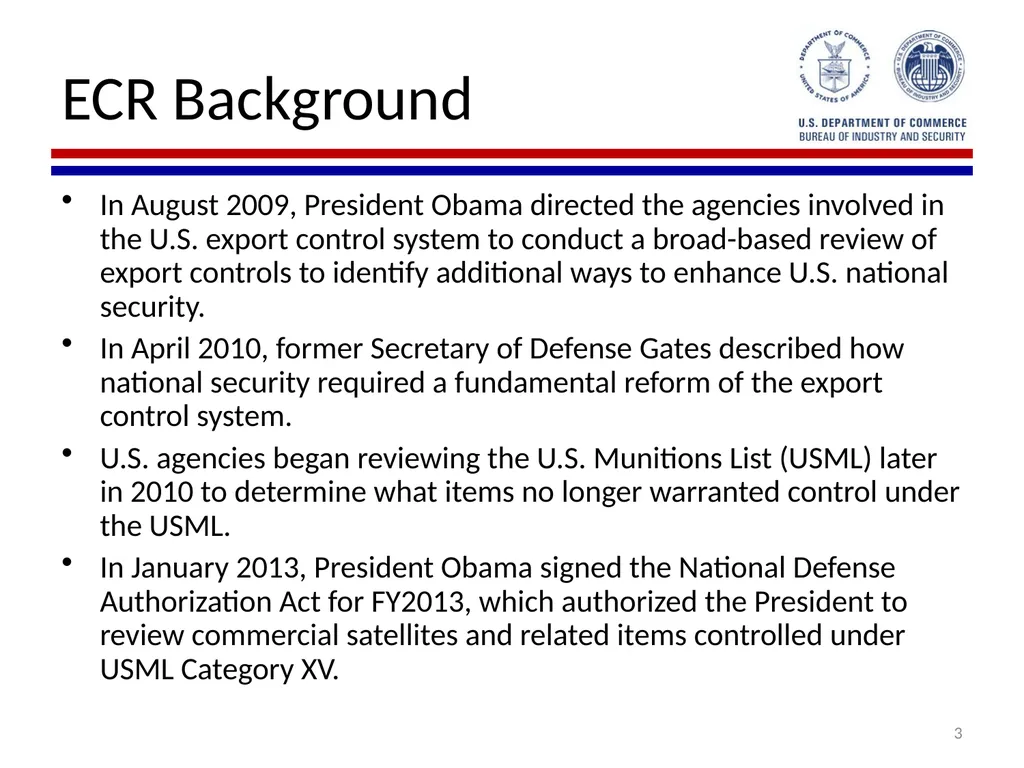
slide3. ECR Background In August 2009, President Obama directed the agencies involved in the U.S. export control system to conduct a broad-based review of export controls to identify additional ways to enhance U.S. national security.
In April 2010, former Secretary of Defense Gates described how national security required a fundamental reform of the export control system.
U.S. agencies began reviewing the U.S. Munitions List (USML) later in 2010 to determine what items no longer warranted control under the USML.
In January 2013, President Obama signed the National Defense Authorization Act for FY2013, which authorized the President to review commercial satellites and related items controlled under USML Category XV. 3<br>
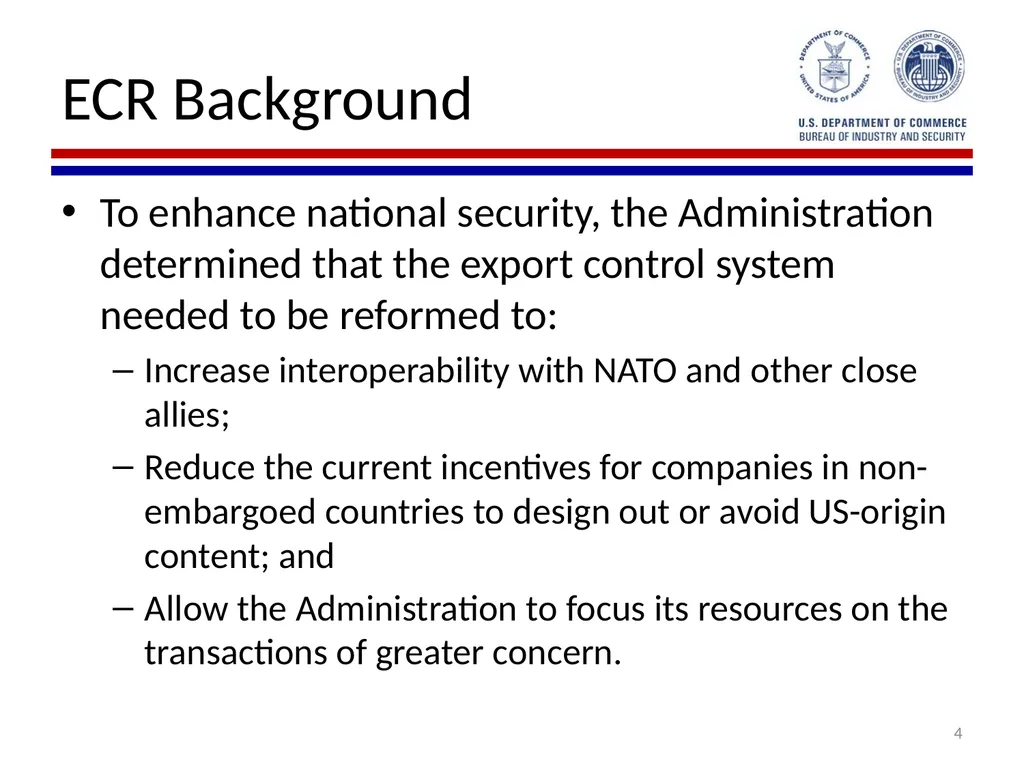
slide4. ECR Background To enhance national security, the Administration determined that the export control system needed to be reformed to:
Increase interoperability with NATO and other close allies;
Reduce the current incentives for companies in non-embargoed countries to design out or avoid US-origin content; and
Allow the Administration to focus its resources on the transactions of greater concern. 4<br>
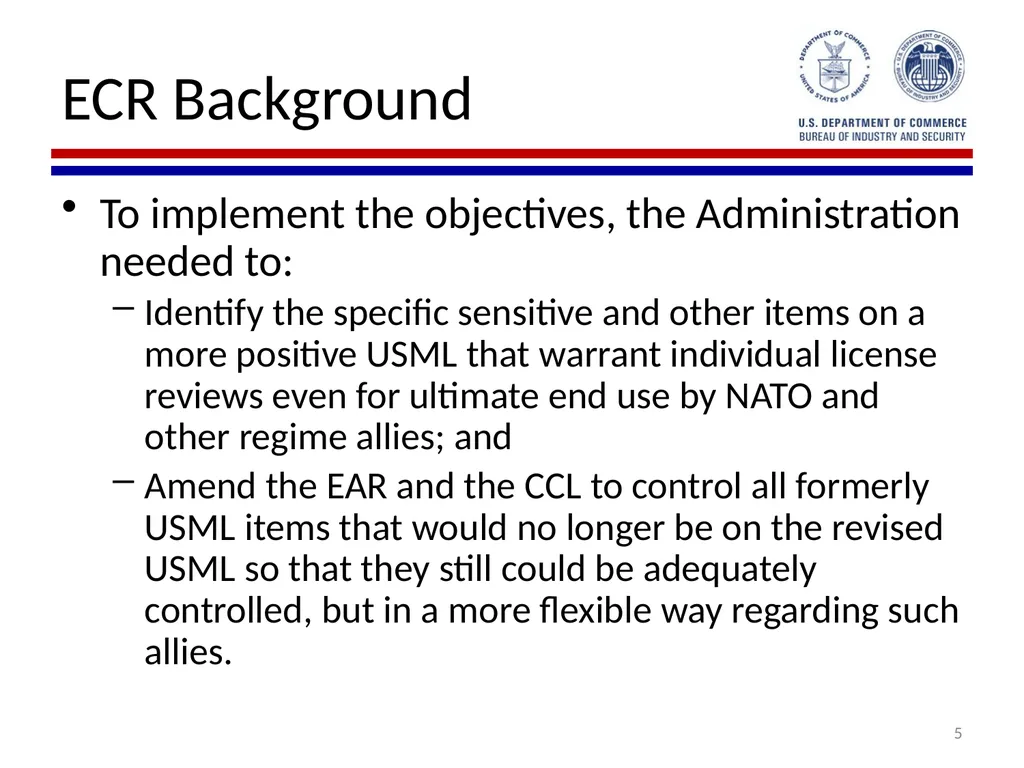
slide5. ECR Background To implement the objectives, the Administration needed to:
Identify the specific sensitive and other items on a more positive USML that warrant individual license reviews even for ultimate end use by NATO and other regime allies; and
Amend the EAR and the CCL to control all formerly USML items that would no longer be on the revised USML so that they still could be adequately controlled, but in a more flexible way regarding such allies. 5<br>
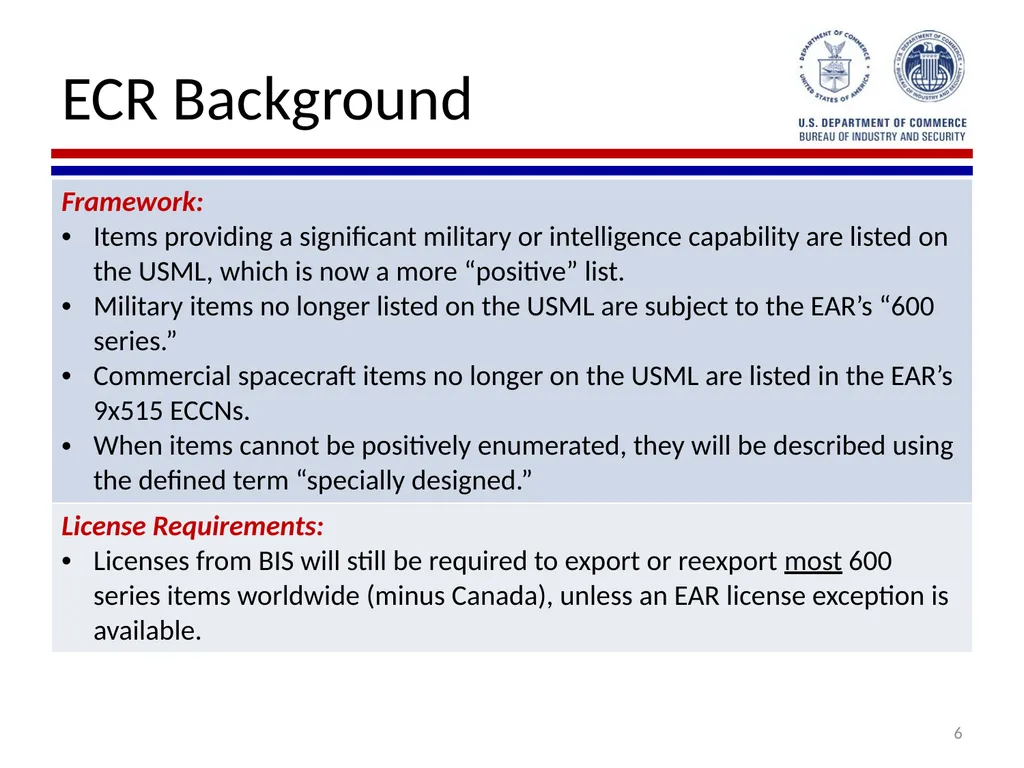
slide6. 6 ECR Background<br>
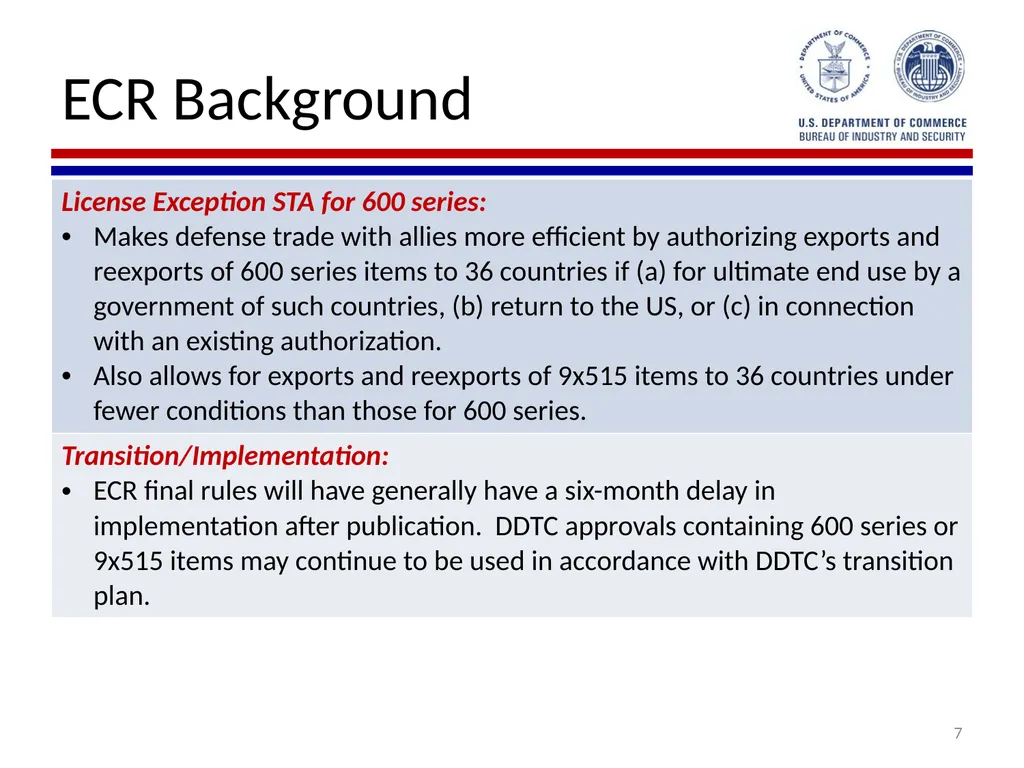
slide7. ECR Background 7<br>
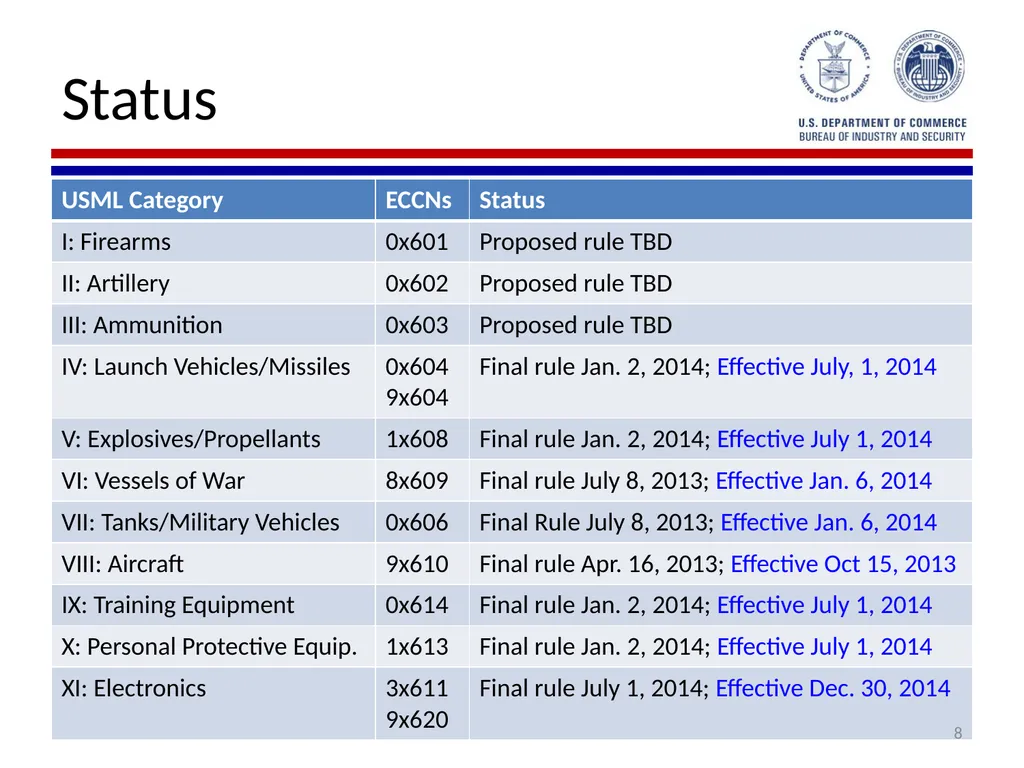
slide8. Status 8<br>
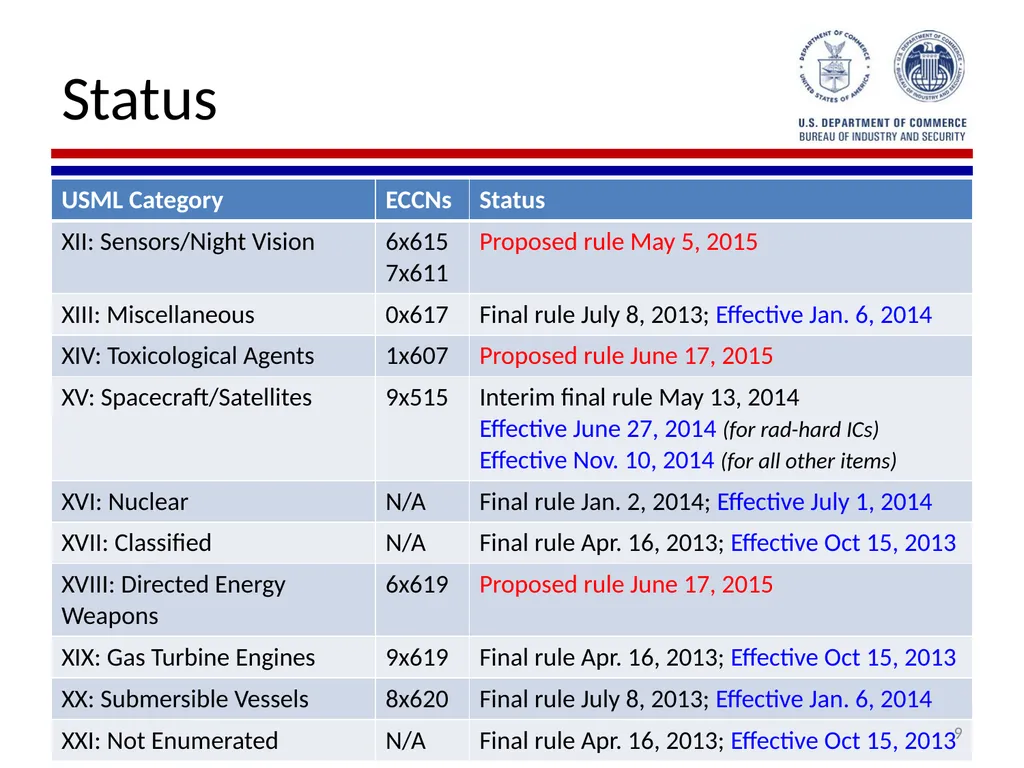
slide9. Status 9<br>
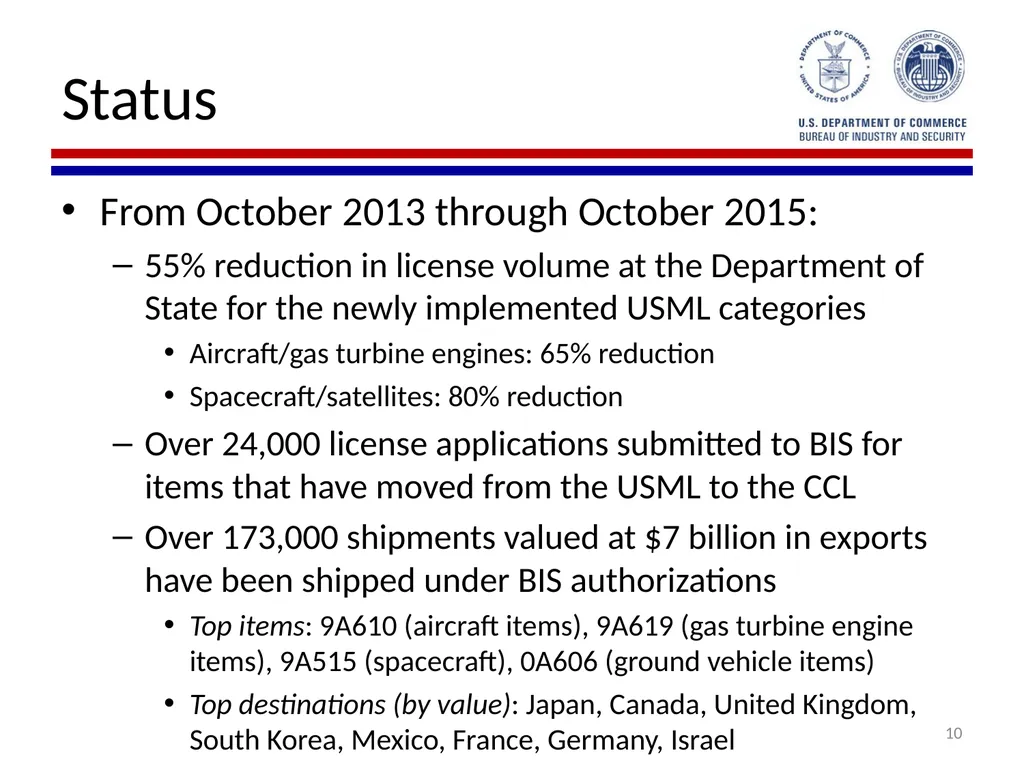
slide10. Status From October 2013 through October 2015:
55% reduction in license volume at the Department of State for the newly implemented USML categories
Aircraft/gas turbine engines: 65% reduction
Spacecraft/satellites: 80% reduction
Over 24,000 license applications submitted to BIS for items that have moved from the USML to the CCL
Over 173,000 shipments valued at $7 billion in exports have been shipped under BIS authorizations
Top items: 9A610 (aircraft items), 9A619 (gas turbine engine items), 9A515 (spacecraft), 0A606 (ground vehicle items)
Top destinations (by value): Japan, Canada, United Kingdom, South Korea, Mexico, France, Germany, Israel 10<br>
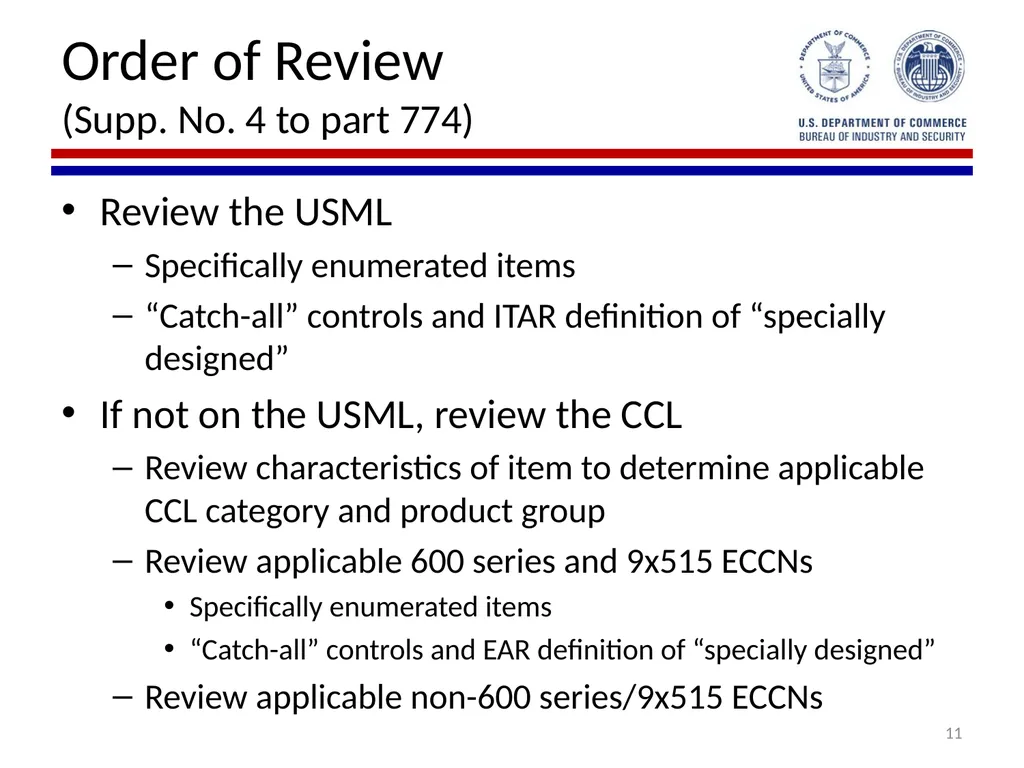
slide11. Order of Review (Supp. No. 4 to part 774) Review the USML
Specifically enumerated items
“Catch-all” controls and ITAR definition of “specially designed”
If not on the USML, review the CCL
Review characteristics of item to determine applicable CCL category and product group
Review applicable 600 series and 9x515 ECCNs
Specifically enumerated items
“Catch-all” controls and EAR definition of “specially designed”
Review applicable non-600 series/9x515 ECCNs 11<br>
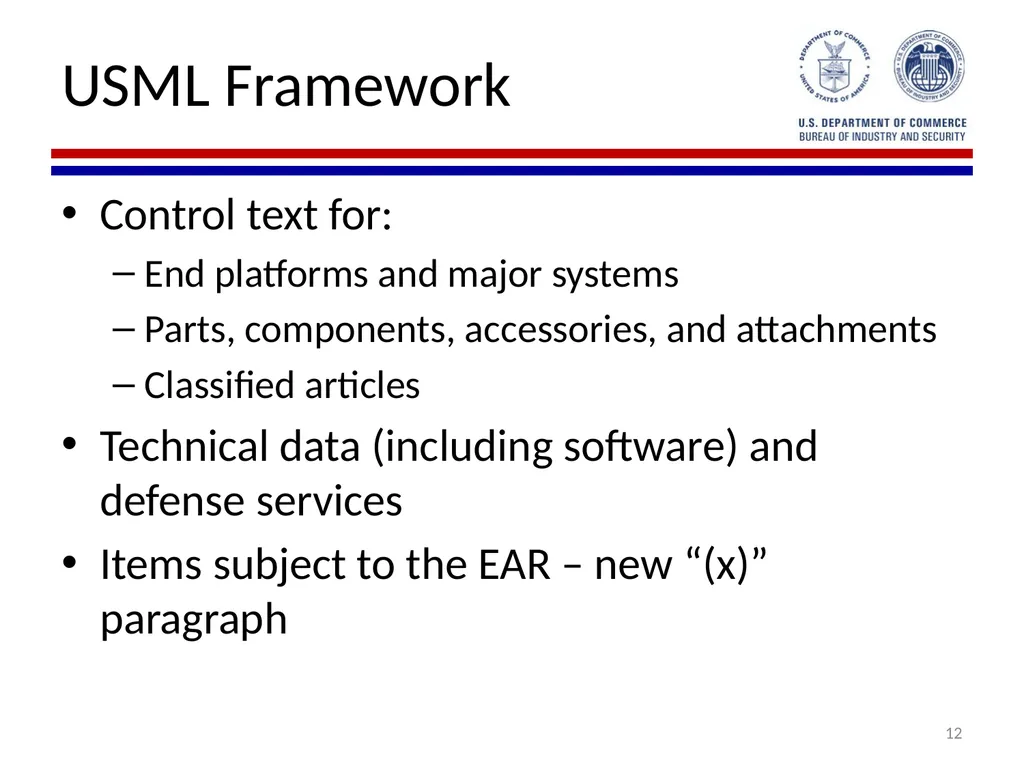
slide12. USML Framework Control text for:
End platforms and major systems
Parts, components, accessories, and attachments
Classified articles
Technical data (including software) and defense services
Items subject to the EAR – new “(x)” paragraph 12<br>
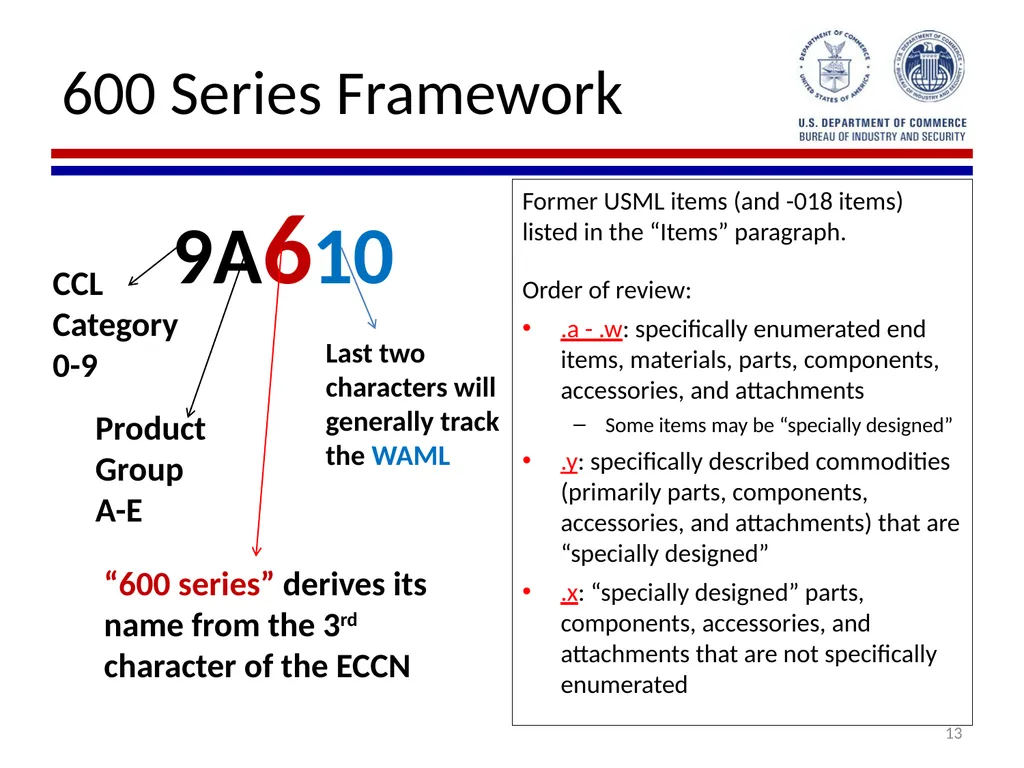
slide13. 600 Series Framework Former USML items (and -018 items) listed in the “Items” paragraph.
Order of review:
.a - .w: specifically enumerated end items, materials, parts, components, accessories, and attachments
Some items may be “specially designed”
.y: specifically described commodities (primarily parts, components, accessories, and attachments) that are “specially designed”
.x: “specially designed” parts, components, accessories, and attachments that are not specifically enumerated 9A610 CCL
Category
0-9 Product Group
A-E “600 series” derives its name from the 3rd character of the ECCN Last two characters will generally track the WAML 13<br>
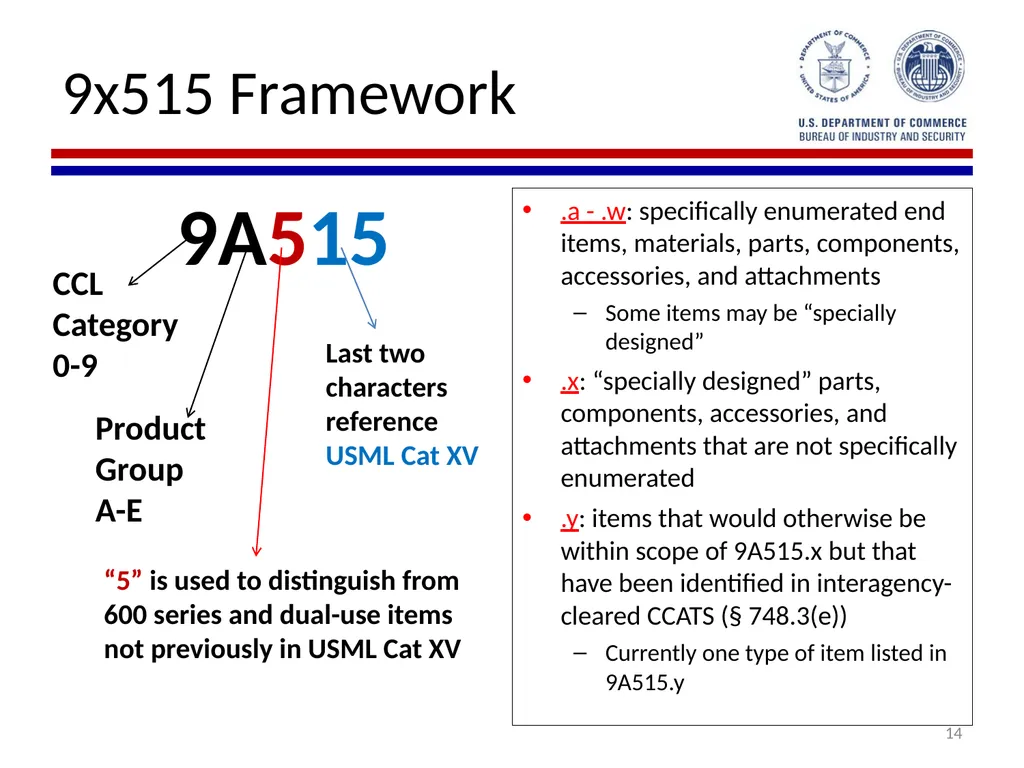
slide14. 9x515 Framework .a - .w: specifically enumerated end items, materials, parts, components, accessories, and attachments
Some items may be “specially designed”
.x: “specially designed” parts, components, accessories, and attachments that are not specifically enumerated
.y: items that would otherwise be within scope of 9A515.x but that have been identified in interagency-cleared CCATS (§ 748.3(e))
Currently one type of item listed in 9A515.y 9A515 CCL
Category
0-9 Product Group
A-E “5” is used to distinguish from 600 series and dual-use items not previously in USML Cat XV Last two characters reference USML Cat XV 14<br>
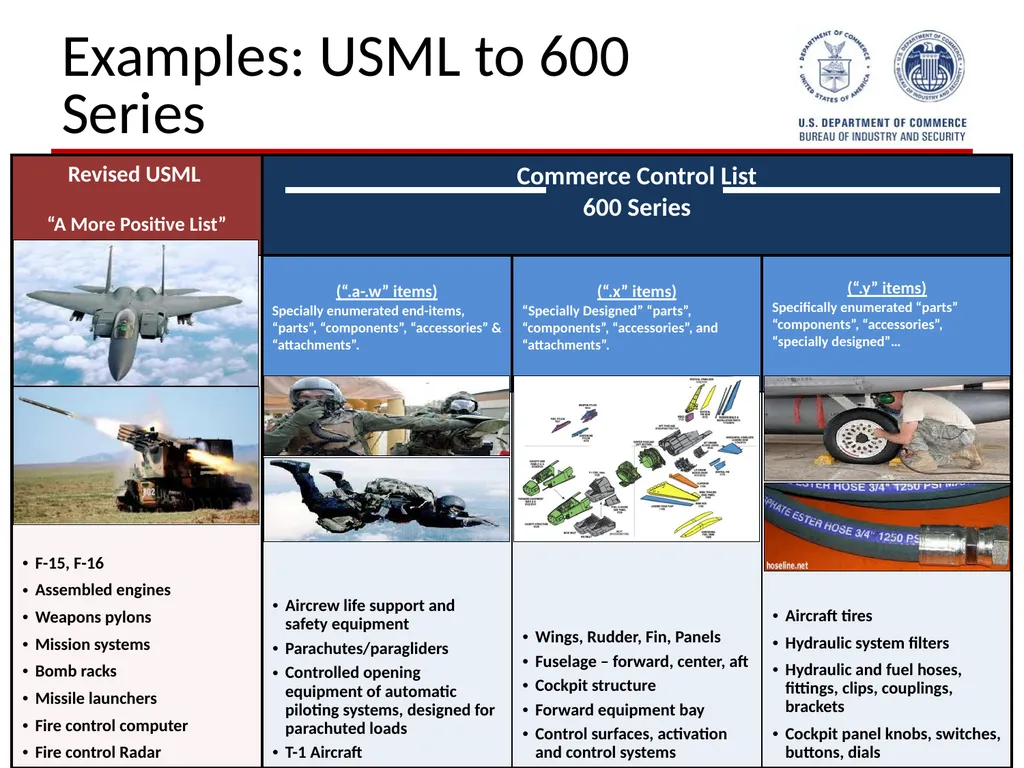
slide15. Examples: USML to 600 Series<br>
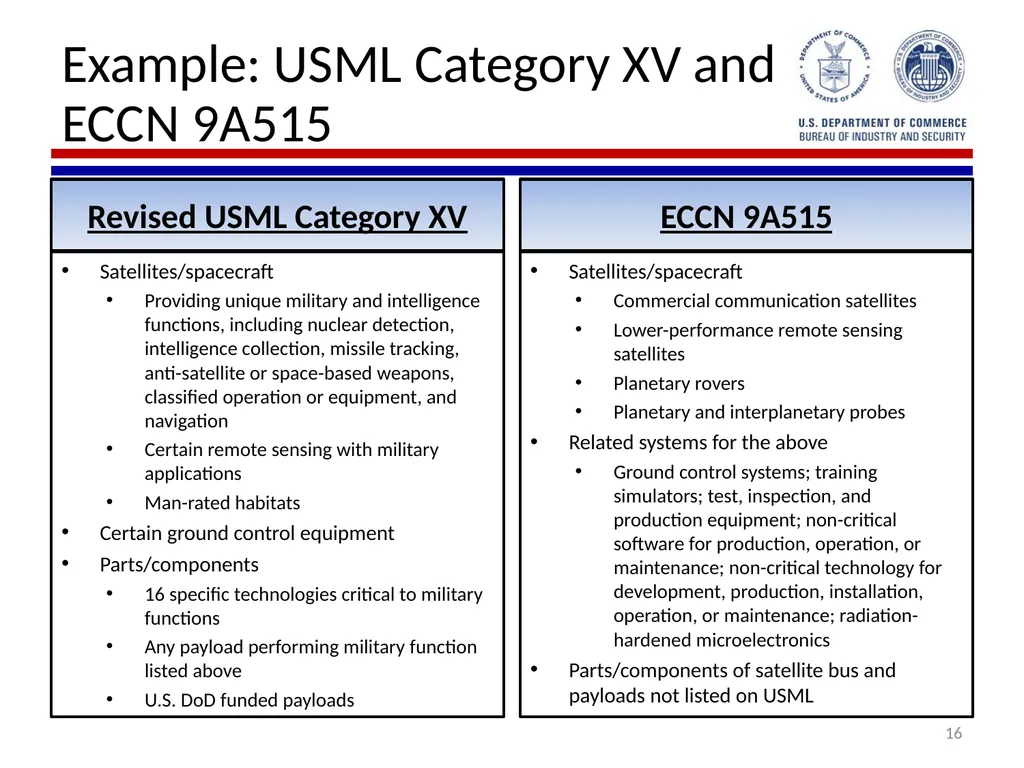
slide16. Example: USML Category XV and ECCN 9A515 Revised USML Category XV Satellites/spacecraft
Providing unique military and intelligence functions, including nuclear detection, intelligence collection, missile tracking, anti-satellite or space-based weapons, classified operation or equipment, and navigation
Certain remote sensing with military applications
Man-rated habitats
Certain ground control equipment
Parts/components
16 specific technologies critical to military functions
Any payload performing military function listed above
U.S. DoD funded payloads ECCN 9A515 Satellites/spacecraft
Commercial communication satellites
Lower-performance remote sensing satellites
Planetary rovers
Planetary and interplanetary probes
Related systems for the above
Ground control systems; training simulators; test, inspection, and production equipment; non-critical software for production, operation, or maintenance; non-critical technology for development, production, installation, operation, or maintenance; radiation-hardened microelectronics
Parts/components of satellite bus and payloads not listed on USML 16<br>
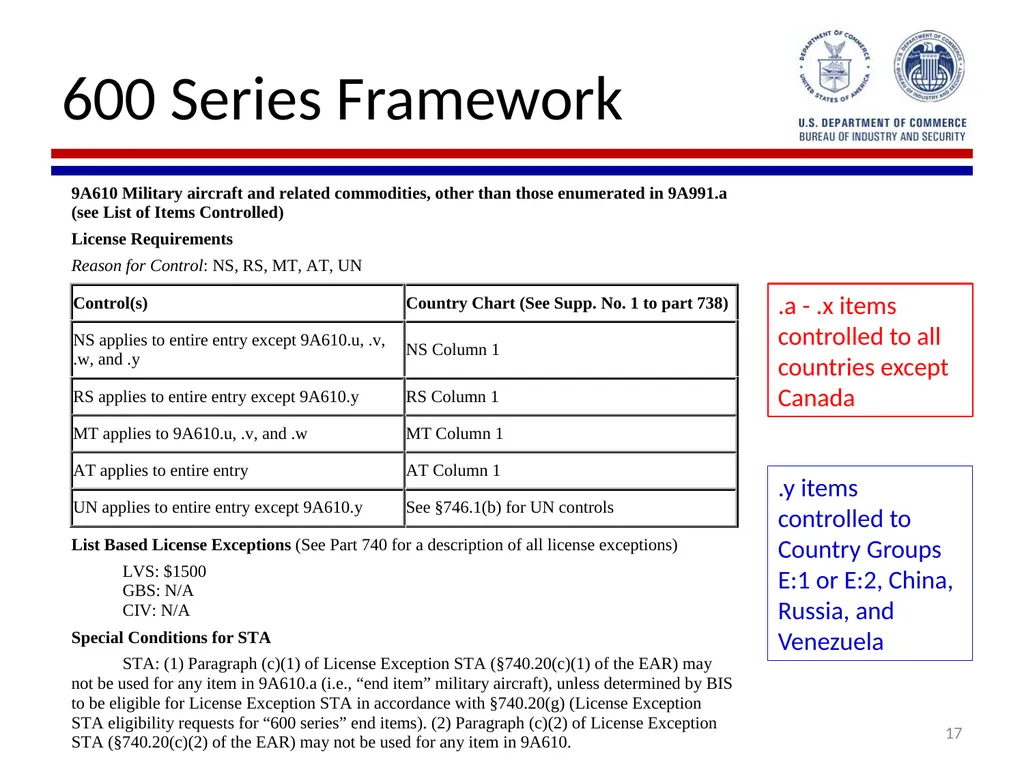
slide17. 600 Series Framework 17 .a - .x items controlled to all countries except Canada .y items controlled to Country Groups E:1 or E:2, China, Russia, and Venezuela<br>
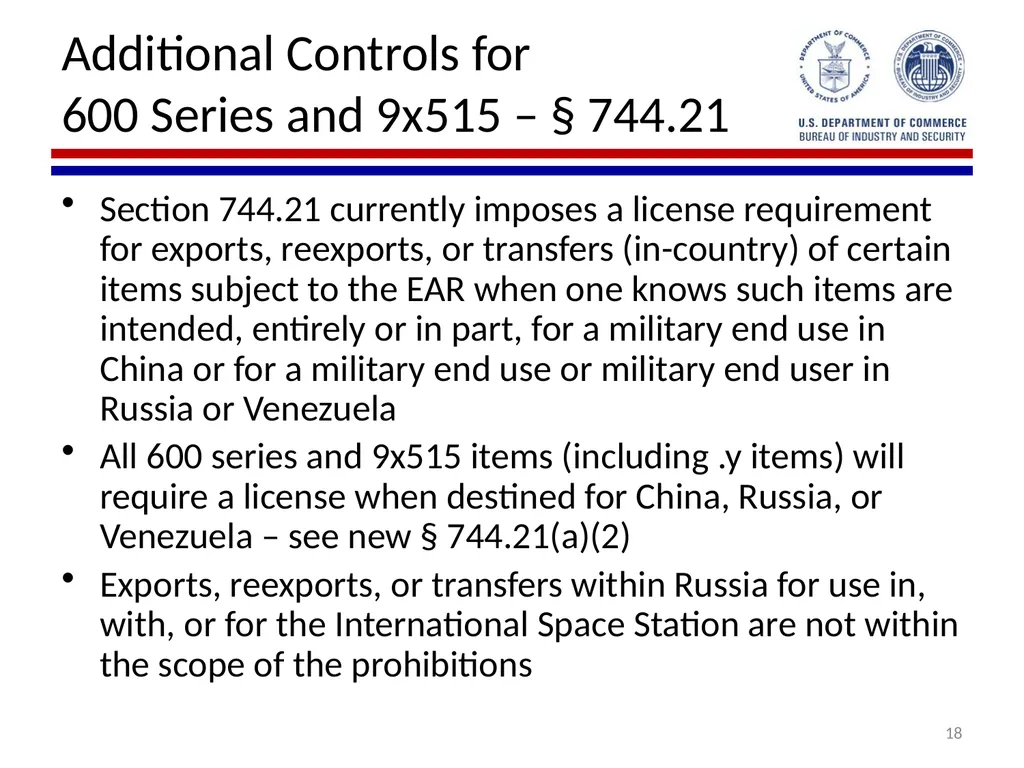
slide18. Additional Controls for 600 Series and 9x515 – § 744.21 Section 744.21 currently imposes a license requirement for exports, reexports, or transfers (in-country) of certain items subject to the EAR when one knows such items are intended, entirely or in part, for a military end use in China or for a military end use or military end user in Russia or Venezuela
All 600 series and 9x515 items (including .y items) will require a license when destined for China, Russia, or Venezuela – see new § 744.21(a)(2)
Exports, reexports, or transfers within Russia for use in, with, or for the International Space Station are not within the scope of the prohibitions 18<br>
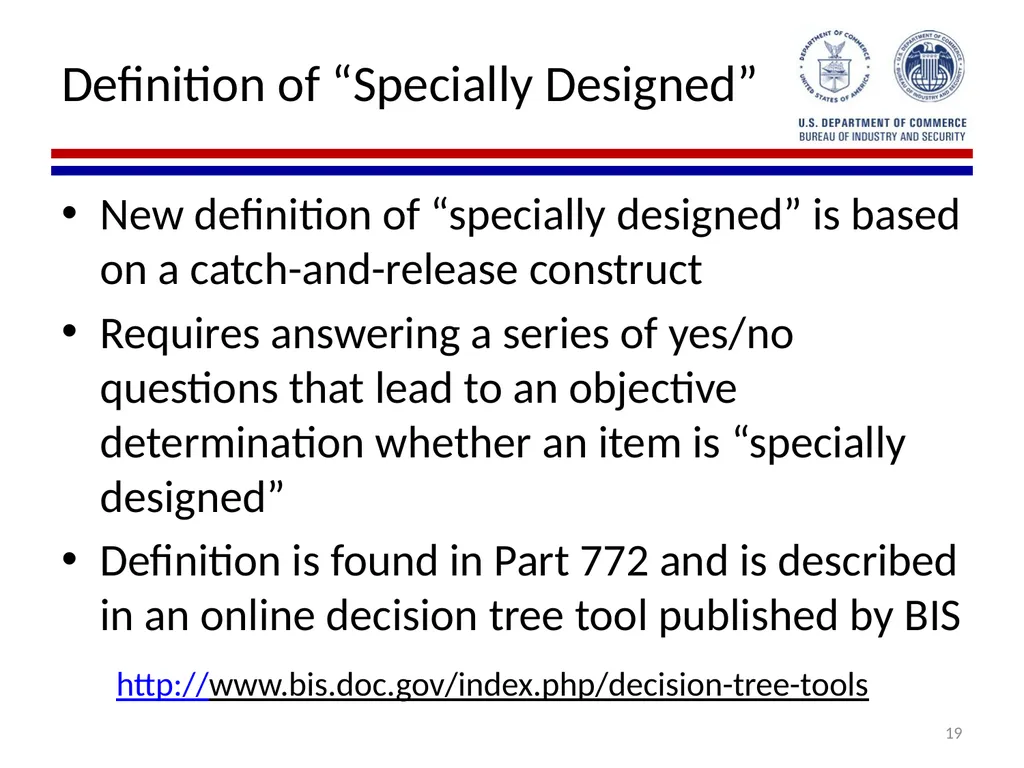
slide19. Definition of “Specially Designed” New definition of “specially designed” is based on a catch-and-release construct
Requires answering a series of yes/no questions that lead to an objective determination whether an item is “specially designed”
Definition is found in Part 772 and is described in an online decision tree tool published by BIS 19 http://www.bis.doc.gov/index.php/decision-tree-tools<br>
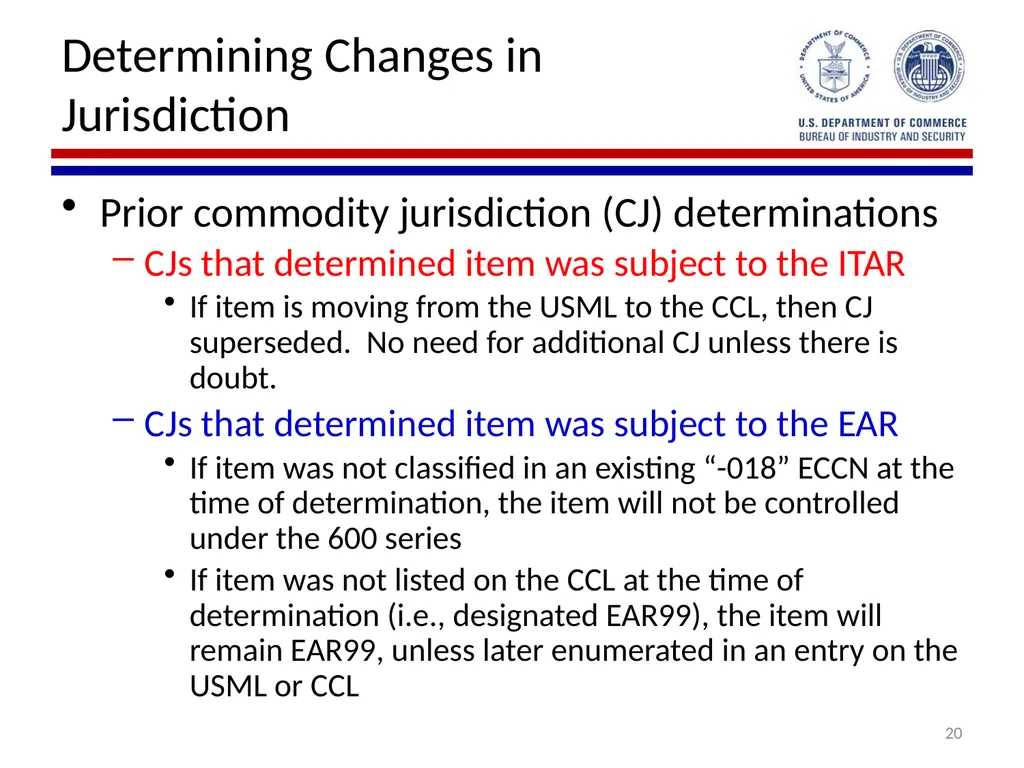
slide20. Determining Changes in Jurisdiction Prior commodity jurisdiction (CJ) determinations
CJs that determined item was subject to the ITAR
If item is moving from the USML to the CCL, then CJ superseded. No need for additional CJ unless there is doubt.
CJs that determined item was subject to the EAR
If item was not classified in an existing “-018” ECCN at the time of determination, the item will not be controlled under the 600 series
If item was not listed on the CCL at the time of determination (i.e., designated EAR99), the item will remain EAR99, unless later enumerated in an entry on the USML or CCL 20<br>
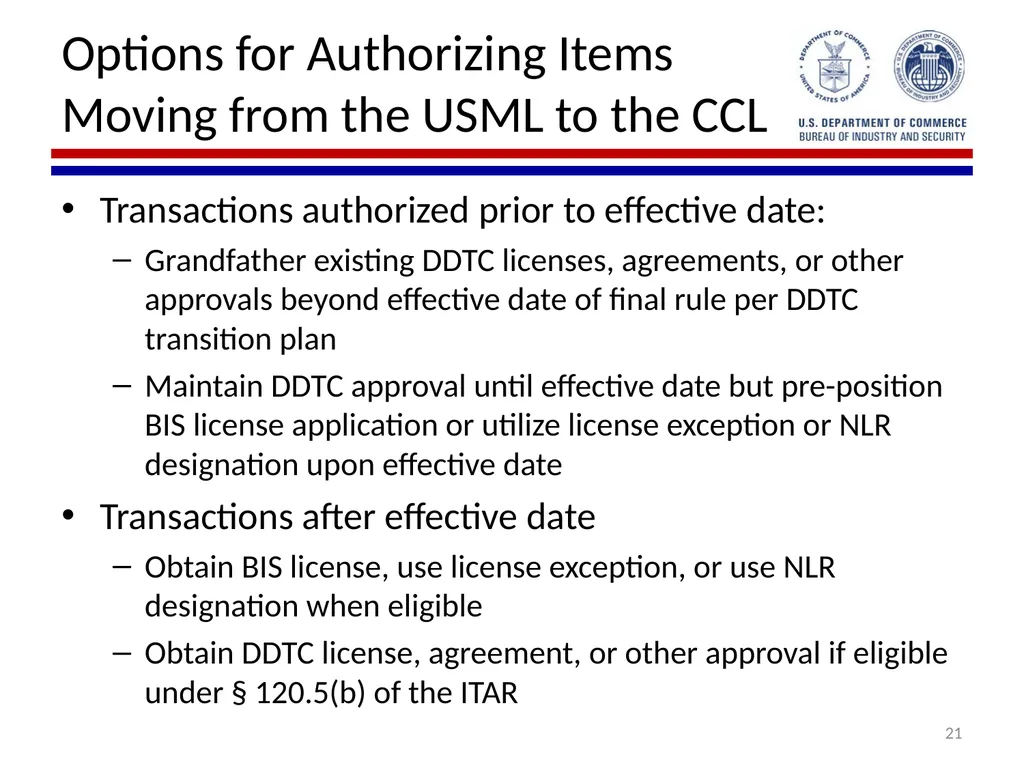
slide21. Options for Authorizing Items Moving from the USML to the CCL Transactions authorized prior to effective date:
Grandfather existing DDTC licenses, agreements, or other approvals beyond effective date of final rule per DDTC transition plan
Maintain DDTC approval until effective date but pre-position BIS license application or utilize license exception or NLR designation upon effective date
Transactions after effective date
Obtain BIS license, use license exception, or use NLR designation when eligible
Obtain DDTC license, agreement, or other approval if eligible under § 120.5(b) of the ITAR 21<br>
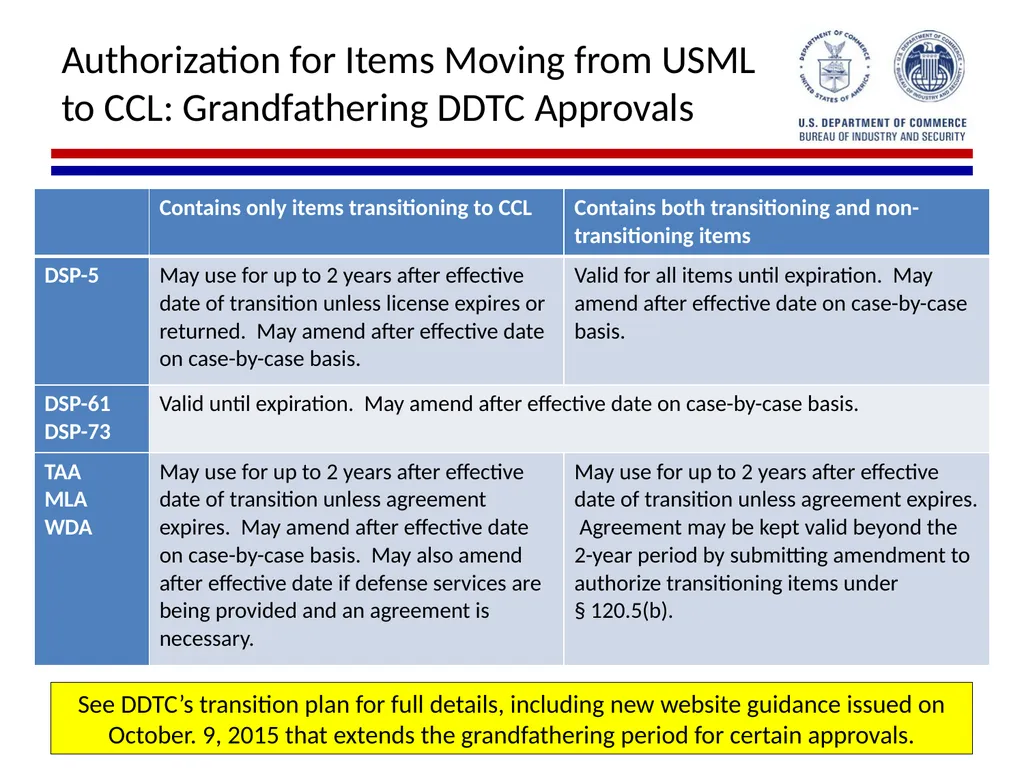
slide22. Authorization for Items Moving from USML to CCL: Grandfathering DDTC Approvals See DDTC’s transition plan for full details, including new website guidance issued on October. 9, 2015 that extends the grandfathering period for certain approvals. 22<br>
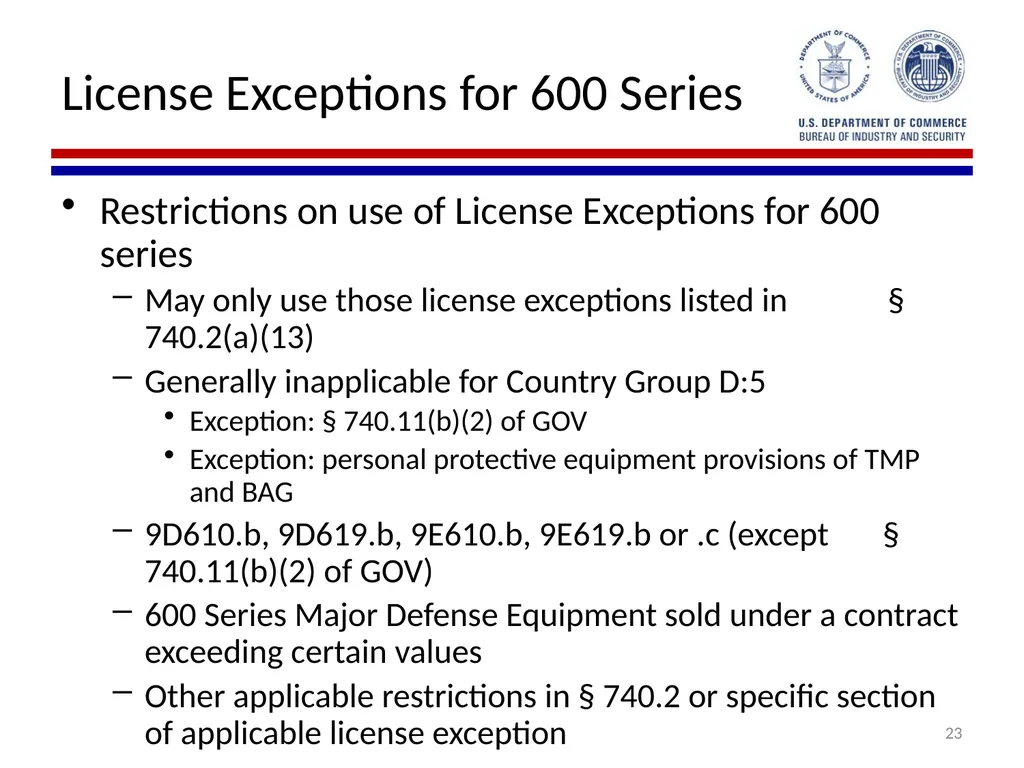
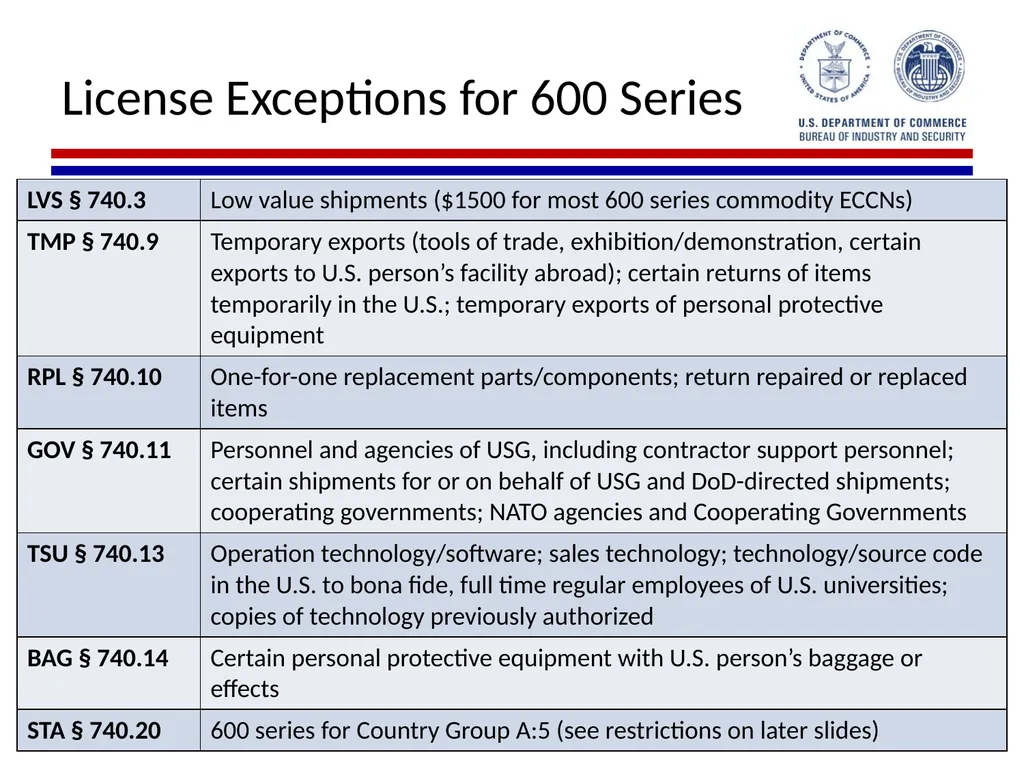
slide23. License Exceptions for 600 Series Restrictions on use of License Exceptions for 600 series
May only use those license exceptions listed in § 740.2(a)(13)
Generally inapplicable for Country Group D:5
Exception: § 740.11(b)(2) of GOV
Exception: personal protective equipment provisions of TMP and BAG
9D610.b, 9D619.b, 9E610.b, 9E619.b or .c (except § 740.11(b)(2) of GOV)
600 Series Major Defense Equipment sold under a contract exceeding certain values
Other applicable restrictions in § 740.2 or specific section of applicable license exception 23<br>
slide24. License Exceptions for 600 Series 24<br>
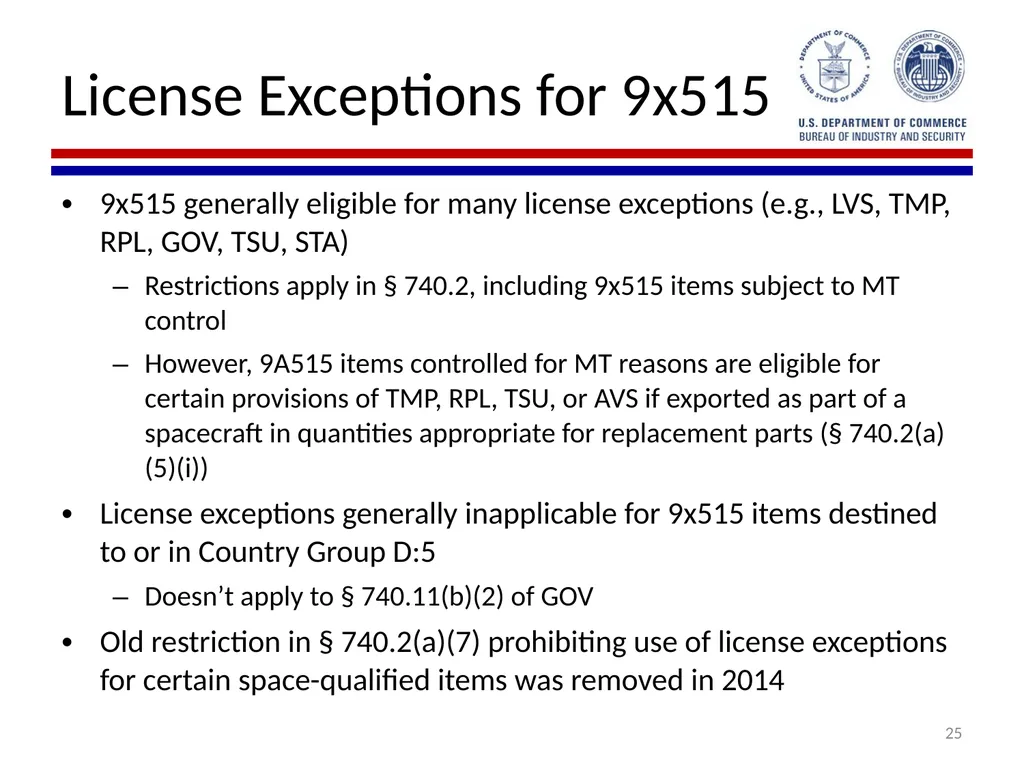
slide25. License Exceptions for 9x515 9x515 generally eligible for many license exceptions (e.g., LVS, TMP, RPL, GOV, TSU, STA)
Restrictions apply in § 740.2, including 9x515 items subject to MT control
However, 9A515 items controlled for MT reasons are eligible for certain provisions of TMP, RPL, TSU, or AVS if exported as part of a spacecraft in quantities appropriate for replacement parts (§ 740.2(a)(5)(i))
License exceptions generally inapplicable for 9x515 items destined to or in Country Group D:5
Doesn’t apply to § 740.11(b)(2) of GOV
Old restriction in § 740.2(a)(7) prohibiting use of license exceptions for certain space-qualified items was removed in 2014 25<br>
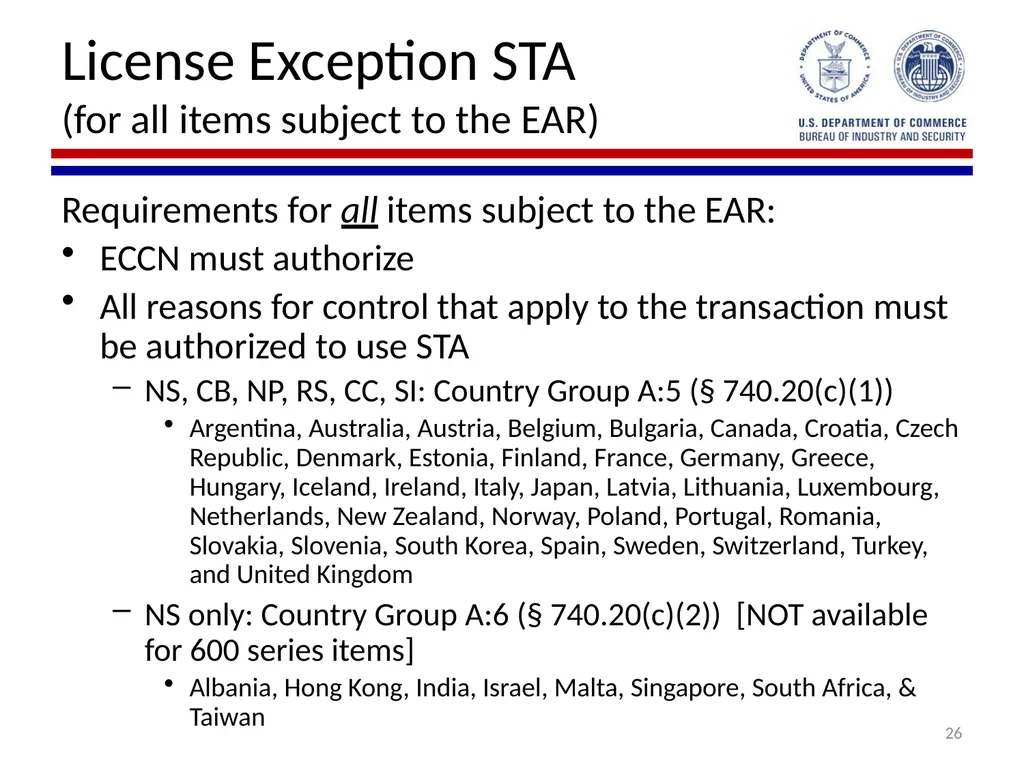
slide26. License Exception STA (for all items subject to the EAR) Requirements for all items subject to the EAR:
ECCN must authorize
All reasons for control that apply to the transaction must be authorized to use STA
NS, CB, NP, RS, CC, SI: Country Group A:5 (§ 740.20(c)(1))
Argentina, Australia, Austria, Belgium, Bulgaria, Canada, Croatia, Czech Republic, Denmark, Estonia, Finland, France, Germany, Greece, Hungary, Iceland, Ireland, Italy, Japan, Latvia, Lithuania, Luxembourg, Netherlands, New Zealand, Norway, Poland, Portugal, Romania, Slovakia, Slovenia, South Korea, Spain, Sweden, Switzerland, Turkey, and United Kingdom
NS only: Country Group A:6 (§ 740.20(c)(2)) [NOT available for 600 series items]
Albania, Hong Kong, India, Israel, Malta, Singapore, South Africa, & Taiwan 26<br>
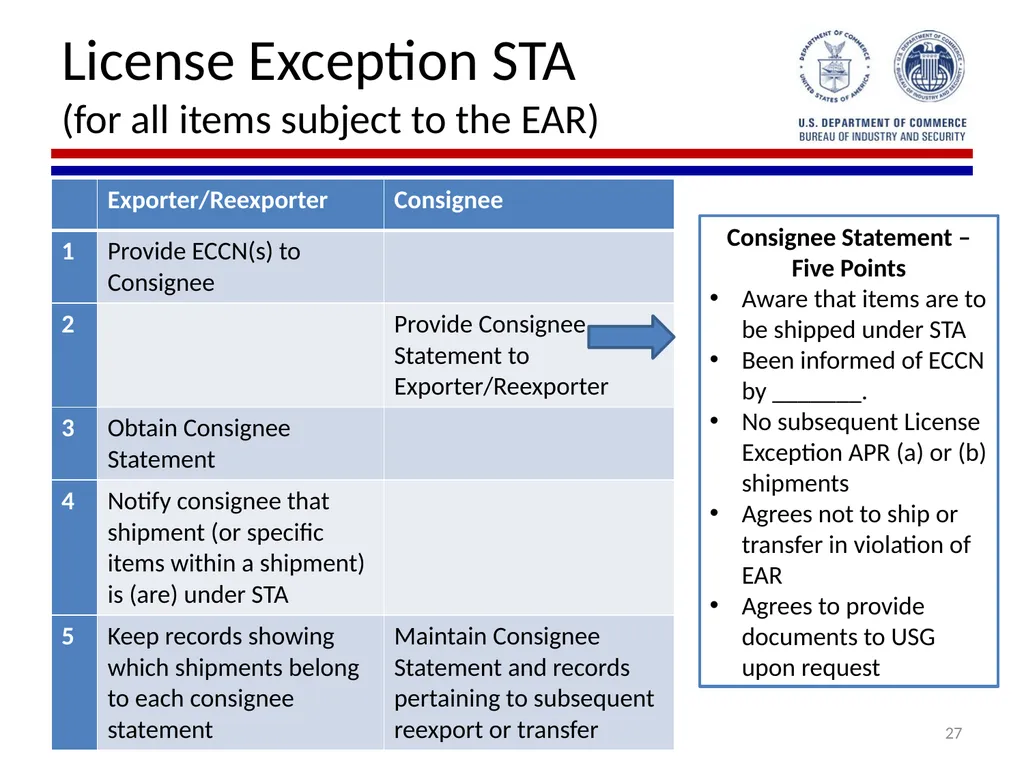
slide27. License Exception STA (for all items subject to the EAR) 27 Consignee Statement – Five Points
Aware that items are to be shipped under STA
Been informed of ECCN by _______.
No subsequent License Exception APR (a) or (b) shipments
Agrees not to ship or transfer in violation of EAR
Agrees to provide documents to USG upon request<br>
slide28. License Exception STA - 600 Series License Exception STA: additional requirements for 600 series items only
For ultimate end user that is the USG or government of country in Country Group A:5 (“STA-36” countries);
For development, production, or servicing of an item in A:5 or the United States that is:
Ultimately to be used by the USG or government of country in Country Group A:5, or
Sent to a person in the United States; or
If USG has otherwise authorized its use. 28<br>
slide29. License Exception STA - 600 Series License Exception STA: additional requirements for 600 series items only
Non-U.S. parties must have been previously approved on a State approval or Commerce license
Consignee statement must also address ultimate end user restrictions for 600 series items and agree to end use check
Eligibility request required for end items in 0A606.a, 8A609.a, 8A620.a or .b, or 9A610.a 29<br>
slide30. License Exception STA - 9x515 9x515 generally eligible for STA for Country Group A:5
Unlike 600 series, ultimate government end use is not required
Prior Consignee Statement requirements generally the same as for non-600 series items, but statement must allow for USG end-use check
Certain spacecraft in 9A515.a require eligibility request
Software in 9D515.b, .d, or .e and technology in 9E515.b, .d, or .e are not eligible for STA 30<br>
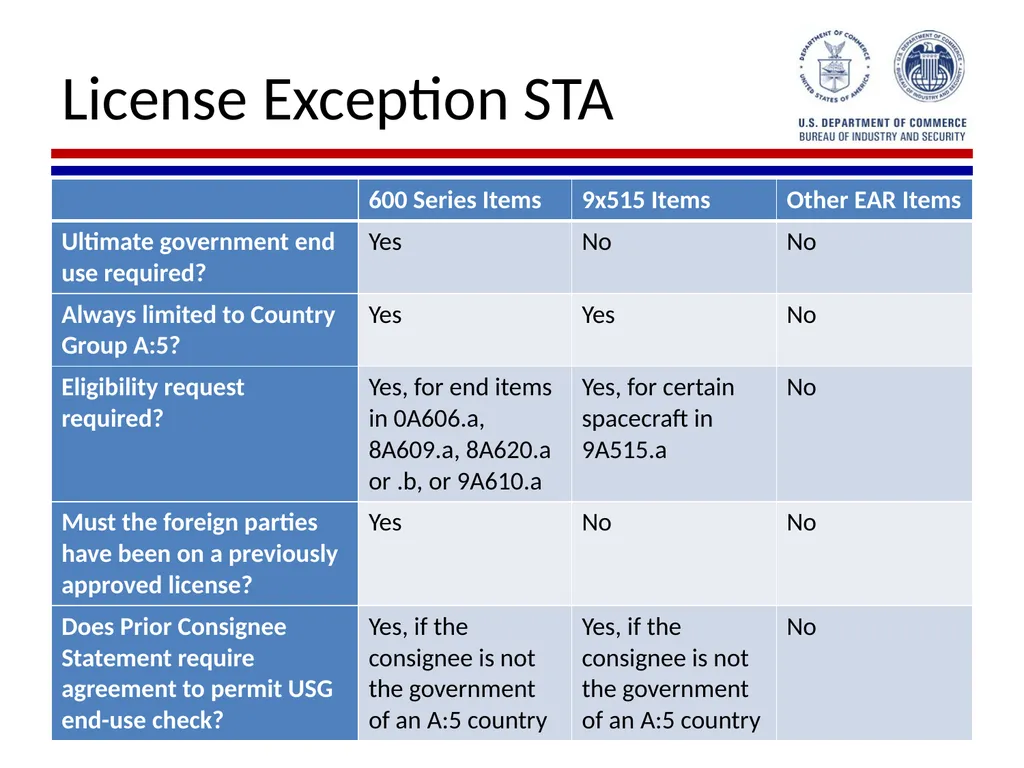
slide31. License Exception STA 31<br>
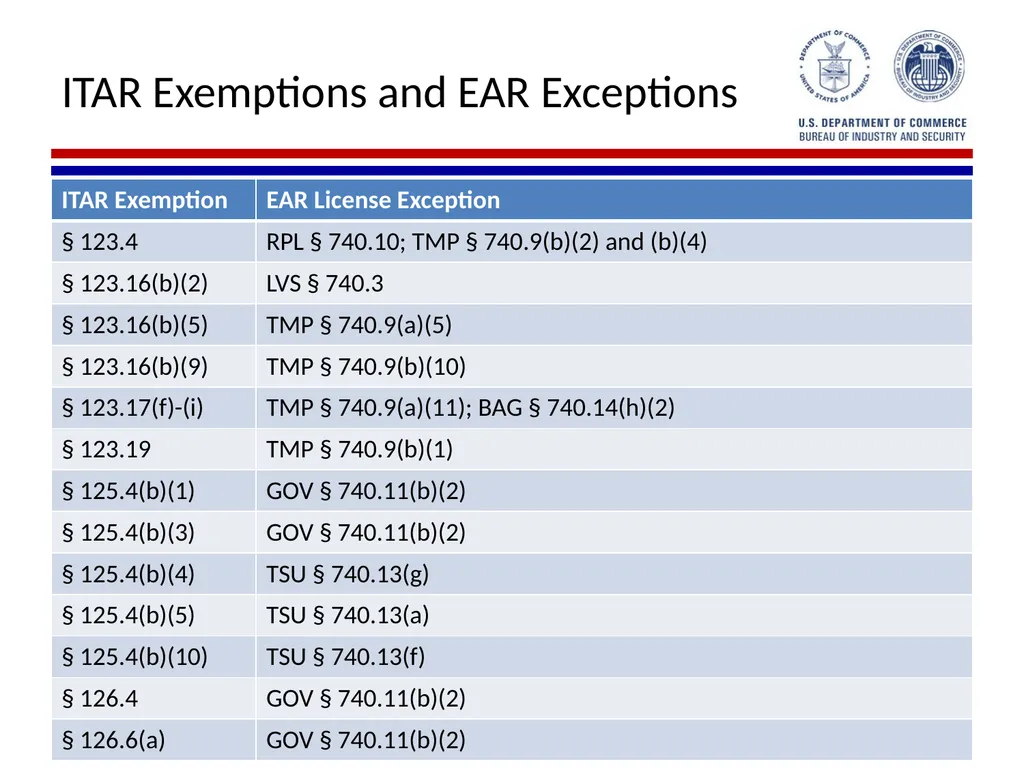
slide32. ITAR Exemptions and EAR Exceptions 32<br>
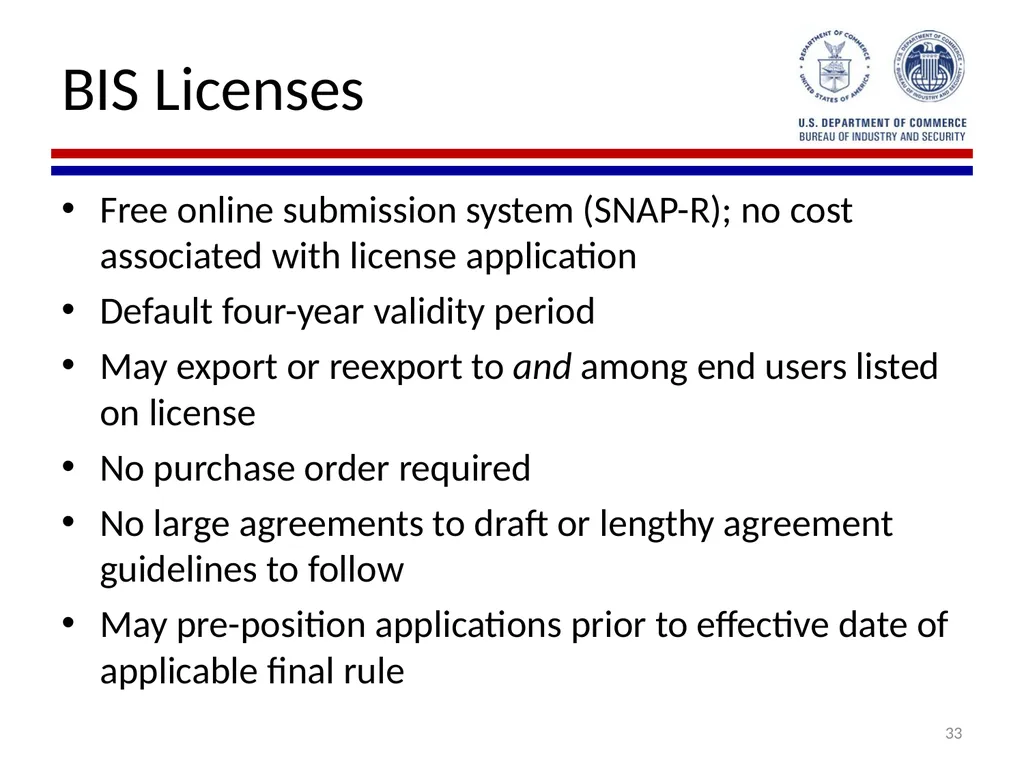
slide33. BIS Licenses Free online submission system (SNAP-R); no cost associated with license application
Default four-year validity period
May export or reexport to and among end users listed on license
No purchase order required
No large agreements to draft or lengthy agreement guidelines to follow
May pre-position applications prior to effective date of applicable final rule 33<br>
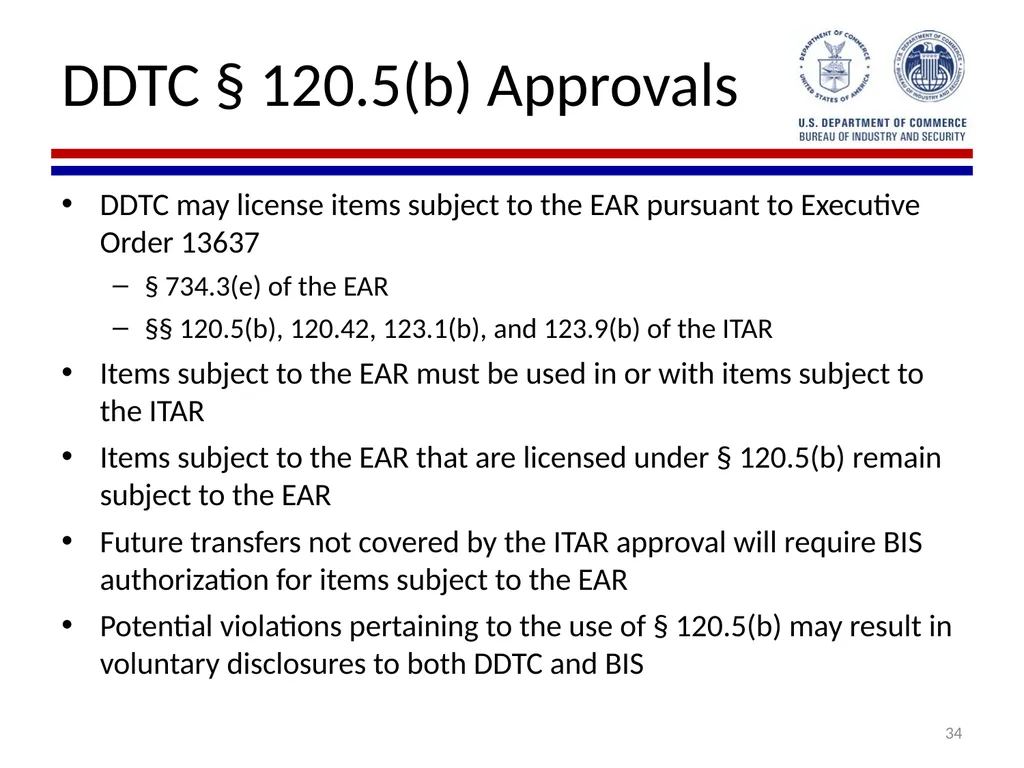
slide34. DDTC § 120.5(b) Approvals DDTC may license items subject to the EAR pursuant to Executive Order 13637
§ 734.3(e) of the EAR
§§ 120.5(b), 120.42, 123.1(b), and 123.9(b) of the ITAR
Items subject to the EAR must be used in or with items subject to the ITAR
Items subject to the EAR that are licensed under § 120.5(b) remain subject to the EAR
Future transfers not covered by the ITAR approval will require BIS authorization for items subject to the EAR
Potential violations pertaining to the use of § 120.5(b) may result in voluntary disclosures to both DDTC and BIS 34<br>
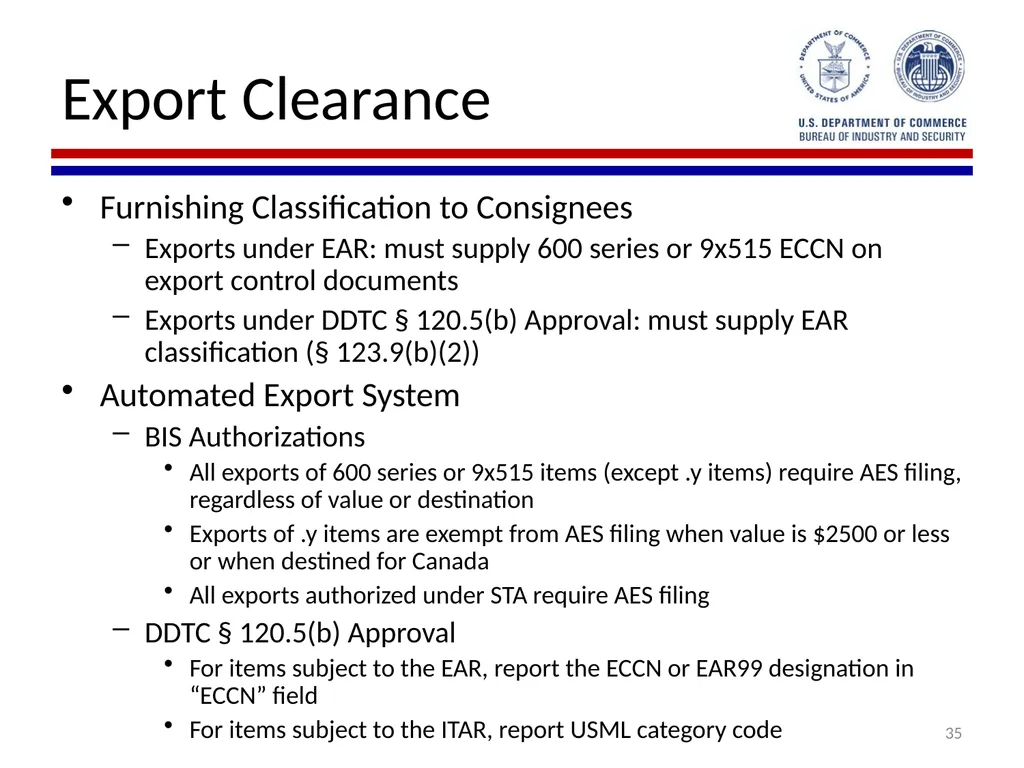
slide35. Export Clearance Furnishing Classification to Consignees
Exports under EAR: must supply 600 series or 9x515 ECCN on export control documents
Exports under DDTC § 120.5(b) Approval: must supply EAR classification (§ 123.9(b)(2))
Automated Export System
BIS Authorizations
All exports of 600 series or 9x515 items (except .y items) require AES filing, regardless of value or destination
Exports of .y items are exempt from AES filing when value is $2500 or less or when destined for Canada
All exports authorized under STA require AES filing
DDTC § 120.5(b) Approval
For items subject to the EAR, report the ECCN or EAR99 designation in “ECCN” field
For items subject to the ITAR, report USML category code 35<br>
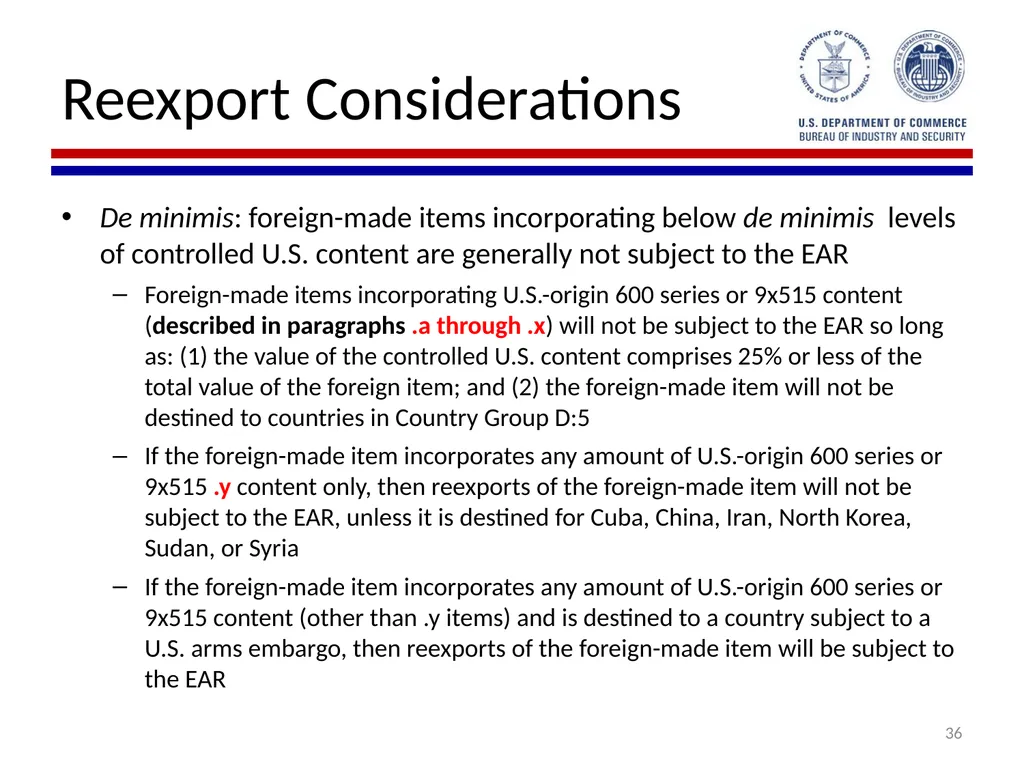
slide36. Reexport Considerations De minimis: foreign-made items incorporating below de minimis levels of controlled U.S. content are generally not subject to the EAR
Foreign-made items incorporating U.S.-origin 600 series or 9x515 content (described in paragraphs .a through .x) will not be subject to the EAR so long as: (1) the value of the controlled U.S. content comprises 25% or less of the total value of the foreign item; and (2) the foreign-made item will not be destined to countries in Country Group D:5
If the foreign-made item incorporates any amount of U.S.-origin 600 series or 9x515 .y content only, then reexports of the foreign-made item will not be subject to the EAR, unless it is destined for Cuba, China, Iran, North Korea, Sudan, or Syria
If the foreign-made item incorporates any amount of U.S.-origin 600 series or 9x515 content (other than .y items) and is destined to a country subject to a U.S. arms embargo, then reexports of the foreign-made item will be subject to the EAR 36<br>
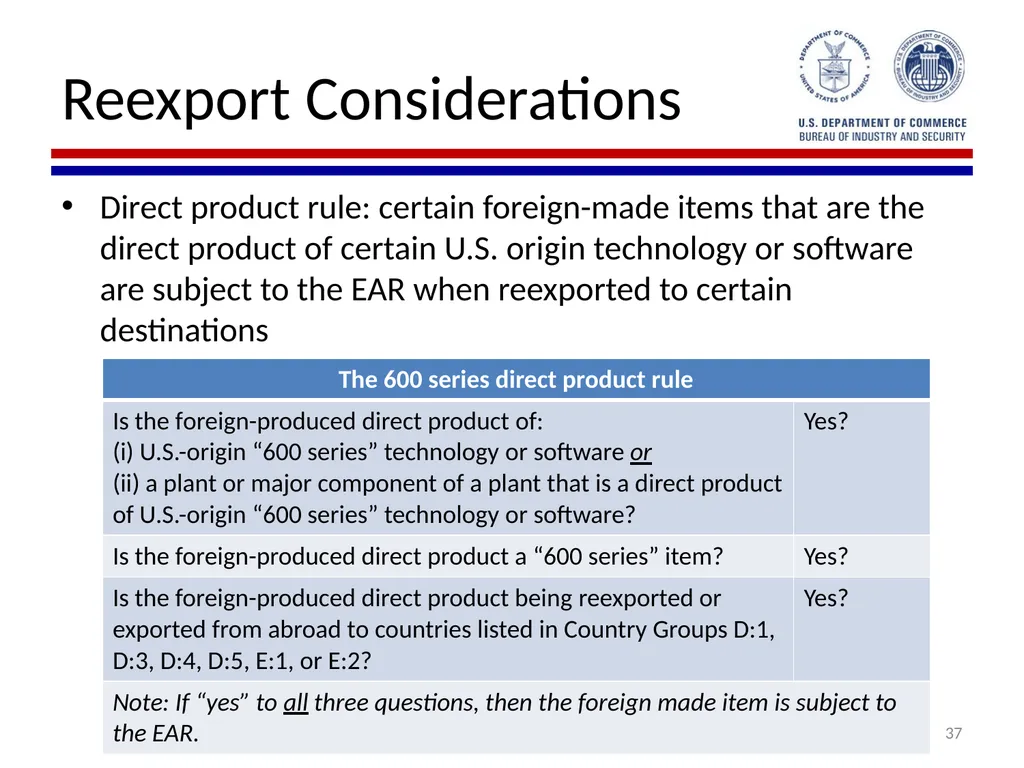
slide37. Reexport Considerations Direct product rule: certain foreign-made items that are the direct product of certain U.S. origin technology or software are subject to the EAR when reexported to certain destinations 37<br>
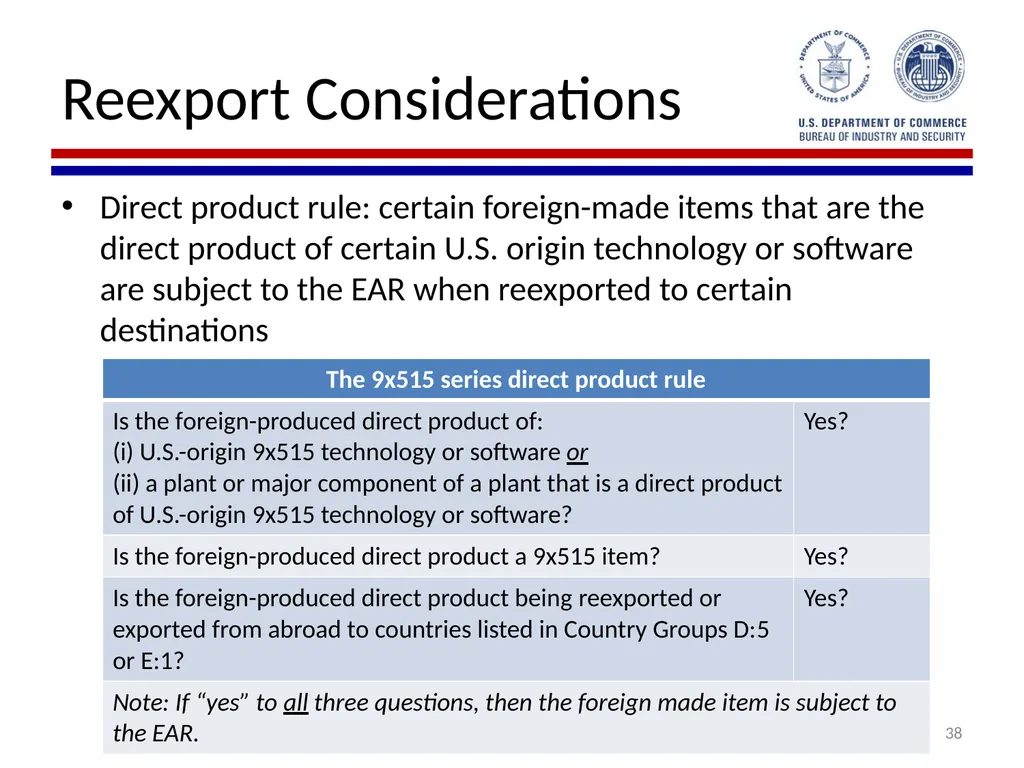
slide38. Reexport Considerations Direct product rule: certain foreign-made items that are the direct product of certain U.S. origin technology or software are subject to the EAR when reexported to certain destinations 38<br>
slide39. Contact Information 600 Series Licensing and Classification Requests: Munitions Control Division
Elena Love, elena.love@bis.doc.gov; Tom DeFee, thomas.defee@bis.doc.gov
Technical Product Questions
Aircraft, gas turbine engines, or ground vehicles: Gene Christiansen, gene.christiansen@bis.doc.gov; Jeff Leitz, jeffrey.leitz@bis.doc.gov
Surface or submersible vessels: Alex Lopes, alexander.lopes@bis.doc.gov; Jeff Leitz, jeffrey.leitz@bis.doc.gov
Materials, miscellaneous items, energetic materials, or protective equipment: Mike Rithmire, michael.rithmire@bis.doc.gov
Military training equipment: Dan Squire, daniel.squire@bis.doc.gov
Missiles/launch vehicles: Dennis Krepp, dennis.krepp@bis.doc.gov
Electronics: Brian Baker, brian.baker@bis.doc.gov; Tom DeFee, thomas.defee@bis.doc.gov
Spacecraft/satellites: Dennis Krepp, dennis.krepp@bis.doc.gov; Mark Jaso, mark.jaso@bis.doc.gov
Regulatory Interpretation and Transition Guidance
Regulatory Policy Division: rpd2@bis.doc.gov , 1-202-482-2440
Office of the Assistant Secretary for Export Administration: steven.emme@bis.doc.gov
Outreach Assistance: Outreach and Educational Services Division
Director: Rebecca Joyce, OESDseminar@bis.doc.gov, 1-202-482-4811
Western Regional Office Director: Michael Hoffman, 1-949-660-0144
www.bis.doc.gov www.export.gov/ecr 39<br>
Assistant Secretary of Commerce
for Export Administration<br>
slide2. Topics ECR Background/Status
Determining Changes in Jurisdiction
Order of Review
Framework for USML, 600 Series, and 9x515
“Specially Designed”
Authorization for Items Moving from USML to CCL
Grandfathering DDTC Approvals
License Exceptions
BIS Licenses
DDTC § 120.5(b) Approvals
Export Clearance
Reexport Considerations 2<br>
slide3. ECR Background In August 2009, President Obama directed the agencies involved in the U.S. export control system to conduct a broad-based review of export controls to identify additional ways to enhance U.S. national security.
In April 2010, former Secretary of Defense Gates described how national security required a fundamental reform of the export control system.
U.S. agencies began reviewing the U.S. Munitions List (USML) later in 2010 to determine what items no longer warranted control under the USML.
In January 2013, President Obama signed the National Defense Authorization Act for FY2013, which authorized the President to review commercial satellites and related items controlled under USML Category XV. 3<br>
slide4. ECR Background To enhance national security, the Administration determined that the export control system needed to be reformed to:
Increase interoperability with NATO and other close allies;
Reduce the current incentives for companies in non-embargoed countries to design out or avoid US-origin content; and
Allow the Administration to focus its resources on the transactions of greater concern. 4<br>
slide5. ECR Background To implement the objectives, the Administration needed to:
Identify the specific sensitive and other items on a more positive USML that warrant individual license reviews even for ultimate end use by NATO and other regime allies; and
Amend the EAR and the CCL to control all formerly USML items that would no longer be on the revised USML so that they still could be adequately controlled, but in a more flexible way regarding such allies. 5<br>
slide6. 6 ECR Background<br>
slide7. ECR Background 7<br>
slide8. Status 8<br>
slide9. Status 9<br>
slide10. Status From October 2013 through October 2015:
55% reduction in license volume at the Department of State for the newly implemented USML categories
Aircraft/gas turbine engines: 65% reduction
Spacecraft/satellites: 80% reduction
Over 24,000 license applications submitted to BIS for items that have moved from the USML to the CCL
Over 173,000 shipments valued at $7 billion in exports have been shipped under BIS authorizations
Top items: 9A610 (aircraft items), 9A619 (gas turbine engine items), 9A515 (spacecraft), 0A606 (ground vehicle items)
Top destinations (by value): Japan, Canada, United Kingdom, South Korea, Mexico, France, Germany, Israel 10<br>
slide11. Order of Review (Supp. No. 4 to part 774) Review the USML
Specifically enumerated items
“Catch-all” controls and ITAR definition of “specially designed”
If not on the USML, review the CCL
Review characteristics of item to determine applicable CCL category and product group
Review applicable 600 series and 9x515 ECCNs
Specifically enumerated items
“Catch-all” controls and EAR definition of “specially designed”
Review applicable non-600 series/9x515 ECCNs 11<br>
slide12. USML Framework Control text for:
End platforms and major systems
Parts, components, accessories, and attachments
Classified articles
Technical data (including software) and defense services
Items subject to the EAR – new “(x)” paragraph 12<br>
slide13. 600 Series Framework Former USML items (and -018 items) listed in the “Items” paragraph.
Order of review:
.a - .w: specifically enumerated end items, materials, parts, components, accessories, and attachments
Some items may be “specially designed”
.y: specifically described commodities (primarily parts, components, accessories, and attachments) that are “specially designed”
.x: “specially designed” parts, components, accessories, and attachments that are not specifically enumerated 9A610 CCL
Category
0-9 Product Group
A-E “600 series” derives its name from the 3rd character of the ECCN Last two characters will generally track the WAML 13<br>
slide14. 9x515 Framework .a - .w: specifically enumerated end items, materials, parts, components, accessories, and attachments
Some items may be “specially designed”
.x: “specially designed” parts, components, accessories, and attachments that are not specifically enumerated
.y: items that would otherwise be within scope of 9A515.x but that have been identified in interagency-cleared CCATS (§ 748.3(e))
Currently one type of item listed in 9A515.y 9A515 CCL
Category
0-9 Product Group
A-E “5” is used to distinguish from 600 series and dual-use items not previously in USML Cat XV Last two characters reference USML Cat XV 14<br>
slide15. Examples: USML to 600 Series<br>
slide16. Example: USML Category XV and ECCN 9A515 Revised USML Category XV Satellites/spacecraft
Providing unique military and intelligence functions, including nuclear detection, intelligence collection, missile tracking, anti-satellite or space-based weapons, classified operation or equipment, and navigation
Certain remote sensing with military applications
Man-rated habitats
Certain ground control equipment
Parts/components
16 specific technologies critical to military functions
Any payload performing military function listed above
U.S. DoD funded payloads ECCN 9A515 Satellites/spacecraft
Commercial communication satellites
Lower-performance remote sensing satellites
Planetary rovers
Planetary and interplanetary probes
Related systems for the above
Ground control systems; training simulators; test, inspection, and production equipment; non-critical software for production, operation, or maintenance; non-critical technology for development, production, installation, operation, or maintenance; radiation-hardened microelectronics
Parts/components of satellite bus and payloads not listed on USML 16<br>
slide17. 600 Series Framework 17 .a - .x items controlled to all countries except Canada .y items controlled to Country Groups E:1 or E:2, China, Russia, and Venezuela<br>
slide18. Additional Controls for 600 Series and 9x515 – § 744.21 Section 744.21 currently imposes a license requirement for exports, reexports, or transfers (in-country) of certain items subject to the EAR when one knows such items are intended, entirely or in part, for a military end use in China or for a military end use or military end user in Russia or Venezuela
All 600 series and 9x515 items (including .y items) will require a license when destined for China, Russia, or Venezuela – see new § 744.21(a)(2)
Exports, reexports, or transfers within Russia for use in, with, or for the International Space Station are not within the scope of the prohibitions 18<br>
slide19. Definition of “Specially Designed” New definition of “specially designed” is based on a catch-and-release construct
Requires answering a series of yes/no questions that lead to an objective determination whether an item is “specially designed”
Definition is found in Part 772 and is described in an online decision tree tool published by BIS 19 http://www.bis.doc.gov/index.php/decision-tree-tools<br>
slide20. Determining Changes in Jurisdiction Prior commodity jurisdiction (CJ) determinations
CJs that determined item was subject to the ITAR
If item is moving from the USML to the CCL, then CJ superseded. No need for additional CJ unless there is doubt.
CJs that determined item was subject to the EAR
If item was not classified in an existing “-018” ECCN at the time of determination, the item will not be controlled under the 600 series
If item was not listed on the CCL at the time of determination (i.e., designated EAR99), the item will remain EAR99, unless later enumerated in an entry on the USML or CCL 20<br>
slide21. Options for Authorizing Items Moving from the USML to the CCL Transactions authorized prior to effective date:
Grandfather existing DDTC licenses, agreements, or other approvals beyond effective date of final rule per DDTC transition plan
Maintain DDTC approval until effective date but pre-position BIS license application or utilize license exception or NLR designation upon effective date
Transactions after effective date
Obtain BIS license, use license exception, or use NLR designation when eligible
Obtain DDTC license, agreement, or other approval if eligible under § 120.5(b) of the ITAR 21<br>
slide22. Authorization for Items Moving from USML to CCL: Grandfathering DDTC Approvals See DDTC’s transition plan for full details, including new website guidance issued on October. 9, 2015 that extends the grandfathering period for certain approvals. 22<br>
slide23. License Exceptions for 600 Series Restrictions on use of License Exceptions for 600 series
May only use those license exceptions listed in § 740.2(a)(13)
Generally inapplicable for Country Group D:5
Exception: § 740.11(b)(2) of GOV
Exception: personal protective equipment provisions of TMP and BAG
9D610.b, 9D619.b, 9E610.b, 9E619.b or .c (except § 740.11(b)(2) of GOV)
600 Series Major Defense Equipment sold under a contract exceeding certain values
Other applicable restrictions in § 740.2 or specific section of applicable license exception 23<br>
slide24. License Exceptions for 600 Series 24<br>
slide25. License Exceptions for 9x515 9x515 generally eligible for many license exceptions (e.g., LVS, TMP, RPL, GOV, TSU, STA)
Restrictions apply in § 740.2, including 9x515 items subject to MT control
However, 9A515 items controlled for MT reasons are eligible for certain provisions of TMP, RPL, TSU, or AVS if exported as part of a spacecraft in quantities appropriate for replacement parts (§ 740.2(a)(5)(i))
License exceptions generally inapplicable for 9x515 items destined to or in Country Group D:5
Doesn’t apply to § 740.11(b)(2) of GOV
Old restriction in § 740.2(a)(7) prohibiting use of license exceptions for certain space-qualified items was removed in 2014 25<br>
slide26. License Exception STA (for all items subject to the EAR) Requirements for all items subject to the EAR:
ECCN must authorize
All reasons for control that apply to the transaction must be authorized to use STA
NS, CB, NP, RS, CC, SI: Country Group A:5 (§ 740.20(c)(1))
Argentina, Australia, Austria, Belgium, Bulgaria, Canada, Croatia, Czech Republic, Denmark, Estonia, Finland, France, Germany, Greece, Hungary, Iceland, Ireland, Italy, Japan, Latvia, Lithuania, Luxembourg, Netherlands, New Zealand, Norway, Poland, Portugal, Romania, Slovakia, Slovenia, South Korea, Spain, Sweden, Switzerland, Turkey, and United Kingdom
NS only: Country Group A:6 (§ 740.20(c)(2)) [NOT available for 600 series items]
Albania, Hong Kong, India, Israel, Malta, Singapore, South Africa, & Taiwan 26<br>
slide27. License Exception STA (for all items subject to the EAR) 27 Consignee Statement – Five Points
Aware that items are to be shipped under STA
Been informed of ECCN by _______.
No subsequent License Exception APR (a) or (b) shipments
Agrees not to ship or transfer in violation of EAR
Agrees to provide documents to USG upon request<br>
slide28. License Exception STA - 600 Series License Exception STA: additional requirements for 600 series items only
For ultimate end user that is the USG or government of country in Country Group A:5 (“STA-36” countries);
For development, production, or servicing of an item in A:5 or the United States that is:
Ultimately to be used by the USG or government of country in Country Group A:5, or
Sent to a person in the United States; or
If USG has otherwise authorized its use. 28<br>
slide29. License Exception STA - 600 Series License Exception STA: additional requirements for 600 series items only
Non-U.S. parties must have been previously approved on a State approval or Commerce license
Consignee statement must also address ultimate end user restrictions for 600 series items and agree to end use check
Eligibility request required for end items in 0A606.a, 8A609.a, 8A620.a or .b, or 9A610.a 29<br>
slide30. License Exception STA - 9x515 9x515 generally eligible for STA for Country Group A:5
Unlike 600 series, ultimate government end use is not required
Prior Consignee Statement requirements generally the same as for non-600 series items, but statement must allow for USG end-use check
Certain spacecraft in 9A515.a require eligibility request
Software in 9D515.b, .d, or .e and technology in 9E515.b, .d, or .e are not eligible for STA 30<br>
slide31. License Exception STA 31<br>
slide32. ITAR Exemptions and EAR Exceptions 32<br>
slide33. BIS Licenses Free online submission system (SNAP-R); no cost associated with license application
Default four-year validity period
May export or reexport to and among end users listed on license
No purchase order required
No large agreements to draft or lengthy agreement guidelines to follow
May pre-position applications prior to effective date of applicable final rule 33<br>
slide34. DDTC § 120.5(b) Approvals DDTC may license items subject to the EAR pursuant to Executive Order 13637
§ 734.3(e) of the EAR
§§ 120.5(b), 120.42, 123.1(b), and 123.9(b) of the ITAR
Items subject to the EAR must be used in or with items subject to the ITAR
Items subject to the EAR that are licensed under § 120.5(b) remain subject to the EAR
Future transfers not covered by the ITAR approval will require BIS authorization for items subject to the EAR
Potential violations pertaining to the use of § 120.5(b) may result in voluntary disclosures to both DDTC and BIS 34<br>
slide35. Export Clearance Furnishing Classification to Consignees
Exports under EAR: must supply 600 series or 9x515 ECCN on export control documents
Exports under DDTC § 120.5(b) Approval: must supply EAR classification (§ 123.9(b)(2))
Automated Export System
BIS Authorizations
All exports of 600 series or 9x515 items (except .y items) require AES filing, regardless of value or destination
Exports of .y items are exempt from AES filing when value is $2500 or less or when destined for Canada
All exports authorized under STA require AES filing
DDTC § 120.5(b) Approval
For items subject to the EAR, report the ECCN or EAR99 designation in “ECCN” field
For items subject to the ITAR, report USML category code 35<br>
slide36. Reexport Considerations De minimis: foreign-made items incorporating below de minimis levels of controlled U.S. content are generally not subject to the EAR
Foreign-made items incorporating U.S.-origin 600 series or 9x515 content (described in paragraphs .a through .x) will not be subject to the EAR so long as: (1) the value of the controlled U.S. content comprises 25% or less of the total value of the foreign item; and (2) the foreign-made item will not be destined to countries in Country Group D:5
If the foreign-made item incorporates any amount of U.S.-origin 600 series or 9x515 .y content only, then reexports of the foreign-made item will not be subject to the EAR, unless it is destined for Cuba, China, Iran, North Korea, Sudan, or Syria
If the foreign-made item incorporates any amount of U.S.-origin 600 series or 9x515 content (other than .y items) and is destined to a country subject to a U.S. arms embargo, then reexports of the foreign-made item will be subject to the EAR 36<br>
slide37. Reexport Considerations Direct product rule: certain foreign-made items that are the direct product of certain U.S. origin technology or software are subject to the EAR when reexported to certain destinations 37<br>
slide38. Reexport Considerations Direct product rule: certain foreign-made items that are the direct product of certain U.S. origin technology or software are subject to the EAR when reexported to certain destinations 38<br>
slide39. Contact Information 600 Series Licensing and Classification Requests: Munitions Control Division
Elena Love, elena.love@bis.doc.gov; Tom DeFee, thomas.defee@bis.doc.gov
Technical Product Questions
Aircraft, gas turbine engines, or ground vehicles: Gene Christiansen, gene.christiansen@bis.doc.gov; Jeff Leitz, jeffrey.leitz@bis.doc.gov
Surface or submersible vessels: Alex Lopes, alexander.lopes@bis.doc.gov; Jeff Leitz, jeffrey.leitz@bis.doc.gov
Materials, miscellaneous items, energetic materials, or protective equipment: Mike Rithmire, michael.rithmire@bis.doc.gov
Military training equipment: Dan Squire, daniel.squire@bis.doc.gov
Missiles/launch vehicles: Dennis Krepp, dennis.krepp@bis.doc.gov
Electronics: Brian Baker, brian.baker@bis.doc.gov; Tom DeFee, thomas.defee@bis.doc.gov
Spacecraft/satellites: Dennis Krepp, dennis.krepp@bis.doc.gov; Mark Jaso, mark.jaso@bis.doc.gov
Regulatory Interpretation and Transition Guidance
Regulatory Policy Division: rpd2@bis.doc.gov , 1-202-482-2440
Office of the Assistant Secretary for Export Administration: steven.emme@bis.doc.gov
Outreach Assistance: Outreach and Educational Services Division
Director: Rebecca Joyce, OESDseminar@bis.doc.gov, 1-202-482-4811
Western Regional Office Director: Michael Hoffman, 1-949-660-0144
www.bis.doc.gov www.export.gov/ecr 39<br>