
IMPLEMENTATION OF TRAINING AND EDUCATION FOR






Description: IMPLEMENTATION OF TRAINING AND EDUCATION FOR DEFICIT OCCUPATIONS The Ministry of Finance of Montenegro the Directorate for Finance and Contracting of the EU Assistance Funds Multi-annual Action Programme for Montenegro on Employment,
Related Topics
Download Presentation
"IMPLEMENTATION OF TRAINING AND EDUCATION FOR" is the property of its rightful owner. Permission is granted to download and print the materials on this website for personal, non-commercial use only, and to display it on your personal computer provided you do not modify the materials and that you retain all copyright notices contained in the materials. By downloading content from our website, you accept the terms of this agreement.
Presentation Transcript
slide1. IMPLEMENTATION OF TRAINING AND EDUCATION FOR DEFICIT OCCUPATIONS
The Ministry of Finance of Montenegro – the Directorate for Finance and Contracting of the EU Assistance Funds
Multi-annual Action Programme for Montenegro on Employment, Education and Social Policies (2015-2017)
INFORMATION SESSION 17/03/2021<br>
slide2. Sectoral Operational Program for Employment, Education and Social Policy (2015-2017) "Implementation of training and education for deficit occupations " BUDGET Marko Backović
Financial controller
Directorate for Financing and Contracting of EU Aid (CFCU), Ministry of Finance of Montenegro<br>
slide3. General description of the budget
Eligible and ineligible costs
Simplified cost options
Budget structure
Eligibility of costs
Sources of financing
The most common mistakes Presentation content<br>
slide4. Mandatory part of the application package
Along with the activity plan and the logical matrix is the most important implementation tool
Connection between planning, implementation and control of project activities (basis for financial reports)
Cost planning is necessary for the implementation of project activities
Description of budget items: detailed and divided into main components
The number of units and the value must be specified for each budget line
The budget must include costs relating to the project as a whole, regardless of the part financed by the Contracting Authority.
The actual costs incurred will be presented in the financial report and compared with the costs from the budget. Budget<br>
slide5. Eligible
Necessary for the realization of the project and related activities
Costs should be based on real market prices
Without VAT Costs must be:<br>
slide6. Eligible costs are the actual costs, incurred by the beneficiaries or their partners, that meet the following criteria:
incured during the implementation of the project
indicated in the estimated overall budget for the action
they are necessary for the implementation of the project
they are recognizable and available for verification, they are recorded in the account of the beneficiary or the beneficiary's partners
they comply with the requirements of applicable tax and social legislation
they must be reasonable, justified and in accordance with the requirements of sound financial management Eligible costs<br>
slide7. debts and debt service charges (interest);
provisions for losses or potential future liabilities;
costs declared by the beneficiary(ies) and financed by another action or work programme receiving a European Union (including through EDF) grant;
purchases of land or buildings, except where necessary for the direct implementation of the action, in which case ownership must be transferred in accordance with Article 7.5 of the general conditions of the standard grant contract, at the latest at the end of the action;
currency exchange losses;
credit to third parties. Ineligible costs<br>
slide8. Budget expenditures can be planned in two ways:
as a real cost, e.g. per month, per km, per item…
using the Simplified cost option Budget cost planning<br>
slide9. They can be used in all budget items
Simplified costs can be:
unit costs: cover all or certain specific categories of eligible costs that can be clearly identified (as indicated in the Budget, at the proposal stage) and that are expressed in amounts per unit
lump sums: cover globally all or certain specific categories of eligible costs. Simplified cost options<br>
slide10. flat-rate financing: they cover certain categories of eligible costs and are expressed as a percentage of other eligible costs.
Candidates must clearly state e.g. “UNIT COST” (per month, flight ...), “LUMP SUM” or “FLAT RATE” for each eligible cost item to which this applies.
Detailed information on Simplified Cost option can be found in Annex K of Application package Simplified cost options<br>
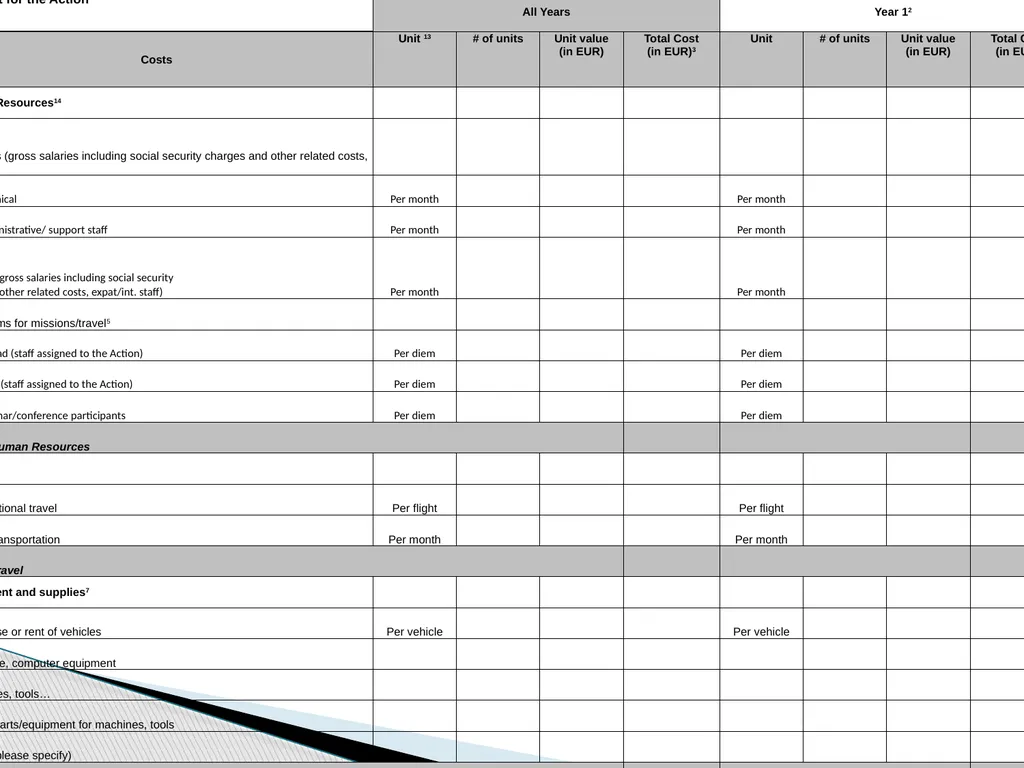
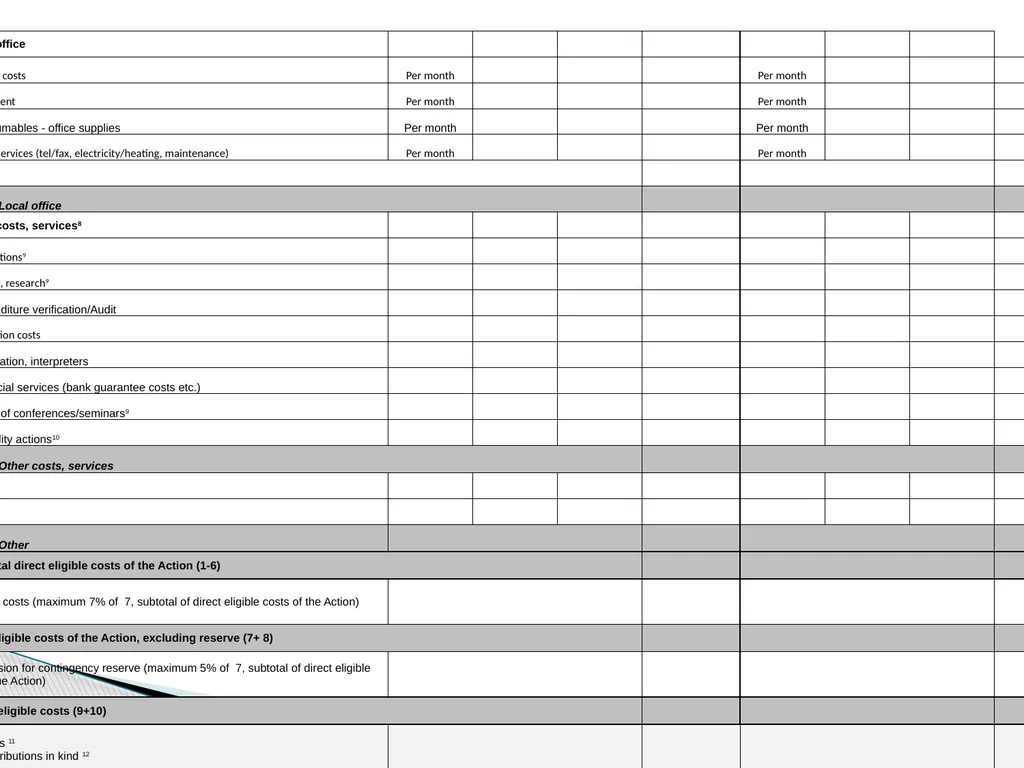
slide11. The project budget contains 6 main categories, which are divided into subcategories
The first column lists the budget items required in the project - rows can be added but the main categories and subcategories cannot be changed.
The first part of the table refers to all years, and the second part to the first year
Each new item has a new number (eg. 1.1.1 Technical, Project Manager 1.1.1.1, 1.1.1.2 Project Assistant, etc.) Project budget<br>
slide14. Salary costs under this budget heading can be planned for project team members i.e. already employed by the lead grant beneficiary or partner of the lead beneficiary, or in some specific cases persons that are newly engaged
Next to the name of the budget line ex. 1.1.1.1 Project manager, the percentage of engagement in the project must be stated.
Column Number of units refers the total number of months during which the employee is engaged.
Column Unit value refers to gross 2 salary (including all taxes and contributions) of employees engaged in the project. Human resources<br>
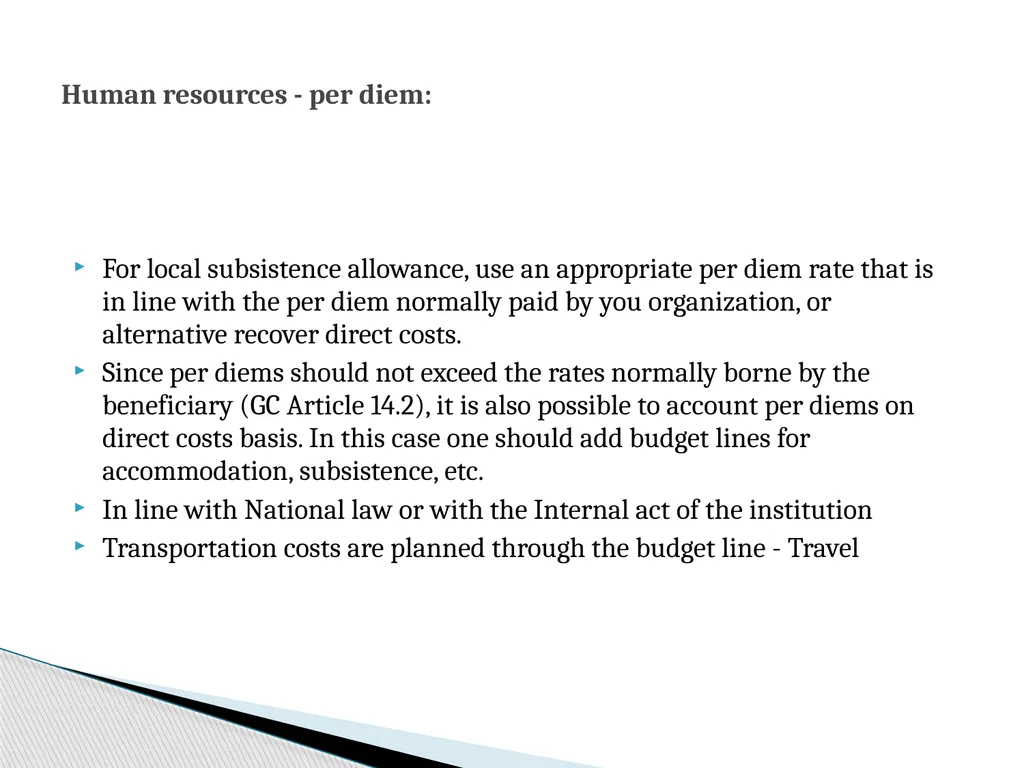
slide15. For local subsistence allowance, use an appropriate per diem rate that is in line with the per diem normally paid by you organization, or alternative recover direct costs.
Since per diems should not exceed the rates normally borne by the beneficiary (GC Article 14.2), it is also possible to account per diems on direct costs basis. In this case one should add budget lines for accommodation, subsistence, etc.
In line with National law or with the Internal act of the institution
Transportation costs are planned through the budget line - Travel Human resources - per diem:<br>
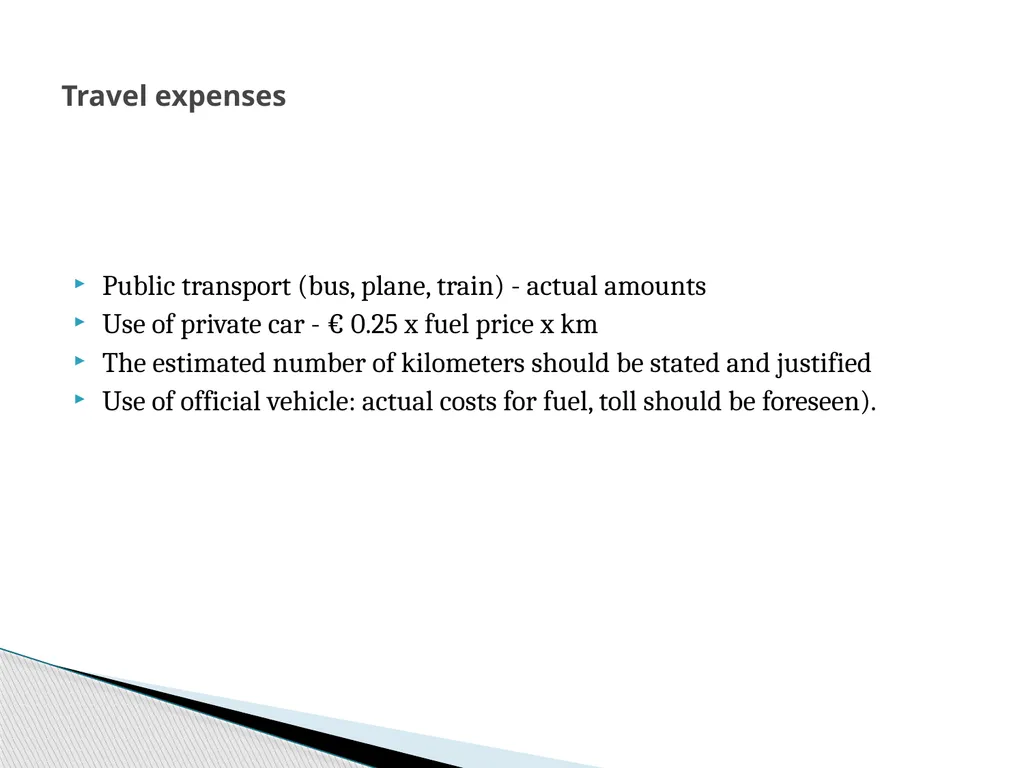
slide16. Public transport (bus, plane, train) - actual amounts
Use of private car - € 0.25 x fuel price x km
The estimated number of kilometers should be stated and justified
Use of official vehicle: actual costs for fuel, toll should be foreseen). Travel expenses<br>
slide17. Purchase of equipment and furniture;
Each item should be listed (e.g., "office furniture" is not correct, but „a desk, computer, chair, closet, shelf,“ etc., is correct);
In line with actual market prices. Equipment and supplies<br>
slide18. Example of costs that can be planed under this budget heading: car service, electricity/water/heating bills, phone bills, office supplies etc.
If new premises are needed for the project, the cost of rent can be planned in the budget.
Only the actual costs incurred in the implementation of the project can be shown.
Costs can only be justified with invoices and contract in case of office rent. Local office<br>
slide19. Professional publications, conference costs, auditing, bookkeeping, visibility, etc.
If there is more than 1 study, don’t use an average, but breakdown into sub-lines per study. It is ok to use global price per study. The price of the study should be value-for-money in relation to its scope and output.
Check Article 15.7 of the General Conditions, if your grant requires and expenditure verification (only if the grant is above € 100,000).
Cost verification - 1-3% of the contract value Other costs / services<br>
slide20. Contingency reserve : max 5% of direct eligible costs. It can only be used with the prior written authorization of the contracting authority
Administrative (indirect) costs: 7% of direct eligible costs, for costs not assigned to another budget heading in grant contract Contingency and administrative expenses<br>
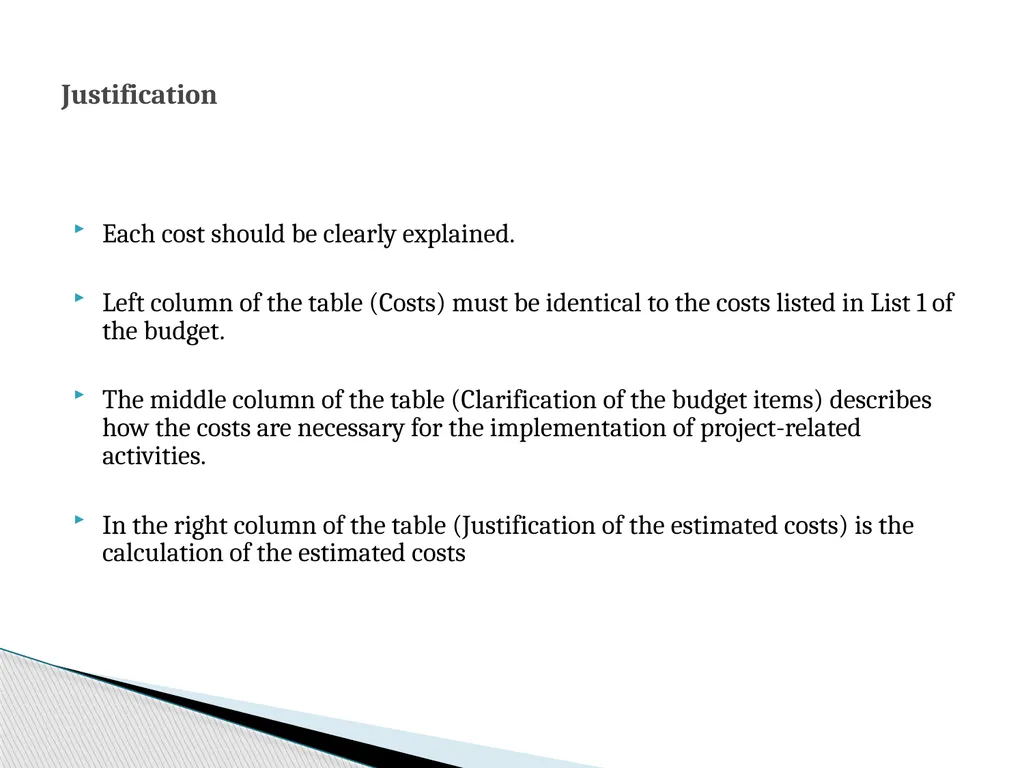
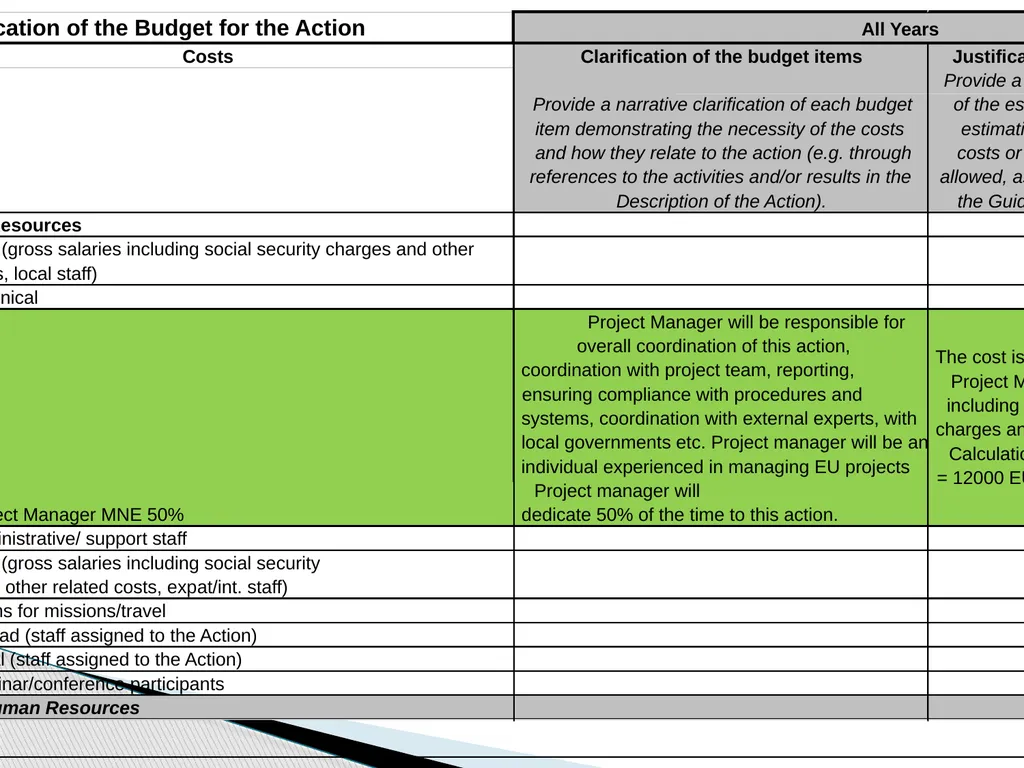
slide21. Each cost should be clearly explained.
Left column of the table (Costs) must be identical to the costs listed in List 1 of the budget.
The middle column of the table (Clarification of the budget items) describes how the costs are necessary for the implementation of project-related activities.
In the right column of the table (Justification of the estimated costs) is the calculation of the estimated costs Justification<br>
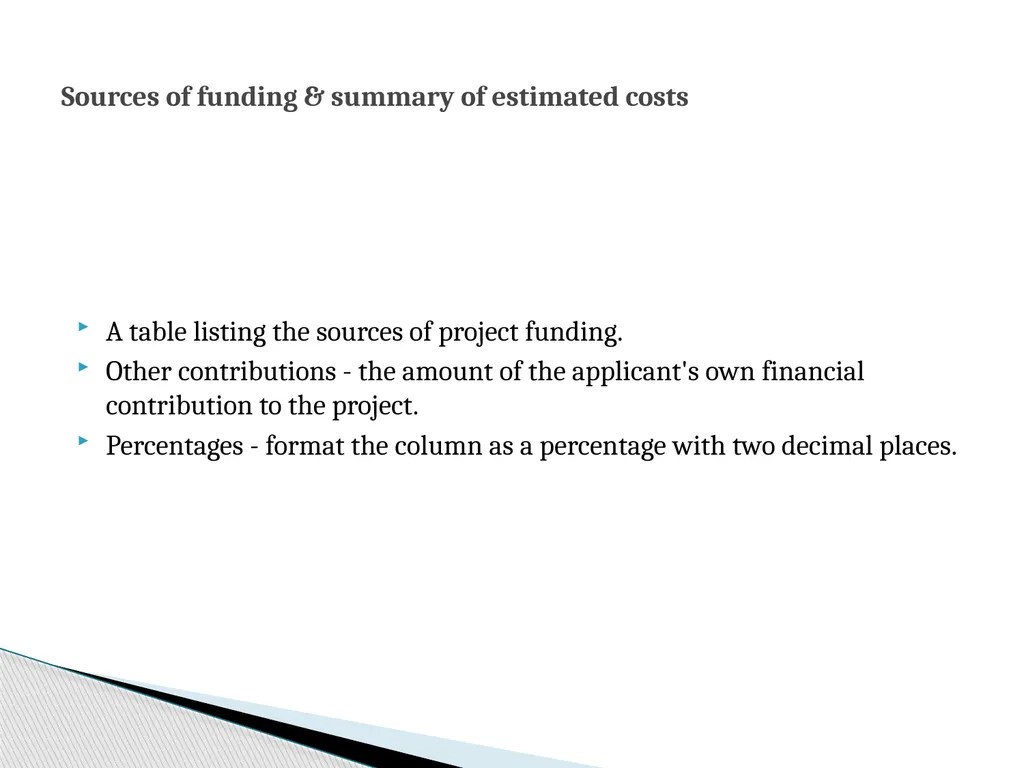
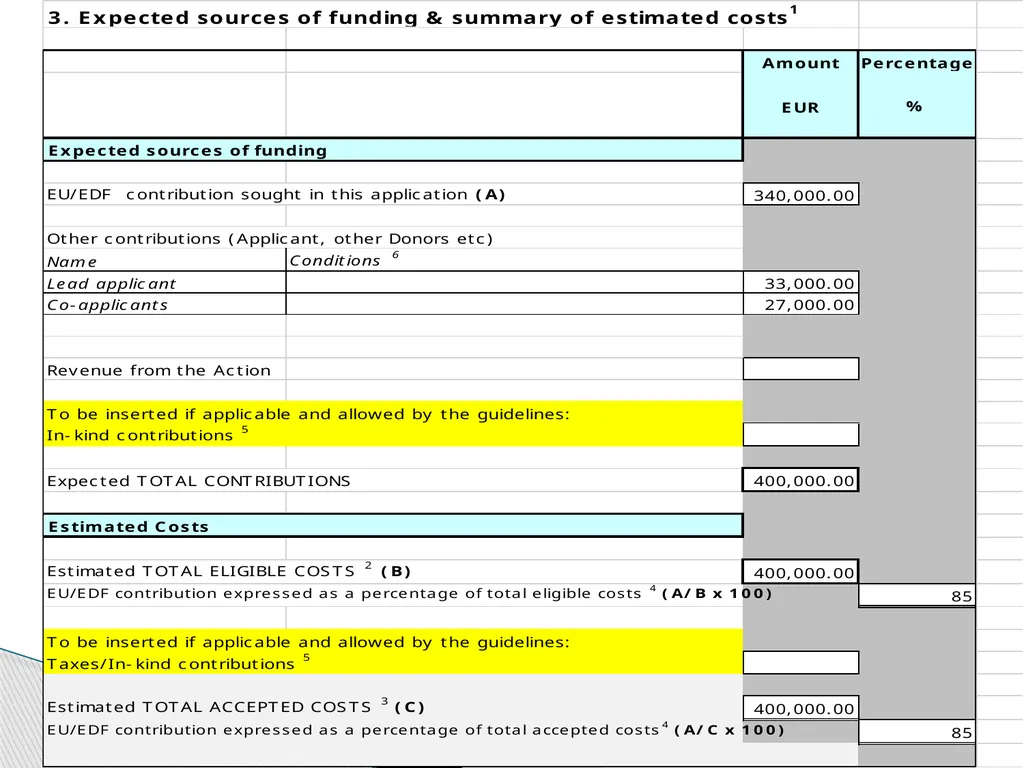
slide23. A table listing the sources of project funding.
Other contributions - the amount of the applicant's own financial contribution to the project.
Percentages - format the column as a percentage with two decimal places. Sources of funding & summary of estimated costs<br>
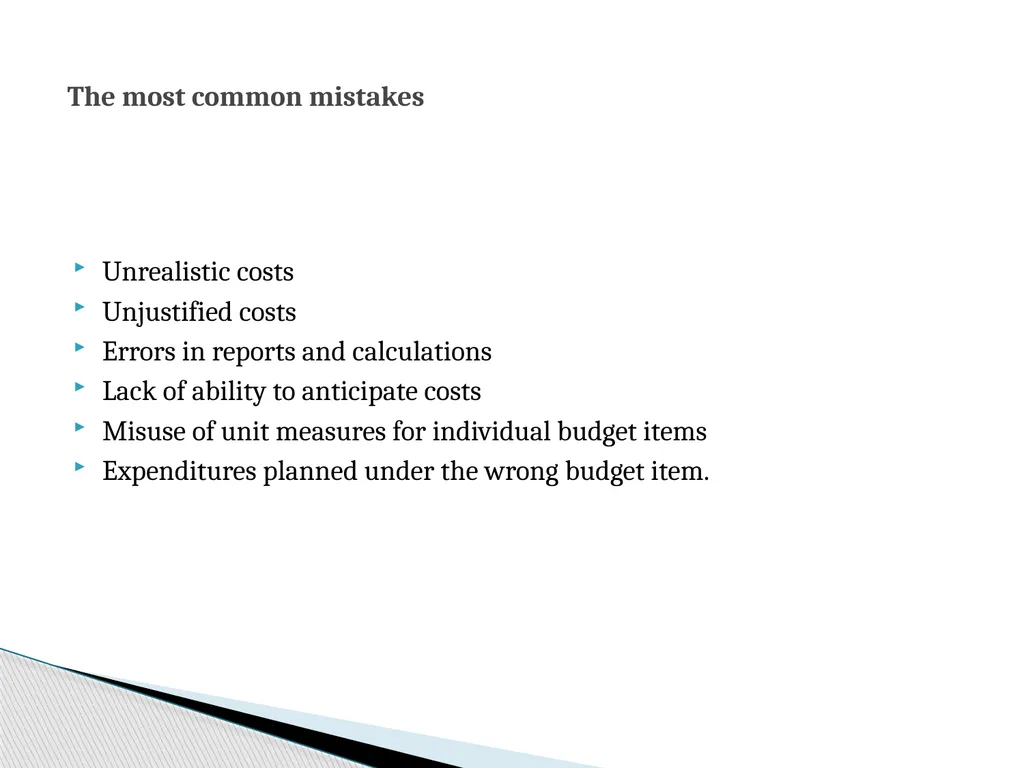
slide25. Unrealistic costs
Unjustified costs
Errors in reports and calculations
Lack of ability to anticipate costs
Misuse of unit measures for individual budget items
Expenditures planned under the wrong budget item. The most common mistakes<br>
slide26. IMPLEMENTATION OF TRAINING AND EDUCATION FOR DEFICIT OCCUPATIONS
THANK YOU!
cfcu@mif.gov.me<br>
slide2. Sectoral Operational Program for Employment, Education and Social Policy (2015-2017) "Implementation of training and education for deficit occupations " BUDGET Marko Backović
Financial controller
Directorate for Financing and Contracting of EU Aid (CFCU), Ministry of Finance of Montenegro<br>
slide3. General description of the budget
Eligible and ineligible costs
Simplified cost options
Budget structure
Eligibility of costs
Sources of financing
The most common mistakes Presentation content<br>
slide4. Mandatory part of the application package
Along with the activity plan and the logical matrix is the most important implementation tool
Connection between planning, implementation and control of project activities (basis for financial reports)
Cost planning is necessary for the implementation of project activities
Description of budget items: detailed and divided into main components
The number of units and the value must be specified for each budget line
The budget must include costs relating to the project as a whole, regardless of the part financed by the Contracting Authority.
The actual costs incurred will be presented in the financial report and compared with the costs from the budget. Budget<br>
slide5. Eligible
Necessary for the realization of the project and related activities
Costs should be based on real market prices
Without VAT Costs must be:<br>
slide6. Eligible costs are the actual costs, incurred by the beneficiaries or their partners, that meet the following criteria:
incured during the implementation of the project
indicated in the estimated overall budget for the action
they are necessary for the implementation of the project
they are recognizable and available for verification, they are recorded in the account of the beneficiary or the beneficiary's partners
they comply with the requirements of applicable tax and social legislation
they must be reasonable, justified and in accordance with the requirements of sound financial management Eligible costs<br>
slide7. debts and debt service charges (interest);
provisions for losses or potential future liabilities;
costs declared by the beneficiary(ies) and financed by another action or work programme receiving a European Union (including through EDF) grant;
purchases of land or buildings, except where necessary for the direct implementation of the action, in which case ownership must be transferred in accordance with Article 7.5 of the general conditions of the standard grant contract, at the latest at the end of the action;
currency exchange losses;
credit to third parties. Ineligible costs<br>
slide8. Budget expenditures can be planned in two ways:
as a real cost, e.g. per month, per km, per item…
using the Simplified cost option Budget cost planning<br>
slide9. They can be used in all budget items
Simplified costs can be:
unit costs: cover all or certain specific categories of eligible costs that can be clearly identified (as indicated in the Budget, at the proposal stage) and that are expressed in amounts per unit
lump sums: cover globally all or certain specific categories of eligible costs. Simplified cost options<br>
slide10. flat-rate financing: they cover certain categories of eligible costs and are expressed as a percentage of other eligible costs.
Candidates must clearly state e.g. “UNIT COST” (per month, flight ...), “LUMP SUM” or “FLAT RATE” for each eligible cost item to which this applies.
Detailed information on Simplified Cost option can be found in Annex K of Application package Simplified cost options<br>
slide11. The project budget contains 6 main categories, which are divided into subcategories
The first column lists the budget items required in the project - rows can be added but the main categories and subcategories cannot be changed.
The first part of the table refers to all years, and the second part to the first year
Each new item has a new number (eg. 1.1.1 Technical, Project Manager 1.1.1.1, 1.1.1.2 Project Assistant, etc.) Project budget<br>
slide14. Salary costs under this budget heading can be planned for project team members i.e. already employed by the lead grant beneficiary or partner of the lead beneficiary, or in some specific cases persons that are newly engaged
Next to the name of the budget line ex. 1.1.1.1 Project manager, the percentage of engagement in the project must be stated.
Column Number of units refers the total number of months during which the employee is engaged.
Column Unit value refers to gross 2 salary (including all taxes and contributions) of employees engaged in the project. Human resources<br>
slide15. For local subsistence allowance, use an appropriate per diem rate that is in line with the per diem normally paid by you organization, or alternative recover direct costs.
Since per diems should not exceed the rates normally borne by the beneficiary (GC Article 14.2), it is also possible to account per diems on direct costs basis. In this case one should add budget lines for accommodation, subsistence, etc.
In line with National law or with the Internal act of the institution
Transportation costs are planned through the budget line - Travel Human resources - per diem:<br>
slide16. Public transport (bus, plane, train) - actual amounts
Use of private car - € 0.25 x fuel price x km
The estimated number of kilometers should be stated and justified
Use of official vehicle: actual costs for fuel, toll should be foreseen). Travel expenses<br>
slide17. Purchase of equipment and furniture;
Each item should be listed (e.g., "office furniture" is not correct, but „a desk, computer, chair, closet, shelf,“ etc., is correct);
In line with actual market prices. Equipment and supplies<br>
slide18. Example of costs that can be planed under this budget heading: car service, electricity/water/heating bills, phone bills, office supplies etc.
If new premises are needed for the project, the cost of rent can be planned in the budget.
Only the actual costs incurred in the implementation of the project can be shown.
Costs can only be justified with invoices and contract in case of office rent. Local office<br>
slide19. Professional publications, conference costs, auditing, bookkeeping, visibility, etc.
If there is more than 1 study, don’t use an average, but breakdown into sub-lines per study. It is ok to use global price per study. The price of the study should be value-for-money in relation to its scope and output.
Check Article 15.7 of the General Conditions, if your grant requires and expenditure verification (only if the grant is above € 100,000).
Cost verification - 1-3% of the contract value Other costs / services<br>
slide20. Contingency reserve : max 5% of direct eligible costs. It can only be used with the prior written authorization of the contracting authority
Administrative (indirect) costs: 7% of direct eligible costs, for costs not assigned to another budget heading in grant contract Contingency and administrative expenses<br>
slide21. Each cost should be clearly explained.
Left column of the table (Costs) must be identical to the costs listed in List 1 of the budget.
The middle column of the table (Clarification of the budget items) describes how the costs are necessary for the implementation of project-related activities.
In the right column of the table (Justification of the estimated costs) is the calculation of the estimated costs Justification<br>
slide23. A table listing the sources of project funding.
Other contributions - the amount of the applicant's own financial contribution to the project.
Percentages - format the column as a percentage with two decimal places. Sources of funding & summary of estimated costs<br>
slide25. Unrealistic costs
Unjustified costs
Errors in reports and calculations
Lack of ability to anticipate costs
Misuse of unit measures for individual budget items
Expenditures planned under the wrong budget item. The most common mistakes<br>
slide26. IMPLEMENTATION OF TRAINING AND EDUCATION FOR DEFICIT OCCUPATIONS
THANK YOU!
cfcu@mif.gov.me<br>