
Implementation Science Research 1 Implementation



Description: Implementation Science Research 1 Implementation Science Working Group Chairs: Stefan Baral, MD Associate Professor, Johns Hopkins University, School of Public Health Michael Mugavero, MD Professor, University of Alabama, Birmingham
Related Topics
Download Presentation
"Implementation Science Research 1 Implementation" is the property of its rightful owner. Permission is granted to download and print the materials on this website for personal, non-commercial use only, and to display it on your personal computer provided you do not modify the materials and that you retain all copyright notices contained in the materials. By downloading content from our website, you accept the terms of this agreement.
Presentation Transcript
slide1. Implementation
Science Research 1<br>
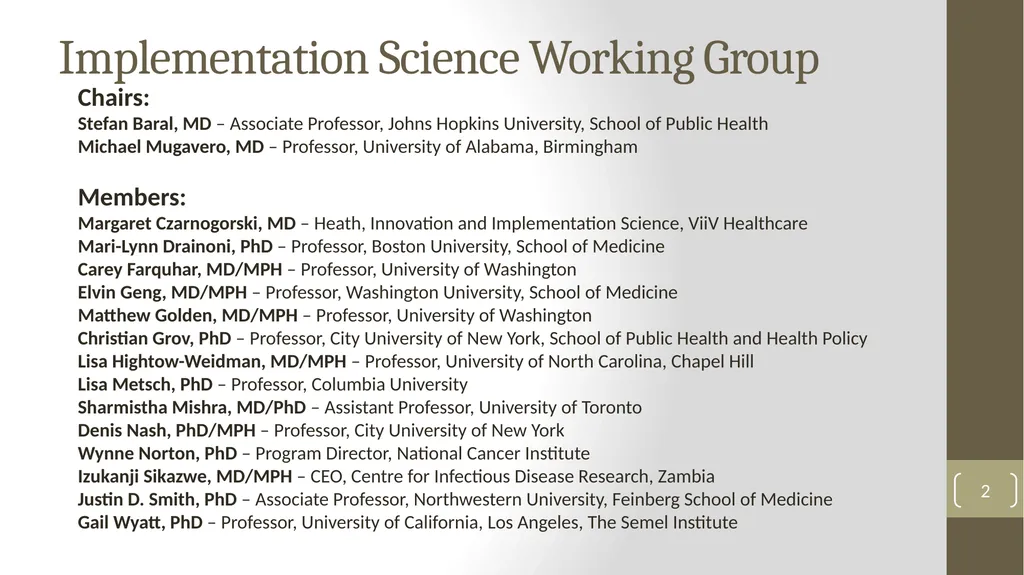
slide2. Implementation Science Working Group Chairs: Stefan Baral, MD – Associate Professor, Johns Hopkins University, School of Public Health Michael Mugavero, MD – Professor, University of Alabama, Birmingham
Members: Margaret Czarnogorski, MD – Heath, Innovation and Implementation Science, ViiV Healthcare Mari-Lynn Drainoni, PhD – Professor, Boston University, School of Medicine Carey Farquhar, MD/MPH – Professor, University of Washington Elvin Geng, MD/MPH – Professor, Washington University, School of Medicine Matthew Golden, MD/MPH – Professor, University of Washington Christian Grov, PhD – Professor, City University of New York, School of Public Health and Health Policy Lisa Hightow-Weidman, MD/MPH – Professor, University of North Carolina, Chapel Hill Lisa Metsch, PhD – Professor, Columbia University Sharmistha Mishra, MD/PhD – Assistant Professor, University of Toronto Denis Nash, PhD/MPH – Professor, City University of New York Wynne Norton, PhD – Program Director, National Cancer Institute Izukanji Sikazwe, MD/MPH – CEO, Centre for Infectious Disease Research, Zambia Justin D. Smith, PhD – Associate Professor, Northwestern University, Feinberg School of Medicine Gail Wyatt, PhD – Professor, University of California, Los Angeles, The Semel Institute 2<br>
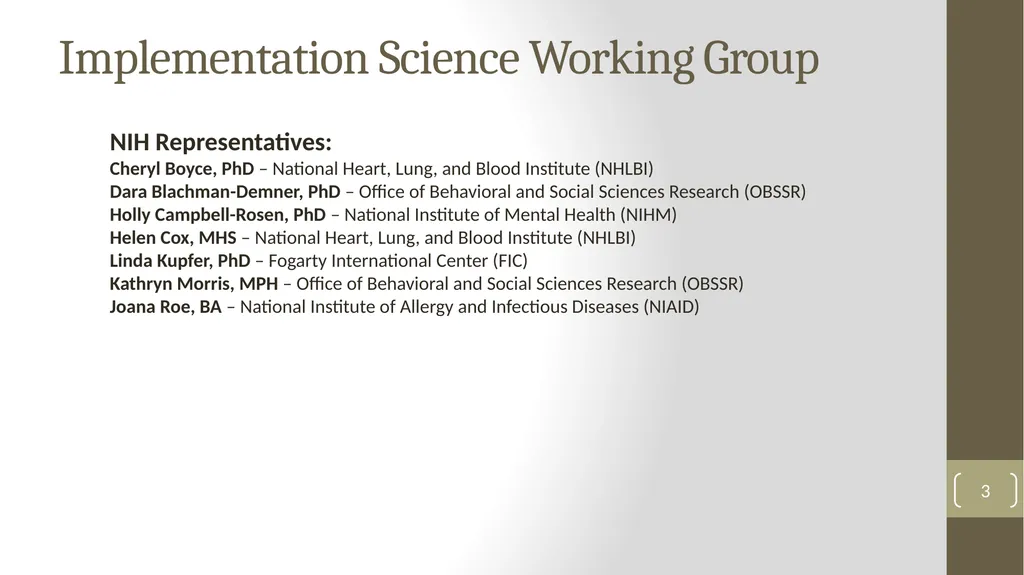
slide3. Implementation Science Working Group NIH Representatives:
Cheryl Boyce, PhD – National Heart, Lung, and Blood Institute (NHLBI)
Dara Blachman-Demner, PhD – Office of Behavioral and Social Sciences Research (OBSSR)
Holly Campbell-Rosen, PhD – National Institute of Mental Health (NIHM)
Helen Cox, MHS – National Heart, Lung, and Blood Institute (NHLBI)
Linda Kupfer, PhD – Fogarty International Center (FIC)
Kathryn Morris, MPH – Office of Behavioral and Social Sciences Research (OBSSR)
Joana Roe, BA – National Institute of Allergy and Infectious Diseases (NIAID) 3<br>
slide4. Hilary Pinnock et al. BMJ 2017;356:bmj.i6795 4<br>
slide5. Implementation Science Priority Topics Introduction to Implementation Science (IS) Research
Synthesizing priority IS HIV co-morbidity research questions
Novel observational and experimental IS research designs
Training opportunities and resources to expand the IS research workforce 5<br>
slide6. Introduction to Implementation Science (IS) Research Denis Nash, PhD, MPH
City University of New York (CUNY) School of Public Health
CUNY Institute for Implementation Science in Population Health<br>
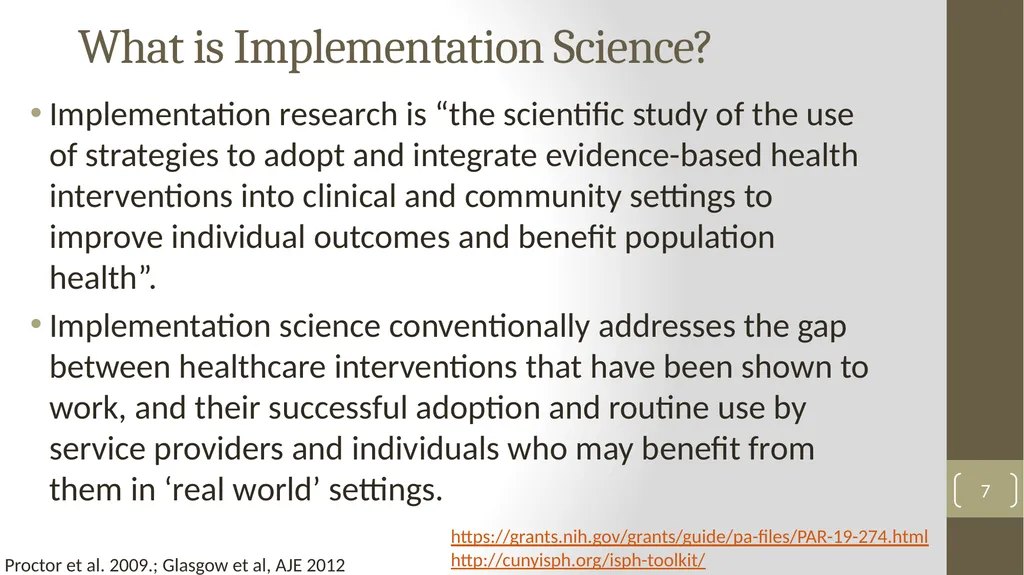
slide7. What is Implementation Science? Implementation research is “the scientific study of the use of strategies to adopt and integrate evidence-based health interventions into clinical and community settings to improve individual outcomes and benefit population health”.
Implementation science conventionally addresses the gap between healthcare interventions that have been shown to work, and their successful adoption and routine use by service providers and individuals who may benefit from them in ‘real world’ settings. https://grants.nih.gov/grants/guide/pa-files/PAR-19-274.html
http://cunyisph.org/isph-toolkit/ Proctor et al. 2009.; Glasgow et al, AJE 2012 7<br>
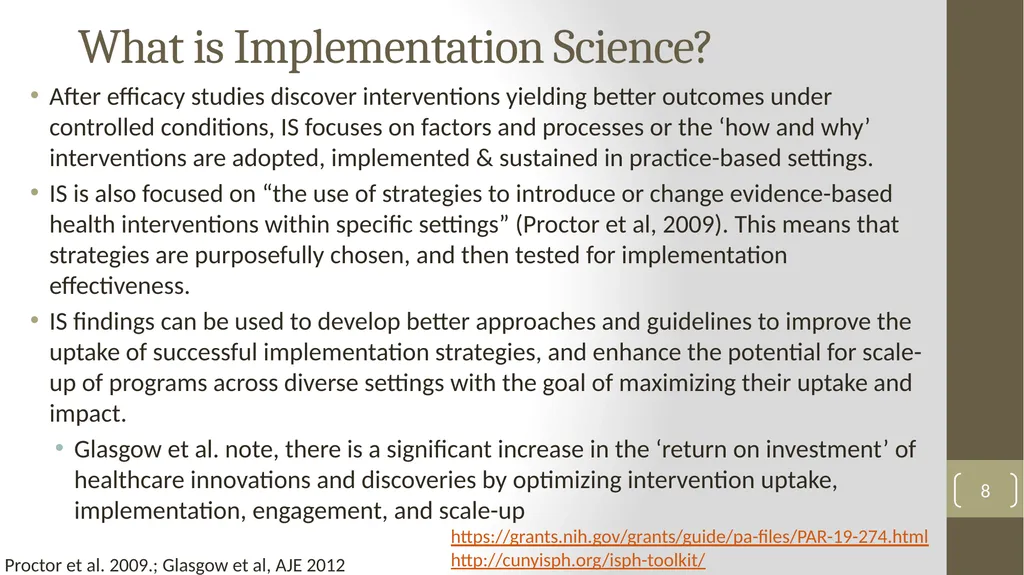
slide8. What is Implementation Science? After efficacy studies discover interventions yielding better outcomes under controlled conditions, IS focuses on factors and processes or the ‘how and why’ interventions are adopted, implemented & sustained in practice-based settings.
IS is also focused on “the use of strategies to introduce or change evidence-based health interventions within specific settings” (Proctor et al, 2009). This means that strategies are purposefully chosen, and then tested for implementation effectiveness.
IS findings can be used to develop better approaches and guidelines to improve the uptake of successful implementation strategies, and enhance the potential for scale-up of programs across diverse settings with the goal of maximizing their uptake and impact.
Glasgow et al. note, there is a significant increase in the ‘return on investment’ of healthcare innovations and discoveries by optimizing intervention uptake, implementation, engagement, and scale-up Proctor et al. 2009.; Glasgow et al, AJE 2012 https://grants.nih.gov/grants/guide/pa-files/PAR-19-274.html
http://cunyisph.org/isph-toolkit/ 8<br>
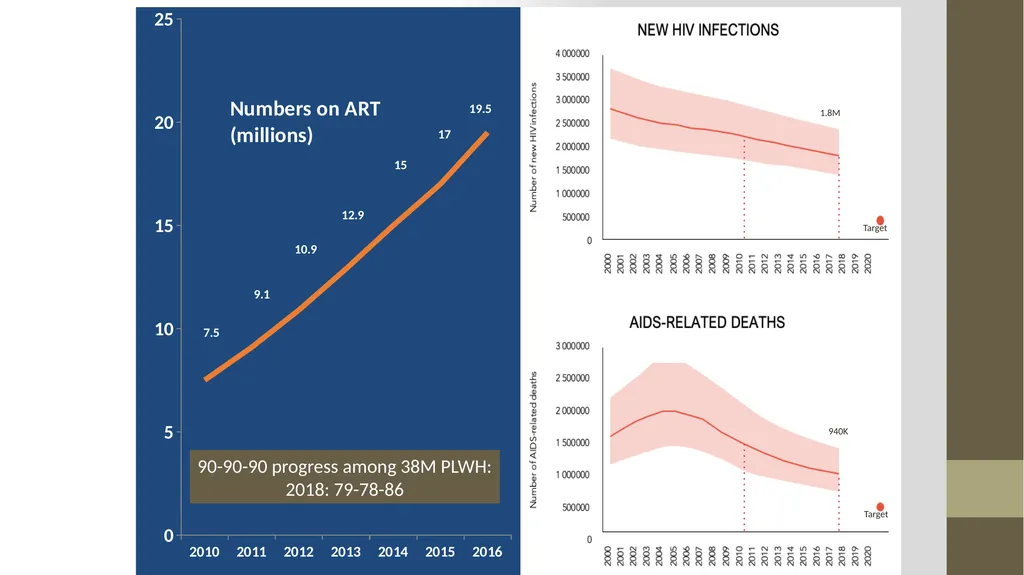
slide9. Slide courtesy of N Ford, WHO and UNAIDS % Starting ART CD4<100 90-90-90 progress among 38M PLWH:
2018: 79-78-86<br>
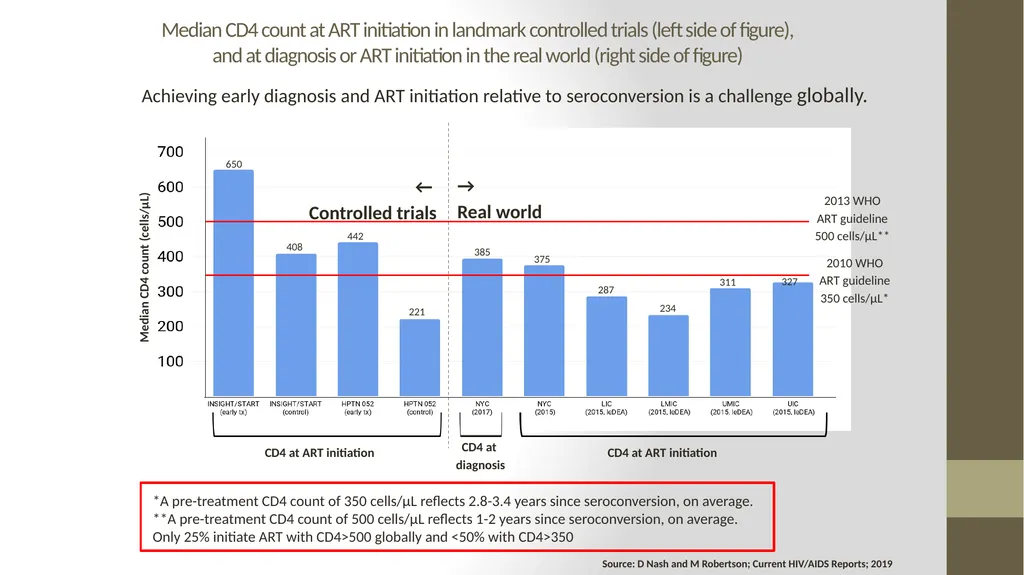
slide10. Median CD4 count at ART initiation in landmark controlled trials (left side of figure), and at diagnosis or ART initiation in the real world (right side of figure) Achieving early diagnosis and ART initiation relative to seroconversion is a challenge globally. *A pre-treatment CD4 count of 350 cells/µL reflects 2.8-3.4 years since seroconversion, on average.
**A pre-treatment CD4 count of 500 cells/µL reflects 1-2 years since seroconversion, on average.
Only 25% initiate ART with CD4>500 globally and <50% with CD4>350 Source: D Nash and M Robertson; Current HIV/AIDS Reports; 2019<br>
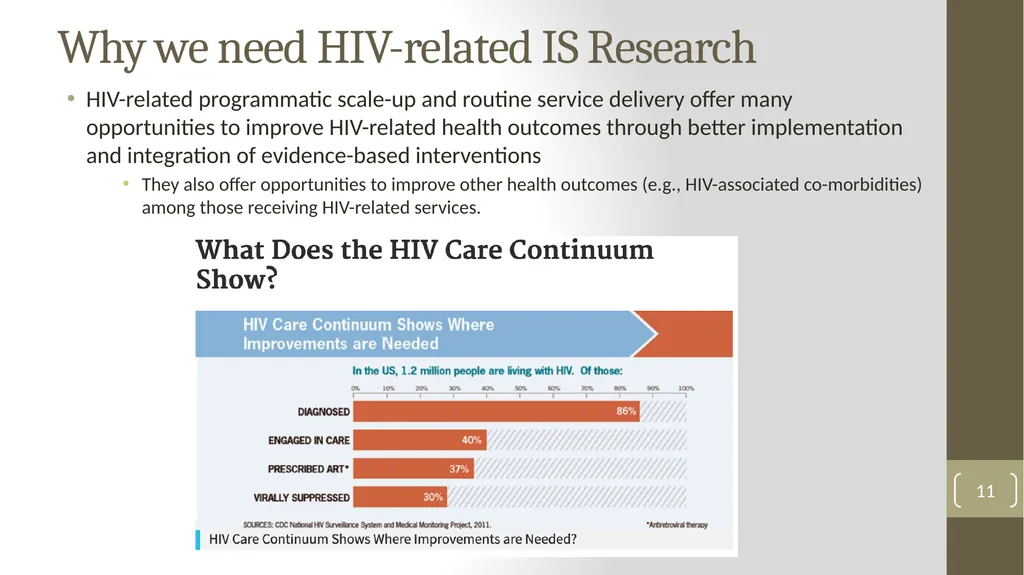
slide11. Why we need HIV-related IS Research HIV-related programmatic scale-up and routine service delivery offer many opportunities to improve HIV-related health outcomes through better implementation and integration of evidence-based interventions
They also offer opportunities to improve other health outcomes (e.g., HIV-associated co-morbidities) among those receiving HIV-related services. HIV.gov 11<br>
slide12. IS Opportunities vis a vis HIV-associated co-morbidities: The Big Picture For a given HIV-associated co-morbidity, what can be learned from implementation science research that has been conducted outside the HIV setting
In resource-limited settings, what can we learn about screening, diagnosis, and management of HIV-related comorbidities that will be relevant to the care HIV-negative populations?
Implementation science research around screening and management of risk factors for HIV-related comorbidities (e.g., smoking, obesity) could result in prevention and/or earlier detection of several HIV-related comorbidities, reducing their ultimate burden.
Would a better understanding of the preferences of clients/patients/providers with respect to a given evidence-based intervention be useful to better inform the design of strategies to improve their uptake, engagement, and delivery? 12<br>
slide13. J.D. Smith, Ph.D. Northwestern University Feinberg School of Medicine Synthesizing priority Implementation Science HIV co-morbidity questions 13<br>
slide14. Current State-of-the-Science IS has established a corpus of research methodologies to evaluate, test, and understand implementation of evidence-based practices
Shifting from “Can we make it work?” to “How can we best make it work?”
Greater emphasis on optimizing implementation strategies that, alone or in combination, achieve crucial implementation outcomes more expediently, cost-effectively, and acceptably to delivery systems/agents and those PLWH that receive interventions for HIV-related comorbidities 14<br>
slide15. Key Research Questions What combination of implementation strategies are necessary and sufficient to increase the impact of interventions for HIV-related comorbidities?
Given limited resources in our jurisdiction, what implementation strategies will be most effective when implementing interventions for HIV-related comorbidities at the lowest cost?
How can we learn from our successes and challenges as we roll out interventions for HIV-related comorbidities over time to more expediently achieve implementation?
Can the cost and resources involved in a successful multicomponent implementation strategy package be reduced while maintaining its impact?
How can the field begin to optimize implementation during the development and testing of new interventions for HIV-related comorbidities? 15<br>
slide16. Why these Questions? With recent scientific advances in both biomedical and behavioral interventions, the challenge is delivering these interventions to the right people, at the right time, in the right place, via the right way, and in the right amount (implementation).
Finite resources exist for implementation that must be used as efficiently as possible to achieve maximum effects
Decision-makers need guidance to make informed selections of interventions and the required strategies to implement them based on evidence that can quantify the budget impact, cost-benefit, and cost-effectiveness 16<br>
slide17. Opportunities Design implementation trials to either explicitly or at least to better understand implementation optimization.
adaptive designs (fractional factorial, SMART, MOST)
dismantling designs
rollout optimization trials
Begin to synthesize the findings from multiple implementation trials
Design interventions for HIV-related comorbidities with implementation in mind (designing for D&I)
Apply a range of implementation research methodologies for PLWH experiencing comorbidities (e.g., McNulty, Smith, et al. 2019, Ethnicity & Disease) 17<br>
slide18. Novel study designs for implementation research (a sampler) Elvin Geng, MD MPH
Professor of Medicine
Director, Center for Dissemination and Implementation
Washington University in St Louis<br>
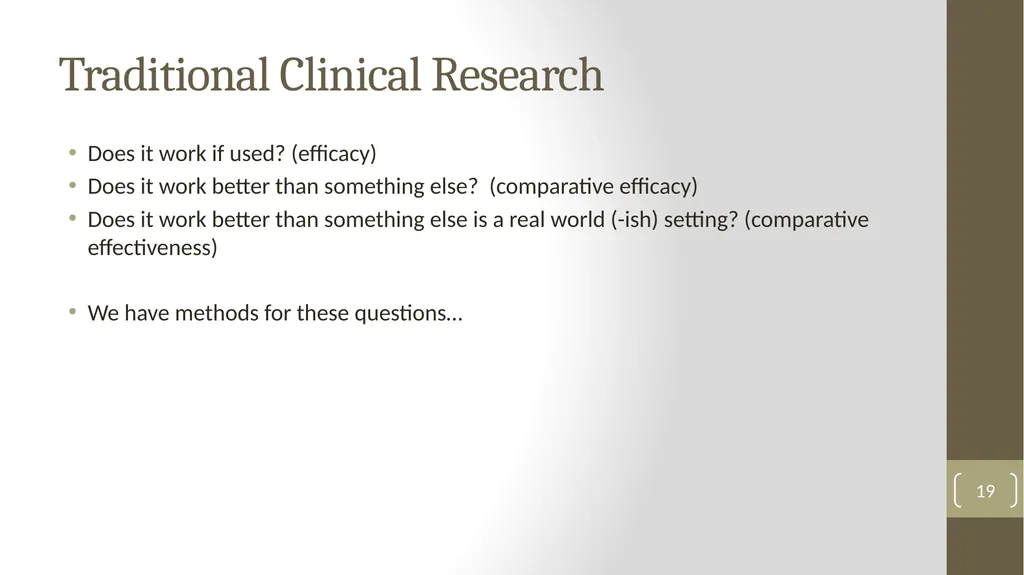
slide19. Traditional Clinical Research Does it work if used? (efficacy)
Does it work better than something else? (comparative efficacy)
Does it work better than something else is a real world (-ish) setting? (comparative effectiveness)
We have methods for these questions… 19<br>
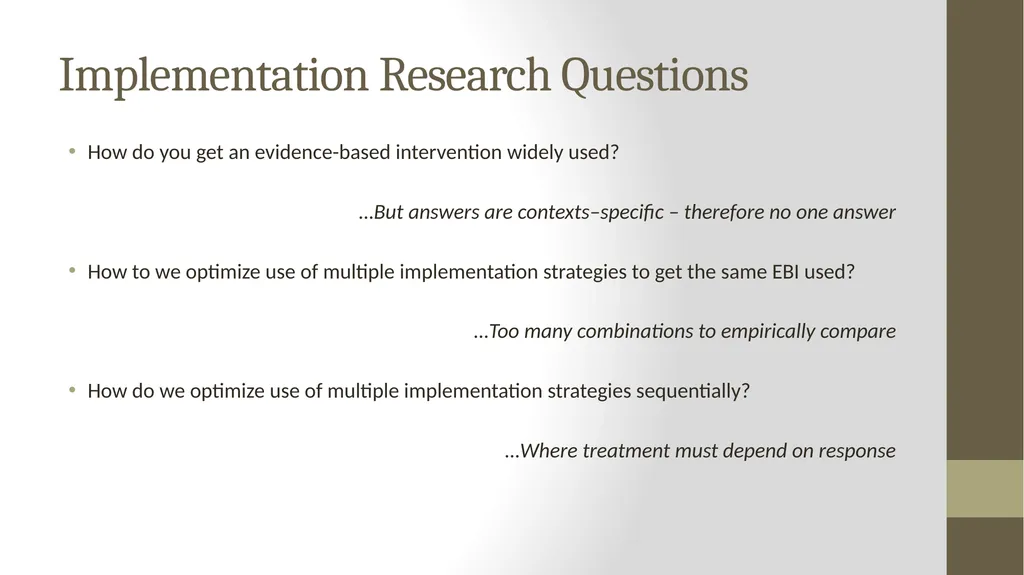
slide20. Implementation Research Questions How do you get an evidence-based intervention widely used?
…But answers are contexts–specific – therefore no one answer
How to we optimize use of multiple implementation strategies to get the same EBI used?
…Too many combinations to empirically compare
How do we optimize use of multiple implementation strategies sequentially?
…Where treatment must depend on response<br>
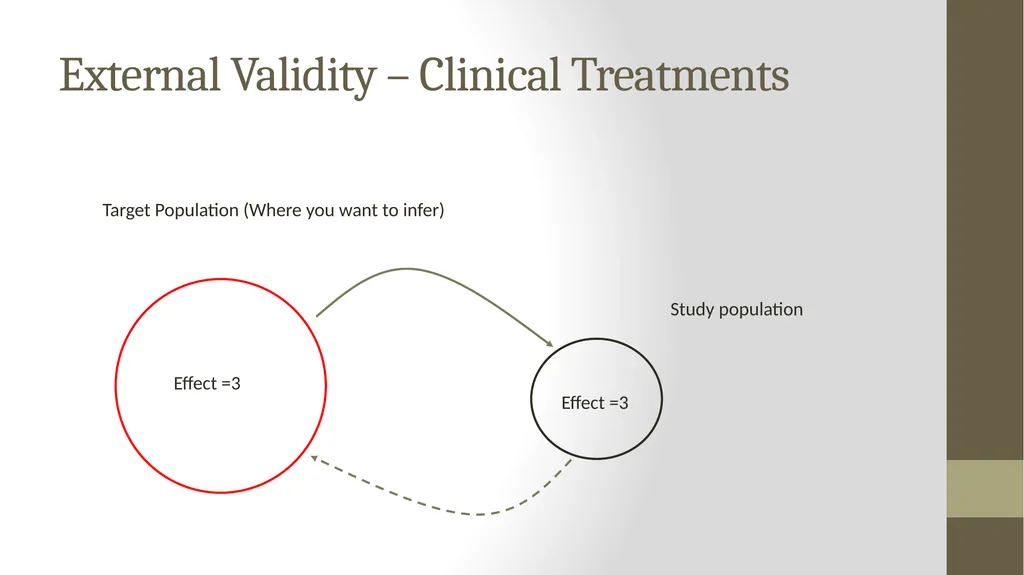
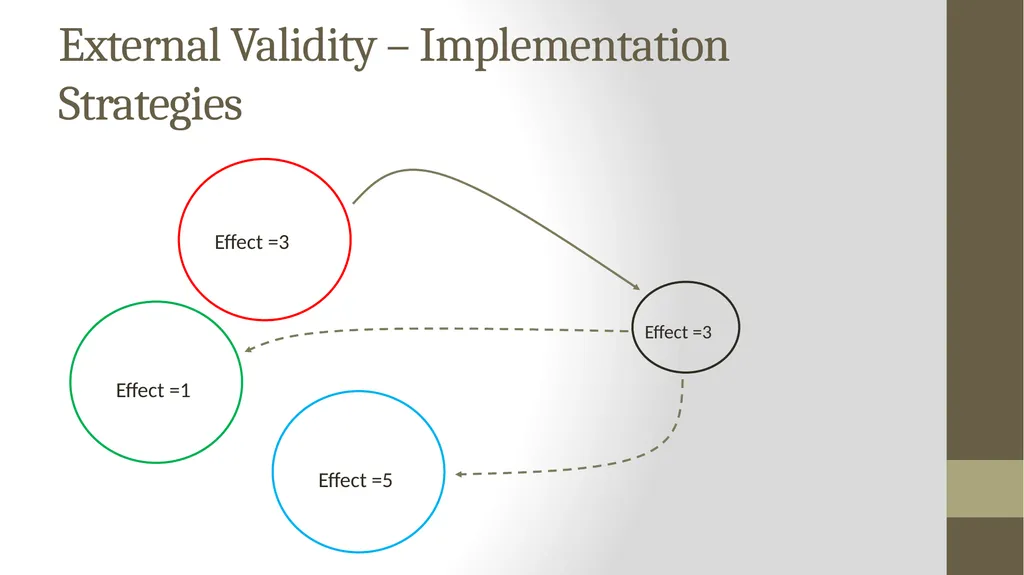
slide21. External Validity – Clinical Treatments Target Population (Where you want to infer) Study population Effect =3 Effect =3<br>
slide22. External Validity – Implementation Strategies<br>
slide23. New Science of External Validity? Transportability
Population composition and the mechanism in the source population
+
Information about how those differ in target population
“Seed and soil” Judea Pearl and Elias Bareinboim 2011 JSM Proceedings, Miami Beach FL, July 30-August 4, 2011, pp. 157-171. Statistical Science
2014, Vol. 29, No. 4, 579–595<br>
slide24. How do we optimize the mix of implementation strategies when there are too many strategies to compare empirically?<br>
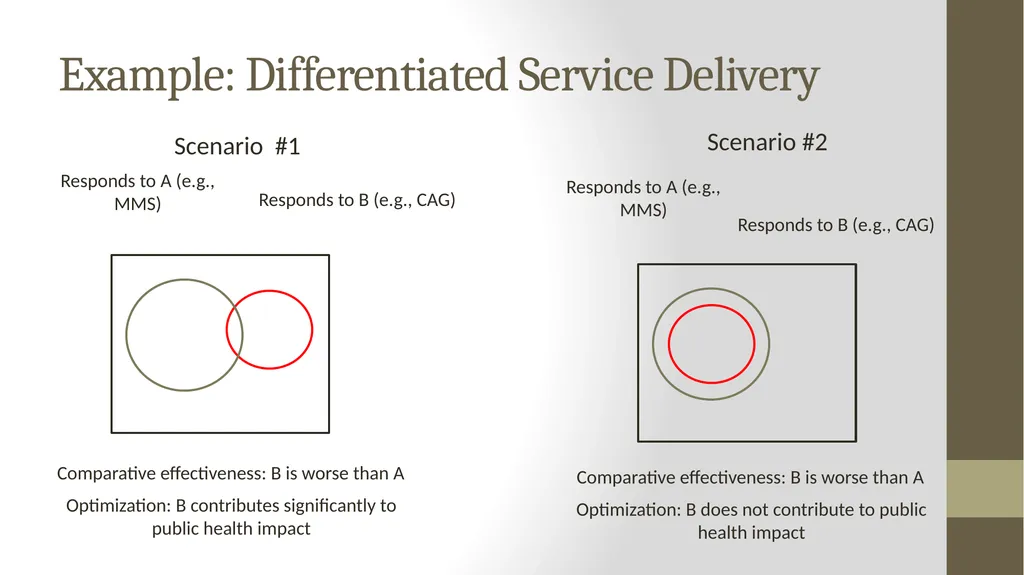
slide25. Example: Differentiated Service Delivery<br>
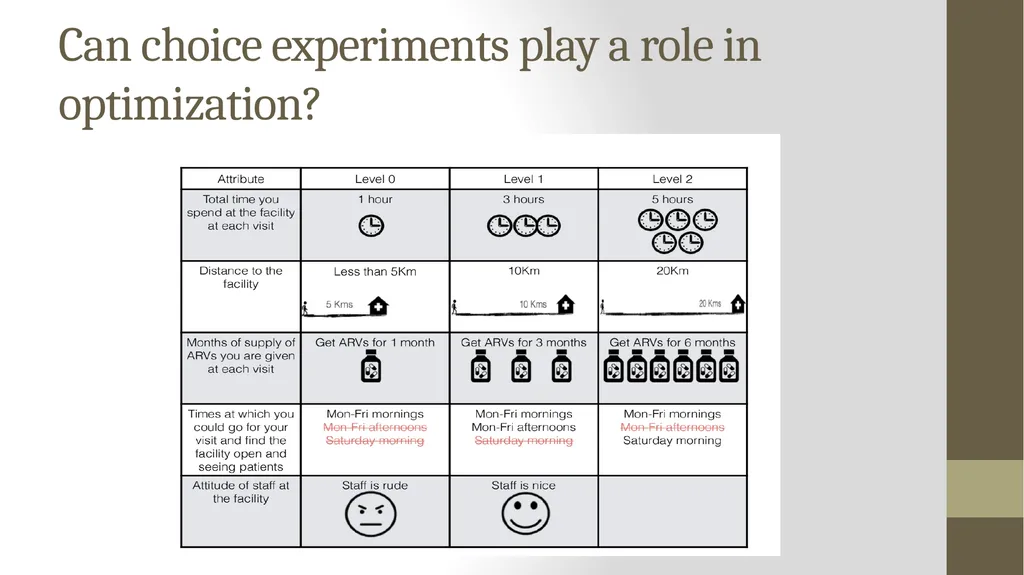
slide26. Can choice experiments play a role in optimization?<br>
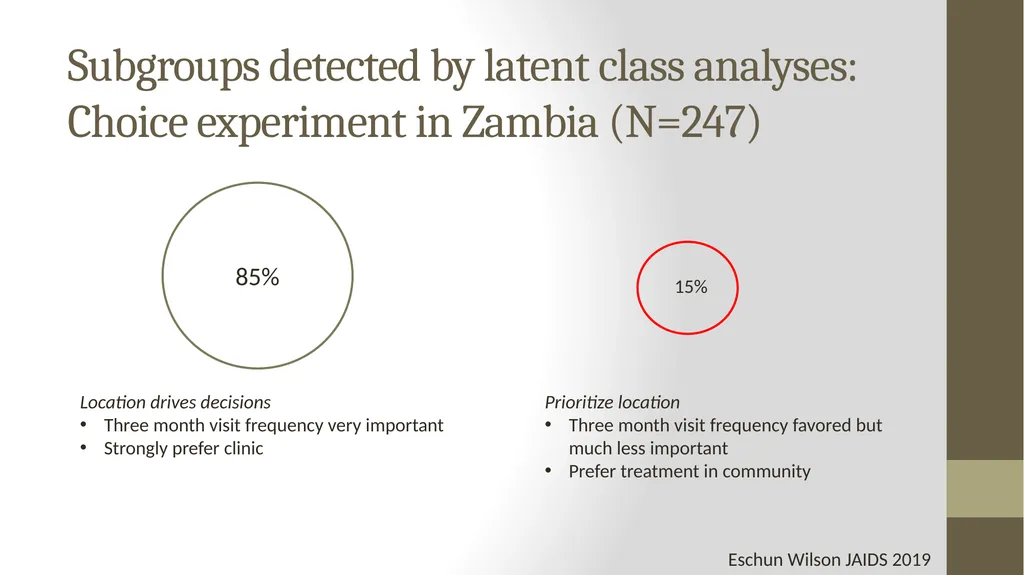
slide27. Subgroups detected by latent class analyses: Choice experiment in Zambia (N=247) Eschun Wilson JAIDS 2019<br>
slide28. How do we optimize use strategies together sequentially (target treatment to response)? 28<br>
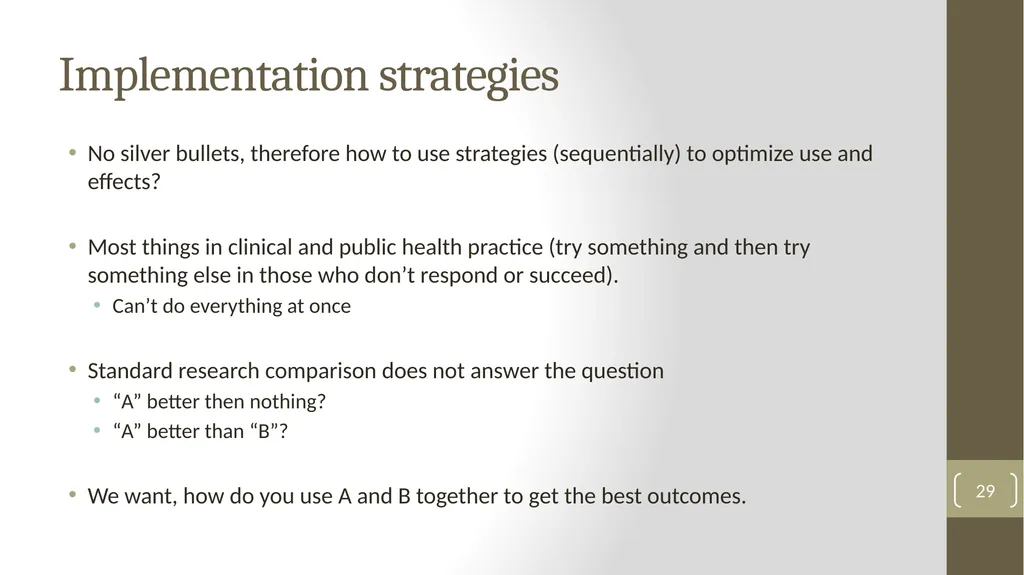
slide29. Implementation strategies No silver bullets, therefore how to use strategies (sequentially) to optimize use and effects?
Most things in clinical and public health practice (try something and then try something else in those who don’t respond or succeed).
Can’t do everything at once
Standard research comparison does not answer the question
“A” better then nothing?
“A” better than “B”?
We want, how do you use A and B together to get the best outcomes. 29<br>
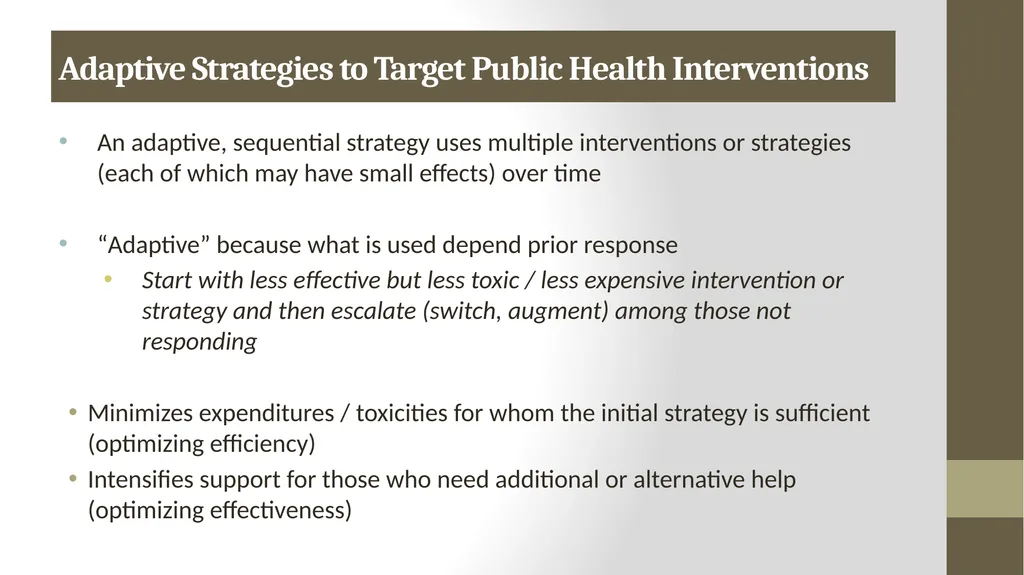
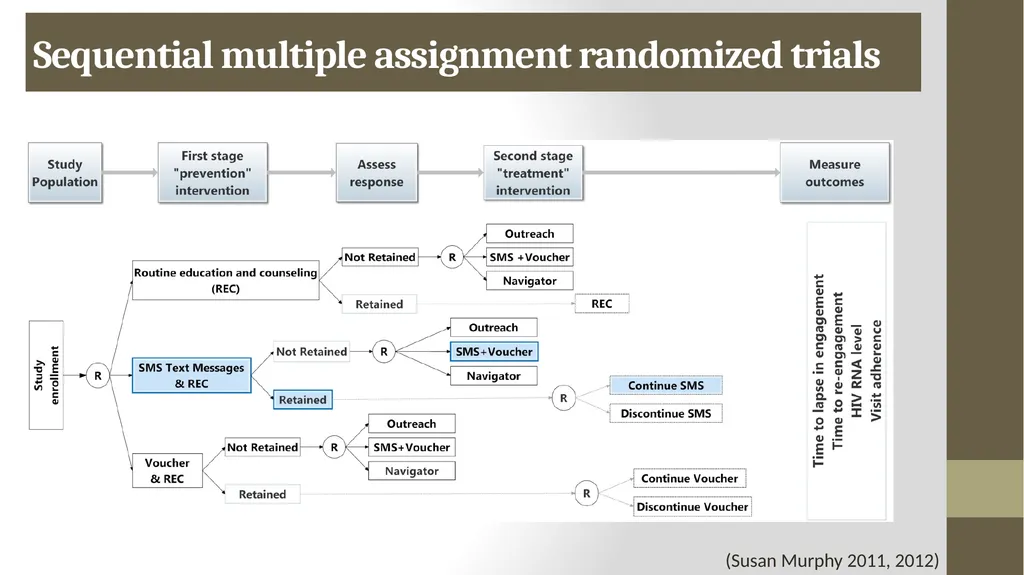
slide30. Adaptive Strategies to Target Public Health Interventions An adaptive, sequential strategy uses multiple interventions or strategies (each of which may have small effects) over time
“Adaptive” because what is used depend prior response
Start with less effective but less toxic / less expensive intervention or strategy and then escalate (switch, augment) among those not responding
Minimizes expenditures / toxicities for whom the initial strategy is sufficient (optimizing efficiency)
Intensifies support for those who need additional or alternative help (optimizing effectiveness)<br>
slide31. Sequential multiple assignment randomized trials (Susan Murphy 2011, 2012)<br>
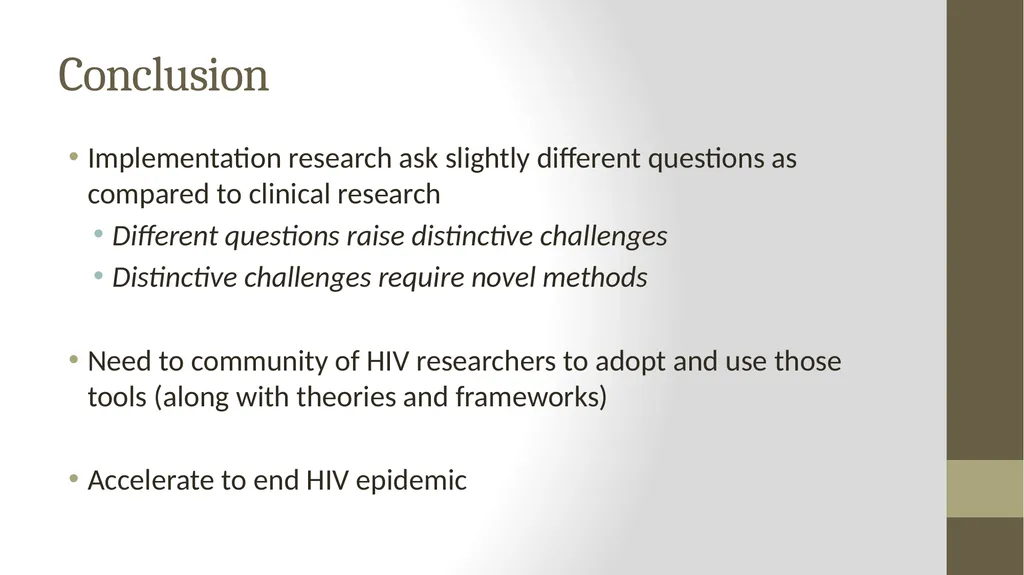
slide32. Conclusion Implementation research ask slightly different questions as compared to clinical research
Different questions raise distinctive challenges
Distinctive challenges require novel methods
Need to community of HIV researchers to adopt and use those tools (along with theories and frameworks)
Accelerate to end HIV epidemic<br>
slide33. Training opportunities and resources to expand the Implementation Science research workforce Mari-Lynn Drainoni, PhD
Boston University School of Medicine 33<br>
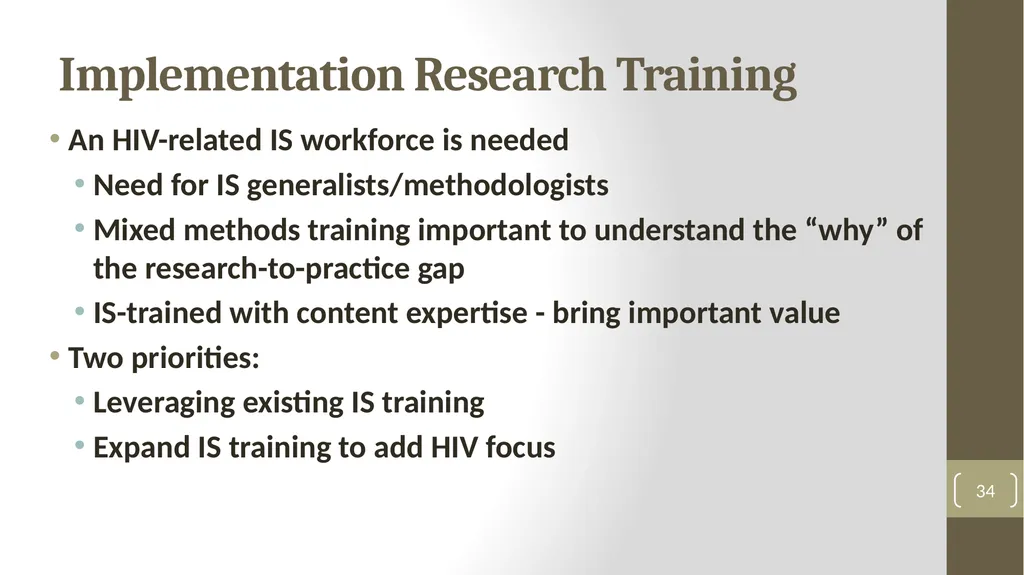
slide34. Implementation Research Training An HIV-related IS workforce is needed
Need for IS generalists/methodologists
Mixed methods training important to understand the “why” of the research-to-practice gap
IS-trained with content expertise - bring important value
Two priorities:
Leveraging existing IS training
Expand IS training to add HIV focus 34<br>
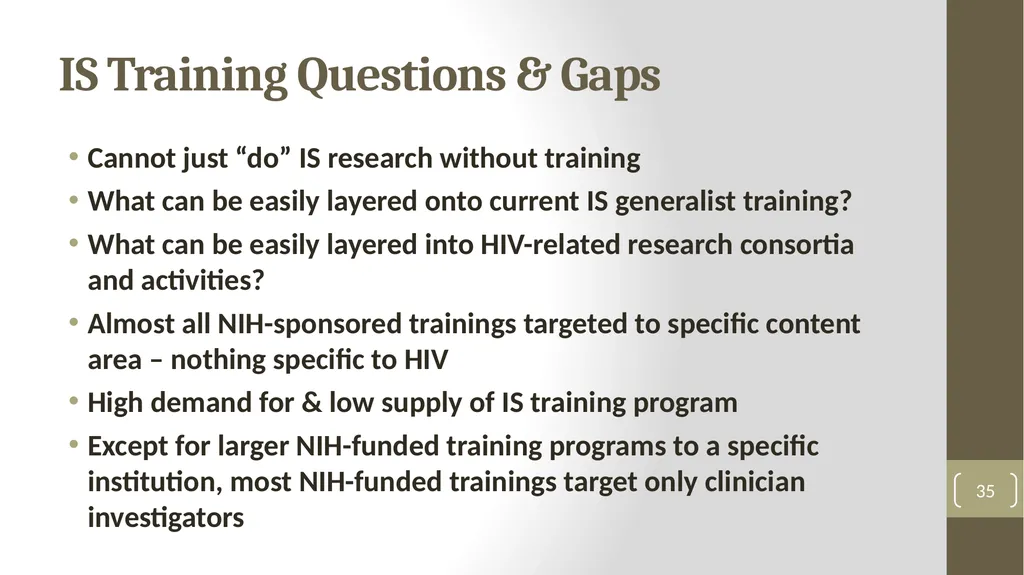
slide35. IS Training Questions & Gaps Cannot just “do” IS research without training
What can be easily layered onto current IS generalist training?
What can be easily layered into HIV-related research consortia and activities?
Almost all NIH-sponsored trainings targeted to specific content area – nothing specific to HIV
High demand for & low supply of IS training program
Except for larger NIH-funded training programs to a specific institution, most NIH-funded trainings target only clinician investigators 35<br>
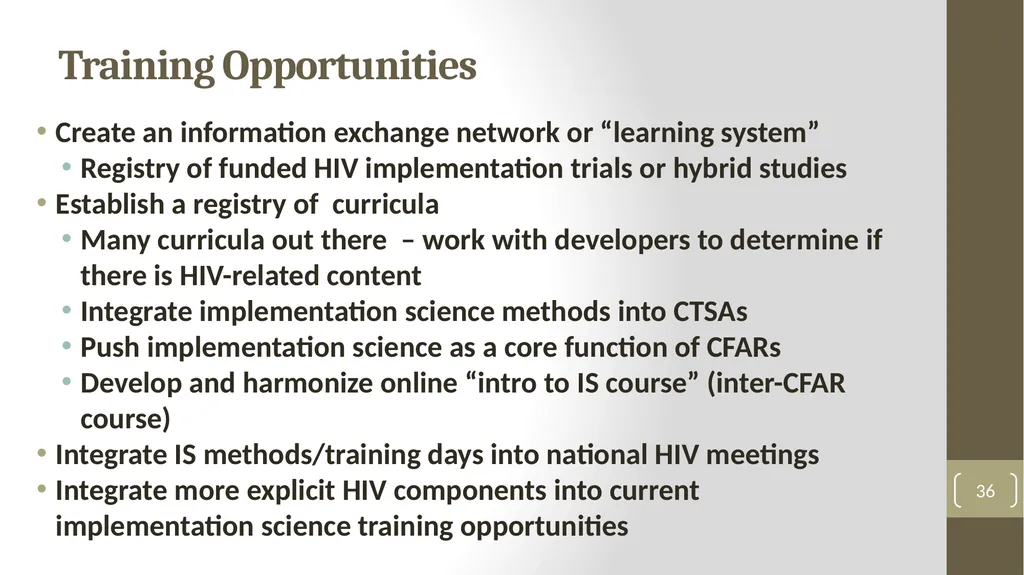
slide36. Training Opportunities Create an information exchange network or “learning system”
Registry of funded HIV implementation trials or hybrid studies
Establish a registry of curricula
Many curricula out there – work with developers to determine if there is HIV-related content
Integrate implementation science methods into CTSAs
Push implementation science as a core function of CFARs
Develop and harmonize online “intro to IS course” (inter-CFAR course)
Integrate IS methods/training days into national HIV meetings
Integrate more explicit HIV components into current implementation science training opportunities 36<br>
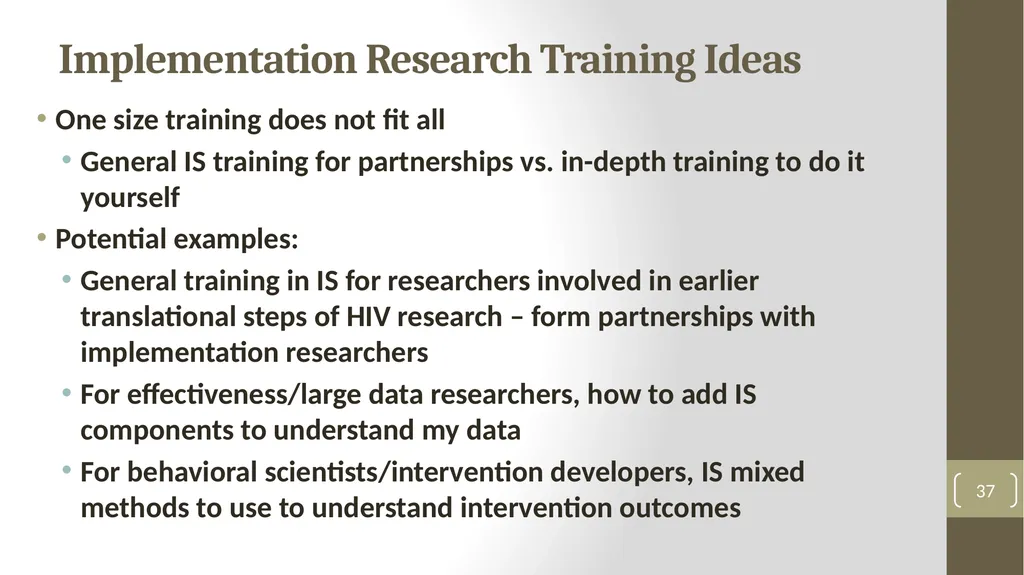
slide37. Implementation Research Training Ideas One size training does not fit all
General IS training for partnerships vs. in-depth training to do it yourself
Potential examples:
General training in IS for researchers involved in earlier translational steps of HIV research – form partnerships with implementation researchers
For effectiveness/large data researchers, how to add IS components to understand my data
For behavioral scientists/intervention developers, IS mixed methods to use to understand intervention outcomes 37<br>
Science Research 1<br>
slide2. Implementation Science Working Group Chairs: Stefan Baral, MD – Associate Professor, Johns Hopkins University, School of Public Health Michael Mugavero, MD – Professor, University of Alabama, Birmingham
Members: Margaret Czarnogorski, MD – Heath, Innovation and Implementation Science, ViiV Healthcare Mari-Lynn Drainoni, PhD – Professor, Boston University, School of Medicine Carey Farquhar, MD/MPH – Professor, University of Washington Elvin Geng, MD/MPH – Professor, Washington University, School of Medicine Matthew Golden, MD/MPH – Professor, University of Washington Christian Grov, PhD – Professor, City University of New York, School of Public Health and Health Policy Lisa Hightow-Weidman, MD/MPH – Professor, University of North Carolina, Chapel Hill Lisa Metsch, PhD – Professor, Columbia University Sharmistha Mishra, MD/PhD – Assistant Professor, University of Toronto Denis Nash, PhD/MPH – Professor, City University of New York Wynne Norton, PhD – Program Director, National Cancer Institute Izukanji Sikazwe, MD/MPH – CEO, Centre for Infectious Disease Research, Zambia Justin D. Smith, PhD – Associate Professor, Northwestern University, Feinberg School of Medicine Gail Wyatt, PhD – Professor, University of California, Los Angeles, The Semel Institute 2<br>
slide3. Implementation Science Working Group NIH Representatives:
Cheryl Boyce, PhD – National Heart, Lung, and Blood Institute (NHLBI)
Dara Blachman-Demner, PhD – Office of Behavioral and Social Sciences Research (OBSSR)
Holly Campbell-Rosen, PhD – National Institute of Mental Health (NIHM)
Helen Cox, MHS – National Heart, Lung, and Blood Institute (NHLBI)
Linda Kupfer, PhD – Fogarty International Center (FIC)
Kathryn Morris, MPH – Office of Behavioral and Social Sciences Research (OBSSR)
Joana Roe, BA – National Institute of Allergy and Infectious Diseases (NIAID) 3<br>
slide4. Hilary Pinnock et al. BMJ 2017;356:bmj.i6795 4<br>
slide5. Implementation Science Priority Topics Introduction to Implementation Science (IS) Research
Synthesizing priority IS HIV co-morbidity research questions
Novel observational and experimental IS research designs
Training opportunities and resources to expand the IS research workforce 5<br>
slide6. Introduction to Implementation Science (IS) Research Denis Nash, PhD, MPH
City University of New York (CUNY) School of Public Health
CUNY Institute for Implementation Science in Population Health<br>
slide7. What is Implementation Science? Implementation research is “the scientific study of the use of strategies to adopt and integrate evidence-based health interventions into clinical and community settings to improve individual outcomes and benefit population health”.
Implementation science conventionally addresses the gap between healthcare interventions that have been shown to work, and their successful adoption and routine use by service providers and individuals who may benefit from them in ‘real world’ settings. https://grants.nih.gov/grants/guide/pa-files/PAR-19-274.html
http://cunyisph.org/isph-toolkit/ Proctor et al. 2009.; Glasgow et al, AJE 2012 7<br>
slide8. What is Implementation Science? After efficacy studies discover interventions yielding better outcomes under controlled conditions, IS focuses on factors and processes or the ‘how and why’ interventions are adopted, implemented & sustained in practice-based settings.
IS is also focused on “the use of strategies to introduce or change evidence-based health interventions within specific settings” (Proctor et al, 2009). This means that strategies are purposefully chosen, and then tested for implementation effectiveness.
IS findings can be used to develop better approaches and guidelines to improve the uptake of successful implementation strategies, and enhance the potential for scale-up of programs across diverse settings with the goal of maximizing their uptake and impact.
Glasgow et al. note, there is a significant increase in the ‘return on investment’ of healthcare innovations and discoveries by optimizing intervention uptake, implementation, engagement, and scale-up Proctor et al. 2009.; Glasgow et al, AJE 2012 https://grants.nih.gov/grants/guide/pa-files/PAR-19-274.html
http://cunyisph.org/isph-toolkit/ 8<br>
slide9. Slide courtesy of N Ford, WHO and UNAIDS % Starting ART CD4<100 90-90-90 progress among 38M PLWH:
2018: 79-78-86<br>
slide10. Median CD4 count at ART initiation in landmark controlled trials (left side of figure), and at diagnosis or ART initiation in the real world (right side of figure) Achieving early diagnosis and ART initiation relative to seroconversion is a challenge globally. *A pre-treatment CD4 count of 350 cells/µL reflects 2.8-3.4 years since seroconversion, on average.
**A pre-treatment CD4 count of 500 cells/µL reflects 1-2 years since seroconversion, on average.
Only 25% initiate ART with CD4>500 globally and <50% with CD4>350 Source: D Nash and M Robertson; Current HIV/AIDS Reports; 2019<br>
slide11. Why we need HIV-related IS Research HIV-related programmatic scale-up and routine service delivery offer many opportunities to improve HIV-related health outcomes through better implementation and integration of evidence-based interventions
They also offer opportunities to improve other health outcomes (e.g., HIV-associated co-morbidities) among those receiving HIV-related services. HIV.gov 11<br>
slide12. IS Opportunities vis a vis HIV-associated co-morbidities: The Big Picture For a given HIV-associated co-morbidity, what can be learned from implementation science research that has been conducted outside the HIV setting
In resource-limited settings, what can we learn about screening, diagnosis, and management of HIV-related comorbidities that will be relevant to the care HIV-negative populations?
Implementation science research around screening and management of risk factors for HIV-related comorbidities (e.g., smoking, obesity) could result in prevention and/or earlier detection of several HIV-related comorbidities, reducing their ultimate burden.
Would a better understanding of the preferences of clients/patients/providers with respect to a given evidence-based intervention be useful to better inform the design of strategies to improve their uptake, engagement, and delivery? 12<br>
slide13. J.D. Smith, Ph.D. Northwestern University Feinberg School of Medicine Synthesizing priority Implementation Science HIV co-morbidity questions 13<br>
slide14. Current State-of-the-Science IS has established a corpus of research methodologies to evaluate, test, and understand implementation of evidence-based practices
Shifting from “Can we make it work?” to “How can we best make it work?”
Greater emphasis on optimizing implementation strategies that, alone or in combination, achieve crucial implementation outcomes more expediently, cost-effectively, and acceptably to delivery systems/agents and those PLWH that receive interventions for HIV-related comorbidities 14<br>
slide15. Key Research Questions What combination of implementation strategies are necessary and sufficient to increase the impact of interventions for HIV-related comorbidities?
Given limited resources in our jurisdiction, what implementation strategies will be most effective when implementing interventions for HIV-related comorbidities at the lowest cost?
How can we learn from our successes and challenges as we roll out interventions for HIV-related comorbidities over time to more expediently achieve implementation?
Can the cost and resources involved in a successful multicomponent implementation strategy package be reduced while maintaining its impact?
How can the field begin to optimize implementation during the development and testing of new interventions for HIV-related comorbidities? 15<br>
slide16. Why these Questions? With recent scientific advances in both biomedical and behavioral interventions, the challenge is delivering these interventions to the right people, at the right time, in the right place, via the right way, and in the right amount (implementation).
Finite resources exist for implementation that must be used as efficiently as possible to achieve maximum effects
Decision-makers need guidance to make informed selections of interventions and the required strategies to implement them based on evidence that can quantify the budget impact, cost-benefit, and cost-effectiveness 16<br>
slide17. Opportunities Design implementation trials to either explicitly or at least to better understand implementation optimization.
adaptive designs (fractional factorial, SMART, MOST)
dismantling designs
rollout optimization trials
Begin to synthesize the findings from multiple implementation trials
Design interventions for HIV-related comorbidities with implementation in mind (designing for D&I)
Apply a range of implementation research methodologies for PLWH experiencing comorbidities (e.g., McNulty, Smith, et al. 2019, Ethnicity & Disease) 17<br>
slide18. Novel study designs for implementation research (a sampler) Elvin Geng, MD MPH
Professor of Medicine
Director, Center for Dissemination and Implementation
Washington University in St Louis<br>
slide19. Traditional Clinical Research Does it work if used? (efficacy)
Does it work better than something else? (comparative efficacy)
Does it work better than something else is a real world (-ish) setting? (comparative effectiveness)
We have methods for these questions… 19<br>
slide20. Implementation Research Questions How do you get an evidence-based intervention widely used?
…But answers are contexts–specific – therefore no one answer
How to we optimize use of multiple implementation strategies to get the same EBI used?
…Too many combinations to empirically compare
How do we optimize use of multiple implementation strategies sequentially?
…Where treatment must depend on response<br>
slide21. External Validity – Clinical Treatments Target Population (Where you want to infer) Study population Effect =3 Effect =3<br>
slide22. External Validity – Implementation Strategies<br>
slide23. New Science of External Validity? Transportability
Population composition and the mechanism in the source population
+
Information about how those differ in target population
“Seed and soil” Judea Pearl and Elias Bareinboim 2011 JSM Proceedings, Miami Beach FL, July 30-August 4, 2011, pp. 157-171. Statistical Science
2014, Vol. 29, No. 4, 579–595<br>
slide24. How do we optimize the mix of implementation strategies when there are too many strategies to compare empirically?<br>
slide25. Example: Differentiated Service Delivery<br>
slide26. Can choice experiments play a role in optimization?<br>
slide27. Subgroups detected by latent class analyses: Choice experiment in Zambia (N=247) Eschun Wilson JAIDS 2019<br>
slide28. How do we optimize use strategies together sequentially (target treatment to response)? 28<br>
slide29. Implementation strategies No silver bullets, therefore how to use strategies (sequentially) to optimize use and effects?
Most things in clinical and public health practice (try something and then try something else in those who don’t respond or succeed).
Can’t do everything at once
Standard research comparison does not answer the question
“A” better then nothing?
“A” better than “B”?
We want, how do you use A and B together to get the best outcomes. 29<br>
slide30. Adaptive Strategies to Target Public Health Interventions An adaptive, sequential strategy uses multiple interventions or strategies (each of which may have small effects) over time
“Adaptive” because what is used depend prior response
Start with less effective but less toxic / less expensive intervention or strategy and then escalate (switch, augment) among those not responding
Minimizes expenditures / toxicities for whom the initial strategy is sufficient (optimizing efficiency)
Intensifies support for those who need additional or alternative help (optimizing effectiveness)<br>
slide31. Sequential multiple assignment randomized trials (Susan Murphy 2011, 2012)<br>
slide32. Conclusion Implementation research ask slightly different questions as compared to clinical research
Different questions raise distinctive challenges
Distinctive challenges require novel methods
Need to community of HIV researchers to adopt and use those tools (along with theories and frameworks)
Accelerate to end HIV epidemic<br>
slide33. Training opportunities and resources to expand the Implementation Science research workforce Mari-Lynn Drainoni, PhD
Boston University School of Medicine 33<br>
slide34. Implementation Research Training An HIV-related IS workforce is needed
Need for IS generalists/methodologists
Mixed methods training important to understand the “why” of the research-to-practice gap
IS-trained with content expertise - bring important value
Two priorities:
Leveraging existing IS training
Expand IS training to add HIV focus 34<br>
slide35. IS Training Questions & Gaps Cannot just “do” IS research without training
What can be easily layered onto current IS generalist training?
What can be easily layered into HIV-related research consortia and activities?
Almost all NIH-sponsored trainings targeted to specific content area – nothing specific to HIV
High demand for & low supply of IS training program
Except for larger NIH-funded training programs to a specific institution, most NIH-funded trainings target only clinician investigators 35<br>
slide36. Training Opportunities Create an information exchange network or “learning system”
Registry of funded HIV implementation trials or hybrid studies
Establish a registry of curricula
Many curricula out there – work with developers to determine if there is HIV-related content
Integrate implementation science methods into CTSAs
Push implementation science as a core function of CFARs
Develop and harmonize online “intro to IS course” (inter-CFAR course)
Integrate IS methods/training days into national HIV meetings
Integrate more explicit HIV components into current implementation science training opportunities 36<br>
slide37. Implementation Research Training Ideas One size training does not fit all
General IS training for partnerships vs. in-depth training to do it yourself
Potential examples:
General training in IS for researchers involved in earlier translational steps of HIV research – form partnerships with implementation researchers
For effectiveness/large data researchers, how to add IS components to understand my data
For behavioral scientists/intervention developers, IS mixed methods to use to understand intervention outcomes 37<br>