
Implementing trauma informed care in practice:
LD
Published · 19 slides · 0 views
1 / 1
Description
Implementing trauma informed care in practice: Evolving support plans from behavioural to relational support Dr Paddy McNally Consultant Clinical Psychologist Implementing trauma informed care in practice Overview Trauma experiences for
Related Topics
Share
Embed code
Download this presentation From Below
"Implementing trauma informed care in practice:" is the property of its rightful owner. Permission is granted to download and print the materials on this website for personal, non-commercial use only, and to display it on your personal computer provided you do not modify the materials and that you retain all copyright notices contained in the materials. By downloading content from our website, you accept the terms of this agreement.
Presentation Transcript
01
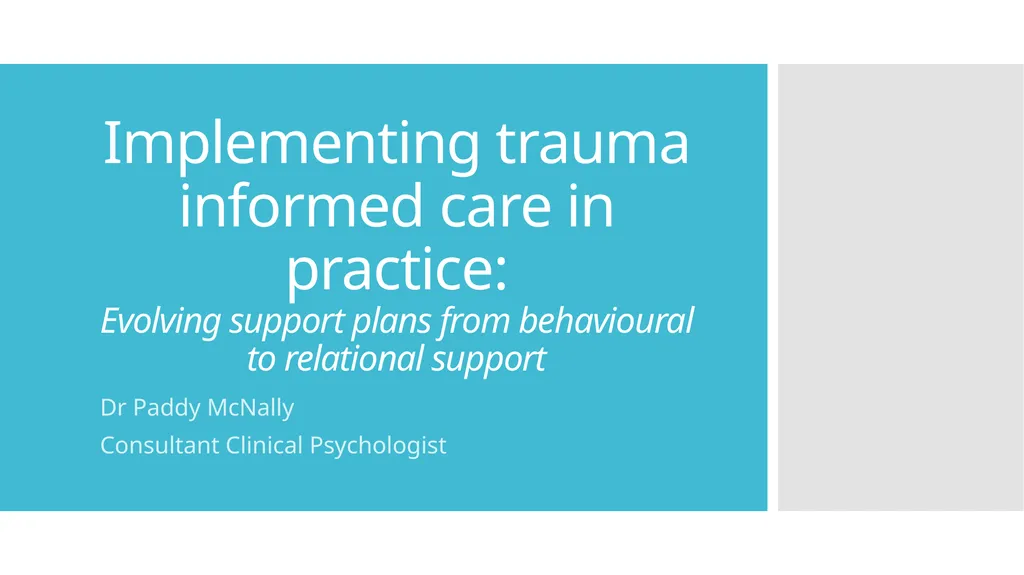
Implementing trauma informed care in practice:
Evolving support plans from behavioural to relational support Dr Paddy McNally
Consultant Clinical Psychologist<br>
Consultant Clinical Psychologist<br>
02
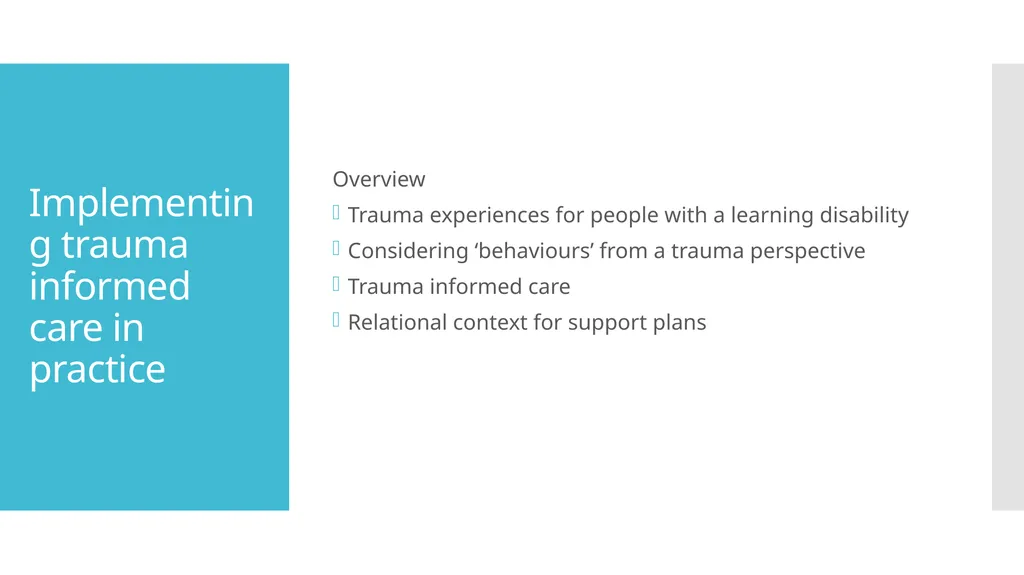
Implementing trauma informed care in practice Overview
Trauma experiences for people with a learning disability
Considering ‘behaviours’ from a trauma perspective
Trauma informed care
Relational context for support plans<br>
Trauma experiences for people with a learning disability
Considering ‘behaviours’ from a trauma perspective
Trauma informed care
Relational context for support plans<br>
03
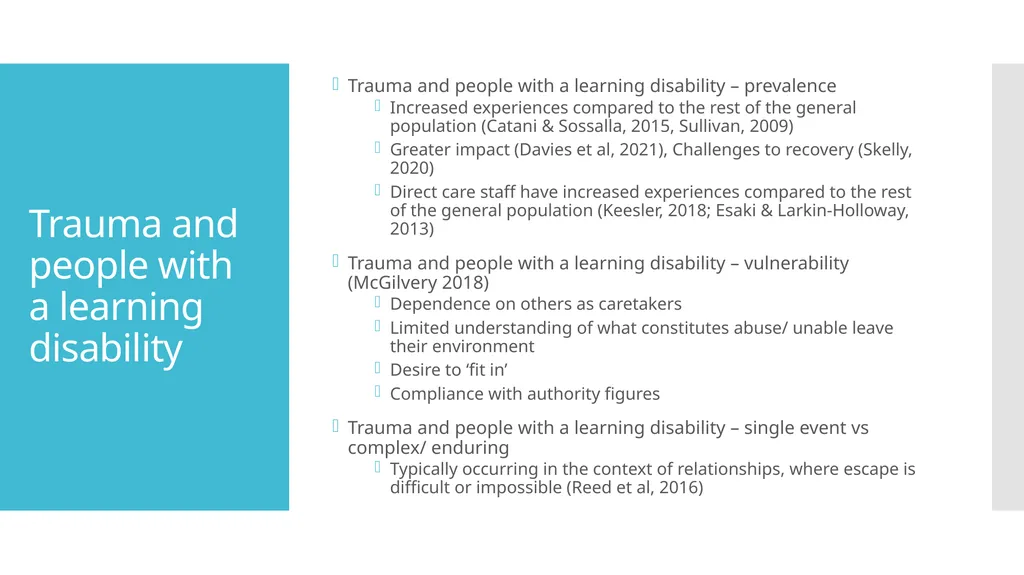
Trauma and people with a learning disability Trauma and people with a learning disability – prevalence
Increased experiences compared to the rest of the general population (Catani & Sossalla, 2015, Sullivan, 2009)
Greater impact (Davies et al, 2021), Challenges to recovery (Skelly, 2020)
Direct care staff have increased experiences compared to the rest of the general population (Keesler, 2018; Esaki & Larkin-Holloway, 2013)
Trauma and people with a learning disability – vulnerability (McGilvery 2018)
Dependence on others as caretakers
Limited understanding of what constitutes abuse/ unable leave their environment
Desire to ‘fit in’
Compliance with authority figures
Trauma and people with a learning disability – single event vs complex/ enduring
Typically occurring in the context of relationships, where escape is difficult or impossible (Reed et al, 2016)<br>
Increased experiences compared to the rest of the general population (Catani & Sossalla, 2015, Sullivan, 2009)
Greater impact (Davies et al, 2021), Challenges to recovery (Skelly, 2020)
Direct care staff have increased experiences compared to the rest of the general population (Keesler, 2018; Esaki & Larkin-Holloway, 2013)
Trauma and people with a learning disability – vulnerability (McGilvery 2018)
Dependence on others as caretakers
Limited understanding of what constitutes abuse/ unable leave their environment
Desire to ‘fit in’
Compliance with authority figures
Trauma and people with a learning disability – single event vs complex/ enduring
Typically occurring in the context of relationships, where escape is difficult or impossible (Reed et al, 2016)<br>
04
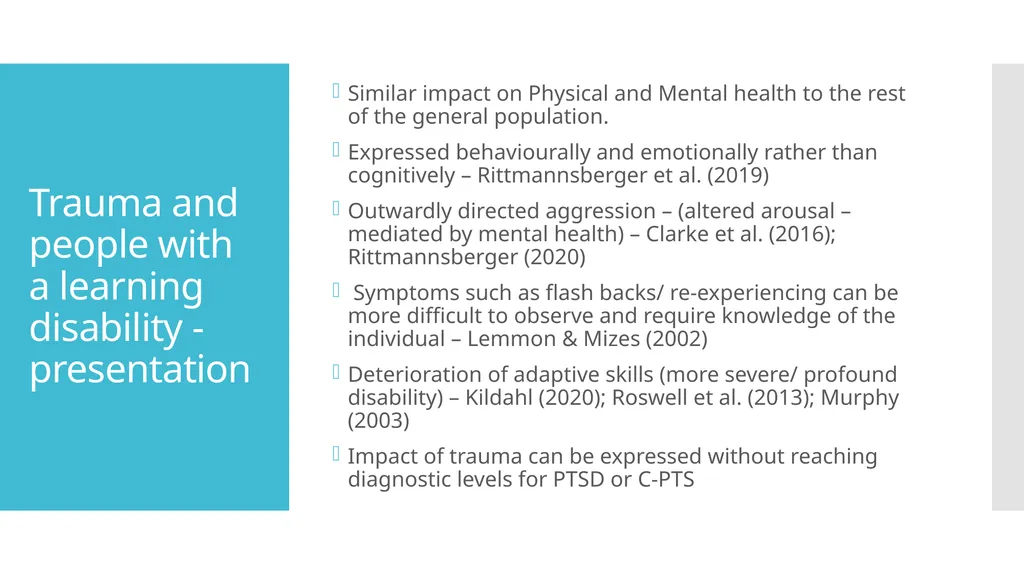
Trauma and people with a learning disability - presentation Similar impact on Physical and Mental health to the rest of the general population.
Expressed behaviourally and emotionally rather than cognitively – Rittmannsberger et al. (2019)
Outwardly directed aggression – (altered arousal – mediated by mental health) – Clarke et al. (2016); Rittmannsberger (2020)
Symptoms such as flash backs/ re-experiencing can be more difficult to observe and require knowledge of the individual – Lemmon & Mizes (2002)
Deterioration of adaptive skills (more severe/ profound disability) – Kildahl (2020); Roswell et al. (2013); Murphy (2003)
Impact of trauma can be expressed without reaching diagnostic levels for PTSD or C-PTS<br>
Expressed behaviourally and emotionally rather than cognitively – Rittmannsberger et al. (2019)
Outwardly directed aggression – (altered arousal – mediated by mental health) – Clarke et al. (2016); Rittmannsberger (2020)
Symptoms such as flash backs/ re-experiencing can be more difficult to observe and require knowledge of the individual – Lemmon & Mizes (2002)
Deterioration of adaptive skills (more severe/ profound disability) – Kildahl (2020); Roswell et al. (2013); Murphy (2003)
Impact of trauma can be expressed without reaching diagnostic levels for PTSD or C-PTS<br>
05
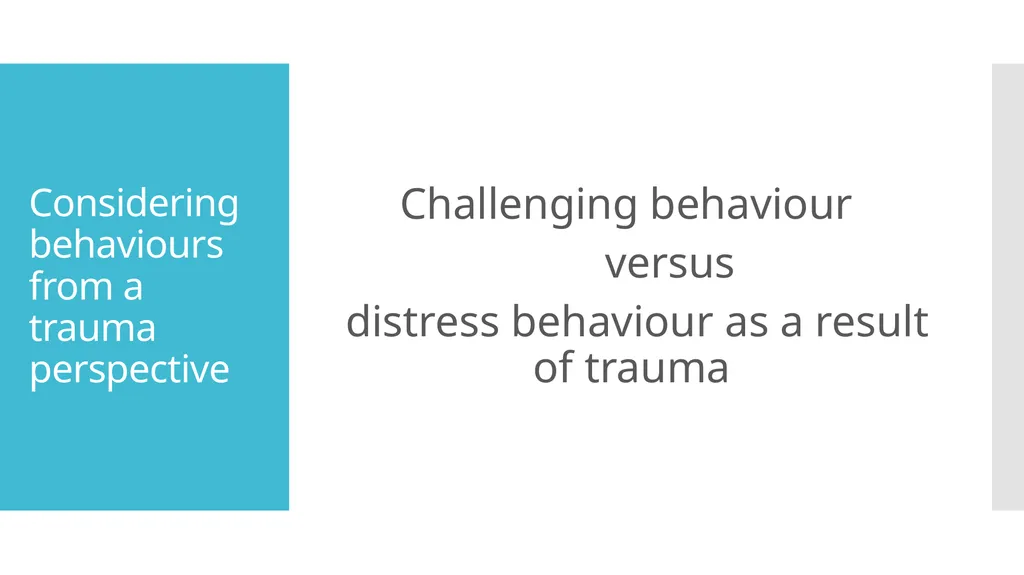
Considering behaviours from a trauma perspective Challenging behaviour
versus
distress behaviour as a result of trauma<br>
versus
distress behaviour as a result of trauma<br>
06
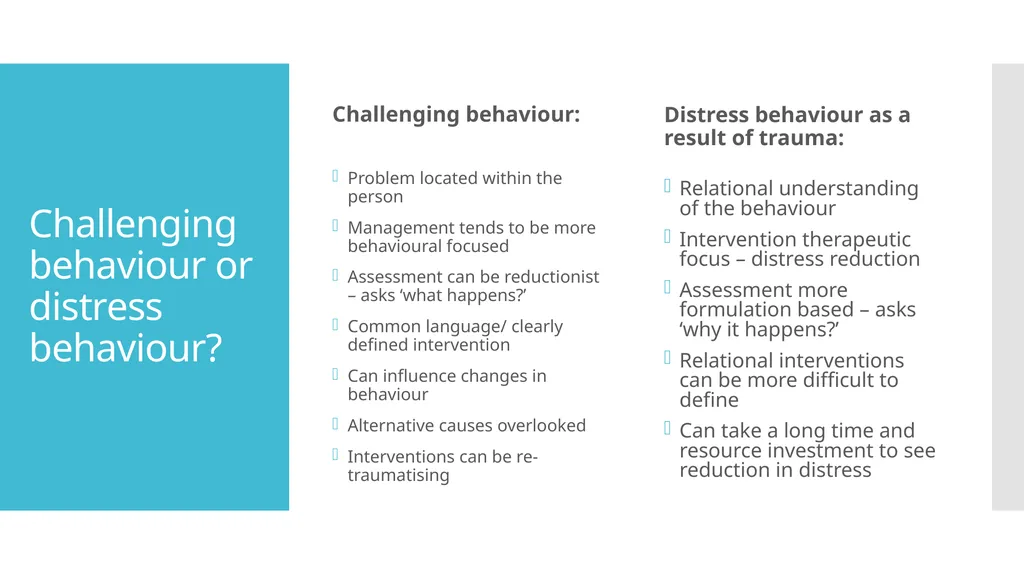
Challenging behaviour or distress behaviour? Challenging behaviour: Problem located within the person
Management tends to be more behavioural focused
Assessment can be reductionist – asks ‘what happens?’
Common language/ clearly defined intervention
Can influence changes in behaviour
Alternative causes overlooked
Interventions can be re-traumatising Distress behaviour as a result of trauma: Relational understanding of the behaviour
Intervention therapeutic focus – distress reduction
Assessment more formulation based – asks ‘why it happens?’
Relational interventions can be more difficult to define
Can take a long time and resource investment to see reduction in distress<br>
Management tends to be more behavioural focused
Assessment can be reductionist – asks ‘what happens?’
Common language/ clearly defined intervention
Can influence changes in behaviour
Alternative causes overlooked
Interventions can be re-traumatising Distress behaviour as a result of trauma: Relational understanding of the behaviour
Intervention therapeutic focus – distress reduction
Assessment more formulation based – asks ‘why it happens?’
Relational interventions can be more difficult to define
Can take a long time and resource investment to see reduction in distress<br>
07
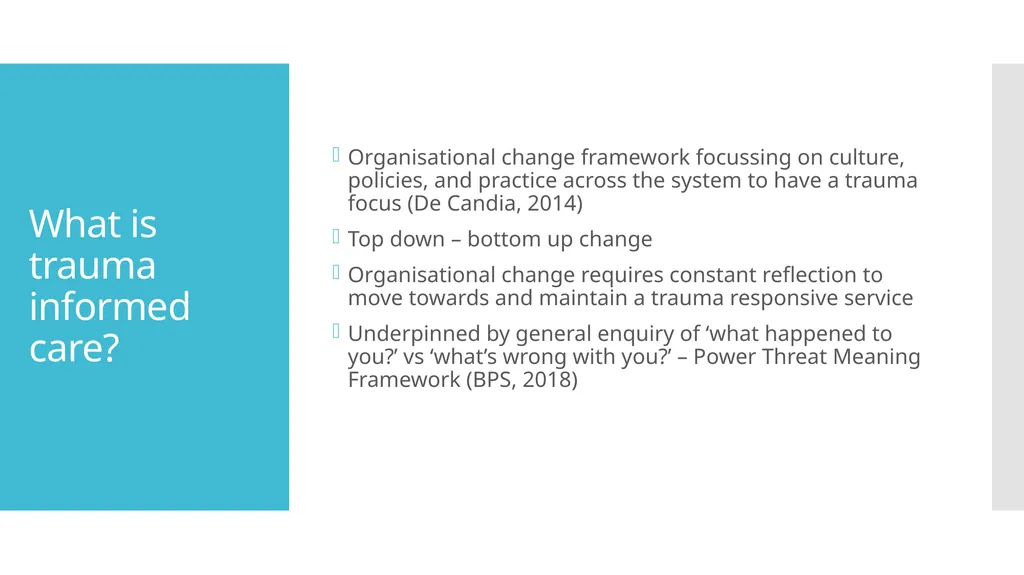
What is trauma informed care? Organisational change framework focussing on culture, policies, and practice across the system to have a trauma focus (De Candia, 2014)
Top down – bottom up change
Organisational change requires constant reflection to move towards and maintain a trauma responsive service
Underpinned by general enquiry of ‘what happened to you?’ vs ‘what’s wrong with you?’ – Power Threat Meaning Framework (BPS, 2018)<br>
Top down – bottom up change
Organisational change requires constant reflection to move towards and maintain a trauma responsive service
Underpinned by general enquiry of ‘what happened to you?’ vs ‘what’s wrong with you?’ – Power Threat Meaning Framework (BPS, 2018)<br>
08
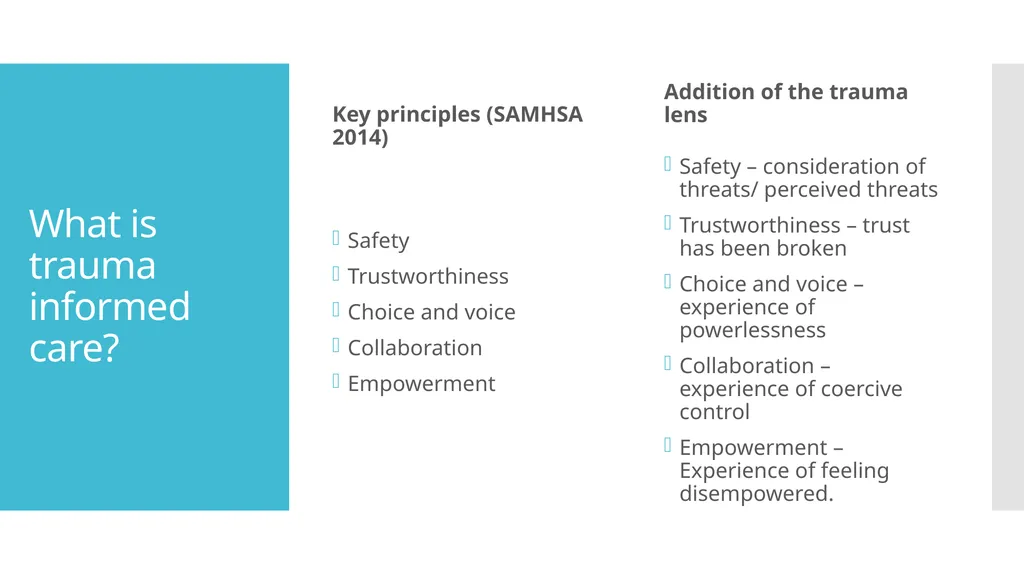
What is trauma informed care? Key principles (SAMHSA 2014) Safety
Trustworthiness
Choice and voice
Collaboration
Empowerment Addition of the trauma lens Safety – consideration of threats/ perceived threats
Trustworthiness – trust has been broken
Choice and voice – experience of powerlessness
Collaboration – experience of coercive control
Empowerment – Experience of feeling disempowered.<br>
Trustworthiness
Choice and voice
Collaboration
Empowerment Addition of the trauma lens Safety – consideration of threats/ perceived threats
Trustworthiness – trust has been broken
Choice and voice – experience of powerlessness
Collaboration – experience of coercive control
Empowerment – Experience of feeling disempowered.<br>
09
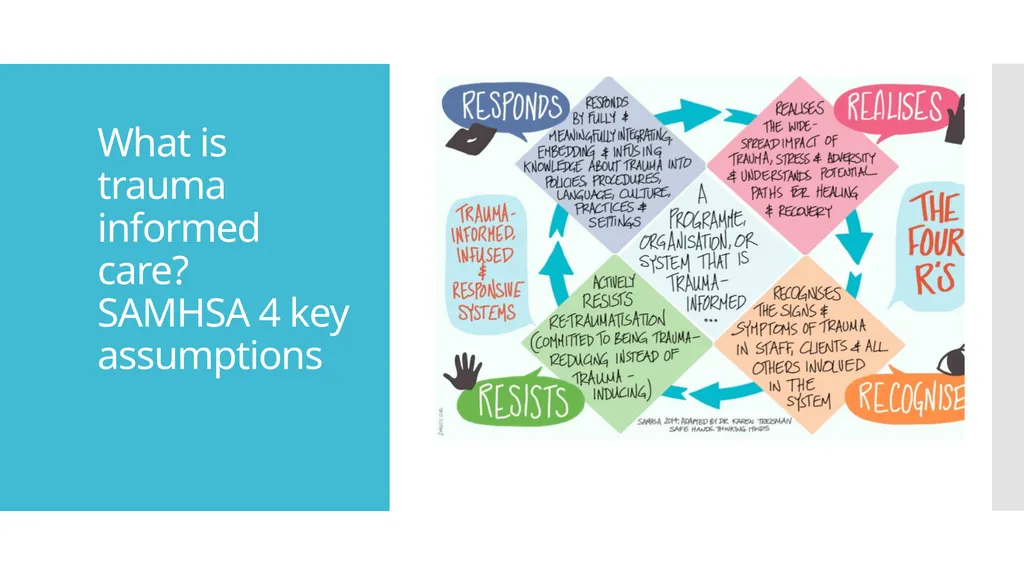
What is trauma informed care?
SAMHSA 4 key assumptions<br>
10
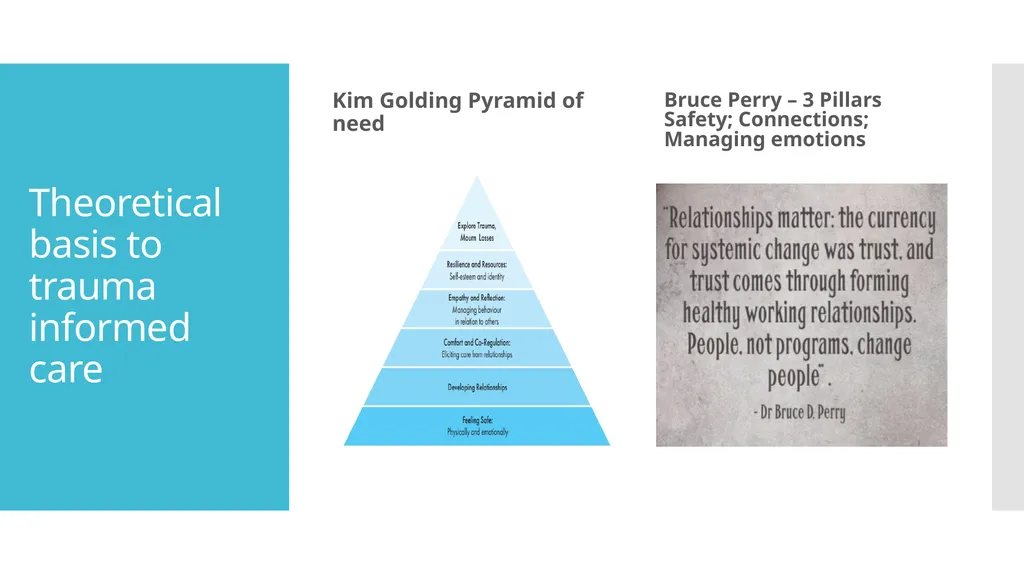
Theoretical basis to trauma informed care Kim Golding Pyramid of need Bruce Perry – 3 Pillars
Safety; Connections; Managing emotions<br>
Safety; Connections; Managing emotions<br>
11
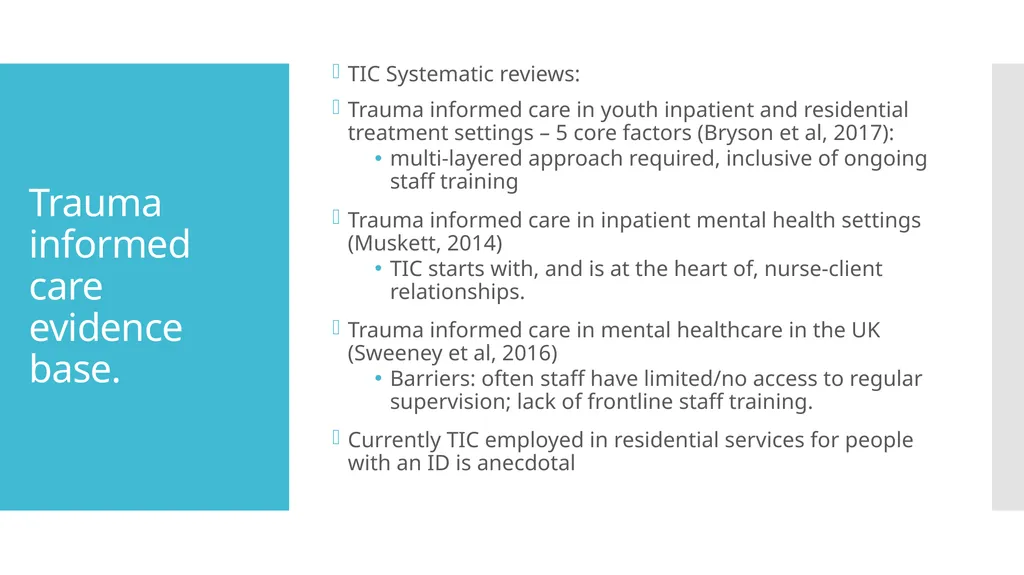
Trauma informed care evidence base. TIC Systematic reviews:
Trauma informed care in youth inpatient and residential treatment settings – 5 core factors (Bryson et al, 2017):
multi-layered approach required, inclusive of ongoing staff training
Trauma informed care in inpatient mental health settings (Muskett, 2014)
TIC starts with, and is at the heart of, nurse-client relationships.
Trauma informed care in mental healthcare in the UK (Sweeney et al, 2016)
Barriers: often staff have limited/no access to regular supervision; lack of frontline staff training.
Currently TIC employed in residential services for people with an ID is anecdotal<br>
Trauma informed care in youth inpatient and residential treatment settings – 5 core factors (Bryson et al, 2017):
multi-layered approach required, inclusive of ongoing staff training
Trauma informed care in inpatient mental health settings (Muskett, 2014)
TIC starts with, and is at the heart of, nurse-client relationships.
Trauma informed care in mental healthcare in the UK (Sweeney et al, 2016)
Barriers: often staff have limited/no access to regular supervision; lack of frontline staff training.
Currently TIC employed in residential services for people with an ID is anecdotal<br>
12
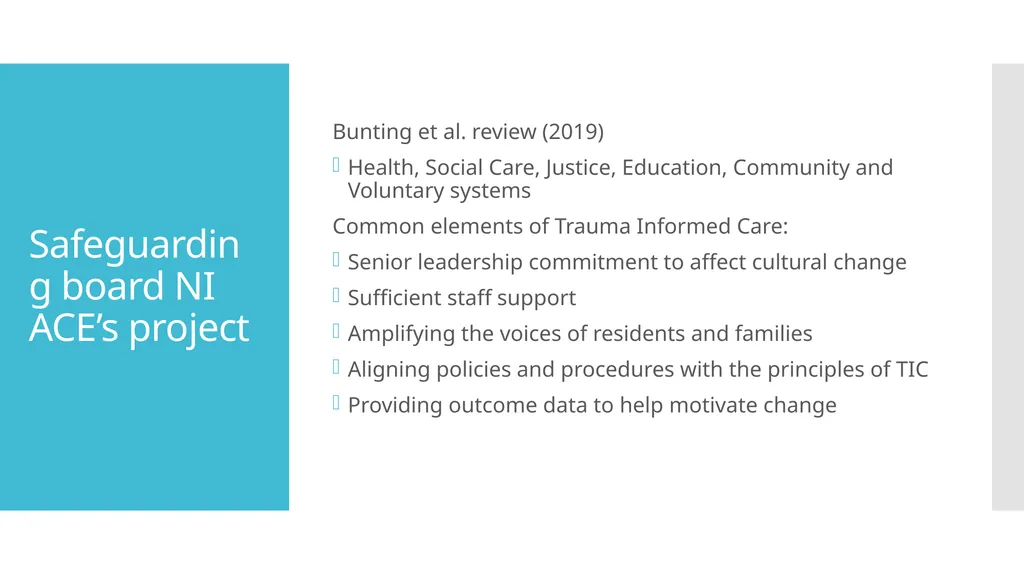
Safeguarding board NI ACE’s project Bunting et al. review (2019)
Health, Social Care, Justice, Education, Community and Voluntary systems
Common elements of Trauma Informed Care:
Senior leadership commitment to affect cultural change
Sufficient staff support
Amplifying the voices of residents and families
Aligning policies and procedures with the principles of TIC
Providing outcome data to help motivate change<br>
Health, Social Care, Justice, Education, Community and Voluntary systems
Common elements of Trauma Informed Care:
Senior leadership commitment to affect cultural change
Sufficient staff support
Amplifying the voices of residents and families
Aligning policies and procedures with the principles of TIC
Providing outcome data to help motivate change<br>
13
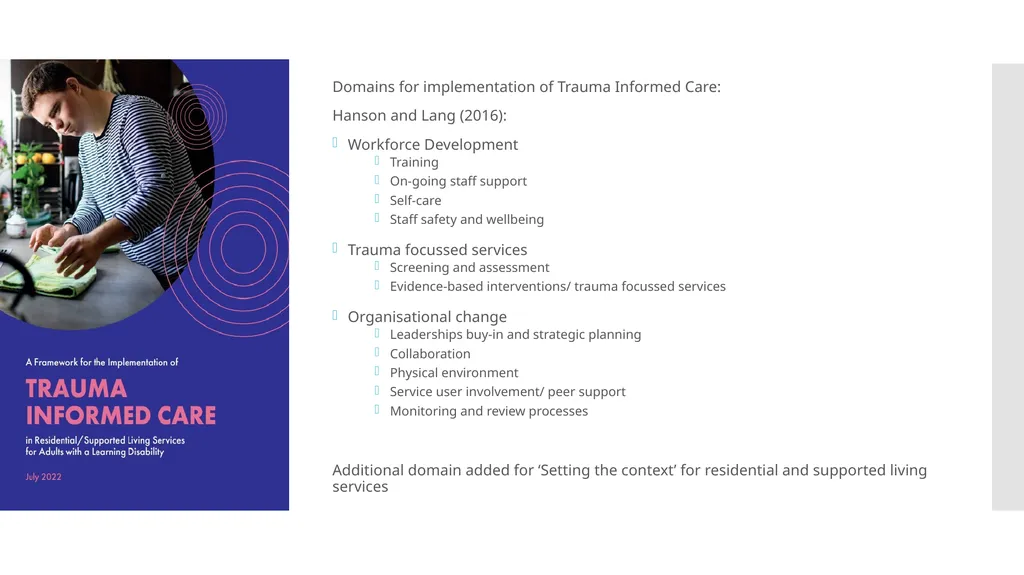
Domains for implementation of Trauma Informed Care:
Hanson and Lang (2016):
Workforce Development
Training
On-going staff support
Self-care
Staff safety and wellbeing
Trauma focussed services
Screening and assessment
Evidence-based interventions/ trauma focussed services
Organisational change
Leaderships buy-in and strategic planning
Collaboration
Physical environment
Service user involvement/ peer support
Monitoring and review processes
Additional domain added for ‘Setting the context’ for residential and supported living services<br>
Hanson and Lang (2016):
Workforce Development
Training
On-going staff support
Self-care
Staff safety and wellbeing
Trauma focussed services
Screening and assessment
Evidence-based interventions/ trauma focussed services
Organisational change
Leaderships buy-in and strategic planning
Collaboration
Physical environment
Service user involvement/ peer support
Monitoring and review processes
Additional domain added for ‘Setting the context’ for residential and supported living services<br>
14
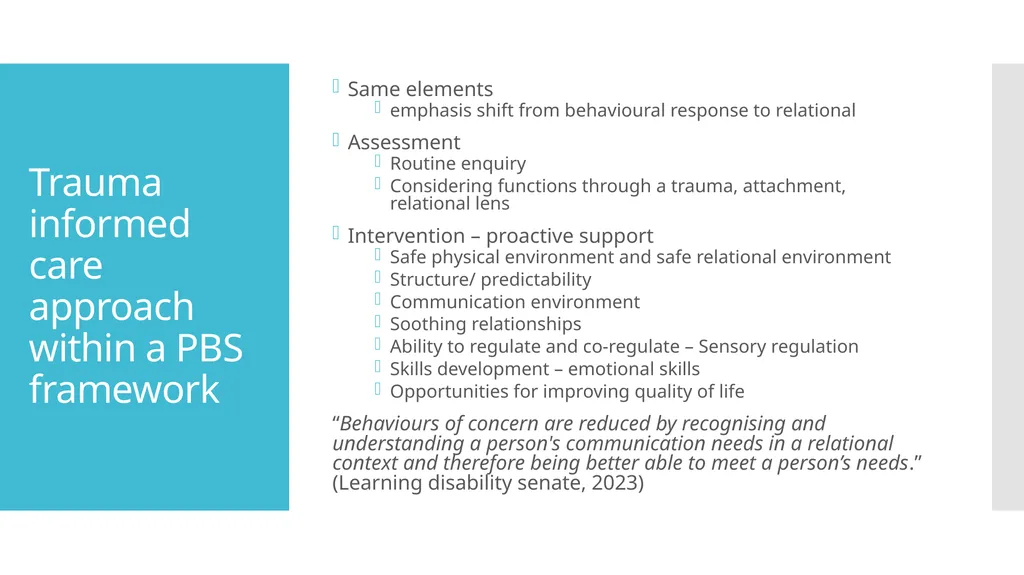
Trauma informed care approach within a PBS framework Same elements
emphasis shift from behavioural response to relational
Assessment
Routine enquiry
Considering functions through a trauma, attachment, relational lens
Intervention – proactive support
Safe physical environment and safe relational environment
Structure/ predictability
Communication environment
Soothing relationships
Ability to regulate and co-regulate – Sensory regulation
Skills development – emotional skills
Opportunities for improving quality of life
“Behaviours of concern are reduced by recognising and understanding a person's communication needs in a relational context and therefore being better able to meet a person’s needs.” (Learning disability senate, 2023)<br>
emphasis shift from behavioural response to relational
Assessment
Routine enquiry
Considering functions through a trauma, attachment, relational lens
Intervention – proactive support
Safe physical environment and safe relational environment
Structure/ predictability
Communication environment
Soothing relationships
Ability to regulate and co-regulate – Sensory regulation
Skills development – emotional skills
Opportunities for improving quality of life
“Behaviours of concern are reduced by recognising and understanding a person's communication needs in a relational context and therefore being better able to meet a person’s needs.” (Learning disability senate, 2023)<br>
15
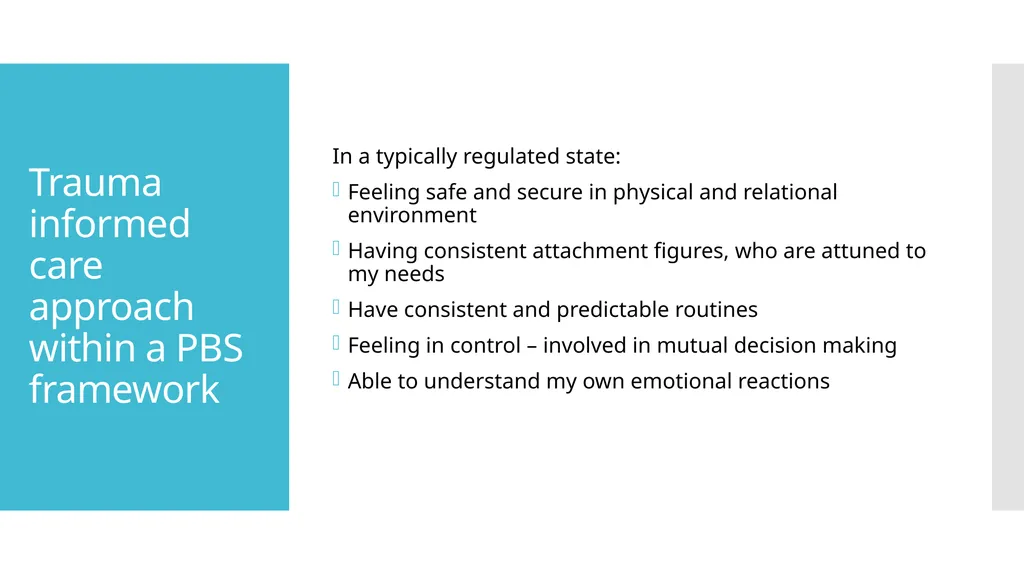
Trauma informed care approach within a PBS framework In a typically regulated state:
Feeling safe and secure in physical and relational environment
Having consistent attachment figures, who are attuned to my needs
Have consistent and predictable routines
Feeling in control – involved in mutual decision making
Able to understand my own emotional reactions<br>
Feeling safe and secure in physical and relational environment
Having consistent attachment figures, who are attuned to my needs
Have consistent and predictable routines
Feeling in control – involved in mutual decision making
Able to understand my own emotional reactions<br>
16
Trauma informed care approach within a PBS framework Starting to show signs of distress (Reactive support):
People around me are attuned to triggers for me
People around me are regulated themselves
As my ability to tolerate environmental demands decreases, adjustments are made to help me stay regulated.
As I move into hyper/ hypo arousal you will see changes in my behaviour. The behaviours you see are often ones that I needed in order to survive in earlier relationships/ environments<br>
People around me are attuned to triggers for me
People around me are regulated themselves
As my ability to tolerate environmental demands decreases, adjustments are made to help me stay regulated.
As I move into hyper/ hypo arousal you will see changes in my behaviour. The behaviours you see are often ones that I needed in order to survive in earlier relationships/ environments<br>
17
Trauma informed care approach within a PBS framework Reached a high level of distress (Reactive support):
At this point I am no longer in control of my reactions and my ‘thinking’ brain is not as engaged
I need the people around me to be aware of their own responses to my distress
I need the people around me to be emotionally regulated to help me regulate my emotions
People around me should be aware that some of their natural responses can be re-traumatising for me<br>
At this point I am no longer in control of my reactions and my ‘thinking’ brain is not as engaged
I need the people around me to be aware of their own responses to my distress
I need the people around me to be emotionally regulated to help me regulate my emotions
People around me should be aware that some of their natural responses can be re-traumatising for me<br>
18
Trauma informed care approach within a PBS framework What happens after:
I may feel shame and guilt for my actions
I may seek reassurance from familiar staff/ attachment figures that our relationships is ok.
I will need our relationship to be repaired
Nurture statements are important to me<br>
I may feel shame and guilt for my actions
I may seek reassurance from familiar staff/ attachment figures that our relationships is ok.
I will need our relationship to be repaired
Nurture statements are important to me<br>
19
Challenges to implementing relational support within a trauma informed care framework Crisis in care sector – high staff turnover/ challenges to recruitment
Skills required – higher levels of complexity
Systems investing in their staff
Staff experience of trauma and vicarious trauma
Investment in PBS framework/ behavioural understanding<br>
Skills required – higher levels of complexity
Systems investing in their staff
Staff experience of trauma and vicarious trauma
Investment in PBS framework/ behavioural understanding<br>