
Important aspects of procurement and contract
DJ
Published · 40 slides · 0 views

1 / 1


Description
Important aspects of procurement and contract management Electronic Procurement Systems As per the Loan Agreement signed with World Bank Borrowers may use electronic procurement systems (e-Procurement) for aspects of the Procurement
Related Topics
Share
Embed code
Download this presentation From Below
"Important aspects of procurement and contract" is the property of its rightful owner. Permission is granted to download and print the materials on this website for personal, non-commercial use only, and to display it on your personal computer provided you do not modify the materials and that you retain all copyright notices contained in the materials. By downloading content from our website, you accept the terms of this agreement.
Presentation Transcript
01
Important aspects of procurement and contract management<br>
02
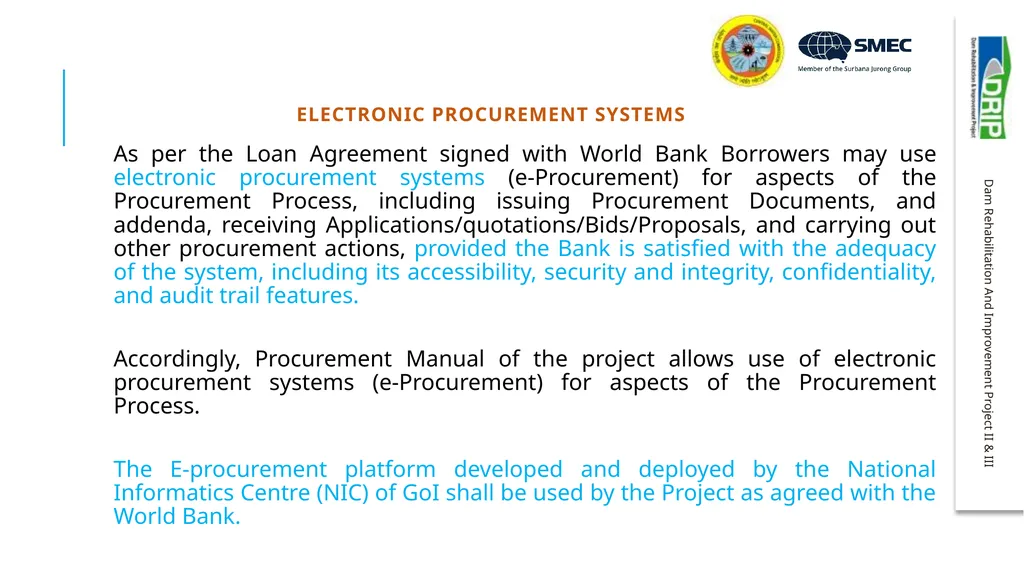
Electronic Procurement Systems As per the Loan Agreement signed with World Bank Borrowers may use electronic procurement systems (e-Procurement) for aspects of the Procurement Process, including issuing Procurement Documents, and addenda, receiving Applications/quotations/Bids/Proposals, and carrying out other procurement actions, provided the Bank is satisfied with the adequacy of the system, including its accessibility, security and integrity, confidentiality, and audit trail features.
Accordingly, Procurement Manual of the project allows use of electronic procurement systems (e-Procurement) for aspects of the Procurement Process.
The E-procurement platform developed and deployed by the National Informatics Centre (NIC) of GoI shall be used by the Project as agreed with the World Bank. © Santosh K. Singh<br>
Accordingly, Procurement Manual of the project allows use of electronic procurement systems (e-Procurement) for aspects of the Procurement Process.
The E-procurement platform developed and deployed by the National Informatics Centre (NIC) of GoI shall be used by the Project as agreed with the World Bank. © Santosh K. Singh<br>
03
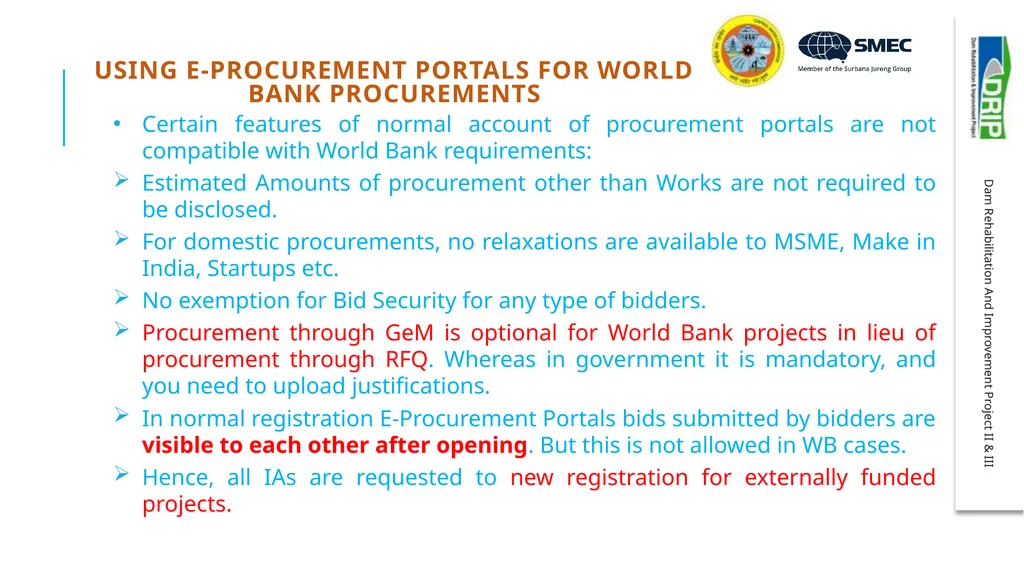
Using E-Procurement portals for World Bank Procurements Certain features of normal account of procurement portals are not compatible with World Bank requirements:
Estimated Amounts of procurement other than Works are not required to be disclosed.
For domestic procurements, no relaxations are available to MSME, Make in India, Startups etc.
No exemption for Bid Security for any type of bidders.
Procurement through GeM is optional for World Bank projects in lieu of procurement through RFQ. Whereas in government it is mandatory, and you need to upload justifications.
In normal registration E-Procurement Portals bids submitted by bidders are visible to each other after opening. But this is not allowed in WB cases.
Hence, all IAs are requested to new registration for externally funded projects. © Santosh K. Singh<br>
Estimated Amounts of procurement other than Works are not required to be disclosed.
For domestic procurements, no relaxations are available to MSME, Make in India, Startups etc.
No exemption for Bid Security for any type of bidders.
Procurement through GeM is optional for World Bank projects in lieu of procurement through RFQ. Whereas in government it is mandatory, and you need to upload justifications.
In normal registration E-Procurement Portals bids submitted by bidders are visible to each other after opening. But this is not allowed in WB cases.
Hence, all IAs are requested to new registration for externally funded projects. © Santosh K. Singh<br>
04
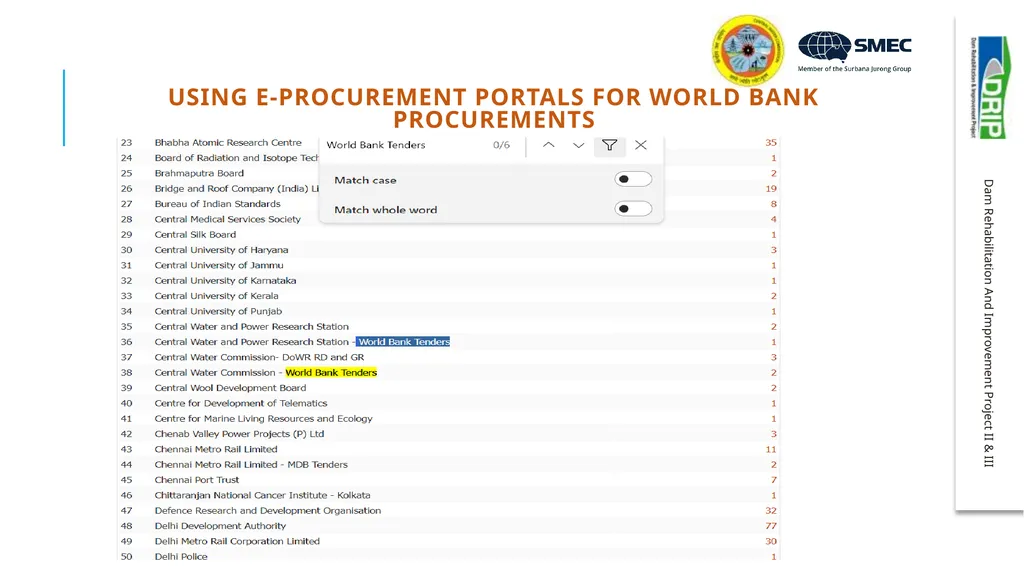
Using E-Procurement portals for World Bank Procurements © Santosh K. Singh<br>
05
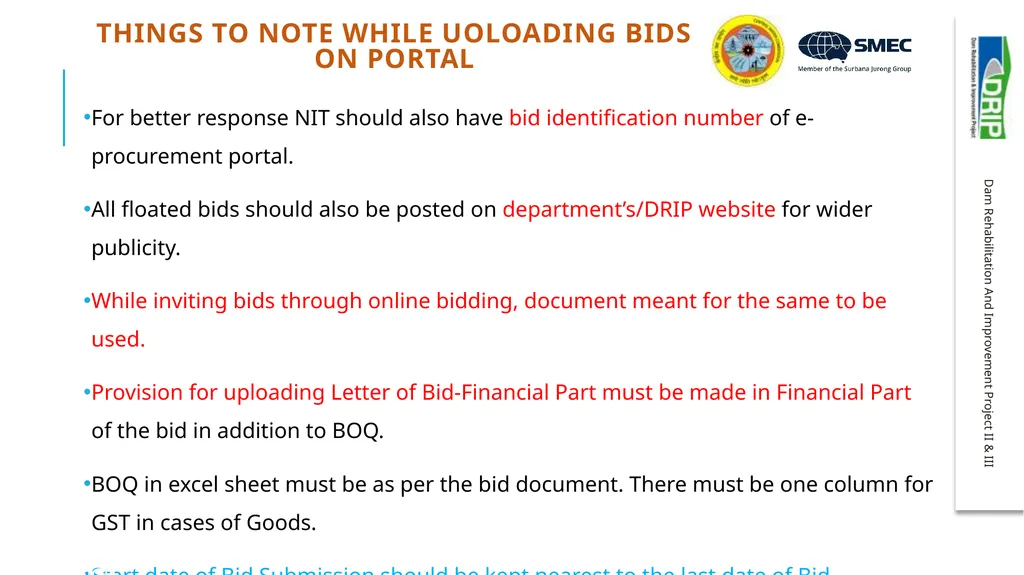
Things to note while UOLOADING bids on portal For better response NIT should also have bid identification number of e-procurement portal.
All floated bids should also be posted on department’s/DRIP website for wider publicity.
While inviting bids through online bidding, document meant for the same to be used.
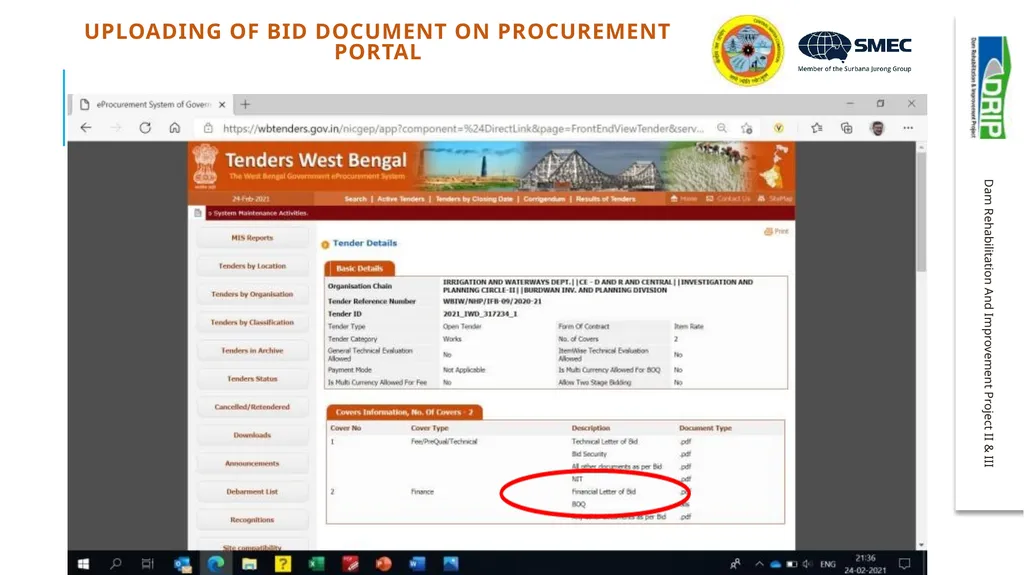
Provision for uploading Letter of Bid-Financial Part must be made in Financial Part of the bid in addition to BOQ.
BOQ in excel sheet must be as per the bid document. There must be one column for GST in cases of Goods.
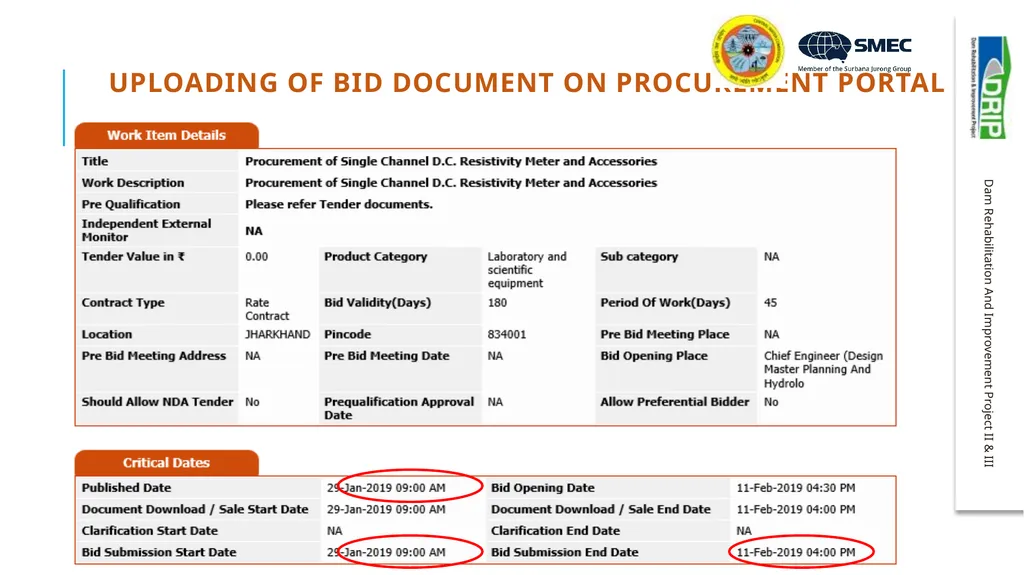
Start date of Bid Submission should be kept nearest to the last date of Bid Submission to enable to amend BOQ if required.
Please make sure that excel BOQ is compatible with the portal. © Santosh K. Singh<br>
All floated bids should also be posted on department’s/DRIP website for wider publicity.
While inviting bids through online bidding, document meant for the same to be used.
Provision for uploading Letter of Bid-Financial Part must be made in Financial Part of the bid in addition to BOQ.
BOQ in excel sheet must be as per the bid document. There must be one column for GST in cases of Goods.
Start date of Bid Submission should be kept nearest to the last date of Bid Submission to enable to amend BOQ if required.
Please make sure that excel BOQ is compatible with the portal. © Santosh K. Singh<br>
06
Things to note while UOLOADING bids on portal……. MoM of pre bid meeting and amendments should be issued before start of bid submission date.
Issue of amendments having financial implication should be avoided after bid submission start date.
In case some amendment is inescapable, it shall be ensured that bidders get minimum 7-10 days’ time from date of issue of amendment to the bid submission end date.
All critical details filled in the portal should be in line with the published bid document. © Santosh K. Singh<br>
Issue of amendments having financial implication should be avoided after bid submission start date.
In case some amendment is inescapable, it shall be ensured that bidders get minimum 7-10 days’ time from date of issue of amendment to the bid submission end date.
All critical details filled in the portal should be in line with the published bid document. © Santosh K. Singh<br>
07
Things to note while UOLOADING bids on portal……. Estimated cost for Goods and Consultancy bids should not be indicated in the Procurement Portal.
All bids are to be invited for Item Rates. No percentage rate bid is allowed by the World Bank.
Bid submission end date and Bid Opening date must be same with only 30 minutes time difference.
For inviting EOI for consultancy bids two stage bidding should be selected.
In cases where two stage bidding is not selected, issue RFP as limited tender.
While uploading technical evaluation report reasons for rejecting bids must be clearly stated.
After the selection of a bidder by the competent authority, the successful bidder will be formally notified of the award by order prior to expiration of validity period. The letter called “Award of Contract” (AOC) will state the contract price that has to be paid to the bidder towards the execution/completion of the tender, subject to furnishing a performance security within the stipulated date. © Santosh K. Singh<br>
All bids are to be invited for Item Rates. No percentage rate bid is allowed by the World Bank.
Bid submission end date and Bid Opening date must be same with only 30 minutes time difference.
For inviting EOI for consultancy bids two stage bidding should be selected.
In cases where two stage bidding is not selected, issue RFP as limited tender.
While uploading technical evaluation report reasons for rejecting bids must be clearly stated.
After the selection of a bidder by the competent authority, the successful bidder will be formally notified of the award by order prior to expiration of validity period. The letter called “Award of Contract” (AOC) will state the contract price that has to be paid to the bidder towards the execution/completion of the tender, subject to furnishing a performance security within the stipulated date. © Santosh K. Singh<br>
08
Things to note while UOLOADING bids on portal……. While replying to the query during pre-bid meeting bidder's name should not be disclosed in the MoM.
All amendments and MoM of pre bid should be uploaded in Procurement Portal only.
Bids submitted by the bidder should not be visible to other participating bidders.
Please contact NIC team to provide all functionalities required for DRIP tenders. If these functionalities are not available with current registration, agencies may go for separate registration specifically for their World Bank tenders. © Santosh K. Singh<br>
All amendments and MoM of pre bid should be uploaded in Procurement Portal only.
Bids submitted by the bidder should not be visible to other participating bidders.
Please contact NIC team to provide all functionalities required for DRIP tenders. If these functionalities are not available with current registration, agencies may go for separate registration specifically for their World Bank tenders. © Santosh K. Singh<br>
09
Uploading of bid document on procurement portal<br>
10
Uploading of bid document on procurement portal<br>
11
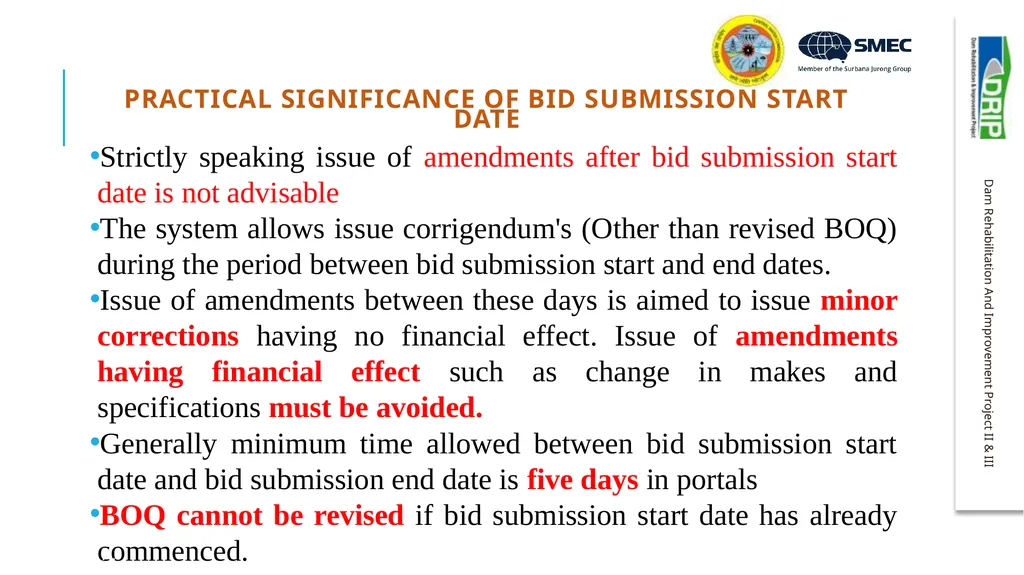
PRACTICAL SIGNIFICANCE OF BID SUBMISSION START DATE Strictly speaking issue of amendments after bid submission start date is not advisable
The system allows issue corrigendum's (Other than revised BOQ) during the period between bid submission start and end dates.
Issue of amendments between these days is aimed to issue minor corrections having no financial effect. Issue of amendments having financial effect such as change in makes and specifications must be avoided.
Generally minimum time allowed between bid submission start date and bid submission end date is five days in portals
BOQ cannot be revised if bid submission start date has already commenced. © Santosh K. Singh<br>
The system allows issue corrigendum's (Other than revised BOQ) during the period between bid submission start and end dates.
Issue of amendments between these days is aimed to issue minor corrections having no financial effect. Issue of amendments having financial effect such as change in makes and specifications must be avoided.
Generally minimum time allowed between bid submission start date and bid submission end date is five days in portals
BOQ cannot be revised if bid submission start date has already commenced. © Santosh K. Singh<br>
12
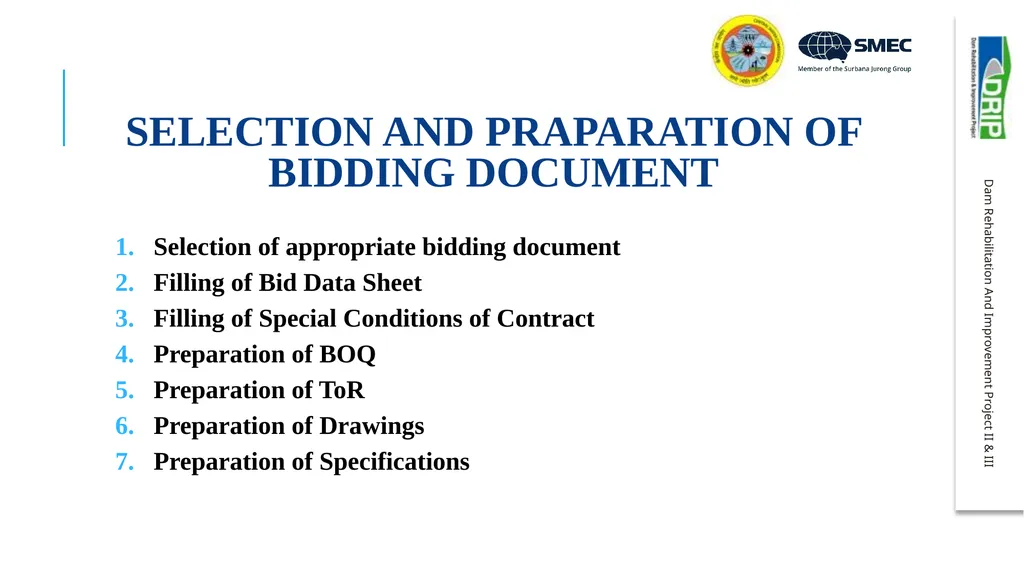
SELECTION AND PRAPARATION OF BIDDING DOCUMENT Selection of appropriate bidding document
Filling of Bid Data Sheet
Filling of Special Conditions of Contract
Preparation of BOQ
Preparation of ToR
Preparation of Drawings
Preparation of Specifications © Santosh K. Singh<br>
Filling of Bid Data Sheet
Filling of Special Conditions of Contract
Preparation of BOQ
Preparation of ToR
Preparation of Drawings
Preparation of Specifications © Santosh K. Singh<br>
13
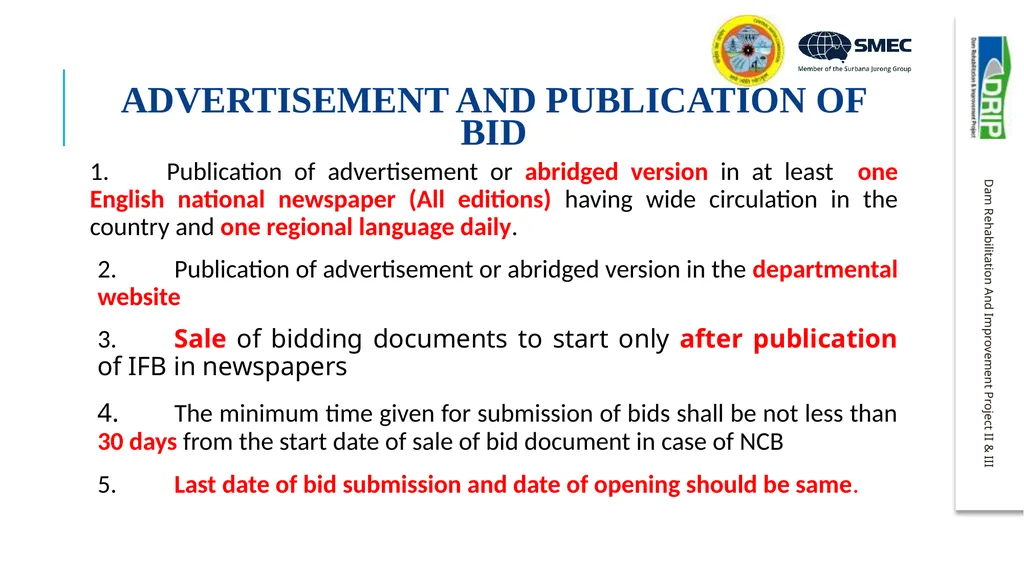
ADVERTISEMENT AND PUBLICATION OF BID 1. Publication of advertisement or abridged version in at least one English national newspaper (All editions) having wide circulation in the country and one regional language daily.
2. Publication of advertisement or abridged version in the departmental website
3. Sale of bidding documents to start only after publication of IFB in newspapers
4. The minimum time given for submission of bids shall be not less than 30 days from the start date of sale of bid document in case of NCB
5. Last date of bid submission and date of opening should be same. © Santosh K. Singh<br>
2. Publication of advertisement or abridged version in the departmental website
3. Sale of bidding documents to start only after publication of IFB in newspapers
4. The minimum time given for submission of bids shall be not less than 30 days from the start date of sale of bid document in case of NCB
5. Last date of bid submission and date of opening should be same. © Santosh K. Singh<br>
14
Bid Evaluation Bid evaluation will be conducted after the determination of bidders with substantial responsiveness.
Without material deviations
General Procedure (for Works Contract- Single stage):
Check for Arithmetic Errors
Check for Omissions (e.g line items in the BoQ)
Convert to a Common Currency for Bid Comparison (ICB)
Apply discounts (if any)
Seek Clarification from Bidders
Assess monetary implications of bidders’ deviations; if any
Apply domestic works preference, if applicable (ICB) © Santosh K. Singh<br>
Without material deviations
General Procedure (for Works Contract- Single stage):
Check for Arithmetic Errors
Check for Omissions (e.g line items in the BoQ)
Convert to a Common Currency for Bid Comparison (ICB)
Apply discounts (if any)
Seek Clarification from Bidders
Assess monetary implications of bidders’ deviations; if any
Apply domestic works preference, if applicable (ICB) © Santosh K. Singh<br>
15
AWARD OF CONTRACT The Borrower shall award the contract, within the period of the validity of bids, to the bidder who meets the specified qualification criteria and
whose bid is substantially responsive to the bidding documents; and
who is the lowest evaluated bidder.
A bidder shall neither be required nor permitted, as a condition of award, to undertake responsibilities for work not stipulated in the bidding documents or otherwise to modify the bid as originally submitted.
Publication of the Award of Contract
The Borrower shall publish the award as per procedure specified in the Procurement Regulations. © Santosh K. Singh<br>
whose bid is substantially responsive to the bidding documents; and
who is the lowest evaluated bidder.
A bidder shall neither be required nor permitted, as a condition of award, to undertake responsibilities for work not stipulated in the bidding documents or otherwise to modify the bid as originally submitted.
Publication of the Award of Contract
The Borrower shall publish the award as per procedure specified in the Procurement Regulations. © Santosh K. Singh<br>
16
SPECIFIC CONCERNS Delays in finalization of bidding documents
Failure to adequately publicize invitation for bids - resulting in poor response
Need to provide price adjustment for contracts which extend beyond 18 months
Allowing an unreasonably short time for submitting Bids
Collusion in bidding
Fake Bid Security/experience/performance certificates (need to verify)
Requesting or permitting a bidder to alter its bid after the bid has been opened
Lack of clarity in specified Qualification Requirements
Relaxing/modifying Qualification Requirements during bid evaluation © Santosh K. Singh<br>
Failure to adequately publicize invitation for bids - resulting in poor response
Need to provide price adjustment for contracts which extend beyond 18 months
Allowing an unreasonably short time for submitting Bids
Collusion in bidding
Fake Bid Security/experience/performance certificates (need to verify)
Requesting or permitting a bidder to alter its bid after the bid has been opened
Lack of clarity in specified Qualification Requirements
Relaxing/modifying Qualification Requirements during bid evaluation © Santosh K. Singh<br>
17
SPECIFIC CONCERNS Delays in bid evaluation and award of contracts
Delays in signing of contracts after obtaining no objection from the Bank
Fake Performance Security (need to verify from the issuing bank)
Delays in releasing advance & other payments
Inadequate engineering (in Works) leading to wide variations at the time of implementation and consequent disputes
Delay in handing over the site/land acquisition
Weak monitoring of construction program & Sub-contracting
Weak contract administration; Need for enforcing specifications
Delays in resolving issues during implementation
Failure to keep Performance Security valid till contract completion © Santosh K. Singh<br>
Delays in signing of contracts after obtaining no objection from the Bank
Fake Performance Security (need to verify from the issuing bank)
Delays in releasing advance & other payments
Inadequate engineering (in Works) leading to wide variations at the time of implementation and consequent disputes
Delay in handing over the site/land acquisition
Weak monitoring of construction program & Sub-contracting
Weak contract administration; Need for enforcing specifications
Delays in resolving issues during implementation
Failure to keep Performance Security valid till contract completion © Santosh K. Singh<br>
18
Contracts Contract: Contract is defined in short as “an agreement between the parties enforceable under the law”.
Types of contracts in DRIP:
1. Works
2. Goods
3 Consulting Services
4. Non-Consulting Services © Santosh K. Singh<br>
Types of contracts in DRIP:
1. Works
2. Goods
3 Consulting Services
4. Non-Consulting Services © Santosh K. Singh<br>
19
What is Contract management ? Aim of contract management is to obtain the product/services as agreed in the contract and get value for money. Foundation of contract management are laid in the procurement process itself.
T&C of the contract should i/c specifications, BOQ, time period, price adjustment, measurement, variation, change control, liquidated damage, termination and all other formal mechanisms that enable a contract to be implemented.
A contract must clearly identify the obligations of all the parties to the contract. It should be flexible to accommodate variations and changes. © Santosh K. Singh<br>
T&C of the contract should i/c specifications, BOQ, time period, price adjustment, measurement, variation, change control, liquidated damage, termination and all other formal mechanisms that enable a contract to be implemented.
A contract must clearly identify the obligations of all the parties to the contract. It should be flexible to accommodate variations and changes. © Santosh K. Singh<br>
20
Good Contract management Contract management is about resolving/reducing friction and achieving timely completion of the contract. It is essential for good contract management to select appropriate SBD
If contract is not managed properly following may happen:
Neglect of quality of work
Decisions are not taken at right time or not taken at all
Leads to delay in payment, approvals leading to claims
Slow progress
Time and cost overrun. © Santosh K. Singh<br>
If contract is not managed properly following may happen:
Neglect of quality of work
Decisions are not taken at right time or not taken at all
Leads to delay in payment, approvals leading to claims
Slow progress
Time and cost overrun. © Santosh K. Singh<br>
21
Role of communication in contract management The key of successful contract execution is clear, timely and adequate communication between employer and contractor at all times. Communication helps in more openness between the parties. Good management requires proactive and assertive people, and not passive and submissive. Negotiation whether formal or informal are valuable means of resolving any problem, dispute or outstanding issues. © Santosh K. Singh<br>
22
Importance of Contract management Over the years it was observed that in majority of the projects there were large numbers of complaints/arbitrations/disputes during the contract implementation. These led to areas of great concern and sometimes delays, excessive cost overruns and non-completion of contracts.
The primary objective of this session is to disseminate best practices in contract management, to understand the concepts, principles and procedures of the process of contract management and improve contract management practices. © Santosh K. Singh<br>
The primary objective of this session is to disseminate best practices in contract management, to understand the concepts, principles and procedures of the process of contract management and improve contract management practices. © Santosh K. Singh<br>
23
Contract management in World bank projects Project, financed by the World Bank, is governed by a “Loan Agreement” between the World Bank and the loan receiving agency. The World Bank has established Procurement Regulations with detailed procedures for implementation of the project. The Bank Reviews the Borrower’s procurement procedures, documents, bid evaluations, award recommendations, and contracts to ensure that the procurement process is carried out in accordance with the agreed procedures.
Inadequate understanding of contractual provisions by the implementing officials often lead to problems in contractor’s performance, cost and time overruns. © Santosh K. Singh<br>
Inadequate understanding of contractual provisions by the implementing officials often lead to problems in contractor’s performance, cost and time overruns. © Santosh K. Singh<br>
24
EXTENSION OF TIME (EOT) Every contract provides for EOT of the project for reasons beyond the control of the contractor. Contractor has to report delays occurring in the project which entitles for extension. If Engineer is satisfied that delays are not due to contractor, Engineer shall give certificate of extension. Examples of extension causes:
1. Variation
2. Adverse climatic conditions
3. Site possession
4. Delay in supply of drawings
5. Unforeseen shortage of personal or goods
6. Any other delays attributable to the employer.
7. Force Majeure © Santosh K. Singh<br>
1. Variation
2. Adverse climatic conditions
3. Site possession
4. Delay in supply of drawings
5. Unforeseen shortage of personal or goods
6. Any other delays attributable to the employer.
7. Force Majeure © Santosh K. Singh<br>
25
Liquidated Damage Liquidated Damage: A predetermined amount to be paid by the contractor to the employer for the delay in completion. This is not source of revenue to the employer nor a penalty to the contractor.
Liquidated damages are prescribed in the contract as an amount to be paid per day or per week of delay and maximum percentage of LD is also prescribed in the contract. © Santosh K. Singh<br>
Liquidated damages are prescribed in the contract as an amount to be paid per day or per week of delay and maximum percentage of LD is also prescribed in the contract. © Santosh K. Singh<br>
26
Change control Change during the performance of the contract can come from a range of sources, both internal and external. Change is easier to deal with when preparations are made. It is desired that contract includes some flexibility as well as the necessary procedures for handling changes. A properly managed change can be good opportunity to alter or improve the project. Change control procedures should be included in the contract. Change control procedure steps are:
Requesting changes
Assessment of Impact
prioritization and authorization
agreement with contractor
Control of implementation
documentation of change assessments and variation © Santosh K. Singh<br>
Requesting changes
Assessment of Impact
prioritization and authorization
agreement with contractor
Control of implementation
documentation of change assessments and variation © Santosh K. Singh<br>
27
Variation - Works A Variation is an instruction given by the Project Manager which varies the Works. In variation applicability of a tender rate to the new or varied item is always a contentious issue.
Extension of Intended Completion date: The Project Manager shall decide within 21 days.
Acceleration: If on request of the Employer the Contractor finish the work before the Intended Completion Date is also treated as variation.
Changes in the Contract Price: Details given in bid document.
Variations: All Variations shall be included in updated Programs, produced by the Contractor. Rates are decided mutually.
The engineer may initiate variations at any time prior to taking over the completed work. © Santosh K. Singh<br>
Extension of Intended Completion date: The Project Manager shall decide within 21 days.
Acceleration: If on request of the Employer the Contractor finish the work before the Intended Completion Date is also treated as variation.
Changes in the Contract Price: Details given in bid document.
Variations: All Variations shall be included in updated Programs, produced by the Contractor. Rates are decided mutually.
The engineer may initiate variations at any time prior to taking over the completed work. © Santosh K. Singh<br>
28
Variation - Goods Bid Prices and Discounts:Prices quoted by the Bidder shall be fixed during the Bidder’s performance of the Contract and not subject to variation on any account
Purchaser’s Right to Vary Quantities at Time of Award: At the time the Contract is awarded, the Purchaser reserves the right to increase or decrease the quantity of Goods and Related Services originally specified provided it does not exceed the percentage specified in BDS and without any change in unit prices or other T&C of the contract..
Contract Price: Prices charged by the Supplier for the Goods supplied and the Related Services shall not vary from the prices, with the exception of any price adjustments authorized in the SCC.
Change Orders and Contract Amendments: If changes in scope of contract cause an increase or decrease in the cost equitable adjustment shall be made in contract price or in completion schedule or both © Santosh K. Singh<br>
Purchaser’s Right to Vary Quantities at Time of Award: At the time the Contract is awarded, the Purchaser reserves the right to increase or decrease the quantity of Goods and Related Services originally specified provided it does not exceed the percentage specified in BDS and without any change in unit prices or other T&C of the contract..
Contract Price: Prices charged by the Supplier for the Goods supplied and the Related Services shall not vary from the prices, with the exception of any price adjustments authorized in the SCC.
Change Orders and Contract Amendments: If changes in scope of contract cause an increase or decrease in the cost equitable adjustment shall be made in contract price or in completion schedule or both © Santosh K. Singh<br>
29
Performance Security - Works This is the amount to be paid by the contractor to the Employer before signing of contract as a security against performance. The amount varies from 5% to 10% of the contract amount. Performance Security has to be valid until a date 28 days from discharge of all obligations.
Performance Security : Within twenty-one (21) days of the receipt of notification of award from the Employer, the successful Bidder shall furnish the performance security. Upon the successful Bidder’s signing the Agreement and furnishing of the Performance Security, the Employer shall promptly notify the name of the winning bidder to each unsuccessful bidder and shall discharge the Bid Securities of other bidders. © Santosh K. Singh<br>
Performance Security : Within twenty-one (21) days of the receipt of notification of award from the Employer, the successful Bidder shall furnish the performance security. Upon the successful Bidder’s signing the Agreement and furnishing of the Performance Security, the Employer shall promptly notify the name of the winning bidder to each unsuccessful bidder and shall discharge the Bid Securities of other bidders. © Santosh K. Singh<br>
30
Performance Security - Goods This is the amount to be paid by the contractor to the Employer before signing of contract as a security against performance. The amount varies from 5% to 10% of the contract amount. Performance Security has to be valid until a date 28 days from discharge of all obligations.
Performance Security : Within twenty-one (21) days of the receipt of notification of award from the Employer, the successful Bidder shall furnish the performance security. Upon the successful Bidder’s signing the Agreement and furnishing of the Performance Security, the Employer shall promptly notify the name of the winning bidder to each unsuccessful bidder and shall discharge the Bid Securities of other bidders.
Performance Security: The Performance Security shall be discharged by the Purchaser and returned to the Supplier not later than twenty-eight (28) days following the date of Completion of the Supplier’s performance obligations i/c including any warranty obligations. © Santosh K. Singh<br>
Performance Security : Within twenty-one (21) days of the receipt of notification of award from the Employer, the successful Bidder shall furnish the performance security. Upon the successful Bidder’s signing the Agreement and furnishing of the Performance Security, the Employer shall promptly notify the name of the winning bidder to each unsuccessful bidder and shall discharge the Bid Securities of other bidders.
Performance Security: The Performance Security shall be discharged by the Purchaser and returned to the Supplier not later than twenty-eight (28) days following the date of Completion of the Supplier’s performance obligations i/c including any warranty obligations. © Santosh K. Singh<br>
31
Insurance - works Insurance : The Contractor shall provide, in the joint names of the Employer and the Contractor, insurance cover from the Start Date to the end of the Defects Liability Period, in the amounts and deductibles stated in the PCC for the following events before the start date :
loss of or damage to the Works, Plant, and Materials
loss of or damage to Construction Equipment;
loss of or damage to property in connection with the Contract; and
personal injury or death.
If the Contractor does not provide any of the policies and certificates required, the Employer may affect the insurance which the Contractor should have provided and recover the premiums from the contractor. © Santosh K. Singh<br>
loss of or damage to the Works, Plant, and Materials
loss of or damage to Construction Equipment;
loss of or damage to property in connection with the Contract; and
personal injury or death.
If the Contractor does not provide any of the policies and certificates required, the Employer may affect the insurance which the Contractor should have provided and recover the premiums from the contractor. © Santosh K. Singh<br>
32
Insurance - goods Insurance : Unless otherwise specified in the SCC, the Goods supplied under the Contract shall be fully insured —against loss or damage incidental to manufacture or acquisition, transportation, storage, and delivery, in accordance with the applicable Incoterms or in the manner specified in the SCC.
The insurance shall be paid in an amount equal to 110 percent of the EXW value of the Goods from “Warehouse to warehouse (final destination)” on “All Risks” basis including War Risks and Strikes. © Santosh K. Singh<br>
The insurance shall be paid in an amount equal to 110 percent of the EXW value of the Goods from “Warehouse to warehouse (final destination)” on “All Risks” basis including War Risks and Strikes. © Santosh K. Singh<br>
33
Running bills - Works Payment Certificate:
The Contractor shall submit monthly bills along with details of measurement of the quantity of works executed in a tabular form.
The Project Manager shall check the details given in the Contractor’s monthly statement and within 14 days and certify the amounts to be paid to the Contractor.
Payments: Payments shall be adjusted for deductions for advance payments, retention, other recoveries. The Employer shall pay the Contractor the amounts certified by the Project Manager within 28 days of the date of each certificate. If the Employer makes a late payment, the Contractor shall be paid interest on the late payment in the next payment. Interest shall be calculated from the date by which the payment should have been made upto the date when the late payment is made at the rate stated in the PCC. © Santosh K. Singh<br>
The Contractor shall submit monthly bills along with details of measurement of the quantity of works executed in a tabular form.
The Project Manager shall check the details given in the Contractor’s monthly statement and within 14 days and certify the amounts to be paid to the Contractor.
Payments: Payments shall be adjusted for deductions for advance payments, retention, other recoveries. The Employer shall pay the Contractor the amounts certified by the Project Manager within 28 days of the date of each certificate. If the Employer makes a late payment, the Contractor shall be paid interest on the late payment in the next payment. Interest shall be calculated from the date by which the payment should have been made upto the date when the late payment is made at the rate stated in the PCC. © Santosh K. Singh<br>
34
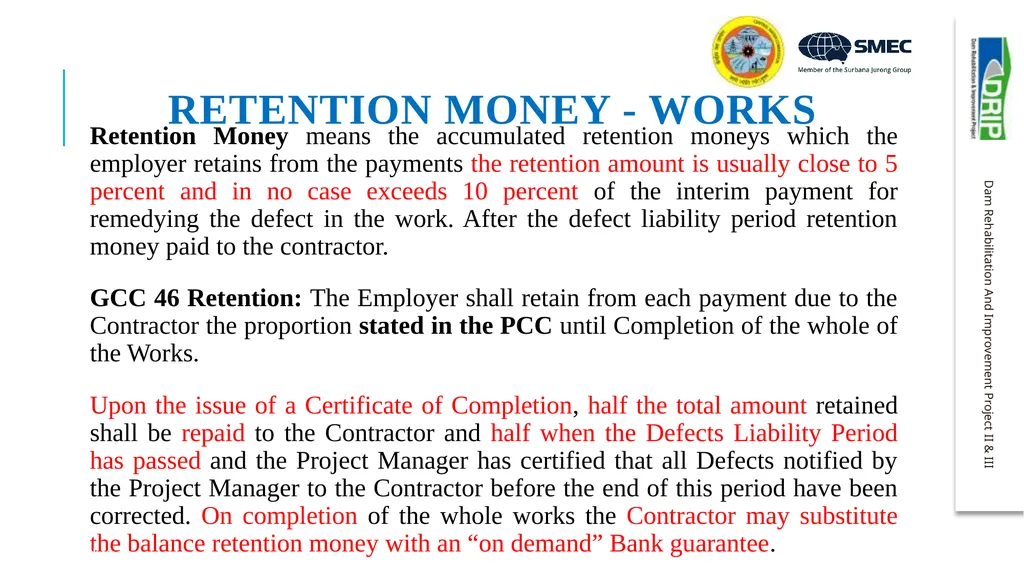
Retention money - works Retention Money means the accumulated retention moneys which the employer retains from the payments the retention amount is usually close to 5 percent and in no case exceeds 10 percent of the interim payment for remedying the defect in the work. After the defect liability period retention money paid to the contractor.
GCC 46 Retention: The Employer shall retain from each payment due to the Contractor the proportion stated in the PCC until Completion of the whole of the Works.
Upon the issue of a Certificate of Completion, half the total amount retained shall be repaid to the Contractor and half when the Defects Liability Period has passed and the Project Manager has certified that all Defects notified by the Project Manager to the Contractor before the end of this period have been corrected. On completion of the whole works the Contractor may substitute the balance retention money with an “on demand” Bank guarantee. © Santosh K. Singh<br>
GCC 46 Retention: The Employer shall retain from each payment due to the Contractor the proportion stated in the PCC until Completion of the whole of the Works.
Upon the issue of a Certificate of Completion, half the total amount retained shall be repaid to the Contractor and half when the Defects Liability Period has passed and the Project Manager has certified that all Defects notified by the Project Manager to the Contractor before the end of this period have been corrected. On completion of the whole works the Contractor may substitute the balance retention money with an “on demand” Bank guarantee. © Santosh K. Singh<br>
35
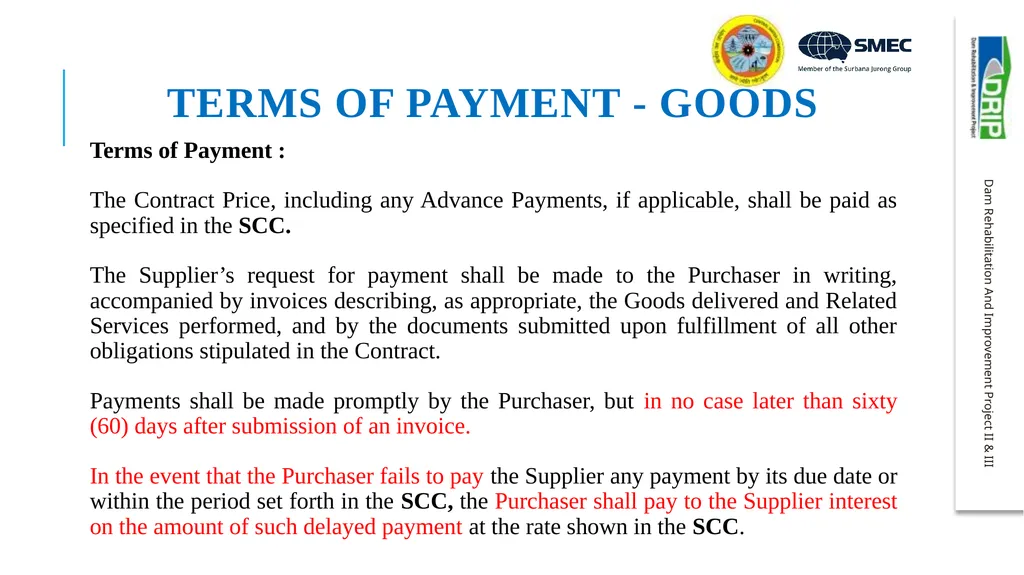
Terms of payment - goods Terms of Payment :
The Contract Price, including any Advance Payments, if applicable, shall be paid as specified in the SCC.
The Supplier’s request for payment shall be made to the Purchaser in writing, accompanied by invoices describing, as appropriate, the Goods delivered and Related Services performed, and by the documents submitted upon fulfillment of all other obligations stipulated in the Contract.
Payments shall be made promptly by the Purchaser, but in no case later than sixty (60) days after submission of an invoice.
In the event that the Purchaser fails to pay the Supplier any payment by its due date or within the period set forth in the SCC, the Purchaser shall pay to the Supplier interest on the amount of such delayed payment at the rate shown in the SCC. © Santosh K. Singh<br>
The Contract Price, including any Advance Payments, if applicable, shall be paid as specified in the SCC.
The Supplier’s request for payment shall be made to the Purchaser in writing, accompanied by invoices describing, as appropriate, the Goods delivered and Related Services performed, and by the documents submitted upon fulfillment of all other obligations stipulated in the Contract.
Payments shall be made promptly by the Purchaser, but in no case later than sixty (60) days after submission of an invoice.
In the event that the Purchaser fails to pay the Supplier any payment by its due date or within the period set forth in the SCC, the Purchaser shall pay to the Supplier interest on the amount of such delayed payment at the rate shown in the SCC. © Santosh K. Singh<br>
36
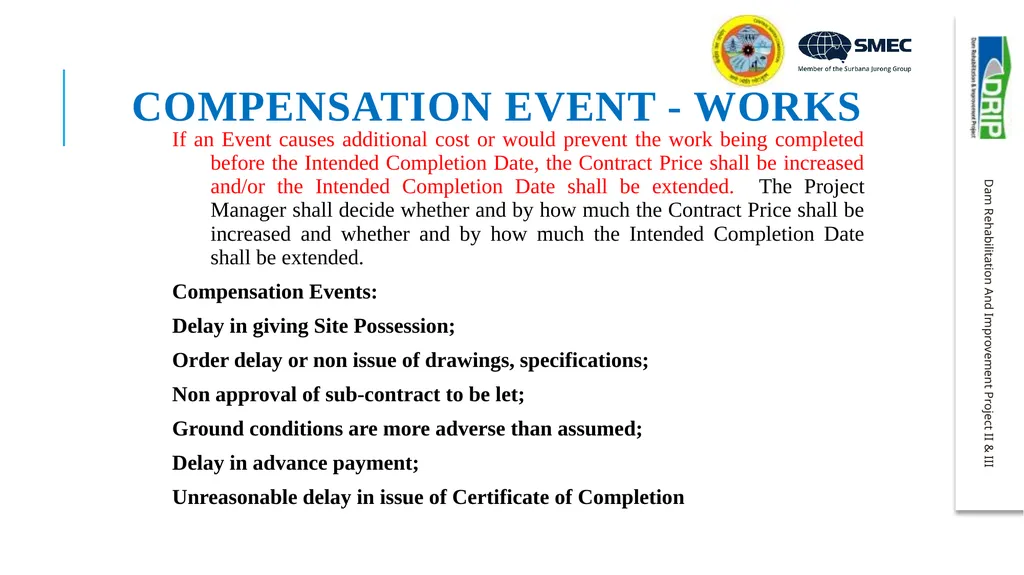
Compensation event - Works © Santosh K. Singh<br>
37
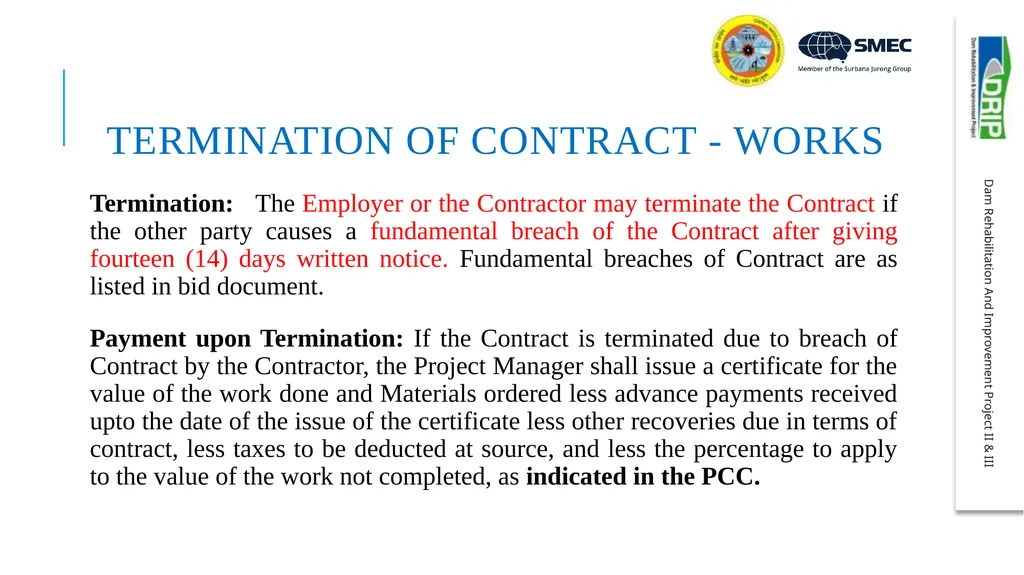
Termination of contract - works Termination: The Employer or the Contractor may terminate the Contract if the other party causes a fundamental breach of the Contract after giving fourteen (14) days written notice. Fundamental breaches of Contract are as listed in bid document.
Payment upon Termination: If the Contract is terminated due to breach of Contract by the Contractor, the Project Manager shall issue a certificate for the value of the work done and Materials ordered less advance payments received upto the date of the issue of the certificate less other recoveries due in terms of contract, less taxes to be deducted at source, and less the percentage to apply to the value of the work not completed, as indicated in the PCC. © Santosh K. Singh<br>
Payment upon Termination: If the Contract is terminated due to breach of Contract by the Contractor, the Project Manager shall issue a certificate for the value of the work done and Materials ordered less advance payments received upto the date of the issue of the certificate less other recoveries due in terms of contract, less taxes to be deducted at source, and less the percentage to apply to the value of the work not completed, as indicated in the PCC. © Santosh K. Singh<br>
38
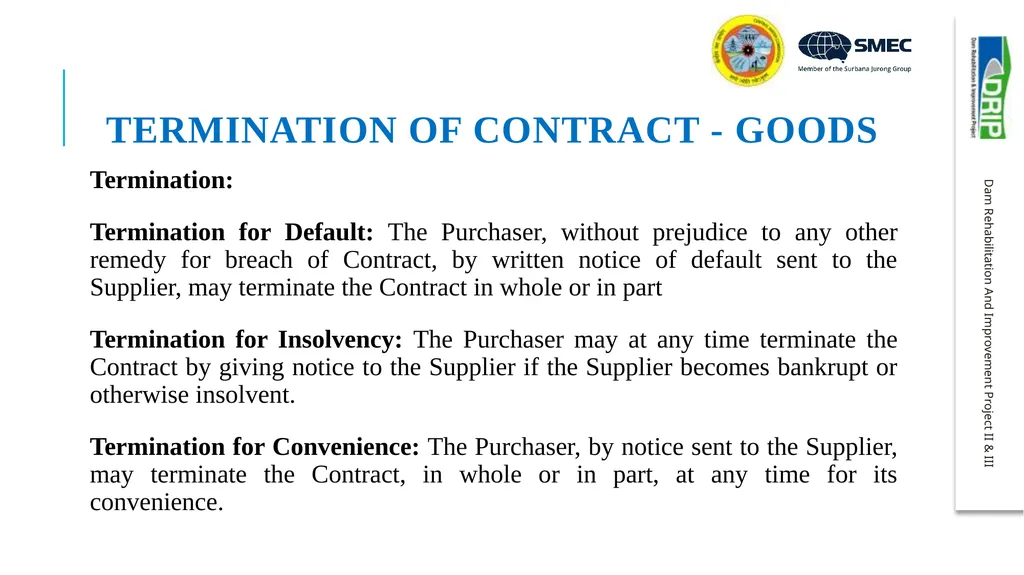
Termination of contract - Goods Termination:
Termination for Default: The Purchaser, without prejudice to any other remedy for breach of Contract, by written notice of default sent to the Supplier, may terminate the Contract in whole or in part
Termination for Insolvency: The Purchaser may at any time terminate the Contract by giving notice to the Supplier if the Supplier becomes bankrupt or otherwise insolvent.
Termination for Convenience: The Purchaser, by notice sent to the Supplier, may terminate the Contract, in whole or in part, at any time for its convenience. © Santosh K. Singh<br>
Termination for Default: The Purchaser, without prejudice to any other remedy for breach of Contract, by written notice of default sent to the Supplier, may terminate the Contract in whole or in part
Termination for Insolvency: The Purchaser may at any time terminate the Contract by giving notice to the Supplier if the Supplier becomes bankrupt or otherwise insolvent.
Termination for Convenience: The Purchaser, by notice sent to the Supplier, may terminate the Contract, in whole or in part, at any time for its convenience. © Santosh K. Singh<br>
39
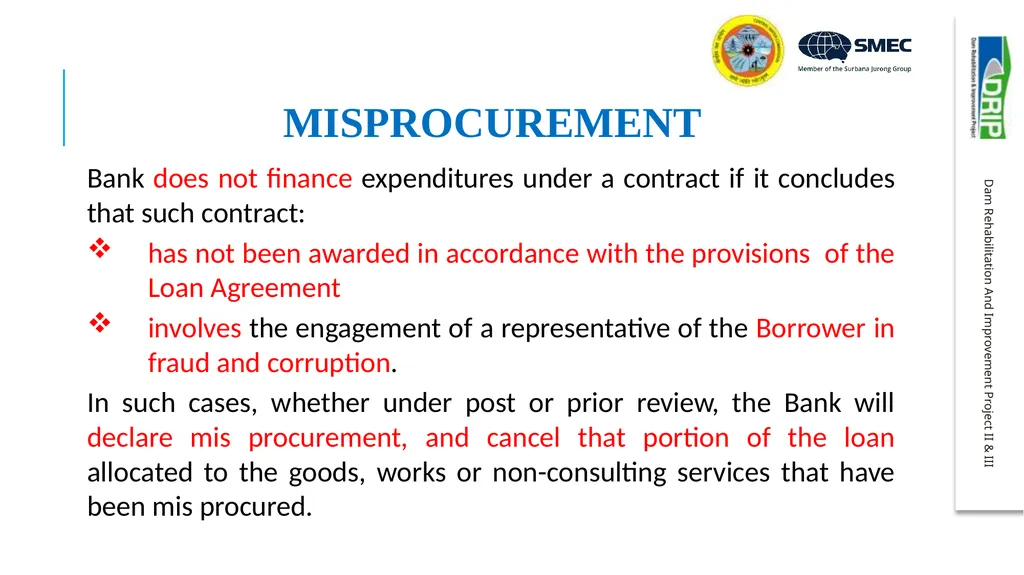
MISPROCUREMENT Bank does not finance expenditures under a contract if it concludes that such contract:
has not been awarded in accordance with the provisions of the Loan Agreement
involves the engagement of a representative of the Borrower in fraud and corruption.
In such cases, whether under post or prior review, the Bank will declare mis procurement, and cancel that portion of the loan allocated to the goods, works or non-consulting services that have been mis procured. © Santosh K. Singh<br>
has not been awarded in accordance with the provisions of the Loan Agreement
involves the engagement of a representative of the Borrower in fraud and corruption.
In such cases, whether under post or prior review, the Bank will declare mis procurement, and cancel that portion of the loan allocated to the goods, works or non-consulting services that have been mis procured. © Santosh K. Singh<br>
40
THANK
YOU 0x<br>
YOU 0x<br>