
Improving prevention and diversion for children






Description: Improving prevention and diversion for children Youth Endowment Foundation: Virtual Learning Cafe 1 Current landscape Areas for improvement Equal access to diversion Inspection framework Data Funding Youth justice partnership: Our Practice
Related Topics
Download Presentation
"Improving prevention and diversion for children" is the property of its rightful owner. Permission is granted to download and print the materials on this website for personal, non-commercial use only, and to display it on your personal computer provided you do not modify the materials and that you retain all copyright notices contained in the materials. By downloading content from our website, you accept the terms of this agreement.
Presentation Transcript
slide1. Improving prevention and diversion for children Youth Endowment Foundation: Virtual Learning Cafe 1<br>
slide2. Current landscape
Areas for improvement
Equal access to diversion
Inspection framework
Data
Funding
Youth justice partnership: Our Practice offer What we are covering Putting practitioners and evidence at the heart of justice reform 2<br>
slide3. Current landscape
Areas for improvement
Equal access to diversion
Inspection framework
Data
Funding
Youth justice partnership: Our Practice offer What we are covering Putting practitioners and evidence at the heart of justice reform 3<br>
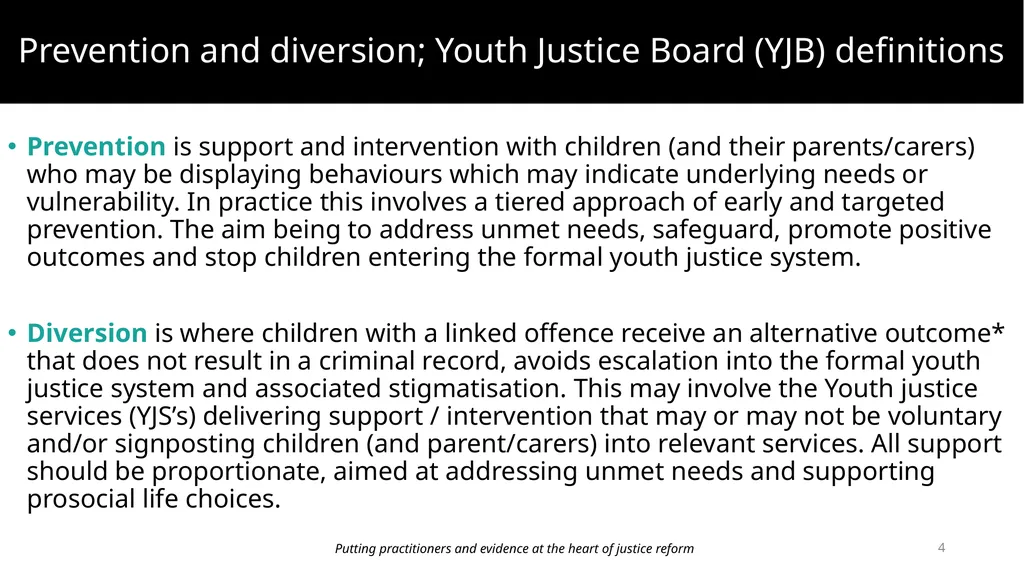
slide4. Prevention and diversion; Youth Justice Board (YJB) definitions Putting practitioners and evidence at the heart of justice reform 4 Prevention is support and intervention with children (and their parents/carers) who may be displaying behaviours which may indicate underlying needs or vulnerability. In practice this involves a tiered approach of early and targeted prevention. The aim being to address unmet needs, safeguard, promote positive outcomes and stop children entering the formal youth justice system.
Diversion is where children with a linked offence receive an alternative outcome* that does not result in a criminal record, avoids escalation into the formal youth justice system and associated stigmatisation. This may involve the Youth justice services (YJS’s) delivering support / intervention that may or may not be voluntary and/or signposting children (and parent/carers) into relevant services. All support should be proportionate, aimed at addressing unmet needs and supporting prosocial life choices.<br>
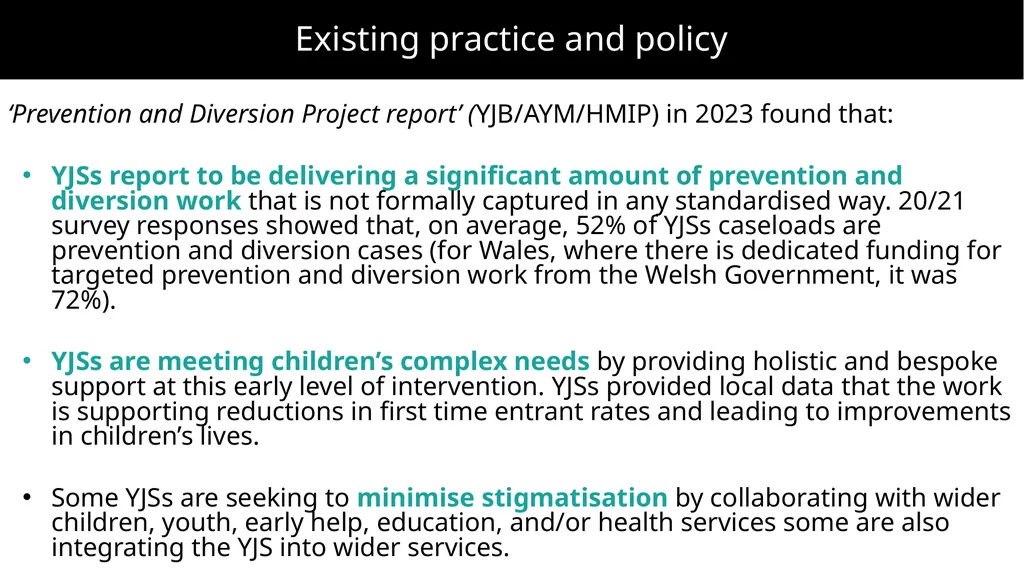
slide5. ‘Prevention and Diversion Project report’ (YJB/AYM/HMIP) in 2023 found that:
YJSs report to be delivering a significant amount of prevention and diversion work that is not formally captured in any standardised way. 20/21 survey responses showed that, on average, 52% of YJSs caseloads are prevention and diversion cases (for Wales, where there is dedicated funding for targeted prevention and diversion work from the Welsh Government, it was 72%).
YJSs are meeting children’s complex needs by providing holistic and bespoke support at this early level of intervention. YJSs provided local data that the work is supporting reductions in first time entrant rates and leading to improvements in children’s lives.
Some YJSs are seeking to minimise stigmatisation by collaborating with wider children, youth, early help, education, and/or health services some are also integrating the YJS into wider services. Existing practice and policy<br>
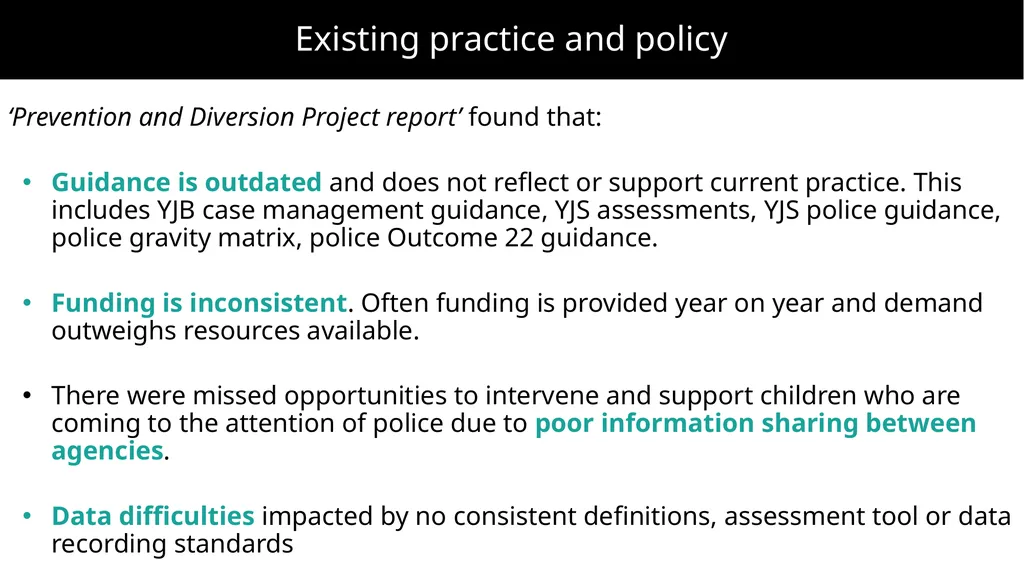
slide6. ‘Prevention and Diversion Project report’ found that:
Guidance is outdated and does not reflect or support current practice. This includes YJB case management guidance, YJS assessments, YJS police guidance, police gravity matrix, police Outcome 22 guidance.
Funding is inconsistent. Often funding is provided year on year and demand outweighs resources available.
There were missed opportunities to intervene and support children who are coming to the attention of police due to poor information sharing between agencies.
Data difficulties impacted by no consistent definitions, assessment tool or data recording standards Existing practice and policy<br>
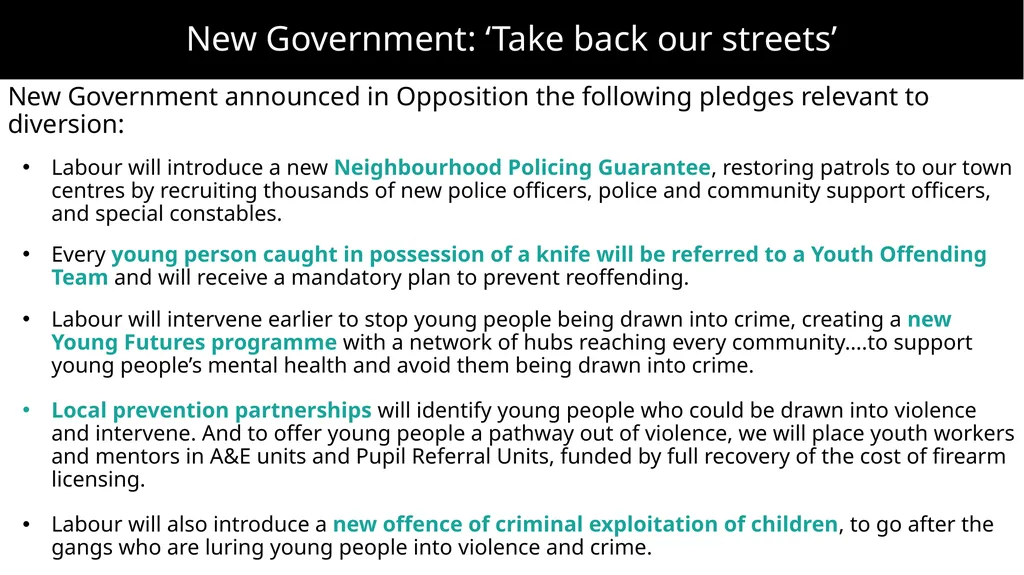
slide7. New Government announced in Opposition the following pledges relevant to diversion:
Labour will introduce a new Neighbourhood Policing Guarantee, restoring patrols to our town centres by recruiting thousands of new police officers, police and community support officers, and special constables.
Every young person caught in possession of a knife will be referred to a Youth Offending Team and will receive a mandatory plan to prevent reoffending.
Labour will intervene earlier to stop young people being drawn into crime, creating a new Young Futures programme with a network of hubs reaching every community….to support young people’s mental health and avoid them being drawn into crime.
Local prevention partnerships will identify young people who could be drawn into violence and intervene. And to offer young people a pathway out of violence, we will place youth workers and mentors in A&E units and Pupil Referral Units, funded by full recovery of the cost of firearm licensing.
Labour will also introduce a new offence of criminal exploitation of children, to go after the gangs who are luring young people into violence and crime.
Introduce a strong antisocial behaviour plan, including a full prevention and diversion programme, including new youth mentors for children most vulnerable to crime. New Government: ‘Take back our streets’<br>
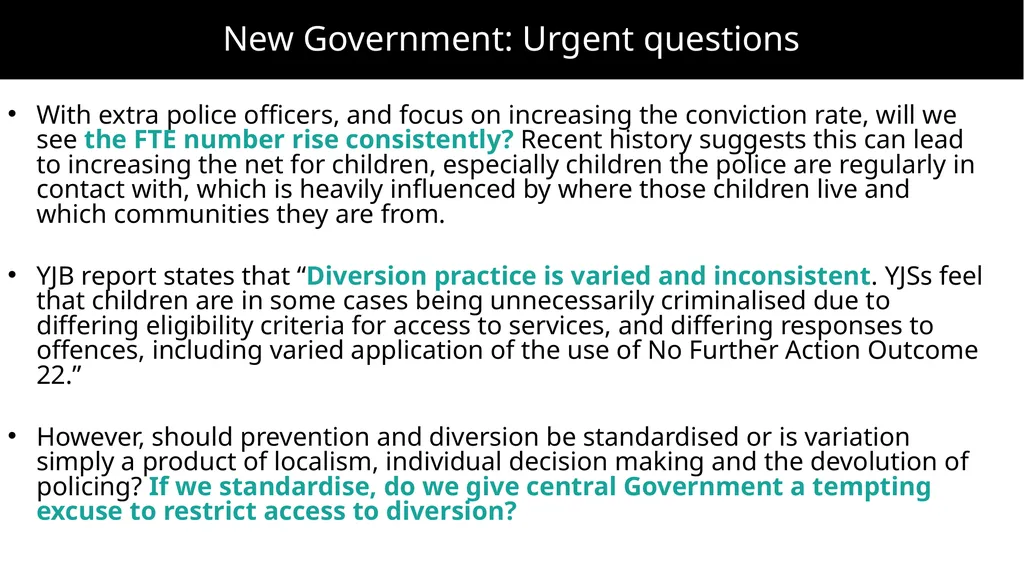
slide8. With extra police officers, and focus on increasing the conviction rate, will we see the FTE number rise consistently? Recent history suggests this can lead to increasing the net for children, especially children the police are regularly in contact with, which is heavily influenced by where those children live and which communities they are from.
YJB report states that “Diversion practice is varied and inconsistent. YJSs feel that children are in some cases being unnecessarily criminalised due to differing eligibility criteria for access to services, and differing responses to offences, including varied application of the use of No Further Action Outcome 22.”
However, should prevention and diversion be standardised or is variation simply a product of localism, individual decision making and the devolution of policing? If we standardise, do we give central Government a tempting excuse to restrict access to diversion? New Government: Urgent questions<br>
slide9. Current landscape
Areas for improvement
Equal access to diversion
Inspection framework
Data
Funding
Youth partnership: Our Practice offer What we are covering Putting practitioners and evidence at the heart of justice reform 9<br>
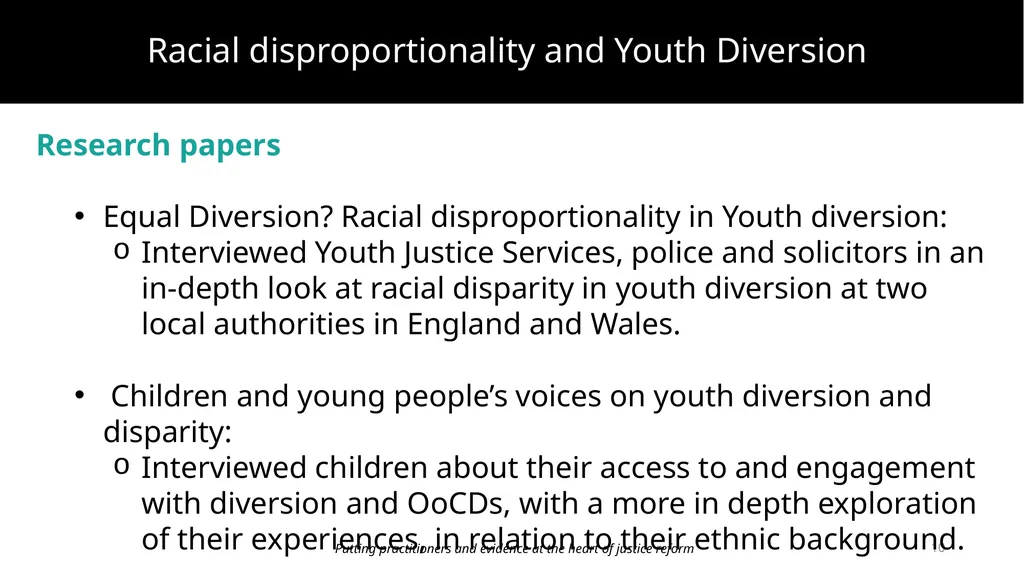
slide10. Racial disproportionality and Youth Diversion Putting practitioners and evidence at the heart of justice reform 10 Research papers
Equal Diversion? Racial disproportionality in Youth diversion:
Interviewed Youth Justice Services, police and solicitors in an in-depth look at racial disparity in youth diversion at two local authorities in England and Wales.
Children and young people’s voices on youth diversion and disparity:
Interviewed children about their access to and engagement with diversion and OoCDs, with a more in depth exploration of their experiences, in relation to their ethnic background.<br>
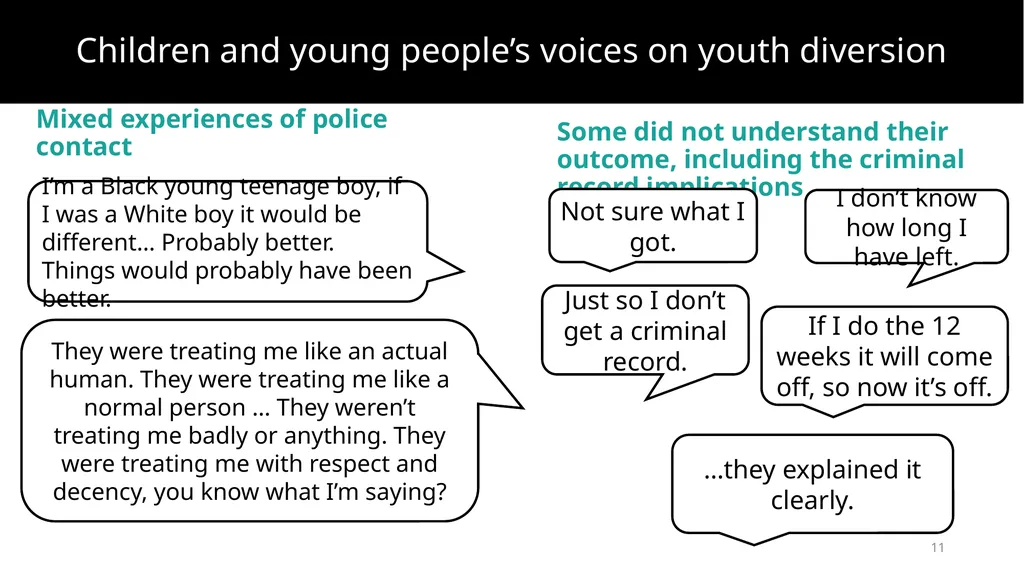
slide11. Mixed experiences of police contact Children and young people’s voices on youth diversion 11 They were treating me like an actual human. They were treating me like a normal person … They weren’t treating me badly or anything. They were treating me with respect and decency, you know what I’m saying? I’m a Black young teenage boy, if I was a White boy it would be different… Probably better. Things would probably have been better. Some did not understand their outcome, including the criminal record implications Not sure what I got. I don’t know how long I have left. Just so I don’t get a criminal record. If I do the 12 weeks it will come off, so now it’s off. …they explained it clearly.<br>
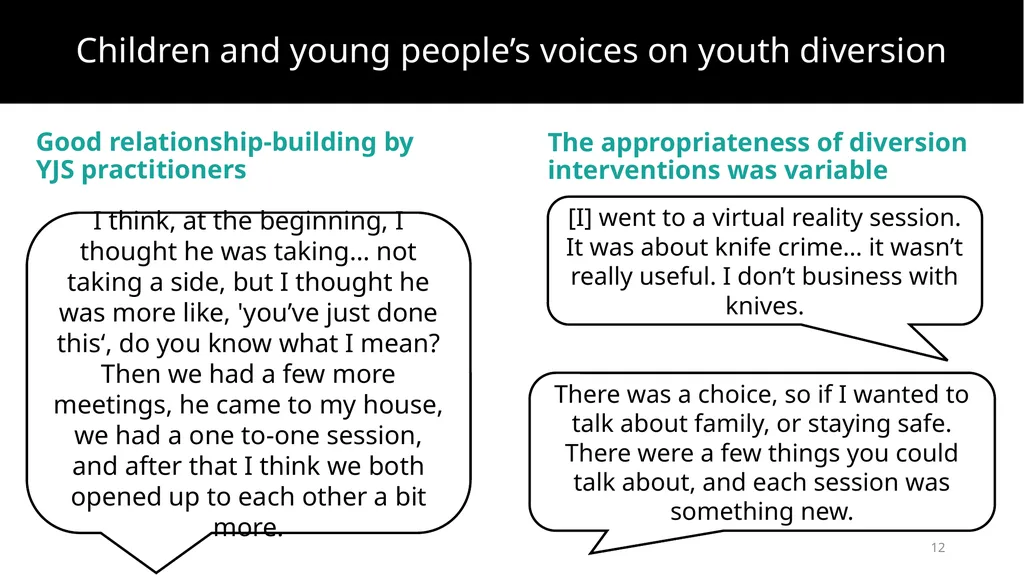
slide12. Good relationship-building by YJS practitioners Children and young people’s voices on youth diversion 12 I think, at the beginning, I thought he was taking… not taking a side, but I thought he was more like, 'you’ve just done this‘, do you know what I mean? Then we had a few more meetings, he came to my house, we had a one to-one session, and after that I think we both opened up to each other a bit more. The appropriateness of diversion interventions was variable [I] went to a virtual reality session. It was about knife crime… it wasn’t really useful. I don’t business with knives. There was a choice, so if I wanted to talk about family, or staying safe. There were a few things you could talk about, and each session was something new.<br>
slide13. Children and young people’s voices on youth diversion Putting practitioners and evidence at the heart of justice reform 13 Promising practice principles from ‘Children and young people’s voices on youth diversion’ Provide relevant and accessible information about legal processes and diversion
Implement effective communication practices
Co-produce tailored intervention plans with children
Ensure that eligibility criteria and referral routes for diversion do not exacerbate racial disparities
Address the risk of ‘adultification’ of children by embedding Child First principles in practice
Make effective use of data to monitor local disparities
Implement anti-racist and anti-discriminatory practices<br>
slide14. How is youth diversion working for children with Special Educational Needs and Disabilities? 14<br>
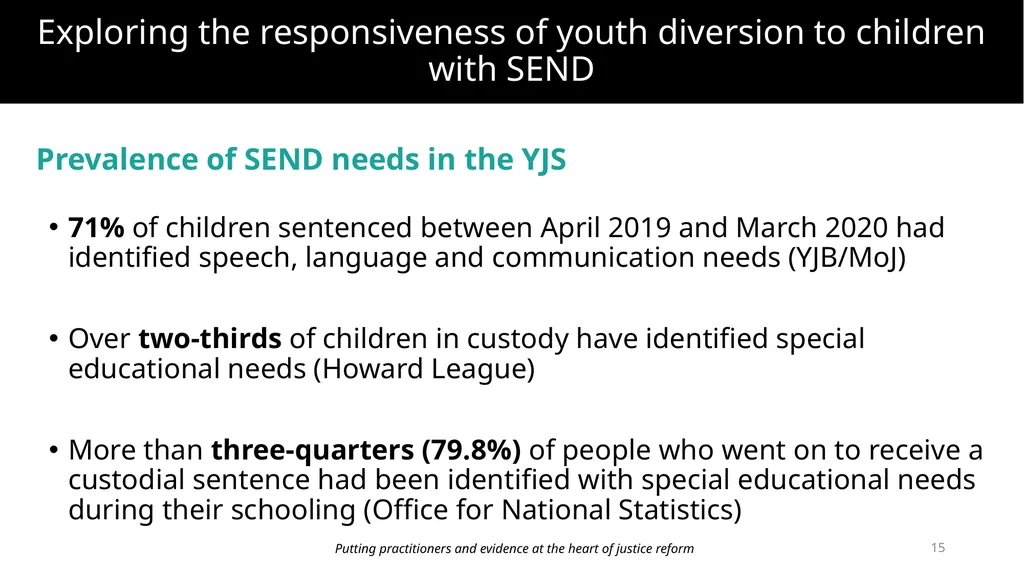
slide15. Prevalence of SEND needs in the YJS Exploring the responsiveness of youth diversion to children with SEND Putting practitioners and evidence at the heart of justice reform 15 71% of children sentenced between April 2019 and March 2020 had identified speech, language and communication needs (YJB/MoJ)
Over two-thirds of children in custody have identified special educational needs (Howard League)
More than three-quarters (79.8%) of people who went on to receive a custodial sentence had been identified with special educational needs during their schooling (Office for National Statistics)<br>
slide16. Barriers to access Prevalence of unidentified SEND among youth justice cohort
Police insistence on admission of guilt and display of remorse
Poor advice at police station
Gaps & inconsistency in SEND training
“On the whole, we don't really get training as such as how to deal with a child if they don't look at you. Is it because they've got autism or Asperger's and they don't like holding eye contact?”
Poor advice at police station
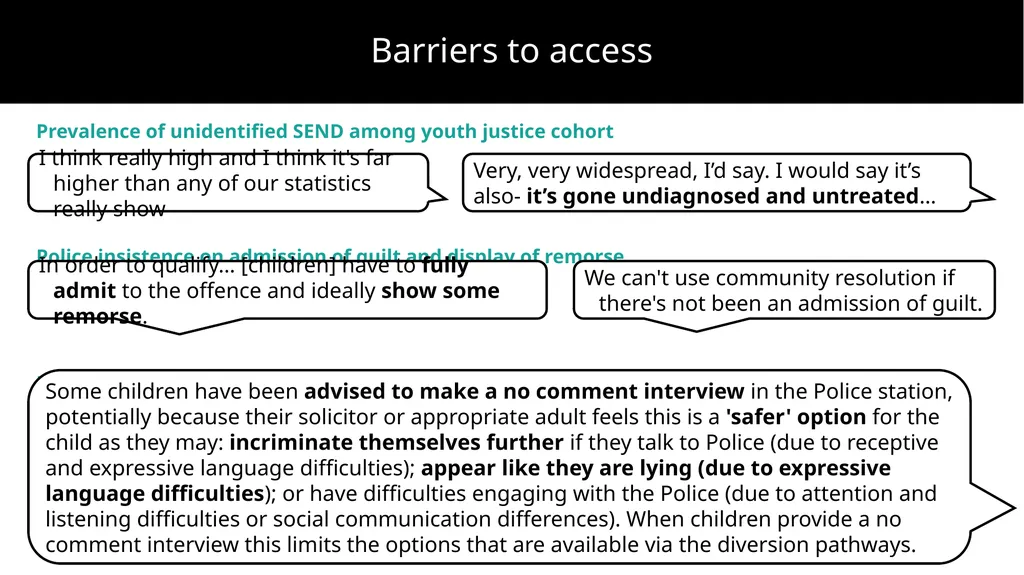
Overwhelming assessment process Putting practitioners and evidence at the heart of justice reform 16 I think really high and I think it's far higher than any of our statistics really show Very, very widespread, I’d say. I would say it’s also- it’s gone undiagnosed and untreated… In order to qualify… [children] have to fully admit to the offence and ideally show some remorse. We can't use community resolution if there's not been an admission of guilt. Some children have been advised to make a no comment interview in the Police station, potentially because their solicitor or appropriate adult feels this is a 'safer' option for the child as they may: incriminate themselves further if they talk to Police (due to receptive and expressive language difficulties); appear like they are lying (due to expressive language difficulties); or have difficulties engaging with the Police (due to attention and listening difficulties or social communication differences). When children provide a no comment interview this limits the options that are available via the diversion pathways.<br>
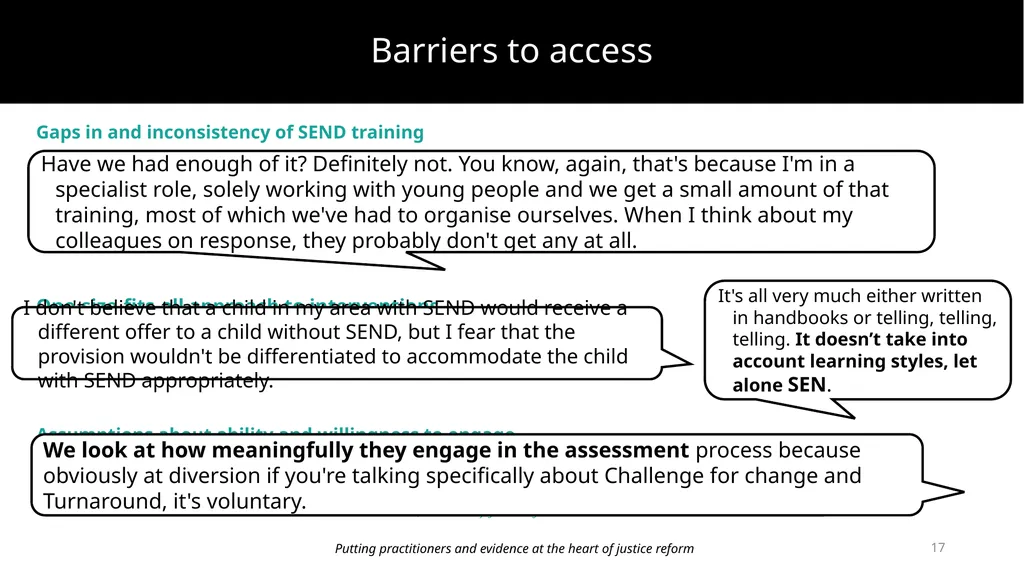
slide17. Barriers to access Gaps in and inconsistency of SEND training
One-size-fits-all approach to interventions
Assumptions about ability and willingness to engage
Gaps & inconsistency in SEND training
“On the whole, we don't really get training as such as how to deal with a Putting practitioners and evidence at the heart of justice reform 17 Have we had enough of it? Definitely not. You know, again, that's because I'm in a specialist role, solely working with young people and we get a small amount of that training, most of which we've had to organise ourselves. When I think about my colleagues on response, they probably don't get any at all. We look at how meaningfully they engage in the assessment process because obviously at diversion if you're talking specifically about Challenge for change and Turnaround, it's voluntary. I don't believe that a child in my area with SEND would receive a different offer to a child without SEND, but I fear that the provision wouldn't be differentiated to accommodate the child with SEND appropriately. It's all very much either written in handbooks or telling, telling, telling. It doesn’t take into account learning styles, let alone SEN.<br>
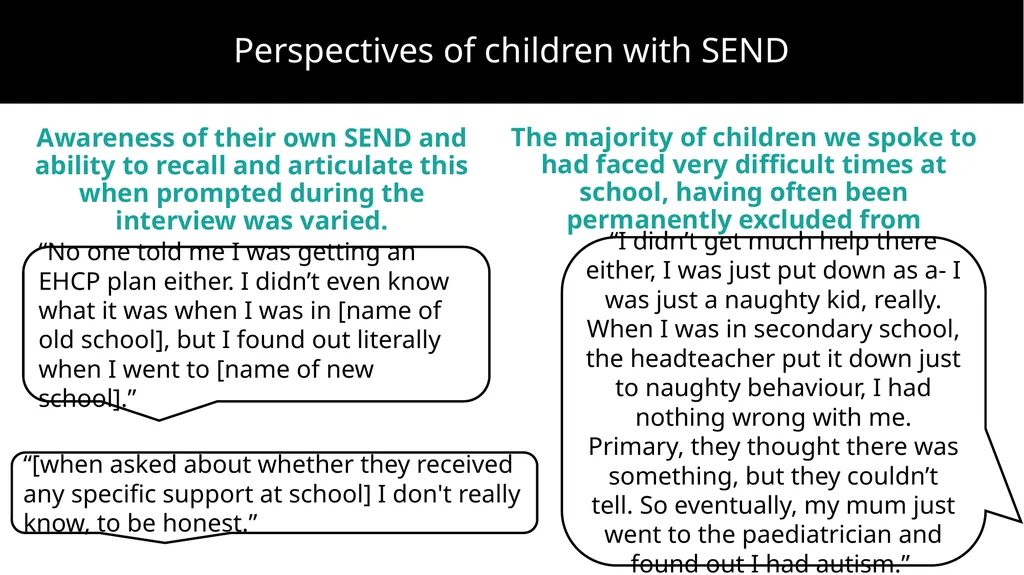
slide18. Awareness of their own SEND and ability to recall and articulate this when prompted during the interview was varied. Perspectives of children with SEND 18 “No one told me I was getting an EHCP plan either. I didn’t even know what it was when I was in [name of old school], but I found out literally when I went to [name of new school].” “[when asked about whether they received any specific support at school] I don't really know, to be honest.” The majority of children we spoke to had faced very difficult times at school, having often been permanently excluded from mainstream school. “I didn’t get much help there either, I was just put down as a- I was just a naughty kid, really. When I was in secondary school, the headteacher put it down just to naughty behaviour, I had nothing wrong with me. Primary, they thought there was something, but they couldn’t tell. So eventually, my mum just went to the paediatrician and found out I had autism.”<br>
slide19. Children felt that the police offered little to no support, they found use of force during arrest traumatic, they felt their needs were dismissed, they struggled to process information in interview and they reported they had little trust in the police. Perspectives of children with SEND 19 “Zero. It’s always been zero trust.” “Yeah, 100%. I think they knew that I couldn’t know what the big words were.” “…I came home with bruises and everything. They broke my toe once. When you're even calm and when you say, ‘Yeah,’ and you don’t kick off, they still think they have to use force. They feel like everywhere they go, they’ve got to go, “Grr,” and slam you to the floor.” “They asked me if I was dyslexic or owt, but I’m not sure. I’ve never actually been diagnosed with it because I had three answers, inconclusive, yes and no. So I never knew if I had it or not. So they asked if I wanted that support, but no other support, just that.” “[when asked about trust in the police] Don’t make me laugh…. So, the amount of times I’ve called the police on my mum for being abusive or whatever, there’s no records. They just can’t find any records about it, but I know I’ve definitely called the police. The police have been out to my house many times for it, they’ve took me to my sisters and everything, but there’s just no records about it…But when my teacher rang, they came in seconds.”<br>
slide20. On the whole, the children we spoke to felt that they had gained valuable support from their YJS workers and had very positive relationships with them. Perspectives of children with SEND 20 “I get really excited when I know I’m gonna see [YJS worker]. On Mondays I’ll be in a really good mood coz I know I’m gonna see [YJS worker] the next day and I know I’m gonna be able to express how I feel. I don’t know [YJS worker]’s just a fucking G ain’t she” “Yeah, she showed me videos and stuff. Because obviously I just thought it was a bad thing, people assume you're different. And she just built my confidence up and said, ‘It’s not, look at all these famous people who have got it’ and then just talked about it.” “If I could make it last forever I genuinely would. It has honestly helped so much. And the fact that I’ve got [YJS worker] there to remind me how much I’ve changed and how much I’ve grown and matured and got on better.” “I remember [YJS worker] taking me to the park, the park where I’m always hanging out... I had to draw down all the antisocial behaviour. And then after, he told me to run around the whole park, trying to tire me out.”<br>
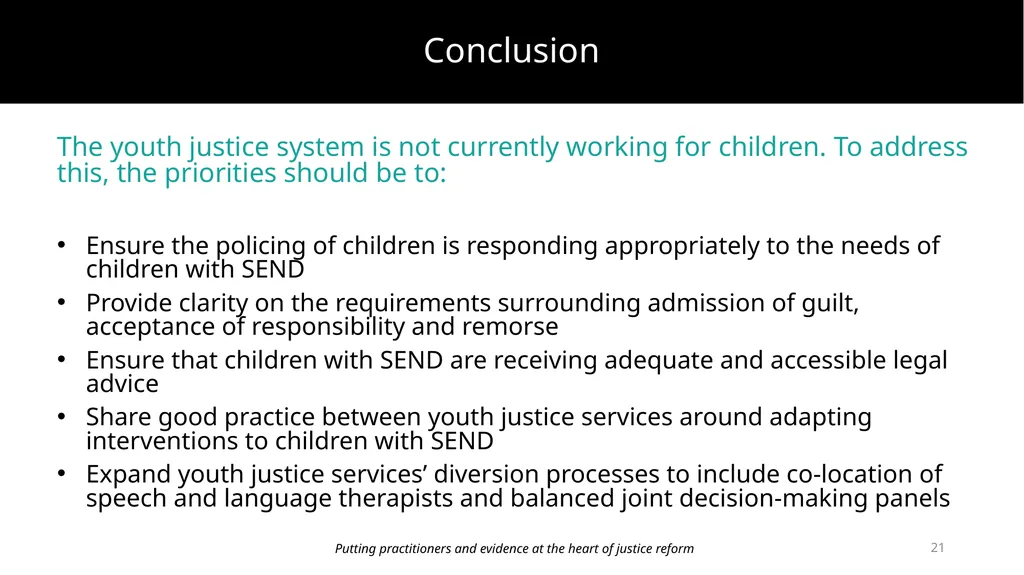
slide21. Conclusion Putting practitioners and evidence at the heart of justice reform 21 The youth justice system is not currently working for children. To address this, the priorities should be to:
Ensure the policing of children is responding appropriately to the needs of children with SEND
Provide clarity on the requirements surrounding admission of guilt, acceptance of responsibility and remorse
Ensure that children with SEND are receiving adequate and accessible legal advice
Share good practice between youth justice services around adapting interventions to children with SEND
Expand youth justice services’ diversion processes to include co-location of speech and language therapists and balanced joint decision-making panels<br>
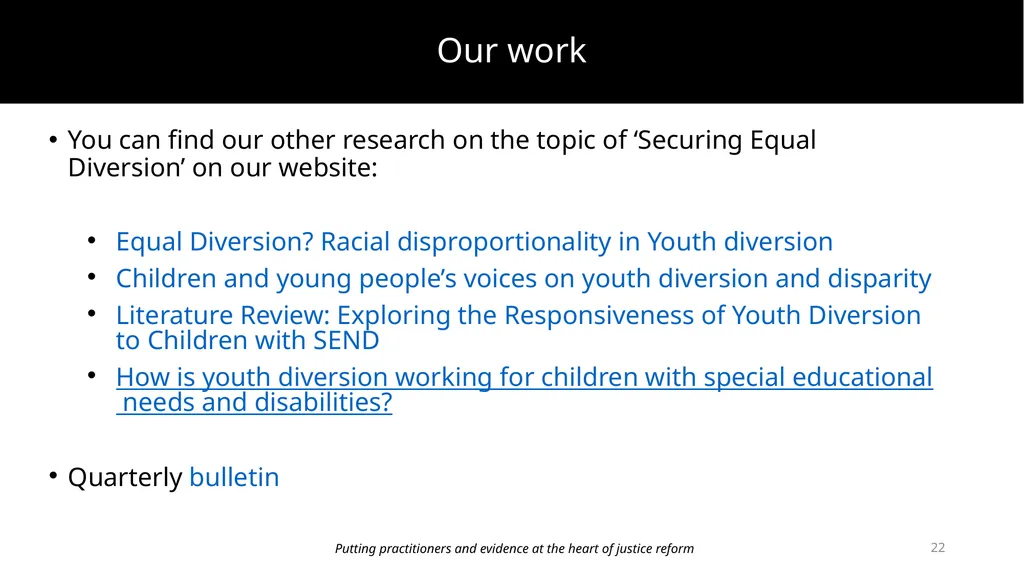
slide22. Our work Putting practitioners and evidence at the heart of justice reform 22 You can find our other research on the topic of ‘Securing Equal Diversion’ on our website:
Equal Diversion? Racial disproportionality in Youth diversion
Children and young people’s voices on youth diversion and disparity
Literature Review: Exploring the Responsiveness of Youth Diversion to Children with SEND
How is youth diversion working for children with special educational needs and disabilities?
Quarterly bulletin<br>
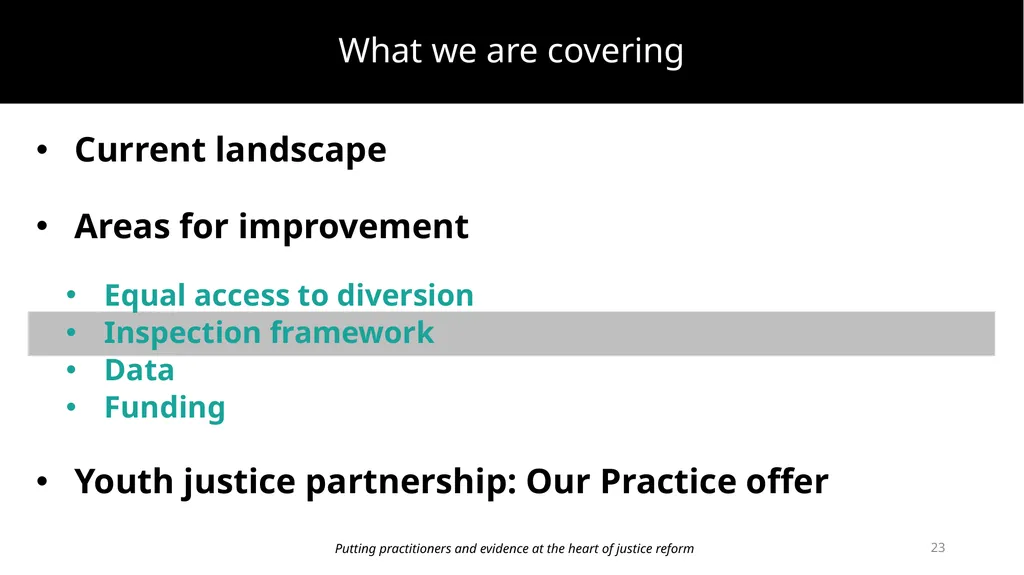
slide23. Current landscape
Areas for improvement
Equal access to diversion
Inspection framework
Data
Funding
Youth justice partnership: Our Practice offer What we are covering Putting practitioners and evidence at the heart of justice reform 23<br>
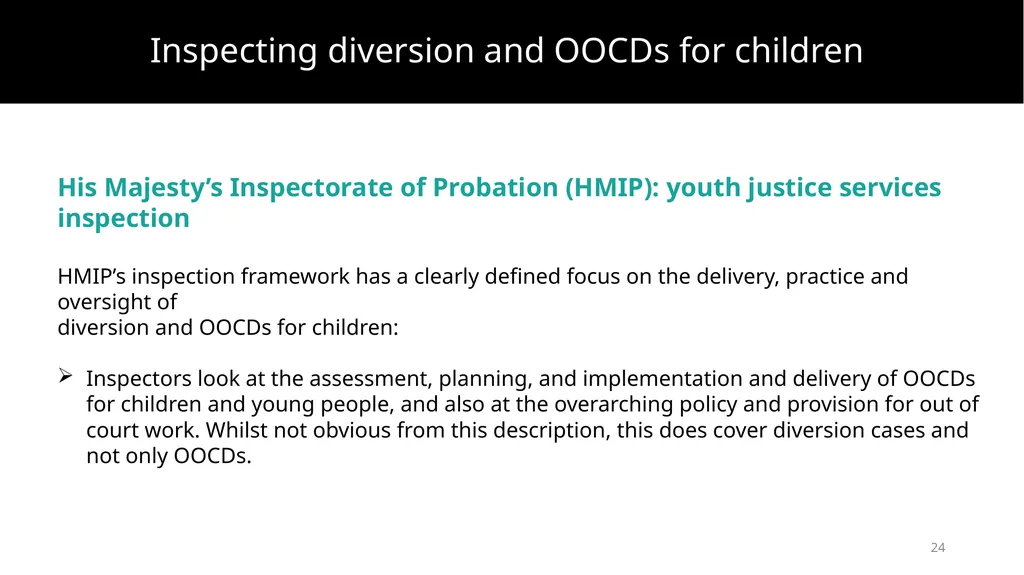
slide24. Inspecting diversion and OOCDs for children 24 His Majesty’s Inspectorate of Probation (HMIP): youth justice services inspection
HMIP’s inspection framework has a clearly defined focus on the delivery, practice and oversight of
diversion and OOCDs for children:
Inspectors look at the assessment, planning, and implementation and delivery of OOCDs for children and young people, and also at the overarching policy and provision for out of court work. Whilst not obvious from this description, this does cover diversion cases and not only OOCDs.<br>
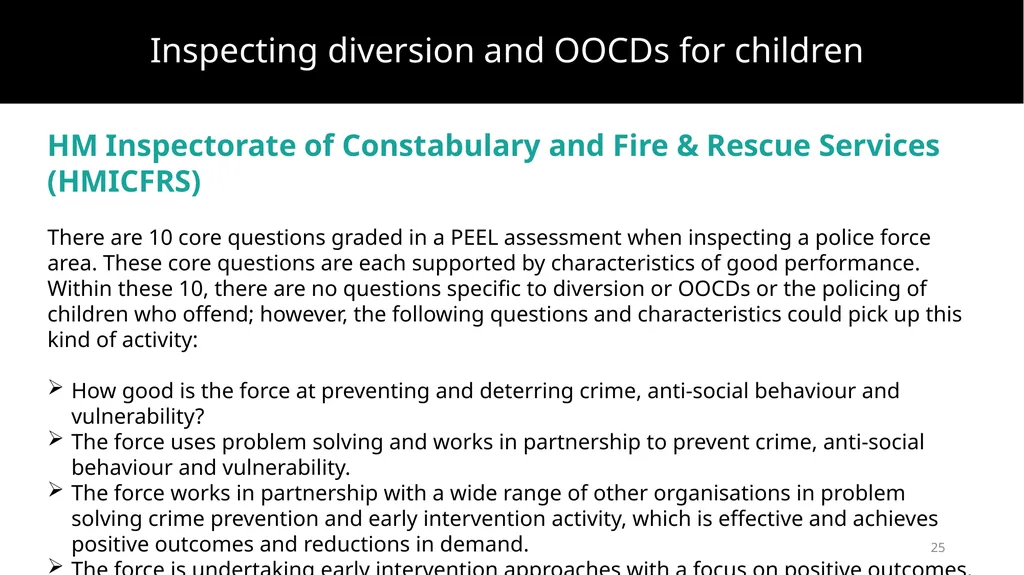
slide25. Inspecting diversion and OOCDs for children 25 HM Inspectorate of Constabulary and Fire & Rescue Services (HMICFRS)
There are 10 core questions graded in a PEEL assessment when inspecting a police force area. These core questions are each supported by characteristics of good performance. Within these 10, there are no questions specific to diversion or OOCDs or the policing of children who offend; however, the following questions and characteristics could pick up this kind of activity:
How good is the force at preventing and deterring crime, anti-social behaviour and vulnerability?
The force uses problem solving and works in partnership to prevent crime, anti-social behaviour and vulnerability.
The force works in partnership with a wide range of other organisations in problem solving crime prevention and early intervention activity, which is effective and achieves positive outcomes and reductions in demand.
The force is undertaking early intervention approaches with a focus on positive outcomes.<br>
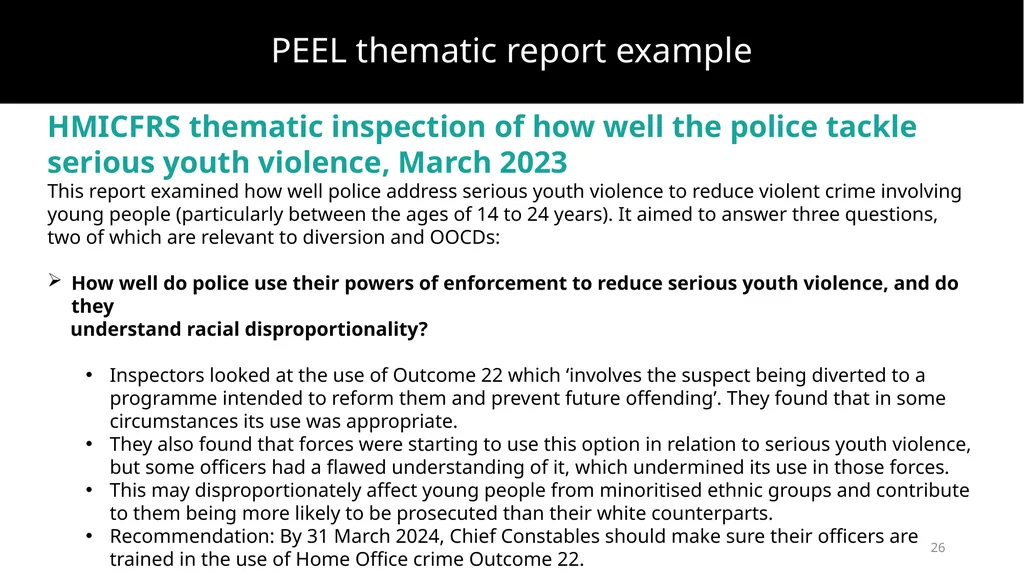
slide26. PEEL thematic report example 26 HMICFRS thematic inspection of how well the police tackle serious youth violence, March 2023
This report examined how well police address serious youth violence to reduce violent crime involving young people (particularly between the ages of 14 to 24 years). It aimed to answer three questions, two of which are relevant to diversion and OOCDs:
How well do police use their powers of enforcement to reduce serious youth violence, and do they
understand racial disproportionality?
Inspectors looked at the use of Outcome 22 which ‘involves the suspect being diverted to a programme intended to reform them and prevent future offending’. They found that in some circumstances its use was appropriate.
They also found that forces were starting to use this option in relation to serious youth violence, but some officers had a flawed understanding of it, which undermined its use in those forces.
This may disproportionately affect young people from minoritised ethnic groups and contribute to them being more likely to be prosecuted than their white counterparts.
Recommendation: By 31 March 2024, Chief Constables should make sure their officers are trained in the use of Home Office crime Outcome 22.<br>
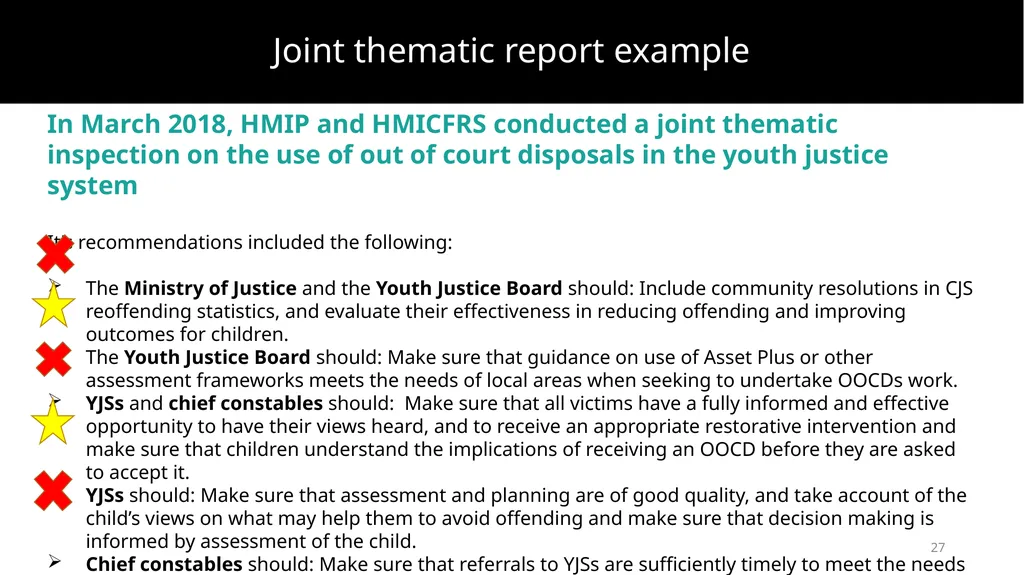
slide27. Joint thematic report example 27 In March 2018, HMIP and HMICFRS conducted a joint thematic inspection on the use of out of court disposals in the youth justice system
It’s recommendations included the following:
The Ministry of Justice and the Youth Justice Board should: Include community resolutions in CJS reoffending statistics, and evaluate their effectiveness in reducing offending and improving outcomes for children.
The Youth Justice Board should: Make sure that guidance on use of Asset Plus or other assessment frameworks meets the needs of local areas when seeking to undertake OOCDs work.
YJSs and chief constables should: Make sure that all victims have a fully informed and effective opportunity to have their views heard, and to receive an appropriate restorative intervention and make sure that children understand the implications of receiving an OOCD before they are asked to accept it.
YJSs should: Make sure that assessment and planning are of good quality, and take account of the child’s views on what may help them to avoid offending and make sure that decision making is informed by assessment of the child.
Chief constables should: Make sure that referrals to YJSs are sufficiently timely to meet the needs of victims for speedy justice and achieve the objectives of OOCDs and make the YJS aware of all community resolutions given by the police.<br>
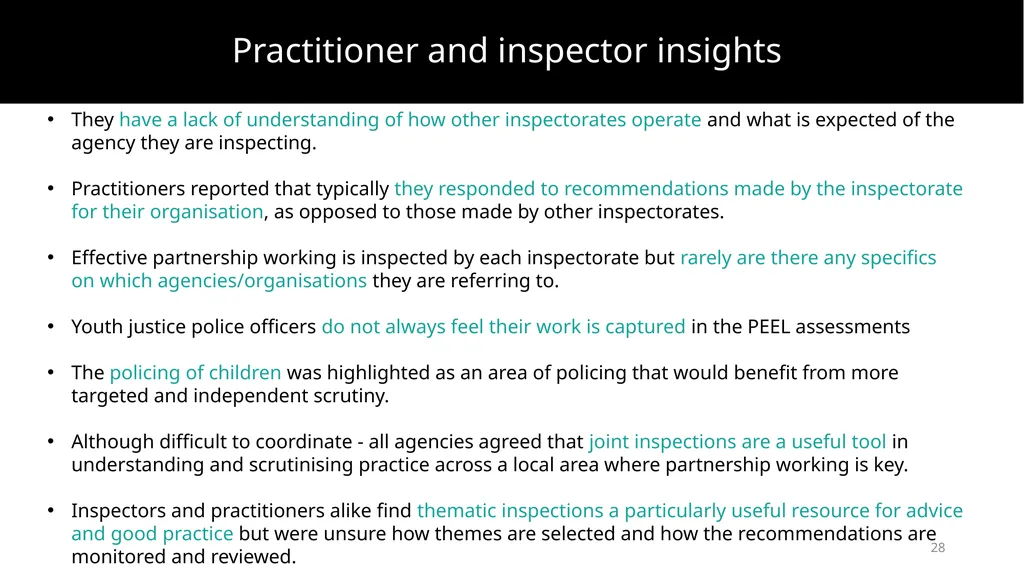
slide28. Practitioner and inspector insights 28 They have a lack of understanding of how other inspectorates operate and what is expected of the agency they are inspecting.
Practitioners reported that typically they responded to recommendations made by the inspectorate for their organisation, as opposed to those made by other inspectorates.
Effective partnership working is inspected by each inspectorate but rarely are there any specifics on which agencies/organisations they are referring to.
Youth justice police officers do not always feel their work is captured in the PEEL assessments
The policing of children was highlighted as an area of policing that would benefit from more targeted and independent scrutiny.
Although difficult to coordinate - all agencies agreed that joint inspections are a useful tool in understanding and scrutinising practice across a local area where partnership working is key.
Inspectors and practitioners alike find thematic inspections a particularly useful resource for advice and good practice but were unsure how themes are selected and how the recommendations are monitored and reviewed.<br>
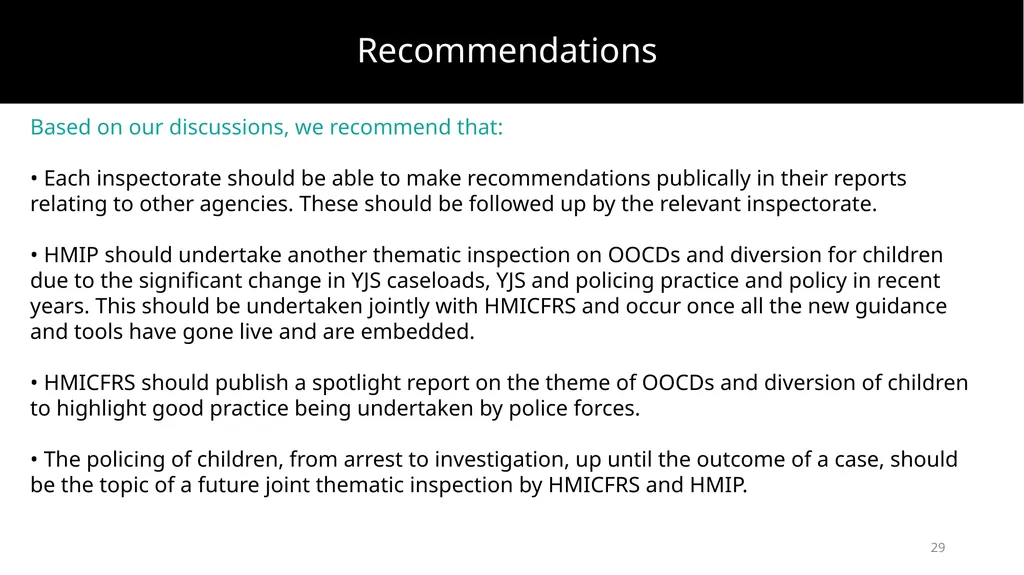
slide29. Recommendations 29 Based on our discussions, we recommend that:
• Each inspectorate should be able to make recommendations publically in their reports relating to other agencies. These should be followed up by the relevant inspectorate.
• HMIP should undertake another thematic inspection on OOCDs and diversion for children due to the significant change in YJS caseloads, YJS and policing practice and policy in recent years. This should be undertaken jointly with HMICFRS and occur once all the new guidance and tools have gone live and are embedded.
• HMICFRS should publish a spotlight report on the theme of OOCDs and diversion of children to highlight good practice being undertaken by police forces.
• The policing of children, from arrest to investigation, up until the outcome of a case, should be the topic of a future joint thematic inspection by HMICFRS and HMIP.<br>
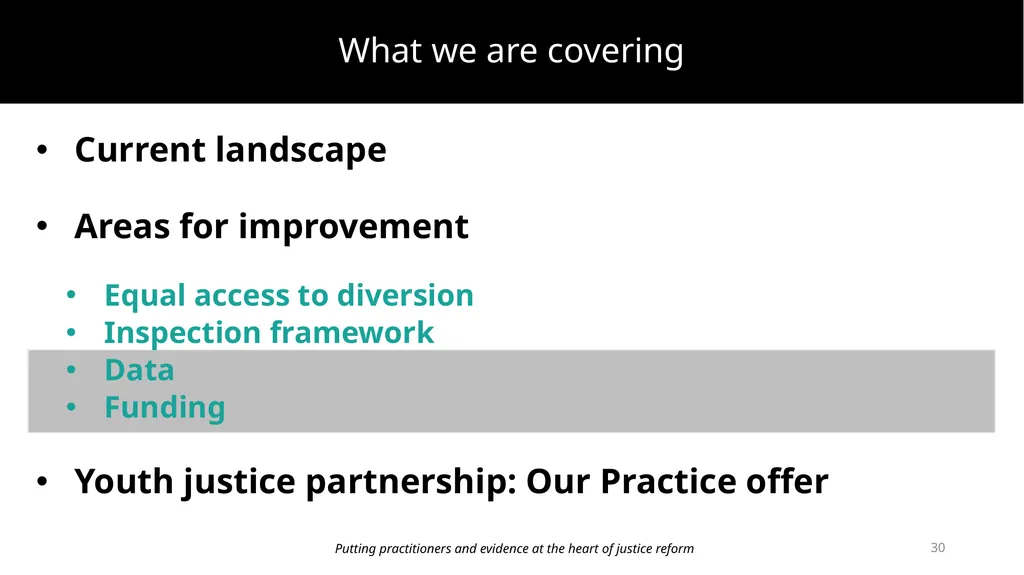
slide30. Current landscape
Areas for improvement
Equal access to diversion
Inspection framework
Data
Funding
Youth justice partnership: Our Practice offer What we are covering Putting practitioners and evidence at the heart of justice reform 30<br>
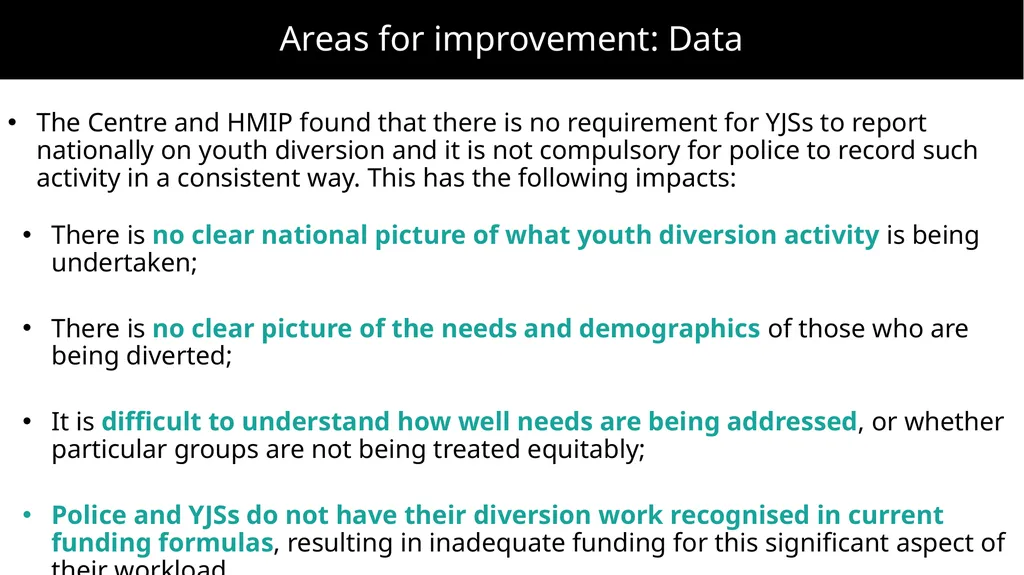
slide31. The Centre and HMIP found that there is no requirement for YJSs to report nationally on youth diversion and it is not compulsory for police to record such activity in a consistent way. This has the following impacts:
There is no clear national picture of what youth diversion activity is being undertaken;
There is no clear picture of the needs and demographics of those who are being diverted;
It is difficult to understand how well needs are being addressed, or whether particular groups are not being treated equitably;
Police and YJSs do not have their diversion work recognised in current funding formulas, resulting in inadequate funding for this significant aspect of their workload. Areas for improvement: Data<br>
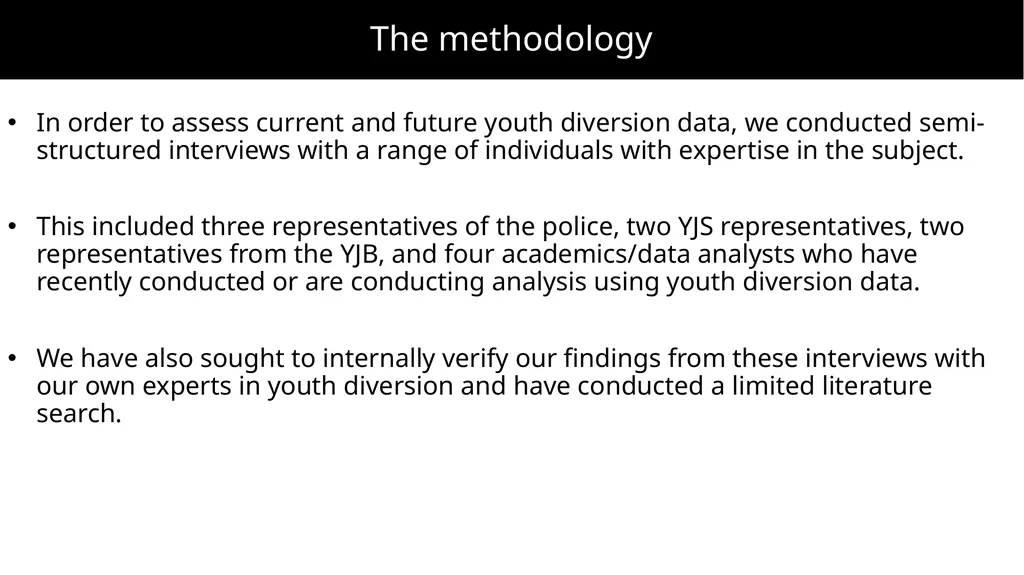
slide32. In order to assess current and future youth diversion data, we conducted semi-structured interviews with a range of individuals with expertise in the subject.
This included three representatives of the police, two YJS representatives, two representatives from the YJB, and four academics/data analysts who have recently conducted or are conducting analysis using youth diversion data.
We have also sought to internally verify our findings from these interviews with our own experts in youth diversion and have conducted a limited literature search. The methodology<br>
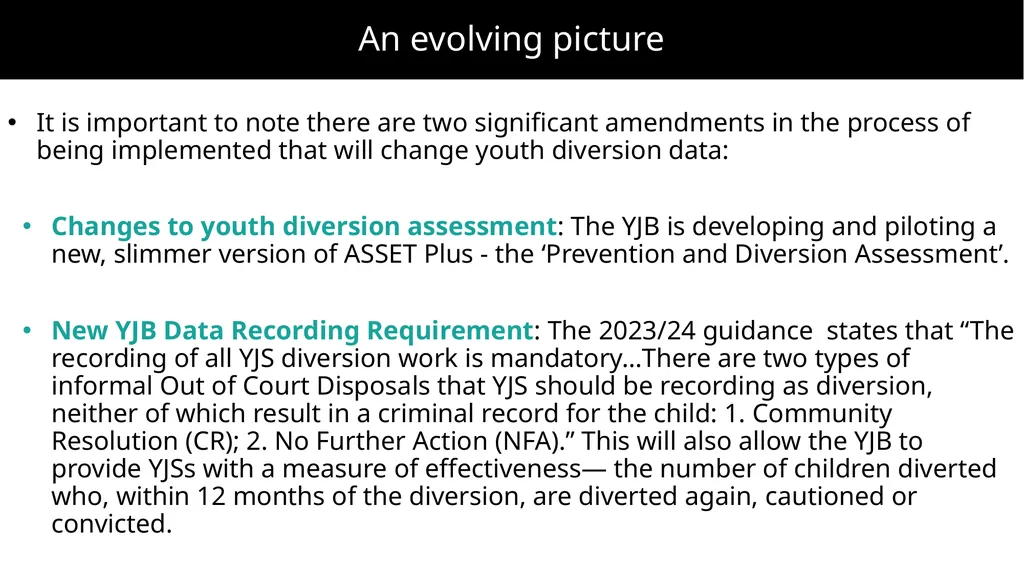
slide33. It is important to note there are two significant amendments in the process of being implemented that will change youth diversion data:
Changes to youth diversion assessment: The YJB is developing and piloting a new, slimmer version of ASSET Plus - the ‘Prevention and Diversion Assessment’.
New YJB Data Recording Requirement: The 2023/24 guidance states that “The recording of all YJS diversion work is mandatory…There are two types of informal Out of Court Disposals that YJS should be recording as diversion, neither of which result in a criminal record for the child: 1. Community Resolution (CR); 2. No Further Action (NFA).” This will also allow the YJB to provide YJSs with a measure of effectiveness— the number of children diverted who, within 12 months of the diversion, are diverted again, cautioned or convicted. An evolving picture<br>
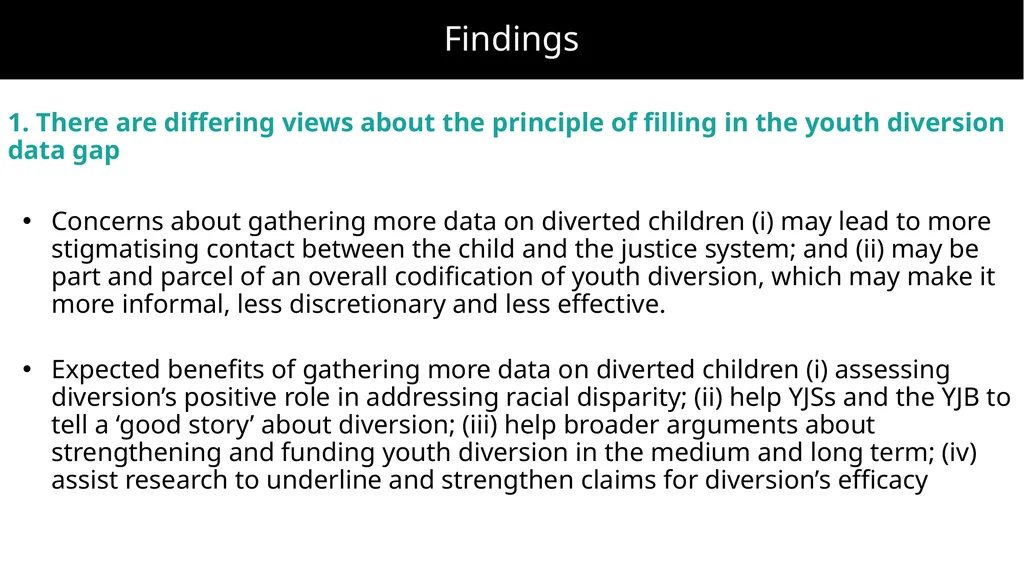
slide34. 1. There are differing views about the principle of filling in the youth diversion data gap
Concerns about gathering more data on diverted children (i) may lead to more stigmatising contact between the child and the justice system; and (ii) may be part and parcel of an overall codification of youth diversion, which may make it more informal, less discretionary and less effective.
Expected benefits of gathering more data on diverted children (i) assessing diversion’s positive role in addressing racial disparity; (ii) help YJSs and the YJB to tell a ‘good story’ about diversion; (iii) help broader arguments about strengthening and funding youth diversion in the medium and long term; (iv) assist research to underline and strengthen claims for diversion’s efficacy Findings<br>
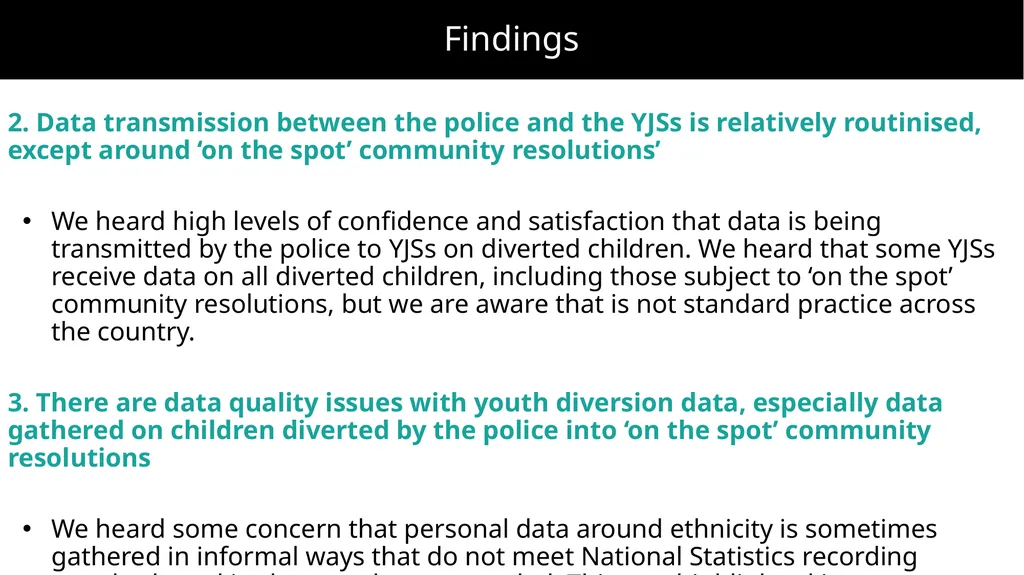
slide35. 2. Data transmission between the police and the YJSs is relatively routinised, except around ‘on the spot’ community resolutions’
We heard high levels of confidence and satisfaction that data is being transmitted by the police to YJSs on diverted children. We heard that some YJSs receive data on all diverted children, including those subject to ‘on the spot’ community resolutions, but we are aware that is not standard practice across the country.
3. There are data quality issues with youth diversion data, especially data gathered on children diverted by the police into ‘on the spot’ community resolutions
We heard some concern that personal data around ethnicity is sometimes gathered in informal ways that do not meet National Statistics recording standards and is also not always recorded. This was highlighted in a recent HMICFRS report Findings<br>
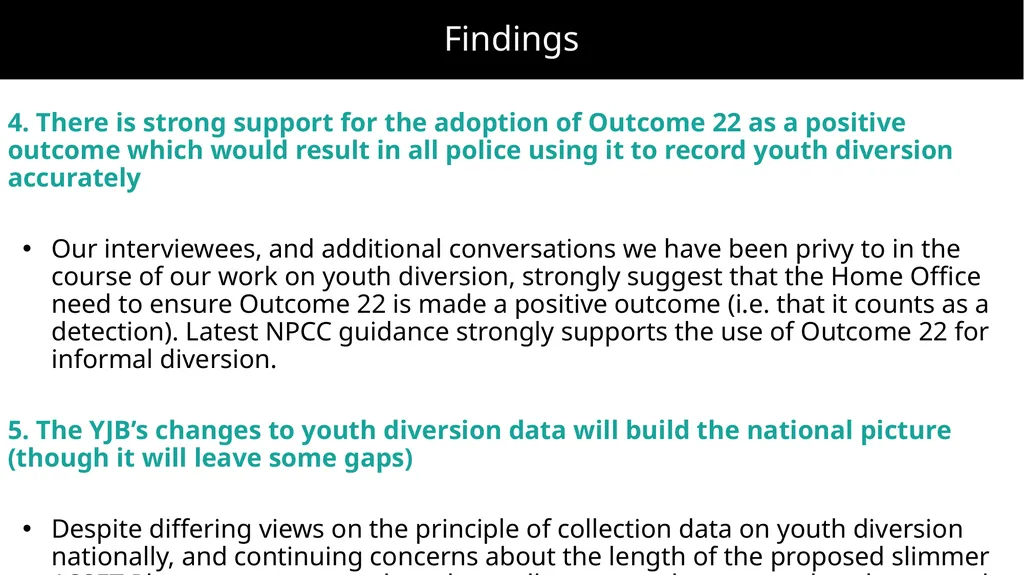
slide36. 4. There is strong support for the adoption of Outcome 22 as a positive outcome which would result in all police using it to record youth diversion accurately
Our interviewees, and additional conversations we have been privy to in the course of our work on youth diversion, strongly suggest that the Home Office need to ensure Outcome 22 is made a positive outcome (i.e. that it counts as a detection). Latest NPCC guidance strongly supports the use of Outcome 22 for informal diversion.
5. The YJB’s changes to youth diversion data will build the national picture (though it will leave some gaps)
Despite differing views on the principle of collection data on youth diversion nationally, and continuing concerns about the length of the proposed slimmer ASSET Plus assessment, we heard overall strong endorsement that the steps the YJB are taking will fill substantial gaps in the youth diversion data. Findings<br>
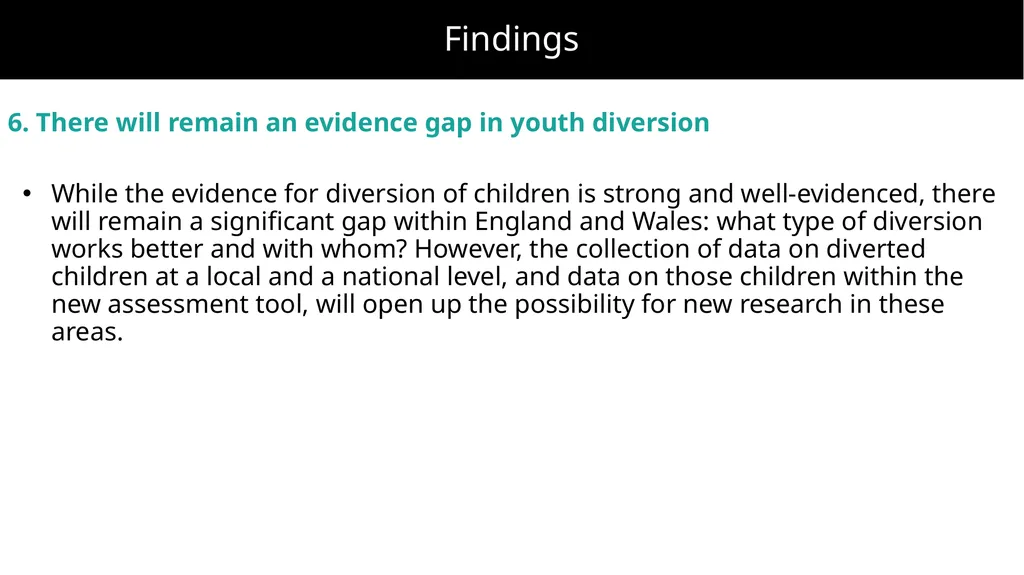
slide37. 6. There will remain an evidence gap in youth diversion
While the evidence for diversion of children is strong and well-evidenced, there will remain a significant gap within England and Wales: what type of diversion works better and with whom? However, the collection of data on diverted children at a local and a national level, and data on those children within the new assessment tool, will open up the possibility for new research in these areas. Findings<br>
slide38. Based on our findings, we recommend:
• The Home Office make outcome 22 a positive outcome and ensure that police involved in youth diversion fully understand its requirements and how to use it;
• The police should inform their local YJS of any CRs given to children, ensuring that children and their families can be offered (if appropriate) voluntary support;
• The YEF, and others, fund more research, using the new YJB data collection requirement as a platform from which they can conduct additional, scheme level-evaluations of youth diversion. Recommendations<br>
slide39. The current funding regime is not operating effectively for youth diversion. All YJSs are now running youth diversion schemes, but funding arrangements – at least at a national level – have not yet been revised to reflect this aspect of their work.
There is no direct funding for youth diversion activity, with funding for youth diversion coming from two national sources – from the HMPPS and from the Youth Justice Board’s Youth Justice Grant – and a variety of local partners including police, health and local authorities. Neither of the national funding formulae currently allocate money on the basis of youth diversion activity.
The local funding arrangements that diversion schemes rely on are often changeable and short-term. Areas for improvement: Funding<br>
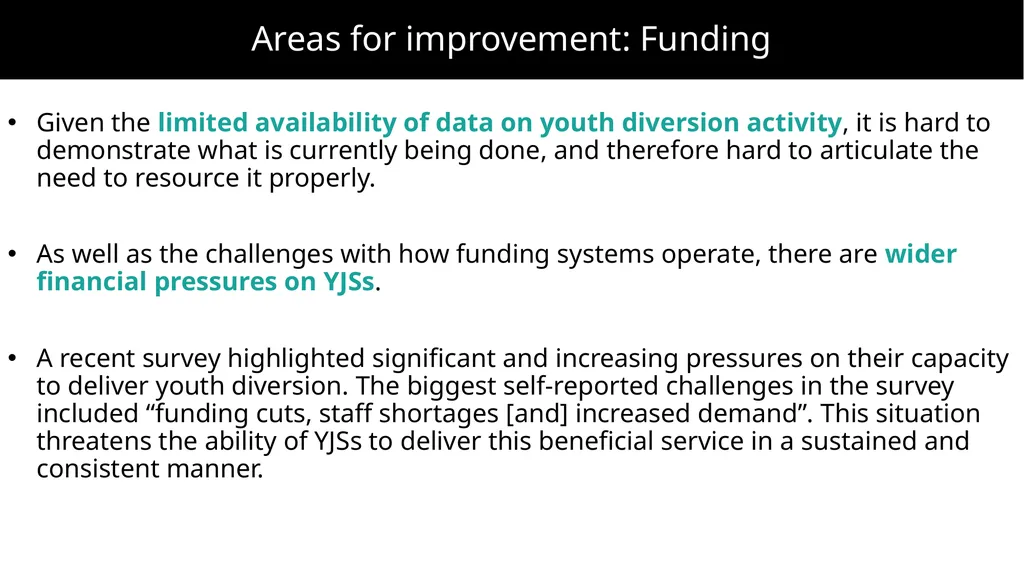
slide40. Given the limited availability of data on youth diversion activity, it is hard to demonstrate what is currently being done, and therefore hard to articulate the need to resource it properly.
As well as the challenges with how funding systems operate, there are wider financial pressures on YJSs.
A recent survey highlighted significant and increasing pressures on their capacity to deliver youth diversion. The biggest self-reported challenges in the survey included “funding cuts, staff shortages [and] increased demand”. This situation threatens the ability of YJSs to deliver this beneficial service in a sustained and consistent manner. Areas for improvement: Funding<br>
slide41. Current landscape
Areas for improvement
Equal access to diversion
Inspection framework
Data
Funding
Youth justice partnership: Our Practice offer What we are covering Putting practitioners and evidence at the heart of justice reform 41<br>
slide42. We are funded to provide free enhanced support to 10 YJSs and their partners to develop or improve their diversion offer. This support can include:
Improving processes: reviewing your eligibility criteria and referral processes against evidence and best practice;
Providing multi-agency training: on a variety of subjects, including on Outcome 22 implementation and delivery;
Addressing disproportionality: reviewing your local data and practice to understand why not all children have equal access to your scheme;
Reviewing protocols and documents: helping you to formalise procedures and paperwork for your scheme;
Support with inspections: helping you to prepare for an inspection or implement recommendations from an inspection.
To apply for this support, please contact Bami at bjolaoso@justiceinnovation.org How we can help: The new Youth Jusitce Partnership<br>
slide43. Putting practitioners and evidence at the heart of justice reform www.justiceinnovation.org
info@justiceinnovation.org
@cjinnovation<br>
slide2. Current landscape
Areas for improvement
Equal access to diversion
Inspection framework
Data
Funding
Youth justice partnership: Our Practice offer What we are covering Putting practitioners and evidence at the heart of justice reform 2<br>
slide3. Current landscape
Areas for improvement
Equal access to diversion
Inspection framework
Data
Funding
Youth justice partnership: Our Practice offer What we are covering Putting practitioners and evidence at the heart of justice reform 3<br>
slide4. Prevention and diversion; Youth Justice Board (YJB) definitions Putting practitioners and evidence at the heart of justice reform 4 Prevention is support and intervention with children (and their parents/carers) who may be displaying behaviours which may indicate underlying needs or vulnerability. In practice this involves a tiered approach of early and targeted prevention. The aim being to address unmet needs, safeguard, promote positive outcomes and stop children entering the formal youth justice system.
Diversion is where children with a linked offence receive an alternative outcome* that does not result in a criminal record, avoids escalation into the formal youth justice system and associated stigmatisation. This may involve the Youth justice services (YJS’s) delivering support / intervention that may or may not be voluntary and/or signposting children (and parent/carers) into relevant services. All support should be proportionate, aimed at addressing unmet needs and supporting prosocial life choices.<br>
slide5. ‘Prevention and Diversion Project report’ (YJB/AYM/HMIP) in 2023 found that:
YJSs report to be delivering a significant amount of prevention and diversion work that is not formally captured in any standardised way. 20/21 survey responses showed that, on average, 52% of YJSs caseloads are prevention and diversion cases (for Wales, where there is dedicated funding for targeted prevention and diversion work from the Welsh Government, it was 72%).
YJSs are meeting children’s complex needs by providing holistic and bespoke support at this early level of intervention. YJSs provided local data that the work is supporting reductions in first time entrant rates and leading to improvements in children’s lives.
Some YJSs are seeking to minimise stigmatisation by collaborating with wider children, youth, early help, education, and/or health services some are also integrating the YJS into wider services. Existing practice and policy<br>
slide6. ‘Prevention and Diversion Project report’ found that:
Guidance is outdated and does not reflect or support current practice. This includes YJB case management guidance, YJS assessments, YJS police guidance, police gravity matrix, police Outcome 22 guidance.
Funding is inconsistent. Often funding is provided year on year and demand outweighs resources available.
There were missed opportunities to intervene and support children who are coming to the attention of police due to poor information sharing between agencies.
Data difficulties impacted by no consistent definitions, assessment tool or data recording standards Existing practice and policy<br>
slide7. New Government announced in Opposition the following pledges relevant to diversion:
Labour will introduce a new Neighbourhood Policing Guarantee, restoring patrols to our town centres by recruiting thousands of new police officers, police and community support officers, and special constables.
Every young person caught in possession of a knife will be referred to a Youth Offending Team and will receive a mandatory plan to prevent reoffending.
Labour will intervene earlier to stop young people being drawn into crime, creating a new Young Futures programme with a network of hubs reaching every community….to support young people’s mental health and avoid them being drawn into crime.
Local prevention partnerships will identify young people who could be drawn into violence and intervene. And to offer young people a pathway out of violence, we will place youth workers and mentors in A&E units and Pupil Referral Units, funded by full recovery of the cost of firearm licensing.
Labour will also introduce a new offence of criminal exploitation of children, to go after the gangs who are luring young people into violence and crime.
Introduce a strong antisocial behaviour plan, including a full prevention and diversion programme, including new youth mentors for children most vulnerable to crime. New Government: ‘Take back our streets’<br>
slide8. With extra police officers, and focus on increasing the conviction rate, will we see the FTE number rise consistently? Recent history suggests this can lead to increasing the net for children, especially children the police are regularly in contact with, which is heavily influenced by where those children live and which communities they are from.
YJB report states that “Diversion practice is varied and inconsistent. YJSs feel that children are in some cases being unnecessarily criminalised due to differing eligibility criteria for access to services, and differing responses to offences, including varied application of the use of No Further Action Outcome 22.”
However, should prevention and diversion be standardised or is variation simply a product of localism, individual decision making and the devolution of policing? If we standardise, do we give central Government a tempting excuse to restrict access to diversion? New Government: Urgent questions<br>
slide9. Current landscape
Areas for improvement
Equal access to diversion
Inspection framework
Data
Funding
Youth partnership: Our Practice offer What we are covering Putting practitioners and evidence at the heart of justice reform 9<br>
slide10. Racial disproportionality and Youth Diversion Putting practitioners and evidence at the heart of justice reform 10 Research papers
Equal Diversion? Racial disproportionality in Youth diversion:
Interviewed Youth Justice Services, police and solicitors in an in-depth look at racial disparity in youth diversion at two local authorities in England and Wales.
Children and young people’s voices on youth diversion and disparity:
Interviewed children about their access to and engagement with diversion and OoCDs, with a more in depth exploration of their experiences, in relation to their ethnic background.<br>
slide11. Mixed experiences of police contact Children and young people’s voices on youth diversion 11 They were treating me like an actual human. They were treating me like a normal person … They weren’t treating me badly or anything. They were treating me with respect and decency, you know what I’m saying? I’m a Black young teenage boy, if I was a White boy it would be different… Probably better. Things would probably have been better. Some did not understand their outcome, including the criminal record implications Not sure what I got. I don’t know how long I have left. Just so I don’t get a criminal record. If I do the 12 weeks it will come off, so now it’s off. …they explained it clearly.<br>
slide12. Good relationship-building by YJS practitioners Children and young people’s voices on youth diversion 12 I think, at the beginning, I thought he was taking… not taking a side, but I thought he was more like, 'you’ve just done this‘, do you know what I mean? Then we had a few more meetings, he came to my house, we had a one to-one session, and after that I think we both opened up to each other a bit more. The appropriateness of diversion interventions was variable [I] went to a virtual reality session. It was about knife crime… it wasn’t really useful. I don’t business with knives. There was a choice, so if I wanted to talk about family, or staying safe. There were a few things you could talk about, and each session was something new.<br>
slide13. Children and young people’s voices on youth diversion Putting practitioners and evidence at the heart of justice reform 13 Promising practice principles from ‘Children and young people’s voices on youth diversion’ Provide relevant and accessible information about legal processes and diversion
Implement effective communication practices
Co-produce tailored intervention plans with children
Ensure that eligibility criteria and referral routes for diversion do not exacerbate racial disparities
Address the risk of ‘adultification’ of children by embedding Child First principles in practice
Make effective use of data to monitor local disparities
Implement anti-racist and anti-discriminatory practices<br>
slide14. How is youth diversion working for children with Special Educational Needs and Disabilities? 14<br>
slide15. Prevalence of SEND needs in the YJS Exploring the responsiveness of youth diversion to children with SEND Putting practitioners and evidence at the heart of justice reform 15 71% of children sentenced between April 2019 and March 2020 had identified speech, language and communication needs (YJB/MoJ)
Over two-thirds of children in custody have identified special educational needs (Howard League)
More than three-quarters (79.8%) of people who went on to receive a custodial sentence had been identified with special educational needs during their schooling (Office for National Statistics)<br>
slide16. Barriers to access Prevalence of unidentified SEND among youth justice cohort
Police insistence on admission of guilt and display of remorse
Poor advice at police station
Gaps & inconsistency in SEND training
“On the whole, we don't really get training as such as how to deal with a child if they don't look at you. Is it because they've got autism or Asperger's and they don't like holding eye contact?”
Poor advice at police station
Overwhelming assessment process Putting practitioners and evidence at the heart of justice reform 16 I think really high and I think it's far higher than any of our statistics really show Very, very widespread, I’d say. I would say it’s also- it’s gone undiagnosed and untreated… In order to qualify… [children] have to fully admit to the offence and ideally show some remorse. We can't use community resolution if there's not been an admission of guilt. Some children have been advised to make a no comment interview in the Police station, potentially because their solicitor or appropriate adult feels this is a 'safer' option for the child as they may: incriminate themselves further if they talk to Police (due to receptive and expressive language difficulties); appear like they are lying (due to expressive language difficulties); or have difficulties engaging with the Police (due to attention and listening difficulties or social communication differences). When children provide a no comment interview this limits the options that are available via the diversion pathways.<br>
slide17. Barriers to access Gaps in and inconsistency of SEND training
One-size-fits-all approach to interventions
Assumptions about ability and willingness to engage
Gaps & inconsistency in SEND training
“On the whole, we don't really get training as such as how to deal with a Putting practitioners and evidence at the heart of justice reform 17 Have we had enough of it? Definitely not. You know, again, that's because I'm in a specialist role, solely working with young people and we get a small amount of that training, most of which we've had to organise ourselves. When I think about my colleagues on response, they probably don't get any at all. We look at how meaningfully they engage in the assessment process because obviously at diversion if you're talking specifically about Challenge for change and Turnaround, it's voluntary. I don't believe that a child in my area with SEND would receive a different offer to a child without SEND, but I fear that the provision wouldn't be differentiated to accommodate the child with SEND appropriately. It's all very much either written in handbooks or telling, telling, telling. It doesn’t take into account learning styles, let alone SEN.<br>
slide18. Awareness of their own SEND and ability to recall and articulate this when prompted during the interview was varied. Perspectives of children with SEND 18 “No one told me I was getting an EHCP plan either. I didn’t even know what it was when I was in [name of old school], but I found out literally when I went to [name of new school].” “[when asked about whether they received any specific support at school] I don't really know, to be honest.” The majority of children we spoke to had faced very difficult times at school, having often been permanently excluded from mainstream school. “I didn’t get much help there either, I was just put down as a- I was just a naughty kid, really. When I was in secondary school, the headteacher put it down just to naughty behaviour, I had nothing wrong with me. Primary, they thought there was something, but they couldn’t tell. So eventually, my mum just went to the paediatrician and found out I had autism.”<br>
slide19. Children felt that the police offered little to no support, they found use of force during arrest traumatic, they felt their needs were dismissed, they struggled to process information in interview and they reported they had little trust in the police. Perspectives of children with SEND 19 “Zero. It’s always been zero trust.” “Yeah, 100%. I think they knew that I couldn’t know what the big words were.” “…I came home with bruises and everything. They broke my toe once. When you're even calm and when you say, ‘Yeah,’ and you don’t kick off, they still think they have to use force. They feel like everywhere they go, they’ve got to go, “Grr,” and slam you to the floor.” “They asked me if I was dyslexic or owt, but I’m not sure. I’ve never actually been diagnosed with it because I had three answers, inconclusive, yes and no. So I never knew if I had it or not. So they asked if I wanted that support, but no other support, just that.” “[when asked about trust in the police] Don’t make me laugh…. So, the amount of times I’ve called the police on my mum for being abusive or whatever, there’s no records. They just can’t find any records about it, but I know I’ve definitely called the police. The police have been out to my house many times for it, they’ve took me to my sisters and everything, but there’s just no records about it…But when my teacher rang, they came in seconds.”<br>
slide20. On the whole, the children we spoke to felt that they had gained valuable support from their YJS workers and had very positive relationships with them. Perspectives of children with SEND 20 “I get really excited when I know I’m gonna see [YJS worker]. On Mondays I’ll be in a really good mood coz I know I’m gonna see [YJS worker] the next day and I know I’m gonna be able to express how I feel. I don’t know [YJS worker]’s just a fucking G ain’t she” “Yeah, she showed me videos and stuff. Because obviously I just thought it was a bad thing, people assume you're different. And she just built my confidence up and said, ‘It’s not, look at all these famous people who have got it’ and then just talked about it.” “If I could make it last forever I genuinely would. It has honestly helped so much. And the fact that I’ve got [YJS worker] there to remind me how much I’ve changed and how much I’ve grown and matured and got on better.” “I remember [YJS worker] taking me to the park, the park where I’m always hanging out... I had to draw down all the antisocial behaviour. And then after, he told me to run around the whole park, trying to tire me out.”<br>
slide21. Conclusion Putting practitioners and evidence at the heart of justice reform 21 The youth justice system is not currently working for children. To address this, the priorities should be to:
Ensure the policing of children is responding appropriately to the needs of children with SEND
Provide clarity on the requirements surrounding admission of guilt, acceptance of responsibility and remorse
Ensure that children with SEND are receiving adequate and accessible legal advice
Share good practice between youth justice services around adapting interventions to children with SEND
Expand youth justice services’ diversion processes to include co-location of speech and language therapists and balanced joint decision-making panels<br>
slide22. Our work Putting practitioners and evidence at the heart of justice reform 22 You can find our other research on the topic of ‘Securing Equal Diversion’ on our website:
Equal Diversion? Racial disproportionality in Youth diversion
Children and young people’s voices on youth diversion and disparity
Literature Review: Exploring the Responsiveness of Youth Diversion to Children with SEND
How is youth diversion working for children with special educational needs and disabilities?
Quarterly bulletin<br>
slide23. Current landscape
Areas for improvement
Equal access to diversion
Inspection framework
Data
Funding
Youth justice partnership: Our Practice offer What we are covering Putting practitioners and evidence at the heart of justice reform 23<br>
slide24. Inspecting diversion and OOCDs for children 24 His Majesty’s Inspectorate of Probation (HMIP): youth justice services inspection
HMIP’s inspection framework has a clearly defined focus on the delivery, practice and oversight of
diversion and OOCDs for children:
Inspectors look at the assessment, planning, and implementation and delivery of OOCDs for children and young people, and also at the overarching policy and provision for out of court work. Whilst not obvious from this description, this does cover diversion cases and not only OOCDs.<br>
slide25. Inspecting diversion and OOCDs for children 25 HM Inspectorate of Constabulary and Fire & Rescue Services (HMICFRS)
There are 10 core questions graded in a PEEL assessment when inspecting a police force area. These core questions are each supported by characteristics of good performance. Within these 10, there are no questions specific to diversion or OOCDs or the policing of children who offend; however, the following questions and characteristics could pick up this kind of activity:
How good is the force at preventing and deterring crime, anti-social behaviour and vulnerability?
The force uses problem solving and works in partnership to prevent crime, anti-social behaviour and vulnerability.
The force works in partnership with a wide range of other organisations in problem solving crime prevention and early intervention activity, which is effective and achieves positive outcomes and reductions in demand.
The force is undertaking early intervention approaches with a focus on positive outcomes.<br>
slide26. PEEL thematic report example 26 HMICFRS thematic inspection of how well the police tackle serious youth violence, March 2023
This report examined how well police address serious youth violence to reduce violent crime involving young people (particularly between the ages of 14 to 24 years). It aimed to answer three questions, two of which are relevant to diversion and OOCDs:
How well do police use their powers of enforcement to reduce serious youth violence, and do they
understand racial disproportionality?
Inspectors looked at the use of Outcome 22 which ‘involves the suspect being diverted to a programme intended to reform them and prevent future offending’. They found that in some circumstances its use was appropriate.
They also found that forces were starting to use this option in relation to serious youth violence, but some officers had a flawed understanding of it, which undermined its use in those forces.
This may disproportionately affect young people from minoritised ethnic groups and contribute to them being more likely to be prosecuted than their white counterparts.
Recommendation: By 31 March 2024, Chief Constables should make sure their officers are trained in the use of Home Office crime Outcome 22.<br>
slide27. Joint thematic report example 27 In March 2018, HMIP and HMICFRS conducted a joint thematic inspection on the use of out of court disposals in the youth justice system
It’s recommendations included the following:
The Ministry of Justice and the Youth Justice Board should: Include community resolutions in CJS reoffending statistics, and evaluate their effectiveness in reducing offending and improving outcomes for children.
The Youth Justice Board should: Make sure that guidance on use of Asset Plus or other assessment frameworks meets the needs of local areas when seeking to undertake OOCDs work.
YJSs and chief constables should: Make sure that all victims have a fully informed and effective opportunity to have their views heard, and to receive an appropriate restorative intervention and make sure that children understand the implications of receiving an OOCD before they are asked to accept it.
YJSs should: Make sure that assessment and planning are of good quality, and take account of the child’s views on what may help them to avoid offending and make sure that decision making is informed by assessment of the child.
Chief constables should: Make sure that referrals to YJSs are sufficiently timely to meet the needs of victims for speedy justice and achieve the objectives of OOCDs and make the YJS aware of all community resolutions given by the police.<br>
slide28. Practitioner and inspector insights 28 They have a lack of understanding of how other inspectorates operate and what is expected of the agency they are inspecting.
Practitioners reported that typically they responded to recommendations made by the inspectorate for their organisation, as opposed to those made by other inspectorates.
Effective partnership working is inspected by each inspectorate but rarely are there any specifics on which agencies/organisations they are referring to.
Youth justice police officers do not always feel their work is captured in the PEEL assessments
The policing of children was highlighted as an area of policing that would benefit from more targeted and independent scrutiny.
Although difficult to coordinate - all agencies agreed that joint inspections are a useful tool in understanding and scrutinising practice across a local area where partnership working is key.
Inspectors and practitioners alike find thematic inspections a particularly useful resource for advice and good practice but were unsure how themes are selected and how the recommendations are monitored and reviewed.<br>
slide29. Recommendations 29 Based on our discussions, we recommend that:
• Each inspectorate should be able to make recommendations publically in their reports relating to other agencies. These should be followed up by the relevant inspectorate.
• HMIP should undertake another thematic inspection on OOCDs and diversion for children due to the significant change in YJS caseloads, YJS and policing practice and policy in recent years. This should be undertaken jointly with HMICFRS and occur once all the new guidance and tools have gone live and are embedded.
• HMICFRS should publish a spotlight report on the theme of OOCDs and diversion of children to highlight good practice being undertaken by police forces.
• The policing of children, from arrest to investigation, up until the outcome of a case, should be the topic of a future joint thematic inspection by HMICFRS and HMIP.<br>
slide30. Current landscape
Areas for improvement
Equal access to diversion
Inspection framework
Data
Funding
Youth justice partnership: Our Practice offer What we are covering Putting practitioners and evidence at the heart of justice reform 30<br>
slide31. The Centre and HMIP found that there is no requirement for YJSs to report nationally on youth diversion and it is not compulsory for police to record such activity in a consistent way. This has the following impacts:
There is no clear national picture of what youth diversion activity is being undertaken;
There is no clear picture of the needs and demographics of those who are being diverted;
It is difficult to understand how well needs are being addressed, or whether particular groups are not being treated equitably;
Police and YJSs do not have their diversion work recognised in current funding formulas, resulting in inadequate funding for this significant aspect of their workload. Areas for improvement: Data<br>
slide32. In order to assess current and future youth diversion data, we conducted semi-structured interviews with a range of individuals with expertise in the subject.
This included three representatives of the police, two YJS representatives, two representatives from the YJB, and four academics/data analysts who have recently conducted or are conducting analysis using youth diversion data.
We have also sought to internally verify our findings from these interviews with our own experts in youth diversion and have conducted a limited literature search. The methodology<br>
slide33. It is important to note there are two significant amendments in the process of being implemented that will change youth diversion data:
Changes to youth diversion assessment: The YJB is developing and piloting a new, slimmer version of ASSET Plus - the ‘Prevention and Diversion Assessment’.
New YJB Data Recording Requirement: The 2023/24 guidance states that “The recording of all YJS diversion work is mandatory…There are two types of informal Out of Court Disposals that YJS should be recording as diversion, neither of which result in a criminal record for the child: 1. Community Resolution (CR); 2. No Further Action (NFA).” This will also allow the YJB to provide YJSs with a measure of effectiveness— the number of children diverted who, within 12 months of the diversion, are diverted again, cautioned or convicted. An evolving picture<br>
slide34. 1. There are differing views about the principle of filling in the youth diversion data gap
Concerns about gathering more data on diverted children (i) may lead to more stigmatising contact between the child and the justice system; and (ii) may be part and parcel of an overall codification of youth diversion, which may make it more informal, less discretionary and less effective.
Expected benefits of gathering more data on diverted children (i) assessing diversion’s positive role in addressing racial disparity; (ii) help YJSs and the YJB to tell a ‘good story’ about diversion; (iii) help broader arguments about strengthening and funding youth diversion in the medium and long term; (iv) assist research to underline and strengthen claims for diversion’s efficacy Findings<br>
slide35. 2. Data transmission between the police and the YJSs is relatively routinised, except around ‘on the spot’ community resolutions’
We heard high levels of confidence and satisfaction that data is being transmitted by the police to YJSs on diverted children. We heard that some YJSs receive data on all diverted children, including those subject to ‘on the spot’ community resolutions, but we are aware that is not standard practice across the country.
3. There are data quality issues with youth diversion data, especially data gathered on children diverted by the police into ‘on the spot’ community resolutions
We heard some concern that personal data around ethnicity is sometimes gathered in informal ways that do not meet National Statistics recording standards and is also not always recorded. This was highlighted in a recent HMICFRS report Findings<br>
slide36. 4. There is strong support for the adoption of Outcome 22 as a positive outcome which would result in all police using it to record youth diversion accurately
Our interviewees, and additional conversations we have been privy to in the course of our work on youth diversion, strongly suggest that the Home Office need to ensure Outcome 22 is made a positive outcome (i.e. that it counts as a detection). Latest NPCC guidance strongly supports the use of Outcome 22 for informal diversion.
5. The YJB’s changes to youth diversion data will build the national picture (though it will leave some gaps)
Despite differing views on the principle of collection data on youth diversion nationally, and continuing concerns about the length of the proposed slimmer ASSET Plus assessment, we heard overall strong endorsement that the steps the YJB are taking will fill substantial gaps in the youth diversion data. Findings<br>
slide37. 6. There will remain an evidence gap in youth diversion
While the evidence for diversion of children is strong and well-evidenced, there will remain a significant gap within England and Wales: what type of diversion works better and with whom? However, the collection of data on diverted children at a local and a national level, and data on those children within the new assessment tool, will open up the possibility for new research in these areas. Findings<br>
slide38. Based on our findings, we recommend:
• The Home Office make outcome 22 a positive outcome and ensure that police involved in youth diversion fully understand its requirements and how to use it;
• The police should inform their local YJS of any CRs given to children, ensuring that children and their families can be offered (if appropriate) voluntary support;
• The YEF, and others, fund more research, using the new YJB data collection requirement as a platform from which they can conduct additional, scheme level-evaluations of youth diversion. Recommendations<br>
slide39. The current funding regime is not operating effectively for youth diversion. All YJSs are now running youth diversion schemes, but funding arrangements – at least at a national level – have not yet been revised to reflect this aspect of their work.
There is no direct funding for youth diversion activity, with funding for youth diversion coming from two national sources – from the HMPPS and from the Youth Justice Board’s Youth Justice Grant – and a variety of local partners including police, health and local authorities. Neither of the national funding formulae currently allocate money on the basis of youth diversion activity.
The local funding arrangements that diversion schemes rely on are often changeable and short-term. Areas for improvement: Funding<br>
slide40. Given the limited availability of data on youth diversion activity, it is hard to demonstrate what is currently being done, and therefore hard to articulate the need to resource it properly.
As well as the challenges with how funding systems operate, there are wider financial pressures on YJSs.
A recent survey highlighted significant and increasing pressures on their capacity to deliver youth diversion. The biggest self-reported challenges in the survey included “funding cuts, staff shortages [and] increased demand”. This situation threatens the ability of YJSs to deliver this beneficial service in a sustained and consistent manner. Areas for improvement: Funding<br>
slide41. Current landscape
Areas for improvement
Equal access to diversion
Inspection framework
Data
Funding
Youth justice partnership: Our Practice offer What we are covering Putting practitioners and evidence at the heart of justice reform 41<br>
slide42. We are funded to provide free enhanced support to 10 YJSs and their partners to develop or improve their diversion offer. This support can include:
Improving processes: reviewing your eligibility criteria and referral processes against evidence and best practice;
Providing multi-agency training: on a variety of subjects, including on Outcome 22 implementation and delivery;
Addressing disproportionality: reviewing your local data and practice to understand why not all children have equal access to your scheme;
Reviewing protocols and documents: helping you to formalise procedures and paperwork for your scheme;
Support with inspections: helping you to prepare for an inspection or implement recommendations from an inspection.
To apply for this support, please contact Bami at bjolaoso@justiceinnovation.org How we can help: The new Youth Jusitce Partnership<br>
slide43. Putting practitioners and evidence at the heart of justice reform www.justiceinnovation.org
info@justiceinnovation.org
@cjinnovation<br>