Improving Prosecution Quality 35 U.S.C. 112 (b) A Private Practice Perspective Heart of Definiteness Definiteness concerns the question of whether one skilled in the art would understand the scope of what is being claimed. See Nautilus,
"Improving Prosecution Quality 35 U.S.C. 112 (b) A" is the property of its rightful owner. Permission is granted to
download and print the materials on this website for personal, non-commercial use only, and to display it
on your personal computer provided you do not modify the materials and that you retain all copyright
notices contained in the materials. By downloading content from our website, you accept the terms of this
agreement.
Presentation Transcript
01
Improving Prosecution Quality 35 U.S.C. 112 (b) A Private Practice Perspective<br>
02
Heart of Definiteness Definiteness concerns the question of whether one skilled in the art would understand the scope of what is being claimed. See Nautilus, Inc. v. Biosig Instruments, Inc., 134 S. Ct. 2120 (2014).
MPEP 2173.02: “After applying the broadest reasonable interpretation to the claim, if the metes and bounds of the claimed invention are not clear, the claim is indefinite and should be rejected… Examiners, however, are cautioned against confusing claim breadth with claim indefiniteness.”<br>
03
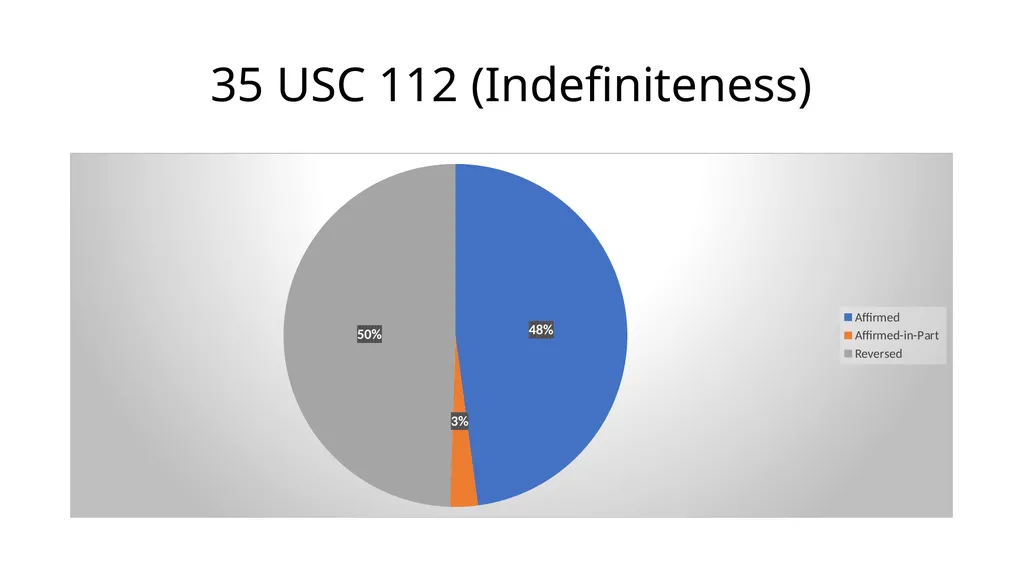
Using the PTAB to Gauge Performance Detailed below are the decision statistics for each individual rejection type between October 2015 and October 2017 (all TCs). For each rejection type, a random sample of cases where taken of sufficient size that the results presented below have a confidence level of 95% and a confidence interval of 5.
Additionally, the samples taken were spread-out evenly through the 2-year time period of the population sampled.
Fully study Published in the JPTOS: Ryan Pool, Should You Appeal? A Look at Success Rates Before the PTAB on an Individual Rejection Basis, 100 J.Pat. & Trademark Off. Soc’y 320 (2018).<br>
04
35 USC 112 (Indefiniteness)<br>
05
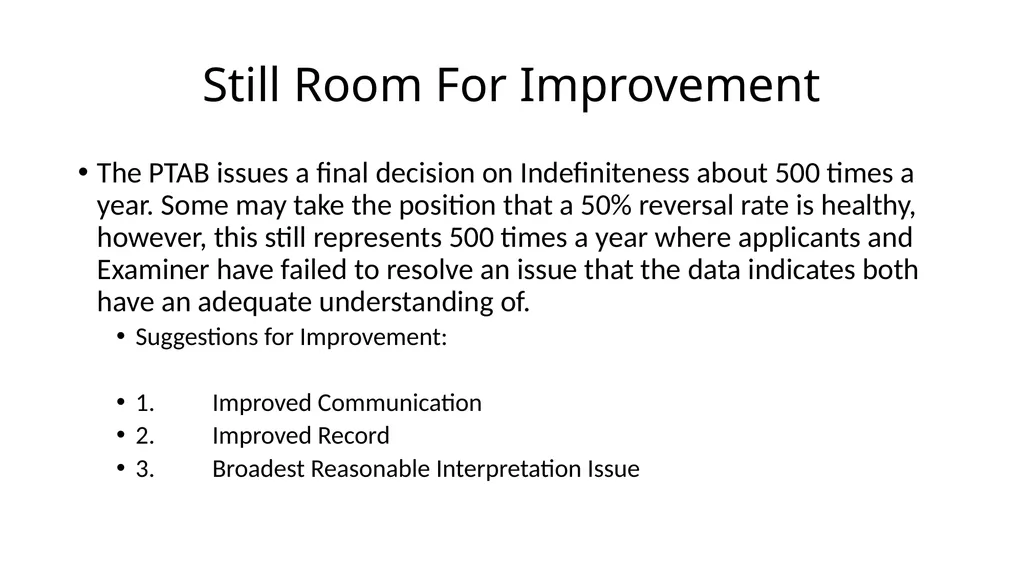
Still Room For Improvement The PTAB issues a final decision on Indefiniteness about 500 times a year. Some may take the position that a 50% reversal rate is healthy, however, this still represents 500 times a year where applicants and Examiner have failed to resolve an issue that the data indicates both have an adequate understanding of.
Suggestions for Improvement:
1. Improved Communication
2. Improved Record
3. Broadest Reasonable Interpretation Issue<br>
06
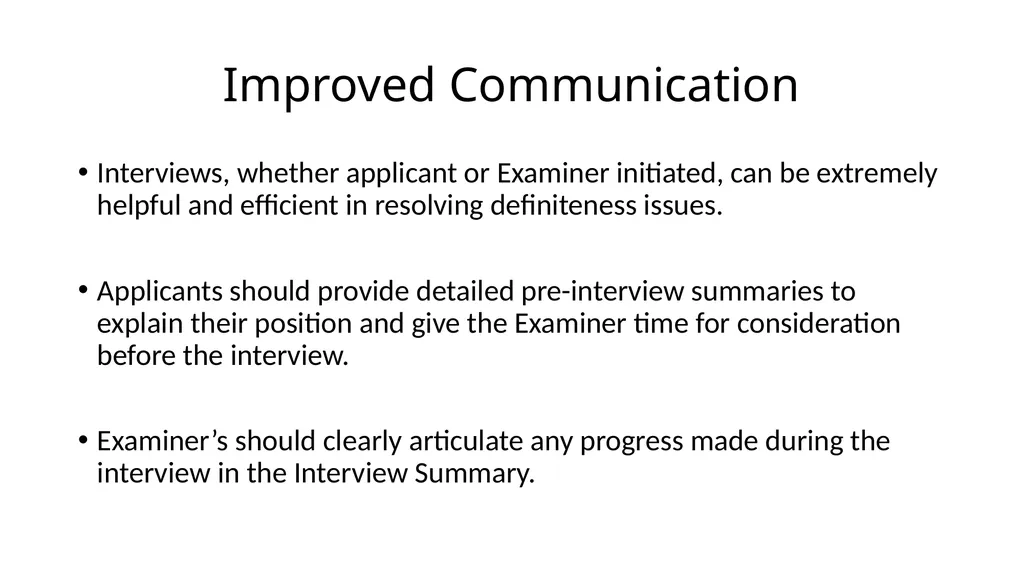
Improved Communication Interviews, whether applicant or Examiner initiated, can be extremely helpful and efficient in resolving definiteness issues.
Applicants should provide detailed pre-interview summaries to explain their position and give the Examiner time for consideration before the interview.
Examiner’s should clearly articulate any progress made during the interview in the Interview Summary.<br>
07
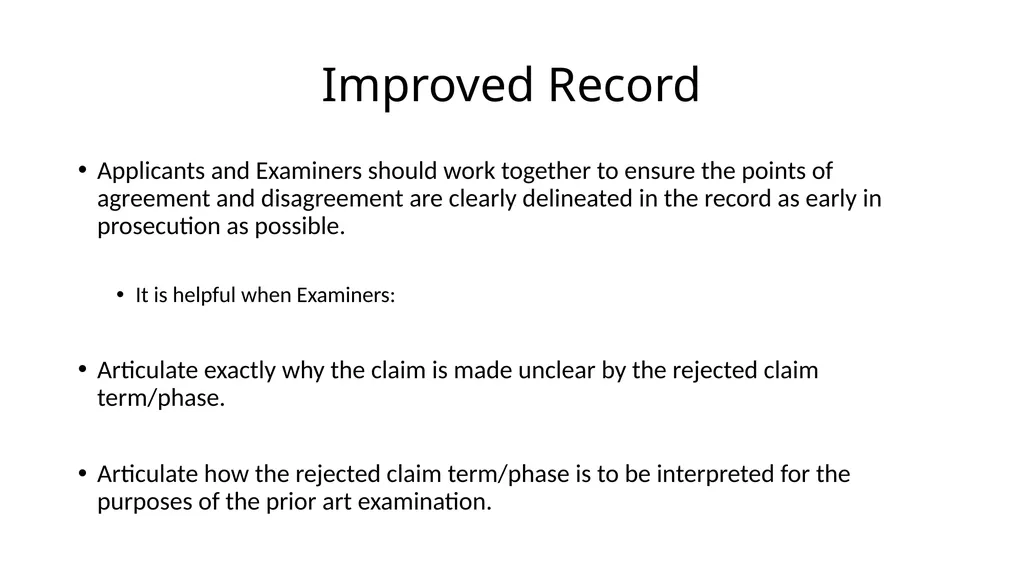
Improved Record Applicants and Examiners should work together to ensure the points of agreement and disagreement are clearly delineated in the record as early in prosecution as possible.
It is helpful when Examiners:
Articulate exactly why the claim is made unclear by the rejected claim term/phase.
Articulate how the rejected claim term/phase is to be interpreted for the purposes of the prior art examination.<br>
08
Broadest Reasonable Interpretation Determining the Broadest Reasonable Interpretation (BRI) can sometimes be a contentious issue. This can also be an issue were applicants and Examiners talk past each other rather than to each other.
At each stage of prosecution where BRI is an issue, care should be taken by both parties to clearly articulate their respective positions in the record.
When claim terminology is not identical to that of the cited reference, Examiners discussing BRI while reasonably indicating where claim limitations are taught in the cited reference is helpful to prevent applicant confusion.
Interviews can be especially helpful.<br>
09
Cooperative Process Patent Examination is intended to be a cooperative process not an adversarial process.
Applicants appreciate thorough examinations because they result in stronger patents.
We are all working to achieve the common goal of efficiently determining the allowable scope of subject matter for any given application.<br>