Incident Summary for CCE CCE Safety Committee Meeting February 25,2021 Overview of Incidents Academic Year: September 2020 to now Report Incidents! Injuries Needle Prick: While handling new, unused needles, researcher was poked accidentally
"Incident Summary for CCE CCE Safety Committee" is the property of its rightful owner. Permission is granted to
download and print the materials on this website for personal, non-commercial use only, and to display it
on your personal computer provided you do not modify the materials and that you retain all copyright
notices contained in the materials. By downloading content from our website, you accept the terms of this
agreement.
Presentation Transcript
01
Incident Summary for CCE CCE Safety Committee Meeting
February 25,2021<br>
02
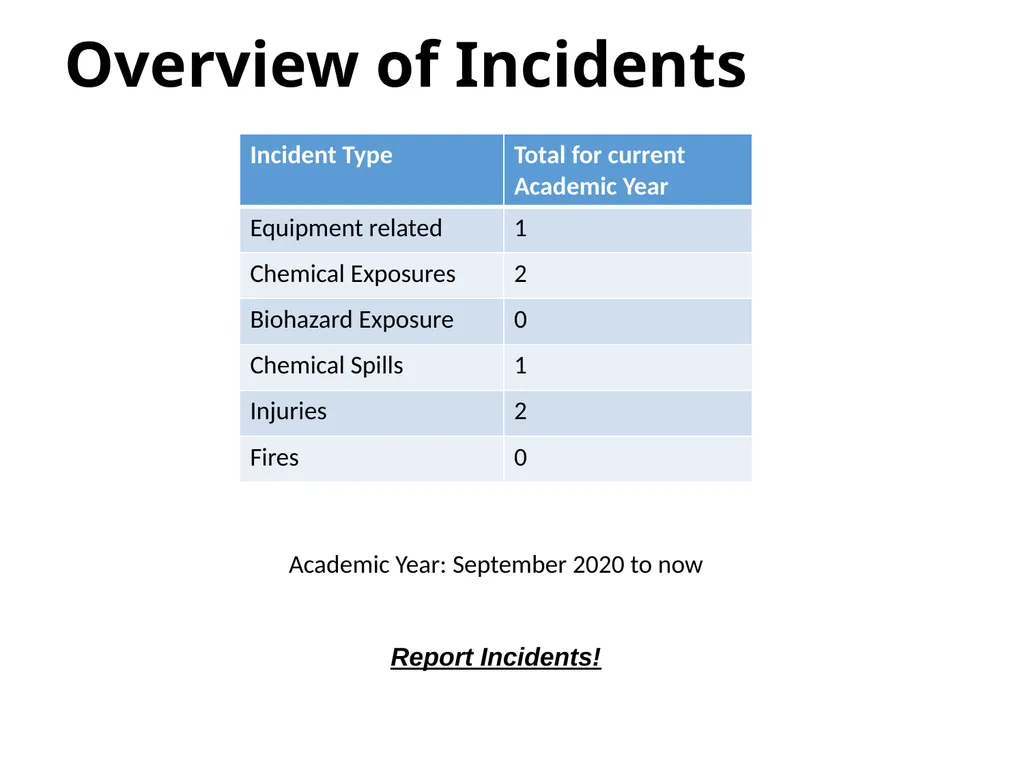
Overview of Incidents Academic Year: September 2020 to now Report Incidents!<br>
03
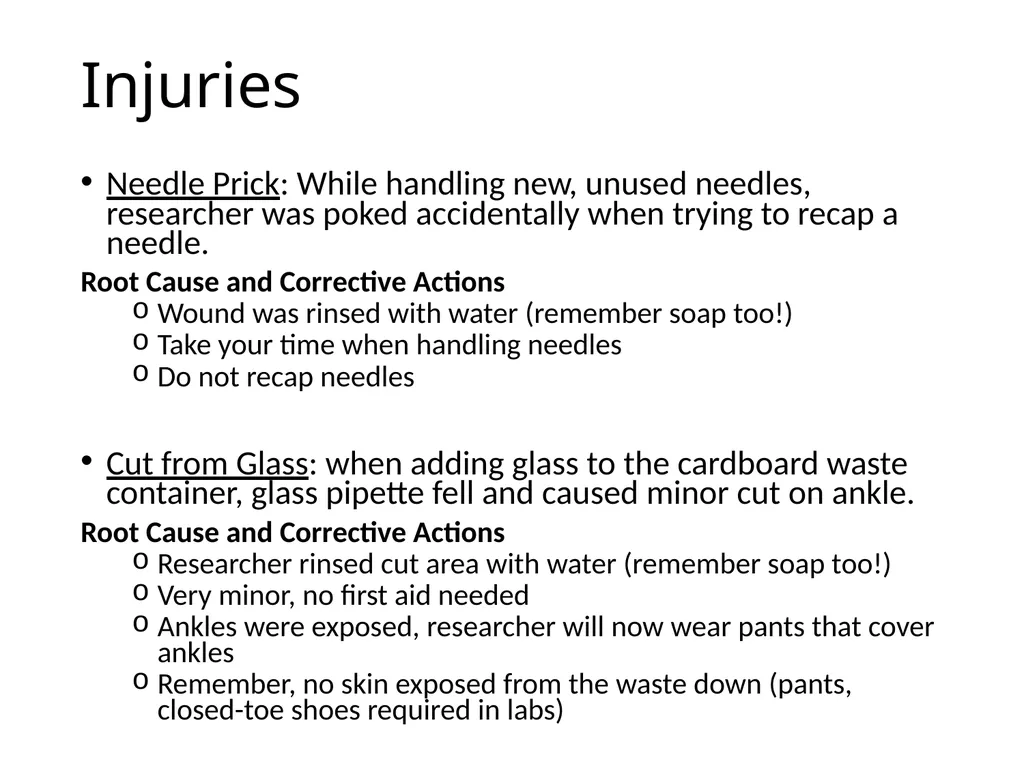
Injuries Needle Prick: While handling new, unused needles, researcher was poked accidentally when trying to recap a needle.
Root Cause and Corrective Actions
Wound was rinsed with water (remember soap too!)
Take your time when handling needles
Do not recap needles
Cut from Glass: when adding glass to the cardboard waste container, glass pipette fell and caused minor cut on ankle.
Root Cause and Corrective Actions
Researcher rinsed cut area with water (remember soap too!)
Very minor, no first aid needed
Ankles were exposed, researcher will now wear pants that cover ankles
Remember, no skin exposed from the waste down (pants, closed-toe shoes required in labs)<br>
04
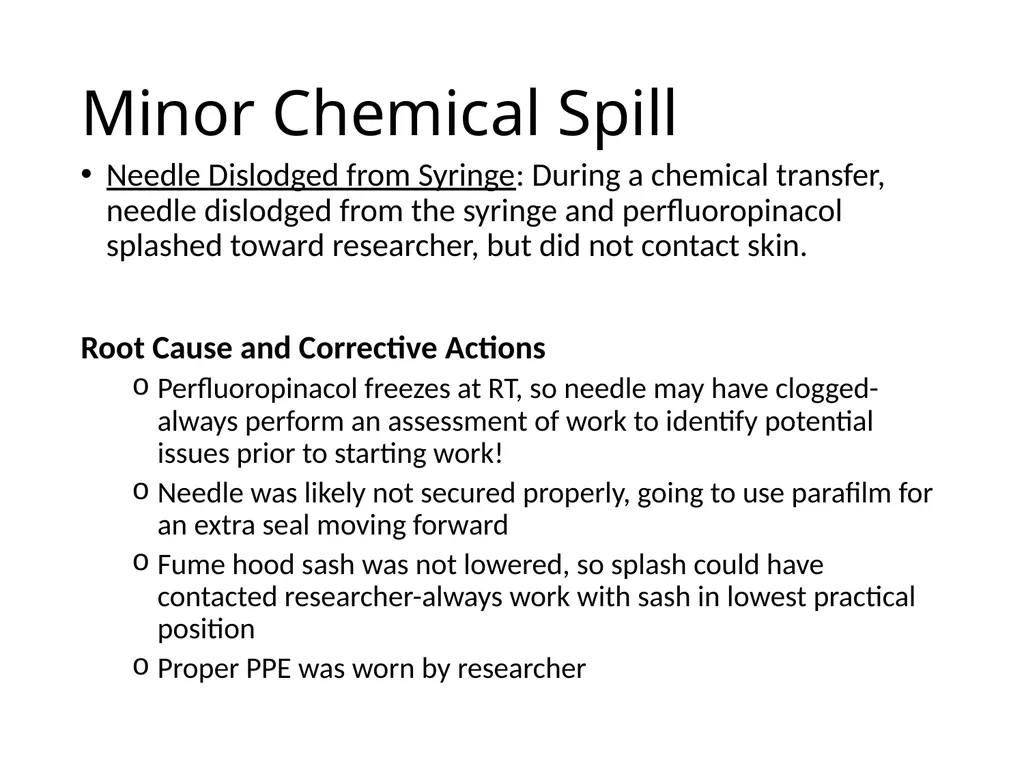
Minor Chemical Spill Needle Dislodged from Syringe: During a chemical transfer, needle dislodged from the syringe and perfluoropinacol splashed toward researcher, but did not contact skin.
Root Cause and Corrective Actions
Perfluoropinacol freezes at RT, so needle may have clogged-always perform an assessment of work to identify potential issues prior to starting work!
Needle was likely not secured properly, going to use parafilm for an extra seal moving forward
Fume hood sash was not lowered, so splash could have contacted researcher-always work with sash in lowest practical position
Proper PPE was worn by researcher<br>
05
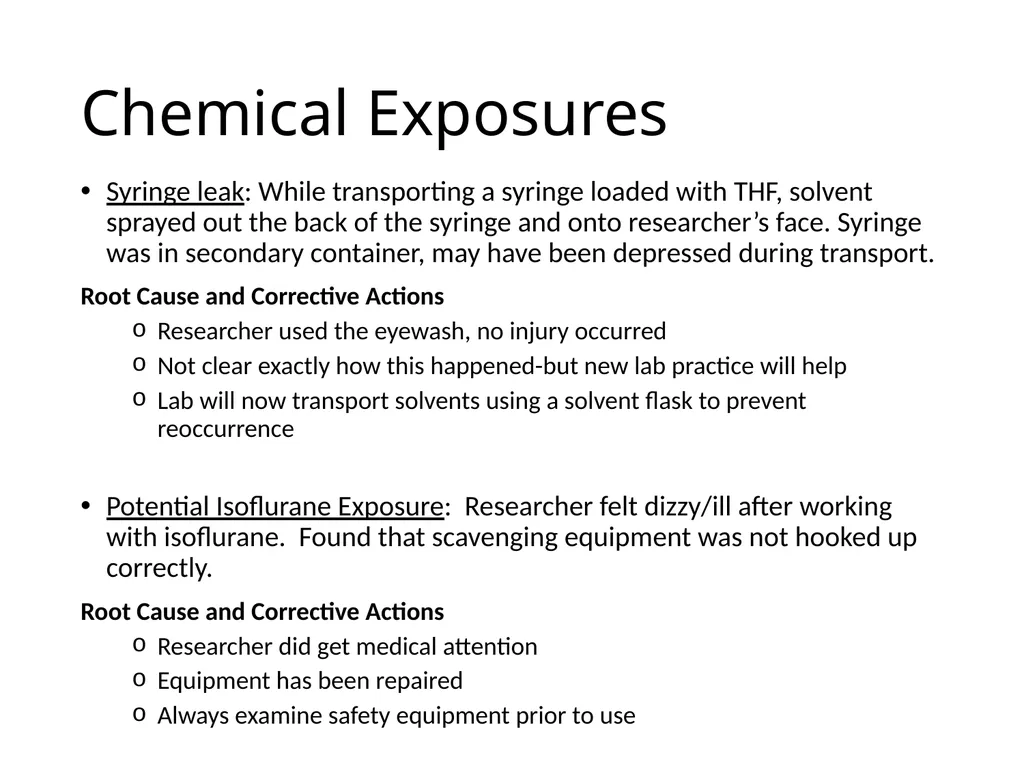
Chemical Exposures Syringe leak: While transporting a syringe loaded with THF, solvent sprayed out the back of the syringe and onto researcher’s face. Syringe was in secondary container, may have been depressed during transport.
Root Cause and Corrective Actions
Researcher used the eyewash, no injury occurred
Not clear exactly how this happened-but new lab practice will help
Lab will now transport solvents using a solvent flask to prevent reoccurrence
Potential Isoflurane Exposure: Researcher felt dizzy/ill after working with isoflurane. Found that scavenging equipment was not hooked up correctly.
Root Cause and Corrective Actions
Researcher did get medical attention
Equipment has been repaired
Always examine safety equipment prior to use<br>
06
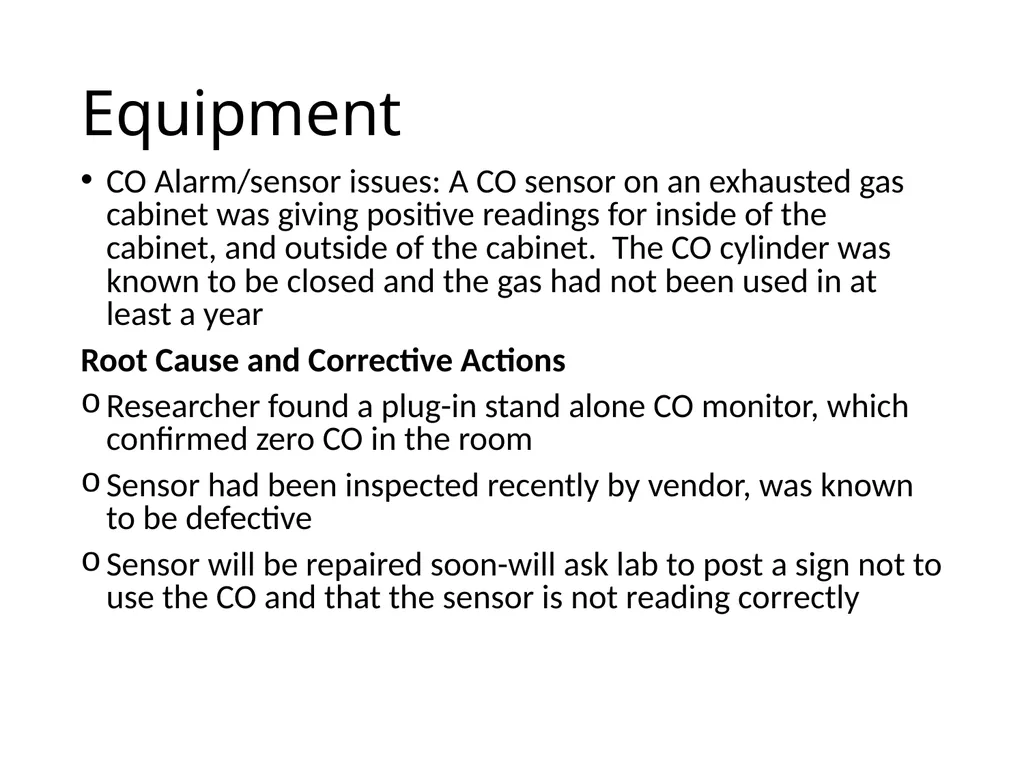
Equipment CO Alarm/sensor issues: A CO sensor on an exhausted gas cabinet was giving positive readings for inside of the cabinet, and outside of the cabinet. The CO cylinder was known to be closed and the gas had not been used in at least a year
Root Cause and Corrective Actions
Researcher found a plug-in stand alone CO monitor, which confirmed zero CO in the room
Sensor had been inspected recently by vendor, was known to be defective
Sensor will be repaired soon-will ask lab to post a sign not to use the CO and that the sensor is not reading correctly<br>
07
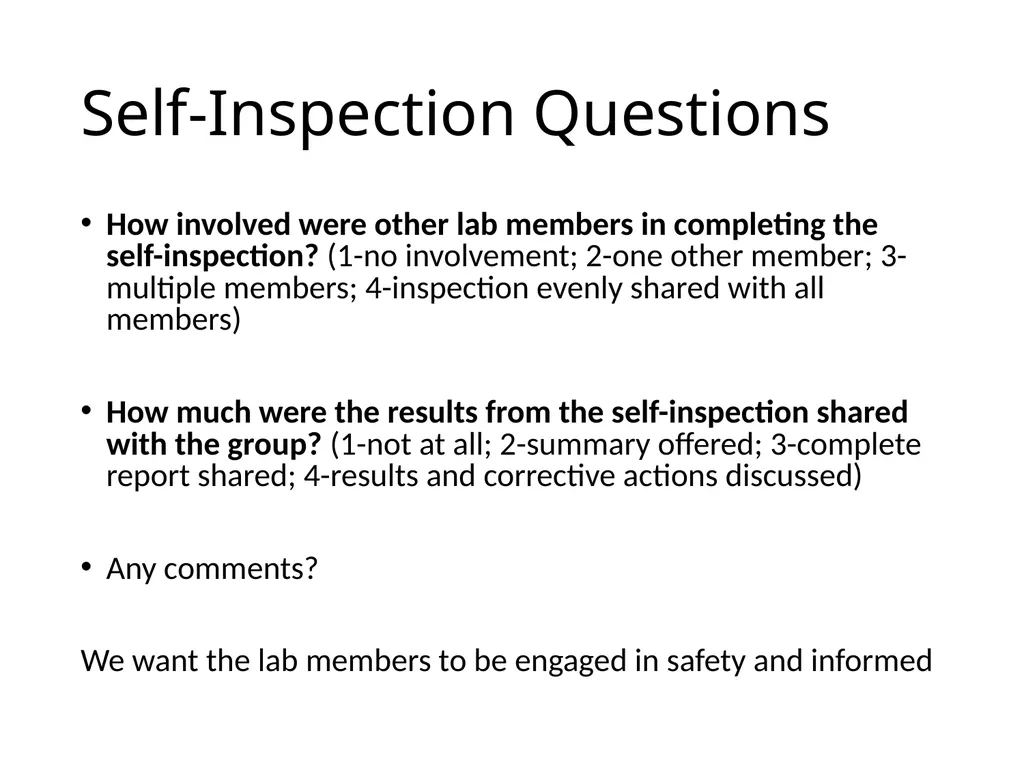
Self-Inspection Questions How involved were other lab members in completing the self-inspection? (1-no involvement; 2-one other member; 3-multiple members; 4-inspection evenly shared with all members)
How much were the results from the self-inspection shared with the group? (1-not at all; 2-summary offered; 3-complete report shared; 4-results and corrective actions discussed)
Any comments?
We want the lab members to be engaged in safety and informed<br>
08
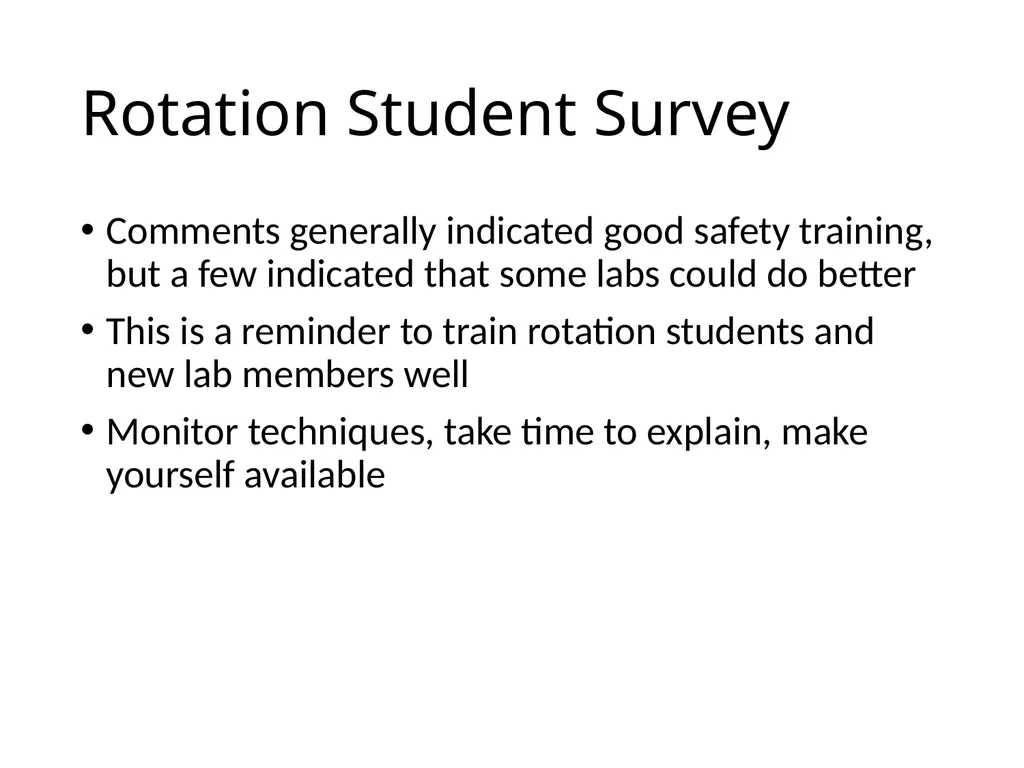
Rotation Student Survey Comments generally indicated good safety training, but a few indicated that some labs could do better
This is a reminder to train rotation students and new lab members well
Monitor techniques, take time to explain, make yourself available<br>
09
SURF Students Note that SURF students did not have lab classes over the last year
They may lack some basic laboratory skills that is usually acquired in lab classes
No working alone
With reduced populations in the lab, may need to watch work more closely
In general, take extra care in training these students<br>
10
For Faculty EHS developed a guide to help Faculty:
Identify safety practices that support a strong safety culture in their labs
Comply with the Institute’s updated Environment, Health, and Safety Policy: https://www.hr.caltech.edu/documents/2646/caltech_institute_policy-environment_health_and_safety.pdf
Choose and empower the Safety Coordinator
Link to the Guide: https://www.safety.caltech.edu/documents/18020/Faculty_Guide_on_Laboratory_Safety_Practices.pdf<br>