
IND AS By CA H.Anand Basic introduction Roadmap of



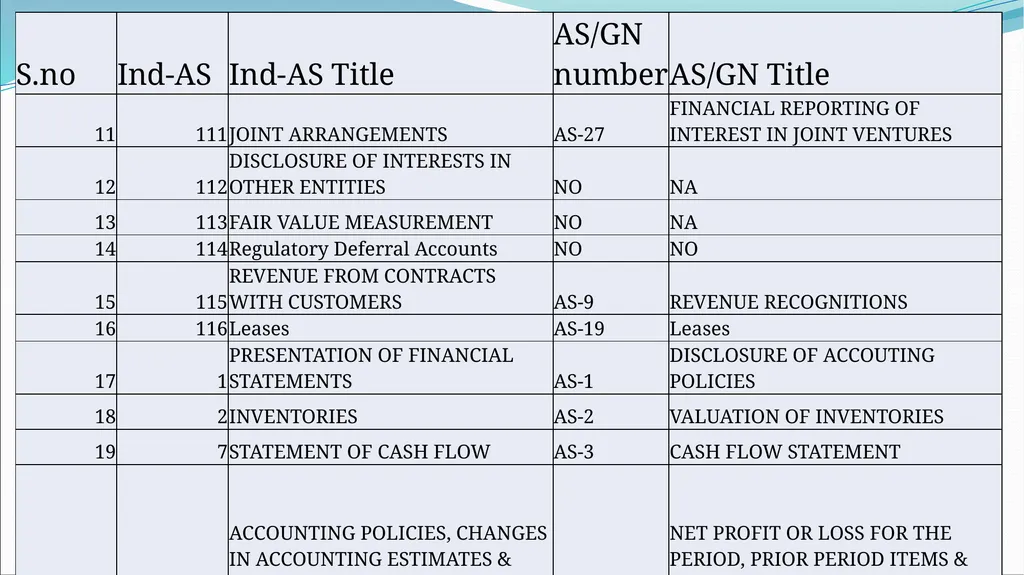
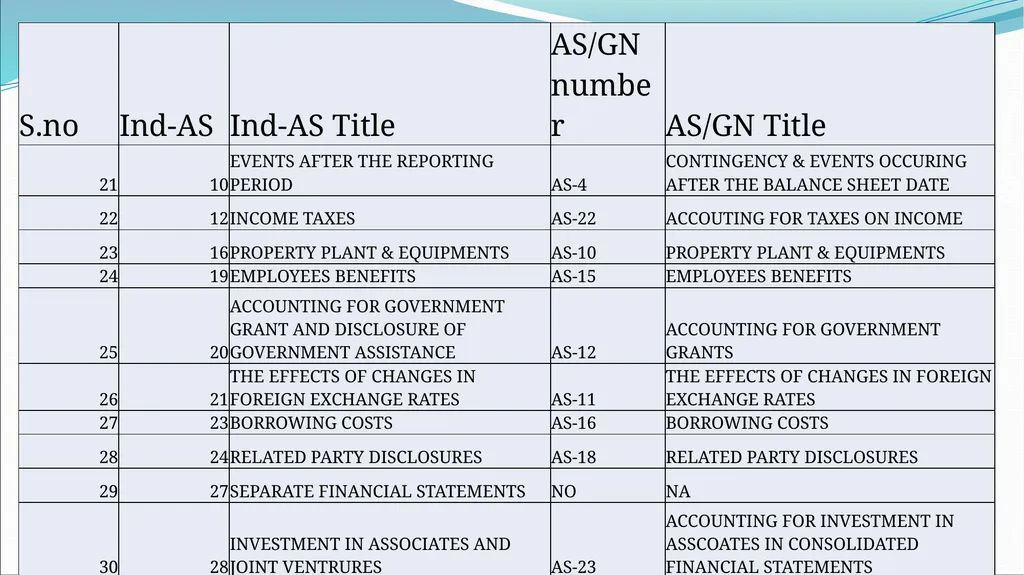
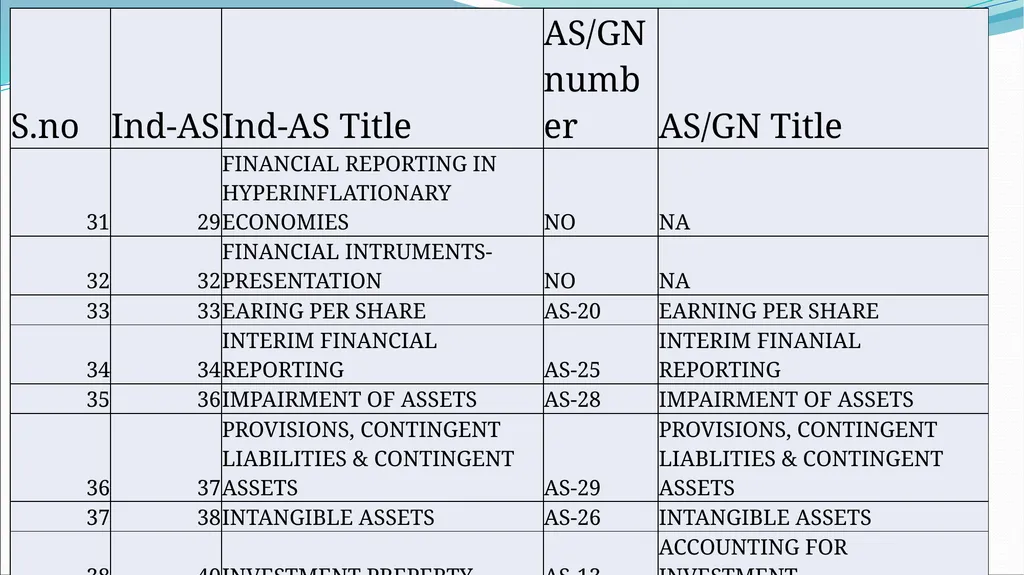








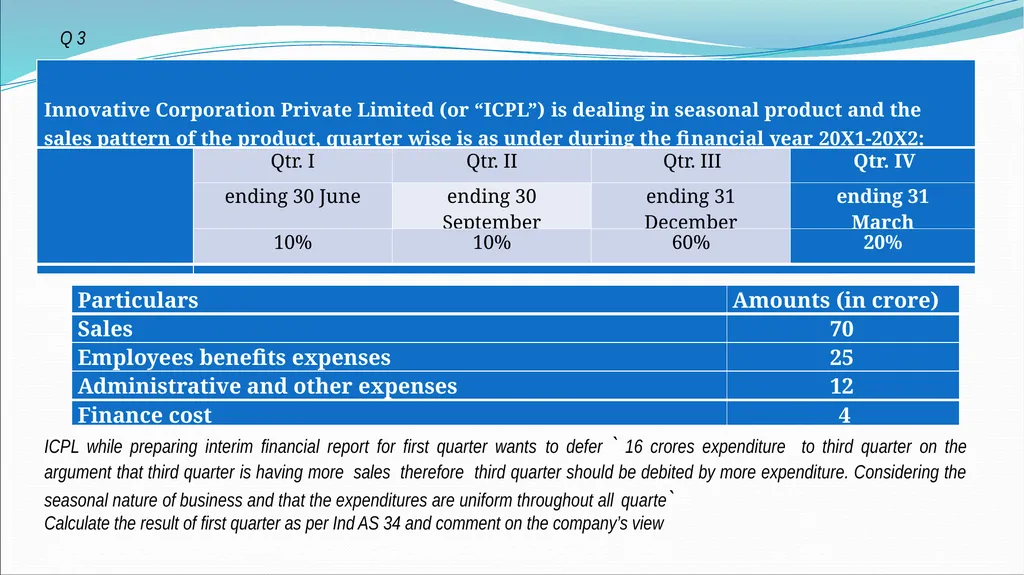
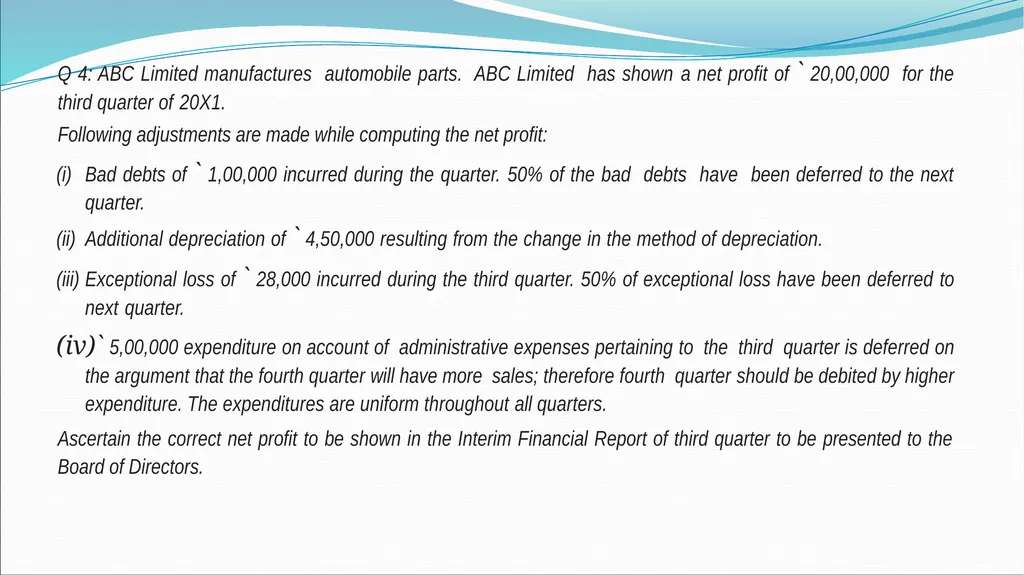
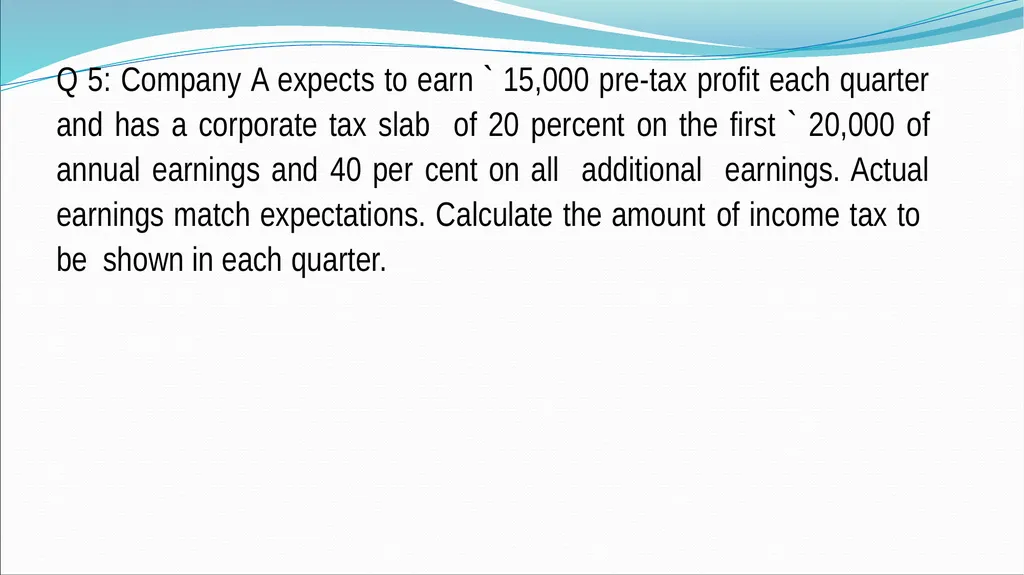
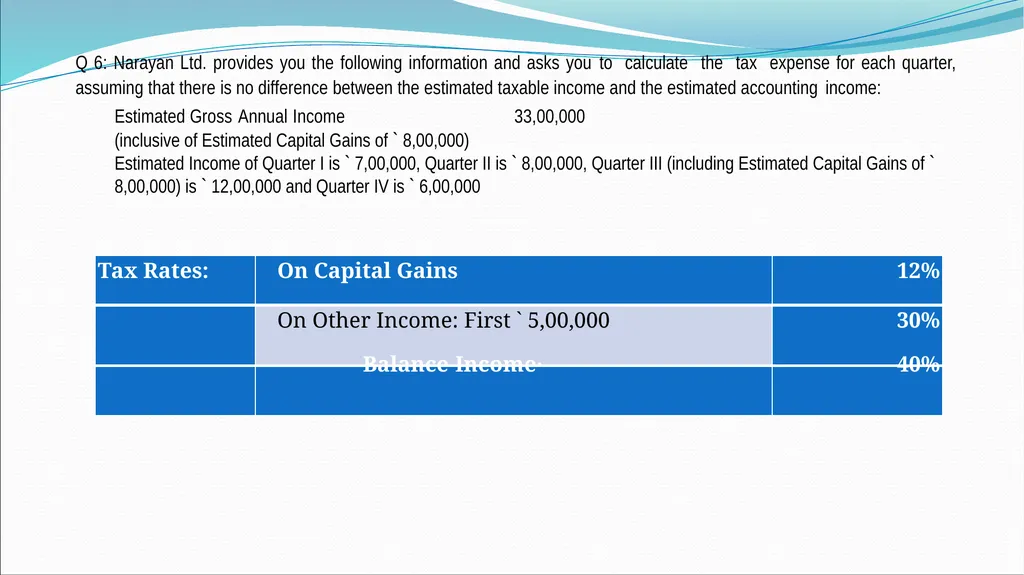







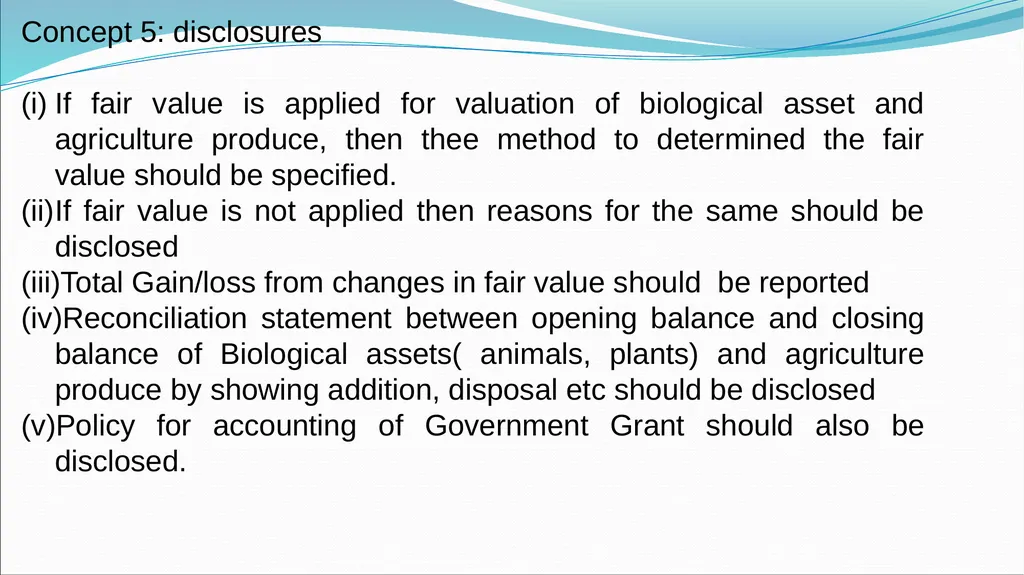
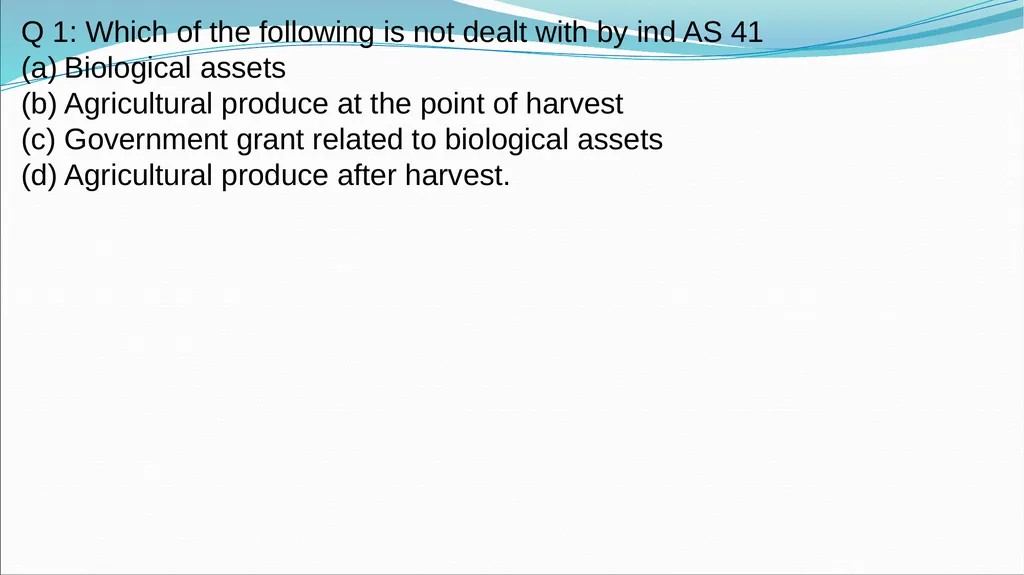
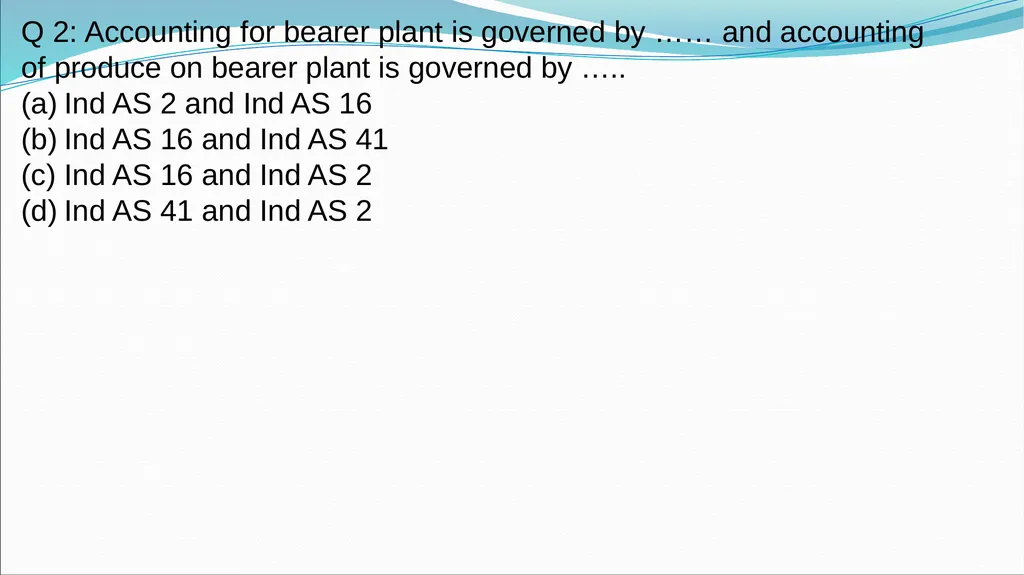
Description: IND AS By CA H.Anand Basic introduction Roadmap of Ind AS Name of Ind AS , IFRSIAS and AS Important provisions of Ind AS Objective type questions on Ind AS (1) Basic Introduction of Ind AS Ind-AS are IFRS converged standards issued by
Related Topics
Download Presentation
"IND AS By CA H.Anand Basic introduction Roadmap of" is the property of its rightful owner. Permission is granted to download and print the materials on this website for personal, non-commercial use only, and to display it on your personal computer provided you do not modify the materials and that you retain all copyright notices contained in the materials. By downloading content from our website, you accept the terms of this agreement.
Presentation Transcript
slide1. IND AS
By CA H.Anand<br>
slide2. Basic introduction
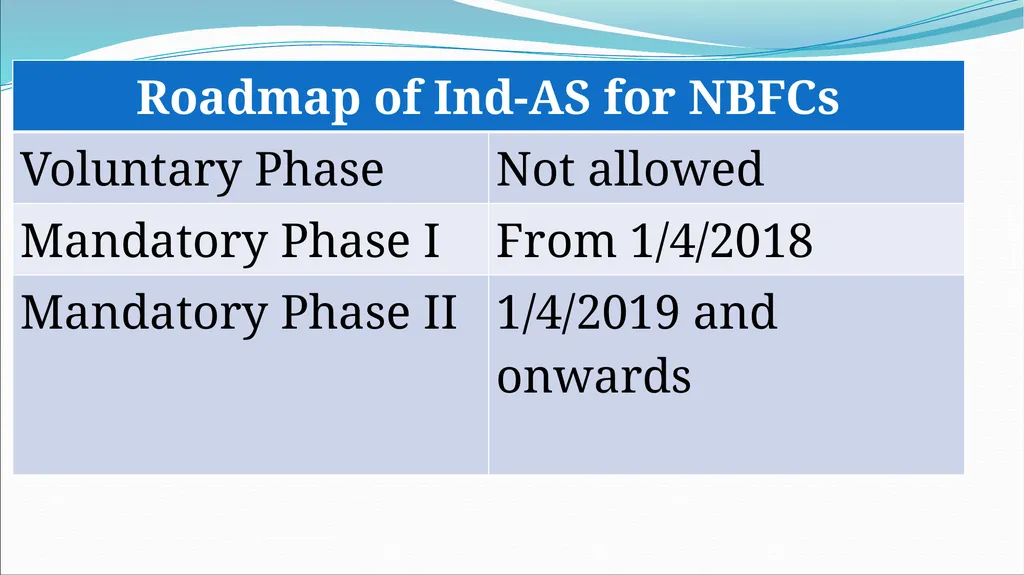
Roadmap of Ind AS
Name of Ind AS , IFRS/IAS and AS
Important provisions of Ind AS
Objective type questions on Ind AS<br>
slide3. (1) Basic Introduction of Ind AS
Ind-AS are IFRS converged standards issued by Central Government of India through Ministry of Corporate Affairs( MCA) under the supervisions and control of Accounting standard board (ASB) of ICAI and in consultation with National Advisory Committee on Accounting Standards ( NACAS) now National Financial Reporting Authority (NFRA)
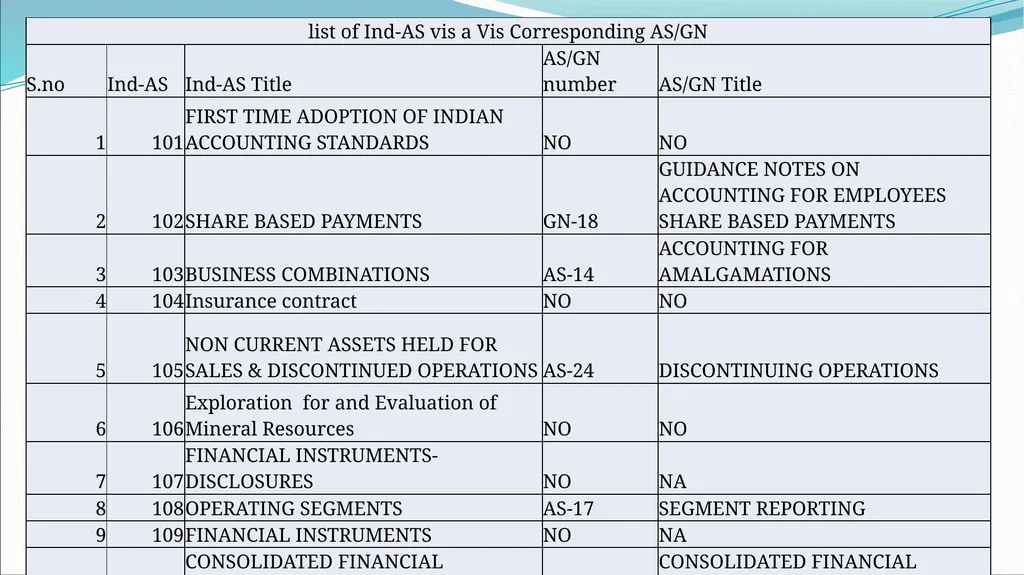
Ind-AS are named and numbered in the same way as the corresponding IFRS/IAS for ease of reference.<br>
slide4. Some important points regarding Ind-AS
Law overrides Ind-AS
Ind AS applicable on material items only
Ind-AS applicable both on SFS and CFS
Partial adoption of Ind-AS is not allowed
One Ind-AS applied/adopted, after that back out /withdraw not allowed
Ind-AS shall be applicable on Group( Holding, subsidiary, Associates and Joint Ventures)<br>
slide5. Carve-in /Carve-out in Ind-AS
Government of India in consultation with ICAI decided to converge and not to adopt IFRS/IAS issued by IASB/IASC.
The decision of convergence rather than adoption was taken after detail analysis of IFRS/IAS requirements and extensive discussion with various stakeholders
Accordingly , while formulating IFRS-converged Ind-AS, efforts have been made to keep these standards , as far as possible, in line with the corresponding IFRS/IAS and departures have been made where considered absolutely essential . Such changes may divided into the following three categories:
Terminology related changes
Carve -Outs
Carve –Ins<br>
slide6. Terminology changes
Various terminology changes have been made to make it consistent with the terminology used in Indian law eg Statement of profit and loss in place of Statement of Comprehensive income and balance sheet in place of Statement of financial position. (ii) Carve outs
Certain changes have been made considering the economic environment of India, which is different as compare to the economic environment of developed countries which has been considered while making IFRS/IAS. The differences which are in deviation to the accounting principles and practices stated in IFRS, are commonly known as Carve-Outs. It may be noted that removal of options in accounting principles & practices in Ind AS vis-à-vis IFRS, in order to maintain the consistency & comparability of the financial statements , shall not be treated as Carve-Outs (iii) Carve-Ins
If there is no guidelines under IFRS for any particular transaction or event, then the guidelines provided under Ind-AS is known as Carve-Ins.<br>
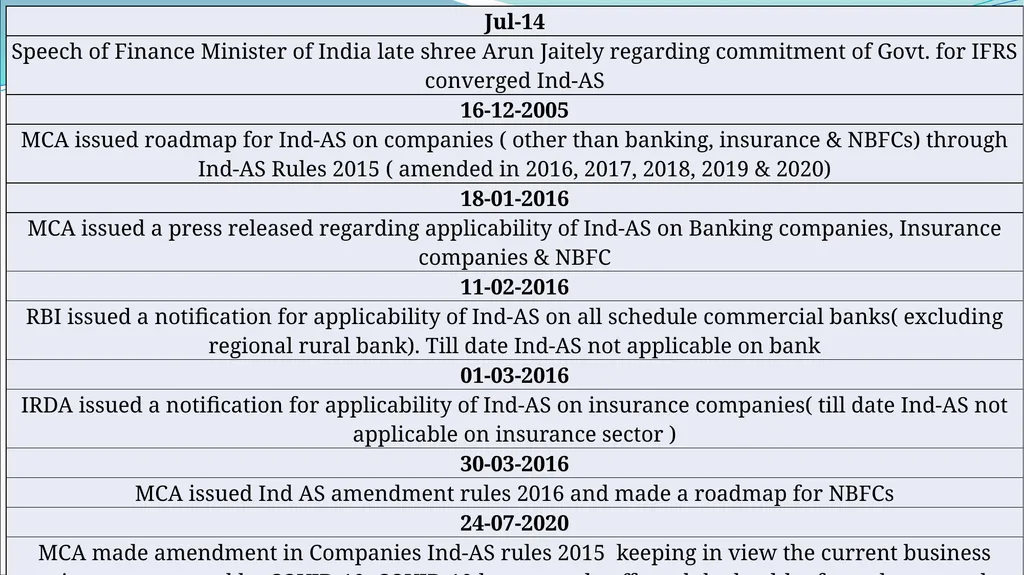
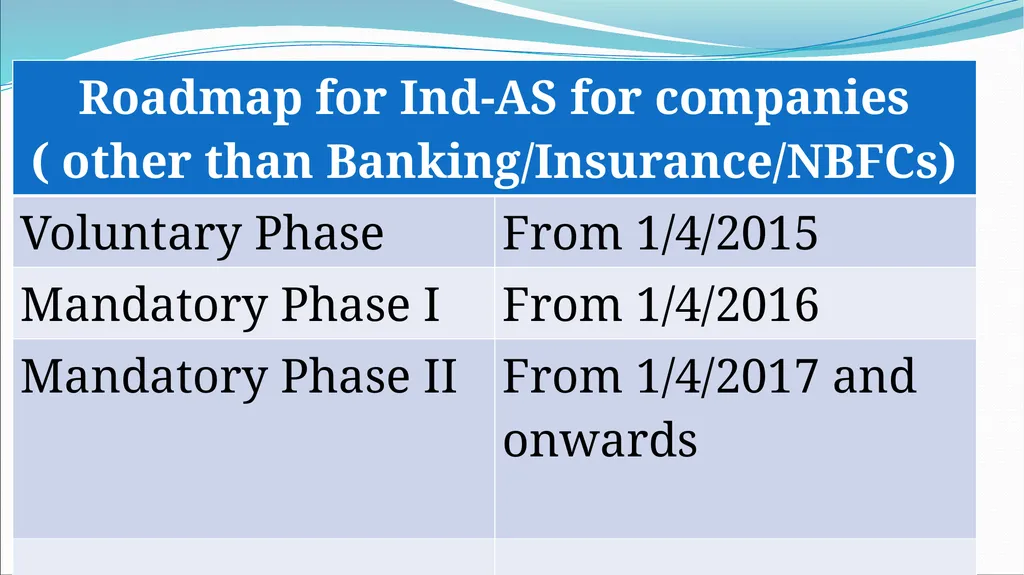
slide7. (2) : Roadmap for Ind-AS<br>
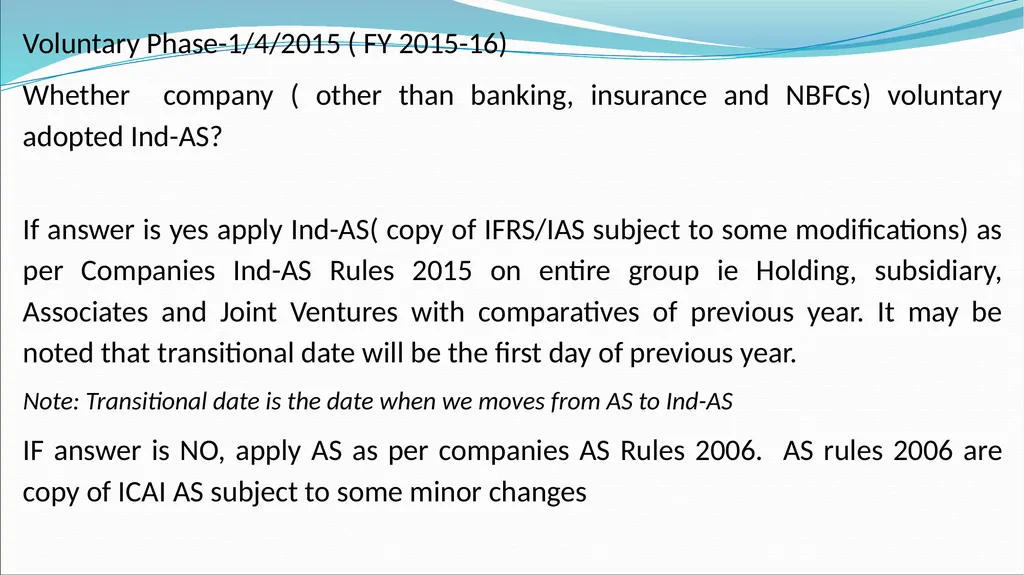
slide10. Voluntary Phase-1/4/2015 ( FY 2015-16)
Whether company ( other than banking, insurance and NBFCs) voluntary adopted Ind-AS?
If answer is yes apply Ind-AS( copy of IFRS/IAS subject to some modifications) as per Companies Ind-AS Rules 2015 on entire group ie Holding, subsidiary, Associates and Joint Ventures with comparatives of previous year. It may be noted that transitional date will be the first day of previous year.
Note: Transitional date is the date when we moves from AS to Ind-AS
IF answer is NO, apply AS as per companies AS Rules 2006. AS rules 2006 are copy of ICAI AS subject to some minor changes<br>
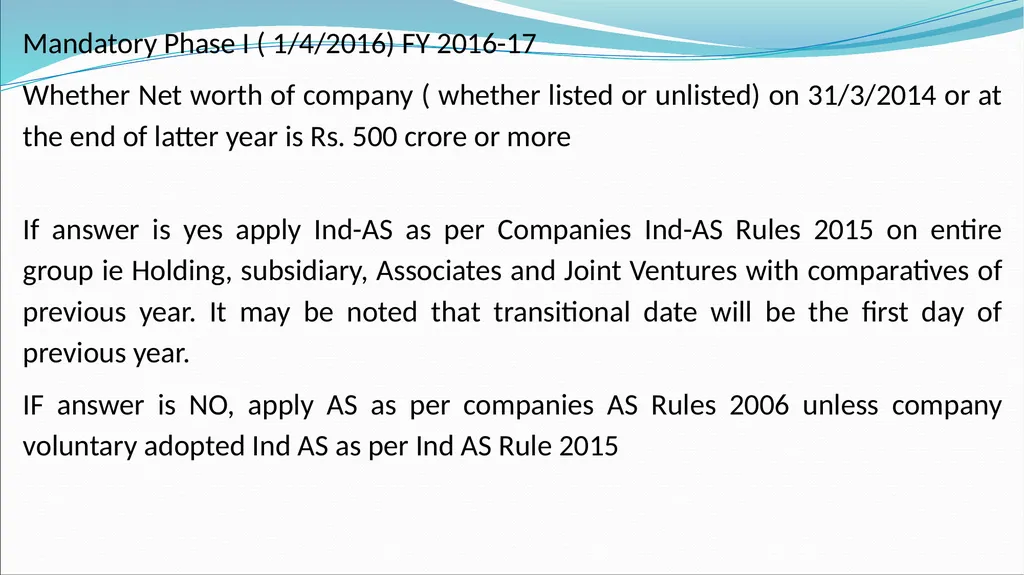
slide11. Mandatory Phase I ( 1/4/2016) FY 2016-17
Whether Net worth of company ( whether listed or unlisted) on 31/3/2014 or at the end of latter year is Rs. 500 crore or more
If answer is yes apply Ind-AS as per Companies Ind-AS Rules 2015 on entire group ie Holding, subsidiary, Associates and Joint Ventures with comparatives of previous year. It may be noted that transitional date will be the first day of previous year.
IF answer is NO, apply AS as per companies AS Rules 2006 unless company voluntary adopted Ind AS as per Ind AS Rule 2015<br>
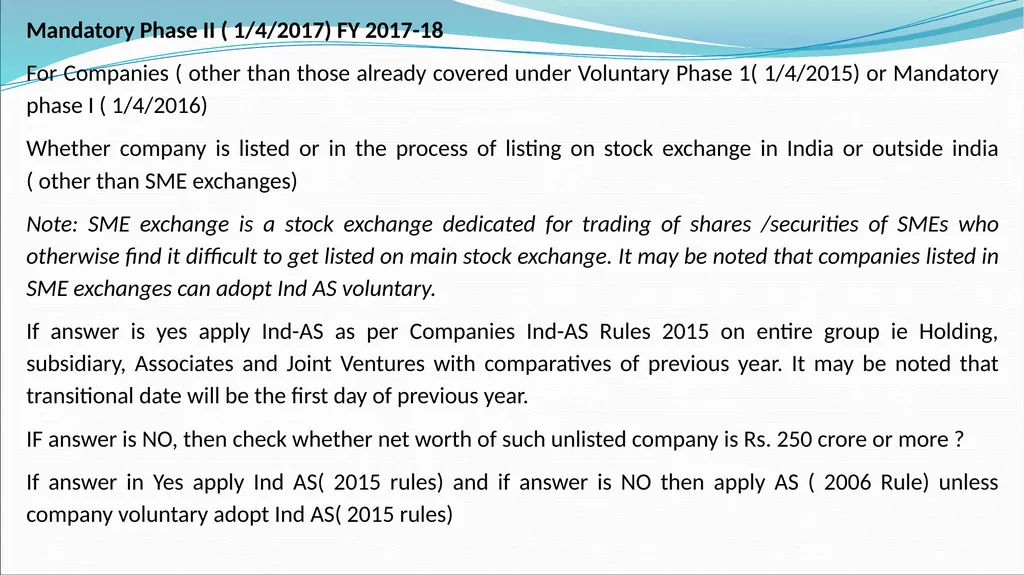
slide12. Mandatory Phase II ( 1/4/2017) FY 2017-18
For Companies ( other than those already covered under Voluntary Phase 1( 1/4/2015) or Mandatory phase I ( 1/4/2016)
Whether company is listed or in the process of listing on stock exchange in India or outside india ( other than SME exchanges)
Note: SME exchange is a stock exchange dedicated for trading of shares /securities of SMEs who otherwise find it difficult to get listed on main stock exchange. It may be noted that companies listed in SME exchanges can adopt Ind AS voluntary.
If answer is yes apply Ind-AS as per Companies Ind-AS Rules 2015 on entire group ie Holding, subsidiary, Associates and Joint Ventures with comparatives of previous year. It may be noted that transitional date will be the first day of previous year.
IF answer is NO, then check whether net worth of such unlisted company is Rs. 250 crore or more ?
If answer in Yes apply Ind AS( 2015 rules) and if answer is NO then apply AS ( 2006 Rule) unless company voluntary adopt Ind AS( 2015 rules)<br>
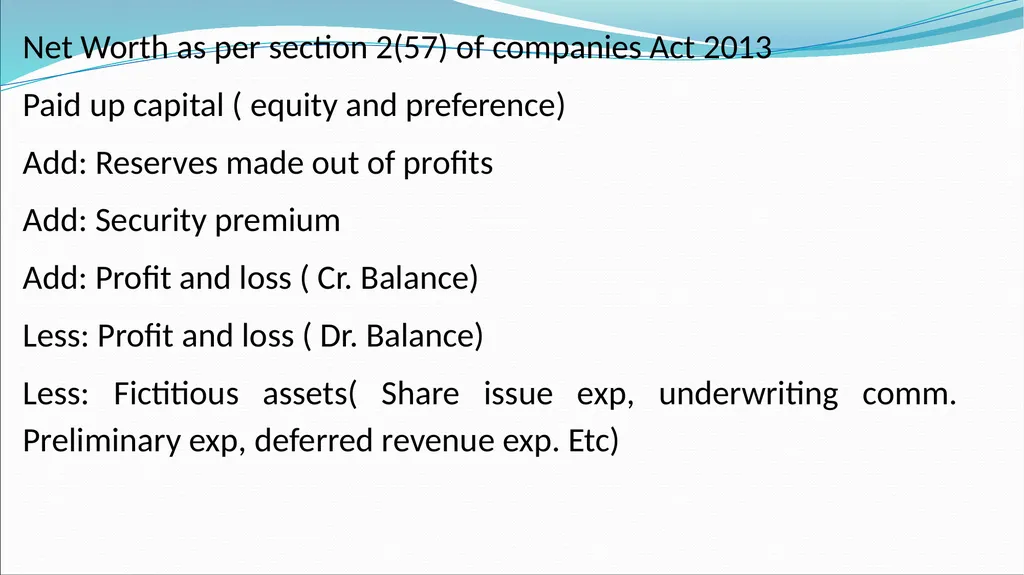
slide13. Net Worth as per section 2(57) of companies Act 2013
Paid up capital ( equity and preference)
Add: Reserves made out of profits
Add: Security premium
Add: Profit and loss ( Cr. Balance)
Less: Profit and loss ( Dr. Balance)
Less: Fictitious assets( Share issue exp, underwriting comm. Preliminary exp, deferred revenue exp. Etc)<br>
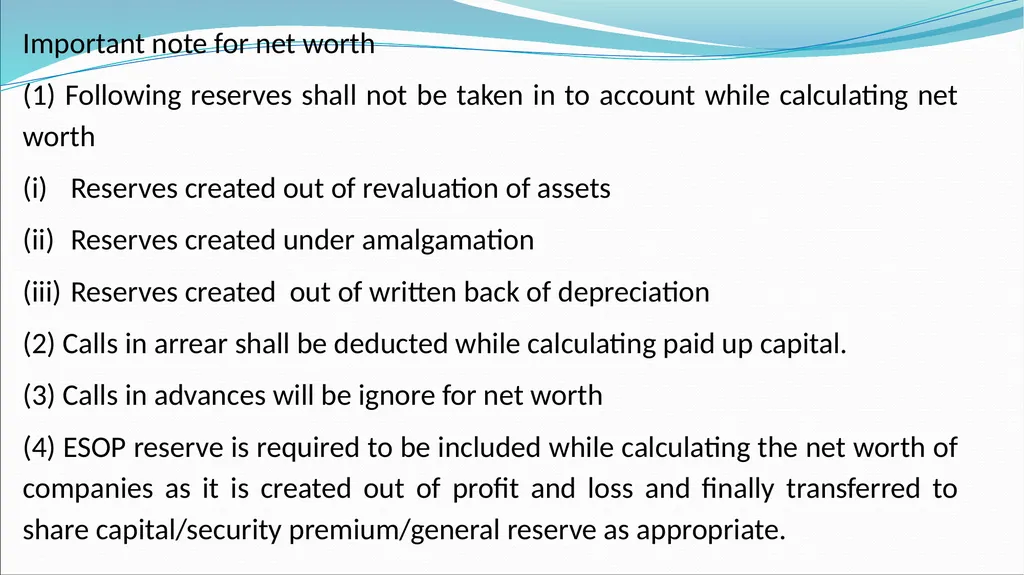
slide14. Important note for net worth
(1) Following reserves shall not be taken in to account while calculating net worth
Reserves created out of revaluation of assets
Reserves created under amalgamation
Reserves created out of written back of depreciation
(2) Calls in arrear shall be deducted while calculating paid up capital.
(3) Calls in advances will be ignore for net worth
(4) ESOP reserve is required to be included while calculating the net worth of companies as it is created out of profit and loss and finally transferred to share capital/security premium/general reserve as appropriate.<br>
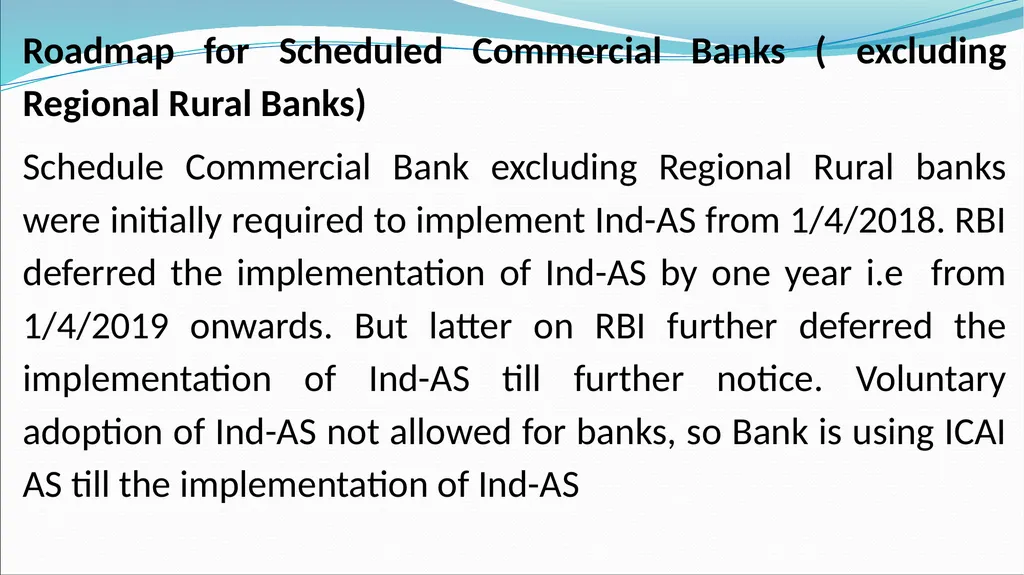
slide16. Roadmap for Scheduled Commercial Banks ( excluding Regional Rural Banks)
Schedule Commercial Bank excluding Regional Rural banks were initially required to implement Ind-AS from 1/4/2018. RBI deferred the implementation of Ind-AS by one year i.e from 1/4/2019 onwards. But latter on RBI further deferred the implementation of Ind-AS till further notice. Voluntary adoption of Ind-AS not allowed for banks, so Bank is using ICAI AS till the implementation of Ind-AS<br>
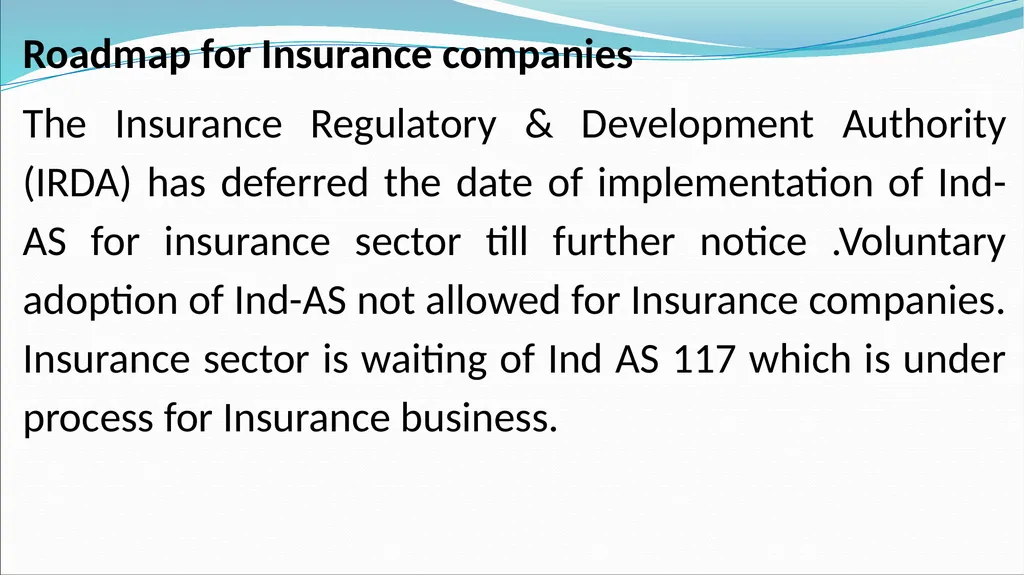
slide17. Roadmap for Insurance companies
The Insurance Regulatory & Development Authority (IRDA) has deferred the date of implementation of Ind-AS for insurance sector till further notice .Voluntary adoption of Ind-AS not allowed for Insurance companies. Insurance sector is waiting of Ind AS 117 which is under process for Insurance business.<br>
slide22. Ind AS 1: Presentation of Financial Statements<br>
slide23. Topic no 1: COMPLETE SET OF FINANCIAL STATEMENTS
A complete set of financial statements comprises:
(i) a balance sheet as at the end of the period;
(ii) a statement of profit and loss for the period;
(iii) statement of changes in equity for the period;
(iv) a statement of cash flows for the period;
(iv) notes, comprising significant accounting policies and other explanatory information;
(vi) comparative information in respect of the preceding period;
(vii) a balance sheet as at the beginning of the preceding period when an entity applies an accounting policy retrospectively or makes a retrospective restatements of items in its financial statements, or when it reclassifies items in its financial statements.<br>
slide24. Topic no 1: COMPLETE SET OF FINANCIAL STATEMENTS
Important note:
An entity shall present a single statement of profit and loss, with profit or loss and other comprehensive income presented in two sections. The sections shall be presented together, with the profit or loss section presented first followed directly by the other comprehensive income section.<br>
slide25. Important note
An entity shall present, as a minimum:
2 Balance Sheets
2 Statement of Profit and Loss
2 Statement of Cash Flows
2 Statement of Changes in Equity and Related Notes.<br>
slide26. Carve Out
As per IFRS/IAS
IAS 1 requires that in case of a loan liability, if any condition of the loan agreement which was classified as non -current is breached on or before the reporting date, such loan liability should be classified as current, even if the breach is rectified after the balance sheet date.<br>
slide27. Carve Out
Para 74 of Ind AS 1: Presentation of Financial Statements clarifies that where there is a breach of a material provision of a long-term loan arrangement on or before the end of the reporting period with the effect that the liability becomes payable on demand on the reporting date, the entity does not classify the liability as current, if the lender agreed, after the reporting period and before the approval of the financial statements for issue, not to demand payment as a consequence of the breach.
Para 75 of Ind AS 1: Presentation of Financial statements further clarifies that an entity classifies the liability as non current if the lender agreed by the end of reporting period to provide a period of grace ending at least twelve months after the reporting date , with in which the entity can rectify the breach and during which the lender cannot demand immediate repayment.<br>
slide28. Para 3 of Ind AS 10: Event after the reporting period are those events , favourable and unfavourable , that occur between the end of the reporting period and the date when the financial statements are approved by the Board of Director in case of company. Two types of events can be identified :
( i) Those that providing evidence of the conditions that existed at the end of reporting period ( adjusting events)
(ii) Those that are indicative of conditions that arose after the reporting period ( non adjusting events)
Notwithstanding anything contained above, where there is a breach of a material provisions of a long term loan arrangement on or before the end of the reporting period with the effect that the liability becomes payable on demand on the reporting date, the agreement by lender before the approval of the financial statements, to not demand payment as a consequences of the breach , shall be considered as adjusting events<br>
slide29. Reason
Under Indian banking system, a long-term loan agreement generally contains a large number of conditions. Some of these conditions are substantive, such as, recalling the loan in case interest is not paid, and some conditions are procedural and not substantive, such as, submission of insurance details where the entity has taken the insurance but not submitted the details to the lender at the end of the reporting period. Generally, customer-banker relationships are developed whereby in case of any procedural breach, a loan is generally not recalled. Also, in many cases, a breach is rectified after the balance sheet date and before the approval of financial statements. Carve out has been made as it is felt that if the breach is rectified after the balance sheet date and before the approval of the financial statements, it would be appropriate that the users are informed about the true nature of liabilities being non-current liabilities and not current liabilities.<br>
slide30. General features of financial statements
Presentation of true and fair view and compliance with Ind AS
Going concern
Accrual base of accounting
Materiality & Aggregation
Offsetting( as permitted by other Ind AS eg DTA and DTL)
Frequency of reporting( at least annually)
Comparative information
Consistency of presentation<br>
slide31. MCQ Ind AS 1
Q 1: As per Ind AS 1, a complete set of financial statements do not comprise:
Balance sheet
Statement of change in equity
Notes and other explanatory information
Director’s report.<br>
slide32. MCQ Ind AS 1
Q 2: An entity whose financial statement comply with Ind AS shall make an ……….. Statement of such compliance in the notes
Explicit and reserved
Implicit and unreserved
Explicit and unreserved.
Implicit and reserved<br>
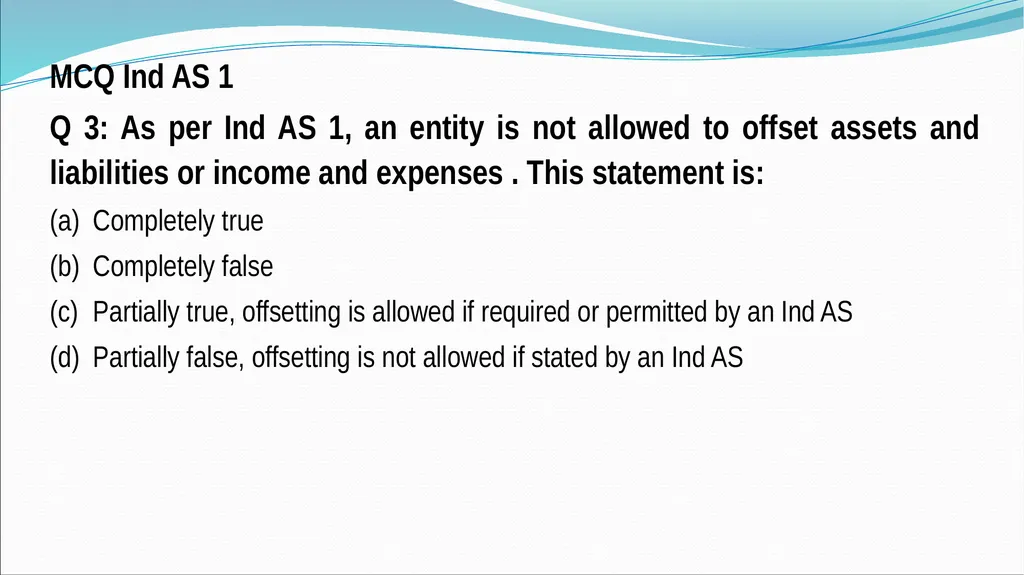
slide33. MCQ Ind AS 1
Q 3: As per Ind AS 1, an entity is not allowed to offset assets and liabilities or income and expenses . This statement is:
Completely true
Completely false
Partially true, offsetting is allowed if required or permitted by an Ind AS
Partially false, offsetting is not allowed if stated by an Ind AS<br>
slide34. Ind AS 2: Inventories<br>
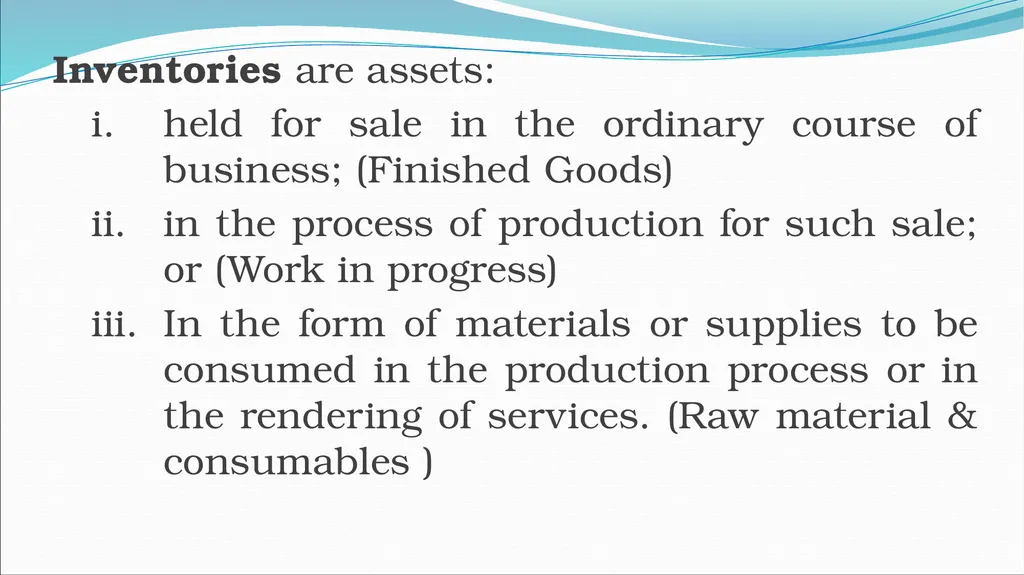
slide35. Inventories are assets:
held for sale in the ordinary course of business; (Finished Goods)
in the process of production for such sale; or (Work in progress)
In the form of materials or supplies to be consumed in the production process or in the rendering of services. (Raw material & consumables )<br>
slide36. Measurement of Inventories
Inventories shall be measured at the lower of COST & NET REALISABLE VALUE(NRV)<br>
slide37. A. Cost of Inventories
Cost of Inventories comprises:
all costs of purchase;
costs of conversion; and
Other cost incurred in bringing the inventories to their present location & condition<br>
slide38. (i) Cost of purchase
The costs of purchase of inventories include:
the purchase price( net of trade discount & Rebates),
import duties and other taxes (non refundable),
transport, freight , carriage, cartage, handling cost, loading, unloading, transit insurance and
other costs directly attributable to the acquisition of finished goods, materials and services.<br>
slide39. (ii) Special case when inventory is acquired in deferred payment basis:
An entity may acquire inventories on deferred settlement terms. When the arrangement effectively contains a financing element, that element, for example a difference between the purchase prices for normal credit terms and the amount paid, is recognized as interest expense over the period of financing<br>
slide40. Q 1: Which of the following cost is excluded from cost of inventory as per Ind AS 2
Sales commission.
Direct labour cost
Factory rent and utilities
Factory overheads based on normal capacity.<br>
slide41. Q 2: Allocation of fixed production overheads to the cost of conversion of items of inventory should be based on ……… production cacapity
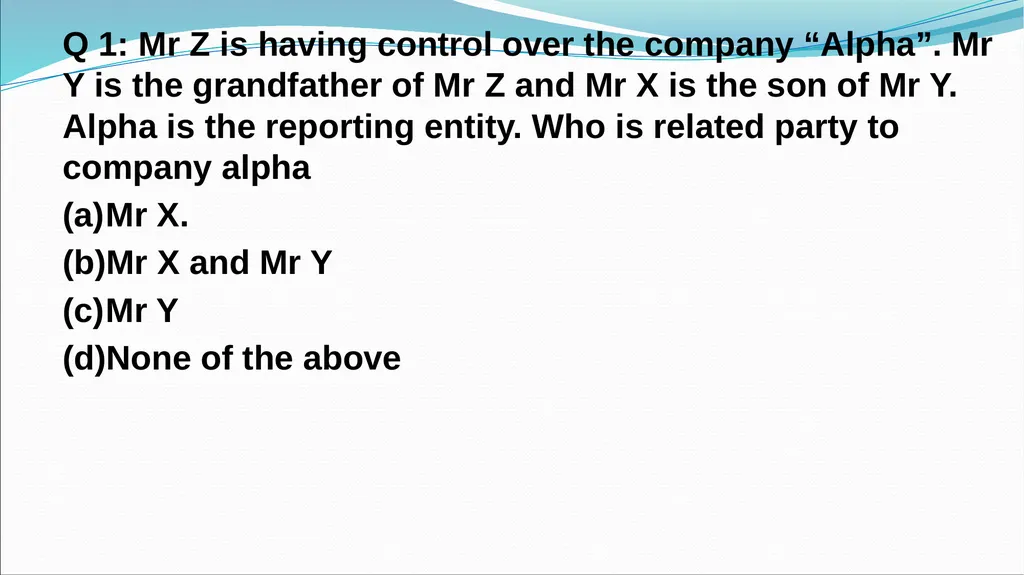
Actual
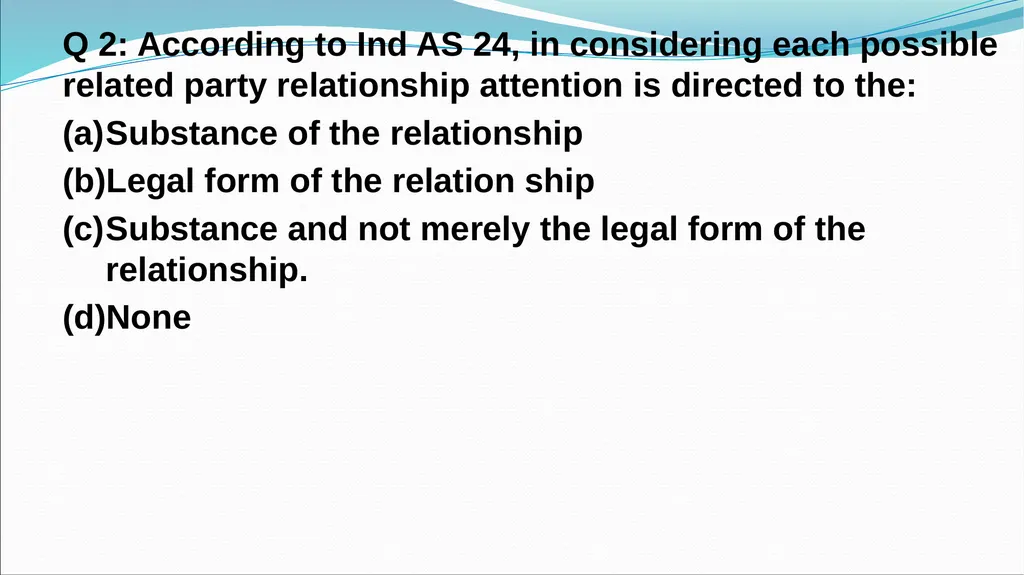
Normal.
Abnormal
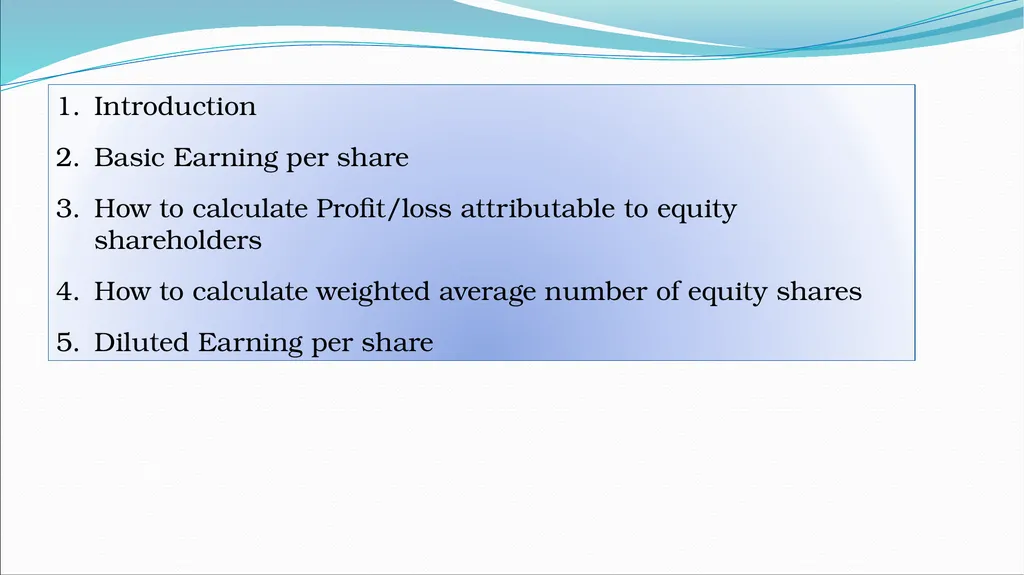
estimated<br>
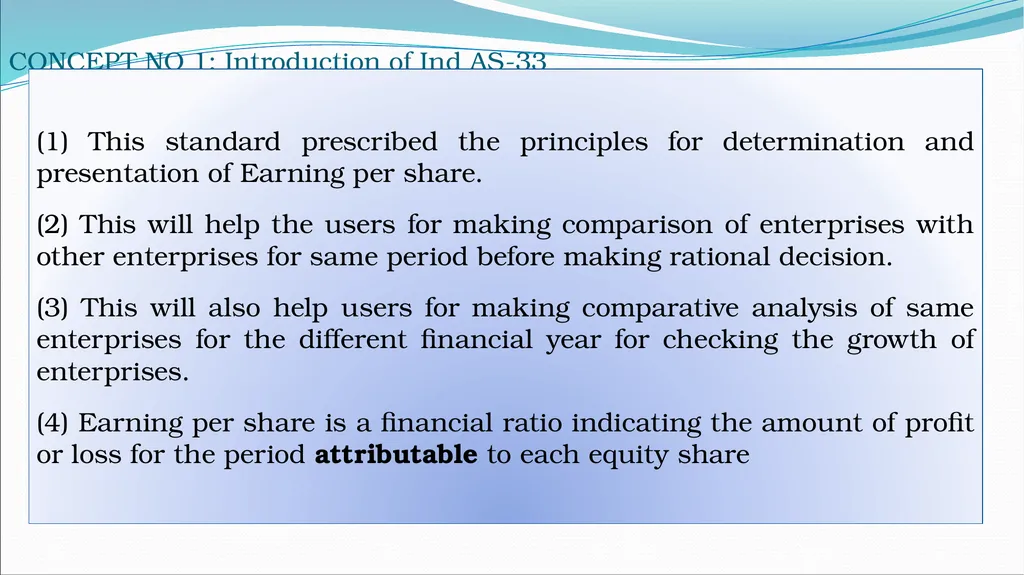
slide42. Q 3: Which of the following cost formula is not allowed under Ind AS 2
FIFO
LIFO.
Weighted average
Special identification method<br>
slide43. Ind AS 7: Statement of Cash flow<br>
slide44. Introduction of Ind AS 7
Balance sheet show the financial position at particular date. Accrual concept is being followed while preparing balance sheet of entity.
Statement of profit and loss show the performance of entity during the reporting period. It is also prepared as per accrual concept of accounting.
The statement of cash flows includes only inflows and outflows of cash and cash equivalents; it excludes transactions that do not affect cash receipts and payments.The information on cash flows is useful in assessing sources of generating and deploying cash and cash equivalents during the reporting period. The statement of cash flows can be used for comparison with earlier reporting periods of the same entity as well as comparison with other entities for the same reporting period.
Ind AS 7, Statement of Cash Flows, prescribes principles and guidance on preparation and presentation of cash flows of an entity from operating activities, investing activities an d financing activities for a reporting period.
An entity shall prepare a statement of cash flows in accordance with the requirements of this Standard and shall present it as an integral part of its financial statements for each period for which financial statements are presented.<br>
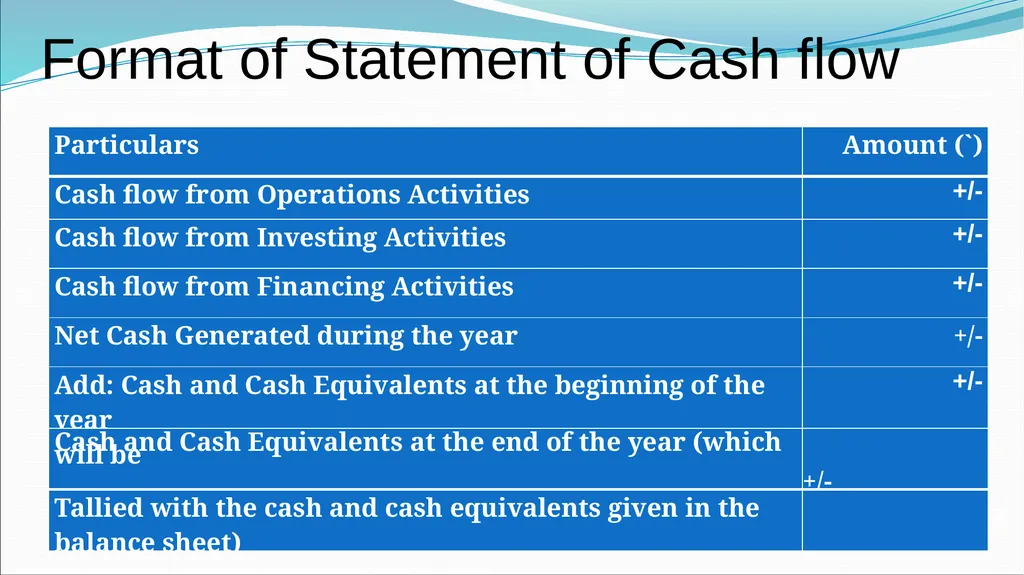
slide45. Format of Statement of Cash flow<br>
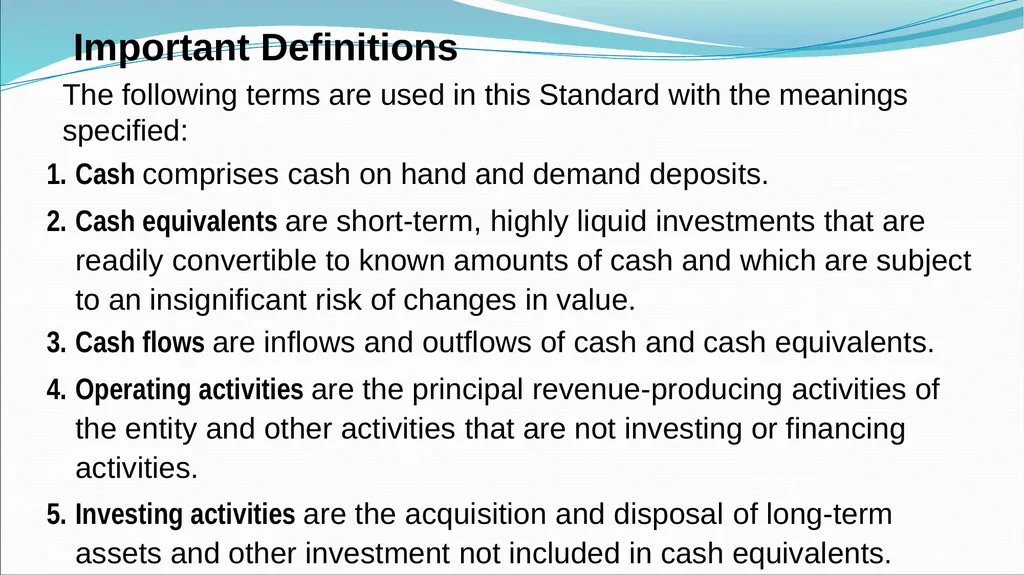
slide46. Important Definitions
The following terms are used in this Standard with the meanings specified:
Cash comprises cash on hand and demand deposits.
Cash equivalents are short-term, highly liquid investments that are readily convertible to known amounts of cash and which are subject to an insignificant risk of changes in value.
Cash flows are inflows and outflows of cash and cash equivalents.
Operating activities are the principal revenue-producing activities of the entity and other activities that are not investing or financing activities.
Investing activities are the acquisition and disposal of long-term assets and other investment not included in cash equivalents.<br>
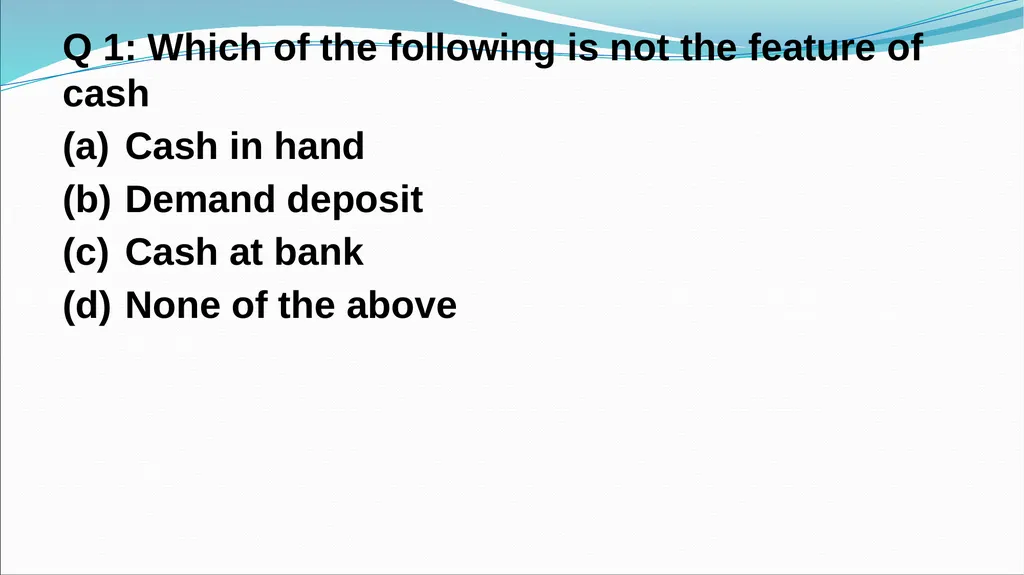
slide47. Q 1: Which of the following is not the feature of cash
Cash in hand
Demand deposit
Cash at bank
None of the above<br>
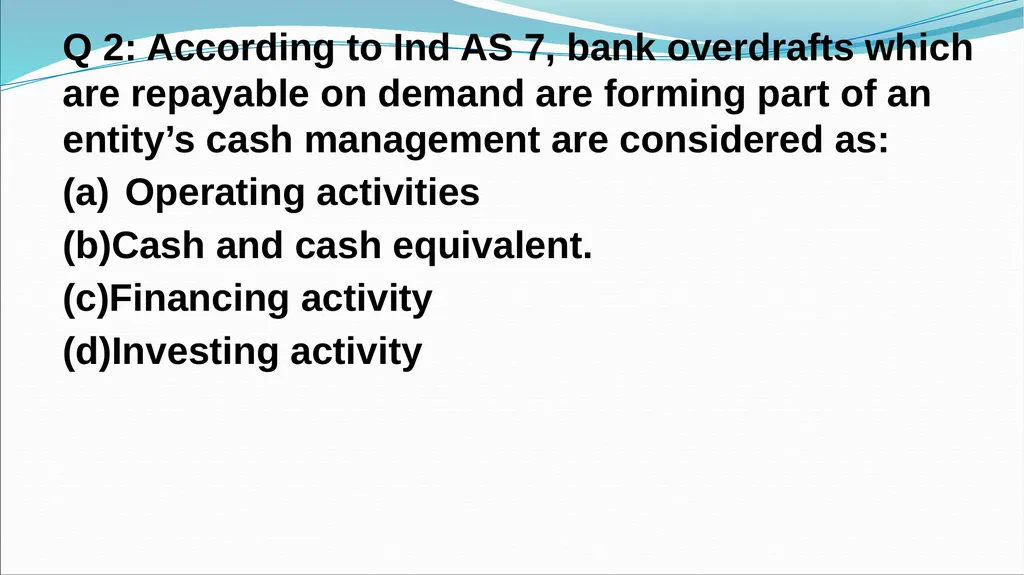
slide48. Q 2: According to Ind AS 7, bank overdrafts which are repayable on demand are forming part of an entity’s cash management are considered as:
Operating activities
Cash and cash equivalent.
Financing activity
Investing activity<br>
slide49. Q 3: The accountant of the company has classified separately the cash flow from extraordinary items as arising from operating, investing and financing activities which preparing the statement of cash flow. He is of the view that this is acceptable treatment under Ind AS 7
True
False.<br>
slide50. Ind AS 8: Accounting Policies, Changes in Account estimates & Errors<br>
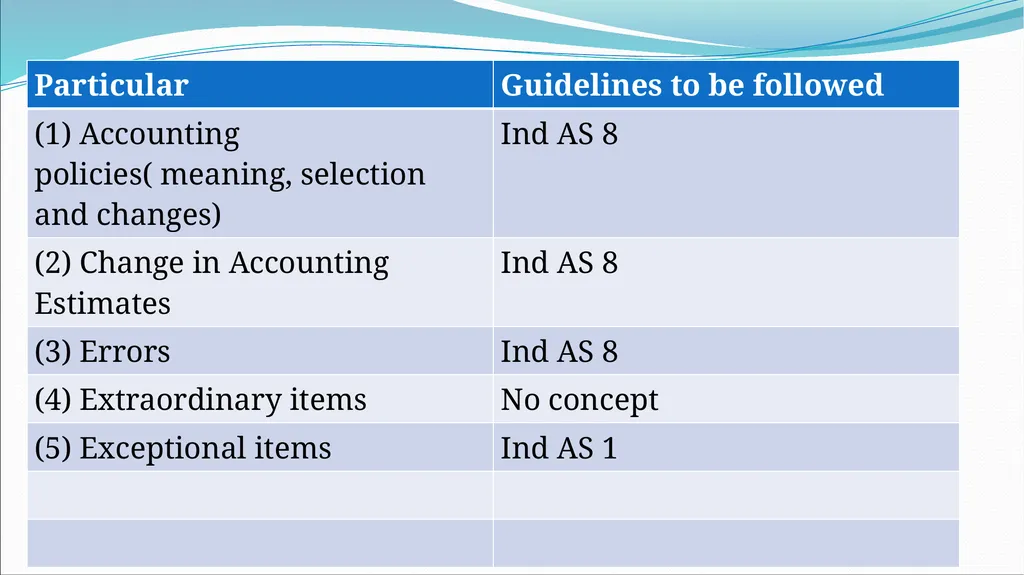
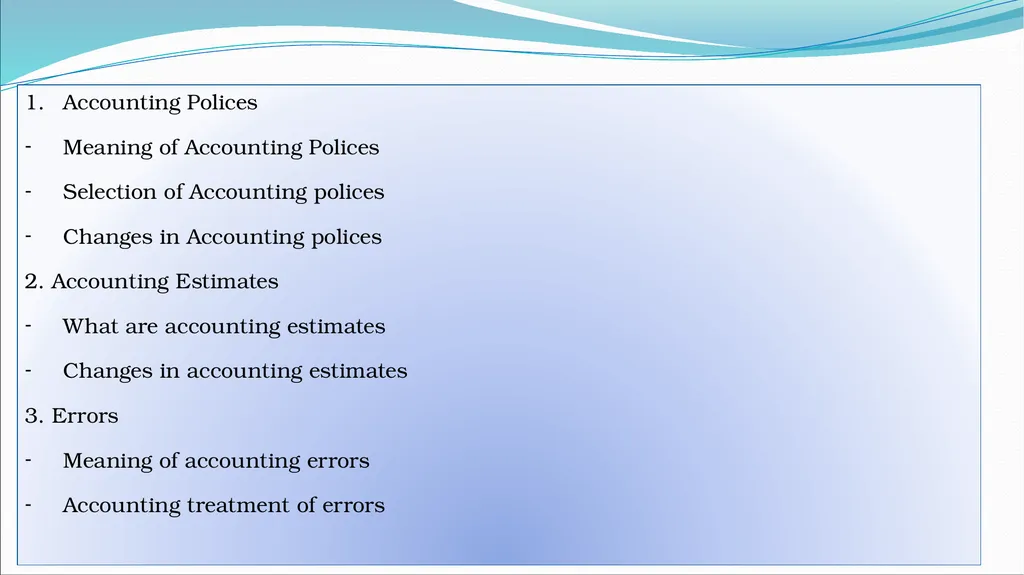
slide52. CONCEPTS Accounting Polices
Meaning of Accounting Polices
Selection of Accounting polices
Changes in Accounting polices
2. Accounting Estimates
What are accounting estimates
Changes in accounting estimates
3. Errors
Meaning of accounting errors
Accounting treatment of errors<br>
slide53. CONCEPT no 1: Accounting policies Accounting Polices
Meaning of Accounting Polices
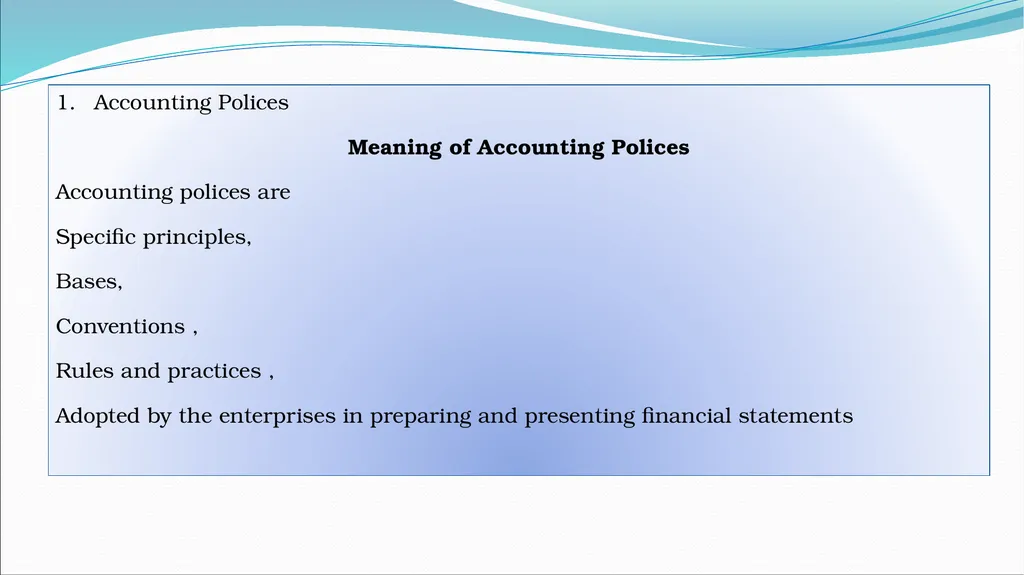
Accounting polices are
Specific principles,
Bases,
Conventions ,
Rules and practices ,
Adopted by the enterprises in preparing and presenting financial statements<br>
slide54. CONCEPT no 1: Accounting polices Accounting Polices
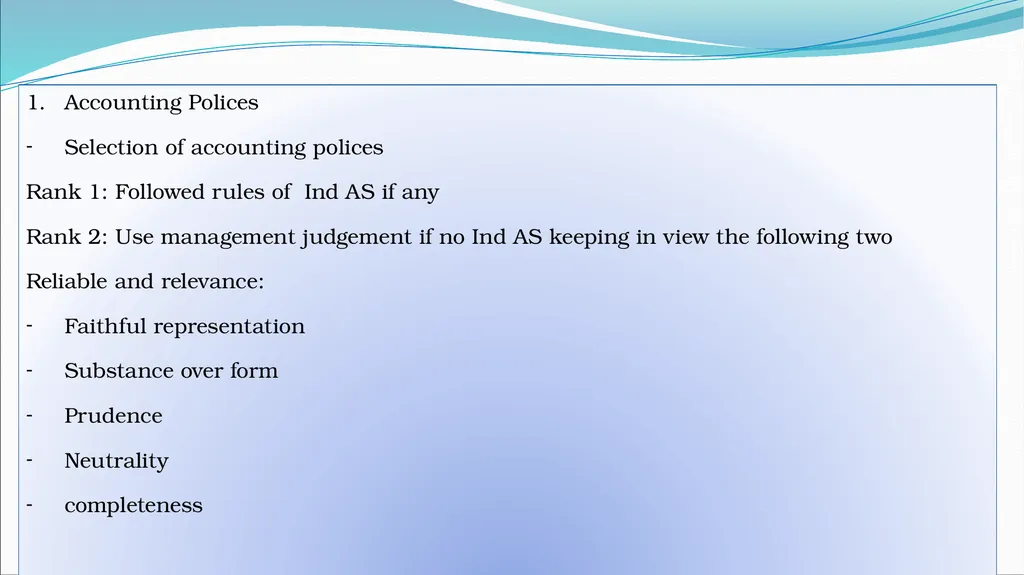
Selection of accounting polices
Rank 1: Followed rules of Ind AS if any
Rank 2: Use management judgement if no Ind AS keeping in view the following two
Reliable and relevance:
Faithful representation
Substance over form
Prudence
Neutrality
completeness<br>
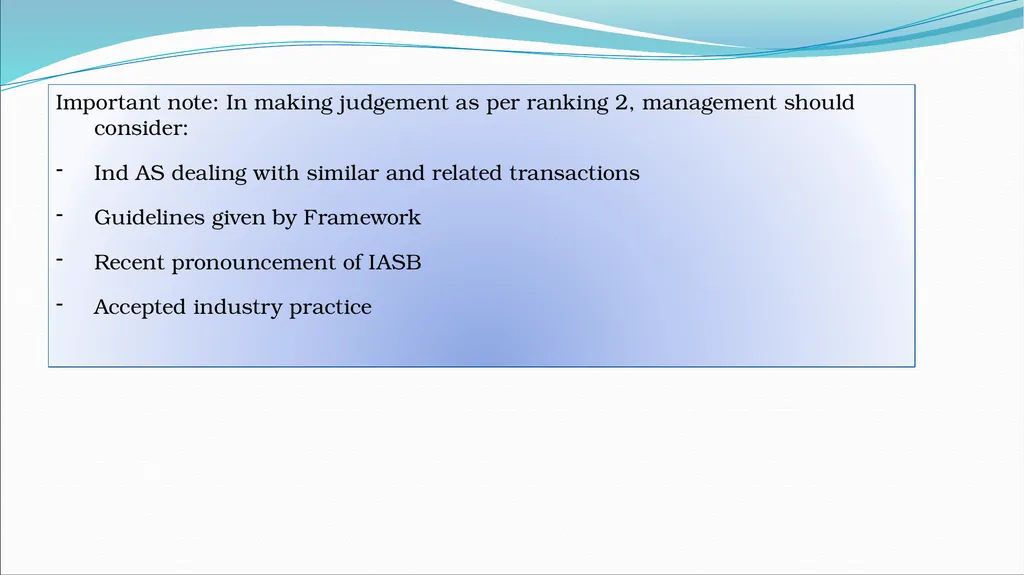
slide55. CONCEPT no 1: Accounting polices Important note: In making judgement as per ranking 2, management should consider:
Ind AS dealing with similar and related transactions
Guidelines given by Framework
Recent pronouncement of IASB
Accepted industry practice<br>
slide56. CONCEPT no 1: Accounting polices Change in Accounting policy
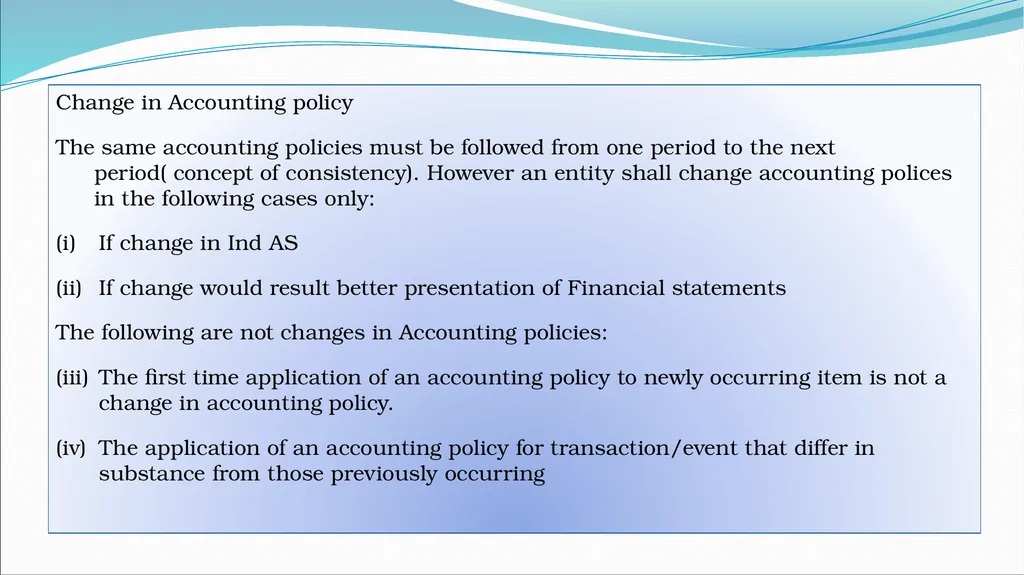
The same accounting policies must be followed from one period to the next period( concept of consistency). However an entity shall change accounting polices in the following cases only:
If change in Ind AS
If change would result better presentation of Financial statements
The following are not changes in Accounting policies:
The first time application of an accounting policy to newly occurring item is not a change in accounting policy.
The application of an accounting policy for transaction/event that differ in substance from those previously occurring<br>
slide57. Concept 2: Accounting Estimates Meaning of Accounting Estimates
Some times some components of financial statement cannot be measured with precision and can only be estimated eg provision for doubtful debt, provision for warranty cost, provisions for loss, useful life of asset, scrap value, useful life of asset etc. Accounting estimates are based on the latest available information. The use of reasonable estimates is an essential part of the preparation of financial statements and does not undermine their reliability.
Change in Accounting Estimates
Accounting estimates are revised/change as a result of new information or new development or new experience or change in circumstances on which estimate was based.
Effects of change in accounting estimates
A change in accounting estimates is recognized prospectively ie in the current period<br>
slide58. Concept 2: Accounting Estimates Important notes regarding change in accounting estimates
An estimate may need revision if changes occur in the circumstances on which the estimate was based or as a result of new information or more experience. By its nature, the revision of an estimate does not relate to prior periods and is not the correction of an error.
A change in the measurement basis applied is a change in an accounting policy, and is not a change in an accounting estimate. When it is difficult to distinguish a change in an accounting policy from a change in an accounting estimate, the change is treated as a change in an accounting estimate. It may be noted that change in method of depreciation shall be treated as change in accounting estimates as per Ind AS 16-PPE<br>
slide59. Concept 3: Errors Meaning of Errors
Priors period errors are errors committed in earlier year but discovered in current year. Eg mathematical mistake, misinterpretation of facts, frauds, oversights etc. Definition of Priors period item as prescribed in Ind AS 8 is as under:
Prior period errors are omissions from, and misstatements in, the entity‘s financial statements for one or more prior periods arising from a failure to use, or misuse of, reliable information that:
(a) was available when financial statements for those periods were approved for issue; and
(b) could reasonably be expected to have been obtained and taken into account in the preparation and presentation of those financial statements. Such errors include the effects of mathematical mistakes, mistakes in applying accounting policies, oversights or misinterpretations of facts, and fraud.
Effect of rectification of errors
. Prior period amount are restated as if the error had never occurred. The error and the effect of its correction on financial statement are disclosed.
Limitation of retrospective restatement
When it is impracticable to determine the cummulative effect, at the beginning of current year, the entity shall restate the comparative information to correct the errors prospectively from the earliest date practicable.<br>
slide60. Q 1: While selecting an accounting policy an entity should always review:
Ind AS
Pronouncements of International accounting standards boards
Conceptual framework only
All of the above<br>
slide61. Q 2: Change in the method of depreciation shall be accounted …………….. In accordance with Ind AS 8
As a change in accounting policy
As a change in accounting estimates.
As a correction of error
As per management discretion<br>
slide62. Q 3: As per Ind AS 8, prior period errors shall be corrected:
Prospectively
Retrospectively
Prospectively with disclosure
None of the above<br>
slide63. Ind AS 10: Events after the reporting period<br>
slide64. Events after the reporting period
Events after the reporting period are those events, favourable and unfavourable, that occur between the end of the reporting period and the date when the financial statements are approved by the Board of Directors (in case of a company) and by the corresponding approving authority (in case of any other entity) for issue.<br>
slide65. Type of Events
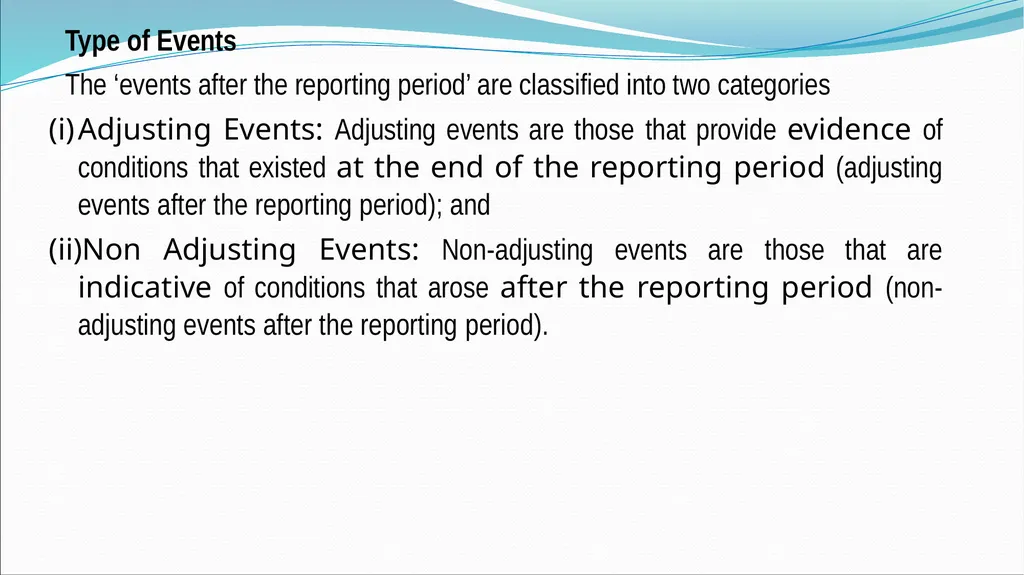
The ‘events after the reporting period’ are classified into two categories
Adjusting Events: Adjusting events are those that provide evidence of conditions that existed at the end of the reporting period (adjusting events after the reporting period); and
Non Adjusting Events: Non-adjusting events are those that are indicative of conditions that arose after the reporting period (non-adjusting events after the reporting period).<br>
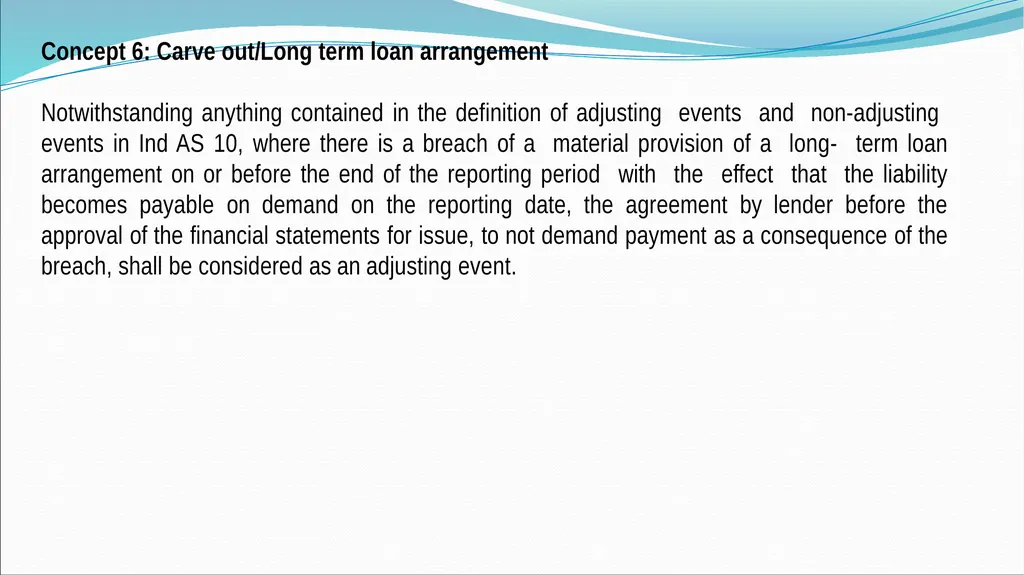
slide66. Concept 6: Carve out/Long term loan arrangement
Notwithstanding anything contained in the definition of adjusting events and non-adjusting events in Ind AS 10, where there is a breach of a material provision of a long- term loan arrangement on or before the end of the reporting period with the effect that the liability becomes payable on demand on the reporting date, the agreement by lender before the approval of the financial statements for issue, to not demand payment as a consequence of the breach, shall be considered as an adjusting event.<br>
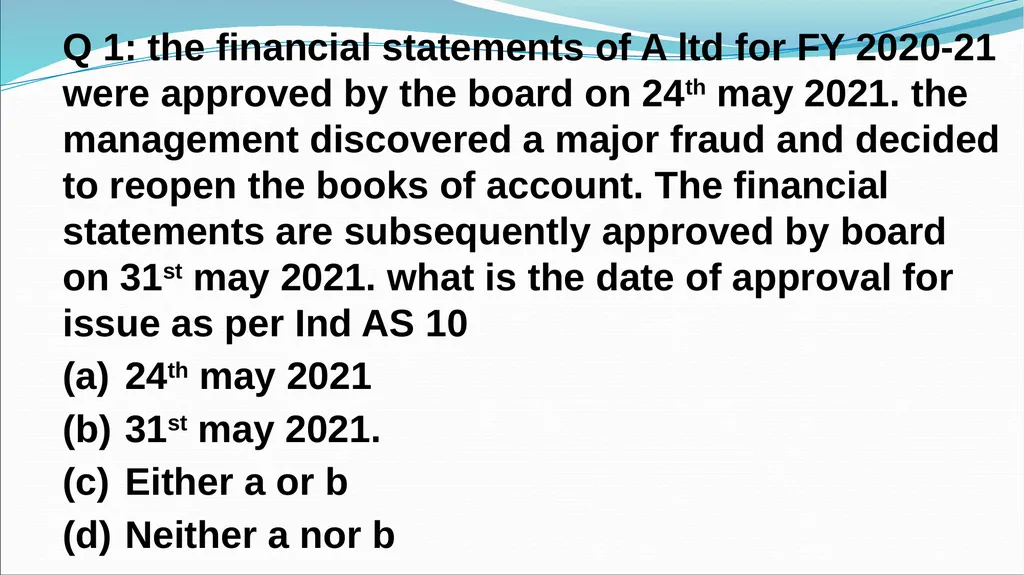
slide67. Q 1: the financial statements of A ltd for FY 2020-21 were approved by the board on 24th may 2021. the management discovered a major fraud and decided to reopen the books of account. The financial statements are subsequently approved by board on 31st may 2021. what is the date of approval for issue as per Ind AS 10
24th may 2021
31st may 2021.
Either a or b
Neither a nor b<br>
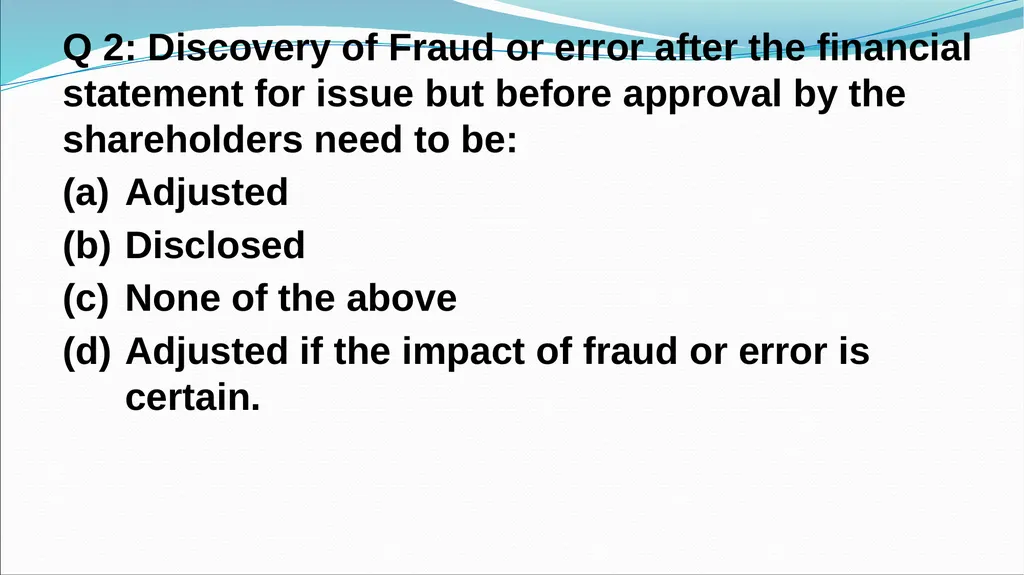
slide68. Q 2: Discovery of Fraud or error after the financial statement for issue but before approval by the shareholders need to be:
Adjusted
Disclosed
None of the above
Adjusted if the impact of fraud or error is certain.<br>
slide69. Ind AS 12: Income Tax<br>
slide70. Topic no 1: Introduction Note on temporary difference: As Ind AS 12 follows the balance sheet approach for the income tax accounting and therefore, it defines the temporary differences with respect to the balance sheet items ie asset or liabilities. These difference occur when the items of revenue or expenses are included in both accounting profit and taxable profit, but not for the same accounting period. For example, interest revenue received in arrear and included in the accounting profit on the basis of accrual say in 2017-18, however it may be included in taxable income in 2018-19 when it was actually received( cash basis) . In the long run the total taxable profit and total accounting profit will be the same except for some exceptions( permanent differences). It is to be noted that in Ind AS 12, there is no term like permanent differences. Temporary difference orginate in one period and are capable of reversal in on or more subsequent periods. Deferred tax is the tax attributable to such temporary differences . If temporary difference are taxable temporary difference generate DTL and if these are deductable temporary differences generate DTA.<br>
slide71. (2) Nine Important Definitions Accounting profit is profit or loss for a period before deducting tax expense( calculated as per Ind AS).
Taxable profit (tax loss) is the profit (loss) for a period, computed as per the income tax act, upon which income taxes are payable (recoverable).
Tax expense (tax income) is the aggregate amount included in the determination of profit or loss for the period in respect of current tax and deferred tax.
Current tax is the amount of income taxes payable (recoverable) in respect of the taxable profit (tax loss) for a period.
Deferred tax liabilities are the amounts of income taxes payable in future periods in respect of taxable temporary differences( AS 22 use word timing difference).
Deferred tax assets are the amounts of income taxes recoverable in future periods in respect of:
deductible temporary differences;
the carry forward of unused tax losses; and
the carry forward of unused tax credits.<br>
slide72. Temporary differences are differences between the carrying amount of an asset or liability in the balance sheet and its tax base.
Temporary differences may be either:
taxable temporary differences, which are temporary differences that will result in taxable amounts in determining taxable profit (tax loss) of future periods when the carrying amount of the asset or liability is recovered or settled; or
deductible temporary differences, which are temporary differences that will result in amounts that are deductible in determining taxable profit (tax loss) of future periods when the carrying amount of the asset or liability is recovered or settled.
ix. The tax base of an asset or liability is the carrying amount to that asset or liability for tax purposes<br>
slide73. Q 1: As per ind as 12, a taxable temporary difference generates
Deferred tax liabilities.
Deferred tax assets
Tax income
Tax expenses<br>
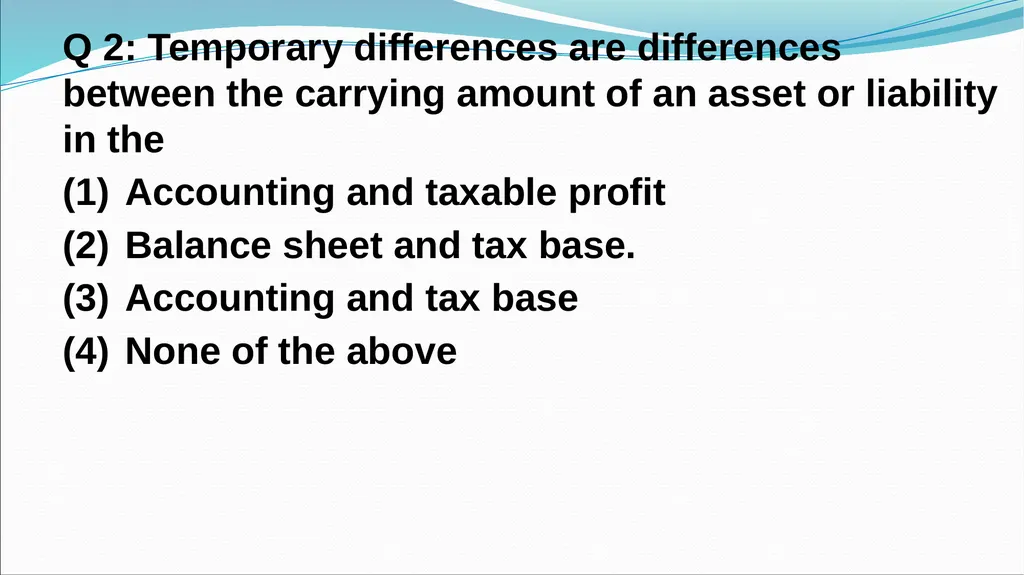
slide74. Q 2: Temporary differences are differences between the carrying amount of an asset or liability in the
Accounting and taxable profit
Balance sheet and tax base.
Accounting and tax base
None of the above<br>
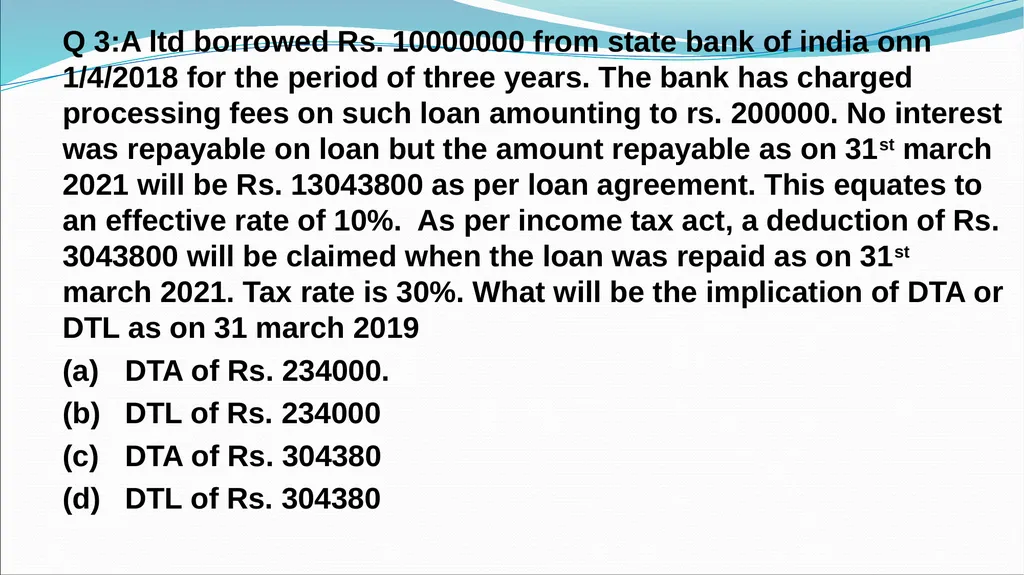
slide75. Q 3:A ltd borrowed Rs. 10000000 from state bank of india onn 1/4/2018 for the period of three years. The bank has charged processing fees on such loan amounting to rs. 200000. No interest was repayable on loan but the amount repayable as on 31st march 2021 will be Rs. 13043800 as per loan agreement. This equates to an effective rate of 10%. As per income tax act, a deduction of Rs. 3043800 will be claimed when the loan was repaid as on 31st march 2021. Tax rate is 30%. What will be the implication of DTA or DTL as on 31 march 2019
DTA of Rs. 234000.
DTL of Rs. 234000
DTA of Rs. 304380
DTL of Rs. 304380<br>
slide76. Ind AS 16-Property, Plant & Equipments<br>
slide77. Definition of PPE
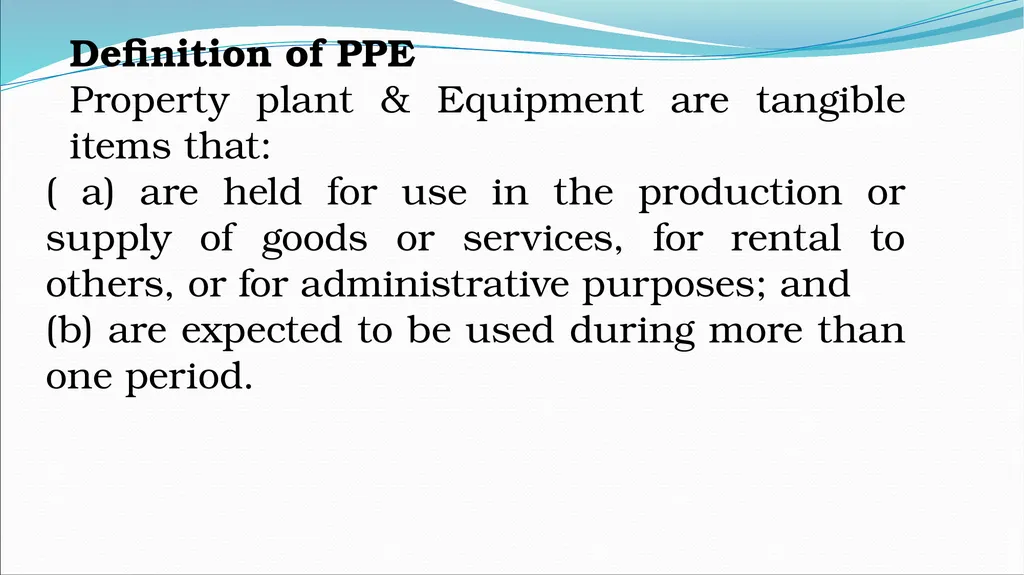
Property plant & Equipment are tangible items that:
( a) are held for use in the production or supply of goods or services, for rental to others, or for administrative purposes; and
(b) are expected to be used during more than one period.<br>
slide78. General Recognition criteria
The cost of an item of property, plant and equipment shall be recognised as an asset if, and only if:
(i) it is probable that future economic benefits associated with the item will flow to the entity; and
(ii) The cost of the item can be measured reliably.<br>
slide79. Conclusion:
If four conditions satisfied then the asset will be treated PPE
Tangible asset
Held for use in production, services, administrative purpose, distribution purpose, rental purpose ( DURING MORE THAN ONE PERIOD)
Future economic benefit are expected to flow to the enterprises
Cost can be measured reliably<br>
slide80. Important note regarding definition of PPE and Recognition criteria
(i) Applicability of Different Ind AS on building
Building held for use in production
Building held for use in administration
Building held for use for selling department/Marketing agents
Building held for use in providing services
Building held for sale
Building held for rental income
Building held for capital appreciation
Building originally held for use/rental purpose but now held for sale<br>
slide81. Recognition of spare parts, stand by equipments( kept in hand to ensure smooth running of activities) & Servicing equipments
Items such as spare parts, stand-by equipment and servicing equipment are recognised in accordance with this Ind AS when they meet the definition of property, plant and equipment. Otherwise, such items are classified as inventory.<br>
slide82. Out of scope
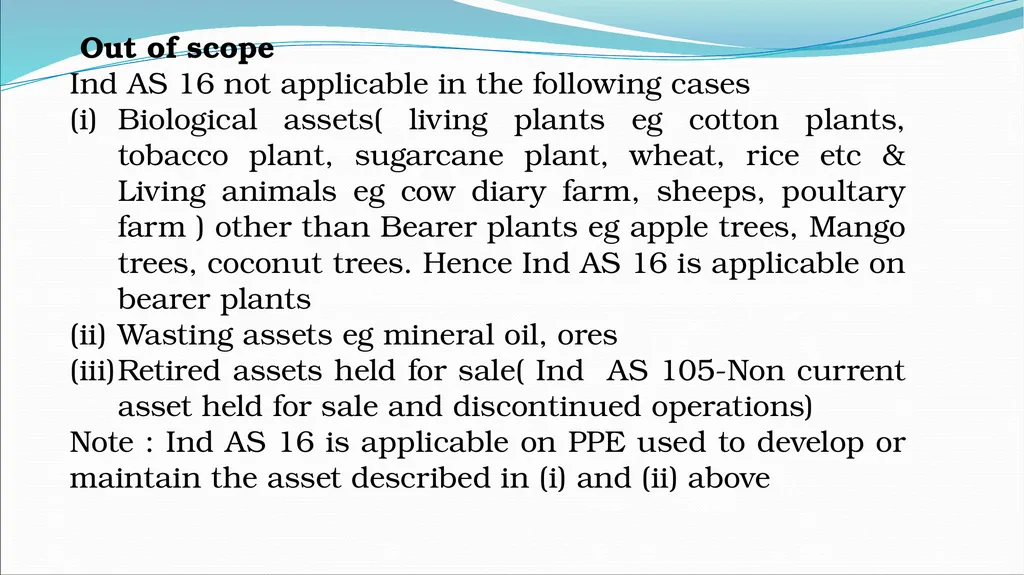
Ind AS 16 not applicable in the following cases
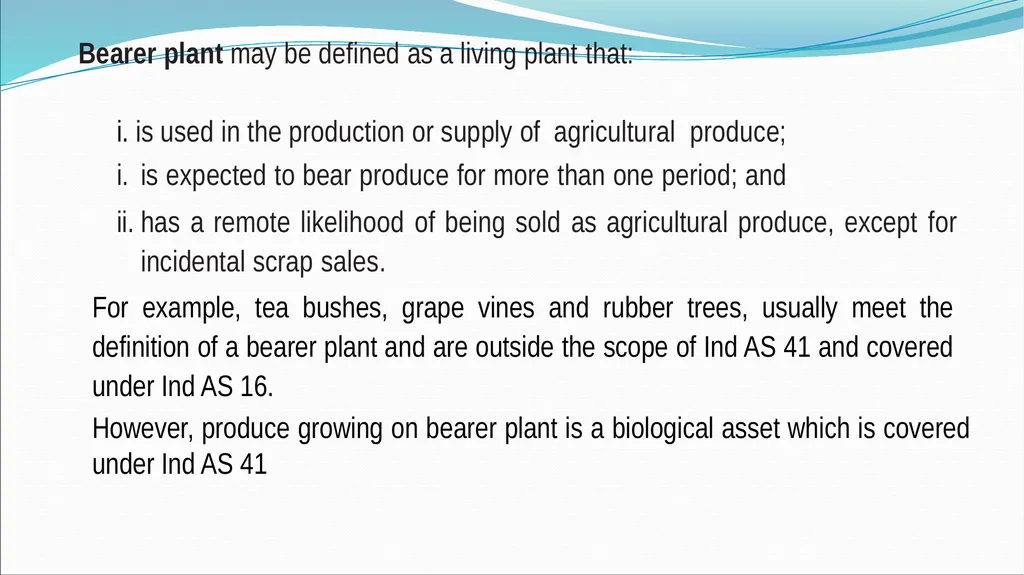
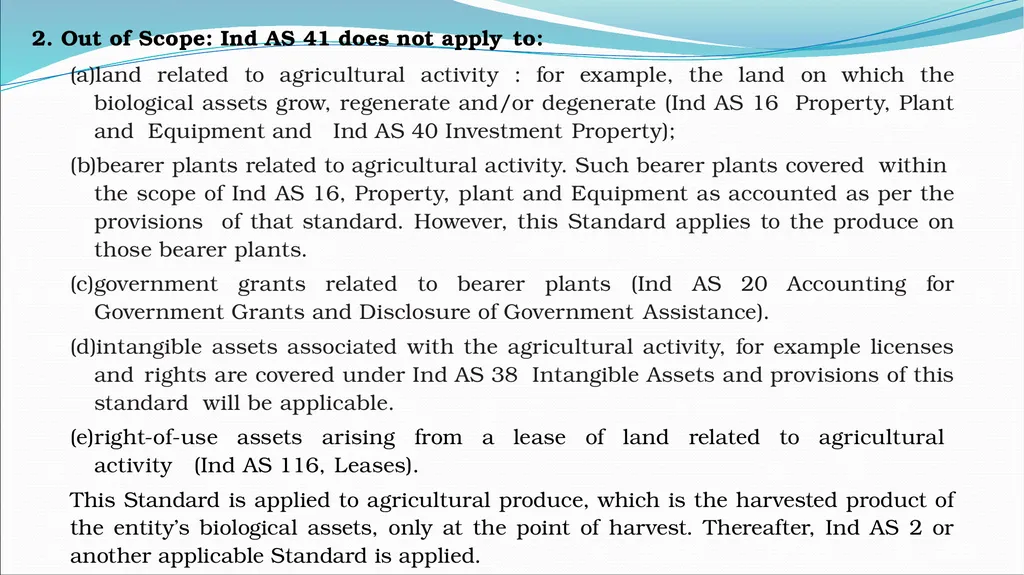
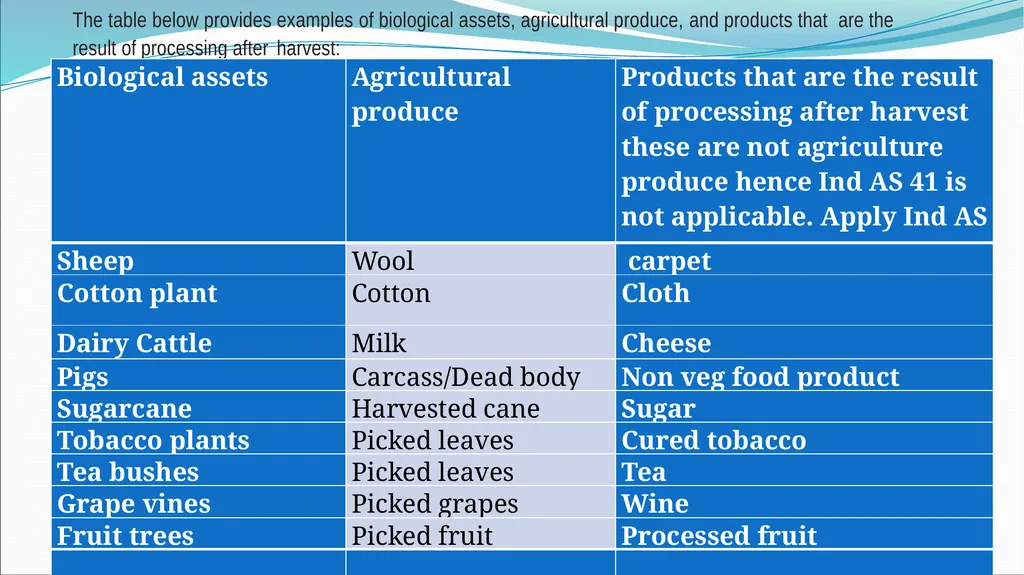
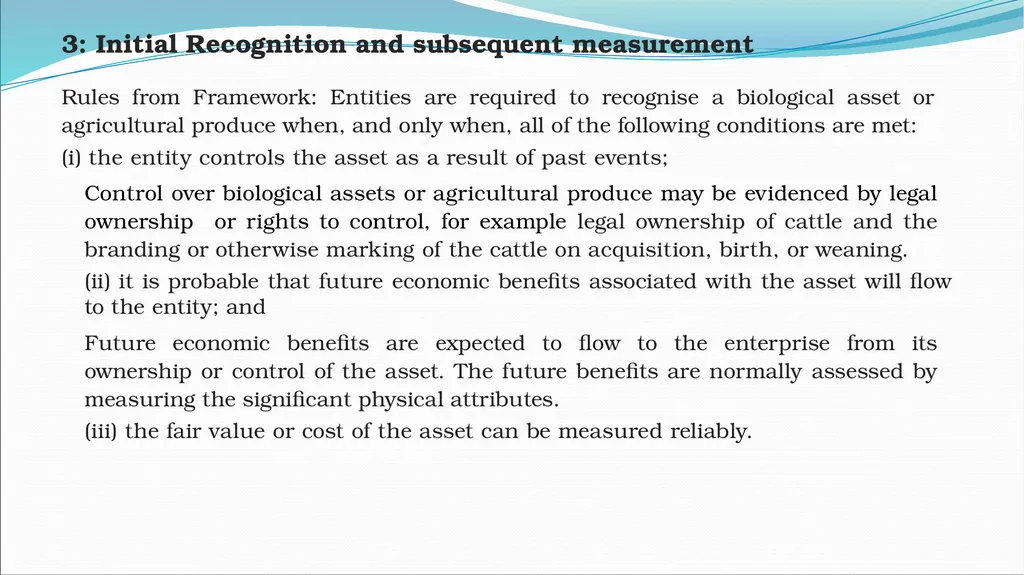
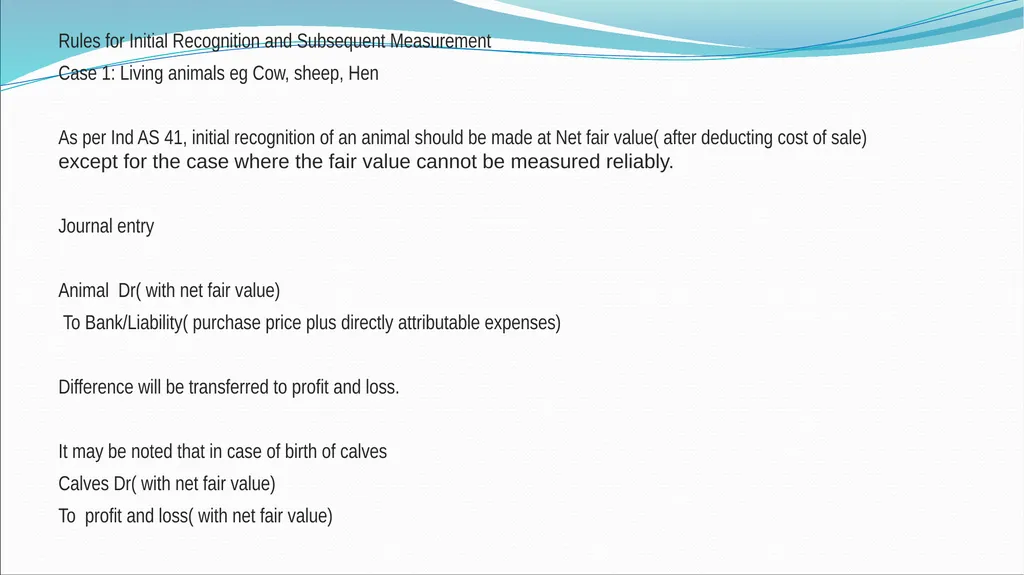
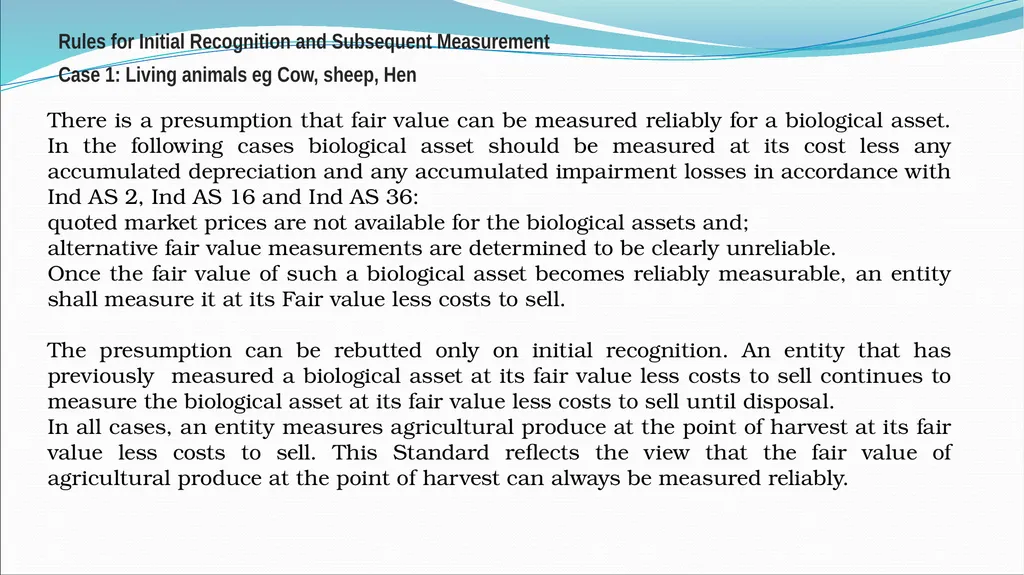
Biological assets( living plants eg cotton plants, tobacco plant, sugarcane plant, wheat, rice etc & Living animals eg cow diary farm, sheeps, poultary farm ) other than Bearer plants eg apple trees, Mango trees, coconut trees. Hence Ind AS 16 is applicable on bearer plants
Wasting assets eg mineral oil, ores
Retired assets held for sale( Ind AS 105-Non current asset held for sale and discontinued operations)
Note : Ind AS 16 is applicable on PPE used to develop or maintain the asset described in (i) and (ii) above<br>
slide83. Topic no 4: Initial Recognition of PPE
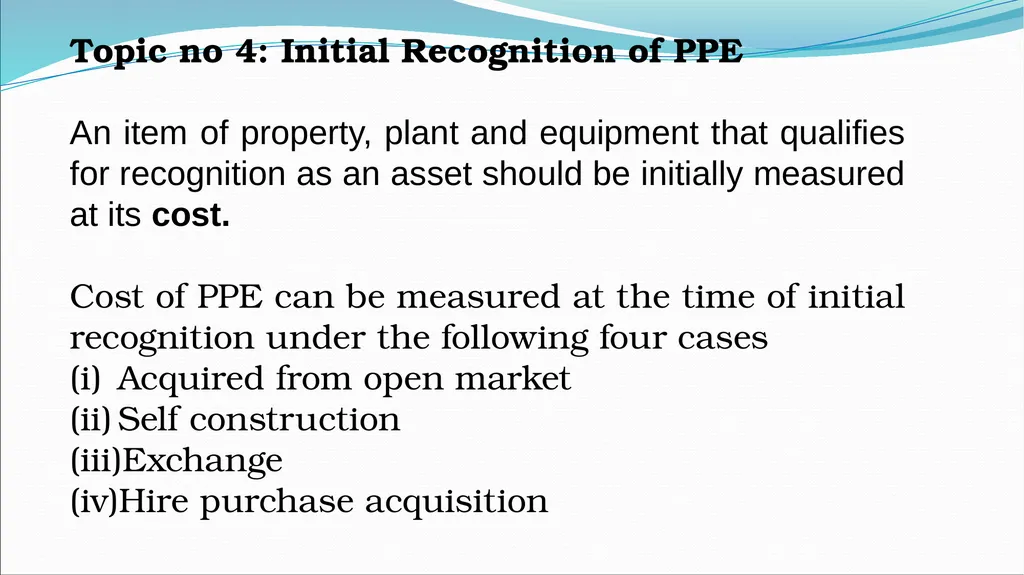
An item of property, plant and equipment that qualifies for recognition as an asset should be initially measured at its cost.
Cost of PPE can be measured at the time of initial recognition under the following four cases
Acquired from open market
Self construction
Exchange
Hire purchase acquisition<br>
slide84. Model for Presentation
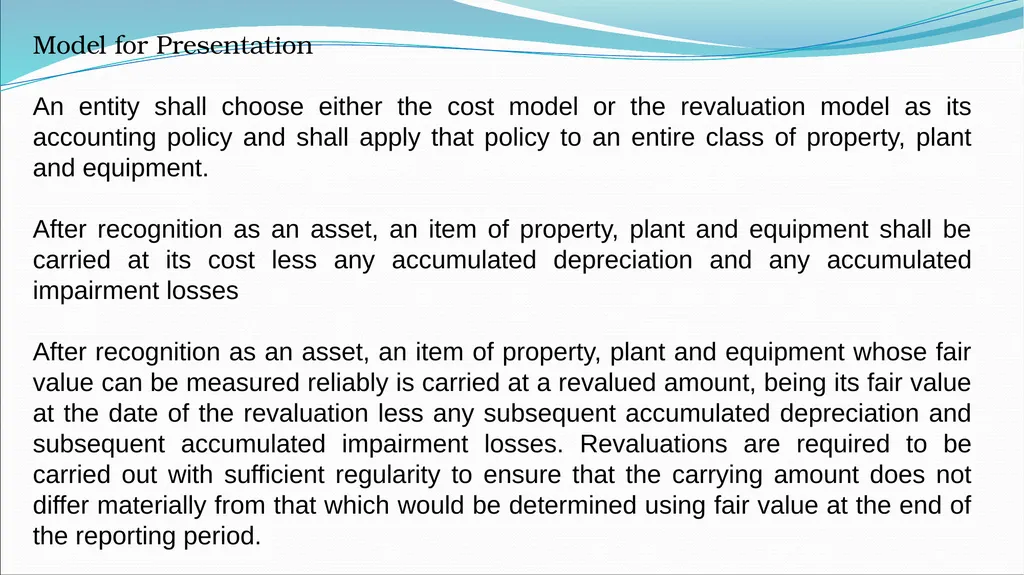
An entity shall choose either the cost model or the revaluation model as its accounting policy and shall apply that policy to an entire class of property, plant and equipment.
After recognition as an asset, an item of property, plant and equipment shall be carried at its cost less any accumulated depreciation and any accumulated impairment losses
After recognition as an asset, an item of property, plant and equipment whose fair value can be measured reliably is carried at a revalued amount, being its fair value at the date of the revaluation less any subsequent accumulated depreciation and subsequent accumulated impairment losses. Revaluations are required to be carried out with sufficient regularity to ensure that the carrying amount does not differ materially from that which would be determined using fair value at the end of the reporting period.<br>
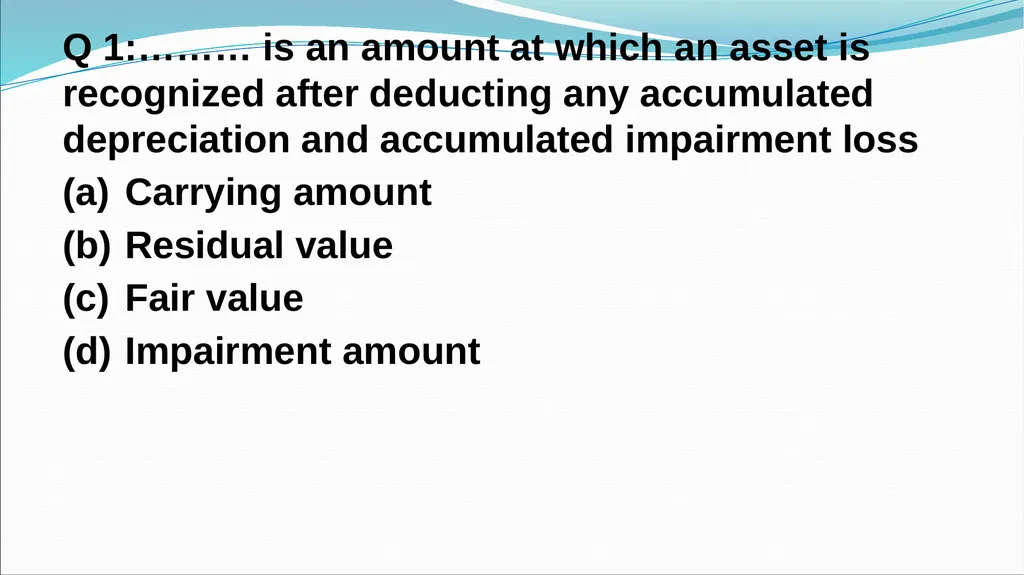
slide85. Q 1:……… is an amount at which an asset is recognized after deducting any accumulated depreciation and accumulated impairment loss
Carrying amount
Residual value
Fair value
Impairment amount<br>
slide86. Q 2: How to value an item of property , plant and equipment acquired in exchange in an arm’s length commercial transaction
Carrying value.
Present value
Residual value
Fair value<br>
slide87. Q 3: what are the various method suggested for subsequent measurement as per ind as 16
Fair value model or cost model
Cost model or revaluation model.
Fair value model or present value model
Market price model or fair value model<br>
slide88. Ind AS 19: Employee benefits<br>
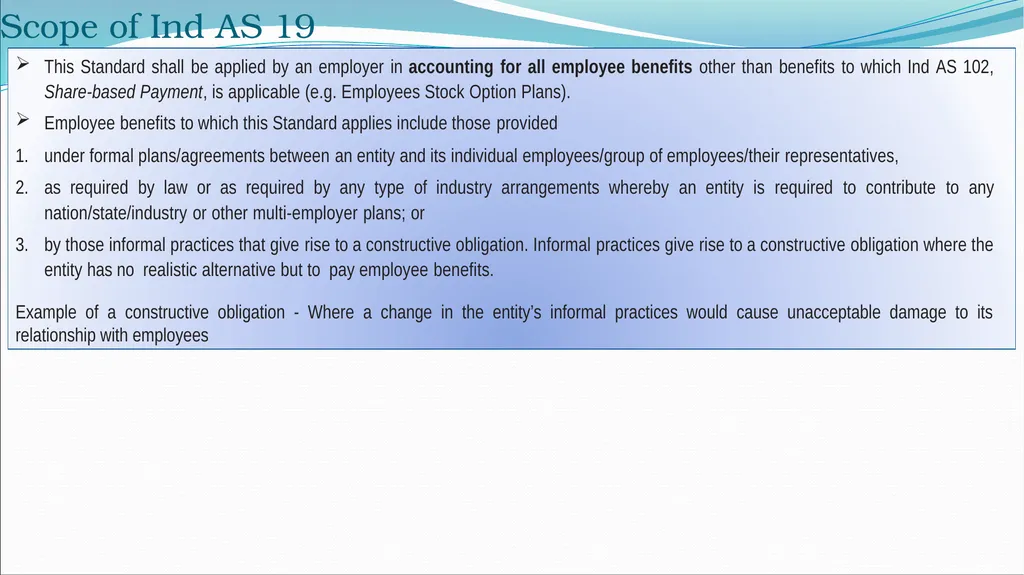
slide89. Scope of Ind AS 19 This Standard shall be applied by an employer in accounting for all employee benefits other than benefits to which Ind AS 102, Share-based Payment, is applicable (e.g. Employees Stock Option Plans).
Employee benefits to which this Standard applies include those provided
under formal plans/agreements between an entity and its individual employees/group of employees/their representatives,
as required by law or as required by any type of industry arrangements whereby an entity is required to contribute to any nation/state/industry or other multi-employer plans; or
by those informal practices that give rise to a constructive obligation. Informal practices give rise to a constructive obligation where the entity has no realistic alternative but to pay employee benefits.
Example of a constructive obligation - Where a change in the entity’s informal practices would cause unacceptable damage to its relationship with employees<br>
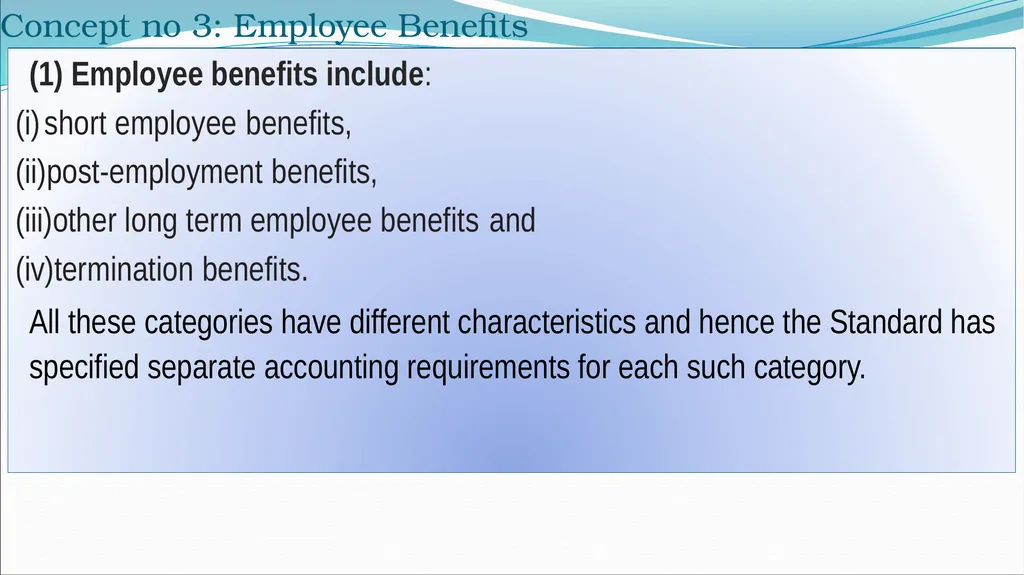
slide90. Concept no 3: Employee Benefits (1) Employee benefits include:
short employee benefits,
post-employment benefits,
other long term employee benefits and
termination benefits.
All these categories have different characteristics and hence the Standard has specified separate accounting requirements for each such category.<br>
slide91. (2) Employee benefits include benefits provided either to
employees; or
their dependents/Beneficiaries<br>
slide92. (3) Employee benefits may be settled by payments (or the provision of goods or services) made either
directly to the employees; or
their spouses; or
their children; or
their other dependants; or
others, such as insurance companies/Trusts/EPF department.<br>
slide93. (4) An employee may provide services to an entity on a
full-time; or
part-time; or
permanent; or
Casual/temporary basis. Note: For the purpose of this Standard, employees include directors and other management personnel.<br>
slide94. A: Short term employee benefits ( i) Meaning of STEB: Employee benefits ( other than termination benefits) that are expected to be settled wholly before 12 months after the end of annual reporting period in which the employee render the related service.
STEB may be divided in to the following four categories
Regular period benefits( Salary /wages, social security contributions)
Paid annual leave & paid sick leave
Profit sharing & Bonus
Non monetary benefits( medical facility, housing facility, education facility, car facility, free or subsidized goods or services)<br>
slide95. A: Short term employee benefits (ii) Recognition of Short term employee benefits
Accounting for short term benefits has two characteristics:
short-term benefits are measured on an undiscounted basis; and
they don’t involve any actuarial valuation for their measurement.
The undiscounted amount of short-term employee benefits expected to be paid in exchange for that service shall be recognised:
as a liability (accrued expense), after deducting any amount already paid.
If the amount already paid exceeds the undiscounted amount of the benefits, an entity shall recognise that excess as an asset (prepaid expense) to the extent that the prepayment will lead to, for example, a reduction in future payments or a cash refund; and
(b) as an expense, if it doesn’t form part of the cost of an asset as per any other Ind AS (e.g. Ind AS 2, Inventories or Ind AS 16 Property, Plant and equipments<br>
slide96. Types of Post employment benefits/Long term Benefits
Defined Contribution plan
Defined benefits plan<br>
slide97. 1. defined contribution plans
The entity’s legal or constructive obligation is limited to the amount that it agrees to contribute to the fund.
As a result of this, actuarial risk (which means that benefits will be less than expected) and investment risk (that assets invested will be insufficient to meet expected benefits) fall, in substance on the employee (and not on the entity).
Example: Contribution of EPF, ESI, contribution to insurance company/Trust for retirement benefits/Insurance
2. Under defined benefit plans
(a) The entity’s obligation is to provide the agreed benefits employees; and
(b) Actuarial risk (that benefits will cost more than expected) and investment risk fall, in substance, on the entity (and not on the employee like in the case of defined contribution plan).
(c.) Thus, if actuarial or investment experience are worse than expected, the entity’s obligation may be increased.
Example: Gratuity, fixed amount after the retirement or after continuing services for certain period etc.<br>
slide98. ACCOUNTING FOR DEFINED CONTRIBUTION PLANS
The reporting entity’s obligation for each period is determined by the amounts to be contributed for that period.
No actuarial assumptions are required to measure the obligation or the expense and there is no possibility of any actuarial gain or loss.
The obligations are measured on an undiscounted basis , however discounting is done where the obligation falls due after twelve months after the end of the annual reporting period in which the employees render the related service.<br>
slide99. Accounting for Defined benefits plan
Accounting for defined benefit plans is complex because -
actuarial assumptions are required to measure the obligation and the expense;
there is a possibility of actuarial gains and losses;
the obligations are measured on a discounted basis because they may be settled many years after the employees render the related service<br>
slide100. Q 1: Ind AS 19 employees benefits does not cover casual or temporary employees
True
False<br>
slide101. Q 2: Which of the following amount should not be recognized in profit and loss in relation to defined benefit plan
Current service cost
Actuarial gain and loss
Both above
None of the above<br>
slide102. Ind AS 20: Accounting for Government Grant & Disclosure of Government Assistance<br>
slide103. Definition of Government( State/Central/Local Bodies/foreign Govt) grants are assistance by government in the form of transfers of resources to an entity in return for past or future compliance with certain conditions relating to the operating activities of the entity.
They exclude those forms of government assistance which cannot reasonably have a value placed upon them and transactions with government which cannot be distinguished from the normal trading transactions of the entity.
Government grants are sometimes called by other names such as subsidies, subventions, or premiums.<br>
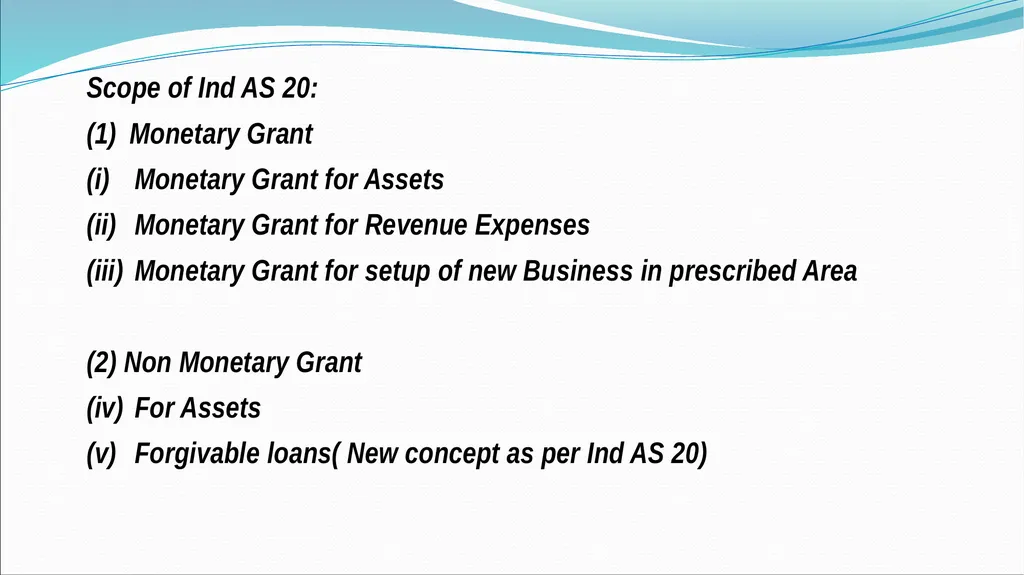
slide104. Scope of Ind AS 20:
Monetary Grant
Monetary Grant for Assets
Monetary Grant for Revenue Expenses
Monetary Grant for setup of new Business in prescribed Area
(2) Non Monetary Grant
For Assets
Forgivable loans( New concept as per Ind AS 20)<br>
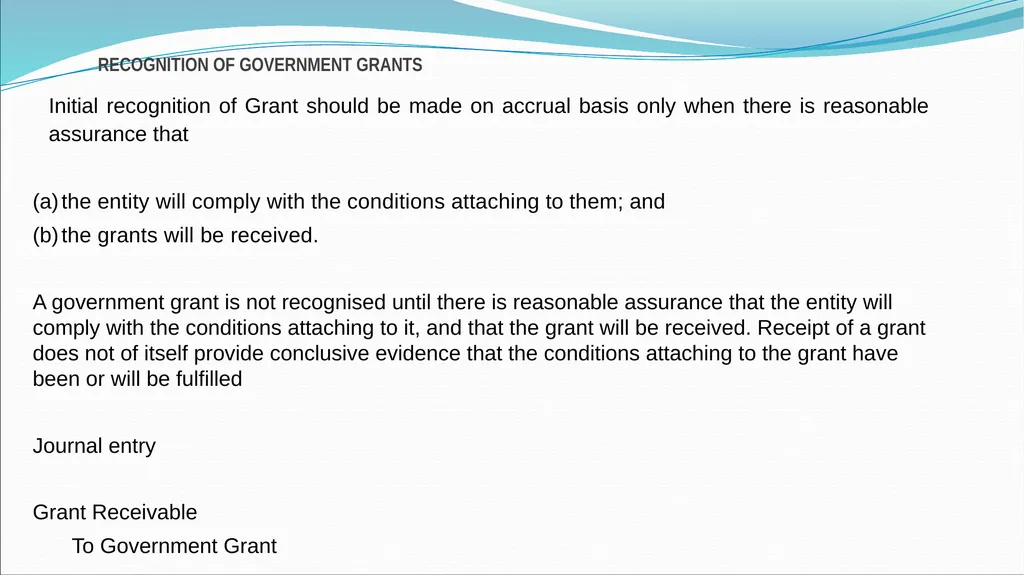
slide105. RECOGNITION OF GOVERNMENT GRANTS Initial recognition of Grant should be made on accrual basis only when there is reasonable assurance that
the entity will comply with the conditions attaching to them; and
the grants will be received.
A government grant is not recognised until there is reasonable assurance that the entity will comply with the conditions attaching to it, and that the grant will be received. Receipt of a grant does not of itself provide conclusive evidence that the conditions attaching to the grant have been or will be fulfilled
Journal entry
Grant Receivable
To Government Grant<br>
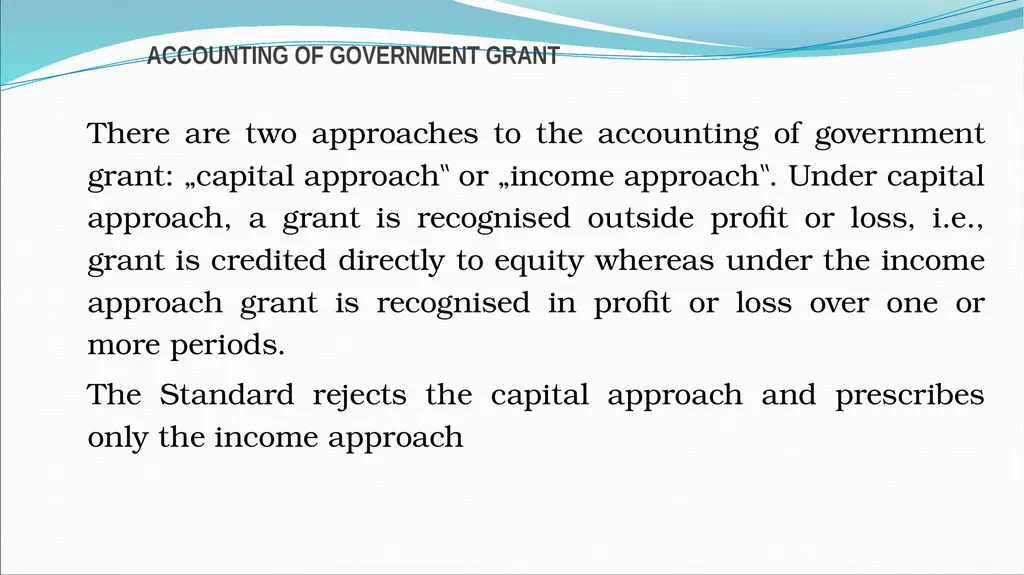
slide106. ACCOUNTING OF GOVERNMENT GRANT There are two approaches to the accounting of government grant: „capital approach‟ or „income approach‟. Under capital approach, a grant is recognised outside profit or loss, i.e., grant is credited directly to equity whereas under the income approach grant is recognised in profit or loss over one or more periods.
The Standard rejects the capital approach and prescribes only the income approach<br>
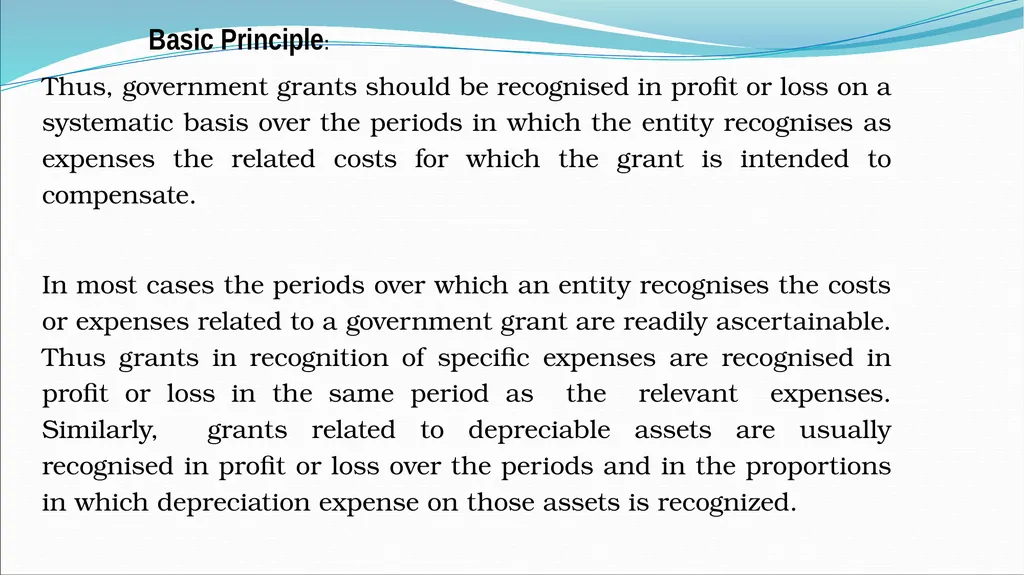
slide107. Basic Principle: Thus, government grants should be recognised in profit or loss on a systematic basis over the periods in which the entity recognises as expenses the related costs for which the grant is intended to compensate.
In most cases the periods over which an entity recognises the costs or expenses related to a government grant are readily ascertainable. Thus grants in recognition of specific expenses are recognised in profit or loss in the same period as the relevant expenses. Similarly, grants related to depreciable assets are usually recognised in profit or loss over the periods and in the proportions in which depreciation expense on those assets is recognized.<br>
slide108. Accounting for Government Grant
Case 1- Monetary Grant
Case 2: Non Monetary Grant<br>
slide109. Monetary Grant related with assets
(a) Depreciable assets( PPE, Intangible asset)
Initial recognition
Option 1: Deferred it and amortized in the statement of profit and loss over the period and in the proportions in which depreciation expenses on those asset is recognized.
Option 2: Reduced it from the Cost of asset and charged depreciation on the net cost of asset after adjustment of Grant<br>
slide110. Case study:A fixed asset was purchased for Rs. 10 lacs. Government grant received towards it amounted to Rs. 4 lacs. Show the accounting if it is a depreciable asset with Rs. 2 lacs residual value and four year useful life. The company adopts straight line method for depreciation.
Also make accounting entries in the books of company if grant is refunded at the beginning of second year.<br>
slide111. (b) Monetary Grant related with Non depreciable asset
If there is no condition then transfer to profit and loss immediately however if there is condition then deferred and amortized it over the period that bear the cost of meeting the obligation<br>
slide112. (ii) Monetary Grant related with expenses
Without condition: Transfer to statement of profit and loss
With condition: deferred and amortized over the period of fulfillment of conditions attached with the grant( matching concept)<br>
slide113. Q1: Ind AS 20 is applicable to Government Grant received for agriculture
True
False.<br>
slide114. Q2: What dies the term “ Government means in the context of accounting for government grant
Government
Government agencies
Similar bodies whether local national or international
All of the above.<br>
slide115. Ind AS 21: The Effects of changes in Foreign exchange rates<br>
slide116. (1) Objective of Ind AS 21:
The objective of the Standard is to address the accounting for foreign activities which include:
transactions in foreign currencies; or
foreign operations.
Considering that an entity may present its financial statements in a foreign currency, the Standard also seeks to prescribe how to translate financial statements into a presentation currency.
In this context, the Standard defines foreign currency as a currency other than the functional currency of the entity.<br>
slide117. (2) Important definition
Functional currency is the currency of the primary economic environment in which the entity operates.
In this regard, the primary economic environment will normally be the one in which it primarily generates and expends cash i.e. it operates. The functional currency is normally the currency of the country in which the entity is located. It might, however, be a different currency.
Foreign operation has been defined as an entity that is a subsidiary, associate, joint venture or branch of a reporting entity, the activities of which are based or conducted in a country or currency other than those of the reporting entity.
Presentation currency is the currency in which the financial statements are presented, the presentation currency may be different from the entity’s functional currency.<br>
slide118. 4. Spot exchange rate is the exchange rate for immediate delivery.
5. Closing rate is the spot exchange rate at the end of the reporting period.
6. Exchange difference is the difference resulting from translating a given number of units of one currency into another currency at different exchange rates.<br>
slide119. (3) 9 Nine important notes for Functional Currency
An entity measures its assets, liabilities, equity, income and expenses in its functional currency
All transactions in currencies other than the functional currency are foreign currency transactions.
Ind AS 21 requires each entity to determine its functional currency.
In determining its functional currency, an entity emphasises the currency that determines the pricing of the transactions that it undertakes, rather than focusing on the currency in which those transactions are denominated.
(v) The following are the factors that may be considered in determining an appropriate functional currency (Primary indicators):
the currency:
that mainly influences sales prices for its goods and services. This will often be the currency in which sales prices are denominated and settled; and
of the country whose competitive forces and regulations mainly determine the sales prices of its goods and services.
the currency that mainly influences labour, material and other costs of providing goods and services. This will often be the currency in which these costs are denominated and settled.<br>
slide120. (vi) Other factors that may provide supporting evidence to determine an entity’s functional currency are (Secondary indicators):
the currency in which funds from financing activities (i.e. issuing debt and equity instruments) are generated; and
the currency in which receipts from operating activities are usually retained.<br>
slide121. (vii) If an entity is a foreign operation, additional factors are set out in this Standard which should be considered to determine whether its functional currency is the same as that of the reporting entity of which it is a subsidiary, branch, associate or joint venture:
Whether the activities of foreign operations are carried out as an extension of that reporting entity, rather than being carried out with a significant degree of autonomy;
An example of the former is when the foreign operation only sells goods imported from the reporting entity and remits the proceeds to it.
An example of the latter is when the foreign operations accumulates cash and other monetary items, incurs expenses, generates income and arranges borrowings, all substantially in its local currency.
(b) Whether the transactions with the reporting entity are a high or a low proportion of the foreign operation’s activities;
(c,) Whether cash flows from the activities of the foreign operations directly affect the cash flows of the reporting entity and are readily available for remittance to it.
(d) Whether cash flows from the activities of the foreign operation are sufficient to service existing and normally expected debt obligation without funds being made available by the reporting entity.
These factors also demonstrate whether the entity is integral to the reporting entity or not. In practice, the functional currency of a foreign operation that is integral to the parent / reporting entity will usually be the same as that of the parent / reporting entity.<br>
slide122. (viii) Determining an entity’s functional currency depends on the facts and circumstances.
(ix) When the above indicators are mixed and the functional currency is not obvious, the management will be required to use its judgement to determine the functional currency that most faithfully represents the economic effects of the underlying transactions, events and conditions. As part of this approach, management has to give priority to the primary indicators before considering the other indicators, which are designed to provide additional supporting evidence to determine an entity’s functional currency.<br>
slide123. Q 1: The currency of the primary economic environment in which the entity operates is called as
Functional currency
Foreign currency
Reporting currency
Presentation currency<br>
slide124. Q 2: AB Inc, a USA based company has a subsidiary in India SG ltd. The subsidiary assembles all goods in india using a combination of locally sourced material and material manufactured by AB inc. All goods are tahen exported and sold in south Africa, based on selling price decided by AB inc and influenced by indian market. The company has a loan from an indian bank. What will be the functional currency of SG ltd
INR.
US$
South affrican Rand®
None<br>
slide125. Ind AS 23: Borrowing cost<br>
slide126. CONCEPTS Core Principle of Ind AS 23-Borrowing cost
The core principle of Ind AS 23 states that:
(i) Borrowing costs that are directly attributable to the acquisition, construction or production of a qualifying asset are included in the cost of that asset i.e. must be capitalised.
(ii) Other borrowing costs are recognised as an expense in the period in which they are incurred<br>
slide127. Definition of Borrowing Cost
Borrowing Cost are interest and other costs that an entity incurs in connection with the borrowing of funds. Borrowing costs may include:
interest expense calculated using the effective interest rate method as described in Ind AS 109 Financial Instruments;
interest in respect of lease liabilities recognized in accordance with Ind AS 116, Leases; and
exchange differences arising from foreign currency borrowings to the extent that they are regarded as an adjustment to interest costs<br>
slide128. Note on effective rate of interest( N:
As per Ind AS 23, interest on borrowed fund must be calculated using effective rate of interest method. There may be some expenses at the time of arrangement of borrowed funds or at the time of repayment of borrowed fund. For example, commission, commitment fees, discount on issue of debentures, underwriting commission , stamp duty,premium on redemption of debentures. All these expenses shall be taken into account while calculating effective rate of interest, in fact due to these expenses the effective interest rate is increased as compare to the actual interest rate.<br>
slide129. 1] Case study on effective rate of interest
X ltd issue 10% debentures on dated 1/4/2018. The detail is as under:
No of debenture: 10000
Issue price per debenture: 98
Face value per debenture: 100
Redemption after five year at premium of 5%
Underwriting commission: 2.50% on face value
Calculate effective rate of interest and prepared debentures accounts for five years.<br>
slide130. Q 1: Borrowing cost that are directly attributable to the ………. Of a qualifying asset form part of the cost of that asset
Acquisition
Constrution
Production
All of the above<br>
slide131. Q 2 : How to treat the borrowing cost incurred during the extended period in which an entity suspends active development of a qualifying asset
Capitalized
Expensed
Charged to statement of changes in equity
None of the above<br>
slide132. Ind AS 24: Related Party Disclosures<br>
slide133. CONCEPTS Introduction of Ind AS 24
Important terms used in Ind AS 24
Related party transaction
Identification of related parties
Related Party Disclosures<br>
slide134. CONCEPT NO 1: Introduction of Ind AS-24 Users are entitled to believe that all the transactions of an entity are at “ARM’s LENGTH”.
Arm’s length transaction is a business deal in which both parties of transactions act independently. The concept of an arm’s length transaction assures that both parties in the deal are acting in their own self interest and are not subject to any pressure from the other party. It also assures users that there is no collusion between the buyer and seller.<br>
slide135. CONCEPT NO 1: Introduction of Ind AS 24 Sometimes business transactions between RELATED PARTIES lose the feature and character of the arm’s length transactions. Hence disclosure of related party transaction is essential for proper understanding of financial performance and financial position of enterprises.<br>
slide136. CONCEPT NO 2: Important terms used in Ind AS 24 Holding & Subsidiary Company
If an entity CONTROL other entity then controlling entity is known as Holding company and the entity to whom holding company control is known as subsidiary company. Control means power to Govern the decision of other entity ie acquisition of more than 50% equity shares of other entity. The meaning of control will be discussed in detail under Ind AS 110: Consolidated Financial Statements
2. Fellow Subsidiary
Subsidiaries under common control is known as Fellow subsidiaries<br>
slide137. CONCEPT NO 2: Important terms used in Ind AS 24 3. Significant influence means power to participate in operating/financial decisions of the entity but not controlling power eg acquisition of 20% or more equity shares but up to 50%.
4. Associates: If an entity enjoy significant influence over the other entity then such other entity is considered as associates of the investor company.
5. Joint Venture is an economic activity which is undertaken by two or more enterprises subject to the joint control . The entities which exercise joint control are known as joint venturer/Co venturers<br>
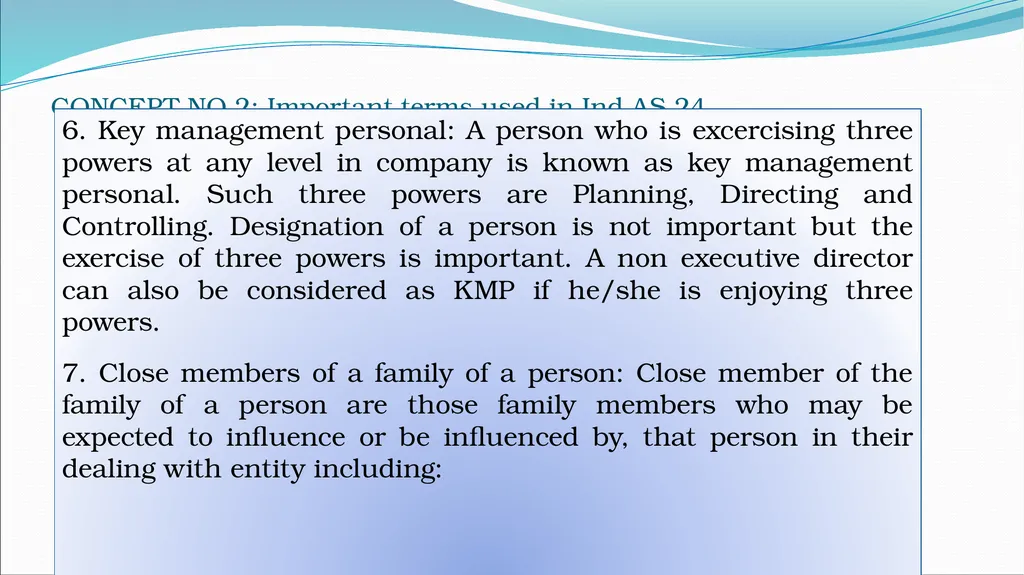
slide138. CONCEPT NO 2: Important terms used in Ind AS 24 6. Key management personal: A person who is excercising three powers at any level in company is known as key management personal. Such three powers are Planning, Directing and Controlling. Designation of a person is not important but the exercise of three powers is important. A non executive director can also be considered as KMP if he/she is enjoying three powers.
7. Close members of a family of a person: Close member of the family of a person are those family members who may be expected to influence or be influenced by, that person in their dealing with entity including:<br>
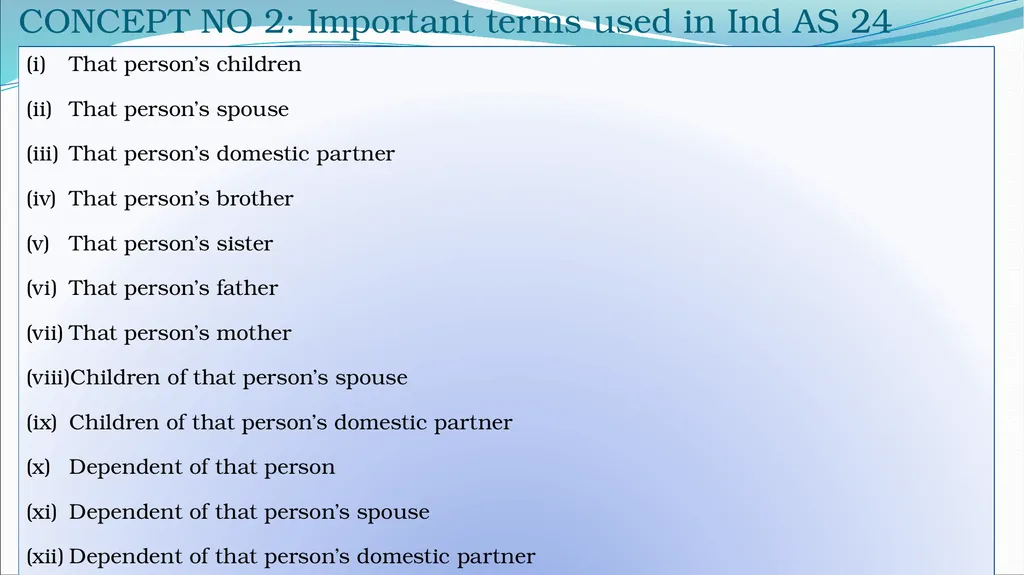
slide139. CONCEPT NO 2: Important terms used in Ind AS 24 That person’s children
That person’s spouse
That person’s domestic partner
That person’s brother
That person’s sister
That person’s father
That person’s mother
Children of that person’s spouse
Children of that person’s domestic partner
Dependent of that person
Dependent of that person’s spouse
Dependent of that person’s domestic partner<br>
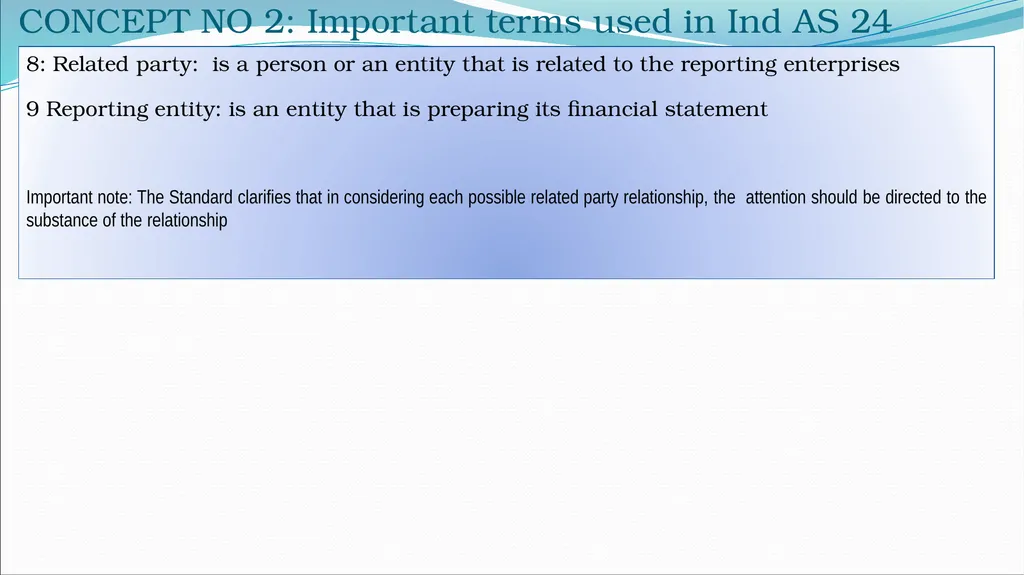
slide140. CONCEPT NO 2: Important terms used in Ind AS 24 8: Related party: is a person or an entity that is related to the reporting enterprises
9 Reporting entity: is an entity that is preparing its financial statement
Important note: The Standard clarifies that in considering each possible related party relationship, the attention should be directed to the substance of the relationship<br>
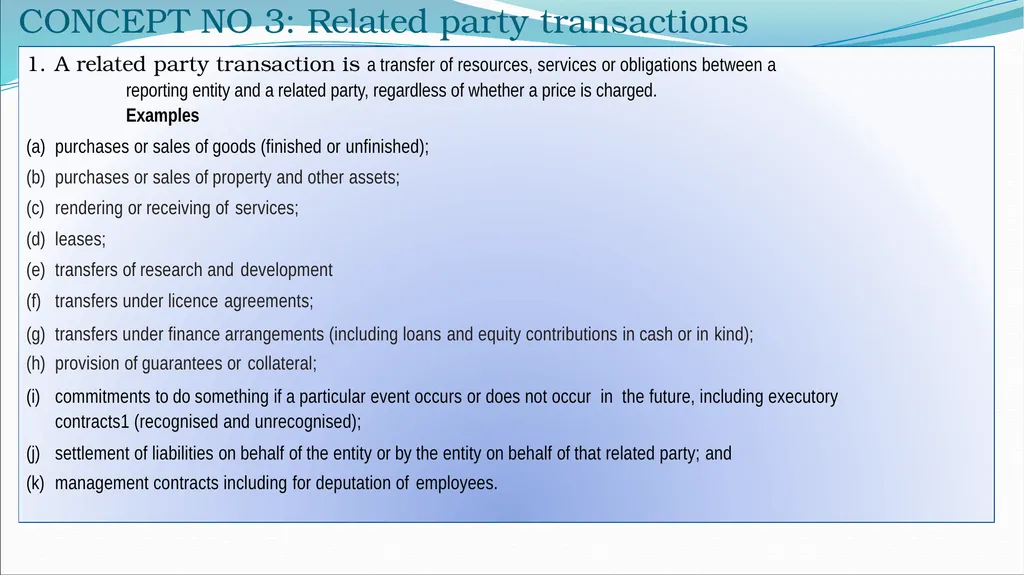
slide141. CONCEPT NO 3: Related party transactions A related party transaction is a transfer of resources, services or obligations between a
reporting entity and a related party, regardless of whether a price is charged.
Examples
purchases or sales of goods (finished or unfinished);
purchases or sales of property and other assets;
rendering or receiving of services;
leases;
transfers of research and development
transfers under licence agreements;
transfers under finance arrangements (including loans and equity contributions in cash or in kind);
provision of guarantees or collateral;
commitments to do something if a particular event occurs or does not occur in the future, including executory contracts1 (recognised and unrecognised);
settlement of liabilities on behalf of the entity or by the entity on behalf of that related party; and
management contracts including for deputation of employees.<br>
slide142. CONCEPT NO 4: Identification of related parties Case no 1: If related party is a person
Case no 2: If related party is an entity<br>
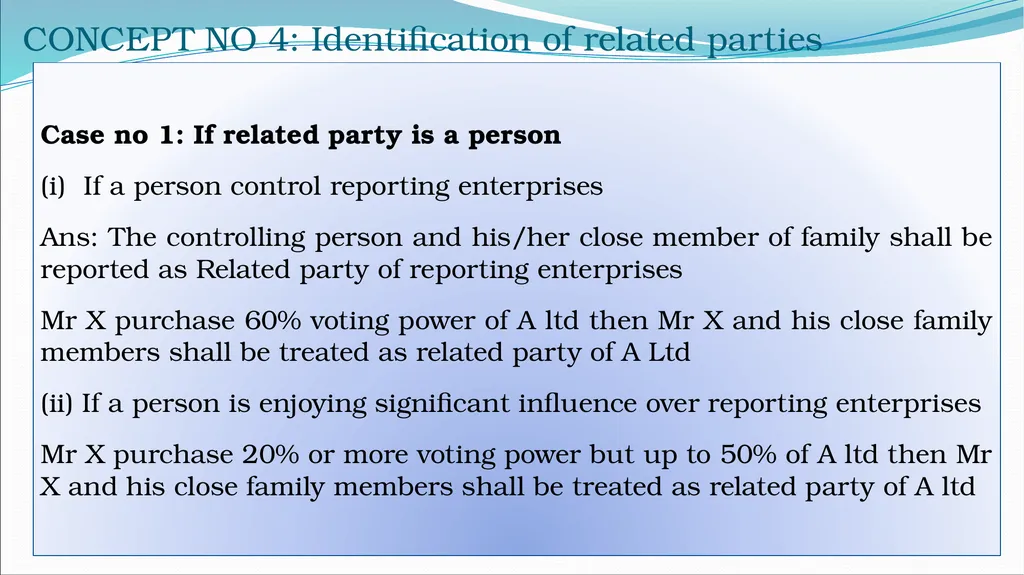
slide143. CONCEPT NO 4: Identification of related parties Case no 1: If related party is a person
If a person control reporting enterprises
Ans: The controlling person and his/her close member of family shall be reported as Related party of reporting enterprises
Mr X purchase 60% voting power of A ltd then Mr X and his close family members shall be treated as related party of A Ltd
(ii) If a person is enjoying significant influence over reporting enterprises
Mr X purchase 20% or more voting power but up to 50% of A ltd then Mr X and his close family members shall be treated as related party of A ltd<br>
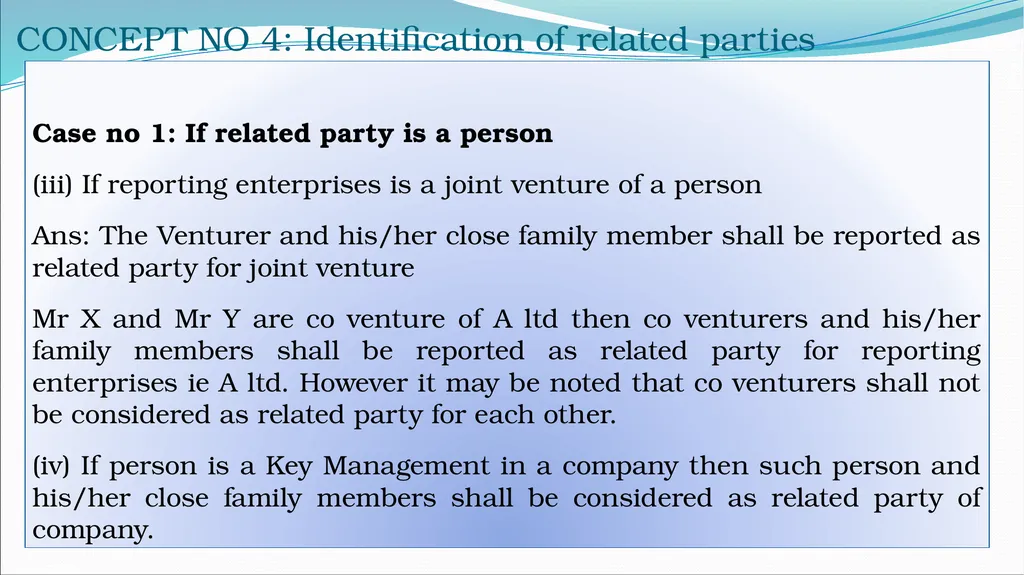
slide144. CONCEPT NO 4: Identification of related parties Case no 1: If related party is a person
(iii) If reporting enterprises is a joint venture of a person
Ans: The Venturer and his/her close family member shall be reported as related party for joint venture
Mr X and Mr Y are co venture of A ltd then co venturers and his/her family members shall be reported as related party for reporting enterprises ie A ltd. However it may be noted that co venturers shall not be considered as related party for each other.
(iv) If person is a Key Management in a company then such person and his/her close family members shall be considered as related party of company.<br>
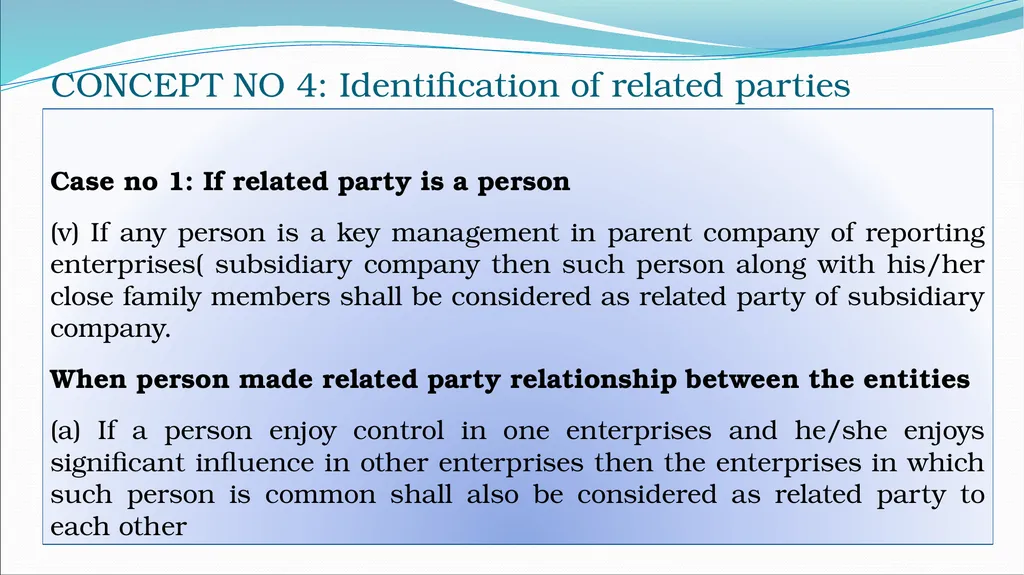
slide145. CONCEPT NO 4: Identification of related parties Case no 1: If related party is a person
(v) If any person is a key management in parent company of reporting enterprises( subsidiary company then such person along with his/her close family members shall be considered as related party of subsidiary company.
When person made related party relationship between the entities
(a) If a person enjoy control in one enterprises and he/she enjoys significant influence in other enterprises then the enterprises in which such person is common shall also be considered as related party to each other<br>
slide146. CONCEPT NO 4: Identification of related parties Case no 1: If related party is a person
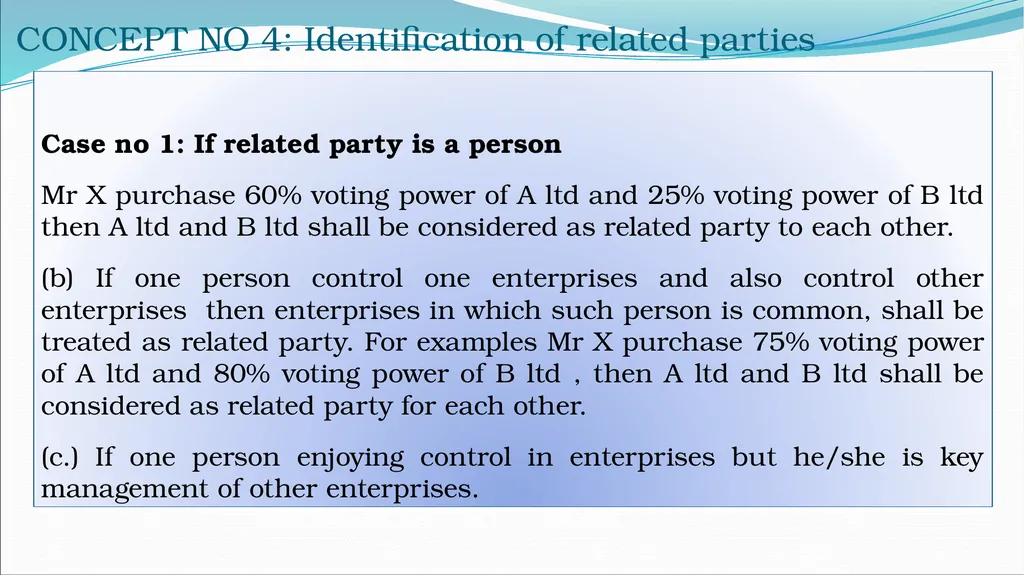
Mr X purchase 60% voting power of A ltd and 25% voting power of B ltd then A ltd and B ltd shall be considered as related party to each other.
(b) If one person control one enterprises and also control other enterprises then enterprises in which such person is common, shall be treated as related party. For examples Mr X purchase 75% voting power of A ltd and 80% voting power of B ltd , then A ltd and B ltd shall be considered as related party for each other.
(c.) If one person enjoying control in enterprises but he/she is key management of other enterprises.<br>
slide147. CONCEPT NO 4: Identification of related parties Case no 1: If related party is a person
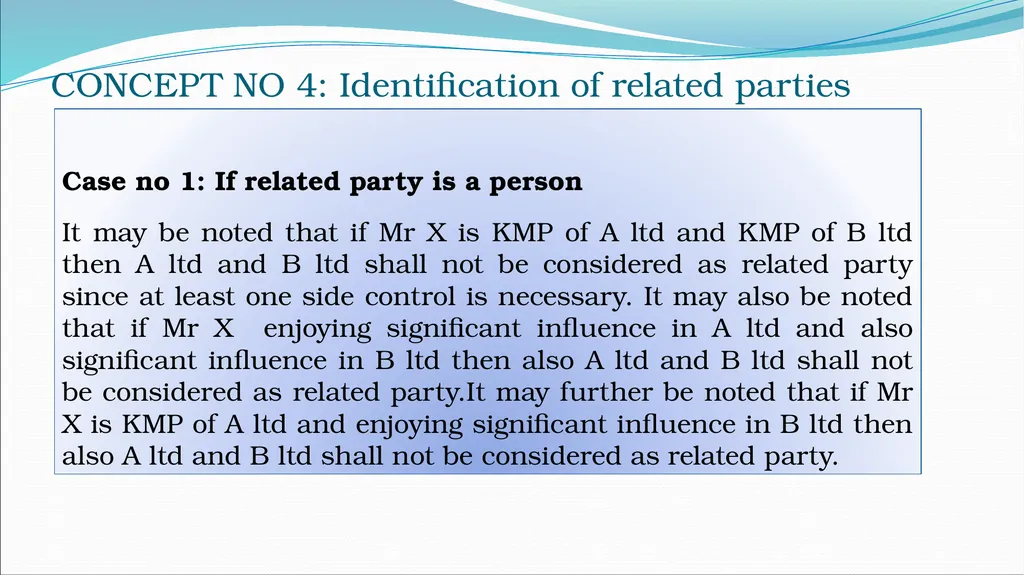
It may be noted that if Mr X is KMP of A ltd and KMP of B ltd then A ltd and B ltd shall not be considered as related party since at least one side control is necessary. It may also be noted that if Mr X enjoying significant influence in A ltd and also significant influence in B ltd then also A ltd and B ltd shall not be considered as related party.It may further be noted that if Mr X is KMP of A ltd and enjoying significant influence in B ltd then also A ltd and B ltd shall not be considered as related party.<br>
slide148. CONCEPT NO 4: Identification of related parties Case no 1: If related party is a person
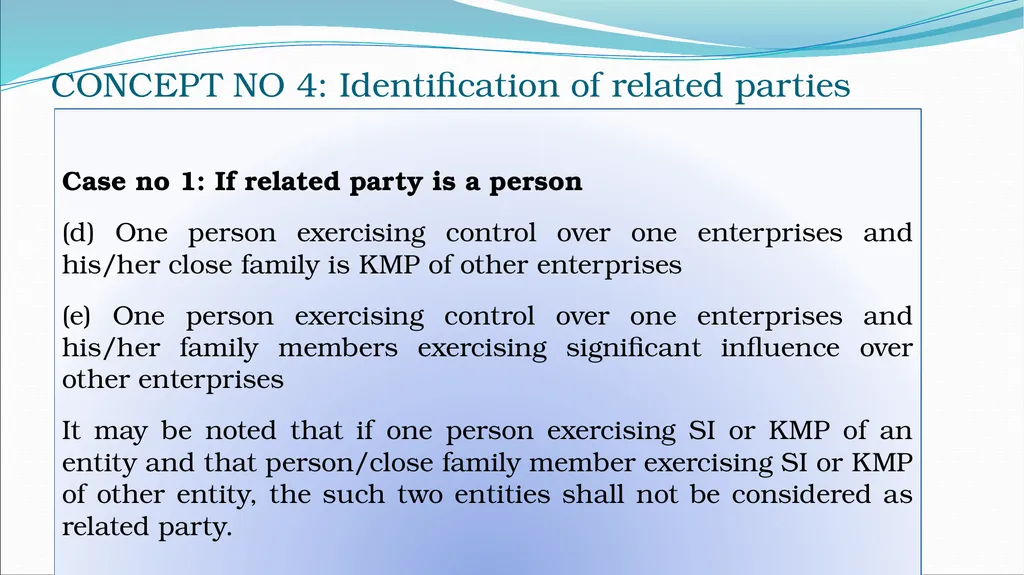
(d) One person exercising control over one enterprises and his/her close family is KMP of other enterprises
(e) One person exercising control over one enterprises and his/her family members exercising significant influence over other enterprises
It may be noted that if one person exercising SI or KMP of an entity and that person/close family member exercising SI or KMP of other entity, the such two entities shall not be considered as related party.<br>
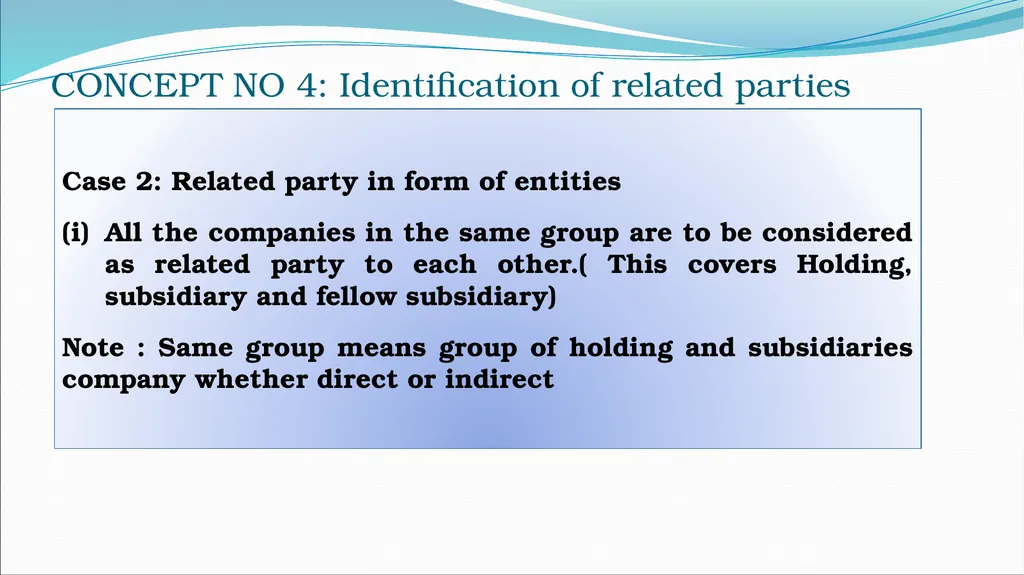
slide149. CONCEPT NO 4: Identification of related parties Case 2: Related party in form of entities
All the companies in the same group are to be considered as related party to each other.( This covers Holding, subsidiary and fellow subsidiary)
Note : Same group means group of holding and subsidiaries company whether direct or indirect<br>
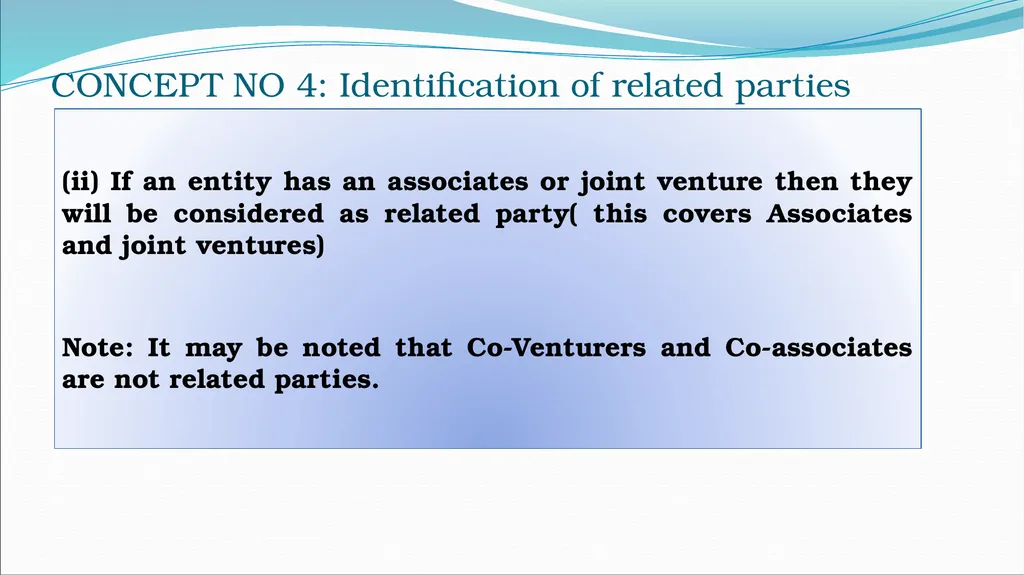
slide150. CONCEPT NO 4: Identification of related parties (ii) If an entity has an associates or joint venture then they will be considered as related party( this covers Associates and joint ventures)
Note: It may be noted that Co-Venturers and Co-associates are not related parties.<br>
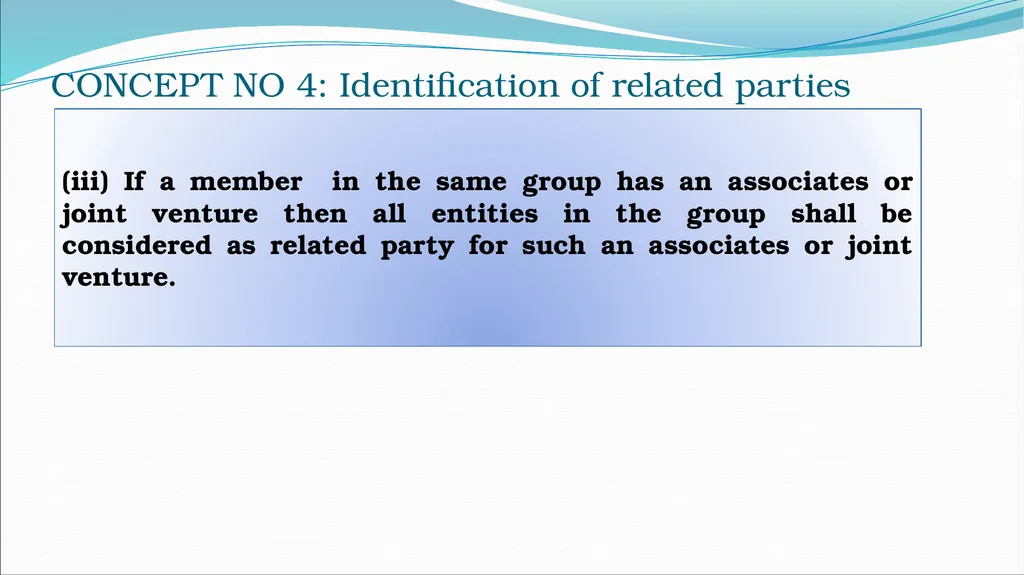
slide151. CONCEPT NO 4: Identification of related parties (iii) If a member in the same group has an associates or joint venture then all entities in the group shall be considered as related party for such an associates or joint venture.<br>
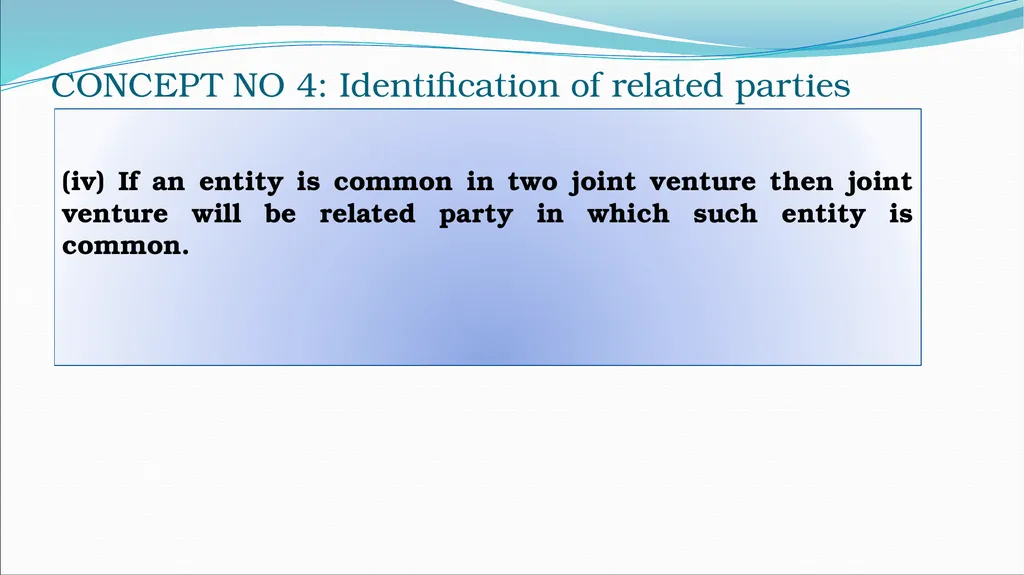
slide152. CONCEPT NO 4: Identification of related parties (iv) If an entity is common in two joint venture then joint venture will be related party in which such entity is common.<br>
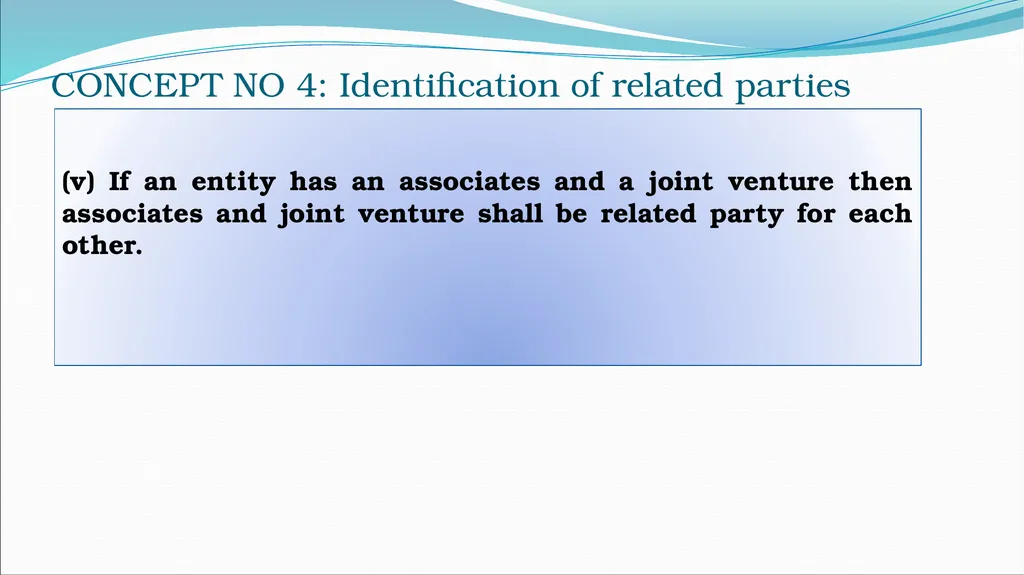
slide153. CONCEPT NO 4: Identification of related parties (v) If an entity has an associates and a joint venture then associates and joint venture shall be related party for each other.<br>
slide154. Q 1: Mr Z is having control over the company “Alpha”. Mr Y is the grandfather of Mr Z and Mr X is the son of Mr Y. Alpha is the reporting entity. Who is related party to company alpha
Mr X.
Mr X and Mr Y
Mr Y
None of the above<br>
slide155. Q 2: According to Ind AS 24, in considering each possible related party relationship attention is directed to the:
Substance of the relationship
Legal form of the relation ship
Substance and not merely the legal form of the relationship.
None<br>
slide156. Ind AS 33: EARNING PER SHARE<br>
slide157. CONCEPTS Introduction
Basic Earning per share
How to calculate Profit/loss attributable to equity shareholders
How to calculate weighted average number of equity shares
Diluted Earning per share<br>
slide158. CONCEPT NO 1: Introduction of Ind AS-33 (1) This standard prescribed the principles for determination and presentation of Earning per share.
(2) This will help the users for making comparison of enterprises with other enterprises for same period before making rational decision.
(3) This will also help users for making comparative analysis of same enterprises for the different financial year for checking the growth of enterprises.
(4) Earning per share is a financial ratio indicating the amount of profit or loss for the period attributable to each equity share<br>
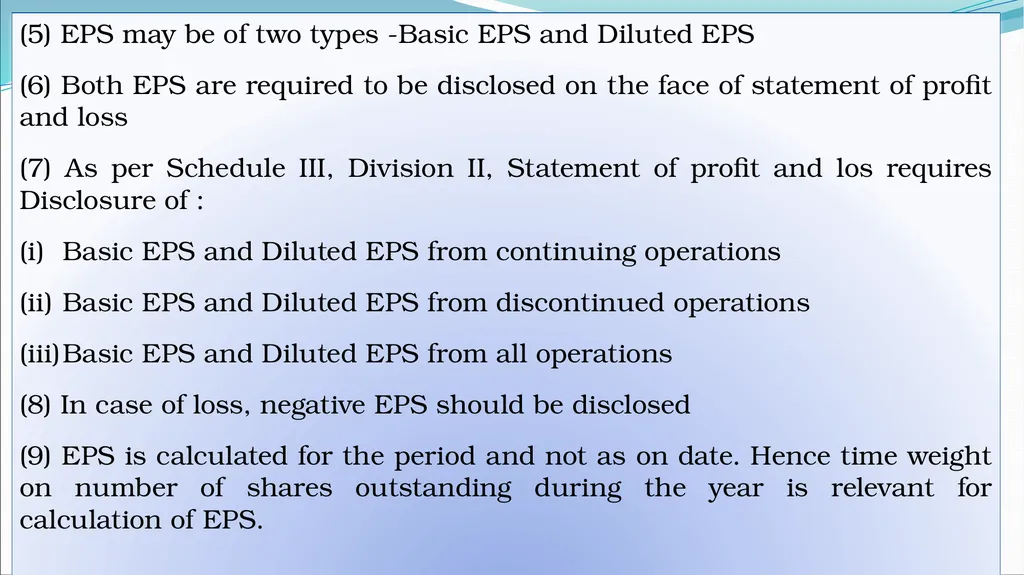
slide159. CONCEPT NO 1: Introduction of Ind AS-33 (5) EPS may be of two types -Basic EPS and Diluted EPS
(6) Both EPS are required to be disclosed on the face of statement of profit and loss
(7) As per Schedule III, Division II, Statement of profit and los requires Disclosure of :
Basic EPS and Diluted EPS from continuing operations
Basic EPS and Diluted EPS from discontinued operations
Basic EPS and Diluted EPS from all operations
(8) In case of loss, negative EPS should be disclosed
(9) EPS is calculated for the period and not as on date. Hence time weight on number of shares outstanding during the year is relevant for calculation of EPS.<br>
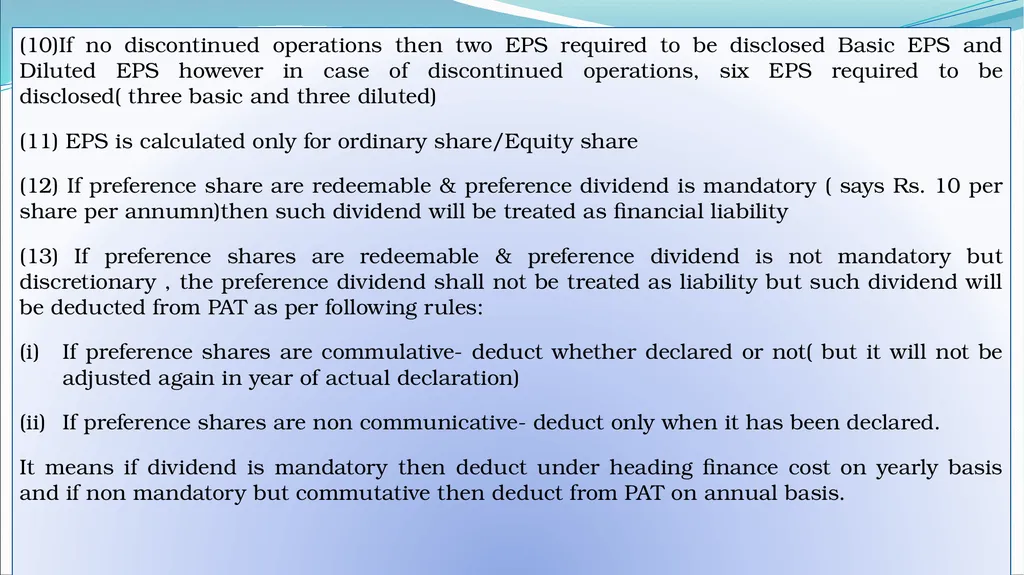
slide160. CONCEPT NO 1: Introduction of Ind AS-33 (10)If no discontinued operations then two EPS required to be disclosed Basic EPS and Diluted EPS however in case of discontinued operations, six EPS required to be disclosed( three basic and three diluted)
(11) EPS is calculated only for ordinary share/Equity share
(12) If preference share are redeemable & preference dividend is mandatory ( says Rs. 10 per share per annumn)then such dividend will be treated as financial liability
(13) If preference shares are redeemable & preference dividend is not mandatory but discretionary , the preference dividend shall not be treated as liability but such dividend will be deducted from PAT as per following rules:
If preference shares are commulative- deduct whether declared or not( but it will not be adjusted again in year of actual declaration)
If preference shares are non communicative- deduct only when it has been declared.
It means if dividend is mandatory then deduct under heading finance cost on yearly basis and if non mandatory but commutative then deduct from PAT on annual basis.<br>
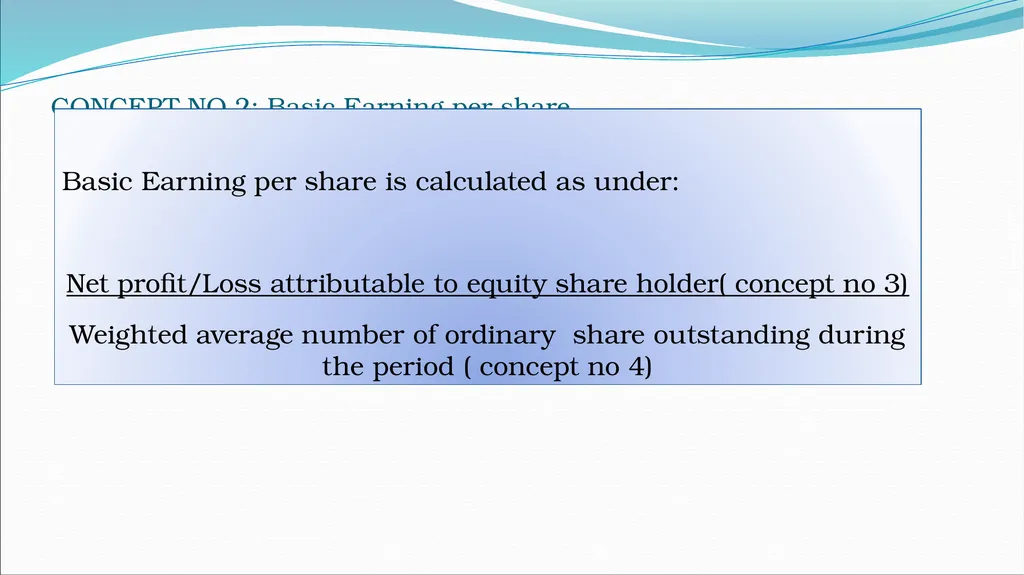
slide161. CONCEPT NO 2: Basic Earning per share Basic Earning per share is calculated as under:
Net profit/Loss attributable to equity share holder( concept no 3)
Weighted average number of ordinary share outstanding during the period ( concept no 4)<br>
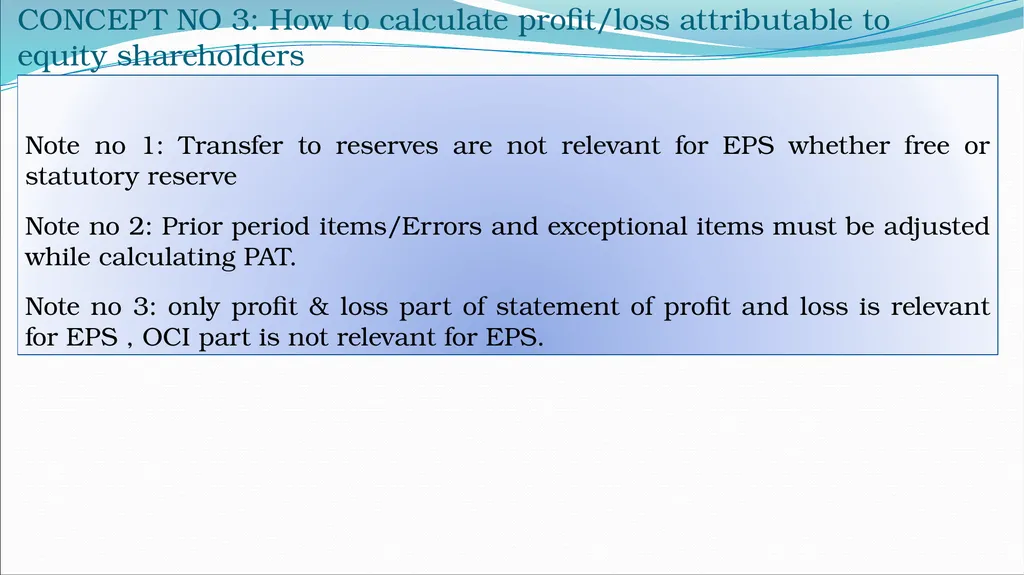
slide162. CONCEPT NO 3: How to calculate profit/loss attributable to equity shareholders Note no 1: Transfer to reserves are not relevant for EPS whether free or statutory reserve
Note no 2: Prior period items/Errors and exceptional items must be adjusted while calculating PAT.
Note no 3: only profit & loss part of statement of profit and loss is relevant for EPS , OCI part is not relevant for EPS.<br>
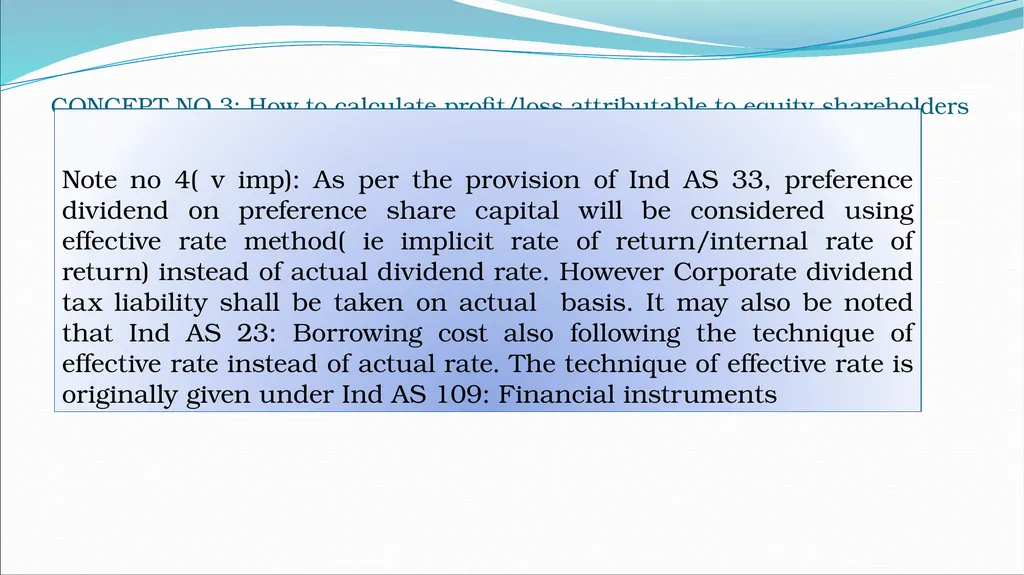
slide163. CONCEPT NO 3: How to calculate profit/loss attributable to equity shareholders Note no 4( v imp): As per the provision of Ind AS 33, preference dividend on preference share capital will be considered using effective rate method( ie implicit rate of return/internal rate of return) instead of actual dividend rate. However Corporate dividend tax liability shall be taken on actual basis. It may also be noted that Ind AS 23: Borrowing cost also following the technique of effective rate instead of actual rate. The technique of effective rate is originally given under Ind AS 109: Financial instruments<br>
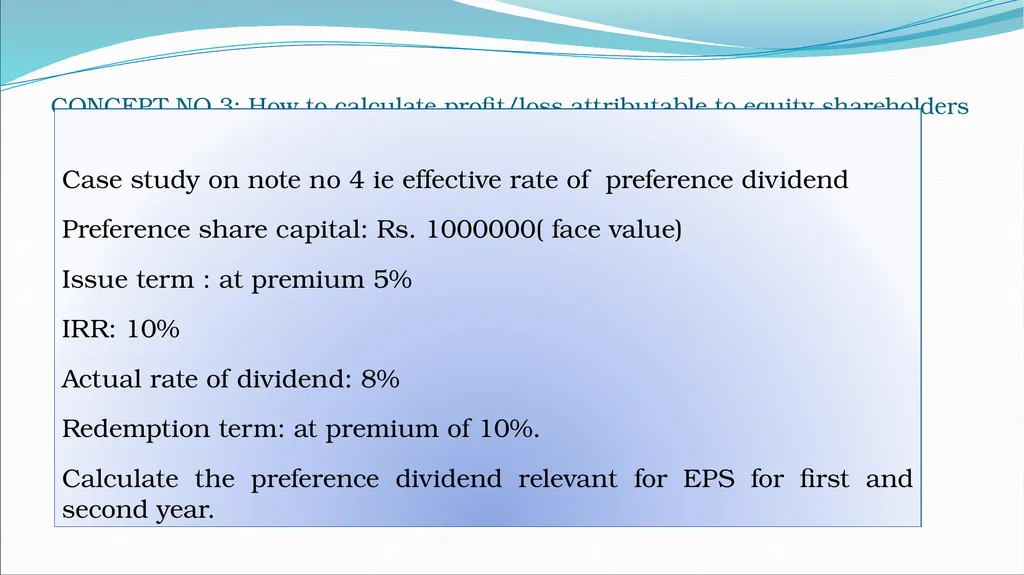
slide164. CONCEPT NO 3: How to calculate profit/loss attributable to equity shareholders Case study on note no 4 ie effective rate of preference dividend
Preference share capital: Rs. 1000000( face value)
Issue term : at premium 5%
IRR: 10%
Actual rate of dividend: 8%
Redemption term: at premium of 10%.
Calculate the preference dividend relevant for EPS for first and second year.<br>
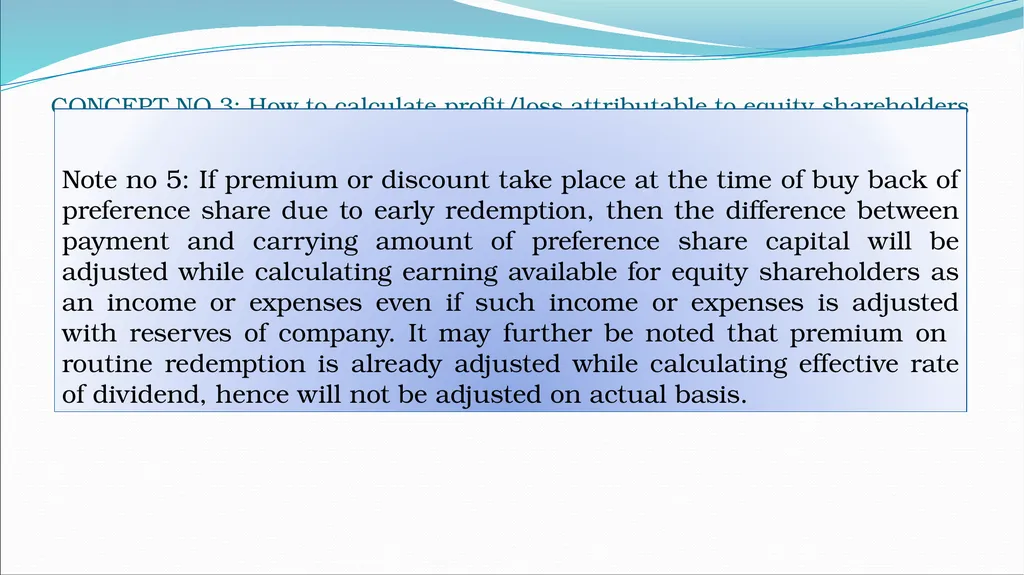
slide165. CONCEPT NO 3: How to calculate profit/loss attributable to equity shareholders Note no 5: If premium or discount take place at the time of buy back of preference share due to early redemption, then the difference between payment and carrying amount of preference share capital will be adjusted while calculating earning available for equity shareholders as an income or expenses even if such income or expenses is adjusted with reserves of company. It may further be noted that premium on routine redemption is already adjusted while calculating effective rate of dividend, hence will not be adjusted on actual basis.<br>
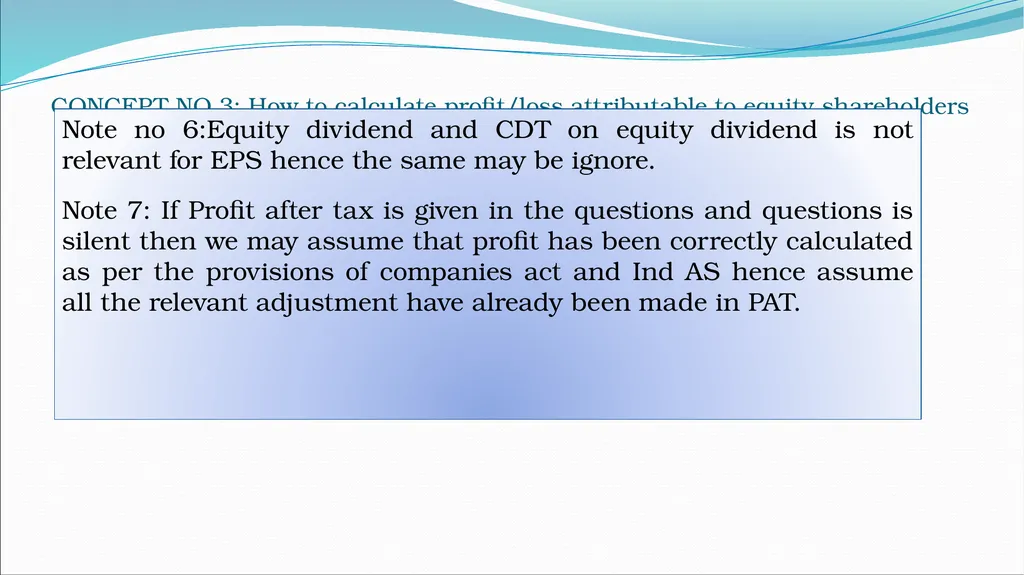
slide166. CONCEPT NO 3: How to calculate profit/loss attributable to equity shareholders Note no 6:Equity dividend and CDT on equity dividend is not relevant for EPS hence the same may be ignore.
Note 7: If Profit after tax is given in the questions and questions is silent then we may assume that profit has been correctly calculated as per the provisions of companies act and Ind AS hence assume all the relevant adjustment have already been made in PAT.<br>
slide167. Note 8: An entity that has preference shares in issue, will classify those shares as financial liabilities or equity in accordance with the principles under Ind AS 32. An adjustment is required to the profit or loss for the period, to arrive at the profit or loss attributable to ordinary equity holders for the purpose of calculating EPS, if preference shares are classified as equity. Any dividends and other appropriations would be debited directly to equity under Ind AS 32. Any dividends or other appropriations for preference shares classified as liabilities should be accounted for as finance costs in arriving at profit or loss for the period. No adjustment is required for the purpose of calculating EPS.<br>
slide168. Note 9: The amount of dividends declared in respect of the year should be deducted in arriving at the profit attributable to ordinary shareholders for preference dividends that are non-cumulative.
Note 10:The dividend for the period should be taken into account, whether or not it has been declared for cumulative preference dividends. If an entity is unable to pay or declare a cumulative preference dividend, the undeclared amount of the cumulative preference dividend should still be deducted in arriving at earnings for the purpose of the EPS calculation. The amount paid is not deducted in arriving at earnings for the purpose of the EPS calculation in the period in which arrears of cumulative preference dividends are paid.<br>
slide169. Note 11: Early conversion of convertible preference shares may be induced by an entity through favourable changes to the original conversion terms or the payment of additional consideration. The excess of the fair value of the ordinary shares or other consideration paid over the fair value of the ordinary shares issuable under the original conversion terms is a return to the preference shareholders and is deducted in calculating profit or loss attributable to ordinary equity holders of the entity.
Note 12: Preference shares may be repurchased under an entity’s tender offer to the holders. The excess of the fair value of the consideration paid to the preference shareholders over the carrying amount of the preference shares represents a return to the holders of the preference shares and a charge to retained earnings for the entity. This amount is deducted in calculating profit or loss attributable to ordinary equity holders of the entity.<br>
slide170. Note 13: Preference shares that provide for a low initial dividend to compensate an entity for selling the preference shares at a discount, or an above-market dividend in later periods to compensate investors for purchasing preference shares at a premium, are sometimes referred to as increasing rate preference shares. Any original issue discount or premium on increasing rate preference shares is amortised to retained earnings using the effective interest method and treated as a preference dividend for the purposes of calculating earnings per share (irrespective of whether such discount or premium is debited or credited to securities premium account in view of requirements of any law).
.<br>
slide171. Q 1: Which of the following is not an example of potential ordinary share
Convertible debt
Share warrant
Contingent share
Non convertible preference share
.<br>
slide172. Q 2: share issued in exchange for settlement of a liability are included the Weighted average number of equity share from the:
Date that interest ceases to accrue
Settlement date.
Acquisition date
Any of the above.
.<br>
slide173. Ind AS 34: Interim Financial Reporting(IFR)<br>
slide174. Topics/Concepts Introduction of IFR
Form and contents of IFR
Guidelines for preparation of IFR<br>
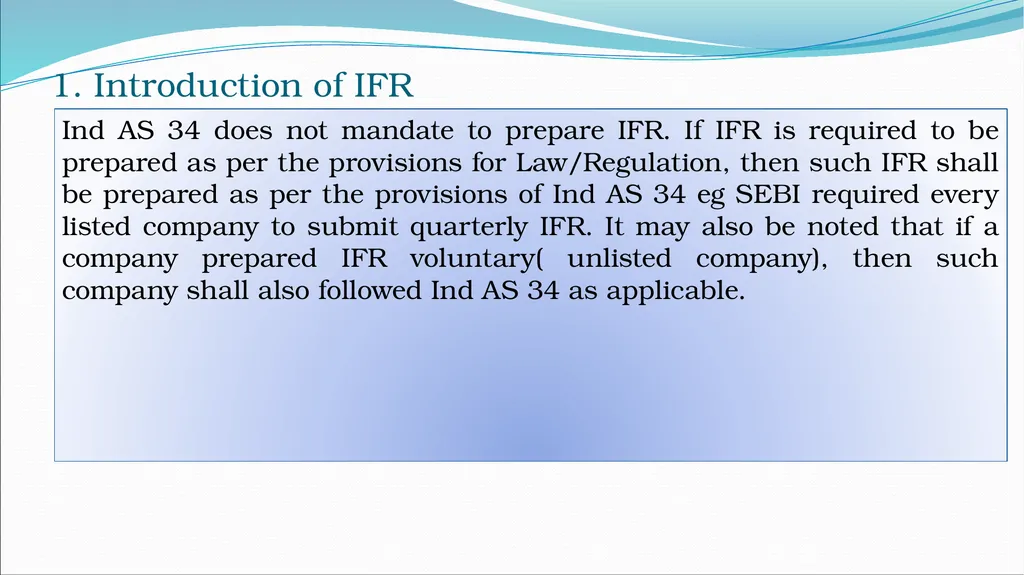
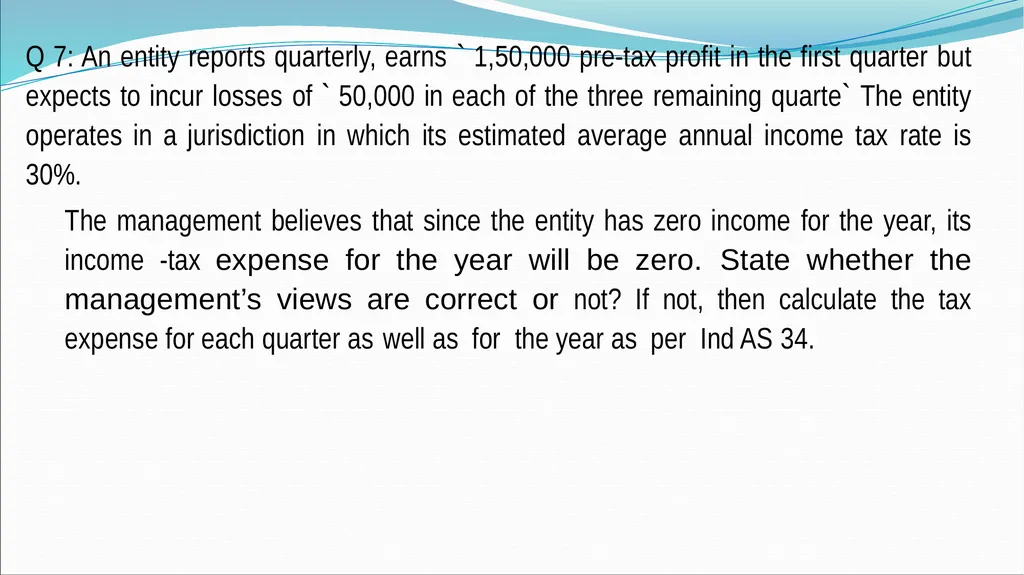
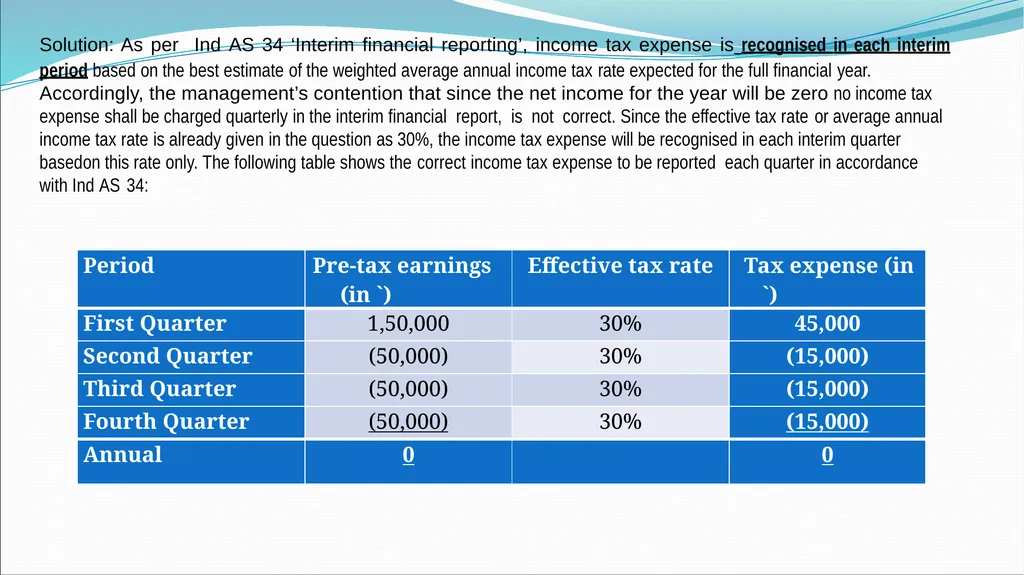
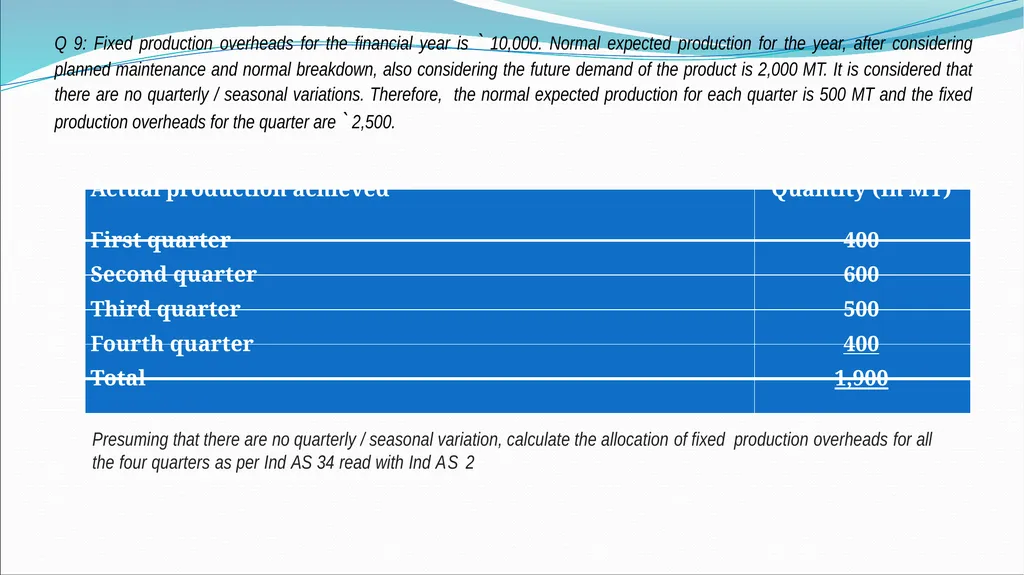
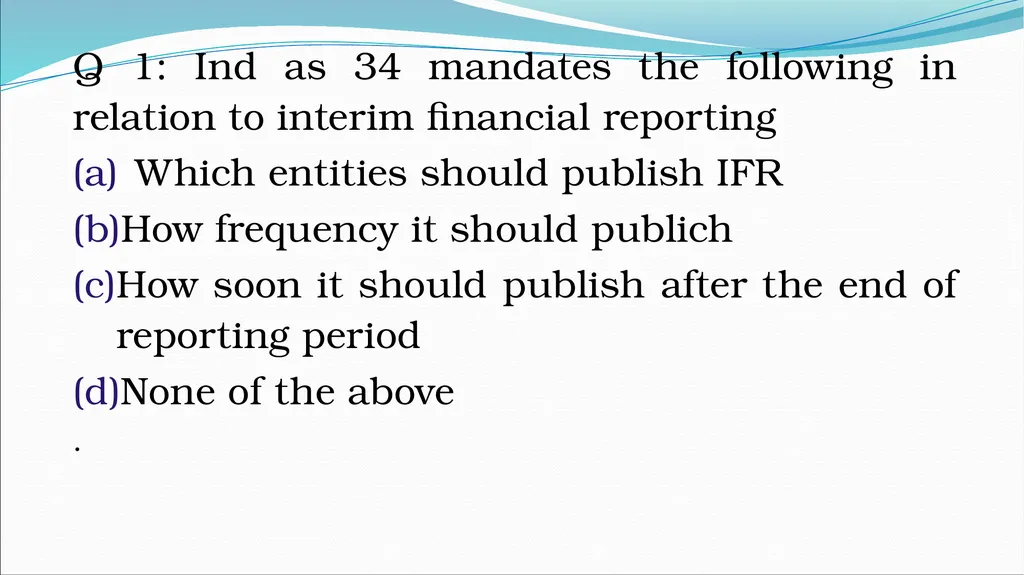
slide175. 1. Introduction of IFR Ind AS 34 does not mandate to prepare IFR. If IFR is required to be prepared as per the provisions for Law/Regulation, then such IFR shall be prepared as per the provisions of Ind AS 34 eg SEBI required every listed company to submit quarterly IFR. It may also be noted that if a company prepared IFR voluntary( unlisted company), then such company shall also followed Ind AS 34 as applicable.<br>
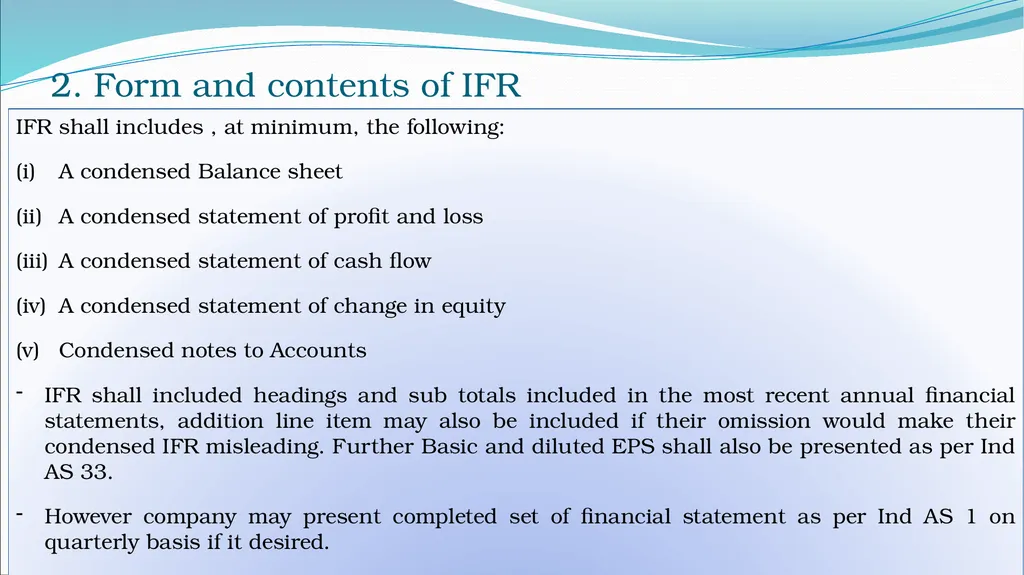
slide176. 2. Form and contents of IFR IFR shall includes , at minimum, the following:
A condensed Balance sheet
A condensed statement of profit and loss
A condensed statement of cash flow
A condensed statement of change in equity
Condensed notes to Accounts
IFR shall included headings and sub totals included in the most recent annual financial statements, addition line item may also be included if their omission would make their condensed IFR misleading. Further Basic and diluted EPS shall also be presented as per Ind AS 33.
However company may present completed set of financial statement as per Ind AS 1 on quarterly basis if it desired.<br>
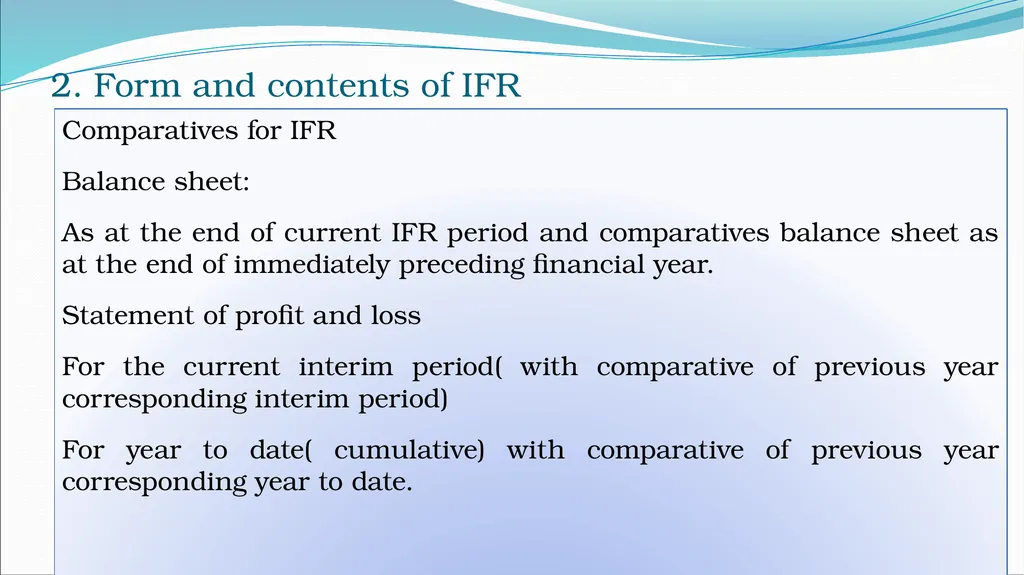
slide177. 2. Form and contents of IFR Comparatives for IFR
Balance sheet:
As at the end of current IFR period and comparatives balance sheet as at the end of immediately preceding financial year.
Statement of profit and loss
For the current interim period( with comparative of previous year corresponding interim period)
For year to date( cumulative) with comparative of previous year corresponding year to date.<br>
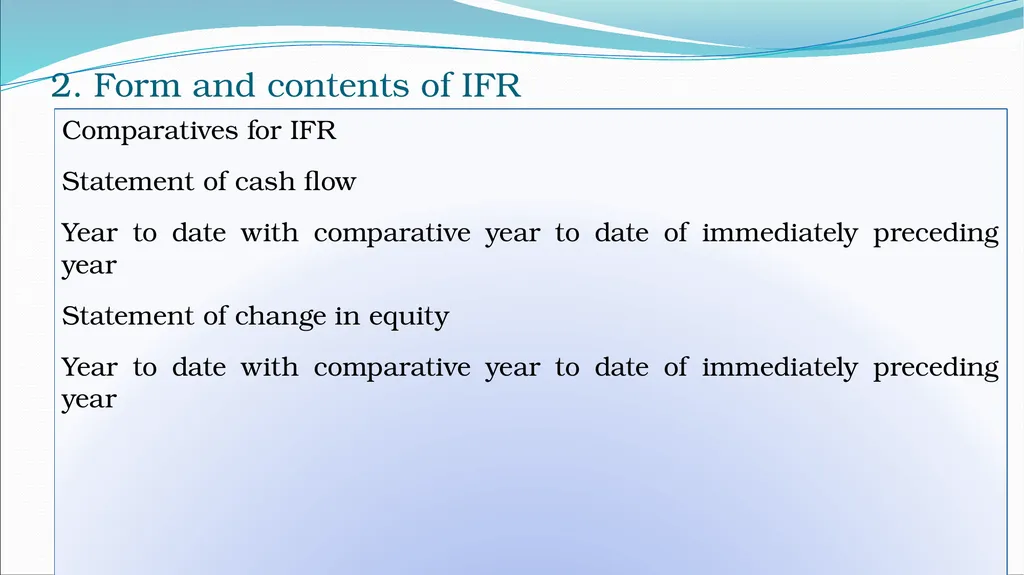
slide178. 2. Form and contents of IFR Comparatives for IFR
Statement of cash flow
Year to date with comparative year to date of immediately preceding year
Statement of change in equity
Year to date with comparative year to date of immediately preceding year<br>
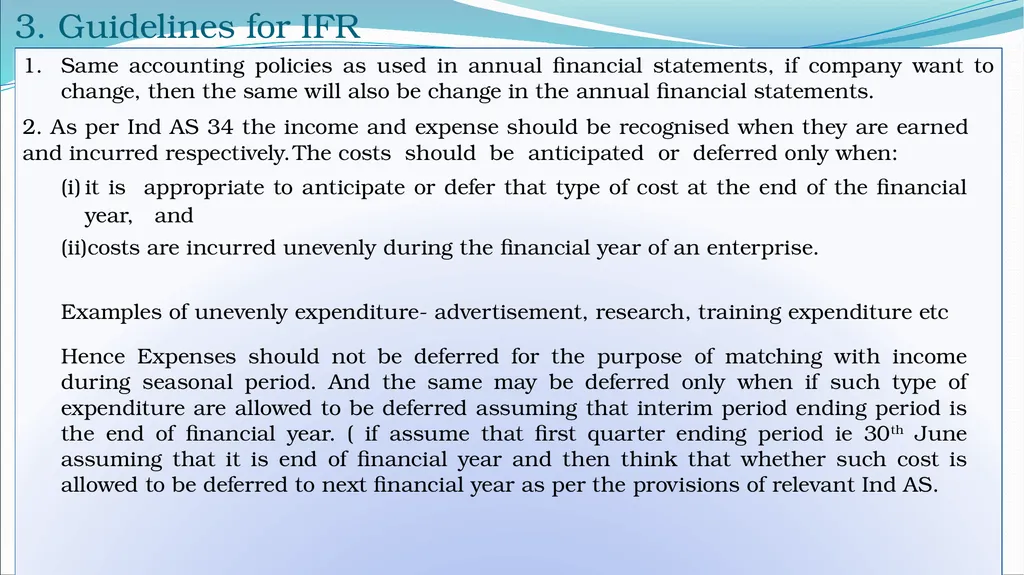
slide179. 3. Guidelines for IFR Same accounting policies as used in annual financial statements, if company want to change, then the same will also be change in the annual financial statements.
2. As per Ind AS 34 the income and expense should be recognised when they are earned and incurred respectively. The costs should be anticipated or deferred only when:
it is appropriate to anticipate or defer that type of cost at the end of the financial year, and
costs are incurred unevenly during the financial year of an enterprise.
Examples of unevenly expenditure- advertisement, research, training expenditure etc
Hence Expenses should not be deferred for the purpose of matching with income during seasonal period. And the same may be deferred only when if such type of expenditure are allowed to be deferred assuming that interim period ending period is the end of financial year. ( if assume that first quarter ending period ie 30th June assuming that it is end of financial year and then think that whether such cost is allowed to be deferred to next financial year as per the provisions of relevant Ind AS.<br>
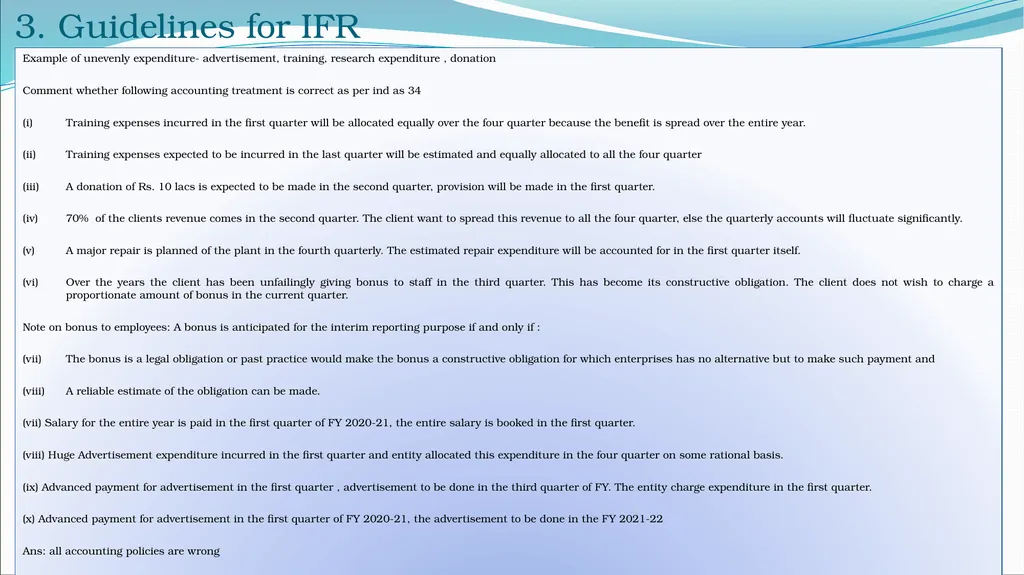
slide180. 3. Guidelines for IFR Example of unevenly expenditure- advertisement, training, research expenditure , donation
Comment whether following accounting treatment is correct as per ind as 34
Training expenses incurred in the first quarter will be allocated equally over the four quarter because the benefit is spread over the entire year.
Training expenses expected to be incurred in the last quarter will be estimated and equally allocated to all the four quarter
A donation of Rs. 10 lacs is expected to be made in the second quarter, provision will be made in the first quarter.
70% of the clients revenue comes in the second quarter. The client want to spread this revenue to all the four quarter, else the quarterly accounts will fluctuate significantly.
A major repair is planned of the plant in the fourth quarterly. The estimated repair expenditure will be accounted for in the first quarter itself.
Over the years the client has been unfailingly giving bonus to staff in the third quarter. This has become its constructive obligation. The client does not wish to charge a proportionate amount of bonus in the current quarter.
Note on bonus to employees: A bonus is anticipated for the interim reporting purpose if and only if :
The bonus is a legal obligation or past practice would make the bonus a constructive obligation for which enterprises has no alternative but to make such payment and
A reliable estimate of the obligation can be made.
(vii) Salary for the entire year is paid in the first quarter of FY 2020-21, the entire salary is booked in the first quarter.
(viii) Huge Advertisement expenditure incurred in the first quarter and entity allocated this expenditure in the four quarter on some rational basis.
(ix) Advanced payment for advertisement in the first quarter , advertisement to be done in the third quarter of FY. The entity charge expenditure in the first quarter.
(x) Advanced payment for advertisement in the first quarter of FY 2020-21, the advertisement to be done in the FY 2021-22
Ans: all accounting policies are wrong<br>
slide181. 3. Guidelines for IFR 3. Interim period income tax expense is accrued using the tax rate that would be applicable to expected total annual earnings, that is, the estimated average annual effective income tax rate applied to the pre-tax income of the interim period. Income taxes are assessed on an annual basis. Interim period income tax expense is calculated by applying to an interim period’s pre-tax income the tax rate that would be applicable to expected total annual earnings, that is, the estimated average annual effective income tax rate. if different income tax rates apply to different categories of income (such as capital gains or income earned in particular industries), to the extent practicable a separate rate is applied to each individual category of interim period pre-tax income<br>
slide182. Q 1: Company A has reported ` 60,000 as pre tax profit in first quarter and expects a loss of ` 15,000 each in the subsequent quarte` It has a corporate tax slab of 20 percent on the first ` 20,000 of annual earnings and 40 per cent on all additional earnings. Calculate the amount of tax to be shown in each quarter.
Q 2: ABC Ltd. presents interim financial report quarterly. On 1.4.20X1, ABC Ltd. has carried forward loss of ` 600 lakhs for income-tax purpose for which deferred tax asset has not been recognized. ABC Ltd. earns ` 900 lakhs in each quarter ending on 30.6.20X1, 30.9.20X1, 31.12.20X1 and 31.3.20X2 excluding the carried forward loss. Income-tax rate is expected to be 40%. Calculate the amount of tax expense to be reported in each quarter.<br>
slide183. Q 3 ICPL while preparing interim financial report for first quarter wants to defer ` 16 crores expenditure to third quarter on the argument that third quarter is having more sales therefore third quarter should be debited by more expenditure. Considering the seasonal nature of business and that the expenditures are uniform throughout all quarte`
Calculate the result of first quarter as per Ind AS 34 and comment on the company’s view<br>
slide184. Q 4: ABC Limited manufactures automobile parts. ABC Limited has shown a net profit of ` 20,00,000 for the third quarter of 20X1.
Following adjustments are made while computing the net profit:
Bad debts of ` 1,00,000 incurred during the quarter. 50% of the bad debts have been deferred to the next quarter.
Additional depreciation of ` 4,50,000 resulting from the change in the method of depreciation.
Exceptional loss of ` 28,000 incurred during the third quarter. 50% of exceptional loss have been deferred to next quarter.
` 5,00,000 expenditure on account of administrative expenses pertaining to the third quarter is deferred on the argument that the fourth quarter will have more sales; therefore fourth quarter should be debited by higher expenditure. The expenditures are uniform throughout all quarters.
Ascertain the correct net profit to be shown in the Interim Financial Report of third quarter to be presented to the Board of Directors.<br>
slide185. Q 5: Company A expects to earn ` 15,000 pre-tax profit each quarter and has a corporate tax slab of 20 percent on the first ` 20,000 of annual earnings and 40 per cent on all additional earnings. Actual earnings match expectations. Calculate the amount of income tax to be shown in each quarter.<br>
slide186. Q 6: Narayan Ltd. provides you the following information and asks you to calculate the tax expense for each quarter, assuming that there is no difference between the estimated taxable income and the estimated accounting income:
Estimated Gross Annual Income 33,00,000
(inclusive of Estimated Capital Gains of ` 8,00,000)
Estimated Income of Quarter I is ` 7,00,000, Quarter II is ` 8,00,000, Quarter III (including Estimated Capital Gains of ` 8,00,000) is ` 12,00,000 and Quarter IV is ` 6,00,000<br>
slide187. Q 7: An entity reports quarterly, earns ` 1,50,000 pre-tax profit in the first quarter but expects to incur losses of ` 50,000 in each of the three remaining quarte` The entity operates in a jurisdiction in which its estimated average annual income tax rate is 30%.
The management believes that since the entity has zero income for the year, its income -tax expense for the year will be zero. State whether the management’s views are correct or not? If not, then calculate the tax expense for each quarter as well as for the year as per Ind AS 34.<br>
slide188. Solution: As per Ind AS 34 ‘Interim financial reporting’, income tax expense is recognised in each interim period based on the best estimate of the weighted average annual income tax rate expected for the full financial year.
Accordingly, the management’s contention that since the net income for the year will be zero no income tax expense shall be charged quarterly in the interim financial report, is not correct. Since the effective tax rate or average annual income tax rate is already given in the question as 30%, the income tax expense will be recognised in each interim quarter basedon this rate only. The following table shows the correct income tax expense to be reported each quarter in accordance with Ind AS 34:<br>
slide189. Q 8: Due to decline in market price in second quarter, Happy India Ltd. incurred an inventory loss. The Market price is expected to return to previous levels by the end of the year. At the end of year, the decline had not reversed. When should the loss be reported in interim statement of profit and loss of Happy India Ltd.?
Ans: Loss should be recongised in the second quarter of the year.<br>
slide190. Q 9: Fixed production overheads for the financial year is ` 10,000. Normal expected production for the year, after considering planned maintenance and normal breakdown, also considering the future demand of the product is 2,000 MT. It is considered that there are no quarterly / seasonal variations. Therefore, the normal expected production for each quarter is 500 MT and the fixed production overheads for the quarter are ` 2,500. Presuming that there are no quarterly / seasonal variation, calculate the allocation of fixed production overheads for all the four quarters as per Ind AS 34 read with Ind AS 2<br>
slide191. Q 1: Ind as 34 mandates the following in relation to interim financial reporting
Which entities should publish IFR
How frequency it should publich
How soon it should publish after the end of reporting period
None of the above
.<br>
slide192. Q 2: The standard defines Interim financial report as a financial report for an interim period that contains a set of …… financial statement
Complete
Condensed
Complete of condensed.
None of the above
.<br>
slide193. Ind AS 36: Impairment of Asset<br>
slide194. Target of Ind AS 36: Impairment of Asset
A: Impairment of Individual asset
Impairment of individual asset
Reversal of Impairment loss
Out of scope
Indication of impairment
Concept of cash flow
Concept of fair value
B: Impairment of Group of Assets i.e Cash generating units( CGUs)
Impairment of Cash Generating units
Reversal of impairment of CGUs
Treatment of Goodwill
Treatment of corporate assets/HO Assets
C: Miscellaneous points<br>
slide195. Target of Ind AS 36: Impairment of Asset
A: Impairment of Individual asset
Impairment of individual asset
As per Ind AS 36, impairment means reduction in the value of asset. Whenever carrying amount of asset exceeds the recoverable amount, the difference in known as impairment loss.
Impairment loss=Carrying amount less Recoverable amount<br>
slide196. Carrying amount
Carrying amount means book value/Balance sheet value of asset after deducting accumulated depreciation & accumulated impairment loss on the date of impairment
Recoverable amount=
Net fair value( net of disposal cost) or Value in use( PV of future expected cash flow)
Which ever is higher<br>
slide197. Journal entries in the books of companies
Impairment loss A/c Dr
To provision for impairment loss
Statement of profit and loss Dr
To impairment loss
It may be noted that in future depreciation will be changed on revised carrying amount.<br>
slide198. (ii) Reversal of impairment loss
(!)The increased carrying amount of an asset other then goodwill attributable to a reversal of an impairment loss shall not exceed the carrying amount that would have been determined (net of amortisation or depreciation) had no impairment loss been recognised for the asset in prior years. Any increase in excess of this amount would be a revaluation and would be accounted for under the appropriate Standard (e.g. Ind AS 16 Property, Plant and Equipment).
(2) A reversal of an impairment loss for an asset other than goodwill is recognised immediately in profit or loss, unless the asset is carried at revalued amount in accordance with another Indian Accounting Standard. Any reversal of an impairment loss of a revalued asset shall be treated as a revaluation increase in accordance with that other Indian Accounting Standard.
(3) A reversal of an impairment loss on a revalued asset is recognised in other comprehensive income and increases the revaluation surplus for that asset. However, to the extent that an impairment loss on the same revalued asset was previously recognised in profit or loss, a reversal of that impairment loss is also recognised in profit or loss.
(4) After a reversal of an impairment loss is recognised, the depreciation (amortisation) charge for the asset is adjusted in future periods to allocate the asset’s revised carrying amount, less its residual value (if any), on a systematic basis over its remaining useful life.<br>
slide199. Case study 1:
Cost of asset on 1/4/2017: Rs. 10000
Estimated useful life: 10 years
Salvage value : Nil
Recoverable amount as on 31/3/2018-Rs. 7000
Recoverable amount as on 31/3/2020-Rs. 9000
Calculate impairment loss in 2017-18 and reversal of impairment loss in 2019-20<br>
slide200. Important note
Impairment loss will be adjusted with revaluation surplus on priority basis and the balances of loss of any will be transferred to statement of profit and loss<br>
slide201. (iii) Out of scope
Assets out of scope of Ind AS 36
Inventories ( Ind AS 2)
Investment held for retirement of employees ( Ind AS 19-Employee benefits)
Deferred tax assets( Ind AS 12-Income tax)
Biological asset measured at Fair value less cost to sell( Ind AS 41)
Financial instruments( Ind AS 109)
Non current asset held for sale( Ind AS 105)
Contract assets ( Ind AS 115)<br>
slide202. (iv) Indication of Impairment
An entity shall assess at the end of each reporting period whether there is any indication that an asset may be impaired. If any such indication exists, the entity is required to estimate the recoverable amount of the asset. The indication can be divided into the following two categories
External indicators( from market)
Internal indicators( judgement of management)<br>
slide203. External indicator
Technology changes
Increase in discounting factor
Legal restrictions/Government restrictions regarding use of asset
Decrease in market price
(2) Internal indicator
Physical damage
Poor maintenance policy
Shortage of skilled staff
Cash flow is less than expected<br>
slide204. Important points:
Impairment loss will be checked only when indicators exists
Indicators does not mean there is always impairment loss
There will be annual test of following three assets whether indicator exist or not
Goodwill acquired under business combination ( Ind AS 103)
Intangible asset not in use
Intangible asset having unlimited useful life.<br>
slide205. (v) Concept of Cash flow
Value in use= Expected cash flowX PV factor
Case 1: if cash flow estimate in range says 5000-7000 then
Take average Rs. 6000
Case 2: if probability factor is given in Q, then apply that factor while calculating expected cash flow.<br>
slide206. Case 3: asset located in foreign country
Expected cash flow= Foreign currency cash flow X exchange rate on the date when impairment loss is calculated
Case 4: Projections should cover a maximum period of five years, unless a longer period can be justified.
As per Ind AS 36, and enterprises should not estimate cash flow beyond 5 years. It means if useful life of asset is higher than five year then salvage value should also be assumed at the end of five year.
If more than 5 year cash flow is given in question, then follow Question<br>
slide207. Case 5: PV factor should be based on Weighted average cost of capital of company , however if WACC is not available then incremental borrowing rate of company may be taken as discounting factor.<br>
slide208. (vi) Concept of Fair value
Recoverable amount= net fair value or value in use which ever is higher
Net fair value
Recent transaction price ( first preference)
Check active market
If above two not available then ignore net fair value and calculate Recoverable amount on the basis of value in use only.<br>
slide209. Q 1: Which of the following is not covered by Ind AS 36
Deferred tax asset
Inventory
Financial asset
All of the above
.<br>
slide210. Q 2: Recoverable amount of an asset of cash generating unit is
Higher of fair value less cost of disposal and value in use.
Lower of net realizable value and cost
Higher of fair value and value in use
Higher of market value and value in use
.<br>
slide211. Ind AS 37: Provisions, Contingent Liabilities and Contingent Assets<br>
slide212. CONCEPTS Introduction of Ind AS 37
Scope and out of scope
Important terms used in Ind AS 37
Provisions
Contingent Liabilities
Contingent assets
Miscellanesous points<br>
slide213. Concept 1: Introduction of Ind AS 37
Ind AS 37 deals with recognition/Measurement/Disclosure for the following three:
Provisions( related with increase in liabilities and not related with decrease in assets)
Contingent liabilities &
Contingent assets<br>
slide214. Concept 2: Scope and out of scope of Ind AS 37 Ind AS 37 should be applied by all entities in accounting for provisions, contingent liabilities and contingent assets, except:
those resulting from executory contracts, except where the contract is onerous; and
financial instruments (including guarantees) that are within the scope of Ind AS 109, Financial Instruments;
those covered by another Standard such as:
revenue from contracts with customers covered by Ind AS 115. However, Ind AS 115 contains no specific requirement to address onerous contracts with customers. Hence, Ind AS 37 applies to such cases;
income taxes (Ind AS 12, Income Taxes);
leases (Ind AS 116, Leases). However, this Standard applies to any lease that becomes onerous before the commencement date of the lease as defined in Ind AS 116. This Standard also applies to short-term leases and leases for which the underlying asset is of low value accounted for in accordance with paragraph 6 of Ind AS 116 and that have become onerous;
employee benefits (Ind AS 19, Employee Benefits); and
Contingent consideration of an acquirer in a business combination (Ind AS 103,
Business Combinations)
(vi) Provisions related with assets eg provision for doubtful debts, provision for depreciation, provisions for impairment etc)<br>
slide215. Important notes regarding concept 2
Executory Contracts
Executory contracts are contracts under which
neither party has performed any of its obligations or
both parties have partially performed their obligations to an equal extent.
Note: Ind AS 37 is applied to executory contracts only if they are onerous. For example, a long- term purchase contract that has a higher unit cost than unit sales price.<br>
slide216. Example for Executory Contracts: On 1 April 20X2, Company XYZ Limited enters into a contract with Company PQR Limited for the manufacture and delivery of 200 units of component A at five different dates in the future, i.e. 1,000 units are to be delivered in total. Payment is due on delivery of the units. On 1 April 20X2, the contract between Company XYZ Limited and Company PQR Limited is executory because neither party has performed any of its obligations; Company XYZ Limited has not manufactured or delivered any of the units, nor has Company PQR Limited paid for any of them.
By 1 June 20X2, Company XYZ Limited has produced and delivered 400 of the units and Company PQR Limited has paid in full for those 400 units. At this date, the contract between Company XYZ Limited and Company PQR Limited continues to be executory because both parties have partially performed their obligations to an equal extent.
By 1 September 20X2, Company XYZ Limited has produced and delivered the full 1000 units, but Company PQR Limited has only paid for 800 units in total. The contract between Company XYZ Limited and Company PQR Limited no longer meets the definition of an executory contract because the two parties have not performed under the terms of the contract to an equal extent. Company PQR Limited is required to recognise a liability for the final 200 units of component A for which it has not yet paid.<br>
slide217. Onerous contracts: An onerous contract is a contract in which the unavoidable costs of meeting the obligations under the contract exceed the economic benefits expected to be received under it.<br>
slide218. Concept 3: Important Terms used in Ind AS 37
A provision is a liability of uncertain timing & amount
(ii) A liability is a present obligation( legal or constructive obligation that is created by obligating event) of the entity arising from past events, the settlement of which is expected to result in an outflow from the entity of resources embodying economic benefits.
(iii) An obligating event is an event that creates a legal or constructive obligation that results in an entity having no realistic alternative to settling that obligation.
Example for obligative event: X Ltd. entered into a contract with Y Ltd. for supply of some material. As per the terms of contract in case of breach of contract, the party who breaches the contract has to pay Rs. 50,00,000 to other party. X Ltd. breached the contract with Y Ltd. Now in this case the obligating event is the breach of contract that gave rise to present obligation and X Ltd. must settle the obligation.<br>
slide219. Concept 3: Important Terms used in Ind AS 37
(iv) A legal obligation is an obligation that derives from :
A contract or
Legislation or Other operation of law
(v) A constructive obligation is an obligation that derives from an entity’s action where:
By an established pattern of past practice , published policies or a sufficient specific current statement , the entity has indicated to other parties that it will accept certain responsibilities and
As a result, the entity has created a valid expectation on the part of those other parties that it will discharge those responsibilities.<br>
slide220. Example of constructive obligation : X Ltd. is engaged in the manufacture of fertilisers. Effluents discharged in the manufacturing process have polluted the river near the manufacturing plant. The residents of the nearby locality launched a massive agitation against the pollution. X Ltd. agreed to their demands to reduce the water pollution by installing the necessary Effluent Treatment Plant. However, during the year no steps are taken to install the plant. No legislation requiring the company to reduce its pollution is in existence. In this case, though there is no law but by promising to take steps to reduce pollution, X Ltd. has created a valid expectation on the part of public that it will discharge its responsibilities. So the obligation in this case is a constructive obligation.<br>
slide221. Example of constructive obligation: An entity has prepared a formal plan for a re-organisation involving site closures and redundancies. The plan has been approved by the board at the year end, but the entity will not implement or announce the re-organisation until after the year end. There is no constructive obligation, even if there is an announcement after the entity’s year end but before its financial statements are approved. The announcement is a non-adjusting post balance sheet event and there was no commitment to restructure at the year end. The entity could change its plans completely after the year end.<br>
slide222. (vi) A contingent liability is:
a possible obligation that arises from past events and whose existence will be confirmed only by the occurrence or non-occurrence of one or more uncertain future events not wholly within the control of the entity; or
a present obligation that arises from past events but is not recognised because:
(i) it is not probable that an outflow of resources embodying economic benefits will be required to settle the obligation; or
(ii) the amount of the obligation cannot be measured with
sufficient reliability.<br>
slide223. Example for contingent liabilities: A tax case pending before the court, the liability for payment arising or not in respect of which depends on the outcome of court decision is a possible obligation that arises from past events and whose existence will be confirmed only by the occurrence or non-occurrence of one or more uncertain future events not wholly within the control of the entity.<br>
slide224. (vii) A contingent asset is a possible asset that arises from past events and whose existence will be confirmed only by the occurrence or non-occurrence of one or more uncertain future events not wholly within the control of the entity.<br>
slide225. Example for contingent assets: X Ltd. filed a legal suit against a supplier of goods for
compensation against damages on non–supply of contracted goods. This meets the
definition of a contingent asset since there is a possible asset (compensation against
damages) that arose from past event (contract with the supplier) and whose existence will
be confirmed by the occurrence or non- occurrence of uncertain future event not wholly
within the control of the entity (i.e., the outcome of the leg suit).<br>
slide226. Q 1: Provision shall be recognized for future operating loss
True
False
.<br>
slide227. Q2: A present obligation under onerous contract shall be recognized and measured as
Liability
Provisions
Contingent liability
expenses
.<br>
slide228. Ind AS 38: Intangible Assets<br>
slide229. Target of Ind AS 38: Intangible assets
Seven Test of Intangible Asset
Out of Scope
Initial recognition
Subsequent recognition
Model for Presentation
Amortization
Disposal of Intangible Asset
Disclosures
Miscellaneous point<br>
slide230. Definition of Intangible Assets
Following conditions must be fulfilled to present asset as Intangible asset in the balance sheet
Without physical substance( from definition of IA)
Non monetary asset
Identifiable
Control by enterprises( definition of asset as per framework)
Future economic benefits are expected to flow to the enterprises( definition of Asset as per framework)
Cost can be measured reliably( recognition criteria as per framework)
Value should be material( concept of materiality as per Framework)<br>
slide231. Definition of Intangible asset
An Intangible asset(i) is an identifiable(ii) non-monetary asset(iii) without physical substance(iv).<br>
slide232. Definition of Intangible asset
Definition of Asset( as per Framework)
An asset is a resource
Controlled by an entity as a result of past events and
From which future economic benefits are expected to flow to the entity<br>
slide233. Definition of Intangible asset
Key word 1: Without physical substance
Some intangible assets may be contained in or on a physical substance such as a compact disc (in the case of computer software), Pen drive, legal documentation (in the case of a licence or patent) or film. In determining whether an asset that incorporates both tangible and intangible elements should be treated under Ind AS 16, Property, Plant and Equipment, or as an intangible asset under this Standard, an entity uses judgement to assess which element is more significant<br>
slide234. Definition of Intangible asset
Key word 1: Without physical substance
Example: computer software for a computer-controlled machine tool that cannot operate without that specific software is an integral part of the related hardware and it is treated as property, plant and equipment. The same applies to the operating system of a computer. When the software is not an integral part of the related hardware, computer software may be treated as an intangible asset.<br>
slide235. Definition of Intangible asset
Key words 2: Non Monetary Assets
Ind AS 38 defines monetary asset and asset which is not monetary is known as non monetary asset
Monetary asset( As per Ind As 38-Intangible Asset) are money held and assets to be received in fixed or determinable amounts of money.<br>
slide236. Definition of Intangible asset
Key words 3: Identifiable
An asset is identifiable if it either:
is separable, ie is capable of being separated or divided from the entity and sold, transferred, licensed, rented or exchanged, either individually or together with a related contract, identifiable asset or liability, regardless of whether the entity intends to do so; or
arises from contractual or other legal rights, regardless of whether those rights are transferable or separable from the entity or from other rights and obligations.<br>
slide237. Definition of Intangible asset
Q 1: Sun Ltd has an expertise in the consulting business. In years gone by, the Company gained a 30% market share for its services business and intends to recognizes it as an intangible asset. Is the action by Company justified?
Ans: Market share does not meet the definition of intangible assets as is not identifiable i.e. it is neither separable and nor has arisen from contractual or legal rights.<br>
slide238. Definition of Intangible asset
Key words 4: Control by enterprises
Control means( as per Framework):
Power to obtain the future economic benefits from asset &
Power to restricts the access of other<br>
slide239. Definition of Intangible asset
Example( Control) : In the following no intangible asset can be be recognized as condition of control not fulfilled:
Skill of emplyees
Training cost for employees for Ind AS
Speicific management or technical talent unless it is protected by legal rights to use it or to obtain the future economic benefits
Good customer relations
Good share in the market<br>
slide240. Definition of Intangible asset
Q 2: Company XYZ ltd has provided training to its staff on various new topics like GST, Ind AS etc. to ensure the compliance as per the required law. Can the company recognise such cost of staff training as intangible asset?
Ans: It is clear that the company will obtain the economic benefits from the work performed by the staff as it increases their efficiency. But it does not have control over them because staff could choose to resign the company at any time.Hence the company lacks the ability to restrict the access of others to those benefits. Therefore, the staff training cost does not meet the definition of an intangible asset.<br>
slide241. Definition of Intangible asset
Key words 5: Future Economic benefits are expected to flow to the enterprises
Future Economic Benefits( as per Framework)
Future economic benefits includes the following:
Revenue from the sale of product generated through use of asset
Revenue from rendering services generated through use of asset
Cost saving ( use of intellectual property in a production process and reduce production cost)
Other administrative benifits<br>
slide242. Definition of Intangible asset
Q 3: Pluto Ltd. intends to open a new retail store in a new location in the next few weeks. Pluto Ltd has spent a substantial sum on a series of television advertisements to promote this new store. The Company has paid an amount of Rs. 800,000 for advertisements before 31st March, 20X1. Rs. 700,000 of this sum relates to advertisements shown before 31st March, 20X1 and Rs. 100,000 to advertisements shown in April, 20X1. Since 31st March, 20X1, the Company has paid for further advertisements costing Rs. 400,000.
Pluto Ltd is of view that such costs can be carried forward as intangible assets. Since market research indicates that this new store is likely to be highly successful. Please explain and justify the treatment of the above costs in the financial statements for the year ended 31st March, 20X1.<br>
slide243. Definition of Intangible asset
Solution: Under Ind AS 38 – Intangible Assets – intangible assets can only be recognised if they are identifiable and have a cost which can be reliably measured.
These criteria are very difficult to satisfy for internally developed intangibles.
For these reasons, Ind AS 38 specifically prohibits recognising advertising expenditure as an intangible asset. The issue of how successful the store is likely to be does not affect this prohibition. Therefore, such costs should be recognised as expenses.
However, the costs would be recognised on accrual basis. Therefore, of the advertisements paid for before 31st March, 20X1, Rs. 7,00,000 would be recognised as an expense and Rs. 1,00,000 as a pre-payment in the year ended 31st March, 20X1. The Rs. 4,00,000 cost of advertisements paid for since 31st March, 20X1 would be charged as expenses in the year ended 31st March, 20X2.<br>
slide244. Definition of Intangible asset
Key words 6: Cost can be measured reliably
Self generated goodwill not recognized in the books as cost cannot be measured reliably
Key word 7: Materiality
Immaterial item may be charged to the statement of profit and loss<br>
slide245. If an item within the scope of this Standard does not meet the definition of an intangible asset, expenditure to acquire it or generate it internally is recognised as an expense when it is incurred.<br>
slide246. (2) Out of Scope
Following asset not covered under Ind AS 38
IA held for sale in ordinary course of business( tally soft for tally solution pvt ltd- apply Ind AS 2-Inventories)
Non current asset held for sale( Ind AS 105: Non current asset held for sale and discontinued operations)
Deferred tax assets( Ind AS 12-Income tax)
IA generated through lease contracts( Ind AS 116: Leases)
Goodwill arising through Business combination( Ind AS 103: Business Combination)
Intangible asset covered under Ind AS 19-Employees benefits<br>
slide247. ((3) Initial recognition
Intangible asset should be measured initially at COST
Cost is the amount of cash or cash equivalents paid or the fair value of other consideration given to acquire an asset at the time of its acquisition or construction
How to calculate cost under following different mode of acquisition of IA
Purchase from open market
In House development of IA
IA acquired by exchange
IA acquired through Government Grant<br>
slide248. IA purchase from open market
Following cost shall be capitalize in Intangible asset
Purchase price( net of trade discount/volume rebate)
Non refundable taxes
Brokerage/commission related with acquisition
Registration fees
Legal fees
Professional fees for installation
Employee benefit cost( Ind AS 19-employee benefits) arising directly from brining the IA to its working condition
Cost of testing
any other directly attributable cost of preparing the IA for its intended use<br>
slide249. IA purchase from open market
Following cost shall not be capitalize in Intangible asset but it will be charged to the statement of profit and loss
Staff training cost( as no control over staff skills)
Advertisement expenses
Administrative/selling/general overheads
Abnormal cost
Start up cost/Inaugration cost
Ceremony cost
Initial operating losses due to interruption in production activities on account of training of staff for implementation of Intangible asset. It means these are initial losses at the time of adoption of new technology
Borrowing cost unless criteria of Ind AS 23: Borrowing cost is met
Finance charges in case of deferred payment<br>
slide250. IA purchase from open market
Note on Deferred payment
If payment for an intangible asset is deferred beyond normal credit terms, then cost of such Intangible asset is the cash price equivalent. The difference between this amount and the total payments is recognised as interest expense over the period of credit unless it is capitalised in accordance with Ind AS 23, Borrowing Costs. Treatment is same as discussed in Ind AS 16: PPE<br>
slide251. Q 1: Which of the following is not covered with in the scope of ind as 38
Intangible asset held for sale in the ordinary course of business
Asset arising from employee benefits
Non current intangible asset held for sale
All of the above.<br>
slide252. Q 2: Intangible asset is an identifiable ……
Non monetary asset with physical substance
Monetary asset without physical substance.
Non monetary asset without physical substance
Monetary with physical substance<br>
slide253. Ind AS 40: Investment Property<br>
slide254. Target of Ind AS 40: Investment Property
Meaning of Investment Property
Initial recognition
Subsequent recognition
Model for Presentation
Transfer to/from other Ind AS
Amortization
Disposal of Intangible Asset
Disclosures
Miscellaneous point<br>
slide255. Meaning of Investment Property
Investment property is property (land or a building—or part of a building—or both) held (by the owner or by the lessee as a right-of-use asset) to earn rentals or for capital appreciation or both, rather than for:
(a) use in the production or supply of goods or services or for administrative purposes; or
(b) sale in the ordinary course of business.
Property mentioned in (a) above would be covered under Ind AS 16 ‘Property, Plant and Equipment’ and property specified in (b) above would be dealt with under Ind AS 2 ‘Inventories’.<br>
slide256. Note 1: Examples of Investment property
Building purchase for rental purpose( even if it is not actually rented out it means TO LET board may be displayed.
Flat purchase for rental purpose
Land purchase for capital appreciation purpose
Building/Flat purchase for capital appreciation purpose
Land held for undetermined purpose( Ind AS-40)
Land held for long term capital appreciation rather than for short-term sale in the ordinary course of business.
a building owned by the entity (or a right-of-use asset relating to a building held by the entity) and leased out under one or more operating leases.
a building that is vacant but is held to be leased out under one or more operating leases.
property that is being constructed or developed for future use as investment property.
Important note: if you buy a land and you intend to build some production hall for your own purposes , sometime in the future, then this land is not an investment property but treated as owner occupied property . Hence Ind AS 16 will be applicable.<br>
slide257. Note no 2: applicability of different Ind AS on building
If Building is held for use in production/administration/distribution of goods purpose)- then apply Ind AS-16: Property, Plant & Equipment
If Building is held for sale in ordinary course of business( DLF/Property dealer)- then apply Ind AS-2: Inventories
If building is held for rental or capital appreciation-then apply Ind AS-40: Investment Property
If building which was originally held for rental or capital appreciation and latter on held for sale-Then apply Ind AS-105: Non Current Asset held for sale and discontinued operations<br>
slide258. (v) If building was given to lessee under operating lease agreement-Then apply Ind AS- 40: Investment property, for recognition and measurement of Building and apply Ind AS-116: Leases for recognition of rental income, apply Ind 36: Impairment of asset for recognition of impairment loss and apply the provisions for Ind AS 16: Property, Plant and equipment for charging depreciation on Building.
(vi) If Building was given to lessee under finance lease agreement-then building shall be derecognized in the books of lessor and recognized in the books of Lessee. If lessee held such building for use in business then asset shall be recognized as per the provisions of Ind AS-116:Leases and if lessee held such building as investment property then such building shall be recognized as per the provisions of Ind AS-40.<br>
slide259. (vii) If Building held for rental then apply Ind AS-40: Investment Property and if Other asset eg plant and machinery/Furniture held for rental then apply Ind AS-16: Property, Plant & Equipment.
(viii) Building occupied by employees as residential house whether or not the employees pay rent at market rates( Ind AS 16)
(ix) Building held for undermined purpose( Ind AS 40)
(x) Building constructed by the contractor on behalf of contractee ( Ind AS 115: Revenue from contract with customers)<br>
slide260. Important points regarding meaning of Investment property
Nature of Investment property
Investment property is held to earn rentals or for capital appreciation or both. Therefore, an investment property generates cash flows largely independent of the other assets held by an entity. This distinguishes investment property from owner-occupied property.
Owner-occupied property is property held (by the owner or by the lessee as a right-of-use asset) for use in the production or supply of goods or services or for administrative purposes.
Ind AS 16 ‘Property, Plant and Equipment’ applies to owner-occupied property and Ind AS 116 ‘Leases’ applies to owner-occupied property held by a lessee as a right-of-use asset.<br>
slide261. This distinguishes investment property from owner-occupied property. Accordingly, investment properties could represent a cash generating unit since they generate cash inflows that are largely independent of the cash inflows from other assets or group of assets, thus meeting the definition of cash generating unit laid down in Ind AS 36, ‘Impairment of Assets’.<br>
slide262. (2) Property held for more than one purpose
In circumstances when property is held partly for capital appreciation and/or rentals, and partly for production or supply of goods or services or for administrative purposes, the two parts are accounted for separately if they could be sold, or leased out separately under a finance lease, separately. If they could not be sold (or leased out under a finance lease) separately, the property is accounted for as an investment property only if an insignificant portion is held for use in the production or supply of goods or services or for administrative purpose.<br>
slide263. Example 1: Sun Ltd owns a building having 15 floors of which it uses 5 floors for its office; the remaining 10 floors are leased out to tenants under operating leases. According to law company could sell legal title to the 10 floors while retaining legal title to the other 5 floors.
In the given scenario, the remaining 10 floors should be classified as investment property since they are able to split the title between the floors.<br>
slide264. Example 2: Moon Ltd uses 35% of the office floor space of the building as its head office. It leases the remaining 65% to tenants, but it is unable to sell the tenant’s space or to enter into finance leases related solely to it.
Therefore, the company should not classify the property as an investment property as the 35% of the floor space used by the company is significant. So the property should be classified as owner occupied property ( PPE) and Ind AS 16 will be applicable<br>
slide265. Example 3: An entity owns a hotel, which includes a health and fitness centre, housed in a separate building that is part of the premises of the entire hotel. The owner operates the hotel and other facilities on the hotel with the exception of the health and fitness centre, which can be sold or leased out under a finance lease. The health and fitness centre will be leased to an independent operator. The entity has no further involvement in the health and fitness centre. In this scenario, management should classify the hotel and other facilities as property, plant and equipment in accordance with Ind AS 16 and the health and fitness centre as investment property under Ind AS 40.
If the health and fitness centre could not be sold or leased out separately on a finance lease, then because the owner-occupied portion is not insignificant, the whole property would be treated as an owner-occupied property.<br>
slide266. (3) Ancillary services
If ancillary services are provided by an owner to the tenant( ie securities, repairs etc) then it will not effect on classification of Property but this concept shall not be applied on building held for hotel business. It means that land and building of hotel may be classified as a PPE.
In some cases, an entity provides ancillary services to the occupants of a property it holds. An entity treats such a property as investment property if the services are insignificant to the arrangement as a whole. An example is when the owner of an office building provides security and maintenance services to the lessees who occupy the building.<br>
slide267. In other cases, the services provided are significant. For example, if an entity owns and manages a hotel, services provided to guests are significant to the arrangement as a whole. Therefore, an owner-managed hotel is owner-occupied property, rather than investment property.<br>
slide268. Difficulty in deciding classification under investment property
It may be difficult to determine whether ancillary services are so significant that a property does not qualify as investment property. For example, the owner of a hotel sometimes transfers some responsibilities to third parties under a management contract. The terms of such contracts vary widely. At one end of the spectrum, the owner’s position may, in substance, be that of a passive investor. At the other end of the spectrum, the owner may simply have outsourced day-to-day functions while retaining significant exposure to variation in the cash flows generated by the operations of the hotel. Judgement is needed to determine whether a property qualifies as investment property.<br>
slide269. (4) Property leased to other group members – treatment of same asset differently in the individual financial statements and the consolidated financial statements
In some cases, an entity owns property that is leased to, and occupied by, its parent or another subsidiary. The property does not qualify as investment property in the consolidated financial statements, because the property is owner-occupied from the perspective of the group. However, from the perspective of the entity that owns it, the property is investment property if it meets the definition of Investment Property. Therefore, the lessor treats the property as investment property in its individual financial statements. We can apply Ind AS 40 in CFS also only when property is given to third party on rent( ie sub let to third party)<br>
slide270. Q 1: Owner occupied property is property held for use in the
Production of goods or services
Supply of goods or services
Administrative purpose
All of the above<br>
slide271. Q 2: What is the key characteristics that distinguish the investment property from owner occupied property
Property held for sale in ordinary course of business
Property held to earn rental of capital appreciation.
Property classified as held for sale
Property held for use in production or supply of goods or services or from administrative purpose<br>
slide272. Ind AS 41: Agriculture<br>
slide273. Target of Ind AS 40: Investment Property
Introduction and coverage of Ind AS 41
Out of scope
Initial recognition and subsequent measurement
Government Grant for Biological assets
Disclosure<br>
slide274. Coverage of Ind AS 41-Agriculture
Biological assets
Agriculture produce
Government Grant for Biological asset and agriculture produce<br>
slide275. (i) Biological asset
As per Ind AS 41, Biological asset means a living plant or a living animal except bearer plant which are already covered under Ind AS 16-Property, Plant and Equipment<br>
slide276. Living plants- Cotton plant, tobacco plant, Sugarcane plant, wheat plant, rice plant, timber plant- Covered under Ind AS 41
Living animals: Cow diary farm, sheep, poultry farms etc-Covered under Ind AS-41
Bearer plant-Apple tree, Mango tree, Grape vines, tea bushes, rubber trees-Covered under Ind AS-16<br>
slide277. Bearer plant may be defined as a living plant that:
i. is used in the production or supply of agricultural produce;
is expected to bear produce for more than one period; and
has a remote likelihood of being sold as agricultural produce, except for incidental scrap sales.
For example, tea bushes, grape vines and rubber trees, usually meet the definition of a bearer plant and are outside the scope of Ind AS 41 and covered under Ind AS 16.
However, produce growing on bearer plant is a biological asset which is covered under Ind AS 41<br>
slide278. 2. Out of Scope: Ind AS 41 does not apply to:
land related to agricultural activity : for example, the land on which the biological assets grow, regenerate and/or degenerate (Ind AS 16 Property, Plant and Equipment and Ind AS 40 Investment Property);
bearer plants related to agricultural activity. Such bearer plants covered within the scope of Ind AS 16, Property, plant and Equipment as accounted as per the provisions of that standard. However, this Standard applies to the produce on those bearer plants.
government grants related to bearer plants (Ind AS 20 Accounting for Government Grants and Disclosure of Government Assistance).
intangible assets associated with the agricultural activity, for example licenses and rights are covered under Ind AS 38 Intangible Assets and provisions of this standard will be applicable.
right-of-use assets arising from a lease of land related to agricultural activity (Ind AS 116, Leases).
This Standard is applied to agricultural produce, which is the harvested product of the entity’s biological assets, only at the point of harvest. Thereafter, Ind AS 2 or another applicable Standard is applied.<br>
slide279. Important note: It may be noted Ind AS 41 is not applicable on asset which are being used for generating biological asset eg land used for crops, Building shed for animals, other asset used for agriculture activities<br>
slide280. The table below provides examples of biological assets, agricultural produce, and products that are the result of processing after harvest:<br>
slide281. Agricultural produce is the harvested product of the entity’s biological assets.
Harvest is the detachment of produce from a biological asset or the cessation of a biological asset’s life processes.
It may be noted that harvested product is under the scope of Ind AS 41 but subsequent processing is not covered under Ind AS 41. the subsequent processing will be dealt as per Ind AS 2-Inventory. Fair value less cost to sell will be the cost for the purpose of Ind AS 2.<br>
slide282. 3: Initial Recognition and subsequent measurement Rules from Framework: Entities are required to recognise a biological asset or agricultural produce when, and only when, all of the following conditions are met:
(i) the entity controls the asset as a result of past events;
Control over biological assets or agricultural produce may be evidenced by legal ownership or rights to control, for example legal ownership of cattle and the branding or otherwise marking of the cattle on acquisition, birth, or weaning.
(ii) it is probable that future economic benefits associated with the asset will flow to the entity; and
Future economic benefits are expected to flow to the enterprise from its ownership or control of the asset. The future benefits are normally assessed by measuring the significant physical attributes.
(iii) the fair value or cost of the asset can be measured reliably.<br>
slide283. Rules for Initial Recognition and Subsequent Measurement
Case 1: Living animals eg Cow, sheep, Hen
As per Ind AS 41, initial recognition of an animal should be made at Net fair value( after deducting cost of sale) except for the case where the fair value cannot be measured reliably.
Journal entry
Animal Dr( with net fair value)
To Bank/Liability( purchase price plus directly attributable expenses)
Difference will be transferred to profit and loss.
It may be noted that in case of birth of calves
Calves Dr( with net fair value)
To profit and loss( with net fair value)<br>
slide284. Rules for Initial Recognition and Subsequent Measurement
Case 1: Living animals eg Cow, sheep, Hen There is a presumption that fair value can be measured reliably for a biological asset. In the following cases biological asset should be measured at its cost less any accumulated depreciation and any accumulated impairment losses in accordance with Ind AS 2, Ind AS 16 and Ind AS 36:
quoted market prices are not available for the biological assets and;
alternative fair value measurements are determined to be clearly unreliable.
Once the fair value of such a biological asset becomes reliably measurable, an entity shall measure it at its Fair value less costs to sell.
The presumption can be rebutted only on initial recognition. An entity that has previously measured a biological asset at its fair value less costs to sell continues to measure the biological asset at its fair value less costs to sell until disposal.
In all cases, an entity measures agricultural produce at the point of harvest at its fair value less costs to sell. This Standard reflects the view that the fair value of agricultural produce at the point of harvest can always be measured reliably.<br>
slide285. Rules for Initial Recognition and Subsequent Measurement Agricultural produce harvested from an entity’s biological assets should be measured at its fair value less costs to sell at the point of harvest. Such measurement is the cost at that date when applying Ind AS 2 or another applicable Standard.
The fair value less cost to sell of a biological asset can change due to both physical changes and price changes in the market.
Entities often enter into contacts to sell their biological assets or agricultural produce at a future date. Contract prices are not necessarily relevant in measuring fair value, because fair value reflects the current market conditions in which market participant buyers and sellers would enter into a transaction. As a result, the fair value of a biological asset or agricultural produce is not adjusted because of the existence of a contract.<br>
slide286. Fair Value is the price that would be received to sell an asset or paid to transfer a liability in an orderly transaction between market participants at the measurement date. (The definition of Fair value is as given in Ind AS 113, Fair Value Measurement)
Costs to sell are the incremental costs directly attributable to the disposal of an asset, excluding finance costs and income taxes.<br>
slide287. Subsequent measurement
At the balance sheet date, we should disclose the animals in the balance sheet at Net fiar value( ie net of cost to sell). The difference between net fair value at initial recognition and net fair value at balance sheet date, will be transferred to profit and loss as change in fair value.
Journal entry
Animal Dr
To Fair value change
Fair value change
To profit and loss
Or
Fair value change
To animal
Profit and loss
To fair value change
No concept of OCI under Ind AS 41
No Depreciation will be changed as fair valuation principle adopted<br>
slide288. Important note: Change in fair value classification
Price change( Net Fair value current less Net fair value old)
Physical change ie age factor ( Total change in fair value less price change)
X ltd purchase two year old cow for Rs. 10000 on dated 1/4/2020 at net fair value
Net fair value of cow on dated 31/3/21-Rs. 12000,
Total change in fair value Rs. 2000, we need to disclose the above two changes in following two parts
Price change
Physical change( b/f)
We have to check the net fair value of two year old cow on dated 31/3/2021 assume it is Rs. 10500, so the price change is Rs. 500( Rs. 10500 less Rs. 10000). So the physical change is Rs. 1500<br>
slide289. Case 2-Recognition of Agriculture produce
Initial recognition
Eg wool detached from sheep on dated 26/8/20. The journal entry on 26/8/20 will be
Agriculture produce( eg wool /Inventory of agriculture produce-At net fair value at the time of harvest
To profit and loss
( ii) Subsequent measurement
As per Ind AS 2-Inventory- Cost or NRV which ever is less
Important note: all the expenses which are incurred for growth and routine maintainance of biological asset shall be written off in profit and loss eg Pesticides , fertilizer , seeds, food for animals, labour cost etc.<br>
slide290. Special case for Calves etc
Initial recognition at the time of birth of Calve –at net fair value
Calves A/c Dr
To profit and loss
Suppose Net fair value of calve on the date of birth says on dated 12/10/2020 Rs. 5000 and net fair value on the balance sheet date ie on 31st march 2021 is Rs. 6000
Calves A/c Dr
To Changes in fair value( through Profit and loss)
Changes in fair value Dr
To profit and loss
No need to calculate price change and physical change in above case<br>
slide291. Case no 3: If Biological asset is a plant( crops, sugarcane plant, tobacco plant etc)
Same rules shall be followed as discussed for agriculture produce
Means initial recognition at the time of harvest-AT Net Fair value
Inventory Account Dr
To profit and loss
On balance sheet date
Measured at cost or NRV which ever is less, and transfer the difference initial recognition at the time of harvesting and subsequent measurement at the time of balance sheet , to the statement of profit and loss<br>
slide292. Concept no 4: Treatment of Government Grant
Case 1: Unconditional Grant- An unconditional government grant related to a biological asset measured at its fair value less costs to sell shall be recognised in profit or loss when, and only when, the government grant becomes receivable.
Case 2: Conditional Grant:
If a government grant related to a biological asset measured at its fair value less costs to sell is conditional, including when a government grant requires an entity not to engage in specified agricultural activity, an entity shall recognise the government grant in profit or loss when, and only when, the conditions attaching to the government grant are met.
Terms and conditions of government grants vary. For example, a grant may require an entity to farm in a particular location for five years and require the entity to return the entire grant if it farms for a period shorter than five years. In this case, the grant is not recognised in profit or loss until the five years have passed. However, if the terms of the grant allow part of it to be retained according to the time elapsed, the entity recognises that part in profit or loss as time passes.
If a government grant relates to a Biological Asset measured at its cost less any accumulated depreciation and any accumulated impairment losses i.e. (i.e. inability to measure fair value reliably), Ind AS 20 is applied.<br>
slide293. Example: Sun Ltd cultivated a huge plot of land. The government offers a grant of ` 10 crore under the condition that the land is being cultivated for 5 years. If the land will be cultivated for a shorter period, the entity is required to return the entire grant.
Therefore, the government grant will be recognised as income only after 5 years of cultivation. The situation would be different if the returning obligation referred to the years of not cultivating the land is with respect to retention of grant for the period till which the entity has cultivated the land. In this case, the amount of ` 10 crore would be recognised as income, proportionately with the time period, meaning ` 2 crore per annum.<br>
slide294. Concept 5: disclosures
If fair value is applied for valuation of biological asset and agriculture produce, then thee method to determined the fair value should be specified.
If fair value is not applied then reasons for the same should be disclosed
Total Gain/loss from changes in fair value should be reported
Reconciliation statement between opening balance and closing balance of Biological assets( animals, plants) and agriculture produce by showing addition, disposal etc should be disclosed
Policy for accounting of Government Grant should also be disclosed.<br>
slide295. Q 1: Which of the following is not dealt with by ind AS 41
Biological assets
Agricultural produce at the point of harvest
Government grant related to biological assets
Agricultural produce after harvest.<br>
slide296. Q 2: Accounting for bearer plant is governed by …… and accounting of produce on bearer plant is governed by …..
Ind AS 2 and Ind AS 16
Ind AS 16 and Ind AS 41
Ind AS 16 and Ind AS 2
Ind AS 41 and Ind AS 2<br>
slide2. Basic introduction
Roadmap of Ind AS
Name of Ind AS , IFRS/IAS and AS
Important provisions of Ind AS
Objective type questions on Ind AS<br>
slide3. (1) Basic Introduction of Ind AS
Ind-AS are IFRS converged standards issued by Central Government of India through Ministry of Corporate Affairs( MCA) under the supervisions and control of Accounting standard board (ASB) of ICAI and in consultation with National Advisory Committee on Accounting Standards ( NACAS) now National Financial Reporting Authority (NFRA)
Ind-AS are named and numbered in the same way as the corresponding IFRS/IAS for ease of reference.<br>
slide4. Some important points regarding Ind-AS
Law overrides Ind-AS
Ind AS applicable on material items only
Ind-AS applicable both on SFS and CFS
Partial adoption of Ind-AS is not allowed
One Ind-AS applied/adopted, after that back out /withdraw not allowed
Ind-AS shall be applicable on Group( Holding, subsidiary, Associates and Joint Ventures)<br>
slide5. Carve-in /Carve-out in Ind-AS
Government of India in consultation with ICAI decided to converge and not to adopt IFRS/IAS issued by IASB/IASC.
The decision of convergence rather than adoption was taken after detail analysis of IFRS/IAS requirements and extensive discussion with various stakeholders
Accordingly , while formulating IFRS-converged Ind-AS, efforts have been made to keep these standards , as far as possible, in line with the corresponding IFRS/IAS and departures have been made where considered absolutely essential . Such changes may divided into the following three categories:
Terminology related changes
Carve -Outs
Carve –Ins<br>
slide6. Terminology changes
Various terminology changes have been made to make it consistent with the terminology used in Indian law eg Statement of profit and loss in place of Statement of Comprehensive income and balance sheet in place of Statement of financial position. (ii) Carve outs
Certain changes have been made considering the economic environment of India, which is different as compare to the economic environment of developed countries which has been considered while making IFRS/IAS. The differences which are in deviation to the accounting principles and practices stated in IFRS, are commonly known as Carve-Outs. It may be noted that removal of options in accounting principles & practices in Ind AS vis-à-vis IFRS, in order to maintain the consistency & comparability of the financial statements , shall not be treated as Carve-Outs (iii) Carve-Ins
If there is no guidelines under IFRS for any particular transaction or event, then the guidelines provided under Ind-AS is known as Carve-Ins.<br>
slide7. (2) : Roadmap for Ind-AS<br>
slide10. Voluntary Phase-1/4/2015 ( FY 2015-16)
Whether company ( other than banking, insurance and NBFCs) voluntary adopted Ind-AS?
If answer is yes apply Ind-AS( copy of IFRS/IAS subject to some modifications) as per Companies Ind-AS Rules 2015 on entire group ie Holding, subsidiary, Associates and Joint Ventures with comparatives of previous year. It may be noted that transitional date will be the first day of previous year.
Note: Transitional date is the date when we moves from AS to Ind-AS
IF answer is NO, apply AS as per companies AS Rules 2006. AS rules 2006 are copy of ICAI AS subject to some minor changes<br>
slide11. Mandatory Phase I ( 1/4/2016) FY 2016-17
Whether Net worth of company ( whether listed or unlisted) on 31/3/2014 or at the end of latter year is Rs. 500 crore or more
If answer is yes apply Ind-AS as per Companies Ind-AS Rules 2015 on entire group ie Holding, subsidiary, Associates and Joint Ventures with comparatives of previous year. It may be noted that transitional date will be the first day of previous year.
IF answer is NO, apply AS as per companies AS Rules 2006 unless company voluntary adopted Ind AS as per Ind AS Rule 2015<br>
slide12. Mandatory Phase II ( 1/4/2017) FY 2017-18
For Companies ( other than those already covered under Voluntary Phase 1( 1/4/2015) or Mandatory phase I ( 1/4/2016)
Whether company is listed or in the process of listing on stock exchange in India or outside india ( other than SME exchanges)
Note: SME exchange is a stock exchange dedicated for trading of shares /securities of SMEs who otherwise find it difficult to get listed on main stock exchange. It may be noted that companies listed in SME exchanges can adopt Ind AS voluntary.
If answer is yes apply Ind-AS as per Companies Ind-AS Rules 2015 on entire group ie Holding, subsidiary, Associates and Joint Ventures with comparatives of previous year. It may be noted that transitional date will be the first day of previous year.
IF answer is NO, then check whether net worth of such unlisted company is Rs. 250 crore or more ?
If answer in Yes apply Ind AS( 2015 rules) and if answer is NO then apply AS ( 2006 Rule) unless company voluntary adopt Ind AS( 2015 rules)<br>
slide13. Net Worth as per section 2(57) of companies Act 2013
Paid up capital ( equity and preference)
Add: Reserves made out of profits
Add: Security premium
Add: Profit and loss ( Cr. Balance)
Less: Profit and loss ( Dr. Balance)
Less: Fictitious assets( Share issue exp, underwriting comm. Preliminary exp, deferred revenue exp. Etc)<br>
slide14. Important note for net worth
(1) Following reserves shall not be taken in to account while calculating net worth
Reserves created out of revaluation of assets
Reserves created under amalgamation
Reserves created out of written back of depreciation
(2) Calls in arrear shall be deducted while calculating paid up capital.
(3) Calls in advances will be ignore for net worth
(4) ESOP reserve is required to be included while calculating the net worth of companies as it is created out of profit and loss and finally transferred to share capital/security premium/general reserve as appropriate.<br>
slide16. Roadmap for Scheduled Commercial Banks ( excluding Regional Rural Banks)
Schedule Commercial Bank excluding Regional Rural banks were initially required to implement Ind-AS from 1/4/2018. RBI deferred the implementation of Ind-AS by one year i.e from 1/4/2019 onwards. But latter on RBI further deferred the implementation of Ind-AS till further notice. Voluntary adoption of Ind-AS not allowed for banks, so Bank is using ICAI AS till the implementation of Ind-AS<br>
slide17. Roadmap for Insurance companies
The Insurance Regulatory & Development Authority (IRDA) has deferred the date of implementation of Ind-AS for insurance sector till further notice .Voluntary adoption of Ind-AS not allowed for Insurance companies. Insurance sector is waiting of Ind AS 117 which is under process for Insurance business.<br>
slide22. Ind AS 1: Presentation of Financial Statements<br>
slide23. Topic no 1: COMPLETE SET OF FINANCIAL STATEMENTS
A complete set of financial statements comprises:
(i) a balance sheet as at the end of the period;
(ii) a statement of profit and loss for the period;
(iii) statement of changes in equity for the period;
(iv) a statement of cash flows for the period;
(iv) notes, comprising significant accounting policies and other explanatory information;
(vi) comparative information in respect of the preceding period;
(vii) a balance sheet as at the beginning of the preceding period when an entity applies an accounting policy retrospectively or makes a retrospective restatements of items in its financial statements, or when it reclassifies items in its financial statements.<br>
slide24. Topic no 1: COMPLETE SET OF FINANCIAL STATEMENTS
Important note:
An entity shall present a single statement of profit and loss, with profit or loss and other comprehensive income presented in two sections. The sections shall be presented together, with the profit or loss section presented first followed directly by the other comprehensive income section.<br>
slide25. Important note
An entity shall present, as a minimum:
2 Balance Sheets
2 Statement of Profit and Loss
2 Statement of Cash Flows
2 Statement of Changes in Equity and Related Notes.<br>
slide26. Carve Out
As per IFRS/IAS
IAS 1 requires that in case of a loan liability, if any condition of the loan agreement which was classified as non -current is breached on or before the reporting date, such loan liability should be classified as current, even if the breach is rectified after the balance sheet date.<br>
slide27. Carve Out
Para 74 of Ind AS 1: Presentation of Financial Statements clarifies that where there is a breach of a material provision of a long-term loan arrangement on or before the end of the reporting period with the effect that the liability becomes payable on demand on the reporting date, the entity does not classify the liability as current, if the lender agreed, after the reporting period and before the approval of the financial statements for issue, not to demand payment as a consequence of the breach.
Para 75 of Ind AS 1: Presentation of Financial statements further clarifies that an entity classifies the liability as non current if the lender agreed by the end of reporting period to provide a period of grace ending at least twelve months after the reporting date , with in which the entity can rectify the breach and during which the lender cannot demand immediate repayment.<br>
slide28. Para 3 of Ind AS 10: Event after the reporting period are those events , favourable and unfavourable , that occur between the end of the reporting period and the date when the financial statements are approved by the Board of Director in case of company. Two types of events can be identified :
( i) Those that providing evidence of the conditions that existed at the end of reporting period ( adjusting events)
(ii) Those that are indicative of conditions that arose after the reporting period ( non adjusting events)
Notwithstanding anything contained above, where there is a breach of a material provisions of a long term loan arrangement on or before the end of the reporting period with the effect that the liability becomes payable on demand on the reporting date, the agreement by lender before the approval of the financial statements, to not demand payment as a consequences of the breach , shall be considered as adjusting events<br>
slide29. Reason
Under Indian banking system, a long-term loan agreement generally contains a large number of conditions. Some of these conditions are substantive, such as, recalling the loan in case interest is not paid, and some conditions are procedural and not substantive, such as, submission of insurance details where the entity has taken the insurance but not submitted the details to the lender at the end of the reporting period. Generally, customer-banker relationships are developed whereby in case of any procedural breach, a loan is generally not recalled. Also, in many cases, a breach is rectified after the balance sheet date and before the approval of financial statements. Carve out has been made as it is felt that if the breach is rectified after the balance sheet date and before the approval of the financial statements, it would be appropriate that the users are informed about the true nature of liabilities being non-current liabilities and not current liabilities.<br>
slide30. General features of financial statements
Presentation of true and fair view and compliance with Ind AS
Going concern
Accrual base of accounting
Materiality & Aggregation
Offsetting( as permitted by other Ind AS eg DTA and DTL)
Frequency of reporting( at least annually)
Comparative information
Consistency of presentation<br>
slide31. MCQ Ind AS 1
Q 1: As per Ind AS 1, a complete set of financial statements do not comprise:
Balance sheet
Statement of change in equity
Notes and other explanatory information
Director’s report.<br>
slide32. MCQ Ind AS 1
Q 2: An entity whose financial statement comply with Ind AS shall make an ……….. Statement of such compliance in the notes
Explicit and reserved
Implicit and unreserved
Explicit and unreserved.
Implicit and reserved<br>
slide33. MCQ Ind AS 1
Q 3: As per Ind AS 1, an entity is not allowed to offset assets and liabilities or income and expenses . This statement is:
Completely true
Completely false
Partially true, offsetting is allowed if required or permitted by an Ind AS
Partially false, offsetting is not allowed if stated by an Ind AS<br>
slide34. Ind AS 2: Inventories<br>
slide35. Inventories are assets:
held for sale in the ordinary course of business; (Finished Goods)
in the process of production for such sale; or (Work in progress)
In the form of materials or supplies to be consumed in the production process or in the rendering of services. (Raw material & consumables )<br>
slide36. Measurement of Inventories
Inventories shall be measured at the lower of COST & NET REALISABLE VALUE(NRV)<br>
slide37. A. Cost of Inventories
Cost of Inventories comprises:
all costs of purchase;
costs of conversion; and
Other cost incurred in bringing the inventories to their present location & condition<br>
slide38. (i) Cost of purchase
The costs of purchase of inventories include:
the purchase price( net of trade discount & Rebates),
import duties and other taxes (non refundable),
transport, freight , carriage, cartage, handling cost, loading, unloading, transit insurance and
other costs directly attributable to the acquisition of finished goods, materials and services.<br>
slide39. (ii) Special case when inventory is acquired in deferred payment basis:
An entity may acquire inventories on deferred settlement terms. When the arrangement effectively contains a financing element, that element, for example a difference between the purchase prices for normal credit terms and the amount paid, is recognized as interest expense over the period of financing<br>
slide40. Q 1: Which of the following cost is excluded from cost of inventory as per Ind AS 2
Sales commission.
Direct labour cost
Factory rent and utilities
Factory overheads based on normal capacity.<br>
slide41. Q 2: Allocation of fixed production overheads to the cost of conversion of items of inventory should be based on ……… production cacapity
Actual
Normal.
Abnormal
estimated<br>
slide42. Q 3: Which of the following cost formula is not allowed under Ind AS 2
FIFO
LIFO.
Weighted average
Special identification method<br>
slide43. Ind AS 7: Statement of Cash flow<br>
slide44. Introduction of Ind AS 7
Balance sheet show the financial position at particular date. Accrual concept is being followed while preparing balance sheet of entity.
Statement of profit and loss show the performance of entity during the reporting period. It is also prepared as per accrual concept of accounting.
The statement of cash flows includes only inflows and outflows of cash and cash equivalents; it excludes transactions that do not affect cash receipts and payments.The information on cash flows is useful in assessing sources of generating and deploying cash and cash equivalents during the reporting period. The statement of cash flows can be used for comparison with earlier reporting periods of the same entity as well as comparison with other entities for the same reporting period.
Ind AS 7, Statement of Cash Flows, prescribes principles and guidance on preparation and presentation of cash flows of an entity from operating activities, investing activities an d financing activities for a reporting period.
An entity shall prepare a statement of cash flows in accordance with the requirements of this Standard and shall present it as an integral part of its financial statements for each period for which financial statements are presented.<br>
slide45. Format of Statement of Cash flow<br>
slide46. Important Definitions
The following terms are used in this Standard with the meanings specified:
Cash comprises cash on hand and demand deposits.
Cash equivalents are short-term, highly liquid investments that are readily convertible to known amounts of cash and which are subject to an insignificant risk of changes in value.
Cash flows are inflows and outflows of cash and cash equivalents.
Operating activities are the principal revenue-producing activities of the entity and other activities that are not investing or financing activities.
Investing activities are the acquisition and disposal of long-term assets and other investment not included in cash equivalents.<br>
slide47. Q 1: Which of the following is not the feature of cash
Cash in hand
Demand deposit
Cash at bank
None of the above<br>
slide48. Q 2: According to Ind AS 7, bank overdrafts which are repayable on demand are forming part of an entity’s cash management are considered as:
Operating activities
Cash and cash equivalent.
Financing activity
Investing activity<br>
slide49. Q 3: The accountant of the company has classified separately the cash flow from extraordinary items as arising from operating, investing and financing activities which preparing the statement of cash flow. He is of the view that this is acceptable treatment under Ind AS 7
True
False.<br>
slide50. Ind AS 8: Accounting Policies, Changes in Account estimates & Errors<br>
slide52. CONCEPTS Accounting Polices
Meaning of Accounting Polices
Selection of Accounting polices
Changes in Accounting polices
2. Accounting Estimates
What are accounting estimates
Changes in accounting estimates
3. Errors
Meaning of accounting errors
Accounting treatment of errors<br>
slide53. CONCEPT no 1: Accounting policies Accounting Polices
Meaning of Accounting Polices
Accounting polices are
Specific principles,
Bases,
Conventions ,
Rules and practices ,
Adopted by the enterprises in preparing and presenting financial statements<br>
slide54. CONCEPT no 1: Accounting polices Accounting Polices
Selection of accounting polices
Rank 1: Followed rules of Ind AS if any
Rank 2: Use management judgement if no Ind AS keeping in view the following two
Reliable and relevance:
Faithful representation
Substance over form
Prudence
Neutrality
completeness<br>
slide55. CONCEPT no 1: Accounting polices Important note: In making judgement as per ranking 2, management should consider:
Ind AS dealing with similar and related transactions
Guidelines given by Framework
Recent pronouncement of IASB
Accepted industry practice<br>
slide56. CONCEPT no 1: Accounting polices Change in Accounting policy
The same accounting policies must be followed from one period to the next period( concept of consistency). However an entity shall change accounting polices in the following cases only:
If change in Ind AS
If change would result better presentation of Financial statements
The following are not changes in Accounting policies:
The first time application of an accounting policy to newly occurring item is not a change in accounting policy.
The application of an accounting policy for transaction/event that differ in substance from those previously occurring<br>
slide57. Concept 2: Accounting Estimates Meaning of Accounting Estimates
Some times some components of financial statement cannot be measured with precision and can only be estimated eg provision for doubtful debt, provision for warranty cost, provisions for loss, useful life of asset, scrap value, useful life of asset etc. Accounting estimates are based on the latest available information. The use of reasonable estimates is an essential part of the preparation of financial statements and does not undermine their reliability.
Change in Accounting Estimates
Accounting estimates are revised/change as a result of new information or new development or new experience or change in circumstances on which estimate was based.
Effects of change in accounting estimates
A change in accounting estimates is recognized prospectively ie in the current period<br>
slide58. Concept 2: Accounting Estimates Important notes regarding change in accounting estimates
An estimate may need revision if changes occur in the circumstances on which the estimate was based or as a result of new information or more experience. By its nature, the revision of an estimate does not relate to prior periods and is not the correction of an error.
A change in the measurement basis applied is a change in an accounting policy, and is not a change in an accounting estimate. When it is difficult to distinguish a change in an accounting policy from a change in an accounting estimate, the change is treated as a change in an accounting estimate. It may be noted that change in method of depreciation shall be treated as change in accounting estimates as per Ind AS 16-PPE<br>
slide59. Concept 3: Errors Meaning of Errors
Priors period errors are errors committed in earlier year but discovered in current year. Eg mathematical mistake, misinterpretation of facts, frauds, oversights etc. Definition of Priors period item as prescribed in Ind AS 8 is as under:
Prior period errors are omissions from, and misstatements in, the entity‘s financial statements for one or more prior periods arising from a failure to use, or misuse of, reliable information that:
(a) was available when financial statements for those periods were approved for issue; and
(b) could reasonably be expected to have been obtained and taken into account in the preparation and presentation of those financial statements. Such errors include the effects of mathematical mistakes, mistakes in applying accounting policies, oversights or misinterpretations of facts, and fraud.
Effect of rectification of errors
. Prior period amount are restated as if the error had never occurred. The error and the effect of its correction on financial statement are disclosed.
Limitation of retrospective restatement
When it is impracticable to determine the cummulative effect, at the beginning of current year, the entity shall restate the comparative information to correct the errors prospectively from the earliest date practicable.<br>
slide60. Q 1: While selecting an accounting policy an entity should always review:
Ind AS
Pronouncements of International accounting standards boards
Conceptual framework only
All of the above<br>
slide61. Q 2: Change in the method of depreciation shall be accounted …………….. In accordance with Ind AS 8
As a change in accounting policy
As a change in accounting estimates.
As a correction of error
As per management discretion<br>
slide62. Q 3: As per Ind AS 8, prior period errors shall be corrected:
Prospectively
Retrospectively
Prospectively with disclosure
None of the above<br>
slide63. Ind AS 10: Events after the reporting period<br>
slide64. Events after the reporting period
Events after the reporting period are those events, favourable and unfavourable, that occur between the end of the reporting period and the date when the financial statements are approved by the Board of Directors (in case of a company) and by the corresponding approving authority (in case of any other entity) for issue.<br>
slide65. Type of Events
The ‘events after the reporting period’ are classified into two categories
Adjusting Events: Adjusting events are those that provide evidence of conditions that existed at the end of the reporting period (adjusting events after the reporting period); and
Non Adjusting Events: Non-adjusting events are those that are indicative of conditions that arose after the reporting period (non-adjusting events after the reporting period).<br>
slide66. Concept 6: Carve out/Long term loan arrangement
Notwithstanding anything contained in the definition of adjusting events and non-adjusting events in Ind AS 10, where there is a breach of a material provision of a long- term loan arrangement on or before the end of the reporting period with the effect that the liability becomes payable on demand on the reporting date, the agreement by lender before the approval of the financial statements for issue, to not demand payment as a consequence of the breach, shall be considered as an adjusting event.<br>
slide67. Q 1: the financial statements of A ltd for FY 2020-21 were approved by the board on 24th may 2021. the management discovered a major fraud and decided to reopen the books of account. The financial statements are subsequently approved by board on 31st may 2021. what is the date of approval for issue as per Ind AS 10
24th may 2021
31st may 2021.
Either a or b
Neither a nor b<br>
slide68. Q 2: Discovery of Fraud or error after the financial statement for issue but before approval by the shareholders need to be:
Adjusted
Disclosed
None of the above
Adjusted if the impact of fraud or error is certain.<br>
slide69. Ind AS 12: Income Tax<br>
slide70. Topic no 1: Introduction Note on temporary difference: As Ind AS 12 follows the balance sheet approach for the income tax accounting and therefore, it defines the temporary differences with respect to the balance sheet items ie asset or liabilities. These difference occur when the items of revenue or expenses are included in both accounting profit and taxable profit, but not for the same accounting period. For example, interest revenue received in arrear and included in the accounting profit on the basis of accrual say in 2017-18, however it may be included in taxable income in 2018-19 when it was actually received( cash basis) . In the long run the total taxable profit and total accounting profit will be the same except for some exceptions( permanent differences). It is to be noted that in Ind AS 12, there is no term like permanent differences. Temporary difference orginate in one period and are capable of reversal in on or more subsequent periods. Deferred tax is the tax attributable to such temporary differences . If temporary difference are taxable temporary difference generate DTL and if these are deductable temporary differences generate DTA.<br>
slide71. (2) Nine Important Definitions Accounting profit is profit or loss for a period before deducting tax expense( calculated as per Ind AS).
Taxable profit (tax loss) is the profit (loss) for a period, computed as per the income tax act, upon which income taxes are payable (recoverable).
Tax expense (tax income) is the aggregate amount included in the determination of profit or loss for the period in respect of current tax and deferred tax.
Current tax is the amount of income taxes payable (recoverable) in respect of the taxable profit (tax loss) for a period.
Deferred tax liabilities are the amounts of income taxes payable in future periods in respect of taxable temporary differences( AS 22 use word timing difference).
Deferred tax assets are the amounts of income taxes recoverable in future periods in respect of:
deductible temporary differences;
the carry forward of unused tax losses; and
the carry forward of unused tax credits.<br>
slide72. Temporary differences are differences between the carrying amount of an asset or liability in the balance sheet and its tax base.
Temporary differences may be either:
taxable temporary differences, which are temporary differences that will result in taxable amounts in determining taxable profit (tax loss) of future periods when the carrying amount of the asset or liability is recovered or settled; or
deductible temporary differences, which are temporary differences that will result in amounts that are deductible in determining taxable profit (tax loss) of future periods when the carrying amount of the asset or liability is recovered or settled.
ix. The tax base of an asset or liability is the carrying amount to that asset or liability for tax purposes<br>
slide73. Q 1: As per ind as 12, a taxable temporary difference generates
Deferred tax liabilities.
Deferred tax assets
Tax income
Tax expenses<br>
slide74. Q 2: Temporary differences are differences between the carrying amount of an asset or liability in the
Accounting and taxable profit
Balance sheet and tax base.
Accounting and tax base
None of the above<br>
slide75. Q 3:A ltd borrowed Rs. 10000000 from state bank of india onn 1/4/2018 for the period of three years. The bank has charged processing fees on such loan amounting to rs. 200000. No interest was repayable on loan but the amount repayable as on 31st march 2021 will be Rs. 13043800 as per loan agreement. This equates to an effective rate of 10%. As per income tax act, a deduction of Rs. 3043800 will be claimed when the loan was repaid as on 31st march 2021. Tax rate is 30%. What will be the implication of DTA or DTL as on 31 march 2019
DTA of Rs. 234000.
DTL of Rs. 234000
DTA of Rs. 304380
DTL of Rs. 304380<br>
slide76. Ind AS 16-Property, Plant & Equipments<br>
slide77. Definition of PPE
Property plant & Equipment are tangible items that:
( a) are held for use in the production or supply of goods or services, for rental to others, or for administrative purposes; and
(b) are expected to be used during more than one period.<br>
slide78. General Recognition criteria
The cost of an item of property, plant and equipment shall be recognised as an asset if, and only if:
(i) it is probable that future economic benefits associated with the item will flow to the entity; and
(ii) The cost of the item can be measured reliably.<br>
slide79. Conclusion:
If four conditions satisfied then the asset will be treated PPE
Tangible asset
Held for use in production, services, administrative purpose, distribution purpose, rental purpose ( DURING MORE THAN ONE PERIOD)
Future economic benefit are expected to flow to the enterprises
Cost can be measured reliably<br>
slide80. Important note regarding definition of PPE and Recognition criteria
(i) Applicability of Different Ind AS on building
Building held for use in production
Building held for use in administration
Building held for use for selling department/Marketing agents
Building held for use in providing services
Building held for sale
Building held for rental income
Building held for capital appreciation
Building originally held for use/rental purpose but now held for sale<br>
slide81. Recognition of spare parts, stand by equipments( kept in hand to ensure smooth running of activities) & Servicing equipments
Items such as spare parts, stand-by equipment and servicing equipment are recognised in accordance with this Ind AS when they meet the definition of property, plant and equipment. Otherwise, such items are classified as inventory.<br>
slide82. Out of scope
Ind AS 16 not applicable in the following cases
Biological assets( living plants eg cotton plants, tobacco plant, sugarcane plant, wheat, rice etc & Living animals eg cow diary farm, sheeps, poultary farm ) other than Bearer plants eg apple trees, Mango trees, coconut trees. Hence Ind AS 16 is applicable on bearer plants
Wasting assets eg mineral oil, ores
Retired assets held for sale( Ind AS 105-Non current asset held for sale and discontinued operations)
Note : Ind AS 16 is applicable on PPE used to develop or maintain the asset described in (i) and (ii) above<br>
slide83. Topic no 4: Initial Recognition of PPE
An item of property, plant and equipment that qualifies for recognition as an asset should be initially measured at its cost.
Cost of PPE can be measured at the time of initial recognition under the following four cases
Acquired from open market
Self construction
Exchange
Hire purchase acquisition<br>
slide84. Model for Presentation
An entity shall choose either the cost model or the revaluation model as its accounting policy and shall apply that policy to an entire class of property, plant and equipment.
After recognition as an asset, an item of property, plant and equipment shall be carried at its cost less any accumulated depreciation and any accumulated impairment losses
After recognition as an asset, an item of property, plant and equipment whose fair value can be measured reliably is carried at a revalued amount, being its fair value at the date of the revaluation less any subsequent accumulated depreciation and subsequent accumulated impairment losses. Revaluations are required to be carried out with sufficient regularity to ensure that the carrying amount does not differ materially from that which would be determined using fair value at the end of the reporting period.<br>
slide85. Q 1:……… is an amount at which an asset is recognized after deducting any accumulated depreciation and accumulated impairment loss
Carrying amount
Residual value
Fair value
Impairment amount<br>
slide86. Q 2: How to value an item of property , plant and equipment acquired in exchange in an arm’s length commercial transaction
Carrying value.
Present value
Residual value
Fair value<br>
slide87. Q 3: what are the various method suggested for subsequent measurement as per ind as 16
Fair value model or cost model
Cost model or revaluation model.
Fair value model or present value model
Market price model or fair value model<br>
slide88. Ind AS 19: Employee benefits<br>
slide89. Scope of Ind AS 19 This Standard shall be applied by an employer in accounting for all employee benefits other than benefits to which Ind AS 102, Share-based Payment, is applicable (e.g. Employees Stock Option Plans).
Employee benefits to which this Standard applies include those provided
under formal plans/agreements between an entity and its individual employees/group of employees/their representatives,
as required by law or as required by any type of industry arrangements whereby an entity is required to contribute to any nation/state/industry or other multi-employer plans; or
by those informal practices that give rise to a constructive obligation. Informal practices give rise to a constructive obligation where the entity has no realistic alternative but to pay employee benefits.
Example of a constructive obligation - Where a change in the entity’s informal practices would cause unacceptable damage to its relationship with employees<br>
slide90. Concept no 3: Employee Benefits (1) Employee benefits include:
short employee benefits,
post-employment benefits,
other long term employee benefits and
termination benefits.
All these categories have different characteristics and hence the Standard has specified separate accounting requirements for each such category.<br>
slide91. (2) Employee benefits include benefits provided either to
employees; or
their dependents/Beneficiaries<br>
slide92. (3) Employee benefits may be settled by payments (or the provision of goods or services) made either
directly to the employees; or
their spouses; or
their children; or
their other dependants; or
others, such as insurance companies/Trusts/EPF department.<br>
slide93. (4) An employee may provide services to an entity on a
full-time; or
part-time; or
permanent; or
Casual/temporary basis. Note: For the purpose of this Standard, employees include directors and other management personnel.<br>
slide94. A: Short term employee benefits ( i) Meaning of STEB: Employee benefits ( other than termination benefits) that are expected to be settled wholly before 12 months after the end of annual reporting period in which the employee render the related service.
STEB may be divided in to the following four categories
Regular period benefits( Salary /wages, social security contributions)
Paid annual leave & paid sick leave
Profit sharing & Bonus
Non monetary benefits( medical facility, housing facility, education facility, car facility, free or subsidized goods or services)<br>
slide95. A: Short term employee benefits (ii) Recognition of Short term employee benefits
Accounting for short term benefits has two characteristics:
short-term benefits are measured on an undiscounted basis; and
they don’t involve any actuarial valuation for their measurement.
The undiscounted amount of short-term employee benefits expected to be paid in exchange for that service shall be recognised:
as a liability (accrued expense), after deducting any amount already paid.
If the amount already paid exceeds the undiscounted amount of the benefits, an entity shall recognise that excess as an asset (prepaid expense) to the extent that the prepayment will lead to, for example, a reduction in future payments or a cash refund; and
(b) as an expense, if it doesn’t form part of the cost of an asset as per any other Ind AS (e.g. Ind AS 2, Inventories or Ind AS 16 Property, Plant and equipments<br>
slide96. Types of Post employment benefits/Long term Benefits
Defined Contribution plan
Defined benefits plan<br>
slide97. 1. defined contribution plans
The entity’s legal or constructive obligation is limited to the amount that it agrees to contribute to the fund.
As a result of this, actuarial risk (which means that benefits will be less than expected) and investment risk (that assets invested will be insufficient to meet expected benefits) fall, in substance on the employee (and not on the entity).
Example: Contribution of EPF, ESI, contribution to insurance company/Trust for retirement benefits/Insurance
2. Under defined benefit plans
(a) The entity’s obligation is to provide the agreed benefits employees; and
(b) Actuarial risk (that benefits will cost more than expected) and investment risk fall, in substance, on the entity (and not on the employee like in the case of defined contribution plan).
(c.) Thus, if actuarial or investment experience are worse than expected, the entity’s obligation may be increased.
Example: Gratuity, fixed amount after the retirement or after continuing services for certain period etc.<br>
slide98. ACCOUNTING FOR DEFINED CONTRIBUTION PLANS
The reporting entity’s obligation for each period is determined by the amounts to be contributed for that period.
No actuarial assumptions are required to measure the obligation or the expense and there is no possibility of any actuarial gain or loss.
The obligations are measured on an undiscounted basis , however discounting is done where the obligation falls due after twelve months after the end of the annual reporting period in which the employees render the related service.<br>
slide99. Accounting for Defined benefits plan
Accounting for defined benefit plans is complex because -
actuarial assumptions are required to measure the obligation and the expense;
there is a possibility of actuarial gains and losses;
the obligations are measured on a discounted basis because they may be settled many years after the employees render the related service<br>
slide100. Q 1: Ind AS 19 employees benefits does not cover casual or temporary employees
True
False<br>
slide101. Q 2: Which of the following amount should not be recognized in profit and loss in relation to defined benefit plan
Current service cost
Actuarial gain and loss
Both above
None of the above<br>
slide102. Ind AS 20: Accounting for Government Grant & Disclosure of Government Assistance<br>
slide103. Definition of Government( State/Central/Local Bodies/foreign Govt) grants are assistance by government in the form of transfers of resources to an entity in return for past or future compliance with certain conditions relating to the operating activities of the entity.
They exclude those forms of government assistance which cannot reasonably have a value placed upon them and transactions with government which cannot be distinguished from the normal trading transactions of the entity.
Government grants are sometimes called by other names such as subsidies, subventions, or premiums.<br>
slide104. Scope of Ind AS 20:
Monetary Grant
Monetary Grant for Assets
Monetary Grant for Revenue Expenses
Monetary Grant for setup of new Business in prescribed Area
(2) Non Monetary Grant
For Assets
Forgivable loans( New concept as per Ind AS 20)<br>
slide105. RECOGNITION OF GOVERNMENT GRANTS Initial recognition of Grant should be made on accrual basis only when there is reasonable assurance that
the entity will comply with the conditions attaching to them; and
the grants will be received.
A government grant is not recognised until there is reasonable assurance that the entity will comply with the conditions attaching to it, and that the grant will be received. Receipt of a grant does not of itself provide conclusive evidence that the conditions attaching to the grant have been or will be fulfilled
Journal entry
Grant Receivable
To Government Grant<br>
slide106. ACCOUNTING OF GOVERNMENT GRANT There are two approaches to the accounting of government grant: „capital approach‟ or „income approach‟. Under capital approach, a grant is recognised outside profit or loss, i.e., grant is credited directly to equity whereas under the income approach grant is recognised in profit or loss over one or more periods.
The Standard rejects the capital approach and prescribes only the income approach<br>
slide107. Basic Principle: Thus, government grants should be recognised in profit or loss on a systematic basis over the periods in which the entity recognises as expenses the related costs for which the grant is intended to compensate.
In most cases the periods over which an entity recognises the costs or expenses related to a government grant are readily ascertainable. Thus grants in recognition of specific expenses are recognised in profit or loss in the same period as the relevant expenses. Similarly, grants related to depreciable assets are usually recognised in profit or loss over the periods and in the proportions in which depreciation expense on those assets is recognized.<br>
slide108. Accounting for Government Grant
Case 1- Monetary Grant
Case 2: Non Monetary Grant<br>
slide109. Monetary Grant related with assets
(a) Depreciable assets( PPE, Intangible asset)
Initial recognition
Option 1: Deferred it and amortized in the statement of profit and loss over the period and in the proportions in which depreciation expenses on those asset is recognized.
Option 2: Reduced it from the Cost of asset and charged depreciation on the net cost of asset after adjustment of Grant<br>
slide110. Case study:A fixed asset was purchased for Rs. 10 lacs. Government grant received towards it amounted to Rs. 4 lacs. Show the accounting if it is a depreciable asset with Rs. 2 lacs residual value and four year useful life. The company adopts straight line method for depreciation.
Also make accounting entries in the books of company if grant is refunded at the beginning of second year.<br>
slide111. (b) Monetary Grant related with Non depreciable asset
If there is no condition then transfer to profit and loss immediately however if there is condition then deferred and amortized it over the period that bear the cost of meeting the obligation<br>
slide112. (ii) Monetary Grant related with expenses
Without condition: Transfer to statement of profit and loss
With condition: deferred and amortized over the period of fulfillment of conditions attached with the grant( matching concept)<br>
slide113. Q1: Ind AS 20 is applicable to Government Grant received for agriculture
True
False.<br>
slide114. Q2: What dies the term “ Government means in the context of accounting for government grant
Government
Government agencies
Similar bodies whether local national or international
All of the above.<br>
slide115. Ind AS 21: The Effects of changes in Foreign exchange rates<br>
slide116. (1) Objective of Ind AS 21:
The objective of the Standard is to address the accounting for foreign activities which include:
transactions in foreign currencies; or
foreign operations.
Considering that an entity may present its financial statements in a foreign currency, the Standard also seeks to prescribe how to translate financial statements into a presentation currency.
In this context, the Standard defines foreign currency as a currency other than the functional currency of the entity.<br>
slide117. (2) Important definition
Functional currency is the currency of the primary economic environment in which the entity operates.
In this regard, the primary economic environment will normally be the one in which it primarily generates and expends cash i.e. it operates. The functional currency is normally the currency of the country in which the entity is located. It might, however, be a different currency.
Foreign operation has been defined as an entity that is a subsidiary, associate, joint venture or branch of a reporting entity, the activities of which are based or conducted in a country or currency other than those of the reporting entity.
Presentation currency is the currency in which the financial statements are presented, the presentation currency may be different from the entity’s functional currency.<br>
slide118. 4. Spot exchange rate is the exchange rate for immediate delivery.
5. Closing rate is the spot exchange rate at the end of the reporting period.
6. Exchange difference is the difference resulting from translating a given number of units of one currency into another currency at different exchange rates.<br>
slide119. (3) 9 Nine important notes for Functional Currency
An entity measures its assets, liabilities, equity, income and expenses in its functional currency
All transactions in currencies other than the functional currency are foreign currency transactions.
Ind AS 21 requires each entity to determine its functional currency.
In determining its functional currency, an entity emphasises the currency that determines the pricing of the transactions that it undertakes, rather than focusing on the currency in which those transactions are denominated.
(v) The following are the factors that may be considered in determining an appropriate functional currency (Primary indicators):
the currency:
that mainly influences sales prices for its goods and services. This will often be the currency in which sales prices are denominated and settled; and
of the country whose competitive forces and regulations mainly determine the sales prices of its goods and services.
the currency that mainly influences labour, material and other costs of providing goods and services. This will often be the currency in which these costs are denominated and settled.<br>
slide120. (vi) Other factors that may provide supporting evidence to determine an entity’s functional currency are (Secondary indicators):
the currency in which funds from financing activities (i.e. issuing debt and equity instruments) are generated; and
the currency in which receipts from operating activities are usually retained.<br>
slide121. (vii) If an entity is a foreign operation, additional factors are set out in this Standard which should be considered to determine whether its functional currency is the same as that of the reporting entity of which it is a subsidiary, branch, associate or joint venture:
Whether the activities of foreign operations are carried out as an extension of that reporting entity, rather than being carried out with a significant degree of autonomy;
An example of the former is when the foreign operation only sells goods imported from the reporting entity and remits the proceeds to it.
An example of the latter is when the foreign operations accumulates cash and other monetary items, incurs expenses, generates income and arranges borrowings, all substantially in its local currency.
(b) Whether the transactions with the reporting entity are a high or a low proportion of the foreign operation’s activities;
(c,) Whether cash flows from the activities of the foreign operations directly affect the cash flows of the reporting entity and are readily available for remittance to it.
(d) Whether cash flows from the activities of the foreign operation are sufficient to service existing and normally expected debt obligation without funds being made available by the reporting entity.
These factors also demonstrate whether the entity is integral to the reporting entity or not. In practice, the functional currency of a foreign operation that is integral to the parent / reporting entity will usually be the same as that of the parent / reporting entity.<br>
slide122. (viii) Determining an entity’s functional currency depends on the facts and circumstances.
(ix) When the above indicators are mixed and the functional currency is not obvious, the management will be required to use its judgement to determine the functional currency that most faithfully represents the economic effects of the underlying transactions, events and conditions. As part of this approach, management has to give priority to the primary indicators before considering the other indicators, which are designed to provide additional supporting evidence to determine an entity’s functional currency.<br>
slide123. Q 1: The currency of the primary economic environment in which the entity operates is called as
Functional currency
Foreign currency
Reporting currency
Presentation currency<br>
slide124. Q 2: AB Inc, a USA based company has a subsidiary in India SG ltd. The subsidiary assembles all goods in india using a combination of locally sourced material and material manufactured by AB inc. All goods are tahen exported and sold in south Africa, based on selling price decided by AB inc and influenced by indian market. The company has a loan from an indian bank. What will be the functional currency of SG ltd
INR.
US$
South affrican Rand®
None<br>
slide125. Ind AS 23: Borrowing cost<br>
slide126. CONCEPTS Core Principle of Ind AS 23-Borrowing cost
The core principle of Ind AS 23 states that:
(i) Borrowing costs that are directly attributable to the acquisition, construction or production of a qualifying asset are included in the cost of that asset i.e. must be capitalised.
(ii) Other borrowing costs are recognised as an expense in the period in which they are incurred<br>
slide127. Definition of Borrowing Cost
Borrowing Cost are interest and other costs that an entity incurs in connection with the borrowing of funds. Borrowing costs may include:
interest expense calculated using the effective interest rate method as described in Ind AS 109 Financial Instruments;
interest in respect of lease liabilities recognized in accordance with Ind AS 116, Leases; and
exchange differences arising from foreign currency borrowings to the extent that they are regarded as an adjustment to interest costs<br>
slide128. Note on effective rate of interest( N:
As per Ind AS 23, interest on borrowed fund must be calculated using effective rate of interest method. There may be some expenses at the time of arrangement of borrowed funds or at the time of repayment of borrowed fund. For example, commission, commitment fees, discount on issue of debentures, underwriting commission , stamp duty,premium on redemption of debentures. All these expenses shall be taken into account while calculating effective rate of interest, in fact due to these expenses the effective interest rate is increased as compare to the actual interest rate.<br>
slide129. 1] Case study on effective rate of interest
X ltd issue 10% debentures on dated 1/4/2018. The detail is as under:
No of debenture: 10000
Issue price per debenture: 98
Face value per debenture: 100
Redemption after five year at premium of 5%
Underwriting commission: 2.50% on face value
Calculate effective rate of interest and prepared debentures accounts for five years.<br>
slide130. Q 1: Borrowing cost that are directly attributable to the ………. Of a qualifying asset form part of the cost of that asset
Acquisition
Constrution
Production
All of the above<br>
slide131. Q 2 : How to treat the borrowing cost incurred during the extended period in which an entity suspends active development of a qualifying asset
Capitalized
Expensed
Charged to statement of changes in equity
None of the above<br>
slide132. Ind AS 24: Related Party Disclosures<br>
slide133. CONCEPTS Introduction of Ind AS 24
Important terms used in Ind AS 24
Related party transaction
Identification of related parties
Related Party Disclosures<br>
slide134. CONCEPT NO 1: Introduction of Ind AS-24 Users are entitled to believe that all the transactions of an entity are at “ARM’s LENGTH”.
Arm’s length transaction is a business deal in which both parties of transactions act independently. The concept of an arm’s length transaction assures that both parties in the deal are acting in their own self interest and are not subject to any pressure from the other party. It also assures users that there is no collusion between the buyer and seller.<br>
slide135. CONCEPT NO 1: Introduction of Ind AS 24 Sometimes business transactions between RELATED PARTIES lose the feature and character of the arm’s length transactions. Hence disclosure of related party transaction is essential for proper understanding of financial performance and financial position of enterprises.<br>
slide136. CONCEPT NO 2: Important terms used in Ind AS 24 Holding & Subsidiary Company
If an entity CONTROL other entity then controlling entity is known as Holding company and the entity to whom holding company control is known as subsidiary company. Control means power to Govern the decision of other entity ie acquisition of more than 50% equity shares of other entity. The meaning of control will be discussed in detail under Ind AS 110: Consolidated Financial Statements
2. Fellow Subsidiary
Subsidiaries under common control is known as Fellow subsidiaries<br>
slide137. CONCEPT NO 2: Important terms used in Ind AS 24 3. Significant influence means power to participate in operating/financial decisions of the entity but not controlling power eg acquisition of 20% or more equity shares but up to 50%.
4. Associates: If an entity enjoy significant influence over the other entity then such other entity is considered as associates of the investor company.
5. Joint Venture is an economic activity which is undertaken by two or more enterprises subject to the joint control . The entities which exercise joint control are known as joint venturer/Co venturers<br>
slide138. CONCEPT NO 2: Important terms used in Ind AS 24 6. Key management personal: A person who is excercising three powers at any level in company is known as key management personal. Such three powers are Planning, Directing and Controlling. Designation of a person is not important but the exercise of three powers is important. A non executive director can also be considered as KMP if he/she is enjoying three powers.
7. Close members of a family of a person: Close member of the family of a person are those family members who may be expected to influence or be influenced by, that person in their dealing with entity including:<br>
slide139. CONCEPT NO 2: Important terms used in Ind AS 24 That person’s children
That person’s spouse
That person’s domestic partner
That person’s brother
That person’s sister
That person’s father
That person’s mother
Children of that person’s spouse
Children of that person’s domestic partner
Dependent of that person
Dependent of that person’s spouse
Dependent of that person’s domestic partner<br>
slide140. CONCEPT NO 2: Important terms used in Ind AS 24 8: Related party: is a person or an entity that is related to the reporting enterprises
9 Reporting entity: is an entity that is preparing its financial statement
Important note: The Standard clarifies that in considering each possible related party relationship, the attention should be directed to the substance of the relationship<br>
slide141. CONCEPT NO 3: Related party transactions A related party transaction is a transfer of resources, services or obligations between a
reporting entity and a related party, regardless of whether a price is charged.
Examples
purchases or sales of goods (finished or unfinished);
purchases or sales of property and other assets;
rendering or receiving of services;
leases;
transfers of research and development
transfers under licence agreements;
transfers under finance arrangements (including loans and equity contributions in cash or in kind);
provision of guarantees or collateral;
commitments to do something if a particular event occurs or does not occur in the future, including executory contracts1 (recognised and unrecognised);
settlement of liabilities on behalf of the entity or by the entity on behalf of that related party; and
management contracts including for deputation of employees.<br>
slide142. CONCEPT NO 4: Identification of related parties Case no 1: If related party is a person
Case no 2: If related party is an entity<br>
slide143. CONCEPT NO 4: Identification of related parties Case no 1: If related party is a person
If a person control reporting enterprises
Ans: The controlling person and his/her close member of family shall be reported as Related party of reporting enterprises
Mr X purchase 60% voting power of A ltd then Mr X and his close family members shall be treated as related party of A Ltd
(ii) If a person is enjoying significant influence over reporting enterprises
Mr X purchase 20% or more voting power but up to 50% of A ltd then Mr X and his close family members shall be treated as related party of A ltd<br>
slide144. CONCEPT NO 4: Identification of related parties Case no 1: If related party is a person
(iii) If reporting enterprises is a joint venture of a person
Ans: The Venturer and his/her close family member shall be reported as related party for joint venture
Mr X and Mr Y are co venture of A ltd then co venturers and his/her family members shall be reported as related party for reporting enterprises ie A ltd. However it may be noted that co venturers shall not be considered as related party for each other.
(iv) If person is a Key Management in a company then such person and his/her close family members shall be considered as related party of company.<br>
slide145. CONCEPT NO 4: Identification of related parties Case no 1: If related party is a person
(v) If any person is a key management in parent company of reporting enterprises( subsidiary company then such person along with his/her close family members shall be considered as related party of subsidiary company.
When person made related party relationship between the entities
(a) If a person enjoy control in one enterprises and he/she enjoys significant influence in other enterprises then the enterprises in which such person is common shall also be considered as related party to each other<br>
slide146. CONCEPT NO 4: Identification of related parties Case no 1: If related party is a person
Mr X purchase 60% voting power of A ltd and 25% voting power of B ltd then A ltd and B ltd shall be considered as related party to each other.
(b) If one person control one enterprises and also control other enterprises then enterprises in which such person is common, shall be treated as related party. For examples Mr X purchase 75% voting power of A ltd and 80% voting power of B ltd , then A ltd and B ltd shall be considered as related party for each other.
(c.) If one person enjoying control in enterprises but he/she is key management of other enterprises.<br>
slide147. CONCEPT NO 4: Identification of related parties Case no 1: If related party is a person
It may be noted that if Mr X is KMP of A ltd and KMP of B ltd then A ltd and B ltd shall not be considered as related party since at least one side control is necessary. It may also be noted that if Mr X enjoying significant influence in A ltd and also significant influence in B ltd then also A ltd and B ltd shall not be considered as related party.It may further be noted that if Mr X is KMP of A ltd and enjoying significant influence in B ltd then also A ltd and B ltd shall not be considered as related party.<br>
slide148. CONCEPT NO 4: Identification of related parties Case no 1: If related party is a person
(d) One person exercising control over one enterprises and his/her close family is KMP of other enterprises
(e) One person exercising control over one enterprises and his/her family members exercising significant influence over other enterprises
It may be noted that if one person exercising SI or KMP of an entity and that person/close family member exercising SI or KMP of other entity, the such two entities shall not be considered as related party.<br>
slide149. CONCEPT NO 4: Identification of related parties Case 2: Related party in form of entities
All the companies in the same group are to be considered as related party to each other.( This covers Holding, subsidiary and fellow subsidiary)
Note : Same group means group of holding and subsidiaries company whether direct or indirect<br>
slide150. CONCEPT NO 4: Identification of related parties (ii) If an entity has an associates or joint venture then they will be considered as related party( this covers Associates and joint ventures)
Note: It may be noted that Co-Venturers and Co-associates are not related parties.<br>
slide151. CONCEPT NO 4: Identification of related parties (iii) If a member in the same group has an associates or joint venture then all entities in the group shall be considered as related party for such an associates or joint venture.<br>
slide152. CONCEPT NO 4: Identification of related parties (iv) If an entity is common in two joint venture then joint venture will be related party in which such entity is common.<br>
slide153. CONCEPT NO 4: Identification of related parties (v) If an entity has an associates and a joint venture then associates and joint venture shall be related party for each other.<br>
slide154. Q 1: Mr Z is having control over the company “Alpha”. Mr Y is the grandfather of Mr Z and Mr X is the son of Mr Y. Alpha is the reporting entity. Who is related party to company alpha
Mr X.
Mr X and Mr Y
Mr Y
None of the above<br>
slide155. Q 2: According to Ind AS 24, in considering each possible related party relationship attention is directed to the:
Substance of the relationship
Legal form of the relation ship
Substance and not merely the legal form of the relationship.
None<br>
slide156. Ind AS 33: EARNING PER SHARE<br>
slide157. CONCEPTS Introduction
Basic Earning per share
How to calculate Profit/loss attributable to equity shareholders
How to calculate weighted average number of equity shares
Diluted Earning per share<br>
slide158. CONCEPT NO 1: Introduction of Ind AS-33 (1) This standard prescribed the principles for determination and presentation of Earning per share.
(2) This will help the users for making comparison of enterprises with other enterprises for same period before making rational decision.
(3) This will also help users for making comparative analysis of same enterprises for the different financial year for checking the growth of enterprises.
(4) Earning per share is a financial ratio indicating the amount of profit or loss for the period attributable to each equity share<br>
slide159. CONCEPT NO 1: Introduction of Ind AS-33 (5) EPS may be of two types -Basic EPS and Diluted EPS
(6) Both EPS are required to be disclosed on the face of statement of profit and loss
(7) As per Schedule III, Division II, Statement of profit and los requires Disclosure of :
Basic EPS and Diluted EPS from continuing operations
Basic EPS and Diluted EPS from discontinued operations
Basic EPS and Diluted EPS from all operations
(8) In case of loss, negative EPS should be disclosed
(9) EPS is calculated for the period and not as on date. Hence time weight on number of shares outstanding during the year is relevant for calculation of EPS.<br>
slide160. CONCEPT NO 1: Introduction of Ind AS-33 (10)If no discontinued operations then two EPS required to be disclosed Basic EPS and Diluted EPS however in case of discontinued operations, six EPS required to be disclosed( three basic and three diluted)
(11) EPS is calculated only for ordinary share/Equity share
(12) If preference share are redeemable & preference dividend is mandatory ( says Rs. 10 per share per annumn)then such dividend will be treated as financial liability
(13) If preference shares are redeemable & preference dividend is not mandatory but discretionary , the preference dividend shall not be treated as liability but such dividend will be deducted from PAT as per following rules:
If preference shares are commulative- deduct whether declared or not( but it will not be adjusted again in year of actual declaration)
If preference shares are non communicative- deduct only when it has been declared.
It means if dividend is mandatory then deduct under heading finance cost on yearly basis and if non mandatory but commutative then deduct from PAT on annual basis.<br>
slide161. CONCEPT NO 2: Basic Earning per share Basic Earning per share is calculated as under:
Net profit/Loss attributable to equity share holder( concept no 3)
Weighted average number of ordinary share outstanding during the period ( concept no 4)<br>
slide162. CONCEPT NO 3: How to calculate profit/loss attributable to equity shareholders Note no 1: Transfer to reserves are not relevant for EPS whether free or statutory reserve
Note no 2: Prior period items/Errors and exceptional items must be adjusted while calculating PAT.
Note no 3: only profit & loss part of statement of profit and loss is relevant for EPS , OCI part is not relevant for EPS.<br>
slide163. CONCEPT NO 3: How to calculate profit/loss attributable to equity shareholders Note no 4( v imp): As per the provision of Ind AS 33, preference dividend on preference share capital will be considered using effective rate method( ie implicit rate of return/internal rate of return) instead of actual dividend rate. However Corporate dividend tax liability shall be taken on actual basis. It may also be noted that Ind AS 23: Borrowing cost also following the technique of effective rate instead of actual rate. The technique of effective rate is originally given under Ind AS 109: Financial instruments<br>
slide164. CONCEPT NO 3: How to calculate profit/loss attributable to equity shareholders Case study on note no 4 ie effective rate of preference dividend
Preference share capital: Rs. 1000000( face value)
Issue term : at premium 5%
IRR: 10%
Actual rate of dividend: 8%
Redemption term: at premium of 10%.
Calculate the preference dividend relevant for EPS for first and second year.<br>
slide165. CONCEPT NO 3: How to calculate profit/loss attributable to equity shareholders Note no 5: If premium or discount take place at the time of buy back of preference share due to early redemption, then the difference between payment and carrying amount of preference share capital will be adjusted while calculating earning available for equity shareholders as an income or expenses even if such income or expenses is adjusted with reserves of company. It may further be noted that premium on routine redemption is already adjusted while calculating effective rate of dividend, hence will not be adjusted on actual basis.<br>
slide166. CONCEPT NO 3: How to calculate profit/loss attributable to equity shareholders Note no 6:Equity dividend and CDT on equity dividend is not relevant for EPS hence the same may be ignore.
Note 7: If Profit after tax is given in the questions and questions is silent then we may assume that profit has been correctly calculated as per the provisions of companies act and Ind AS hence assume all the relevant adjustment have already been made in PAT.<br>
slide167. Note 8: An entity that has preference shares in issue, will classify those shares as financial liabilities or equity in accordance with the principles under Ind AS 32. An adjustment is required to the profit or loss for the period, to arrive at the profit or loss attributable to ordinary equity holders for the purpose of calculating EPS, if preference shares are classified as equity. Any dividends and other appropriations would be debited directly to equity under Ind AS 32. Any dividends or other appropriations for preference shares classified as liabilities should be accounted for as finance costs in arriving at profit or loss for the period. No adjustment is required for the purpose of calculating EPS.<br>
slide168. Note 9: The amount of dividends declared in respect of the year should be deducted in arriving at the profit attributable to ordinary shareholders for preference dividends that are non-cumulative.
Note 10:The dividend for the period should be taken into account, whether or not it has been declared for cumulative preference dividends. If an entity is unable to pay or declare a cumulative preference dividend, the undeclared amount of the cumulative preference dividend should still be deducted in arriving at earnings for the purpose of the EPS calculation. The amount paid is not deducted in arriving at earnings for the purpose of the EPS calculation in the period in which arrears of cumulative preference dividends are paid.<br>
slide169. Note 11: Early conversion of convertible preference shares may be induced by an entity through favourable changes to the original conversion terms or the payment of additional consideration. The excess of the fair value of the ordinary shares or other consideration paid over the fair value of the ordinary shares issuable under the original conversion terms is a return to the preference shareholders and is deducted in calculating profit or loss attributable to ordinary equity holders of the entity.
Note 12: Preference shares may be repurchased under an entity’s tender offer to the holders. The excess of the fair value of the consideration paid to the preference shareholders over the carrying amount of the preference shares represents a return to the holders of the preference shares and a charge to retained earnings for the entity. This amount is deducted in calculating profit or loss attributable to ordinary equity holders of the entity.<br>
slide170. Note 13: Preference shares that provide for a low initial dividend to compensate an entity for selling the preference shares at a discount, or an above-market dividend in later periods to compensate investors for purchasing preference shares at a premium, are sometimes referred to as increasing rate preference shares. Any original issue discount or premium on increasing rate preference shares is amortised to retained earnings using the effective interest method and treated as a preference dividend for the purposes of calculating earnings per share (irrespective of whether such discount or premium is debited or credited to securities premium account in view of requirements of any law).
.<br>
slide171. Q 1: Which of the following is not an example of potential ordinary share
Convertible debt
Share warrant
Contingent share
Non convertible preference share
.<br>
slide172. Q 2: share issued in exchange for settlement of a liability are included the Weighted average number of equity share from the:
Date that interest ceases to accrue
Settlement date.
Acquisition date
Any of the above.
.<br>
slide173. Ind AS 34: Interim Financial Reporting(IFR)<br>
slide174. Topics/Concepts Introduction of IFR
Form and contents of IFR
Guidelines for preparation of IFR<br>
slide175. 1. Introduction of IFR Ind AS 34 does not mandate to prepare IFR. If IFR is required to be prepared as per the provisions for Law/Regulation, then such IFR shall be prepared as per the provisions of Ind AS 34 eg SEBI required every listed company to submit quarterly IFR. It may also be noted that if a company prepared IFR voluntary( unlisted company), then such company shall also followed Ind AS 34 as applicable.<br>
slide176. 2. Form and contents of IFR IFR shall includes , at minimum, the following:
A condensed Balance sheet
A condensed statement of profit and loss
A condensed statement of cash flow
A condensed statement of change in equity
Condensed notes to Accounts
IFR shall included headings and sub totals included in the most recent annual financial statements, addition line item may also be included if their omission would make their condensed IFR misleading. Further Basic and diluted EPS shall also be presented as per Ind AS 33.
However company may present completed set of financial statement as per Ind AS 1 on quarterly basis if it desired.<br>
slide177. 2. Form and contents of IFR Comparatives for IFR
Balance sheet:
As at the end of current IFR period and comparatives balance sheet as at the end of immediately preceding financial year.
Statement of profit and loss
For the current interim period( with comparative of previous year corresponding interim period)
For year to date( cumulative) with comparative of previous year corresponding year to date.<br>
slide178. 2. Form and contents of IFR Comparatives for IFR
Statement of cash flow
Year to date with comparative year to date of immediately preceding year
Statement of change in equity
Year to date with comparative year to date of immediately preceding year<br>
slide179. 3. Guidelines for IFR Same accounting policies as used in annual financial statements, if company want to change, then the same will also be change in the annual financial statements.
2. As per Ind AS 34 the income and expense should be recognised when they are earned and incurred respectively. The costs should be anticipated or deferred only when:
it is appropriate to anticipate or defer that type of cost at the end of the financial year, and
costs are incurred unevenly during the financial year of an enterprise.
Examples of unevenly expenditure- advertisement, research, training expenditure etc
Hence Expenses should not be deferred for the purpose of matching with income during seasonal period. And the same may be deferred only when if such type of expenditure are allowed to be deferred assuming that interim period ending period is the end of financial year. ( if assume that first quarter ending period ie 30th June assuming that it is end of financial year and then think that whether such cost is allowed to be deferred to next financial year as per the provisions of relevant Ind AS.<br>
slide180. 3. Guidelines for IFR Example of unevenly expenditure- advertisement, training, research expenditure , donation
Comment whether following accounting treatment is correct as per ind as 34
Training expenses incurred in the first quarter will be allocated equally over the four quarter because the benefit is spread over the entire year.
Training expenses expected to be incurred in the last quarter will be estimated and equally allocated to all the four quarter
A donation of Rs. 10 lacs is expected to be made in the second quarter, provision will be made in the first quarter.
70% of the clients revenue comes in the second quarter. The client want to spread this revenue to all the four quarter, else the quarterly accounts will fluctuate significantly.
A major repair is planned of the plant in the fourth quarterly. The estimated repair expenditure will be accounted for in the first quarter itself.
Over the years the client has been unfailingly giving bonus to staff in the third quarter. This has become its constructive obligation. The client does not wish to charge a proportionate amount of bonus in the current quarter.
Note on bonus to employees: A bonus is anticipated for the interim reporting purpose if and only if :
The bonus is a legal obligation or past practice would make the bonus a constructive obligation for which enterprises has no alternative but to make such payment and
A reliable estimate of the obligation can be made.
(vii) Salary for the entire year is paid in the first quarter of FY 2020-21, the entire salary is booked in the first quarter.
(viii) Huge Advertisement expenditure incurred in the first quarter and entity allocated this expenditure in the four quarter on some rational basis.
(ix) Advanced payment for advertisement in the first quarter , advertisement to be done in the third quarter of FY. The entity charge expenditure in the first quarter.
(x) Advanced payment for advertisement in the first quarter of FY 2020-21, the advertisement to be done in the FY 2021-22
Ans: all accounting policies are wrong<br>
slide181. 3. Guidelines for IFR 3. Interim period income tax expense is accrued using the tax rate that would be applicable to expected total annual earnings, that is, the estimated average annual effective income tax rate applied to the pre-tax income of the interim period. Income taxes are assessed on an annual basis. Interim period income tax expense is calculated by applying to an interim period’s pre-tax income the tax rate that would be applicable to expected total annual earnings, that is, the estimated average annual effective income tax rate. if different income tax rates apply to different categories of income (such as capital gains or income earned in particular industries), to the extent practicable a separate rate is applied to each individual category of interim period pre-tax income<br>
slide182. Q 1: Company A has reported ` 60,000 as pre tax profit in first quarter and expects a loss of ` 15,000 each in the subsequent quarte` It has a corporate tax slab of 20 percent on the first ` 20,000 of annual earnings and 40 per cent on all additional earnings. Calculate the amount of tax to be shown in each quarter.
Q 2: ABC Ltd. presents interim financial report quarterly. On 1.4.20X1, ABC Ltd. has carried forward loss of ` 600 lakhs for income-tax purpose for which deferred tax asset has not been recognized. ABC Ltd. earns ` 900 lakhs in each quarter ending on 30.6.20X1, 30.9.20X1, 31.12.20X1 and 31.3.20X2 excluding the carried forward loss. Income-tax rate is expected to be 40%. Calculate the amount of tax expense to be reported in each quarter.<br>
slide183. Q 3 ICPL while preparing interim financial report for first quarter wants to defer ` 16 crores expenditure to third quarter on the argument that third quarter is having more sales therefore third quarter should be debited by more expenditure. Considering the seasonal nature of business and that the expenditures are uniform throughout all quarte`
Calculate the result of first quarter as per Ind AS 34 and comment on the company’s view<br>
slide184. Q 4: ABC Limited manufactures automobile parts. ABC Limited has shown a net profit of ` 20,00,000 for the third quarter of 20X1.
Following adjustments are made while computing the net profit:
Bad debts of ` 1,00,000 incurred during the quarter. 50% of the bad debts have been deferred to the next quarter.
Additional depreciation of ` 4,50,000 resulting from the change in the method of depreciation.
Exceptional loss of ` 28,000 incurred during the third quarter. 50% of exceptional loss have been deferred to next quarter.
` 5,00,000 expenditure on account of administrative expenses pertaining to the third quarter is deferred on the argument that the fourth quarter will have more sales; therefore fourth quarter should be debited by higher expenditure. The expenditures are uniform throughout all quarters.
Ascertain the correct net profit to be shown in the Interim Financial Report of third quarter to be presented to the Board of Directors.<br>
slide185. Q 5: Company A expects to earn ` 15,000 pre-tax profit each quarter and has a corporate tax slab of 20 percent on the first ` 20,000 of annual earnings and 40 per cent on all additional earnings. Actual earnings match expectations. Calculate the amount of income tax to be shown in each quarter.<br>
slide186. Q 6: Narayan Ltd. provides you the following information and asks you to calculate the tax expense for each quarter, assuming that there is no difference between the estimated taxable income and the estimated accounting income:
Estimated Gross Annual Income 33,00,000
(inclusive of Estimated Capital Gains of ` 8,00,000)
Estimated Income of Quarter I is ` 7,00,000, Quarter II is ` 8,00,000, Quarter III (including Estimated Capital Gains of ` 8,00,000) is ` 12,00,000 and Quarter IV is ` 6,00,000<br>
slide187. Q 7: An entity reports quarterly, earns ` 1,50,000 pre-tax profit in the first quarter but expects to incur losses of ` 50,000 in each of the three remaining quarte` The entity operates in a jurisdiction in which its estimated average annual income tax rate is 30%.
The management believes that since the entity has zero income for the year, its income -tax expense for the year will be zero. State whether the management’s views are correct or not? If not, then calculate the tax expense for each quarter as well as for the year as per Ind AS 34.<br>
slide188. Solution: As per Ind AS 34 ‘Interim financial reporting’, income tax expense is recognised in each interim period based on the best estimate of the weighted average annual income tax rate expected for the full financial year.
Accordingly, the management’s contention that since the net income for the year will be zero no income tax expense shall be charged quarterly in the interim financial report, is not correct. Since the effective tax rate or average annual income tax rate is already given in the question as 30%, the income tax expense will be recognised in each interim quarter basedon this rate only. The following table shows the correct income tax expense to be reported each quarter in accordance with Ind AS 34:<br>
slide189. Q 8: Due to decline in market price in second quarter, Happy India Ltd. incurred an inventory loss. The Market price is expected to return to previous levels by the end of the year. At the end of year, the decline had not reversed. When should the loss be reported in interim statement of profit and loss of Happy India Ltd.?
Ans: Loss should be recongised in the second quarter of the year.<br>
slide190. Q 9: Fixed production overheads for the financial year is ` 10,000. Normal expected production for the year, after considering planned maintenance and normal breakdown, also considering the future demand of the product is 2,000 MT. It is considered that there are no quarterly / seasonal variations. Therefore, the normal expected production for each quarter is 500 MT and the fixed production overheads for the quarter are ` 2,500. Presuming that there are no quarterly / seasonal variation, calculate the allocation of fixed production overheads for all the four quarters as per Ind AS 34 read with Ind AS 2<br>
slide191. Q 1: Ind as 34 mandates the following in relation to interim financial reporting
Which entities should publish IFR
How frequency it should publich
How soon it should publish after the end of reporting period
None of the above
.<br>
slide192. Q 2: The standard defines Interim financial report as a financial report for an interim period that contains a set of …… financial statement
Complete
Condensed
Complete of condensed.
None of the above
.<br>
slide193. Ind AS 36: Impairment of Asset<br>
slide194. Target of Ind AS 36: Impairment of Asset
A: Impairment of Individual asset
Impairment of individual asset
Reversal of Impairment loss
Out of scope
Indication of impairment
Concept of cash flow
Concept of fair value
B: Impairment of Group of Assets i.e Cash generating units( CGUs)
Impairment of Cash Generating units
Reversal of impairment of CGUs
Treatment of Goodwill
Treatment of corporate assets/HO Assets
C: Miscellaneous points<br>
slide195. Target of Ind AS 36: Impairment of Asset
A: Impairment of Individual asset
Impairment of individual asset
As per Ind AS 36, impairment means reduction in the value of asset. Whenever carrying amount of asset exceeds the recoverable amount, the difference in known as impairment loss.
Impairment loss=Carrying amount less Recoverable amount<br>
slide196. Carrying amount
Carrying amount means book value/Balance sheet value of asset after deducting accumulated depreciation & accumulated impairment loss on the date of impairment
Recoverable amount=
Net fair value( net of disposal cost) or Value in use( PV of future expected cash flow)
Which ever is higher<br>
slide197. Journal entries in the books of companies
Impairment loss A/c Dr
To provision for impairment loss
Statement of profit and loss Dr
To impairment loss
It may be noted that in future depreciation will be changed on revised carrying amount.<br>
slide198. (ii) Reversal of impairment loss
(!)The increased carrying amount of an asset other then goodwill attributable to a reversal of an impairment loss shall not exceed the carrying amount that would have been determined (net of amortisation or depreciation) had no impairment loss been recognised for the asset in prior years. Any increase in excess of this amount would be a revaluation and would be accounted for under the appropriate Standard (e.g. Ind AS 16 Property, Plant and Equipment).
(2) A reversal of an impairment loss for an asset other than goodwill is recognised immediately in profit or loss, unless the asset is carried at revalued amount in accordance with another Indian Accounting Standard. Any reversal of an impairment loss of a revalued asset shall be treated as a revaluation increase in accordance with that other Indian Accounting Standard.
(3) A reversal of an impairment loss on a revalued asset is recognised in other comprehensive income and increases the revaluation surplus for that asset. However, to the extent that an impairment loss on the same revalued asset was previously recognised in profit or loss, a reversal of that impairment loss is also recognised in profit or loss.
(4) After a reversal of an impairment loss is recognised, the depreciation (amortisation) charge for the asset is adjusted in future periods to allocate the asset’s revised carrying amount, less its residual value (if any), on a systematic basis over its remaining useful life.<br>
slide199. Case study 1:
Cost of asset on 1/4/2017: Rs. 10000
Estimated useful life: 10 years
Salvage value : Nil
Recoverable amount as on 31/3/2018-Rs. 7000
Recoverable amount as on 31/3/2020-Rs. 9000
Calculate impairment loss in 2017-18 and reversal of impairment loss in 2019-20<br>
slide200. Important note
Impairment loss will be adjusted with revaluation surplus on priority basis and the balances of loss of any will be transferred to statement of profit and loss<br>
slide201. (iii) Out of scope
Assets out of scope of Ind AS 36
Inventories ( Ind AS 2)
Investment held for retirement of employees ( Ind AS 19-Employee benefits)
Deferred tax assets( Ind AS 12-Income tax)
Biological asset measured at Fair value less cost to sell( Ind AS 41)
Financial instruments( Ind AS 109)
Non current asset held for sale( Ind AS 105)
Contract assets ( Ind AS 115)<br>
slide202. (iv) Indication of Impairment
An entity shall assess at the end of each reporting period whether there is any indication that an asset may be impaired. If any such indication exists, the entity is required to estimate the recoverable amount of the asset. The indication can be divided into the following two categories
External indicators( from market)
Internal indicators( judgement of management)<br>
slide203. External indicator
Technology changes
Increase in discounting factor
Legal restrictions/Government restrictions regarding use of asset
Decrease in market price
(2) Internal indicator
Physical damage
Poor maintenance policy
Shortage of skilled staff
Cash flow is less than expected<br>
slide204. Important points:
Impairment loss will be checked only when indicators exists
Indicators does not mean there is always impairment loss
There will be annual test of following three assets whether indicator exist or not
Goodwill acquired under business combination ( Ind AS 103)
Intangible asset not in use
Intangible asset having unlimited useful life.<br>
slide205. (v) Concept of Cash flow
Value in use= Expected cash flowX PV factor
Case 1: if cash flow estimate in range says 5000-7000 then
Take average Rs. 6000
Case 2: if probability factor is given in Q, then apply that factor while calculating expected cash flow.<br>
slide206. Case 3: asset located in foreign country
Expected cash flow= Foreign currency cash flow X exchange rate on the date when impairment loss is calculated
Case 4: Projections should cover a maximum period of five years, unless a longer period can be justified.
As per Ind AS 36, and enterprises should not estimate cash flow beyond 5 years. It means if useful life of asset is higher than five year then salvage value should also be assumed at the end of five year.
If more than 5 year cash flow is given in question, then follow Question<br>
slide207. Case 5: PV factor should be based on Weighted average cost of capital of company , however if WACC is not available then incremental borrowing rate of company may be taken as discounting factor.<br>
slide208. (vi) Concept of Fair value
Recoverable amount= net fair value or value in use which ever is higher
Net fair value
Recent transaction price ( first preference)
Check active market
If above two not available then ignore net fair value and calculate Recoverable amount on the basis of value in use only.<br>
slide209. Q 1: Which of the following is not covered by Ind AS 36
Deferred tax asset
Inventory
Financial asset
All of the above
.<br>
slide210. Q 2: Recoverable amount of an asset of cash generating unit is
Higher of fair value less cost of disposal and value in use.
Lower of net realizable value and cost
Higher of fair value and value in use
Higher of market value and value in use
.<br>
slide211. Ind AS 37: Provisions, Contingent Liabilities and Contingent Assets<br>
slide212. CONCEPTS Introduction of Ind AS 37
Scope and out of scope
Important terms used in Ind AS 37
Provisions
Contingent Liabilities
Contingent assets
Miscellanesous points<br>
slide213. Concept 1: Introduction of Ind AS 37
Ind AS 37 deals with recognition/Measurement/Disclosure for the following three:
Provisions( related with increase in liabilities and not related with decrease in assets)
Contingent liabilities &
Contingent assets<br>
slide214. Concept 2: Scope and out of scope of Ind AS 37 Ind AS 37 should be applied by all entities in accounting for provisions, contingent liabilities and contingent assets, except:
those resulting from executory contracts, except where the contract is onerous; and
financial instruments (including guarantees) that are within the scope of Ind AS 109, Financial Instruments;
those covered by another Standard such as:
revenue from contracts with customers covered by Ind AS 115. However, Ind AS 115 contains no specific requirement to address onerous contracts with customers. Hence, Ind AS 37 applies to such cases;
income taxes (Ind AS 12, Income Taxes);
leases (Ind AS 116, Leases). However, this Standard applies to any lease that becomes onerous before the commencement date of the lease as defined in Ind AS 116. This Standard also applies to short-term leases and leases for which the underlying asset is of low value accounted for in accordance with paragraph 6 of Ind AS 116 and that have become onerous;
employee benefits (Ind AS 19, Employee Benefits); and
Contingent consideration of an acquirer in a business combination (Ind AS 103,
Business Combinations)
(vi) Provisions related with assets eg provision for doubtful debts, provision for depreciation, provisions for impairment etc)<br>
slide215. Important notes regarding concept 2
Executory Contracts
Executory contracts are contracts under which
neither party has performed any of its obligations or
both parties have partially performed their obligations to an equal extent.
Note: Ind AS 37 is applied to executory contracts only if they are onerous. For example, a long- term purchase contract that has a higher unit cost than unit sales price.<br>
slide216. Example for Executory Contracts: On 1 April 20X2, Company XYZ Limited enters into a contract with Company PQR Limited for the manufacture and delivery of 200 units of component A at five different dates in the future, i.e. 1,000 units are to be delivered in total. Payment is due on delivery of the units. On 1 April 20X2, the contract between Company XYZ Limited and Company PQR Limited is executory because neither party has performed any of its obligations; Company XYZ Limited has not manufactured or delivered any of the units, nor has Company PQR Limited paid for any of them.
By 1 June 20X2, Company XYZ Limited has produced and delivered 400 of the units and Company PQR Limited has paid in full for those 400 units. At this date, the contract between Company XYZ Limited and Company PQR Limited continues to be executory because both parties have partially performed their obligations to an equal extent.
By 1 September 20X2, Company XYZ Limited has produced and delivered the full 1000 units, but Company PQR Limited has only paid for 800 units in total. The contract between Company XYZ Limited and Company PQR Limited no longer meets the definition of an executory contract because the two parties have not performed under the terms of the contract to an equal extent. Company PQR Limited is required to recognise a liability for the final 200 units of component A for which it has not yet paid.<br>
slide217. Onerous contracts: An onerous contract is a contract in which the unavoidable costs of meeting the obligations under the contract exceed the economic benefits expected to be received under it.<br>
slide218. Concept 3: Important Terms used in Ind AS 37
A provision is a liability of uncertain timing & amount
(ii) A liability is a present obligation( legal or constructive obligation that is created by obligating event) of the entity arising from past events, the settlement of which is expected to result in an outflow from the entity of resources embodying economic benefits.
(iii) An obligating event is an event that creates a legal or constructive obligation that results in an entity having no realistic alternative to settling that obligation.
Example for obligative event: X Ltd. entered into a contract with Y Ltd. for supply of some material. As per the terms of contract in case of breach of contract, the party who breaches the contract has to pay Rs. 50,00,000 to other party. X Ltd. breached the contract with Y Ltd. Now in this case the obligating event is the breach of contract that gave rise to present obligation and X Ltd. must settle the obligation.<br>
slide219. Concept 3: Important Terms used in Ind AS 37
(iv) A legal obligation is an obligation that derives from :
A contract or
Legislation or Other operation of law
(v) A constructive obligation is an obligation that derives from an entity’s action where:
By an established pattern of past practice , published policies or a sufficient specific current statement , the entity has indicated to other parties that it will accept certain responsibilities and
As a result, the entity has created a valid expectation on the part of those other parties that it will discharge those responsibilities.<br>
slide220. Example of constructive obligation : X Ltd. is engaged in the manufacture of fertilisers. Effluents discharged in the manufacturing process have polluted the river near the manufacturing plant. The residents of the nearby locality launched a massive agitation against the pollution. X Ltd. agreed to their demands to reduce the water pollution by installing the necessary Effluent Treatment Plant. However, during the year no steps are taken to install the plant. No legislation requiring the company to reduce its pollution is in existence. In this case, though there is no law but by promising to take steps to reduce pollution, X Ltd. has created a valid expectation on the part of public that it will discharge its responsibilities. So the obligation in this case is a constructive obligation.<br>
slide221. Example of constructive obligation: An entity has prepared a formal plan for a re-organisation involving site closures and redundancies. The plan has been approved by the board at the year end, but the entity will not implement or announce the re-organisation until after the year end. There is no constructive obligation, even if there is an announcement after the entity’s year end but before its financial statements are approved. The announcement is a non-adjusting post balance sheet event and there was no commitment to restructure at the year end. The entity could change its plans completely after the year end.<br>
slide222. (vi) A contingent liability is:
a possible obligation that arises from past events and whose existence will be confirmed only by the occurrence or non-occurrence of one or more uncertain future events not wholly within the control of the entity; or
a present obligation that arises from past events but is not recognised because:
(i) it is not probable that an outflow of resources embodying economic benefits will be required to settle the obligation; or
(ii) the amount of the obligation cannot be measured with
sufficient reliability.<br>
slide223. Example for contingent liabilities: A tax case pending before the court, the liability for payment arising or not in respect of which depends on the outcome of court decision is a possible obligation that arises from past events and whose existence will be confirmed only by the occurrence or non-occurrence of one or more uncertain future events not wholly within the control of the entity.<br>
slide224. (vii) A contingent asset is a possible asset that arises from past events and whose existence will be confirmed only by the occurrence or non-occurrence of one or more uncertain future events not wholly within the control of the entity.<br>
slide225. Example for contingent assets: X Ltd. filed a legal suit against a supplier of goods for
compensation against damages on non–supply of contracted goods. This meets the
definition of a contingent asset since there is a possible asset (compensation against
damages) that arose from past event (contract with the supplier) and whose existence will
be confirmed by the occurrence or non- occurrence of uncertain future event not wholly
within the control of the entity (i.e., the outcome of the leg suit).<br>
slide226. Q 1: Provision shall be recognized for future operating loss
True
False
.<br>
slide227. Q2: A present obligation under onerous contract shall be recognized and measured as
Liability
Provisions
Contingent liability
expenses
.<br>
slide228. Ind AS 38: Intangible Assets<br>
slide229. Target of Ind AS 38: Intangible assets
Seven Test of Intangible Asset
Out of Scope
Initial recognition
Subsequent recognition
Model for Presentation
Amortization
Disposal of Intangible Asset
Disclosures
Miscellaneous point<br>
slide230. Definition of Intangible Assets
Following conditions must be fulfilled to present asset as Intangible asset in the balance sheet
Without physical substance( from definition of IA)
Non monetary asset
Identifiable
Control by enterprises( definition of asset as per framework)
Future economic benefits are expected to flow to the enterprises( definition of Asset as per framework)
Cost can be measured reliably( recognition criteria as per framework)
Value should be material( concept of materiality as per Framework)<br>
slide231. Definition of Intangible asset
An Intangible asset(i) is an identifiable(ii) non-monetary asset(iii) without physical substance(iv).<br>
slide232. Definition of Intangible asset
Definition of Asset( as per Framework)
An asset is a resource
Controlled by an entity as a result of past events and
From which future economic benefits are expected to flow to the entity<br>
slide233. Definition of Intangible asset
Key word 1: Without physical substance
Some intangible assets may be contained in or on a physical substance such as a compact disc (in the case of computer software), Pen drive, legal documentation (in the case of a licence or patent) or film. In determining whether an asset that incorporates both tangible and intangible elements should be treated under Ind AS 16, Property, Plant and Equipment, or as an intangible asset under this Standard, an entity uses judgement to assess which element is more significant<br>
slide234. Definition of Intangible asset
Key word 1: Without physical substance
Example: computer software for a computer-controlled machine tool that cannot operate without that specific software is an integral part of the related hardware and it is treated as property, plant and equipment. The same applies to the operating system of a computer. When the software is not an integral part of the related hardware, computer software may be treated as an intangible asset.<br>
slide235. Definition of Intangible asset
Key words 2: Non Monetary Assets
Ind AS 38 defines monetary asset and asset which is not monetary is known as non monetary asset
Monetary asset( As per Ind As 38-Intangible Asset) are money held and assets to be received in fixed or determinable amounts of money.<br>
slide236. Definition of Intangible asset
Key words 3: Identifiable
An asset is identifiable if it either:
is separable, ie is capable of being separated or divided from the entity and sold, transferred, licensed, rented or exchanged, either individually or together with a related contract, identifiable asset or liability, regardless of whether the entity intends to do so; or
arises from contractual or other legal rights, regardless of whether those rights are transferable or separable from the entity or from other rights and obligations.<br>
slide237. Definition of Intangible asset
Q 1: Sun Ltd has an expertise in the consulting business. In years gone by, the Company gained a 30% market share for its services business and intends to recognizes it as an intangible asset. Is the action by Company justified?
Ans: Market share does not meet the definition of intangible assets as is not identifiable i.e. it is neither separable and nor has arisen from contractual or legal rights.<br>
slide238. Definition of Intangible asset
Key words 4: Control by enterprises
Control means( as per Framework):
Power to obtain the future economic benefits from asset &
Power to restricts the access of other<br>
slide239. Definition of Intangible asset
Example( Control) : In the following no intangible asset can be be recognized as condition of control not fulfilled:
Skill of emplyees
Training cost for employees for Ind AS
Speicific management or technical talent unless it is protected by legal rights to use it or to obtain the future economic benefits
Good customer relations
Good share in the market<br>
slide240. Definition of Intangible asset
Q 2: Company XYZ ltd has provided training to its staff on various new topics like GST, Ind AS etc. to ensure the compliance as per the required law. Can the company recognise such cost of staff training as intangible asset?
Ans: It is clear that the company will obtain the economic benefits from the work performed by the staff as it increases their efficiency. But it does not have control over them because staff could choose to resign the company at any time.Hence the company lacks the ability to restrict the access of others to those benefits. Therefore, the staff training cost does not meet the definition of an intangible asset.<br>
slide241. Definition of Intangible asset
Key words 5: Future Economic benefits are expected to flow to the enterprises
Future Economic Benefits( as per Framework)
Future economic benefits includes the following:
Revenue from the sale of product generated through use of asset
Revenue from rendering services generated through use of asset
Cost saving ( use of intellectual property in a production process and reduce production cost)
Other administrative benifits<br>
slide242. Definition of Intangible asset
Q 3: Pluto Ltd. intends to open a new retail store in a new location in the next few weeks. Pluto Ltd has spent a substantial sum on a series of television advertisements to promote this new store. The Company has paid an amount of Rs. 800,000 for advertisements before 31st March, 20X1. Rs. 700,000 of this sum relates to advertisements shown before 31st March, 20X1 and Rs. 100,000 to advertisements shown in April, 20X1. Since 31st March, 20X1, the Company has paid for further advertisements costing Rs. 400,000.
Pluto Ltd is of view that such costs can be carried forward as intangible assets. Since market research indicates that this new store is likely to be highly successful. Please explain and justify the treatment of the above costs in the financial statements for the year ended 31st March, 20X1.<br>
slide243. Definition of Intangible asset
Solution: Under Ind AS 38 – Intangible Assets – intangible assets can only be recognised if they are identifiable and have a cost which can be reliably measured.
These criteria are very difficult to satisfy for internally developed intangibles.
For these reasons, Ind AS 38 specifically prohibits recognising advertising expenditure as an intangible asset. The issue of how successful the store is likely to be does not affect this prohibition. Therefore, such costs should be recognised as expenses.
However, the costs would be recognised on accrual basis. Therefore, of the advertisements paid for before 31st March, 20X1, Rs. 7,00,000 would be recognised as an expense and Rs. 1,00,000 as a pre-payment in the year ended 31st March, 20X1. The Rs. 4,00,000 cost of advertisements paid for since 31st March, 20X1 would be charged as expenses in the year ended 31st March, 20X2.<br>
slide244. Definition of Intangible asset
Key words 6: Cost can be measured reliably
Self generated goodwill not recognized in the books as cost cannot be measured reliably
Key word 7: Materiality
Immaterial item may be charged to the statement of profit and loss<br>
slide245. If an item within the scope of this Standard does not meet the definition of an intangible asset, expenditure to acquire it or generate it internally is recognised as an expense when it is incurred.<br>
slide246. (2) Out of Scope
Following asset not covered under Ind AS 38
IA held for sale in ordinary course of business( tally soft for tally solution pvt ltd- apply Ind AS 2-Inventories)
Non current asset held for sale( Ind AS 105: Non current asset held for sale and discontinued operations)
Deferred tax assets( Ind AS 12-Income tax)
IA generated through lease contracts( Ind AS 116: Leases)
Goodwill arising through Business combination( Ind AS 103: Business Combination)
Intangible asset covered under Ind AS 19-Employees benefits<br>
slide247. ((3) Initial recognition
Intangible asset should be measured initially at COST
Cost is the amount of cash or cash equivalents paid or the fair value of other consideration given to acquire an asset at the time of its acquisition or construction
How to calculate cost under following different mode of acquisition of IA
Purchase from open market
In House development of IA
IA acquired by exchange
IA acquired through Government Grant<br>
slide248. IA purchase from open market
Following cost shall be capitalize in Intangible asset
Purchase price( net of trade discount/volume rebate)
Non refundable taxes
Brokerage/commission related with acquisition
Registration fees
Legal fees
Professional fees for installation
Employee benefit cost( Ind AS 19-employee benefits) arising directly from brining the IA to its working condition
Cost of testing
any other directly attributable cost of preparing the IA for its intended use<br>
slide249. IA purchase from open market
Following cost shall not be capitalize in Intangible asset but it will be charged to the statement of profit and loss
Staff training cost( as no control over staff skills)
Advertisement expenses
Administrative/selling/general overheads
Abnormal cost
Start up cost/Inaugration cost
Ceremony cost
Initial operating losses due to interruption in production activities on account of training of staff for implementation of Intangible asset. It means these are initial losses at the time of adoption of new technology
Borrowing cost unless criteria of Ind AS 23: Borrowing cost is met
Finance charges in case of deferred payment<br>
slide250. IA purchase from open market
Note on Deferred payment
If payment for an intangible asset is deferred beyond normal credit terms, then cost of such Intangible asset is the cash price equivalent. The difference between this amount and the total payments is recognised as interest expense over the period of credit unless it is capitalised in accordance with Ind AS 23, Borrowing Costs. Treatment is same as discussed in Ind AS 16: PPE<br>
slide251. Q 1: Which of the following is not covered with in the scope of ind as 38
Intangible asset held for sale in the ordinary course of business
Asset arising from employee benefits
Non current intangible asset held for sale
All of the above.<br>
slide252. Q 2: Intangible asset is an identifiable ……
Non monetary asset with physical substance
Monetary asset without physical substance.
Non monetary asset without physical substance
Monetary with physical substance<br>
slide253. Ind AS 40: Investment Property<br>
slide254. Target of Ind AS 40: Investment Property
Meaning of Investment Property
Initial recognition
Subsequent recognition
Model for Presentation
Transfer to/from other Ind AS
Amortization
Disposal of Intangible Asset
Disclosures
Miscellaneous point<br>
slide255. Meaning of Investment Property
Investment property is property (land or a building—or part of a building—or both) held (by the owner or by the lessee as a right-of-use asset) to earn rentals or for capital appreciation or both, rather than for:
(a) use in the production or supply of goods or services or for administrative purposes; or
(b) sale in the ordinary course of business.
Property mentioned in (a) above would be covered under Ind AS 16 ‘Property, Plant and Equipment’ and property specified in (b) above would be dealt with under Ind AS 2 ‘Inventories’.<br>
slide256. Note 1: Examples of Investment property
Building purchase for rental purpose( even if it is not actually rented out it means TO LET board may be displayed.
Flat purchase for rental purpose
Land purchase for capital appreciation purpose
Building/Flat purchase for capital appreciation purpose
Land held for undetermined purpose( Ind AS-40)
Land held for long term capital appreciation rather than for short-term sale in the ordinary course of business.
a building owned by the entity (or a right-of-use asset relating to a building held by the entity) and leased out under one or more operating leases.
a building that is vacant but is held to be leased out under one or more operating leases.
property that is being constructed or developed for future use as investment property.
Important note: if you buy a land and you intend to build some production hall for your own purposes , sometime in the future, then this land is not an investment property but treated as owner occupied property . Hence Ind AS 16 will be applicable.<br>
slide257. Note no 2: applicability of different Ind AS on building
If Building is held for use in production/administration/distribution of goods purpose)- then apply Ind AS-16: Property, Plant & Equipment
If Building is held for sale in ordinary course of business( DLF/Property dealer)- then apply Ind AS-2: Inventories
If building is held for rental or capital appreciation-then apply Ind AS-40: Investment Property
If building which was originally held for rental or capital appreciation and latter on held for sale-Then apply Ind AS-105: Non Current Asset held for sale and discontinued operations<br>
slide258. (v) If building was given to lessee under operating lease agreement-Then apply Ind AS- 40: Investment property, for recognition and measurement of Building and apply Ind AS-116: Leases for recognition of rental income, apply Ind 36: Impairment of asset for recognition of impairment loss and apply the provisions for Ind AS 16: Property, Plant and equipment for charging depreciation on Building.
(vi) If Building was given to lessee under finance lease agreement-then building shall be derecognized in the books of lessor and recognized in the books of Lessee. If lessee held such building for use in business then asset shall be recognized as per the provisions of Ind AS-116:Leases and if lessee held such building as investment property then such building shall be recognized as per the provisions of Ind AS-40.<br>
slide259. (vii) If Building held for rental then apply Ind AS-40: Investment Property and if Other asset eg plant and machinery/Furniture held for rental then apply Ind AS-16: Property, Plant & Equipment.
(viii) Building occupied by employees as residential house whether or not the employees pay rent at market rates( Ind AS 16)
(ix) Building held for undermined purpose( Ind AS 40)
(x) Building constructed by the contractor on behalf of contractee ( Ind AS 115: Revenue from contract with customers)<br>
slide260. Important points regarding meaning of Investment property
Nature of Investment property
Investment property is held to earn rentals or for capital appreciation or both. Therefore, an investment property generates cash flows largely independent of the other assets held by an entity. This distinguishes investment property from owner-occupied property.
Owner-occupied property is property held (by the owner or by the lessee as a right-of-use asset) for use in the production or supply of goods or services or for administrative purposes.
Ind AS 16 ‘Property, Plant and Equipment’ applies to owner-occupied property and Ind AS 116 ‘Leases’ applies to owner-occupied property held by a lessee as a right-of-use asset.<br>
slide261. This distinguishes investment property from owner-occupied property. Accordingly, investment properties could represent a cash generating unit since they generate cash inflows that are largely independent of the cash inflows from other assets or group of assets, thus meeting the definition of cash generating unit laid down in Ind AS 36, ‘Impairment of Assets’.<br>
slide262. (2) Property held for more than one purpose
In circumstances when property is held partly for capital appreciation and/or rentals, and partly for production or supply of goods or services or for administrative purposes, the two parts are accounted for separately if they could be sold, or leased out separately under a finance lease, separately. If they could not be sold (or leased out under a finance lease) separately, the property is accounted for as an investment property only if an insignificant portion is held for use in the production or supply of goods or services or for administrative purpose.<br>
slide263. Example 1: Sun Ltd owns a building having 15 floors of which it uses 5 floors for its office; the remaining 10 floors are leased out to tenants under operating leases. According to law company could sell legal title to the 10 floors while retaining legal title to the other 5 floors.
In the given scenario, the remaining 10 floors should be classified as investment property since they are able to split the title between the floors.<br>
slide264. Example 2: Moon Ltd uses 35% of the office floor space of the building as its head office. It leases the remaining 65% to tenants, but it is unable to sell the tenant’s space or to enter into finance leases related solely to it.
Therefore, the company should not classify the property as an investment property as the 35% of the floor space used by the company is significant. So the property should be classified as owner occupied property ( PPE) and Ind AS 16 will be applicable<br>
slide265. Example 3: An entity owns a hotel, which includes a health and fitness centre, housed in a separate building that is part of the premises of the entire hotel. The owner operates the hotel and other facilities on the hotel with the exception of the health and fitness centre, which can be sold or leased out under a finance lease. The health and fitness centre will be leased to an independent operator. The entity has no further involvement in the health and fitness centre. In this scenario, management should classify the hotel and other facilities as property, plant and equipment in accordance with Ind AS 16 and the health and fitness centre as investment property under Ind AS 40.
If the health and fitness centre could not be sold or leased out separately on a finance lease, then because the owner-occupied portion is not insignificant, the whole property would be treated as an owner-occupied property.<br>
slide266. (3) Ancillary services
If ancillary services are provided by an owner to the tenant( ie securities, repairs etc) then it will not effect on classification of Property but this concept shall not be applied on building held for hotel business. It means that land and building of hotel may be classified as a PPE.
In some cases, an entity provides ancillary services to the occupants of a property it holds. An entity treats such a property as investment property if the services are insignificant to the arrangement as a whole. An example is when the owner of an office building provides security and maintenance services to the lessees who occupy the building.<br>
slide267. In other cases, the services provided are significant. For example, if an entity owns and manages a hotel, services provided to guests are significant to the arrangement as a whole. Therefore, an owner-managed hotel is owner-occupied property, rather than investment property.<br>
slide268. Difficulty in deciding classification under investment property
It may be difficult to determine whether ancillary services are so significant that a property does not qualify as investment property. For example, the owner of a hotel sometimes transfers some responsibilities to third parties under a management contract. The terms of such contracts vary widely. At one end of the spectrum, the owner’s position may, in substance, be that of a passive investor. At the other end of the spectrum, the owner may simply have outsourced day-to-day functions while retaining significant exposure to variation in the cash flows generated by the operations of the hotel. Judgement is needed to determine whether a property qualifies as investment property.<br>
slide269. (4) Property leased to other group members – treatment of same asset differently in the individual financial statements and the consolidated financial statements
In some cases, an entity owns property that is leased to, and occupied by, its parent or another subsidiary. The property does not qualify as investment property in the consolidated financial statements, because the property is owner-occupied from the perspective of the group. However, from the perspective of the entity that owns it, the property is investment property if it meets the definition of Investment Property. Therefore, the lessor treats the property as investment property in its individual financial statements. We can apply Ind AS 40 in CFS also only when property is given to third party on rent( ie sub let to third party)<br>
slide270. Q 1: Owner occupied property is property held for use in the
Production of goods or services
Supply of goods or services
Administrative purpose
All of the above<br>
slide271. Q 2: What is the key characteristics that distinguish the investment property from owner occupied property
Property held for sale in ordinary course of business
Property held to earn rental of capital appreciation.
Property classified as held for sale
Property held for use in production or supply of goods or services or from administrative purpose<br>
slide272. Ind AS 41: Agriculture<br>
slide273. Target of Ind AS 40: Investment Property
Introduction and coverage of Ind AS 41
Out of scope
Initial recognition and subsequent measurement
Government Grant for Biological assets
Disclosure<br>
slide274. Coverage of Ind AS 41-Agriculture
Biological assets
Agriculture produce
Government Grant for Biological asset and agriculture produce<br>
slide275. (i) Biological asset
As per Ind AS 41, Biological asset means a living plant or a living animal except bearer plant which are already covered under Ind AS 16-Property, Plant and Equipment<br>
slide276. Living plants- Cotton plant, tobacco plant, Sugarcane plant, wheat plant, rice plant, timber plant- Covered under Ind AS 41
Living animals: Cow diary farm, sheep, poultry farms etc-Covered under Ind AS-41
Bearer plant-Apple tree, Mango tree, Grape vines, tea bushes, rubber trees-Covered under Ind AS-16<br>
slide277. Bearer plant may be defined as a living plant that:
i. is used in the production or supply of agricultural produce;
is expected to bear produce for more than one period; and
has a remote likelihood of being sold as agricultural produce, except for incidental scrap sales.
For example, tea bushes, grape vines and rubber trees, usually meet the definition of a bearer plant and are outside the scope of Ind AS 41 and covered under Ind AS 16.
However, produce growing on bearer plant is a biological asset which is covered under Ind AS 41<br>
slide278. 2. Out of Scope: Ind AS 41 does not apply to:
land related to agricultural activity : for example, the land on which the biological assets grow, regenerate and/or degenerate (Ind AS 16 Property, Plant and Equipment and Ind AS 40 Investment Property);
bearer plants related to agricultural activity. Such bearer plants covered within the scope of Ind AS 16, Property, plant and Equipment as accounted as per the provisions of that standard. However, this Standard applies to the produce on those bearer plants.
government grants related to bearer plants (Ind AS 20 Accounting for Government Grants and Disclosure of Government Assistance).
intangible assets associated with the agricultural activity, for example licenses and rights are covered under Ind AS 38 Intangible Assets and provisions of this standard will be applicable.
right-of-use assets arising from a lease of land related to agricultural activity (Ind AS 116, Leases).
This Standard is applied to agricultural produce, which is the harvested product of the entity’s biological assets, only at the point of harvest. Thereafter, Ind AS 2 or another applicable Standard is applied.<br>
slide279. Important note: It may be noted Ind AS 41 is not applicable on asset which are being used for generating biological asset eg land used for crops, Building shed for animals, other asset used for agriculture activities<br>
slide280. The table below provides examples of biological assets, agricultural produce, and products that are the result of processing after harvest:<br>
slide281. Agricultural produce is the harvested product of the entity’s biological assets.
Harvest is the detachment of produce from a biological asset or the cessation of a biological asset’s life processes.
It may be noted that harvested product is under the scope of Ind AS 41 but subsequent processing is not covered under Ind AS 41. the subsequent processing will be dealt as per Ind AS 2-Inventory. Fair value less cost to sell will be the cost for the purpose of Ind AS 2.<br>
slide282. 3: Initial Recognition and subsequent measurement Rules from Framework: Entities are required to recognise a biological asset or agricultural produce when, and only when, all of the following conditions are met:
(i) the entity controls the asset as a result of past events;
Control over biological assets or agricultural produce may be evidenced by legal ownership or rights to control, for example legal ownership of cattle and the branding or otherwise marking of the cattle on acquisition, birth, or weaning.
(ii) it is probable that future economic benefits associated with the asset will flow to the entity; and
Future economic benefits are expected to flow to the enterprise from its ownership or control of the asset. The future benefits are normally assessed by measuring the significant physical attributes.
(iii) the fair value or cost of the asset can be measured reliably.<br>
slide283. Rules for Initial Recognition and Subsequent Measurement
Case 1: Living animals eg Cow, sheep, Hen
As per Ind AS 41, initial recognition of an animal should be made at Net fair value( after deducting cost of sale) except for the case where the fair value cannot be measured reliably.
Journal entry
Animal Dr( with net fair value)
To Bank/Liability( purchase price plus directly attributable expenses)
Difference will be transferred to profit and loss.
It may be noted that in case of birth of calves
Calves Dr( with net fair value)
To profit and loss( with net fair value)<br>
slide284. Rules for Initial Recognition and Subsequent Measurement
Case 1: Living animals eg Cow, sheep, Hen There is a presumption that fair value can be measured reliably for a biological asset. In the following cases biological asset should be measured at its cost less any accumulated depreciation and any accumulated impairment losses in accordance with Ind AS 2, Ind AS 16 and Ind AS 36:
quoted market prices are not available for the biological assets and;
alternative fair value measurements are determined to be clearly unreliable.
Once the fair value of such a biological asset becomes reliably measurable, an entity shall measure it at its Fair value less costs to sell.
The presumption can be rebutted only on initial recognition. An entity that has previously measured a biological asset at its fair value less costs to sell continues to measure the biological asset at its fair value less costs to sell until disposal.
In all cases, an entity measures agricultural produce at the point of harvest at its fair value less costs to sell. This Standard reflects the view that the fair value of agricultural produce at the point of harvest can always be measured reliably.<br>
slide285. Rules for Initial Recognition and Subsequent Measurement Agricultural produce harvested from an entity’s biological assets should be measured at its fair value less costs to sell at the point of harvest. Such measurement is the cost at that date when applying Ind AS 2 or another applicable Standard.
The fair value less cost to sell of a biological asset can change due to both physical changes and price changes in the market.
Entities often enter into contacts to sell their biological assets or agricultural produce at a future date. Contract prices are not necessarily relevant in measuring fair value, because fair value reflects the current market conditions in which market participant buyers and sellers would enter into a transaction. As a result, the fair value of a biological asset or agricultural produce is not adjusted because of the existence of a contract.<br>
slide286. Fair Value is the price that would be received to sell an asset or paid to transfer a liability in an orderly transaction between market participants at the measurement date. (The definition of Fair value is as given in Ind AS 113, Fair Value Measurement)
Costs to sell are the incremental costs directly attributable to the disposal of an asset, excluding finance costs and income taxes.<br>
slide287. Subsequent measurement
At the balance sheet date, we should disclose the animals in the balance sheet at Net fiar value( ie net of cost to sell). The difference between net fair value at initial recognition and net fair value at balance sheet date, will be transferred to profit and loss as change in fair value.
Journal entry
Animal Dr
To Fair value change
Fair value change
To profit and loss
Or
Fair value change
To animal
Profit and loss
To fair value change
No concept of OCI under Ind AS 41
No Depreciation will be changed as fair valuation principle adopted<br>
slide288. Important note: Change in fair value classification
Price change( Net Fair value current less Net fair value old)
Physical change ie age factor ( Total change in fair value less price change)
X ltd purchase two year old cow for Rs. 10000 on dated 1/4/2020 at net fair value
Net fair value of cow on dated 31/3/21-Rs. 12000,
Total change in fair value Rs. 2000, we need to disclose the above two changes in following two parts
Price change
Physical change( b/f)
We have to check the net fair value of two year old cow on dated 31/3/2021 assume it is Rs. 10500, so the price change is Rs. 500( Rs. 10500 less Rs. 10000). So the physical change is Rs. 1500<br>
slide289. Case 2-Recognition of Agriculture produce
Initial recognition
Eg wool detached from sheep on dated 26/8/20. The journal entry on 26/8/20 will be
Agriculture produce( eg wool /Inventory of agriculture produce-At net fair value at the time of harvest
To profit and loss
( ii) Subsequent measurement
As per Ind AS 2-Inventory- Cost or NRV which ever is less
Important note: all the expenses which are incurred for growth and routine maintainance of biological asset shall be written off in profit and loss eg Pesticides , fertilizer , seeds, food for animals, labour cost etc.<br>
slide290. Special case for Calves etc
Initial recognition at the time of birth of Calve –at net fair value
Calves A/c Dr
To profit and loss
Suppose Net fair value of calve on the date of birth says on dated 12/10/2020 Rs. 5000 and net fair value on the balance sheet date ie on 31st march 2021 is Rs. 6000
Calves A/c Dr
To Changes in fair value( through Profit and loss)
Changes in fair value Dr
To profit and loss
No need to calculate price change and physical change in above case<br>
slide291. Case no 3: If Biological asset is a plant( crops, sugarcane plant, tobacco plant etc)
Same rules shall be followed as discussed for agriculture produce
Means initial recognition at the time of harvest-AT Net Fair value
Inventory Account Dr
To profit and loss
On balance sheet date
Measured at cost or NRV which ever is less, and transfer the difference initial recognition at the time of harvesting and subsequent measurement at the time of balance sheet , to the statement of profit and loss<br>
slide292. Concept no 4: Treatment of Government Grant
Case 1: Unconditional Grant- An unconditional government grant related to a biological asset measured at its fair value less costs to sell shall be recognised in profit or loss when, and only when, the government grant becomes receivable.
Case 2: Conditional Grant:
If a government grant related to a biological asset measured at its fair value less costs to sell is conditional, including when a government grant requires an entity not to engage in specified agricultural activity, an entity shall recognise the government grant in profit or loss when, and only when, the conditions attaching to the government grant are met.
Terms and conditions of government grants vary. For example, a grant may require an entity to farm in a particular location for five years and require the entity to return the entire grant if it farms for a period shorter than five years. In this case, the grant is not recognised in profit or loss until the five years have passed. However, if the terms of the grant allow part of it to be retained according to the time elapsed, the entity recognises that part in profit or loss as time passes.
If a government grant relates to a Biological Asset measured at its cost less any accumulated depreciation and any accumulated impairment losses i.e. (i.e. inability to measure fair value reliably), Ind AS 20 is applied.<br>
slide293. Example: Sun Ltd cultivated a huge plot of land. The government offers a grant of ` 10 crore under the condition that the land is being cultivated for 5 years. If the land will be cultivated for a shorter period, the entity is required to return the entire grant.
Therefore, the government grant will be recognised as income only after 5 years of cultivation. The situation would be different if the returning obligation referred to the years of not cultivating the land is with respect to retention of grant for the period till which the entity has cultivated the land. In this case, the amount of ` 10 crore would be recognised as income, proportionately with the time period, meaning ` 2 crore per annum.<br>
slide294. Concept 5: disclosures
If fair value is applied for valuation of biological asset and agriculture produce, then thee method to determined the fair value should be specified.
If fair value is not applied then reasons for the same should be disclosed
Total Gain/loss from changes in fair value should be reported
Reconciliation statement between opening balance and closing balance of Biological assets( animals, plants) and agriculture produce by showing addition, disposal etc should be disclosed
Policy for accounting of Government Grant should also be disclosed.<br>
slide295. Q 1: Which of the following is not dealt with by ind AS 41
Biological assets
Agricultural produce at the point of harvest
Government grant related to biological assets
Agricultural produce after harvest.<br>
slide296. Q 2: Accounting for bearer plant is governed by …… and accounting of produce on bearer plant is governed by …..
Ind AS 2 and Ind AS 16
Ind AS 16 and Ind AS 41
Ind AS 16 and Ind AS 2
Ind AS 41 and Ind AS 2<br>