INDIAN ENGLISH LAW COMPARED -Carishma Singh HOLDER THE NEGOTIABLE INSTRUMENTS ACT, 1881: S. 8 The holder of a promissory note, bill of exchange or cheque means any person entitled in his own name to the possession thereof and to receive
"INDIAN & ENGLISH LAW COMPARED -Carishma Singh" is the property of its rightful owner. Permission is granted to
download and print the materials on this website for personal, non-commercial use only, and to display it
on your personal computer provided you do not modify the materials and that you retain all copyright
notices contained in the materials. By downloading content from our website, you accept the terms of this
agreement.
Presentation Transcript
01
INDIAN & ENGLISH LAW COMPARED
-Carishma Singh<br>
02
HOLDER THE NEGOTIABLE INSTRUMENTS ACT, 1881: S. 8
The “holder” of a promissory note, bill of exchange or cheque means any person entitled in his own name to the possession thereof and to receive or recover the amount due thereon from the parties thereto.
Where the note, bill or cheque is lost or destroyed, its holder is the person so entitled at the time of such loss or destruction.
ENGLISH BILLS OF EXCHANGE ACT, 1882 : S. 2
Holder means the payee or endorsee of a bill or note who is in possession of it or the bearer thereof.<br>
03
Entitlement to possession as asked for under s.8 of the Indian Act can not exist without the person being either a payee, an endorsee or bearer.
Hence section 2 of the English Act and section 8 of the Indian Act are quite similar in terms of the scope of the definition of HOLDER<br>
04
HOLDER IN DUE COURSE THE NEGOTIABLE INSTRUMENTS ACT, 1881 s.9
Holder in due course means any person who for consideration became the possessor of a promissory note, bill of exchange or cheque if payable to bearer, or the payee or indorsee thereof, if payable to order, before the amount mentioned in it became payable, and without having sufficient cause to believe that any defect existed in the title of the person from whom he derived his title.<br>
05
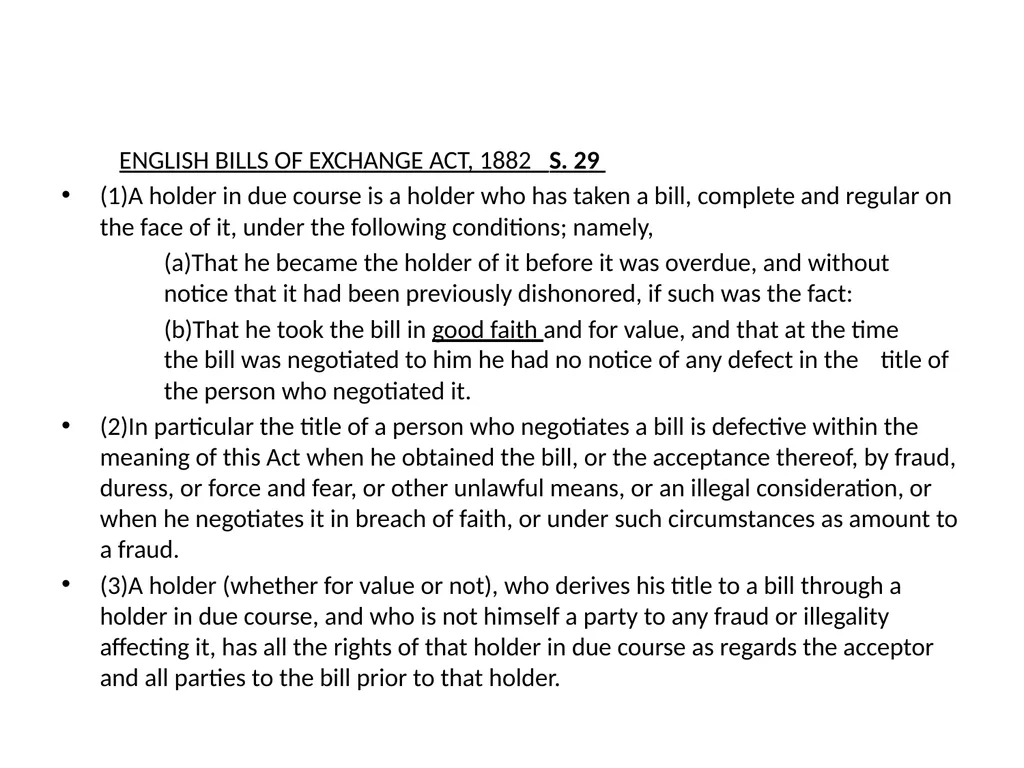
ENGLISH BILLS OF EXCHANGE ACT, 1882 S. 29
(1)A holder in due course is a holder who has taken a bill, complete and regular on the face of it, under the following conditions; namely,
(a)That he became the holder of it before it was overdue, and without notice that it had been previously dishonored, if such was the fact:
(b)That he took the bill in good faith and for value, and that at the time the bill was negotiated to him he had no notice of any defect in the title of the person who negotiated it.
(2)In particular the title of a person who negotiates a bill is defective within the meaning of this Act when he obtained the bill, or the acceptance thereof, by fraud, duress, or force and fear, or other unlawful means, or an illegal consideration, or when he negotiates it in breach of faith, or under such circumstances as amount to a fraud.
(3)A holder (whether for value or not), who derives his title to a bill through a holder in due course, and who is not himself a party to any fraud or illegality affecting it, has all the rights of that holder in due course as regards the acceptor and all parties to the bill prior to that holder.<br>
06
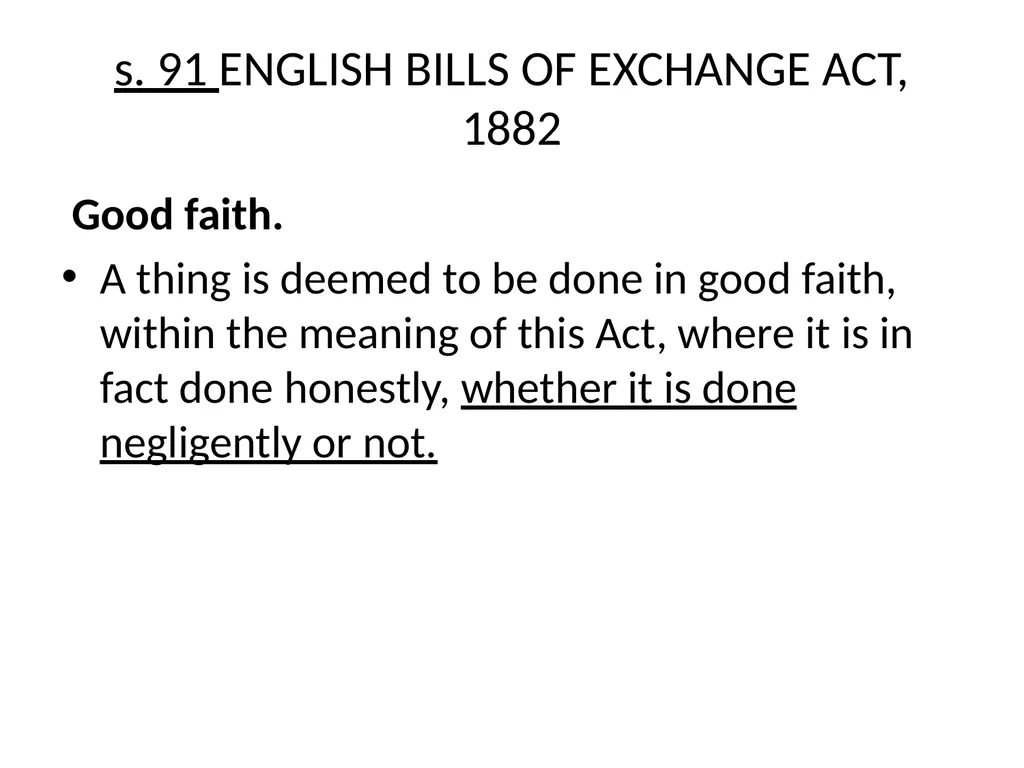
s. 91 ENGLISH BILLS OF EXCHANGE ACT, 1882 Good faith.
A thing is deemed to be done in good faith, within the meaning of this Act, where it is in fact done honestly, whether it is done negligently or not.<br>
07
While the Indian Act requires good faith coupled with due care and caution, the English Act simply requires good faith on the part of the holder in due course<br>
08
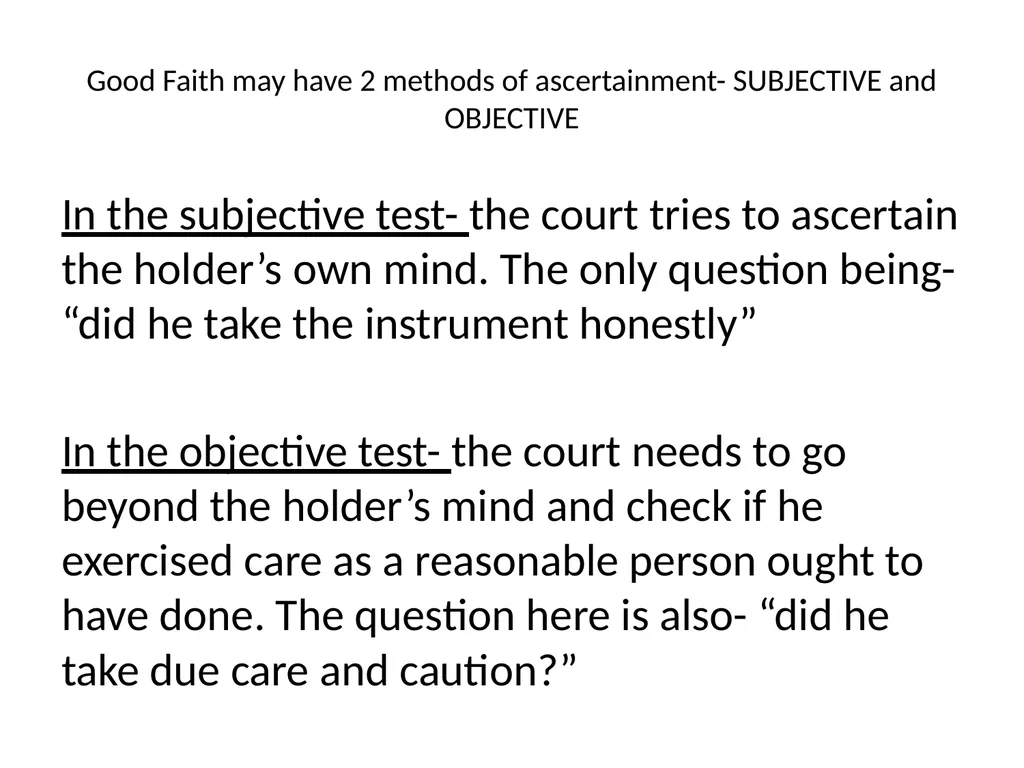
Good Faith may have 2 methods of ascertainment- SUBJECTIVE and OBJECTIVE In the subjective test- the court tries to ascertain the holder’s own mind. The only question being- “did he take the instrument honestly”
In the objective test- the court needs to go beyond the holder’s mind and check if he exercised care as a reasonable person ought to have done. The question here is also- “did he take due care and caution?”<br>
09
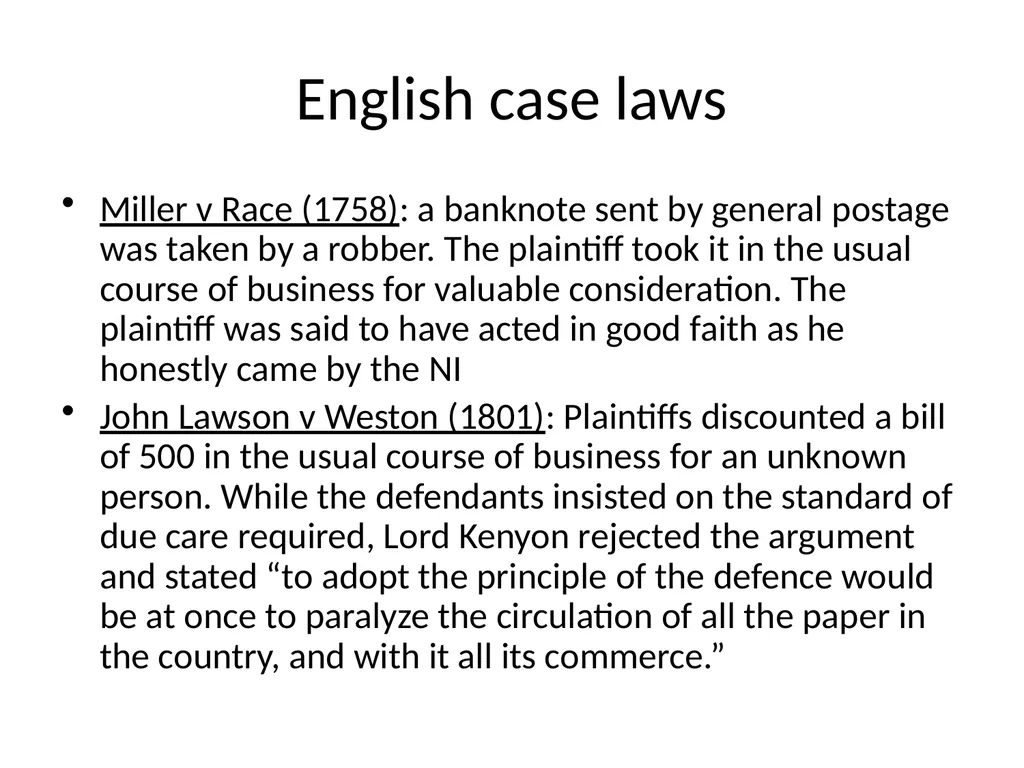
English case laws Miller v Race (1758): a banknote sent by general postage was taken by a robber. The plaintiff took it in the usual course of business for valuable consideration. The plaintiff was said to have acted in good faith as he honestly came by the NI
John Lawson v Weston (1801): Plaintiffs discounted a bill of 500 in the usual course of business for an unknown person. While the defendants insisted on the standard of due care required, Lord Kenyon rejected the argument and stated “to adopt the principle of the defence would be at once to paralyze the circulation of all the paper in the country, and with it all its commerce.”<br>
10
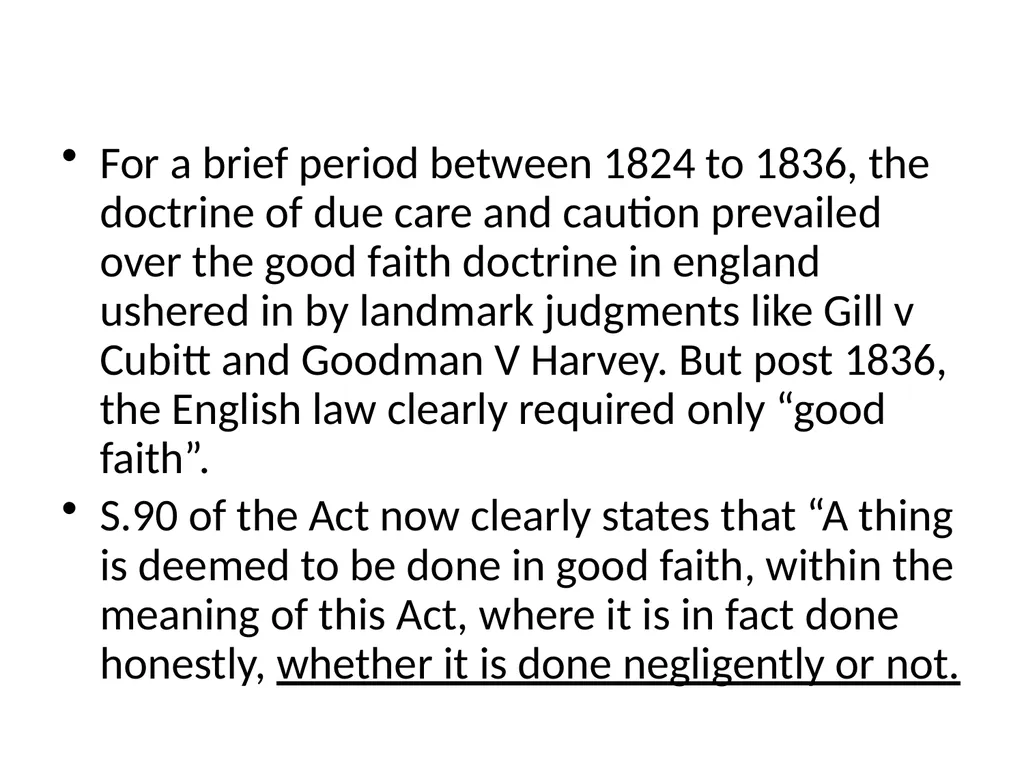
For a brief period between 1824 to 1836, the doctrine of due care and caution prevailed over the good faith doctrine in england ushered in by landmark judgments like Gill v Cubitt and Goodman V Harvey. But post 1836, the English law clearly required only “good faith”.
S.90 of the Act now clearly states that “A thing is deemed to be done in good faith, within the meaning of this Act, where it is in fact done honestly, whether it is done negligently or not.<br>
11
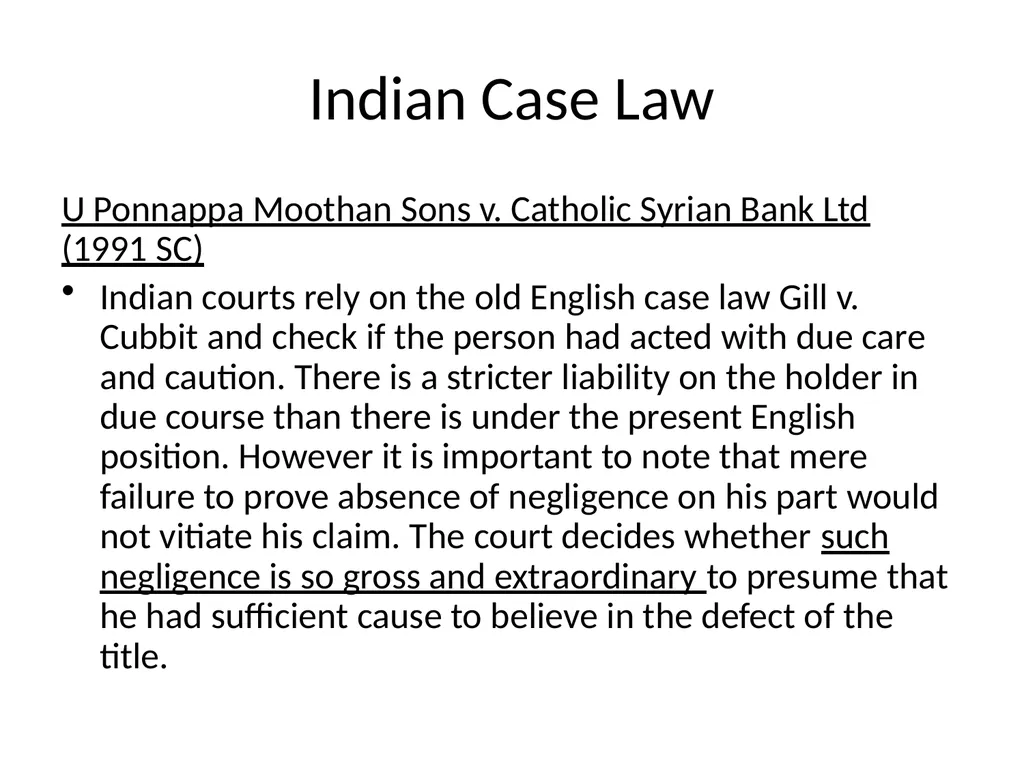
Indian Case Law U Ponnappa Moothan Sons v. Catholic Syrian Bank Ltd (1991 SC)
Indian courts rely on the old English case law Gill v. Cubbit and check if the person had acted with due care and caution. There is a stricter liability on the holder in due course than there is under the present English position. However it is important to note that mere failure to prove absence of negligence on his part would not vitiate his claim. The court decides whether such negligence is so gross and extraordinary to presume that he had sufficient cause to believe in the defect of the title.<br>