
Indian Judiciary Why Judiciary is important?
FD
Published · 14 slides · 0 views

1 / 1


Description
Indian Judiciary Why Judiciary is important? Indian Constitution is a Federal Constitution. Federalism has Distribution of Powers between Centre States. The disputes between Centre and States and two States are bound to arise and
Related Topics
Share
Embed code
Download this presentation From Below
"Indian Judiciary Why Judiciary is important?" is the property of its rightful owner. Permission is granted to download and print the materials on this website for personal, non-commercial use only, and to display it on your personal computer provided you do not modify the materials and that you retain all copyright notices contained in the materials. By downloading content from our website, you accept the terms of this agreement.
Presentation Transcript
01
Indian Judiciary<br>
02
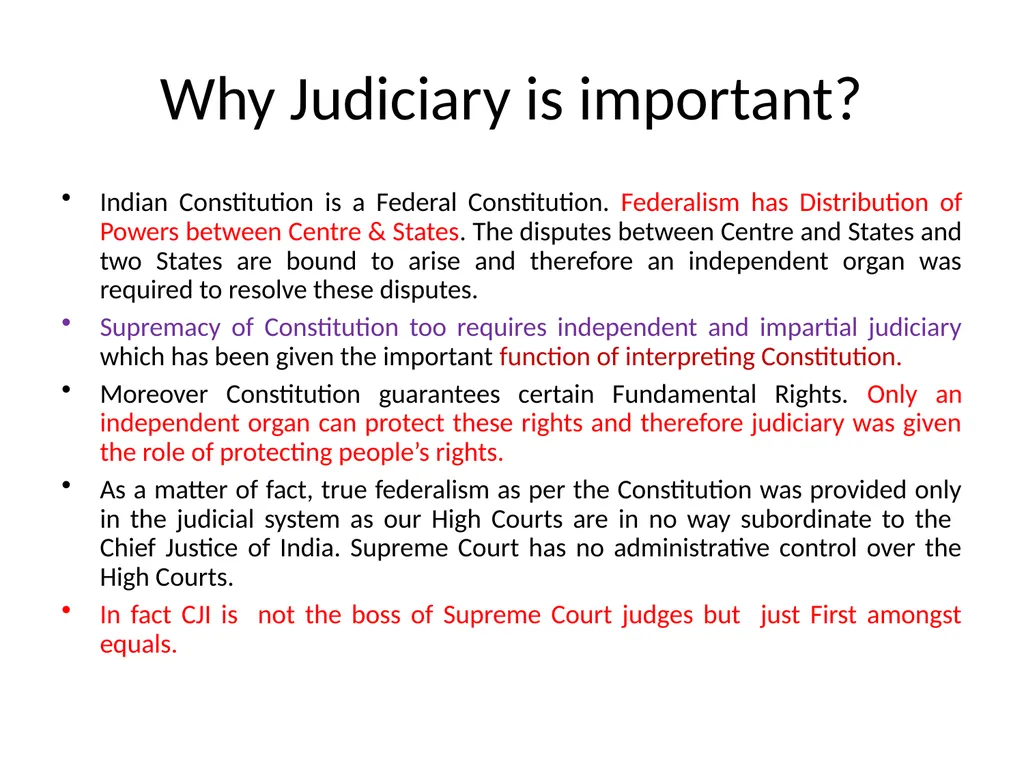
Why Judiciary is important? Indian Constitution is a Federal Constitution. Federalism has Distribution of Powers between Centre & States. The disputes between Centre and States and two States are bound to arise and therefore an independent organ was required to resolve these disputes.
Supremacy of Constitution too requires independent and impartial judiciary which has been given the important function of interpreting Constitution.
Moreover Constitution guarantees certain Fundamental Rights. Only an independent organ can protect these rights and therefore judiciary was given the role of protecting people’s rights.
As a matter of fact, true federalism as per the Constitution was provided only in the judicial system as our High Courts are in no way subordinate to the Chief Justice of India. Supreme Court has no administrative control over the High Courts.
In fact CJI is not the boss of Supreme Court judges but just First amongst equals.<br>
Supremacy of Constitution too requires independent and impartial judiciary which has been given the important function of interpreting Constitution.
Moreover Constitution guarantees certain Fundamental Rights. Only an independent organ can protect these rights and therefore judiciary was given the role of protecting people’s rights.
As a matter of fact, true federalism as per the Constitution was provided only in the judicial system as our High Courts are in no way subordinate to the Chief Justice of India. Supreme Court has no administrative control over the High Courts.
In fact CJI is not the boss of Supreme Court judges but just First amongst equals.<br>
03
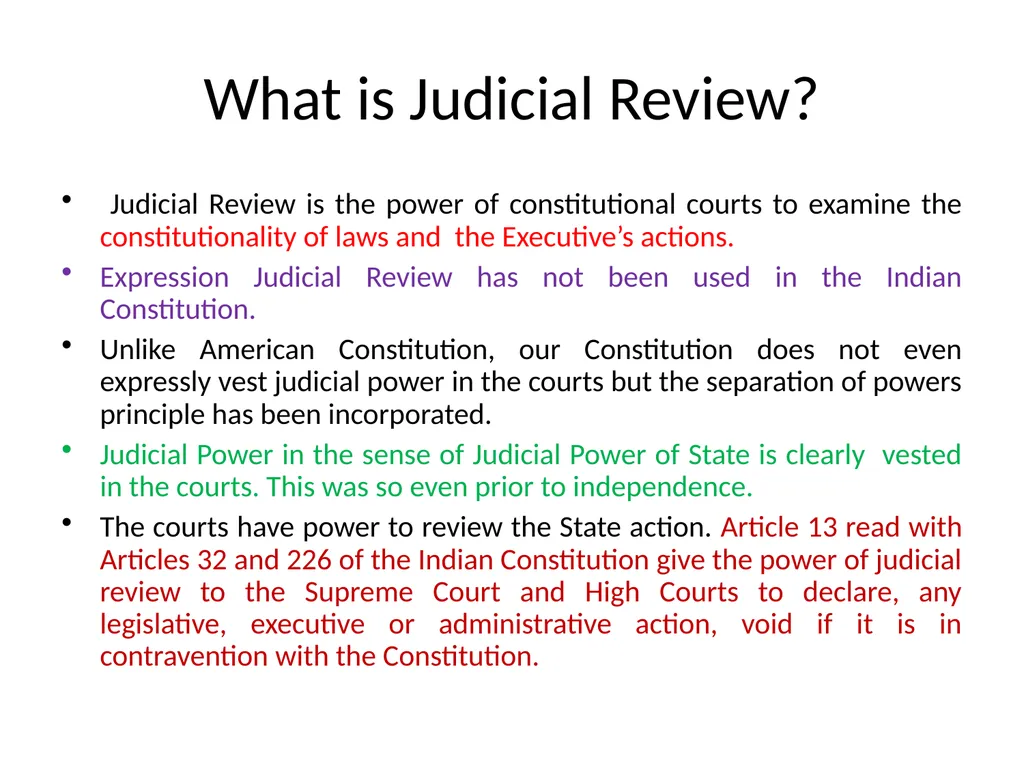
What is Judicial Review? Judicial Review is the power of constitutional courts to examine the constitutionality of laws and the Executive’s actions.
Expression Judicial Review has not been used in the Indian Constitution.
Unlike American Constitution, our Constitution does not even expressly vest judicial power in the courts but the separation of powers principle has been incorporated.
Judicial Power in the sense of Judicial Power of State is clearly vested in the courts. This was so even prior to independence.
The courts have power to review the State action. Article 13 read with Articles 32 and 226 of the Indian Constitution give the power of judicial review to the Supreme Court and High Courts to declare, any legislative, executive or administrative action, void if it is in contravention with the Constitution.<br>
Expression Judicial Review has not been used in the Indian Constitution.
Unlike American Constitution, our Constitution does not even expressly vest judicial power in the courts but the separation of powers principle has been incorporated.
Judicial Power in the sense of Judicial Power of State is clearly vested in the courts. This was so even prior to independence.
The courts have power to review the State action. Article 13 read with Articles 32 and 226 of the Indian Constitution give the power of judicial review to the Supreme Court and High Courts to declare, any legislative, executive or administrative action, void if it is in contravention with the Constitution.<br>
04
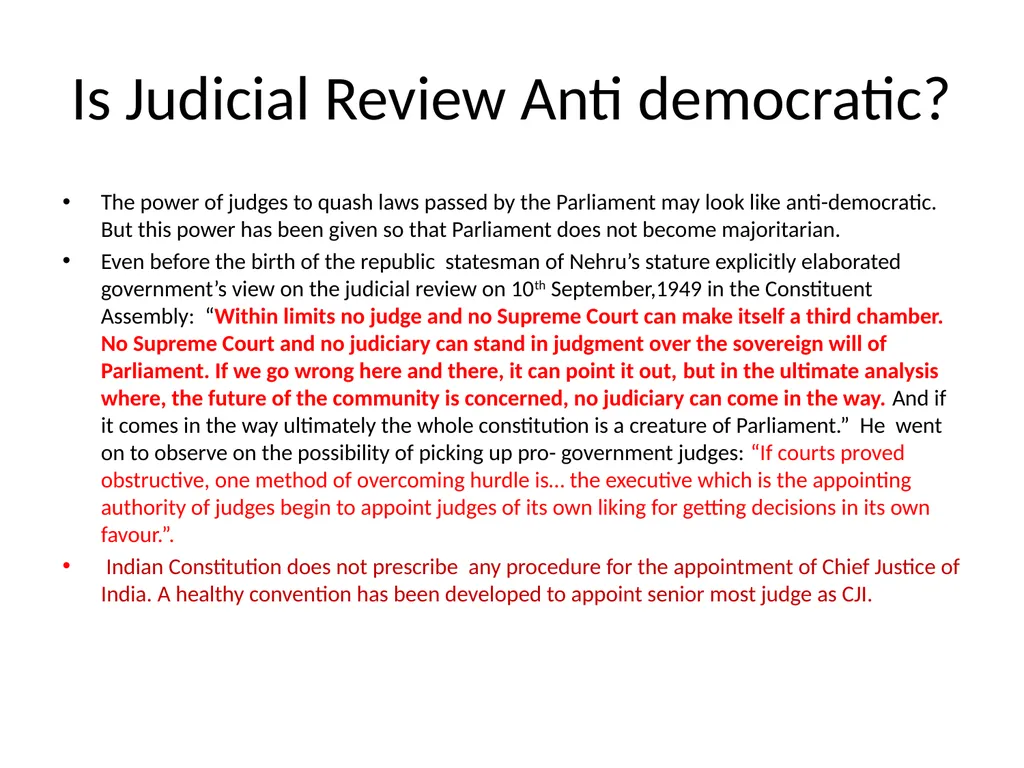
Is Judicial Review Anti democratic? The power of judges to quash laws passed by the Parliament may look like anti-democratic. But this power has been given so that Parliament does not become majoritarian.
Even before the birth of the republic statesman of Nehru’s stature explicitly elaborated government’s view on the judicial review on 10th September,1949 in the Constituent Assembly: “Within limits no judge and no Supreme Court can make itself a third chamber. No Supreme Court and no judiciary can stand in judgment over the sovereign will of Parliament. If we go wrong here and there, it can point it out, but in the ultimate analysis where, the future of the community is concerned, no judiciary can come in the way. And if it comes in the way ultimately the whole constitution is a creature of Parliament.” He went on to observe on the possibility of picking up pro- government judges: “If courts proved obstructive, one method of overcoming hurdle is… the executive which is the appointing authority of judges begin to appoint judges of its own liking for getting decisions in its own favour.”.
Indian Constitution does not prescribe any procedure for the appointment of Chief Justice of India. A healthy convention has been developed to appoint senior most judge as CJI.<br>
Even before the birth of the republic statesman of Nehru’s stature explicitly elaborated government’s view on the judicial review on 10th September,1949 in the Constituent Assembly: “Within limits no judge and no Supreme Court can make itself a third chamber. No Supreme Court and no judiciary can stand in judgment over the sovereign will of Parliament. If we go wrong here and there, it can point it out, but in the ultimate analysis where, the future of the community is concerned, no judiciary can come in the way. And if it comes in the way ultimately the whole constitution is a creature of Parliament.” He went on to observe on the possibility of picking up pro- government judges: “If courts proved obstructive, one method of overcoming hurdle is… the executive which is the appointing authority of judges begin to appoint judges of its own liking for getting decisions in its own favour.”.
Indian Constitution does not prescribe any procedure for the appointment of Chief Justice of India. A healthy convention has been developed to appoint senior most judge as CJI.<br>
05
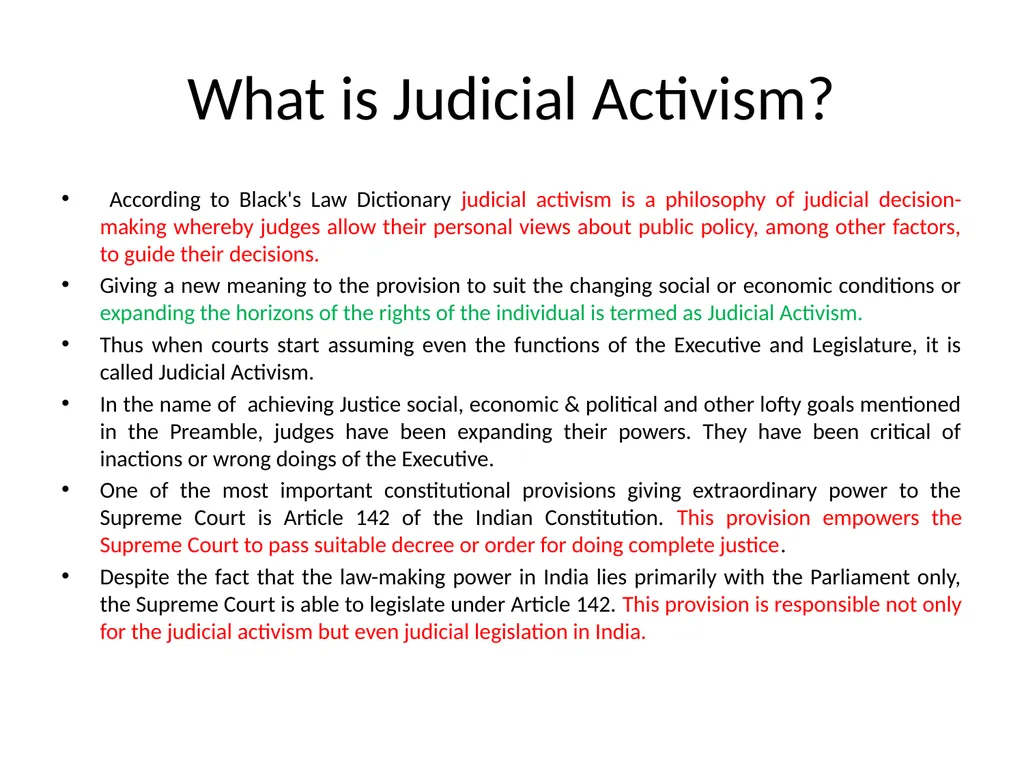
What is Judicial Activism? According to Black's Law Dictionary judicial activism is a philosophy of judicial decision-making whereby judges allow their personal views about public policy, among other factors, to guide their decisions.
Giving a new meaning to the provision to suit the changing social or economic conditions or expanding the horizons of the rights of the individual is termed as Judicial Activism.
Thus when courts start assuming even the functions of the Executive and Legislature, it is called Judicial Activism.
In the name of achieving Justice social, economic & political and other lofty goals mentioned in the Preamble, judges have been expanding their powers. They have been critical of inactions or wrong doings of the Executive.
One of the most important constitutional provisions giving extraordinary power to the Supreme Court is Article 142 of the Indian Constitution. This provision empowers the Supreme Court to pass suitable decree or order for doing complete justice.
Despite the fact that the law-making power in India lies primarily with the Parliament only, the Supreme Court is able to legislate under Article 142. This provision is responsible not only for the judicial activism but even judicial legislation in India.<br>
Giving a new meaning to the provision to suit the changing social or economic conditions or expanding the horizons of the rights of the individual is termed as Judicial Activism.
Thus when courts start assuming even the functions of the Executive and Legislature, it is called Judicial Activism.
In the name of achieving Justice social, economic & political and other lofty goals mentioned in the Preamble, judges have been expanding their powers. They have been critical of inactions or wrong doings of the Executive.
One of the most important constitutional provisions giving extraordinary power to the Supreme Court is Article 142 of the Indian Constitution. This provision empowers the Supreme Court to pass suitable decree or order for doing complete justice.
Despite the fact that the law-making power in India lies primarily with the Parliament only, the Supreme Court is able to legislate under Article 142. This provision is responsible not only for the judicial activism but even judicial legislation in India.<br>
06
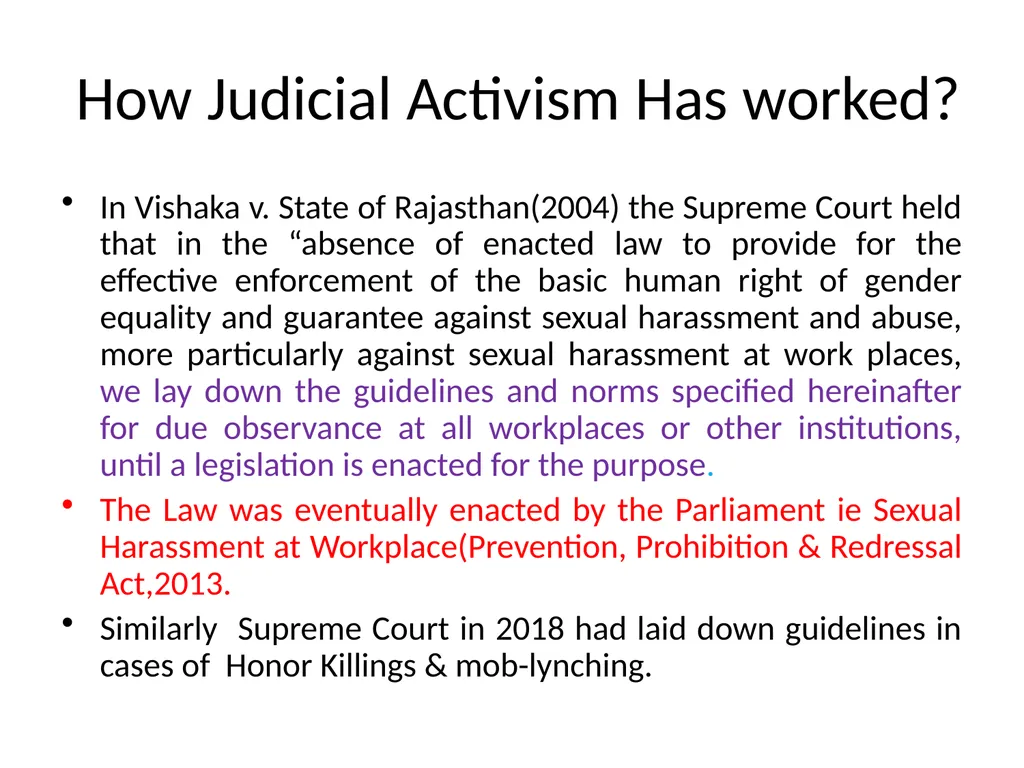
How Judicial Activism Has worked? In Vishaka v. State of Rajasthan(2004) the Supreme Court held that in the “absence of enacted law to provide for the effective enforcement of the basic human right of gender equality and guarantee against sexual harassment and abuse, more particularly against sexual harassment at work places, we lay down the guidelines and norms specified hereinafter for due observance at all workplaces or other institutions, until a legislation is enacted for the purpose.
The Law was eventually enacted by the Parliament ie Sexual Harassment at Workplace(Prevention, Prohibition & Redressal Act,2013.
Similarly Supreme Court in 2018 had laid down guidelines in cases of Honor Killings & mob-lynching.<br>
The Law was eventually enacted by the Parliament ie Sexual Harassment at Workplace(Prevention, Prohibition & Redressal Act,2013.
Similarly Supreme Court in 2018 had laid down guidelines in cases of Honor Killings & mob-lynching.<br>
07
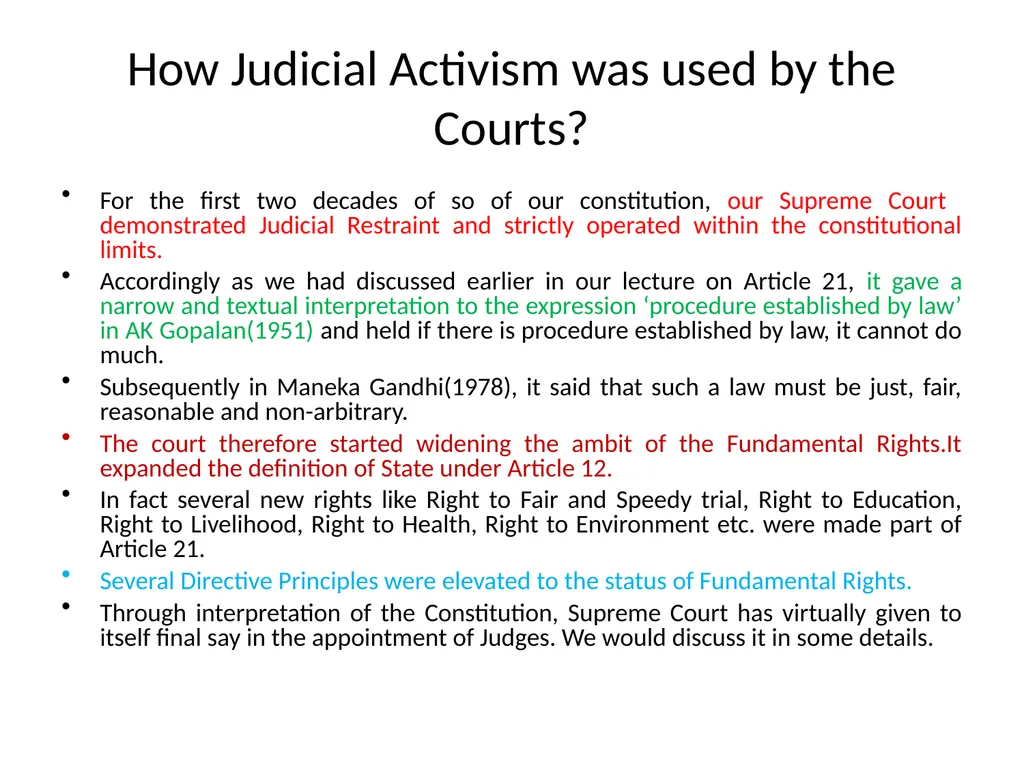
How Judicial Activism was used by the Courts? For the first two decades of so of our constitution, our Supreme Court demonstrated Judicial Restraint and strictly operated within the constitutional limits.
Accordingly as we had discussed earlier in our lecture on Article 21, it gave a narrow and textual interpretation to the expression ‘procedure established by law’ in AK Gopalan(1951) and held if there is procedure established by law, it cannot do much.
Subsequently in Maneka Gandhi(1978), it said that such a law must be just, fair, reasonable and non-arbitrary.
The court therefore started widening the ambit of the Fundamental Rights.It expanded the definition of State under Article 12.
In fact several new rights like Right to Fair and Speedy trial, Right to Education, Right to Livelihood, Right to Health, Right to Environment etc. were made part of Article 21.
Several Directive Principles were elevated to the status of Fundamental Rights.
Through interpretation of the Constitution, Supreme Court has virtually given to itself final say in the appointment of Judges. We would discuss it in some details.<br>
Accordingly as we had discussed earlier in our lecture on Article 21, it gave a narrow and textual interpretation to the expression ‘procedure established by law’ in AK Gopalan(1951) and held if there is procedure established by law, it cannot do much.
Subsequently in Maneka Gandhi(1978), it said that such a law must be just, fair, reasonable and non-arbitrary.
The court therefore started widening the ambit of the Fundamental Rights.It expanded the definition of State under Article 12.
In fact several new rights like Right to Fair and Speedy trial, Right to Education, Right to Livelihood, Right to Health, Right to Environment etc. were made part of Article 21.
Several Directive Principles were elevated to the status of Fundamental Rights.
Through interpretation of the Constitution, Supreme Court has virtually given to itself final say in the appointment of Judges. We would discuss it in some details.<br>
08
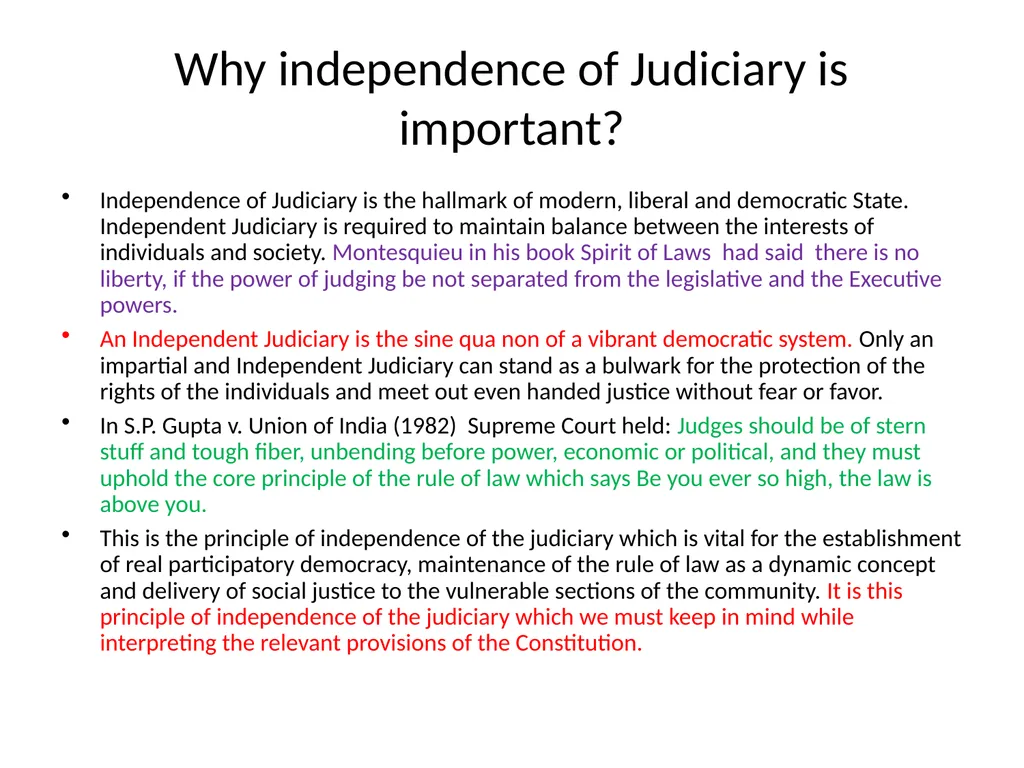
Why independence of Judiciary is important? Independence of Judiciary is the hallmark of modern, liberal and democratic State. Independent Judiciary is required to maintain balance between the interests of individuals and society. Montesquieu in his book Spirit of Laws had said there is no liberty, if the power of judging be not separated from the legislative and the Executive powers.
An Independent Judiciary is the sine qua non of a vibrant democratic system. Only an impartial and Independent Judiciary can stand as a bulwark for the protection of the rights of the individuals and meet out even handed justice without fear or favor.
In S.P. Gupta v. Union of India (1982) Supreme Court held: Judges should be of stern stuff and tough fiber, unbending before power, economic or political, and they must uphold the core principle of the rule of law which says Be you ever so high, the law is above you.
This is the principle of independence of the judiciary which is vital for the establishment of real participatory democracy, maintenance of the rule of law as a dynamic concept and delivery of social justice to the vulnerable sections of the community. It is this principle of independence of the judiciary which we must keep in mind while interpreting the relevant provisions of the Constitution.<br>
An Independent Judiciary is the sine qua non of a vibrant democratic system. Only an impartial and Independent Judiciary can stand as a bulwark for the protection of the rights of the individuals and meet out even handed justice without fear or favor.
In S.P. Gupta v. Union of India (1982) Supreme Court held: Judges should be of stern stuff and tough fiber, unbending before power, economic or political, and they must uphold the core principle of the rule of law which says Be you ever so high, the law is above you.
This is the principle of independence of the judiciary which is vital for the establishment of real participatory democracy, maintenance of the rule of law as a dynamic concept and delivery of social justice to the vulnerable sections of the community. It is this principle of independence of the judiciary which we must keep in mind while interpreting the relevant provisions of the Constitution.<br>
09
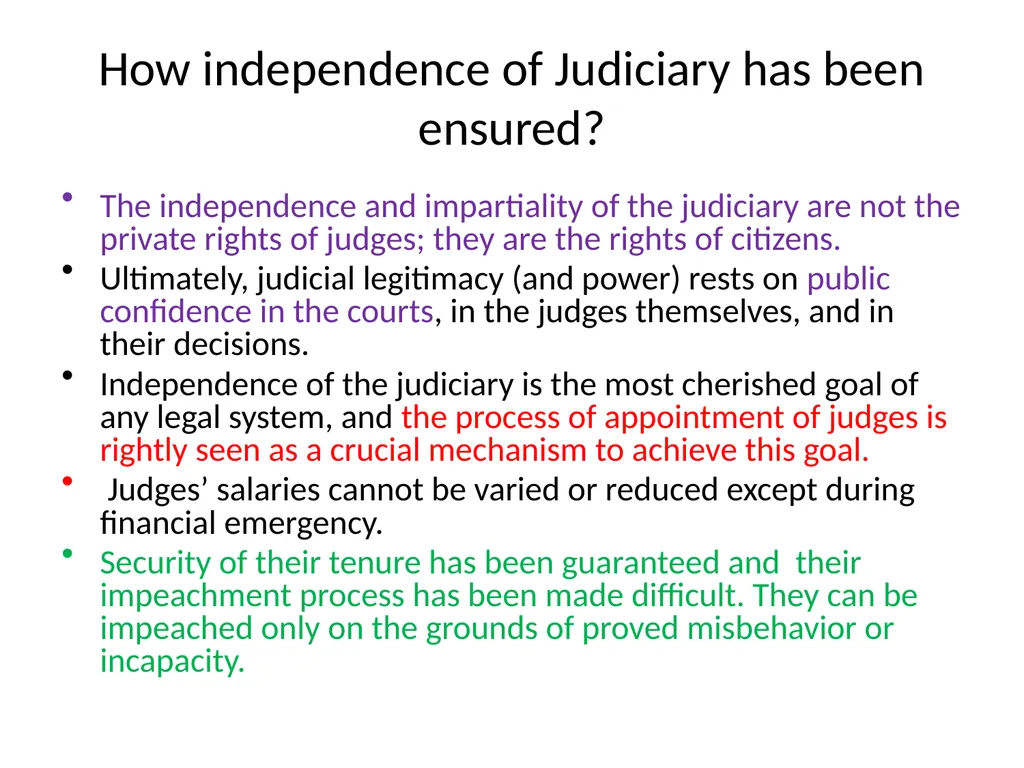
How independence of Judiciary has been ensured? The independence and impartiality of the judiciary are not the private rights of judges; they are the rights of citizens.
Ultimately, judicial legitimacy (and power) rests on public confidence in the courts, in the judges themselves, and in their decisions.
Independence of the judiciary is the most cherished goal of any legal system, and the process of appointment of judges is rightly seen as a crucial mechanism to achieve this goal.
Judges’ salaries cannot be varied or reduced except during financial emergency.
Security of their tenure has been guaranteed and their impeachment process has been made difficult. They can be impeached only on the grounds of proved misbehavior or incapacity.<br>
Ultimately, judicial legitimacy (and power) rests on public confidence in the courts, in the judges themselves, and in their decisions.
Independence of the judiciary is the most cherished goal of any legal system, and the process of appointment of judges is rightly seen as a crucial mechanism to achieve this goal.
Judges’ salaries cannot be varied or reduced except during financial emergency.
Security of their tenure has been guaranteed and their impeachment process has been made difficult. They can be impeached only on the grounds of proved misbehavior or incapacity.<br>
10
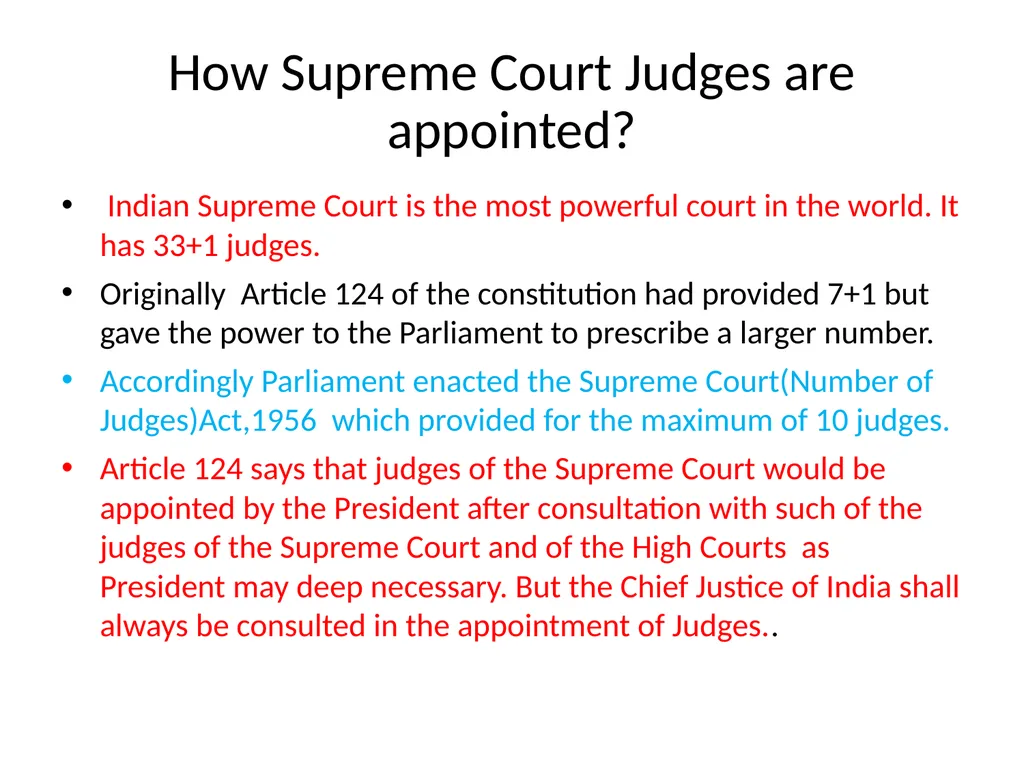
How Supreme Court Judges are appointed? Indian Supreme Court is the most powerful court in the world. It has 33+1 judges.
Originally Article 124 of the constitution had provided 7+1 but gave the power to the Parliament to prescribe a larger number.
Accordingly Parliament enacted the Supreme Court(Number of Judges)Act,1956 which provided for the maximum of 10 judges.
Article 124 says that judges of the Supreme Court would be appointed by the President after consultation with such of the judges of the Supreme Court and of the High Courts as President may deep necessary. But the Chief Justice of India shall always be consulted in the appointment of Judges..<br>
Originally Article 124 of the constitution had provided 7+1 but gave the power to the Parliament to prescribe a larger number.
Accordingly Parliament enacted the Supreme Court(Number of Judges)Act,1956 which provided for the maximum of 10 judges.
Article 124 says that judges of the Supreme Court would be appointed by the President after consultation with such of the judges of the Supreme Court and of the High Courts as President may deep necessary. But the Chief Justice of India shall always be consulted in the appointment of Judges..<br>
11
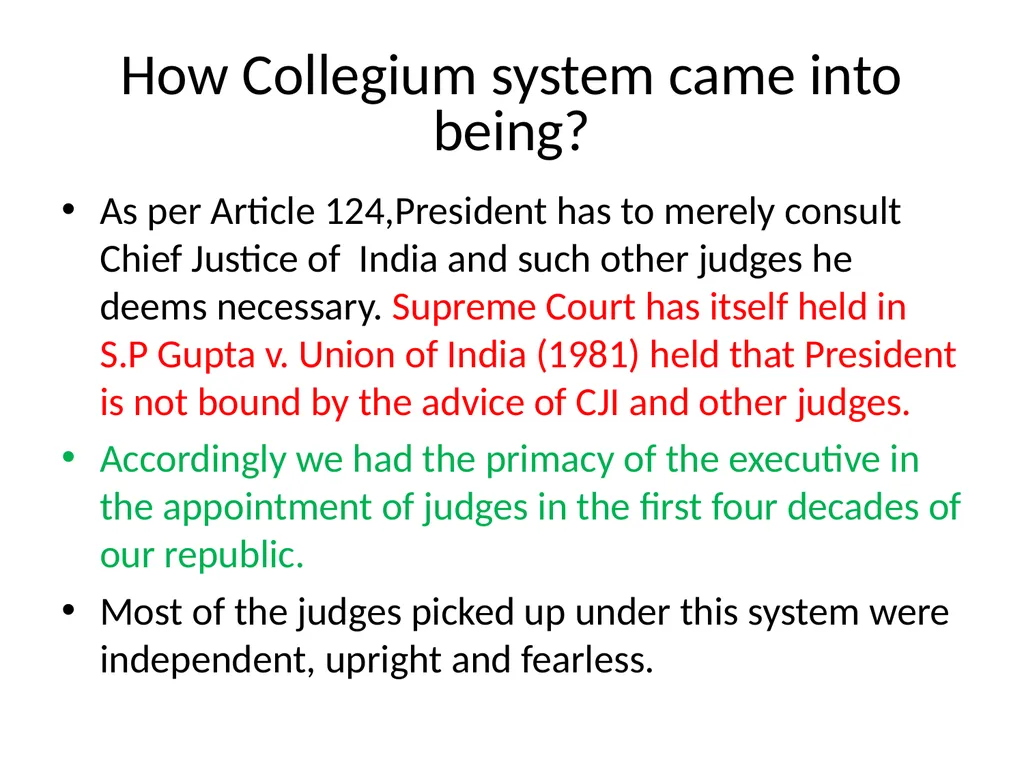
How Collegium system came into being? As per Article 124,President has to merely consult Chief Justice of India and such other judges he deems necessary. Supreme Court has itself held in S.P Gupta v. Union of India (1981) held that President is not bound by the advice of CJI and other judges.
Accordingly we had the primacy of the executive in the appointment of judges in the first four decades of our republic.
Most of the judges picked up under this system were independent, upright and fearless.<br>
Accordingly we had the primacy of the executive in the appointment of judges in the first four decades of our republic.
Most of the judges picked up under this system were independent, upright and fearless.<br>
12
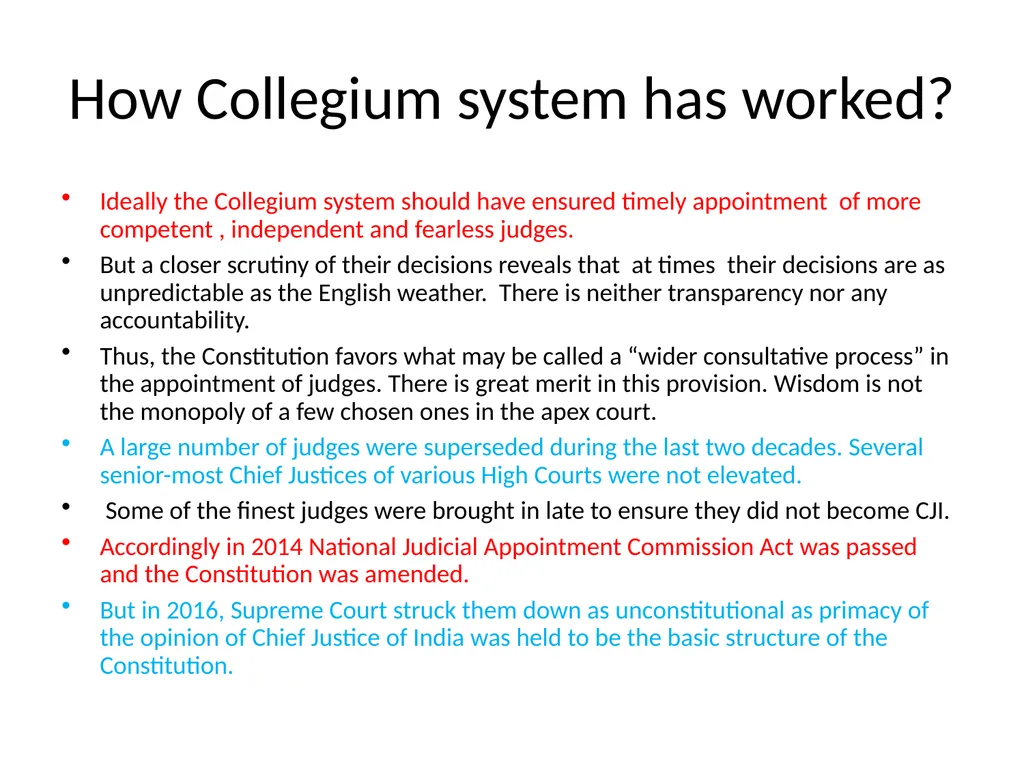
How Collegium system has worked? Ideally the Collegium system should have ensured timely appointment of more competent , independent and fearless judges.
But a closer scrutiny of their decisions reveals that at times their decisions are as unpredictable as the English weather. There is neither transparency nor any accountability.
Thus, the Constitution favors what may be called a “wider consultative process” in the appointment of judges. There is great merit in this provision. Wisdom is not the monopoly of a few chosen ones in the apex court.
A large number of judges were superseded during the last two decades. Several senior-most Chief Justices of various High Courts were not elevated.
Some of the finest judges were brought in late to ensure they did not become CJI.
Accordingly in 2014 National Judicial Appointment Commission Act was passed and the Constitution was amended.
But in 2016, Supreme Court struck them down as unconstitutional as primacy of the opinion of Chief Justice of India was held to be the basic structure of the Constitution.<br>
But a closer scrutiny of their decisions reveals that at times their decisions are as unpredictable as the English weather. There is neither transparency nor any accountability.
Thus, the Constitution favors what may be called a “wider consultative process” in the appointment of judges. There is great merit in this provision. Wisdom is not the monopoly of a few chosen ones in the apex court.
A large number of judges were superseded during the last two decades. Several senior-most Chief Justices of various High Courts were not elevated.
Some of the finest judges were brought in late to ensure they did not become CJI.
Accordingly in 2014 National Judicial Appointment Commission Act was passed and the Constitution was amended.
But in 2016, Supreme Court struck them down as unconstitutional as primacy of the opinion of Chief Justice of India was held to be the basic structure of the Constitution.<br>
13
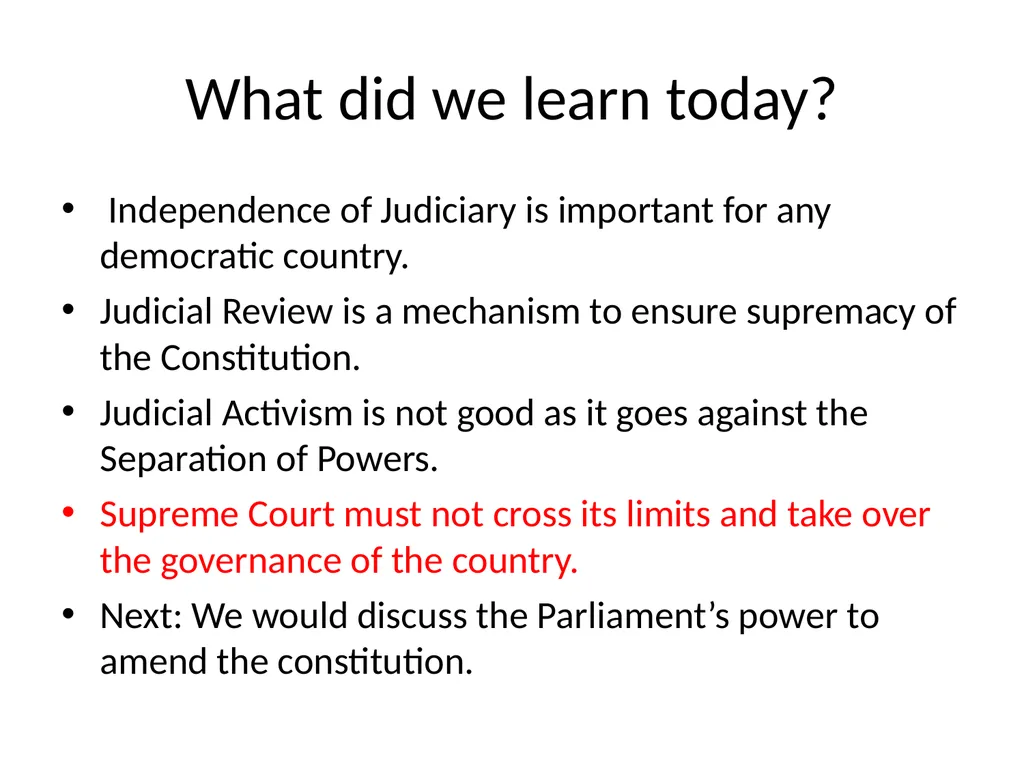
What did we learn today? Independence of Judiciary is important for any democratic country.
Judicial Review is a mechanism to ensure supremacy of the Constitution.
Judicial Activism is not good as it goes against the Separation of Powers.
Supreme Court must not cross its limits and take over the governance of the country.
Next: We would discuss the Parliament’s power to amend the constitution.<br>
Judicial Review is a mechanism to ensure supremacy of the Constitution.
Judicial Activism is not good as it goes against the Separation of Powers.
Supreme Court must not cross its limits and take over the governance of the country.
Next: We would discuss the Parliament’s power to amend the constitution.<br>
14
Disclaimer The views which have been expressed by the speaker in the lecture are his personal views.<br>