
Individual Placement and Support - IPS The
T
Published · 35 slides · 0 views
1 / 1
Description
Individual Placement and Support - IPS The Evidence-Based Practice for Employment Updated 7.27.21 Research Originally studied and validated with people with serious mental illness, including people with co-occurring substance use disorders
Related Topics
Share
Embed code
Download this presentation From Below
"Individual Placement and Support - IPS The" is the property of its rightful owner. Permission is granted to download and print the materials on this website for personal, non-commercial use only, and to display it on your personal computer provided you do not modify the materials and that you retain all copyright notices contained in the materials. By downloading content from our website, you accept the terms of this agreement.
Presentation Transcript
01
Individual Placement and Support - IPS The Evidence-Based Practice for Employment
Updated 7.27.21<br>
Updated 7.27.21<br>
02
Research Originally studied and validated with people with serious mental illness, including people with co-occurring substance use disorders<br>
03
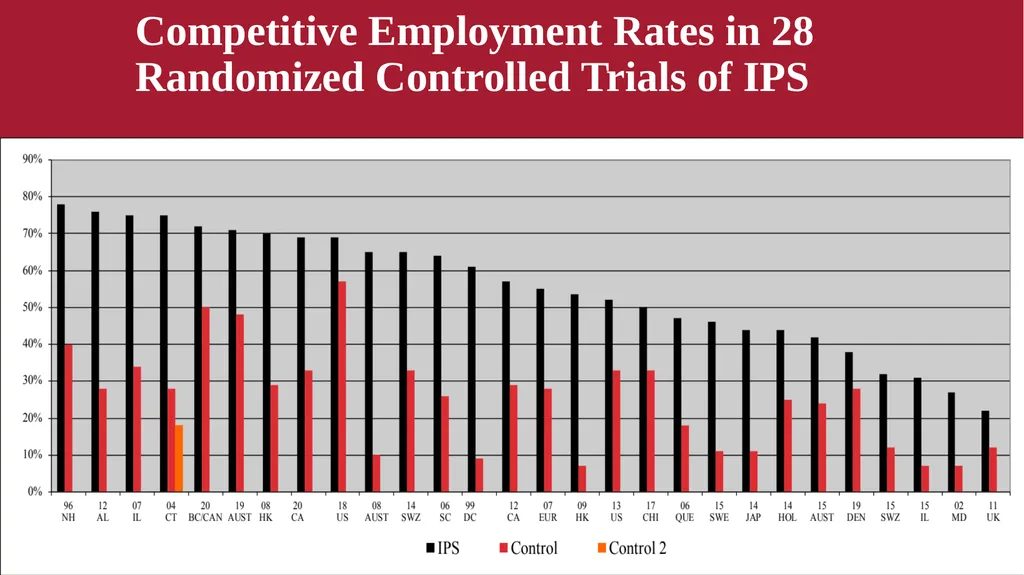
Research IPS has been compared to traditional vocational rehabilitation approaches that typically include stepwise features such as prevocational assessment, sheltered setting, and volunteer work. In 28 randomized controlled trials, 27 showed a significant advantage for IPS.<br>
04
Competitive Employment Rates in 28 Randomized Controlled Trials of IPS 4<br>
05
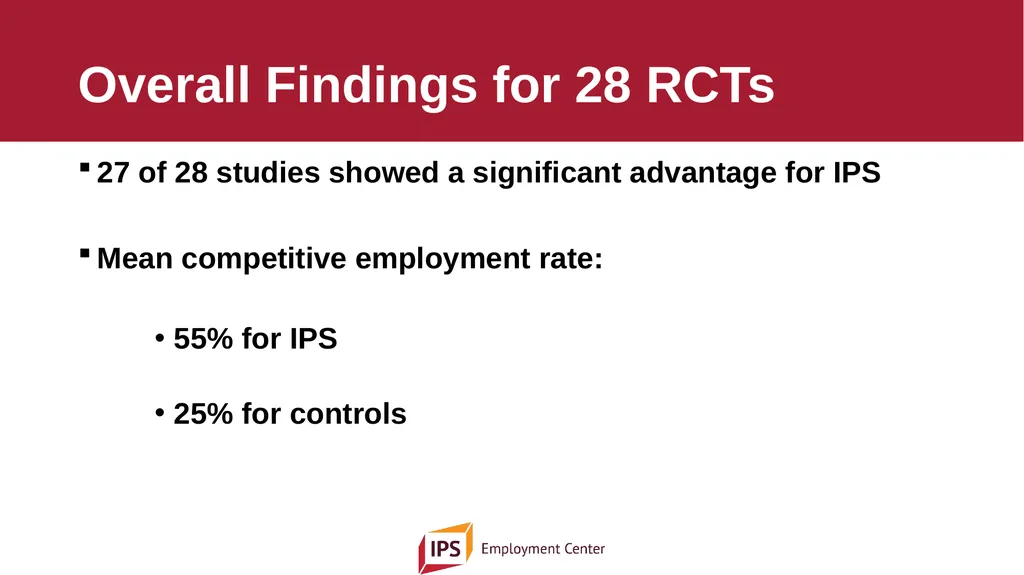
Overall Findings for 28 RCTs 27 of 28 studies showed a significant advantage for IPS
Mean competitive employment rate:
55% for IPS
25% for controls<br>
Mean competitive employment rate:
55% for IPS
25% for controls<br>
06
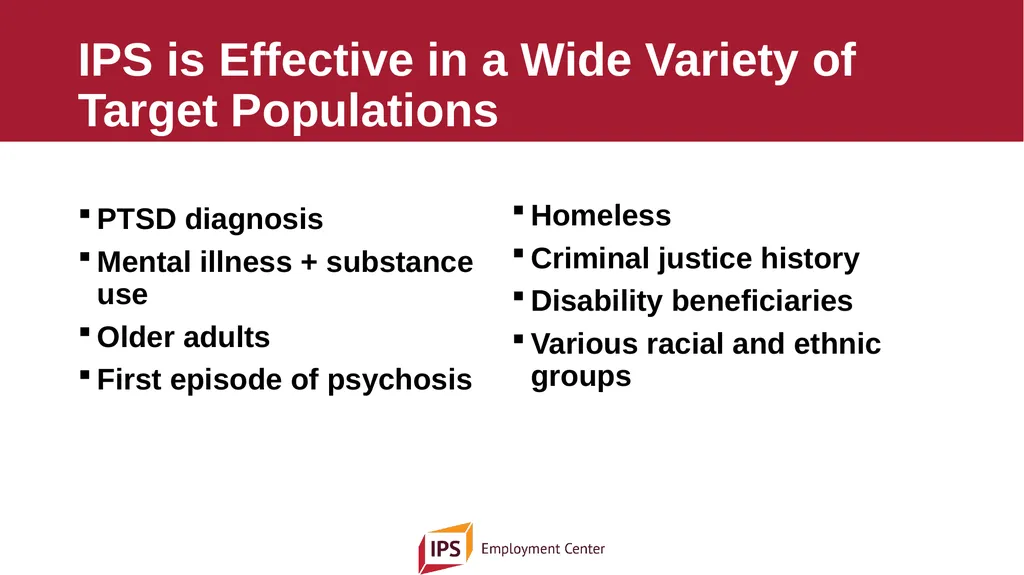
IPS is Effective in a Wide Variety of Target Populations PTSD diagnosis
Mental illness + substance use
Older adults
First episode of psychosis
Homeless
Criminal justice history
Disability beneficiaries
Various racial and ethnic groups<br>
Mental illness + substance use
Older adults
First episode of psychosis
Homeless
Criminal justice history
Disability beneficiaries
Various racial and ethnic groups<br>
07
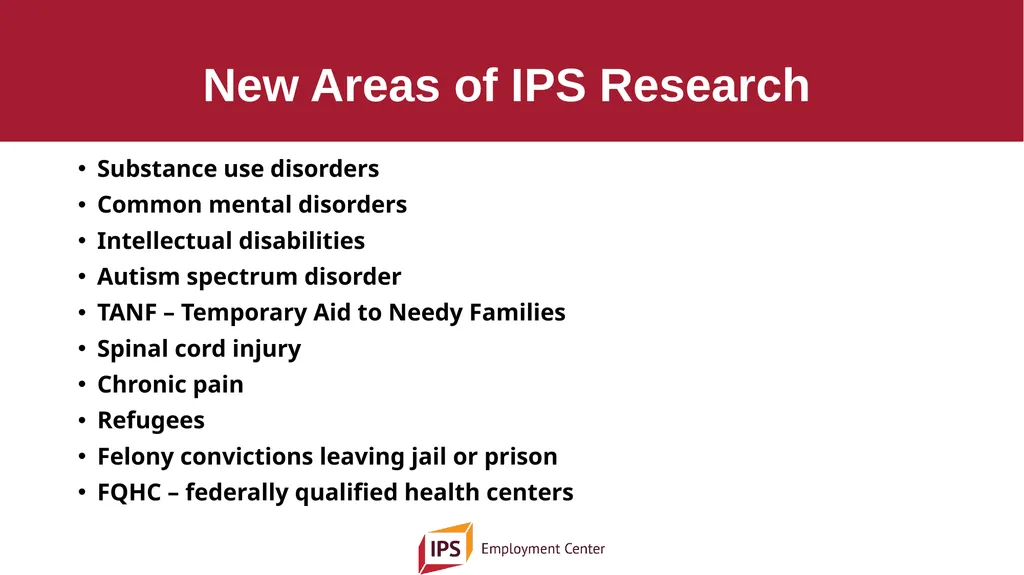
New Areas of IPS Research Substance use disorders
Common mental disorders
Intellectual disabilities
Autism spectrum disorder
TANF – Temporary Aid to Needy Families
Spinal cord injury
Chronic pain
Refugees
Felony convictions leaving jail or prison
FQHC – federally qualified health centers<br>
Common mental disorders
Intellectual disabilities
Autism spectrum disorder
TANF – Temporary Aid to Needy Families
Spinal cord injury
Chronic pain
Refugees
Felony convictions leaving jail or prison
FQHC – federally qualified health centers<br>
08
Why Focus on Employment and Careers? Considered by many as an important part of recovery
Most people with serious mental illness want to work
Employment is a typical role for adults in our society
Cost-effective alternative to day treatment<br>
Most people with serious mental illness want to work
Employment is a typical role for adults in our society
Cost-effective alternative to day treatment<br>
09
Benefits of Steady Competitive Employment Increased income
Improved self esteem
Improved social networks
Increased quality of life
Better control of symptoms
Reduced hospitalization
Reduced substance use
Reduced use of mental health services<br>
Improved self esteem
Improved social networks
Increased quality of life
Better control of symptoms
Reduced hospitalization
Reduced substance use
Reduced use of mental health services<br>
10
Negative Effects of Unemployment in General Population Increased substance abuse
Increased physical problems
Increased psychiatric disorders
Reduced self esteem
Loss of social contacts
Alienation and apathy
(Warr, 1987)<br>
Increased physical problems
Increased psychiatric disorders
Reduced self esteem
Loss of social contacts
Alienation and apathy
(Warr, 1987)<br>
11
What People Say “When you are working, you are part of the real world. You feel connected. Having a job gives me stability. I have something to look forward to every day.”
“In the past, people might have used labels to describe me such as ‘homeless,’ ‘mentally ill,’ and ‘welfare mother.’ Now my titles are ‘financial administrator,’ ‘college student,’ and ‘working mom.’”<br>
“In the past, people might have used labels to describe me such as ‘homeless,’ ‘mentally ill,’ and ‘welfare mother.’ Now my titles are ‘financial administrator,’ ‘college student,’ and ‘working mom.’”<br>
12
What People Say “I was really glad that my son’s employment counselor asked me about work ideas. My son wanted me to be a part of the team. And he landed a job that I suggested.”
“I worried that if my daughter got a job, she would feel stressed. But just the opposite happened. She is doing much better than before.”<br>
“I worried that if my daughter got a job, she would feel stressed. But just the opposite happened. She is doing much better than before.”<br>
13
What People Say “Andre is as good as any worker that I have.” Automotive parts store manager
“I count on Juanita. If she is feeling stressed, she sits in a room by herself for awhile. That’s okay; she gets the job done.” Bakery supervisor
“The employment counselor helped me understand why Tony paces. It’s okay in the security business.” Security business owner<br>
“I count on Juanita. If she is feeling stressed, she sits in a room by herself for awhile. That’s okay; she gets the job done.” Bakery supervisor
“The employment counselor helped me understand why Tony paces. It’s okay in the security business.” Security business owner<br>
14
A Strength-based Approach to Wellness and Recovery Where does a person draw their strengths?
Personal characteristics
Past experiences
Resources
Supports<br>
Personal characteristics
Past experiences
Resources
Supports<br>
15
Who Provides IPS Services? IPS specialists (sometimes called employment specialists or supported employment and education specialists) provide direct assistance with work and education/technical training.
IPS specialists work closely with a team of practitioners who provide services for the same group of people.<br>
IPS specialists work closely with a team of practitioners who provide services for the same group of people.<br>
16
IPS Principles Open to anyone who wants to work
Focus on competitive employment
Rapid job search
Targeted job development
Client preferences guide decisions
Individualized long-term supports
Integrated with treatment
Benefits counseling included<br>
Focus on competitive employment
Rapid job search
Targeted job development
Client preferences guide decisions
Individualized long-term supports
Integrated with treatment
Benefits counseling included<br>
17
Open to Anyone Who Wants to Work Eligibility is based on consumer choice
People are not excluded because of diagnosis, recent hospitalizations, criminal justice history, or work readiness criteria<br>
People are not excluded because of diagnosis, recent hospitalizations, criminal justice history, or work readiness criteria<br>
18
Focus on Competitive Employment IPS specialists help people find jobs that exist in the open labor market and pay the same as others in a similar position (at least minimum wage), including part-time and full-time jobs.
People are not steered into sheltered jobs (that are set aside for people with disabilities) but work in community settings with others who do not have disabilities.<br>
People are not steered into sheltered jobs (that are set aside for people with disabilities) but work in community settings with others who do not have disabilities.<br>
19
Rapid Job Search IPS specialists help people start looking for jobs within one month of starting the program.
Pre-employment assessment, training and counseling are not required and are kept to a minimum.
IPS specialists help people explore the world of work at a pace that is right for the individual.<br>
Pre-employment assessment, training and counseling are not required and are kept to a minimum.
IPS specialists help people explore the world of work at a pace that is right for the individual.<br>
20
Targeted Job Development Based on individuals’ interests, IPS specialists build relationships with employers to learn about the employers’ needs in order to identify qualified job candidates.
IPS specialists make multiple visits to the same employers to develop relationships and average six face-to-face contacts with hiring managers per week.<br>
IPS specialists make multiple visits to the same employers to develop relationships and average six face-to-face contacts with hiring managers per week.<br>
21
Individual Preferences Guide Decisions The job search is based on individual preferences, strengths, and work experiences, not on a pool of jobs that are readily available.
Job seekers indicate preferences for job type, work hours, and types of job supports.<br>
Job seekers indicate preferences for job type, work hours, and types of job supports.<br>
22
Individualized Long-Term Supports IPS specialists provide support for as long as needed and desired, without arbitrary time limits.
Job supports are individualized based on the needs of the person and what will promote a positive work experience.
IPS specialists help people with job changes and career advancement, including additional schooling and training.<br>
Job supports are individualized based on the needs of the person and what will promote a positive work experience.
IPS specialists help people with job changes and career advancement, including additional schooling and training.<br>
23
IPS is Integrated with Treatment IPS specialists meet at least weekly with the team of providers who serve the same group of people, for example, care coordinators, therapists, medication providers, housing specialists.
The team meets together regularly to review clients’ status and plans coordinated, recovery-oriented services.<br>
The team meets together regularly to review clients’ status and plans coordinated, recovery-oriented services.<br>
24
Personalized Benefits Counseling IPS specialists refer people for comprehensive, individualized benefits planning by a trained benefits specialist so they can make informed decisions about starting or changing jobs.<br>
25
Key Factors in Implementation Build consensus
Maximize financing
Examine agency philosophy
Identify leadership
Key on organizational structure
Provide ongoing training/technical assistance
Make time commitment
Track process and outcomes<br>
Maximize financing
Examine agency philosophy
Identify leadership
Key on organizational structure
Provide ongoing training/technical assistance
Make time commitment
Track process and outcomes<br>
26
Build Consensus Develop a steering committee to oversee implementation process
Include representatives from all stakeholder groups:
Local and state mental health and vocational rehabilitation leaders
Funders
Providers
Service recipients
Family members
Employers
School counselors
Educate stakeholders about the practice<br>
Include representatives from all stakeholder groups:
Local and state mental health and vocational rehabilitation leaders
Funders
Providers
Service recipients
Family members
Employers
School counselors
Educate stakeholders about the practice<br>
27
Maximize Funding Determine how IPS services can be funded – Which funding sources pay for which parts of IPS?
Explore funding (in the US) from Medicaid, state vocational rehabilitation funds, state mental health contracts and grants
Approximately $5,000 per person in the first year and typically accruing limited costs thereafter (Salkever, 2013).
Reallocate resources to IPS when feasible<br>
Explore funding (in the US) from Medicaid, state vocational rehabilitation funds, state mental health contracts and grants
Approximately $5,000 per person in the first year and typically accruing limited costs thereafter (Salkever, 2013).
Reallocate resources to IPS when feasible<br>
28
Examine Agency Philosophy Determine if service agency’s philosophy, mission statement, and service paradigm are consistent with a recovery-oriented IPS approach.
Are there competing programs such as day treatment and/or stepwise vocational services that may include sheltered work, work readiness assessments, volunteer work?<br>
Are there competing programs such as day treatment and/or stepwise vocational services that may include sheltered work, work readiness assessments, volunteer work?<br>
29
Identify Leadership Identify a committed agency IPS champion who has the authority to oversee and ensure implementation.
Leaders at all levels, including the agency director, visibly demonstrate support for IPS and consumers gaining competitive integrated employment.
Leadership from state vocational rehabilitation reinforces commitment to IPS and collaboration with IPS services.
Critical role of IPS supervisor in program success.<br>
Leaders at all levels, including the agency director, visibly demonstrate support for IPS and consumers gaining competitive integrated employment.
Leadership from state vocational rehabilitation reinforces commitment to IPS and collaboration with IPS services.
Critical role of IPS supervisor in program success.<br>
30
Organizational Structure IPS specialists join one or two treatment teams, share office space, attend weekly treatment team meetings to discuss shared clients.
Mental health treatment team integrates IPS, benefits counseling, care management, medication management, and substance use treatment.
IPS supervisor provides weekly group outcomes-based supervision to IPS specialists.<br>
Mental health treatment team integrates IPS, benefits counseling, care management, medication management, and substance use treatment.
IPS supervisor provides weekly group outcomes-based supervision to IPS specialists.<br>
31
Provide Ongoing Training/Technical Assistance Agency staff receive initial training on IPS and the roles of different practitioners (e.g., care managers, therapists, medication prescribers, housing specialists) in supporting people’s work efforts.
IPS trainer provides ongoing training and technical assistance to help the agency reach good IPS implementation.
IPS supervisor trains and mentors new staff on IPS services.<br>
IPS trainer provides ongoing training and technical assistance to help the agency reach good IPS implementation.
IPS supervisor trains and mentors new staff on IPS services.<br>
32
Make Time Commitment Typically, 6-12 months to build agency interest to implement IPS, organize team structure, access stable funding, and develop staff skills and confidence to implement IPS.<br>
33
Track Process and Outcomes Track competitive integrated employment outcomes on a monthly and quarterly basis.
Set realistic incremental goals.
Baseline IPS fidelity review typically occurs 6-9 months after program start when people have obtained employment, and conducted every six months until reaching at least 100 on the 25-item IPS Fidelity Scale, and yearly thereafter.<br>
Set realistic incremental goals.
Baseline IPS fidelity review typically occurs 6-9 months after program start when people have obtained employment, and conducted every six months until reaching at least 100 on the 25-item IPS Fidelity Scale, and yearly thereafter.<br>
34
Summary People with serious mental illness do want to work and can work in competitive integrated employment.
IPS is a successful employment intervention for a wide variety of populations.
IPS is an evidence-based practice that includes program manuals and an IPS Fidelity Scale to serve as roadmaps for good program implementation.
Agency leaders organize services, maximize funding, provide training and supervision, monitor implementation and track outcomes to ensure high-quality IPS services.<br>
IPS is a successful employment intervention for a wide variety of populations.
IPS is an evidence-based practice that includes program manuals and an IPS Fidelity Scale to serve as roadmaps for good program implementation.
Agency leaders organize services, maximize funding, provide training and supervision, monitor implementation and track outcomes to ensure high-quality IPS services.<br>
35
Resources www.IPSworks.org
Online courses for practitioners, supervisors, VR counselors, fidelity reviewers
IPS Supported Employment: A Practical Guide (2013)
IPS Supported Employment for Youth (2017)
25-item IPS Supported Employment Fidelity Scale<br>
Online courses for practitioners, supervisors, VR counselors, fidelity reviewers
IPS Supported Employment: A Practical Guide (2013)
IPS Supported Employment for Youth (2017)
25-item IPS Supported Employment Fidelity Scale<br>